Wednesday, February 26, 2025

Texas to Become Hub for Advanced Nuclear Energy Development

By ZeroHedge - Feb 25, 2025


Texas is actively pursuing the development of advanced nuclear reactors to meet its increasing energy demands, with significant investments and legislative support.

Companies like Natura Resources and Kairos Power are leading the way in building and testing new reactor designs, which offer improved safety and efficiency compared to traditional nuclear technology.

Texas A&M University is establishing an "Energy Proving Ground" to host multiple commercial advanced reactors, aiming to become a hub for nuclear energy innovation.


The small West Texas city of Abilene is better known for country music and rodeos than advanced nuclear physics. But that's where scientists are entering the final stretch of a race to boot up the next generation of American atomic energy.

Amid a flurry of nuclear startups around the country, Abilene-based Natura Resources is one of just two companies with permits from the U.S. Nuclear Regulatory Commission to construct a so-called "advanced" reactor. It will build its small, one megawatt molten salt reactor beneath a newly-completed laboratory at Abilene Christian University, in an underground trench 25 feet deep and 80 feet long, covered by a concrete lid and serviced by a 40-ton construction crane.

The other company, California-based Kairos Power, is building its 35 megawatt test reactor in Oak Ridge, Tennessee, the 80-year capital of American nuclear power science. Both target completion in 2027 and hope to usher in a new chapter of the energy age.

"A company and school no one has heard of has gotten to the forefront of advanced nuclear," said Rusty Towell, a nuclear physicist at Abilene Christian University and lead developer of Natura's reactor. "This is going to bless the world."

The U.S. Department of Energy has been working for years to resuscitate the American nuclear sector, advancing the development of new reactors to meet the enormous incoming electrical demands of big new industrial facilities, from data centers and Bitcoin mines to chemical plants and desalination facilities.


Leaders in Texas, the nation's largest energy producer and consumer, have declared intentions to court the growing nuclear sector and settle it in state. The project at Abilene Christian University is just one of several early advanced reactor deployments already planned here.

Dow Chemical plans to place small reactors made by X-energy at its Seadrift complex on the Gulf Coast. Last month, Natura announced plans to power oilfield infrastructure in the Permian Basin. And in February, Texas A&M University announced that four companies, including Natura and Kairos, would build small, 250 megawatt commercial-scale reactors at a massive new "proving grounds" near its campus in College Station.

"We need energy in Texas, we need a lot of it and we need it fast," said state Sen. Charles Perry, chairman of the Senate Committee on Water, Agriculture and Rural Affairs. "The companies that are coming here are going to need a different type of energy long term."

During this year's biennial legislative session, state lawmakers are hoping to make billions of dollars of public financing available for new nuclear projects, and to pass other bills in support of the sector.

"If we do what we're asked to do from industry groups out here, if we do what we think we should do and we know we should do, we could actually put a stake in the ground that Texas is the proving ground for these energies," Perry said, speaking this month in the state capitol at a nuclear power forum hosted by PowerHouse Texas, a nonprofit that promotes energy innovation.


But, he added, "Texas is going to have to decide: At what level of risk is it prudent for taxpayer dollars to be risked?"

The first new reactors might be commercially ready within five years, he said; most are 10 to 20 years away.

Dozens of proposed new reactor designs promise improved efficiency and safety over traditional models with less hazardous waste. While existing nuclear reactors use cooling systems filled with water, so-called "advanced" reactor designs use alternatives like molten salt or metal. It enables them, in theory, to operate at a higher temperature and lower pressure, increasing the energy output while decreasing the risks of leaks or explosions.

"Texas is going to have to decide: At what level of risk is it prudent for taxpayer dollars to be risked?" — State Sen. Charles Perry

Before it can be built, each design is extensively reviewed by the Nuclear Regulatory Commission in a yearslong process to ensure they meet safety requirements.


"We understand how much work we're facing and getting that done means finding every appropriate efficiency in our reviews," said Scott Burnell, public affairs officer for the NRC.

The commission is also reviewing a permit application by Washington-based TerraPower, founded by Bill Gates in 2006, to build a full commercial nuclear power plant in Wyoming. It expects to receive a construction permit application for the X-energy reactor at Dow in Texas this year, Burnell said.

After construction, the companies will require a separate permit to operate their projects. None have sought an operating license for an advanced nuclear reactor, but Natura plans to file its application this year.

For Towell, an Abilene native and the son of two ACU faculty members, this moment was a decade in the making. In 2015 he founded the NEXT Lab at ACU for advanced nuclear testing, got a $3 million donation from a wealthy West Texas oilman in 2017, entered into partnership with the Energy Department in 2019 and formed the company Natura in 2020. Construction finished in 2023 on NEXT's shimmering new facility. And in 2024, the NRC issued a permit to build the first advanced reactor at an American university.
What are Advanced Nuclear Reactors?

Towell, a former instructor at the U.S. Naval Nuclear Power School, said these new projects represent the first major advancement in American nuclear power technology in 70 years. While layers and layers of safety systems have been added, the basic reactor design has remained unchanged.


It uses a cooling system of circulating water to avoid overheating, melting down and releasing its radioactive contents into the atmosphere. The system operates at extremely high pressure to keep the water in liquid state far above its boiling point. If circulation stops due to power loss or malfunction, a buildup of pressure can cause an explosion, as it did at the Fukushima Daiichi nuclear plant in Japan in 2011.
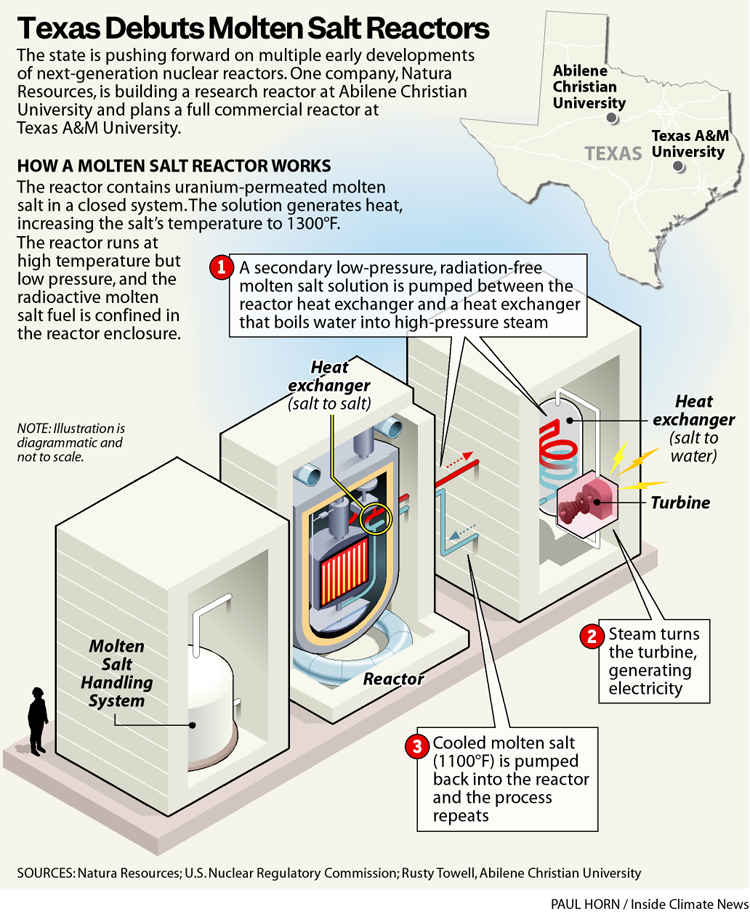


In contrast, new "advanced" reactor designs use alternatives to water for cooling, like liquid metal or special gases.

Natura's design, like many others, uses molten salt. It's not table salt but fluoride salt, a corrosive, crystalline substance that melts around 750 degrees Fahrenheit and remains liquid until 2,600 degrees under regular pressure.

As a result, the reactor can operate at extremely high temperatures without high pressure. If the system ruptures, it won't jettison a plume of steam, but instead leak a molten sludge that hardens in place.


"It doesn't poof into the air and drift around the world," Towell said. "It drips down to a catchpan and freezes to a solid."

Rather than solid fuel rods, Natura's design also uses a liquid uranium fuel that is dissolved into the molten coolant. According to Towell, a former research fellow at Los Alamos National Laboratory, that decreases the amount of radioactive waste produced by the reactor and makes it easier to recycle.

The Kairos reactor design uses molten salt coolant with hundreds of thousands of uranium fuel "pebbles," while the X-energy design uses fuel pebbles with a gas coolant.

Critically, many new reactor designs are also small and modular. Instead of massive, custom construction projects, they are meant to be built in factories with assembly line efficiency and then shipped out on truck trailers and installed on site. That will allow large industrial facilities or data centers to operate their own power sources independent from public electrical grids.

Natura president Doug Robison, a retired oil company executive who worked 13 years as an ExxonMobil landman, said small reactors could run oilfield infrastructure in the Permian Basin, from pumpjacks to compressor stations.

"By powering the oil and gas industry, which uses a tremendous amount of power for their operations, we're helping alleviate the grid pressure," he said.

He also wants to power new treatment plants for the enormous quantities of wastewater produced each day in the Permian Basin. In January, Natura announced a partnership with the state-funded Texas Produced Water Consortium at Texas Tech University aimed at using small reactors to purify oilfield wastewater, most of which is currently pumped underground for disposal.
"It Always Gets Back to the Funding"

The new reactor projects fit into plans by state leaders to establish Texas as a global leader of advanced nuclear reactor technology. In 2023, Gov. Greg Abbott directed the state's Public Utility Commission to study the question and produce a report.

"Texas is well-positioned to lead the country in the development of ANRs," said the 78-page report, issued late last year. "Texas can lead by cutting red tape and establishing incentives to accelerate advanced nuclear deployment, overcome regulator hurdles and attract investment."

The report made several recommendations, and state lawmakers this year have already filed bills to enact several of them, including the creation of a Texas Advanced Nuclear Authority and a nuclear permitting officer. Most significantly, the report also recommended two new public funds to support nuclear energy deployment, including one modeled after the Texas Energy Fund, which was created in 2023 and made $5 billion in financing available for new gas power plants.

"When I talk to folks, it always gets back to the funding," said Thomas Gleeson, chairman of the Public Utility Commission, during the PowerHouse forum. "All of those issues are somewhat ancillary to: How are we going to fund this?"

Gleeson said developers will expect the state to put up at least $100 million per project through public-private partnerships in order to help reduce financial risk.

"Given the load growth in this state that we're projecting, if you want clean air and you want a reliable grid, you have to be in favor of nuclear," he said.

Critics of the plan oppose the use of public money on private projects and worry about safety.

"We don't use tax dollars to fund a bunch of experimental and pie-in-the-sky designs that should be the responsibility of private industry," said John Umphress, a retired Austin Energy program specialist who is evaluating the nuclear efforts on contract for the consumer advocacy group Public Citizen. "Nobody has really penciled out the cost because there's still a lot of proof of concept that's going to have to be pursued before these things get built."

Umphress raised concerns over materials in development to withstand the astronomical temperatures and extremely corrosive qualities of molten salt coolants.

He also noted that the U.S. still lacks a permanent repository for nuclear waste following decades of unsuccessful efforts. Most waste today is stored on site in specialized interim facilities at nuclear power plants, which wouldn't be possible if small reactors were deployed to individual industrial projects.

"That's the big issue that we still haven't solved, but it's not stopping some of these developers from pushing forward with their designs," he said. "They're hoping the federal government will take ownership of the waste and be responsible for its storage and disposal."

During the PowerHouse forum, officials expressed hope that the private sector would develop a solution after new reactor projects create demand for waste disposal.
The Energy Proving Ground

Those reactor projects are still many years away. So far, the NRC has only authorized advanced reactor construction for university research. Next it will issue permits for larger commercial reactors before they can be deployed.

Perhaps the largest early deployment of commercial advanced reactors is set to take place at Texas A&M University. In February, the school announced that four companies had committed to install their commercial reactor designs at a new 2,400-acre "Energy Proving Ground" near its College Station campus.

The site is an old Army air base, currently home to vehicle crash test facilities and an advanced warfare development complex.

The university will build infrastructure there and help streamline permitting for the reactor projects, said Joe Elabd, vice chancellor for research at the Texas A&M System. The university is requesting $200 million in state appropriations to help develop the site, he said.

"We're providing a little bit more of a plug-and-play site for these companies, as opposed to them going to a true greenfield and having to do everything for themselves," he said.

Reactors on the site will be connected to Texas' electrical GRID, Elabd said.

A&M began seeking proposals from companies to build at the site last August, and a panel of university experts selected the four finalists, which include Natura and Kairos.

A Kairos spokesperson, Christopher Ortiz, said the company is building a manufacturing facility in Albuquerque, New Mexico, which will produce the reactors deployed to Texas A&M. He said the company is currently working to identify sites for future commercial reactors, evaluating factors like workforce availability, existing infrastructure and community support.

"The Texas A&M site presents a unique opportunity to site multiple commercial power plants in one location, which makes it particularly attractive," he said.

The site will also include Terrestrial Energy, a Canadian company. And it will include Aalo Atomics, a two-year-old investor-funded startup that is currently building a 40,000-square-foot reactor factory in Austin, which it plans to unveil in April.

More than modular reactors, Aalo plans to produce entire modular power plants, called Aalo Pods, including several reactors, a turbine and a generator, which are designed to be installed at data centers.

"It's made in the factory, shipped to the site and assembled like Legos," said Aalo CEO Matt Loszak.

He estimated five to 10 years for deployment at the A&M site but said that depended on continued financial support from investors. Aalo is developing its reactor design at the Department of Energy's Idaho National Laboratory, a 70-year-old national nuclear research center.

But Loszak, a former software engineer from Canada, decided to locate his factory in Texas, he said, to be close to massive incoming energy demands and to take advantage of the state's business-friendly approach to regulation.

"Politicians here are really pro-nuclear, they want to see nuclear get built, and that's not the case in other places across the country," he said. "From a regulatory and permitting perspective, it's a great place to build stuff."

Authored by Dylan Baddour of Inside Climate News via Zerohedge.com
Trump’s Oil Tariffs Could Cost Foreign Producers $10 Billion Annually


By Alex Kimani - Feb 24, 2025


Goldman Sachs: a proposed 10% U.S. oil tariff could cost foreign producers $10 billion per year.

Goldman Sachs: oil tariffs would result in a $22 billion annual price tag for U.S. consumers.

Last week, China announced retaliatory tariffs on American energy imports.


Goldman Sachs has provided estimates that a proposed 10% U.S. oil tariff could cost foreign producers $10 billion per year, with Canadian and Latin American heavy crude producers heavily reliant on U.S. refiners due to limited alternative buyers and processing capabilities. Trump plans to impose a 25% tariff on Mexican crude and a 10% levy on Canadian crude starting in March. However, Goldman Sachs has predicted that the U.S. will remain the primary destination for heavy crude thanks to advanced refining capabilities and low costs. However, Goldman says that U.S. consumers would pay a much higher price, with an annual tariff cost of $22 billion, while the government would generate $20 billion in revenue.

Last week, China announced retaliatory tariffs on American energy imports and also announced an antitrust investigation into Google, just minutes after a sweeping levy on Chinese products imposed by U.S. President Donald Trump took effect. Beijing said it would implement a 15% tariff on coal and liquefied natural gas (LNG) products as well as a 10% tariff on crude oil, agricultural machinery and large-engine cars. Well, the tariffs came into force on 10 February, marking the beginning of another trade war between the world’s biggest economies under Trump. Commodity analysts at Standard Chartered have delved into the potential effects of the tariffs on the U.S. energy sector.

StanChart has pointed out that China first levied a tariff of 10% on U.S. LNG imports in September 2018 and then increased to 25% in June 2019. StanChart notes that whereas some imports continued at the 10% rate, there were none at the higher rate. Beijing then granted tariff waivers for LNG in February 2020 as part of a trade war de-escalation and after 11 months of zero flows, with the first US cargo arriving in April 2020. According to the analysts, in the following 59 months, there have been cargoes in all but three months. Further, the relationship between U.S. producers and Chinese LNG buyers has deepened with some long-term contracts signed. In contrast, no long-term LNG contracts between the two countries were signed prior to 2021.Related: U.S. Imposes New Sanctions On Iran's Shadow Fleet


However, the potential negative effects of the latest tariffs on LNG are likely to be limited. The U.S. currently provides less than 6% of China LNG imports, while China accounts for just 6% of U.S. exports. With Europe’s demand for U.S. LNG likely to remain robust, StanChart has predicted that displaced flows are unlikely to become distressed. StanChart sees the tariffs cutting the flow of spot cargoes to China dramatically, with some flows under longer-term contracts likely to continue, depending on the nature of re-export clauses. The experts have warned that the biggest threat of these tariffs is the economics of future long-term contracts, including contracts amounting to at least 15 million tonnes per annum (mtpa) that have already been signed.

Oil Prices Steady On Potential Ukraine Peace Deal


Oil prices were little moved on Monday as markets awaited clarity on ongoing talks by the U.S. and Russia to end the war in Ukraine, as well as a potential resumption of crude exports from northern Iraq. Brent crude for April delivery was up 0.4% to trade at $74.76 per barrel at 12.15 pm ET while WTI crude for March delivery gained 0.6% to change hands at $70.77 per barrel.

Trump initiated talks with Russia without inviting Ukraine or the European Union to the table. Russian and U.S. teams plan to meet for further discussions this week. Ukrainian president Volodymyr Zelenskiy announced on Sunday that he is willing to step down if it means peace for his country.

A ceasefire to the Russia-Ukraine war could be bearish for oil prices if Trump pushes for removal of sanctions on the Russian energy industry, Tyler Richey, co-editor at Sevens Report Research, told MarketWatch. Geopolitical stability may also "largely extinguish the still simmering 'fear bid' in the oil market." The latest sanctions by the Biden administration roughly tripled the number of directly sanctioned Russian crude oil tankers, enough to affect around 900,000 barrels per day (bpd). Whereas it’s highly likely that Russia will try to circumvent the sanctions by employing even more shadow fleet tankers and ship-to-ship transfers, StanChart sees 500,000 bpd of displacements over the next six months.

However, the oil price selloff kicked off before Trump’s latest mediation efforts in the Ukraine war thanks to rising U.S. crude stockpiles and hawkish remarks from Fed Chair Jerome Powell. Jerome Powell said on Tuesday that the Fed is not rushing to cut interest rates further because the economy is in a good place, but it is prepared to do so if inflation drops or the job market weakens. Higher interest rates increase the cost of borrowing, which can slow economic activity and weaken oil demand. The U.S. consumer price index (CPI) increased at a faster-than-expected clip in January, reinforcing the Federal Reserve's wait-and-see stance before cutting interest rates further amid growing uncertainty over the economy. The CPI jumped 0.5% last month, up from 0.4% in December, and advanced 3.0% in the 12 months through January after advancing 2.9% in December.


By Alex Kimani for Oilprice.com
Is Trump Breaking the Wind Industry?

By Julianne Geiger - Feb 25, 2025


On his first day in office, President Trump paused leasing and permitting for new wind energy projects.

Wind developers are now playing a high-stakes waiting game.

Rising costs, supply chain snags, and high interest rates plagued the wind energy industry already before Trump took office.


The Biden administration wanted to paint America’s skies with spinning blades, but Trump has once again sent the wind industry into a tizzy.

On Trump's first day back in office, he took an axe to federal wind policies, pausing leasing and permitting for new projects and leaving developers in limbo. Offshore and onshore wind giants—Shell, TotalEnergies, and Orsted among them, according to the WSJ—are suddenly staring at billion-dollar write-downs and wondering if their investments just got sucked into a policy tornado.

“We aren’t going to do the wind thing,” Trump declared at a rally earlier this year, dismissing turbines as “big ugly windmills” that “ruin your neighborhood.”

Love him or hate him, the man is consistent.

The Permitting Freeze and Its Fallout

The immediate fallout is a regulatory standstill. The Army Corps of Engineers, the Federal Aviation Administration, and the Bureau of Land Management are all reassessing their roles in permitting. The Lava Ridge Wind Project in Idaho was specifically called out in Trump’s executive order, at the urging of Senator Jim Risch, who praised the decision, saying, “He gets it. It’s not a hard lift because he shares my reticence about windmills.”

Wind developers are now playing a high-stakes waiting game. It’s not just about missing out on tax credits from Biden’s 2022 Inflation Reduction Act (which Trump has labeled a “scam”), but about the industry’s ability to plan for the long term. David Hindman of AlixPartners summed up the uncertainty: “All parties—developers, financers, others—are going to want to have more certainty than we have now.” And certainty is in short supply.

The Trump Doctrine: Fossil Fuels First


Trump isn’t just hitting pause on wind—he’s fast-tracking fossil fuels. His first move? Withdrawing from the Paris Agreement. Again. “I’m immediately withdrawing from the unfair, one-sided Paris climate accord rip-off,” he announced. His second move? Reversing Biden’s restrictions on offshore oil and gas drilling.

Trump’s philosophy is simple: More drilling, more exports, and energy dominance. “America will be a manufacturing nation once again, and we have something that no other manufacturing nation will ever have: the largest amount of oil and gas of any country on Earth.”

Hyperbole aside (according to Rystad, OPEC members held 40% of the world's total recoverable oil reserves at 657 billion barrels, with Saudi Arabia holding the top spot at 247 billion barrels, with the United States holding the next recoverable--not proven--oil reserves powerhouse with 156 billion barrels), his administration has promised to refill the Strategic Petroleum Reserve, drive energy prices down, and boost U.S. exports—while giving wind and solar the cold shoulder. But will the energy industry play ball? Oil producers have already signaled that they appreciate the friendlier regulatory environment but are unlikely to jump back into “drill, baby, drill” mode with both feet unless market conditions demand it.

Trump can clear bureaucratic hurdles, but he can’t force private companies to flood the market with oil.

A Wind Industry Already Facing Headwinds

To be fair, the wind industry was already struggling before Trump slammed on the brakes. Rising costs, supply chain snags, and high interest rates had already put projects on shaky ground. Offshore wind, in particular, has been an expensive experiment in patience. Germany’s biggest utility, RWE, recently pointed out that offshore wind costs 30% more in the U.S. than in Europe. And with interest rates still biting, investors are less eager to pour money into projects with long payback periods.

Biden had ambitious offshore wind goals—up to 12 lease auctions by 2028, with a vision for a zero-emission grid by 2035. But even with tax credits and federal backing, developers were canceling projects left and right due to cost overruns. Now, with Trump freezing federal support, those cancellations might turn into an industry-wide exodus.

Is This the End of U.S. Wind?

Even if Trump guts federal incentives, wind energy still has traction at the state level. Texas and Iowa, both deeply red states, have quietly become wind powerhouses thanks to favorable economics. And while offshore wind may take a hit, onshore wind and solar could keep growing—especially if power companies continue to push for renewables as a hedge against fossil fuel volatility.

For now, though, the industry is stuck in purgatory. No new federal leases, no permitting clarity, and the looming threat of tax credit rollbacks mean developers are going to tread cautiously.

Trump has made his stance clear: Fossil fuels are king, and wind is an eyesore. His permitting freeze has left the U.S. wind industry in a state of paralysis, and unless states pick up the slack, new projects are in danger of grinding to a halt. Meanwhile, oil and gas are back in the driver’s seat—at least for now.

Whether this is a long-term death blow for U.S. wind or just another political speed bump will depend on what happens in the courts, on Wall Street, and—of course—at the ballot box in 2028.

By Julianne Geiger for Oilprice.com


Tshisekedi seeks mineral deal with US and EU as M23 gains ground in eastern DRC

24 February 2025


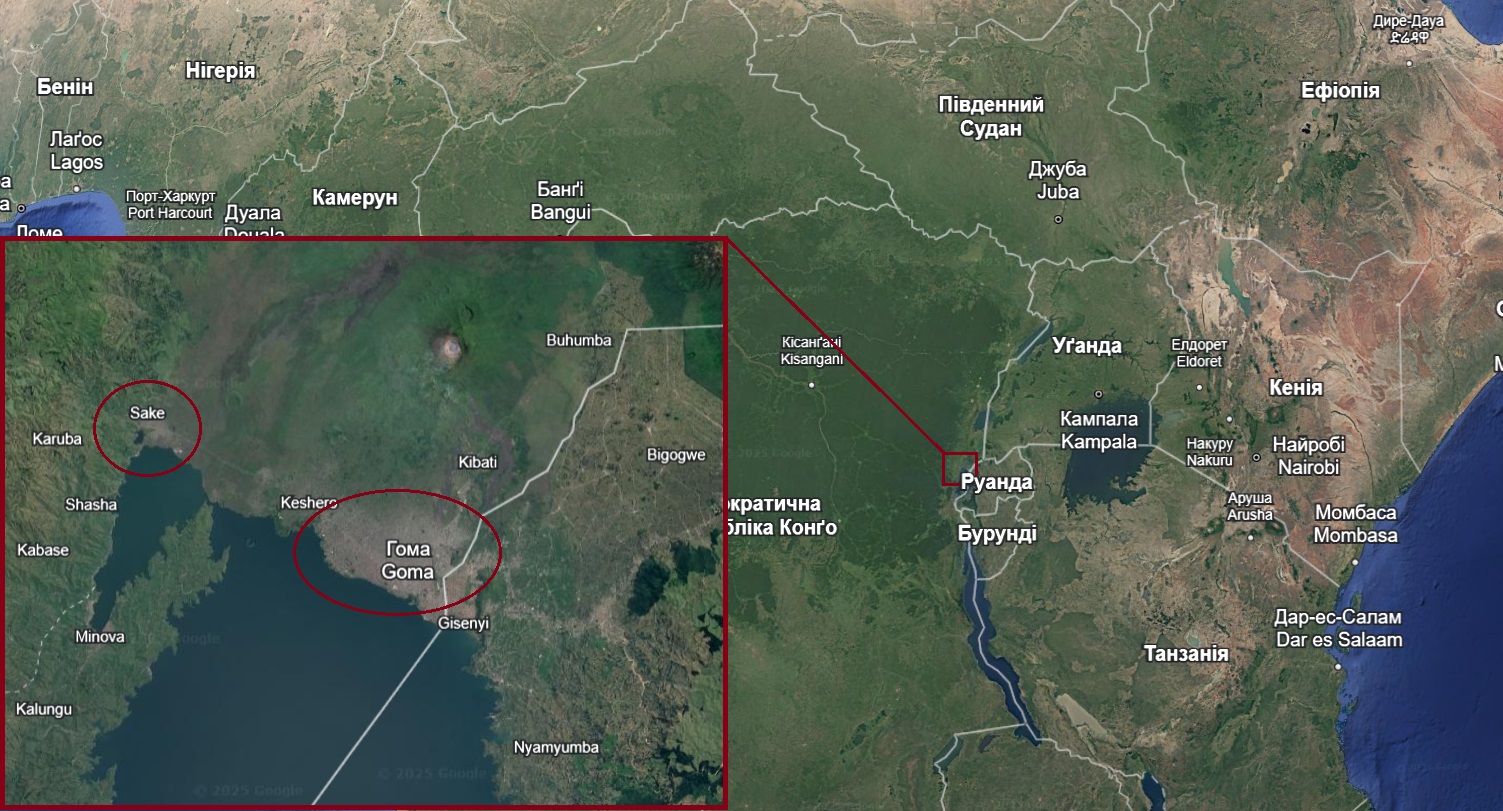
Congolese president Felix Tshisekedi has called on the US and EU to buy minerals directly from the Democratic Republic of Congo (DRC). His appeal comes as M23 advances in eastern DRC, seizing Goma and other key cities.

Tshisekedi’s spokesperson, Tina Salama, said on X the offer was first extended to the U.S., arguing that the Trump administration had exposed Rwanda’s role in exploiting DRC’s wealth. She then added that the proposal was also open to European nations, warning that “receiving stolen goods will become increasingly complicated.”


The EU and US currently source minerals such as coltan and cobalt from Rwanda. This is facing growing scrutiny as M23 expands its control over Congo’s resource-rich areas. The European Parliament has already called for suspending the EU’s 935 million euro deal with Rwanda over concerns about illicit minerals. On Monday, the EU Foreign Affairs Council will debate the suspension and consider further sanctions.

M23-advance

M23, which resurfaced in 2021, has captured Bukavu and is now advancing toward Uvira, near Burundi’s border. The militant group seized the city of Goma in January. Over 3,000 people were killed and thousands were displaced in the fighting.

Tshisekedi has rejected direct talks with M23 and has insisted on negotiations with Rwanda instead. As peace efforts falter and the DRC military struggles to contain rebel advances, Kinshasa is betting on Western support to regain control over its territory and resources.

The Armed Forces of the Democratic Republic of Congo (FARDC) struggle to keep control over mineral-rich areas in the east of the country, where the Rwandan-backed group M23 is seizing towns 

© Luis TATO / AFP

Democratic Republic Of The Congo Offers Resources In Exchange For Security Support

The President of the Democratic Republic of the Congo has offered the United States and the European Union access to its mineral deposits in exchange for security support to deter Rwanda.


24 February, 2025March 23 Movement fighters in the captured city of Goma, DR Congo, February 2025

The New York Times reported on this.

In order to deter the aggression of the Rwandan-backed March 23 Movement militants, who are increasingly advancing in the east of the country, President Félix Tshisekedi has offered the United States and the European Union access to its mineral resources.

The country has some of the world’s largest mineral reserves, such as gold, tin, and tantalum, which are critical materials for the production of microelectronics and batteries. The country’s coltan deposits account for most of the world’s tantalum production. It also contains more than half of the world’s reserves of cobalt, which is used in electric vehicles.

Tshisekedi is pinning his hopes on Western pressure on Rwanda, hoping that large investments in Congo, including a possible minerals deal, will bring his country much more security and stability. He said the Trump administration had already shown interest in the deal.

China now has far more access to Congo’s mineral wealth than the United States, while the European Union has negotiated with Rwanda, agreeing to provide it with about $935 million in exchange for access to minerals such as tin, tungsten and gold.
Hybrid war with Rwanda

Earlier this year, the paramilitary group of the March 23 Movement, also known as M23, began fighting in eastern Democratic Republic of the Congo, rapidly seizing key cities and territories.

After taking control of the small town of Sake, the Rwandan-backed militants launched an operation on April 27 to surround Goma, the largest city in the eastern part of the DRC, and Bukavu, the administrative center of South Kivu province.


Having driven government forces out of the besieged border town on January 30, the militants took control of key positions and the Mpumalanga airport, which was located in the middle of a building and was home to troops and Congolese warplanes.

One of the successes of the rebels of the March 23 Movement was the capture of Congolese armored vehicles and artillery, in particular, T-55 tanks, BATT UMG armored vehicles, 122 mm D-30 and M-30 howitzers, as well as the Bastion multiple rocket launcher system, which was purchased in Ukraine.

However, the most significant trophy of the militants was a Su-25 attack aircraft based at the captured airport.

A DR Congo Su-25 attack aircraft captured by March 23 Movement militants, January 30, 2025. Photo: RBA Digital

Following these successes, the March 23 Movement continued its advance, attacking the main government positions on the road to Butembo, a town north of Goma.

China cobalt stocks jump as Congo exports ban sparks “chaos”


Bloomberg News | February 25, 2025 |


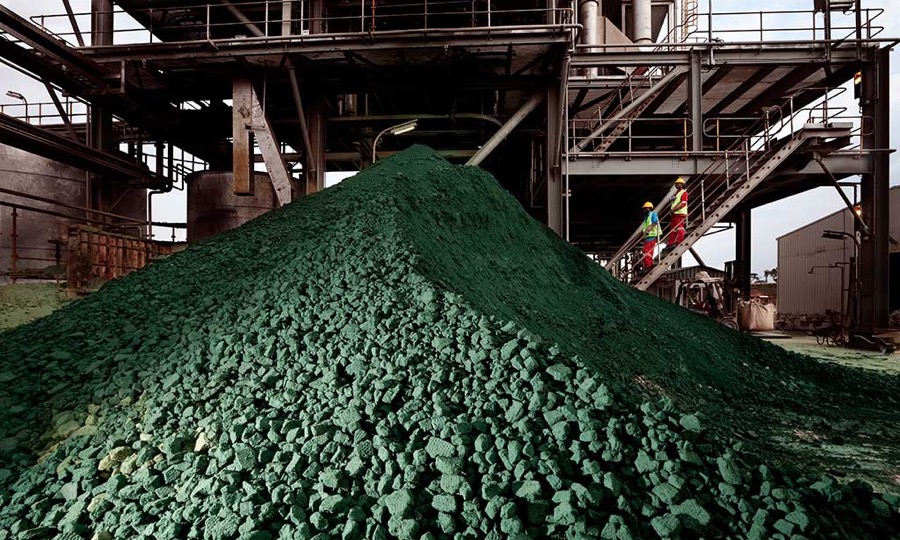
Processing facilities at Tenke Fungurume mine. (Image courtesy of Lundin Mining.)

Cobalt stocks rose in China on Tuesday as a surprise export ban in the Democratic Republic of Congo lifted the near-term outlook for the material used in alloys and batteries.


Shares in Nanjing Hanrui Cobalt Co. jumped as much as 17% in Shenzhen, while Zhejiang Huayou Cobalt Co. rose as much as 7.8%. Meanwhile, CMOC Group Ltd., which has been ramping up its two giant mines in Congo, slipped 2% in Hong Kong.

Congo, the top producer of the raw material, is suspending cobalt exports for four months in an attempt to rein in global oversupply. The government also said it will prepare additional measures to balance the market. The news has sent shockwaves through the industry as Congo’s cobalt production accounts for about three-quarters of world’s total.

“Everybody is panicking and we don’t know how to secure the material,” said Ian Liu, cobalt procurement director at CNGR Advanced Material Co., a Chinese battery-component manufacturer. “We need a long-term mechanism to support cobalt prices, not a sudden halt on exports, which will cause chaos downstream,” he said at a Fastmarkets conference in Shanghai on Tuesday.

The African nation’s production has increased in recent years thanks to the expansion from China’s CMOC, but that has also pushed down prices. Benchmark metal has dropped below $10 a pound, a level not breached for 21 years apart from a brief dip in late 2015, according to Fastmarkets data. Cobalt hydroxide, the main form of the metal produced in Congo, has slid below $6 a pound.

Congo’s policy could cut global cobalt supply by around 20,000 tons a month, but the market has adequate inventory to fill the gap, Xu Aidong, an analyst with Beijing Antaike Information Co. said on the sidelines of the Shanghai conference.

While questions remains over policy uncertainty in the Congo after four months, the ban, for now, could be a blessing for companies in Indonesia, the second-biggest cobalt producing country that’s seeing a growing share in the global market.
US, Ukraine reach minerals deal
IT'S ALL OVER BUT THE CRYING

Staff Writer | February 25, 2025 | 


Ukraine President Volodymyr Zelenskyy. Credit: Volodymyr Zelenskyy’s official X account

The United States and Ukraine have reached terms on a critical minerals deal, media outlets including the Financial Times reported on Tuesday, in a move Trump administration regards as crucial to brokering a ceasefire with Russia.


Earlier this week, Ukraine’s Deputy Prime Minister Olha Stefanishyna said that the minerals deal is close, and a new draft has been almost agreed for both country’s leaders to sign off on. Ukraine’s parliament is expected to recommend on Wednesday that President Volodymyr Zelenskiy sign the deal.

Sources later confirmed to Reuters that Zelenskiy is due in Washington on Friday make the deal official.

Both sides have been locked in negotiations since Ukraine rejected the initial offer presented by the US earlier this month. President Zelenskiy has repeatedly stated that guaranteed US military support must be part of any deal. A breakthrough was made this past weekend when the US reduced its demand of $500 billion worth of critical mineral resources as repayment for military aid.

Various reports have suggested that Ukraine has upwards of $10 trillion in mineral deposits, including those containing rare earth elements that are essential to defense and other high-tech industries. However, these deposits have yet to be internationally recognized as economically viable. Ukrainian data shows that the country has deposits of 22 of the 34 minerals identified by the EU as critical.

While details of the agreement are undisclosed, and it is expected that the parties will jointly develop these minerals on a 50/50 basis.

On the US side, a deal represents a way for President Donald Trump to encourage buy-in from his supporters for continued backing for Ukraine, which relies on US and European allies for weapons and ammunition.

Justin Logan, director of defense and foreign policy studies at the Cato institute, told Bloomberg that the deal was about Trump being able to “domestically market a political win,” and for Zelenskiy about deescalating tensions with the US.

Tuesday, February 25, 2025

MONOPOLY CAPITALI$M


Offshore Services Giant Proposed in $4.7B Deal to Merge Saipem and Subsea 7

offshore energy services
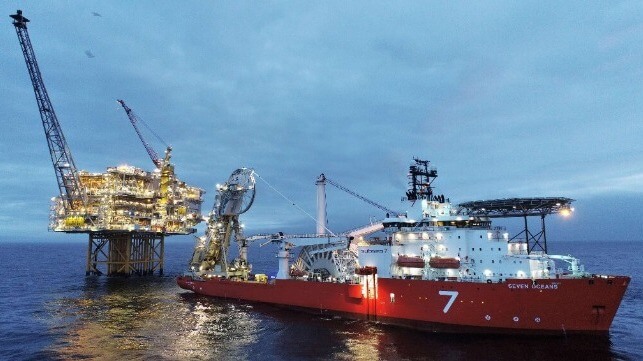
Saipem and Subsea 7 would merge to form and offshore services mega company (Subsea 7)

Published Feb 24, 2025 7:44 PM by The Maritime Executive


Two of the leaders in the offshore sector for energy, Saipem and Subsea 7 entered into an understanding that is designed to lead to a merger of equally to create an offshore services giant. The deal valued at nearly $4.7 billion would combine the companies to create a global presence with a fleet of more than 60 construction vessels and 45,000 employees.

The companies highlighted that they have highly complementary geographical footprints, competencies and capabilities, vessel fleets, and technologies that will benefit the global client base. They believe a combination would also unlock annual synergies of approximately €300 million to be achieved in the third year after completion, with one-off costs to achieve such synergies of approximately €270 million. The combined company would have a current backlog of €43 billion and annual revenues of nearly €20 billion.

Explaining the rationale for the combination, the companies told investors it would create a more comprehensive solution for customers, expand the expertise and experience base, and create a global and diversified operation. It would also lay the foundation for future innovation in the industry. The management of both Saipem and Subsea7 said they share the conviction that there is compelling logic in creating a global leader in energy services, particularly considering the growing size of clients’ projects.

While recognizing the potential, analysts were quick to question the logistics of completing such a combination. They cited a difficult regulatory approval in part reflected by the companies’ projection that it would be mid-2026 before the deal could be completed.

The companies reported they have completed a memorandum of understanding for the combination which calls for a merger of equals. Each company would own 50 percent of the combined entity with the new company being known as Saipem 7. Current plans call for Alessandro Puliti, CEO of Saipem, to be appointed as CEO of the combined company while John Evans, CEO of Subsea 7, would be the CEO of the offshore business which will comprise all Subsea7 and Saipem’s Offshore Engineering & Construction activities.

The companies’ large shareholders are expressing their support for the combination. Siem Industries, the largest shareholder of Subsea7, would own approximately 12 percent of the new company, while Eni and CDP Equity, the largest shareholders of Saipem, would own approximately 10.6 percent and approximately 6.4 percent of the new company.

The companies independently developed as leaders in the offshore services industry tracing their origins to the 1950s and the start of modern offshore operations. Each has been involved in the consolidation and growth of the industry. The modern Subsea 7 emerged in the early 200s and reports it is the product of over 25 different legacy companies and businesses with Kristian Siem continuing to drive the company as its chairman. Saipem was also the product of mergers and served as the service supplier for Eni until 2015 when it reduced its holding setting the stage for the modern company.

The timeline for the deal calls for completing the merger agreement by mid-year. They will require extensive antitrust approvals and shareholder approval from each company.


Video: French Navy Carries Out Rare Shock Trial on New Frigate

Frigate
Courtesy Marine Nationale

Published Feb 25, 2025 5:11 PM by The Maritime Executive


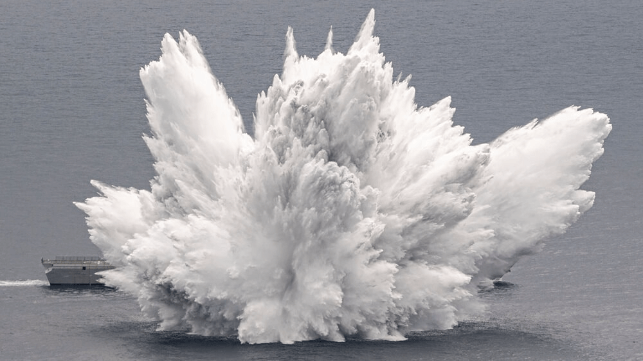
The French Navy has carried out a rare "shock trial" on one of its new frigates to evaluate its resilience to near-miss explosions. It is the first time that the service has performed one of these tests in years.  

Video released Tuesday shows that the service set off a substantial underwater explosion just off the starboard beam of the frigate FLF Courbet. Unlike the U.S. Navy, which conducts shock trials while the ship holds position, the Marine Nationale had Courbet under way at a slow bell when the explosion went off. 

The Marine Nationale said that the purpose of the trial was to prepare the vessel and crew for operations "in a context of increasing threats." The idea of the shock trial dates back to WWII, when the U.S. Navy found that near-miss explosions from naval mines could damage or disable mission-critical systems, taking the target vessel out of action - even if it managed to evade a direct hit.

The U.S. Navy uses a series of up to four "shots" for each trial, typically performed with the first-in-class vessel shortly after delivery. The maximum shock intensity occurs in the third shot, and is equal to two-thirds of the maximum shock design value of the ship. The test process is expensive, typically costing tens of millions for preparation, evaluation and post-shock repairs. 

In the past, full-ship shock trials have revealed design flaws with components that previously passed rigorous testing standards. As an example, early testing of the Flight I Arleigh Burke-class destroyer USS John Paul Jones led to significant shock-hardening revisions, which were tested seven years later aboard the Flight IIA USS Winston Churchill. Though Churchill did worse overall on the test, many systems that had been revised performed much better than the first time - and the second test led to significant upgrades and QA checks on all Flight IIA hulls. 

ALT. FUEL

Ship Managers Make Changes to IMO Net-Zero Framework to Avoid Legal Action

InterManager
InterManager President: Sebastian von Hardenberg, CEO of Bernhard Schulte Shipmanagement (BSM).

Published Feb 25, 2025 7:45 AM by The Maritime Executive


[By: InterManager]

Ship managers have expressed concerns in connection with the International Maritime Organization’s future net-zero framework and have suggested concrete changes which they believe would make the proposals more effective.

Acting on behalf of the global shipmanagement sector, InterManager, the international association for ship managers, has submitted a proposal to the next meeting of the IMO’s Marine Environment Protection Committee (MEPC83) to suggest important changes.

The submission warns that, in its current form, the greenhouse gas (GHG) proposal doesn’t properly account for the involvement of a third-party International Safety Management (ISM) Manager.

Highlighting that roughly 20% of the global fleet is operated by a third-party technical ship manager as the ISM Manager, the submission asserts the need for further refining to make it applicable in practice and to avoid future national implementing acts being open to inevitable and avoidable litigation by ship managers. 

In comparison to the charterer and shipowner, the ship manager has no material influence over the GHG intensity of a ship. Ship managers have no say regarding the type of engine powering the managed ship, nor whether sails, solar, fuel cells or other installations are installed on board. Such choices are decided exclusively by the shipowner. 

“Ship managers are not consulted and, in addition, have no influence as to which fuels are procured and supplied to any of the managed ships, neither contractually nor in practice. The matter is negotiated between the shipowner and the charterer and agreed in the charter party agreement for the ship, together with speed and consumption, the remaining significant parameters impacting on its GHG intensity,” the submission states. 

However, the current proposed draft amendments to MARPOL Annex VI on the IMO net-zero framework suggest making ship managers the sole responsible entity for penalties related to GHG emissions. InterManager says this clearly misidentifies the ship manager as the polluter to be held responsible and penalised which, as well as being factually wrong, could lead to legal challenges. 

Further, by assigning liability for compliance fees to the ship manager, they in turn, are forced to ask shipowners to provide upfront financial security to cover potential risks of insolvency or defaults. This forces significant amounts of equity to be tied up in security, limiting cash flow available for growth or investment in new ships.

InterManager President Sebastian von Hardenberg commented: “We Ship managers are fully committed to playing our part in shipping’s journey to net zero. However, when it comes to the GHG intensity of a ship, ship managers have no say whatsoever in any of the decisions that result in material impact; they are not even consulted. In shore terms, we are the Facility Managers, not the Factory Owners.

“In taking our points into consideration, the IMO can develop a more practical and equitable framework for decarbonisation that is supported by all stakeholders within the shipping industry,” he said.

The products and services herein described in this press release are not endorsed by The Maritime Executive.


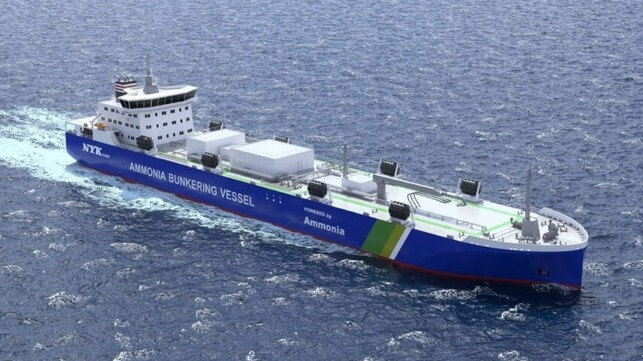
Designs for NYK’s Ammonia Bunker Vessel Advances

ammonia bunker vessel design concept
Design approvals are advancing the project to develop an ammonia-fueled ammonia bunkering vessel (NYK)

Published Feb 25, 2025 7:51 PM by The Maritime Executive


As the industry prepares for the commercial introduction of the first ammonia-fueled marine engines, efforts are continuing to develop the infrastructure that will be needed to support ammonia at scale as a fuel for the maritime industry. Japan’s NYK Group (Nippon Yusen Kabushiki Kaisha) working in partnership with Seatrium and its design company LMG Marine, is reporting a groundbreaking step in advancing the sector.

The group’s design for an ammonia-fueled ammonia bunkering vessel has passed the next key milestone in its development. ClassNK reviewed the design engineering developed by LMG and issued the next Approval-in-Principle for the project. The partners report the design will now be submitted to the Maritime and Port Authority of Singapore for evaluation. Singapore hosted the first ammonia bunkering operations and certification program in early 2024 for the converted offshore support vessel developed by Fortescue. 

The AiP certification validated the ammonia-fueled ammonia bunkering vessel design’s compliance with stringent safety, technical, and environmental standards. LMG Marin provided design capabilities, leading to a Hazard Identification Study (HAZID) for design validation. The comprehensive HAZID conducted was instrumental in ensuring optimal safety, performance, and operational reliability. 

The partners report the vessel design incorporates the consortium's two key features to ensure safety and operational reliability. It uses ammonia fuel dual-fuel engines from IHI Power Systems and a bunkering boom by TB Global Technologies. The bunkering boom features a unique technology called the High Speed Ammonia Purging Emergency Release System (ERS), which enables a reliable and efficient disconnection between vessels in an emergency.

NYK is already at the forefront of ammonia-fueled shipping. In 2024, it completed the conversion of its pioneering LNG-fueled tugboat Sakigake into an ammonia-powered vessel. It completed one of the first ammonia bunkering operation which used truck-based delivery and the vessel is now demonstrating operations in Tokyo Bay.

The effort to develop an ammonia bunker vessel began several years ago. In September 2022, the project received its first AiP certification based on a 3D model.

NYK said the design for the bunker vessel is an essential contribution to developing the infrastructure needed for ammonia bunkering. The designs will be reviewed by the authorities in Singapore, which already is one of the world’s largest bunker ports, and seeks to be a hub for innovation.


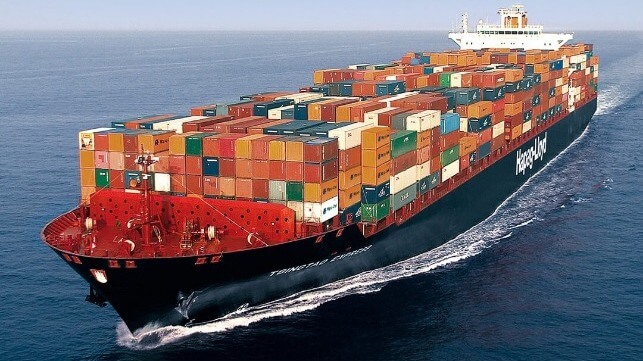
Buyers Alliance Launches Large Tender to Support E-Fuel Container Shipping

containership at sea
Hapag-Lloyd launches the first service as the second tender sets ambitious goals for e-fuels (Hapag-Lloyd)

Published Feb 25, 2025 7:19 PM by The Maritime Executive


The buyers' alliance established in 2023 to spur demand for decarbonization in shipping officially opened its second, larger tender for shipping services this time requiring the use of the e-fuel. It comes as the first contract which was awarded to Hapag-Lloyd for low-emission shipper services is set to kick off in 2025 and run into 2026.

The concept behind the initiative known as ZEMBA (Zero Emission Maritime Buyers Alliance) and facilitated by the Aspen Institute builds demand by aggregating the shipping needs of members ranging from Ikea and Nike to Levi Straus and Electrolux. Over forty major manufacturing and consumer brands are currently members of the alliance. The group launched its first tender in 2024 saying the goal was to accelerate commercial deployment of clean energy powered shipping. By aggregating demand, they are enabling economies of scale and building lead-edge demand to encourage the shipping and fuel industries to pursue their initiatives.

Under the first tender, well-known brands including Amazon, Patagonia, Bauhaus, New Balance, Nike, REI, and others agreed to purchase over one billion TEU miles on the route between Singapore and Rotterdam in 2025 and 2026. Hapag as the winner of the tender agreed to provide an independently certified and exclusive waste-based biomethane service.

The second tender launched today and accepting proposals through the spring of 2025 shifts to a focus on e-fuels. ZEMBA reported in October 2024 that a survey of the industry found sufficient predicted supply of both e-methanol and e-methanol-capable vessels in the container segment to support ZEMBA’s focus on e-fuel deployment. They noted however that many producers remained at the pre-FID stage, casting doubt on whether those projects would begin production on projected timelines and, related, if e-fuel-capable dual fuel vessels would actually run on e-fuels without spurring demand.

With the second tender, ZEMBA intends to aggregate approximately 86 billion tonne nautical miles of demand for the emissions abatement associated with e-fuel-powered shipping to be deployed starting in 2027. This equates to 1.5 million TEU transported across the Pacific by e-fuels, assuming a benchmark distance of Shanghai to Los Angeles and projects enabling companies to abate approximately 500,000 metric tonnes of greenhouse gas (GHG) emissions, subject to final commercial details.

“Getting e-fuel-powered shipping on the water for the first time through this collaborative forward procurement will be a huge technical and commercial innovation milestone for the sector,” said Ingrid Irigoyen, President and CEO of ZEMBA.  

A qualifying bid for ZEMBA’s tender will be a proposal from a containership carrier or consortium for e-fuel-powered shipping for three to five years, starting around 2027. All bids must demonstrate at least a 90 percent lifecycle emission reduction for the primary propulsion of the vessels compared to a high-emission fuel baseline. 

ZEMBA will select the best proposal(s), and after vetting and commercial negotiation, members will enter bilateral contracts with the winner(s). For this tender, ZEMBA is open to the potential of multiple winners. Results of the second tender are expected to be announced by the end of 2025.  


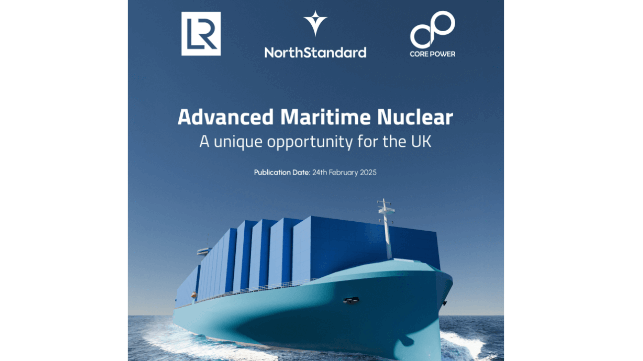
NorthStandard, CORE POWER and Lloyd’s Register Call for UK Action

NorthStandard

Published Feb 25, 2025 7:55 AM by The Maritime Executive


[By: NorthStandard]

New paper proposes framework to support UK development of advanced, safe, small nuclear reactors as a reliable and scalable zero-emission maritime power source.

The UK is well positioned to lead the safe development and deployment of new nuclear power systems for commercial ships and Floating Nuclear Power Plants (FNPPs), according to a new report from CORE POWER, NorthStandard and Lloyd’s Register (LR).

Technology company CORE POWER, global marine insurer NorthStandard and maritime professional services provider LR have jointly published Advanced Maritime Nuclear: A unique opportunity for the UK. The new paper sets out a policy framework for the UK Government to support the deployment of advanced small nuclear reactors on commercial ships and FNPPs.

The Department for Transport should include nuclear-powered shipping and FNPPs in an updated Clean Maritime Plan (CMP) and long-term nuclear strategy, the report argues.

Global shipping currently depends on fossil fuels for close to 99% of its energy consumption, but the International Maritime Organization (IMO) is aiming for its greenhouse gas (GHG) emissions to reach net zero by around 2050. However, alternative fuels options (including biodiesel, methanol, hydrogen and ammonia) face major cost, production, transportation and use challenges.

In the foreword to the paper, Lord Mountevans comments: “The UK has the skills, expertise, and history of innovation to lead the development of nuclear-powered shipping. By leveraging our decades of experience with small reactors for the Royal Navy, we can decarbonise maritime transport, create jobs, and strengthen Britain’s position as a clean energy world power.”
 
The UK pledged to triple nuclear energy generation capacity at COP 28. The Civil Nuclear Roadmap to 2050, published by the last government, envisaged nuclear technologies, from Advanced Small Modular Reactors (A-SMRs) to large-scale nuclear plants as part of the UK’s energy mix. These new, safe and advanced nuclear technologies in modular designs, which allow for straightforward manufacturing and regulatory approval processes that enable dramatic energy efficiency gains for global shipping. NorthStandard’s participation in the new paper reflects the role commercial insurability will play in future nuclear operations in the civil maritime space, particularly to cover shipowners’ liability.

Paul Jennings, Managing Director, NorthStandard, commented: “The ability to commercially insure nuclear propelled ships will be vital to the success of bringing nuclear to maritime.  It is important that governments understand the need for a civil marine nuclear liability convention within the framework of IMO and work towards creating an appropriate liability regime.”

With the right investments and policies, the UK can develop a multi-billion-pound industry according to the report. In addition to zero pollution, nuclear powered ships would not rely on shore power in port and could even feed electricity into the grid.

FNPPs could also be used to alleviate the issues surrounding shore power and expensive connections to the UK national grid.

CORE POWER’s founder and CEO, Mikal Bøe, said: "History has shown that there has never been a great naval power that wasn't also a great maritime power. Maritime nuclear is the catalyst that can reverse the trajectory of the British shipping sector, creating unique competition to Chinese shipbuilding and ocean transport. The UK has been at the centre of global shipping for centuries, and this report reinforces that maritime nuclear power is not only necessary to improve the energy effectiveness of shipping dramatically but also a £2.5 trillion economic opportunity. Over time, the cost of inaction will far outweigh the cost of being the champion in this rapidly emerging market.”

Commenting on the launch of the research paper, Andy McKeran, LR’s Chief Commercial Officer, said: "As nuclear technology advances toward maritime applications including Floating Nuclear Power Plants, global regulatory alignment is crucial. Existing frameworks must be updated to reflect modern reactor designs and operational needs. The UK has the expertise to lead these efforts at the International Maritime Organization (IMO) and with the International Atomic Energy Agency (IAEA), setting the foundation for safe, insurable, and scalable nuclear-powered shipping."

Together, CORE POWER, NorthStandard and LR aim to expand on the potential role for safe and sustainable nuclear technology within the maritime industry at the next London International Shipping Week (LISW) in September 2025.

Advanced Maritime Nuclear: A unique opportunity for the UK can be downloaded here.

The products and services herein described in this press release are not endorsed by The Maritime Executive.


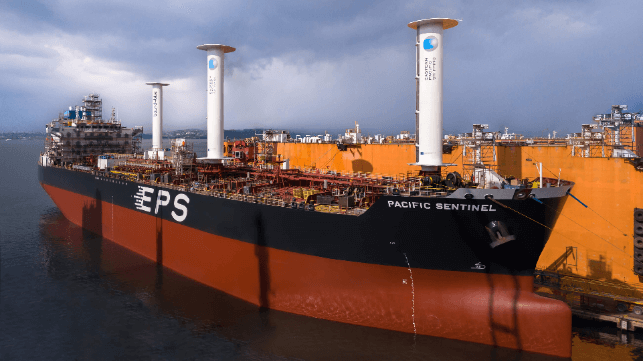
Bound4Blue Installs Three Sails on an EPS Product Tanker

Bound4Blue
Courtesy Bound4Blue

Published Feb 24, 2025 11:26 PM by The Maritime Executive


[By bound4blue]

bound4blue has completed the installation of its breakthrough eSAIL® suction sails on tanker vessel Pacific Sentinel with a streamlined single-stop process for Eastern Pacific Shipping (EPS) at Besiktas Shipyard in Turkey during a planned drydocking.  

Three 22-metre, DNV Type Approved eSAILs® were installed on the 50,000dwt Pacific Sentinel in under a day per unit, as planned. The installation took place during a scheduled vessel drydock, with preparatory work completed in advance. The fully autonomous wind-assisted propulsion system (WAPS) will help the vessel reduce overall energy consumption with forecasted energy consumption savings of around 10% depending on vessel routing, slashing OPEX and emissions to air, while also enhancing regulatory compliance. 

Fast-track, single-stop benefits 

The installation heralds a landmark in numerous regards, signifying EPS’ first step into wind-assisted propulsion – as a continuation of its ambitious decarbonisation programme - while also marking bound4blue’s first tanker installation. The Spanish-based wind pioneer has undertaken a fast-track “single-stop” process, ensuring minimal vessel downtime with all work undertaken during planned vessel maintenance at the shipyard.  

The fast-track, single-stop installation combined vessel groundwork, such as fitting pedestals for the eSAILs® and welding, with the simultaneous preparation and programming of the sails. This efficient approach helped minimize installation time. 

David Ferrer, Co-founder and CTO, bound4blue explains: 

“We’re committed to helping shipping companies, such as EPS, embrace clean, proven, wind power in the simplest, most cost efficient and effective manner. Thanks to our collaboration with shipowners, operators, shipyards, and other key partners in all installations carried out by bound4blue, we have achieved a quick, robust, and high-quality deployment procedure. In this case the vessel and sails were fully prepared in advance, ensuring they could be lifted and bolted into place without extending the planned time at the yard.” 

Easy advantages 

Ferrer adds that the nature of the eSAIL® unlocks further advantages for cost, weight savings and efficiency on what could otherwise have been a demanding task: 

“The fact that this is an MR Tanker creates unique challenges in terms of ATEX zones and air draft limitations, but the eSAILs® simplicity is the ideal solution.  

“It allows for non-EX-proof units, which streamlines the process, and reduces CAPEX, while their high performance achieves substantial savings without requiring excessively large sails, eliminating the need for tilting mechanisms and allowing for compatibility with the vessel's existing air draft. It is, we believe, an ‘easy’ way for such vessels, and many other demanding shipping segments, to access the compelling commercial, regulatory and environmental advantages of wind power.” 

Ensuring regulatory compliance  

The installation was also completed in collaboration with the American Bureau of Shipping (ABS), ensuring compliance with the highest classification and safety standards. Achieving a ‘wind-assisted’ notation played a key role in verifying the structural integration of the eSAILs® with the vessel while aligning with regulatory frameworks such as the EU ETS, CII, and FuelEU Maritime. 

Sustainable partnerships 

bound4blue has installed its solution on five vessels, with many more in its growing order book. EPS, which signed the agreement for the Pacific Sentinel in February 2024 and has now successfully completed this installation, further extended its collaboration with bound4blue in December 2024 through a new agreement for the installation of three eSAILs® on an MR tanker under construction at New Times Shipbuilding in Jiangsu Province, China. This installation is scheduled for late 2025. 

Speaking of the collaboration with bound4blue, Mirtcho Spassov, Decarbonisation Manager at?EPS, comments: “We are committed to reducing emissions across our fleet by embracing cutting-edge green technologies, including wind-assisted propulsion. We need the right partners to achieve meaningful impact, and we’ve found bound4blue, with their proven technology and solutions-driven approach, to be an excellent match. This successful installation is testament to our partnership, and we look forward to harnessing the benefits of wind propulsion in support of our drive to decarbonise. We look forward to completing our second installation later this year.” 

Delivering progress 

The eSAIL® units work by dragging air across an aerodynamic surface to generate exceptional propulsive efficiency. The technology is suitable for both newbuilds and retrofitting across the huge majority of vessel segments, including, but not limited to, Tankers, Bulkers, Ro-Ros, Cruises, Ferries, Gas Carriers, and General Cargo vessels.  

eSAILs® help shipping companies simplify compliance, and achieve advantage, with regulations including EU ETS, CII and FuelEU Maritime, while offering a typical payback of less than five years. 

The products and services herein described in this press release are not endorsed by The Maritime Executive.