The End of Free Speech?
If the White House can punish anybody who engages in speech it dislikes, nobody will be free to criticize the government—and corporate criminals will be free to run amok.
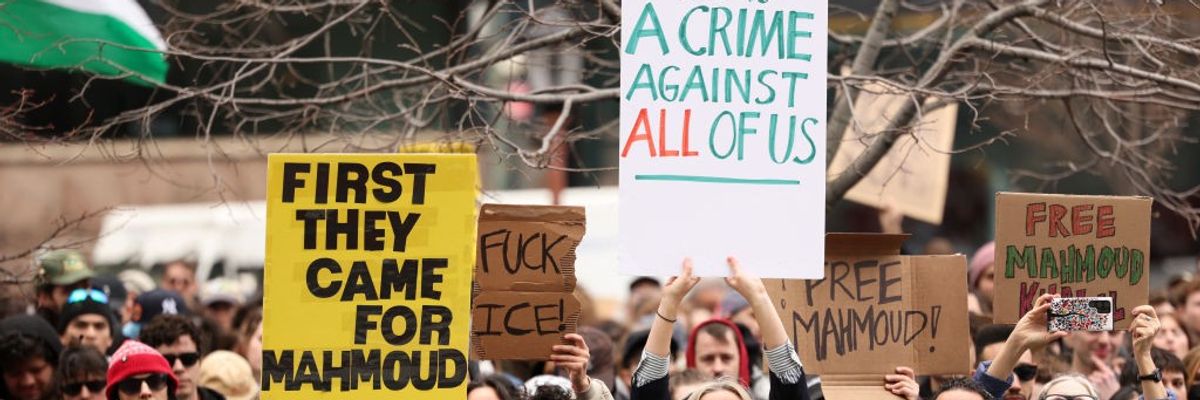
Pro-Palestinian protesters rally in support of Mahmoud Khalil outside of the Thurgood Marshall Courthouse, where a hearing is underway regarding Khalil's arrest, in New York City on March 12, 2025.
(Photo: Charly Triballeau/AFP via Getty Images)
Toni Aguilar Rosenthal
Mar 22, 2025
If the White House can punish anybody who engages in speech it dislikes, nobody will be free to criticize the government—and corporate criminals will be free to run amok.
Pro-Palestinian protesters rally in support of Mahmoud Khalil outside of the Thurgood Marshall Courthouse, where a hearing is underway regarding Khalil's arrest, in New York City on March 12, 2025.
(Photo: Charly Triballeau/AFP via Getty Images)
Toni Aguilar Rosenthal
Mar 22, 2025
Common Dreams
Earlier this March, agents from the Department of Homeland Security, or DHS, arrested Mahmoud Khalil at his Columbia University-owned apartment building in New York City. Khalil, a lawful permanent resident of the United States, was then promptly disappeared by federal agents, who refused to tell Khalil’s wife (a U.S. citizen) why he was being detained or where he was being held. He has since been found by his attorneys and partner in a private Louisiana detention facility notorious for abuse. His deportation was successfully, though only temporarily, halted by a federal judge.
An initial hearing in Khalil’s case was subsequently heard—without him present—in New York City. There, the Department of Justice defended the kidnapping, and backed the White House’s claimed rationale: the Trump administration doesn’t approve of Khalil’s speech, and therefore it has the right to forgo due process, revoke his green card without judicial order, and deport him.
Khalil is a prominent pro-Palestinian leader at Columbia University. He was one of students’ lead negotiators during the anti-genocide encampments that formed on its campus in 2024. It is this right to speech, enshrined in the U.S. Constitution, and affirmed over and over and over again, that President Donald Trump and Secretary of State Marco Rubio are endeavoring to unilaterally, and with no constraints, gut.
Trump and his allies seemingly hope to manufacture a future in which any public critic of the administration or its friends can be defined, and prosecuted, as a “terrorist” for whom basic civil liberties can be summarily suspended.
To this end, the federal government has made no case that Khalil has committed a crime. Instead, the Trump administration has continuously boasted that Khalil is being targeted with the full force of the state for engaging in speech it doesn’t like; speech that is unambiguously guaranteed by the First Amendment, and that the White House now seeks to classify as “terrorism.”
Should Trump and Rubio succeed, as The Intercept aptly summarized, it will symbolize the death of free speech for American citizens and green-card holders alike.
Of course, it isn’t just Khalil—though if the government succeeds in his case it will be a chilling bellwether for the state of speech and protest in the Trump years and beyond. Even just in the weeks since kidnapping Khalil, it’s been reported that DHS officers have arrested another student protester at Columbia, stripped a different Columbia student of their visa status, denied a French scientist entry to the United States reportedly because of their expressed political disagreement with the administration, disappeared dozens of New Mexico residents, and more.
Of course, this playbook isn’t new, and Republicans have long sought to gut protected speech, and protected protest in particular. Indeed, dozens of Stop Cop City protesters and organizers are still navigating an abusive investigation and prosecution regime in Georgia that functionally seeks to render public displays of political dissent as violent conspiracy and “domestic terrorism,” including speech activities as mundane as handing out pamphlets.
As baseless and unconstitutional as those prosecutions were and still are, it’s this principle that is being pushed to new and even-more horrifying depths, as Trump and his allies seemingly hope to manufacture a future in which any public critic of the administration or its friends can be defined, and prosecuted, as a “terrorist” for whom basic civil liberties can be summarily suspended.
Indeed, Donald Trump, while turning the White House into a car dealership earlier this month, told reporters that people protesting Elon Musk’s hostile takeover of the U.S. federal government at Tesla storefronts, or protesting “any company,” should be labeled domestic terrorists, and that was something he “will do.”
Should the political persecution of Khalil succeed, it will foster a new era of the militarized American police state that greenlights the arbitrary and capricious abduction of organizers, dissidents, and critics of the Trump administration and the corporations it serves.
It should not need to be said, but to say it anyway: If foundational constitutional rights can be unilaterally suspended by the government, with no trial or even formal documentation of so-called wrongdoing, then those rights do not actually exist for anyone.
Who stands to benefit from such a bleak future? Advocates for authoritarianism for one, and corporations for another.
While the executive branch targets protesters’ rights to speech on White House orders, Trump’s own corporate allies and donors are pursuing adjacent tactics to divest normal people of the right to criticize the corporate hegemons ruining our lives.
Greenpeace, for example, just lost the trial brought against it by Energy Transfer, which seeks to functionally sue the group out of existence in the U.S. for criticizing the Dakota Access Pipeline (DAPL). That notorious project, controlled by Energy Transfer, is well-known for its environmental racism and for deploying extreme force against environmental advocates, Indigenous communities, and others who opposed it.
Greenpeace is set to appeal the verdict, but if Energy Transfer should ultimately succeed, it would not just spell the end of Greenpeace’s U.S. operations, but will also usher in a new era in which corporate money can not just silence, but wholly eradicate, organizations that are critical of corporate polluters, labor abusers, price-gougers, and more. Such a future would place a price tag on First Amendment protections, with only the most well-resourced entities in the country seemingly eligible to enjoy it, and everyone else left vulnerable to their whims and machinations.
The political kidnapping of Mahmoud Khalil is an egregious attempt to undo 233 years of American constitutional law, and—regardless of what Trump or others claim—threatens to end the right to free speech, and democracy, as we know it. Should the political persecution of Khalil succeed, it will foster a new era of the militarized American police state that greenlights the arbitrary and capricious abduction of organizers, dissidents, and critics of the Trump administration and the corporations it serves. That, to be clear, would wholly cement the United States’ descent into full-fledged fascism.
Crucially, though, even if they fail to make Khalil the defining, and chilling, example of a new epoch of American political prisoners, Donald Trump and his allies in and outside of government have made it clear: They want to eliminate the First Amendment, and will do whatever it takes to do so.
Our work is licensed under Creative Commons (CC BY-NC-ND 3.0). Feel free to republish and share widely.
Toni Aguilar Rosenthal
Toni Aguilar Rosenthal is a researcher at the Revolving Door Project
Full Bio >
Earlier this March, agents from the Department of Homeland Security, or DHS, arrested Mahmoud Khalil at his Columbia University-owned apartment building in New York City. Khalil, a lawful permanent resident of the United States, was then promptly disappeared by federal agents, who refused to tell Khalil’s wife (a U.S. citizen) why he was being detained or where he was being held. He has since been found by his attorneys and partner in a private Louisiana detention facility notorious for abuse. His deportation was successfully, though only temporarily, halted by a federal judge.
An initial hearing in Khalil’s case was subsequently heard—without him present—in New York City. There, the Department of Justice defended the kidnapping, and backed the White House’s claimed rationale: the Trump administration doesn’t approve of Khalil’s speech, and therefore it has the right to forgo due process, revoke his green card without judicial order, and deport him.
Khalil is a prominent pro-Palestinian leader at Columbia University. He was one of students’ lead negotiators during the anti-genocide encampments that formed on its campus in 2024. It is this right to speech, enshrined in the U.S. Constitution, and affirmed over and over and over again, that President Donald Trump and Secretary of State Marco Rubio are endeavoring to unilaterally, and with no constraints, gut.
Trump and his allies seemingly hope to manufacture a future in which any public critic of the administration or its friends can be defined, and prosecuted, as a “terrorist” for whom basic civil liberties can be summarily suspended.
To this end, the federal government has made no case that Khalil has committed a crime. Instead, the Trump administration has continuously boasted that Khalil is being targeted with the full force of the state for engaging in speech it doesn’t like; speech that is unambiguously guaranteed by the First Amendment, and that the White House now seeks to classify as “terrorism.”
Should Trump and Rubio succeed, as The Intercept aptly summarized, it will symbolize the death of free speech for American citizens and green-card holders alike.
Of course, it isn’t just Khalil—though if the government succeeds in his case it will be a chilling bellwether for the state of speech and protest in the Trump years and beyond. Even just in the weeks since kidnapping Khalil, it’s been reported that DHS officers have arrested another student protester at Columbia, stripped a different Columbia student of their visa status, denied a French scientist entry to the United States reportedly because of their expressed political disagreement with the administration, disappeared dozens of New Mexico residents, and more.
Of course, this playbook isn’t new, and Republicans have long sought to gut protected speech, and protected protest in particular. Indeed, dozens of Stop Cop City protesters and organizers are still navigating an abusive investigation and prosecution regime in Georgia that functionally seeks to render public displays of political dissent as violent conspiracy and “domestic terrorism,” including speech activities as mundane as handing out pamphlets.
As baseless and unconstitutional as those prosecutions were and still are, it’s this principle that is being pushed to new and even-more horrifying depths, as Trump and his allies seemingly hope to manufacture a future in which any public critic of the administration or its friends can be defined, and prosecuted, as a “terrorist” for whom basic civil liberties can be summarily suspended.
Indeed, Donald Trump, while turning the White House into a car dealership earlier this month, told reporters that people protesting Elon Musk’s hostile takeover of the U.S. federal government at Tesla storefronts, or protesting “any company,” should be labeled domestic terrorists, and that was something he “will do.”
Should the political persecution of Khalil succeed, it will foster a new era of the militarized American police state that greenlights the arbitrary and capricious abduction of organizers, dissidents, and critics of the Trump administration and the corporations it serves.
It should not need to be said, but to say it anyway: If foundational constitutional rights can be unilaterally suspended by the government, with no trial or even formal documentation of so-called wrongdoing, then those rights do not actually exist for anyone.
Who stands to benefit from such a bleak future? Advocates for authoritarianism for one, and corporations for another.
While the executive branch targets protesters’ rights to speech on White House orders, Trump’s own corporate allies and donors are pursuing adjacent tactics to divest normal people of the right to criticize the corporate hegemons ruining our lives.
Greenpeace, for example, just lost the trial brought against it by Energy Transfer, which seeks to functionally sue the group out of existence in the U.S. for criticizing the Dakota Access Pipeline (DAPL). That notorious project, controlled by Energy Transfer, is well-known for its environmental racism and for deploying extreme force against environmental advocates, Indigenous communities, and others who opposed it.
Greenpeace is set to appeal the verdict, but if Energy Transfer should ultimately succeed, it would not just spell the end of Greenpeace’s U.S. operations, but will also usher in a new era in which corporate money can not just silence, but wholly eradicate, organizations that are critical of corporate polluters, labor abusers, price-gougers, and more. Such a future would place a price tag on First Amendment protections, with only the most well-resourced entities in the country seemingly eligible to enjoy it, and everyone else left vulnerable to their whims and machinations.
The political kidnapping of Mahmoud Khalil is an egregious attempt to undo 233 years of American constitutional law, and—regardless of what Trump or others claim—threatens to end the right to free speech, and democracy, as we know it. Should the political persecution of Khalil succeed, it will foster a new era of the militarized American police state that greenlights the arbitrary and capricious abduction of organizers, dissidents, and critics of the Trump administration and the corporations it serves. That, to be clear, would wholly cement the United States’ descent into full-fledged fascism.
Crucially, though, even if they fail to make Khalil the defining, and chilling, example of a new epoch of American political prisoners, Donald Trump and his allies in and outside of government have made it clear: They want to eliminate the First Amendment, and will do whatever it takes to do so.
Our work is licensed under Creative Commons (CC BY-NC-ND 3.0). Feel free to republish and share widely.
Toni Aguilar Rosenthal
Toni Aguilar Rosenthal is a researcher at the Revolving Door Project
Full Bio >
"Columbia's capitulation to fascist government intervention is so severe when you really look at the details," wrote an assistant professor at the University of California, Los Angeles.
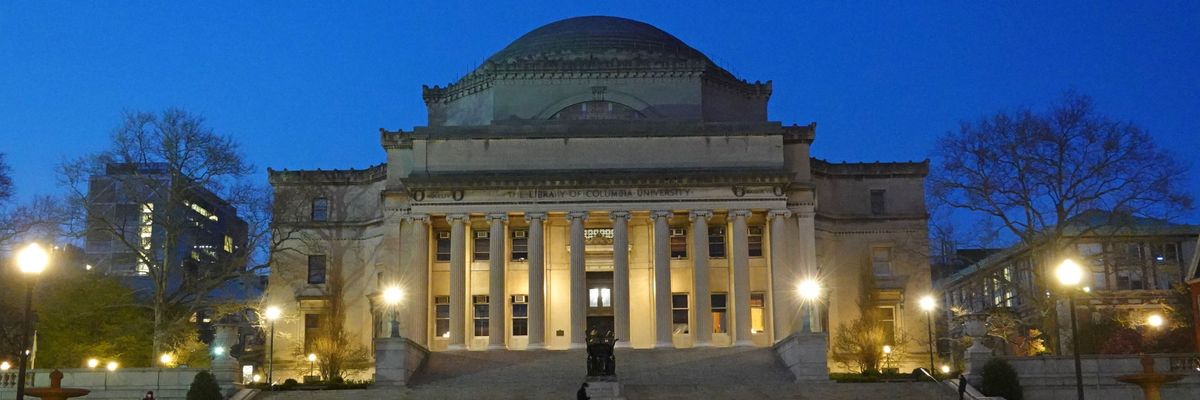
Columbia University's library building is pictured by night on April 15, 2020, in New York City, New York.
(Photo by: Peter Titmuss/Education Images/Universal Images Group via Getty Images)
Eloise Goldsmith
Mar 22, 2025
COMMON DREAMS
Columbia University received a wave of criticism on Friday after it agreed to a number of demands from the Trump administration as part of negotiations over $400 million in federal grants and contracts that the Trump administration had pulled due to the school's alleged "inaction in the face of persistent harassment of Jewish students."
The school agreed to a ban on masks and to appoint a senior vice provost with broad power to oversee both the department of Middle East, South Asian, and African Studied and the school's Center for Palestine Studies, according to the Wall Street Journal, which first reported the news. Also, Columbia has hired over 30 "special officers" who will have the ability to remove individuals from campus and arrest them, per the memo from the school announcing the update.
On Friday evening, writer Ross Barkan wrote on X, "I confess I don't get Columbia folding. Don't they have an endowment worth many billions? Very rich alumni? Alumni who hate Trump? They could do a massive 'resistance' fundraiser to make up for lost federal dollars. Very odd and very weak." Others echoed this sentiment.
"Columbia's capitulation to fascist government intervention is so severe when you really look at the details," wrote Nour Joudah, an assistant professor at the University of California, Los Angeles, on X. "This is pathetic."
Leaders at Columbia's Knight First Amendment Institute expressed sadness. "The administration held up the university at gunpoint, but I can't help but feel that Columbia has lost something it may never regain," wrote the litigation director at the Knight Institute, Alex Abdo, on Friday.
Jameel Jaffer, executive director of the Knight Institute, wrote on Bluesky that it is "a sad day for Columbia and for our democracy."
The episode highlight's the Trump administration's escalating scrutiny of higher education.
In February, U.S. President Donald Trump signed an executive order with the purported aim of rooting out antisemitism on college campuses, and has vowed to go after foreign-born students who have engaged in pro-Palestine protests, which he has deemed "anti-American activity." The Department of Education—which the Trump administration is endeavoring to shut down—has also launched investigations into dozens of universities over alleged "race-exclusionary practices."
But Columbia has so far been at the center of the administration's feud with universities. In a March 7 press release, members of Trump's Joint Task Force to Combat Anti-Semitism announced the cancellation of $400 million, and a day later immigration agents arrested a recent Columbia University graduate who played a major role in pro-Palestine demonstrations last year. The arrest of Mahmoud Khalil, a legal permanent resident, has been widely decried.
On March 13, the Trump administration sent a letter to Columbia University Interim President Katrina Armstrong outlining a series of steps that Columbia must comply with in order to maintain a "continued financial relationship" between the school and the government.
Among the nine demands was a call for disciplinary proceedings for students involved in last year's Gaza Solidarity Encampments and occupation of Hamilton Hall. The same day Columbia received the letter it issued expulsions, multi-year suspensions, and temporary degree revocations for students involved in the Hamilton occupation.
An senior administrator at Columbia told the Journal that the university had considered legal challenges to resist the demands, but decided that the federal government had too many ways to take back money from the university. Columbia has an endowment of about $15 billion, though according to the outlet it would not "take long for it to cease to operate in any recognizable form without government money."
"Additionally the school believed there was considerable overlap between needed campus changes and Trump's demands," according to the Journal.
K-12 Leaders Rejected Weaponization of Antisemitism Claims. Why Won’t Higher Ed?
Columbia has capitulated in what one scholar calls “an ideological battle to shut down any dissent” against Trump.
By Daniel Falcone ,

Columbia has capitulated in what one scholar calls “an ideological battle to shut down any dissent” against Trump.
By Daniel Falcone ,
March 22, 2025
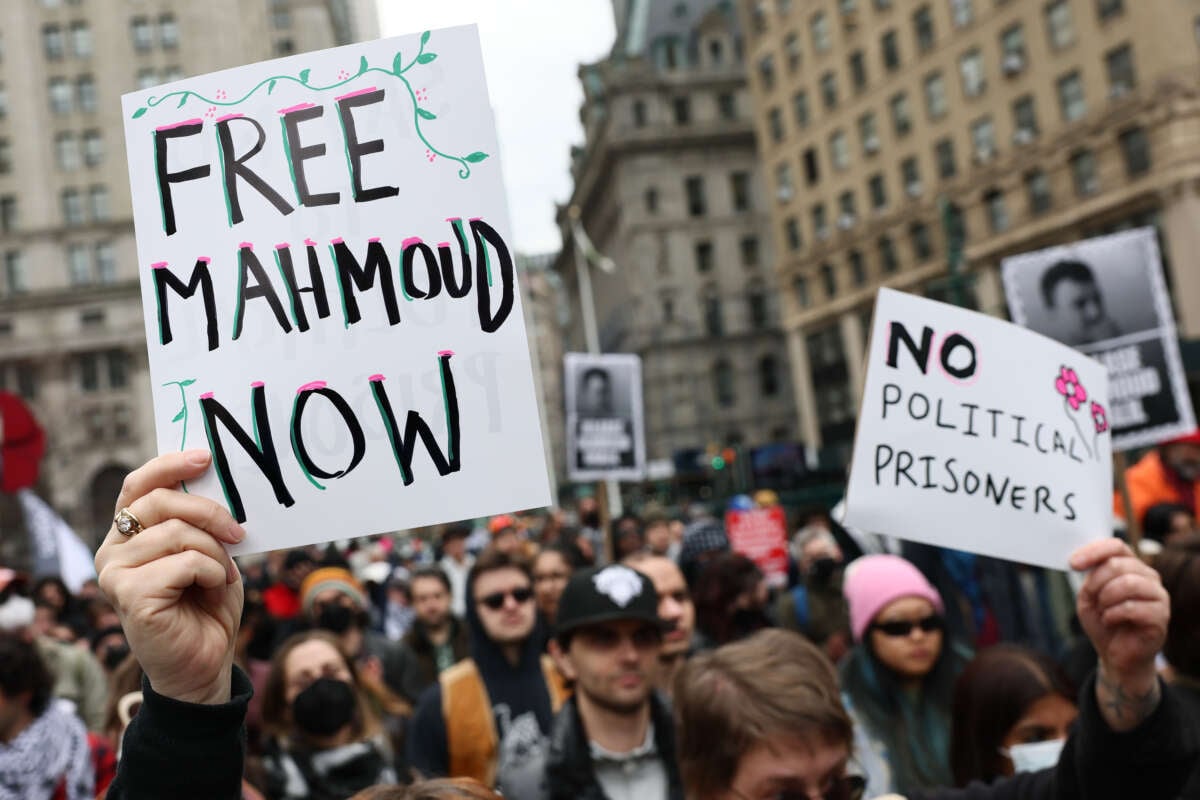
People gather outside of a New York court to protest the arrest and detention of Mahmoud Khalil at Foley Square on March 12, 2025, in New York City.Michael M.
Columbia University has caved into a broad set of demands from Donald Trump in an attempt to restore $400 million in federal funding withheld by his administration. Katrina Armstrong, the university’s interim president, announced on Friday that masks would be banned on campus (barring health or religious reasons), policing would be expanded, and curriculum related to the Middle East would come under review, among other new policies.
Meanwhile, Columbia University activist Mahmoud Khalil’s case has sparked concerns about the criminalization of political protest and the broader implications for higher education and political activism in the U.S. He remains in Immigration and Customs Enforcement (ICE) jail.
In this exclusive interview for Truthout, Nivedita Majumdar discusses how Khalil’s case displays xenophobic sentiment, the right-wing targeting of higher education and the relative silence of the Democratic Party in addressing civil liberties concerns.
Majumdar is a professor of English at John Jay College, City University of New York (CUNY). She is the co-chair of the John Jay chapter of the Professional Staff Congress, the CUNY faculty and staff union. Majumdar’s academic work focuses on postcolonial studies, Marxist theory and cultural studies. She is the author of The World in a Grain of Sand: Postcolonial Literature and Radical Universalism (Verso, 2021) and is actively engaged in academic governance and labor advocacy. The interview that follows has been lightly edited for clarity and length.
Daniel Falcone: ICE’s abduction of Mahmoud Khalil looks to be a strategic move to criminalize political protest and speech. What are the broader implications of this, not only for the immigrant rights movement but also for the future of political activism on college campuses across the U.S.?
Nivedita Majumdar: The ICE arrest and attempt to deport Mahmoud Khalil, a permanent resident, for leading a university protest is almost unprecedented for the attack on First Amendment rights. The current context in some ways is reminiscent of the political climate in the aftermath of 9/11 and the passage of the PATRIOT Act, which provided sweeping powers to law enforcement authorities, broad surveillance powers to the state without probable cause, and allowed noncitizens to be detained for long periods without being charged with a crime.
But even in that period, we don’t recall ICE agents rounding up international students from university dorms. Now, the Trump administration’s attempt to deport Khalil does not evoke the relatively recent PATRIOT Act; instead, it harks back to the Immigration and Nationality Act of 1952 that targeted Communists. As draconian as these acts were, it’s instructive that the state could carry out the violation of fundamental rights under those acts only at a moment of perceived national threat. Khalil’s arrest is a war on basic rights at a time when there is no external threat, nor is there any attempt to even make such a case.
The attack on universities is part of an ideological battle to shut down any dissent against Donald Trump’s agenda. It makes sense for them [the Trump administration] to start by targeting the pro-Palestinian movement with the cynical weaponization of antisemitism, because it activates both decades of cultivated anti-Arab sentiments, and a more generalized anti-immigrant sensibility. But we need to be very clear that they won’t stop with pro-Palestinian protesters; it’s just the lowest-hanging fruit. In fact if we want a sense of the broader agenda here, we can simply look at the administration’s letter to Columbia University demanding compliance on an expansive range of matters as a precondition for reconsidering the cancelation of $400 million in federal funding. It includes centralizing disciplinary processes under Columbia’s Office of the President and empowering the office to suspend and expel students, instituting “time place and manner rules” (i.e. restricting protests), banning masks, empowering campus police with full law enforcement authority (including those of arrest and removal), and placing the Middle East, South Asian, and African Studies Department under academic receivership, (meaning an outside chair would control the department). All of this under the pretext of fighting antisemitism!
If we have fully funded public universities and if all institutions, public and private, are meaningfully integrated into the larger society, it is harder to stigmatize them as elite and out of touch.
A cursory glance at the list gives you a sense of the actual agenda of squelching dissent by centralizing authority, diminishing civil rights, decimating academic freedom and ideological straitjacketing. There are currently 60 other universities which are now subject to similar investigations and consequences as Columbia. To what extent all of that succeeds is of course an open question.
Could you talk about the targeting of higher education by the right wing in general?
The targeting of higher education is often a part of the program of authoritarian regimes; we have recently witnessed similar attacks play out in Turkey, India, Hungary, and other places. The sector is deemed threatening for the institutional power it represents in its relative autonomy, its ability to shape young minds, and for being a central locus of critique and dissension.
About our current moment, I find it instructive that while it is certainly a perilous territory for all higher education, it is the elite institutions that are on the front line of their attack. I think there is a parallel here between making the pro-Palestinian movement the face of all “undesirable” protest and making Columbia the symbol of university culture. In both cases, they have started with easy targets. To appreciate what makes the top universities soft targets, we must consider Trump’s entire “anti-elite” discourse with which he has successfully mobilized the genuine grief and rage of ordinary working people in a broken system. First, the price tag attached to college makes it impossible for many to earn a degree and saddles those who do make it with often a lifetime of debt. This is the case with even public institutions, thanks to decades of systemic underfunding of these colleges and universities, and the increasing reliance on tuition.
With private universities like Columbia, Harvard, Brown and Stanford, they are simply perceived by the vast majority as inaccessible institutions with little impact on community life. Columbia and NYU are the largest private landowners in New York City, and it is impossible for city residents not to witness their massive footprint. But an ordinary New Yorker not directly connected to the schools would be hard pressed for a response if asked how the universities impacted their lives. For the most part, people remain indifferent to these institutions perceived as expensive and expansive oases for the select few.
Between underfunding and privatization, higher education has morphed into an entity that is simply not recognizable as a public good. Trump has cannily exploited this development to weave his anti-elitist narrative where higher education in general is part of the problem, and a school like Columbia, simply undesirable.
The Democratic Party has largely remained silent in the face of Khalil’s arrest, despite the broader implications for civil liberties. What does this say about the state of the party?
Yes, the Democratic pushback on the Khalil case has been pitiful. Several other people have been arrested by ICE after Khalil, similarly, with no regard to their constitutional rights. It is inexplicable how Rashida Tlaib’s statement circulated to a hundred progressive Congress members garnered only 14 signatures. The issue was not even one of condemning Israel, or supporting people with pro-Palestinian views, but simply the defense of the First Amendment right, and they could not step up to even that much. There was thankfully a statement by New York elected officials calling for the immediate release of Khalil, but even that had only 40 signatures. Beyond these petitions and a few social media comments, there has been little action to stem this frightening course of action.
A large part of the Democratic Party was extremely critical of the pro-Palestine protests, and under Joe Biden, often joined Republicans in denouncing student protesters, thus contributing to the current buildup. And now, virtually the entire party seems to have decided that nonconfrontation is the best strategy with Trump. There have been several demonstrations organized by local organizations protesting the treatment of Khalil and Columbia, and that is heartening.
But what is required in resistance to the unconstitutional government actions is a large-scale coordinated resistance that a national party is best positioned to organize. If we want an example of what an opposition can organize, think of the congressional hearings led by Rep. Elise Stefanik that took place under Biden. It is truly shameful to have this docility in the face of such flagrant violations, and the party must know that if Trump is allowed to get away with this violation, it only empowers him further. Trump will not stop with pro-Palestine protesters.
The Democrats lost the 2024 elections because of their inability to forge a platform addressing the pervasive economic anxiety in the country. Add to that, the aiding and abetting of a genocide which alienated the party’s youth base, while sealing the deal for Republicans. Now, in the face of Trump’s authoritarian march, the Democratic Party is in disarray with no ability or willingness to fight back.
Why isn’t higher ed fighting back harder, in your view?
The last time you interviewed me was at the time of the congressional hearings of college presidents of Harvard, Penn and MIT, and later also of the Columbia president. We witnessed then how the university leaders all caved under pressure, sacrificing both their students and principles of academic freedom and freedom of speech. Of course, the humiliation was not sufficient, and all but one of the university presidents had to resign from their positions.
You will recall those hearings were followed by hearings of school principals from three large public school systems, again for the purpose of interrogating their response to the alleged growing antisemitism in their schools. What was remarkable was that the principals struck a very different note compared to the college presidents. They refused to be badgered and held their ground with the message that they knew how to run their institutions; and one of them called out the “cheap political theater” in the name of combating antisemitism. None of the principals lost their positions coming out of the hearings.
What explains the difference between the hearings and the outcome? My sense is it’s because unlike the Ivies, public schools are fully funded and deeply entrenched in their communities. That makes our K-12 institutions much more immune from untoward political pressure.
Of course, while the funding situation of public higher ed institutions goes a long way in explaining the tepid response of leaders of the sector to the current assault, it still begs the question why universities like Columbia and Harvard, with billions in endowments, refuse to stand up and push back. One assumes they are afraid of losing their politically motivated donor base, but that is a pathetic reason to not fight for fundamental institutional values. At this point of existential threat, public and private universities need to join forces and push back; legal challenges are necessary, but they also need to take their case to the wider public.
Moving forward, how can we better organize higher education so it’s viewed as a public good?
I think the question for us is if it’s possible to build a similar model for higher education, that’s both fully funded and has community roots. Currently, the “fully funded” model is nowhere to be seen in the country. CUNY, where I teach, is integrated into the larger city. Its 25 campuses educate an extremely multiracial student body of half a million, and half of them come from families with income under $40,000. And a Stanford study provides a sense of why the institution remains deeply relevant for the city: CUNY alone propels almost six times as many low-income students into the middle class as all eight Ivy League campuses combined.
But there is little reward for this tremendous societal function. Only around 60 percent of the university is state funded and even that is not guaranteed. Every budget season, the university and the union are in Albany making a case for funds to run the institution; it’s the same for our state counterpart, SUNY, and indeed for public universities across the nation. This economic vulnerability, one that school principals thankfully do not share, makes it hard for university leaders to stand up to the kind of political pressure we are witnessing currently. We need a model of full and guaranteed funding for all public higher education institutions, so that is an essential fight.
I also believe both public and private universities — but especially private ones — need to be more structurally integrated into the social spaces they inhabit. Private universities, as nonprofit entities, are tax-exempt, and therefore should be in the business of actively serving their communities. There are many models that can be devised to make this work if there is political will. A portion of the faculty teaching load could be designated for free courses for community members. There can be routine workshops, exhibitions, readings, concerts etc., free and open to the public, led by faculty members. And none of this should be extra or voluntary labor by faculty but baked into the regular workload with the expectation that it will require the institution to expand faculty hiring. At a minimum, all university libraries should function as public libraries.
In the long run, if we have fully funded public universities and if all institutions, public and private, are meaningfully integrated into the larger society, it is harder to stigmatize them as elite and out of touch. And when they are under attack, you can expect societal outrage, instead of the broad indifference we are currently experiencing. There is a reason even someone like Trump must tread lightly when it comes to Social Security, Medicare and Medicaid: Attacking services that are genuinely public is simply not politically expedient. Of course, at this moment we are in an existential battle to save higher education and all our public institutions, so building out toward a more expansive community-oriented mode may not be feasible right now, but the moment should be a time for us to reflect also on our long-term objectives.
This article is licensed under Creative Commons (CC BY-NC-ND 4.0), and you are free to share and republish under the terms of the license.
Daniel Falcone is a writer, activist and teacher in New York City and studies in the Ph.D. program in World History at St. John’s University in Queens, New York. Follow him on Twitter: @DanielFalcone7.
Columbia University has caved into a broad set of demands from Donald Trump in an attempt to restore $400 million in federal funding withheld by his administration. Katrina Armstrong, the university’s interim president, announced on Friday that masks would be banned on campus (barring health or religious reasons), policing would be expanded, and curriculum related to the Middle East would come under review, among other new policies.
Meanwhile, Columbia University activist Mahmoud Khalil’s case has sparked concerns about the criminalization of political protest and the broader implications for higher education and political activism in the U.S. He remains in Immigration and Customs Enforcement (ICE) jail.
In this exclusive interview for Truthout, Nivedita Majumdar discusses how Khalil’s case displays xenophobic sentiment, the right-wing targeting of higher education and the relative silence of the Democratic Party in addressing civil liberties concerns.
Majumdar is a professor of English at John Jay College, City University of New York (CUNY). She is the co-chair of the John Jay chapter of the Professional Staff Congress, the CUNY faculty and staff union. Majumdar’s academic work focuses on postcolonial studies, Marxist theory and cultural studies. She is the author of The World in a Grain of Sand: Postcolonial Literature and Radical Universalism (Verso, 2021) and is actively engaged in academic governance and labor advocacy. The interview that follows has been lightly edited for clarity and length.
Daniel Falcone: ICE’s abduction of Mahmoud Khalil looks to be a strategic move to criminalize political protest and speech. What are the broader implications of this, not only for the immigrant rights movement but also for the future of political activism on college campuses across the U.S.?
Nivedita Majumdar: The ICE arrest and attempt to deport Mahmoud Khalil, a permanent resident, for leading a university protest is almost unprecedented for the attack on First Amendment rights. The current context in some ways is reminiscent of the political climate in the aftermath of 9/11 and the passage of the PATRIOT Act, which provided sweeping powers to law enforcement authorities, broad surveillance powers to the state without probable cause, and allowed noncitizens to be detained for long periods without being charged with a crime.
But even in that period, we don’t recall ICE agents rounding up international students from university dorms. Now, the Trump administration’s attempt to deport Khalil does not evoke the relatively recent PATRIOT Act; instead, it harks back to the Immigration and Nationality Act of 1952 that targeted Communists. As draconian as these acts were, it’s instructive that the state could carry out the violation of fundamental rights under those acts only at a moment of perceived national threat. Khalil’s arrest is a war on basic rights at a time when there is no external threat, nor is there any attempt to even make such a case.
The attack on universities is part of an ideological battle to shut down any dissent against Donald Trump’s agenda. It makes sense for them [the Trump administration] to start by targeting the pro-Palestinian movement with the cynical weaponization of antisemitism, because it activates both decades of cultivated anti-Arab sentiments, and a more generalized anti-immigrant sensibility. But we need to be very clear that they won’t stop with pro-Palestinian protesters; it’s just the lowest-hanging fruit. In fact if we want a sense of the broader agenda here, we can simply look at the administration’s letter to Columbia University demanding compliance on an expansive range of matters as a precondition for reconsidering the cancelation of $400 million in federal funding. It includes centralizing disciplinary processes under Columbia’s Office of the President and empowering the office to suspend and expel students, instituting “time place and manner rules” (i.e. restricting protests), banning masks, empowering campus police with full law enforcement authority (including those of arrest and removal), and placing the Middle East, South Asian, and African Studies Department under academic receivership, (meaning an outside chair would control the department). All of this under the pretext of fighting antisemitism!
If we have fully funded public universities and if all institutions, public and private, are meaningfully integrated into the larger society, it is harder to stigmatize them as elite and out of touch.
A cursory glance at the list gives you a sense of the actual agenda of squelching dissent by centralizing authority, diminishing civil rights, decimating academic freedom and ideological straitjacketing. There are currently 60 other universities which are now subject to similar investigations and consequences as Columbia. To what extent all of that succeeds is of course an open question.
Could you talk about the targeting of higher education by the right wing in general?
The targeting of higher education is often a part of the program of authoritarian regimes; we have recently witnessed similar attacks play out in Turkey, India, Hungary, and other places. The sector is deemed threatening for the institutional power it represents in its relative autonomy, its ability to shape young minds, and for being a central locus of critique and dissension.
About our current moment, I find it instructive that while it is certainly a perilous territory for all higher education, it is the elite institutions that are on the front line of their attack. I think there is a parallel here between making the pro-Palestinian movement the face of all “undesirable” protest and making Columbia the symbol of university culture. In both cases, they have started with easy targets. To appreciate what makes the top universities soft targets, we must consider Trump’s entire “anti-elite” discourse with which he has successfully mobilized the genuine grief and rage of ordinary working people in a broken system. First, the price tag attached to college makes it impossible for many to earn a degree and saddles those who do make it with often a lifetime of debt. This is the case with even public institutions, thanks to decades of systemic underfunding of these colleges and universities, and the increasing reliance on tuition.
With private universities like Columbia, Harvard, Brown and Stanford, they are simply perceived by the vast majority as inaccessible institutions with little impact on community life. Columbia and NYU are the largest private landowners in New York City, and it is impossible for city residents not to witness their massive footprint. But an ordinary New Yorker not directly connected to the schools would be hard pressed for a response if asked how the universities impacted their lives. For the most part, people remain indifferent to these institutions perceived as expensive and expansive oases for the select few.
Between underfunding and privatization, higher education has morphed into an entity that is simply not recognizable as a public good. Trump has cannily exploited this development to weave his anti-elitist narrative where higher education in general is part of the problem, and a school like Columbia, simply undesirable.
The Democratic Party has largely remained silent in the face of Khalil’s arrest, despite the broader implications for civil liberties. What does this say about the state of the party?
Yes, the Democratic pushback on the Khalil case has been pitiful. Several other people have been arrested by ICE after Khalil, similarly, with no regard to their constitutional rights. It is inexplicable how Rashida Tlaib’s statement circulated to a hundred progressive Congress members garnered only 14 signatures. The issue was not even one of condemning Israel, or supporting people with pro-Palestinian views, but simply the defense of the First Amendment right, and they could not step up to even that much. There was thankfully a statement by New York elected officials calling for the immediate release of Khalil, but even that had only 40 signatures. Beyond these petitions and a few social media comments, there has been little action to stem this frightening course of action.
A large part of the Democratic Party was extremely critical of the pro-Palestine protests, and under Joe Biden, often joined Republicans in denouncing student protesters, thus contributing to the current buildup. And now, virtually the entire party seems to have decided that nonconfrontation is the best strategy with Trump. There have been several demonstrations organized by local organizations protesting the treatment of Khalil and Columbia, and that is heartening.
But what is required in resistance to the unconstitutional government actions is a large-scale coordinated resistance that a national party is best positioned to organize. If we want an example of what an opposition can organize, think of the congressional hearings led by Rep. Elise Stefanik that took place under Biden. It is truly shameful to have this docility in the face of such flagrant violations, and the party must know that if Trump is allowed to get away with this violation, it only empowers him further. Trump will not stop with pro-Palestine protesters.
The Democrats lost the 2024 elections because of their inability to forge a platform addressing the pervasive economic anxiety in the country. Add to that, the aiding and abetting of a genocide which alienated the party’s youth base, while sealing the deal for Republicans. Now, in the face of Trump’s authoritarian march, the Democratic Party is in disarray with no ability or willingness to fight back.
Why isn’t higher ed fighting back harder, in your view?
The last time you interviewed me was at the time of the congressional hearings of college presidents of Harvard, Penn and MIT, and later also of the Columbia president. We witnessed then how the university leaders all caved under pressure, sacrificing both their students and principles of academic freedom and freedom of speech. Of course, the humiliation was not sufficient, and all but one of the university presidents had to resign from their positions.
You will recall those hearings were followed by hearings of school principals from three large public school systems, again for the purpose of interrogating their response to the alleged growing antisemitism in their schools. What was remarkable was that the principals struck a very different note compared to the college presidents. They refused to be badgered and held their ground with the message that they knew how to run their institutions; and one of them called out the “cheap political theater” in the name of combating antisemitism. None of the principals lost their positions coming out of the hearings.
What explains the difference between the hearings and the outcome? My sense is it’s because unlike the Ivies, public schools are fully funded and deeply entrenched in their communities. That makes our K-12 institutions much more immune from untoward political pressure.
Of course, while the funding situation of public higher ed institutions goes a long way in explaining the tepid response of leaders of the sector to the current assault, it still begs the question why universities like Columbia and Harvard, with billions in endowments, refuse to stand up and push back. One assumes they are afraid of losing their politically motivated donor base, but that is a pathetic reason to not fight for fundamental institutional values. At this point of existential threat, public and private universities need to join forces and push back; legal challenges are necessary, but they also need to take their case to the wider public.
Moving forward, how can we better organize higher education so it’s viewed as a public good?
I think the question for us is if it’s possible to build a similar model for higher education, that’s both fully funded and has community roots. Currently, the “fully funded” model is nowhere to be seen in the country. CUNY, where I teach, is integrated into the larger city. Its 25 campuses educate an extremely multiracial student body of half a million, and half of them come from families with income under $40,000. And a Stanford study provides a sense of why the institution remains deeply relevant for the city: CUNY alone propels almost six times as many low-income students into the middle class as all eight Ivy League campuses combined.
But there is little reward for this tremendous societal function. Only around 60 percent of the university is state funded and even that is not guaranteed. Every budget season, the university and the union are in Albany making a case for funds to run the institution; it’s the same for our state counterpart, SUNY, and indeed for public universities across the nation. This economic vulnerability, one that school principals thankfully do not share, makes it hard for university leaders to stand up to the kind of political pressure we are witnessing currently. We need a model of full and guaranteed funding for all public higher education institutions, so that is an essential fight.
I also believe both public and private universities — but especially private ones — need to be more structurally integrated into the social spaces they inhabit. Private universities, as nonprofit entities, are tax-exempt, and therefore should be in the business of actively serving their communities. There are many models that can be devised to make this work if there is political will. A portion of the faculty teaching load could be designated for free courses for community members. There can be routine workshops, exhibitions, readings, concerts etc., free and open to the public, led by faculty members. And none of this should be extra or voluntary labor by faculty but baked into the regular workload with the expectation that it will require the institution to expand faculty hiring. At a minimum, all university libraries should function as public libraries.
In the long run, if we have fully funded public universities and if all institutions, public and private, are meaningfully integrated into the larger society, it is harder to stigmatize them as elite and out of touch. And when they are under attack, you can expect societal outrage, instead of the broad indifference we are currently experiencing. There is a reason even someone like Trump must tread lightly when it comes to Social Security, Medicare and Medicaid: Attacking services that are genuinely public is simply not politically expedient. Of course, at this moment we are in an existential battle to save higher education and all our public institutions, so building out toward a more expansive community-oriented mode may not be feasible right now, but the moment should be a time for us to reflect also on our long-term objectives.
This article is licensed under Creative Commons (CC BY-NC-ND 4.0), and you are free to share and republish under the terms of the license.
Daniel Falcone is a writer, activist and teacher in New York City and studies in the Ph.D. program in World History at St. John’s University in Queens, New York. Follow him on Twitter: @DanielFalcone7.