Sunday, March 23, 2025

Explosive Meta memoir tops US best-seller list


By AFP
March 21, 2025


'Careless People: A Cautionary Tale of Power, Greed and Lost Idealism,' which criticizes Meta, was released on March 11 - Copyright AFP Philip FONG

Glenn CHAPMAN

A scathing book about Facebook parent company Meta, whose author has been barred from promoting her work, entered at the top of the New York Times bestseller list after its first week of release in the United States.

The book also ranks fourth on Amazon’s bestseller list, the platform showed on Thursday.

In “Careless People: A Cautionary Tale of Power, Greed and Lost Idealism,” which was released on March 11, Sarah Wynn-Williams recounts working at the tech titan from 2011 to 2017.

Wynn-Williams’s book includes claims of sexual harassment by longtime company executive Joel Kaplan, a prominent Republican and ally of President Donald Trump who took over as head of Meta’s global affairs team this year.

She also wrote of Meta, then known as Facebook, exploring the possibility of breaking into the lucrative Chinese market by appeasing government censors there.

Meta quickly took the matter to arbitration, contending the book violates a non-disparagement contract signed by Wynn-Williams when she worked with the company’s global affairs team.

An arbitration court granted Meta’s request to bar Wynn-Williams from promoting the book or making derogatory statements about the company.

She also must retract previous critical comments about Meta or its executives, according to the ruling, which remains in place until the dispute is settled in the private arbitration process.

“This ruling affirms that Sarah Wynn-Williams’ false and defamatory book should never have been published,” Meta communications director Andy Stone said at the time in a post on X, formerly Twitter.

Stone said Wynn-Williams was “fired for poor performance and toxic behavior,” having made a series of unfounded allegations that the company investigated.

Another book that is highly critical of Meta, “The Anxious Generation,” which paints a dark picture of social media’s effect on children, is currently fourth on the Times best-seller list a year after its release.
Trump’s call for AI deregulation gets strong backing from Big Tech

By AFP
March 20, 2025


US President Trump gestures as CEO of Open AI Sam Altman speaks at the White House in January - Copyright AFP Jim WATSON

Alex PIGMAN with Thomas URBAIN in Las Vegas

Major tech firms are pushing the administration of President Donald Trump to loosen rules on building artificial intelligence, arguing it is the only way to maintain a US edge and compete with China.

Spooked by generative AI’s sudden advance, governments initially scrambled to develop guardrails, as major tech companies rapidly integrated the technology into their products.

Since taking office in January, the Trump administration has shifted focus toward accelerating AI development at all costs, pushing aside concerns about the models suffering hallucinations, producing deepfakes, or destroying human jobs.

“The AI future is not going to be won by hand-wringing about safety,” Vice President JD Vance told world leaders at a recent AI summit in Paris.

This message unsettled international partners, particularly Europe, which had proudly established the EU AI Act as a new standard for keeping the technology in check.

But, faced with America’s new direction, European officials are now pivoting their messaging toward investment and innovation rather than safety.

“We’re going to see a significant pullback in terms of the regulatory efforts… worldwide,” explained David Danks, professor of data science and philosophy at University of California San Diego.

“That certainly has been signaled here in the United States, but we’re also seeing it in Europe.”


– ‘Step back’ –


Tech companies are capitalizing on this regulatory retreat, seeking the freedom to develop AI technologies that they claim have been too constrained under the Biden administration.

One of Trump’s first executive actions was dismantling Biden’s policies, which had proposed modest guardrails for powerful AI models and directed agencies to prepare to oversee the change.

“It’s clear that we’re taking a step back from that idea that there’s going to be a coherent overall approach to AI regulation,” noted Karen Silverman, CEO of AI advisory firm Cantellus Group.

The Trump administration has invited industry leaders to share their policy vision, emphasizing that the US must maintain its position as the “undeniable leader in AI technology” with minimal investor constraints.

The industry submissions will shape the White House’s AI action plan, expected this summer.

The request has yielded predictable responses from major players, with a common theme emerging: China represents an existential threat which can only be addressed by plowing an open path for companies unencumbered by regulation.

OpenAI’s submission probably goes the furthest in its contrast with China, highlighting DeepSeek, a Chinese-developed generative AI model created at a fraction of American development costs, to emphasize the competitive threat.

According to OpenAI, American AI development should be “protected from both autocratic powers that would take people’s freedoms away, and layers of laws and bureaucracy that would prevent our realizing them.”

For AI analyst Zvi Mowshowitz, OpenAI’s “goal is to have the federal government not only not regulate AI,” but also ban individual US states from doing so.

Currently engaged in litigation with the New York Times over the use of its content for training, OpenAI also argues that restricting access to online data would concede the AI race to China.

“Without fair use access to copyrighted material…America loses, as does the success of democratic AI,” OpenAI said.

Another response submitted by a group of Hollywood celebrities — including Ben Stiller and Cynthia Erivo — rejected the notion, reflecting the film and television industry’s contentious relationship with the technology.


– ‘Essential’ –


In its response, Meta touted its open Llama AI model as part of the fight for American technological superiority.

“Open source models are essential for the US to win the AI race against China and ensure American AI dominance,” the company stated.

CEO Mark Zuckerberg has even advocated for retaliatory tariffs against European regulatory efforts.

Google’s input focused on infrastructure investment for AI’s substantial energy requirements.

Like its peers, Google also opposes state-by-state regulations in the US that it claims would undermine America’s technological leadership.

Despite the push for minimal oversight, industry observers caution that generative AI carries inherent risks, with or without government regulation.

“Bad press is universal, and if your technology leads to really bad outcomes, you’re going to get raked over the public relations coals,” warned Danks.

Companies have no choice but to mitigate the dangers, he added.
Prospect of copper mine reopening revives tensions in Panama


By AFP
March 21, 2025


An employee inspects heavy machinery that sits unused at the Cobre Panama copper mine - Copyright AFP Chris DELMAS

Francisco Jara

Piles of copper concentrate from a Canadian-owned mine closed by the Panama courts in 2023 sit on the shores of the Caribbean Sea and are now approved for export, to the dismay of environmentalists.

A red and white chimney serves as a beacon for ships, but none have docked for more than a year at the Cobre Panama mine, which had been operated since February 2019 by Canada’s First Quantum Minerals.

Earlier this month, Panamanian President Jose Raul Mulino announced that he had authorized the firm to export the copper concentrate it had already extracted before Central America’s largest open-pit mine was shut.

Around 130,000 tons of it are stored in a huge shed near the dock.

In response, the mine operator signaled that it was ready to suspend multibillion-dollar arbitration proceedings against Panama over the closure.

Supporters and opponents of the mine see it as a first step toward its reopening, although Mulino said there are still issues to be negotiated.

“The president has given us a light at the end of the tunnel,” Sebastian Rojas, port maintenance manager at Cobre Panama, said during a visit Friday by journalists.

In November 2023, following weeks of crippling protests over the mine’s environmental impact, Panama’s Supreme Court ruled that a concession contract signed by former president Laurentino Cortizo’s government was unconstitutional.

In response, the company initiated international arbitration proceedings seeking $20 billion in compensation.

– Machinery sits idle –

Not far from the chimney of Cobre Panama’s thermoelectric plant, which has also been given the green light to operate again, there is a huge hole in the ground made with explosives and huge drills.

Kilometers of pipelines and long conveyor belts resemble the structures of an elevated train.

“This is an industrial city,” said Hugo Mendoza, who used to operate heavy machinery and now serves as a mine tour guide.

Cobre Panama had produced about 300,000 tons of copper concentrate a year, representing 75 percent of the country’s exports and about five percent of its national economic output.

Its shutdown deprived the Panamanian treasury of nearly $600 million a year in royalties and raised doubts about the security of foreign investment in the country.

The closure also left around 36,000 direct and indirect workers unemployed. The mining company now has only about 1,300 employees performing maintenance tasks.

Mulino said this week that he was willing to negotiate with First Quantum about a possible reopening of the mine, angering opponents of mining.

“The government acts like it’s the company’s lawyer or legal advisor,” said Lilian Guevara, one of the leaders of the Panama Is Worth More Without Mining movement, which brings together 45 NGOs.

“It’s trying to illegally reopen this mine,” she added.

In nearby communities, there are both supporters and opponents of the mine, due to the jobs it brings as well as environmental concerns.

Since the stoppage, the company has spent about $20 million a month on equipment maintenance, salary payments and other expenses.

Dozens of enormous trucks sit idle, each one worth several million dollars, along with other heavy machinery, some of it slowly rusting.
'Nothing will happen to Elon': AG Pam Bondi warns Jasmine Crockett on Tesla protests

David Edwards
March 23, 2025 
RAW STORY


Fox News/screen grab

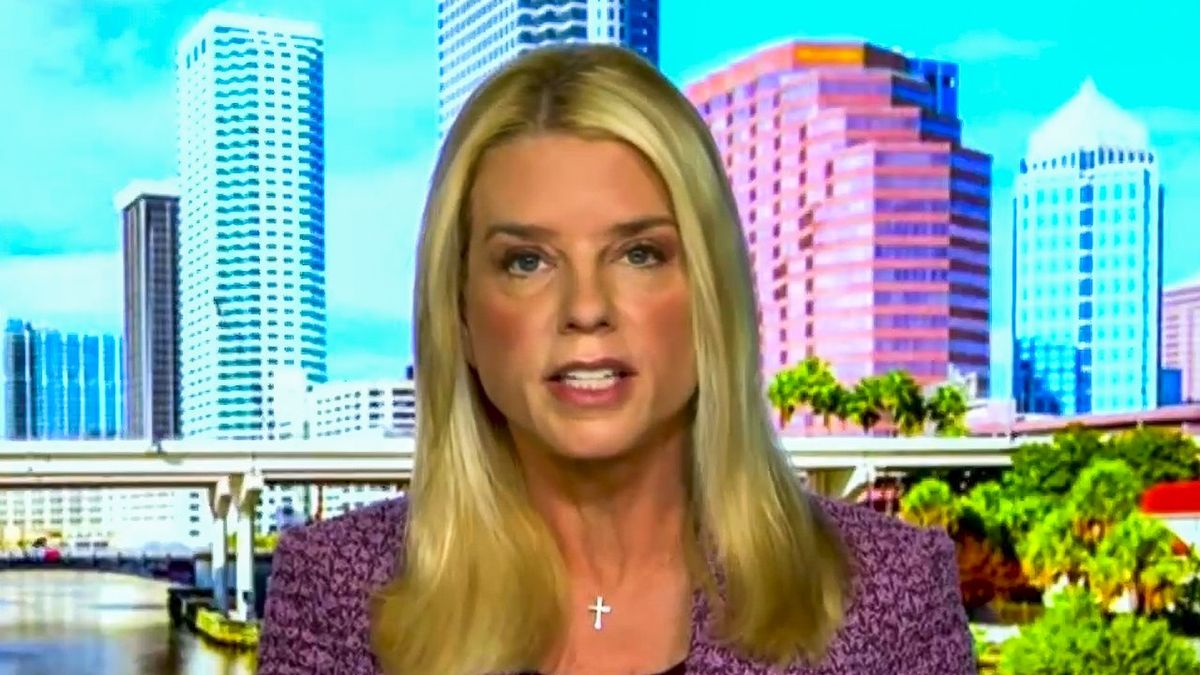
Attorney General Pam Bondi singled out Rep. Jasmine Crockett (D-TX) over protests and alleged "domestic terrorism" against billionaire Tesla CEO Elon Musk for his role in dismantling parts of the federal government.

"What about these vandals on Tesla vehicles and dealerships?" Fox News host Maria Bartiromo asked Bondi during a Sunday interview. "Why are they doing this?"

"We have a dedicated task force," Bondi revealed. "These are not isolated incidents, as you know, and these aren't vandals. These are Molotov cocktails."

"You know, that could be a weapon of mass destruction that they're throwing in Tesla dealerships, that they're lighting these Tesla charging stations on fire, that are in residential neighborhoods," she noted.

Bondi pledged not to go easy on people who vandalize Teslas.

"We are looking at everything, especially if this is a concerted effort," she vowed. "This is domestic terrorism."

"And Maria, now you have this congresswoman, Crockett, who is calling for attacks on Elon Musk on her birthday," she added. "Let's take him out on my birthday, she says. And yet she turns and says, oh, I'm not calling for violence."

"Well, she is an elected public official, and so she needs to tread very carefully, because nothing will happen to Elon Musk, and we're going to fight to protect all of the Tesla owners throughout this country, and it's basic safety, once again. Domestic terrorism is going to come to a stop in our country."

Watch the video below from Fox News or at the link..


'Yell some more': Newsmax pundit goes berserk when Dem points out his Tesla stock losses

David Edwards
March 23, 2025
RAW STORY

Newsmax/screen grab

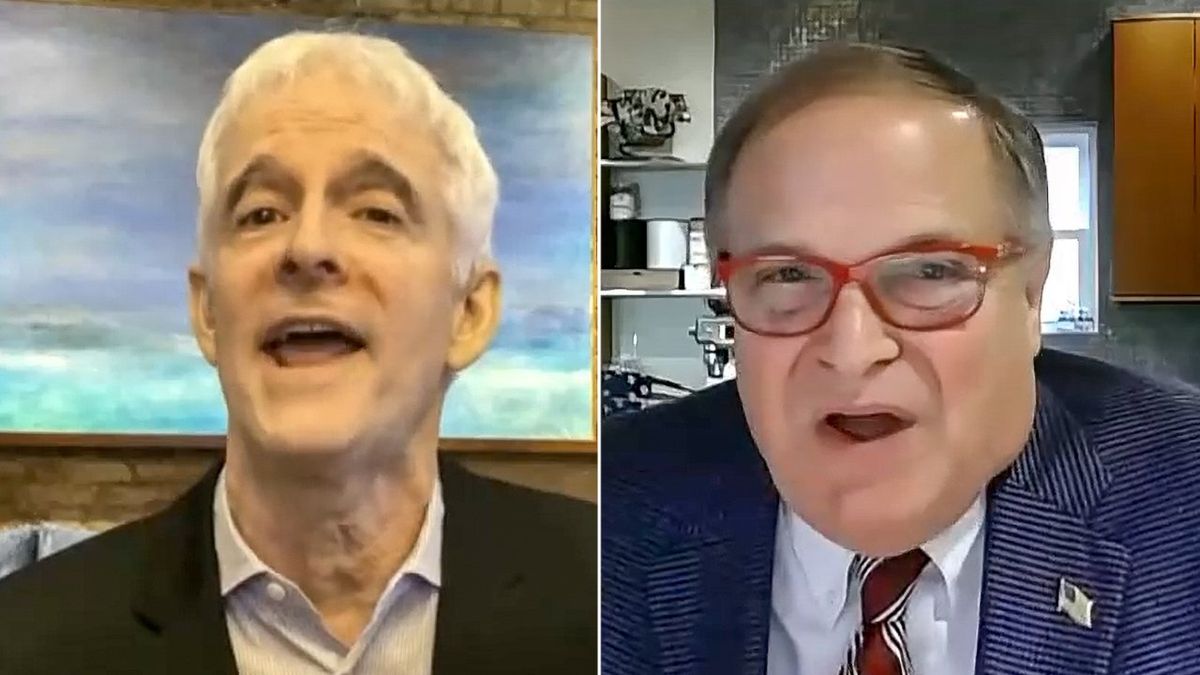
Republican strategist Gene Valentino lost his cool with liberal writer Ellis Henican over the weekend during a clash about struggling Tesla stock prices.

In a panel discussion on Sunday, Henican jabbed Valentino after the GOP strategist recommended investing in Tesla.

"I'm very, very sorry about the Tesla stock," Henican said. "I know it's gone down, I think about 50% since the end of last year. So, boy, I'm glad I don't have any of that in my retirement."

"You worry about your stock, and I'll worry about mine!" Valentino exclaimed. "You're a master at overspeak, and it's not fair for you to judge my stock."

"Well, I can judge one of your stocks," Henican shot back. "The water went down about 50%."

"Trust me, you keep an eye on Tesla," Valentino insisted. "Mark this moment. The next six months, you watch where Tesla goes."

"My condolences, sir, on that," the Democratic pundit replied.

"Yeah, you pray for yourself," Valentino snapped. "Don't worry about me... We are a nation that was saved by Donald Trump."

"How dare you attempt to minimize his good efforts in a short period of time to try to fix this nation which has been under siege by a deep liberal left conspiracy orchestrated by George Soros and the likes of you that have had decades to fester the wrongdoing that's now he's trying to change in just 100 days?" he shouted.

"Are you finished?" Henican asked. "Are you finished, Gene? Do you want to yell some more?"

"Elon Musk is down around chiggers and jock itch in the ratings right now," he noted. "I guess, Gene, three other people may be the last people who actually like him because people don't want an unelected, world's richest oligarch and Trump's biggest financial supporter to be in monkeying around with their Social Security, to be undermining Medicare."


Watch the video below from Newsmax or at the link. .


'A lot of abuse': Fear grows as Trump's FBI targets anti-Musk protesters

FBI CONTRACTED OUT AS TESLA SECURITY

REUTERS/Chris J Ratcliffe
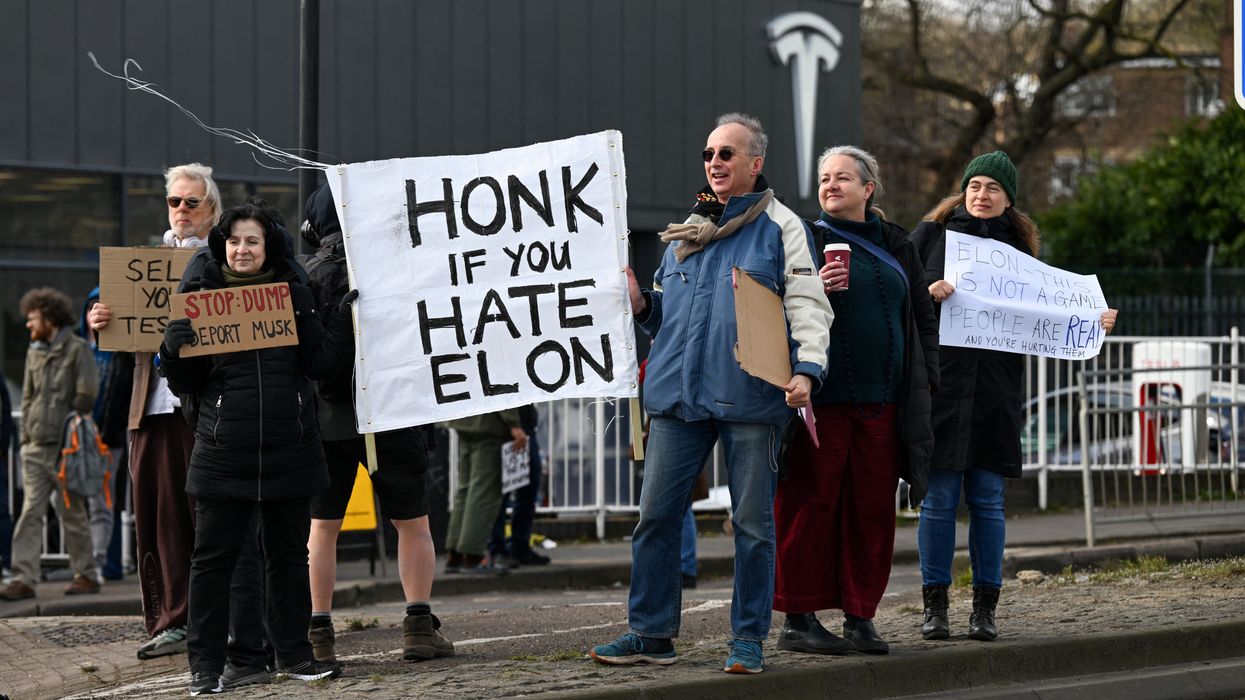
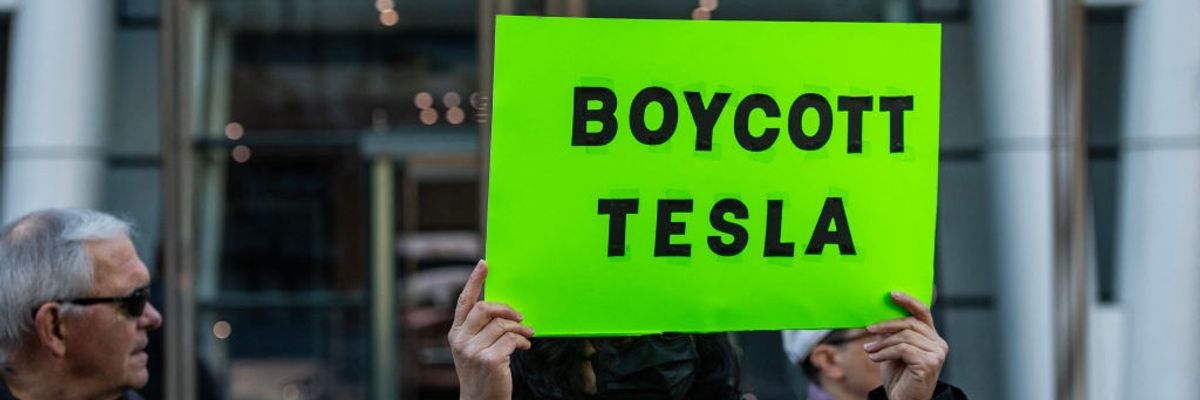
Demonstrators hold anti-Tesla posters during a protest encouraging people to boycott Tesla in opposition to Tesla CEO Elon Musk's political involvement in the U.S. government, outside the Tesla Centre Park Royal in London, Britain, March 15, 2025.
March 22, 2025
ALTERNET


Although the vast majority of anti-Elon Musk demonstrations in the United States and other countries have been peaceful, some critics of the Tesla/SpaceX/X.com leader and Donald Trump ally are resorting to destroying Teslas or committing acts of vandalism. U.S. Attorney General Pam Bondi is describing these incidents as acts of "domestic terrorism," but some civil libertarians fear that her approach could create problems for Musk opponents who are protesting in a nonviolent way.

In a U.S. Department of Justice (DOJ) press release published on Thursday, March 20, Bondi declared, "Let this be a warning: if you join this wave of domestic terrorism against Tesla properties, the Department of Justice will put you behind bars."

The U.S. attorney general and Trump loyalist discussed federal charges against three people accused of throwing Molotov cocktails at Tesla vehicles

READ MORE: Republicans have no moral authority to decide what 'domestic terrorism' is

Wired's Caroline Haskins, in an article published on March 22, reports, "Civil liberties experts claim treating alleged attacks against Tesla cars and infrastructure as terrorist activity could give federal and local law enforcement broad authority to surveil people protesting Elon Musk’s role in the government. The terrorism designation could also allow Musk and other Tesla executives to access information authorities uncover in their investigations."

Haskins notes that Bondi's statement "comes ahead of hundreds of grassroots 'Tesla Takedown' events protesting Musk and his influence in Washington that are scheduled to take place at Tesla facilities across the U.S. this weekend. The demonstrations have multiplied since they began in mid-February, with some attracting hundreds of people each."

President Trump put Musk in charge of an advisory group called the Department of Government Efficiency (DOGE), which is helping the Trump Administration with mass layoffs of federal government workers. And many Musk critics are arguing that Musk has way too much power for someone who was never elected to office.

"Most of the protests have been peaceful, and the organizers of some of them have said that they don't endorse property damage," Haskins explains. "But they are happening amid a string of alleged arson and vandalism cases targeting Tesla dealerships and charging stations, including one in Las Vegas Tuesday morning, (March 18), as well as others in Colorado and Boston. By labeling these and other incidents involving Tesla domestic terrorism, the FBI can file broader search warrants than in other types of cases."

Haskins continues, "Under the Patriot Act, law enforcement gets 'special authorities' while investigating terrorism, including 'single-jurisdiction search warrants' from magistrate judges that apply anywhere in the U.S. instead of a single geographic area, according to a 2023 report from the Government Accountability Office. With a court order, law enforcement can additionally get 'confidential education records' from any school or agency in the course of a terrorism investigation, the report notes."

Michael German, a former FBI special agent who is now with the Brennan Center for Justice at the New York University Law School, fears that instead of focusing on extremists who are actually committing acts of violence, a DOJ/FBI probe could end up targeting anyone peacefully expressing "anger or animosity towards Tesla or Elon Musk."

German told Wired, "We've seen a lot of abuse of FBI investigative authorities, particularly around domestic advocacy groups."

Read the full Wired article at this link.


Trump suggests Tesla vandals be jailed in El Salvador

By AFP
March 21, 2025


Several Tesla dealerships have been vandalized in apparent protest at Elon Musk's role in the US government - Copyright AFP Roslan RAHMAN

President Donald Trump suggested Friday that people who vandalize Tesla property — the car brand owned by his billionaire ally Elon Musk — could be deported to prisons in El Salvador.

“I look forward to watching the sick terrorist thugs get 20 year jail sentences for what they are doing to Elon Musk and Tesla,” Trump wrote on his Truth Social platform.

“Perhaps they could serve them in the prisons of El Salvador, which have become so recently famous for such lovely conditions!” he added, referencing the Central American nation known for its harsh treatment of criminals.

Trump’s remarks mark a further consolidation of his administration’s support for key advisor Musk, who has divided Americans as an unelected tycoon who has led a ruthless cost-cutting drive at the head of the Department of Government Efficiency (DOGE).

Several Tesla dealerships around the country have been vandalized in recent weeks and the company’s stock price has plummeted over the past month.

Attorney General Pam Bondi this week branded vandalism against property owned by Tesla as “domestic terrorism” in a public show of support for Musk.

On Thursday she announced that unspecified charges were being brought against three people accused of targeting Tesla cars, carrying between five and 20 years in prison.

The three defendants, who were not identified, “will face the full force of the law” for using Molotov cocktails to set fire to Tesla vehicles and charging stations in Oregon, Colorado and South Carolina, the Justice Department said.

Trump, in an unprecedented product endorsement by a sitting president, sought to boost Tesla sales earlier this month, briefly turning the White House into a showroom and announcing he was buying one of the electric cars.

His suggestion of jailing Tesla vandals in El Salvador is particularly pointed after US officials last weekend flew more than 200 alleged gang members to be jailed in the country.

The move caused uproar as it apparently defied a US court order halting the flights — though the Trump administration insists it was legal.


Tesla Has Same Problem as Big Oil: Its Time Has Come


In the end, despite major victories for the fossil fuel industry in recent days, Elon Musk's very bad week shows there's possibly a much brighter future ahead for the rest of us.


Protesters hold signs and sing chants during a protest against Elon Musk and his Tesla car company outside the Tesla dealership in Boston, Massachusetts on March 15, 2025.
(Photo by Joseph Prezioso / AFP via Getty Images)

Bill Mckibben
Mar 22, 2025
The Crucial Years


It must have seemed like a huge week for the fossil fuel industry: as the Wall Street Journal put it yesterday (and you could sense the headline writer’s glee), “The fossil fuel industry gets its revenge on green activists.”

The oil-and-gas industry is landing blow after blow against climate activists.
The Trump administration has cranked out approvals of major projects to ship liquefied natural gas from the Gulf Coast and killed a host of climate-related initiatives.

 Meanwhile, Texas billionaire Kelcy Warren has won a nearly $700 million verdict against Greenpeace that could spell the end of the group’s U.S. presence.


Hell, the Trump administration is trying to resurrect coal, and in what’s doubtless considered a back-slapping prank around the West Wing it just named a fracking executive to run the Department of Energy’s renewables office. Meanwhile, Musk’s vandals fired the quite brilliant chief scientist at NASA, doubtless because her work involved protecting the planet’s climate—Katherine Calvin was, among other things, the head of Working Group III of the Intergovernmental Panel on Climate Change, so good sport to Jackie Robinson her.

All of this is deeply stupid and damaging. And yet, despite all that, there must have been a few shivers that ran down the spines of both Elon Musk and oil executives last week when they read a piece of news from China.

Here’s the story, as told by Bloomberg. Chinese automaker BYD (their slogan, at least in English, is ‘Build Your Dreams”) announced on Tuesday that its new cars—available in April for $30,000 if you’re in a place where you can buy one—will recharge in five minutes. Or, roughly, the time it takes to fill your tank with gasoline.
From “more features for no more price” and “smart driving for all,” BYD can now add “charging as fast as refueling” to its marketing slogans, potentially helping it to capture more share from legacy automakers and more direct rivals like Elon Musk’s Tesla Inc.


How did they do this? Here are a bunch of words I don’t fully understand:
BYD cites its “all liquid-cooled megawatt flash charging terminal system.”
In addition, to match the ultra-high power charging, BYD has self-developed a next-generation automotive-grade silicon carbide power chip. The chip has a voltage rating of up to 1500V, the highest to date in the car industry.
In tandem, BYD on Monday launched its flash-charging battery. From the positive to the negative electrode, the cell contains ultra-fast ion channels, which BYD says reduces the battery’s internal resistance by 50%.
There’s also a mass-produced 30,000 RPM motor. Luo Hongbin, BYD senior vice president, said the motor “not only significantly boosts a vehicle’s speed, but also greatly reduces the motor’s weight and size, enhancing power density.”


But I can translate it into English. BYD did not waste its time giving Nazi salutes. It didn’t buy a social media platform so it could make obscure marijuana jokes and make fun of poor people. It didn’t devote itself to helping a nincompoop win the presidency and then decide it would be exhilarating fun to fire a bunch of government workers. Instead, BYD did, you know, engineering.

It’s gotten so bad that even true believers like Dan Ives, one of Tesla’s biggest shareholders, have suggested Musk might want to go back to, you know, work.

It must sting for Musk to watch that kind of progress, especially on a week when he had to recall all 46,000 cybertrucks (and thus disclose for the first time that he’d only sold 46,000 cybertrucks) in order to keep them from dropping parts on the road. It turns out they’d stuck the trim on the plug-ugly things with the wrong glue—now they’re going to replace it with an adhesive that is “not prone to environmental embrittlement.” When owners drive their sad vehicles back to the dealers for repairs (not during a rainstorm, because that apparently causes rusting), they’ll likely encounter one of the hundreds of protests that have broken out across the country. (I confess to being quite proud of my sign at our local demonstration last Saturday)

It’s gotten so bad that even true believers like Dan Ives, one of Tesla’s biggest shareholders, have suggested Musk might want to go back to, you know, work. I mean, Musk has cut the value of his company in half in the last couple of months. But never fear—last night he assembled the company’s workers for a pep talk. Robo-taxis coming soon! As they have been since 2016!

But if the BYD announcement was a reminder that Musk is a poseur, the deeper threat probably comes for Big Oil. Because if you can put 400 kilometers worth of juice in a car in five minutes, the last even slightly good reason for buying an internal combustion vehicle vanishes. Yeah, you still need a fast charger—and BYD is building 4,000 of them across China. But it feels like writing on the wall: Chinese demand for gasoline dropped in 2024, and analysts see it going down almost five percent a year between now and 2030. As the International Energy Agency explained last week,
Electric vehicles currently account for about half of car sales in China, undercutting 3.5% of new fuel demand in 2024... China has been providing subsidy support to purchases of so-called “new energy vehicles” (NEVs) since 2009, promoting its automotive manufacturing industry, and reducing air pollution. A trade-in policy, introduced in April 2024 and expanded in 2025, continues to drive growth in China’s EV sales. Meanwhile, highly competitive Chinese automakers are also making gains in international markets.


America’s oil companies decided they could make more money from fossil fuel than from embracing renewables—they’ve decided to let the Chinese win the solar energy battle, reckoning that they can use their political power to keep the world hooked on hydrocarbons. In some ways it’s working—they helped buy Trump his presidency and he’s giving them what they want. In particular, he’s been shaking down foreign countries to buy more of their Liquefied Natural Gas to avoid tariffs.

But oil is a global commodity, and the perfect example of marginal pricing. If China is going to be using less gasoline—well, the price of oil is going to drop. That’s bad news for American producers—as Trump’s biggest industry fundraiser Harold Hamm explained
U.S. shale needs much higher oil prices than $50 per barrel, and even higher than the current WTI Crude price in the high $60s, for a “drill, baby, drill” boom, oil tycoon and Trump campaign donor Harold Hamm told Bloomberg last week.
“There are a lot of fields that are getting to the point that’s real tough to keep that cost of supply down,” Hamm told Bloomberg Television in an interview.


The fracking revolution is wearing down—wells are sputtering towards empty faster than expected, and if prices are depressed it will make less economic sense to drill baby drill, no matter what our new king demands. As David Wethe and Alix Steel reported his week
Shale operators are slowing production growth after years of drilling up their best locations. At this week’s CERAWeek by S&P Global energy conference in Houston, executives for some of the largest US shale companies forecast US oil production will peak in the next three to five years.


I’m beginning to think you can imagine a world where the U.S. builds tariff walls around its borders, prevents the easy development and spread of technology like EVs and heat pumps, and manages to become an island of internal combustion on an increasingly electrified world. That’s a depressing vision, though nowhere near as depressing as the U.S. imposing that vision on the rest of the world, something that’s going to get harder: if you were any other country (Canada, say) would you tie yourself to the U.S. for any critical product? If you had a choice? And everyone has a choice, because the sun shines and the wind blows everywhere. As the economists at IEEFA said this week, even the expensive “just energy transition partnerships” with emerging Asian nations may survive Trump’s desertion.
Given the current U.S. administration’s priorities and ambitions to “drill, baby, drill” for oil and gas, the withdrawal from JETP can be viewed as favorable for the energy transition. The program’s complexities and transformative potential demand the involvement of a “coalition of the willing.” The original countries (including the European Union), private sector partners, and philanthropies still support JETP and want to realize the mechanism’s potential. In the case of Indonesia, Germany has quickly stepped in to fill the U.S.’s vacated leadership role. Japan has reaffirmed its co-leadership role and remains committed to Indonesia’s USD20 billion JETP. Despite the U.S. exit, critical financing and support for the program remains.


Here’s a great interactive map from the New York Times of what the solar and wind boom looks like from outer space. It shows the burst of development in China—but also Turkey. And it doesn’t even capture the small-scale home by home and factory by factory spread of solar that seems to be speeding up exponentially over the last year.

It may even be hard to stomp out all this goodness here at home. Case in point: the Utah (!) legislature this week became the first in the country to (unanimously!) pass a law enabling “balcony solar,” the small-scale arrays that brought solar power to a million and a half German apartments last year.

The legislation exempts these systems from several requirements:No technical interconnection requirements.
No technical interconnection agreement.
Utilities cannot mandate approval, charge fees, or require additional controls or equipment beyond what is integrated into the system.

Plug and play, baby!

Indeed, if you want a sign for the future, here’s one: Chinese authorities are pulling back on a plan to let BYD build a new car plant in Mexico. Why? Because they’re afraid that people like Musk—an unimaginative pol, not an engineering genius—will steal their cool new tech.
Those respective authorities in China fear that BYD’s advanced (and in many cases, leading) technology could more easily end up in the possession of US competitors through Mexico, as the US neighbors to the south would gain unrestricted access to the Chinese automaker’s technology and production practices. Those powers went as far as to suggest that Mexico could even assist the US in gaining access to BYD’s technology.

It’s bad news for America that our country has lost its technological edge. It may be good news for the planet, though.


© 2022 Bill McKibben


Bill Mckibben
Bill McKibben is the Schumann Distinguished Scholar at Middlebury College and co-founder of 350.org and ThirdAct.org. His most recent book is "Falter: Has the Human Game Begun to Play Itself Out?." He also authored "The End of Nature," "Eaarth: Making a Life on a Tough New Planet," and "Deep Economy: The Wealth of Communities and the Durable Future."
Full Bio >
Chinese electric car maker BYD aims for Europe boost


By AFP
March 20, 2025


BYD plans to launch its small format Seagull, to be renamed the Dolphin Surf in Europe around the middle of the year - Copyright AFP Philip FONG

Chinese carmaker BYD on Thursday vowed to conquer Europe with a new compact electric model and super-fast charging capability to rival continental brands.

“You will see, starting from March or April, our registration numbers will jump” in Europe, company vice-president Stella Li told AFP in an interview at a showroom in Paris.

“This year, BYD sales in the whole of Europe will start increasing.”

The group has launched major advertising campaigns including sponsorship of last year’s European Championships in football and has opened numerous new showrooms across the continent.

It plans to launch its small format Seagull, to be renamed the Dolphin Surf in Europe — a rival to the Renault 5 and Citroen C3 — around the middle of the year, Li said.

In China this week it unveiled a new charging system that it says will allow drivers 470 kilometres (nearly 300 miles) of battery life after charging for just five minutes — four times faster than the best systems currently on the market.

“It is really as fast as refuelling a petrol car,” Li said. “We are… preparing to bring this kind of cutting-edge technology to Europe in the next few years.”

BYD said it doubled its exports in the first two months of 2025 from a year earlier, to 130,000 vehicles. It sold 4.2 million worldwide in 2024, making it the globe’s sixth-biggest car firm.

The European Union has imposed a 17-percent tariff on Chinese electric vehicles to make up for Chinese state subsidies.

EU restrictions “will not change BYD’s plan because BYD is like a long-term player”, Li insisted.

EU authorities are also reportedly investigating BYD’s first European factory, in Hungary, where electric car production is scheduled to start late this year.

“We will be very transparent, very open, working with anybody who wants to do an investigation,” Li said.

EU tariffs not a deterrent, says Chinese EV maker XPeng


By AFP
March 21, 2025


An Xpeng G6 electric car at the opening of their second flagship store in Hong Kong on March 21, 2025 - Copyright AFP Annabelle Gordon

Chinese electric vehicle maker XPeng said Friday that European Union tariffs on EVs made in China have had a “large economic impact” but will not deter the firm’s plans to tap European markets.

Brussels decided to impose tariffs in October of up to 35.3 percent on imports of Chinese electric cars, citing alleged subsidies that give them an unfair advantage over European rivals.

The tariffs are “something we have to deal with… it’s a large economic impact,” XPeng vice chairman and president Brian Gu said at the opening of a Hong Kong store.

The Guangzhou-headquartered firm said last month that it aimed to double its presence to 60 countries and regions this year — part of a years-long globalisation trend in the Chinese EV sector.

The tariffs are “not deterring us from tackling the European opportunity”, Gu told AFP, adding “we still think it’s a very important market”.

“Being local is the way to mitigate a lot of these tariffs and protectionism,” he said.

Following years of generous support from Beijing, China’s EV manufacturers have intensified their domestic competition and are eager to gain an edge via exports and innovations.

Chinese EV giant BYD saw a boost to its shares on Tuesday after unveiling new battery technology that it says can charge a vehicle in the same time it takes to fill up a petrol car.

Self-driving technology — commonly divided into five tiers, with L5 being full automation with no need for human drivers — is also a key battleground for Chinese carmakers.

The technology is “moving very rapidly”, fuelled by more powerful chips and artificial intelligence advancements, Gu said, adding that L4 vehicles could enter mass production next year.

Meanwhile, the United States had maintained its 100 percent tariff on China-made EVs and in January finalised a rule that effectively barred Chinese technology from its cars.

XPeng entered the Hong Kong market in April 2024 and has faced stiff competition from Chinese rivals and established names such as Tesla.

There were just shy of 500 XPeng vehicles registered for the first time in Hong Kong last year, behind other Chinese brands such as SAIC’s Maxus and Geely’s Zeekr, official figures show.

At its Friday store opening, the company said it will bring its luxury seven-seater X9 to Hong Kong.
Israel defence minister threatens to annex parts of Gaza


By AFP
March 21, 2025


Palestinians used donkey carts to transport their belongings as they fled Beit Lahia in the northern Gaza Strip. - Copyright AFP Roslan RAHMAN

Israeli Defence Minister Israel Katz threatened Friday to annex parts of the Gaza Strip unless Hamas militants release the remaining Israeli hostages held in the war-battered Palestinian territory.

The warning came as Israel stepped up the renewed assault it launched on Tuesday, shattering the relative calm that had reigned in the war-battered territory since a January 19 ceasefire.

Gaza’s civil defence agency said Thursday that 504 people had been killed since the bombardment resumed, one of the highest tolls since the war began more than 17 months ago with Hamas’s attack on Israel.

“I ordered (the army) to seize more territory in Gaza… The more Hamas refuses to free the hostages, the more territory it will lose, which will be annexed by Israel,” Katz said in a statement.

Should Hamas not comply, Katz also threatened “to expand buffer zones around Gaza to protect Israeli civilian population areas and soldiers by implementing a permanent Israeli occupation of the area”.

AFP images from northern Gaza Friday showed donkey-pulled carts piled high with belongings as residents fled their homes along rubble-strewn roads.

Israel resumed intensive bombing of Gaza on Tuesday, citing deadlock in indirect negotiations on next steps in the truce after its first stage expired early this month.

Its resumption of large-scale military operations was coordinated with US President Donald Trump’s administration but drew widespread condemnation.

Israeli President Isaac Herzog expressed concern about the government’s actions in a video statement on Thursday, saying it was “unthinkable to resume fighting while still pursuing the sacred mission of bringing our hostages home”.

Thousands of protesters have rallied in Jerusalem in recent days, accusing Prime Minister Benjamin Netanyahu of resuming military operations without regard for the safety of the hostages.

Of the 251 hostages seized during Hamas’s October 7, 2023 attack, 58 are still held by Gaza militants, including 34 the Israeli military says are dead.


– ‘Pressure points’ –


The Israeli military said on Thursday that troops had begun “conducting ground activity” in the Shabura area of Rafah, Gaza’s southernmost city near the Egyptian border.

It said it had also closed off the territory’s main north-south route as it expanded the ground operations which resumed on Wednesday.

Katz vowed to step up the assault, using civilian as well as military “pressure points” to defeat Hamas.

“We will intensify the fight with aerial, naval and ground shelling as well as by expanding the ground operation until hostages are freed and Hamas is defeated, using all military and civilian pressure points.”

He said these included implementing Trump’s proposal for the United States to redevelop Gaza as a Mediterranean resort after the relocation of its Palestinian inhabitants to other Arab countries.

When asked if Trump was trying to get a Gaza ceasefire back on track Thursday, White House Press Secretary Karoline Leavitt told reporters that the president “fully supports” Israel’s renewed Gaza operations.

Israel rejected negotiations for a promised second stage of the truce, calling instead for the return of all of its remaining hostages under an extended first stage.

That would have meant delaying talks on a lasting ceasefire, and was rejected by Hamas as an attempt to renegotiate the original deal.

Hamas said it fired rockets at Israeli commercial hub Tel Aviv on Thursday in its first military response to the growing civilian death toll. Israel’s military said it intercepted one, while two hit an uninhabited area.
Israel opposition urges general strike over security chief ouster


By AFP
March 22, 2025


Thousands of demonstrators turned out in Tel Aviv - Copyright AFP Dave Chan

Israel’s opposition leader on Saturday called for a general strike if Prime Minister Benjamin Netanyahu refuses to obey a Supreme Court decision freezing the government’s dismissal of the internal security chief.

If the government “decides to disobey the Court’s decision it will become a government outside of the law,” Yair Lapid told thousands of demonstrators in central Tel Aviv.

“If that happens, the entire country should stop,” he said. “The only system that must not stop is the security system.”

The unprecedented move to fire Shin Bet chief Ronen Bar has deepened divisions in the country as Israel resumes its military operations in the Gaza Strip.

Attorney General Gali Baharav-Miara said on Friday that Netanyahu could not name a replacement for Bar, following the Supreme Court decision.

Netanyahu insisted, in a post on X, that it was up to the government to decide who headed the domestic security agency.

“There will be no civil war! The State of Israel is a state of law, and according to the law, the government of Israel decides who will be the head of the Shin Bet,” the prime minister said.

He reiterated that view in a video message Saturday as the Tel Aviv protest was under way.

“Ronen Bar will not stay as head of Shin Bet,” he said. “There will not be civil war, and Israel will remain a democratic state.”


– ‘Flagrant conflict of interest’ –


Demonstrators have spoken of Netanyahu’s policies, including the firing of Bar, as a threat to Israel’s democracy.

Lapid spoke at an anti-government rally where demonstrators held signs protesting the war in the Gaza Strip and calling for hostages held there to be freed.

Signs read “No more bloodshed” and “Stop the war, Now!” to ensure the return of the 58 hostages captured on October 7, 2023 and still held in Gaza.

In front of the defence ministry headquarters, Menahem Begin Street was packed from Kaplan Street to King Saul Street, an AFP photographer observed, suggesting a crowd of several tens of thousands of people, a very significant mobilization on a national scale.

Lapid’s party Yesh Atid, which appealed Bar’s firing to the Supreme Court, denounced the government move to sack Bar as “a decision based on flagrant conflict of interest”.

The government is to meet on Sunday to begin dismissal proceedings against the attorney general, a vocal Netanyahu critic, citing “prolonged disagreements”.

A demonstration against her removal is scheduled for Sunday outside parliament, and near Netanyahu’s Jerusalem residence.
United States imports eggs from Korea, Turkey to help ease prices

By AFP
March 21, 2025


An avian flu outbreak has curtailed the supply of eggs in the United States, pushing up prices - Copyright AFP Frederic J. BROWN

United States is importing Turkish and South Korean eggs to ease an avian flu-fueled supply crunch that has pushed up prices across the country, Donald Trump’s agriculture secretary confirmed Friday.

Brooke Rollins told reporters in Washington that imports from Turkey and South Korea had already begun and that the White House was also in talks with other countries about temporarily importing their eggs.

“We are talking in the hundreds of millions of eggs for the short term,” she added.

The cost of eggs has skyrocketed due to multiple bird flu outbreaks in the United States, forcing farmers to cull at least 30 million birds and sharply constraining supply.

On the political battlefield, egg prices became an unlikely rallying point for Trump on the campaign trail as he sought to capitalize on voters’ frustrations with the rising cost of essential items during his predecessor Joe Biden’s presidency.

After returning to office in January, Trump tasked Rollins with the job of boosting the supply of eggs, and bringing down prices.

In the weeks since, producers in several countries have reported American interest in their produce, with the Polish and Lithuanian poultry associations telling AFP that they had been approached by US diplomatic staff on the hunt for fresh eggs.

“There is a shortage of eggs in many countries,” Katarzyna Gawronska, director of the Poland’s National Chamber of Poultry and Feed Producers, said recently. “The key question would be what financial conditions would be offered by the Americans.”

Speaking to reporters on Friday, Rollins said that imports of eggs would be time-limited, and would stop once US poultry farmers were able to ramp up supply.

“When our chicken populations are repopulated and we’ve got a full egg laying industry going again — hopefully in a couple of months — we then shift back to our internal egg layers and moving those eggs out onto the shelf,” she said.
Aid freeze silences Latin America media scrutiny of US foes


By AFP
March 21, 2025


The newsroom of Venezuelan daily El Nacional in October 2018, shortly before it stopped its paper edition - Copyright AFP Ozan KOSE

A choke on US aid threatens to smother media exposing abuses in Cuba, Nicaragua and Venezuela, to the unconcealed delight of the very leaders Washington once wanted held accountable.

It was one of President Donald Trump’s first acts on his return to the White House: curbing the US Agency for International Development (USAID) and other bodies that fund humanitarian and democratization projects.

And, while a judge has since ruled the action was probably unconstitutional, a dark cloud hangs over aid projects, including some $268 million budgeted for “independent media” in 30 countries in 2025, according to Reporters Without Borders (RSF).

Dozens of Latin American outlets have cut staff. Some have closed altogether.

At the same time, the Trump administration has dismantled state-run American media with a global audience, such as Radio Y Television Marty — founded in Florida in the 1980s to counter the Cuban Communist Party’s monopoly on information — and the Voice of America.

“It is regrettable that what had been one of the most reliable partners for the independent media sector and Cuban civil society has decided to so freely give the authoritarians cause for celebration,” Jose Nieves, editor of the Miami-based Cuban news portal El Toque told AFP of the US retreat.

“As we are seeing these days, the dictatorships in the region openly organize their propaganda apparatus, using resources they are not allocating to all the humanitarian crises we are experiencing,” he added.


– ‘Subversion’ –


Cuba’s President Miguel Diaz Canel, who describes critical journalists as Washington-backed “mercenaries,” has welcomed the Donald Trump administration’s cut to funding for non-state media that operate mostly from abroad, including Miami.

USAID-funded projects for “so-called independent media and NGOs,” he wrote on X last month, amounted to nothing other than multi-million dollar “subversion.”

In Cuba, most media outlets belong to the state, their narrative controlled by the Communist Party.

Some non-state digital sites have emerged in recent years, many operating from abroad and accessible only to Cubans with a VPN.

El Toque, which received money from the National Endowment for Democracy — a non-profit foundation funded largely by appropriations from the US Congress — has had to lay off half its staff as its budget was slashed, said Nieves.

The resulting “paralysis” of critical media “will only contribute to a more misinformed populace subjected to the lies of the enemies of freedom and democracy,” the editor said.


– ‘Information blackout’ –


For journalists in Nicaragua and Venezuela — countries which, like Cuba, are under US sanctions for anti-democratic actions — the aid cuts have also been devastating.

“It put us in a state of emergency,” Carlos Herrera, co-founder of the Nicaraguan news site Divergentes told AFP.

Divergentes, which operates from Costa Rica, cut its payroll in half and Herrera fears “a total information blackout” in Nicaragua.

Several journalists have been banished or stripped of their nationality by Daniel Ortega’s government in recent years.

At least 300 Nicaraguan journalists have left the country, and four were arrested in the last 12 months, according to RSF.

Nicaragua “no longer has independent media” operating within the country, where only state-run and media groups in “total self-censorship” survive, said Herrera.


– “USAIDcalypse” –


In Venezuela, the media industry is “suffocating, drowning, and we can’t even scream for help,” said the editor of an online paper who requested anonymity for fear for his safety.

More than 200 media outlets in the South American country have closed since the 1999-2013 presidency of socialist leader Hugo Chavez, according to the rights NGO Espacio Publico.

Several journalists are under investigation for receiving foreign funds, suspected of being anti-government “agents.”

“Traditional media have stopped fulfilling their informational role in a climate of self-censorship and brutal censorship,” said Rodolfo Rico, a Venezuelan free press activist.

Whatever critical media remains depend on foreign funding due to domestic advertisers’ fear of reprisals, and for them, Washington’s withdrawal amounts to a “USAIDcalypse,” added Rico.

“Journalists have less and less space to practice their profession, and people have fewer ways to stay informed,” a Venezuelan reporter who recently lost his job told AFP, also declining to be named.

lp-jb-mis-erc/nn/mlr/dc
AI startup Perplexity confirms interest to buy TikTok


By AFP
March 22, 2025


Perplexity says its vision for buying TikTok includes putting its artificial intelligence search tools to work letting users check the veracity of videos they are watching - Copyright AFP Chris DELMAS

Glenn CHAPMAN

Artificial intelligence (AI) startup Perplexity on Friday expressed its interest in buying TikTok, which faces a deadline to divest from its Chinese owner or be banned in the United States.

Perplexity in a blog post laid out a vision for integrating its AI-powered internet search capabilities with the popular video-snippet sharing app.

“Combining Perplexity’s answer engine with TikTok’s extensive video library would allow us to build the best search experience in the world,” the San Francisco-based firm reasoned.

“Perplexity is singularly positioned to rebuild the TikTok algorithm without creating a monopoly, combining world-class technical capabilities with Little Tech independence.”

President Donald Trump earlier this month said the United States was in talks with four groups interested in acquiring TikTok, with the Chinese-owned app facing an uncertain future in the country.

A US law has ordered TikTok to divest from its Chinese owner ByteDance or be banned in the United States.

“We’re dealing with four different groups. And a lot of people want it, and it’s up to me,” Trump said aboard Air Force One.

“All four are good,” he added, without naming them.

The law banning TikTok took effect on January 19 over concerns that the Chinese government could exploit the video-sharing platform to spy on Americans or covertly influence US public opinion.

During his first stint in the White House, Trump similarly attempted to ban TikTok in the United States on national security concerns.

TikTok temporarily shut down in the United States and disappeared from app stores as the deadline for the law approached, to the dismay of millions of users.

Trump suspended its implementation for two-and-a-half months after beginning his second term in January, seeking a solution with Beijing.

TikTok subsequently restored service in the United States and returned to the Apple and Google app stores in February.

Although TikTok does not appear overly motivated regarding the sale of the app, potential buyers include an initiative called “The People’s Bid for TikTok,” launched by real estate and sports tycoon Frank McCourt’s Project Liberty initiative.

Others in the running are Microsoft, Oracle and a group that includes Internet personality MrBeast, whose real name is Jimmy Donaldson.

“Any acquisition by a consortium of investors could in effect keep ByteDance in control of the algorithm, while any acquisition by a competitor would likely create a monopoly in the short form video and information space,” Perplexity contended in the post.

“All of society benefits when content feeds are liberated from the manipulations of foreign governments and globalist monopolists.”

Perplexity said it would build infrastructure for TikTok at datacenters in the United States and maintain it with US oversight.

The AI startup also proposed rebuilding TikTok’s winning algorithm “from the ground up”, making the app’s “For You” recommendation feed open-source.

Perplexity also vowed to enable TikTok users to cross-reference information as they watch videos to check their veracity.