Saturday, July 25, 2026


Albanian police use water cannons as anti-government protesters clash in Tirana


By bne IntelliNews July 24, 2026

Albanian police used water cannon and pepper spray against anti-government protesters outside parliament in Tirana on July 23, before demonstrators regrouped and marched to the prime minister's office, ATA reported.

The rally was the 54th since the movement began in the coastal village of Zvërnec on May 23, driven by a luxury resort project backed by Jared Kushner and Ivanka Trump at the protected Vjosa-Narta wetlands and Sazan Island. What started as an environmental dispute has become the largest sustained unrest since the fall of communism, with demonstrators now demanding Prime Minister Edi Rama's resignation.

Clashes began after protesters threw eggs, tomatoes and other objects at officers guarding the parliament building.

Demonstrators gathered in Skanderbeg Square carrying banners and calling for Rama's resignation and an end to what they described as an entrenched political establishment.

Protesters repeated demands for changes to the electoral law, repeal of the strategic investor legislation known as the Mountain Package, and amendments to laws governing protected areas and cultural heritage.

Albania amended its environmental protection law in 2024 to permit developments described as structures of excellence rated five stars or above, a change that has become central to the dispute. Rama acknowledged last month that an environmental impact assessment for the resort had not begun.

A representative of the Albanian community in Western Australia told the rally that demonstrators had the backing of Albanians abroad. Parallel protests have been held in Berlin, Rome, London, Cologne and Paris.

Several speakers urged protesters to remain united and peaceful. One demonstrator said the movement's sole objective was Rama's resignation and that the protest was not directed against the police.

The Vjosa-Narta landscape hosts more than 200 bird species, including the flamingos that gave the movement its name, along with monk seals and sea turtles.


Ukraine hits Wildberries warehouses again, targetting St Petersburg for first time

Ukraine hits Wildberries warehouses again, targetting St Petersburg for first time
Drones reached the historically well-defended city overnight, the fifth Wildberries strike in a week, as Russia says at least six died in a separate missile strike on Kyiv. / bne IntelliNewsFacebook
By Ben Aris in Berlin July 24, 2026

Ukrainian drones struck a Wildberries warehouse for the fifth time this week, targeting a logistics centre in St Petersburg and the surrounding Leningrad region overnight on July 24, triggering large fires. Drones also hit a Wildberries sorting centre in Russian-occupied Simferopol, Crimea, and a facility in Tver.

St Petersburg — 1,100 km from Ukraine's border and Vladimir Putin's home city — has rarely been hit during the war given the concentration of Russian air defences there, so the strike marks a notable extension of Ukraine's reach.

Fires broke out at the Utkin Zavod logistics park south of the city and at a separate facility in the Shushary district; Leningrad Oblast governor Alexander Drozdenko said three people were hospitalised. Wildberries confirmed both St Petersburg-area logistics centres were “temporarily suspended” and around 50 flights were delayed at Pulkovo airport as a result of the attack.

Drones killed seven people at a Wildberries warehouse in Tambov region on July 18, prompting Russia to respond with its largest bombardment of Kyiv of the war. By July 20, sellers were facing more than $1bn in losses, a single warehouse strike alone was estimated to cost up to $0.5bn, and rival e-commerce operator Ozon saw its shares plunge 12% as the strikes rattled the wider sector.

President Volodymyr Zelensky said the campaign also hit military enterprises in Kirov and an unnamed oil facility overnight. “It is important that the operation is also ongoing against Russian logistics, which provides the occupying army with components for drones, navigation equipment, and equipment,” he said, without directly naming the Wildberries strikes. Wildberries, founded by Tatyana Kim, Russia’s richest woman and Wildberries’ co-founder and chief executive, lists drone components and body armour for sale on its site and was flagged by Poland as “the largest taxpayer in the Russian Federation” when it was first sanctioned in 2022.

Separately on July 24, a Russian ballistic missile strike hit an arms exhibition event in Kyiv, killing at least six people, Ukraine's Air Force said — underlining that the tit-for-tat escalation bne IntelliNews flagged in its own July 18 analysis is continuing to run in both directions.


Fedorov's popularity surges after sacking as Ukraine protests continue

Fedorov's popularity surges after sacking as Ukraine protests continue
New Rating Group poll puts the dismissed defence minister second only to Valery Zaluzhny in public trust — ahead of Zelenskiy. / bne IntelliNews
By Ben Aris in Berlin July 23, 2026

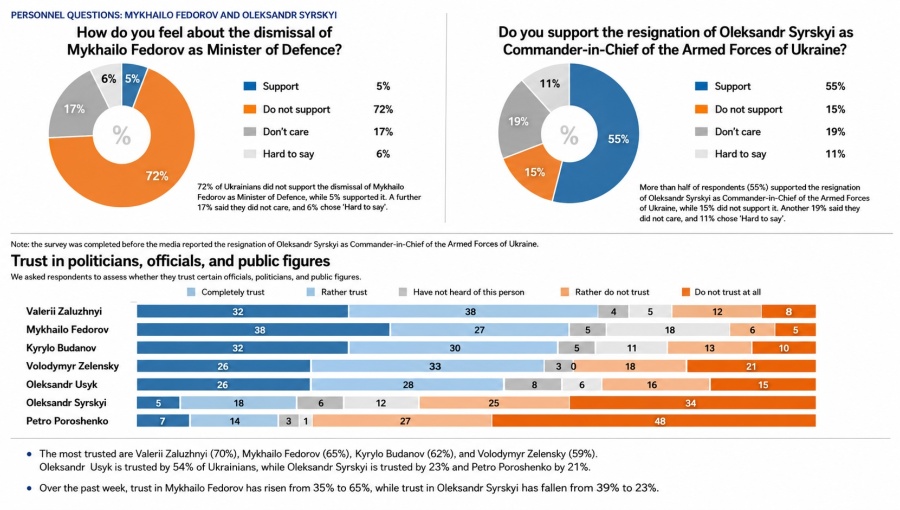
Trust in Mykhailo Fedorov has surged since President Volodymyr Zelenskiy dismissed him as defence minister on July 15 as part of a surprise government reshuffle, with a new Rating Group poll putting him second only to former commander-in-chief Valery Zaluzhny among Ukraine's most trusted public figures — ahead of Zelenskiy himself.

Trust rankings upended

The poll, reported on July 22, found Zaluzhny trusted by 70% of respondents (20% distrust him), followed by Fedorov on 65% (11% distrust), General Kyrylo Budanov, chief of the general staff, on 62% (23% distrust), and Zelenskiy in fourth place on 59% (39% distrust). Boxing champion Oleksandr Usyk placed fifth on 54%. General Oleksandr Syrskyi, removed as commander-in-chief this month, scored just 23% (59% distrust), while former president Petro Poroshenko trailed on 21% (75% distrust). The survey was completed before Syrskyi's resignation was reported, so it captures a snapshot mid-crisis rather than its resolution.

The Fedorov effect

Trust in Fedorov jumped from 35% to 65% in a single week, according to the Rating Group polling, overtaking the president. Separately, 72% of Ukrainians said they did not support Fedorov's dismissal, against 5% who backed it; 17% said they did not care and 6% could not say.

Zelenskiy sacked Fedorov on July 15, citing a conflict between the defence ministry and the general staff — part of a wider government reshuffle that bne IntelliNews described at the time as Ukraine's Battle of Britain moment. Public backlash was swift, feeding a wave of protests that also targeted Syrskyi's leadership. Separate polling found 55% of Ukrainians supported Syrskyi's removal (15% opposed, 19% indifferent); he was in fact dismissed shortly after the poll was taken and replaced by General Mykhailo Drapatyi, whom bne IntelliNews profiled as Ukraine's new, young military chief.

Protests to continue, Zelenskiy offers Fedorov a new post

The reshuffle followed — and was substantially driven by — street protests in Kyiv and other Ukrainian cities. One of the organisers said the protests would continue despite Syrskyi's removal, because their second core demand, reinstating Fedorov as defence minister, remains unmet. “We shouldn't forget about the second demand of the protest — to reinstate Mykhailo Fedorov as defense minister,” the organiser wrote, arguing that the ministry-general staff conflict Zelenskiy cited as his reason for sacking Fedorov “has also disappeared” now that Syrskyi is gone. Organisers called for an “indefinite protest” beginning Friday, July 24, at Kyiv's Ivan Franko Square and in other cities' central squares.

Zelenskiy has since confirmed he approached Fedorov with an offer to become deputy prime minister for military innovations, The Guardian reported on July 23 — an apparent attempt to defuse the pressure without fully reversing the original decision. Whether that satisfies protesters demanding his return specifically to the defence ministry remains to be seen.


Black Sea ports shut down as Crimea's blackout deepens

Black Sea ports shut down as Crimea's blackout deepens
Black Sea ports shut down as Crimea's blackout deepens / bne IntelliNewsFacebookTwitter
By bne IntelliNews July 23, 2026

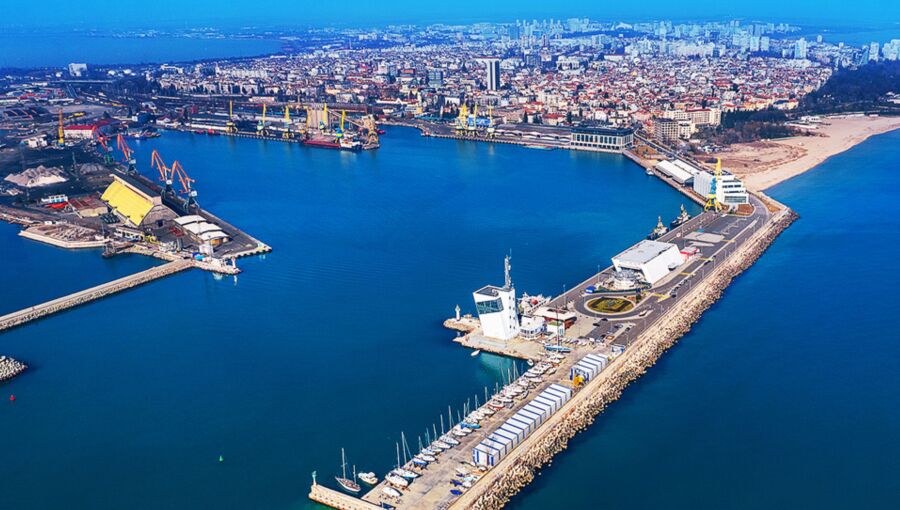
Vessel traffic into Ukrainian Black Sea ports has been fully suspended because of the threat of Russian attacks, Agrarian Policy Minister Taras Vysotskyi said on July 23, as occupied Crimea entered its third month of a deepening, Ukrainian-engineered power collapse.

Ports close

As recently as the previous day, four to five ships were still arriving in Ukrainian ports daily; that flow has now stopped entirely amid heightened Russian strike risk, Vysotskyi said, putting Ukraine's exports — including agricultural shipments — at risk and raising the prospect of upward pressure on global food prices if the suspension persists. Some shipping companies had already begun suspending stops at Ukraine's sea ports despite the high grain season, The Guardian reported on July 23, while President Volodymyr Zelenskiy warned Russia could step up attacks on vessels in the Black Sea to undermine Ukraine's grain corridor.

Crimea in the dark

Ukraine's campaign to cut Crimea off from Russia's power grid entered its third month in mid-July, and the peninsula's electricity supply is now collapsing visibly enough to be seen from space.

Working with analysts at the Berlin-based satellite-analysis group Vertical52, independent outlet Meduza examined NASA night-time satellite imagery of Crimea and found total illumination had fallen to about a fifth of normal by late June, with no meaningful recovery since — and those readings predate a July 14 Ukrainian strike on the Balaklava thermal power plant, which accounts for as much as a third of Crimea's generating capacity.

Ukrainian drones began hitting Crimea in spring 2026, initially targeting fuel infrastructure before shifting to substations and power lines. Russian authorities in Sevastopol began rationing petrol by coupon in late May, and widespread outages started in mid-June. Sergey Aksyonov, the Russian-installed head of the peninsula, said some communities had gone nearly two weeks without power, with utilities in some districts now running rolling blackouts on a three-hours-on, three-hours-off schedule.

The outages have upended daily life: card payments are failing, food is spoiling in refrigerators, and water and sewage systems are breaking down alongside the power supply. Some mobile towers have switched to generator power, and residents are organising group purchases of bottled water on social media, Meduza reported.

Black Sea shipping targetted

Russian forces attacked 28 civilian vessels in the Odesa region over the past month, killing 21 people and wounding 34, according to a social media post by Ukrainian journalist Iuliia Mendel on July 22.

Of the 28 ships targeted, 26 were foreign-flagged and only two Ukrainian, underlining the growing risk to international shipping using Ukraine's Black Sea export corridor. Moscow has relied mainly on strike drones, though rocket attacks have increased sharply in recent days.

The deadliest single strike came on July 19, when an attack on the tanker Golden Leo killed ten people — nine crew and a Ukrainian harbour pilot.

The intensifying campaign against foreign-flagged shipping is compounding pressure on Ukraine's Black Sea corridor, one of the few reliable export channels left since 2022. bne IntelliNews has separately reported that Ukrainian ports halted all vessel traffic entirely on July 23 amid the same threat (see companion story) — a sign the shipping squeeze is now closing off, not just endangering, Ukraine's sea lanes.


Foreign investors return to Ukraine as M&A activity rises in 2026

Foreign investors return to Ukraine as M&A activity rises in 2026
Foreign investors return to Ukraine as M&A activity rises in 2026. / bne IntelliNewsFacebookTwitter
By bne IntelliNews July 23, 2026

Foreign buyers completed 10 acquisitions of Ukrainian assets in the first half of 2026, double the five recorded a year earlier, with disclosed value rising to $415mn from $26mn, KPMG in Ukraine said in its M&A Radar report.

The rebound in inbound dealmaking sits against foreign direct investment that has yet to recover from the 2022 invasion, leaving acquisitions rather than greenfield capital as the main channel for foreign money entering the country. KPMG cautioned that a fuller assessment will only be possible with full-year data, noting that just 45% of transactions disclosed a value in the first half, against 63% a year earlier, which suggests reported market size may understate underlying activity.

Overall deal volume rose 14% year on year, while disclosed value for transactions above $5mn fell 5%.

Technology and financial services drew the strongest foreign interest. Poland's PZU SA agreed to acquire 100% of MetLife Ukraine, the country's largest life insurer with close to half the market, in a deal valued at about $100mn. Kapenata Limited bought agricultural holding Agro-Region Group for more than $100mn.

Preply, the Ukrainian-founded language learning marketplace now headquartered in New York, raised $150mn in a Series D round led by WestCap in January, reaching a valuation of $1.2bn. The platform connects more than 100,000 tutors with learners in 180 countries.

Outbound activity held steady at five transactions in each half-year period, with Europe the main destination for Ukrainian acquirers. Language software company Grammarly bought Portuguese data analytics startup Rows.com, while poultry producer MHP expanded into the Greek food market. Content studio Holywater raised $22mn and classifieds platform Jiji acquired Bangladeshi marketplace Bikroy for $20mn.

"Transactions continue to progress where asset quality is strong and investors are prepared to manage Ukraine-specific execution risks," said Svitlana Shcherbatyuk, partner and head of transaction services at KPMG in Ukraine.

KPMG identified innovation and technology, agriculture, power and utilities, and consumer markets as the sectors most likely to attract attention in the second half. It said expanded war-risk insurance mechanisms and delivery on investment plans announced by Horizon Capital and the US Development Finance Corporation would be needed to support prospects.

FDI inflows reached $7.95bn in 2021, the strongest year of the 2015-2024 period, before collapsing to $560mn in 2022. Inflows partially recovered to between $4.2bn and $4.5bn in 2023, though around three-quarters came from companies retaining profits in Ukraine rather than new capital. Investment fell again to about $3.3bn in 2024.

Annual inflows since the invasion have run at roughly 20% to 55% of the 2021 level, averaging about 1.6% of GDP.

Cyprus, the Netherlands and Switzerland remain among the largest nominal sources of FDI, though a substantial share of Cypriot investment is Ukrainian capital returning through offshore jurisdictions.

Former Google chief executive Eric Schmidt and his wife acquired stakes in funds owning shopping centres managed by a Ukrainian investment company, valued at $55mn to $70mn, The New York Times reported. Schmidt has also backed Ukrainian drone manufacturers.

The US Export-Import Bank opened a $300mn credit line for state energy company Naftogaz to buy American equipment and services for oil and gas projects. Ukraine holds some of Europe's largest proven natural gas reserves, with estimated potential value of around $300bn. The European Bank for Reconstruction and Development announced more than $570mn for renewable energy projects.

Polish discount retailer Pepco plans to open its first Ukrainian stores in Kyiv, Chernivtsi, Mukachevo and Ternopil in the second half of 2026.

The Czech government plans to raise the capital of a fund supporting Czech businesses operating in Ukraine to CZK1bn ($47mn) from CZK639mn ($30mn), drawing on resources redistributed from state export guarantee and insurance company EGAP.

Israel secures largest arms sale in its history of $4bn to Greece


By IntelliNews Tel Aviv bureau July 24, 2026

Greece's National Security Council has approved a €3.5bn ($4bn) procurement of Israeli air defence systems from Rafael and IAI, the largest defence export deal in Israel's history.

This agreement surpasses the previous record, namely the $3.5bn Arrow 3 sale to Germany in 2023.

Rafael Advanced Defense Systems appears to be pursuing a significant growth strategy this year. In addition to completing a record deal, the company also seems to be ramping up its output capacity in what seems to be an effort to facilitate further deals of this scale.

Rafael is planning to establish a production line for Iron Dome Tamir interceptor missiles in India, according to previous IntelliNews reporting. The company is also seeking to acquire Volkswagen's OsnabrĂĽck plant in Germany, from where it plans to produce trucks and other parts for the Iron Dome system.

The package for Greece covers three tiers of air defence. Rafael's David's Sling will provide long-range coverage, with a 300km reach and Mach 7.5 intercept speed, designed against cruise missiles, aircraft and drones.

Israel Aerospace Industries' (IAI) Barak MX will handle the medium-range tier, supporting intercept ranges of up to 150km across multiple interceptor variants.

Rafael's Spyder system rounds out the short-range layer, targeting UAVs, aircraft, helicopters and short-range ballistic missiles using Python and Derby interceptors. The deal will also include unmanned aerial vehicles.

David's Sling, which incorporates IAI Elta's MMR radar and Elbit's Elisra-developed Golden Almond command and control system, is rarely sold abroad. Its most notable prior export was a €316mn sale to Finland in August 2023. The Barak MX has been sold more widely, with Azerbaijan procuring it for $1.2bn in November 2023. Spyder was recently sold to Romania in a deal exceeding €2bn.

Greece's procurement is driven primarily by the Turkish threat, Globes observed, with the initial deployment earmarked for Thrace and the eastern Aegean. Further tranches are expected as coverage extends across the country.

The deal marks a record for Israel's defence export programme, which reached €19.2bn in 2025, approximately €10bn of which was government-to-government transactions. It follows a December 2025 follow-on Arrow 3 agreement with Germany worth $3.1bn and comes as Israel's Ministry of Defence director general visited India to advance bilateral defence cooperation.


World Bank puts Venezuela earthquake damage at nearly $20bn

World Bank puts Venezuela earthquake damage at nearly $20bn
"Under current levels of public and private investment, reconstruction would largely need to be funded by redirecting resources from other investment projects," the World Bank said. / xinhuaFacebook
By bnl editorial staff July 23, 2026

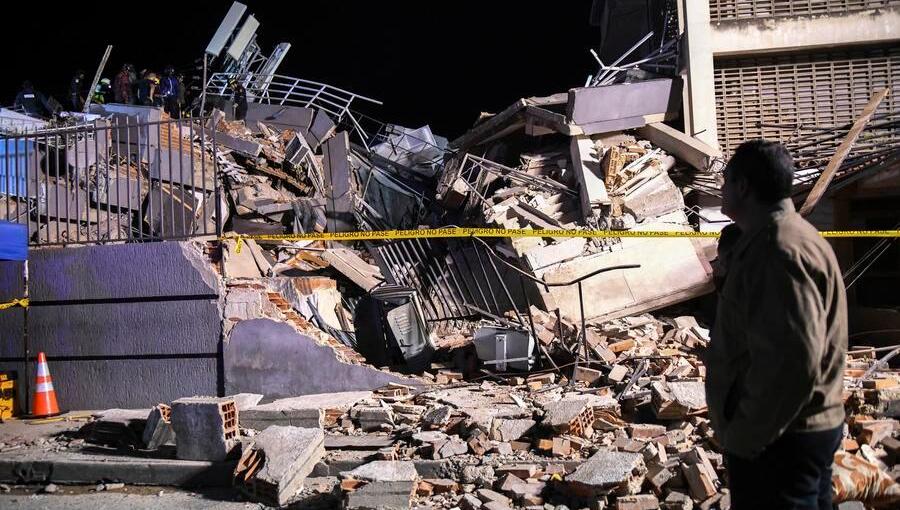
The World Bank has estimated that the devastating earthquakes that struck Venezuela last month caused $19.6bn in direct physical damage, an assessment intended to guide the government and international partners as they plan the country's reconstruction, the multilateral lender said on July 23.

The findings come from a Global Rapid Damage Estimation, or GRADE, which the World Bank said was designed to give an early picture of the scale of rebuilding required and to help prioritise recovery efforts as Venezuela confronts one of the most significant disasters in its recent history.

According to the assessment, 47% of the total damage occurred in residential buildings, with infrastructure accounting for 27% and non-residential buildings for 26%. La Guaira state and the Distrito Capital, which includes Caracas, were the worst-affected areas, together accounting for around half of the total damage.

The bank's figure is less than half the $37bn in direct physical damage estimated by the UN Office for Disaster Risk Reduction, in an assessment released on July 14. That estimate attributed about $24bn of the damage to commercial properties, homes, schools, hospitals and other public buildings, with a further $13bn linked to infrastructure, including $5bn to telecommunications networks alone. The two earthquakes measured 7.2 and 7.5 on the Richter scale and struck the north-central region 39 seconds apart on June 24, according to the report, which covered only direct physical damage and excluded losses from business interruption, emergency response costs and reduced economic activity, suggesting the overall economic toll would be considerably higher.

Building on the GRADE findings, the World Bank carried out a further assessment of the disaster's macroeconomic and social implications, concluding that the pace of reconstruction would be a decisive factor in shaping Venezuela's recovery. Under current levels of public and private investment, the bank said, rebuilding would largely depend on redirecting resources from other investment projects and would remain incomplete even after a decade, with lasting damage to economic activity. A faster reconstruction effort, backed by higher public and private investment, would help limit the economic and social fallout, the assessment found.

"The earthquakes have disrupted lives, damaged critical infrastructure, and created new challenges for Venezuela's recovery," said Susana Cordeiro Guerra, World Bank Vice President for Latin America and the Caribbean. "Recovering effectively begins with reliable evidence. This assessment gives the Government of Venezuela and its partners an early objective foundation for recovery planning, and the World Bank Group is committed to supporting that effort every step of the way."

The World Bank said it was working with the Venezuelan government and development partners, including the Inter-American Development Bank, which shared data used in preparing the report, and the Development Bank of Latin America, to determine what additional technical and financial support would be needed for further damage assessment and reconstruction, drawing on its experience of disaster recovery elsewhere in the region.

Venezuela has separately secured access to $346m from its reserve tranche at the International Monetary Fund to help finance reconstruction, Acting President Delcy RodrĂ­guez said. RodrĂ­guez said the funds would go towards housing, infrastructure and essential public services, and thanked IMF Managing Director Kristalina Georgieva for her support. The release follows the IMF's resumption of relations with Venezuela in April, after a suspension in place since 2019, and leaves the country with close to $5bn in overall IMF assets, including its Special Drawing Rights holdings, IMF spokesperson Julie Kozack has said.

Venezuela's unicameral National Assembly has also passed reforms aimed at accelerating the construction of housing developments as part of the country's rebuilding drive.

That effort is unfolding alongside a US-backed push for a political transition in Venezuela, with Secretary of State Marco Rubio saying formal negotiations between the interim government, which took office following the US capture of then-president Nicolas Maduro in January, and opposition representatives are expected to begin in the first week of August. Washington has already disbursed $180m of a pledged $300m in earthquake assistance, Rubio said, adding that the US was also seeking to help Caracas secure access to international funding and credit for rebuilding.

According to the Venezuelan government’s latest figures, the earthquakes have killed 5,398 people, injured 16,740 and left 23,000 homeless, while damaging 856 buildings, of which 190 collapsed completely.


Iran war closes Hormuz, Bab al-Mandeb simultaneously for first time ever

Iran war closes Hormuz, Bab al-Mandeb simultaneously for first time ever
Oil holds above $100 a barrel as Washington's air campaign against Tehran grinds through a 13th night, Houthi attacks squeeze the last open route out of the Gulf, and the fallout spreads to piracy, insurance and Sudan's food supply. / bne IntelliNewsFacebook
By Ben Aris in Berlin Ben Aris in Berlin July 24, 2026

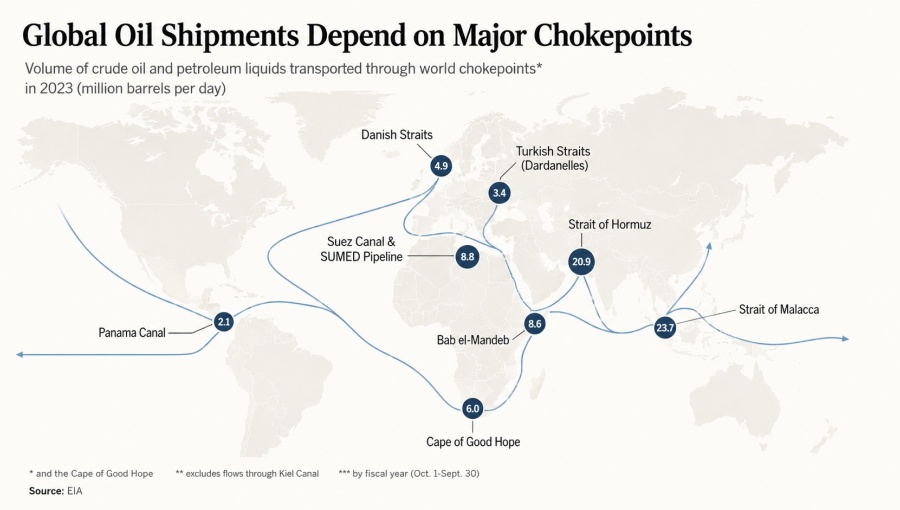
For the first time since records began, both of the Middle East's great oil chokepoints are shut at once. The Strait of Hormuz has been effectively closed since February 28, when the US and Israel opened their war on Iran; the Bab al-Mandeb Strait, at the southern end of the Red Sea, has been under an Iran-backed Houthi blockade since July 20-21, after the militia fired on two Saudi-flagged tankers.

Together the two straits normally carry around a quarter of the world's seaborne oil and gas, according to a Red Sea Monitor analysis citing Kpler and others. As IntelliNews reported, the closing of two of the world’s major maritime transport chokepoints is policy makers’ worst nightmare.

It matters because there is no historical precedent for both chokepoints failing together: Saudi Arabia built its entire Hormuz workaround around shipping oil out via the Red Sea, and that workaround now runs straight through the new embargo.

It has created a multi-front headache: Washington has restarted its bombing campaign against Iran; a scramble by Saudi Arabia to reroute oil the long way around via Suez and Africa; a new and untested US legal manoeuvre to make Iran pay for the damage; and knock-on effects as far afield as Somali piracy and Sudan's food security.

The UN's International Maritime Organization has, for what it is worth, called for calm. “I unequivocally condemn the latest reported attacks on international shipping in the Red Sea area,” IMO Secretary-General Arsenio Dominguez said in a statement on July 24. “These attacks are indefensible... De-escalation is the only solution.” Nobody directly involved shows much sign of listening.

US strikes grind on

The US military struck Iranian targets across the south, southeast and west of the country on July 22-23, US Central Command said, describing it as the 12th consecutive night of strikes — hitting maritime capabilities, missile and drone storage facilities, coastal surveillance sites and air-defence assets as the 60 day Memorandum of Understanding ceasefire definitely collapses. The next day Iranian officials confirmed strikes in Khuzestan, Hormozgan, Bushehr, Sistan-Baluchistan, Kermanshah and Chaharmahal-Bakhtiari provinces; a strike on the Shalamcheh border crossing with Iraq killed two people, including an Artesh communications officer, according to a provincial deputy governor.

Iran's own parliament has tabled a "Hormuz security bill", and a senior Iranian official has already called the closure the central economic cost of the war. Only a single tanker crossed Hormuz on July 24, the lowest daily total since May 7, according to Kpler ship-tracking data cited by Iran International.

Two chokepoints, closed at once

According to the Red Sea Monitor analysis, Saudi Arabia had already rerouted around 70% of its oil exports through its Red Sea terminal at Yanbu to work around the Hormuz closure — and that bypass now runs directly through the new Houthi embargo. The same analysis puts 25% of world oil and gas supply at risk if both chokepoints stay closed, Saudi loadings already down 36% before the embargo even hit, and Bab al-Mandeb's Saudi-linked flow falling from a peak of 9.5mn barrels a day to 6.1mn. A weekly transit chart tracking Bab al-Mandeb traffic, compiled by analyst Anas Alhajji, shows volumes that had been climbing through 2026 dropping sharply in the most recent week.

Iran itself gave warning of wider export-route disruption back in mid-July, and shipping giant Maersk had just sent its first cargo back through the Suez Canal since the war began — a tentative normalisation that the new Houthi embargo now complicates. Yanbu itself was flagged as a potential target amid rising Houthi tensions weeks ago, a warning that reads differently now that the port sits at the centre of Saudi Arabia's only remaining workaround.

The knock-on effect reaches well beyond oil. Port Sudan, 180 miles north of the new embargo line, imports 80% of Sudan's wheat and serves as the sole functioning port for 33.7mn people, per the Red Sea Monitor breakdown — with no Atlantic access, no pipeline alternative and no strategic food reserve to fall back on. Re-routing around the Cape of Good Hope adds more than 30 days and 25%-plus in cost, up to $2.5mn per tanker, which the analysis argues is unaffordable for humanitarian supply chains specifically.

Saudi Arabia's costly detour

With both its main export routes disrupted, Saudi Arabia is falling back on the norther escape hatch of the Suez Canal — a route it has not used as a primary export outlet for decades.

The arithmetic is brutal: sailing from Saudi Arabia's Red Sea port of Yanbu to Taiwan takes 19 days via Bab al-Mandeb but 48 days via Suez, the Mediterranean and the Cape of Good Hope, according to Kpler shipping data, roughly doubling fuel costs to around $2.87mn from $1.26mn per voyage before Suez Canal fees — an extra $1mn — are even added. Big tankers will reportedly have to sail through Suez partly empty and top up in the Mediterranean, given the canal's size restrictions.

One workaround: partially unloading tankers into the Sumed pipeline, which runs 320 km (200 miles) from the Ain Sukhna terminal on the Red Sea to Sidi Kerir on the Mediterranean and can carry up to 2.5mn barrels a day, against Saudi Arabia's total exports of around 7mn b/d. State producer Aramco is already offering extra cargoes from Sidi Kerir to bypass Bab al-Mandeb entirely, according to a widely circulated trader note, in what one analyst called Riyadh "hedging the exact route in question" rather than treating the risk as theoretical.

Washington's to make Tehran pay for the damage

President Donald Trump said on July 23 that damage to ships and cargo hit in the conflict will be “paid for out of Iranian money” the US holds and controls, writing on Truth Social that "any and all damages done to Ships, Cargo, or anything related thereto, will be paid for by Iranian Money that the United States has in its possession, and controls." Iranian Foreign Minister Abbas Araghchi called it "an incendiary precedent," warning that "once governments normalise confiscation, no one's assets are safe."

The legal mechanism has a precedent: in 2016 the US Supreme Court ruled in Peterson v. Islamic Republic of Iran (also known as Bank Markazi v. Peterson) that almost $2bn in Iranian central bank bonds held in New York had to be handed to American families of the 1983 Beirut Marine barracks bombing and other Iran-linked attacks — a ruling that took a law written for that single case plus a Supreme Court decision to enforce. Iran subsequently took the seizure to the International Court of Justice, which found in 2023 that the US had violated a bilateral treaty, though the ICJ ruling has not reversed the transfer. Whether — and how — the Trump administration intends to apply a similar mechanism to today's shipping damages remains legally untested and, per reporting so far, unclear even in its basic scope.

Ripple effects: piracy revives, Somalia in the mix

A merchant tanker, the Tanzanian-flagged MT Asana, hijacked in Yemeni waters in the Gulf of Aden last week, is now reportedly being held by Somali pirates rather than its original Houthi-linked hijackers, Reuters reported on July 23, citing residents of Somalia's Puntland region. It fits a broader resurgence of Gulf of Aden piracy since a lull that ran roughly 2018-2023 — a breakdown of the world's piracy hotspots earlier this year traced the rebound directly to the security vacuum left by Houthi attacks — the same dynamic now playing out again as naval and commercial attention is consumed by the wider war.