Saturday, August 15, 2026

Courage for Peace, Not for War


 August 14, 2026

Photo: Swedish Red Cross.

Can we escape the terrors of our time?

In September of 2025, during a Saturday vigil in Stockholm’s Odenplan Square, Isak Hernández, age nine, asked if he could recite a poem he wrote. Deeply troubled by images he saw, day and night, from Gaza, he resolved not to be silent. “Their lives are not numbers,” Isak declared. “Their dreams are not ashes.” His refrain repeated: “I won’t be silent,” and he begged the world, “Listen to me.”

Isabella Lundgren, a Swedish jazz vocalist, heard Isak deliver his poem. She felt his words had reverberated throughout Sweden. No one could possibly turn away. Everyone, she said, bore the responsibility of witnessing. She and Isak collaborated to turn his poem into a song entitled “Their dreams are not ashes.”

Their witness is crucial for counteracting decisions on the part of countries which have newly decided to enter NATO.

We should acknowledge that NATO has done nothing to stop the U.S. provisioned Israeli genocide or to restrain Israel.

On the contrary, NATO seeks fuller integration of Israel’s “security” into NATO strategies. What’s more, tradebetween Israel and European countries continues.

The Swedish government ought to argue that NATO must force Israel to end their genocide of Palestinian people.

We should note that Israel possesses at least ninety-one thermonuclear weapons which it refuses to declare. Each of these weapons would cause the death of at least six million people – a Holocaust – in a can, waiting to be opened on human civilization’s last day. A planetary omnicide comprising every conceivable genocide, military analysts agree, is almost certain to occur days, hours, or even minutes after any of these weapons are ever again used.

Sadly, Sweden’s hurried entry into NATO in 2024, alongside the rise of armaments industries and even support for nuclear weapons acquisition, compromises Sweden’s historic capacity to resist the rush into unimaginable genocides.

What are the major threats we all face? Surely, the list must begin with the possibility of nuclear annihilation. Next, we must reckon with possible ecological collapse. Following this, we must prepare for outbreaks of new pandemics. And, achingly, we must oppose genocide. War is not the answer. Militarism exacerbates each of these threats.

Now, as corrupt political leaders extract the hard-earned resources of people throughout Europe and pour those resources into bulging coffers of, primarily, U.S. military contractors, it’s crucial to hear Isak Hernández’s pledge not to be silent. We also can learn from the legacy of Sweden’s heroic diplomat, Count Folke Bernadotte.

 As Vice President of Sweden’s Red Cross, during World War II, he witnessed first-hand how prisoners in concentration camps suffered. He resolved to negotiate with SS leader Heinrich Himmler for the release of prisoners. Bernadotte collaborated with Danish, Swedish, and Norwegian relief groups to create the White Buses campaign. Ultimately, they managed to free over 17,000 thousand prisoners from concentration camps.

During World War II, Adolph Hitler, eager as current European leaders for war with Russia, plainly aimed to eliminate the Jews in Europe. He wanted to create “Grossedeutchland,” – “Greater Germany.” The SS had turned into an immense bureaucracy under Himmler’s control, systematically enacting Hitler’s hideous “final solution.” Amid chaotic and extremely dangerous conditions Bernadotte and his team steadily negotiated liberation and transport of prisoners.

Sune Persson records, in Escape from the Third Reich: Folke Bernadotte and the White Buses, the minutes from the May 13, 1945, gathering of the Jewish Stockholm Community. The chairperson thanked the Swedish Red Cross and Count Bernadotte:

“When the assembly now gathers here today, it is with a strong sense of entering a new epoch. These recent times, darker than humanity has ever known them, have reached a climax, so desperately coveted, and we stand –yearning, inquiring, hopeful – on the threshold of a new world…We would like to think at this moment of the admirable rescue operation undertaken by the Swedish Red Cross, bringing thousands of people – among them a considerable number of Jews – here to our country, to liberation from the horrors of the concentration camps and a terrible demise.”

But Bernadotte’s work on behalf of refugees and mediation wasn’t finished. After World War II, the United Nations Security Council unanimously chose Bernadotte to be the UN Security Council mediator in the Arab–Israeli conflict of 1947–1948.

Count Folke Bernadotte’s first report to the Secretary General outlined the desperate plight of Palestinian refugees, nearly a quarter of whom, he wrote, “are simply camped out and living under trees. In most places there was absolutely no sanitary accommodation, and since water was drawn from surface collections, and typhoid was endemic, grave possibilities in this regard at this season of the year were likely.”

He surveyed destroyed Palestinian villages and witnessed long lines of people waiting for food, scarce medical aid, and an ongoing humanitarian disaster. He and U.S. diplomat Ralph Bunche wrote a proposal to meet short-term and long-term needs of refugees. Their plan would allow for fixed boundaries between the Israelis and the Palestinians, with an economic union between the states and assurance that Palestinian refugees could return.

“It would be an offence against the principles of elemental justice,” Bernadotte wrote, “if these innocent victims of the conflict were denied the right to return to their homes, while Jewish immigrants flow into Palestine.”

Boldly and truthfully, Bernadotte drew links between meeting humanitarian needs and creating an environment in which peace could take hold. He insisted the UN must respect the refugees’ “unconditional right to make a free choice.”

Bernadotte’s and Ralph Bunche’s report was submitted to the UN on September 18, 1948, but Bernadotte did not live to present it in person. On September 17, terrorists from an extremist Zionist group, the Stern Gang, ambushed Bernadotte’s motorcade. They fired six bullets into Bernadotte’s body. His colleague, the French Colonel André Sérot was killed by seventeen bullets.

Count Bernadotte’s principled humanitarian work may have cost him his life, but we can choose to continue his legacy.

It’s encouraging to know that the 2026 Stockholm Forum for Peace and Development has recognized a fundamental reality: “many modern security risks, from climate shocks to pandemics and cyber threats, do not have hard security solutions and do not stop at borders. They are, however, further exacerbated when geopolitical rivalries undermine cooperative solutions.”

I hope Count Bernadotte’s inspiring life and Isak Hernández’s compassionate insistence: “I won’t be silent,” will steer us as we reckon with what Dr. King called “the fierce urgency of now.”

Kathy Kelly (kathy@worldbeyondwar.org), Board President of World BEYOND War, co-coordinates the November 2023 Merchants of Death War Crimes Tribunal. She is the author of Other Lands Have Dreams, published by CounterPunch/AK Press.

800+ USA Today Journalists Demand Paper End Deal With Palantir to Collect Reader Data

Not only does the partnership “create an inherent conflict of interest,” it “fails the journalists who have been assaulted and falsely arrested while covering immigration enforcement actions and protests.”


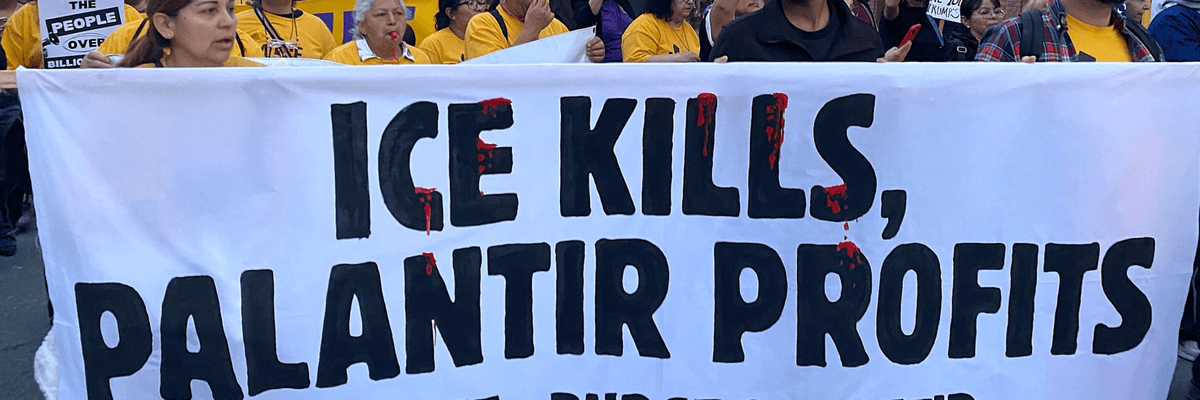
Protesters hold a banner reading, “ICE Kills, Palantir Profits” during a January 20, 2026 demonstration in Palo Alto, California.
(Photo by Dov Baum/American Friends Service Committee)


Brett Wilkins
Aug 14, 2026
COMMON DREAMS

More than 800 unionized journalists and other media workers at USA Today Co. demanded this week that the nation’s largest newspaper chain abandon a newly announced partnership with surveillance tech giant Palantir to collect and analyze reader data, warning that the deal threatens privacy, public trust, and newsroom independence.

USA Today Co. chair Mike Reed told investors during an August 6 meeting that the company, formerly known as Gannett, is working with Palantir to “drive more effective and faster monetization across our platform” by using its software to collect and analyze reader data. Reed did not say how long USA Today had been using the software.

In a statement released earlier this week, workers represented by The NewsGuild-CWA said they were “shocked” by the company’s decision to partner with the controversial data analytics firm. Thirty-one unions representing employees across USA Today Co. publications have called on management to immediately terminate the agreement.

“We have significant ethical issues with Palantir, whose artificial intelligence (AI) software has been used to advance widespread surveillance and power immigration crackdowns,” the union said. “Not only does partnering with Palantir, a major player in the news we cover, create an inherent conflict of interest, but it fails the journalists who have been assaulted and falsely arrested while covering immigration enforcement actions and protests.”


“USA Today Co. has provided minimal details about this partnership and the parameters of its agreement with Palantir,” the statement continues. “We have serious concerns and questions about how readers’ personal information and data will be used under this partnership and how their data would be protected. Without answers, how can journalists encourage readers to subscribe to our news outlets?”

The journalists noted that billionaire Palantir co-founder Peter Thiel—who “once said freedom and democracy were not compatible”—is responsible for products tied to human rights abuses and privacy violations.

“Technologists and even former employees have warned that it’s not far-fetched to imagine a future where Palantir’s AI technology is used to surveil American citizens and target dissidents,” their statement notes. “And throughout history, journalists are often the first to be targeted.”

“These concerns should be reason enough for USA Today Co. to steer clear,” the journalists asserted. “This partnership with Palantir arrives as USA Today Co. executives dive headfirst into AI without sufficient regard for workers or the public after decimating newsrooms across the country.”

“We will continue pushing back on ill-planned attempts to force AI into our newsrooms and onto our readers, who deserve quality, human-led journalism,” they added. “We will advocate for the responsible use of new technologies when it emboldens our journalists and their work instead of shamelessly promoting AI to support profit-driven corporate edicts.”

News organizations increasingly operate not just as publishers, but as data collection businesses. The USA Today journalists’ concerns come against a backdrop of increasingly sophisticated tracking across digital news. USA Today Co.'s own public Data Collection Explorer shows that the company already operates an extensive system for collecting, routing, and analyzing user data across its publications and platforms, including through third-party analytics vendors.

Mike Davis, a reporter for the Asbury Park Press—a USA Today Co. newspaper in southern New Jersey—told NiemanLab that “part of the problem” with the Palantir partnership “is that we know very, very little” about how the company’s software is being used.

“It’s pretty surprising that our company would unilaterally decide to bring in such a controversial partner like Palantir without providing a complete explanation to its employees, most of whom are naturally skeptical journalists,” Davis said.

“An investigative reporter who keeps a ton of sensitive notes, source information, and confidential documents on their devices is going to be naturally concerned about protecting that information, and who could blame them?” he added. “It’s pretty hard to trust management’s intentions when the goalposts shift so often that there’s always a fear that what’s true today won’t be true in six months. We’ve all seen the years of disinvestment in local news, especially in the name of going all-in on AI.”
Green Groups Sue Trump EPA for Approving Toxic Semiconductor Chemicals Amid AI Data Center Boom

“The rush to build more and more data centers is causing harm far beyond the data centers themselves.”


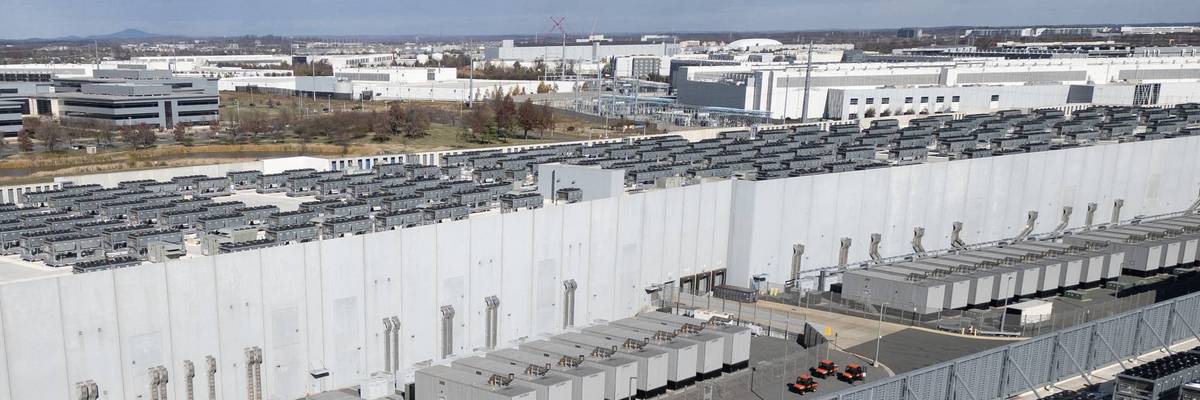
An aerial view shows cooling vent fans on the roof next to generators on the lower level of a Digital Realty data center in Ashburn, Virginia on November 12, 2025.
(Photo by Andrew Caballero-Reynolds/AFP via Getty Images)

Brett Wilkins
Aug 14, 2026
COMMON DREAMS


A trio of green groups on Friday sued the US Environmental Protection Agency over its approval of two new chemicals for semiconductor manufacturing, arguing that the EPA allowed potentially dangerous substances to be sold despite acknowledging significant gaps in its understanding of their health risks.

CHIPS Communities United and the Sierra Club, represented by Earthjustice, filed suit in the US Court of Appeals for the 9th Circuit in San Francisco challenging the approvals. The groups contend that the EPA violated the Toxic Substances Control Act (TSCA) by permitting the chemicals’ use without adequately assessing their risks to employees in semiconductor plants and the communities in which they are located.

According to Earthjustice, the EPA identified potential hazards including cancer, neurological damage, and even sudden death, but also acknowledged that it lacked sufficient information to determine the full extent of those risks. The names of the chemicals are redacted in the complaint—in which they are identified by their EPA premanufacture notice numbers, P-26-0029 and P-26-0045—because the agency has designated their identities as confidential business information.

“The Trump administration is rushing dangerous chemicals to market without the review or the protection that the law requires,” Earthjustice senior attorney Jonathan Kalmuss-Katz said in a statement announcing the lawsuit. “Here, EPA admits that it has not evaluated the full extent of these chemicals’ health risks, yet it is still sending them into communities across the country and leaving the public to discover their effects one doctor’s visit at a time.”

CHIPS Communities United coalition director Judith Barish said: “Neighbors and workers are exposed to toxic chemicals in semiconductor factories. Over decades, workers in chip [factories] have been harmed by workplace exposure and residents of nearby communities have been impacted by hazardous air or water that is contaminated by these chemicals.”

“We call on the EPA to stop approving chemicals that can harm public health without understanding the risks,” Barish added.

As Earthjustice noted:
Semiconductor manufacturing is a major ongoing source of [per- and polyfluoroalkyl substances], a large class of toxic “forever chemicals,” along with other industrial manufacturing sources. PFAS don’t easily break down and can persist in our bodies and the environment for decades or more. Semiconductors are also foundational hardware for artificial intelligence (AI) data centers, affecting many communities in addition to those surrounding the massive polluting chip factories.

The groups’ lawsuit comes over a month after the EPA under President Donald Trump—who campaigned on what critics say was a largely empty promise to “make America healthy again”—and agency Administrator Lee Zeldin approved a fifth “forever chemical” pesticide pushed by industry lobbyists.

“EPA’s approval of these unstudied chemicals is just the latest example of the Trump EPA refusing to follow the legal risk assessment processes under TSCA and prioritizing industry profits over public health,” Earthjustice said on Friday. “Last year, the agency proposed shifts to how it conducts risk evaluations for chemicals already in use and on the market that would let it ignore the real-world risks posed by toxic chemicals.”

Harmful chemicals associated with data center cooling, fire suppression, and production of semiconductors and other electronic components include refrigerants such as Freon and Opteon, Teflon coatings for cable insulation, Krytox for pumps and robotics, and Viton for sealing.

Additionally, as the Natural Resources Defense Council explained, data center cooling systems “can consume vast quantities of water and pollute large quantities of water, depending on the type of cooling system used. For example, evaporative cooling consumes large quantities of water while some immersion cooling techniques rely on harmful chemicals such as PFAS.”

While much critical attention on the lack of guardrails on unchecked AI development has focused on the risks of the technology itself and its economic implications—which experts say includes the shorter-term danger of mass unemployment and the long-term threat that superintelligent machines could one day subjugate or even wipe out humanity—the green groups are highlighting environmental and health hazards amid the worsening climate emergency.

“The rush to build more and more data centers is causing harm far beyond the data centers themselves,” Jane Williams, chair of the Grassroots Network National Clean Air Team at Sierra Club, said Friday.

“From the plants where toxic chemicals are used to make semiconductors, to the roads these chemicals are transported on, and finally to the incinerators where they are disposed, EPA’s approval of these dangerously unstudied chemicals places the public at risk,” Williams added. “These chemicals are suspected to be persistent bioaccumulative toxins, a category of chemicals that contaminate breast milk, cord blood, and the next generation. This action is an assault on the future.”

When the AI Bubble Bursts, Who Will Be Left Holding the Bag?


 August 14, 2026

Photo by Juan Pablo

A new paper making a stir in the financial press spells out the dangers to which private equity-owned life insurance companies are exposed by private credit funds with large portfolios of loans to software and AI companies. It’s a complicated story that could have enormous consequences.

Pranjal Drall and Andrew Granato, the report’s authors, argue that some of these insurance companies could become insolvent if these loans crash. And an unanticipated consequence of a 60-year-old rule that protects insurance company policy holders from losing all of their life insurance benefits or annuity payments could leave taxpayers holding the bag.

Let’s step back to understand some of the backstory. In 2022, I wrote about private equity firms gobbling up life insurance companies, and in 2026 about the risky, high-fee investments these companies were making with people’s life insurance and annuity premiums. Private equity firms are best known for the private equity (PE) buyout funds they sponsor. These funds buy up anything from doctor’s practices to single-family homes to youth sports leagues. PE funds use money committed by their investors as the down payment (the equity) on these acquisitions, and they use lots of debt to acquire companies in what are known as leveraged buyouts (LBOs).

As PE firms diversify their holdings, life and annuity insurance companies are an attractive target because they amass premium income, but may not need to pay out benefits for years or even decades. PE’s interest in owning life insurance companies emerged in earnest in 2009 following the Great Financial Crisis, and accelerated in the early 2020s.

While traditional insurance companies mostly invested premium income in corporate and Treasury bonds, PE firms count on earning high fees for managing risky investments made with these assets, and on profiting from the spread between what it owes policyholders and what its investments earn. There are no legal barriers to private equity-owned insurance companies using their assets to support struggling companies also owned by their PE owner, and no prohibition on selling poorly performing loans of a PE-owned company to an insurance company owned by the same PE firm. PE-owned life insurers also extract value by transferring assets and liabilities to a shadow reinsurer it owns or is affiliated with. This can reduce the insurance company’s tax liabilities, lower its capital requirements and hide the extent of the risk it is exposed to.

Private Credit Funds Make Big Bets on Software and Data Centers

Stricter financial regulations put in place following the Great Financial Crisis were intended to prevent similar catastrophes in the future. The regulations limited the amount of debt that regulated financial institutions could put on a company, crimping the ability of PE funds to use as much debt in LBOs as they wanted. Banks were restricted from making riskier loans, and this resulted in small- and medium-sized companies finding it difficult to get bank financing.  Immediately, private equity firms stepped into the breach and created private credit funds to make direct loans to companies frozen out of public financial markets  Private credit funds are sponsored by investment firms, including PE firms. They are not subject to the regulations intended to make the financial system safer. They operate in the shadows, making risky loans to companies, many of whom don’t qualify for bank loans. Today, private credit funds hold $3 trillion in largely unregulated, high risk, opaque loans many made to companies owned by PE firms.

Private credit funds have been a hot investment for the last 16 or so years. These loans are not subject to the rules that govern corporate bonds. Because the loans are risky, lenders demand a premium and borrowers pay high interest rates a profitable situation that rewards investors in these funds. The funds have bet big on software firms that create code and develop management tools that businesses subscribe to, providing them with multi-billion-dollar loans. The software tools manage various business operations customer relationships, workflow and corporate spending and are collectively known as Software as a Service (SaaS). Private credit funds are also behind the multi-billion-dollar loans to the huge data centers that AI firms are building to train their latest AI models.

Where do these billions of dollars come from? While there are multiple sources of funding for private credit funds including investment banks like Goldman Sachs that are barred from making these loans directly, and pension funds looking for lucrative payoffs private equity-owned insurance companies figure prominently as a source of capital for these funds. Investments in SaaS have been the bread and butter of private credit funds. The recurring income these companies generate from business subscribers have enabled them to make payments on their massive loans; default rates have been low.

But share prices of these software companies cratered in 2026 under pressure from Claude, AI company Anthropic’s code-writing frontier model and other similar models. As a whole, these AI tools are undermining the SaaS business model and challenging the “assumptions around software growth, pricing power and borrower durability.“ Investors in private credit funds worry that many of the SaaS companies will not be able to repay their loans.

Similar doubts are being raised about the construction of super expensive data centers that private credit funds are financing amid rising concerns about an AI bubble and anxiety about what will happen if the bubble bursts. Will many of the data centers become white elephants, deserted by the AI firms that planned to use them to develop new AI models? Will the return on investment in models trained in these expensive data centers justify business spending on these high-cost AI models? Will the much cheaper Chinese AI models out compete the US models and take market share away from American AI companies? These questions are raising doubts about whether all of these loans can be repaid. And if the loans can’t be repaid, what then?

Insurance Regulations Could Bail Out Risky PE Bets 

PE-owned life insurance companies will see their investments in private credit funds crushed, marked down substantially or even wiped out. Private credit default rates above 15 percent may lead some insurance companies to become insolvent and unable to make good on the life insurance payouts or annuity payments promised to beneficiaries.

At that point, state Insurance Commissioners will step in. Rules put in place decades ago to protect beneficiaries of insurance companies enable the commissioners to require the remaining life insurance companies in the state to pay into a special guaranty fund that will make good on the policies held by the beneficiaries of the defunct company, up to a cap of about $300,000 on life insurance and about $250,000 on an annuity. That varies by state. Insurance companies not affiliated with a PE firm and that didn’t make risky bets on private credit will be required to bail out the failed insurance companies that did. And the PE firm that owned the insolvent company will get off scot-free and not have to pay anything. That creates a moral hazard and seems to be a miscarriage of justice.

But the story doesn’t end there. In 44 states, these payments are fully creditable over five years against state taxes on premium income. That means that, ultimately, it is taxpayers in those states that provide the backstop when software and/or AI companies can’t repay their loans to private credit funds, and a private equity-owned insurance company that invested in private credit funds becomes insolvent. The result is, as the report’s authors point out, “a system that socializes losses.”

First published by CEPR.