Tuesday, August 04, 2026

The Most Shocking Climate News of 2026


 August 4, 2026

Image by Casey Horner.

The UK Green Party’s former leader Caroline Lucas recently nailed the Labor Party for “burying the most explosive report” of the year by UK military and intelligence sources. The concealed report warns “that the global collapse of ecosystems poses grave threats to the UK’s security and food supply within as little as five years.” (Source: As Europe Burns, a Climate Cover-Up Continues, The Nation, July 30, 2026)

“The UK ‘has no future’ if it cannot ‘restore the natural world on which we rely for our food, water, and clean air,’ said Chris Hinchliff, who is among the members of Parliament pressing the government to release the full report, rather than a shorter, redacted version. Even that version, which was obtained by The Guardian’s Fiona Harvey, ‘paints a devastating picture of severe food shortages, price rises, migration, political destabilization, and possible war, resulting from the collapse of ecosystems, fueled by the human-induced climate crisis and over-exploitation,” Ibid.

Global collapse of ecosystems, if realized, if in fact it truly happens within five years, is certain to create havoc throughout the world, but no governments, other than this leak of a high-ranking report, has suggested to the public the risks of collapse of ecosystems leading to food shortages with panic and fighting. Why not?

After all, it was only a few months ago that an esteemed panel of UK scientists held a public forum, i.e., UK National Emergency Briefing d/d November 27, 2025, that essentially spelled out the same problem with powerful evidence of near-term collapse of some ecosystems. Why don’t the nations of the world confront the causes and inform the public as soon as possible? In five years, it’ll be too late to inform anybody. The only way to get the public onside to help fight this scourge is to explain the issue to the public and requests they embrace efforts to mitigate.

Spain’s PM recently declared a “climate emergency,” with scorching fires consuming much of the countryside for the second year in a row. PM Pedro Sanchez called on political parties “across the ideological spectrum ‘to reach an agreement, a State pact, (and) to address the climate emergency,” Ibid.

Throughout the EU extreme heat is sucking soils dry and destroying agricultural crops. In America, nearly 50% of the Lower States are in some level of drought. The Rocky Mountain “water towers for the Southwest” experienced dreadfully scattered snowfall and the entire Colorado River Complex that feeds water to 40 million people is broken, Lakes Mead and Powell, the two largest reservoirs in the United States, are at dangerously low levels. The emergency recognized by PM Sanchez is “everywhere as an emergency.” Spain is not alone.

But governments throughout the world are too timid to be effective and thus seduce their constituencies by greenwashing or ignoring reality often in concert with media. They can’t face the truth because they don’t have any good answers or they’re paid off to ignore the truth, to hide it from the public. Sadly, politics are for sale to the highest bidders that could care less about public welfare. If they truly cared, problems like this would already be addressed.

Which is good reason for people to rise up against incompetent leaders. The world is infested with them. For example, “Aides to former Labour prime minister Keir Starmer twice quashed plans to release the UK report… allegedly for fear that the climate-denying Reform UK Party would attack Labour for putting climate concerns ahead of the cost of living,” Ibid. How bloody stupid is that?

“Climate denial persists in the UK media as well: Even as wildfires scorched Europe, the front page of the Rupert Murdoch–owned The Times of London featured a rant against the net-zero emissions goal that scientists say is essential to preserving a livable planet,” Ibid. Oh please, this is beyond stupidity. It’s something worse than stupidity.

This kind of behavi0r by weak-kneed leaders is sickening. It’s insulting to the public. It’s a crime against humanity to fail to tell the truth accompanied by outrageously blatant failure to search for answers, mitigation measures, exploring whatever can be done to protect citizens but alas, at the end of the day, failing to protect them.

This failure of leadership in the world started in earnest for all to see when 195 nations agreed at Paris 2015 that CO2 emissions from burning fossil fuels, oil, gas, and coal cause global warming, and they all agreed to cut these harmful emissions. Today, less than a handful of those original 195 nations will even come close to meeting their obligations. They have failed. The public deserves to know the truth about their failure, and why it unintentionally but ridiculously promotes excessive global heat throughout the planet today.

It’s even worse than that, according to The Nation, most news outlets across Europe are not reporting the “influence of climate change driving the massive fires.” But they are providing images of people having fun on the beach with massive fires raging in the distant background. Oh please!

The Most Shocking Aspect: The Public Knows

“Covering Climate Now’s 89 Percent Project spotlights the reality that 80 to 89 percent of the world’s people want their governments to take stronger climate action. In this summer of smoke and fire, the public is waiting for their politicians and their press to respond. ‘Voters are much more tuned into this than most of our [elected] representatives are,’ author George Monbiot said on the UK’s Channel 4. ‘And indeed than most of the media is,” Ibid.

That’s 80-89% of the world’s people want their governments to take stronger climate action. But ever since WWII, the United States has been the world leader in many respects, especially militarily. It is the only country with military in 80 countries with 750 individual bases. No nation is in such a favorable position to assist the world in fighting battles. Yet, the U.S. is promoting fossil fuels that assist excessive heat whilst ignoring fierce battles against climate-induced wildfires throughout the world. Hmm.

Robert Hunziker lives in Los Angeles and can be reached at rlhunziker@gmail.com.

Morocco

“Almounadila socialiste”: Our ecosocialist and feminist alternative to the crisis of capitalist civilization

Saturday 1 August 2026, by Al Mounadil-a


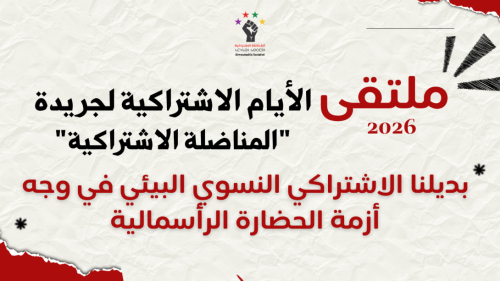
From July 16 to 19, 2026, the headquarters of the newspaper Almounadila socialiste hosted the first edition of “Socialist Days”, a space for political education, strategic reflection and activist exchanges dedicated to the deepening of the revolutionary socialist project.

Organized according to a participatory methodology based on the exchange of experiences, collective discussions and the joint elaboration of analyses, this meeting brought together activists engaged in social struggles in order to strengthen the theoretical and political tools essential for intervention in the current period.

The work focused on the main challenges facing the working class, in its broadest sense, as well as the oppressed peoples, in a context marked by the deepening multidimensional crisis of capitalist civilization, the rise of the new extreme right and reactionary forces, the acceleration of the ecological catastrophe and the generalized offensive against social rights and freedoms.

Faced with this situation, the construction of an ecosocialist, feminist, internationalist and democratic alternative appears more than ever to be a historical necessity.

The training program drew on several fundamental texts of the Fourth International, enriched by discussions on the transformations of contemporary capitalism as well as the political, social and ecological issues facing popular movements. The objective was to better understand the dynamics of the international situation and to draw the consequences for the tasks of revolutionaries, constantly articulating the theoretical elaboration with the concrete experience of the struggles in Morocco and in the region.

The meeting opened with the discussion of the programmatic manifesto of the Fourth International, “Manifesto for an Ecosocialist Revolution – Breaking with Capitalist Growth”. This text shows that extractivist capitalism is leading humanity towards a dead end by destroying ecological balances, depleting natural resources and increasingly subordinating human needs to the logic of profit.

The discussions highlighted the main foundations of the ecosocialist alternative: breaking with capitalist productivism, establishing democratic planning of the economy, respecting the ecological limits of the planet, and redirecting production towards the satisfaction of social needs rather than the private accumulation of capital.

The second session was devoted to the resolution “The new rise of the women’s movement”. The debates focused on the renewal of feminist mobilizations on an international scale, on the perspectives they open up as well as on the challenges they pose to the socialist movement. They reaffirmed that the struggle against patriarchy is inseparable from the struggle against capitalism and all forms of exploitation and oppression. The exchanges also deepened several central notions of socialist feminism, including social reproduction and intersectionality, as tools for analysing relations of domination and developing a strategy of emancipation. Particular attention was paid to the realities of the feminist movement in Morocco and the region.

Another session focused on the resolution “Our orientation and tasks in social movements”. The discussions reaffirmed the need for socialists to contribute to the strengthening of social movements while fully respecting their autonomy, to foster self-organization, grassroots democracy, unity of resistance, and convergence of struggles. The debates also drew on the experience of social movements in Morocco and the region in order to identify their achievements, limitations and strategic lessons.

The Days concluded with the discussion of the resolution “As the crises of capitalism converge, the challenge of how to move forward for those below”. This text analyses the strategic tasks of the socialist movement in a period characterized by the interweaving of economic, social, ecological, geopolitical and democratic crises. It also highlights the contrast between the proliferation of popular resistance around the world and the weakness of a global political alternative, a lasting consequence of the collapse of the bureaucratic regimes of Eastern Europe. The discussions focused on the conditions for the reconstruction of a social and political force capable of carrying out a revolutionary ecosocialist project.

Throughout the Conference, the working method favoured introductory presentations, group workshops, plenary debates and the collective elaboration of summaries. This approach has encouraged the active participation of all activists and a collective enrichment of the texts based on their concrete experiences of struggle.

The Days also reserved an important place for discussions on the political situation in Morocco, the evolutions of the left, the stakes of the next elections and the immediate tasks of militant intervention, with the constant concern to articulate theoretical analysis with concrete political challenges.

Self-management was an essential dimension of this experience. The participants took turns collectively preparing meals, organizing common areas and carrying out the various tasks necessary for daily life in the room. This practice was a political and pedagogical choice: to make training itself a space for experimenting with socialist values, based on equality, shared responsibility, solidarity and the questioning of hierarchical and gendered divisions of work. For revolutionary training does not consist only in the study of texts; it also implies building collective practices that are consistent with the social project that we defend.

This first edition of the Socialist Days confirmed, once again, the urgency of strengthening theoretical and political training in order to understand the transformations of contemporary capitalism and to equip activists with the analytical tools essential to interpreting the world as well as to transforming it. Contributing to the development of the struggles of the working class, women, youth and the entire popular classes, while linking daily struggles to the strategic perspective of overcoming capitalism, remains a central task for all those who campaign for an ecosocialist, democratic and emancipatory society.

The editorial staff of the newspaper Almounadila socialist warmly thanks all the educators, participants and all those who contributed to the success of this initiative. It reaffirms that the Socialist Days are part of a long-term process aimed at deepening theoretical and political training, strengthening militant capacities and bringing the project of revolutionary socialism to life at the heart of social and popular resistance.

Translated by International Viewpoint from lInprecor.

Nicaragua

The Ortega-Murillo Dictatorship Was Not Born of the Revolution

Seven Deadly Sins That Made a Dictatorship


Tuesday 4 August 2026, by Mónica Baltodano


Every anniversary of Nicaragua’s 1979 revolution revives a false choice: either the Ortega-Murillo dictatorship is the legitimate heir of the Sandinista revolution, or the revolution itself led inevitably to today’s regime. This piece rejects both claims. It traces the dictatorship’s origins not to 1979 but to a cumulative sequence of political failures across four decades: the displacement of the revolution’s historic protagonists; the 2000 pact between Ortega’s Frente Sandinista de Liberación Nacional (FSLN, Sandinista National Liberation Front) and the Partido Liberal Constitucionalista (PLC, Liberal Constitutionalist Party) that dismantled institutional checks; the acquiescence of business, religious and international actors who traded democratic guarantees for stability; and the eventual construction of a family-based regime. It insists that assigning this shared responsibility does not exonerate Ortega, and that the April 2018 Rebellion demonstrated the persistence of a democratic current independent of any single ideological lineage. [AN]

Acknowledging shared responsibility for the emergence of the Ortega-Murillo dictatorship does not diminish the responsibility of Orteguismo: the political system and practices built by Daniel Ortega and Rosario Murillo, as distinct from Ortega the individual.

Every 19 July, the same debate returns. The Ortega-Murillo dictatorship insists on presenting itself as heir to the Sandinista Popular Revolution. At the same time, part of the opposition accepts that narrative and ends up reinforcing it by asserting that the current regime is nothing more than the logical consequence of the 1979 revolution.

Both versions are profoundly mistaken.

The dictatorship that oppresses Nicaragua today was not born of the Revolution. It was born of the progressive concentration of power, the abandonment of democratic principles, and the ethical degradation of a section of the leadership that ended up betraying the ideals it claimed to represent. The Revolution did not engender this dictatorship. It was engendered by the seven deadly sins of politics.

Memory too can be hijacked.

The insurrection that culminated on 19 July 1979 was not the exclusive work of a vanguard, still less of a small group of leaders. It was a national rebellion against a regime that had exhausted all legitimacy. Peasants, students, workers, business people, people of faith, intellectuals and citizens with no political affiliation all took part. Thousands of young people even gave their lives to make it possible. As with great historical events, the Revolution became possible only once it had become inevitable.

Reducing that feat to the figure of Daniel Ortega is one of the greatest falsifications of Nicaragua’s recent history. One need only look at who actually led the Revolution and where they are today. Many of its historic leaders broke with Ortega long before April 2018. They were persecuted, imprisoned, stripped of their nationality, or forced into exile. Others died in prison under persecution by the very regime that now claims to appropriate their legacy.

Rosario Murillo understood years ago that memory, too, is a space of power. That is why she systematically displaced the historic protagonists and built a political apparatus made up, in many cases, of people who never took part in the struggle against Somoza [1] — including some former collaborators of the overthrown regime. The irony is devastating: those who fought one dictatorship ended up persecuted by another that speaks in their name.

Revolutions can defeat a dictatorship without yet having built a democracy.

The 1979 Revolution grew out of a broad national consensus and extraordinary popular participation, expressed in the National Literacy Crusade [2], community health programmes, agrarian reform, and an exceptional flourishing of culture, education, music and poetry. It also sowed a far more active citizenry, which after the 1990 electoral defeat would find new expressions in feminist, environmental, municipalist and citizens’ rights movements.

None of this means turning the Revolution into a perfect process. That would be as false as the official narrative. Every revolution has its light and shadow. So does Nicaragua’s.

Its history cannot be analysed while ignoring the war promoted by the Reagan administration, the armed aggression of the counter-revolution [3], or the enormous tensions the new government faced. But nor can its own errors be concealed: human rights violations, repression against Indigenous and peasant communities, restrictions on public freedoms and, above all, the growing concentration of power in a small group of commanders. It was perhaps there that one of the most important lessons history left unresolved began to take shape.

Responsibility, however, does not end there either.

After the 1990 electoral defeat, Nicaragua had the opportunity to build a solid republican democracy. But economic policies that deepened inequality, the failure to heal the wounds of war, and the absence of genuine national reconciliation fed the resurgence of caudillismo [4] under the populist figures of Arnoldo Alemán and Daniel Ortega. At the same time, credit must be given to the democratic commitment of governments such as those of Violeta Barrios de Chamorro and Enrique Bolaños [5], who never imprisoned or persecuted their adversaries for political reasons.

History shows that authoritarian populisms, whether of the right or the left, thrive when democracies fail to respond to the population’s needs. It was on that fertile ground that Ortega reappeared. And once that process was under way, too many actors chose to accommodate themselves to it.

Sixteen years later he returned to the presidency. But the regime he built no longer represented the continuity of a revolution; it represented the triumph of the true sins that made the new dictatorship possible: caudillismo, corruption, the arrogance of absolute power, the greed to perpetuate oneself in government, the cult of personality, lying turned into state policy, and impunity as a system.

None of these ills was born in 1979. They grew over decades until they produced the regime that oppresses Nicaragua today.

Liberals, Social Christian sectors, conservatives and Contras struck pacts. Big capital prioritised the stability of its business interests. Important sectors of the religious hierarchies legitimised the new strongman. International bodies played down the signs of institutional deterioration, and part of the international community even went so far as to present the Nicaraguan model as an example of governability.

Meanwhile, Ortega dismantled democratic guarantees one by one, captured the electoral system, subordinated the other branches of the state, and prepared the establishment of a family regime [6].

This is why it is intellectually insufficient to claim that the current dictatorship is simply a consequence of the Revolution.

No.

It is also a consequence of the pact with Arnoldo Alemán [7]; of institutionalised fraud; of business silence; of religious complicity; of international indifference; of the errors of democratic Sandinismo itself; and of the collective failure to defend republican institutions in time.

Acknowledging that shared responsibility does not diminish the responsibility of orteguismo. It explains it. It allows us to understand how a society can lose its freedoms gradually, until one day it discovers that almost all of them have disappeared.

The April 2018 Rebellion showed, however, that democratic memory was still alive. Barricades, marches, territorial organising and even old slogans reappeared as the expression of a citizenry that once again said enough [8]. It involved young people who had not been born in 1979, alongside former Sandinistas who once again confronted another dictatorship. The struggle ceased to belong to an ideology and returned to belonging to the nation.

That may be the greatest lesson of our recent history.

Dictatorships do not always erupt through a coup d’état. Many are built slowly: they concentrate power, destroy institutional checks and balances, normalise corruption, and feed on complicity and silence. That is an uncomfortable truth, but an indispensable one if we want to offer the new generations an honest account of our history.

The 1979 Revolution may be remembered, as Ernesto Cardenal [9] put it, as a lost revolution. Others consider it a betrayed revolution. Perhaps both claims contain part of the truth. What history cannot accept is that the Ortega-Murillo dictatorship be presented as its inevitable outcome.

Revolutions do not inevitably produce dictatorships. What produces them is the absence of limits on power; the abdication by institutions of their role; fear turned into a form of government; and the decision of too many people to accommodate themselves rather than resist.

That was the true seed of orteguismo.

The lesson for new generations is not to renounce the ideals of social justice and freedom that mobilised thousands of Nicaraguans in 1979. It is to understand that no cause, however noble, justifies the concentration of power in a single man or a single family.

Because democracy rarely disappears overnight. It is lost slowly, every time a society tolerates someone placing themselves above the law.

And it is also recovered slowly, when a people decides that fear will no longer govern its destiny.

In exile, July 2026.

17 July 2026

Translated and annotated by Adam Novak for ESSF from Confidencial Digital.

P.S.

If you like this article or have found it useful, please consider donating towards the work of International Viewpoint. Simply follow this link: Donate then enter an amount of your choice. One-off donations are very welcome. But regular donations by standing order are also vital to our continuing functioning. See the last paragraph of this article for our bank account details and take out a standing order. Thanks.

Footnotes

[1] The Somoza family ruled Nicaragua from 1936 to 1979; the last of the dynasty, Anastasio Somoza Debayle, was overthrown by the Sandinista-led insurrection culminating on 19 July 1979.

[2] Cruzada Nacional de Alfabetización (National Literacy Crusade), 1980: a mass campaign that reduced Nicaragua’s illiteracy rate from around 50% to approximately 13% within five months, using thousands of student and volunteer teachers ("brigadistas").

[3] The Contra war (1981–1990): a US-funded and -armed counter-revolutionary insurgency against the Sandinista government, authorised under the Reagan administration and condemned by the International Court of Justice in 1986 for violations of international law against Nicaragua.

[4] Caudillismo: a Latin American political tradition of personalist rule by a strongman ("caudillo") whose authority rests on personal loyalty and patronage networks rather than institutions.

[5] Violeta Barrios de Chamorro (president, 1990–1997) defeated Daniel Ortega at the ballot box in 1990, ending the Sandinista government; Enrique Bolaños (president, 2002–2007) was a Liberal Party leader whose government prosecuted his predecessor Arnoldo Alemán for corruption.

[6] Statement by the Executive Bureau of the Fourth International, "Nicaragua’s capitalist and authoritarian regime ’bans’ elections", Europe Solidaire Sans Frontières, 24 July 2026, https://www.europe-solidaire.org/spip.php?article79536

[7] The "pacto" (2000): a power-sharing arrangement between Ortega’s FSLN and Alemán’s PLC that reformed the constitution and electoral law, lowering the threshold for winning the presidency in the first round and distributing control of state institutions, including the judiciary and electoral council, between the two parties.

[8] For first-hand accounts from this period, see BALTODANO Mónica, "Nicaragua: Monica Baltodano Describes her New Year’s Eve Visit to the ’La Modelo’ Prison", Europe Solidaire Sans Frontières, 3 January 2019, https://www.europe-solidaire.org/spip.php?article47411; and BALTODANO Mónica, KOROL Claudia, "Nicaragua : « Non à l’ingérence étrangère. Seul le peuple... »", Europe Solidaire Sans Frontières, 28 December 2018, https://www.europe-solidaire.org/spip.php?article47333

[9] Ernesto Cardenal (1925–2020): Nicaraguan Catholic priest, poet and Sandinista Minister of Culture (1979–1987), later a critic of Ortega’s government.