Sunday, February 16, 2020

The Hole in the Wall, The Dead Curator’s Diary, and the Strange Case of the Missing Masterpiece

HOLE IN THE WALL GANG

The truth about why Klimt’s 1917 “Portrait of a Lady” was found hidden in a museum wall in Italy may lie in the dead curator’s secret diaries.


Barbie Latza Nadeau
 Correspondent-At-Large Feb. 16, 2020 


Photo Illustration by Elizabeth Brockway/The Daily Beast/Getty/Gustav Klimt

ROME—In late 1997, just a few days after thieves allegedly fished Gustav Klimt’s Portrait of a Lady through a skylight just days before it was to be exhibited at the Ricci Oddi Modern Art Gallery, Stefano Fugazza wrote a strange passage in his diary.

The world’s attention was on the little museum Piacenza, Italy, after the audacious heist, and Fugazza, who was curator at the time, clearly needed to put his thoughts in order. “I wondered what could be done to give the exhibition some notoriety, to ensure an audience success like never before,” he wrote in black pen. “And the idea that came to me was to organize, from the inside together with police, a theft of the Klimt, just before the show, for the work to then be rediscovered after the show began.” In parentheses he adds, “Exactly, my God, what happened.”

The Craziest Twist Yet in the Saga of a Stolen Masterpiece
ART OF THE STEAL


Barbie Latza Nadeau



Fugazza then outlined the various stages of the investigation, essentially a tick-tock of what it was like to wade through the labyrinth of murky bureaucracy that often comes with Italian police investigations. Police say they would have never agreed to a hoax such as Fugazza suggested in his journal. He ended the passage with something that slaloms the line between confession and astonishment. “But now The Lady has gone for good, and damned be the day I even thought of such a foolish and childish thing.”

Throughout the years, the mystery of the painting became an obsession for Ermanno Mariani, who has written a book about the disappearance and has always harbored a suspicion that Fugazza knew more than he let on. “It just can’t be that the thieves acted alone,” he told The Daily Beast. “Whoever took The Lady had free reign inside the museum, that is for sure.”

In early December last year, the $65 million painting was found hidden in a utility box in an exterior wall of the museum. It is not yet clear whether someone tipped a worker to where it might be hidden under a thick growth of ivy.

A month later, in January, guilty thieves wrote to Mariani and confessed in large block print that they had placed it there out of moral duty—and to bargain a lighter sentence on another theft. Mariani turned the letter over to police, who have since questioned the thieves.

But prosecutors in Piacenza aren’t buying the story and have placed Fugazza’s widow Rossella Tiadina under formal investigation after her husband’s diaries were entered into evidence. Police tell The Daily Beast that they don’t necessarily think Tiadina was in on the mysterious theft, but they do want to know if her husband had hidden the painting in the family home. If she had lived in a house with stolen goods for 23 years, she could be found complicit in a coverup of the crime. Unless, of course, she cooperates with investigators.

The painting is now safely back in the hands of Italy’s culture ministry, where it has gone through a series of checks by experts who have confirmed its authenticity. One of the reasons the work was so highly celebrated—and easy to authenticate—is that it is actually a “double” painting. For years, art collectors thought that an earlier work by the Viennese artist called Portrait of a Young Lady had been stolen, but a young restorer discovered that it was actually painted over to create Portrait of a Lady. The earlier painting is thought to be of Klimt’s young lover, who died suddenly.

But experts are also studying how the painting was housed for more than two decades. Was it kept in an unsafe environment, such as one might expect from career thieves like the men who confessed? Or was it carefully wrapped up and preserved in a hermetically sealed environment, which is what someone in charge of a museum would be more inclined to do? This, they say, is key to determining whether Fugazza’s diary entry was actually a confession.

Police also are looking closely at the financial dealings of Fugazza and Tiadina. There is some credible speculation that Fugazza may have indeed commissioned the thieves to steal the painting to drum up interest in an upcoming exhibit. As Fugazza’s diary suggests, the plan would have been for them to return it, perhaps even put it in a hole in the museum wall, right before the exhibit was set to open.

But that did not happen. So investigators wonder if the thieves then came up with a plan of their own and blackmailed the curator for all these years. Once he and his wife were out of money, they may have been decided once again to return the painting to the museum, almost as if it never left in the first place.

---30---
Disney Sued by Labor Union for Failing to Pay Living Wage: Employees Have to ‘Live in Their Cars’
MOUSE HOUSE   

Photo Illustration by The Daily Beast/Getty/George Rose

“A lot of [workers] have to live in their cars, on people’s couches, because they can’t afford the rent on that wage in the City of Anaheim.”

Tarpley Hitt
 Reporter
Published Dec. 11, 2019

There’s an old Walt Disney quote, a favorite of workplace morale posters and business self-help books, that goes: “You can design and create, and build the most wonderful place in the world. But it takes people to make the dream a reality.” These days, there are a lot of people making the Disney dream a reality—a study of the Disneyland Resorts last year found that 27.2 million people visited the California theme park in 2016 alone, thanks to the 30,000 workers who keep the place up and running.

But a new class action lawsuit, filed Friday in California Superior Court and announced in a press advisory Monday, argues that the Walt Disney Company, worth approximately $130 billion as of this year, failed to pay hundreds of those workers a living wage. The complaint was filed by five Disney employees on behalf of more than 400 hospitality workers, accusing the Walt Disney Company and several affiliates (Walt Disney Parks and Resorts U.S. Inc., Sodexo Inc., SodexoMagic, LLC, and 100 unnamed Does) of “unlawful conduct and unfair business practices.” The plaintiffs are asking for back wages, restitution, and damages, which their attorney, Randy Renick, said may be significant. “With the back pay,” Renick said, “we’re talking millions of dollars.”

“A lot of [workers] have to live in their cars, or on people’s couches, because they can’t afford the rent on that wage in the City of Anaheim,” said Kathleen Grace, a plaintiff in the case and a Starbucks barista employed by Sodexo, which Disney contracts to operate its backstage food and beverage services. “It’s really sad to see. A lot of times, they’re choosing to feed their families or put gas in their car to come to work.”

The L.A. Hotel Where Workers Wade Through Literal Sh*t
LABOR PRACTICES


Tarpley Hitt


Why Martin Scorsese’s War on Marvel Actually Matters
TRUTH TO POWER


Cassie Da Costa


The case concerns an initiative called Measure L, which Anaheim voters passed in November of 2018. The ballot measure requires resort employers that received tax rebates from the city to pay their employees a $15 living wage. The new wage was supposed to go into effect Jan. 1, 2019, and increase by one dollar each year until Jan. 1, 2022. By 2023, the code states, the wage increases would change to reflect rising costs of living. The ballot measure was backed by the Coalition of Resort Labor Unions, a group of 11 local unions representing 17,000 workers, or more than half of Disney employees. In a press advisory Monday, the CRLU came out in support of the workers’ class-action case.

The complaint argues that Disney and its contractors took “massive” subsidies from the City of Anaheim, but did not alter their wages or overtime pay to reflect the new law. Grace, who came out of retirement in August of 2016 to work for Sodexo, said she makes $14.25 an hour. Many of her co-workers, including food servers, banquet servers, bellhops, and doormen at the three Disney hotels, earn as little as $12 an hour. Other plaintiffs in the case include Thomas Bray, a bell person at the Disneyland Hotel, who earns $12.25 an hour; Regina Delgado, a cashier at the Plaza Inn restaurant inside the Disneyland theme park who made $12 an hour until October; Alicia Grijalva, a make-up stylist at the park who earned $12 an hour until July; and Javier Terrazas, a banquet event server who makes $12 an hour.

“We shouldn’t have to struggle living paycheck to paycheck,” Grace said. “We all are trying to pay our rent, feed our families, get gas to drive here and there. We shouldn’t have to make the choice between putting gas in our car to get to work and feeding our family.”

We shouldn’t have to struggle living paycheck to paycheck. We all are trying to pay our rent, feed our families, get gas to drive here and there. We shouldn’t have to make the choice between putting gas in our car to get to work and feeding our family.


When Measure L was first drafted, Disneyland Resort fell squarely among the employers it would affect. At the time, Disney had two deals with the City of Anaheim which would have qualified them for the living wage law: a $267 million tax rebate to build an additional luxury hotel; and a 30-year entertainment tax break in exchange for investing $1 billion into their existing resorts. Just one month before the measure passed, however, Disney terminated both agreements, leaving their status under Measure L uncertain. At the time, the Los Angeles Times noted that the last-minute pull-out effectively ensured the billion-dollar corporation would not have to pay workers a living wage.

But those weren’t the only deals Disney has made involving public money. A Los Angeles Times investigation from 2017 found that the company had secured rebates and other incentives from the city worth more than $1 billion (Disney disputed the estimate). In the lawsuit, the workers specifically point to a subsidy from 1996, when Disney received over $500 million in tax rebates from Anaheim to help build California Adventure, the second Disney-owned theme park after the original Disneyland. The bulk of that money came in the form of municipal bonds, borrowed from the Anaheim Finance Authority, which were used to construct a $108 million parking facility. Since its construction, Disney has kept all the revenue from the garage, which low estimates put at around $35 million annually, but leases the garage from the city for just one dollar a year. “Disney got a rebate of the best kind,” the complaint states. “It got its taxes back before it paid them.”

Disneyland park in Anaheim, California
Paul Hiffmeyer/Getty

Still, the case hinges on the definition of “rebate.” In a report from October 2018, the Anaheim City Attorney argued that “rebate”—though not defined in Measure L or set at a fixed legal definition—meant “discount.” Under that definition, he wrote, the 1996 transaction did not qualify, rendering Disneyland exempt from paying a living wage. Disneyland spokesperson Liz Jaeger echoed the findings in a statement: “The union coalition is well aware that the City Attorney has previously looked at this issue,” Jaeger wrote, “and clearly stated that Measure L does not apply to the Disneyland Resort."

The theme park also alleged that all non-tipped workers already earn a minimum of $15 an hour and can get overtime pay. Grace and Renick disputed that claim, pointing out that two of the plaintiffs made just $12 an hour, and that many workers who make less than $15 an hour do not receive tips. “We are not tipped employees,” Grace said. “Sodexo doesn’t allow tips. I was told that was a Disney policy, but I’m not clear. We do not receive tips.”

“It’s important to know that the law doesn’t distinguish [between tipped or non-tipped employees],” Renick said. “You have to pay the minimum wage, or in this case the living wage, to all employees—whether tipped or not. California Constitution actually requires that… There are quite a number of folks in the class who are not tipped employees who are making less than $15 an hour.”

The 2018 survey of Disneyland Resort workers, or “cast members” as they’re called, found that 73 percent of employees “do not earn enough money to cover basic expenses every month.” Conducted by the Occidental College Urban & Environmental Policy Institute and underwritten by the CRLU, the report surveyed more than 5,000 Disney Resort employees. More than half reported concerns of being evicted from their homes or apartments; two-thirds said they were food insecure; and 11 percent said they had been homeless in the past two years. In the latter category, 13 percent were living with young children.
The Scandal Rocking California’s Weed Industry

Chris Roberts,
The Daily Beast•February 15, 2020
Photo Illustration by Sarah Rogers/The Daily Beast /Photos Getty

Sometime in 2018, a Chicago-area union honcho named Joseph Senese started showing up at cannabis industry mixers in California.

Senese represented himself as a leader of the National Production Workers Union, an Illinois-based outfit. As he put it to curious cannabis business owners and consultants, the union was getting into weed with a new California-based local called “ProTech Local 33.” The idea was to help West Coast cannabis businesses fulfill a labor-friendly licensing requirement necessary for them to obtain a state permit and open up shop.

To Johnny Delaplane—an Illinois native and partner in Berner’s on Haight, the first legal weed store in San Francisco’s Haight-Ashbury—ProTech Local 33 sounded great. Or at least a fine option to satisfy local authorities with what’s called a “labor peace agreement” (LPA), essentially a promise between management and a union to not sabotage organizing efforts.

But when Delaplane and his partners submitted their signed LPA to the San Francisco Mayor’s Office of Economic and Workforce Development for final approval, there was a problem: Their new union partner, according to the city’s workforce development director, might not actually be a union.


Not only had nobody heard of ProTech Local 33—the group is not a member of state or local labor councils or federations—but it didn’t appear to have any members. Even worse, the office found “several articles and court cases” suggesting ProTech was a “company union,” a so-called labor outfit actually controlled by employers. For these reasons, MOEWD Workforce Director Joshua Arce wrote in a December email obtained by The Daily Beast, ProTech had not cleared the threshold of being a “Bona Fide Labor Organization.”

A Drop of Cannabis Oil Could Land This Pennsylvania Woman in Jail

The episode has touched off a furor in California labor and in the larger cannabis industry—which, with more than 250,000 workers nationwide, most of whom are engaged in low-wage retail or agricultural work, represents a potential bonanza for organizers. So far, however, with the exception of some limited wins by the United Food and Commercial Workers and the Teamsters, organized labor has failed to make many inroads into cannabis, much as it has struggled to make much major headway organizing skilled workers at Silicon Valley powerhouses like Google and Facebook.

The strange saga of a weed labor organizer from the Midwest poking around the local scene doesn’t seem to be making it any easier.

When things went wrong for ProTech in San Francisco, Senese struck back. In a blistering letter obtained by The Daily Beast, he suggested ProTech’s rejection was made at the behest of other existing labor organizations incensed at a newcomer encroaching on their turf. “This smacks of collusion,” he wrote, insisting the Production Workers had been operating in San Francisco and in California “for over 20 years.”

But while ProTech Local 33’s website lists a phone number and an address at an office park in Bakersfield, a hardscrabble city in that state’s Central Valley, several calls over a period of days to a number listed on the website were not returned. That’s because that office has been closed, Senese explained to The Daily Beast in a telephone interview Thursday from Illinois, where he said he orchestrates West Coast organizing efforts.

Those efforts are on the up-and-up, he insisted.

In addition to the dispensary in San Francisco, ProTech has signed “close to 100” LPAs with other California cannabis businesses and has actually organized workers at five shops, Senese said, including distribution and processing centers. (“Don’t hold me to that number,” he cautioned of the “100” figure.)

The fact that none of ProTech’s members appear in any labor filings reviewed by San Francisco regulators can be explained by the fact that the union was only chartered a year ago, in January 2019, and none of that data has been reported yet, he added.

Asked to name any of the outfits he’d organized, Senese declined. “That’s not something most unions talk about,” he told The Daily Beast. (Most other unions, for what it’s worth, do talk about organizing victories, extremely publicly.)

Nor would he name any other cannabis businesses with whom his shop had signed labor-peace agreements, except to say that ProTech Local 33 was active “from San Diego to Sonoma” County, north of San Francisco. Senese specifically claimed to have signed other LPAs with San Francisco-based cannabis businesses.

The Daily Beast struggled mightily to verify these claims. Labor organizations in Los Angeles and San Francisco, the state’s two most prominent cities with thriving cannabis industries, did not appear to be familiar with ProTech. “We have not heard about any union called ProTech,” Christian Castro, a spokesman for the Los Angeles Labor Federation, told The Daily Beast in an email. “They are not affiliated with us or the AFL-CIO.” Rudy Gonzalez, executive director of the San Francisco Labor Council, likewise said he’d never heard of ProTech Local 33.

In California’s state Capitol of Sacramento, Jerome Parra, a spokesman for Assemblymember Rob Bonta, who authored the cannabis regulation bill that contains the labor-peace language, said he was also not familiar with the organization.

The union was news to cannabis regulators in other cities, too. Rayna Plummer, a spokeswoman for the Los Angeles Department of Cannabis Regulation, said her office had never heard of ProTech—and that it did not have any LPAs on file for any of the city’s hundreds of permitted cannabis operations. (In an email, Alex Traverso, a spokesman for the state Bureau of Cannabis Control, said any information his agency might have about ProTech would be in pending license applications, and thus not subject to open-records laws.)

For his part, Delaplane, who runs the San Francisco Cannabis Retail Alliance, a network of weed sales permit-holders and permit-seekers in that city, said he “did not know” of any other LPAs signed with ProTech among his members.

ProTech also departs from typical union tradition with its membership in a trade group representing business owners. ProTech is the only labor outfit that’s a member of the California Cannabis Industry Association (CCIA)—Senese even ran for a position on its board, and lost—which recently circulated a white paper instructing owners on how to sign business-friendly labor peace agreements.

Disney Sued by Labor Union for Failing to Pay Living Wage: Employees Have to ‘Live in Their Cars’

Josh Drayton, a spokesman for the CCIA, declined to discuss ProTech, including whether the association vetted it before accepting payment for the union’s membership, and similarly declined to discuss the memo aside from denying engaging in any union-busting activities. ProTech had been a member of the National Cannabis Industry Association, spokesman Morgan Fox confirmed, but the organization’s membership lapsed in September.

Privately, labor officials have suggested National Production Workers, and, by extension, ProTech, is a business-friendly front meant to help companies meet state labor requirements without ever intending to allow workers to organize. Indeed, ProTech appeared to dance very close to the definition of “a company union”—ersatz worker organizations set up by management to crush organizing efforts before they can begin—which have been banned under federal labor law since the 1930s.

“This ‘union,’ and you can put that in quotes, does not look on the face of it to be a ‘bona fide labor organization,’” said Ken Jacobs, director of the University of California-Berkeley Labor Center.

“You’ve got a union that doesn’t appear to have many, or any members, is offering a labor-peace agreement that is extremely favorable to companies, and matches the criteria put forward in an anti-union memo from the industry association,” said Jacobs, who added that ProTech appears to be following a well-established pattern of anti-organizing behavior.

“It looks to me like San Francisco made the right call,” he added.

Senese defended his reputation and National Production Workers. “This union has never ever been found guilty of anything,” he said Thursday. San Francisco “was throwing the whole kitchen sink at us” in an effort to reject the LPA, he added.

For now, he said, he would let the matter sit. But “if another one of my peace agreements gets rejected,” Senese vowed, “I will take legal action.”


Read more at The Daily Beast.
Disease found in 66-million-year-old dinosaur tail that still affects humans today

Israeli researcher says find is a world first


‘This is the first time this disease has been identified in a dinosaur,’ said lecturer Dr Hila May ( SWNS )
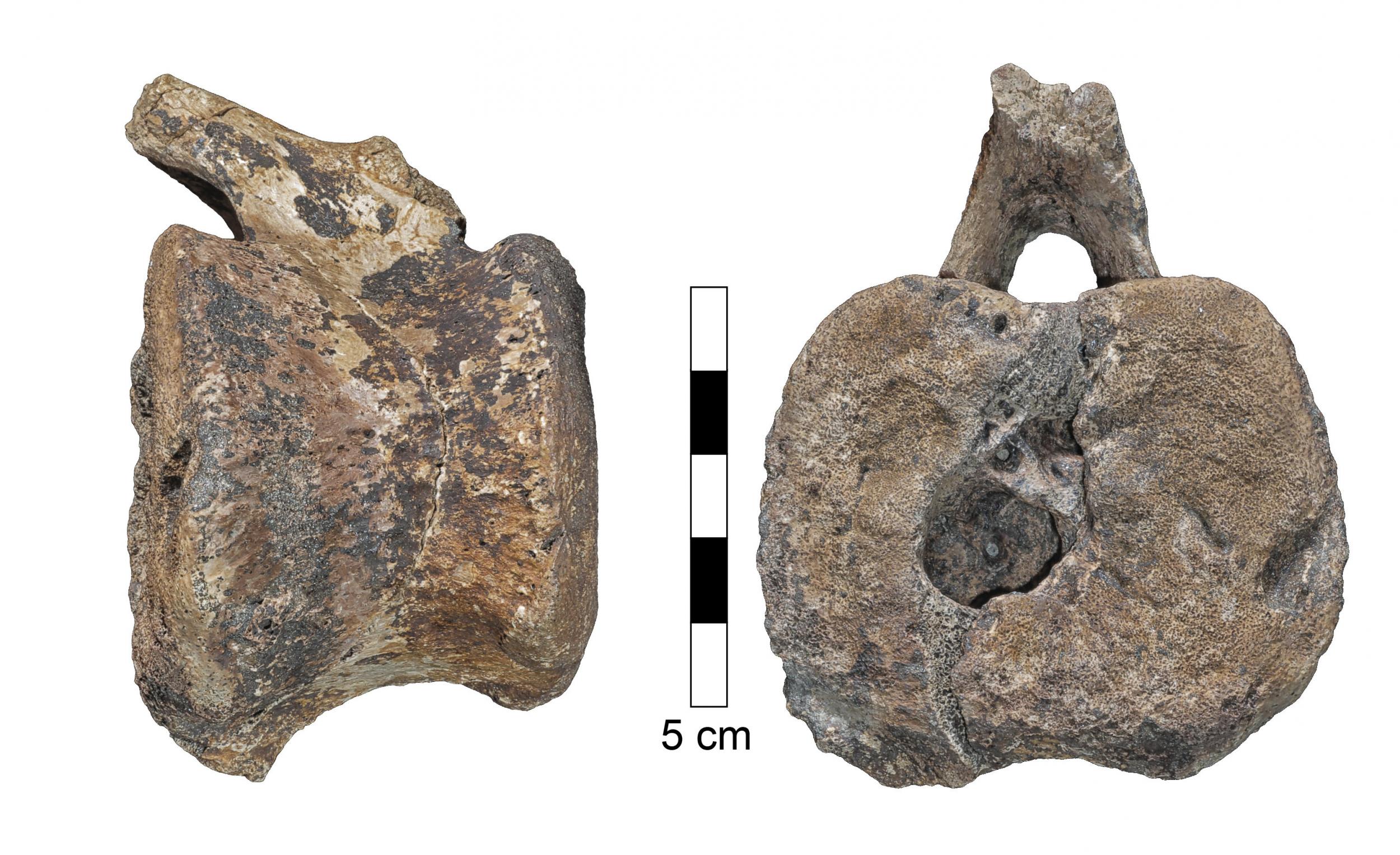
A disease which still affects people today has been discovered in the fossilised tail of a dinosaur that lived over 66 million years ago.

The discovery came after a tumour was found in the vertebrae of a young dinosaur which had been unearthed in Alberta, Canada.

Following a micro-CT scan of the tail in Tel Aviv, Israeli researchers created a reconstruction of the tumour.

They identified the disease as Langerhans cell histiocytosis (LCH), which is a rare condition that is sometimes classified as a cancer.According to the NHS, LCH is an “unusual condition” which displays “some characteristics of cancer.”

It is also recognised as a cancer by the National Cancer Institute, a US government agency.

Dr Hila May, a lecturer in anatomy and anthropology at Tel Aviv University, said large cavities in two sections of the dinosaur’s vertebrae were “extremely similar” to those produced by LCH.
Dr May said that further analyses confirmed it was LCH, adding: “This is the first time this disease has been identified in a dinosaur.”

The researchers think their findings could help the study of evolutionary medicine, which looks at the behaviour and development of diseases over time.

Israel Hershkovitz, also of Tel Aviv University, said: “We are trying to understand why certain diseases survive evolution with an eye to deciphering what causes them in order to develop new and effective ways of treating them.”

---30---
Modern slaves and more than 1,400 cannabis plants found during Sussex drug raids

WAR ON DRUGS REVIVES THE SLAVE TRADE

Police estimate value of plants at £1.2m as hunt for members of drug network continues

Lizzie Dearden
Home Affairs Correspondent

Some of the 1,400 cannabis plants that have been seized by police after a series of raids in Sussex over the first two weeks of February ( PA/Sussex Police )

Cannabis plants worth £1.2m have been seized in a series of drugs raids across Sussex.

More than 1,400 plants were found at 10 properties, sparking seven arrests and the discovery of four potential modern slaves.

Sussex Police said the investigation was triggered by a report of a break-in at a property in Tennyson Road, Crawley, on 2 February.


Police who responded to the call found around 800 cannabis plants and equipment used for their cultivation.


Two men were arrested and interviewed, before warrants were executed at nine other properties.

Modern Slavery in the UKShow all 13


Detective Inspector Cheryl Lewendon said: “We have completely disrupted a fully planned commercial project which appears to have been operating for several months, and was aimed at bringing illegal drugs on to the streets of Crawley and the surrounding area on a large scale.”

She said the investigation had involved officers across West Sussex and a new tactical enforcement unit, adding: “Our enquiries are continuing to trace other people we suspect of being involved in the organisation and management of these sites.”

On 6 February, 110 plants were found in Cowfold Close, Crawley, and four days later 150 plants were discovered in Three Bridges and another 100 in Worth.

On 12 February, several people allegedly linked to the supply were found inside a property in Woodfield Road, Crawley.

Later that day, 70 more cannabis plants were found in Dobson Road, Crawley.

On Thursday, 120 plants were found at three addresses, one in Alpha Road, and two in Forester Road. Nobody was present.

On Friday, police found 60 plants at two other properties in Crawley.

Six men and a woman, aged between 21 and 38, were arrested on suspicion of cannabis production and released under investigation.

Sussex Police said they were also “referred to immigration enforcement for further enquiries about their status in the UK”.

Two other men, aged 31 and 32, from Stratford in east London, have been interviewed under caution on suspicion of human trafficking offences.

Home Office forced to defend refusal to disclose detention of hundreds of modern slavery victims

Four people found at the sites have been referred to specialist support services as potential victims of modern slavery.

Police have launched an operation codenamed Forfar in an attempt to trace more people in connection with the criminal enterprise and are appealing to the public for information.

The raids came amid continued efforts to battle “county lines” gangs who export drug-dealing operations from cities, such as London, to smaller towns and rural areas.

The trade, which sees children used as drug mules and criminals take over the homes of vulnerable people for their operations, has caused a dramatic rise in British modern slaves.

The next largest groups of modern slaves are Albanian and Vietnamese nationals, who are frequently referred over labour exploitation in cannabis farms and the wider drugs trade.


ROCK FOUND AT THE EDGE OF THE SOLAR SYSTEM CHANGES OUR UNDERSTANDING OF HOW PLANETS FORM, NASA SAYS


Surface of distant object is still surprising astronomers

Andrew Griffin


A mysterious object found at the edge of the solar system has changed our understanding of how planets formed.

The snowman-shaped object – previously known as Ultima Thule, but now named Arrokoth – became the most distant object ever explored by humanity when a Nasa spacecraft flew past it more than a year ago.

And it is still giving more information about the workings of the universe as scientists pick through the data sent from the far reaches of the solar system, 4 billion miles away.

"The data rate is painfully slow from so far away," said Will Grundy of Lowell Observatory in Flagstaff, Arizona, one of the lead authors.

Astronomers reported Thursday that this pristine, primordial cosmic body is relatively smooth with far fewer craters than expected. It's also entirely ultrared, or highly reflective, which is commonplace in the faraway Twilight Zone of our solar system known as the the Kuiper Belt.

Nasa's groundbreaking decade of space exploration: In picturesShow all 10


Grundy said in an email that to the human eye, Arrokoth would look less red and more dark brown, sort of like molasses. The reddish color is indicative of organic molecules.


While frozen methane is present, no water has yet been found on the body, which is an estimated 22 miles (36 kilometers) long tip to tip. At a news conference Thursday in Seattle, New Horizons' chief scientist Alan Stern of Southwest Research Institute said its size was roughly that of the city.
Read more
Nasa renames space rock after Nazi controversy

As for the snowman shape, it's not nearly as flat on the backside as previously thought. Neither the small nor big sphere is fully round, but far from the flatter pancake shape scientists reported a year ago. The research team likened the somewhat flattened spherical forms to the shape of M&Ms.


No rings or satellites have been found. The light cratering suggests Arrokoth dates back to the formation of the solar system 4.5 billion years ago. It likely was created by a slow, gentle merger between two separate objects that possibly were an orbiting pair. The resulting fused body is considered a contact binary.

This kind of slow-motion hookup likely arose from collapsing clouds in the solar nebula, as opposed to intense collisions theorized to form these planetesimals, or little orbiting bodies.


New Horizons flew past Arrokoth on Jan. 1, 2019, more than three years after the spacecraft visited Pluto. Originally nicknamed Ultima Thule, the object received its official name in November; Arrokoth means sky in the language of the Native American Powhatan people.

Launched in 2006, the spacecraft is now 316 million miles (509 million kilometers) beyond Arrokoth. The research team is looking for other potential targets to investigate. Powerful ground telescopes still under construction will help survey this part of the sky.

Emerging technology will enable scientists to develop a mission that could put a spacecraft in orbit around Pluto, 3 billion miles (5 billion kilometers) away, according to Stern. After a few years, that same spacecraft could be sent even deeper into the Kuiper Belt to check out other dwarf planets and objects, he said.

The New Horizons scientists reported their latest findings at the annual meeting of the American Association for the Advancement of Science, as well as in three separate papers in the journal Science.

David Jewitt of the University of California, Los Angeles, who was not involved in the studies, said a flyby mission like New Horizons, where encounters last just a few days, is hardly ideal.

"For future missions, we need to be able to send spacecraft to the Kuiper Belt and keep them there" in orbit around objects, Jewitt wrote in a companion piece in Science. That would allow "these intriguing bodies to be studied in stunning geological and geophysical detail," he noted.

Additional reporting by Reuters

Trump blames his border wall falling over on 'big winds' and claims it's fixed 'forever'

President claims his wall fell because 'the concrete foundation was just poured [and] soaking wet when big winds kicked in'

Chris Riotta New York @chrisriotta


Donald Trump has blamed reports about a section of his border wall falling over on the “Fake News”, claiming in a tweet the wall fell due to “big winds” and had since been fixed “forever”.

“Last week the Fake News said that a section of our powerful, under construction, Southern Border Wall ‘fell over’”, the president wrote.

He went on to say that the media was “trying to make it sound terrible”, but “the reason was that the concrete foundation was just poured & soaking wet when big winds kicked in”.

The president also claimed the section of his long-promised border wall was “quickly fixed ‘forever’” after the incident.

While Mr Trump did not indicate what region of the wall he was referring to on Sunday, a newly-installed panel of the US border wall in California fell over due to high winds in late January.

Videos posted online showed the wall, which had recently been installed with a concrete foundation, leaning on trees on the Mexican side of the border.

Winds in the area were as high as 37mph (60kph) during the incident, according to the National Weather Service.

Carlos Pitones, a US Customs and Border Protection agent, confirmed to CNN that the concrete had not yet cured when the metal panels fell.

He added: “We are grateful there was no property damage or injuries.”

Heriberto Reyes, a journalist in the Mexicali region, also told the Associated Press: “They averted a tragedy, in my opinion.”

He noted how the trees had blocked the wall from crashing down onto a Mexican road that runs parallel to the US border wall.

Mr Trump has sought to fulfil his campaign promise despite continued legal and funding challenges, pushing for 450 miles (2,070 kilometres) of new walling to be added along the US-Mexico border by next year.

Strength in unity: Churchill wanted the new Europe to shine ( Getty )

Given how bulkily he towers over the European debate, and has since the end of the Second World War, maybe a good starting point for assessing Britain’s troubled, ambiguous, and now emotionally charged relationship with Europe is with Winston Churchill. Although various notions of a more politically united Europe had been floated over the years (excluding the imperial designs of Napoleon and Hitler, of course), these had mostly been idealistic and academic; few practising politicians, and none of the stature of Churchill, had put forward such a vision.

Yet, in a speech in Zurich in 1946, Churchill did precisely that, and in terms that would still make the Eurosceptics of today squirm, not least with embarrassment at the way they lazily invoke his memory and reputation to “get Brexit done”. Only one year after the end of the war, Churchill told his startled audience this:

“If Europe were once united in the sharing of its common inheritance, there would be no limit to the happiness, to the prosperity and glory which its three or four hundred million people would enjoy. Yet it is from Europe that have sprung that series of frightful nationalistic quarrels, originated by the Teutonic nations, which we have seen even in this twentieth century and in our own lifetime, wreck the peace and mar the prospects of all mankind.

Hadaka Matsuri: Thousands take part in Japan’s ‘Naked Festival’

Men in loincloths compete to be ‘luckiest of the year’


Peter Stubley

Naked men in loincloths compete to become 'luckiest man of the year' in Japan  REUTERS

Ten thousand men stripped off to take part in “Hadaka Matsuri”, an annual naked festival in Japan‘s Honshu Island.

The loincloth-clad competitors gathered at the Saidaiji Temple in Okayama Prefecture for the event to celebrate prosperity and fertility.


Their aim was to snatch one of two 20cm-long “shingi” wooden sticks thrown by a priest into the crowd.

The sticks, thrown among 100 bundles of twigs, are meant to bring a year of good fortune to whoever is lucky enough to catch them.

Men dressed in loincloths react as a priest splashes water on them before they prepare to snatch a wooden stick called ‘shingi‘ (REUTERS)

Similar naked festivals are held throughout Japan every year, as part of a tradition that is said to stretch back 500 years.

The event also includes bathing in cold water for an hour or two to purify the soul.
RETURN OF THE AIRSHIPS

Airlander 10 is the largest aircraft in the world ( AFP/Getty )

A concept that was once consigned to the engineering litter bin is about to be rediscovered. The airship is looking to make a comeback and there are several nations – including our own – trying to cash in. Although men have dreamt of flight since antiquity, it wasn’t until quite late in the 18th century that the first balloons carried a small number of people to high altitude. Most of them worked on hot air and this kind of flight is referred to as lighter-than-air transport.

A hundred years later, hot air balloons were a reasonably common sight but many experts felt that heavier-than-air transport was still a fantasy. Then, incredibly, a couple of bicycle repairmen in the US proved them all wrong, taking it in turns to fly their prototype vehicle off the beach in Kitty Hawk.

Overnight, the Wright Brothers changed everything, but besides heavier-than-air transport, they had also opened the minds of men to a machine that could move through the Earth’s atmosphere using propellers. Concerned about the range and cargo capacity of aircraft, many engineers started to experiment with airships. These were essentially torpedo-shaped balloons that were powered by onboard propellers. This kind of technology probably reached its zenith with the maiden flight of the gigantic luxury airship, the Hindenburg, that flew all the way from Europe to America where it managed to catch fire and explode.
Watch more

Video shows world's biggest aircraft crashing into ground

Quite a lot of the Hindenburg was built out of animal skins and if we decided to revisit that technology now, we could use some much better materials with a much lower risk of failure. But the political and folk memory of the Hindenburg disaster isn’t going anywhere fast and both the public and legislators remain sceptical of a hydrogen-based airship.