Tuesday, March 17, 2020


Scientists spy rare eclipsing binary brown dwarf system


An artist's rendering depicts a rare eclipsing binary brown dwarf system. Photo by NASA/ESA/A. Feild (STScI)

March 11 (UPI) -- Astronomers have spotted a rare eclipsing binary brown dwarf system using the "first light" observations of a new array of telescopes in Chile.

The new SPECULOOS telescopes were built to search for planets surrounding ultra-cool dwarfs and brown dwarfs. Ultra-cool dwarfs are the smallest stars in the universe, and brown dwarfs are bodies that are less massive than a star but more massive than a planet. Brown dwarfs don't have enough mass to sustain the fusion that powers light-producing stars like our sun.

Models suggest ultra-cool dwarfs are likely to host sizable populations of potentially habitable rocky planets. Many of these systems are predicted to be close by, making them a prime target for planet-hunting operations.

One of the first targets for the SPECULOOS mission was the brown dwarf 2M1510, located in the constellation Libra. The object produced an unusual spectral pattern that suggested the object might be two brown dwarfs.

"Among the first test observations we performed, we turned one of our telescopes to a known brown dwarf," Michaël Gillon, principal investigator of the SPECULOOS project and an astronomer at the University of Liège in Belgium, said in a news release. "But suddenly the object appeared to get dimmer for about 90 minutes, which indicated an eclipse just took place."

"We rapidly realized that we were probably looking at two eclipsing brown dwarfs, one passing in front of the other, a configuration which is much rarer than planetary systems," said Artem Burdanov, a postdoctoral researcher at MIT.

Scientists used the powerful spectrometers of the Keck Telescope, in Hawaii, and the Very Large Telescope, in Chile, to measure the velocities of the two orbiting brown dwarfs that form 2M1510.

"From the very first spectrum we obtained, we could tell we had an exciting binary discovery," said Adam Burgasser, professor of Physics at the University of California, San Diego. "It was thrilling to see the absorption lines move back and forth in perfect synchronicity, and this allowed us to measure the mass of the binary."

Only one other eclipsing binary brown dwarf system has been previously identified. The rare discovery, described this week in the journal Nature Astronomy, allowed scientists to directly measure the radii and masses of the two brown dwarfs -- data that will help astronomers build more accurate stellar models.

"Collecting a combination of mass, radius and age is really rare for a star, let alone a brown dwarf," said lead study author Amaury Triaud, an astrophysicist at the University of Birmingham in Britain. "Usually one or more of these measurements is missing. By drawing all these elements together, we were able to verify theoretical models for how brown dwarfs cool, models which are over 30 years old. We found the models match remarkably well with the observations, a testament to human ingenuity."
Coronavirus can live in air for 3 hours, on surfaces for 2-3 days

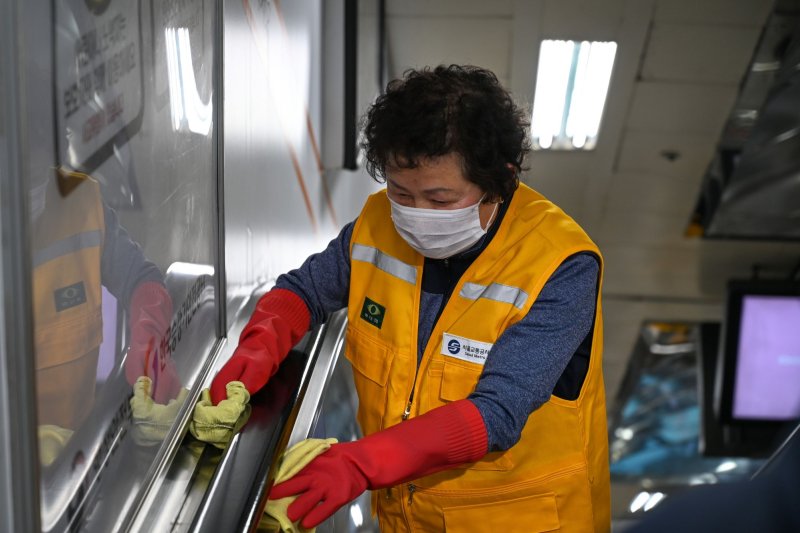
A worker cleans inside the Myeongdond subway station to protect against the coronavirus in Seoul on March 4. Photo by Thomas Maresca/UPI | License Photo
March 11 (UPI) -- According to new research, the novel coronavirus can remain in the air for up to 3 hours and survive on some surfaces for two to three days.

The research, which was carried out by scientists from the National Institutes of Health, Princeton University and UCLA, suggests it's possible for the virus to spread through the air as well as through the touching of contaminated surfaces


"Our results indicate that aerosol and fomite transmission of HCoV-19 is plausible, as the virus can remain viable in aerosols for multiple hours and on surfaces up to days," researchers wrote in the study's abstract.

The research was published on medRxiv, a site where health and medical science studies can be shared prior to peer review and acceptance into a scientific journal.

For the study, scientists used a nebulizer to spray the coronavirus into the air in a manner similar to a cough. The virus could be detected in the air up to 3 hours later. Researchers also placed samples on a variety of surfaces. They found the virus could survive for up to 4 hours on copper, as many as 24 hours on cardboard, and two to three days on plastic and stainless steel.

Tests showed the genetically related virus responsible for the 2003 SARS outbreak is similarly durable, so the ability of the new coronavirus to survive in the air and on surfaces doesn't explain its ability to spread more rapidly.

"Overall, stability is very similar between HCoV-19 and SARS-CoV-1," researchers wrote.

The study is one of the first to look specifically at how long the new coronavirus can live in the air and on surfaces, but it doesn't prove how exactly COVID-19 is spreading.

"We don't know if you can pick up COVID-19 from contaminated surfaces or inanimate objects at this point. That's the bottom line," Marilyn Roberts, a microbiologist at the University of Washington School of Public Health, told the MIT Technology Review.

The new coronavirus can be killed using a range of disinfectants, including rubbing alcohol and diluted hydrogen peroxide. The Environmental Protection Agency has a complete list of the commercially available cleaning products that can kill the virus.

An earlier survey of the available scientific literature on the complete family of coronaviruses -- SARS coronavirus, the Middle East Respiratory Syndrome coronavirus and endemic human coronaviruses -- showed some of the viruses can can persist on inanimate surfaces such as metal, glass and plastic for up to nine days.
Remote Tierra del Fuego kelp forests surveyed for the first time in 45 years

Kelp, seen in waters near Blanco islet, an island that is part of Tierra del Fuego on the southernmost tip of South America. Photo by Shane Anderson/NOAA/Wikimedia

March 12 (UPI) -- For the first time since 1973, scientists have surveyed the health of remote kelp forests of Tierra del Fuego, the southernmost tip of South America. Researchers found the ecosystem largely unchanged from 45 years ago, with similar abundances of kelp, sea urchins and sea stars.

A study published this week in the journal PLOS One shows the ecosystem remains healthy, but researchers warn this may not always be the case. Kelp forests host tremendous marine biodiversity. Just as healthy forests on land are vital to diversity of animals, healthy kelp forests are essential to a wide array of marine species. Kelp forests can even protect shell-forming organisms from dangerous spikes in acidity.

In some parts of the world, rising water temperatures are transforming their makeup. But remote kelp forests are less well understood. To find out how some of the world's most remote kelp forests off the coast of South America are doing, scientists utilized both the observations of scuba divers and a catalogue of Landsat satellite images.

The observations of scuba divers suggest the kelp forests of Tierra del Fuego host similar levels of biodiversity to what they hosted 45 years ago. The analysis of Landsat satellite images showed the area's kelp forest cover has grown and declined in a four-year cycle that reflects changes in sea surface temperature and El Niño-Southern Oscillation rainfall patterns.

When scientists conducted a survey of fish populations among the kelp forests, they found the abundance of different species varied greatly in different locations. Distribution patterns showed the variability was largely dictated by exposure to ocean waves.

While the latest research, published this week in the journal PLOS One, is good news, scientists suggest it's unlikely Tierra del Fuego's kelp forests will be spared from the effects of climate change indefinitely.

To mitigate the impacts of rising water temperatures on kelp forest ecosystems, scientists recommend policy makers spearhead more aggressive conservation efforts. For example, the expansion of the newly designated Yaganes Marine National Park to include coastal waters along the southern tip of South America could help protect the kelp forests of Tierra del Fuego.

"The kelp forest of the extreme tip of South America are some of the most pristine on earth and have not changed substantially since the early 1970s, when they were first surveyed," Alan Friedlander, researcher with National Geographic Society's Pristine Seas project, said in a news release. "Re-examination of this remote region is incredibly valuable in this age of climate change and gives us a better understanding of how these ecosystems function in the absence of direct human impacts."

Scotland's Isle of Sky hosted rich dinosaur diversity during middle Jurassic


Scientists found several three-toed footprints in the ancient Scottish mudflats, most likely made by early carnivorous theropod dinosaurs. Photo by Paige E. dePolo, et. al/PLOS One

March 12 (UPI) -- Paleontologists have discovered a pair of fossil sites featuring dozens of dinosaur footprints preserved in what were once coastal mudflats. The fossils suggest Scotland's Isle of Skye was home to a rich diversity of dinosaurs during the Middle Jurassic Period, between 174.1 and 163.5 million years ago.

Dinosaur remains from the Middle Jurassic Period are rare, but the new Scottish fossils sites -- described this week in the journal PLOS One -- suggests many dinosaur groups were rapidly diversifying during this period.

The 50 dinosaur tracks found at the two sites included footprints made by Deltapodus, the first to be found on the Isle of Skye. Researchers also found tracks they estimate were made by a stegosaurian, a plate-backed dinosaur.

Several three-toed footprints suggest early carnivorous theropods walked across the ancient mudflats. Some of the prints appear to have been made by large-bodied herbivorous ornithopod dinosaurs -- the oldest of their kind.

"These new tracksites help us get a better sense of the variety of dinosaurs that lived near the coast of Skye during the Middle Jurassic than what we can glean from the island's body fossil record," lead study author Paige dePolo, scientist at the University of Edinburgh in Scotland, said in a news release. "In particular, Deltapodus tracks give good evidence that stegosaurs lived on Skye at this time."

Analysis of ancient dinosaur footprints can help paleontologists provide context for body fossils. Scientists hope their discoveries will inspire other paleontologist to revisit known fossil sites, as the latest footprint collections were found near popular fossil-hunting destinations.

"These new tracksites give us a much clearer picture of the dinosaurs that lived in Scotland 170 million years ago," said study co-author Stephen Brusatte, researcher at Edinburgh. "We knew there were giant long-necked sauropods and jeep-sized carnivores, but we can now add plate-backed stegosaurs to that roster, and maybe even primitive cousins of the duck-billed dinosaurs too. These discoveries are making Skye one of the best places in the world for understanding dinosaur evolution in the Middle Jurassic."

Study of shear zones yields data on earthquakes deep below surface


Scientists of Britain's University of Plymouth and Norway's University of Oslo published results of their study, in Norway's Lofoten Islands, of earthquakes deep in the earth this week. Photo by Heidi Monstang/University of Plymouth

March 13 (UPI) -- A new study led by Britain's University of Plymouth offers insight on the mechanisms behind earthquakes 25 or more miles below the surface.

Little is known about deep earthquakes, largely because their effects are generally hidden underground, but the study suggests that ruptures may be encouraged by the interaction of different shear zones moving slowly and aseismically, indicating movement without accompanying seismic shock. The interaction loads the adjacent blocks of stiff rocks in the deep crust until they can no longer sustain the rising stress, and a rupture prompts an earthquake. The study suggests that slow but repeating cycles of deformation on the shear zones bring accumulated stress, punctuated by episodic earthquakes.

The study, underwritten by Britain's Natural Environment Research Council, was led by scientists from the University of Plymouth and Norway's University of Oslo in Norway's Lofoten Islands, and published this week in the scholarly journal Nature Communications. They spent several months in the region, analyzing exposed rock pristine pseudotachylytes -- solidified melt produced during seismic slips and regarded as "fossil earthquakes" -- which decorate fault sets linking shear zones.

"The Lofoten Islands provide an almost unique location in which to examine the impact of earthquakes in the lower crust," said Dr. Lucy Campbell of the University of Plymouth. "By looking at sections of exposed rock less than 15 meters [49.2 feet] wide, we were able to see examples of slow-forming rock deformation working to trigger earthquakes generated up to 30 kilometers [18.6 miles] beneath the surface."
Ancient cave carving depicts six-legged mantis-man


Scientists found an ancient half-mantid figure at an Iranian rock art site. Photo by Pensoft Publishers

March 16 (UPI) -- Researchers have discovered a unique petroglyph, depicting what appears to be a six-legged mantis-man, at the Teymareh rock art site in Iran.

Invertebrates are rarely found in rock carvings, so the archaeologists on the project recruited entomologists to help them determine what kinds of creatures might have inspired the motif. Researchers looked at several six-legged species that prehistoric artists might have come across in central Iran.

The motif measures just 5.5 inches in length, and though it was discovered in 2017, its small size and unusual shape made it difficult to identify. In addition to boasting six legs, the creature features large eyes and enlarged pincher-like forearms.

The entomologists on the study identified an extension on the creature's head that matches local praying mantis species belonging to the genus Empusa.

Scientists estimate the rock art is between 4,000 and 40,000 years old.

"The petroglyph proves that praying mantids have been astounding and inspiring humans since prehistoric times," researchers wrote in the Journal of Orthoptera.

The figure isn't a perfect representation of a Empusa mantis, as the middle limbs feature loops as a hands. Researchers linked the carving with a common petroglyph motif known as "Squatter Man," which has been found at rock art sites around the world. The motif features a person flanked by circles.

Some researchers suggest the circles represent the atmospheric plasma discharges created by auroras.

The discovery of the latest petroglyph reinforces the theory, based on previous discoveries of half-mantid, half-human figures, that the mantis was a symbol for the supernatural.

"An example includes several prehistoric pictographs in southern Africa representing 'mantis people' with half-mantid bodies," researchers wrote in their paper. "These, and the Iranian mantid petroglyph, bear witness that in prehistory, almost as today, praying mantids were animals of mysticism and appreciation."

Tokyo 1940: The Games that became the 'Missing Olympics'


AFP / Mladen ANTONOVIf the Olympics are postponed, it would be the second time for Tokyo after its military aggression in Asia forced the annulment of what became known as the "Missing Olympics" in 1940
Fears are growing that this year's Olympics may be postponed or axed because of the coronavirus pandemic but Japan has been here before -- the cancelled summer Games of 1940 were also due to be hosted in Tokyo.
Japan's military aggression in Asia forced the annulment of what became known as the "Missing Olympics" after the Games were switched to Helsinki before finally being scrapped because of World War II.
Tokyo officials originally touted a bid for the 1940 Games as a way to show the city had recovered from the devastating 1923 earthquake, according to author David Goldblatt in his history of the Olympics entitled "The Games".
In much the same way, Japan has framed the 2020 Olympics as the "Recovery Games" -- a chance to show the country is back on its feet after the catastrophic 2011 triple disaster of earthquake, tsunami and nuclear meltdown.
Tokyo's 1940 bid was spearheaded by Jigoro Kano, the founder of modern judo and first Japanese member of the International Olympic Committee, who stressed the importance of bringing the Games to Asia for the first time.

THE NATIONAL ARCHIVES/AFP/File / HOJapan engaged in a fierce lobbying campaign to win the 1940 Olympics including with Italy's fascist dictator Benito Mussolini (L) to step aside in their favour
"I carry a grave resolve. The Olympics should naturally come to Japan. If they don't, the reason for this must be something unjust," said Kano in his plea to the IOC.
The Japanese had a special reason for wanting to celebrate 1940, as it coincided with the 2,600th year since the enthronement of the nation's legendary first emperor, Jimmu.
Tokyo launched an official bid in 1932 and found themselves up against Rome and Helsinki.
Japan engaged in a fierce lobbying campaign that included pleading with Italy's fascist dictator Benito Mussolini to step aside in their favour.
"In the you-scratch-my-back kind of deal that has become the norm in international sports politics, Mussolini announced with unusual candour, 'We will waive our claim for 1940 in favour of Japan if Japan will support Italy's effort to get the XIIIth Olympiad for Rome in 1944," wrote Goldblatt.
With just Tokyo and Helsinki left standing, the IOC plumped for the Japanese capital by 37 votes to 26.
- 'Cultural diplomacy' -
Before the bid had been tabled, Japan in 1931 invaded the Chinese province of Manchuria and two years later withdrew from the League of Nations -- the precursor to the United Nations -- after the body refused to sanction the occupation.
The Olympic bid was therefore also an attempt to shore up international diplomacy, according to Asato Ikeda, assistant professor at Fordham University, New York, who has written about the 1940 Games.

AFP / Kazuhiro NOGISeiko Hashimoto, minister for the Tokyo Olympic and Paralympic Games, speaks during a press conference in Tokyo
Japan's bid was "part of its international cultural diplomacy in order to ameliorate the relationship with the Western democratic nations, especially Britain and the United States," Ikeda wrote in an essay in the Asia-Pacific Journal.
As preparations for the Games gathered pace, a schedule was drawn up and posters were printed. The Opening Ceremony was set for September 21, 1940.
There were some hiccups though, including questions about whether the Emperor could declare the Games open, as the Japanese then held him to be semi-divine and therefore unable to be seen and heard by ordinary citizens.
- 'No other course' -
As diplomatic pressure grew on Japan from outside, there was increasing clamour inside the country for cash to be diverted for military purposes.
Japanese diplomats at the time voiced concern in cables back to Tokyo that powers such as Britain and the United States could boycott the Games over Japan's war-like activity.

AFP/File / -August 1945 - Japanese soldiers surrender to the Russian army in the Chinese province of Manchuria which Japan invaded in 1931
Yet, in words familiar to those following the story of the 2020 Games, Tokyo insisted the show would go on.
Barker cites a cable from Tokyo City Hall to the IOC which said: "The citizens of Tokyo are doing their utmost to make the 1940 Games a success."
But the Japanese Olympic Committee eventually bowed to the inevitable and forfeited in July 1938, saying what they euphemistically called "the trouble with China" had made staging the Games impossible.
"The organising committee and the people of Japan were deeply disappointed in having to give up the Games, but, in the circumstances, no other course was open," the "Olympic News" bulletin published in Tokyo wrote at the time.
"With the worsening international relations and increasing military activities in the Asian continent, the cancellation might not have been that surprising," Ikeda told AFP.
The Winter Games, due to be held in the northern Japanese city of Sapporo, were also scrapped and the war put paid to the proposed rescheduling in the Finnish capital.
The next time the Olympic torch was lit was for London in 1948, four years after the city had originally been due to host. But Japan, as a defeated power, was excluded and Helsinki staged the next summer Games in 1952.
Tokyo finally became the first Asian city to host the Olympic Games in 1964.
FDA inches closer to CBD rules for dietary supplements


The U.S. Food and Drug Administration is moving forward toward evaluating CBD for use in dietary supplements, the agency said. Photo by CBD-Infos-com/Pixabay

DENVER, March 17 (UPI) -- The U.S. Food and Drug Administration moved closer this month toward evaluating CBD for human foods, topicals and pet products, but consumers and regulators still have unanswered questions about its safety.

The FDA is looking at safe daily doses, the different forms of CBD products and any health threats that the substance might present. These include potential liver toxicity and male reproductive problems, as well as side effects such as drowsiness, the agency said in a report submitted to appropriations committees in the U.S. House and Senate.

"We have made progress, but there are still areas where timely attention is needed," the agency said.

The FDA said it will produce a followup document for Congress within 180 days with the results of a sampling study of the current CBD marketplace "to determine the extent to which products are mislabeled or adulterated."

Senate Majority Leader Mitch McConnell, R-Ky., and others, have urged the FDA to approve CBD for dietary uses. The appropriations committees had requested a CBD overview report within 60 days in late December 2019.

"We are concerned that some people wrongly think that the myriad CBD products on the market have been evaluated by the FDA and determined to be safe, or that using CBD 'can't hurt,'" Dr. Stephen Hahn, the FDA's new commissioner, said in a statement.

The FDA's approval process for a new dietary ingredient can take three years or more. The popularity of CBD and internet commerce has raced ahead of the FDA's ability to prove its safety.

"We know one thing from the American people -- they're using CBD products," Hahn said in February. "We're not going to be able to say you can't use these products. It's a fool's game to try to even approach that."

Federal laws that forbid research on cannabis-derived products have delayed for years scientists who want to know more about how CBD works. The FDA is trying to catch up by issuing a call for private research on the effects of CBD products.

"Where it becomes a public health issue is when tons of people are self-dosing who-knows-how-much and who-knows-what quality," said Edgar Asebey, a Fort Lauderdale, Fla.,-based FDA regulatory life-sciences lawyer.

Even though CBD food-safety research might take several years, the FDA is very likely to issue stopgap guidance documents soon, attorney Asebey predicted.

The FDA might also look to other countries' health agencies for guidance, he said.

The United Kingdom's Food Standards Agency proposed a safe daily dose of 70 milligrams in January. The agency set up a regulatory path to reintroduce CBD over the next year, including removing some non-compliant products from the market by 2021.

"If you're selling CBD all over the country, there are minimal standards you'll need to follow for dietary supplements or foods. It's a special industry, but it's not that special," Asebey said. "There are federal guidelines for what you ask people to eat."

CBD, or cannabidiol, is marketed in a confusing number of products including kombucha, gummies, chocolate, hand cream, tinctures, oils, cosmetics and pet foods. But it still hasn't been fully approved by the FDA, even though several states have passed laws allowing the substance to be used products for people and pets.

Until hard-and-fast FDA rules are issued, consumers could remain confused about the bewildering number of non-regulated products available, those in the industry said.

Sticking with long-standing dietary supplement brands certified as food-safe under Good Manufacturing Practices guidelines, is a good bet, said Alan Lewis, director of special projects at Natural Grocers of Lakewood, Colo.

"You should not be buying CBD products at a gas station, not at a convenience store and not on Amazon," Lewis said. "Those bottles could contain anything -- or nothing."

FDA clarity will allow many more natural herbal supplement companies to produce CBD or hemp-based products, giving consumers more choices, said Michael McGuffin, president of the Silver Spring, Md.,-based American Herbal Products Association.

"We want FDA to regulate CBD and hemp products as dietary supplements with all the rules that apply," McGuffin said. "I know it's difficult to get there quickly, but the regulatory framework is significantly robust to regulate these products. "
Poll: Record share of Americans think military spending 'about right'
CUT MILITARY SPENDING FUND MEDICARE FOR ALL

President Donald Trump speaks with Lockheed Martin CEO Marillyn Hewson and chief test pilot Alan Norman in front of an F-35 fighter jet during the Made in America Product Showcase at the White House on July 23, 2018. File Photo by Alex Wong/UPI | License Photo 


March 16 (UPI) -- About half of Americans believe present U.S. military spending is "about right" where it should be, a dramatic change from just four years ago and the highest share since Gallup began asking the question a half-century ago.

The Gallup survey said 50 percent of adults in the United States agree with military spending levels under the Trump administration. Thirty-one percent said spending is too much and 17 percent said there's too little military funding.


The previous high, 48 percent, was recorded after the Sept. 11, 2001, terrorist attacks.

The greatest change in the survey was shown by Republicans. In 2016, 23 percent of GOP respondents said military spending was "about right" and 66 percent said it was too little. Last year, 49 percent of Republicans agreed with the spending levels and Monday's poll saw that figure rise to 72 percent.

In December, President Donald Trump signed a $738 billion defense bill for fiscal 2020, $21 billion more than Congress approved for 2019.

Forty-two percent of independents said military spending is about right and 36 percent of Democrats agreed, Monday's poll showed. Most Democratic respondents, 51 percent, said the present spending level is too much.

Gallup polled more than 1,000 U.S. adults for the survey, which has a margin of error of 4 points.


Neil Young to play at Bernie Sanders digital rally

CANADIAN ROCKER ENDORSES BERNIE


March 16, 2020 By Agence France-Presse


Rocker Neil Young will get onstage for presidential hopeful Bernie Sanders on Monday, at a rally that will be streamed, with the United States mostly shut down due to the coronavirus pandemic and large gatherings banned.

The campaign announced ahead of Tuesday’s presidential primaries that Young, a newly minted American citizen, and his spouse Daryl Hannah will stump for Sanders at a digital rally also featuring Jim James, frontman of the rock band My Morning Jacket, and the retro-soul group the Free Nationals.

Sanders, 78, will again face off against Joe Biden, 77, as four large states pick their favorite for the Democratic nomination, in a contest overshadowed by an outbreak that has prevented both candidates from campaigning before large crowds.

Sanders, who has relied on rallies to whip up support among his base, has seen his campaigning severely curtailed but the crisis has also given him a platform to tout his plan for a government-run universal health care system.

The Vermont senator’s core support also skews much younger than Biden’s, helping his chances that voters will tune in online for the rally.

Biden is comfortably ahead in the race to challenge President Donald Trump in November’s general election, backed by almost all of his former rivals who made it to the latter stages of the primary contest.

But Sanders has scooped endorsements from across the entertainment industry — including rappers Cardi B and Chuck D along with alt acts Bon Iver, Vampire Weekend and The Strokes

“The Free Nationals are stoked to be performing at Monday’s digital rally for Senator Sanders’ bid for president,’ said Kelsey Gonzalez of the group in a Sanders campaign statement.

“His progressive positions on universal health care, immigration and education make him the clear choice for us in the primaries.”

Long outspoken on politics, Young, 74, officially endorsed Sanders on his website earlier this month, saying “every point he makes is what I believe in.”

“I believe Bernie Sanders. I think Bernie Sanders is the real deal.”


© 2020 AFP