Why We Are on Hunger Strike in UK Jails
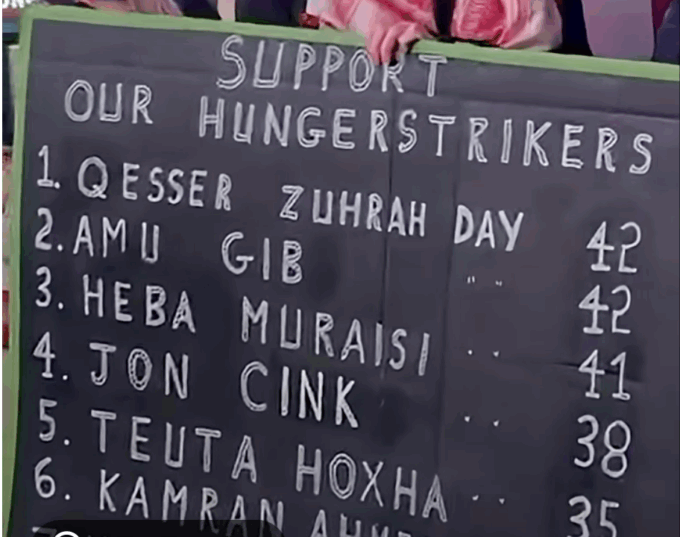
London protest in support of jailed Palestinian rights hunger strikers. Screengrab from video posted to Instagram.
Amu Gib is one of eight prisoners incarcerated for alleged involvement in direct action against Israeli genocide currently on hunger strike in UK jails. This piece is based on interviews conducted by Ainle Ó Cairealláin and ES Wight on Days 18 and 33 of the strike. Amu has subsequently been hospitalised, on Day 50 of their strike, the sixth hunger strike to be so.
We began our hunger strike on November 2nd: the anniversary of the Balfour Declaration, when Britain planted the seeds of the genocide we are witnessing today.
Palestinians are now facing another winter without any of the things that anyone needs to survive. It is such a joke to say there is a ceasefire in Gaza when nothing’s stopped: maybe carpet bombing has been less prevalent, but perhaps that is just because there are no more buildings left to shell. There are so many layers of violent displacement the Palestinian people have undergone. The Israeli occupation has meant that people who have lived on fertile land that they’ve grazed and managed and farmed for forty generations are no longer able to feed themselves. To reach the point we have, where Israel can weaponise starvation, you have to confront who enables that. Who arms them? Who allows Zionist settlers to steal and occupy Palestinian land? Who continues to allow Israel to blockade and target farmers and people harvesting their olives? The use of starvation as a weapon is the tip of the iceberg.
I first learnt about Palestine in sixth form–not from the teachers obviously, but from other students, young Muslim women who were doing all the legwork around the campaign. This was during a time when Palestine was undergoing an active bombing campaign. I didn’t understand the historical context back then, or have the language to explain it, but the bombing of civilian populations, residential buildings–you could just see that it was wrong. And then seeing the routine nature of it–from one year to the next, the same thing happening, and knowing that this wasn’t a war with a fixed end or even a clear goal: it was just so stark–this is going to keep going unless people stop it. And then the more I learnt the British role in the creation of the Zionist occupation, the more I was unable to deal with inaction towards that.
Our demands are simple. One: shut down the weapons factories that are supplying these arms to Israel. Two, deproscribe Palestine Action. Palestine Action is a direct action protest group and should never have been labelled a terrorist organisation; Three, an end to the mistreatment of prisoners in custody, including censorship and the use of terror legislation to harass us. Four, immediate bail. There’s people whose parents are ill or dying, people who have missed major life events. And five: a fair trial, including the release of the unredacted correspondence about us between British and Israeli officials and arms dealers. I think they’re quite reasonable demands; we could have gone much further! But I believe we can win all of them.
What prompted our hunger strike was partly just the understanding that while we’re in here the prison authorities can do whatever they want. They can give us bogus non-association orders so we can’t spend time with each other, they move our lives around at will, they can mess with our visits, they can mess with our gym slots, they can say that we’re a security threat so we’re not allowed to work. They’re banning our books and censoring our post – it’s completely out of control. I was barred from the crafts group because they said I was a security threat after I embroidered ‘Free Palestine’ on a cushion; ironically, that was on the day that the UK recognised the state of Palestine. After the protest outside the prison in August – and after two people were killed by the prison in a week – they really wanted to crack down on the eight or nine of us who were in here at the time. There was just this sense of ‘we must punish them because they have too much involvement with the outside world’. We all started to get demerits and negative IPs [‘Incentive Points’, which dictate the amount of phone credit, time outside your cell etc that you are entitled to] for hugging or just breathing too near to each other. And then John was randomly told to get behind his door during out-of-cell time and he just refused. He sat on the floor and told them, ‘I’m not moving to my cell, this has got ridiculous’. And Heba immediately sat down with him. It wasn’t a planned act of resistance, it just reached the point where we’re not going to comply with this because it’s completely unjustifiable. And at some point you have to resist that. Then they both got bent up, which is prison terminology for a routine assault of prisoners by screws, and spent the next five days in solitary confinement. Heba got shipped to a different prison five hours away from her loved ones, and John was moved to a different house block to further isolate him from us and others.
There is no rhyme or reason to our imprisonment. But when you’re on hunger strike, when you decide to take action despite being in prison, you’re free. There’s a freedom in taking action, and there’s an energy to it. And then there’s also this ongoing responsibility to the cause and to the liberation of Palestine that landed us here, and that we still all believe in and are committed to. Just because we are in prison, it doesn’t change the fact that we don’t believe that the UK should fund and supply weapons for genocide. Just because we’re in here doesn’t mean that we can’t see that the aid that desperately needs to get into Gaza is still being blocked and that no one seems to be able to actually change that. So our action is a way of declaring that the state can’t stop you even when it has you in prison; that we are not going to give up the focus and the responsibility to people, whatever conditions we’re in.
Physically, I have lost eleven kilos now and am moving in slow motion. My blood sugar’s really low and my ketones–which is the way that you measure the amount of toxins that your body produces by eating itself, burning through fat and muscle instead of calories–are really high. Kamran and T have been hospitalised already.
The response from other prisoners has been incredible. There’s no one who understands injustice like a prisoner does: whether you’re on hunger strike or not, it’s always the prisoners who keep each other going and the screws who make life hell. Everyone’s checking in on me, making sure I have hot water, coming to socialise in my cell even when I’m a shadowy version of myself, lending me clothes to keep warm; just lots of generosity. This is despite one of the screws telling the other prisoners that they would get negative behaviour points if they helped us. And they did: people were given negative IPs for bringing Qesser a flask of hot water and for washing her bedsheet in their washing. Luckily, the people in that spur have the right attitude towards authority figures.
So the hunger strike has sharpened the reality of prison: the shouting and screaming from the screws and the arbitrariness of the rules that they enforce. Their mood really dictates a prisoner’s entire life already. But in another way, the hunger strike also makes the prison fade into irrelevance. We’re focused on the world beyond these walls and it seems much more real.
Together we’re strong and we’re really capable of defeating the state, whether it’s in this round of the fight or in future rounds. I don’t believe that this genocidal imperialist hellhole can sustain itself because it’s people who make things and build things and grow things and repair things that actually make the world go round – not these money-hungry lunatics. In prison, as elsewhere, there’s always a reason not to resist: ‘what’s the point of resisting if we’re just gonna get bent up,or get a negative point, or get half of our money taken away?’ Or there’s that temptation to load the responsibility onto your lawyer to deal with your complaints, or ‘look, there’ll be a judicial review and it’ll all come to light then!’ There’s always a way around resisting. But there’s never not a point to resistance. And the act of being on hunger strike has really opened up this whole other world, where we’re fuelled by every act of resistance that we hear about. The prison demands that we be alive on their terms, but now it’s on our terms, and we have the power that they hold over us in our hands, in our bodies and in our empty stomachs.
We need to keep pushing ourselves to imagine a fuller reality. I just wish that I had a way to convey to people how much energy resistance brings you and how much power you have when you’re in solidarity. We actually have the power, agency, responsibility, creativity, resourcefulness and love that it takes to be fuelled and moved to action not just once but every minute of every day – now 33 days for some of us. It doesn’t ever feel like what we’re doing is enough but in another way it feels like the best thing in the world.
A shorter version of this piece originally appeared in the Guardian.

No comments:
Post a Comment