Light-activated coating kills bacteria

Scientists have developed a new coating that kills bacteria under ambient light conditions. Photo courtesy of University College London
March 5 (UPI) -- Scientists have developed a new light-activated coating that kills bacteria. The coating could be applied to phone screens and keyboards to curb the spread of harmful bacteria.
More importantly, the coating could be used on medical equipment like catheters and breathing tubes, the main sources of of healthcare-associated infections. The most common healthcare-associated infections are caused by Clostridioides difficile, methicillin-resistant Staphylococcus aureus, or MRSA, and E. coli.
In lab tests, the new antimicrobial coating successfully killed bacteria when exposed to low intensity, ambient light, the kind of light commonly found in hospital wards. The coating's antibacterial properties were activated by light levels as low as 300 Lux. Most light-activated antimicrobial coatings require lights as bright as 3,000 Lux.
Researchers created the coating by embedding chemically modified gold in a polymer with crystal violet, a medical dye boasting antibacterial and antifungal properties. The dye is also antihelmintic, which means it is hostile to small parasites.
Scientists described the novel coating Thursday in the journal Nature Communications.
"Dyes such as crystal violet are promising candidates for killing bacteria and keeping surfaces sterile as they are widely used to disinfect wounds," first author Gi Byoung Hwang, a chemist at University College London, said in a news release. "When exposed to bright light, they create reactive oxygen species, which in turn kill bacteria by damaging their protective membranes and DNA. This is amplified when they are paired with metals such as silver, gold and zinc oxide."
During the initial test phases, scientists found a control coating of crystal violet in a polymer was not enough to kill either S. aureus or E. coli bacteria under ambient light. However, the new bactericidal coating slowed the proliferation of each bacteria. Tests showed the coating took longer to curb E. coli growth.
"E. coli was more resistant to the bactericidal coating than S. aureus as it took longer to achieve a significant reduction in the number of viable bacteria on the surface," said Elaine Allan, UCL researcher and study co-author. "This is presumably because E. coli has a cell wall with a double membrane structure, whereas S. aureus only has a single membrane barrier."
The tests results showed the coating's production of hydrogen peroxide was responsible for killing the bacteria.
"The gold clusters in our coating are key to generating the hydrogen peroxide, through the action of light and humidity," said senior study author Asterios Gavriilidis, professor of chemical engineering at UCL. "Given the clusters contain only 25 atoms of gold, very little of this precious metal is required compared to similar coatings, making our coating attractive for wider use."
Researchers suggest the new coating could be incorporated into a variety of healthcare environments in the near future.
upi.com/6989145
Study confirms space-grown lettuce nutritious, safe
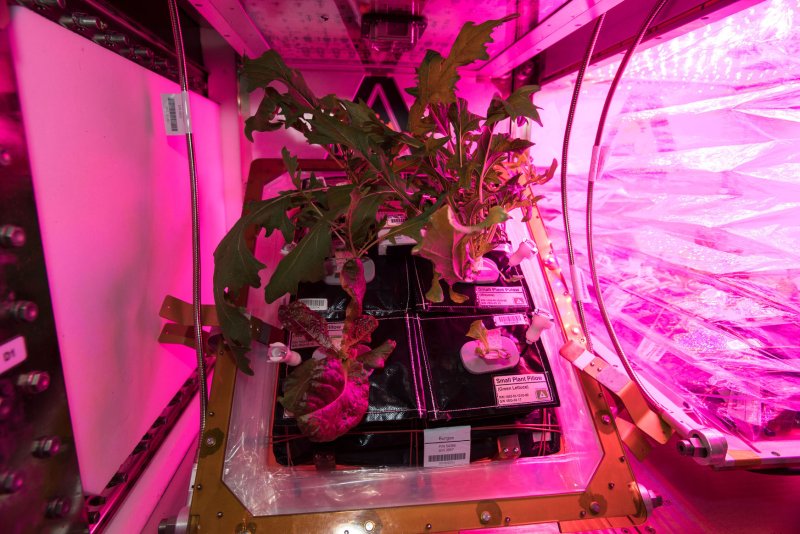
The crew aboard the International Space Station has grown batches of mixed greens -- mizuna, red romaine lettuce and Tokyo bekana cabbage -- and further research has found it is safe to eat, even though astronauts have already used it for salads. Photo by NASA/UPI | License Photo
March 6 (UPI) -- Astronauts onboard the International Space Station have successfully cultivated lettuce and, according to a study published Friday, the red romaine lettuce -- a Lactuca sativa variety known as 'Outredgeous' -- is disease-free and safe to eat.
Currently, astronauts must go without fresh produce. All of their meals are sterilized for the trip to space by heating, freeze drying or irradiation. Nutrients tend to degrade during long-term storage.
In addition to offering a reprieve from the monotony of freeze-dried meals, fresh lettuce would provide a nutritional boost. The red romaine lettuce contains potassium as well as vitamins K, B1, and C.
NASA officials have previously pinpointed growing crops in space as an essential part of long-term space missions, such as a human outpost on the moon or a trip to Mars.
"The ability to grow food in a sustainable system that is safe for crew consumption will become critical as NASA moves toward longer missions," lead study author Christina Khodadad, researcher at the Kennedy Space Center, said in a news release. "Salad-type, leafy greens can be grown and consumed fresh with few resources."
The lettuce was grown from surface-sterilized seeds inside a chamber specifically designed for space-based crops. Scientists outfitted the Vegetable Production Systems, dubbed "Veggie," with LED lighting and a watering system. The lettuce was allowed to grow undisturbed for 33 to 56 days before being deep-frozen and readied for shipment back to Earth.
Scientists grew a control crop at Kennedy Space Center's laboratories under conditions similar to those found inside the space station.
When they compared the harvests, scientists found the space lettuce was similar in composition. However, some of the space lettuce boasted higher concentrations of vitamins and other compounds, including potassium, sodium, phosphorus, sulphur and zinc. Researchers also measured elevated levels of phenolics in the space lettuce, molecules that boast antiviral, anticancer, and anti-inflammatory properties.
Researchers also used next-generation DNA sequencing technology to identify the communities of fungi and bacteria living on the space lettuce. They found the 15 most abundant microbial genera on the space lettuce leaves were similar to those living on the control crop. Fungi and bacteria living on the roots of the two crops were also similar. The sequencing revealed no bacteria genera known to cause disease in humans.
As scientists confirmed in the paper, published in the journal Frontiers in Plant Science, the red romaine lettuce grown on the International Space Station is safe to eat.
Astronauts already knew as much, anecdotally, as several space station crew members ate a salad before sending the rest of the harvest back to Earth for study. There were no ill effects. But the official findings bode well for the future of crop cultivation in space.
"The International Space Station is serving as a test bed for future long-duration missions, and these types of crop growth tests are helping to expand the suite of candidates that can be effectively grown in microgravity," said study co-author Gioia Massa, project scientist at Kennedy Space Center. "Future tests will study other types of leafy crops as well as small fruits like pepper and tomatoes, to help provide supplemental fresh produce for the astronaut diet."
Plastic found in amphipods in Earth's deepest ocean trench
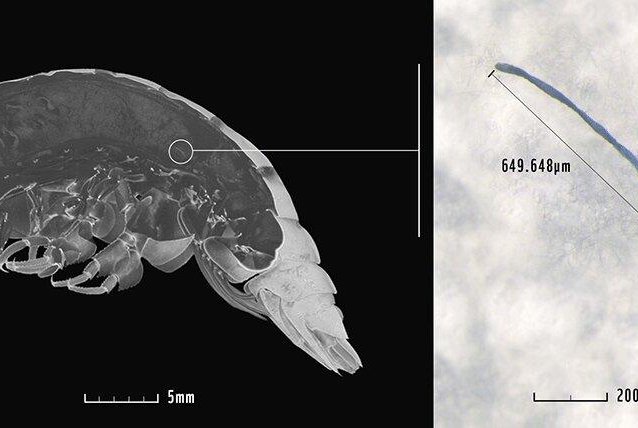
Scientists found plastic fragments inside amphipods living between 3.7 and 4.3 miles beneath the ocean surface. Photo by Newcastle University
March 6 (UPI) -- Plastics are being ingested by amphipods living in one of the deepest places on Earth, the Pacific Ocean's Mariana Trench.
Amphipods, sometimes called hoppers, are tiny shrimp-like crustaceans. Though they are found in all aquatic environs, the majority of the roughly 9,900 known species are found in the ocean.
Recently, scientists found a new species living in the Mariana Trench, between Japan and the Philippines -- the ninth species in a genus of deep-sea amphipods. Scientists named the new species, Eurythenes plasticus, for the the contents of its digestive tract.
Inside the amphipod's body, scientists found polyethylene terephthalate, a synthetic compound used to make water bottles and workout attire. The plastic-eating amphipods were caught on baited lines between 3.7 and 4.3 miles beneath the ocean surface.
RELATED Bats inspire new technique to find corroding metal in oil, gas pipelines
The discovery, described this week in the journal Zootaxa, confirms what other studies have suggested, that plastics pollution has made its way to the deepest parts of the ocean.
"We decided on the name Eurythenes plasticus as we wanted to highlight the fact that we need to take immediate action to stop the deluge of plastic waste into our oceans," lead researcher Alan Jamieson, senior lecturer in marine ecology at Newcastle University in Britain, said in a news release.
Much of the world's plastic waste gets exported to Southeast Asia, where recycling efforts are often lackluster. Lots of the plastic gets burned or dumped at repositories, and some of that waste ends up washed into the ocean. Over time, big pieces of plastic get broken down into smaller bits.
Marine animals ingest plastic particles on accident or mistake pieces of plastic for food. Previous studies suggest some animals, including certain coral species, seem to prefer plastic to real food.
As the latest research proves, some of the plastic particles filter down to the deepest parts of the ocean, where it gets ingested by amphipods and other miniature organisms.
"The newly discovered species Eurythenes plasticus shows us how far-reaching the consequences of our inadequate handling of plastic waste truly is," said Heike Vesper, director of the marine program at the World Wildlife Fund in Germany. "There are species living in the deepest, most remote places on earth which have already ingested plastic before they are even known about by humankind. Plastics are in the air that we breathe, in the water that we drink and now also in animals that live far away from human civilization."
NASA: Boeing software team had too much power over Starliner capsule

The Boeing Starliner spacecraft was returned to Kennedy Space Center in Florida for refurbishment. File Photo by Joe Marino/UPI | License Photo
March 6 (UPI) -- Boeing's software team had too much influence over final decisions regarding the company's Starliner capsule, a top NASA administrator said Friday.
The finding was among 61 corrective actions NASA and Boeing have agreed to make before moving ahead with another Starliner mission. A test flight in December failed to reach the International Space Station, but landed successfully in New Mexico after two days in space.
NASA has not decided if it will require another test flight before sending astronauts aloft.
"We had delegated too much authority to the software board to approve changes and to approve actions as it applied to software," said Douglas Loverro, NASA's associate administrator for human exploration. "Those changes should have been brought up to the overall engineering review board."
RELATED Boeing says longer Starliner software tests could have prevented flight failure
For example, software experts made a decision not to test all possible ways the software could respond to a given condition, Loverro said.
He also said Friday he had decided to formally classify the Boeing flight failure as a "high visibility close call," the lowest category NASA uses for serious mission problems.
Boeing and SpaceX are competing to become the first private company to fly astronauts on NASA missions. Boeing previously revealed that it had failed to detect problems with the capsule mission clock because it hadn't run full-length mission tests from launch to docking at the space station.
RELATED NASA: Software defects could have destroyed Boeing Starliner on test flight
The Starliner problems come as Boeing struggles to overcome serious safety issues with its Boeing 737 Max aircraft. Jim Chilton, senior vice president at Boeing Space and Launch, said he wasn't aware of any issues in common between Starliner and 737 Max.
However, Chilton added that the lessons learned from Starliner "are being applied across our enterprise."
Soldier ants prove evolution sometimes works in reverse
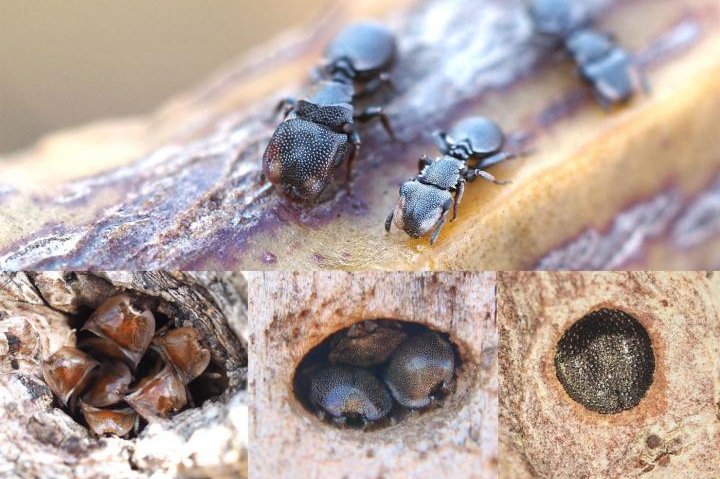
Turtle ant soldiers have evolved a variety of head shapes to block the entrance to their tunneled tree nests. Photo by Scott Powell/George Washington University
March 10 (UPI) -- Turtle ant soldiers have evolved a unique defensive strategy. These gate guards use their comically large heads to block entrances to their nests.
Some ants have round heads, like a manhole cover, ideal for blocking a small round entrance. Other ants, with square heads, congregate to form a blockade, like the wall of overlapping shields formed by Spartan armies.
Turtle ant soldiers seem like a perfect example of evolutionary specialization. The many species of the turtle ant genus occupy specific niches. But a new study of turtle ant soldiers suggests evolution doesn't only encourage specialization.
Instead, scientists uncovered evidence that evolution can promote regression toward a more generalist approach.
"Usually, you would think that once a species is specialized, it's stuck in that very narrow niche," Daniel Kronauer, head of the Laboratory of Social Evolution and Behavior at Rockefeller University, said in a news release. "But turtle ants are an interesting case of a very dynamic evolutionary trajectory, with a lot of back and forth."
Turtle ants make their homes in abandoned tunnels that were carved by wood-boring beetles. Different turtle ant species have evolved to occupy and defend different sized tunnels.
"There's a whopping four-fold difference between the smallest and largest turtle ant soldier heads," said Scott Powell, a biologist at George Washington University. "To help people picture this, I often say that the smallest species is able to sit comfortably on the head of the largest species."
RELATED Some fire ant colonies are ruled by multiple queens
To better understand how turtle ants diversify to fill the various niches of uniquely sized tree tunnels, scientists classified different turtle ant species by the shapes of their soldiers' heads: square, dome, disc or dish-shaped. Next, scientist used genetic data to untangle the evolutionary relationship between different species.
If evolution moved in just one direction, turtle ants should have started out without specialized soldier. And the earliest soldiers should have boasted simple square heads. Highly specialized shapes should have come only later.
Scientists found the oldest turtle ant ancestor did have square-headed soldiers. As well, turtle ants and their soldiers quickly diversified to adapt to variety of tunnels with unusually shaped heads. However, many newer species have since reversed course, having evolved more generalized head shapes, allowing them to occupy a variety of tunnels.
The new research, published this week in the journal PNAS, suggests evolution is a two-way street.
"The space that evolution has to play with is actually quite a bit larger than previously thought," Kronauer adds.
Protecting flood-controlling mangrove forests pays for itself

Mangrove forests offer billions of dollars in flood protection
to vulnerable coastlines. Photo by Needpix/CC
March 10 (UPI) -- The economic costs of protecting mangrove forests along coastlines vulnerable to flooding are more than made up for by the flood protections these ecosystems provide.
In a new study, scientists produced high-resolution models to map the costs of flooding along exposed coastlines and the benefits provided by local mangrove forests. The analysis, detailed this week in the journal Scientific Reports, revealed where and how mangroves provide the most protection.
Authors of the newly published paper also identified the best strategies -- including economic incentives, insurance and climate risk financing -- for funding mangrove conservation and restoration efforts.
"Now that we can value these flood protection benefits, it opens all kinds of new opportunities to fund mangrove conservation and restoration with savings for insurance premiums, storm rebuilding, climate adaptation, and community development," study co-author Michael Beck, research professor at the University of California, Santa Cruz's Institute of Marine Sciences, said in a news release.
RELATED Hurricanes benefit mangroves in Florida's Everglades, study finds
Studies suggest the effects of climate change, including sea level rise and increasing global temperatures, are likely to yield bigger, more intense ocean storms. The latest research showed that without mangroves, flood damages would climb by $65 billion per year, and 15 million more people would be impacted by coastal floods.
In Florida, mangroves were once found along most of state's coastline, but many have been filled in and turned into housing developments. The trend is similar elsewhere, but as more research details the ecological services provided by mangroves, efforts are being made to protect them.
In the Philippines, Vietnam and Guyana, more than 250,000 acres have been restored. Scientists hope these efforts will inspire similar restoration projects in Florida and along other degraded coastlines.
RELATED Healthy mangroves can protect against climate change
"Mangroves are resilient and can grow like weeds, even around cities, if we give them half a chance," Beck said.
The new study identified several specific 12-mile stretches of mangrove forest that provide especially lucrative flood protection services. Some stretches near cities save communities as much as $250 million a year.
Authors of the new study hope their findings will motivate insurance companies, the World Bank and conservation groups to develop plans for risk reduction and conservation along the most important stretches of mangrove-lined coasts.
Project promises to turn palm oil plantations back into rainforest in Borneo
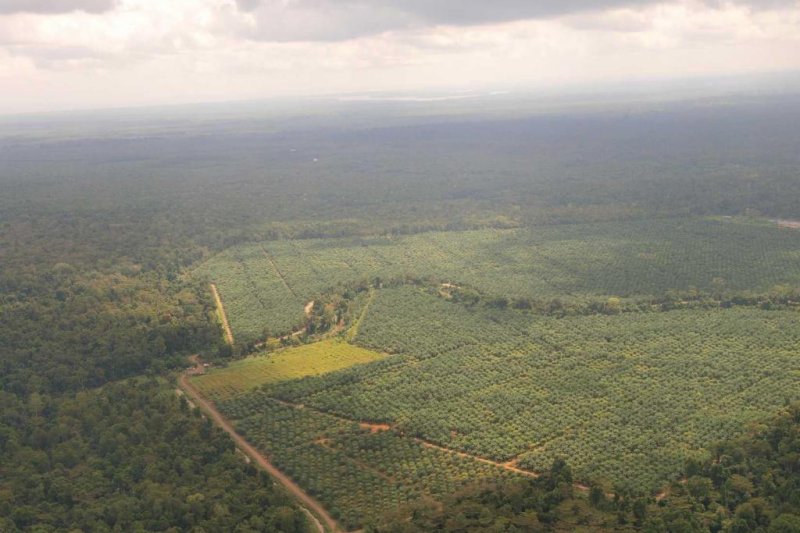
An aerial photos shows the first 38 acres of palm oil plantation that will be turned back into rainforest on the island of Borneo. Photo by Robert Risch
March 22 (UPI) -- Across the island of Borneo, conservationists are preparing to rewild palm oil plantations. The project will see agricultural acreage turned back into near-natural rainforest.
The list of species threatened by deforestation as a result of palm oil production in Malaysia and Indonesia includes the orangutan, Sumatran elephant, Bornean pygmy elephant, Sumatran rhino and Sumatran tiger.
Conservationists and ecologists presented the details of the reforestation project this week in Malaysia at the Heart of Borneo conference. The effort is being organized by the Rhino and Forest Fund, or RFF.
RFF is German-based organization that is supported by the Leibniz Institute for Zoo and Wildlife Research and dedicated to protecting the Sabah rhino, as well as "the remaining lowland rainforest in Malaysia and its unique flora and fauna."
RELATED Oil palm plantations threaten protected Malaysian forests in unexpected ways
"There is a lack of evidence-based experience in practice," conservationists acknowledged in a news release. "With this pilot scheme, the Rhino and Forest Fund would like to close this knowledge gap."
To begin, project leaders plan to turn 15.5 hectares, or 38 acres, of palm oil plantations back into rainforest.
"The signing of a purchase agreement at the current Heart of Borneo conference in Kota Kinabalu, Malaysia, marks a breakthrough in the creation of a significant wildlife corridor," said Robert Risch, a RFF board member and scientist at the Leibniz Institute for Zoo and Wildlife Research. "In order to prevent mass extinction of species, isolated forest areas must be reconnected as soon as possible."
RELATED Palm oil production, deforestation blamed for rising temperatures in Indonesia
The initial project will provide conservationists a chance to develop best practices as they scale their reforestation efforts.
"The challenge is to investigate the optimal transformation of oil palm plantations and their degraded soils into near-natural rainforests," said Swiss researcher Philippe Saner, an environmental scientist and founding member of the RFF. "Knowledge gained from this enables us to make statements about future optimal surface reconstruction."
Scientists are keen to find out how long it takes for biodiversity to return to palm oil plantations once they have been rewilded.
Scientists call for more sustainable palm oil practices
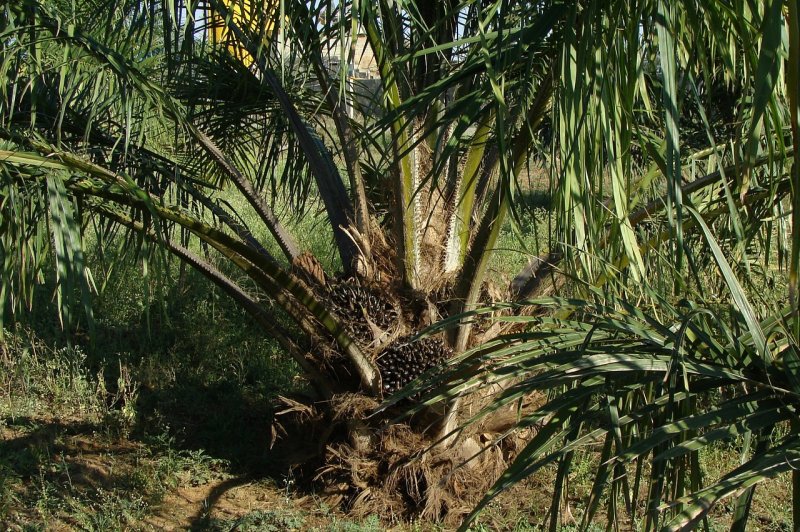
While some alternative natural oils could satisfy a portion of the demand for palm oil, researchers say scaling up production of many other oils presents additional problems. Photo by sarangib/Pixabay
March 10 (UPI) -- Researchers are currently working to find, develop and scale the production of possible synthetic replacements for palm oil, but the process could take years.
In the meantime, a trio of scientists have called for more sustainable palm oil practices, detailing a plea for more eco-friendly palm oil in a paper published this week in the journal Nature Sustainability.
Because none of the current palm oil replacements are economically viable at scale, and because demand for palm oil is unlikely to decline, it makes sense for governments and policy makers to focus on making the palm oil production process more friendly to the environment.
"Palm oil is the most widely used land-grown oil crop, and expansion in the market over the past few decades has led to increases in greenhouse gas emissions and the loss of biodiverse tropical forest areas to farming," study co-author Chris Chuck, professor of chemical engineering at the University of Bath in Britain, said in a news release. "Whilst action is being taken to improve the sustainability of palm oil cultivation it is not happening as effectively or quickly as it needs to."
For the study, scientists analyzed the viability of different replacement possibilities, including existing crop oils, alternative tropical oils and microbial single cell oils.
"Palm oil is challenging to replace as a product because it is very versatile -- it is used in a wide range of cooking, food and other consumer goods products, as well as fuels -- but it's also cheap to produce compared to the alternatives," said lead study author Sophie Parsons, also a mechanical engineer at Bath.
Although some alternative natural oils could satisfy a portion of the demand for palm oil, researchers determined that efforts to scale up production of sunflower and rapeseed, or exotic oils like coconut oil and shea butter, would present their own technical and ecological problems.
RELATED Land prep for palm oil plantations does the most environmental damage
"The only viable large-scale direct replacements are single cell oils from algae or yeast, but these require significant further development before being economically viable," Parsons said. "Governments in producing countries and industry should be working together closely to reduce the impact of the industry while synthetic alternatives are developed for the sake of our climate."
Due to the lack of viable alternatives, authors of the new study recommend governments do more to ensure palm oil farming doesn't extend into ecologically-valuable land. The authors also recommend governments do more to ensure farmers abide by the cultivation practices recommended by the Roundtable on Sustainable Palm Oil.
Currently, only 19 percent of the world's palm oil crops are Certified Sustainable Palm Oil. That number must increase if leaders and policy makers are to minimize the environmental impacts of palm oil.
Baboon moms carry deceased infants for up to 10 days

Scientists documented baboons mothers in the wild in Namibia carry dead infants for up to ten days. Photo by Alecia Carter/UCL
March 11 (UPI) -- Wild baboon mothers carry dead infants for up to ten days, according to a new study. The research promises to illuminate the ways animals deal with death.
Over the course of 13 years, scientists observing wild Namibian chacma baboons documented group responses to 12 infant deaths.
Chacma baboons live in mixed-sex groups ranging in size from 20 to 100 primates. The groups are organized by strong linear male and female hierarchies.
Scientists observed mothers carrying dead infants for as little as an hour and as many as 10 days. Mothers carried their dead infants for an average of three to four days. The research team published their observations Wednesday in the journal Royal Society Open Science.
"There are numerous hypotheses to explain primate responses to dead infants," lead study author Alecia Carter, anthropologist at the University College London, said in a news release. "Perhaps the strongest hypothesis is that carrying after death is an extension of nurturing behavior."
Scientists watched baboon mothers carry deceased infants by a limb and dragged them along the ground, behaviors never seen with live infants.
"We are not suggesting that the mothers are unaware that their infants are dead, but there is such strong selection on mother-infant bond formation that, once formed, the bond is difficult to break," Carter said. "It's less clear why only some mothers carry or protect their dead infant, but I suspect that a range of factors influence this behavior."
According to Carter and her colleagues, the "grief-management hypothesis" best explains the behavior. According to the hypothesis, carrying a dead infant is a way of coping with the emotional impacts of a tragic loss. The "social-bonds hypothesis" suggests baboon mothers hold onto their dead infants due to their intense social bonds with their young offspring.
Scientists suspect a range of factors account for the range of time that mothers carry their dead infants, including the mothers' age, the cause of death and the climate conditions.
"Other primates have been observed carrying their dead infants for much longer periods of time," Carter said. "Chimps and Japanese macaques for example have been observed carrying infants for over a month. However, chacma baboons travel much longer distances on an average day and the desert environment is harsh, making it costly for a mother to carry her infant for long periods."
Researchers also observed the fathers of dead infants protecting the corpse and sometimes grooming the dead infant when the mother wasn't nearby.
"This is quite surprising behavior, because it has rarely been reported by previous studies," said co-author Elise Huchard, a researcher at the University of Montpellier in France. "Male baboons are not usually very paternal, but they regularly protect their infant from threats, especially from infanticidal attacks. That is where a male baboon kills another male's offspring in order to mate with the mother."
Scientists hope their findings can help researchers begin to answer questions about the origins of humans' awareness of death and dying, and perhaps even the evolution of consciousness.
As health of prairie grasses decline, so does number of grasshoppers
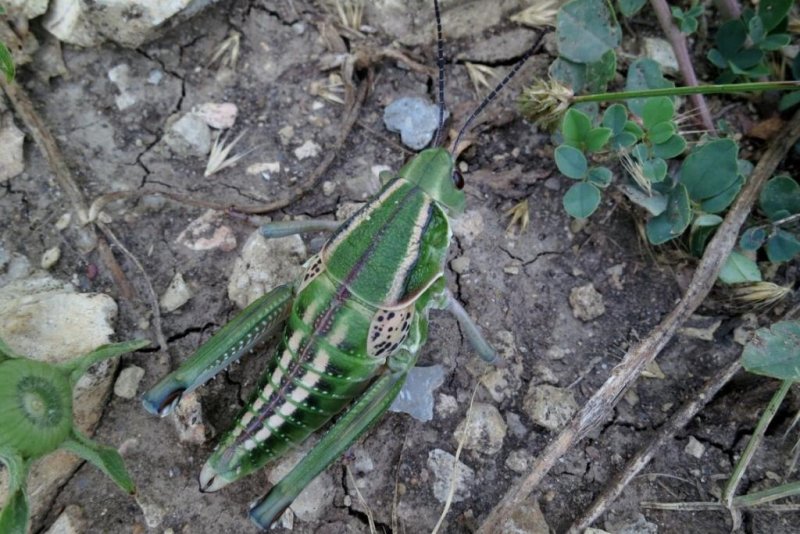
A plains lubber grasshopper, Brachystola magna, is pictured in Konza Prairie, a preserve in northeast Kansas. Photo by Ellen Welti/University of Oklahoma
March 11 (UPI) -- There are 30 percent fewer grasshoppers living in a Kansas grassland preserve than there were 20 years ago, and new research suggests the herbivore's decline is a result of the reduction in nutrients typically found in wild grasses.
Usually, declines in species abundance, whether insects or mammals, are linked with habitat destruction. But the latest research -- published this week in the journal PNAS -- suggests declines in the nutritional qualities of grass, even in preserved habitats, can spur declines in the number of herbivores.
"One surprise was that grasshopper abundances in this large native tallgrass prairie reserve are declining," lead study author Ellen Welti, ecologist at the University of Oklahoma, said in a news release. "This grassland appears to be a stable and prime habitat for grasshoppers and yet even here, we are seeing 2 percent annual declines."
The latest analysis suggests climate change is to blame. Researchers measured declining levels of nitrogen, phosphorus and sodium in the grass growing in Konza Prairie, a large reserve in northeast Kansas. Grass growth rates have increased as CO2 levels rise, but there is less and less nutrients to nourish new grass.
"The greenhouse gas CO2 is heating the Earth and acidifying its oceans, but it is also the main ingredient in the sugars, starches, and cellulose of plants," said Michael Kaspari, professor of ecology at Oklahoma. "When we pump the atmosphere full of CO2, we build more plants. But, with no additional nutrients to fertilize them, the nutritional value of each bite is diluted. Mouthful by mouthful, the prairie provides less and less food to the grasshoppers. Hence, their decline."
Grassland covers more than 30 percent of Earth's land mass, and grasshoppers are one of the most abundance grass-eaters. It's like similar declines are occurring among herbivore populations around the globe.
"The mechanism of grasshopper declines that we propose in this study -- declining plant quality with increasing atmospheric CO2 -- is expected to be global in scope and pose the largest challenge to herbivores," Kaspari said. "It is notable that a large number of previous studies documenting insect declines were on another herbivorous group -- butterflies and moths -- but few of these papers identified a mechanism causing declines."
