Tuesday, March 17, 2020

Mysterious bone circles made from the remains of mammoths reveal clues about Ice Age

by University of Exeter
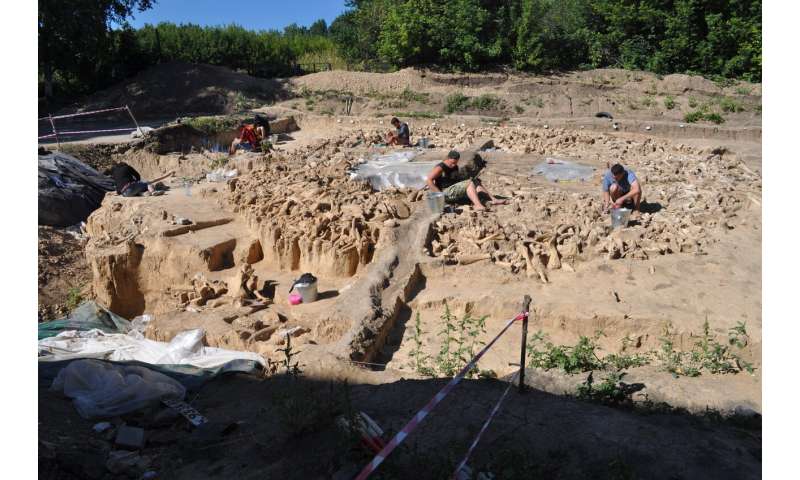
The majority of the bones found at the site investigated, in the Russian Plains, are from mammoths. A total of 51 lower jaws and 64 individual mammoth skulls were used to construct the walls of the 30ft by 30ft structure and scattered across its interior. Credit: Alex Pryor

Mysterious bone circles made from the remains of dozens of mammoths have revealed clues about how ancient communities survived Europe's ice age.

About 70 of these structures are known to exist in Ukraine and the west Russian Plain.

New analysis shows the bones at one site are more than 20,000 years old, making it the oldest such circular structure built by humans discovered in the region. The bones were likely sourced from animal graveyards, and the circle was then hidden by sediment and is now a foot below current surface level.

The majority of the bones found at the site investigated, in the Russian Plains, are from mammoths. A total of 51 lower jaws and 64 individual mammoth skulls were used to construct the walls of the 30ft by 30ft structure and scattered across its interior. Small numbers of reindeer, horse, bear, wolf, red fox and arctic fox bones were also found.

Archaeologists from the University of Exeter have also found for the first time the remains of charred wood and other soft non-woody plant remains within the circular structure, situated just outside the modern village of Kostenki, about 500km south of Moscow. This shows people were burning wood as well as bones for fuel, and the communities who lived there had learned where to forage for edible plants during the Ice Age. The plants could also have been used for poisons, medicines, string or fabric. More than 50 small charred seeds were also found—the remains of plants growing locally or possibly food remains from cooking and eating.
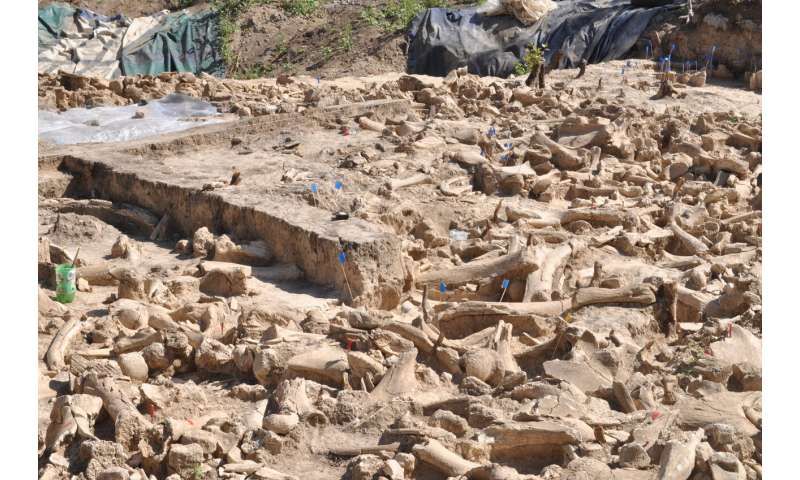
The majority of the bones found at the site investigated, in the Russian Plains, are from mammoths. A total of 51 lower jaws and 64 individual mammoth skulls were used to construct the walls of the 30ft by 30ft structure and scattered across its interior. Credit: Alex Pryor

Dr. Alexander Pryor, who led the study, said: "Kostenki 11 represents a rare example of Palaeolithic hunter-gatherers living on in this harsh environment. What might have brought ancient hunter gatherers to this site? One possibility is that the mammoths and humans could have come to the area on masse because it had a natural spring that would have provided unfrozen liquid water throughout the winter—rare in this period of extreme cold.

"These finds shed new light on the purpose of these mysterious sites. Archaeology is showing us more about how our ancestors survived in this desperately cold and hostile environment at the climax of the last ice age. Most other places at similar latitudes in Europe had been abandoned by this time, but these groups had managed to adapt to find food, shelter and water."


The last ice age, which swept northern Europe between 75-18,000 years ago, reached its coldest and most severe stage at around 23-18,000 years ago, just as the site at Kostenki 11 was being built. Climate reconstructions indicate at the time summers were short and cool and winters were long and cold, with temperatures around -20 degrees Celsius or colder. Most communities left the region, likely because of lack of prey to hunt and plant resources they depended upon for survival. Eventually the bone circles were also abandoned as the climate continued to get colder and more inhospitable.

Previously archaeologists have assumed that the circular mammoth bone structures were used as dwellings, occupied for many months at a time. The new study suggests this may not always have been the case as the intensity of activity at Kostenki 11 appears less than would be expected from a long term base camp site.
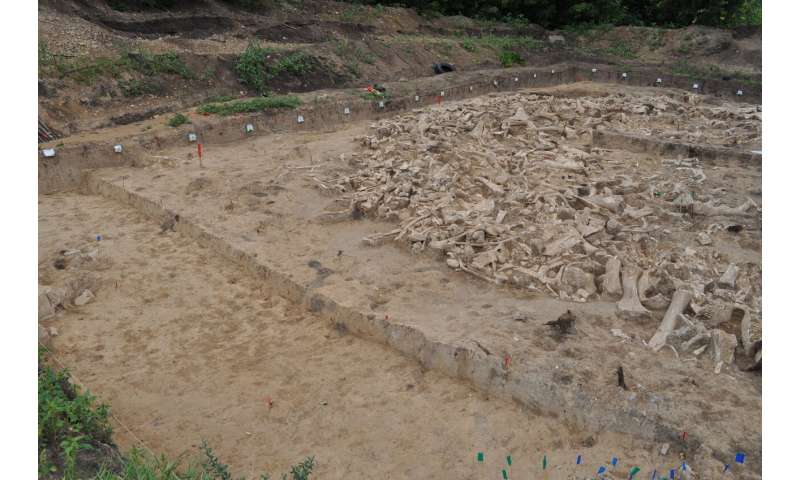
The majority of the bones found at the site investigated, in the Russian Plains, are from mammoths. A total of 51 lower jaws and 64 individual mammoth skulls were used to construct the walls of the 30ft by 30ft structure and scattered across its interior. Credit: Alex Pryor

Other finds include more than 300 tiny stone and flint chips just a few millimetres in size, debris left behind the site's inhabitants as they knapped stone nodules into sharp tools with distinctive shapes used for tasks such as butchering animals and scraping hides.

The research, conducted by academics from the University of Exeter, University of Cambridge, Kostenki State Museum Preserve, University of Colorado Boulder and the University of Southampton, is published in the journal Antiquity.
The potential of lucid dreaming and virtual reality to treat combat-related PTSD

by Ingrid Fadelli , Medical Xpress
Credit: Shahzin Shajid, Unsplash.

In recent years, experts in the field of transcultural psychiatry have been trying to identify alternative approaches for treating mental health disorders that could enhance traditional Western psychotherapeutic practices. One of these alternative techniques is lucid dreaming, which entails teaching individuals to become aware that they are dreaming and potentially gain control over a dream's narrative.

Some science fiction movies, such as "Avatar" and "Inception," introduced imaginative examples of how lucid dreaming or entering virtual realities could help to treat a particular segment of the population: soldiers affected by post traumatic stress disorder (PTSD). The high-tech and imaginary realities portrayed in these movies inspired independent researcher Susan Smith to write a paper focusing on the potential use of lucid dreaming for treating post-combat PTSD, which was published in SAGE's Transcultural Psychiatry journal.

"My initial academic interest started with looking at disability and the wounded war hero in science fiction, which then led my research to the medical humanities and psychiatry," Smith told MedicalXpress. "In my recent study, I take on a critical medical humanities approach with the main objective of raising awareness about the healing potential of transcultural psychiatry for treating PTSD, while critiquing the inherent bias of war underpinned by military-funded medicine in Western society."

Smith's recent study stems out of her past work focusing on disability, rehabilitation and military medicine, as well as on their relatable representation in science fiction stories. In her considerations, she combines theoretical constructs and ideas rooted in different disciplines, including psychology, psychiatry and media studies.

"Popular science fiction movies "Avatar' and "Inception' provide a cultural register for imagining how alternate treatments like lucid dreaming or virtual worlds have the potential to empower soldiers to manage and cope with long-term combat related mental health conditions," Smith explained.

Over the past decade or so, a number of media articles claimed that the United States military is experimenting with technologies and techniques depicted in popular science fiction movies, including "Avatar" and "Inception," assessing their potential in helping war veterans affected by PTSD to better cope with disturbing nightmares "Inception," a renowned sci-fi movie directed by Christopher Nolan and released in 2010, portrays a reality in which experts can alter people's thoughts by entering their dreams using technology that vaguely resembles virtual reality (VR). Similarly, in "Avatar," a movie directed by James Cameron and released in 2009, the consciousness of a disabled soldier is transferred into a genetically engineered body, which acts as his avatar during a war.

In her study, Smith discusses the potential of using similar techniques to assist war veterans affected by PTSD, teaching them to manipulate their unconscious and conscious mind. While her work is primarily based on theories and speculation, it highlights some of the possible benefits that these techniques could have in psychotherapeutic settings. Her considerations could pave the way for further transcultural psychiatry studies aimed at devising innovative therapeutic approaches that integrate the use of lucid dreaming, VR or other techniques resembling to those depicted in science fiction movies.

"My paper suggests that a critical engagement with rehabilitation medicine and military psychology and psychiatry is essential for confronting western society's culture of war, which continues to present the American soldier as salvageable and invincible," Smith said. "In my future work, I plan to investigate this topic further by analyzing recent media reports on the robot psychiatrist/virtual therapist currently trialled in military medicine for assessing the mental health and wellbeing of soldiers returning from active duty to civilian life.

Iron 'whiskers' found covering Itokawa asteroid samples

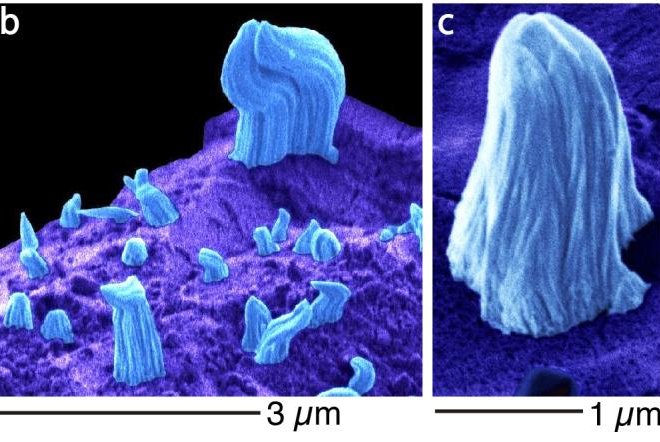
Scientists discovered tiny hair-like iron crystals on dust particles from Itokawa asteroid samples. Photo by Friedrich-Schiller University of Jena

Feb. 28 (UPI) -- Scientists have found iron "whiskers" on particles from the asteroid samples returned by the Japanese space agency's Hayabusa mission.

In 2005, JAXA's Hayabusa probe hunted down and landed on the near-Earth asteroid 25143 Itokawa. Five years later, the spacecraft returned to Earth with soil samples collected from the asteroid's surface -- something that had never been done before.

Over the last decade, the Itokawa samples have been analyzed by dozens of scientists, but until recently, the presence of these tiny crystalline threads of iron went unnoticed.

The iron whiskers were first spotted by Japanese researcher Toru Matsumoto, currently a visiting scientist with the Institute of Geosciences at the Friedrich-Schiller University of Jena in Germany.

Matsumoto identified the hair-like iron crystals after capturing high-resolution images of Itokawa dust particles using a transmission electron microscope. Scientists have since located the same whiskers around particles from other Itokawa samples.

The whiskers have provided scientists with clues as to how Itokawa first formed.

"These structures are the consequence of cosmic influences on the surface of the asteroid," Falko Langenhorst, researcher with the Institute of Geosciences, said in a news release.

Itokawa is rich in the mineral troilite, which contains both iron and sulphur. The mineral is regularly bombarded with high-energy particles from solar wind.

"As a result of space weathering, the iron is released from the troilite and deposited on the surface in the form of the needles that have now been discovered," said Langenhorst.

Scientists detailed their analysis of the newly discovered asteroid whiskers this week in the journal Nature Communications. Their findings have laid the groundwork for how scientists can use evidence of space weathering to illuminate the history of celestial bodies.
In the years ahead, scientists will have a number of asteroid samples to test, including samples returned by NASA's OSIRIS-REx probe, which is poised to scoop samples from the surface of the asteroid Bennu, as well as JAXA's Hayabusa2, which is already on its way back to Earth, with samples from the near-Earth asteroid 162173 Ryugu in tow.
Vulnerable species safest on federally protected lands
CONTRARY TO THE LIBERTARIAN RIGHT IN AMERIKA 
Scientists found habitat loss for endangered species is two times greater on private lands, colored orange, than on federal lands, coded blue. Photo by Tufts University

March 2 (UPI) -- Vulnerable species are most at risk on private lands, according to a new study. On federally protected lands, rates of habitat loss and extinction are diminished.

For the study, scientists at Tufts University and the conservation group Defenders of Wildlife surveyed three decades of earth satellite images for evidence of habitat loss. The data, detailed Monday in the journal Frontiers in Ecology and the Environment, showed habitat loss for endangered species was twice as great on private lands than on federally protected lands.

The study suggests protections offered by an endangered species listing and land use regulations are beneficial to vulnerable species.

Instead of looking at a specific species, confined region and certain king of habitat, researchers set out to measure the nationwide impacts of local land regulations and conservation policies on habitat loss for 24 endangered vertebrate species.

Scientists first mapped the ranges of the 24 species, which comprised 49 percent of the country and encompassed all major ecosystems. Then, researchers used the Google Earth Engine LandTrendr algorithm to identify habitat change across the ranges.

The species lost 3.6 percent of their habitat on federally protected lands and some 8.6 percent of their habitat on private lands without protections. Lands managed by states and lands protected by non-governmental organizations featured habitat losses measuring roughly 4.5 percent.

Because some of the species included in the study were classified as endangered during the course of the 30-year time frame, scientists were able to measure the effects of the listing on habitat loss. The data showed species lost less habitat on federal lands after the official endangered designation.

In other words, the Endangered Species Act is a boon to vulnerable species in the United States.

The data suggests federal land protections alone aren't as helpful. The combination of land-use regulations and an official endangered designation works best. Efforts to coordinate state land protections with federal land protections could further insulate vulnerable species for habitat loss, according to the new study.

"We know from research conducted by other scientists that development surrounding protected areas can reduce the effectiveness of those protections for animals," first study author Adam Eichenwald, a biology graduate student at Tufts, said in a news release.

Authors of the new study acknowledged that federal lands could be come less effective as climate change alters the ranges of vulnerable species.

"Global climate change can force species to move, which we worry may eventually result in areas designed to protect species without any of their protected occupants," Eichenwald said.

Though the new research suggests federal regulations are helpful to vulnerable species, federal lands still host small amounts of habitat loss. Researchers suggest more needs be done to curb habitat loss and protect important ecosystems.

"At a time when the planet faces a looming extinction crisis, we need every tool available to protect species and their habitats," said study co-author Jacob Malcom, director of the Center for Conservation Innovation at Defenders of Wildlife. "This research illustrates the critical importance of America's federal lands system for conserving wildlife habitat and the urgent need for better protections on other land ownerships. Biodiversity and the services it provides to society can be conserved through concerted effort and transformative change; protecting habitats must be an essential part of that effort."
5,000-year-old milk proteins show dairy pastoralism's effect on Eurasian steppe

Today, the people of the Eurasian steppe get more than 
half their calories from dairy during the summer months. 
Photo by Björn Reichhardt

March 2 (UPI) -- Archaeological evidence suggests dairy pastoralism originated in southwest Asia. How and when the tradition migrated eastward is less understood.

The discovery of 5,000-year-old milk proteins -- described Monday in the journal Nature Ecology and Evolution -- suggests populations living on the Eurasian steppe were producing and consuming milk as early as 3,000 B.C.

The Eurasian steppe's strong winds weathered away much of the evidence of the pastoral populations that occupied prehistoric Mongolia. To better understand the evolution of these early pastoralists, researchers examined a series of ritual human burial mounds.

Scientists analyzed the chemical makeup of dental calculus, or plaque, extracted from human teeth dated from the Early Bronze Age to the Mongol Period. More than three-quarters of the individuals tested revealed evidence of dairy consumption.

The extensive nature of the milk consumption suggests the practice was introduced even earlier than 3,000 B.C.

Previous genetic surveys have linked the people of prehistoric Mongolia with herder populations of the western steppe. The connection suggests populations from Russia's Atlai mountains likely brought dairy pastoralism with them as they traveled east.

"Modern Mongolians use cow, sheep, goat, yak, camel, horse and reindeer for milk today, yet when each of these species were first utilized for dairy in Mongolia remains unclear," lead study author Shevan Wilkin, researcher at the Max Planck Institute for the Science of Human History in Germany, said in a news release. "What is clear is that the crucial renewable calories and hydration made available through the incorporation of dairying would have become essential across the arid and agriculturally challenging ancient Eastern Steppe."

RELATED Teeth of British farmers show earliest direct evidence of milk consumption

Analysis of the ancient plaque showed the earliest milk drinkers in prehistoric Mongolia sourced their dairy from ruminant species, like cattle, sheep and goats. Scientists found the chemical signatures of horse milk consumption in the plaque extracted from teeth dating to 1,200 B.C. The analysis also showed camel milk consumption was popular during the Mongol Empire, between 1,400 and 1,200 B.C.

"We are excited that through the analysis of proteins we are able to see the consumption of multiple different animal species, even sometimes in the same individual," said senior study author Jessica Hendy. "This gives us a whole new insight into ancient dairying practices."

Researchers hope further analysis will help them determine how exactly western steppe herders helped spread the tradition of dairy pastoralism through the region.
Global air pollution shortens lifespan by average of three years

Air pollution shortens the average human lifespan by three years, according to new models. Photo by PublicDomainPictures/Pixabay


March 3 (UPI) -- Air pollution is a greater drag on the average human lifespan than war, malaria, HIV/AIDS, smoking and more.

In a new study, published Tuesday in the journal Cardiovascular Research, an international team of scientists used a novel modelling technique to estimate the effects of different types of air pollution on death rates around the world.

Simulations showed global air pollution was responsible for 8.8 million premature deaths in 2015, shortening human life expectancy an average of three years. By comparison, smoking tobacco shortened life expectancy by 2.2 years. Diseases spread by parasites or insects like mosquitoes, ticks and fleas shortened life expectancy by a little more than half a year.

Using the results of previous scientific studies as their guide, the creators of the new model tabulated the impacts of air pollution on six different types of disease: lower respiratory tract infection, chronic obstructive pulmonary disease, lung cancer, heart disease, stroke-causing cerebrovascular disease and other non-communicable diseases like high blood pressure and diabetes.


The data showed the effects of air pollution on cardiovascular diseases -- heart disease and cerebrovascular disease -- is responsible for 43 percent of the reduction in global life expectancy.

"Air pollution causes damage to the blood vessels through increased oxidative stress, which then leads to increases in blood pressure, diabetes, stroke, heart attacks and heart failure," lead study author Jos Lelieveld, climate scientist at the Max Planck Institute for Chemistry in Germany, said in a news release.

The new models also revealed 75 percent of the premature deaths caused by air pollution occurred in people over the age of 60.


"It is remarkable that both the number of deaths and the loss in life expectancy from air pollution rival the effect of tobacco smoking and are much higher than other causes of death," said Lelieveld. "Air pollution exceeds malaria as a global cause of premature death by a factor of 19, it exceeds violence by a factor of 16, HIV/AIDS by a factor of 9, alcohol by a factor of 45, and drug abuse by a factor of 60."

Authors of the new study argued air pollution -- and its significant negative impacts on human health -- warrants the term "pandemic."

"Since the impact of air pollution on public health overall is much larger than expected, and is a worldwide phenomenon, we believe our results show there is an 'air pollution pandemic,'" said Thomas Münzel, cardiovascular researcher at the University Medical Center of the Johannes Gutenberg University in Germany. "Policy-makers and the medical community should be paying much more attention to this. Both air pollution and smoking are preventable, but over the past decades much less attention has been paid to air pollution than to smoking, especially among cardiologists."


RELATED Closing coal plants saves lives, boosts crop yields

The research distinguished between air pollution caused by human activities and air pollution caused by natural phenomena, like wildfire emissions and dust blown into the air by desert winds.

Around the world, human-caused pollution, mostly from the burning of fossil fuels, accounted for two-thirds of premature deaths. In the wealthiest countries, human-caused pollution accounted for 80 percent of premature deaths.

Topics
Max Plan
New drug prevents bacteria from acquiring antibiotic resistance genes

Postdoctoral researcher Arnau Domenech and his colleagues identified a new pathway for disrupting the ability of bacteria cells to develop antibiotic resistance. Photo by Veening Lab

March 3 (UPI) -- According to a new study, scientists have developed a drug that prevents bacteria from acquiring the genes needed to develop antibiotic resistance.

Bacteria evolve resistance to antibiotics by acquiring DNA fragments from their environs and incorporating them into their genomes. This ability is referred to as "competence."

Through a series of observations and lab tests, scientists were able to identify the chain of events that allow bacteria cells to become competent. Once they identified what competence looked like, scientists were able to identify drugs that interfered with the process.

"We collaborated with scientists from Heidelberg, who developed a high-throughput assay to simultaneously test cells for competence and growth," lead study author Arnau Domenech, postdoctoral researcher at the University of Groningen in the Netherlands, said in a news release. "In this assay, 1,366 approved drugs were screened. It turned out that 46 of them blocked the induction of competence, without negatively affecting growth."
RELATED New antibiotics have a unique way of killing bacteria

Cells can become motivated to evolve defenses against drugs if the drugs cause growth stress. Because the 46 drugs don't negatively impact cell growth, cells of the bacterium Streptococcus pneumoniae didn't develop resistance.

The drugs that prevented competence and didn't inhibit cell growth belonged to two different categories: drugs affecting ion homeostasis and antipsychotics. Further investigation showed that all of the drugs block competence by disrupting the proton-motive force, the electrochemical gradient that propels protons cellular membranes and fuels a variety of cellular processes.

"The result is that the cells fail to secrete a peptide called CSP," said Domenech.

When enough cells secrete CSP, competence genes get activated -- a process known as quorum sensing. By disrupting the proton-motive force, the 46 drugs prevented CSP secretion from crossing the necessary threshold and turning on the competence genes.

"In the lab, we observed that our competence-blocking drugs could prevent the transfer of antibiotic resistance genes to susceptible strains of Streptococcus pneumoniae and we obtained the same results in cultures of human lung epithelial cells," Domenech said.

Scientists got the same promising results when they repeated the lab tests using a mouse model. The research team published the results of their tests this week in the journal Cell Host and Microbe.

RELATED Bacterial evolution of antibiotic weapons promises new insights for drug makers

Because the proton-motive force is necessary for some vital functions in humans, scientists aren't certain whether drugs are safe for humans. Further testing is needed to determine whether these anti-evolution drugs can help
ULTIMATE BREEDER
Swamp wallaby never stops being pregnant


Female swamp wallabies are constantly pregnant during adulthood.
Photo by Wikimedia/CC

March 4 (UPI) -- The female swamp wallaby, native to eastern Australia, is the only mammal that remains pregnant for the entirety of adulthood, according to a new study.

Like kangaroos, wallabies have two uteri. During the later stages of a swamp wallaby's most immediate pregnancy, a new embryo forms in the unused uterus. When the wallaby gives birth and the newborn joey starts suckling milk, the new embryo enters a long period of developmental arrest called embryonic diapause.

When the young wallaby's appetite for milk starts to wane, the embryo begins growing once more and the pregnancy cycle starts anew. The female wallaby becomes fertile and she seeks out a new mate to form a second embryo.

"Thus, females are permanently pregnant their whole lives," lead researcher Brandon Menzies, geneticist and marsupial expert at the University of Melbourne, said in a news release.

Most mammals need a break in between pregnancies to help raise newborns or avoid seasonal dips in food resources, but the latest research -- published this week in the journal PNAS -- suggests the female swamp wallaby never takes a day off from being pregnant.

"We used high resolution ultrasound to track pregnancy and mating in 10 female swamp wallabies," said Menzies. "What we found amazed us: the females come into oestrus, mate and form a new embryo 1 to 2 days before the end of their existing pregnancy. The swamp wallaby is the only mammal known to be continuously pregnant in this way."

Because the swamp wallaby is always pregnant, moms are always supporting three different stages of development: an embryo in the uterus, a young joey in the pouch and a semi-dependent young still suckling milk. Despite these heavy demands on female swamp wallabies, surveys suggest the species is doing well.

"Whatever the reason, the swamp wallaby is an incredibly successful and ubiquitous species in Australia, occupying a range that stretches from the Western Victoria/South Australian border all the way up the eastern seaboard to cape York in far north Queensland," said Menzies.


RELATED Territorial conflicts suppress female chimpanzees' reproductive success
Sex chromosomes explain shorter lifespans of male mammals

Male mammals tend to lead shorter lives than their female
counterparts, at least in part due to their Y chromosome. 
Photo by Piqsels/CC

March 4 (UPI) -- According to a new study, male mammals live shorter lives than their female peers as a result of sex chromosomes, not because of their risky behavior.

When an international team of researchers surveyed the scientific literature for links between sex chromosomes and lifespan across the animal kingdom, they found evidence supporting the "unguarded X hypothesis."

The unguarded X hypothesis supposes that males, because they have an X and Y chromosome, are less able to avoid harmful genes expressed on the X chromosome. Because the Y chromosome is often smaller than the X, it can's hide the flaws in the X chromosome.

Having two X chromosomes is beneficial because the homogametic chromosomes can be interchanged, with a healthy X chromosome taking the place of an X that has damaging genes.

Researchers found broad support for the hypothesis in available scientific literature. They published findings Wednesday in the journal Biology Letters.

"We looked at lifespan data in not just primates, other mammals and birds, but also reptiles, fish, amphibians, arachnids, cockroaches, grasshoppers, beetles, butterflies and moths among others," lead study author Zoe Xirocostas, doctoral student at the University of New South Wales, said in a news release. "And we found that across that broad range of species, the heterogametic sex does tend to die earlier than the homogametic sex, and it's 17.6 percent earlier on average."

Male animals don't always carry heterogametic sex chromosomes. Female birds, butterflies and moths carry ZW chromosomes, while the males carry homogametic ZZ sex chromosomes. Data analyzed by Xirocostas and her colleagues showed female birds, butterflies and moths tend to die sooner than their male counterparts.

The difference in lifespans between the carriers of ZW and ZZ chromosomes wasn't as great, however.

"We found a smaller difference in lifespan between the males and females in the female heterogametic species compared to males and females in the male heterogametic species," Xirocostas said. "In species where males are heterogametic (XY), females live almost 21 percent longer than males. But in the species of birds, butterflies and moths, where females are heterogametic (ZW), males only outlive females by 7 percent."
The findings suggest chromosomal differences help explain some of differences in lifespan between male and female mammals, but it's possible that differences in behavior further shrink the male mammal's already shorter lifespan.
Farming encouraged cooperation and violence among early humans

Farming brought people together in larger concentrations,

 encouraging cooperation -- but also violence. 
Photo by Pexels from Pixabay

March 4 (UPI) -- As hunter-gatherers settled down and took to farming the land, groups of people began gathering in larger numbers and cooperating. But new research suggests the adoption of agriculture encouraged violence between humans populations, too.

"We were interested in understanding why people would make the shift from hunting and gathering to farming," Elic Weitzel, doctoral student in anthropology at the University of Connecticut, said in a news release. "Then I started to get interested in what happened in society after they made that shift and started farming on a larger scale."

Weitzel and his colleagues used "ideal free distribution" to simulate the distribution of farmers in in eastern North America between 7,500 and 5,000 years ago, as well as to locate the most coveted land -- the acreage with the most food, water, raw materials and shelter.

Scientists graded different land parcels with a "net primary productivity" score. The most productive pieces of land tended to host the largest concentration of people, and thus, host the greatest amount of conflict and violence.

"If you are living in a suitable area, you can lay claim and keep others from accessing what you have," Weitzel said. "That becomes a cooperative process, because one person is not as effective as a whole group is at defending a territory."

But scientists also found evidence of the so-called Allee's Principle, which posits increases in individual fitness boost the density of the population through cooperation.

"The transition from a hunting and gathering society to an agricultural society is dependent on collaboration," said co-author Stephen Carmody, an anthropologist at Troy University. "The development of agriculture appears to only have happened in nine places around the world so Eastern North America is a unique part of the world to study. Agriculture was one of the most consequential transitions that happened in the past. It changed our whole economic situation."

The concentration of valuable resources could only be accessed via cooperation and coordinated protection, but coveted land and resources also inspired jealousy and violence.

"When a resource like domesticated crops is dense and predictable, that is when we expect that it would be defendable," Weitzel said. "Other groups may want access to your crop in case their crop failed, for example. There is cooperation and there are aspects of competition. Harvesting and defending."

During the time period studied, scientists identified archaeological evidence of larger, more dense population centers, a sign of growing levels of cooperation among groups of humans. But researchers also found evidence of increased violence and trophy taking in the archaeological record.

"Of course there are signs of violence throughout history, but trophy-taking is a different type of violence," Weitzel said. "The victor removes a part of the loser as a signal they won. They took scalps, hands, feet, heads -- that first evidence appears to have happened at the same time as plant management."

Scientists were also able to see patterns predicted by Allee's Principle playing out in the archaeological record. As concentrations of humans grew, the land's suitability declined and groups began to disperse once more. A decline in trophy-taking violence declined during the period of dispersal.

Researchers suggest their findings -- published this week in the journal Environmental Archaeology -- could be used to better understand the effects of modern pressures, like climate change and economic inequality, on human behavior.

"This is one of the ways archaeology is relevant to contemporary and future society," Weitzel said. "The modeling of human behaviors in society and our relationships can help us overcome current collective action problems. We are all better off if we cooperate."