Sunday, September 06, 2020


Hurricane Laura’s Winds Are Now Long Gone, But Residents Fear The Toxic Sludge Left Behind

Residents and environmentalists say that Louisiana’s weak environmental laws are keeping them in the dark about the health risks left in the wake of the historic storm’s path through dozens of major petrochemical plants and oil refineries.
Posted on September 5, 2020

Andrew Caballero-Reynolds / Getty Image

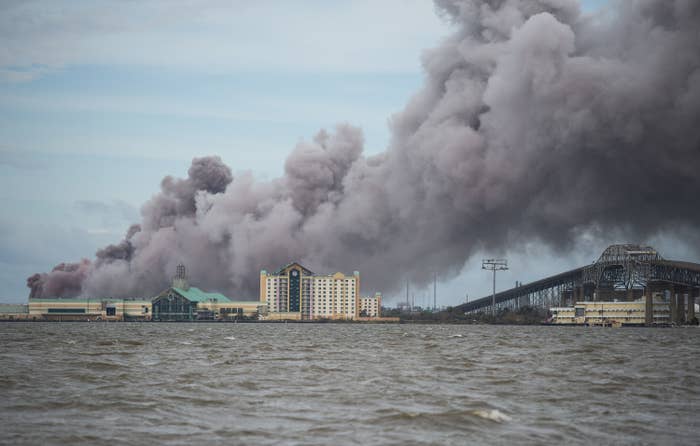
Smoke rises from a burning chemical plant after the passing of Hurricane Laura in Lake Charles, Louisiana on August 27, 2020.


Two days after Hurricane Laura’s 150 mph winds finally subsided, Christine and Delma Bennett were back in Calcasieu Parish, Louisiana, to survey what was left of their home and the rental properties whose income the elderly couple depends on to pay their bills.

“It’s like somebody dropped a bomb,” Christine Bennett said. Along with her husband of 48 years and their children and grandchildren, she had fled to her son’s house in Texas in two cars stuffed with six people and as many of their things they could fit in. “Nearly every roof in the neighborhood is ruined.”

Worse than that, however, was what she feared the hours spent in the area had done to her health: Both she and her husband had headaches, which lingered for days. Bennett worried the couple had inhaled toxic substances, released from the area’s many petrochemical plants during the hurricane. “God knows what was in that air,” she said.

The Bennetts’ properties are in Mossville, a small unincorporated Black community on the outskirts of the city of Lake Charles. Originally founded in 1790 by formerly enslaved people, Mossville was a thriving community for over 15 decades until the 1950s, when the chemical industry began gobbling up nearby land. First residents welcomed the jobs, Bennett said, but slowly the expanding number of chemical plants crept closer and closer to people’s homes.

These days, just a few dozen families remain in Mossville. As they struggle to rebuild, they also find themselves at the leading edge of a problem that environmental experts fear may soon confront neighborhoods in numerous small towns and cities along Louisiana’s coast: the toxic aftermath of hurricanes’ howling winds and surging storm waters. What’s more: Given Louisiana’s lax environmental reporting requirements, the true extent of the environmental damage and long-term health impacts may never be accounted for. After all, environmental advocates note, they weren’t after Hurricane Katrina hit New Orleans or Hurricane Rita hit southwest Louisiana. Nor were the impacts of Hurricane Harvey in Houston in 2017 fully tallied — even though Texas’s environmental laws are stricter than Louisiana’s. Often, it is communities of color who bear the brunt of these problems because of racist zoning policies that funneled industry to Black and Latino communities.

“We just don't know what has been released since Laura because the system is designed to obfuscate,” said Anne Rolfes, director of the Louisiana Bucket Brigade, a nonprofit that works to give voice to the needs of communities located near industry.

When the Bennetts drove into Mossville on Friday, the area was under a shelter-in-place order because of toxic gas. A fire had ignited at the nearby BioLab chlorine plant, which processes chlorine for swimming pools.

“We haven't heard about any other leaks or spills, but they're not going to let that out,” said Christine Bennett. “With BioLab, that was just such a big fire that they couldn’t hide it.”
Andrew Caballero-Reynolds / Getty Images

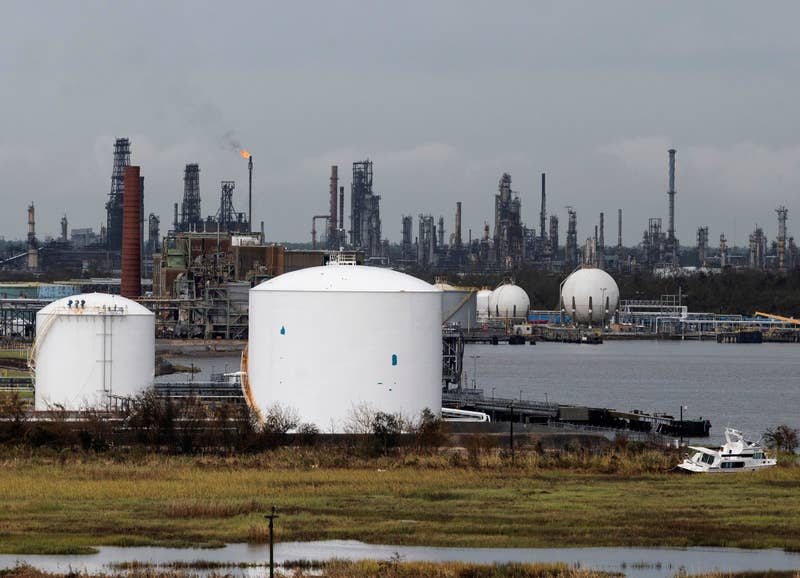
An oil and gas processing plant is seen in Lake Charles, Louisiana on August 28, 2020.

Greg Langley, press secretary for the Louisiana Department of Environmental Quality, said that the agency is confident that they will be able to address the environmental concerns that have arisen since Hurricane Laura.

“We're not naive,” Langley said. “We know there's bound to be some small amounts of spillage. We don't know how much, but it doesn't at this point seem to be any widespread large incidents.”

Leaks and spills have become part and parcel of hurricanes that hit Texas and Louisiana’s Gulf Coast. A Reuters analysis found that in the wake of Hurricane Harvey’s punishing rain in the Houston area, at least 22,000 barrels of oil, refined fuels, and chemicals were spilled across the state. That was in addition to millions of cubic feet of natural gas and hundreds of tons of other toxic substances. While Harvey had a widespread effect on Texas, the environmental damage paled in comparison to Hurricane Katrina. Researchers estimate that there were as many as 200 releases of hazardous chemicals, petroleum, or natural gas in the wake of that storm coming ashore south of New Orleans.

“These releases are a well-known problem,” said Nicholas Santella, a geochemist who studied the spills and leaks after Hurricane Katrina and now works at BSTI, an environmental consultancy based in Pennsylvania. “There has been some improvements in some aspects of planning, but in recent hurricanes, some of the same type of things, damage to storage tanks and other industrial infrastructure that results in really large releases, continue to occur.”

John Pardue, a professor of civil and environmental engineering at Louisiana State University, wrote in a piece for the Conversation about how the fire at BioLab may be just the tip of Hurricane Laura’s damage to the oil and petrochemical facilities. In that piece, Pardue points out that the storm’s strongest winds whipped through the Hackberry oil field, a marsh dotted with thousands of oil wells, storage tanks, and pipelines. Storage tanks have been known to be ripped from their moorings during hurricanes, releasing whatever toxins they had inside into the environment.

David J. Phillip / AP

A chemical fire burns at a facility during the aftermath of Hurricane Laura Aug. 27, 2020, near Lake Charles, La.

The Gulf Coast is home to a dense network of oil and gas refineries and pipelines and increasingly the booming petrochemical industry. And the industrialization is growing. Using state permitting data, the Environmental Integrity Project showed that between 2012 and 2018, regulators in Louisiana and Texas approved 74 oil, gas, and petrochemical projects within 70 miles of coastline. Many of the biggest projects coming online are in Calcasieu Parish, the county where Lake Charles and Mossville are located, and Cameron Parish, the county just south of Lake Charles that was almost entirely inundated by water during Hurricane Laura. But while regulators have been busy approving new projects in vulnerable areas, they have been unwilling to step up monitoring to protect the surrounding communities during disasters, activists said.

While Texas has made information about the pollutants released since Hurricane Laura available to the public, Louisiana residents are still largely in the dark. Few people think of Texas as a place that strictly regulates industry — except, maybe, in comparison to Louisiana. In Texas, companies must report big emissions events within 24 hours. They must also report how many pounds of pollutants they released. That’s how people learned that at least 4 million pounds of pollutants and greenhouse gases were released in the run-up to Hurricane Laura as plants in East Texas conducted emergency shutdowns ahead of the storm. Those plants emitted well above the allowed amounts of pollutants like nitrogen oxides, carbon dioxide, and volatile organic compounds in an effort to prevent accidents like when the Arkema chemical plant outside of Houston exploded and burst into flames during Hurricane Harvey. In Louisiana, Environmental advocates say they only know that more than 50 sites released pollutants in recent days. There hasn’t been a full public accounting of what was released or how many pounds of toxins were emitted; the state doesn’t require companies to report either data point.

The Biolab facility that caught fire, for example, did not report the amount of emissions emitted since Hurricane Laura hit. If that factory was in Texas that would have been required.

In Louisiana, plants are typically allowed up to a week to report any emissions event and even those rules were relaxed in March in response to the coronavirus. Ahead of the storm, the Louisiana Department of Environmental Quality issued an emergency declaration that further relaxed regulations extending reporting deadlines and loosening rules around completing repairs without preapproval. In a 2019 report, the Environmental Protection Agency’s inspector general chided state and local officials for failing to properly monitor air quality during Hurricane Harvey and then failing to effectively communicate the associated risks to residents.

Wilma Subra, an environmental scientist and chemist who has been working in Louisiana for decades, said she plans to spend the coming weeks collecting her own samples to try to piece together the effects of Hurricane Laura on the environment and health of southwest Louisiana. She said she will be looking for pollutants like hexachlorobenzene, hexachlorobutadiene, and mercury that she worries the storm surge may have washed into neighborhoods around Lake Charles area’s polluted waterways. The EPA says that hexachlorobenzene is a probable human carcinogen; studies suggest that hexachlorobutadiene causes damage to the kidneys and liver and may lead to kidney tumors; and mercury has been shown to affect the nervous system.

In 2019, BioLab, the plant that caught fire during Hurricane Laura, was found in violation of the Clean Water Act for releasing over 90 times the allowed amount of hexachlorobenzene into area waters. In all the facility has reported dumping chemicals into the nearby bayou and river 145 times since last September, according to data from the Environmental Protection Agency.

In a statement, BioLab’s parent company, KIK Custom Products, said it is actively engaged in helping the broader community recover from the impacts of Hurricane Laura.

BioLab is far from an anomaly. A new ethane plant in Westlake, a joint venture between Lotte Chemical of South Korea and Houston-based Westlake Chemical, has reported consistently releasing more than the allowed amount of the same chemical into area waterways since opening last year. According to EPA enforcement data, that plant is in significant noncompliance with the Clean Water Act. Not far away, the South African–owned chemical complex that led to the leveling of much of Mossville was dinged in 2017 for releasing nearly five times the allowed amount of mercury.

“With a storm surge, you have this sediment sludge that gets moved around,” Subra said. “After Katrina in the greater New Orleans area, some people didn't clean the sediment sludge from their property. And then they call me up after the grass has grown and they've fixed up their house and they say every time I mow the lawn I don’t feel well. That’s the sediment sludge that the lawnmower is throwing up into the air and they are inhaling it, so then we’re talking about long-term exposure.”
Mickey Welsh / Reuters

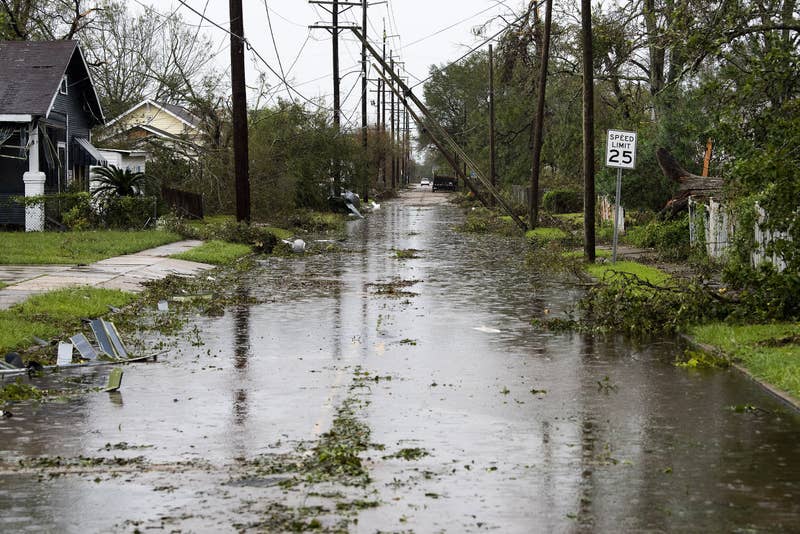
Water stands in a street in Lake Charles, Louisiana, after a rain storm, August 28, 2020. Hurricane Laura hit the city on Aug. 26.

Subra hopes that if she can get to the problem areas early and get the information out there, southwest Louisiana can avoid that kind of issue this time around.

“If we get enough information out there, they'll be able to do something with that information, if we lack information, three to five years from now, they will look back and say, you know, I didn't have this health issue before and it started after the hurricane.”

Langley at the Louisiana Department of Environmental Quality said they were actively monitoring the situation in the affected areas and are working with parish officials to make sure they get what they need.

“We're still assessing to get a full picture of what has happened,” said Langley. “We know that we had a few small spills, we saw some sheen when our plane flew over. And we have a couple of planes still looking in wetlands for orphaned drums or any kinds of spills, sheens or industrial debris that's been blown around. We do have some areas of concern. There's a lot of oil and gas activity in that area.”

“We are trying to locate the companies’ people and identify responsible parties, and we will work with them to get cleanup people in,” he added.

Rolfes of the Louisiana Bucket Brigade said she isn’t optimistic.

“I can tell you right now, the clean up that Lake Charles needs won’t happen,” she said. “After Katrina, they just pressure-washed the sidewalks and the roads like that was going to solve the problem. I don’t expect much more this time.”

The Bennets, meanwhile, are focused on repairing their properties. They themselves moved out of Mossville in 2010. Christine Bennett said she and her husband held out as long as they could, but they were getting older and were terrified of the long-term health consequences of living next to the sprawling campuses of oil refineries and chemical companies. She hates living in Lake Charles, but she says her hometown just isn’t safe anymore. “There is always just this smell in the air,” she said.

Agents bust international shark finning, drug trafficking ring
Operation Apex is the first organized crime drug enforcement task force in the history of the U.S. Fish and Wildlife Service, its director, Aurelia Skipwith, said.

Since 2016, more than 35 tons of shark fins have been confiscated by federal authorities. Photo courtesy of Fish and Wildlife Service/Website

Sept. 4 (UPI) -- A federal prosecutor announced that a multi-agency law enforcement operation has busted an international shark finning and drug trafficking conspiracy, resulting in a dozen arrests and the seizure of millions of dollars worth of gold, silver, diamonds, drugs and illegally traded wildlife.

U.S. Attorney for the Southern District of Georgia Bobby L. Christine announced Thursday that agents of Operation Apex have arrested 12 members or associates of the Wu transnational criminal organization and shut down two businesses, one in Florida and the other in California, for participating in wildlife and drug trafficking, shark finning and money laundering.

Agents of the multi-agency task force arrested the suspected gang members and conducted 22 federal search warrants from coast to coast, confiscating some $4 million from bank accounts, $1 million in diamonds and about $3 million in gold, silver and other precious metals.

The agents also seized more than six tons of shark fins and 18 fish bladders harvested from the endangered totoaba fish, which is considered a delicacy in parts of Asia.

RELATED Overfishing erased sharks from many of the world's reefs, researchers say

About 18,000 marijuana plants, 34.5 pounds of processed marijuana and multiple guns were also retrieved from the searches, authorities said.

"Millions and millions of dollars in cash, millions and millions in gold, millions in diamonds, tens of thousands of illegal plants and that is a one-day snapshot of what we believe to be a decade-long conspiracy -- a one-day snapshot," Christine said during a press briefing on Thursday.

The 37-page indictment charges suspects, who come from California, Florida, Georgia, Arizona and Michigan, and the two businesses with mail and wire fraud, possession with intent to distribute and to distribute controlled substances and money laundering, which carry potential penalties of up to life in prison without parole.

Others are likely to be implicated as the investigation proceeds, Christine said, who added that the conspiracy stretched from the United States to Canada, Mexico to China and into its criminal underworld.

According to the indictment, the conspiracy began as early as 2010 when its members submitted false documents and used front companies and dozens of bank accounts to launder the money they earned through their illegal activities, including shark finning which is the practice of catching sharks at sea, cutting off their fins and throwing the injured animal back into the sea to die.

"Shark finning is aimed at supporting the demand for shark fin soup, an Asian delicacy," the indictment said.

Federal laws protect certain species of sharks, but state laws vary concerning shark finning, with it being legal in Florida but illegal in California.

The indictment states the Wu gang used the Florida shark fin business as a front for the California company that would ship the fins to Hong Kong.

Aurelia Skipwith, director of the U.S. Fish and Wildlife Service, which initiated Operation Apex, said the mission began in 2015 as an investigation into the trafficking of the fins of sharks, the apex predator of the ocean.

In 2018, while investigating, her agency discovered that the same criminal organizations behind shark finning were also behind drug trafficking and money laundering in Asia and central and north America.

This elevated Operation Apex to become an organized crime drug enforcement task force, the first for the U.S. Fish and Wildlife Service, she said.

"We are one government working to stop wildlife crime and prosecute criminals who try to profit by wildlife trafficking," she said. "Ultimately, our work will save animals so that future generations will be able to see them in the wild where they belong."

Since 2016, more than 35 tons of shark fins that were in transit through the United States have been seized, she sai
Appeals court rules against Trump administration in abortion 'gag rule'

anti-abortion activist yells in a megaphone at abortion-rights activists participating in the Women's March January 19, 2019, at Freedom Plaza in Washington, D.C. A federal appeals court on Thursday said the Trump administration can't deny Title X funding to Maryland clinics that provide information on abortions. File Photo by Ken Cedeno/UPI | License Photo

Sept. 3 (UPI) -- A federal appeals court on Thursday ruled against a Trump administration rule denying federal funds to family planning clinics that refer patients for abortions.

The 4th U.S. Circuit Court of Appeals ruling blocks the enforcement of the federal rule in Maryland, but is likely to set up a Supreme Court challenge.

The appeals court, based in Richmond, Va., said the Trump administration's rule revision "failed to recognize and address the ethical concerns of literally every major medical organization in the country."

The panel also said the government "arbitrarily estimated" what clinics would have to spend to comply with the rules, which includes, in some cases, constructing new facilities to separate abortion services from other medical services.

The Department of Health and Human Services issued the revised rule in 2019, banning family planning providers that receive Title X funding from abortion referrals. Opponents, including Planned Parenthood, likened it to a "gag rule."

The government it would require "clear financial and physical separation" between Title X-compliant facilities and those that provide abortions or abortion referrals.

In February, the 9th U.S. Circuit Court of Appeals ruled in favor of the Trump administration in a challenge by Planned Parenthood, saying the rule allows family clinics to mention abortion but not to refer or encourage it, a "reasonable interpretation" of federal law which is not "arbitrary and capricious" as plaintiffs argued.


GERMANY AND NATO
HAVE NOT SHOWN CIVIL SOCIETY ANY PROOF
THEY SIMPLY ASSURE US THEY HAVE PROOF

Kremlin denies poisoning Alexei Navalny; OPCW 'gravely concerned'

The Kremlin is seen in Moscow, Russia. A spokesman for President Vladimir Putin said Thursday denied culpability for the poisoning of opposition figure Alexei Navalny. 
File Photo by Yuri Gripas/UPI | License Photo

Sept. 3 (UPI) -- The Kremlin said Thursday there's no reason to blame the Russian government for the poisoning of prominent opposition figure Alexei Navalny, who is now hospitalized in Germany.

German authorities said Wednesday Navalny had been poisoned with a nerve agent in the Novichok-class group, similar to the one that nearly killed a former Russian spy and his daughter in Britain two years ago. The Novichok poison was developed decades ago by the former Soviet Union.

Navalny became sick on a flight from Siberia to Moscow on Aug. 20. Two days later, at the urging of his family and political team, he was taken to Berlin for treatment. He remained unconscious Thursday.

Kremlin spokesman Dmitry Peskov on Thursday rejected calls for an explanation from German Chancellor Angela Merkel, Russia's state-run TASS news agency reported.

RELATED Russian doctors OK opposition leader Alexei Navalny's move to Germany

"I would choose words carefully when speaking about accusations against the Russian state because there are no accusations at the moment and there is no reason to accuse the Russian state," Peskov said. "We aren't inclined to accept any accusations in this regard."

Peskov questioned why Moscow would want to poison Navalny, a vocal opponent of Russian President Vladimir Putin.

"I cannot answer ... who could benefit from that person's poisoning," he said. "As a matter of fact, I don't think that anyone could stand to gain from that if one just takes a sober look at things.

BECAUSE NAVALNY IS A PUTIN PATSY WHO HAS ENDED BEING USEFUL AS BELARUS CONFLICT BREWS NEXT DOOR. PUTIN USED HIM AS A LURE FOR MOSCOW SHOPPER PROTESTERS

RELATED Russians vote to allow Putin to rule until 2036

The Organization for the Prohibition of Chemical Weapons said Thursday any use of toxins like Novichok would be considered the use of a banned chemical weapon.

"Such an allegation is a matter of grave concern," OPCW Director-general Fernando Arias said in a statement. "State Parties to the Chemical Weapons Convention deem the use of chemical weapons by anyone under any circumstances as reprehensible and wholly contrary to the legal norms established by the international community."

Arias said the OPCW is following developments in the Navalny case and is ready to "engage" with and assist any parties that ask for it.

Novichok was the poison used in an attack on former double agent Sergei Skripal and his adult daughter in Salisbury, Britain, in 2018. The two eventually recovered and the poisoning was largely believed to have been ordered by the Kremlin.

The European Council on Thursday condemned the assassination attempt "in the strongest words possible," describing the Novichok chemical used as a military-grade nerve agent.

"The use of chemical weapons is completely unacceptable under any circumstances, constitutes a serious breach of international law and international human rights standards," Josep Borrell, the high representative of the EU, said in a statement. "The European Union calls for a joint international response and reserves the right to take appropriate actions, including through restrictive measures."

As the poisoning occurred on Russian soil, the Kremlin must investigate the crime, Borrell said, calling for the probe to be transparent with the aim of bringing those responsible to justice.

"Impunity must not and will not be tolerated," he said. "The European Union calls upon the Russian Federation to fully cooperate with the Organization for the Prohibition of Chemical Weapons to ensure an impartial international investigation."

Merkel said Wednesday that Navalny was "the victim of a crime intended to silence him," and that she felt a need to "take a clear stance" against the poisoning.

Russian lawmaker Andrei Lugovoi suggested that Navalny was exposed to the poison in Germany.

"Once they have found something linked with Novichok, most likely, he was exposed to it in this clinic," he told TASS. "A nurse or a doctor could have done that if they really wanted to somehow expose Navalny to a toxic agent. I am sure this is what really happened."
Kids' 'green' time reduces adverse effects of 'screen' time on behavior, learning


Studies show screen time can adversely affect behavior and learning in children, but the effects can be balanced with increased time outdoors. Photo by Andi Graf/Pixabay

Sept. 4 (UPI) -- More time spent outdoors -- and less in front of a screen -- leads to improved mental health in children and adolescents, according to an analysis of existing research published Friday by the journal PLOS ONE.

Based on data from 186 previously published studies, researchers determined that young people who spent more time on handheld games and devices, television and computers were more likely to have behavior and emotional problems and display symptoms of aggression and attention deficit-hyperactivity disorder.

The young people also were more likely to have learning or social difficulties.

Conversely, children who spent more time outdoors and who had increased access to "green" spaces for play and learning were less likely to have these undesirable traits.

"Overall, the studies showed that high levels of screen time were associated with poorer psychological well-being, while more green time was associated with better psychological well-being," co-author Tassia Oswald told UPI.

"While a lot more work needs to be done in this field to help us understand why this is the case, it is important that [technology] doesn't become the only thing young people do in their leisure time," said Oswald, a doctoral student in public health at the University of Adelaide in Australia.

The prevalence of mental health illness among children and adolescents is increasing globally, according to Oswald and her colleagues.

In the United States, roughly 7%, or 4.5 million, of children ages 3 to 17 have been diagnosed with a behavioral problem, the Centers for Disease Control and Prevention estimates.

On average, American children and adolescents spent between four and six hours per day watching or uses devices with screens, and may be exposed to violence and misleading or inaccurate information, among other potentially problematic content, according to the American Academy of Child and Adolescent Psychiatry.

A separate study of 1,239 8- to 9-year-olds in Melbourne, Australia, published earlier this week by PLOS ONE, found that watching two or more hours of television per day at that age was associated with lower reading performance compared to peers two years later.

RELATED Kids spend more time on smartphones, tablets than parents realize

In addition, using a computer for more than one hour per day was linked to a similar reduction in their ability to understand and work with numbers.

However, no links were found between the use of video games and academic performance, the analysis showed.

Preliminary evidence suggests that green time potentially could limit the effects of high screen time, meaning nature may be an under-utilized public health resource to promote youth psychological well-being in a high-tech era, according to Oswald and her colleagues.

RELATED Less screen time, more play may reduce autism-like symptoms as kids age

"Monitoring screen time can be difficult for parents -- especially at the moment when many children have transitioned to online learning due to COVID-19 lockdowns," Oswald said.

"Trying to encourage a balance of activities is good -- so if a child spends an hour on a video game, encourage them to get outside for an hour."

upi.com/7035665


Researchers redesign the face mask to improve comfort and protection

GEORGIA INSTITUTE OF TECHNOLOGY

Research News

IMAGE

IMAGE: GEORGIA TECH PROFESSOR SUNDARESAN JAYARAMAN AND PRINCIPAL RESEARCH SCIENTIST SUNGMEE PARK WEAR PROTOTYPES OF THEIR REDESIGNED FACE MASK. view more 

CREDIT: CHRISTOPHER MOORE, GEORGIA TECH

Imagine a reusable face mask that protects wearers and those around them from SARS-CoV-2, is comfortable enough to wear all day, and stays in place without frequent adjustment. Based on decades of experience with filtration and textile materials, Georgia Institute of Technology researchers have designed a new mask intended to do just that -- and are providing the plans so individuals and manufacturers can make it.

The modular Georgia Tech mask combines a barrier filtration material with a stretchable fabric to hold it in place. Prototypes made for testing use hook and eye fasteners on the back of the head to keep the masks on, and include a pocket for an optional filter to increase protection. After 20 washings, the prototypes have not shrunk or lost their shape.

"If we want to reopen the economy and ask people to go back to work, we need a mask that is both comfortable and effective," said Sundaresan Jayaraman, the Kolon Professor in Georgia Tech's School of Materials Science and Engineering. "We have taken a science-based approach to designing a better mask, and we are very passionate about getting this out so people can use it to help protect themselves and others from harm."

The fundamental flaw in existing reusable cloth masks is that they -- unlike N95 respirators, which are fitted for individual users -- leak air around the edges, bypassing their filtration mechanism. That potentially allows virus particles, both large droplets and smaller aerosols, to enter the air breathed in by users, and allows particles from infected persons to exit the mask.

The leakage problem shows up in complaints about eyeglasses fogging up as exhaled breath leaks around the nose, making people less likely to wear them. The fit problem can also be seen in constant adjustments made by wearers, who could potentially contaminate themselves whenever they touch the masks after touching other surfaces.


Details of a redesigned face mask developed at the Georgia Institute of Technology are modeled on this mannequin.

To address the leakage challenge, Jayaraman and principal research scientist Sungmee Park created a two-part mask that fastens behind the head like many N95 respirators. The front part -- the barrier component -- contains the filtration material and is contoured to fit tightly while allowing space ahead of the nose and mouth to avoid breathing restrictions and permit unrestricted speech. Made from the kind of moisture-wicking material used in athletic clothing, it includes a pocket into which a filter can be inserted to increase the filtration efficiency and thereby increase protection. The washable fabric filter is made of a blend of Spandex and polyester.

The second part of the mask is fashioned from stretchable material. The stretchable part, which has holes for the ears to help position the mask, holds the front portion in place and fastens with conventional hook and eyelet hardware, a mechanism that has been used in clothing for centuries.

"We want people to be able to get the mask in the right place every time," Jayaraman said. "If you don't position it correctly and easily, you are going to have to keep fiddling with it. We see that all the time on television with people adjusting their masks and letting them drop below their noses."

Beyond controlling air leakage, designing a better mask involves a tradeoff between filtration effectiveness and how well users can breathe. If a mask makes breathing too difficult, users will simply not use it, reducing compliance with masking requirements.

Many existing mask designs attempt to increase filtration effectiveness by boosting the number of layers, but that may not be as helpful as it might seem, Park said. "We tested 16 layers of handkerchief material, and as we increased the layers, we measured increased breathing resistance," she said. "While the breathing resistance went up, the filtration did not improve as much as we would have expected."

"Good filtration efficiency is not enough by itself," said Jayaraman. "The combination of fit, filtration efficiency, and staying in the right place make for a good mask."

Georgia Tech professor Sundaresan Jayaraman with prototypes of the redesigned face mask

The stretchable part of the mask is made from knitted fabric -- a Spandex/Lyocell blend -- to allow for stretching around the head and under the chin. The researchers used a woven elastic band sewn with pleats to cover the top of the nose.

The researchers made their mask prototypes from synthetic materials instead of cotton. Though cotton is a natural material, it absorbs moisture and holds it on the face, reducing breathability, and potentially creating a "petri dish" for the growth of microbes.

"Masks have become an essential accessory in our wardrobe and add a social dimension to how we feel about wearing them," Park said. So, the materials chosen for the mask come in a variety of colors and designs. "Integrating form and function is key to having a mask that protects individuals while making them look good and feel less self-conscious," Jayaraman said.

The work of Jayaraman and Park didn't begin with the Covid-19 pandemic. They received funding 10 years ago from the Centers for Disease Control and Prevention to study face masks during the avian influenza outbreak. Since then Jayaraman has been part of several National Academy of Medicine initiatives to develop recommendations for improved respiratory protection.

Covid-19 dramatically increased the importance of using face masks because of the role played by asymptomatic and pre-symptomatic exposure from persons who don't know they are infected, Jayaraman said. While the proportion of aerosol contributions to transmission is still under study, they likely increase the importance of formfitting masks that don't leak.

Jayaraman and Park have published their recommendations in The Journal of The Textile Institute, and will make the specifications and patterns for their mask available to individuals and manufacturers. The necessary materials can be obtained from retail fabric stores, and the instructions describe how to measure for customizing the masks.

"There is so much misinformation about what face masks can do and cannot do," Jayaraman said. "Being scientists and engineers, we want to put out information backed by science that can help our community reduce the harm from SARS-CoV-2."

###

CITATION: Sungmee Park and Sundaresan Jayaraman, "From containment to harm reduction from SARS-CoV-2: a fabric mask for enhanced effectiveness, comfort, and compliance." (The Journal of The Textile Institute, 2020) https://doi.org/10.1080/00405000.2020.1805971

TEAM BUILDING IS BS

Personal success more appreciated than team dominance in sports, business

CORNELL UNIVERSITY

Research News

ITHACA, N.Y. - People enjoy witnessing extraordinary individuals - from athletes to CEOs -extend long runs of dominance in their fields, but they aren't as interested in seeing similar streaks of success by teams or groups, according to new research from Cornell University.

"Individual success inspires awe in a way that team success does not," said co-author Thomas Gilovich, professor of psychology at Cornell. "[Individual success] makes us hopeful that human potential isn't as limited as thought it was. If that height is reached by a team, its cause is seen as more diffuse and isn't as exciting."

In a new study, Gilovich and lead author Jesse Walker conducted nine studies involving 2,625 Americans. In one study, they examined people's view on the success of Usain Bolt, the Jamaican sprinter who won the 100-meter dash in the last three Olympics. Bolt was also a member of a team that won the gold medal in the 4x100-meter relay at those same Olympic games.

Many more people reported they would prefer to see Bolt win the gold medal in the individual event in the next Olympics than in the relay event, results showed.

The preference for seeing individual streaks doesn't just apply to famous athletes in familiar sports. Studies showed people supported individual runs of dominance over team dominance in the British Quizzing Championship and in the best closure rates on homicide cases in U.S. police departments.

This preference has implications in the business world, as well. In one study, participants read about electronic components manufacturer AVnet, one of the 350 largest companies in America.

Participants who read that AVnet's success could be attributed to its CEO thought the company should command a greater share of the market than did the participants who were told the company's success was tied to a group of executives.

Other studies by the researchers looked at why people feel differently about individual versus team winning streaks. They found that people attributed individual streaks of success to the people themselves, while team success was attributed to situational factors.

"We're now looking at how this effect might influence people's reactions to economic inequality and policies designed to alleviate it," Gilovich said. "Are people less troubled by evidence of inequality expressed as big gaps between individuals than expressed as big gaps between groups?"

###

For more information, see this Cornell Chronicle story.


Drone survey reveals large earthwork at ancestral Wichita site in Kansas

Results show possible council circle at what may be Etzanoa near Wichita

DARTMOUTH COLLEGE

Research News

IMAGE

IMAGE: LEFT: DRONE-ACQUIRED ORTHOIMAGE OF THE SITE SHOWING MAJOR FEATURES DISCUSSED IN THE PAPER. RIGHT: THERMAL IMAGES MOSAIC COLLECTED FROM 11:15 PM-12:15 AM. (IMAGES FROM FIGURE 6 OF THE STUDY).... view more 

CREDIT: IMAGES BY JESSE CASANA, ELISE JAKOBY LAUGIER, AND AUSTIN CHAD HILL.

A Dartmouth-led study using multisensor drones has revealed a large circular earthwork at what may be Etzanoa, an archaeological site near Wichita, Kansas. Archaeologists speculate that the site was visited by a Spanish expedition, led by Juan de Oñate, a controversial conquistador, in 1601. The earthwork may be the remains of a so-called "council circle," as it is similar to several other circular earthworks in the region, according to the study's findings published in American Antiquity.

"Our findings demonstrate that undiscovered monumental earthworks may still exist in the Great Plains. You just need a different archeological approach to recognize them," explained lead author, Jesse J. Casana, a professor and chair of the department of anthropology at Dartmouth. "Our results are promising in suggesting that there may be many other impressive archaeological features that have not yet been documented, if we look hard enough," he added.

Archaeological features have various thermal effects. After the ground cools at nighttime, things below the ground cool and emit heat at different rates, enabling researchers to identify features based on thermal infrared radiation. The researchers obtained thermal and multispectral imagery of the site using drones.

The 18-hectare area of the site where the drone survey was conducted is currently home to a ranch property in the lower Walnut River valley, which has been used as a pasture. Topographically, the area is flat with no visible archaeological features. Yet, imagery shows that underground there is an ancient, circular shaped ditch measuring 50 meters wide and approximately 2 meters thick that has been infilled. As the soil erodes, it fills up the ditch with a different type of soil than was there before, and therefore retains water differently giving it unique thermal properties. The water retention levels also impact vegetation. Using near-infrared imagery, the researchers were able to identify areas that had been infilled because grass growth was more vigorous. As the study reports, the results provide evidence for what may have been a "single, sprawling population center" back in its day.

Aerial view of the site. Image is from Figure 3 of the study.

To confirm that the findings were not an anomaly, the team collected a time series of aerial and satellite images of the area from the U.S. Department of Agriculture and other federal agencies. They found that the circular feature was "faintly visible in June 2015 and July 2017 but not in June 2012 or February 2017."

The debate is widespread as to what council circles were used for, whether they were astronomical in nature or made for ceremonial, political and/or defense purposes. Casana added, "While we may never know what the council circles were used for or their significance, new archaeological methods allow us to see that people made these earthworks."

###

Casana is available for comment at: jesse.j.casana@dartmouth.edu. The study was co-authored by Elise Jakoby Laugier, a Dartmouth graduate student; Austin Chad Hill, a Dartmouth post-doc at the time of the study; and Donald Blakeslee, a professor of archaeology at Wichita State University.


Radiology research funding has increased -- still no association with citation rate

While AJR articles were more frequently unfunded, and Radiology articles were more often funded, citation rate was not different between funded vs. unfunded; moreover, funding was not significantly associated with citations

AMERICAN ROENTGEN RAY SOCIETY

Research News

IMAGE

IMAGE: NOTE--EXCEPT WHERE OTHERWISE INDICATED, DATA ARE NUMBER (%) OF RESEARCH ARTICLES. ASIGNIFICANCE LOST AFTER ADJUSTMENT FOR MULTIPLE TESTING USING FALSE-POSITIVE RATE CONTROL. BSTATISTICALLY SIGNIFICANT. CAPPLIES TO RADIOLOGY AND EUROPEAN RADIOLOGY ARTICLES ONLY.... view more 

CREDIT: AMERICAN ROENTGEN RAY SOCIETY (ARRS), AMERICAN JOURNAL OF ROENTGENOLOGY (AJR)

Leesburg, VA, September 3, 2020--According to ARRS' American Journal of Roentgenology (AJR), nearly half (47.7%) of the research articles published in major radiology journals declared funding--a proportion that has increased from 17% of articles in 1994 and 26.9% published between 2001 and 2010.

"Most funded articles received support from federal sponsors or nonprofit foundations, whereas only a minority of funded articles were supported by private industry," explained first author Rayan H.M. Alkhawtani from the department of radiology, nuclear medicine, and molecular imaging at University Medical Center Groningen in The Netherlands.

And as Alkhawtani et al. concluded, "funding was not associated with a higher citation rate."

The Dutch team included a total of 600 consecutive original research articles published between January and October 2016 in three large journals: AJR, Radiology, and European Radiology. Using linear regression analysis to ascertain the association between research funding and citation rate, adjustments were made for the following seven factors:

  • journal,
  • continent of origin of first author,
  • subspecialty,
  • study findings included in article title,
  • number of authors,
  • immediate open access publication,
  • time since publication online.

Finding that funding was declared in 286 of 600 (47.7%) included articles, the authors of this AJR "Original Research" article identified the six most significant funding sources:

  • federal sponsorship (29.4%),
  • nonprofit foundation (16.4%),
  • both federal sponsorship and nonprofit foundation (16.1%),
  • private industry (10.1%),
  • intramural institutional research funding (9.8%),
  • other combinations of funding sources (18.2%).

"Articles with first authors whose continent of origin was Europe (p < 0.001), vascular and interventional radiology articles (p < 0.001), and articles published in AJR (p < 0.001) were significantly more frequently unfunded than funded," Alkhawtani and colleagues noted.

Meanwhile, the team noted that articles published in Radiology were significantly more frequently funded (p < 0.001).

Ultimately, citation rate was not significantly different between funded and unfunded articles (p = 0.166), and in the adjusted linear regression analysis, funding was not significantly associated with citation rate (β coefficient, ?0.31; 95% CI, ?3.27 to 2.66; p = 0.838).

###

Founded in 1900, the American Roentgen Ray Society (ARRS) is the first and oldest radiological society in North America, dedicated to the advancement of medicine through the profession of radiology and its allied sciences. An international forum for progress in medical imaging since the discovery of the x-ray, ARRS maintains its mission of improving health through a community committed to advancing knowledge and skills with an annual scientific meeting, monthly publication of the peer-reviewed American Journal of Roentgenology (AJR), quarterly issues of InPractice magazine, AJR Live Webinars and Podcasts, topical symposia, print and online educational materials, as well as awarding scholarships via The Roentgen Fund®


Texas A&M researchers develop treatment for canine ocular condition using turmeric

A College of Veterinary Medicine and Biomedical Sciences and College of Pharmacy team believes the medication may also translate to the treatment of cataracts and uveitis in humans

TEXAS A&M UNIVERSITY

Research News

IMAGE

IMAGE: DR. ERIN SCOTT AND HER COLLEAGUES PRODUCED A THERAPEUTIC DERIVED FROM TURMERIC TO TREAT OCULAR INFLAMMATION IN DOGS. view more 

CREDIT: TEXAS A&M UNIVERSITY COLLEGE OF VETERINARY MEDICINE & BIOMEDICAL SCIENCES

Researchers at Texas A&M University have produced a therapeutic derived from turmeric, a spice long-praised for its natural anti-inflammatory properties, that shows promise in decreasing ocular inflammation in dogs suffering from uveitis, an inflammation of the eye that leads to pain and reduced vision.

Uveitis -- a common condition in dogs, humans, and other species -- can have many causes, often occurring secondary to infectious diseases cancer, and autoimmune diseases; it also is found in patients with longstanding cataracts and after operations correcting cataracts.

"Uncontrolled inflammation inside the eye, also known as uveitis, is a leading cause of complications after cataract surgery in dogs. The management of postoperative ocular inflammation is a major challenge observed in both human and veterinary ophthalmology," said Dr. Erin Scott, an assistant professor at the Texas A&M University College of Veterinary Medicine & Biomedical Sciences.

In a recent paper published in Science Advances, Scott and her colleagues at the Texas A&M University College of Pharmacy tested the anti-inflammatory properties of curcumin, a compound found in turmeric, and discovered that when processed to a special nanoparticle formulation to boost absorption, the natural compound is safe and effective at managing uveitis without any known side effects.

Oral medications currently used to treat uveitis must be adequately absorbed into the blood stream for their medicinal effects to be effective. This requires the medication to successfully pass through the intestinal barrier -- the physical barrier between the gut and the rest of the body via the circulatory system -- which limits the absorption of many drugs.

Drug delivery to the eye presents additional challenges because of the blood-ocular barrier -- the physical barrier between blood vessels and tissues of the eye -- which tightly controls what substances can pass into the eye.

Therefore, researchers must find ways to bypass such barriers to improve drug availability within the body.

Scott and her colleagues' research implemented a novel formulation of curcumin that improved transport of the substance across both intestinal and ocular barriers. By adding nanoparticle molecules that interact with receptors on a ubiquitous transmembrane carrier protein, known as the transferrin receptor, curcumin is able to hitch a ride across crucial barriers, improving absorption of the substance and reducing ocular inflammation.

Curcumin is especially attractive as a candidate for management of uveitis because it has no known side effects.

"Current treatments include a combination of systemic and topical anti-inflammatory medications, either in the form of steroids or non-steroidal anti-inflammatory drugs (NSAIDs)," Scott said. "While both these medications are effective in the treatment of uveitis, they can cause unwanted side effects, such as vomiting, diarrhea, stomach ulcers, negatively impact kidney and liver function, and increase glucose levels in diabetic patients."

Scott and her colleagues hope to start a clinical trial in the Texas A&M Veterinary Medical Teaching Hospital using this new medication in the near future and are optimistic that the utility of their findings may benefit populations beyond dogs.

"This medication may translate to the treatment of cataracts and uveitis in humans," she said. "By studying animal patients with naturally occurring eye diseases, our findings may accelerate the development of medications to benefit both animals and humans."

###