Monday, September 07, 2020


Hong Kong shocked by violent police arrest of 12-year-old girl

Child’s mother says her daughter was buying art supplies when she was tackled and pinned to the ground by police

 12-year-old girl one of hundreds arrested in huge Hong Kong protest – video report

Hong Kong police have been strongly criticised over the rough arrest of a 12-year-old girl whose family says was caught in a protest crowd while out buying art supplies.

Video widely shared across social media and in Hong Kong media showed the officers seeking to corral a group of people including the young girl, who ducked aside and tried to run away. An officer tackled her to the ground, while several others helped to pin her down.

The arrest came amid the largest street protest seen in Hong Kong since 1 July, the first full day under the national security laws imposed by Beijing on the city, outlawing acts of sedition, secession, foreign collusion and terrorism.

The girl’s mother told Apple Daily she intended to sue and lodge a formal complaint. She said her daughter and her 20-year-old son – who were both fined under the city’s pandemic-related laws against gatherings – were out buying art supplies, and that the girl ran away because she was scared. Her daughter was bruised and scratched after the encounter.

Claudia Mo, a pro-democracy legislator, said the actions taken towards the girl “shows how unnecessarily jumpy [and] trigger-happy Hong Kong police have become”.

 Hong Kong police violently arrest 12-year-old girl – video

In a statement a few hours after the incident, Hong Kong police confirmed the arrest of a 12-year-old girl, saying she had run “in a suspicious manner” and officers had used “minimum necessary force” to apprehend her.

“Police were concerned about youngsters participating in prohibited group gathering. Their presence at the chaotic protest scenes also endangers their own personal safety,” it said.

In a later statement police said: “Police attach great importance to integrity. If any person considers he or she is affected by police misconduct, he or she may lodge a complaint to the Complaints Against Police Office. It will be handled in a fair and impartial manner according to established procedures.”

On Sunday night, the Hong Kong government said people had ignored advice from police not to participate in unlawful assemblies, risking anti-pandemic efforts and potentially breaching the national security law. The government “strongly condemn[ed] these unlawful and selfish acts”.

“Police discharged their rightful duties today and took prompt and decisive actions to apprehend the offenders.”

The liaison office for the central government accused protesters of seeking to “reignite war”, and accused them of having “a cold-blooded disregard for the lives and health of the general public” in breaching gathering bans.

The spokesman said since the implementation of the law “Hong Kong society had undergone a positive change from chaos to governance”, and said there would be “zero tolerance” for any violations.

Almost 300 people were arrested on Sunday, the vast majority for unlawful assemblies. About 2,000 police officers were deployed early in the day, ahead of the protests which had been planned by a coalition of pro-democracy groups to mark the day that Hong Kong’s elections were supposed to be held.

Carrie Lam, Hong Kong’s chief executive, announced in July the elections would be postponed for one year because of the danger of Hong Kong’s most recent Covid-19 outbreak, but was accused of using the pandemic to silence opposition. Many protesters also called for the release of 12 people arrested by Chinese coastguards while attempting to flee by boat to Taiwan.

Separately, activist Tam Tak-chi was also arrested on Sunday, for “uttering seditious words”, Hong Kong police said.

The vice-president of radical democratic party People Power and a former radio host, Tam was arrested by the national security squad of the Hong Kong police force but was charged under the regular criminal ordinance, not the national security law.

Senior superintendent Li Kwai-wah said the squad was leading the investigation because of earlier suspicions that Tam had breached article 21 of the national security law, criminalising “incitement to secession”.

Tam’s words had “brought into hatred and contempt of the government and raised discontent and disaffection among Hong Kong people”, Li said.

At least 25 people have been arrested under the national security law so far, although just one has been charged.

The law has provided authorities with the means to widen the scope of their crackdown on dissent in Hong Kong, and has created a chilling effect across academia, media, and pro-democracy members of the public.

In the past month, newspaper offices have been raided, academics removed from their posts, and books regarded as be problematic removed from shelves or altered. Restaurants and shops have torn down “Lennon walls”, where people stuck up post-it notes with pro-democracy messages, and some politicians and activists have fled overseas.

The law’s articles are so broadly defined they have been found to potentially violate numerous international laws, UN groups said last week.

Media organisations have warned there is little clarity about whether standard acts of journalism – such as quoting someone advocating for independence – would put them in breach of the law, and some outlets have removed such content from online platforms. Visas for foreign journalists have also been delayed or outright denied.

The forgotten victims of the Beirut explosion: domestic workers

Dumped on the streets after Covid-19 hit, hundreds of nannies are now starving amid the ruins of last month’s blast

An Ethiopian migrant worker waits outside her country’s embassy in Beirut.
An Ethiopian migrant worker waits outside her country’s embassy in Beirut. Photograph: Joseph Eid/AFP/Getty Images

It is just over a month since the Beirut port explosion, and the footage from that day remains as shocking as it was when it first began to appear on our TV screens and social media. In fragments of video, the world saw Beirut life freeze in confusion at the unfamiliar sound of the explosion, then shatter as its impact hit. Among those bits of film we saw one scene, captured on domestic CCTV, that was replicated across the city – an African nanny instinctively scooping children up out of harm’s way, and protecting them with her body.

Many of these nannies are now sleeping on the streets of Beirut. Most are starving. Even before the explosion, an economic crisis exacerbated by the coronavirus pandemic meant that Lebanese employers could no longer pay their domestic workers. And so they made them gather their belongings, drove them to their embassies, and dumped them outside. Last June alone, more than 100 Ethiopian domestic workers were left outside their home country’s consulate. They live out of suitcases, and share mattresses. Some still try to maintain the discipline of wearing masks even as they sleep cheek by jowl on the unsanitary pavement.

Last week I spoke to Christine, a West African nanny and domestic worker who didn’t want to use her real name for fear of reprisals from her employer. A veteran of the Beirut labour market, she told me that she was trying to raise some money to help abandoned African women go back to their countries of origin. But that journey can’t be the priority. First, the women sleeping in the streets need to eat. If there is any money left over, it will be spent on shelter.

Travel from Lebanon to destinations in Africa is expensive, so the golden ticket home is reserved for the very sick who need to be with their families. She counts herself as one of the lucky ones, as her “madam” has kept her on, giving her a place to stay, and only reducing her salary by half.

The consulates, even when they are predisposed to helping, have to negotiate a labyrinth of Lebanese government bureaucracy, already infamous for its corruption and inefficiency. In order to secure the necessary paperwork for exit, hefty fees are levied by the ministry of labour, and then there are the travel costs. Ethiopian migrant workers are often told to try to return to their employers.

At the heart of this human rights crisis is a system of migrant labour that remains a stain on many countries in the Arab world. Known as kafala, or “sponsorship”, it effectively hands the fate of workers to their employers, who often withhold their passports to maintain control, and then demand that fees paid to employment agencies be repaid if workers want to leave before their contracts are up. This forces some workers to run away and become undocumented.

Anna, a nanny from the Philippines, told me how she managed to slip away from her abusive employer by layering three sets of underwear, tops and trousers on top of each other. That way she managed to bring with her a change of clothes without carrying a bag. She had lost so much weight by then, she jokes, that she could wear that much stuff without raising suspicion. She left everything else, including her passport, behind.

The cruelty of this kafala system isn’t an unfortunate outcome of bureaucracy, it is the result of a racist hierachy in which black workers find themselves at the bottom. Of all the nationalities that jostle and hustle for a living in the Middle East and the wider Arab world, dark-skinned African women are the cheapest to hire, the most desperate, and the most abused.

All migrant workers in Lebanon are struggling, Christine told me, but African women suffer the most because “we are not considered human beings, everybody ignores us. We are invisible.” Employers who can no longer pay their workers’ salaries can still house and feed them, but they choose not to, even though many maids and nannies offer to work for free.

As with any crisis, the most vulnerable are pushed off the cliff edge. Lebanon is struggling with a corrupt and incompetent political class, and now the aftermath of an explosion that would challenge the most robust infrastructure. The size of the rebuilding process that Beirut faces means that hungry African women sleeping rough on Beirut’s streets are rendered invisible twice – first by Lebanese society, which treats them as subhuman, and again by a global community that cannot see so many layers down into Lebanon’s ranking of victims.

For now, Beirut’s migrant workers are sticking together and sharing whatever meagre resources they have. They also try to warn others to stay away from the country. Christine fears they will still come in any case, because they believe they may be the lucky ones. “When you are poor you think, ‘Let me try,’ she says. “We just want to try.”

• Nesrine Malik is a Guardian columnist and the author of We Need New Stories: Challenging the Toxic Myths Behind Our Age of Discontent


Julian Assange: WikiLeaks founder arrested over 18 new allegations as he appears in court to fight US extradition

The new US indictment, filed in June, contains 18 charges and was handed to Assange moments before he appeared at the Old Bailey


Monday 7 September 2020 15:21, UK
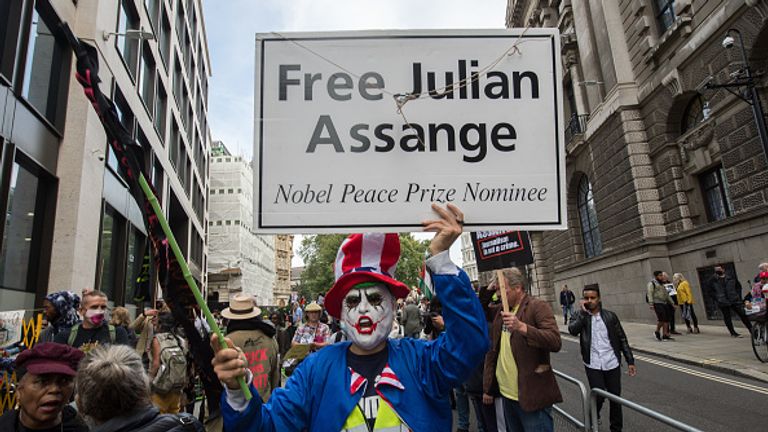
Image:Supporters of Assange gathered outside the Old Bailey


Julian Assange has failed to get new allegations against him thrown out as he battles extradition to the US.

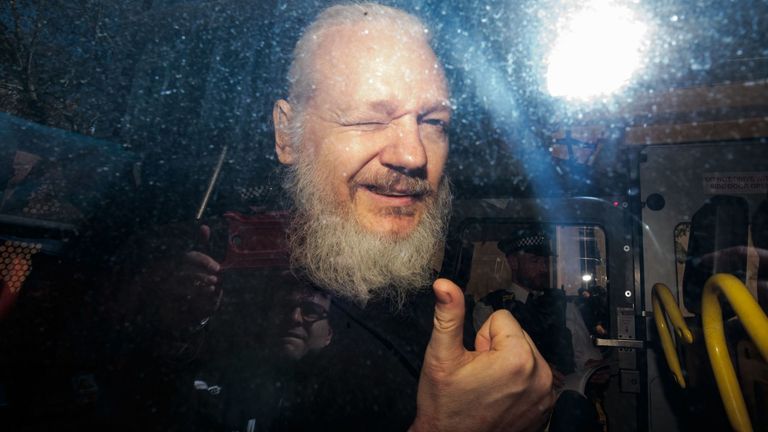
The WikiLeaks founder, 49, appeared at the Old Bailey in London after being held for months on remand at high-security Belmarsh Prison.

He was re-arrested in the court's cells on Monday over new charges contained in a US indictment.

It details a further 18 charges, lodged in June, which accuse him of plotting to hack computers and obtain and disclose national defence information.

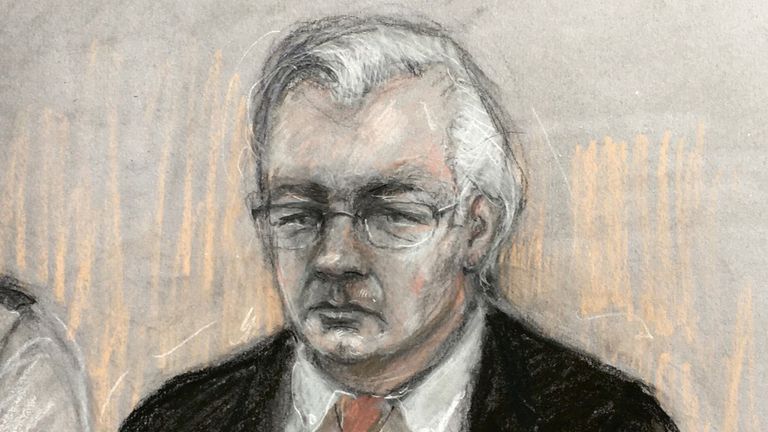
Image:An artist's impression of Assange in the dock at the Old Bailey on Monday
They allege that he conspired with army intelligence analyst Chelsea Manning to crack a scrambled password, known as "hash", to a classified US defence department computer.


The charges also offer further details of alleged hacking plotters that Assange and his WikiLeaks colleagues are said to have recruited.

The 49-year-old spoke only to state he "does not consent to extradition" and confirm his name.

Assange, who is wanted in the US for publishing hundreds of thousands of classified documents in 2010 and 2011, was clean-shaven with short hair and wore glasses, a dark suit, maroon tie and white shirt.

If convicted, he faces a maximum possible sentence of 175 years in jail.

\Image:Fashion designer Vivienne Westwood was outside court

His lawyer, Mark Summers QC, said the "fresh allegations at the 11th hour" were brought without warning or explanation, which meant they had no time to prepare a response.

He highlighted the difficulties Assange faced in speaking to his lawyers in the midst of ongoing restrictions.

"It would be an impossible task for the defence to deal with these fresh allegations in any meaningful way in the time that has been afforded to them, and that time is a matter of weeks in respect of which we are provided absolutely no explanation for the late arrival of these matters."

He added: "What is happening is abnormal, unfair and liable to create injustice if allowed to continue."

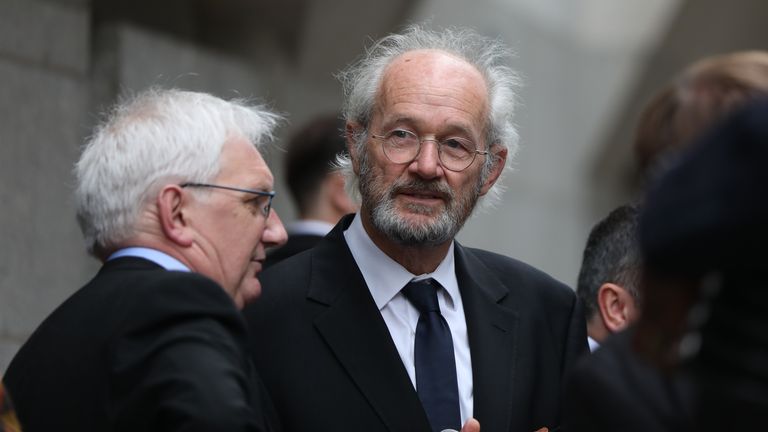
Image:Julian Assange's father was also at the central London court

But District Judge Vanessa Baraitser rejected the defence's bid to "excise" the allegations, saying: "These are issues which must take place in the context of considering the extradition request and not before it."

Outside court, hundreds of protesters gathered in support of Assange, including his father John Shipton and fashion designer Vivienne Westwood.

She said: "I'm an activist, I am very frightened, I've lost days and years of sleep worrying about Julian Assange.

"Julian Assange is the trigger, he is shining the light on all the corruption in the world."

Image:Assange has spent months on remand at Belmarsh Prison in south London

His father described the proceedings as an "abuse trial", which his defence claims has been targeted by Donald Trump's re-election campaign for "political reasons".

His partner, Stella Moris, who he shares two children with, was in the public gallery after delivering an 80,000-signature petition against his extradition to Downing Street.

Dozens of witnesses are expected to be called to give evidence at the Old Bailey over the four-week hearing, with the judgment likely to be delivered at a later date.

Assange has been on remand in Belmarsh Prison since last September after serving a 50-week sentence for breaching bail conditions while he was in London's Ecuadorian embassy for nearly seven years.

Assange’s legal battle to avoid US espionage trial resumes in London


Issued on: 07/09/2020

Text by: NEWS WIRES


A London hearing resumes on Monday to decide if WikiLeaks founder Julian Assange should be extradited to the United States to face trial over the publication of secrets relating to the wars in Afghanistan and Iraq.

The 49-year-old Australian, who is currently being held on remand at a high-security jail, faces 18 counts from US prosecutors that could see him jailed for up to 175 years.

The hearing at the Central Criminal Court, the Old Bailey, is due to last three to four weeks. It had been due to go ahead in April but was delayed due to the coronavirus outbreak.

Any ruling is "almost certain" to be appealed by the losing side, according to John Rees, of the Don't Extradite Assange Campaign, raising the prospect of more time behind bars for the former hacker.

Rees told AFP that Assange -- who has become a figurehead for press freedom and investigative journalism -- had a "very strong defence" but was concerned the case was "highly politicised".


Assange's French lawyer talks to FRANCE 24 as London extradition hearings resume
509000

A previous hearing in February was told that US President Donald Trump had promised to pardon Assange if he denied Russia leaked emails from the campaign of Hillary Clinton, Trump's opponent in the 2016 election.

Assange faces charges under the US Espionage Act for the 2010 release of 500,000 secret files detailing aspects of US military campaigns in Afghanistan and Iraq.

Washington claims he helped intelligence analyst Chelsea Manning to steal the documents before recklessly exposing confidential sources around the world.

At the February hearing, Assange's lawyer, Edward Fitzgerald, said his client would not get a fair trial in the United States and would be a suicide risk.

James Lewis, representing the US government, said WikiLeaks was responsible for "one of the largest compromises of classified information in the history of the United States".

"Reporting or journalism is not an excuse for criminal activities or a licence to break ordinary criminal laws," he added.

'Extradition will be a death sentence'

Assange's partner and the mother of his two young sons, South African-born lawyer Stella Moris, attempted to secure his release in March, claiming he was in danger inside prison during the coronavirus lockdown.

"The life of my partner, Julian Assange, is at severe risk," she said, arguing that Covid-19 was "spreading within (the) walls" of Belmarsh prison in south London.

In an interview published in The Times newspaper on Saturday, Moris, 37, said: "For Julian, extradition will be a death sentence."

She said she feared he would take his own life, and that his sons, who were conceived during his asylum in Ecuador's London embassy, would grow up without a father.

Assange appeared weak and confused during his February court appearance, apparently forgetting his date of birth. He also told district judge Vanessa Baraitser he had not understood what had happened in the hearing.

His legal team has repeatedly warned about his health and an independent UN rights expert said in November that his continued detention was putting his life at risk.

Meanwhile, the Council of Europe rights group warned that Assange's extradition would have a "chilling effect" on press freedom.

Other high-profile supporters of Assange include the Pink Floyd co-founder Roger Waters, "Baywatch" star Pamela Anderson, designer Vivienne Westwood, and Greece's former finance minister Yanis Varoufakis.

The saga began in 2010 when Assange faced allegations of sexual assault and rape in Sweden, which he denied.

He was in Britain at the time but dodged an attempt to extradite him to Sweden by claiming political asylum in Ecuador's embassy in London.

For seven years he lived in a small apartment in the embassy, but after a change of government in Quito, Ecuador lost patience with its guest and turned him over to British police in April 2019.

Swedish prosecutors confirmed last year they had dropped the rape investigation, saying that despite a "credible" account from the alleged victim there was insufficient evidence to proceed.

(AFP)

As British show-trial resumes: The working class must defend Julian Assange!

By Oscar Grenfell
7 September 2020

The latest stage in the decade-long persecution of Julian Assange begins today, with the final three weeks of British court hearings for the extradition of the WikiLeaks publisher to the US, where he faces 175 years in prison for exposing American war crimes, human rights violations, coups and meddling operations around the world.

Whatever the court decides will likely be subject to years of legal appeal, but the scenario that Assange has warned of for the past ten years—that he risks being hauled before a secret US court, prosecuted for lawful publishing activities and thrown into a hellhole run by his CIA persecutors—is all too real.

The innumerable pundits and media commentators who derided these warnings as a conspiracy theory and promoted the slanders used to undermine public support for Assange have fallen silent. The legal travesty underway in the land of the Magna Carta either goes unmentioned in the official press, or is discreetly buried in brief columns halfway through the papers.

The hearings are only proceeding because the attempt of the British state to kill Assange by exposing him to the danger of coronavirus infection has so far failed.

Throughout the pandemic, Assange has been held in the maximum-security Belmarsh Prison, where he has been denied a mask or any other protection, even as dozens of inmates and staff have contracted COVID-19. A bail application has been contemptuously dismissed, despite the fact that Assange has been convicted of no crime, as have warnings that his health continues to deteriorate.

Assange, facing the most consequential legal proceedings of his life, has been unable to meet with his lawyers for the past six months. Weeks before the resumption of the trial, US prosecutors filed a superseding indictment, based on the lies and slanders of FBI informants, over a year after they were required to submit their final charge sheet. The transparent purpose was to inundate Assange’s legal team with tens of thousands of documents, after they had finished preparing their case, to prevent even the possibility of a defence.

As a matter of law, the US extradition request should have been thrown out as soon as it was submitted.

It violates innumerable treaties, laws and international conventions, including a ban on extraditions from Britain to the US for political offenses, prohibitions on the refoulement of those who have secured asylum to their persecutors and an absolute proscription on subjecting anyone to the likelihood of cruel, inhuman and degrading treatment or punishment, which Assange would unquestionably face in the US.

The WikiLeaks founder’s defence is expected to submit detailed evidence establishing that the CIA illegally surveilled Assange when he was a political refugee in Ecuador’s London embassy. His legal meetings were intercepted, in a flagrant breach of attorney-client privilege, and his infant child was spied upon, in a violation of fundamental human rights.

Despite the lawlessness, the hearings proceed, with the backing of the entire British political, media and legal establishment. The case is overseen by a judge whose husband has the closest ties to the intelligence agencies and the military. The Conservative government and the Labour opposition explicitly support the show-trial. The unions and the pseudo-left are opposed to any defence of Assange.

The line-up is proof that the only viable political strategy to fight for Assange’s freedom is one based upon the independent mobilisation of the working class against all of the official parties and the profit system that they defend.

Assange’s dire plight cannot be understood in isolation. It is one of the sharpest expressions of a turn to authoritarianism and censorship by governments around the world, amid a breakdown of capitalism, an escalation of imperialist militarism and the emergence of major class struggles.

The very governments persecuting Assange are at war with the population. In Britain, the US and Australia they have pursued a homicidal response to the pandemic, based on exposing millions of workers to a deadly virus so that capitalist production and corporate profits can continue.

Ordinary people are being made to pay for the economic crisis accelerated by the pandemic. Mass unemployment, the gutting of welfare and jobless payments and a stepped-up assault on wages and conditions goes hand in hand with government handouts of trillions of dollars to the banks, financial speculators and oligarchs.

The class war at home is accompanied by escalating war abroad, exemplified by continuous US provocations and threats against China and Russia, which risk a global nuclear conflagration.

None of this is compatible with democratic norms. Well aware that their criminal policies are inflaming mass social and political opposition from below, the ruling elites are responding with the blunt instruments of repression.

The US authorities, who want to destroy Assange, have, for the past three months, overseen state violence against mass protests in opposition to police killings. The turn to dictatorial methods is epitomised by Trump’s threats to illegally deploy the military against domestic opposition and his attempts to cultivate a fascistic movement.

His nominal opponent, Democratic Party presidential candidate Joe Biden, is rallying support from war criminals and the intelligence agencies. Biden’s program is internet censorship, military confrontation with Russia and China and trillions more for Wall Street.

The unanimity of the ruling elite in the assault on democratic rights is summed-up by the fact that the two official candidates in November’s US presidential election, Biden and Trump, both support the prosecution of Assange, which is a frontal assault on the press freedom enshrined in the US Constitution by the American Revolution. A similar bipartisanship is evident in every other country.

Desperate illusions that a section of the political establishment would come to Assange’s aid now take on the character of hopeless delusions.

Former British Labour leader Jeremy Corbyn, who occasionally claimed to be a socialist, refused to defend Assange and has handed over control of the party to the Blairites. Bernie Sanders, who said that he was waging a “political revolution” through the big business Democratic Party, but would not even mention Assange’s name, is Biden’s most enthusiastic supporter.

The promotion of such bankrupt figures, including by organisations like the official Don’t Extradite Assange campaign group, has only served to demobilise and disorient the latent mass support for the WikiLeaks founder, and direct it behind the very forces responsible for Assange’s persecution.

Experience has shown that the social force that can and must take forward the fight for his freedom is the international working class. All over the world, teachers, auto workers, medical staff and many others are entering into struggle against the governments and corporate elites that have imperilled their lives during the pandemic, and attacked their social and democratic rights.

The persecution of Assange is not only aimed at silencing forever a courageous journalist and publisher who has exposed historic war crimes. It is an attempt to intimidate this emerging movement and establish a precedent for far broader victimisations and frame-ups.

But just as the working class will not accept the turn towards dictatorship, so it must defend Assange.

The World Socialist Web Site appeals to workers, students and young people to become active in the fight to block Assange’s extradition and secure his unconditional release. The fight for his freedom is your fight! It is inseparable from your struggles against inequality, the corporate onslaught on social conditions and the capitalist system that is responsible for the global crisis.

We encourage the broadest meetings and discussions in neighbourhoods, schools, universities and workplaces, along with public protests and rallies, where it is safe for them to be held. Resolutions should be adopted at workplaces, demanding an end to the persecution of Assange and calling on other sections of the working class to join this struggle.

UPDATED
Masked men reportedly seize senior Belarusian opposition figure Maria Kolesnikova in Minsk

Issued on: 07/09/2020 
Maria Kolesnikova is one of the campaign partners of opposition candidate Svetlana Tikhanovskaya, who claimed victory against President Alexander Lukashenko in a disputed election on August 9. © TUT.BY/AFP

Text by:NEWS WIRES

Unidentified men in black on Monday morning grabbed Maria Kolesnikova, a leading Belarusian opposition figure, and pushed her into a minibus, her campaign team reported, citing witnesses.

Kolesnikova was one of the campaign partners of opposition candidate Svetlana Tikhanovskaya, who claimed victory against long-ruling President Alexander Lukashenko in disputed polls on August 9.

She sits on the Coordination Council that is calling for a peaceful transfer of power amid weeks of post-election demonstrations.

Unidentified men seized Kolesnikova in central Minsk and drove her away in a minibus marked "Communications," witnesses told the headquarters of the campaign team she heads, which also reported that her phone was switched off.

There was no immediate comment from Minsk police.


A witness named as Anastasia told the Tut.by news website that she saw men in masks push Kolesnikova into a minibus and take her cell phone at around 10:00 am (0700 GMT) on Monday.

Мария Колесникова похищена в центре Минска неизвестными.https://t.co/iP93RO8JoP pic.twitter.com/w9kJgwoLHm— TUT.BY (@tutby) September 7, 2020

Belarusian authorities have already detained several members of the Coordination Council and questioned others including Kolesnikova in a probe into an alleged attempt to seize power.

Kolesnikova, 38, is the only one of the trio of women who fronted Tikhanovskaya's campaign to remain in Belarus, as the growing opposition movement holds huge demonstrations despite an intimidating show of force from Lukashenko, who insists on his legitimacy and has called on Russia for help.

Tikhanovskaya has taken shelter in neighbouring Lithuania and her other campaign partner, Veronika Tsepkalo, is now in Ukraine.

Kolesnikova, a trained flautist and music teacher, got into politics through running the campaign of another opposition politician, ex-banker Viktor Babaryko, who attempted to stand for president against Lukashenko but was jailed and barred from running.

When Tikhanovskaya, an English teacher and translator with no political experience was unexpectedly allowed to run for president, Kolesnikova and Tsepkalo backed her and spoke with her at rallies.

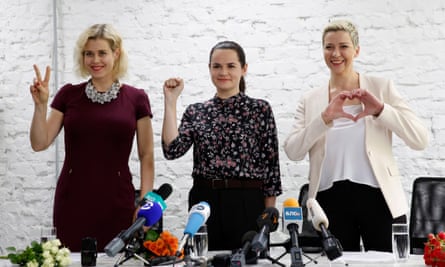
The women came up with signature gestures: for Tikhanovskaya a raised fist, for Kolesnikova a heart formed with her fingers and for Tsepkalo a victory sign.

Kolesnikova and other members of Babaryko's campaign team last month announced the creation of a new opposition party called Together.

(AFP)

Belarus opposition leader Maria Kolesnikova 'snatched from street' in Minsk

Kolesnikova on council calling for a peaceful transfer of power amid post-election protests

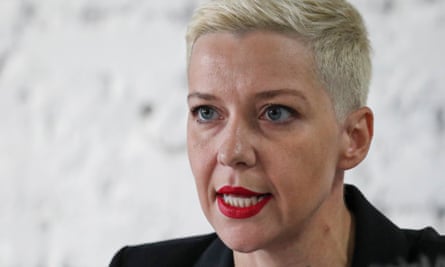
Maria Kolesnikova pictured last month. Unidentified men seized her in central Minsk and drove her away in a minibus, witnesses say. Photograph: Tatyana Zenkovich/EPA


Luke Harding and agencies
Mon 7 Sep 2020 

Unidentified masked men snatched the leading Belarusian opposition figure, Maria Kolesnikova, from the street in the centre of the capital, Minsk, on Monday and drove her away in a minivan, witnesses told local media.

Kolesnikova was one of the campaign partners of the opposition candidate Svetlana Tikhanovskaya, who claimed victory against the long-ruling president, Alexander Lukashenko, in disputed elections on 9 August.

Kolesnikova was reportedly seized soon after 10am local time while walking close to Minsk’s national art museum. Three other members of the opposition coordination council have also vanished, in what appears to be a targeted attempt by the authorities to wipe out the protest movement.

Kolesnikova is the most prominent political figure still inside Belarus.

Lukashenko’s victory – in a poll widely seen as rigged – has sparked mass protests. On Sunday, more than 100,000 people marched on the president’s residence, calling on him to quit. Riot police wearing balaclavas arrested 633 people. Gangs of pro-government thugs beat up protesters on their way home.

It is unclear who abducted Koselnikova. Her coordination council colleagues who have disappeared include Anton Rodnenkov, Ivan Kravtsov and Maxim Bogretsov. Her press team is also missing.

Speaking to the local news website Tut.by, a woman identified as Anastasia said she spotted Kolesnikova in the street. She said she was about to go up to her and to thank her for her work when she changed her mind, thinking Kolesnikova looked exhausted.

She said: “Then I noticed a dark minivan with the slogan “Svyaz” on the side parked up not far from the museum. I carried on and then heard the sound of a telephone falling on the tarmac. I turned round and saw people in civilian clothes and masks dragging Maria into the van. The phone flew out of her hand. One of them picked it up, jumped into the van and they drove off.”

Her telephone did not answer, Tut.by reported.

Kolesnikova’s press aide, Rodnenkov, confirmed her abduction but vanished himself around 40 minutes later, it reported. Kolesnikova’s allies said they were checking the report of her detention. Police in Minsk were cited by Russia’s Interfax news agency as saying they had not detained her.

Before the election, Kolesnikova had joined forces with the opposition presidential candidate Tikhanovskaya who later fled to Lithuania, and with Veronika Tsepkalo, who has also since left the country. Another leading activist, Olga Kovalkova, arrived in Poland on Saturday, saying she had been told she would face arrest if she stayed in Belarus.

Senior Belarus opposition figures have accused the EU of failing to respond to Lukashenko’s brutal crackdown on peaceful protesters. Andrei Sannikov, who stood against Lukashanko in the 2010 presidential election, and was subsequently jailed, said sanctions were urgently needed.

Earlier on Monday, central bank figures showed Belarus had burned through nearly a sixth of its gold and foreign exchange reserves, or $1.4bn (£1.06bn), in August, as it fought to prop up its rouble currency during the wave of unrest.
Veronika Tsepkalo (left), Svetlana Tikhanovskaya (centre), and Maria Kolesnikova display their signature gestures at a press-conference in Minsk in July. Photograph: Tatyana Zenkovich/EPA
Kolesnikova had announced on 31 August that she was forming a new political party, Together, with the team of jailed opposition figure Viktor Babariko with whom she had previously worked.

Kolesnikova, a trained flautist and music teacher, got into politics through running the campaign of another opposition politician, the former banker Viktor Babaryko, who attempted to stand for president against Lukashenko but was jailed and barred from running.

When Tikhanovskaya, an English teacher and translator with no political experience, was unexpectedly allowed to run for president, Kolesnikova and Tsepkalo backed her and spoke alongside her at rallies.

The women came up with signature gestures: for Tikhanovskaya a raised fist, for Kolesnikova a heart formed with her fingers, and for Tsepkalo a victory sign.

Kolesnikova and other members of Babaryko’s campaign team last month announced the creation of a new opposition party called Together.
MISOGYNIST Philippines president pardons HOMOPHOBIC US marine in transgender killing

Issued on: 07/09/2020 -
US Marine Lance Corporal Joseph Scott Pemberton has been granted an absolute pardon by Philippine President Rodrigo Duterte for the killing of a trangender woman in 2014
TED ALJIBE POOL/AFP/File


Manila (AFP)

Philippine President Rodrigo Duterte has granted an absolute pardon to a US marine convicted of killing a transgender woman, officials said Monday, drawing condemnation from rights groups.

Lance Corporal Joseph Scott Pemberton has been in prison since the October 2014 killing of Jennifer Laude, whom he met at a bar while on a break from military exercises in the northern city of Olongapo.

A local court ruled last week that Pemberton qualified for early release due to good behaviour, but was still being held due to an appeal.

Duterte's pardon clears all legal obstacles to his release, despite him serving just half his 10-year sentence.

Duterte's spokesman Harry Roque, a lawyer who represented the Laude family during the trial, confirmed Duterte's decision.

"The president has erased the remaining punishment against Pemberton... He can now go home because of the pardon," Roque told reporters.

The Laude family lawyer condemned the decision, calling it a "mockery" of the country's justice system.

"This is another injustice -- not only to Jennifer Laude and family but a grave injustice to the Filipino people," Virginia Suarez said in a statement.

"This is a travesty of Philippine sovereignty and democracy."

The pardon has renewed anti-American sentiment in the Southeast Asian nation, where groups have long called for removal of US military presence.

Edre Olalia, of the National Union of Peoples' Lawyers, called the pardon "a brazen and shameless sell-out" of country's sovereignty.

The pardon came despite Duterte shifting away from the US to seek closer relations with China since assuming power in 2016.

He will address the nation on Monday night after meeting his Cabinet and he is expected to speak on the issue, Roque said.

© 2020 AFP


Philippines pardons US Marine for killing transgender woman

President’s move to free Joseph Scott Pemberton condemned as ‘shameless mockery of justice’

Cpl Joseph Scott Pemberton during his trial in 2015, at which he was convicted of homicide. Photograph: Ted Aljibe/AP

Associated Press in Manila
Mon 7 Sep 2020 

The Philippine president has pardoned a US Marine in a surprise move that will free him from imprisonment for the 2014 killing of a transgender Filipino woman that sparked anger in the former American colony.

Teodoro Locsin Jr, the Philippine foreign secretary, tweeted that Rodrigo Duterte had “granted an absolute pardon” to L/Cpl Joseph Scott Pemberton “to do justice”, but did not elaborate. Duterte was to deliver televised remarks on Monday night where he would discuss Pemberton’s case, a presidential spokesman, Harry Roque, said.

A leftwing human rights group, Karapatan, immediately condemned the pardon as a “despicable and shameless mockery of justice and servility to US imperialist interests”.

Pemberton was convicted of homicide and has been serving a prison sentence of six to 10 years for the killing of Jennifer Laude in a motel in Olongapo city, north-west of Manila. His lawyer, Rowena Garcia-Flores, told the Associated Press that Pemberton had already been aware of Duterte’s decision when she called him.

“I heard the news,” Garcia-Flores quoted the 25-year-old Pemberton as saying. “I’m very happy.”

Meeting Pemberton in detention a few days ago, she said he had expressed his willingness to apologise to the Laude family, even belatedly.

Roque, who once served as a lawyer for the Laude family, said the presidential pardon would mean the immediate release of Pemberton from detention.

“The president has erased the punishment that should be imposed on Pemberton. What the president did not erase was the conviction of Pemberton. He’s still a killer,” Roque said.

Last week, the regional trial court in Olongapo, which handled Pemberton’s case, ordered authorities to release him early from detention for good conduct, but Laude’s family appealed against the order, blocking the marine’s early release. Roque said the Department of Justice was planning to block Pemberton’s early release with a separate appeal.

The court order rekindled perceptions that US military personnel who fall foul of Philippine laws can get special treatment under the allies’ visiting forces agreement (VFA), which provides the legal framework for temporary visits by US forces to the country for large-scale combat exercises.

Pemberton, an anti-tank missile operator from New Bedford, Massachusetts, was one of thousands of US and Philippine military personnel who participated in joint exercises in the country in 2014.

He and a group of other marines were on leave after the exercises and met Laude and her friends at a bar in Olongapo, a city known for its nightlife, outside Subic Bay, a former US navy base.

Laude was later found dead in a motel room where witnesses said she and Pemberton had checked in. A witness told investigators that Pemberton said he had choked Laude after discovering she was transgender.

In December 2015, a judge convicted Pemberton of homicide, not the more serious charge of murder that prosecutors sought. The Olongapo court judge said at the time that she had downgraded the charge because factors such as cruelty and treachery had not been proven.

Pemberton has been serving his sentence in a compound jointly guarded by Philippine and US security personnel at the main military camp in metropolitan Manila. The place of detention was agreed to under the terms of the VFA, although Laude’s family had demanded that he be held in an ordinary jail.

Garcia-Flores said his detention had been shortened by authorities under a Philippine law that allows the reduction of prison terms for good conduct. A lawyer for the Laude family, Virginia Suarez, said the law could not apply to Pemberton, who has been detained alone in a military camp and given other special privileges under the VFA.

The case has led to calls from some in the Philippines to end the US military presence in the country, with which Washington has a mutual defence treaty.