It’s possible that I shall make an ass of myself. But in that case one can always get out of it with a little dialectic. I have, of course, so worded my proposition as to be right either way (K.Marx, Letter to F.Engels on the Indian Mutiny)
Monday, January 18, 2021
Venezuela dispatches oxygen for Brazil's Amazonas, reeling from COVID-19
CARACAS (Reuters) - Venezuelan President Nicolas Maduro said on Sunday that a convoy of trucks carrying emergency oxygen supplies for Brazil's northern Amazonas state, where a second wave of the coronavirus pandemic has hit hard, has departed and is set to arrive at the border by Monday morning.
Venezuelan President Nicolas Maduro holds a press conference in Caracas
Reading from a message sent by Justo Noguera, governor of Venezuela's southern Bolivar state, Maduro said during a state television appearance that the six trucks would arrive at the Santa Elena de Uairen border crossing by morning, where they would be handed over to Brazilian health authorities.
From there, the trucks - carrying some 136,000 liters of oxygen, enough to fill 14,000 individual canisters - would take 14 hours to arrive in Manaus, the capital of Amazonas, whose hospital system is collapsing due to the pandemic.
"If anything should come first among us Christians in this moment, it is solidarity," said Maduro, a socialist who has had a tense relationship with Brazil's far-right President Jair Bolsonaro. "The Brazilian people should know that we are willing to help Brazil as much as we can, and even more."
Brazil's health regulator on Sunday approved emergency use of COVID-19 vaccines from China's Sinovac Biotech Ltd and Britain's AstraZenaca, as Bolsonaro - a coronavirus skeptic who has refused to take a vaccine himself - has come under fire for his handling of the crisis.
Maduro referred to the situation in Manaus as "Bolsonaro's health disaster."
(Reporting by Deisy Buitrago in Caracas and Luc Cohen in New York; editing by Jonathan Oatis)
The COVID-19 pandemic in Brazil has overwhelmed its health systems
The spread of COVID-19 in Brazil overwhelmed the health systems in all the country's regions, particularly in areas where they were already fragile, according to a collaborative effort involving the Barcelona Institute for Global Health (ISGlobal), an institution supported by the "la Caixa" Foundation, the University of Sao Paulo, the Catholic University of Rio de Janeiro, the D'Or Institute of Research and Education and the Oswaldo Cruz Foundation. The findings, published in The Lancet Respiratory Medicine, reveal that a large percentage of COVID-19 patients that were hospitalised in Brazil required intensive care and respiratory support, and many did not survive.
The COVID-19 pandemic has put an enormous strain on healthcare systems across the world by increasing the demand for healthcare professionals and the need for beds in intensive care units and respiratory support such as ventilators. However, the mortality rate among confirmed cases has greatly varied between countries and this is in great part due to differences in the capacity and preparedness of their health systems.
"To date, there is very limited data on the mortality of patients hospitalised with COVID-19 or on how the health systems have coped with the pandemic in low- and middle-income countries" explains Otavio Ranzani, ISGlobal researcher and first author of the study. Brazil, for example, is an upper middle-income country with a unified health system for its 210 million inhabitants. However, the country's unique health system has been undermined by recent economic and political crises and there is great heterogeneity across different regions of the country.
Ranzani and his colleagues used data from a nationwide surveillance system to evaluate the characteristics of the first 250,000 patients admitted to hospital with COVID-19 in Brazil, whether they required intensive care or respiratory support, and how many of them died. They also analysed the impact of COVID-19 on healthcare resources and in-hospital mortality across the country's five big regions.
The analysis shows that almost half (47%) of the 254,288 patients admitted to hospital with COVID-19 were under 60 years-old. The in-hospital mortality rate was high (38%) and rose to 60% among those admitted to the intensive care unit (ICU) and to 80% for those who were mechanically ventilated. Although COVID-19 overwhelmed the health system in all five regions, hospital admissions and mortality were considerably higher in the North and Northeast regions at the beginning of the pandemic (for example, 31% of patients aged under 60 died in hospitals in the Northeast versus 15% in the South).
"These regional differences in mortality reflect differences in access to better health care that already existed before the pandemic", explains Fernando Bozza, study coordinator and researcher at the National Institute of Infectious Disease. "This means that COVID-19 not only disproportionately affects the most vulnerable patients but also the most fragile health systems", he adds. "Brazil's health system is one of the largest across the globe to provide care to everyone free of charge and has a solid tradition in the surveillance of infectious diseases. However, COVID-19 overwhelmed the system's capacity", says Ranzani.
The authors conclude that the high mortality observed in hospitals underlines the need for improving the structure and the organisation of the health system, particularly in low- and middle-income countries. This implies increasing available resources - from equipment and consumables, to ICU beds and trained healthcare staff.
###
Reference
Ranzani OT, Bastos LSL, Gelli JGM et al. Characterisation of the first 250000 hospital admissions for COVID-19 in Brazil: a retrospective analysis of nationwide data. Lancet Resp Med. Jan 2021, doi:10.1016/S2213-2600(20)30560-9.
Biden's planned Keystone XL cancellation welcomed by Canadas NDP, Green leaders
The leaders of two federal opposition parties welcomed news today that U.S. president-elect Joe Biden is poised to rescind a presidential permit allowing cross-border construction of the Keystone XL pipeline, a decision that would effectively kill the long-delayed project.
Green Party Leader Annamie Paul said Biden's expected move to block the project shows that the U.S. will soon be led by a committed "climate warrior" in Biden while Canada's leadership is "not serious about tackling the climate emergency."
Prime Minister Justin Trudeau has long supported the project — he backed the pipeline while running for the Liberal leadership in 2013 — which would have carried more than 800,000 barrels of Alberta oil a day to refineries in Texas.
The project has been championed by the oilpatch because it would allow Canadian producers to fetch prices closer to the going world rate.
Canada's ambassador to the U.S., Kirsten Hillman, released a statement late Sunday saying the government "continues to support the Keystone XL project and the benefits that it will bring to both Canada and the United States."
"This infrastructure will safely transport Canadian crude oil that is produced under one of the strongest environmental and climate policy frameworks in the world, and will strengthen the vital Canada-U.S. energy relationship," she said.
Hillman said the project has "changed significantly since it was first proposed."
She said the emissions intensity of the Alberta oil sector has improved dramatically over the last two decades, with per-barrel oil sands emissions falling 31 per cent since 2000 after the province implemented new environmental policies. The project also has since secured the support of some Indigenous communities on both sides of the border. Canada should pivot to 'green' jobs: Singh
NDP Leader Jagmeet Singh applauded Biden's expected executive action saying it contrasts with Trudeau's continued support for some natural resources projects.
"I agree with that decision. I do not support the project," Singh told reporters. "This is the direction that the future requires, we've got to fight the climate crisis."
Singh said the federal government needs to pivot from supporting oil-related projects like the Trans Mountain pipeline expansion to support "green" jobs — and lead the global transition away from extractive industries like the oil and gas sector to other, unspecified clean energy.
"Global markets are clearer than ever that the jobs of the future are jobs that help us fight the climate crisis and that's where we need to make investments," Singh said. "Justin Trudeau has failed on this."
Conservative Leader Erin O'Toole, meanwhile, said a U.S. move to rescind the Keystone XL permits would further imperil Canada's oil sector and the tens of thousands of jobs that are tied to the industry.
"This move will devastate thousands of Canadian families who have already been badly hurt by the economic crisis," O'Toole said in a statement.
"I call on the Prime Minister to immediately reach out to the incoming U.S. administration to stop this from happening and stand up for working Canadians across Canada." Keystone long a thorn in Canada-U.S. relations
Alberta Premier Jason Kenney urged Biden administration officials to immediately meet with Canadian leadership to discuss the project's future, saying a "retroactive veto" like the one Biden is considering could threaten other critical energy links.
"Here's the very simple choice: either the United States has access to environmentally responsible energy produced in a close democratic ally, or it becomes more dependent on foreign oil imports from Venezuela and other OPEC dictatorships in the future," Kenney said, referring to the Saudi Arabia-led oil cartel.
"The United States government owes Canada the respect to at least sit down with us and talk about this vital project in the broader context of our shared challenge in addressing climate change, continental energy security and broader issues."
The project has long been a thorn in the side of the Canada-U.S. relationship.
Former prime minister Stephen Harper was openly critical of the former Democratic president, Barack Obama when he blocked cross-border construction through executive action.
Harper predicted the pipeline would be built "with or without Obama." That won't happen if Biden proceeds as planned.
U.S. President Donald Trump breathed new life into the project when he reversed Obama's actions in 2017 and invited the proponent, TC Energy, to again apply for necessary permits.
Trump said the pipeline would secure North American energy independence and create well-paid unionized jobs.
Despite Trump's support, the company faced an onslaught of legal action from Indigenous and environmental groups in states along the route — litigation that substantially delayed construction of the expansion project that was to connect with TC's existing Keystone pipeline system.
While hopeful for a diplomatic solution, Kenney said the province has retained legal counsel on both sides of the border to pursue court challenges should Biden give Keystone XL the axe.
In 2014, TC launched legal action under a section of the old NAFTA after Obama denied the company a permit. That action was dropped after Trump was elected.
Canada continues to ‘make the case’ for Keystone XL to Biden’s team, feds say
Canada’s Natural Resources Minister Seamus O'Regan says the government is continuing to “make the case” for the Keystone XL pipeline expansion despite reported plans from Joe Biden to immediately quash the project.
His comments come on the heels of reports that Biden is planning to cancel the planned pipeline expansion as one of his first moves after becoming U.S. president on Wednesday.
Transition documents, which The Canadian Press has seen, show that one of his to-do list priorities for inauguration day includes a plan to rescind the Keystone XL construction permit granted in 2019 by predecessor Donald Trump. VIDEO Biden plans to block Keystone XL pipeline
“Our government’s support for the Keystone XL project is long-standing and well-known. And we continue to make the case for it to our American colleagues,” O’Regan said in a statement sent to Global News.
“Canadian oil is produced under strong environmental and climate policy frameworks, and this project will not only strengthen the vital Canada-U.S. energy relationship, but create thousands of good jobs for workers on both sides of the border.”
He added that workers in Alberta and across Canada “will always” have the government’s support.
Meanwhile, the reaction in Alberta to the news has been explosive. Alberta Premier Jason Kenney’s government invested $1.5 billion into the project last year, and on Monday he slammed Biden’s plan to shut the door on the pipeline’s expansion.
“That would be, in our view, an economic and strategic error that would set back Canada-U.S. relations with the United States’ most important trading partner and strategic ally: Canada,” Kenney said during a Monday press conference.
“All we ask at this point is that president-elect Biden show Canada respect to actually sit down and hear our case about how we can be partners in prosperity, partners in combating climate change, partners in energy security.”
Canada’s ambassador to the United States, Kirsten Hillman, has also weighed in on the planned cancellation of the pipeline project, imploring the soon-to-be Biden administration to reconsider the plan.
“This infrastructure will safely transport Canadian crude oil that is produced under one of the strongest environmental and climate policy frameworks in the world, and will strengthen the vital Canada-U.S. energy relationship,” she said in a statement issued over the weekend.
“My team and I will continue to work with Alberta and the industry to make sure American lawmakers and stakeholders understand the facts about energy production in Canada, and that KXL will strengthen US energy security safely, sustainably and responsibly.”
However, not all Canadians were aghast at the decision. Green Party Leader Annamie Paul applauded Biden’s planned move on Monday, urging the feds not to push back.
“We have a real chance, because this is a…president-elect who has made it very clear that the climate is going to be on the top of his agenda.”
“We should be working with the United States...rather then pushing them to reverse the commitment to end the Keystone pipeline.”
NDP Leader Jagmeet Singh also applauded the decision on Monday.
"I support the decision, because I know that this is the direction that the future requires," Singh told reporters.
"We've got to fight the climate crisis."
Biden has yet to formalize the decision to kill the project, meaning the government has at least two more days to change the new administration’s mind. That’s exactly what they intend to try to do, O’Regan said, in addition to hitting the ground running in working with the new president.
“We’re looking forward to working with the incoming Biden administration and further strengthening the relationship with our closest ally.”
With files from The Canadian Press and 630CHED's Kirby Bourne
Indigenous-Led Movement Credited With 'Huge Victory' as Biden Plans to Rescind Keystone XL Permit on Day One
"Our communities have been fighting KXL for over a decade, tooth and nail, in the dirt and in the courts."
Shawnee Rae (age 8) was with a group of Native American activists from the Sisseton-Wahpeton tribe who protested the Keystone XL pipeline project in Watertown, South Dakota. (Photo: Michael S. Williamson/The Washington Post via Getty Images)
President-elect Joe Biden is reportedly planning on the day of his inauguration to rescind a federal permit allowing construction of the Keystone XL pipeline in the United States, a move environmentalists said would represent an immense victory for the planet attributable to years of tireless Indigenous-led opposition to the dirty-energy project.
CBCNewsreported Sunday that "the words 'Rescind Keystone XL pipeline permit' appear on a list of executive actions supposedly scheduled for Day One of Biden's presidency," which begins with his swearing-in on Wednesday. The withdrawal of the Keystone XL permit is among several environment-related actions Biden plans to take via executive order during his first day in office, a list that includes rejoining the Paris climate accord.
"A huge victory for Lakota and Indigenous front liners and Water Protectors. None of this would have been possible without their sacrifices," Nick Estes, a citizen of the Lower Brule Sioux Tribe and an assistant professor of American studies at the University of New Mexico, tweeted in response to Biden's reported plan for Keystone XL, a sprawling $8 billion tar sands project that the Trump administration repeatedly sought to advance amid legal challenges and widespread grassroots resistance.
Kendall Mackey, Keep It in the Ground campaign manager for 350.org, said in a statement late Sunday that preventing construction of the Keystone XL pipeline in the U.S. would be a "momentous sign" that Biden "is listening, taking action, and making good on his promises to people and the planet."
"This decision to halt the Keystone XL pipeline on day one in office sets a precedent that all permitting decisions must pass a climate test and respect Indigenous rights," said Mackey. "We expect the administration to make similar announcements on Dakota Access Pipeline and Line 3. We celebrate this great victory and the powerful movement to keep fossil fuels in the ground."
"By ensuring that Keystone XL is reversed," Mackey continued, "Biden is standing on the side of tribal nations, farmers, ranchers, and many communities whose livelihoods would be wrecked by this dirty pipeline."
News of Biden's Inauguration Day plan was met with howls of protest from right-wing Canadian politicians such as Alberta Premier Jason Kenney, who issued a statement Sunday threatening legal action if Biden follows through on yanking the permit for Keystone XL, owned by Canada-based company TC Energy. Last March, as Common Dreams reported, the government of Alberta committed around $1.1 billion USD to the pipeline project.
"I am deeply concerned by reports that the incoming administration of President-elect Joe Biden may repeal the presidential permit for the Keystone XL border crossing," Kenney tweeted, a response that was immediately panned by climate activists.
In a last-ditch effort to rescue its long-delayed Keystone XL project, TC Energy is reportedly "committing to spend $1.7 billion on solar, wind, and battery power to operate the partially completed 2,000-mile pipeline system between Alberta, in western Canada, and Texas," according to the Wall Street Journal.
The attempt to brand Keystone XL as an environmentally friendly and sustainable energy project was swiftly ridiculed, with one journalist accusing TC Energy of a "desperate" effort to put "lipstick on its pig."
Dallas Goldtooth, Keep It in the Ground campaign organizer for the Indigenous Environmental Network, said in response to Biden's plan to rescind the pipeline permit that "our communities have been fighting KXL for over a decade, tooth and nail, in the dirt and in the courts."
"We formed an immensely powerful, unlikely alliance of voices and we never gave up," said Goldtooth. "I will wait for the ink to dry before I fully celebrate, but shit this feels good."
Our work is licensed under a Creative Commons Attribution-Share Alike 3.0 License. Feel free to republish and share widely.
In a desperate economic moment, Alberta is abruptly reshaping a decades-old balance in the Rockies and Foothills, chasing opportunity in the volatile market of coal exports, at the risk of the very land that defines the province and its people.
By Robson Fletcher, Drew Anderson and Jordan Omstead
July 7, 2020
EXCERPT LONG READ FEATURE
A monument outside the Bellevue Underground Mine honouring the miners who died in an explosion in 1910. (Robson Fletcher/CBC)
Digging into the coal lobby
When asked why the coal policy was unceremoniously rescinded by the current government, some critics, including the previous NDP environment minister Shannon Phillips, are quick with an answer: lobbying.
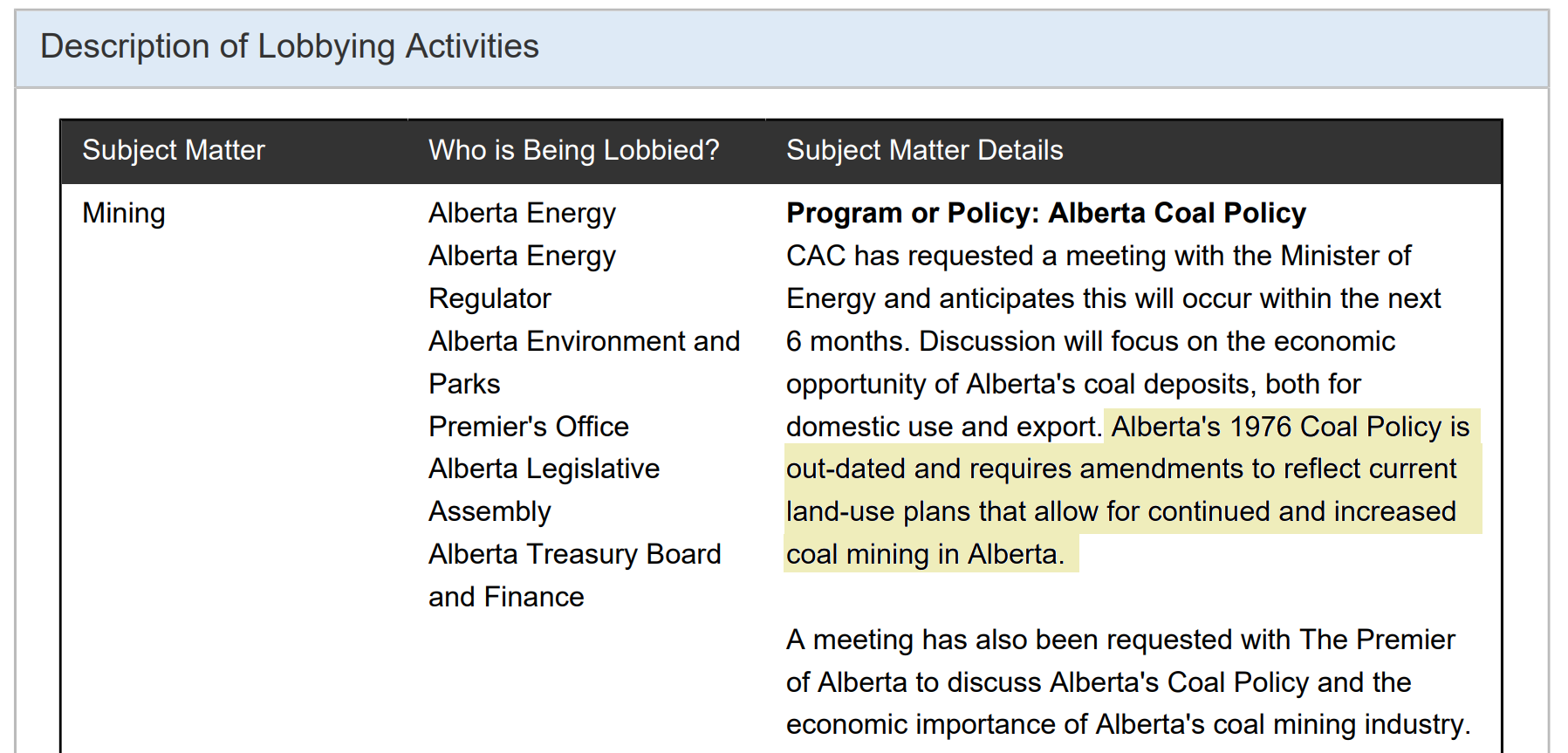
The filings in Alberta's lobbyist registry offer a glimpse into what went down in the halls of power, and how it changed over time.
The online registry dates back to 2017 and a reading of all records that mention "coal" reveals a noticeable uptick in access for the Coal Association of Canada after the election of the United Conservative Party in the spring of 2019. Prior to that, there are no records of the coal association securing meetings with any cabinet ministers under the NDP government.
Robin Campbell’s name appears often in those documents. After serving as finance minister and environment minister under previous Progressive Conservative governments in Alberta, he’s now head of the coal association.
Just over a month after the UCP won the election, lobbying records show Campbell met with the new environment minister, Jason Nixon, to discuss “economic opportunities for the Province of Alberta as a result of proposed coal mining activity, primarily in the Eastern Slopes [of the Rocky Mountains].”
Three days later, the coal association met with the deputy energy minister to try and amend the 1976 coal policy to encourage development on those eastern slopes. Soon, records show there were meetings with the minister of Indigenous relations to discuss consultation, requests for a meeting with the premier, another get-together with Nixon and with his department, a meeting with the minister of red tape reduction and a presentation to the UCP's energy caucus.
An example of the lobbying activity from the Coal Association of Canada. (Alberta Lobbyist Registry/Screenshot)
The coal association then met with Energy Minister Sonya Savage by teleconference on April 30 to discuss the coal policy, among other topics. Just over two weeks later, the government announced, via a news release issued the Friday afternoon before the May long weekend, that it would rescind the 44-year-old policy.
Since that release, which trumpeted flexibility for industry, the continued protection of sensitive lands and the arrival of modern oversight to attract new investment, the government has declined interview requests about the coal policy.
In response to inquiries, its spokespeople have pointed to official statements saying all environmental regulations remain in place and the same regulatory processes applied to other industries will now be applied to coal.
But what the government didn’t highlight in its statements, and what it hasn’t discussed since, is the removal of those Category 2 prohibitions against open-pit mining in vast stretches of the Rockies and Foothills.
Requests for interviews with Savage and Nixon, specifically, were rejected. Alberta Energy spokesperson Kavi Bal responded with a reiteration of the government's previous statements, along with a letter of support for the changes from the Piikani Nation in southern Alberta. Asked whether there was any consultation with any other organizations, Bal did not reply.
On June 3, Savage did tweet about the coal policy being rescinded. "We will continue to protect environmentally sensitive and recreational lands along Alberta’s Eastern Slopes while addressing the continued and growing demand for high quality metallurgical coal," she said, referring to the steel-making type of coal found in the mountains.
Campbell, with the Coal Association of Canada, also did not respond to an interview request for this article, but did speak with CBC News shortly after the policy change was announced. At that time, he celebrated the government's new direction, which he said would clear the way for more coal projects in areas where it was previously difficult to mine.
"For example, around Rocky Mountain House, we have a couple of projects that were on Category 2 lands. This now allows them to move forward,” he said. “It allows them to go out and raise money in the international community. And it allows them to start building an operation, which is going to create jobs."
While it was possible in the past for companies to apply for an exemption to the coal policy's restrictions, Campbell said it was cumbersome and rescinding the policy outright would remove a major barrier to investment. He said "at least a half a dozen" companies are currently looking at developing mines on lands where it would have been previously prohibited and "there will be more."
"Coal's not going away,” he said, “as much as some people like to think it is."
Peter Lougheed defends coal policy
In this 1977 interview, Alberta premier Peter Lougheed defends his Coal Development Policy from critics who accused his government of suppressing the coal industry.
File photos of coal mining operations in Wyoming, left, and Sparwood, B.C., right. Alberta is cancelling a policy that had been in place since 1976 prohibiting open-pit coal mining in wide swaths of land throughout the western side of the province. (Matthew Brown/Associated Press, Jeff McIntosh/Canadian Press)
Alberta is cancelling blanket environmental protections that have been in place since the 1970s and making it easier to develop open-pit coal mines in some of the province's most ecologically sensitive areas.
For decades, wide swaths of the province's Foothills and Rocky Mountains were off-limits to this type of mining, under what was dubbed the "Coal Policy" of 1976.
The provincial government says the policy is outdated and redundant and eliminating it will encourage substantial new investment. Environmentalists say the move will create a high-level regulatory void, as the policy provided a holistic approach to protecting ecosystems, wildlife and Alberta's headwaters.
"Without this, we don't really have a system in place that is enforceable and has evidence-based limits on total land disturbance from industrial operations," said Nissa Petterson with the Alberta Wilderness Association.
The Coal Policy governed coal leasing, exploration and development across four categories of land that encompass most of the western portion of the province.
It is now set to expire on June 1.
Government says some restrictions no longer needed
The government says similar protections will remain in place in former "Category 1" lands — indicated in yellow in the map below — which include most but not all of Alberta's Rocky Mountains.
It says the restrictions in the other three land categories — indicated in blue, pink and purple — are no longer needed.
"When these categories were created, land use planning hadn't yet been completed, supporting infrastructure was lacking and there were environmental concerns that the existing regulatory processes weren't equipped to address," the province says on its website.
These maps show the four categories of land protected under Alberta's 1976 Coal Policy, overlaid with markings indicating caribou ranges and grizzly bear habitat. (Alberta Wilderness Association)
Environment Minister Jason Nixon says the government will continue to protect "critical watersheds and biodiversity along the eastern slopes of Alberta's Rocky Mountains" through other means.
"Through this approach we are striking the balance of ensuring strong environmental protection with providing industry with incentive to increase investment," Nixon said in a news release announcing the policy change, which was sent out last Friday afternoon, before the May long weekend.
Alberta Environment Minister Jason Nixon said 'we are striking the balance of ensuring strong environmental protection with providing industry with incentive to increase investment.' (CBC)
Petterson says the announcement came out of the blue, with no indication such a change had been in the works and no public consultation.
"That doesn't really seem like an open conversation for a resource that's owned by Albertans," she said.
"Albertans should have a say and, unfortunately, this government hasn't demonstrated a lot of consideration towards consulting the public on some of the decisions that they've made related to the environment."
Once the Coal Policy is rescinded, proposals for new mines will go directly to the Alberta Energy Regulator, without the previous restrictions.
Alberta Energy spokesman Kavi Bal says the regulator will still consider the same environmental concerns.
But Petterson says it's "misleading" to say the Coal Policy is redundant with newer regulations.
She says the decades-long policy "operated at a higher level" and helped Alberta "effectively manage cumulative-effect impacts on watersheds and wildlife and our wild spaces."
A grizzly bear is seen in this file photo from the Foothills Research Institute. (fRI Research)
She worries about former Category 2 lands, in particular, which cover 1.4 million hectares of territory that she described as having moderate to high environmental sensitivity. The previous policy prohibited open-pit mines on those lands and allowed only underground operations "where surface effects of the operation are deemed to be environmentally acceptable."
Kevin van Tighem, a spokesman for landowners in one of the affected areas in the Foothills, says the region already exceeds what are supposed to be development limits.
He says the Foothills are also home to threatened species and are crucial to water supplies for the southern Prairies all the way into Saskatchewan.
'Coal's not going away'
Alberta Energy Minister Sonya Savage says the province's move was a "common-sense" decision aimed at creating "certainty and flexibility for industry."
"Rescinding the outdated Coal Policy in favour of modern oversight will help attract new investment for an important industry and protect jobs for Albertans," she said in a release.
Robin Campbell is a former Alberta environment minister and current president of the Coal Association of Canada. He says everyone in the industry that he has spoken with has been "quite pleased" by the province's move.
He says Alberta has vast deposits of high-quality coal — especially steel-making coal that is in high demand in Japan, China and South Korea.
He says it was possible for companies to apply for an exemption to the Coal Policy's restrictions in the past but that it was cumbersome and rescinding the policy removes a major hurdle to investment.
"For example, around Rocky Mountain House, we have a couple of projects that were on Category 2 lands. This now allows them to move forward. It allows them to go out and raise money in the international community. And it allows them to start building an operation, which is going to create jobs."
Former Environment Minister Robin Campbell, seen here in a file photo, now serves as president of the Coal Association of Canada. (Erin Collins/CBC)
The coal industry "is very beneficial to rural communities," Campbell said, and "there are very stringent regulatory obligations that companies have to meet before they can start construction."
"You're looking at a lot of money to build a mine — somewhere in the $750 million to $1 billion range — so people who are going to invest in the coal industry want some certainty," he added.
Campbell estimates there are "at least a half a dozen" companies currently looking at developing mines on lands where it would have been previously prohibited and "there will be more."
"Coal's not going away," he said, "as much as some people like to think it is."
With files from The Canadian Press
BACKGROUNDER Alberta Coal Grab: What Is the Sound of One Group Lobbying? Ask the Coal Association, the only group listened to before Kenney dropped barriers to open-pit mining on the Rockies’ eastern slope.
Andrew Nikiforuk 3 Aug 2020 | TheTyee.ca Tyee contributing editor Andrew Nikiforuk is an award-winning journalist whose books and articles focus on epidemics, the energy industry, nature and more.
Coal Association Canada president Robin Campbell. Before he became the highly-paid top lobbyist for coal interests, he was Alberta’s environment minister. Photo via the Government of Alberta.
When the Edmonton-based Coal Association of Canada lobbies Alberta’s UCP government — as the official registry shows happens a lot — elected ministers not only listen, but act promptly.
Consider, for example, the run-up to the Jason Kenney government’s decision to sweep away protections that had stood for 44 years to safeguard a 1.5-million-hectare area of the eastern Rockies vital for wildlife and safe drinking water for Albertans.
The protective Coal Policy implemented in 1976 by then Progressive Conservative premier Peter Lougheed was quietly trashed in May by the Kenney government, as the pandemic and plummeting oil prices upended its oilsands-driven economic agenda. (See this article published today in The Tyee.)
Plan B? Coal, apparently. And in Alberta coal lobbyists have some clear advantages that ordinary citizens don’t.
For starters, CAC president Robin Campbell used to be a Tory finance and environment minister in the Alberta government of Jim Prentice. He knows his way around government.Riese O’Hara, CAC’s director of government relations, also worked in a Tory government as chief of staff for the provincial transportation minister about five years ago.
According to the Alberta Lobby Registry, Campbell has been busy pressing Alberta Energy, Alberta Environment and Parks and the Alberta Energy Regulator.
In September 2019, for example, Campbell met with the new Environment Minister Jason Nixon to discuss “economic opportunities for the Province of Alberta as a result of proposed coal mining activity, primarily in the Eastern Slopes of Alberta.”
The Coal Policy, which prohibited open-pit mining on those lands, was most likely discussed.
On Jan. 30, 2020 Campbell continued the conversation, this time with idea of pitching the development of metallurgical coal development as a great economic diversification opportunity in a province already crippled by its dependence on fossil fuel exports.
Campbell also provided “an overview of the Canadian coal industry” and talked about “economic opportunities as a result of exporting Canadian coal, carbon capture and storage technology as well as potential opportunities for stranded coal assets in Alberta as a result of the coal-fired generation phase out.”
In March, Environment Minister Nixon abruptly announced that the UCP government planned to fully or partially close 20 provincial parks and hand off another 164 to third-party managers supposedly to save $5 million. There was no public consultation.
About one-third of the closures lay in coal-bearing lands along the Rockies’ eastern slopes and, as subsequent events suggest, that is probably not a coincidence.
On April 30, Campbell lobbied Nixon again but this time via teleconference due to the pandemic.
This go-around, Campbell championed economic opportunities offered by the coal industry in Alberta. Other subjects came up including “the 1976 coal policy and existing land-use planning.”
Fifteen days later the Kenney government rescinded the Coal Policy as “outdated.”
Alberta Energy Minister Sonya Savage explained the government’s reasoning: “Rescinding the outdated coal policy in favour of modern oversight will help attract new investment for an important industry and protect jobs for Albertans.” The CAC, the only association consulted about the axing of the Coal Policy, responded in kind.
“Government is placing a strong focus on creating the necessary conditions for the growth of export coal production,” said the CAC in a statement. “The rescinding of the outdated 1976 Coal Policy is a step in the right direction from the Government of Alberta.”
According to Alberta’s lobbyist registry, the CAC has a lot more heavy work to do.
CAC “will continue engagement with Ministry of Environment and Parks to advocate for land-use planning that does not strand Alberta’s coal assets, both existing projects and potential projects in the Eastern Slopes, primarily.”
The organization “will discuss the implications of rescinding of the 1976 Coal Policy with the Minister and Deputy Ministers of Energy. Discussion will focus on the economic opportunity of Alberta’s coal deposits, both for domestic use and export.”
In all of this lobbying, the words water and climate change are never mentioned.
BACKGROUNDER
What Kenney Had to Kill to Embrace Coal Alberta’s 1976 Coal Policy protected vital drinking water supplies for much of the province. That’s gone now.
Andrew Nikiforuk 3 Aug 2020 | TheTyee.ca Tyee contributing editor Andrew Nikiforuk is an award-winning journalist whose books and articles focus on epidemics, the energy industry, nature and more. Alberta Premier Jason Kenney. His government, after being heavily lobbied by coal interests, opted to open a huge swath of sensitive Rocky Mountains land to open-pit mining, rendering long-standing protections ‘obsolete.’ Photo by Jason Franson, the Canadian Press.
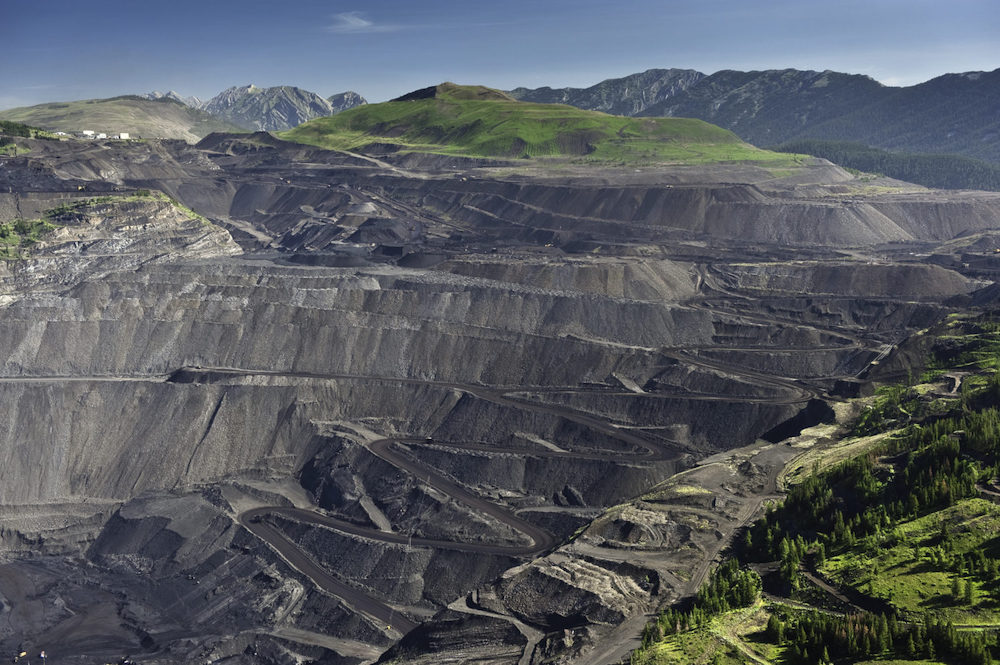
Under the cover of a pandemic, Alberta Premier Jason Kenney quietly wiped away a near half-century of safeguards against open-pit coal mining in most of the province’s Rocky Mountains and foothills.
The result could be the stripping away of mountain tops across more than a million and a half hectares of terrain — about half the size of Vancouver Island.
Gone, as of last May, is the province’s 1976 Coal Policy, which protected the headwaters of rivers that secure drinking water for Canadians across the Prairies.
The Coal Policy was established by the Progressive Conservative government then led by Peter Lougheed, based on nearly six years of active public consultations. It was quietly axed this spring without input by First Nations or the wider public.
That lobbying group is directed by Robin Campbell, a former Tory provincial environmental minister.
Now a handful of largely Australian-owned corporations intent on serving metallurgical coal markets in India and China are poised to begin transforming Alberta’s eastern slopes into an industrial mining zone.
What is scraped from Alberta’s earth will be carried by rail to be loaded on ships in Prince Rupert, B.C., or the port of Vancouver, where opposition from affected communities stopped a previous attempt to ramp up coal shipments from outside the province.
The abrupt rollback of the Coal Policy surprised many, because Kenney’s election platform made no mention of it.
To date, the government has refused to explain the full implications of killing the program, claiming it simply modernized an “obsolete” policy. Albertans, they’ve said, have nothing to worry about because of “the existing rigorous Alberta Energy Regulator review process.”
A government website implies the Coal Policy was all along designed to enable open-pit mining under certain circumstances and nothing’s changed. “The original intention of the Coal Policy was to ensure that there were appropriate regulatory and environmental protection measures in place before new coal projects were authorized,” it says.
But these statements are false, according to David Luff, who worked for Alberta Energy and Natural Resources in the 1970s when the policy was developed and implemented.
“What I find disturbing now is the way the Alberta government is portraying the province’s Coal Policy as archaic and outdated. It was 40 years ahead of its time,” Luff told The Tyee.
“It is unconscionable we are where we are now,” added Luff, who also served as assistant deputy minister for Alberta Energy from 1994 to 1997. He now serves as the vice chair of the Muskwa-Kechika Management Area Advisory Board in British Columbia.
Robin Campbell, top lobbyist for the Coal Association of Canada, commanded significant attention from the Alberta government. Before taking his well-paying job representing coal, he was the province’s environment minister.
The Coal Policy, combined with the Eastern Slopes Policy also implemented by Lougheed, specifically protected much of the province’s clean water and its irreplaceable source, the Rocky Mountains.
The policy also declared that no coal development would take place unless it “achieved maximum benefits for Albertans,” explained Luff. The mining set to be unleashed will enrich some but must be weighed against the threat to water far more Canadians depend upon, he noted.
Lougheed’s Eastern Slopes Policy, also the product of widespread public input, worked in tandem with the Coal Policy: “The highest priority in the overall management of the Eastern Slopes is placed on watershed management.” It also emphasized the importance of protecting “renewable resources” such as wildlife, trees and solace.
The Coal Policy not only set standards for developing coal mines, but represented a form of accountable government that politicians have largely abandoned, noted resource economist Robyn Allan.
“It was sound public policy that supported legitimate and responsible activity by not aggravating bust and boom commodity cycles,” Allan told The Tyee.
The Coal Policy also laid out Lougheed’s principles for resource development in the public interest: Go slow. Save the money. Collect your fair share. Add value. Behave like an owner. And clean up the mess.
Lougheed later applied these same principles to the oilsands development including high royalties, which carefully paced and restricted development. However, successive Tory governments abandoned that model by speeding up and facilitating oilsands production.
“The Coal Policy is anathema to the Kenney model, which props up business interests at everyone’s expense and which will exacerbate the bust and boom cycle for metallurgical coal,” said Allan.
The policy allowed some restricted development on the plains and northern forested regions as well as mines in the rest of the province “subject to the proper assurances respecting protection of the environment and reclamation of disturbed lands.”
There are nine active coal mines in Alberta. But in the past 44 years, no mines have been allowed on what the Coal Policy designated as Category Two lands where underground mining was allowed but open-pit mining forbidden.
Dropping the Coal Policy means the high bar for protecting those lands “has been lost,” said Luff, “and now all these applications from Australian companies are the on block.”
Leading the charge is Hancock Prospecting, owned by Australian billionaire Gina Rinehart. Her Grassy Mountain Coal Project in the Crowsnest Pass will undergo a joint federal and provincial hearing this fall.
Rinehart is one of richest women in the world and does not believe in climate change.
Her proposed mine is not on Category Two land. But other Australian firms including Montem Resources and Atrum Coal hope to piggyback on the success of Rinehart’s application to gain access to the eastern slopes.
Just before the Kenney government wiped away the Coal Policy’s restrictions, in an April investor presentation, Atrum Coal mentioned that policy stood in the way of its plans in Alberta. But it had a solution: “Regular, proactive engagement with Alberta government has significantly increased confidence of such an approval.”
CAC president Campbell recently told the CBC that axing the Coal Policy’s land protections had the desired effect: “at least a half a dozen” companies are currently looking at developing mines on formerly Category Two lands and “there will be more.”
Contrary to claims made by the Kenney government, no comparable land-use planning currently exists to protect Category Two lands in Alberta. They have been orphaned to coal.
To imagine how six open-pit coals would transform Alberta’s eastern slopes from the Crowsnest Pass to Chain Lakes, look at B.C.’s Elk Valley where Teck Resources operates five open mines. B.C. never had a coal policy.
An open-pit coal mine in Elk Valley, BC, similar to ones proposed along the eastern slope of Alberta’s Rocky Mountains, now that the Kenney government has cleared away protections under the Coal Policy of 1976. The method involves removing mountain tops and terracing their sides. Photo by Garth Lenz.
The coal mined in southern Alberta, which is the metallurgical kind used to make steel, would end up at Vancouver’s Neptune and Westshore terminal. Other mines proposed for Alberta’s central eastern slopes would send loads of their hard coal to the Ridley Terminals in Prince Rupert. Globally, the burning of metallurgical coal to make steel accounts for nearly 10 per cent of all greenhouse gas emissions. That makes the industry, after China and the United States, the world’s third largest emitter — or what one analyst calls “The Republic of Steel.”
But by rescinding the Coal Policy, the Kenney government not only eliminated key obstacles to a surge of mining in sensitive ecological areas, but also a set of principles that respected the public interest.
Sped-up, multiple projects. The Coal Policy recognized that permitting too many projects at one time created economic bottlenecks, manpower shortages and infrastructure challenges. As a consequence, government was required to control the pace of the development in the greater public interest.
But the Kenney government has dropped those guardrails, introducing legislation to “allow Cabinet to specify time limits for the review and approval of energy projects by the Alberta Energy Regulator.” Low royalties. The Coal Policy also restricted development by mandating high royalties that collected at least one-third of the revenue generated by the mines. It ordained that “the government will ensure that a fair price is received for this depleting non-renewable resource.”
The Kenney government has instead lowered or frozen royalties for fossil fuels, so that charges will be as low as one per cent.