Thursday, May 13, 2021


Colonial Pipeline reportedly paid nearly $5 million to the hackers who shut off service to the largest fuel line in the US

insider@insider.com (Ben Gilbert) 5 hrs ago

A woman fills her car at a gas station in Annapolis, Maryland, on Wednesday. Fears that the shutdown of a Colonial Pipeline fuel line because of a cyberattack would cause a gasoline shortage led to panic buying in some states. JIM WATSON/AFP via Getty Images

A major US gas provider forced to shut down a fuel line reportedly paid hackers nearly $5 million.

Colonial Pipeline reportedly paid the ransom almost immediately after the attack last Friday.

The nearly $5 million was said to have been paid in untraceable cryptocurrency.


The hackers who shut down the largest US fuel pipeline last week apparently got rich from the attack: The group received nearly $5 million to restore service, Bloomberg reported on Thursday.

That ransom was paid in untraceable cryptocurrency, two people familiar with the transaction told Bloomberg.

Though previous reports said no money had changed hands, the Bloomberg report said Colonial Pipeline paid the ransom within hours of the attack last Friday. Representatives for the company didn't immediately respond to requests for comment.

According to Bloomberg, in exchange for the nearly $5 million in cryptocurrency, Colonial Pipeline got a decryption tool to help restore the company's computer systems that had been hobbled in the so-called ransomware attack.

"Our goal is to make money, and not creating problems for society," DarkSide, the hacking group thought to be responsible for the attack, said in a statement earlier this week. The group also promised to be more careful with its attacks "to avoid social consequences in the future."

Colonial Pipeline is responsible for nearly half the fuel consumed on the East Coast.

After the attack, several states had gas shortages, and some people rushed to hoard gasoline in anticipation of long shortages. The US Department of Energy has said it expects a return to normal supply by the end of the weekend.
Myanmar jails journalist for anti-coup protests coverage

It is one of the first guilty verdicts against a reporter since the military junta took control of Myanmar three months ago. A human rights observer said journalism is effectively illegal in the country.


Press freedoms have been stripped away from many media outlets in Myanmar since the coup

A court in Myanmar has sentenced a journalist to three years in prison for his reports on anti-junta protests, his organization said Thursday.

Min Nyo of the Democratic Voice of Burma (DVB) is one of the first media workers to be imprisoned since the military coup on February 1.

He was arrested on March 3 while covering the protests in the town of Pyay.

The DVB said he was "brutally beaten" by police and denied visits from his family.

"DVB demands the military authority release Min Nyo immediately, as well as other detained or convicted journalists around Myanmar."

VIDEO
Myanmar crackdown leads to deaths, arrests and displaced people

Three of the DVB's journalists were detained in northern Thailand earlier this week for illegally entering the country after fleeing Myanmar.

Human rights groups and press freedom advocates, including the Committee to Protect Journalists, have urged Thailand not to deport them.


Cracking down on press freedom


The DVB, which had its license revoked by the junta, said Min Nyo was found guilty under Article 505 (a) of the penal code, which criminalizes spreading information that could incite security forces to mutiny.

Several other news outlets have had their licenses canceled in Myanmar. Amnesty International's Deputy Regional Director Emerlynne Gil said journalism has been effectively criminalized in the country.

"They risk life and liberty to shed light on the military's abuses. The military authorities are ruthless, determined to crush dissent by silencing those who seek to expose their crimes," said Gil in a statement.

Watch video 02:27 Myanmar still in turmoil 100 days since military coup

The military has brutally suppressed any resistance, firing live ammunition at people and hurting protesters. According to the AAPP prisoners' aid organization, at least 785 people have been killed since the coup occurred three months ago.

More than 4,900 have been imprisoned and arrest warrants have been issued for at least 1,600 people.

Watch video02:45 Myanmar violence: A protester speaks out

kbd/rt (dpa, Reuters)
TRAVEL
Coffee from the Canary Islands


Europe is not really known for coffee cultivation. And yet the beans have been grown in the Valle de Agaete on Gran Canaria since the 19th century. Find out more in part ten of our series "Extreme Places".


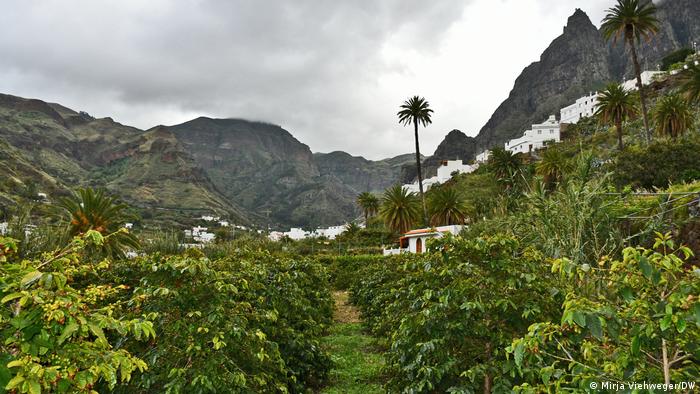
Europe's only coffee plantation can be found on the Spanish Canary Island of Gran Canaria


It is said that it was a shepherd in the region of today's Ethiopia who discovered the coffee plant. He had observed that some of his goats leapt around wildly after they had eaten from the red fruit of the plant. This was a coincidence that laid the foundations for the creation of one of the most popular drinks in the world today, and the multi-billion dollar industry that surrounds it.


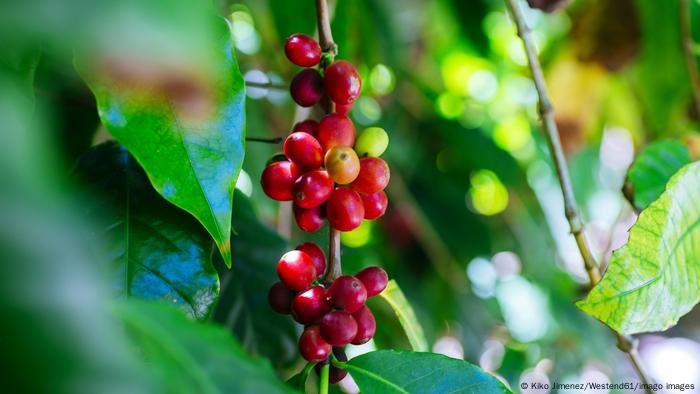
Ripe coffee beans can be recognised by their deep red colour


A particularly large amount of coffee is consumed in European countries, above all in Finland. Every Finn uses up an average of around 12 kilograms a year – that's three to four cups a day. But coffee is also the number one favorite drink in Germany, even ahead of water and beer.


The valley of the coffee farmers

The plants are grown in many parts of the world, with countries such as Brazil, Columbia, Indonesia and Ethiopia all known for their coffee production. Few people though are aware that there are also regions in Europe where coffee plants grow: in the mild climate of the Azores and the Canary Islands. Here some inhabitants have coffee plants in their own gardens and harvest the beans for their private consumption.

Spring-like temperatures all year round: ideal conditions for coffee farmers in Gran Canaria


Europe's largest growing region – and the only really commercial one – is located on Gran Canaria. The Spanish island off the coast of North Africa offers the perfect conditions: mild temperatures throughout the year, and fertile lava soils. Consequently, coffee thrives amidst the lush vegetation in the elongated Valle de Agaete valley.

As a harvest worker on a coffee finca

DW reporter Hendrik Welling travelled to the Canary Islands for the series "Europe to the Maxx" on the culture and lifestyle magazine "Euromaxx". On one of the small plantations he was introduced to the art of coffee cultivation and harvesting – and he got to experience first-hand how much work goes into each cup. Find out how he liked the coffee from the Canary Islands in our video.

Between 1,500 and 2,000 kilograms of coffee are produced in the Agaete valley every year, under the motto 'class instead of mass'.


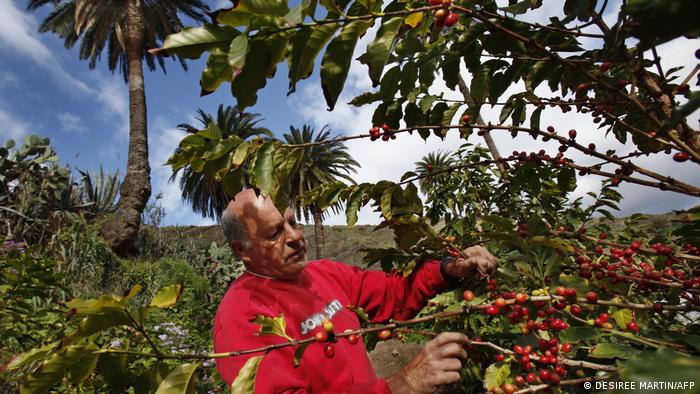
From picking to drying to roasting: coffee production on the Canary Islands is pure manual labour


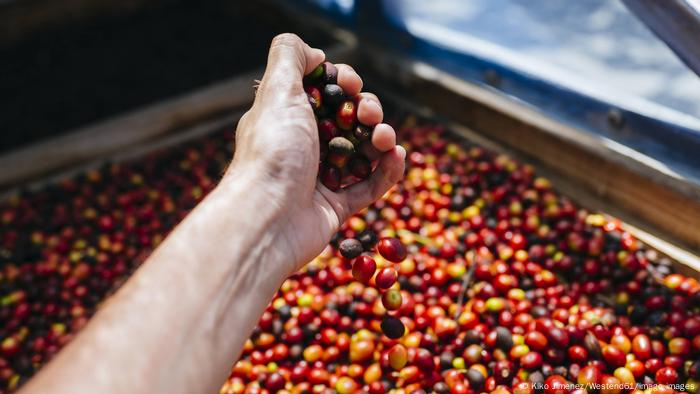
The coffee beans are harvested by hand, and only the ripe, red fruit lands on the drying screen. Gran Canaria's coffee farmers also undertake further processing all the way to roasting directly on-site. The coffee from Agaete is not exported. Thus, visiting coffee-lovers can get something here that's a real rarity in Europe: a regionally-grown cup of Joe.

Service tips:

Address: Valle de Agaete, Province of Las Palmas, Gran Canaria, Spain

Getting there: From Las Palmas de Gran Canaria it's around 30 kilometers to Agaete by bus or rental car.

Special tip: Harvest time is from March to June. Some fincas offer guided tours during which visitors can learn about coffee growing.
The accompanying book


Europe at its most extreme: the series "Europe to the Maxx" on DW's lifestyle and culture magazine "Euromaxx" makes Europe's superlatives experienceable – from extraordinary architecture to spectacular landscapes to unique cultural phenomena. Accompanying the series, the book "111 extreme places in Europe that you shouldn't miss" was published in cooperation with Emons Verlag. An alternative travel guide, both informative and entertaining. For avid travelers, fans of Europe and anyone who likes to show off with unusual pub quiz trivia. Full of guaranteed record breakers!

DW RECOMMENDS


An airport on the beach
'Looted' boat to be shown at Berlin's Humboldt Forum

In a new book, German historian Götz Aly reveals how a boat was taken from the South Pacific and ended up in a German museum. Will it spark a new restitution debate?


Is the Luf boat yet another stolen colonial artifact?

The announcement last month that Germany would return the Benin Bronzes — 13th century sculptures stolen from Africa and since displayed in national museums — to Nigeria caused widespread celebration.

It was a long-overdue win in the fight for the restitution of artworks and artifacts sitting in museum collections that were often acquired illicitly by European colonial powers.

But the recent publication of Das Prachtboot: Wie Deutsche die Kunstschätze der Südsee raubten ("The Magnificent Boat: How Germans Stole the Art Treasures of the South Seas"), by historian Götz Aly, has added another long-hidden dimension to the restitution debate.

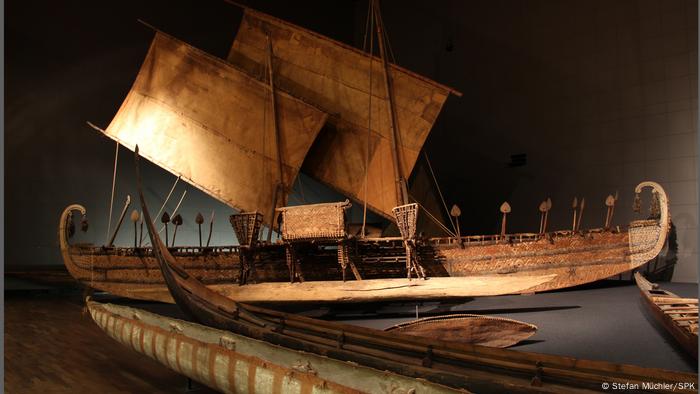
While much of the discussion has been around colonial plundering in Africa, Aly's book focuses on the South Pacific region also colonized by European powers in the 19th century. In particular, the book discusses a unique 16-meter (52-foot) long and 10-meter high sailboat and its journey from Papua New Guinea to the German capital.


Due to be unveiled in Berlin's long-delayed Humboldt Forum museum in autumn 2021, the massive exhibit is set to become the latest restitution battleground.

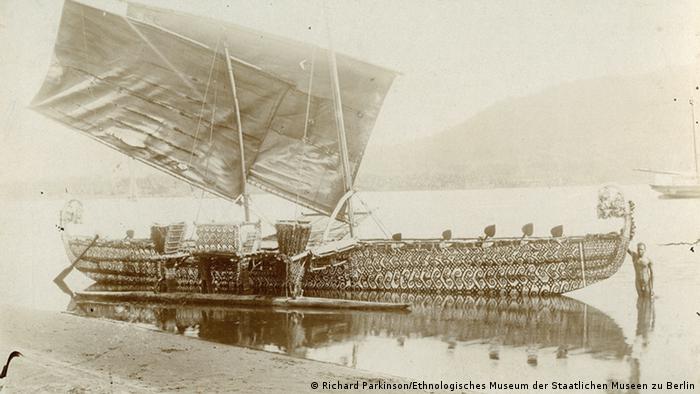
The Luf boat is a masterwork of New Guinean craftsmanship. But should it be returned?

Looted from the South Pacific?

In his look into Germany's stolen South Sea art treasures, Götz Aly reveals the grim circumstances that foreshadowed the arrival of the so-called Luf boat in Berlin.

In the late 19th century, Germany's colonial rulers ran a brutal regime on the Hermit Islands in Papua New Guinea's Bismarck Archipelago — the largest of which is Luf Island. German colonialists who shot the native people, robbed them, raped women or abducted young men for forced labor "generally had no fear of punishment," writes Aly. It might then be assumed that the Luf boat was a looted artifact and was not legally acquired.

Hermann Parzinger, the director of the Prussian Cultural Heritage Foundation (SPK) that owns and manages the Humboldt Forum collection, has so far denied that the boat was stolen.

In a recent statement obtained by the Süddeutsche Zeitung newspaper, the SPK said it will continue to display the boat but will re-brand it, so to speak, as a "memorial of the horrors of the German colonial era."

The SPK has a total of around 65,000 objects from the South Pacific in its possession. For many years, few in charge of museums and collections asked whether these had been legally acquired, despite the mounting number of restitution demands for colonial artifacts stolen from Africa.


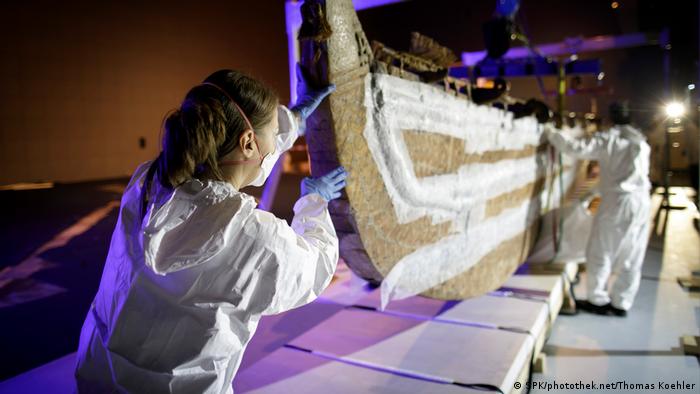
Moving the 16-meter long boat to the Humboldt Forum might not be the only challenge amid possible restitution claims

New Guinean cultural heritage

Before Germany created a protectorate in New Guinea and its neighboring Pacific islands in the 1880s — an area stretching over 3,000 kilometers (1,860 miles) — the Indigenous people had a highly developed culture, especially in terms of arts, crafts and construction. Without using nails, they built large, seaworthy and richly ornamented boats that covered enormous distances and could seat up to 50 people.

Before the arrival of the Europeans, there were hundreds of such boats that sailed the South Pacific seas. According to Aly, all but the one now in Berlin's possession were destroyed during punitive expeditions that were common under colonial rule.

In 1882-83, many of the 400 inhabitants of Luf Island fell victim to such an expedition to the Bismarck Archipelago instigated by Hamburg entrepreneur Eduard Hernsheim.

More than 300 German marines raided the island, destroyed the huts and smashed the boats. Only a few dozen people survived.


Journey to Germany


Two decades after the raid, Max Thiel, director of German trading company Hernsheim & Co., visited the tiny island. In addition to the income made from plantations, trading the "curiosities of primitive peoples," as Aly describes the artifacts, was a profitable side business.

Thiel had gained possession of a boat in German New Guinea and got in touch with Felix von Luschan, who was head of the Oceanic division at Berlin's Ethnological Museum — the predecessor of the Humboldt Forum.

Little is known about how the vessel was acquired by Hernsheim & Co. as there was neither a sales receipt from the islanders nor evidence that it was stolen. What is known is that the boat changed hands for 6,000 German marks, a very high sum at the time, and was transported to Berlin.
Paternalism and 'indirect genocide'

For many years, those involved claimed that they simply wanted to preserve the islanders' culture, saying that since the population had declined so rapidly the boat was no longer needed.

The paternalistic legend persisted that the Germans had, in fact, saved the boat. Yet any need to save the vessel was precipitated by German colonists who had decimated the islander culture and population with their "indirect genocide," as Aly terms it.

The boat was long on display at the Ethnological Museum in Dahlem in Berlin before it was packed into a specially made crate in 2018 and transferred to the new Berlin City Palace.

But will its pending autumn display in the controversial Humboldt Forum collection be met with new questions about its origins?

A book-length report on the "Restitution of African Cultural Heritage" published in 2018 by French academics Benedicte Savoy and Felwine Sarr was instrumental in getting the ball rolling for the restitution of looted African art in Germany. With Götz Aly's latest publication, it is possible that another historian will launch a debate about the origins of South Pacific artifacts, and even their potential repatriation.

This article has been translated from German by Sarah Hucal

Ghana's youth turn to social media to 'fix country's problems'

What started as a social media campaign under #FixTheCountry is turning into a full-fledged movement propelled by predominantly young Ghanaians calling for better living conditions.


#FixtheCountry has been trending in Ghana for the past few weeks


Social media users in Ghana are adhering to the hashtag #FixTheCountry in droves to pressure the government to improve its citizens' lives. The social media initiative is starting to leave cyberspace and taking first steps in the analog world. Among the new movement's demands are more jobs, no corruption, fewer taxes, and better education.

Ernesto Yeboah, of the activist group Economic Fighters League, told DW that the present movement came about out of a feeling among the youth of not being heard by those in charge of the country. "We are hungry. Things are bad. Things are difficult. Life is tough. And it doesn't make the headlines."


The power of social media


Young people, who make up most of the African population, have long discovered social media to vent their frustrations and to put some pressure on governments. Without admitting that it was bowing to pressure, the Ghana National Petroleum Authority last week slightly reduced petrol prices, after a hike produced mass outrage on social media.


Maltiti Sayida Sadick, who supports the movement, left her home in the north to find work in the capital Accra. She is now employed in the private sector. Sadick told DW that she didn't stand a chance of finding a job back home.

But earning a wage that would cover her basic needs has also proved elusive. "It is very frustrating, As a young woman of 28 years, who finished school in 2016, and is still trying to find the job that one can be certain will pay for rent, electricity bills, water bills, to clothe yourself, to take care of transportation and your feeding needs. It's not easy at all."

Pressure on the government


Only about 10% of university students or graduates find jobs one year after completing school, studies show. That's in a country that churns out more than 270,000 graduates every year from public and private universities. Dissatisfaction is bound to grow, and the government is well aware of the tensions, especially since more and more users are taking to social media to air concrete grievances.

Government communicator Courage Nobi says he does understand the manifold frustrations of daily life in Ghana. "Post-COVID, post-2020, we've run into some very severe difficulties," he said. "Is it anybody's fault? No, it's just the dictates of economics, demand and supply and all the forces that inform prices." Nobi says the government is doing its best to address the issues.


Ghana's internet community is not convinced. A call on social media platforms for a demonstration last Sunday was stopped by a court at the request of authorities, for contravening anti-coronavirus safety measures. Maltiti Sayida Sadick scoffed at the concept. "In this country, during elections, politicians were campaigning without regard to the COVID-19 protocols. So we say: lead by example."

Government supporters in Ghana tried to start a countertrend under the hashtag 'FixYourSelf'. It was born after a member of parliament, Frank Annoh-Dompreh advised Ghanaians on the social platform Twitter to do exactly that before asking the government to fix the country. The intensity of the backlash forced him to apologize.

That is not enough for activist Ernesto Yeboah, who has placed his hopes on the country's young. "It's very clear to us and to many young people out there that our leaders are incapable of lifting this country out of the doldrums of poverty, disease, pain, and squalor. And so it looks like what is happening is a call for new leadership and that new leadership is about to emerge from young people," he said.


Nepal: Political tug-of-war hampers efforts to tackle COVID

As the second wave brings deaths and infections to a record high, critics say Nepal's top leadership has largely ignored the health crisis and has instead placed its primary focus on reforming the government.
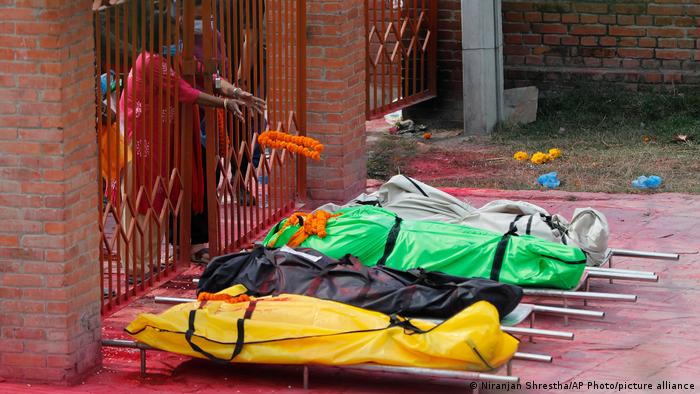


Critics say Nepal's leaders have been primarily concerned with reforming the government

Amid a fatal second wave of the pandemic, with a spiraling number of new cases and deaths, the Nepali leadership has been consumed with power struggles rather than coming up with effective plans to deal with the unfolding public health disaster.

More than 834 people died and almost 50,000 tested positive for coronavirus within just five days.

Meanwhile, the Ministry of Health and Populations on Thursday said that at least 8,960 new cases and 214 deaths were recorded within the past 24 hours.

Critics say the Himalayan nation's top political leaders have been preoccupied with reforming the government. "We have been going through a tough time over the last two weeks. In the meantime, the prime minister has not been seen at many public events. He has not given much attention to the fatal second wave of the pandemic," Gagan Thapa, a former health minister and opposition parliamentarian, told DW.

He said the government is too busy covering up Prime Minister K.P. Sharma Oli's poor management of the pandemic, rather than working actively to upgrade the healthcare system and improve access to medical and oxygen supplies.
Efforts to reshape government take precedence

On Monday, Oli sought a vote of confidence from the 275-seat House of Representatives, but failed to secure enough votes.

He secured just 93 votes, while 28 parliamentarians of his own ruling CPN-UML party didn't vote for him and remained absent. Oli had earlier garnered over two-thirds' majority support when he was sworn in as prime minister in February 2018.


Watch video 01:40 COVID-19 rages through Nepal

Oli had recommended dissolving the House of Representatives last December, but it was reinstated by the Supreme Court in February, which said the move to dissolve the legislature was unconstitutional.

After Oli lost the confidence motion, President Bidhya Devi Bhandari called on political parties to come up with a proposal to form a majority coalition government of two or more parties, within three days.

The leadership of all four political parties represented in the House — the CPN-UML, CPN-Maoist Centre, Janata Samajwadi Party (JSP) and Nepal Workers' and Peasants' Party (NWPP) — were busy in internal meetings and intraparty discussions as to whether or not to keep the Oli government intact.
Oli 'could have postponed'

"The prime minister could have postponed the confidence vote for the time being, after observing the record numbers of new cases and deaths," Krishna Pokhrel, a political science professor at Tribhuvan University in Kirtipur, told DW. "Politically, the prime minister should have sought the confidence vote right after the House was reinstated in late February."

Pokhrel said that if the deadline to form a majority coalition government was missed, there would be a high chance of holding an early election within the next six months.

Former Health Minister Thapa said the prime minister failed to gauge the gravity of the unfolding public health situation, and was busy disseminating false and misleading information over the coronavirus.

Just a few months earlier, the prime minister had claimed that the coronavirus was just like a normal flu and could be wiped out by drinking and gargling herbs like turmeric and guava tree bark.

PM defends pandemic management

But while addressing the parliament, Oli defended his government's handling of the pandemic and accused the opposition party of failing to recognize the achievements made by his government.

Critics say, however, that Oli has been preoccupied with planning rallies and political meetings. Since the dissolution of the House in December, hundreds of political rallies have been organized by both the ruling and opposition parties.


Most of the largest rallies were led and addressed by the prime minister himself.

As late as the last week of April, when the second wave of the pandemic surged in the region, Oli was working on improvements to Kathmandu's iconic Dharahara Tower, with the presence of thousands of supporters.

Meanwhile, most public hospitals were issuing notices that they were overwhelmed with the new number of critical cases, and that they couldn't take in new patients in the absence of oxygen support, beds, ICUs and ventilators.

Additionally, Nepal's pioneering COVID hospital, the Sukraraj Tropical and Infectious Disease Hospital, has stopped conducting polymerase chain reaction (PCR) tests for the virus until further notice, due to a lack of supplies.

Shatosh Paudel, the head of the National Trauma Center in Kathmandu, wrote a Facebook post calling for swift management and an increase in access to oxygen supplies.

In his post, Paudel said that many patients' lives could have been saved if they had been treated on time. He added that the situation could spiral further out of control if medical supplies and oxygen were not immediately made available.

On Wednesday, another major health institution, the Bhaktapur Hospital, started having patients sign contracts that the hospital wouldn't be held responsible for their death in the absence of a sufficient supply of oxygen.

Patients dying of thirst

Samir Bohara from the northwestern city of Nepalgunj — a coronavirus hotspot along the Nepal-India border — told DW that people have also started dying due to a lack of drinking water at hospitals and isolation centers.

"Hospital beds are filled up. Patients are kept in corridors and open yards and left to wait for check-ups, in temperatures of over 35 degrees Celsius [95 degrees Fahrenheit]," said Bohara.

"They do not have enough drinking water, let alone medical oxygen and access to immediate treatment," he said.

Watch video 01:34 Nepal reeling from second wave of coronavirus


He added that even though some remote hospitals have a few ventilators on standby, those ventilators are useless due to a lack of staff qualified to operate the machines.

Jageshwor Gautam, the spokesperson for the Ministry of Health and Population, told DW that the government was doing its best to manage the situation. He said the country is importing oxygen cylinders and ventilators from China, some of which have already arrived.

He further stated that the government has extended lockdown measures in major cities and coronavirus hotspots, including the capital city Kathmandu, for the next 15 days.

Earlier this week, the government had directed large private hospitals to install oxygen plants within the next 15 days. In response, the chairman of the Association of the Private Health Institutions of Nepal, Basanta Chaudhary, said the plan could not be sufficiently carried out within such a short span of time.
German glaciers may melt away in 10 years, study finds

Germany's five glaciers, all in Bavaria's Alps and melting faster than once forecast, could be doomed within 10 years, experts have said. Melt from glaciers is partially responsible for rising sea levels.


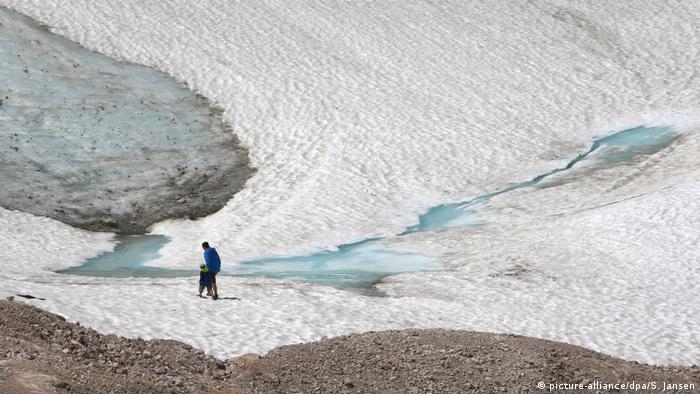
Walks like this on a glacier in the German Alps could be impossible in as little as 10 years


Glaciologist Christoph Mayer said Bavaria's five glaciers — combined — had already shrunk to just half a square kilometer (124 acres) of ice — the equivalent of 36 football fields, and 88% less compared to their status around 1850.

Although small, their fate as climate indicators were of "great importance," said Mayer.

The study by Bavaria's Academy of Science, its second on local glaciers since 2012, emerged as Germany's Constitutional Court ruled Thursday that the nation's climate law was insufficient to protect future generations beyond 2030.

Among the doomed ice remnants, said the study, were the two Schneeferner glaciers skirting Germany's highest peak, the Zugspitze, with its more robust northern sheet shedding 250 liters (66 gallons) of meltwater every 30 seconds.

"Bavaria's last Alpine glacier could be gone in as little as 10 years," said Environment Minister Thorsten Glauber of the Free Voter party, the junior partner in Bavarian Premier Markus Söder's Munich coalition cabinet, adding that the glaciers were melting faster than previously expected.

"The causes and reciprocal effects lie definitively in climate change," stressed Mayer.

The Bavarian study coincided with a global study, published this week in the journal Nature, showing 220,000 glaciers are losing 31% more snow and ice annually than they did 15 years earlier, with permafrost loss prompting landslides.

Already, glaciers are responsible for 21% of sea level rise — melting ice sheets across Greenland and Antarctica excluded, the study said, six months ahead of the UN's next climate conference, COP26, in Glasgow.

That accelerating glacial melt of 298 billion metric tons of ice and snow per year equated to swamping Switzerland under 7.2 meters (24 feet) of water each year, said Zurich glaciologist Romain Hugonnet.

Half of this glacial loss came in the United States and Canada, with Alaska's melt "among the highest on the planet," said the Nature article authors led by Hugonnet of Zurich's ETH University.

Even Tibetan plateau glaciers are affected, impacting millions of people who daily source water downstream, said the study.

That melting mirrored the "global increase in temperature" due to burning of coal, oil and gas, said Hugonnet.
Ever greater sea level rise

Glaciers were becoming "memorials" of the climate crisis, not just early indicators of climate change, said Michael Zemp of the World Glacier Monitoring Service.

"Sea level rise is going to be a bigger and bigger problem as we move through the 21st century," warned Mark Serreze, director of the US Snow and Ice Data Center, which makes extensive use of satellite observation tools.

ipj/sms (dpa, AP, AFP, Reuters)
Cities widely unprepared for climate risks, warns study

Almost half of 812 cities surveyed worldwide still do not have climate adaption plans despite them admitting future risks from water shortages, heat and diseas
e.


Cities around the world need at least $72 billion (€59 billion) to finance environmental projects

Many cities lack a plan to tackle climate change, a London-based think tank said in a report on Wednesday.


Among 812 cities examined across all continents, 43% had not yet drafted climate adaption plans despite most being aware of the risks such as heatwaves and flooding, the CDP (formerly called the Carbon Disclosure Project) found. The group is backed by charities to encourage sustainable investments.


While some cities are making progress, adaption plans were "urgent" in many others to keep citizens safe in fast-expanding urban areas, the CDP stressed.

Described as the world's largest environmental database, the CDP study found that 93% of cities it examined in 2020 admitted they faced "significant risks" likely to hurt "already vulnerable populations."


City councilors witnessing wildfires, heatwaves, droughts, storms and sea level rises could "now feel this and see this," asserted Mirjam Wolfrum, the CDP policy director for Europe.

"They are already paying billions in climate hazards, and they see this as increasing," said Wolfrum, noting a 17-fold surge in cities disclosing data to CDP researchers since their first report in 2011.

Ahead of November's Glasgow COP26 conference, with the UN's 1.5-degree-Celsius climate warming cap still unmet, the CDP estimated that 400 million people will be living in poorly prepared cities by 2030.

For each city a climate risk and vulnerability assessment (CRMA) was the "key step" in identifying people, infrastructure and resources at risk, said the CDP study.

And, despite 3,417 actions to build resilience, notably greening such as tree planting, a quarter of the 812 cities blamed their inaction on "budgetary constraints."

Cities increasingly saw "potential" links between infections and climate, given the COVID-19 pandemic and the $12 trillion (€9.9 trillion) spent globally on recovery so far.
Water supplies, sanitation highly at risk

Presenting urban assets seen as "most affected" by climate change by 2050, the CDP ranked as most vulnerable, city water supplies, sanitation, public health and biodiversity.

"Close monitoring and management of this risk [infectious diseases] will be essential for cities to keep citizens safe from future pandemics," said the CDP.
Cities responsible for global emissions

Cities were responsible for some 70% of global carbon emissions attributed to climate warming and therefore they were "key actors in building a resilient future for all," said Kyra Appleby, a CDP global director.

Solutions included improved green spaces, recycling, public transport and "retrofitting" of fueled vehicles and evacuation procedures for crises.

"However, in 2020 just 50% of reporting cities were taking actions to reduce emissions in buildings, only 42% were tackling transport emissions and only 34% were taking actions to decarbonize the electricity grid," noted the CDP study.

Among climate-friendly trendsetters, it highlighted Santa Fe County in the US, Greater Manchester in Britain and Penampang in Malaysia's Sabah state on Borneo.

"148 cities reported having targets aligned with a 1.5-degree Celsius future," said the CDP, forecasting "this figure is set to grow."

The 812 cities surveyed needed at least $72 billion (€59 billion) to finance environmental projects, said the CDP, with three-quarters of them looking to the private sector for funding and innovation.

The cost of inaction would "greatly outweigh" potential climate-friendly investments, insisted Wolfrum.

The World Bank says global annual losses from weather-related and other disasters in cities, estimated at $314 billion in 2015, will rise to rise to $415 billion by 2030.

ipj/aw (AFP, dpa)


GLOBAL WIND DAY: THE POWER OF WIND
Ancient origins
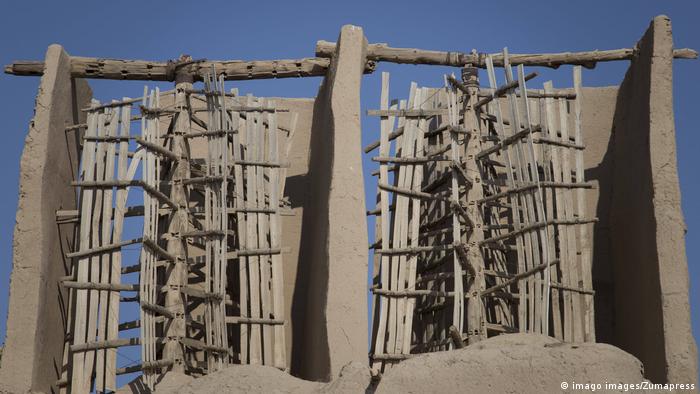
These windmills in Nashtifan, northeastern Iran, are among the oldest in the world. Made of clay, straw and wood and standing up to 20 meters (65 feet) tall, they've been catching the area's strong winds to grind grains into flour for centuries. One of the few such windmills still in operation, they were registered as a national heritage site by Iran's Cultural Heritage Department in 2002. POTOS 1234567


Germany's more ambitious climate goals pressure industry to clean up

The 2030 targets are a "gigantic" task that will push the export-reliant economy to hasten its phase-out of coal-fired power plants and cars that run on fossil fuels.


Germany will need to move its economy away from fossil fuels sooner than planned

Chastened by its highest court and harried by young climate activists, the German government has proposed one of the biggest restructurings of any major economy as it plans to slash emissions 65% from 1990 levels by the end of the decade and hit climate neutrality by 2045.

Nine years from now, the country's energy sector should emit about 60% less than what is allowed today, according to an update to its climate law approved by the cabinet Wednesday. Greenhouse gas emissions from industry would have to fall by a third and emissions from buildings and transport by 43%. The law comes two weeks after the Constitutional Court ruled a previous version was "partly unconstitutional" because it placed too great a burden on future generations to cut emissions.


The law spells major changes in nearly every sector of the export-reliant nation. The steeper cuts will still not be enough to meet the country's obligations under the Paris Agreement on Climate Change, according to environmental research organization Climate Action Tracker. But they will effectively end the burning of coal this decade and require millions more electric cars on the roads and heat pumps in buildings than previously planned.

"For the first time, the most strenuous part of climate protection is not being postponed to the distant future," said German environment minister Svenja Schulze, describing the new law as a "gigantic" task. "The Constitutional Court ordered us to do this and the government reacted very quickly."


Germany is one of the world's biggest historical emitters

Climate neutral by 2045


Analysts say the changes are challenging but achievable.


While the new law does not specify how Germany should achieve the cuts, a report published Friday by environmental think tank Agora Energiewende found that emissions could be brought to net zero by 2045 through a range of technical solutions. It puts forward cuts for each sector that broadly match up with those given for 2030 in the new law.

The report identifies several key actions that Germany could take. The country would need to get two-thirds of its energy from renewable sources by the end of the decade, invest in hydrogen to replace fossil gas, renovate buildings and install heat pumps faster, and stop making cars with internal combustion engines from 2032. Germany would also need to suck pollution out of industrial sites and store it in the ground. The report estimates that 73 million tons of CO2 will need to be removed through carbon-capture technology by 2045, up from zero today.

The foundation of all these actions is building more renewables, said Agora Energiewende's director of industry Frank Peter, who worked on the analysis with two other German think tanks, the Climate Neutrality Foundation and Agora Verkehrswende. "That's where this current government must immediately do their homework."

Export nation


Last month, leaders of several polluting economies backed up their mid-century climate goals with plans to cut emissions in the medium term too. The UK said it will cut emissions 78% from 1990 levels by 2035. The US pledged to halve emissions from 2005 levels by 2030. Japan and Canada announced cuts of just over 40% for the same date relative to 2013 and 2005 levels respectively.

But Germany, more than most other historical polluters, must redesign an economy built upon the manufacture and export of goods made with fossil fuels or designed to burn them.

The government is neither keeping to planetary boundaries nor explaining how its goals can be achieved in a socially just way, said Line Niedeggen, a climate activist with the German branch of the Fridays for Future protest movement that took the government to court over the climate law. "A fair restructuring of the economy is possible if it's communicated clearly and honestly."


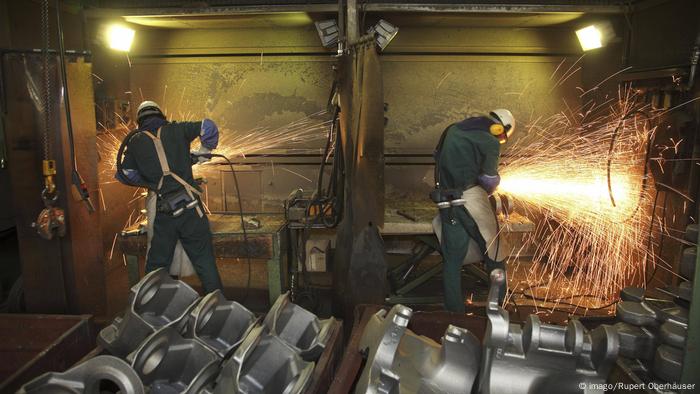
Industrial processes like steel manufacturing will need to cut out fossil fuels

Criticizing the ruling of the Constitutional Court, German daily newspaper Die Welt said the new climate law would lead to "the end of Germany as an export nation." Jörg Hofmann, the head of the country's biggest workers' union IG Metall, said in an interview with the Frankfurter Allgemeine Zeitung newspaper Friday that "climate protection only threatens jobs if we go about it the wrong way." He warned against companies using the transition as an excuse to outsource factories abroad and called for early policies to support struggling companies.

Siegfried Russwurm, President of the Federation of German Industries, called for policy makers to work with businesses to build a climate-neutral industrial country. "Companies are deciding today on the production facilities of 2040. So they need to know now which energy sources they can use to operate their plants then."

The German government is planning to help its industries transition with support of up to €8 billion that will be discussed in the next weeks.


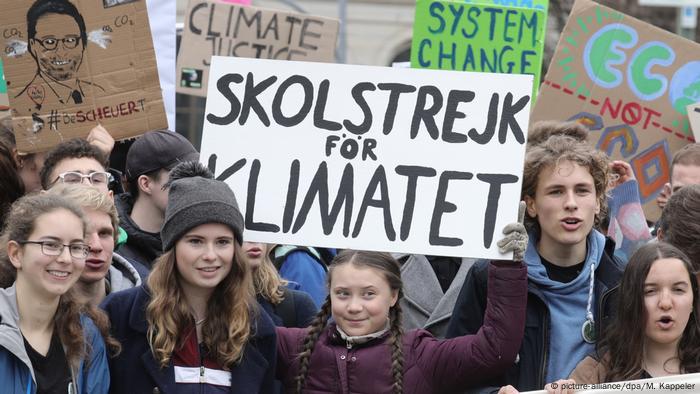
Luisa Neubauer, pictured second-from-the-left alongside Greta Thunberg, is one of several activists who filed the court case that argued Germany's old climate law was unconstitutional

Cleaning up cars


Germany's transport emissions have stayed stubbornly high even as other sectors have cleaned up. In 2019 they were at the same level as in 1990, dropping only in 2020 as coronavirus lockdowns slowed travel."It will require a drastic change of trend," said Giulio Mattioli, a transport researcher at the Technical University of Dortmund.

The average vehicle in Germany's fleet is 9.6 years old, which means that a car sold today will likely still be on the road by the end of the decade. Germany also has just 42,000 charging stations for electric vehicles, according to the regulatory body for gas and electricity markets, the Federal Network Agency. To add 14 million more electric cars by 2030, it would need to massively expand its infrastructure to charge them.

There are currently fewer than half a million electric vehicles in Germany's fleet of 60 million.

As well as phasing out cars with internal combustion engines, said Mattioli, the government will find it "increasingly difficult" to dismiss measures like a generalized motorway speed limit that would help cut emissions. "This is a low-hanging fruit."


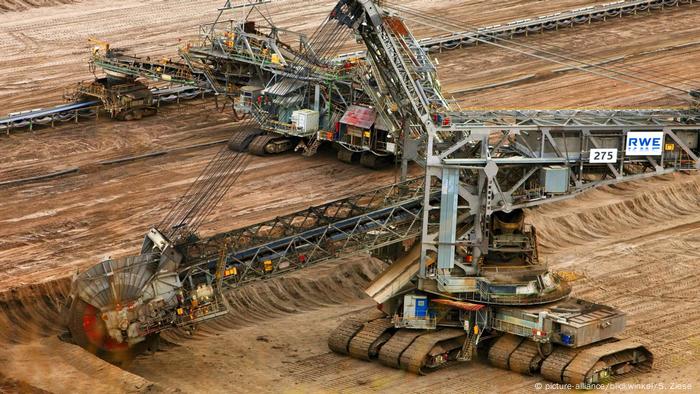
It is unclear whether the new laws will help to protect villages set to be destroyed to make way for coal mines

Cutting out coal


The push for a socially just transition also applies to coal.

Before the new 2030 target, Germany clung to a 2038 deadline of closing its coal plants that scientists say is incompatible with the Paris Agreement and which lags behind the rest of Europe.

This means coal communities will have less time to adapt, said Pao-Yu Oei, a professor of sustainable energy transitions at the Europe University of Flensburg.

A study Oei co-authored in the journal Climate Policy in 2020 looked for lessons from Germany's phase-out of hard coal mining in the Ruhr and Saarland regions in which not a single miner was fired. It found that a faster transition would have been cheaper and more efficient because it would have avoided propping up a dying technology, not given coal regions false hope and left more room to directly act to support miners and their families.

"Their politicians had kept denying the inevitable truth for too long," said Oei.

COVID: Over 25% of EU adults unlikely to take vaccine

A significant proportion of adults in the European Union are unlikely to get the coronavirus vaccine when it is offered to them. The degree of vaccine hesitancy appeared to be linked to their use of social media.


The study showed that Bulgaria had the highest level of vaccine hesitancy


A quarter of adults who said they were unlikely to take the COVID-19 vaccine were also likely to rely more heavily on social media, according to a study published on Thursday.

There was also an apparent east-west divide between respondents across Europe, according to research published by the EU agency Eurofound.
What the results showed

More than a quarter, 27%, of people surveyed across the EU said they were either rather unlikely or very unlikely to have the jab.

Men were slightly more vaccine skeptical (29%) than women (25%).

The actual intention to get vaccinated — people who said they were rather likely or very likely to have it — was above 60% in all western member states except for France (48.7%) and Austria (56.8%). In Germany, the figure was just over 61%.

Nordic and Mediterranean countries had higher rates, with Ireland (86.5%), Denmark (86.1%) and Malta (84%) topping the list.

Spain, Portugal, Sweden and Finland also had rates above 80%.

However, there was a much lower rate of planned uptake in eastern countries.

Those figures ranged from 59% in Romania to the lowest figure of 33% in Bulgaria, where more than 60% were either rather unlikely or very unlikely to have the jab.

The survey found that the main influence on vaccine hesitancy was the time spent on social media, as well as the nature of the medium used. The proportion of people unlikely to take the vaccine rises to 40% among those who use social media as their primary source of news.

Among people who also rely on traditional media including press, radio and television, only about 18% were vaccine skeptics.

The figures showed there was a greater reluctance to take the vaccine in the age range from 35 to 49 years compared with older and younger people.

Students, employed or retired people were less vaccine hesitant than average, while unemployed people and individuals with a long-term disease were more hesitant. Students were the least skeptical group of all.

Daphne Ahrendt, a Eurofound senior research manager, said the results highlighted the importance of clear communication around the efficacy and safety of vaccines.

"Vaccines play a crucial role in overcoming the COVID-19 pandemic. Unfortunately, these findings reflect a failure to deliver persuasive and clear communication regarding the efficacy and safety of vaccines," she said.

"Trust in vaccines is related to trust in institutions, and this is an issue primarily for policymakers, but we also all have a collective responsibility, across society, to ensure that we communicate and publish accurate and sound information on the safety and importance of vaccines."

Almost 47,000 people responded to the e-survey between February and March this year.