Friday, May 21, 2021

The Israeli-Palestinian conflict is changed forever by this war

THIS IS A LONG OVER DUE REACTION TO ISRAEL'S ASSAULT ON GAZA BORDER PROTESTS IN 2019


By Ishaan Tharoor
May 21, 2021 —


After the shooting war over Gaza wound down early Friday, it seems that the Israelis and Palestinians may be poised to return to their fragile, if febrile, status quo. Israeli officials are already claiming their military objectives were met after close to two weeks of relentless bombardment of the blockaded Gaza Strip.

After firing more than 4,000 rockets into Israeli territory, the Islamist group Hamas, which rules the Gaza Strip, may also declare a kind of victory. It is likely to emerge from the fighting as it has after previous rounds, battered but unbowed, and perhaps boosted in the eyes of some of its brethren for having confronted an Israeli state that maintains an unflinching occupation over millions of Palestinians. Never mind the hundreds of Palestinians and dozen people in Israel who lost their lives in the process.
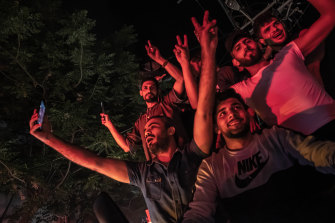

Palestinians celebrate the ceasefire agreement between Israel and Hamas on May 21, 2021 in Gaza City, Gaza. CREDIT:GETTY IMAGES EUROPE

Yet to many analysts and close observers of the Israeli-Palestinian conflict, there may be no going back to the way things once were. The intensity of this latest round of violence took both the Israeli government and the Biden administration by surprise. It should not have.

The coals were stoked far from Gaza, by the provocations of Israeli police and emboldened Jewish far-right vigilantes marching through Jerusalem. Palestinian protests against planned evictions in the contested holy city and the clashes that ensued all came to a head when Israeli security forces decided to storm al-Aqsa Mosque. Hamas then saw an opportunity to don the mantle of the defender of the third-holiest site in Islam, as well as broader Palestinian claims to Jerusalem, and launched its attacks. The resulting war sprawled across the land between the river and the sea, with clashes in the West Bank as well as between Arab and Jewish Israelis in cities inside Israel’s 1967 borders.

The explosion of tensions exposed the internal dysfunctions among both the Israeli and Palestinian political camps. For the former, two years of ceaseless electioneering and the failure to form a stable ruling coalition either with or without Prime Minister Benjamin Netanyahu weakened governance and has brought far-right groups once considered too extremist into the political mainstream. For the latter, a crisis of legitimacy facing the beleaguered Palestinian Authority and its ageing President Mahmoud Abbas has only intensified. Hamas’s renewed militancy followed a decision by Abbas to scrap the first planned Palestinian elections after more than a decade and a half.

Israeli and US officials may tout the return of calm after a ceasefire, but experts fear the opposite. There is no meaningful dialogue between an unpopular, enfeebled PA and a right-wing Israeli government where many politicians now openly reject the idea of an independent Palestinian state. Israel’s entrenched system of control over the Palestinian territories and its creeping annexation of Palestinian lands, unchecked for years by the United States, may only provoke more angry resistance.


“Given Israeli efforts to marginalise Abbas and the PA, it will not be easy to keep the West Bank out of the next conflict or even the current one,” wrote Khalil Shikaki, a Palestinian political analyst and pollster. “Security coordination between Israel and the PA will not be enough to contain the rising flames. And given the rhetoric around annexation, no right-wing Israeli government will be willing or able to renew a political process that would require negotiations with the PA leadership, even for small incremental steps.”

This state of affairs was a long time coming. In a recent survey of US-based Middle East scholars, a majority now viewed the two-state solution as an impossibility. The population of Jewish settlers in the West Bank and East Jerusalem - where a Palestinian state is supposed to emerge - has grown sevenfold since the 1990s. Once on the fringes of Israeli politics, the settler movement now makes up the vanguard of the Israeli right. And, like its US allies in the Republican Party, the Israeli right has no interest in pursuing the two-state goals enshrined by the Oslo accords in 1993.

“The official Israeli abandonment of negotiated compromise, alongside continued settlement expansion and the forcible relocation of Palestinian families in East Jerusalem and communities in the West Bank, made a new crisis almost inevitable,” wrote Tamara Cofman Wittes, a senior fellow at the Brookings Institution. “It made inescapably obvious what was already clear to many: that the Oslo framework was exhausted, and the rationale for the prevailing order in the West Bank, including the existence of the Palestinian Authority, was defunct.”
Advertisement
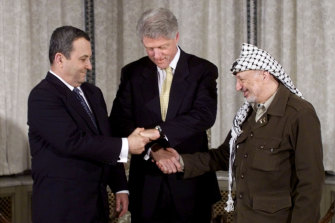


President Bill Clinton joins the hands of Israeli Prime Minister Ehud Barak (L) and Palestinian President Yasser Arafat (R) during the peace talks that led to the Oslo Accords. CREDIT:REUTERS

Now, a growing number of dignitaries and diplomats who staked their careers on building two states recognise that the facts on the ground make it a fantasy. “The Oslo framework is done, it’s over,” said Marwan Muasher, a former Jordanian diplomat and politician who played a lead role in the Arab Peace Initiative two decades ago, at a virtual event hosted by the Carnegie Endowment for International Peace on Wednesday. “I’m a two-stater by training. I’m a one-stater by reality.”

Other veterans of the post-Oslo era who participated in the same event were less emphatic. Tzipi Livni, a former Israeli foreign minister, hoped “pragmatic moderates” on both sides could revive the peace process. In current circumstances, that seems more a wish than a solution.

Daniel Kurtzer, a former US ambassador to Israel, insisted that the two-state solution remained the only policy goal worth striving for - preferable to a single bi-national state, or an Israeli-Palestinian confederation where Jerusalem is shared, or other mooted arrangements. “Anybody who has analysed alternatives to a two-state solution knows that none of them work,” he said.

“Let’s make the rights the central argument for people,” Muasher countered, pointing to an evolving conversation within the Palestinian movement and abroad, including among US Democrats, where the focus is shifting away from the Palestinians’ lack of statehood to their lack of equal rights within Israel. “Let’s keep talking about the shape of a solution, but ignoring the rights of the people is not sustainable.”
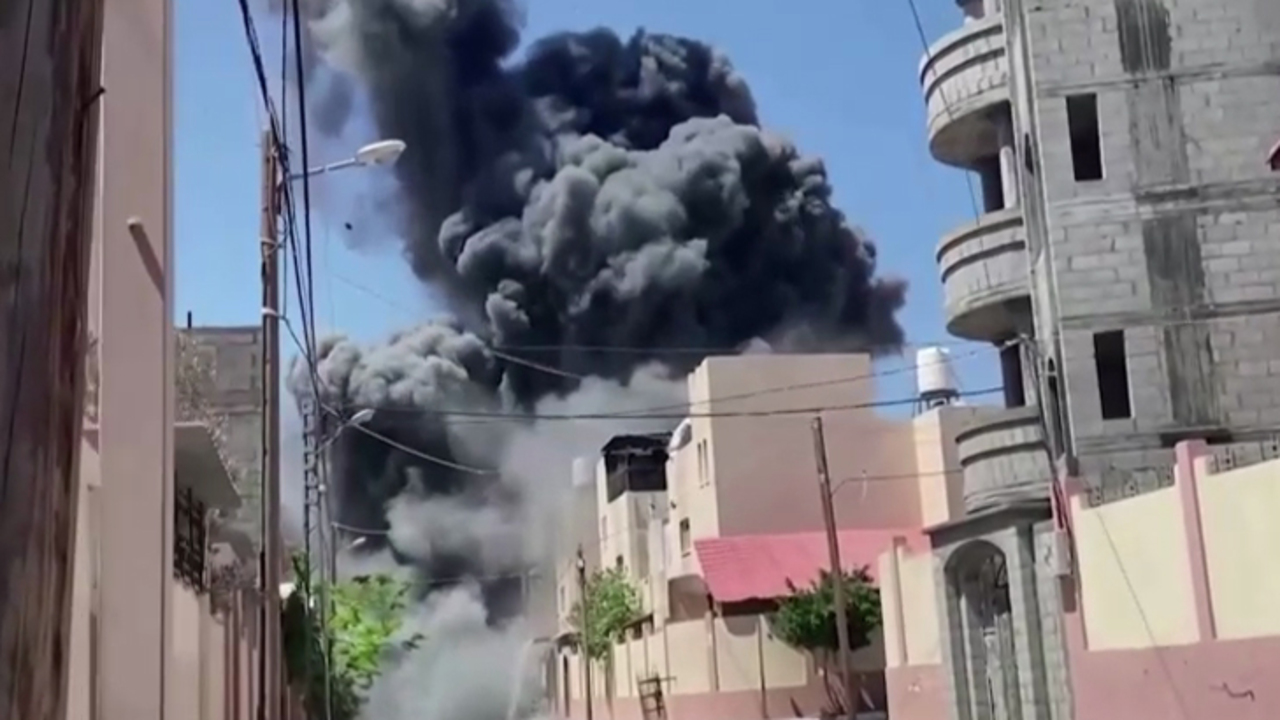

VIDEO The Israeli-Palestinian conflict is changed forever by this war (smh.com.au)


Amid global pressure, Israel, Hamas agree to ceasefire

Israel and Hamas will cease fire across Gaza, says a Palestinian Islamist faction official, bringing a tenuous halt to the fiercest fighting in decades.

Palestinians themselves are trying to make that last point clear. A mass general strike this week saw the joint participation of Arab Israelis - almost all of whom see themselves as Palestinians - and Palestinians in the West Bank, East Jerusalem and Gaza. Analysts of the Palestinian scene see the glimmers of a new era of mobilisation.

“First, the quiescence of the Palestinian people - accused, often most forcefully from within their own communities, of apathy and indifference - never amounted to acceptance of defeat. They have shown that Israel cannot persist in its policies without paying a price,” wrote Tareq Baconi in the London Review of Books. “Second, regardless of whether a broader movement emerges out of the current moment, the collective eruption across historical Palestine shows that the Palestinians remain a people, despite the false hope of partition, the all-too-real separation of their territories, and the deep fragmentation of their political and social life.”
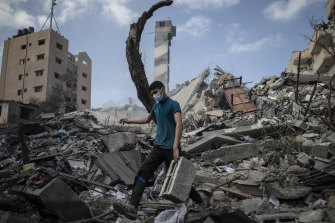

A Palestinian man inspects the damage after a six-storey building was destroyed by an Israeli air strike in Gaza.CREDIT:AP


“For years, Israelis have made peace with the notion that they can manage, however brutally, their relationship with Palestinians instead of resolving it,” wrote Yousef Munayyer in The New York Times. “This has been aided by a process of walling off the ugliness of their rule: Gaza, caged and besieged, might as well have been on a different planet; Israelis could drive throughout the West Bank practically uninterrupted by the sight of Palestinians; Palestinian citizens of Israel have largely been relegated to neglected, concentrated areas.”

But, Munayyer added, the unrest and mass protests have confronted Israelis with a new reality: “Palestine is not ‘over there’ but is everywhere around them.”

The Washington Post


IEA IS MORE CREDIBLE THAN UCP
Alberta portrays IEA’s net-zero plan as ‘driven by activists’


The Alberta government is rebuffing an influential International Energy Agency plan to reach net-zero carbon pollution as an “unreasonable” and “unfeasible” proposal “driven by activists.”

Alberta Energy Minister Sonya Savage made the comments in a statement sent to Canada’s National Observer in response to the release of the IEA’s “Net Zero by 2050” report, which lays out a roadmap for reaching net-zero emissions. It concluded there was “no need for investment in new fossil fuel supply.”


Last year, Savage cited the IEA’s forecasts in an op-ed as “proof” that the world’s energy markets will continue to demand oil “decades” into the future. “Under every single scenario and forecast out there, oil will continue to be used and dominate the energy mix,” she told media on another occasion.


But on Tuesday, the IEA painted a picture of an energy future where Canada’s proven reserves of crude oil — the third-largest in the world after Saudi Arabia and Venezuela, and located almost entirely in the Alberta oilsands — will be increasingly difficult to get to market.

The Paris-based agency sees coal demand being almost wiped out, oil demand cratering by 75 per cent and demand for natural gas cut in half by 2050. “No exploration for new resources is required and ... no new oilfields are necessary,” the IEA wrote.


Savage noted that the new report was out of step with previous agency forecasts that looked more favourably at fossil fuel demand. The minister then suggested this was because the IEA, a body made up of 30 member countries that works to secure the global oil supply, was now being influenced by climate action advocacy.

“Unlike the energy outlook reports that the IEA regularly issues, this is a policy proposal driven by activists, something that the IEA freely admits,” she said.

“There are also major sections of this report that are unreasonable or unfeasible in the real world. The suggestion that global oil and gas production should shift away from socially and environmentally responsible jurisdictions like Alberta and instead substantially increase the market share of OPEC (the Organization of the Petroleum Exporting Countries) is not in the interest of our country, the environment or global energy security.”

Savage did not expand on the definition of “activists.” The agency said the report originated from discussions with the United Kingdom’s government as part of its presidency of the UN climate summit, COP26, in November. Specifically, the IEA had convened a net-zero summit with COP26’s president, former U.K. business secretary Alok Sharma.

In the agency’s net-zero scenario, the price of oil is projected to drop to US$35 per barrel in 2030 and US$25 in 2050, which would make it far more difficult for oilsands operations to stay profitable given that the industry needs to take extra steps to refine Western Canada’s heavy, sulphur-rich crude oil into usable products compared to some other jurisdictions.

“This report is a game changer,” said Dale Marshall of Environmental Defence. “It’s really at odds with basically every government in Canada that in some way benefits from oil and gas development.”

The IEA’s findings could potentially change how Canada approaches critical climate decisions, says Catherine Abreu, executive director of Climate Action Network-Canada.

These projections directly inform modelling used by the Canadian government to make climate decisions, said Abreu, which is why it’s important for future modelling to reflect a path to a climate-safe future.

“If the government of Canada is receiving information from Canada Energy Regulator (CER) saying our oil and gas production is going to continue to grow and we are going to get much more money for our oil and gas on international markets than is realistic … that limits the level of ambition that the Canadian government can then bring to our climate plans,” said Abreu.

The CER projected in November 2020 that Canadian crude oil production will peak in 2039 and natural gas production will peak in 2040.

Darren Christie, chief economist for the CER, said the regulator is working on finalizing the scenarios that will be used to project Canadian energy production for its 2021 Energy Futures report.

“The IEA report is certainly one of the ones that we'll look at as we develop our assumptions heading into the 2021 edition of our long-term projections,” he said in an interview. He noted that this does not mean they will “just take the assumptions that we have in this particular IEA report and transpose them into our 2021 assessment.”

Abreu and Marshall hope the net-zero report will lead the CER to do its own 1.5 C compatible modelling.

Canada also has work to do in the transportation sector.

The IEA report says ending the sale of new internal combustion engine passenger cars by 2035 is key to achieving net zero, but Canada’s target is to reach 100 per cent of new light-duty electric vehicle sales five years later, in 2040.

Transport Canada spokesperson Sau Sau Liu said the department was assessing whether its “level of ambition” on zero-emission vehicles (ZEVs) “continues to remain consistent with the urgency of confronting climate change” given the integrated nature of the North American auto market.

In a recent meeting with U.S. climate envoy John Kerry, Environment Minister Jonathan Wilkinson said the federal government is working with the United States to implement a 100 per cent ZEV sales target as soon as possible.

“We are continually assessing progress to targets to determine if additional measures are needed to meet them,” said Liu.

The transportation sector is Canada’s second-largest emitter, and emissions from this sector continue to increase because of reliance on SUVs and trucks.

“A five-year lag is a big deal,” said Marshall. “We haven't seized the opportunities around efficiency and electric vehicles despite the fact that those electric vehicles are now, on a lifecycle basis, cheaper to own than the internal combustion equivalent.”

As a rich, industrialized country, Marshall says Canada should be working to phase out internal combustion engines sooner than 2035.

He says how the government responds to the report’s findings — particularly the assertion that there can be no new investment in fossil fuel production — will be very telling.

“This really does starkly reveal how out of touch our Canadian governments are, and if governments and companies continue to push for expanding oil and gas … what they are saying is, ‘We are doing this despite the fact that we know that this means climate chaos,’” he said.

If governments ignore the call to stop investing in fossil fuel projects and are slow to embrace the potential of clean energy technologies, Marshall said workers will suffer.

“The transition will be something that is imposed upon them in a way that is maybe quicker, more painful and more disruptive than it could be otherwise if we had a gradual transition, one that is supported and that's fair for workers and communities,” he said.

Natasha Bulowski, Local Journalism Initiative Reporter, National Observer
Single moms sue Missouri for refusing to expand Medicaid

COLUMBIA, Mo. (AP) — Two single mothers are among a group of low-income adults who on Thursday sued Missouri Gov. Mike Parson's administration for dropping plans to expand Medicaid.

The two moms and a third woman asked a Cole County judge to force the state to give them coverage under the government health care program, as called for in a constitutional amendment approved by voters last year.

Two of the women who sued the state are poor enough that their children are covered by Medicaid, but they still make too much — at most $12 an hour working full-time — to get government health care insurance themselves under Missouri’s current rules.

The plaintiffs argued in the lawsuit that they need the health insurance program to get treatment for illnesses including asthma and diabetes.

At issue is the Republican governor's announcement last week that he's dropping plans to expand the program after the GOP-led Legislature refused to provide funding to cover the newly eligible adults.

Before the constitutional amendment passed, the plaintiffs “lacked access to healthcare that, in some cases, is a question of life and death,” according to the lawsuit.

“But with the passage of Medicaid Expansion, Plaintiffs and more than 275,000 other Missourians gained the promise of health care benefits under the MO HealthNet,” the plaintiffs' attorneys wrote in the lawsuit.

They argued that the administration has “broken that promise.”

The plaintiffs also asked that the lawsuit cover the rest of the estimated 275,000 adults who are newly eligible for the program.

Spokespeople for Parson and fellow Republican Attorney General Eric Schmitt declined to comment on the pending lawsuit Thursday.

Missouri’s Medicaid program currently does not cover most adults without children, and its income eligibility threshold for parents is one of the lowest in the nation at about one-fifth of the poverty level.

Plaintiff Melinda Hille, who has diabetes and thyroid disease and is unable to work, has to choose between medical treatment and food, according to the lawsuit.

Stephanie Doyle, who works full time and has three children, can't afford treatment for her eczema and has been hospitalized for severe flare-ups.

The last plaintiff is Autumn Stultz, another single mother who works a part-time, minimum-wage job. She can't afford to go to the doctor and has untreated asthma, according to the lawsuit.

Summer Ballentine, The Associated Press

McDonald's is sued for $10 billion for alleged bias against Black-owned media


By Jonathan Stempel
 Reuters/Mike Blake FILE PHOTO: A McDonald's restaurant is pictured in Encinitas, California

(Reuters) - McDonald's Corp was sued on Thursday for at least $10 billion by two companies owned by media entrepreneur Byron Allen, who accused the fast-food chain of racial discrimination for not advertising enough with Black-owned media outlets.

The complaint filed in Los Angeles County Superior Court said McDonald's violated federal and state civil rights laws through its "racial animus and racial stereotyping" in allocating ad dollars.

According to the complaint, Chicago-based McDonald's has refused to advertise with Allen's Entertainment Studios Networks, which owns several lifestyle channels, or his Weather Group, which owns The Weather Channel.

The complaint said Blacks comprise about 40% of McDonald's customers, but the company devoted less than $5 million of its $1.6 billion U.S. ad budget in 2019 to Black-owned media.

"McDonald's, like much of corporate America these days, publicly touts its commitment to diversity and inclusion, but this is nothing more than empty rhetoric," the complaint said.

Allen sued on the same day McDonald's said it would boost its national ad spending with Black-owned media to 5% from 2% by 2024, and also spend more on Hispanic-, Asian-American, women- and LGBTQ-owned platforms.


"We have doubled down on our relationships with diverse-owned partners," McDonald's said in a statement. It said it will "review and respond accordingly" to Allen's lawsuit.


In April, General Motors Corp pledged to advertise more with Black-owned media, after Allen and other entrepreneurs took out full-page newspaper ads accusing the automaker of ignoring those media.

A former stand-up comic and co-host of the NBC reality TV show "Real People," Allen also sued Comcast Corp for $20 billion in 2015 over its refusal to carry his channels.

He settled in June, three months after the U.S. Supreme Court sided with Comcast in setting a high burden for Allen to prove he was discriminated against.

(Reporting by Jonathan Stempel in New York; Editing by Cynthia Osterman)
ORTEGA FORMER STALINIST NOW CATHOLIC DICTATOR
Nicaragua police raid NGO and news outlet offices


MANAGUA, Nicaragua (AP) — Nicaraguan national police raided offices of a prominent nongovernmental organization and an independent news outlet Thursday — both linked to children of a former president — as the government of President Daniel Ortega continued to clamp down on critical voices in advance of November presidential elections.

The Interior Ministry said in a statement that it was investigating Cristiana Chamorro, former director of the Violeta Barrios de Chamorro Foundation for Reconciliation and Democracy and daughter of the former president.

The ministry said Chamorro and others connected to the foundation had been called in to explain alleged “inconsistencies” in financial reports filed with the government between 2015 and 2019, did not comply with their obligations and that an analysis turned up “clear indications of money laundering.”

Chamorro attended a meeting Thursday at the Interior Ministry, where she was notified of the investigation against her.

After the meeting, she accused Ortega of ordering that evidence be fabricated against her.

“This is a process to not only inhibit me, but to impede Nicaraguans from freely voting and having the sacred right that the law allows us next November 7,” Chamorro said. “This is part of the whole process that the dictatorship is setting up to impede that right.”

Also Thursday, police raided the Managua offices of the news outlet Confidencial, run by Carlos Fernando Chamorro, Cristiana Chamorro’s brother and son of former President Violeta Barrios de Chamorro. In December 2018, police also raided and seized the independent outlet’s offices. The government confiscated the property and turned it over to the Health Ministry.

Ortega alleged at the time that the news outlet and other nongovernmental organizations that were also raided were part of a failed coup attempt in 2018. Street protests of a change to social security in April 2018 set off months of protests that were violently put down by the government.

Carlos Fernando Chamorro was not present Thursday, but denounced the raid and called for authorities to respect the safety of his colleagues. After the raid on his old offices in 2018, Chamorro spent a year in exile in Costa Rica before returning to Nicaragua in January 2020.

He said that a cameraman who was in the offices at the time of Thursday's raid had been detained and was being held by police. The government “has again raided and confiscated our media, but they are not going to silence us, we will continue doing journalism.”

Anti-riot police blocked access to the site. Police briefly detained a photographer from the French news agency AFP, who was covering the raid.

Cristiana Chamorro has not ruled out the possibility of running for president in the November elections. In January, she stepped down from her role at the foundation. A month later, it closed its operations in Nicaragua after passage of a “foreign agents” law that aimed to track foreign funding of organizations operating in the country.

Ortega is seeking his fourth consecutive presidential term in November. Nicaragua's Supreme Electoral Council and congress have been narrowing the space for maneuver for the country's opposition. On Tuesday, the council cancelled the legal status of the Democratic Restoration Party, which was expected to potentially be a vehicle for an opposition coalition bid against Ortega.


Violeta Barrios de Chamorro beat Ortega to win the presidency in 1990 and served until 1997. Her husband Pedro Joaquin Chamorro ran La Prensa, his family newspaper, and was jailed and forced into exile multiple times before his assassination in 1978.


His killing galvanized opposition forces against dictator Anastasio Somoza and propelled the Sandinista revolution led by Ortega that resulted in his ouster.


The Associated Press

First Nations group criticizes Woodside Petroleum's move to sell Kitimat LNG stake


VANCOUVER — A British Columbia First Nations coalition says it's disappointed by the news that a second major investor is looking to sell its shares in the Kitimat Liquefied Natural Gas development.

© Provided by The Canadian Press

Woodside Petroleum Ltd., an Australian company, says it plans sell its 50 per cent stake in the 480-kilometre Pacific Trail Pipeline and the proposed LNG facility at Bish Cove.

The First Nations Limited Partnership, which represents 16 First Nations in northern B.C., says the decision to sell is both disappointing and poses a threat to its members' commercial interests.

Woodside's announcement comes after Chevron Canada Ltd., the operator of the project, said earlier this year that it would stop funding further feasibility work on the project.

The company put its interest up for sale in December 2019, but has failed to find a buyer.

A Woodside spokeswoman said in a statement that the company had worked hard to try to find a mutually acceptable solution, and had not "arrived at this decision lightly."

They added that the company still believes the Kitimat LNG project is well-positioned to supply gas to Asian markets.

Mark Podlasly, the partnership's chair, said he believes the energy project has national benefits and the latest news hurts the group's members.

"We are incredibly disappointed by this setback. The (First Nations Limited Partnership) stands ready to support the right buyers who will treat us as a genuine partner and recognize the unique value we can bring to the table," he said.

Woodside says it will keep a position in the Liard Basin upstream gas resource.

At one time, about 20 LNG terminals were proposed for the West Coast, but the $40-billion LNG Canada project headed by Shell Canada is the only one to reach the construction stage.

Woodside acting CEO Meg O'Neill said the decision to sell will allow the company to focus on higher-value opportunities in Australia and Senegal.

This report by The Canadian Press was first published May 20, 2021.

Nick Wells, The Canadian Press
The anger driving Colombia's protest movement isn't going away anytime soon

By Natalie Gallón and Polo Sandoval, CNN

What started as a tax reform proposal to help ease the strain of the pandemic on the economy and balance government finances ended with people taking to the streets to express their discontent.
© Joaquin Sarmiento/AFP/Getty Images A man is arrested during clashes with the police following a protest against a tax reform bill launched by Colombian President Ivan Duque in Medellin, Colombia on April 29, 2021.

Large-scale protests in Colombia are now in their third week, and prosecutors have announced homicide charges after a national police officer was seen on video shooting and killing a 17-year-old in the city of Cali during the first day of demonstrations.

Last week, Colombia's Attorney General's Office released a statement charging the police officer, Luis Ángel Piedrahita Hernández, with aggravated homicide in connection to the killing of Marcelo Agredo Inchima. Officer Piedrahita Hernández maintains his innocence and the case will go before a criminal court.

The charges were announced on the same day that the head of Colombia's National Police, General Jorge Luis Vargas, just four months into the new role, defended the credibility of the force -- which has been fiercely criticized for its heavy-handed response to the protests -- while admitting that police would be the first to recognize their faults.

"Any act that a police officer commits against the law is forcefully rejected," General Vargas said, speaking to Spanish newspaper El País last week. "Whoever has individual responsibility, we hope that the full weight of the law falls on him. And we will be the first to ask for forgiveness when it is determined," he added.

The institution the general oversees has found itself in the middle of a credibility crisis, as reports of human rights violations increase and international humanitarian groups including the United Nations voice concerns. On Saturday, the Inter-American Commission on Human Rights (IACHR) formally requested access to the country to investigate these abuse allegations.

At least 42 people have died in the protests according to Colombia's Ombudsman Office. Rights groups say the death toll could be higher. According to a compilation by human rights organization Temblores, at least 2,387 cases of police violence have been reported.

The shooting of Marcelo Agredo Inchima


Marcelo Agredo Inchima was among the first casualties that resulted in the protests, on a day when social media videos of brutal repression by police would ignite fury across an already angered nation.

Seventeen-year-old Agredo and his brother joined an anti-tax bill rally on April 28, the first day of protests in Cali — a city in southwest Colombia that would soon become the heart of the movement. Little did they know it would be the last day he would be seen alive.

Dramatic social media footage shot from a balcony in the Mariano Ramos neighborhood shows Agredo kicking a police officer on a motorcycle. Shots can be heard as people scatter in panic. Agredo attempts to run away on foot, but the police officer grabs his gun and shoots, downing the young man.

A second social media video from another angle shows Agredo running and then falling to the ground. A third shows his body on the pavement in a pool of blood, as people frantically try to move him. "They killed him!" a woman screams, terror resonating in her voice.

"No, he's already dead," she sobs near Agredo's still body.

The following day, the young man's father spoke on camera with Temblores and confirmed the death of his son.

"My kid died there as a result of a shot that a police officer gave him. My son attacked a policeman with a kick," Armando Agredo Bustamante said, arguing the kick wasn't a reason to take his son's life when his son was unarmed and "defenseless."

For many Colombians, what started as protests over the now-withdrawn tax reform that would have hit many families already struggling economically, have transformed into a cry to end excessive police force directed at protesters— something they say has plagued the nation for decades.

"The way that they decided to take these things is to bring the police and the military forces against their own people. That's why we are all here," Juan Pablo Randazzo, 21, told CNN during a peaceful protest in the capital of Bogotá, the brightly colored yellow, blue and red Colombian flag wrapped around his neck like a cape.

"We are not prepared to hear the next day that one of our friends, that one of our family, that one of our brothers is getting killed," the university student added with emotion in his voice.

In an exclusive interview with CNN's Chief International Anchor Christiane Amanpour last week, Colombian president Iván Duque announced 65 investigations have been opened into police abuse adding that there were "strict protocols" on the use of force in the country.

Duque said his government had "always trusted and defended the fundamental right in our institution for specific protests."

Nevertheless, government officials also maintain that leftist militants and illegal armed groups are behind some of the violence.

Last week, Colombia's Defense Ministry announced security forces had detained a leader of a local cell of the largest leftist guerrilla group in the country, the National Liberation Army (ELN). The Ministry accused him of attempting to blend into the protests in Cali with plans to detonate a hand grenade and blame security forces, but offered no proof.

A cascade of discontent


The withdrawal of the tax reform proposal, which the government said was necessary to ease the pandemic's blows, was too late to allay protesters' fury over months of economic pressure, reinforced by police brutality, all of which has deepened the sense of inequality that many Colombians feel.

Protesters have burned public buses, police precincts, looted stores and blocked roads throughout the nation, further hampering the economy and flow of goods.

"The Colombian Constitution does not establish the right to block, for violence, or vandalism," Interior Minister Daniel Palacios said on Twitter. "The blockades generate poverty, don't build a country and end the economy," he added.

Negotiations between the Colombian government, indigenous groups and the National Strike Committee are ongoing but have so far been unsuccessful. Even President Duque's announcement last week to cut tuition for lower-income students in the second semester of 2021 has failed to stem the protests.

Meanwhile, Colombians are sinking deeper into poverty, a problem exacerbated by the pandemic and nationwide lockdowns. According to the country's National Statistics Department (DANE), the poverty rate increased from 36 percent in 2019 to 42.5 percent in 2020.

A study from DANE also reports the number of Colombian families eating less than three meals per day has tripled since the start of the pandemic.

Sociology and history professor Jose Alejandro Cifuentes tells CNN the economic situation Colombia faces is grim and entangled with its history of civil war and inequality.

"We are in a very serious situation in the face of access to higher education, employment, and we are facing a situation of high informal employment that is the only space left for these youths," Cifuentes said in regard to the many young Colombians taking to the streets to voice their frustrations and concerns.

Not only has the pandemic hit the future generations though. It has also affected people like Marlon Rincon Peralta, 46, a father of five who we met as he waved down the few visitors who drove past his mostly empty tables.

Rincon Peralta was forced to go from business owner to waiting tables at a restaurant in the once bustling colonial tourist town of Zipaquirá, north of the capital.

"Never, never have I seen this situation," Rincon Peralta told CNN as he got emotional sharing how the pandemic only helped make the rich richer and the poor poorer due to the inequality the country has faced and continues to live.

Financially, he is at his worst.

"I tell my wife, my kids, if we continue like this, no, no... what are we going to do?" he said with tears in his eyes.

"The pandemic has a cure," he said but the economy and inequality doesn't. "If we don't do something, we will never have a cure."

© Joaquin Sarmiento/AFP/Getty Images Demonstrators in Medellin take part in a new protest against the government of Colombian President Ivan Duque on May 19, 2021.

An ailing Sahrawi leader shakes Spain and Morocco's alliance


LOGRONO, Spain (AP) — The mysterious COVID-19 patient arrived at an airport in northern Spain in a medicalized jet. An ambulance ferried the 71-year-old man on a freeway that passed vineyards of Rioja grapes to a state-of-the-art public hospital in the city of Logrono.
© Provided by The Canadian Press

The patient was sent directly to an intensive care bed, registered on April 18 with the identity on his Algerian diplomatic passport: Mohamed Benbatouche.

He turned out to be Brahim Ghali, the leader of the Polisario Front, an Algeria-backed pro-independence movement representing the local Sahrawi people of Africa's Western Sahara. Ghali's presence in Spain under a disguised identity didn't go unnoticed to the government in Morocco, the country that annexed Western Sahara nearly half a century ago.

Rabat, which regards Ghali as a terrorist, protested Spain's decision to grant compassionate assistance to its top enemy. It threatened there would be “consequences.” And they finally came to fruition this week when Morocco let down its guard on the border with Ceuta, a Spanish city perched on the northern African coastline.

The move allowed thousands of migrants to enter Ceuta, many of them children who swam or jumped over fences.

The humanitarian crisis has become a flashpoint between the two neighbors. Morocco recalled its ambassador in Madrid. Spain is under fire from human rights groups for pushing back most of the trespassers in bulk, which is illegal under international law.

And in what resembled an assertion of its sovereignty of Ceuta, which many Moroccan nationalists deem a colony of Madrid along with the nearby Spanish city of Melilla, Spain deployed soldiers to the border. Spanish Prime Minister Pedro Sánchez also made a quick trip to the overwhelmed city.

The Western Sahara region stretches along Africa's Atlantic Coast and is home to roughly 600,000 people. Since Morocco annexed the territory in 1975, filling a void left when Spain withdrew as a colonial power, the international community has been divided on its recognition, with most countries backing a long-running U.N. effort for a negotiated solution.

An announcement by the United States late last year supporting Rabat's claim - in exchange for Morocco normalizing diplomatic ties with Israel - undermined those efforts, rallying other countries behind Morocco's proposal to give the territory greater autonomy.

Pushing instead for a referendum on self-determination has been the main focus for Ghali, who was elected president of the self-declared Sahrawi Arab Democratic Republic in 2016. He previously served as its defense minister and as a Polisario diplomat in Spain (1999-2008) and Algeria (2008-2015).

Ghali, wearing combat fatigues while speaking in February at a military parade marking the 45th anniversary of the SADR, called on the new U.S. administration of President Joe Biden to find a solution that would allow the Sahrawi “to enjoy their inalienable right of freedom and independence.”

At the San Pedro hospital in Logrono, there is little sign of the presence of the Polisario's top man. People familiar with his condition say he recently came out of three weeks in critical care. A security guard performs identity checks on medical personnel and visitors entering the COVID-19 ward. Inside, Ghali receives a daily visit from his personal physician, an Algerian doctor, according to a police report seen by The Associated Press.

“They probably chose this place because nothing ever happens here, and we rarely make it to the news,” local resident Milagros Capellán, 64, said as she left the hospital after a medical check-up. “It feels strange that this is connected with the very sad developments in Ceuta.”

Moroccan intelligence officials knew about Ghali's whereabouts from the moment the Algerian jet carrying Ghali landed in Spain last month, leaking his presence to the media and exposing what had been designed by Spain as a covert “humanitarian” operation.

“What was Spain expecting from Morocco when it hosted an official from a group that is carrying arms against the kingdom?” Morocco’s minister for human rights, Mostapha Ramid, wrote on Facebook on Tuesday.

Spain's foreign minister responded the next day, blaming Morocco for the chaos at the border: “It tears our hearts out to see our neighbors sending children, even babies… (because) they reject a humanitarian gesture on our part," Foreign Minister Arancha González Laya said.

The Spanish Foreign Ministry declined to answer AP's questions on why it agreed to treat Ghali even when other European governments had refused. An official familiar with the decision who requested anonymity because of its sensitive nature said that the request was made directly to González Laya by her Algerian counterpart, Sabri Boukadoum.

Before the request was granted, it had caused deep divisions within Sánchez's Cabinet, the official said.

The Polisario Front’s representative in Spain, Abdulah Arabi, rejected depicting the circumstances of Ghali’s arrival in Spain as exceptional.

“He is the head of state and comes from a country that recognizes the Sahrawi Republic,” Arabi said. He accused Rabat of “trying to discredit the noble, peaceful struggle for resistance of the Sahrawi people by attacking somebody who is a symbol.”

Providing that his recovery goes well, Ghali’s future is now shrouded in uncertainty. With his whereabouts known, a discreet return to Tindouf, Algeria, where Sahrawi refugee camps are located, seems out of question.

Further complicating matters, Spain’s National Court on Tuesday re-opened a genocide probe from 2008 against Ghali and 27 other Polisario members. An investigating judge closed the case last year because the court couldn't locate the defendants.

Ghali is also expected to give testimony June 1 in the same Madrid-based court for a 2019 lawsuit filed by a Sahrawi activist who claims he was tortured in the refugee camps for his opposition to the Polisario.

On May 10, a police officer visited the Polisario leader to hand him a court summons for the lawsuit. According to the police report seen by The Associated Press, Ghali refused to sign the notice, asking for “several days” to consult with the Algerian Embassy and other advisors.

González Laya said that Spain's agreement with Ghali was for medical treatment only, suggesting that the government won't facilitate his immediate departure. “If he has pending matters with Spain's justice, he will have to appear (before the court)," she told Spain's public radio.

Behind the legal cases against Ghali are groups of Sahrawis aligned with Morocco’s position. Asadesh, which stands for the Saharawi Association for Human Rights, accuses 28 Polisario members of killing, torturing, illegally detaining and abducting prisoners and its own Saharawi people, some of whom the group claims were allegedly forced to remain in refugee camps against their will.

Pedro Altamirano is also suing Ghali for allegedly inspiring threats that the Spanish journalist and head of a recently founded platform to support “Sahrawi reunification” received from online netizens.

“The only thing that cannot happen is that by the hand of the devil this man leaves the country without appearing before a judge," said Altamirano, who supports Morocco’s claim on Western Sahara.

___

Associated Press writers Elaine Ganley and Angela Charlton in Paris, and Joseph Wilson in Barcelona, Spain, contributed to this report.

Aritz Parra, The Associated Press
Seven more arrests, 21 in total at anti-logging camp on Vancouver Island: RCMP

LAKE COWICHAN, B.C. — Mounties say they have arrested seven more people along a remote forest service road on southern Vancouver Island as they enforce a court injunction ordering the removal of blockades set up to protest old-growth logging.

© Provided by The Canadian Press

Cpl. Chris Manseau says in a statement the RCMP have now arrested 21 people since enforcement began earlier this week, including 17 for breaching the civil injunction and four for obstruction of justice.

Of the 17 arrested for breaching the injunction, he says police are also recommending that two be charged with obstruction, two with possession of stolen property and one with obstruction and assaulting a police officer.

Manseau says the area along the McClure forest service road west of Lake Cowichan was cleared yesterday to allow Teal Cedar Products to resume work, but several people returned and attached themselves to structures.

Of the seven arrested today, he says six were found in civil contempt of court and one person was escorted out with no charges recommended.

Manseau says everyone arrested today refused to sign conditional release documents, so they will be held overnight at the Lake Cowichan RCMP detachment before appearing in B.C. Supreme Court in Nanaimo on Friday.

More than three dozen protesters gathered in front of the Environment Ministry offices in Victoria on Thursday saying they support those arrested.

The blockaders set up camp along the McClure forest service road in the Caycuse area around Easter, while others have been camped out since last August around the Fairy Creek watershed near Port Renfrew.

Activists say very little of the best old-growth forest remains in B.C. and Fairy Creek is the last unprotected, intact old-growth valley on southern Vancouver Island.

Teal Jones says about 200 hectares of the 1,200-hectare watershed is available for harvest and the rest is either protected or on unstable terrain.

The company says in a statement it plans to harvest about 20 hectares from the harvestable area, which is at a higher elevation on the north ridge of the watershed and contains mostly hemlock and cypress trees.

Teal Jones respects peaceful protest and has a "decades-long history of engagement with First Nations, responsible forest management, and value-added manufacture" in B.C., vice-president Gerrie Kotze says in a statement.

The company's work within its tree farm licence is "undertaken in accordance with British Columbia's strong environmental regulations and only after meaningful engagement with First Nations," he says.

This report by The Canadian Press was first published May 20, 2021.

The Canadian Press
Deutsche Bank Refers to Bitcoin Value As “Wishful Thinking”, Global Banks Join 
Anti-BTC Rant

By Bhushan Akolkar

IN BRIEF

The Deutsche Bank executive referred to Bitcoin’s value as the “Tinkerbell effect”.

JPMorgan notes institutions are now moving from Bitcoin to Gold.


Bitcoin’s (BTC) plunge this week has not only shaken investors but also rattled banking institutions. While the institutional players continue buying the dips, the traditional banks have once again joined the anti-Bitcoin rant.

Germany’s biggest banking institution published a note “Bitcoin: Trendy is the last stage before tacky,” on Thursday, May 20. While quoting fashion icon Karl Lagerfield, Deutsche Bank’s Marion Labouré said:

“What’s true for glamour and style might also be true for bitcoin. Just as a ‘fashion faux pas’ can happen suddenly, we just received the proof that digital currencies can also quickly become passé.”

She further referred to the Bitcoin phenomenon as the “Tinkerbell effect”. Labouré added:

“The value of bitcoin is entirely based on wishful thinking. Bitcoin’s value will continue to rise and fall depending on what people believe it is worth”.

Labouré also pointed out Bitcoin’s vulnerability to react to some news and tweets. As we know, Elon Musk’s Bitcoin bashing tweets earlier this week followed by China’s crackdown caused the entire crypto market to take a nosedive on Wednesday.

While Marion Labouré states that Bitcoin’s $1 trillion valuations certainly make it attractive, it still has limited utility for transactions. Speaking to Yahoo Finance, she adds: the “real debate is whether rising valuations alone can be reason enough for bitcoin to evolve into an asset class, or whether its illiquidity is an obstacle.”
Global Banks Join Anti-Bitcoin Rant

Just one BTC price correction was enough for traditional banks to hop on to their anti-Bitcoin rant while completely ignoring the phenomenal rally that the crypto asset registered earlier. UBS global wealth management, CIO Mark Haefele called Bitcoin a “speculative asset” referring to Wednesday’s price crash.

Referring to crypto in general, Haefele added that investors really don’t need to have crypto in their portfolio. “The portfolio benefits of holding cryptos are limited, in our view,” he added. Reminding his clients he further added: “only a handful of companies accept them as a means of payment” and that “most recently, Tesla reversed a decision to do so.”

In a recent note to clients, the JPMorgan strategists also noted that “institutional investors appear to be shifting away from bitcoin and back into traditional gold, reversing the trend of the previous two quarters,” while questioning Bitcoin’s status as a gold alternative.

Vitalik Buterin: Crypto is a Bubble But Isn’t a Toy

Author: Martin Young Last Updated May 21, 2021

Speaking to CNN Business in an exclusive interview, Ethereum co-founder Vitalik Buterin aired his views on the market crash and current state of the crypto industry.

Buterin, who has had a sizeable chunk of his personal wealth wiped out over the past week, told CNN that he is not concerned about the market crash stating that we have had several of them before.

He likened the current situation to a bubble stating that knowing when they will pop is “notoriously hard to predict.” “It could have ended already,” he added before continuing to suggest that “It could end months from now.”


“We’ve had at least three of these big crypto bubbles so far. And often enough, the reason the bubbles end up stopping is because some event happens that just makes it clear that the technology isn’t there yet.”

Buterin’s Ethereum address currently holds 325,000 ETH worth an estimated $895 million at current prices. This is 35% down from its peak value of $1.4 billion on May 12.
Crypto is Not a Toy

Comparing the current scene with that during the last ‘bubble’ four years ago, Buterin stated:


“It feels like crypto is close to ready for the mainstream in a way that it wasn’t even four years ago. Crypto isn’t just a toy anymore.”

The narrative has been different for Ethereum this time around, with large institutional players entering the scene and pushing up prices. Although, some industry observers are blaming highly leveraged trading on derivatives exchanges for the latest market downturn.

Buterin added that although he’s not sure, there is a “possibility” that Ethereum eventually catches up and surpasses Bitcoin in market value. At the time of writing, the Ethereum market capitalization was $318 billion – 42.5% of Bitcoin’s market cap.

Regarding the ‘Elon effect,’ the Ethereum mastermind stated that it is something new to the scene, and his influence will eventually diminish.


“Elon Musk tweeting is something that the crypto space has only been introduced to for the first time literally last year and this year. I think it’s reasonable to expect a bit of craziness. But I do think that the markets will learn. Elon is not going to have this influence forever.”

Regarding his continued Dogecoin shilling, Buterin added, “I don’t think that Elon has a kind of malevolent intent in any of this.”
Ethereum Price Recovers

At the time of press, Ethereum had recovered 9% on the day to trade at $2,775. Prices touched $3K in late trading on Thursday but were unable to break resistance there, falling back below $2,700 before Friday morning’s recovery. ETH bottomed out at $2,350 during this correction.