Monday, May 24, 2021

Changing global order poses fresh challenges for trade deals

Multilateral trade agreements find themselves in increasingly choppy waters. Protectionism has been growing and tensions between the West and China have ratcheted higher. So, will deals to free up trade have a future?
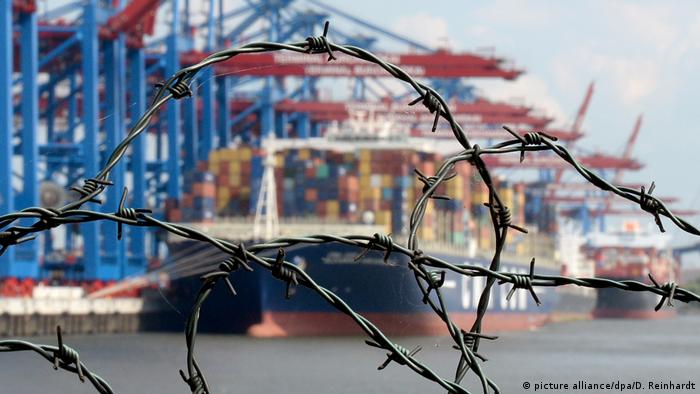


Trade deals are becoming more complex as partners no longer contend with merely cutting tariffs

The history of trade deals is a sea of acronyms…GATT, WTO, CAI, RCEP, TTP, NAFTA. But grand-scale multilateral agreements to promote global trade look set to become increasingly complex. Derek Scissors, a scholar at the American Enterprise Institute thinks reaching a deal on trade these days is "more complex than the tariff-cutting of a generation ago."

He told DW that the impact of free trade pacts on particular industries and groups in societies was harder to assess, causing more domestic opposition. "Similarly, greater financial leveraging has made many economies less capable of adjusting to new competitive pressures," he said, adding that the United States widening trade deficit with the rest of the world also changed the global playing field.

"Trade liberalization has been supported by the dollar as global currency and the US providing liquidity through trade deficits. American hostility toward higher trade deficits and questions about the future role of the dollar make expanding trade riskier," he noted.

The rise of China

The single biggest factor behind the changing international trade landscape has been the rise of China. Twenty years ago, China joined the WTO after 15 years of talks and there was a belief in Europe and the US that trade would help open up the economy and bring about a new era of liberalism in China.

Easier trade conditions helped China become the world's second-biggest economy, but didn't bring political reform. Instead, China's communist leadership has tightened its grip and China operates large trade surpluses with the US and Europe. Two decades on, the talk in the West is of systemic competition with China and constant calls for level playing fields.

As a major exporter, China sees trade deals like the Comprehensive and Progressive Agreement for Trans-Pacific Partnership (CPTPP) and Regional Comprehensive Economic Partnership (RCEP) as means to boost its economic role in Asia. Beijing led the RCEP regional trade deal last year, when China and 14 other countries in the Asia-Pacific region signed the pact in November. It covers 2.2 billion people and 30% of the world's economic output. Now, there are reports that China is even pushing ahead with behind-the-scenes talks to join the CPTPP.


Watch video 01:52 Leaders of 11 countries ink huge trade deal

This is ironic as the CPTPP evolved out of the Trans-Pacific Partnership (TPP), a deal that originally aimed to exclude Beijing and cement US economic power and trade ties in the Asia-Pacific region. However, Donald Trump pulled the US out of the TTP and it fell apart until it was revived as the CPTPP.

Officials from Australia, Malaysia, New Zealand and other nations have held technical talks with Chinese counterparts on details, Bloomberg reported recently.

Ultimately the terms of the CPTPP could prove troublesome for China. The CPTPP has rigorous requirements, particularly its provisions on labor, procurement, state-owned enterprises, state support and subsidies, e-commerce and cross-border data transfer.


China would need the agreement of all 11 CPTPP members, including Australia, Canada and Japan, with whom it is in conflict

Politics trumps trade


Australia's membership of RCEP and its free trade agreement with China didn't stop China imposing tariffs on Australian barley, wheat, coal, wine, lobsters and lumber It also suspended ministerial-level strategic economic dialogue, after Canberra called for an investigation into the origin of the COVID-19 pandemic and criticized China for human rights abuses in Xinjiang province and Hong Kong.

Scissors argues China appears unwilling to "negotiate away" what it sees as state prerogatives. "The obvious example is that China's 'free' trade agreements do not allow foreign competition to harm state-owned enterprises. They are only 'free trade except for the state sector.'"

The tensions that have erupted between China and Australia recently would show, he said, that Beijing was stretching the definition of state interest further than that. "Countries negotiating with Beijing should understand they are negotiating conditional market access only, and China expects them to behave accordingly," said Scissor


Christina Otte, an expert on East Asia at the GTAI, told DW that concluding free trade agreements doesn't protect against punitive tariffs and other such actions, as the example of Australia shows.

"But they can still be a sensible instrument to encourage trade and set standards between the states that are party to the contract. And the fact that in the form of the RCEP a free trade deal was concluded despite all the political differences in Asia means that the onus to act is now on Europe," Otte said.
European sanctions

Geopolitical concerns also played a role in freezing the EU-China Comprehensive Agreement on Investment (CAI). The European Parliament voted to shelve the pact, which had been heavily promoted by Germany, after Beijing introduced sanctions on EU lawmakers earlier this year.

The tit-for-tat sanctions were imposed after the 27 EU countries approved sanctions on Chinese officials running internment camps in the western, Muslim-majority Chinese region of Xinjiang.

US Trade Representative Katherine Tai has called for a strategic rethink of global trade policies that had failed to parlay increased trade activity into advances for workers and the environment.

"The use of force labor is probably the crudest example of the race to the bottom in global trade," Tai told reporters in Washington this month, in reference to China's use of forced labor in the Xinjiang provin


Jürgen Friedrich, chairman and CEO of German state-run trade promotion group, Germany Trade & Invest (GTAI), stresses, though, that geopolitics are always a factor in trade agreements, calling it "a fact of life." He told DW that it was debatable whether, from the larger historical perspective, these times were even "particularly contentious."

"In any case, the German government, including those of us who work for its economic arms, believes in international, negotiated, win-win solutions in both commerce and politics," he said, adding that the government is convinced "this approach will prevail in the long term."


Opinion: Fair deals, not summits, will solve Africa's post-COVID challenges

France and all the EU have justified fears of being affected by African countries' economic challenges. Fair cooperation will address those fears and benefit both Europe and Africa, writes DW's Harrison Mwilima.


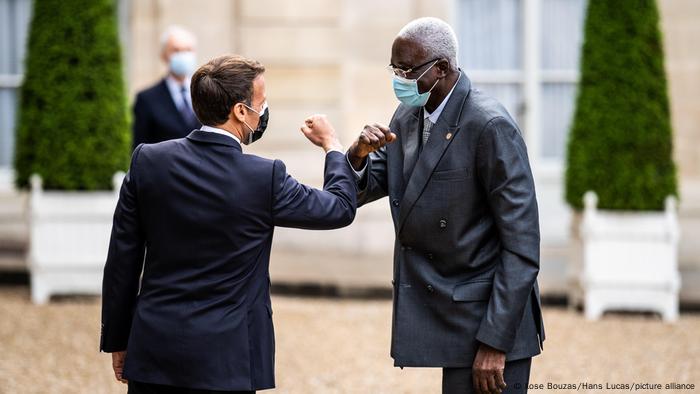
French President Macron, left, and Mali President Bah N Daw were among those at the Paris summit


More than 30 African and European heads of state and the heads of global financial institutions met in Paris for this year's Africa-France summit. Their goal was to find ways to finance African economies hurt by the COVID-19 pandemic and discuss how to handle the continent's billions of dollars in debt.

Although Africa has so far not been badly hit by the COVID-19 pandemic and has a total of 130,000 deaths across the continent, compared with 3.4 million worldwide, most African economies are highly dependent on countries outside the continent, which have been highly affected by the pandemic.

The IMF warned in late 2020 that Africa faces a financial shortfall of almost $300 billion (€246 billion) by the end of 2023 due to the COVID-19 pandemic. A major concern of the summit was, therefore, to figure out how African countries could be supported in financing their economies given the challenges caused by the pandemic.

While initiatives to support African countries in dealing with the pandemic and their debt might show European concern towards the continent, there is a need for fair economic cooperation.


Watch video02:42 France's Macron leads summit on investment plan for Africa


Fair economic cooperation


The COVID-19 crisis led to a fall in commodity prices and increased costs of imports. Additionally, income from tourism, remittances and raw materials also dropped. These are among the legacies of colonialism, of which France has been a major player.


DW editor Harrison Mwilima

The coronavirus pandemic and its economic effect on African countries is another reminder that countries need to diversify their economies and facilitate internal trade.

But there is a need for fair trade deals to be signed between African countries and the rest of the world. French President Emmanuel Macron, who hosted the summit, and his EU counterparts are currently in the process of signing and ratifying the post-Cotonou deal with African, Caribbean and Pacific countries. If France is really concerned about dealing with post-pandemic challenges, it should use its influence to ensure that African countries are getting a fair-trade deal with the entire 27-member EU.
European-African relations in post-pandemic era

As it stands, the coronavirus pandemic has shown, once again, that the world is more connected than we think and that the economy isn't the only place where we all depend on each other. Macron was clear about the future challenges Europe would face if it abandoned Africa: reduced economic opportunity, larger flows of migration toward Europe and a growing terrorism threat.

These points, however, are nothing new. So far, the focus has been on French concerns about African countries and trying to find solutions to help them. That's all fine and good, but it also needs to be made clear that France does this mainly to ensure its own economic, social and security interests.

Both of those aspects should be laid on the table to have a real, mutual exchange of interests between European and African countries. Dealing with COVID-19 challenges in both Europe and Africa will require equal partnership based on fair cooperation.
Opinion: India must address its lack of ethics

Ethics have always been absent in Indian society. To prevent another humanitarian crisis, it must address that fundamental problem, writes Ankita Mukhopadhyay.


The government's failure to address ethical issues and social imbalances has contributed to the disaster in India

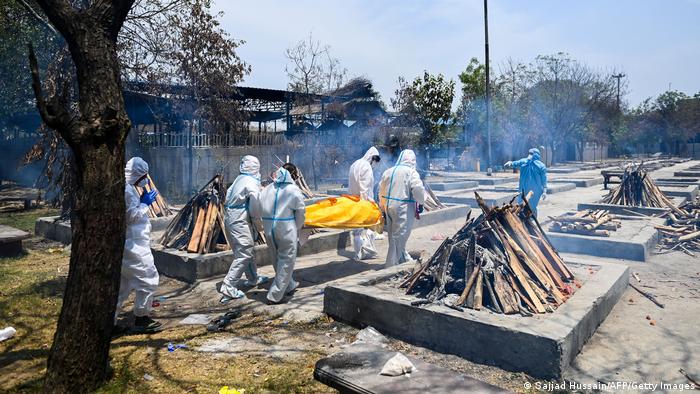
There is no doubt that the Indian government has been highly incompetent in handling the COVID-19 pandemic. Before we hanker for a change in government, it's necessary to understand the nadir of ethical values that has played a vital role in independent India's biggest humanitarian crisis.

Many people have been robbed of their mental health, sanity and money in this pandemic. There are no rules anymore if you want to save someone. People are paying as much as ₹50,000 ($683; €560) for an ambulance; ₹100,000 or more per day for admitting their loved one in a hospital. We are shelling out black market rates to buy basic needs like medical oxygen and anti-viral drugs.

How did we reach this stage of ethical imbalance and moral abrogation?
An ethics system that has consistently failed us


DW's Ankita Mukhopadyay

We had almost 75 years to create a democracy to protect the needy and create opportunities for people across caste and class lines. Instead, the privileged have accrued more privilege and the poor have gotten poorer.

Over the past seven decades, basic necessities like quality healthcare have become confined to the private sector, which mainly caters to the privileged or the connected. When the pandemic put pressure on the private sector, the rich and privileged pulled all strings possible for their loved ones, leaving the needy in the lurch.

Today, the most wealthy man in India isn't willing to squander even 10% of his wealth to help the same country whose broken system enabled him to earn as much as a quarter of the nation's GDP. Meanwhile, celebrities are calling for donations from citizens of a country where almost 30% of the population lives below poverty line.

The pandemic has also laid bare the gross lack of ethics in highly qualified administrative and police officers. Why are most of our bureaucrats unable to administer the country efficiently or hold politicians accountable, but can be found at the frontline to secure favors for themselves and their children?

It's a common adage in India that in anything that involves the government, the process will be slow and government officers will be lazy. This has happened because we have built a system that has reduced the competent to incompetence.

A country that wants to become a $5 trillion (€4 trillion) economy must first instill trust in its system before setting more ambitious goals.


COVID IN INDIA: LIFE GOES ON AS BODIES PILE UP
Social distancing, a farce?
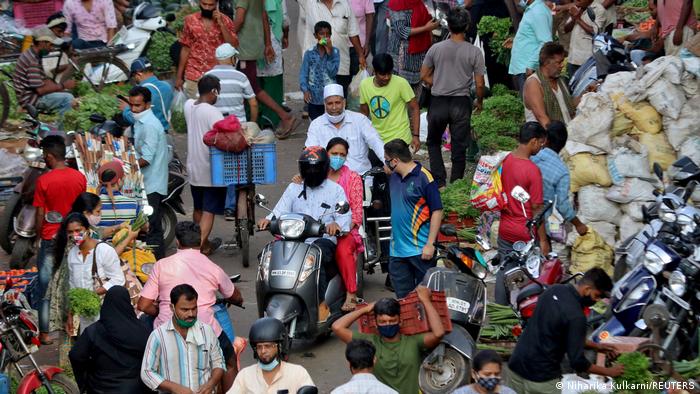
People — many without masks — shop at a vegetable market in Mumbai. India has been struggling to contain a massive coronavirus outbreak, with nearly 24 million infections recorded to date. The country has logged around 260,000 deaths linked to the virus. According to medical experts, these numbers are vastly underreported.


Stop looking for role models


It's time Indians stopped looking for role models to escape their reality and started advocating for actual reform. We have to accept that our lives won't be solved by money, good degrees, immigration to the West, religious gurus or by becoming a government servant.

Our life in this country is much bigger than pursuing shallow goals and it's our responsibility to collectively work towards development.

But development is a pluralistic term and requires collective effort. The first step is to appreciate our federal structure and work towards strengthening our state governments.

The political center, led by the BJP, is there to facilitate administration, but not become the center stage of vile religious bigotry. Religious politics will simply do more harm than good to India as it will divide the nation. The concept of divide and rule was used by the British to break up India into two religions, but we must not go back to that route if we really want to get rid of our colonial hangover.

The ruling party must get ahead of the curve and prepare for the next wave of the pandemic and create safeguards for the needy. The first step in this process is to not make vaccines, a basic necessity, a reserve of the privileged.

It's true that India needs to see change, as soon as possible. But, before we call for change, it's necessary for us to tackle this rot within our ethics which will tear at the fabric of anything that comes in its way — even a new government.
Climate activist Greta Thunberg takes on food industry

Known for starting the Fridays for Future climate movement, Gerta Thunberg wants to see changes to food production and consumption in a bid to combat a trio of threats facing the world.


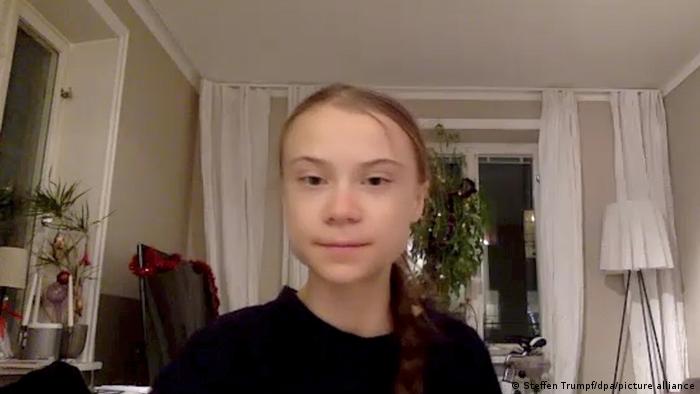
Greta Thunberg has called for changes to food production and consumption

Swedish climate activist Greta Thunberg has called for changes to food production and consumption in a bid to tackle a trio of threats facing the world.

"The climate crisis, ecological crisis and health crisis, they are all interlinked," Thunberg said in a video posted on social media on Saturday to mark International Biodiversity Day.

The focus on food and interlinked crises marks a new direction for Thunberg's environmental activism, which has previously targeted fossil fuel policies and political decision-makers.


Greta tackles disease, environment and emissions


"The way we farm and treat nature cutting down forests and destroying habitats, we are creating the perfect conditions for diseases to spill over from one animal to another — and to us," the 18-year-old activist said.

"Millions have died from COVID-19, Zika, Ebola, West Nile fever, SARS, MERS, HIV-AIDS," she said, listing zoonotic diseases that have jumped from animals to humans.

The World Health Organization has said the coronavirus was probably transmitted from bats to humans through another animal. Scientists say 60% of the infectious human diseases that emerged from 1990 to 2004 came from animals.


VIDEO 30 MINUTES  Made in Germany - The cost of meat


Thunberg also spoke about the consequences of food production on the environment: "If we keep making food the way we do, we will also destroy the habitats of most wild plants and animals driving countless species to extinction.

"They are our life-supporting system; if we lose them, we will be lost too," she said.

She said switching to a plant-based diet could save up to 8 billion tons of carbon dioxide, a major polluting greenhouse gas, each year.
More people going meat-free

Her comments come amid growing demand for meat-free alternatives due to concerns about health, animal welfare and the environment.

In Germany, the total value of meat produced in the country fell in 2020, according to recent data released by the country's Federal Statistics Office.

Meanwhile, the production of vegetarian and vegan substitute products in the country surged.

kmm/sms (Reuters, AFP)
Animal rights activists block UK McDonald's sites

The group, dubbed Animal Rebellion, used trucks and bamboo structures to block McDonald's distribution centers. They want to see the company fully switch to plant-based foods by 2025.


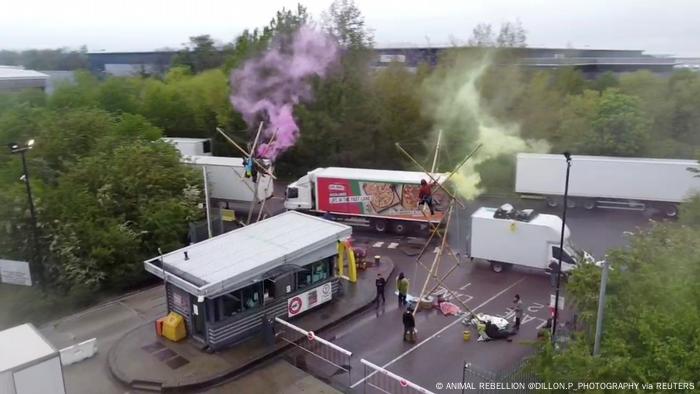
The activists say that a plant-based diet is the only sustainable solution


McDonald's restaurants in the UK faced disruption on Saturday after a group of activists blocked off four of the company's distribution centers.

Around 50 protesters from the Animal Rebellion group used trucks and bamboo structures to cut off deliveries to other company venues. The blockade started early on Saturday.

The activists want the US-based fast-food giant to fully switch to plant-based foods by 2025.


The activists displayed a replica of McDonald's Golden Arches logo stained with blood

"The only sustainable and realistic way to feed 10 billion people is with a plant-based food system," group spokesman Jamez Ozden said. "Organic, free-range and ‘sustainable' animal-based options simply aren't good enough."

Later on Saturday, the group said that police have largely pulled back from two of the McDonald's sites. They said they hoped to maintain the protest until Sunday morning local time.


The Animal Rebellion group used bamboo "beacons" to block the sites
What did McDonald's say?

A McDonald's spokeswoman apologized to the company's customers for "any disappointment caused."

"We are assessing the impact on deliveries to our restaurants and to menu items," she said.


The iconic fast-food company has long faced criticism over its effect on the environment as well the impact of its food on its customers' health.

In recent years, however, McDonald's has taken steps to improve its image, pledging to reduce its carbon footprint and switch to environmentally-friendly packaging.

The company also opened its first zero-emissions restaurant in Disneyworld, Florida last year.

dj/mm (Reuters, AP, AFP)

Bear cub causes trouble in Montreal

JUST HIS APPEARANCE IS CONSIDERED TROUBLE

Issued on: 24/05/2021 -
  
Canadian authorities injected black bear cub (similar to this one pictured May 2019) running loose in a residential neighborhood with three doses of tranquilizer, but he "remained alert," according to Animal Rescue LOIC VENANCE AFP/File

Montreal (AFP)

A black bear cub caused havoc for several hours Sunday in a Montreal neighborhood, requiring three doses of tranquilizer before authorities could finally capture it.

Alerted to the cub's presence in the early afternoon, police cordoned off several streets in Dorval, a municipality to the west of Montreal's airport, according to police spokesperson Raphael Bergeron.

Residents were asked to stay indoors while dozens of police officers, firefighters, wildlife ministry agents and volunteers from Sauvetage Animal Rescue searched for the bear.

The cub, only several months old, was initially trapped in a residential yard before climbing a tree, according to Bergeron.

Game wardens used rifles to administer "three doses of sedative, but the bear remained alert and climbed down the tree before fleeing into another yard," Animal Rescue said in a Facebook post.

The cub finally climbed another tree, where it dozed off. Firefighters put airbags on the ground in case it fell.

The bear was captured several hours later.

"We managed to catch him with a pole and lower him to the bottom of the tree, where he could be secured," Animal Rescue said.

The cub will be released "in an environment that will be more suitable for him."

According to Bergeron, the presence of a bear so close to Montreal, especially in an urban area near an airport, is "very rare."

© 2021 AFP
China probes deaths of 21 runners after freak weather hits ultramarathon


Issued on: 24/05/2021 

Rescuers were dispatched after extreme weather struck a high-altitude section of the 100-kilometre (62-mile) race held in the scenic Yellow River Stone Forest in Gansu province STR AFP


Beijing (AFP)

An investigation was underway Monday into the deaths of 21 runners during a mountain ultramarathon in northwest China, as harrowing testimony emerged from survivors who battled to safety through freezing temperatures and bone-chilling winds.

The extreme weather struck a high-altitude section of the 100-kilometre (62-mile) race held in the scenic Yellow River Stone Forest in Gansu province Saturday afternoon.

Provincial authorities have set up an investigation team to look into the cause of the incident, state media reported, as questions swirled over why organisers apparently ignored extreme weather warnings from the city's Early Warning Information Centre in the lead up to the race, which attracted 172 runners.

ADVERTISING


China's top sports body also vowed to tighten safety rules on holding events across the country.

Survivors gave shocking testimony of events on the rugged mountainside, where unconfirmed meteorological reports to local media said temperatures had plunged to as low as minus 24 degrees Celsius (minus 11 degrees Fahrenheit).

"The wind was too strong and I repeatedly fell over," wrote race participant Zhang Xiaotao in a Weibo post.#photo1

"My limbs were frozen stiff and I felt like I was slowly losing control of my body... I wrapped my insulation blanket around me, took out my GPS tracker, pressed the SOS button and lost consciousness."

He said when he came round he discovered a shepherd had carried him to a cave, placed him by the fire and wrapped him in a duvet.

- 'Foaming at their mouths' -

Marathon survivor Luo Jing told state broadcaster CCTV she saw runners struggling back down the mountain wearing only T-shirts and shorts.


They "described to us people foaming at their mouths, and urged us to quit the race as soon as possible," she said.

Other survivors said insulation blankets provided by organisers were blown to shreds by strong winds.

One told state media as he battled down the mountain he saw many people lying on the ground, some he believed to be dead.

Gansu province is often subject to extreme weather conditions including sandstorms and earthquakes.


The Gansu Meteorological Bureau had warned of "sudden heavy showers, hail, lightning, sudden gale-force winds" and other adverse weather conditions across the province in a report dated Friday.

Victims included elite Chinese long-distance runners Liang Jing and Huang Guanjun, local media reported.

Liang had won multiple Chinese ultramarathons in recent years while Huang won the men's hearing-impaired marathon at the 2019 National Paralympic Games.

Fury mounted on Chinese social media after the disaster, with many users blaming organisers for poor contingency planning.

More than 84 million viewed the hashtag "Is the Gansu marathon accident natural or man-made?", while 130 million scoured a thread around safety concerns for marathons and cross-county races.


"This is purely a man-made disaster," wrote one.


China's top sports governing body has issued instructions to the country's sports system to improve safety management in sports events.

The previous management model for safety in races "had some problems and deficiencies", the sports administration said in a readout published Monday, and said all organisations would now have to set up detailed contingency plans and a mechanism to halt the event quickly if needed.

© 2021 AFP

Berlin protesters urge end to soaring rents

Protesters voiced anger over rising rents in the German capital and a court ruling that overturned a major price control measure. However, police said the number of participants was much smaller than expected.


Germany's Constitutional Court ruled earlier this year that the Berlin rent cap was illegal

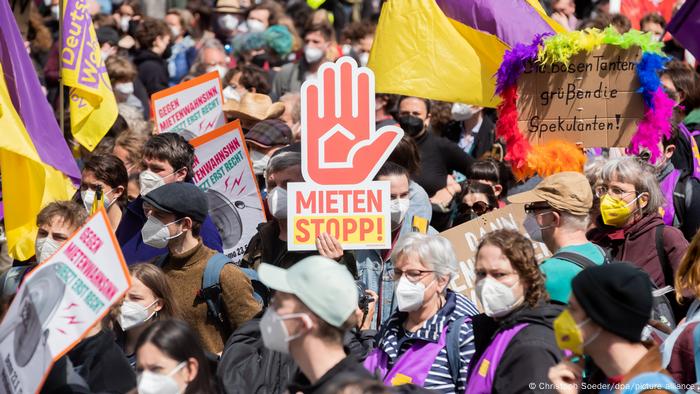
Some 2,500 people marched through Berlin against high rent prices in the German capital, police said on Sunday.

The organizers, however, claimed "at least 10,000" people took part.

The protest took place after Germany's constitutional court overturned Berlin's rent cap, leaving tenants across the city suddenly facing price hikes.

What happened at the protest?


The main rally, under the slogan "Stop the rent madness!" moved from Potsdamer Platz to the neighborhood of Schöneberg, starting one hour later than previously announced.

Protesters were seen carrying banners such as "To reside is a human right" and "No interest on rents."

The march concluded with no reports of violence, according to the AFP news agency.

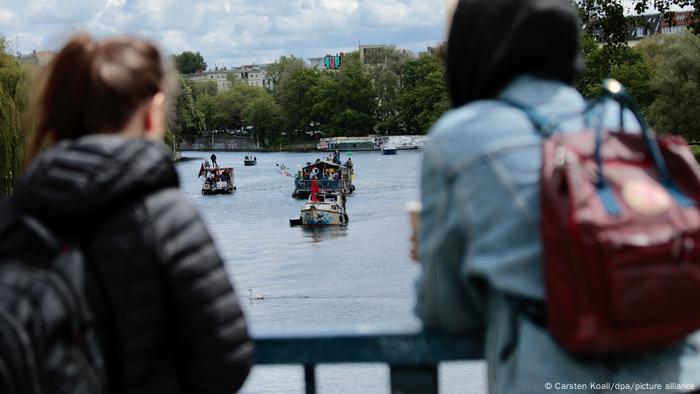
Separately, some 30 participants organized a demonstration of their own by sailing boats on Berlin's river Spree, and displaying the banners against the rising rents.

The small protest flotilla sailed through Berlin


What was the rent cap?

The rent cap was a measure implemented by the city-state's government that went into effect in late February 2020.

It froze the prices for nearly all apartments in Berlin for five years, locking them in place at their June 2019 level. New rental contracts were not allowed to exceed that rate — and some rents had to be reduced.

The Berlin state government said the measure was intended to reduce pressure on renters and buy time for more housing to be buil

VIDEO Berliners struggle with soaring rents

The regulation also allowed for tenants to sue their landlords to reduce rents.

The measure was strongly criticized by Chancellor Angela Merkel's conservative Christian Democrats (CDU) and the business-friendly Free Democratic Party (FDP), who lodged a legal complaint against it.

Why was it overturned?

The constitutional court overturned the Berlin measure on April 15, ruling that the state government didn't have a right to impose the cap.

Since Germany's federal government already implemented a law regulating rents nationwide in 2015, the Berlin state government couldn't create its own regulation, the court said.

As a result of the ruling, many tenants in Berlin now face steep rent hikes — and could be asked by their landlords to pay back rent from the past year.
What is the rental market situation?

Rental prices in Berlin have soared in recent years, making it one of the tightest rental markets in the country.

From 2013 to 2019, rent prices in new contracts rose by 27%, according to the German Property Foundation (ZIA).

A lack of affordable housing, tenants being priced out of their neighborhoods and rising rents have led to tensions.


‘It’s not normal’: Paris protesters decry Gaza conflict’s Palestinian death toll

Issued on: 23/05/2021 -
A demonstrator holds aloft a placard saying "stop the colonisation of Palestinian territories" at a pro-Palestinian protest at Place de la République in eastern Paris on May 23, 2021. © Tom Wheeldon, France 24

Text by:Tom WHEELDON

There was a mood of quiet indignation among the small crowd protesting in Paris on Sunday about this month’s eleven-day flare-up of the Israeli-Palestinian conflict in which at least 260 people were killed, the majority of them Palestinian.

The gathering at Place de la République in eastern Paris appeared to be far smaller than the crowd in the same location the previous day.

The protests came after an Egyptian-brokered ceasefire between Israel and Hamas came into effect on Friday. But demonstrators doubted that this will do anything to avoid repeated bouts of violence in the future.

“I think [the Israeli government] is making it seem like the fighting’s over and done with so that they can strike harder in the future,” said Rania, 15, who had come to the protest from the suburb Boulogne-Billancourt on the other side of the Paris region with a group of friends the same age.

“It feels very good to be here to support a people in distress,” Rania said. At the same time, she continued, coming to protest was a “very sad” experience, because “no nation deserves to go through what the Palestinians have been through; it’s unacceptable”.

Rania added that she was calling for a solution to the conflict as opposed to allowing the status quo to re-emerge now that the ceasefire is holding: Such a solution would be “beneficial to the Palestinians and for the Israelis too”, she emphasised.

Like yesterday’s protest, this was a “static” demonstration, after Paris police banned a planned march through eastern Paris the previous weekend. French authorities feared a repeat of the ugly scenes at protests during the 2014 Gaza conflict, which saw synagogues targeted and chants of “death to Jews”.

Protesters in Paris on Sunday underlined that they support the Palestinian people while disavowing anti-Semitic and anti-Israeli sentiment.

“We’re not against Israel; we’re against the Israeli government’s mistreatment of Palestinians,” said Cathy, 34, who brought her children to Sunday’s demonstration. “I understand that they were fighting against Hamas, but they also killed lots of innocent people including lots of children,” Cathy continued.

At least 248 Palestinians were killed by Israeli air strikes during this month’s conflict, including 66 children. Hamas rocket attacks killed 12 people in Israel, including one child; Israel’s Iron Dome missile defence system blocked many salvos.

The Israeli military said during the conflict that it did its utmost to minimise civilian casualties when responding to Hamas rocket attacks from Gaza, but that the Islamist militant group – classed as a terrorist organisation by the EU and US – was in effect using them as human shields.

Protesters perform a traditional Palestinian dance at a pro-Palestinian demonstration at Place de la République in eastern Paris on May 23, 2021. © Tom Wheeldon, France 24

Cathy also attended last week’s prohibited rally, and expressed anger at the French government for banning it: “It wasn’t normal to be prevented from protesting like that; other demonstrations have gone ahead this year.”

Like Rania, Cathy expressed scepticism that the ceasefire will change the situation over the long run: “There are always ceasefires, but then the fighting starts again later,” she put it.

She was also angry that “France didn’t condemn what was happening” – a common sentiment among Sunday’s protesters.

During the peak of last week's fighting, the Élysée Palace said French President Emmanuel Macron expressed his condolences “the many Palestinian civilian losses resulting from military operations and ongoing clashes with Israel” and “unwavering attachment to Israel’s security and its right to defend itself in line with international law”.

Macron and other national leaders “have said for years that they want an end to the conflict but there’s never anything concrete; it’s a big silence, really” and “one of the reasons I’m protesting is to try and break that silence”, said Sanah, a young demonstrator at Place de la République.

“It’s not normal in the twenty-first century to have to demonstrate for a nation’s freedom,” she continued.

Myriam, 26, used the exact same phrase to describe the deaths of the 66 Palestinian children in Gaza: “It’s not normal; it’s not human to do that,” she said. “It really upset me.”
Afghan war displaced settle in the ruins
 of a lost city


Issued on: 24/05/2021 - 
Thousands of people have been displaced across Helmand since 
October following a surge in Taliban attacks WAKIL KOHSAR AFP

Lashkar Gah (Afghanistan) (AFP)

Once the winter residence of sultans from illustrious Islamic dynasties, the ruins of a thousand-year-old royal city in southern Afghanistan have become home to hundreds of people who have fled Taliban clashes.

The astonishing ochre clay complex juts from the cliffs along the Helmand River, threatened by decay and encroaching urban sprawl as well as the makeshift constructions that have grown within it.

Thousands of people have been displaced across Helmand since October following a surge in Taliban attacks, and while many have resettled in the capital Lashkar Gah -- one of the few areas in the province still under government control -- some have joined other refugees in the ruins.

Qala-e-Kohna, as it is known locally, or Lashkari Bazar to archaeologists, has garnered international attention for its scale, remarkable architecture and murals.

Spread over 10 kilometres (eight miles), the site is the only known winter residence of the Ghaznavid and Ghurid sultans -- two dynasties that ruled a region covering present-day Afghanistan between the 10th and 13th centuries and responsible for spreading Islamic art as far as north India.

"There is no place in the Islamic world where we have something like it -- a site as coherent, elaborate, and despite everything still relatively well preserved," said Philippe Marquis, the director of the French Archaeological Delegation in Afghanistan (DAFA).

"It is important to preserve it because we are sure that it will teach us a lot about this period,"
Among the ancient towers, doors and windows have been added and crumbling walls coated with a clay and straw mixture to strengthen them and plug gaps.

A blue wrought-iron door leads into Agha Mohammad's cramped two-room quarters that house 11 people, a makeshift cradle for his infant son hanging from a bamboo roof.#photo1

"I want the government to give me a place to live. Look at the cracks in the roof. I'm afraid one night it will fall," said Mohammad, a 33-year-old policeman whose district fell to a resurgent Taliban.

Southern Afghanistan has seen renewed fighting as talks between the Afghan government and Taliban leaders have stalled and the United States prepares to withdraw the last of its troops from the country by September.

"I should have the support of the government, because I lost three sons serving it," 48-year-old mother Bibi Halima told AFP from within the palace walls.

"Every house is full of widows," added a neighbour.

Many of the residents are from police families who cannot afford to live elsewhere and have no access to electricity or running water.

An official from the country's archaeology department in Kabul said there have been reports of land-grabbing at the site, with some families forced to pay rent to local mafias.#photo2

For residents, life within the ornate arches and adobe walls of the former royal city is a constant reminder of how the country has yet to emerge from a cycle of battles against invasion and civil war.

"It is a place for ghosts, not humans," said Khudai Nazar, 54.

- Preserving the site -

First explored by DAFA in the 1950s, the site has seen no conservation work since then.

At that time, archaeologists identified the palaces, mosque and other annexe buildings, such as the pottery and craft workshops, as well as ice boxes used for the preservation of fresh food.#photo3

One of the most striking excavations was a series of paintings depicting court scenes, extremely rare for an era in which the realistic representation of living beings was already frowned upon in Islamic societies.

Moved to the Kabul museum, the paintings were destroyed or stolen during the Afghan civil war in the 1990s and only photographs remain.

DAFA director Marquis is now concerned about the impact looters and displaced families will have at the site -- as well as the effects of global warming, which could cause the river to flood.

On the flip side, reinforcements made from clay and straw that have been added to the partly collapsed towers may have also resulted in their temporary preservation.

"The paradox is that in their own way people are protecting the place, because it is their home," Marquis said.

He proposes building an "archaeological park" that involves displaced people in the conservation process so they can earn a living and settle outside the palace walls.#photo4

But for author Shah Mahmud Haseat, who has written a book about the citadel, the future of the largely unexplored ruins remains bleak.

"I tried to convince the government to protect the site, but they did nothing. We are really afraid that our history will be destroyed."

© 2021 AFP