Billionaires Are Encroaching on the Free Press. Let’s Act to Defend It in 2026.
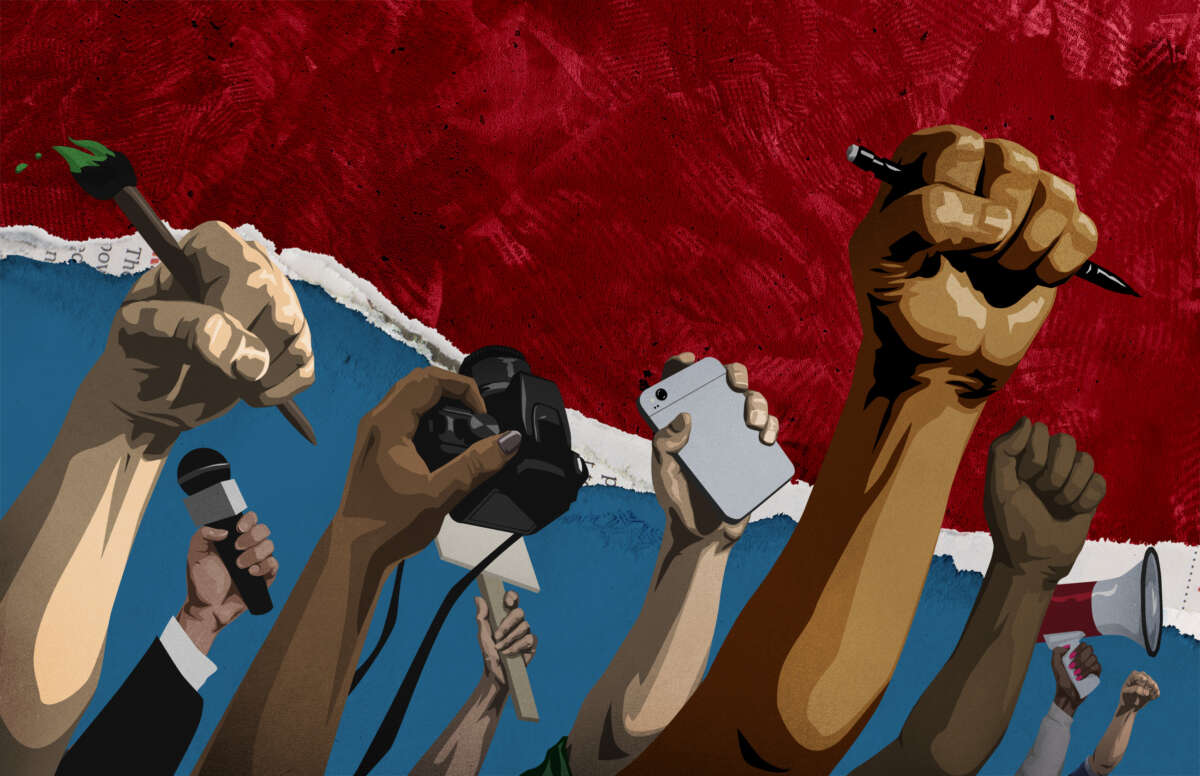
Independent grassroots journalism committed to the pursuit of liberation is an antidote to billionaire-dictated media.
By Maya Schenwar & Negin Owliaei ,
December 17, 2025
Jared Rodriguez / Truthout
It’s becoming something of a theme: Two massive companies are fighting to take over another massive company, in a deal that will enrich a variety of shareholders but leave the rest of us worse off.
The news that Netflix struck a bid to take over movie powerhouse Warner Bros. earlier this month likely horrified entertainment workers: Two Goliaths of the industry combining is no good for pay, job security, nor creativity. Workers at CNN, one Warner-owned product, though, had reason to rejoice. The Netflix deal doesn’t encompass CNN, unlike the proposition floated by Paramount to take over the entirety of the parent company’s subsidiaries.
CNN is hardly above reproach. But as it turns out, the news network — which recently teamed up with a gambling app that allows users to bet on whether Palestinians in Gaza will be ethnically cleansed — still has room to sink lower.
Days after the Netflix deal, Paramount announced it was launching a hostile takeover bid, appealing directly to Warner Bros. shareholders to overturn the decision of the company’s board. That bid, if it is successful, would put CNN in the hands of Paramount’s new owner, failed actor and son of a centibillionaire David Ellison, who has spent the last several months remaking CBS News in Donald Trump’s image. Under Ellison, CBS scrapped diversity, equity, and inclusion initiatives while installing right-wing commentator Bari Weiss as editor-in-chief, much to the dismay of the network’s staff.
If Ellison gets his way, he could do the same at CNN, a move that would be welcomed by his most powerful ally: Trump himself. The Wall Street Journal reported that Ellison promised “sweeping changes” at CNN during a December visit with the president.
Related Story
It’s becoming something of a theme: Two massive companies are fighting to take over another massive company, in a deal that will enrich a variety of shareholders but leave the rest of us worse off.
The news that Netflix struck a bid to take over movie powerhouse Warner Bros. earlier this month likely horrified entertainment workers: Two Goliaths of the industry combining is no good for pay, job security, nor creativity. Workers at CNN, one Warner-owned product, though, had reason to rejoice. The Netflix deal doesn’t encompass CNN, unlike the proposition floated by Paramount to take over the entirety of the parent company’s subsidiaries.
CNN is hardly above reproach. But as it turns out, the news network — which recently teamed up with a gambling app that allows users to bet on whether Palestinians in Gaza will be ethnically cleansed — still has room to sink lower.
Days after the Netflix deal, Paramount announced it was launching a hostile takeover bid, appealing directly to Warner Bros. shareholders to overturn the decision of the company’s board. That bid, if it is successful, would put CNN in the hands of Paramount’s new owner, failed actor and son of a centibillionaire David Ellison, who has spent the last several months remaking CBS News in Donald Trump’s image. Under Ellison, CBS scrapped diversity, equity, and inclusion initiatives while installing right-wing commentator Bari Weiss as editor-in-chief, much to the dismay of the network’s staff.
If Ellison gets his way, he could do the same at CNN, a move that would be welcomed by his most powerful ally: Trump himself. The Wall Street Journal reported that Ellison promised “sweeping changes” at CNN during a December visit with the president.
Related Story

The Right Funds Its Media. Can Progressive Philanthropy Meet the Moment?
Rigorous, principled, independent journalism is an essential part of movement building.
By Lara Witt & Maya Schenwar , Truthout/Prism November 19, 2025
In a year in which crucial sources of journalism have shuttered and corporate consolidation has continued at hyperspeed, the potential fall of another news outlet to Trump already has media critics concerned about the future of the free press. Journalism in the U.S. has already been subject to a process of death by a thousand cuts; the Ellison takeover streak is simply the latest slice.
Big Tech and Billionaires
Ellison family members have made headlines over the last year for their more direct foray into media. Having already taken over Paramount in August, the Ellison family is now set to get its fingers on TikTok too: Oracle, owned by David’s father Larry, has been tapped to take over TikTok’s U.S. operations, including its algorithm, once sale of the app is finalized.
The wealthiest people in the U.S. have all long understood that placing a hand on the media scale can yield big payoffs … and they’re regularly finding new ways to poison public discourse with their tech.
But these moves are nothing new; the wealthiest people in the U.S. have all long understood that placing a hand on the media scale can yield big payoffs, whether that comes from owning a media outlet or a tech platform that serves as a means of distribution. And they’re regularly finding new ways to poison public discourse with their tech.
Elon Musk, who is worth $428 billion, and Mark Zuckerberg, worth $253 billion, currently sandwich Larry Ellison for the top three spots on the Forbes list of the richest people in the United States; both also sit atop social media empires whose algorithms are known for pushing users toward the right — with Musk’s AI chatbot Grok going so far as to spew Nazi hate speech — all while censoring dissent.
Zuckerberg’s Meta platforms and Musk’s X have also been accused of deprioritizing external links to keep people on their apps, a move that can lead to a bounty of bad effects: pushing people toward doomscrolling, robbing readers of context beyond what fits on a social media post, and stifling traffic to news outlets.
Next on the Forbes list is Jeff Bezos, who purchased The Washington Post and has proceeded to run it into the ground ever since. Most recently, the outlet rolled out error-riddled AI-generated podcasts, despite internal documentation of editorial issues, including fabricated or misattributed quotes. The Washington Post also reportedly plans to use AI to edit columns submitted by “nonprofessionals.”
Just after Bezos on the Forbes list of richest people in the U.S. are Google co-founders Sergey Brin and Larry Page. While they no longer are in positions of leadership at Google’s parent company, Alphabet, they still hold controlling stock shares in it. For years, Google has used its opaque algorithm to shuffle the audience of the world’s biggest search engine to a handful of huge outlets; an entire industry was created to try to “optimize” journalism to gain better search engine results, which hurts both smaller publications as well as audiences trying to find more context than shallow explainers loaded with keywords.
The same AI trend that is making Google’s stock — and Brin’s and Page’s net worth — rise could be even more dangerous for the news industry. Google is now using the work produced by news outlets to power its AI summaries, in a move that packs a double economic punch: ripping off journalism without compensation, while also tanking traffic to actual news organizations. Even bigger outlets like CNN and HuffPost have seen declines in traffic of around 30 to 40 percent; imagine what smaller publications are forced to contend with.
The tech oligarchs listed here would find benefits in owning outlets and managing distribution platforms regardless of who was in office. But Trump’s presidency has made billionaire ownership of media and its distribution into an even more urgent issue — especially when all of the people listed here, or the companies they are tied to, donated massive sums to Trump’s inauguration fund.
Ellison family members have made headlines over the last year for their more direct foray into media. Having already taken over Paramount in August, the Ellison family is now set to get its fingers on TikTok too: Oracle, owned by David’s father Larry, has been tapped to take over TikTok’s U.S. operations, including its algorithm, once sale of the app is finalized.
The wealthiest people in the U.S. have all long understood that placing a hand on the media scale can yield big payoffs … and they’re regularly finding new ways to poison public discourse with their tech.
But these moves are nothing new; the wealthiest people in the U.S. have all long understood that placing a hand on the media scale can yield big payoffs, whether that comes from owning a media outlet or a tech platform that serves as a means of distribution. And they’re regularly finding new ways to poison public discourse with their tech.
Elon Musk, who is worth $428 billion, and Mark Zuckerberg, worth $253 billion, currently sandwich Larry Ellison for the top three spots on the Forbes list of the richest people in the United States; both also sit atop social media empires whose algorithms are known for pushing users toward the right — with Musk’s AI chatbot Grok going so far as to spew Nazi hate speech — all while censoring dissent.
Zuckerberg’s Meta platforms and Musk’s X have also been accused of deprioritizing external links to keep people on their apps, a move that can lead to a bounty of bad effects: pushing people toward doomscrolling, robbing readers of context beyond what fits on a social media post, and stifling traffic to news outlets.
Next on the Forbes list is Jeff Bezos, who purchased The Washington Post and has proceeded to run it into the ground ever since. Most recently, the outlet rolled out error-riddled AI-generated podcasts, despite internal documentation of editorial issues, including fabricated or misattributed quotes. The Washington Post also reportedly plans to use AI to edit columns submitted by “nonprofessionals.”
Just after Bezos on the Forbes list of richest people in the U.S. are Google co-founders Sergey Brin and Larry Page. While they no longer are in positions of leadership at Google’s parent company, Alphabet, they still hold controlling stock shares in it. For years, Google has used its opaque algorithm to shuffle the audience of the world’s biggest search engine to a handful of huge outlets; an entire industry was created to try to “optimize” journalism to gain better search engine results, which hurts both smaller publications as well as audiences trying to find more context than shallow explainers loaded with keywords.
The same AI trend that is making Google’s stock — and Brin’s and Page’s net worth — rise could be even more dangerous for the news industry. Google is now using the work produced by news outlets to power its AI summaries, in a move that packs a double economic punch: ripping off journalism without compensation, while also tanking traffic to actual news organizations. Even bigger outlets like CNN and HuffPost have seen declines in traffic of around 30 to 40 percent; imagine what smaller publications are forced to contend with.
The tech oligarchs listed here would find benefits in owning outlets and managing distribution platforms regardless of who was in office. But Trump’s presidency has made billionaire ownership of media and its distribution into an even more urgent issue — especially when all of the people listed here, or the companies they are tied to, donated massive sums to Trump’s inauguration fund.

Democracy Dies in Broad Daylight
In 2016, corporate media organizations ran ad campaigns promising that support for media outlets would be key to resisting fascism under Trump’s first term. Now it’s clear that those same organizations are at best willing to roll over — or even worse, support the administration by manufacturing consent for its repressive agenda.
The most jarring example has been CBS News under the leadership of Ellison and Weiss. The network gutted its climate team and instead threw its resources toward a high-profile town hall with Erika Kirk, the widow of right-wing provocateur Charlie Kirk, who was assassinated in September, that managed to still be a ratings flop. Despite casting herself as a lonely advocate for viewpoint diversity, Weiss has suggested that the ideological window at CBS News could range from former National Rifle Association spokesperson Dana Loesch to Jeffrey Epstein’s longtime lawyer Alan Dershowitz.
Meanwhile The Washington Post — the paper that fashioned itself as a bulwark against the Trump administration’s first term ambitions — has moved further to the right every day since Bezos announced that the editorial board would primarily write in defense of “personal liberties and free markets.” It’s unclear if that mandate has spread to the newsroom or if the desk is publishing headlines like “Why you may not want lower prices as much as you think you do” out of its own accord.
Even outlets that have not announced public overhauls since Trump took over are finding new ways to back away from speaking truth to power. At the Wall Street Journal, that looks like publishing articles declaring that “Venezuelan Gangs and African Jihadists Are Flooding Europe With Cocaine” in a headline reminiscent of 2003 Iraq War propaganda. Meanwhile, The New York Times has doubled down on its panic about expanding health care to trans kids — one of the populations most vulnerable to the administration’s attacks — with an entire podcast series on trans health stuffed with disinformation from known hatemongers.
A Crisis of Confidence
When corporate news organizations aren’t capitulating to Trump in the court of public opinion, they are bending to his will in literal courts, choosing to settle vanity lawsuits from the president instead of mounting an actual defense. The lawsuits are surely another Trumpian tactic — now he can brag that news networks agreed to settle rather than fighting these winnable, meritless cases. These attacks, from the president who has long cried “fake news” at every story he doesn’t like, come as the right wages its larger war against the legal protections that allow journalists to do their jobs without being sued into oblivion.
The current political assault on journalistic truth-telling is not only coming from Republicans. Hillary Clinton — speaking at a conference hosted by the far right Israeli newspaper Israel Hayom, which is owned by the billionaire Trump mega-donor Miriam Adelson — said young people were being fed “pure propaganda” on Gaza. Clinton’s statement was a perversion of the truth so offensive that leading genocide scholars have decried it as genocide denial. It was especially abhorrent given that so many of the videos young people are watching on social media are published by Palestinian journalists themselves, who have been killed at unimaginable rates by Israel. And both Trump’s legal attacks and Clinton’s downplaying of the documented atrocities in Gaza point to a larger bipartisan assault on the journalistic aim of truth-telling.
Coming out of this year, it’s no wonder that condemnations of “the media” are everywhere, and people are tuning out the news in record numbers: The Reuters Institute reported that 40 percent of respondents in their worldwide survey now “sometimes or often avoid the news,” compared to 29 percent in 2017.
The Antidote to Billionaire Media
And yet, it would be a mistake to throw up our hands and declare “the news” obsolete. “The news” isn’t just one thing. While corporate media are caving to the Trump administration and submitting to rule-by-billionaire, they’re not the only ones publishing the news — and some of the solutions to media collapse are already in active motion.
Grassroots-funded journalism isn’t just a theoretical aspiration; it’s a practice.
The antidote to billionaire-dictated media is alive already in the form of grassroots, independent publications that build their work in line with the values of justice, equity, and the pursuit of liberation. Billionaires are, for example, not running Truthout; you’ll be shocked to hear that they haven’t even come knocking on our door! But beyond this, publications like ours have poured our energy into building models directly counter to that type of dictatorial ownership.
Truthout is 80 percent funded by our readers’ small donations, and our average donation size is $20. No one has to pay to read our work because we want anyone to be able to access the news, but the fact that we’re sustained by folks giving $5 or $10 a month means we operate with a different kind of journalistic freedom: the freedom to actually tell the truth, instead of following the directives of the capitalists and fascists at the top. We share this not to sell you on Truthout — you’re already reading it! Rather, we mention this to affirm that grassroots-funded journalism isn’t just a theoretical aspiration; it’s a practice.
It’s also part of an ecosystem: Each of the 24 members of the Movement Media Alliance (which includes organizations like Prism, In These Times, The Real News Network, Haymarket Books, and many more) are making media grounded in principles, not profits, and publishing accurate reporting and analysis to directly face down fascism.
Right-wing brainwashing can only take place in a truth vacuum. As author and journalist Lewis Raven Wallace describes in The Objective, “fascist leaders thrive on an ill-informed public.” Wallace, citing long-time abolitionist leader Andrea Ritchie, notes that movement journalism’s “purpose zero” is “to challenge fascism and authoritarianism by fighting disinformation.” This terrain of journalism is explicitly anti-authoritarian. Its goal is not only speaking truth in the face of rampant fascist propaganda, but also strategically countering that propaganda, engaging and rallying readers to push back, and spreading the word about resistance so more people can join in.
Right-wing brainwashing can only take place in a truth vacuum.
These are active missions. As movement media, we’re not simply shooting truth out into the ether; we are activating our audiences and showing them possibilities for connection and mobilization. As Scot Nakagawa writes, “Truth must be tied to communities of hope that create the conditions for liberation…. The truth alone will not set us free — but truth in the hands of a mobilized, organized movement might.”
Documenting the Resistance
In this vein, our organizations are telling the stories of resistance and organizing, many of which are completely ignored by corporate media, even though they’re playing out in every corner of society. While most movement media organizations report regularly on activism, some platforms — like Waging Nonviolence, Convergence’s “Block & Build” podcast, The Forge, and the YES! newsletter — focus entirely on covering movements, providing both hope and inspiration for concrete action.
As fascist leaders zero in on specific oppressed communities, such as immigrants, trans people, and organizers for Palestinian liberation, corporate media outlets have specialized in exacerbating that harm. Yet over the past year, topic-specific independent media organizations have risen to the struggle.
What all these growing movement journalism projects have in common is not only a dedication to informing the resistance, but also a practice of being human.
Even as corporate media’s immigration coverage has often served overtly racist goals, we’ve seen the growth of diametrically opposed publications like Borderless Magazine, Documented NY, Migrant Roots Media, and others focused on telling true stories, including firsthand narratives, about both the government-sanctioned assault on immigrants and the power of immigrant justice movements.
Even as we’ve seen the rise of anti-trans publishing (with large mainstream outlets like The New York Times and The Atlantic leading the way), we’ve also seen the rise of trans justice-focused independent publications like Assigned Media, TransLash Media, and Erin In The Morning, which unwaveringly report the timely specifics of attacks on trans rights as well as tools for responding and stories of resistance.
And even as Bari Weiss, a self-described “Zionist fanatic,” has seized the reins at CBS News, we’ve seen the significant growth of journalism organizations specifically reporting on the struggle for Palestinian liberation, like Mondoweiss, The Electronic Intifada, and Palestine Square. In early 2024, Movement Media Alliance organizations, including Truthout, co-founded the coalition Media Against Apartheid and Displacement, which produces a roundup newsletter composed primarily of Palestine-related coverage, run by Prism.
Meanwhile, media criticism and literacy projects like Project Censored, The Objective, and the “Citations Needed”podcast are exposing right-wing lies and offering concrete tools for discerning reality and reshaping journalism to better serve our communities. In addition to timely analyses, they provide resources that can be used in classrooms, community groups, and political education programs in order to push back on disinformation and build media-making power.
Being Human
What all these growing movement journalism projects have in common is not only a dedication to ethical funding models, principled truth-telling, audience mobilization, and informing the resistance, but also a practice of being human. As AI rapidly tears through the journalism industry — “writing” stories, “hosting” podcasts, “illustrating” the news — we are often disrupting oppressive systems simply by doing journalism as human beings. Humans are capable of discernment, critical thinking, empathy, creativity, curiosity, originality, and collaboration. Doubling down on these commitments — the things we sentient beings can do, that AI can’t — is a central tenet of journalism-as-resistance, as we move into 2026.
This isn’t just a commitment for those working in media. It’s a commitment for anyone engaging with media — that is, you.
In 2026, let’s take back the media — and our minds and spirits — from the billionaires.
How can we all recommit to our humanity in 2026? How can we authentically seek truth, inform ourselves in active ways, and work together to challenge the forces of disinformation and injustice? How can we draw on our empathy, as living beings who exist in relation to each other, to fuel these practices? How can we keep asking questions, relentlessly, in the face of powerful forces demanding our silent compliance?
Moving into the new year, in this period of resolution-making and intention-setting, it’s worth it for each of us to deeply consider our relationship to media. How is it shaping what we think, feel, and do, for better, or worse, or different? How is it driving us toward action, or toward complacency? What media-related choices can we make, as autonomous, living beings capable of choices, to confront fascism and grow the society we want and need?
In 2026, let’s take back the media — and our minds and spirits — from the billionaires.
This article is licensed under Creative Commons (CC BY-NC-ND 4.0), and you are free to share and republish under the terms of the license.

Maya Schenwar
Maya Schenwar is director of the Truthout Center for Grassroots Journalism. She is also Truthout‘s board president. She is the co-editor of We Grow the World Together: Parenting Toward Abolition; co-author of Prison by Any Other Name: The Harmful Consequences of Popular Reforms; author of Locked Down, Locked Out: Why Prison Doesn’t Work and How We Can Do Better; and co-editor of the Truthout anthology Who Do You Serve, Who Do You Protect? Police Violence and Resistance in the United States. In addition to Truthout, Maya’s work has appeared in many publications including The New York Times, The Guardian, NBC News and The Nation, and she has appeared on Democracy Now!, MSNBC, C-SPAN, NPR, and other television and radio programs. Maya is a cofounder of the Movement Media Alliance (MMA) and Media Against Apartheid and Displacement (MAAD). She lives in Chicago.
Negin Owliaei
Negin Owliaei is Truthout‘s editor-in-chief. An award-winning journalist, she previously worked at Al Jazeera‘s flagship daily news podcast, The Take. She lives in Washington, D.C.

No comments:
Post a Comment