Thursday, June 03, 2021


FBI Investigating Postmaster General Louis DeJoy Over Alleged Straw Donor GOP-Fundraising Scheme: Report


JERRY LAMBE 
June 3rd, 2021, 
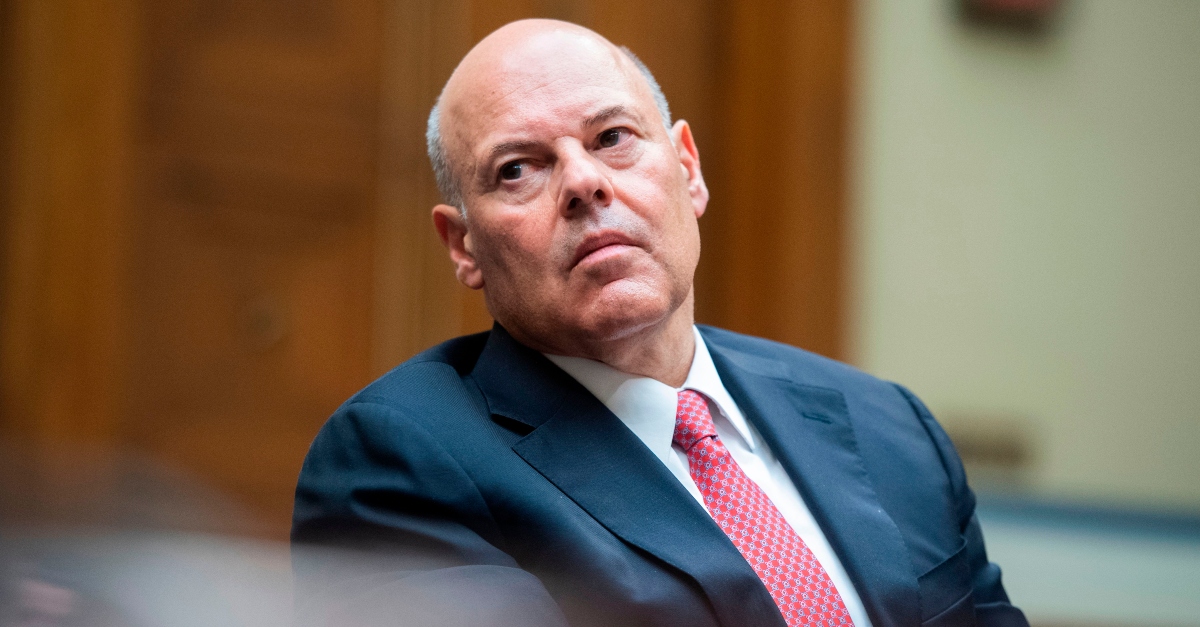
Postmaster General Louis DeJoy

Federal authorities are investigating whether Postmaster General Louis DeJoy pressured his former employees to donate to Republican political candidates and causes before reimbursing them later through excessive bonuses, The Washington Post reported Thursday.

According to the report, “people familiar with the matter” told the Post that federal prosecutors had issued a subpoena to DeJoy for information and said FBI agents had been interviewing current and former employees of DeJoy’s former company, the North Carolina-based contract logistics handler New Breed Logistics.

DeJoy’s spokesman confirmed the investigation, the Post reported.

The Post in September 2020 reported that five of DeJoy’s former employees claimed they were urged by him or one of his chief executives to make large monetary contributions to Republican fundraising efforts and to attend GOP events where tickets “routinely fetched $100,000 or more apiece.”

Two former New Breed Logistics employees also reportedly alleged that DeJoy offset the cost of the contributions by instructing the company to reimburse the employees for their political contributions by awarding them with excessive bonus payments.

“He asked employees for money. We gave him the money, and then he reciprocated by giving us big bonuses,” New Breed’s former director of human resources David Young told The Post. “When we got our bonuses, let’s just say they were bigger, they exceeded expectations — and that covered the tax and everything else.”

The allegations, if true, would appear to constitute a classic straw donor scheme often used to bypass restrictions on an individual’s political donations.

According to a Federal Election Commission (FEC) explainer:

Contributions in the Name of Another are Strictly Prohibited

Reimbursing someone for a contribution or otherwise contributing in the name of another person can result in substantial civil penalties and jail time. The FEC and the Department of Justice have prosecuted several such cases over the last few years. These violations sometimes occur when an individual who has already contributed up to the limit to a campaign gives money to another person to make a contribution to the same candidate.

Mark Corallo, a spokesperson for the embattled postmaster general, confirmed the investigation but told the Post that DeJoy never “knowingly” broke the law.

“Mr. DeJoy has learned that the Department of Justice is investigating campaign contributions made by employees who worked for him when he was in the private sector,” Corallo told the paper. “He has always been scrupulous in his adherence to the campaign contribution laws and has never knowingly violated them.”

The Post’s original reporting on the alleged scheme—which came amid allegations that DeJoy, was intentionally sabotaging the U.S. Postal Service (USPS) ahead of the presidential election—sparked an investigation by Democrats on the House Oversight Committee, many of whom accused DeJoy of lying during sworn congressional testimony.

Testifying before the Committee in August 2020, DeJoy explicitly denied having participated in any kind of straw donor scheme, calling any such claim “outrageous.”

“The answer is no,” DeJoy said when asked about the allegations by Rep. Jim Cooper (D-Tenn.). “I’m fully aware of legal campaign contributions, and I resent the assertion, sir.”

DeJoy has similarly denied allegations that he was sabotaging USPS, though a Washington state federal judge in September 2020 issued an injunction blocking his proposed sweeping changes to the agency. In blocking the changes, Chief U.S. District Judge Stanley A. Bastian, a Barack Obama appointee, said that then-President Donald Trump and DeJoy were “involved in a politically motivated attack on the efficiency of the Postal Service.”

[image via via TOM WILLIAMS_POOL_AFP via Getty Images]

Dallas HS valedictorian delivers abortion rights call

DALLAS (AP) — A Dallas high school valedictorian scrapped a speech approved by her school administrators and delivered an abortion rights call in its place.

© Provided by The Canadian Press

Paxton Smith, the 2021 valedictorian at Lake Highlands High School, submitted to school officials an address on the effect of the media on young minds. But when she spoke at Sunday’s graduation ceremony, she talked of what she called “a war on the rights” of her body and those of other girls and women by the “heartbeat bill” signed into law by Texas Gov. Greg Abbott a week and a half before.


“I cannot give up this platform to promote complacency and peace when there is a war on my body and a war on my rights. A war on the rights of your mothers, a war on the rights of your sisters, a war on the rights of your daughters. We cannot stay silent,” she told her class.

The new law outlaws, without exception, any abortion after a first heartbeat can be detected. That could come as early as six weeks after conception when many women could be unaware that they are pregnant.

The law also would allow anyone to sue a Texas abortion provider or anyone who helped someone get an abortion for as much as $10,000.

The law would take effect in September, but federal courts have mostly blocked states from enforcing similar measures.

“I have dreams and hopes and ambition. Every girl graduating today does. We have spent our entire lives working towards our future, and without our input and without our consent, our control over that future has been stripped away from us. I am terrified that if my contraceptives fail, I am terrified that if I am raped, then my hopes and aspirations and dreams and efforts for my future will no longer matter. I hope that you can feel how gut-wrenching that is, I hope that you can feel how dehumanizing it is, to have the autonomy over your own body taken from you,” she said.

Smith, who plans to study the music business at the University of Texas at Austin, said Wednesday that she had already submitted her original speech to school officials and was trying to finish an end-of-year project in the school's music room when she decided to scrap that speech.


“I couldn't keep my mind on the project. My mind kept wandering to the ‘heartbeat bill’ and what it meant. So, I started making some notes,” she told The Associated Press.

Smith said she expected to have her microphone cut off (it wasn’t) or to have her diploma withheld (it wasn’t but she was told later it was considered). And she was stunned by the response to her message.

“I thought it would die right there,” she said. But she saw tears in her audience midway through the speech. In the days since, video of her address posted on social media and retweeted broadly has drawn kudos from comedian Sarah Silverman, who tweeted, “Brave,” and former Democratic presidential nominee Hillary Clinton, who tweeted: “This took guts. Thank you for not staying silent, Paxton.”


The Richardson Independent School District, of which Lake Highlands is part, was less enthusiastic. In a statement, it said it would review student speech protocols before next year’s graduation ceremonies.

“The content of each student speaker’s message is the private, voluntary expression of the individual student and does not reflect the endorsement, sponsorship, position or expression of the District or its employees,” it said.

Terry Wallace, The Associated Press


Video: Group vows to fight 'sneaky' Texas abortion law (The Canadian Press)
SKILLS ILLITERATE SOCIETY
The Chamber of Commerce just sounded the alarm on America’s labor crisis - and it’s blaming a lack of qualified workers for a historically stark shortfall
BLAME THE BOSSES WHO DON'T WANT TO PAY FOR TRAINING, OR EDUCATION TAXES

bwinck@businessinsider.com (Ben Winck,Juliana Kaplan)  
© Justin Sullivan/Getty Images A customer walks by a now hiring sign at a BevMo store on April 02, 2021 in Larkspur, California. Justin Sullivan/Getty Images

A shortage of qualified workers is hindering the labor market's recovery, the Chamber of Commerce said.

Sectoral shifts in worker demand drove a gap between Americans' skillsets and job openings.

Training programs, childcare support, and an expansion of work visas can counter the mismatch, the Chamber said.

The US economy hasn't faced a labor shortage quite like this one.

By several measures, the economy is on the mend. Consumer spending has bounced back, more than half of Americans are fully vaccinated, and the strictest lockdown measures have been reversed. But as businesses look to rehire after months of slowed activity, they're finding it hard to fill openings.

The labor shortage now represents "the most critical and widespread challenge" to US businesses, the US Chamber of Commerce said in a Tuesday report. Only 1.4 available workers exist for each US job opening, according to government data. That's just half the 20-year average, and the ratio is still falling. In sectors hit hardest by the virus, such as education and government, job openings fully exceed available workers.

© US Chamber of Commerce Source: US Chamber of Commerce US Chamber of Commerce

Economists and politicians have pegged the shortfall to a number of factors, ranging from virus fears to enhanced unemployment insurance. The right-leaning Chamber on Tuesday highlighted the country's massive skills gap as fueling the shortage.

"We must arm workers with the skills they need, we must remove barriers that are keeping too many Americans on the sidelines, and we must recruit the very best from around the world to help fill high-demand jobs," Chamber CEO and President Suzanne Clark said.

The organization announced a new initiative on Tuesday aimed at addressing the shortage of qualified workers and difficulties in developing skills. The Chamber is calling for a doubling of the cap on employment visas, federal investment in job-training programs, and an expansion of childcare access for working parents.

A separate survey by The Conference Board echoed the Chamber's remarks. About 80% of organizations hiring industry and manual service workers said it was either "somewhat difficult" or "very difficult" to find qualified employees, up from 74% before the health crisis. The share of firms saying it's "very difficult" to find workers grew to 25% from 4%.

The Chamber's call to action comes as the country forms a wholly new economy. Experts have warned that the post-pandemic economy won't mirror that seen in late 2019. Millions of Americans will struggle to find work as their jobs are permanently erased, Federal Reserve Chair Jerome Powell said in April. Meanwhile, openings will shift to other industries as the country settles into a new normal.

The mismatch between displaced workers' skills and new job openings is among the biggest challenges facing the US labor market, economists at Fitch Ratings said last week. The rapid change in worker demand by sector "can lead to lasting increases in unemployment" if Americans aren't able to quickly pivot, the team said in a note.


Underscoring the mismatch is the decision by GOP governors in 25 states to prematurely end participation in federal unemployment benefits. Those governors have cited increased benefits as a reason that workers are opting not to come back, causing a labor squeeze. But workers say that's not the full story.

Dina Jones, 54, lives in Texas. Her state's governor, Greg Abbott, announced that Texas will pull out of all federal benefits effective June 26. Prior to the pandemic, Jones had worked in the airline industry for 27 years.

"I made a really good living, and to go out and take a $12, $15 job is - I'm very skilled," Jones told Insider. She said she used to manage over 100 employees. She added: "I just don't understand what's happening out here in the world that I can't get a jo
b."

Early signals suggest low-wage workers will have a harder time pivoting than most. A February report from McKinsey found that low-wage sectors - those hit disproportionately hard by the pandemic - will see permanently weaker labor demand as the country recovers. More than half of the workers displaced from such industries will need to develop new skills and find higher-paying jobs to stay employed after the pandemic ends, the firm said.

"Almost all growth in labor demand will occur in high-wage jobs," the report added.


As for Jones, who will lose all of her unemployment benefits come June, it stings to hear her governor say that there are plenty of jobs out there.

"The jobs that are out there aren't the jobs that I used to have, that I'm skilled for, she said. "And that's the part that hurts."

Read the original article on Business Insider


New Toyota Mirai Travels 623 Miles Or 1,000 km On A Tank Of Hydrogen, Setting New Record

LIKE EV'S WHERE DO YOU CHARGE UP?!

BY BRAD ANDERSON | POSTED ONJUNE 2, 2021 16

FacebookWhatsAppMessengerTwitterRedditPinterest

A Toyota Mirai has set a new world record for the longest distance traveled on a single tank of hydrogen for a production car.

The journey took the Mirai a total of 1,003 km (623 miles) from a hydrogen station in the Paris commune of Orly. The car was driven exclusively on public roads in areas south of Paris and in the Loir-et-Cher and Indre-et-Loire areas.

Read Also: The 2021 Toyota Mirai Is Already Available With $20,000 In Incentives

Toyota says the latest-generation Mirai can travel around 650 km (403 miles) under normal driving conditions but the 4 drivers used during the record-breaking run were able to eke out much more range.

One of the drivers was a man by the name of Victorien Erussard, the founder of Energy Observer that is a Toyota partner and has previously created a boat with a Toyota fuel cell. Other drivers included Toyota Motor Europe engineer James Olden, Mirai product manager Maxime le Hir, and Toyota France PR manager Marie Gadd.


“It’s an amazing challenge that we achieved with the new Mirai. Internally, it is the mindset of Start your Impossible, going beyond our own limits, that drives us, and we proved it again today,” Toyota France chief executive Frank Marotte said in a statement. “I would like to thank the teams of Toyota France and Toyota Europe, as well as Victorien at Energy Observer, with whom we share the same vision and the same ambition. It is by strong partnerships that we will be able to contribute to a better and more environmentally friendly society. With Toyota’s ambition to go ‘Beyond Zero’ in mind: take a seat for the future.


Federal agency: Nevada flower near mine should be protected

Eriogonum tiehmii - Wikipedia

RENO, Nev. (AP) — An extremely rare wildflower that grows only in Nevada’s high desert where an Australian mining company wants to dig for lithium should be protected under the Endangered Species Act, the U.S. Fish and Wildlife Service said Thursday.

The agency outlined its intention to propose listing Tiehm’s buckwheat as a threatened or endangered species as part of its review of a listing petition conservationists filed in 2019. A federal judge said last month the finding was six months overdue and ordered the agency to render a decision by May 31.

The conclusion that federal protection is warranted could jeopardize Ioneer Ltd.’s plans to build the mine halfway between Reno and Las Vegas.

It also ups the ante in an early test of the Biden administration’s ability to make good on promises to protect public lands and their native species while at the same time pursuing an ambitious clean energy agenda that includes bolstering production of lithium needed for electric car batteries.

Environmentalists say the delicate, 6-inch (15-centimeter) tall wildflower with yellow blooms is on the brink of extinction with fewer than 30,000 individual plants remaining.

Ioneer acknowledges Tiehm’s buckwheat hasn’t been documented anywhere else in the world but insists it can co-exist with the mine.

Nevertheless, the looming listing presents the biggest regulatory hurdle to date for what would be only the second large-scale lithium mine operating in the United States.

The Center for Biological Diversity first petitioned for federal listing in October 2019 and weeks later filed suit against the U.S. Bureau of Land Management to block construction of the mine at Rhyolite Ridge west of Tonopah in the Silver Peak Range about 20 miles (32 kilometers) east of the California line and 200 miles (322 km) southeast of Reno — where Tesla Motors’ largest lithium battery factory is located.

“Tiehm's buckwheat shouldn't be wiped off the face of the earth by an open-pit mine,” Patrick Donnelly, the center's Nevada director, said Thursday. “The service stepping in to save the plant from extinction is the right call.”

Ioneer Managing Director Bernard Rowe said Thursday they expected the warranted finding and share the Fish and Wildlife Service’s “commitment to protect and preserve Tiehm’s buckwheat in its habitat.”

“This process will provide greater certainty around our schedule and diminishes the prospect of future litigation,” he said. “We remain confident that the science strongly supports the coexistence of our vital lithium operation and Tiehm’s buckwheat.”

The tiny population of Tiehm’s buckwheat is found on 21 acres (8 hectares) spread across 3 square miles (7.8 square kilometers) at the mine site.

Scientists say the plant plays an integral role in the desert ecosystem by stabilizing soils, dispersing seeds and creating a sort of oasis that provides rare food and moisture for bees and other pollinators.

The service said a 2019 survey estimated the plant's global population totaled 43,921 — all at the mine site. But it said in Thursday's finding that an unprecedented rodent attack during severe drought last summer damaged or destroyed more than half the plants.

It said that herbivory combined with the potential impact from the mining project would reduce the flower's population by an estimated 70% to 88% — “or from 43,921 individuals to roughly 5,289-8,696 individuals.


Ioneer is proposing to salvage most of the remaining plants by transplanting them to another location, the service said.

“However, we are uncertain whether the salvage operation will succeed because current research indicates that Tiehm's buckwheat is a soil specialist, that adjacent unoccupied sites are not suitable for all early life-history stages, and there has been no testing and multiyear monitoring on the feasibility of successfully transplanting the species,” the agency said.

Other threats to the plant include road-building, off-road travel, livestock grazing and climate change, the service said.

Ioneer says the mine would create 400 to 500 construction jobs and 300 to 400 operational jobs, and is expected to produce 22,000 tons (19,958 metric tons) of lithium — enough to power hundreds of thousands of electric vehicles annually.

Demand for lithium worldwide is expected to double by 2025. Much of the world’s lithium supply currently comes from Australia and South America, where Chinese firms are heavily invested.

Boosting domestic production could potentially lower the price tag on a key component of President Joe Biden’s $2 trillion climate plan: offering rebates to consumers to trade in gas-powered for electric cars.

The only large-scale lithium mine currently operating in the U.S. is also in Nevada, only about 10 miles (16 kilometers) from where Ioneer proposes its mine. The North Carolina-based Albemarle’s Silver Peak Mine has been in operation since the 1960s.

A third lithium mine proposed in north-central Nevada near the Oregon line at the largest known lithium deposit in the U.S. also is facing legal challenges.
___

Scott Sonner, The Associated Press


Hundreds of lakes in U.S., Europe are losing oxygen

Oxygen levels have dropped in hundreds of lakes in the United States and Europe over the last four decades, a new study found
© Provided by The Canadian Press
And the authors said declining oxygen could lead to increased fish kills, algal blooms and methane emissions.


Researchers examined the temperature and dissolved oxygen — the amount of oxygen in the water — in nearly 400 lakes and found that declines were widespread. Their study, published Wednesday in the journal Nature, found dissolved oxygen fell 5.5 % in surface waters of these lakes and 18.6% in deep waters.

The authors said their findings suggest that warming temperatures and decreased water clarity from human activity are causing the oxygen decline.

“Oxygen is one of the best indicators of ecosystem health, and changes in this study reflect a pronounced human footprint,” said co-author Craig E. Williamson, a biology professor at Miami University in Ohio.

That footprint includes warming caused by climate change and decreased water clarity caused in part by runoff from sewage, fertilizer, cars and power plants.

Dissolved oxygen losses in Earth’s water systems have been reported before. A 2017 study of oxygen levels in the world’s oceans showed a 2% decline since 1960. But less was known about lakes, which lost two to nine times as much oxygen as oceans, the new study's authors said.

Prior to this study, other researchers had reported on oxygen declines in individual lakes over a long period of time. But none of have looked at as many lakes around the world, said Samuel B. Fey, a Reed College biology professor who studies lakes and was not involved in this study.

“I think one of the really interesting findings here is that the authors were able to show that there’s this pretty pronounced decline in dissolved oxygen concentrations in both the surface and (deep) parts of the lake,” Fey said.

The deep water drop in oxygen levels is critical for aquatic organisms that are more sensitive to temperature increases, such as cold water fish. During summer months, they depend on cooler temperatures found deeper in the water, but if deep waters are low on oxygen, these organisms can’t survive.

“Those are the conditions that sometimes lead to fish kills in water bodies,” said study co-author Kevin C. Rose, a professor of biology at Rensselaer Polytechnic Institute. “It really means that a lot of habitats for cold water fish could become inhospitable.”

Other organisms, Rose said, are more tolerant of warmer temperatures found at the surface level and can get enough oxygen by remaining near the surface, where water meets air.

About a quarter of the lakes examined actually showed increasing oxygen in surface waters, which Rose says is a bad sign because it's likely attributable to increased algal blooms — sudden growth of blue green algae.

In these lakes, he said, dissolved oxygen was “very low” in deep waters and was unlivable for many species.

And the sediment in such oxygen-starved lakes tends to give off methane, a potent greenhouse gas, research shows.

Lakes examined in the new study were in the U.S. or Europe, except for one in Japan and a few in New Zealand. The authors said there was insufficient data to include other parts of the world.

Rose said lakes outside the study area probably are experiencing drops in dissolved oxygen, too. The reason, he said, is that warmer temperatures from climate change reduce the ability of oxygen to dissolve in water — its solubility.

“We know that most or many places around the planet are warming," he said. “And so we would expect to see declining solubility."

___

Follow Drew Costley on Twitter: @drewcostley

___

The Associated Press Health and Science Department receives support from the Howard Hughes Medical Institute’s Department of Science Education. The AP is solely responsible for all content.

Drew Costley, The Associated Press


Why Is Bill Gates Buying So Much Farmland?

Farmland: The biggest investment opportunity of the decade.

May 29, 2021 by Artem Milinchuk 


CANOLA A GMO CROP


Bill Gates’ interest in farmland has stoked interest from an array of investors who are always on the lookout for the next big opportunity. Many wonder why Bill Gates is buying so much farmland and how they can follow suit.

Gates’ investment in farmland gained attention when he and now-ex-wife Melinda became the largest investors in private farmland across the country back in January 2021. The two now own 269,000 acres of farmland across 19 states through one of their investment firms (although Gates declined to state which one).

The potential reasons behind Gates’ farmland acquisition are broad. What we do know is the investment is largely tied to farmland’s strong financial performance. For years, farmland has been a good investment with low volatility, low correlation to the stock market, and gives investors the ability to hedge against inflation. Some other reasons are likely tied to climate initiatives, while other reasons might have to do with promoting innovation.

Profitable Investments Away From Gates’ Usual Technology


Bill Gates and other billionaires continue to place a big bet on farmland, and it’s becoming more and more evident why. Those who add farmland to their portfolios enjoy several potential benefits, including low-volatility performance, returns that rival bonds, and an asset with low correlation to market moves.

Emily Norton, director of Rural Research for the Savills real estate firm, explained why farmland is such a valuable investment.

“Land has been an attractive investment for many years, producing dependable returns for investors and owners over a long cycle, with a primary focus on delivering food, fiber and fuel to a resource-hungry world,” she said.

When you invest in farmland, you unlock investment opportunities in an asset class that expands your portfolio beyond the stock market. Farmland is an excellent hedge against market volatility, given its low-correlation with the movement of stocks and investment funds. That means when the markets move, farmland isn’t always going to follow suit. For instance, farmland investing has stayed stable even when the Dow Jones Industrial Index and S&P 500 suffered market corrections dating all the way back to the 1980s – even during recessions.


Farmland investing doesn’t just open your portfolio beyond the conventional market, it also serves as a competitive hedge against inflation. When the Consumer Product Index rises, that indicates that things like corn, oil, and precious metals are getting more expensive. When these and other commodities gain in price, the value of the land that produces these items will rise as well, which can benefit investors in these alternatives.

Lastly, farmland outperforms traditional safe-haven assets such as bonds and offers a higher-value investment opportunity than gold. Treasury bond interest rates are currently a fraction of a percent, which means investors don’t stand to gain much when their bond comes to term. Farmland, on the other hand, comes with investment opportunities that can have double-digit return rates. In fact, farmland has delivered an average return of 11% since 1992. Farmland investing is often cheaper than gold as well—another popular alternative for investors looking for market hedge. With farmland, your money can go further and accrue interest in greater amounts.

These benefits, as well as historical growth since the mid-1980s, make farmland a dependable growth opportunity for your portfolio that stays steady—even when the markets don’t.

The Desire For Profits With An Emphasis on Sustainability

Farmland is a scarce commodity these days. The amount of farmland in the United States in 2019 was an estimated 2,023,400. This represents a loss of 5,800 farms, roughly 2.1 million acres, from the year before. And yet, at the same time, global demand for food is expected to rise by anywhere from 59% to 98% by 2050 alone. With American farmland declining every year, it is crucial to preserve the ones that are still here.

Although Gates himself may not have been responsible for the investment (according to a Reddit AMA in March 2021), the reasoning behind the investment makes sense: the Bill and Melinda Gates Foundation pays a significant amount of attention and money to causes that align with farmland investing. In the AMA, Gates said this of his investment:


“The agriculture sector is important. With more productive seeds we can avoid deforestation and help Africa deal with the climate difficulty they already face. It is unclear how cheap biofuels can be but if they are cheap it can solve the aviation and truck emissions [issue].”

Farmland innovation is a crucial component of Gates’ philanthropic efforts to harness technology to solve global problems. Investing in American farms helps create and test solutions that help make farms more efficient and sustainable. According to one study, improving farmland connectivity through IoT and near-field communication technologies can help create an additional $500 billion in additional value to global gross domestic product as soon as the year 2030.
The Future of Farming Creates Opportunities

When you, institutional funds, or Bill Gates himself invest in farmland, you’re doing more than incorporating this asset into your array of holdings. You’re also making it easier for farmers to explore new agricultural technologies that can result in a more sustainable future. Innovations are making it easier for global farmers to grow crops with less water, fewer pesticides and chemicals, or even on less land.

Don’t like ads? Become a supporter and enjoy The Good Men Project ad free

Not all farmers can afford to incorporate these new technm or practices, however. Cost is a major barrier for many: the average net cash farm income is expected to be $91,800 this year, which represents a decrease of just over 6% from 2020. These slim margins do not make it easy for farmers to make significant capital investments into new technology, which inhibits wide-scale adoption.

When farmers can bring on outside investors, they can access the kind of capital required to reinvest in new technologies for their farm. This makes new and more sustainable practices achievable for many farmers.
Bill Gates Is Doubling Down on Farmland Investing… And You Can Too

Farmland investing can play a significant role in your portfolio, even without being a billionaire philanthropist. While this asset has long been dominated by those with deep pockets, be they institutional investors, private equity and hedge funds, or individuals with the kind of money needed to finance the outright purchase of a farm, that’s no longer the case. Now, investors can access fractional investing in farmland—a sector long dominated by major players (and, more recently, one of the world’s richest people).


This content is brought to you by Artem Milinchuk – Founder & CEO, FarmTogether.
Bill Gates' next generation nuclear reactor to be built in Wyoming

By Valerie Volcovici and Timothy Gardner 
© Reuters/CHARLES PLATIAU FILE PHOTO:
Bill Gates arrives at the Elysee Palace in Paris, France

WASHINGTON (Reuters) -Billionaire Bill Gates' advanced nuclear reactor company TerraPower LLC and PacifiCorp have selected Wyoming to launch the first Natrium reactor project on the site of a retiring coal plant, the state's governor said on Wednesday.

TerraPower, founded by Gates about 15 years ago, and power company PacifiCorp, owned by Warren Buffet's Berkshire Hathaway, said the exact site of the Natrium reactor demonstration plant is expected to be announced by the end of the year.Small advanced reactors, which run on different fuels than traditional reactors, are regarded by some as a critical carbon-free technology than can supplement intermittent power sources like wind and solar as states strive to cut emissions that cause climate change.

"This is our fastest and clearest course to becoming carbon negative," Wyoming Governor Mark Gordon said. "Nuclear power is clearly a part of my all-of-the-above strategy for energy" in Wyoming, the country's top coal-producing state.

The project features a 345 megawatt sodium-cooled fast reactor with molten salt-based energy storage that could boost the system's power output to 500 MW during peak power demand. TerraPower said last year that the plants would cost about $1 billion.

Late last year the U.S. Department of Energy awarded TerraPower $80 million in initial funding to demonstrate Natrium technology, and the department has committed additional funding in coming years subject to congressional appropriations.

Chris Levesque, TerraPower's president and CEO, said the demonstration plant would take about seven years to build.

"We need this kind of clean energy on the grid in the 2030s," he told reporters.

Nuclear power experts have warned that advanced reactors could have higher risks than conventional ones. Fuel for many advanced reactors would have to be enriched at a much higher rate than conventional fuel, meaning the fuel supply chain could be an attractive target for militants looking to create a crude nuclear weapon, a recent report https://www.ucsusa.org/resources/advanced-isnt-always-better  
said.

Levesque said that the plants would reduce proliferation risks because they reduce overall nuclear waste.

(Reporting by Valerie Volcovici and Timothy Gardner, writing by Timothy Gardner; Editing by Cynthia Osterman and Marguerita Choy)

Bill Gates, Warren Buffett building nuclear reactor in nation's biggest coal-producing state

VIDEO An advanced nuclear reactor will be built in Wyoming.

By Joseph Guzman | June 3, 2021

Story at a glance

The Natrium power plant is expected to be more fuel efficient, cost effective and safer than traditional nuclear reactors and could supplement existing renewable energy sources such as wind and solar.

“We think Natrium will be a game-changer for the energy industry,” Bill Gates said during a news conference Wednesday.

Wyoming’s governor said the nuclear plant would provide on-demand energy and significantly cut carbon emissions, as well as create hundreds of jobs in the state.

A next-generation nuclear power reactor that could bolster the nation’s transition to low-carbon energy will be built on the site of a retiring coal plant in Wyoming.

Wyoming Gov. Mark Gordon (R) on Wednesday announced the state will house a Natrium reactor pilot project in partnership with nuclear reactor design company TerraPower, power company PacifiCorp and the U.S. Department of Energy (DOE).


TerraPower was founded by Bill Gates about 15 years ago, and PacifiCorp is owned by Warren Buffet’s Berkshire Hathaway.

The project will feature a sodium-cooled fast reactor with a molten salt-based energy storage system capable of producing 345 megawatts of power. TerraPower says the storage technology could boost the system’s output to 500 megawatts of power for more than five-and-a-half hours when needed, enough energy to power about 400,000 homes.

TerraPower says the Natrium technology is more fuel efficient, cost effective and safer than traditional nuclear reactors and could supplement existing renewable energy sources such as wind and solar.

“We think Natrium will be a game-changer for the energy industry,” Gates said during a news conference Wednesday.

“Wyoming has been a leader in energy for over a century and we hope our investment in Natrium will help Wyoming to stay in the lead for many decades to come,” Gates said.

The exact location of the Natrium demonstration plant will be announced by the end of the year. TerraPower’s CEO Chris Levesque said the plant would take about seven years to build, according to Reuters.

“Together with PacifiCorp, we’re creating the energy grid of the future where advanced nuclear technologies provide good-paying jobs and clean energy for years to come,” Levesque said.

“The Natrium technology was designed to solve a challenge utilities face as they work to enhance grid reliability and stability while meeting decarbonization and emissions-reduction goals,” he said.

Wyoming’s governor said the nuclear plant would provide on-demand energy and significantly cut carbon emissions, as well as create hundreds of jobs in the state.

Wyoming is the nation’s top coal-producing state.


GREEN CAPITALI$M
Bill Gates and EU pledge $1 billion
boost for green technology

Kate Abnett

Sustainable Business
June 2, 2021


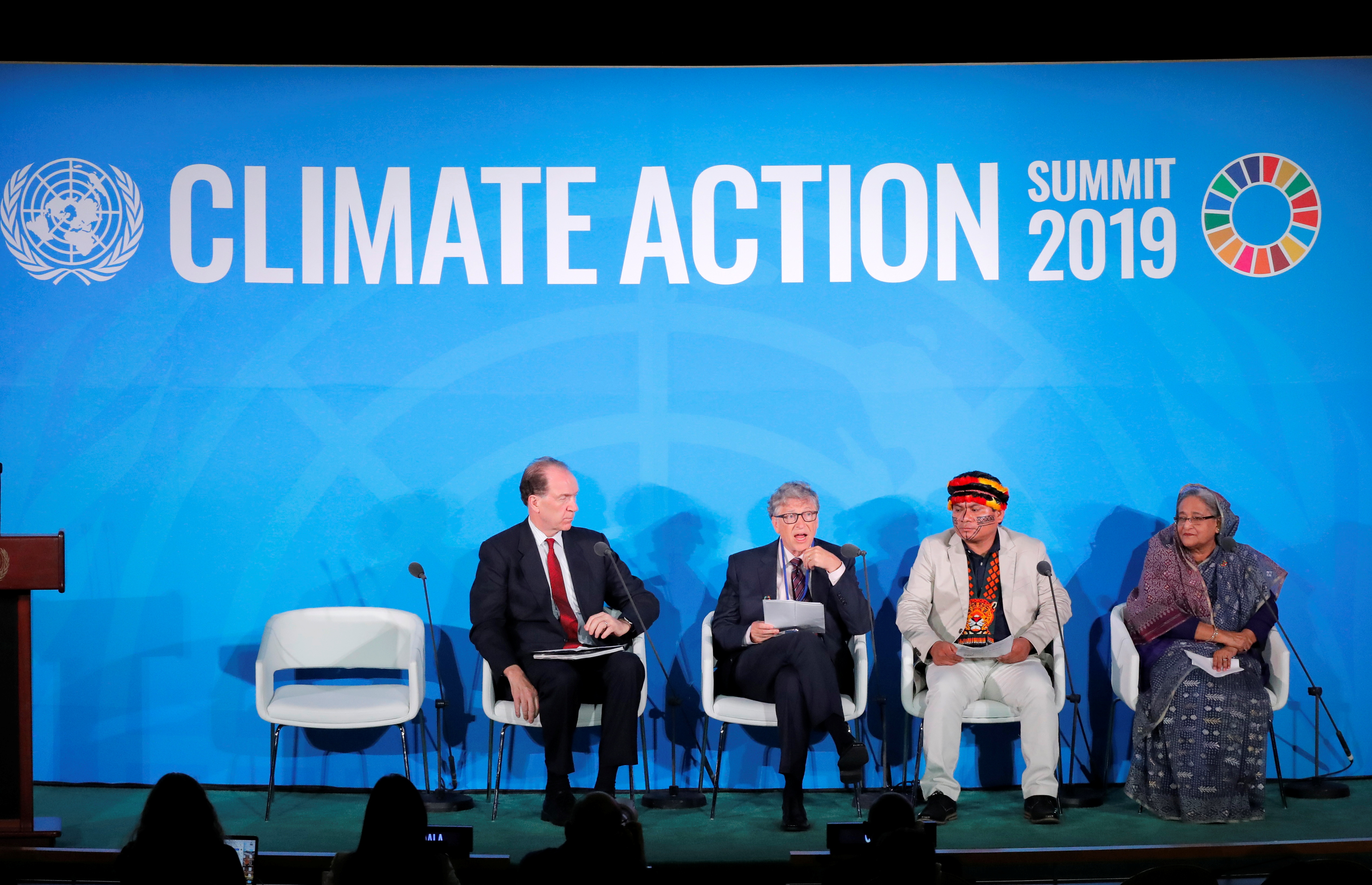
Bill Gates, Trustee and Co-Chair of the Global Commission on Adaptation, speaks as World Bank Group President David R. Malpass (L), Amazon-based indigenous leader Tuntiak Katan and Bangladesh's Prime Minister Sheikh Hasina (R) look on during the 2019 United Nations Climate Action Summit at U.N. headquarters in New York City, New York, U.S., September 23, 2019. REUTERS/Lucas Jackson/File Photo

The European Union and an energy investment programme founded by Bill Gates plan to raise up to $1 billion to roll out the low-carbon technologies Europe is betting on to meet its climate change goals, the European Commission said on Wednesday.

The partnership would see Gates-founded Breakthrough Energy use private capital and philanthropic funds to match funding provided by the EU. The aim is to together provide up to 820 million euros, or $1 billion, from 2022 to 2026.

Support will target hydrogen produced from renewable energy, sustainable aviation fuels, technology to suck CO2 out of the atmosphere, and long-duration energy storage, the Commission said.

Those technologies are seen as critical to slashing emissions from sectors like heavy industry and aviation, but remain too expensive to scale up without support and compete with cheaper fossil fuel alternatives.

"Decarbonising the global economy is the greatest opportunity for innovation the world has ever seen," Gates said in a statement, adding that Europe will play a "critical" role thanks to its climate ambitions and leadership in science and technology.

"The world cannot wait for technologies to develop on their own," the Commission said. The EU has committed to eliminate its net greenhouse gas emissions by 2050.

The investments will focus on building large-scale commercial demonstration projects to reduce the cost of the technologies.

They will comprise grants and other financial instruments, with the EU contribution coming from existing funds including the bloc's budget and the EU Innovation Fund, consisting of cash from sales of permits in the bloc's carbon market.

Unmarked burial site at residential school damages Canada's human rights reputation

OTTAWA — The discovery of an unmarked burial site at a Kamloops, B.C. residential school has sent shock waves across the world, which experts say will have a lasting negative impact on Canada's reputation as a leading human rights defender.
© Provided by The Canadian Press

William Schabas, a professor at Middlesex University in the United Kingdom, said Canada likes to champion itself as a human rights supporter, but the discovery will hurt its reputation and make many people look at its activism with an amount of cynicism.

"They will say 'This is a country that's great at condemning human rights violations in the strongest of terms in other countries, and has more trouble with its own situation,'" he said.

The Tk'emlups te Secwepemc First Nation announced last week that ground-penetrating radar had located what are believed to be the unmarked graves of 215 children at the Kamloops school. A more complete report on the findings is expected later this month.

The United Nations Human Rights Office called Wednesday on all levels of Canadian governments to investigate the deaths of Indigenous children at residential schools and to intensity efforts to find those who are missing.

UN human rights office spokeswoman Marta Hurtado said Canada must ensure "prompt and exhaustive investigations" into the deaths and redouble efforts to find the whereabouts of missing children, including by searching unmarked graves.

The discovery is "shocking and reopens painful wounds," she said.

Hurtado said healing will only be possible once families and Indigenous communities are given access to documents about missing or dead family members and the remains are properly identified.

She said appropriate compensation, official apologies, memorials and rehabilitative services should also be considered, calling those measures "cornerstones for reconciliation."

Prime Minister Justin Trudeau has said it is the "fault of Canada" that children who died during forced attendance at residential schools are not the parents, grandparents, elders and community leaders they should have become.

Hurtado called on Trudeau to establish a specific legal organization, with government and Indigenous members, to protect and manage burial sites, and that the United Nations is able to offer technical help.

"The historic abuses against Indigenous children in government-run educational and health institutions continue to affect the lives of Indigenous communities," she said.

"Lack of exhaustive clarification and access to truth and redress for what happened during this dark period compounds this."

Indigenous Services Minister Marc Miller on Wednesday highlighted $27 million, part of funding previously announced in the 2019 budget, that will now be made urgently available to uncover unmarked graves at former residential schools across the country.

Farida Deif, the Canada Director at Human Rights Watch, said the Kamloops discovery is horrifying.

She said more than 150,000 Indigenous children were forcibly taken from their families and their communities to attend these government-funded and church-run schools, and they were forbidden from speaking their own language or practising their own culture, while many were subjected to physical and sexual abuse.

"These are really very grave human rights abuses," she said.

She said the recent discovery is only at one of the more than 130 different residential school sites across Canada.

"It seems clear that many of Canada's most notorious residential schools may be sitting on cemeteries and other graves like these."

Ryerson University law professor Pamela Palmater said United Nations' human rights treaty bodies and the Inter-American Commission on Human Rights of the Organization of American States have found Canada guilty of multiple ongoing breaches of the human rights of Indigenous Peoples.

"For decades, they continue to send the Canada recommendation saying 'You've got to stop discriminating, you've got to stop engaging in acts of violence, you've got to stop with the racism,'" she said.

"Yet (Canada) continues to hold itself out as a human rights defender, and that's just not holding weight anymore."

She said there could be a wide variety of ramifications that Canada will face in the future if the country doesn't step up and address its own human rights violations.

The Kamloops discovery came a couple weeks before Trudeau is expected to head to the U.K. to meet his counterparts at the G7 summit that will take place June 11 to 13.

Schabas of Middlesex University said that most of the countries in the G7 have problems in their history and Canada has done a better job in acknowledging its wrongdoings.

"I don't think Canada is the worst in that crowd," he said.

Several members of the G7 are former colonial powers including the United Kingdom, France, Italy and Germany, and the United States has its own issues, not just with its Indigenous people but also with the horrible historic treatment of African Americans that continues today, Schabas said.

He said Canada doesn't usually lecture other G7 countries about their human rights records, but it does that with countries in the global south.

"(The Kamloops discovery) is going to discredit Canada's initiatives when we're dealing with people in the global south."

Canada's treatment of Indigenous people has been one of the biggest stains on its human rights record, said Bruno Gelinas-Faucher, a law professor at the University of Montreal and a PhD candidate in international law at the University of Cambridge.

He said China is already using Canada's violations against Indigenous people to its advantage.

"China's in is using this rhetoric, saying, 'Well, you're accusing us of genocide, what about your own actions which constitute genocide?'" he said.

Gelinas-Faucher said Canada and the Netherlands announced recently that they wanted to intervene in the prosecution of Myanmar for genocide at the International Court of Justice to provide the court with information.

"It's highly unusual for states to do this but they have the right to do it," he said. "Myanmar might use the rhetoric, just like China, to say, 'Well, you're accusing us of genocide, what about your own record?"

This report by The Canadian Press was first published June 2, 2021.

---

This story was produced with the financial assistance of the Facebook and Canadian Press News Fellowship.

Maan Alhmidi, The Canadian Press