Wednesday, June 16, 2021

US Jury deciding if immigration detainees must get minimum wage

SEATTLE (AP) — A federal jury is deciding whether one of the nation's biggest private prison companies must pay minimum wage — instead of $1 a day — to immigration detainees who perform tasks like cooking and cleaning at its jail in Washington state.
© Provided by The Canadian Press

Democratic Washington Attorney General Bob Ferguson sued the Florida-based GEO Group in 2017, saying the company had unjustly profited by running the Northwest detention center in Tacoma on the backs of captive workers.


A separate lawsuit filed on behalf of detainees was also filed that year, seeking back pay. Tacoma-based U.S. District Judge Robert Bryan, who rejected several attempts by GEO to dismiss the lawsuits, consolidated the cases for trial, which he conducted via Zoom because of the pandemic.

“What GEO is doing to exploit captive detainee workers at the Northwest detention center is for real — and at a massive scale,” Assistant Attorney General Andrea Brenneke told the jury in closing arguments Tuesday. “GEO could easily pay detainee workers the minimum wage and still make millions of dollars in profits from the facility each year.”


GEO's response is that the detainees simply aren't employees. Even if they were, the company says, it would be unlawfully discriminatory for Washington to require GEO to pay them minimum wage — now $13.69 an hour — when the state doesn't pay minimum wage to inmates who work at its own prisons or other detention facilities.

In her closing argument, GEO attorney Joan Mell accused the state and detainee advocates of using the lawsuits to attack the immigration detention system. GEO has operated the detainee work program for more than a decade, and the state made no effort to get the company to pay the minimum wage until 2017, amid a flurry of lawsuits Ferguson filed against the Trump administration.

“If the plaintiffs can prove the Minimum Wage Act is – quote — applicable ... then they can reform immigration detention without ever having to go to Congress,” she said. “They’re taking a shortcut via the courthouse to get what they want.”

The Northwest detention center houses people who are in custody while the government seeks to deport them or reviews their immigration status. It can hold up to 1,575 detainees, making it one of the nation's largest immigration jails, though as of early this month its population was just 216, largely due to the pandemic.


U.S. Immigration and Customs Enforcement, which pays GEO to run the facility, requires the company to operate a “voluntary work program” to keep the detainees occupied. It requires them to be paid at least $1 per day for work that includes cleaning bathrooms, showers and industrial kitchens; washing and folding laundry; sweeping and buffing floors; preparing and serving food; and cutting hair.

Former detainees testified that they worked because they needed money to buy extra food or clothing at the commissary or to make phone calls to loved ones.


The shifts often last just an hour or two. GEO's own analysis said it that if detainees didn't do the work, it would need to hire 85 full-time workers from the community.


GEO's contract with ICE also requires it to comply with applicable state and local law — which, the state says, includes the Washington Minimum Wage Act.

Washington appears to be the only state suing a private detention contractor for not paying minimum wage to immigration detainees. But similar lawsuits have been brought on behalf of immigration detainees in other states, including New Mexico, Colorado and California, seeking to force GEO and another major private detention company, CoreCivic, to pay minimum wage to detainees there.

The Colorado and California cases are pending, but a federal judge rejected the lawsuit brought by former detainees of CoreCivic's Cibola detention center in New Mexico — a decision upheld by a federal appeals court panel in March.

“Persons in custodial detention—such as appellants—are not in an employer-employee relationship but in a detainer-detainee relationship,” the panel wrote.

That is the crux of GEO's argument in the Washington case. The company acknowledges it has the money to pay detainees the minimum wage if it wants. In 2018 GEO made $18.6 million in profits from the facility; it would have cost $3.4 million to pay the minimum wage to detainees.

Mell also pointed to provisions in GEO's contract with ICE that state that any employees GEO hires must have legal status in the U.S. Many of the detainees don't. “The contract spells it out: The detainees are not employees,” Mell said. “They can’t be.”

But the definition of “employee” in Washington's minimum wage law is extremely broad — it includes anyone who is permitted to work by an employer, without regard to immigration or legal work status. The law says residents of “a state, county, or municipal" detention facility are not entitled to minimum wage.

According to lawyers for the state and for the detainees, that exception doesn't cover a private, for-profit jail such as GEO's. Further, GEO oversaw the scheduling and performance of the work just as a typical employer does, they said.

If the jury finds that the minimum wage law applies to GEO, a second phase of the trial will be held to determine damages. Jurors did not reach a verdict Tuesday; they were to resume deliberations Wednesday.

In a separate effort, Washington is trying to close the detention center entirely. This spring Gov. Jay Inslee signed a law that would ban for-profit detention centers in the state. GEO has sued to block it.

Gene Johnson, The Associated Press


US Park service sued after gate kills Ugandan humanitarian

SALT LAKE CITY (AP) — The family of a women’s rights activist from Uganda sued the National Park Service this month after she was decapitated last year by a gate at Utah’s Arches National Park.
© Provided by The Canadian Press

The gate had been left unlatched against federal policy for two weeks before it struck Esther Nakajjigo in June 2020, according to the lawsuit filed in Denver.

She and her husband were newlyweds traveling in the well-known park when the wind caught the gate as they drove out,
Fox13-KSTU in Salt Lake City reported.

The lawsuit does not specify the amount of damages being sought, but Nakajjigo's family has previously filed a $270 million notice of claim. Notices of claim must be filed ahead of lawsuits against government agencies and the lawsuit was filed June 8 in federal court.

The gate sliced through the side of their rented car, striking Nakajjigo in the head and neck and killing her, the lawsuit said.

Her husband Ludo Michaud witnessed his wife's death, something he has called the “worst thing I hope I will ever see.”

Nakajjigo, 25, was born in Kampala, Uganda, and used her university tuition money to start a nonprofit community health care center for girls and young women when she was a teenager.

She earned numerous humanitarian awards and created a popular reality television series aimed at empowering young mothers. She was attending a social-entrepreneurship program in Colorado at the time of her death.

A National Park Service spokesperson declined comment Monday on the lawsuit, Fox13-KSTU reported. The park service previously issued a statement expressing sympathy to her family.

The Associated Press
'Unacceptable' that Inuk MP felt unsafe in House of Commons, Miller says

OTTAWA — Indigenous Services Minister Marc Miller says it's a "sad reflection" on Canada that an Inuk MP feels she's been racially profiled by security officials on Parliament Hill.
© Provided by The Canadian Press

Mumilaaq Qaqqaq, a rookie New Democrat MP from Nunavut, told the House of Commons on Tuesday night that she does not feel safe on the Hill.

She said she's been chased down hallways and racially profiled by members of the Parliamentary Protective Service.

Commons Speaker Anthony Rota's office says Qaqqaq has never complained about any incidents to the Speaker, who presides over the protective service along with the Speaker of the Senate.

The service itself has not so far responded to a request for comment on Qaqqaq's allegations.

Miller says Qaqqaq is not the first MP of colour to complain, recalling that former Liberal MP Celina Caesar-Chavannes also spoke out about feeling "carded" by Hill security — a reference to a controversial police practice that has been denounced for targeting primarily Indigenous and racialized individuals for questioning.

"It's a reflection of still who we are as a country," Miller said Wednesday.

"It is a sad reflection of where we are. It's unacceptable and it shouldn't be that way but it is."

He added: "For someone to feel unsafe in what should be one of the most secure places in the country because of who she is and what her identity is is entirely unacceptable and, in fact, is an attack on her parliamentary privilege."

Qaqqaq, first elected in 2019, has decided not to seek re-election. She told the Commons in what was her official farewell speech Tuesday that she feels she doesn't belong in the chamber.

Due to the COVID-19 pandemic, the House of Commons has sat in a hybrid format for most of Qaqqaq's brief time as an MP, with most MPs participating virtually in proceedings from their home ridings.

But in the short time she's spent on the Hill, Qaqqaq said security guards have jogged after her down hallways, "nearly put their hands on me and racial profiled me."

She said she's learned "as a brown woman, do not move too quickly or suddenly, do not raise your voice, do not make a scene, maintain eye contact and don't hide your hands."

Last fall, Qaqqaq took a leave of absence for several months, later explaining she had been suffering from "extreme burnout, depression and anxiety." She took another two-week leave in April, citing continuing "personal health problems."

The second leave came on the heels of a Twitter spat with Labrador Liberal MP Yvonne Jones. Qaqqaq charged that Jones "is not an Inuk" and challenged her to "validate her Inuk-ness."

She eventually apologized to Jones.

This report by The Canadian Press was first published June 16, 2021.

Joan Bryden, The Canadian Press
HE HAS A FOOL FOR A CLIENT
Ex-CIA worker seeks to represent himself at espionage trial

NEW YORK (AP) — A former CIA software engineer accused of leaking secrets to WikiLeaks notified a judge Tuesday that he wants to represent himself at an October retrial on espionage charges.

Joshua Schulte, 32, plans to proceed on his own behalf, defense attorney Sabrina Shroff told U.S. District Judge Paul A. Crotty during a court hearing.

The judge then directed prosecutors to submit legal papers on issues surrounding a hearing that would be conducted to ensure Schulte’s right to a fair trial is protected.

Shroff said the judge may have to decide if Schulte is fit to represent himself and then could assign his lawyers to assist him as what is known as “standby counsel.”

Schulte has pleaded not guilty in the 2017 release of secrets by WikiLeaks that resulted from what prosecutors have labeled the largest leak of classified information in CIA history.

The so-called Vault 7 leak revealed how the CIA hacked Apple and Android smartphones in overseas spying operations and efforts to turn internet-connected televisions into listening devices.

After a year-long investigation, authorities arrested Schulte, who had already left the CIA after falling out with colleagues and supervisors and moved to New York City to work at a news agency.

His lawyers argued at his first trial last year that the leak could have been made by many others. A jury then deadlocked on the espionage charges while convicting him of less serious charges of contempt of court and making false statements.

Prior to his arrest, Schulte worked as a coder at the agency’s headquarters in Langley, Virginia, where some of the CIA’s digital sleuths design computer code to spy on foreign adversaries.

In January, Schulte represented himself in a court filing in which he complained that he was subjected to cruel and unusual punishment by being forced to await trial in solitary confinement in a vermin-infested cell of a jail unit where inmates are treated like “caged animals.”

After the October trial, Schulte will face child pornography charges in a separate trial.

Larry Neumeister, The Associated Press
KENNEY LIES
Alberta premier denies supporting niqab ban despite past public statements

© Sean Kilpatrick/The Canadian Press Alberta Premier Jason Kenney is denying he ever supported a ban on niqab or face veils worn by some Muslim women.

Alberta Premier Jason Kenney is denying he supported a ban on niqabs even though he issued a directive in 2011 banning women from wearing them during citizenship ceremonies when he was the federal minister of citizenship and immigration.

Kenney made the remarks during a news conference following the virtual Western Premiers Conference on Tuesday.

"I've never supported a proposed ban," Kenney said.

"To the contrary, I've always said that Canada is a country that protects and respects religious freedom and pluralism, and the government has no business regulating what people wear unlike in certain European and Middle Eastern countries that do have bans on face coverings," he added.

"That has never been proposed. I've always opposed that."

Kenney is facing new questions about his record in light of recent comments by Tim Uppal, the Conservative MP for Edmonton-Mill Woods.

Uppal, who became the spokesperson for the niqab ban as the minister of state of multiculturalism in the Harper cabinet, apologized in a Facebook post Sunday for not pushing back harder against the policies of his former government which he said "alienated Muslim Canadians and contributed to the growing problem of Islamaphobia in Canada."

Uppal said he decided to publicly account for his past actions after four members of a Muslim family were struck and killed by a man driving a truck in London, Ont.


The accused is now facing terrorism charges in addition to four charges of first-degree murder and one charge of attempted murder. One family member, a nine-year-old boy, survived the attack.

Uppal's caucus colleague, Calgary-Nose Hill MP Michelle Rempel Garner, also apologized for her inaction.

Despite his denial on Tuesday, Kenney continued to take responsibility for and defend the policy as recently as 2015, when the ban was struck down in court.

Kenney was also a member of cabinet when the Conservative government led by former prime minister Stephen Harper proposed a hotline during an election campaign to report so-called "barbaric cultural practices."


© CBC Edmonton-Mill Woods MP Tim Uppal, seen here in 2015 when he was minister of state for multiculturalism, became the spokesperson for legislation to ban face-coverings at citizenship ceremonies.

Uppal, who appeared on CBC Radio's Edmonton AM Tuesday, deflected questions about whether he felt Kenney should apologize as he was accounting for his own actions as the minister of state for multiculturalism.

"[Kenney] has a very good relationship with a lot of people in the Muslim community," Uppal said. "This is something that I have seen myself first-hand."

Kenney left federal politics in 2016 to run for the leadership of the Progressive Conservative Party of Alberta, the first step in his successful drive to unite the PCs with the Wildrose Party.

Jasvir Deol, the NDP MLA for Edmonton-Meadows, called for Kenney to apologize. The premier was not in Tuesday's question period to take Opposition questions on the issue.

IN THE CLOSET CONSERVATIVES


RACE BASED RELIGION

Southern Baptists elect moderate Ed Litton president in defeat for hard right


JUNE 16, 2021 / 7:25 AM / AP

Nashville — The Southern Baptist Convention tamped down a push from the right at its largest meeting in decades on Tuesday, electing a new president who has worked to bridge racial divides in the church and defeating an effort to make an issue of critical race theory.


Ed Litton, a pastor from Alabama, won 52% of the vote in a runoff against Mike Stone, a Georgia pastor backed by a new group called the Conservative Baptist Network that has sought to move the already-conservative denomination further right.


Litton, who is white, was nominated by Fred Luter, the only Black pastor to serve as president of the United States' largest Protest denomination. Luter praised Litton's commitment to racial reconciliation and said he has dealt compassionately with the issue of sexual abuse within SBC churches, another hot-button subject at the gathering of more than 15,000 church representatives.

It was standing room only in the hall where, with Nashville's COVID-19 precautions lifted, attendees were packed closely without facemasks. One small section was reserved for those wearing masks.

Last year's annual meeting was canceled due to the pandemic.
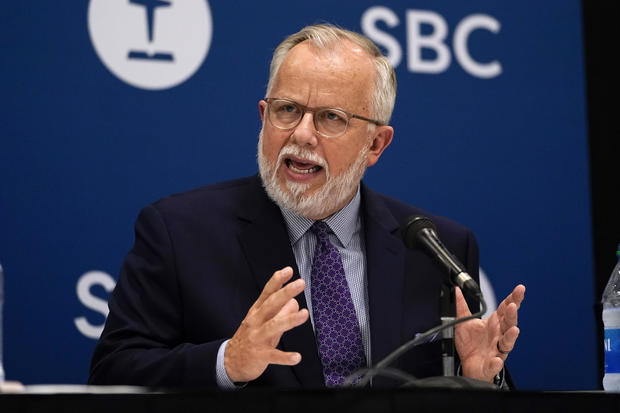
Pastor Ed Litton, of Saraland, Alabama, answers questions after being elected president of the Southern Baptist Convention on June 15, 2021, in Nashville.
MARK HUMPHREY / AP

Stone had campaigned aggressively, including speaking at churches across the country and even appearing on "Fox & Friends" on Tuesday before the vote. And the Conservative Baptist Network had encouraged supporters to come to the meeting as voting delegates.

But in the end, the message that seemed to resonate with voters was that Stone - who supported a motion to repudiate critical race theory - was a divisive choice.

"We're a family, and at times it seems like an incredibly dysfunctional family," Litton said after the results were announced. "But we love each other."

Delegates rejected a proposal that would have explicitly denounced critical race theory, which is an academic construct for framing systemic racism. It's been a target of religious and political conservatives. Instead, they approved a consensus measure that doesn't mention it by name but rejects any view that sees racism as rooted in "anything other than sin."

The measure also affirmed a 1995 resolution apologizing for the history of racism in a denomination that was founded in 1845 in support of slavery and for "condoning and/or perpetuating individual and systemic racism in our lifetime."

One white delegate urged the convention to denounce critical race theory by name, saying it held him "guilty because of the melanin content of my skin." But another argued that the convention shouldn't be swayed by a political movement that has already seen some state legislatures ban teaching of the theory.

"If some people in this room were as passionate about the gospel as they are about critical race theory, we would win this world to Christ," said James Merritt, chairman of the resolutions committee and a former convention president.

Several Black pastors have voiced frustration over critical race theory debates playing out in the SBC instead of the denomination confronting systemic racism itself. Several have already departed the SBC over what they said was racial insensitivity from overwhelmingly white leadership.

Dwight McKissic, a prominent Black pastor from Texas who had planned to join that exodus if Stone won, tweeted in response to Litton's election: "God has a plan for the SBC & I want to be a part of it. Truly, racism was rejected 2day!"

The two-day meeting concludes Wednesday, when delegates will consider proposals for a sweeping review of the SBC's response to abuse in its churches. It's an issue that recently erupted with secret recordings and leaked letters purportedly showing that some leaders tried to slow-walk efforts to hold churches accountable and sought to intimidate and retaliate against those who advocated on the issue. Stone was among those specifically called out.

First published on June 16, 2021 / 1:33 AM

© 2021 The Associated Press. All Rights Reserved. This material may not be published, broadcast, rewritten, or redistributed.

Humanitarian crisis in Ethiopia's Tigray at "tipping point"


BY PAMELA FALK

JUNE 16, 2021 / 3:08 AM / CBS NEWS

United Nations — In his harshest statement yet on the seven-month crisis in northern Ethiopia's Tigray region, U.N. Emergency Relief Coordinator Mark Lowcock told Security Council members Tuesday "there is now famine in Tigray." He put the blame squarely on forces from the neighboring nation of Eritrea.


"Eritrean soldiers are using starvation as a weapon of war," he said.

Lowcock painted a brutal picture. "Rape is being used systematically to terrorize and brutalize women and girls. Aid workers have been killed, interrogated, beaten, blocked from taking aid to the starving and suffering and told not to come back," he told diplomats in a closed briefing at an informal dialogue of the U.N. Security Council that was requested by the Mission of Ireland.


Ireland's U.N. Ambassador, Geraldine Byrne Nason called the situation an "unfolding humanitarian catastrophe."

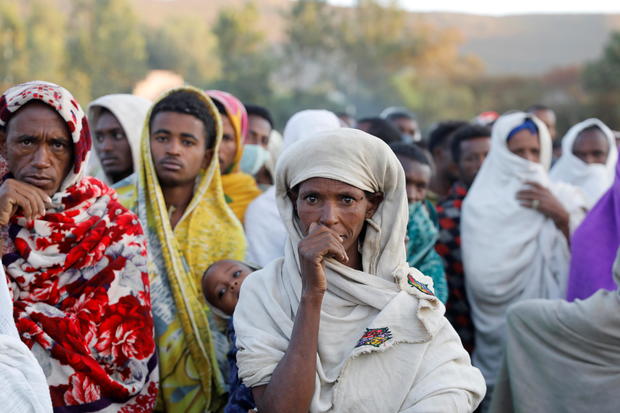
"Now, we are at a tipping point," she said.A woman stands in line to receive food donations at the Tsehaye primary school, which was turned into a temporary shelter for people displaced by conflict, in the town of Shire in the Tigray region of Ethiopia on March 15, 2021. BAZ RATNER / REUTERS
"Ignorance is dangerous. Denial is unforgiveable."

"Despite all we have told you of the widespread and systematic scale of the rapes, we continue to receive horrific reports of widespread sexual violence," Lowcock said, clearly frustrated by the lack of action from the 15-nation council.

Lowcock outlined three areas where progress is "urgently" needed: humanitarian access, funding, and a hastening of the pace of aid.

"Ignorance is dangerous. Denial is unforgiveable," he warned, saying there is a "duty" to "do something."

Fighting in Ethiopia broke out in November 2020 between government troops and Tigrayans. Eritrea sent forces across the border to help Ethiopian troops.

The Biden administration has spoken out. Last month, citing continuing atrocities, Secretary of State Antony Blinken called on the "governments of Eritrea and Ethiopia to take all necessary steps to ensure that their forces in Tigray cease and desist this reprehensible conduct."

U.S. Ambassador to the U.N., Linda Thomas Greenfield scolded the council last week, asking, "Do African lives not matter?" and taking issue with the lack of a single public meeting on the crisis.

U.S. AID Administrator Samantha Power called on the Security Council's three African members to put the issue on the agenda.

Council members weigh in


After Tuesday's U.N. meeting, those three nations - Niger, Tunisia, and Kenya - along with St. Vincent and the Grenadines, issued a statement saying they, "share in the concern for the humanitarian needs faced by 17.1 million Ethiopians including people in the Tigray region." The four nations said they are concerned about "reports of sexual violence against women and girls."

They called on Ethiopia to "conduct thorough investigations into these atrocities."

Not mentioning famine in the statement, the nations cautioned, "Any action by the Security Council must recognize and respond to the reality that Ethiopia is finalizing preparations for an election that is barely a week away."

Ethiopia's U.N. ambassador, Taye Atske Selassie Amde, who was at the meeting, said Eritrean forces "will definitely leave soon," a commitment that Eritrea also made in April – and one that hasn't happened.

Later in the evening, Ireland's Byrne Nason told CBS News, "Ireland has been on the Security Council for six months, and in those six months we have never looked away from this developing catastrophe in Tigray."

She said, "We need unhindered humanitarian access to the hundreds of thousands already in immediate danger of starvation, we need to ensure humanitarian workers and supplies are safe, and we need to end all violence."

"Ultimately, a political solution is needed, and Ireland certainly called for that today, but while we work towards that, our number one priority is ensuring that no more lives are lost," Byrne Nason added.

Russian Deputy Ambassador Anna Evstigneeva, who attended the meeting, told CBS News in a statement, "We take the humanitarian challenges that Ethiopia faces very seriously." She said "humanitarian agencies should scale up their assistance with full respect to and in close coordination with the sovereign authorities."

"We oppose any politicization of humanitarian situations, including in Tigray," Russia's envoy said.

U.K. Ambassador to the U.N. Barbara Woodward spoke to reporters after the closed dialogue, saying she was disappointed that nations on the Council have not been able to agree to a meeting in public, saying that "without a ceasefire, this could become a man-made famine."

First published on June 16, 2021 

© 2021 CBS Interactive Inc. All Rights Reserved.

Pamela Falk

Pamela Falk is CBS News Foreign Affairs Analyst and an international lawyer, based at the United Nations.


US Education Department says Title IX protects LGBTQ students
The announcement is in response to an executive order from President Joe Biden directing federal agencies to evaluate sex discrimination protections.
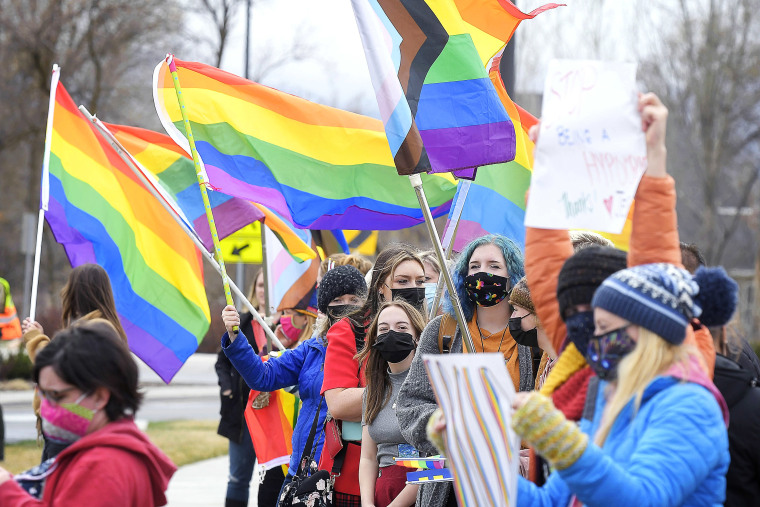
People wave pride flags and hold signs during a rally in support of LGBTQ students on April 14 in Millville, Utah.Eli Lucero / AP file


June 16, 2021
By Jo Yurcaba


The Department of Education will interpret Title IX, a federal law that protects students from sex-based discrimination in federally funded schools, to protect LGBTQ students from discrimination, according to a federal notice published Wednesday.

The update is a reversal of a Trump administration policy rolling back Obama-era guidance that directed schools to allow transgender students to use the bathrooms, changing rooms and other school facilities that aligned with their gender identity.


The department said in a press release that its interpretation came from the landmark U.S. Supreme Court decision in Bostock v. Clayton County, Georgia, which held that LGBTQ people are protected from employment discrimination under Title VII of the Civil Rights Act of 1964.

President Joe Biden issued an executive order in the first days of his presidency directing all federal agencies to implement the Bostock ruling and update their enforcement of sex discrimination protections accordingly.

In the 6-3 Bostock majority opinion, Justice Neil Gorsuch, an appointee of former President Donald Trump, wrote that discrimination based on sexual orientation or gender identity is discrimination based on sex.

"The Supreme Court has upheld the right for LGBTQ+ people to live and work without fear of harassment, exclusion, and discrimination — and our LGBTQ+ students have the same rights and deserve the same protections," U.S. Secretary of Education Miguel Cardona said in a statement. "I'm proud to have directed the Office for Civil Rights to enforce Title IX to protect all students from all forms of sex discrimination. Today, the Department makes clear that all students—including LGBTQ+ students—deserve the opportunity to learn and thrive in schools that are free from discrimination."

The directive will allow the Department of Education to pursue Title IX complaints from LGBTQ students — reversing the Trump administration's 2018 announcement that it wouldn't investigate civil rights complaints from trans students prohibited from using school facilities that aligned with their gender identity.

The policy could also affect states that have passed laws barring trans student athletes from competing on school sports teams that align with their gender. Nine states have passed such measures — eight of which passed in 2021.

After the department announced the policy, Cardona tweeted video of an interview he did with ESPN about trans athlete bans.

"Transgender athletes are students, first and foremost, and they deserve every right that every other student gets," including access to extracurricular activities such as sports, he said.


Sponsors of trans athlete bans have said trans girls have a competitive advantage over cisgender girls, but they've been unable to cite clear scientific evidence to show that's true or examples where trans girls competing in girls sports have caused problems.

Cardona said he recognizes there's "a lot of concern" around the issue of fairness, "but what's not tolerable is saying that some students cannot participate because of their gender."

He added that he does believe in states having control over their own laws, "but we do have a responsibility to protect the civil rights of students, and if we feel the civil rights are being violated, we will act."


New app tracks human mobility and COVID-19

University of Miami researchers create interactive application to analyze patterns between human movement, government policies, and the pandemic

UNIVERSITY OF MIAMI

Research News

Analyzing how people move about in their daily lives has long been important to urban planners, traffic engineers, and others developing new infrastructure projects.

But amid the social restrictions and quarantine policies imposed during the global spread of COVID-19--which is directly linked to the movement of people--human mobility patterns changed dramatically.

To understand just how COVID-19 affected human movement on a global scale, Shouraseni Sen Roy, a professor in the College of Arts and Sciences Department of Geography and Sustainable Development, and graduate student Christopher Chapin developed COVID-19 vs. Human Mobility, an innovative and interactive web application that, shared in a new study, shows the connections between human mobility, government policies, and cases of COVID-19.

"At a macro level, understanding movement patterns of people can help influence decision making for higher-level policies, like social gathering restrictions, mask recommendations, and tracking and tracing the spread of infectious diseases," said Sen Roy. "At a local level, understanding the movement of people can lead to more specific decisions, like where to set up testing sites or vaccination sites."

Using a collection of big data sets, Chapin, who in May earned his Master of Science in Business Analytics with a minor in geospatial technology, developed the web application from three independent sources: Apple Maps, which provides data on human movement via walking, driving, and public transportation; Oxford University's COVID-19 Government Response Tracker, which provides data on government policies implemented during the pandemic; and global cases of COVID-19 gathered by Johns Hopkins University.

"Putting together this data application was a very ambitious project," said Chapin, the lead author of the study in the Journal of Geovisualization and Spatial Analysis. "I'm really proud of the end result and grateful that Dr. Sen Roy pushed me to get the application published. Now other researchers can access the massive amount of data on COVID-19 and human mobility on a global scale."

Users of the interactive web application can select a country, or a specific state or county in the U.S. and view comparisons between human mobility and COVID-19 cases across time. They also can view information on government policies in relation to the spread of COVID-19.

"Since the initial launch, we have continued to update the application with appropriate data at regular intervals," said Sen Roy. "The web application produces interesting visualizations that can reveal fascinating trends specific to a given area that might otherwise not be recognized."

During their exploration of the data, the researchers found a handful of case studies that suggested interesting trends. For example, in New Orleans, the application shows a spike in human mobility at the end of February 2020, which coincided with Mardi Gras celebrations. Coincidentally, there was a corresponding spike in COVID-19 cases almost a month after the event.

"We are hoping to garner more conversation and interest in the application that can help us and other researchers continue to see how COVID-19 has and continues to impact our world," said Sen Roy.

Although the application is specific to the pandemic, she noted that the framework could be modified rather easily to create a similar application for natural disasters--as long as appropriate data sets are available.

"Understanding historic mobility patterns, both under normal circumstances and in response to extreme events like a pandemic or a natural disaster, is surely needed for policy makers to make informed decisions regarding transportation systems and more," she said. "In this context, we hope that our application can be of use."

###

The study, "A Spatial Web Application to Explore the Interactions between Human Mobility, Government Policies and COVID-19 Cases," is available online.


Psychologists identify 18 best measures to assess intimate partner violence

BINGHAMTON UNIVERSITY

Research News

BINGHAMTON, N.Y. -- Millions of people experience intimate partner violence (IPV) in their lifetime and assessment is important in conducting therapy and assisting victims. A team of psychologists at Binghamton University, State University of New York have evaluated dozens of available measures used to assess intimate partner violence and have pinpointed the most effective ones.

IPV is a blanket term used to refer to not only acts of physical violence, but other abusive behaviors, such as psychological and emotional abuse or control tactics. According to estimates by the National Intimate Partner and Sexual Violence Survey, within the United States, 22.3% of women and 14% of men experience severe physical violence by an intimate partner in their lifetimes.

Binghamton University doctoral student Erin F. Alexander and Professor of Psychology Matthew D. Johnson typically administer a measure of IPV to couples therapy patients, and they became curious about which measures are best to use in a clinical practice as well as in research.

"When we located 87 measures, we realized that before conducting any further research, one of the most important contributions we could make to the field is sorting through these measures to identify which measures are of the highest quality," said Alexander.

The researchers examined prior research on each measure. After evaluating each one, they recommended 18 of the available 87. The measures fit different purposes including brief screening instruments, measures of severity, measures used in criminal justice settings, measures of attitudes related to violence without overtly asking about violent behaviors, and measures of specific forms of abuse (e.g., physical, sexual, psychological).

"These measures are recommended because they have been studied more thoroughly than the other measures, and the results from the studies on these measures show consistently that the measure is a valid indicator of IPV in a relationship," said Alexander.

It is best practice for a couples therapist to evaluate a couple for violence in the relationship before beginning therapy, said Alexander. Based on the level of violence, the types of therapeutic interventions that may be appropriate and helpful for a couple are different. Some studies suggest it is unsafe to conduct couples therapy in certain types of abusive relationships. Having a valid measure to administer at the beginning of therapy can help therapists know whether a couple is experiencing IPV, how severe it is and what types of abuse are occurring.

"This can allow therapists to make the best decisions for how to help the couple -- whether that be couples therapy, individual therapy, or taking safety measures to help a victim remove his/herself from a dangerous situation," said Alexander.

Alexander has plans to create her own measure that pulls from the strongest qualities of the existing measures. She also plans to use only the strongest measures that she has identified in assessing IPV in future research and with couples' patients moving forward.

###

The paper, "Evaluating Measures of Intimate Partner Violence Using Consensus-Based Standards of Validity," was published in Trauma, Violence, & Abuse.