Sunday, July 18, 2021

Countries Must Transition Away From Fossil Fuels. But How Can We Do That Fairly for All?
People around the world rely on fossil fuels for work and income — so how can they be protected?


Unsplash / American Public Power Association

By Joe McCarthy
July 16, 2021

Countries are currently in the long overdue process of transitioning away from fossil fuels to mitigate the effects of climate change.

As part of this transition, many leaders are trying to support people employed in sectors dependent on fossil fuels with training, opportunities, and resources.

This is known as a “just transition,” a concept developed by trade unions that seeks to center workers and communities during periods of economic disruption. Without this emphasis, communities would potentially be deprived of a primary source of income as, for example, a coal mine closes, which could lead to poverty and other consequences.

“It really has to do with fairness,” Christopher Sheldon, practice manager for the World Bank’s Infrastructure Energy and Extractive Industries Global Practice and an expert on just transitions, told Global CItizen. “It’s more than transitioning from one form of energy to another; it’s about the socioeconomic upheaval.

3 key things to know about 'just transitions'
 
The idea of a just transition originated with labor groups seeking economic rights in the aftermath of coal mine closures.
 
The concept has since broadened to include a society-wide transition away from fossil fuels.
 
A global just transition must revolve around climate justice.
 
Leaving no one behind


The World Bank and other organizations have developed strategies to help communities rebound in the wake of the socioeconomic upheaval. The World Bank, in particular, works on addressing the repercussions of closing coal mines.

Coal mines can provide thousands of direct jobs in mining, mineral processing, and transportation. They can also support broader networks of service jobs, health care, and other sectors and can finance community infrastructure such as schools and hospitals. In the past, when a coal mine closed, it was usually because a mine was tapped out or no longer economically viable compared to other forms of energy. The sudden vacuum left by the mine would have harsh consequences, according to Sheldon.

As a result, groups like the International Labor Organization and the World Bank stepped in with support for a just transition. Michael Stanley, the extractives lead at the World Bank, explained that just transitions hinge on three pillars: strong government oversight, extensive community involvement, and environmental rehabilitation.

Communities, in particular, have to be compensated fairly during the closure process and allowed to influence the new economic direction of a community, whether investments should be made in tourism, agriculture, or some other industry.

“It really matters that you have a strong, inclusive growth process, that all the impacted stakeholders are included so you really have clarity on how decisions will be taken, what they’ll be informed by, and who will take the decisions,” Stanley said.


Related Stories
7 Trends That Promise Explosive Renewable Energy Growth Post-COVID-19


Sheldon noted that countries such as China, India, the Philippines, Indonesia, and South Africa have the most arduous transition before them since these economies continue to rely so heavily on coal energy.

In recent years, the concept of a just transition has broadened beyond coal mine closures to encompass broader societal shifts.

The Climate Justice Alliance argues that a just transition means moving away from the current “extractive economy” toward a “regenerative economy.”

“This means approaching production and consumption cycles holistically and waste-free,” the organization notes. “The transition itself must be just and equitable; redressing past harms and creating new relationships of power for the future through reparations. If the process of transition is not just, the outcome will never be.”

A regenerative economy


As climate change and biodiversity loss threaten the future survival of humanity, proponents of an expansive just transition are calling for the global economy to be overhauled.

That begins with rapidly phasing out fossil fuels and reducing energy consumption in high-income countries. With global temperature increases expected to surpass the 1.5 degree Celsius threshold enshrined in the Paris climate agreement this decade, drastic action is needed to prevent catastrophic environmental consequences.

The International Energy Agency recently reported that countries can have a fighting chance of staying under the 1.5 degrees limit if countries stop drilling for new fossil fuels immediately and quadruple renewable energy production by 2030.

The United Nations goes further by calling on countries to use the next decade to dramatically scale up investments in environmental restoration, focusing on wetlands and forests, marine ecosystems, and grasslands.

But restoration is only effective if it's accompanied by conservation; if countries continue to use natural resources at unsustainable rates, then more and more of the planet will become degraded. The UN reports that 75% of the Earth’s surface has been altered by human activity to fuel the global economy and the pace of natural resource depletion only continues to grow.

As a result, organizations like the Climate Action Network are calling for countries to phase out current models of consumerism that depend on extreme resource extraction, pollution, and a global underclass of laborers.

“After centuries of global plunder, the profit-driven industrial economy rooted in patriarchy and white supremacy is severely undermining the life support systems of the planet,” the Climate Action Network writes. “Transition is inevitable. Justice is not.”

“We must build a visionary economy that is very different than the one we now are in,” the organization argues. “This requires stopping the bad while at the same time building the new. We must change the rules to redistribute resources and power to local communities.”


A just transition in the fullest sense of the term means reimagining the world we live in so that intersectional forms of justice and the planet’s well-being are elevated above concerns of economic growth.

This means creating societies where food, clean water, shelter, education, and health care are available to all; where smallholder farmers and worker cooperatives are allowed to organize; where marine and land ecosystems are shielded from excessive exploitation; and the potential of every human is cultivated.

“Just transition initiatives are shifting from dirty energy to energy democracy, from funding highways to expanding public transit, from incinerators and landfills to zero waste, from industrial food systems to food sovereignty, from gentrification to community land rights, from military violence to peaceful resolution, and from rampant destructive development to ecosystem restoration,” the Climate Action Network writes.

It adds: “Core to a just transition is deep democracy in which workers and communities have control over the decisions that affect their daily lives.”

You can join the Global Citizen Live campaign by taking action here to defend the planet and defeat poverty, and become part of a movement powered by citizens around the world who are taking action together with governments, corporations, and philanthropists to make change.


Eco-Friendly Ultrasonic Treatment System Controls Algae in Power Plant Settling Pond

Water treatment professionals often turn to chemicals to control algae in power plant settling ponds. While this can be effective, environmentally friendly ultrasonic technology may do a better job at a fraction of the cost—and with no harm to fish or plants.

The National Pollutant Discharge Elimination System (NPDES) permit program was created in 1972 by the Clean Water Act. The NPDES helps address water pollution by regulating point sources that discharge pollutants to waters of the U.S.

Effluent limitations serve as the primary mechanism in NPDES permits for controlling discharges of pollutants to receiving waters. Effluent limitations guidelines and standards are established by the U.S. Environmental Protection Agency for different non-municipal categories. These guidelines are developed based on the degree of pollutant reduction attainable by an industrial category through the application of pollutant control technologies.

It can be difficult for power plants to comply with NPDES permit limits. For example, Northern Indiana Public Service Co.’s (NIPSCO’s) Rollin M. Schahfer Generating Station, located in Jasper County near Wheatfield, Indiana, operates four coal-fired units with a combined capacity of about 1,943 MW. The facility takes its cooling water from the Kankakee River. Before being returned to the river, the water is discharged to a final settling basin, which has a surface area of about 194 acres and an average depth of about 10.7 ft. The water must meet NPDES permit limits when being discharged back to the river.

Among the requirements are that the concentration of total suspended solids (TSS) must be less than 30 parts per million (ppm) on a daily basis and less than 15 ppm on a monthly average, and the water pH must be less than 9. Settling ponds are commonly rich in nutrients, and the temperature of water in Schahfer’s basin is warmer than river water, having absorbed heat in condensers while passing through the plant. This causes algae to grow at a relatively fast rate, and algal blooms have an adverse effect on TSS and pH.

NIPSCO used algaecides for years in its cooling water program in order to meet the NPDES limits at the final settling basin. However, algaecides can be expensive and options were limited because algaecides could not be directly added to the basin due to the pond discharge going back to the river. The company tested other options to lower TSS levels, but results were inconsistent and filters from TSS samples were often green. Filtration of the pond discharge was considered, but it was not really an economical option.

Ultrasonic Treatment

Finally, NIPSCO came across LG Sonic, a company that calls itself a “leader in sustainable algae management.” NIPSCO worked directly with the company to develop an ultrasonic solution, utilizing LG Sonic’s MPC-Buoy technology. MPC-Buoy is a floating solar-powered system that combines real-time water quality monitoring and ultrasonic sound waves to effectively control algae.

“Controlling algae with low-power ultrasound is a well-established technology that has been in existence for many years. It is an environmentally friendly technology that is harmless to fish and plants,” Lisa Brand, CTO for LG Sonic, told POWER.

Ultrasound can be used in both fresh water surfaces, such as lakes, drinking water reservoirs, and irrigation basins, as well as in maritime environments. By controlling the algae, it is possible to improve the clarity of the water, and reduce TSS and pH.

The Science Behind the Technology

To understand how LG Sonic’s MPC-Buoy system targets algae, it is helpful to understand algae’s growing mechanism. All single-celled planktonic algae use some form of buoancy regulation to remain at the surface of the water where most light is available, Brand explained. During the day, algae are photosynthesizing in the top layer, using carbon dioxide and dissolved nutrients from the surrounding water to produce oxygen and polysaccharides.

To control algae, the LG Sonic system transmits specific ultrasonic waves in the water. The sound waves can spread through the water column for hundreds of meters. The ultrasound waves create a sound layer in the top layer of the water, which affects the buoyancy regulation of the algae, fixing them in the water column. The algae cells sink to the deeper and darker layers of the water column where they are not able to photosynthesize, and they eventually die due to a lack of sunlight.

Specific frequency programs are used, based on the type of algae to be controlled. Due to the adaptability of algae during seasons within a lake or other large body of water, the ability to change these ultrasonic frequencies is important for long-term success.

Brand said ultrasonic algae control does not significantly alter the basic level of algae present in a lake or reservoir. However, due to the direct effect of the ultrasound on the vertical distribution of algae in the water column, the ultrasound directly influences the capability of an algal species to form a bloom. In general, these blooms can be reduced by 70% to 90% in concentration, compared to a non-treated body of water.

MPC-Buoy

LG Sonic’s MPC-Buoy makes use of specific and low-power ultrasound (5–20 W per transmitter). As Brand noted, multiple studies have proven low-power ultrasound to be harmless to fish and plants. However, there are other ultrasonic methods too. One less-eco-friendly type produces cavitation using high-power ultrasound. Cavitation is a phenomenon in which high-power ultrasound causes the formation of bubbles that implode upon themselves causing intense heat and pressure, which can destroy cells, and has been known to have a harmful impact on the ecosystem. Furthermore, due to the high power requirements for cavitation-style systems, it is impractical to use the method for treatment of lakes or any large water surface.

“LG Sonic provides continuous support from their engineers to analyze how to best place the units in the reservoirs and estimate at what rate to move away from chemical use when treating algae with ultrasound, and finally, advise on general reservoir management as LG Sonic monitors and treats water bodies across the globe,” Brand said.

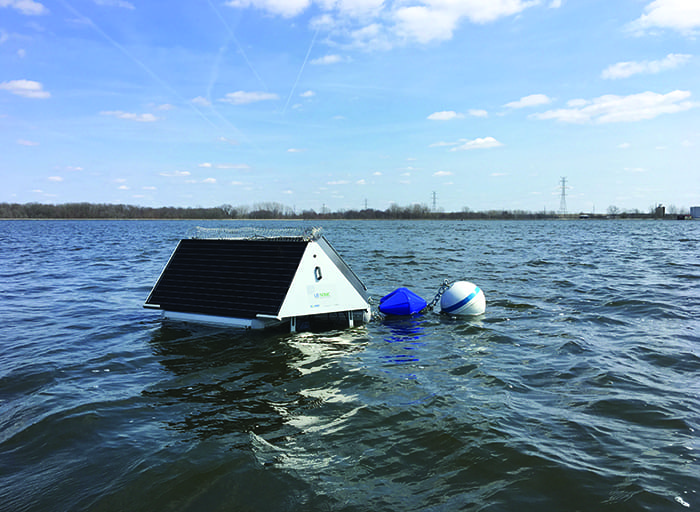
For Schahfer’s settling pond, LG Sonic designed a setup with two MPC-Buoy Pro units and three MPC-Buoy Lite units (Figure 1). Pro units include ultrasound transmitters and water quality monitoring sensors customizable to users’ needs. Lite units only include ultrasound transmitters—no monitoring sensors. The Lite units receive ultrasonic treatment instructions from the Pro units.

1. The MPC-Buoy system installed at the R.M. Schahfer Generating Station uses solar photovoltaic cells to power ultrasound transmitters to control algae. Courtesy: LG Sonic

The MPC-Buoy system does not require chemicals or other consumables. However, the sensors on the buoys need to be cleaned periodically. The cleaning is necessary about every two months and takes just a couple of hours to complete. Maintenance frequencies at other installations could vary, depending on the location, water quality, and weather.

Lessons Learned

The MPC-Buoy system was installed at the Schahfer site on April 1, 2019. The timing was important to NIPSCO because the company wanted to get units in place before algae gained a stronghold.

LG Sonic claims its units have a robust and intelligent design, which makes it easy for customers to install and maintain them. Installation and probe replacements are all straight forward, it said. According to LG Sonic, NIPSCO can easily complete installation of five buoys within one eight-hour shift. Removal and layup can also be done within eight hours.

NIPSCO discontinued most of the chemical treatment it was using on the settling pond at the Schahfer plant on the day the MPC-Buoy system was installed. That turned out to be a mistake, as the ultrasound had not yet begun to have an effect, and an algae bloom ensued. LG Sonic now recommends at least two weeks of ultrasound treatment and monitoring prior to making changes to previous treatment regimens.

“Lakes are a delicate ecosystem, and changes cannot happen overnight, so cooperation is necessary. NIPSCO was very accommodating in this process, as it was their top priority to not exceed the discharge limits,” said Brand.

In 2020, an issue arose due to an insufficiently anchored unit. It had been temporarily fixed in place with rope, but when a wind storm hit the site, the buoy broke free and was damaged when it hit a rocky shore. Fortunately, due to the modular design, only two transmitters and a pH sensor needed to be replaced—the rest was fine.

“Having a boat to quickly, easily, and safely access the buoys has proven to be essential for maneuvering and servicing the buoys at NIPSCO. It is best to have a boat that can hold three persons, allowing two persons to work over the side of the boat,” Brand said.

Favorable Results

“We were using both an algaecide [quaternary amine] and a UV-blocker at all our cooling towers. By the end of season [2019], we eliminated using the UV-blocker chemical and we reduced the algaecide by 25%,” Brian Snyder, senior chemical and environmental specialist with NIPSCO, told LG Sonic. “In 2020, we were able to further reduce use of algaecide to 33% of what we used before the [MPC-Buoy] installation.”

Snyder reported that the Schahfer site did have some days with higher than normal TSS in 2020, but it never exceeded the monthly average for compliance. He told POWER the TSS regularly stays below 6 ppm. During a webinar held on July 1, 2020, Snyder shared before and after images (2018 vs. 2019) of the reservoir, which clearly showed cleaner water in the basin. “We were very pleased with how well the first year of application went,” Snyder said in the webinar. ■

Aaron Larson is POWER’s executive editor.

Oilsands assets worth $13.4 billion may be up for grabs with Big Oil on divestment spree

Investor heat on oil majors to quickly jettison carbon-intensive assets to drive sales with Canada's 'Final Four' the logical buyers


Author of the article:Yadullah Hussain
Publishing date:Jul 14, 2021 • 

Chevron Canada Ltd. and Royal Dutch Shell Ltd. could be eyeing divestment in the Athabasca Oil Sands Project, a venture the two companies own in partnership with Canadian Natural Resources. PHOTO BY BEN NELMS/BLOOMBERG FILES

Canadian oilsands assets with a potential price tag of $13.4 billion may be up for sale as oil majors divest their heavy oil assets in Western Canada, according to a new report.

“Given the pressure to both cut emissions and invest in renewable energy, we expect the super majors to shed mostly upstream oil and gas assets to fund investments into renewables,” Jeffrey Craig, a Veritas Investment Research Corp. analyst, said last week in a report, Climate Policy Creates a Buyers’ Market.


The likely candidates to buy these assets are what Craig calls Canada’s “Final Four” — Canadian Natural Resources Ltd., Suncor Energy Inc., Cenovus Energy Inc. and Imperial Oil Ltd. — given the exodus of major international oil players over the years and the consolidation within the industry. Along with MEG Energy Inc., the group accounts for 90 per cent of Canada’s oilsands production.

“We expect Canada’s oilsands asset to be the first to come to market,” he said. “A poor reputation for oilsands internationally suggests the only logical buyers would be Canada’s Final Four operators.”

The $13.4-billion price tag is a conservative estimate, Craig told the Financial Post. “They may be worth much more than what we put in, but could be sold for much less.”

We expect the super majors to shed mostly upstream oil and gas assets to fund investments into renewables
JEFFREY CRAIG

In 2019, Devon Energy Corp. sold its oil assets to Canadian Natural Resources for $3.8 billion, which some analysts estimated should have sold for $5 billion to $6 billion, but estimates went as high as $9 billion.

Investor heat on oil majors to quickly jettison carbon-intensive assets is driving the sales. For example, Exxon Mobil Corp.’s board was revamped in May with the arrival of an activist hedge fund that wants the company to diversify beyond oil. Meanwhile, Royal Dutch Shell PLC was ordered by a Dutch court to drastically deepen planned greenhouse gas emission cuts.

Around the same time, Chevron Corp. shareholders voted in favour of a proposal to cut emissions generated by the use of the company’s products, a move that underscores the growing investor push to reduce energy companies’ carbon footprints. Shareholders voted 61 per cent in favour of the proposal to cut so-called “Scope 3” emissions.

Given the pressures, analysts expect oil majors to divest assets that are perceived to have high carbon intensity. Average CO2 intensity for oilsands is calculated at a staggering 73 kilograms per barrel of oil equivalent, compared to around 12 kg per boe for U.S. shale assets, according to Rystad Energy, an Oslo-based energy research firm.

A heavy hauler truck drives through the Suncor Energy Inc. Millennium mine. 
PHOTO BY BEN NELMS/BLOOMBERG FILES

Chevron Canada Ltd. and Royal Dutch Shell Ltd. could be eyeing divestment in the Athabasca Oil Sands Project, a venture the two companies own in partnership with Canadian Natural Resources. The Calgary-based operator has a 70-per-cent stake in the 320,000-bpd project, with Chevron owning a 20 per cent stake and Shell holding 10 per cent.

In June, Chevron chief executive Michael Wirth said his company would consider selling its stake in the Athabasca project, noting that it did not consider the project a strategic asset.

“We’re not in the kind of fire-sale mentality,” Wirth said at an energy event in June. “But if we got what we think is fair value for an asset like that, we’ve been willing to transact on things that are of that scale and kind of relative importance in the portfolio.”

Canadian Natural Resources appears to be the most likely candidate to fully consolidate its position in the project, Craig said. In 2017, the company had acquired a 70-per-cent stake in the ASOP project from Shell for $12.74 billion.

Meanwhile, Suncor Energy could be eyeing Shell’s Sarnia, Ont., refinery, according to Veritas.

“Suncor already has a refinery in Sarnia and would benefit from synergies,” Craig said in a note to clients, arguing that the refinery would help process its light oil barrels. Imperial Oil also has a refinery in Sarnia, but the company already refines more light oil than it produces.

Shell’s refinery in Sarnia, Ont. PHOTO BY COLE BURSTON/BLOOMBERG FILES

Exxon Mobil could also offload its 29-per-cent stake in Kearl Oil Sands Mine, which it owns along with its subsidiary Imperial Oil. The project may appeal to Imperial, since it is looking for growth projects after deferring its $2.6-billion Aspen project, which had a planned production capacity of 150,000 bpd.

Another asset that may be up for grabs is BP PLC’s Sunrise Oil Sands project in Alberta and the 160,000-bpd Toledo Refinery in Ohio — the U.K.-based oil major owned the projects jointly with Husky Energy Inc., which was taken over by Cenovus Energy in an all-stock, $3.8-billion deal last year.

“As the operator of Sunrise, Cenovus is the natural acquirer,” Craig said. “The remaining Toledo refinery ownership would help to integrate Cenovus heavy oil production from differentials fully.”

Cenovus, Imperial and BP declined to comment. Suncor and Canadian Natural did not respond as the Financial Post went to press.

Other candidates could emerge for these assets, notably financial buyers such as pension funds or Brookfield Infrastructure Partners LP, which is currently locked in a takeover battle for Inter Pipeline Corp. with rival Pembina Pipeline Corp.

Oilsands assets owned by international state-owned players may also be on the market soon.


Regulate business to tackle climate crisis, urges Mark Carney

Former Bank chief says governments must act as free markets will not reduce emissions alone

Mark Carney is now a UN envoy on climate change and Boris Johnson’s finance adviser on the climate.
Mark Carney is now a UN envoy on climate change and Boris Johnson’s finance adviser on the climate. Photograph: Reuters
 Environment correspondent
Sat 17 Jul 2021 

Governments must step up their regulation of businesses to tackle the climate crisis, the former Bank of England governor Mark Carney has urged, because the financial free markets will not reduce greenhouse gas emissions alone.

Carney, who left the Bank of England last year before the first Covid-19 lockdown, is now one of the most influential figures working on Cop26, the vital UN climate talks to be held in Glasgow in November. He is a UN envoy on climate change and Boris Johnson’s finance adviser on the climate.

He said for the world to meet its climate goals, governments would have to force industries to follow clear rules, on everything from energy generation to construction and transport, and set carbon prices that would drive investment towards green ends and close down fossil fuels.

“We need clear, credible and predictable regulation from government,” he said. “Air quality rules, building codes, that type of strong regulation is needed. You can have strong regulation for the future, then the financial market will start investing today, for that future. Because that’s what markets do, they always look forward.”

Without such robust intervention from governments, markets would fail to address the crisis. “It wouldn’t happen spontaneously by the financial sector,” he said. “But we can’t get there without the financial sector.”

People must also press political leaders to act, Carney said. “When people have made it clear they have that objective [of tackling the climate crisis], and if there is public policy that translates those wishes into real action, a price on carbon, regulation of internal combustion engines for example, then financial markets – capitalism – will come up with the solutions to give people what they want.”

He pointed to Johnson’s promise to ban sales of new diesel- and petrol-driven cars from 2030. Car companies are responding: Nissan has announced a £1bn electric car hub in Sunderland, while Vauxhall’s owner, Stellantis, is making a £100m investment in Ellesmere Port. “We’ve seen the automotive industry saying, wait a minute, we have to make big investments in order to supply people with cars in the future,” Carney said.

However, Carney still sees a future for fossil fuels. In May, the International Energy Agency said if the world was to stay within 1.5C of global heating, there could be no more exploration or development of fossil fuel resources.

Carney argues that countries and companies could still carry on exploiting fossil fuels, despite this advice, if they use technology such as carbon capture and storage, or other ways of reducing emissions. “You have to take it on the specific projects. If [fossil fuel] producers are able, through considerable investment in carbon capture and storage, to get to net zero then that creates some room in the carbon budget.”

In Canada, for instance, where Carney is from and partly lives – and where, according to rumours, he is reported to be considering a political career – he said oil sands producers could continue to develop their high-carbon resources, if they reduce their emissions and Canada can make changes elsewhere. “Canada has an objective of 40-45% down on emissions by 2030,” he said. “I’m not going to dictate exactly how that is accomplished but the critical thing is the aggregate.”

Companies should also be able to use carbon offsets to meet climate targets, Carney insisted. The practice of offsetting – funding the planting of trees or protection of forests, or other projects that reduce carbon, to make up for a company’s or individual’s emissions – has become increasingly controversial. Some fraudulent schemes have been uncovered, in which carbon credits did not exist or did not represent an actual reduction in emissions. Other schemes have been found to fail to protect forests, allowing logging to continue while selling carbon credits based on keeping forests standing.

Carney has drawn criticism from green groups over his support for offsetting, but remains a staunch advocate. “I’m of the view that offsets can play a role because they extend the carbon budget,” he said. “It’s a bit like when we think about people living on a very tight budget. If you can find ways to save a bit of money here and there or earn a bit more money, you do it. That’s what this is.”

Part of the purpose of carbon credits is to protect areas of forest under threat, such as the Amazon or in south-east Asia, with the additional benefits of preserving natural ecosystems and helping indigenous peoples. The world has not yet found other ways of keeping rainforest protected, he said. “We may not like it that it makes sense to have private companies pay to stop [the burning] but it makes a lot more sense to do that and preserve the rainforest than to just let it happen. Unfortunately, we’ve been just letting it happen.”

Despite criticism of companies “greenwashing” before Cop26, and despite his acknowledgment that “we have left it very late” to begin seriously cutting emissions, Carney believes that harnessing capitalism and the power of money will bring about the changes needed in time to avoid climate breakdown.

“With the right regulation, with a rising carbon price, with a financial sector that is oriented this way, with public accountability of government, of financial institutions, of companies, yes, then we can, we certainly have the conditions in which to achieve [holding global heating to 1.5C],” he said. “That’s our objective.”

SPOT THE CONTRADICTION

‘Global fossil fuel demand for power has peaked’

A new report further suggests that almost 63% of emerging markets have seen their fossil fuel demand for electricity peak or plateau


The Big Zero report
Dimitris Mavrokefalidis
More Articles
Friday 16 July 2021


Image: Shutterstock


Global fossil fuel demand for electricity has reached its peak as more and more emerging countries are injecting more renewables into their grid.

That’s one of the findings of a new report by the financial think tank Carbon Tracker and India’s Council on Energy, Environment and Water (CEEW), which further estimates fossil fuel demand for electricity has already peaked or plateaued in nearly 63% of emerging markets.

These include Chile, Nicaragua, Kenya and Thailand among others.

The authors of the report suggest the demand for fossil fuels for electricity generation in developed markets has also dropped by 20% since 2007.

They also note all developed countries except Israel and Latvia have seen a peak in fossil fuel demand for electricity.

In addition, the analysis highlights the huge financial loss that can come as a result of an economy that is heavily reliant on fossil fuels.


It is estimated that China alone could lose $16 billion (£11.5bn) in abandoned fossil fuel-fired assets by 2030 if the country continues investing and building new coal plants.

Kingsmill Bond, Carbon Tracker Energy Strategist and Co-Author of the report, said: “Emerging markets are about to generate all the growth in their electricity supply from renewables.

“The move will cut the costs of their fossil fuel imports, create jobs in domestic clean power industries and save millions of lives lost to fossil fuel pollutants.”

Arunabha Ghosh, Chief Executive Officer of CEEW and Co-Author of the report, said: “Around 770 million people still lack access to electricity.


IEA: Electricity demand growth will require more fossil fuel production

It found renewables are not expanding quickly enough to meet the strong rebound in power demand this year, resulting in a ‘sharp rise’ in coal power consumption


The Big Zero report
Priyanka Shrestha
Friday 16 July 2021


Image: Shutterstock

The demand for global electricity is growing faster than renewable energy capacity and therefore will require more power to be generated from fossil fuels.

That’s according to a new report from the International Energy Agency (IEA), which found renewable energy is not expanding quickly enough to meet the strong rebound in global demand for electricity this year.

That is resulting in a “sharp rise” in the use of coal power, risking pushing carbon dioxide emissions from the electricity sector to “record levels” next year.

Coal power generation is set to increase by almost 5% this year and a further 3% in 2022, potentially reaching an all-time high while gas-fired production, which declined 2% in 2020, is expected to rise by 1% in 2021 and nearly 2% in 2022.

Demand for electricity is set to grow by nearly 5% in 2021 around the world and 4% in 2022, with the majority of the increase expected to come from the Asia Pacific region, primarily China and India.

The report suggests while power generation from renewables, including wind, solar and hydropower, is on track to grow strongly globally over the next two years – by 8% in 2021 and more than 6% in 2022, they will only be able to meet around half of the projected rise in electricity demand.

It adds fossil fuel-based electricity production is set to cover 45% of additional demand in 2021 and 40% in 2022, with nuclear power accounting for the rest.

As a result, carbon emissions from the electricity sector – which fell both in 2019 and 2020 – are forecast to increase by 3.5% in 2021 and 2.5% in 2022, taking them to an all-time high.

Keisuke Sadamori, IEA Director of Energy Markets and Security said: “Renewable power is growing impressively in many parts of the world but it still isn’t where it needs to be to put us on a path to reaching net zero emissions by mid-century.

“As the economy rebounds after the pandemic, we’ve seen a surge in electrical generation from fossil fuels. To shift to a sustainable trajectory, we need to massively step up investment in clean energy technologies – especially renewables and energy efficiency.”


UK’s First Gas-Fired Allam Cycle Power Plant Taking Shape

The inventor of the Allam-Fetvedt Cycle, a novel power cycle that uses supercritical carbon dioxide (sCO2), is collaborating with a subsidiary of Singapore-based Sembcorp Industries to potentially develop the UK’s first 300-MW natural gas–fired NET Power station at an existing site at Teesside, northeastern England. 

Zero Degrees Whitetail Development Ltd. (ZDW), a subsidiary of North Carolina-based 8 Rivers Capital, and Sembcorp subsidiary Sembcorp Energy UK (SEUK) on July 13 said they will collaborate to set up the 300-MW Whitetail Clean Energy NET Power project at SEUK’s Wilton International site. While the companies did not provide a potential start date, 8 Rivers said the project may be the first of “multiple 300-MW facilities in the UK,” and that it could commission a NET Power station in the UK “as soon as 2025.”

The project is another notable prospect for 8 Rivers, which has been developing its potentially revolutionary power plant based on the Allam-Fetvedt Cycle (AFC) since 2012 under NET Power, a business arm it holds jointly with heavyweight industry backers Exelon, McDermott, and Occidental Low Carbon Ventures.

As POWER has reported, the AFC is essentially a specialized Brayton cycle that is directly fired with oxy-fuel and uses supercritical CO2 instead of steam as its working fluid. The cycle also recycles its exhaust heat and eliminates all air emissions, including traditional pollutants and CO2. As a byproduct, the cycle produces pipeline-quality CO2 that can be sequestered. NET Power has said these attributes could make it more cost-competitive and efficient than traditional gas power plants.

The NET Power Allam-Fetvedt Cycle is essentially a specialized Brayton cycle in which the combustor is supplied with three flows: fuel gas, which is compressed in the fuel compressor; oxygen, which is produced in an air separation unit and then compressed; and a carbon dioxide working fluid that is heated in the multi-flow regenerator. Combustion of this oxy-fuel mixture in the carbon dioxide environment creates high-temperature products that then enter the carbon dioxide turbine. These products drive the power generator and then enter the multi-flow regenerator, where some of their heat is transferred to the heated flows. The flow is then directed to the cooler-separator, where its water and carbon dioxide contents are split. Part of that carbon dioxide is compressed to supercritical pressure, and the rest is sent to storage. Courtesy: 8 Rivers

Along with testing the technology at a site in La Porte, Texas, just outside of Houston, 8 Rivers this April unveiled plans for two 280-MW NET Power natural gas–fired plants. These include the Coyote Clean Power Project in southwest Colorado, which will be located within the Southern Ute Indian Reservation, and the Broadwing Clean Energy Complex, which 8 Rivers is developing in partnership with agricultural and processing firm Archer-Daniels-Midlands Co. (ADM) at an existing carbon dioxide storage facility site in Decatur, Illinois. 

SEUK has been developing the 2,000-acre Wilton International site in Teesside’s industrial area as a multi-occupancy manufacturing hub with “plug and play” energy capabilities. The site is outfitted with water distribution and liquid effluent networks, and a natural gas distribution network, and it already has four combined heat and power (CHP) units—two fired with natural gas and two fired with biomass—with a combined capacity of up to 200 MW and a total steam output of 460 tonnes/hour.

Wilton International is also quickly growing into an innovation hub. In June, the site was chosen to host the onshore electricity converter station for RWE Renewables’ 1.4-GW Sofia Wind Farm, which is under development on Dogger Bank, 195 kilometers from the Teesside coast. 

“These services are complemented by our fleet of fast-acting, decentralized power stations and battery storage sites situated throughout England and Wales,” SEUK told POWER. “Monitored and controlled from our central operations facility in Solihull, these flexible assets deliver electricity to the national grid, helping to balance the UK energy system and ensure reliable power for homes and businesses.”

The Whitetail Clean Energy NET Power project, however, will look and operate differently, an 8 Rivers spokesman said. “This power station does not have massive chimneys unlike normal gas power stations. The process combusts natural gas with oxygen, rather than air, and uses supercritical carbon dioxide as a working fluid to drive a turbine instead of steam,” he explained.

Along with its production capacity of 300 MW of “clean” power, the Whitetail Clean Energy plant will also capture 800,000 tons of its carbon dioxide. The Wilton International site’s port and pipeline access will enable captured carbon dioxide to be “conveniently transported to UK sequestration sites [for permanent storage] in secure geological formations deep under the North Sea,” the company said.

Teesside Quickly Transforming Into Innovation, Decarbonization Hub

Teesside, notably, is also home to the Net Zero Teesside (NZT), a carbon capture, utilization, and storage (CCUS) project spearheaded by oil and gas firms BP, Eni, Equinor, Shell, and Total. When it starts up in 2026, the CCUS project will capture up to 10 million tonnes of carbon emissions each year. In March, NZT and two other industrial consortia—the Northern Endurance Partnership (NEP) and Zero Carbon Humber (ZCH)—garnered £229 million ($316 million) in private and public funding as part of the Industrial Decarbonization Challenge under the UK Research and Innovation’s Industrial Strategy Challenge Fund. As part of that project, NZT will develop “a new flexible gas-fired power station” with carbon capture and establish a carbon dioxide “gathering network” to enable decarbonization of industrial emitters, hydrogen production, and power generation in the Teesside area.

However, NZT, NEP, and ZCH on July 8 notably joined forces to form the “East Coast Cluster,” bidding jointly to the UK’s Department for Business, Energy, and Industrial Strategy (BEIS) “cluster sequencing” for CCUS deployment. The effort is rooted in the UK’s November 2020–issued 10-point plan for a Green Industrial Revolution. It envisions CCUS deployment in two industrial clusters by the mid-2020s, and a further two clusters by 2030 with an ambition to capture 10 MtCO2 per year by 2030. The East Coast Cluster, a collaboration between companies across Teesside and Humber—two regions that account for nearly 50% of all UK industrial cluster emissions—wants to secure offshore storage in the Endurance aquifer in the Southern North Sea.

UK Backing for NET Power 

The  Whitetail Clean Energy project also has the UK government’s support. 8 Rivers Capital said it completed a pre-FEED (front end engineering design) study for UK deployments of the AFC technology earlier this year with funding from the UK Department for Business, Energy & Industrial Strategy. “During its construction phase, Whitetail Clean Energy is expected to support over 2,000 direct, indirect, and induced jobs, including cascading supply chain opportunities. The clean energy facility is also expected to support the retraining of power generation engineers with enhanced skills to operate this innovative infrastructure project of national significance,” the firm said.

“Project Whitetail represents a key step towards Net Zero with the UK and US working in close collaboration. The Allam-Fetvedt Cycle technology was first supported by the UK Government’s Department for Energy and Climate Change in 2012, and the announcement today of the Whitetail Clean Energy project demonstrates the value of supporting research and development projects to support the UK’s efforts to achieve its Net Zero targets, with commercially scaled technologies today returning to the United Kingdom as proven concepts,” said Cam Hosie, 8 Rivers Capital CEO.

Ron DeGregorio, CEO of NET Power, meanwhile, lauded the UK for its vision. “Decarbonizing Teesside through NET Power’s groundbreaking technology is a critical step towards achieving the UK’s Net Zero emissions targets,” he said. “In addition to those two development partners, the UK Government has been instrumental in supporting this project, and its foresight and leadership on carbon capture and storage should serve as inspiration for the rest of the world to take bold action to achieve Net Zero.”

 Sonal Patel is a POWER senior associate editor (@sonalcpatel, @POWERmagazine)


Shell, Iberdrola Bid to Build World’s Largest Floating Wind Farm

Bloomberg

July 16, 2021

By William Mathis (Bloomberg) —

Royal Dutch Shell Plc and Iberdrola SA’s ScottishPower unit are teaming up to bid to build what could be the world’s largest wind farms that float in the sea.

The companies submitted proposals for multiple floating projects off the coast of Britain as part of Scotland’s process to lease its seabed to renewable energy developers, according to a statement. Developers’ bids can be for fixed or floating wind projects.

The Crown Estate Scotland’s Scotwind leasing process is drawing some of the world’s biggest names in renewable energy. Already the world’s biggest offshore wind developer Orsted A/S said it will partner with Falck Renewables and BlueFloat Energy on a bid, while TotalEnergies SE is joining with Macquarie’s GIG unit and Scotland’s Renewable Infrastructure Development Group.

Other bidders include a joint venture of Eni SpA with SDIC’s Red Rock Power Ltd. and a partnership between SSE Plc, Copenhagen Infrastructure Partners and Marubeni Corp.

Friday is the last day for bidders to submit their proposals for the Scottish seabed round. Results of the process are expected early next year.

The competition is different than a similar one in England where an auction earlier this year saw developers agree to pay more than $1 billion per year for the right to build the renewable power plants at sea. In Scotland, the winning bidders will pay a one-time fee.

Since it won’t be possible to outbid the competition, developers will have to stand out based on factors like capability, experience and financial resources. It’s not exactly clear what combination of attributes Scotland will decide are necessary for a winning bid.

“Things like capability and experience are difficult to assess for floating wind right now, as there are a limited number of parties with experience of actually developing projects,” said Imogen Brown, offshore wind analyst at BloombergNEF. “Lots of these partnerships are cropping up to try and strengthen applications.”

The companies that do win will have an opportunity to take a world-leading position as a floating wind farm developer. Floating technology could drastically expand the potential of offshore wind to waters where it’s too deep for traditional structures that are attached to the seabed. So far there are only a few demonstration projects, but it could be a major source of clean energy for places such as California, South Korea and Japan.

© 2021 Bloomberg L.P.