Sunday, July 18, 2021

OR SHOOT DOWN SATTELITES

Space: China reveals plan to launch rocket fleet to divert potentially apocalyptic asteroid


Experts at China’s National Space Science Centre have unveiled a plan to launch a fleet of rockets into space to practice diverting an asteroid away from Earth.

Their target is asteroid Bennu — a 1,614 feet (492 m) -wide spinning-top shaped body whose orbit will bring it within 7.5 million kilometres of Earth’s from 2175–2199.

At this time, the space rock will be classified as being potentially dangerous, with scientists having predicted it will have a 1-in-2,700 chance of hitting the Earth.

However, Chinese simulations suggest that the simultaneous impact of 23 ‘Long March 5’ rockets, each some 900 tonnes, could knock Bennu 5,592 miles off course.

This is equal to 1.4 times the Earth’s radius — and could be the difference between the asteroid sailing on by and slamming into Earth with devastating consequences.

Experts at China’s National Space Science Centre have unveiled a plan to launch a fleet of 'Long March' rockets into space to practice diverting an asteroid away from Earth

Experts at China’s National Space Science Centre have unveiled a plan to launch a fleet of ‘Long March’ rockets into space to practice diverting an asteroid away from Earth

Their target is asteroid Bennu (pictured) — a 1,614 feet (492 m) -wide spinning-top shaped body whose orbit will bring it within 7.5 million kilometres of Earth’s from 2175–2199

Their target is asteroid Bennu (pictured) — a 1,614 feet (492 m) -wide spinning-top shaped body whose orbit will bring it within 7.5 million kilometres of Earth’s from 2175–2199

Chinese simulations suggest that the simultaneous impact of 23 ' Long March 5 ' rockets, each some 900 tonnes, could knock Bennu 5,592 miles off course. This is equal to 1.4 times the Earth's radius — and could be the difference between the asteroid sailing on by and slamming into Earth with devastating consequences

Chinese simulations suggest that the simultaneous impact of 23 ‘ Long March 5 ‘ rockets, each some 900 tonnes, could knock Bennu 5,592 miles off course. This is equal to 1.4 times the Earth’s radius — and could be the difference between the asteroid sailing on by and slamming into Earth with devastating consequences

ASTEROID BENNU

Bennu is 1,614 feet (492 m) -wide spinning-top shaped asteroid.

Experts believe the carbon-rich body formed some 4.5 billion years ago. 

Bennu’s future orbit will see it come within 7.5 million kilometres of Earth’s in the period from 2175–2199.

Experts have calculated that, in this period, Bennu will have a cumulative 1-in-2,700 chance of colliding with Earth.

Bennu has been the focus of NASA’s OSIRIS REX mission, which will return with samples from the asteroid in the September of 2023.

‘Asteroid impacts pose a major threat to all life on Earth,’ wrote paper author and space science engineer Mingtao Li of the National Space Science Center in Beijing.

‘Deflecting an asteroid on an impact trajectory is critical to mitigating this threat.’

To knock an asteroid like Bennu off of its original course, a considerable amount of kinetic energy would be needed. 

While using nuclear-powered explosions may seem the obvious choice for such an endeavour, this approach would come with the risk of the target breaking into separate chunks which could also end up on a collision course with the Earth.

However, Dr Li explained, it will be ‘possible to defend against large asteroids with a nuclear-free technique within ten years.’

The approach proposed by the Chinese team would see multiple rockets strike the surface of Bennu at once — after spending some three years travelling from the Earth to reach the asteroid.

The effectiveness of each ‘deflector’ craft — dubbed an ‘Assembled Kinetic Impactor’ — would be improved by not separating from the rocket’s upper stage, thereby providing extra mass to bear on the impact.

According to the team, the Long March 5 rocket would require minimal modifications — such as the addition of manoeuvring thrusters — in order to to be repurposed for an asteroid deflection mission.

The Long March 5 is the same rocket design that made an uncontrolled re-entry into Earth’s atmosphere back in May this year.  

Fortunately, the errant rocket craft ended up disintegrating safely over the Indian Ocean, causing no harm. 

'Asteroid impacts pose a major threat to all life on Earth,' wrote paper author and space science engineer Mingtao Li of the National Space Science Center in Beijing. Pictured: one of the Assembled Kinetic Impactors that the researchers say could be used to deflect Bennu

‘Asteroid impacts pose a major threat to all life on Earth,’ wrote paper author and space science engineer Mingtao Li of the National Space Science Center in Beijing. Pictured: one of the Assembled Kinetic Impactors that the researchers say could be used to deflect Bennu

The effectiveness of each 'deflector' craft — dubbed an 'Assembled Kinetic Impactor' — would be improved by not separating from the rocket's upper stage, thereby providing extra mass to bear on the impact. Pictured: the impactor contained within the rocket fairing

The effectiveness of each ‘deflector’ craft — dubbed an ‘Assembled Kinetic Impactor’ — would be improved by not separating from the rocket’s upper stage, thereby providing extra mass to bear on the impact. Pictured: the impactor contained within the rocket fairing

China is not the only power, however, making preparations to deflect asteroids that could potentially end up on a collision course with the Earth.

HAMMER — short for ‘Hypervelocity Asteroid Mitigation Mission for Emergency Response’ — is a US concept study to investigate the efficacy of using spacecraft as either a kinetic or nuclear impactor against an asteroid.

NASA simulations suggested that it might take 34–53 HAMMER strikes, all launched 10 years before Bennu and Earth were due to collide, to adequately deflect the asteroid onto a different course.

Were HAMMER to have 25 years lead time, however, such a figure could be reduced to only 7–11 individual launches. 

The full findings of the study were published in the journal Icarus.   

WHAT IS NASA’S HAMMER ASTEROID DEFLECTING VEHICLE?

NASA is working on a Hypervelocity Asteroid Mitigation Mission for Emergency Response vehicle, dubbed HAMMER.

The nine metre (30 ft) tall, 8.8-ton spacecraft features a modular design that would enable it to serve as a kinetic impactor, essentially a battering ram.

It could also be used as a transport vehicle for a nuclear device.

Its possible mission is to deflect 101955 Bennu, a massive asteroid around 500 metres (1,640 ft), more than five football fields, in diameter.

It weighs around 79 billion kilograms (174 bn lbs), which makes it 1,664 times as heavy as the Titanic, and is circling the sun at around 63,000 mph (102,000 kph). 

Based on observational data, Bennu has a 1 in 2,700-chance of striking Earth on Sept. 25, 2135.

It is estimated that the kinetic energy of this impact would be equivalent to 1,200 megatons, around 80,000 times the energy of the Hiroshima bomb. 

The preferred approach to mitigating an asteroid threat would be to deflect it by ramming a kinetic impactor into it, delivering a gentle nudge large enough to slow it down, but not so large that the object breaks apart.

However, recent studies have suggested that the nuclear option may be required with larger objects like Bennu.


Source link

Chinese spacecraft returns to Earth after inaugural flight

BEIJING
REUTERS
 JULY 16, 2021

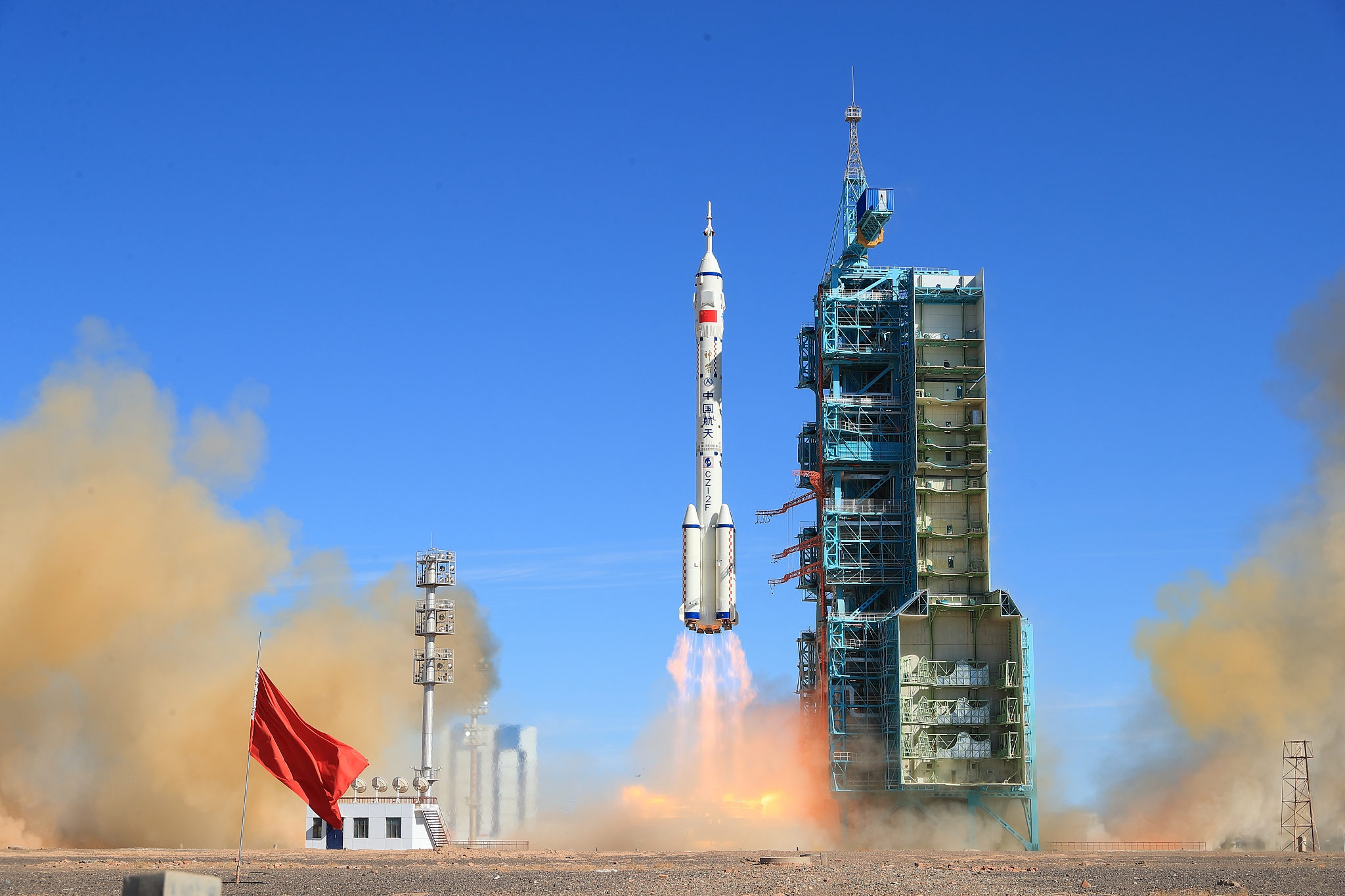
The manned Shenzhou-12 spacecraft from China's Manned Space Agency onboard the Long March-2F rocket launches with three Chinese astronauts onboard at the Jiuquan Satellite Launch Center on June 17 in Jiuquan, Gansu province, China.

KEVIN FRAYER/GETTY IMAGES

A Chinese spacecraft capable of flying to the edge of the atmosphere took off and returned to Earth on the same day in what China said was a big step towards developing reusable space transportation technology.

The spacecraft lifted off from a launch centre in northwest China on Friday and completed its flight according to “set procedures”, said China Aerospace Science and Technology Corp (CASC), the country’s main space contractor.

It then landed back on Earth “horizontally”, CASC said in a statement.

A spacecraft that can fly to suborbital space ought to be able to travel to as high as 100 km (62 miles) above the Earth’s surface. The CASC did not say how high the spacecraft flew, or elaborate on its flight path. Visuals of the spacecraft or its flight were not provided.

“The development of reusable space transportation technology is an important symbol of China’s transition from a ‘big’ space-faring nation to a ‘powerful’ space-faring one,” CASC said.

Reusable spacecraft would lead to higher frequency of missions and lower mission costs due to its reusability.

In September last year, China sent an experimental spacecraft into orbital space on a rocket. The spacecraft returned to Earth after two days in orbit on its low-key mission.

Commentators on Chinese social media have speculated that Beijing has been developing a spacecraft like the U.S. Air Force’s X-37B, an autonomous spaceplane that can remain in orbit for long periods of time before flying back to Earth on its own.

It is not known if both the orbital and suborbital spacecraft launched by China had fixed wings like the U.S. Space Shuttle.
A month in China Space Station: What's been done so far?

Updated 21:49, 17-Jul-2021
Gong Zhe

It's been a month since the Shenzhou-12 spacecraft carried the three Chinese astronauts, or taikonauts, to China's space station. As one of the most important missions for the manned space program, the Shenzhou-12 is a display of China's latest space technology.

The China Manned Space Engineering Office (CMSEO) on Saturday published a timeline of Shenzhou-12's progress so far. And here's a translation of it.

All timestamps below are in Beijing Time.

6:32 a.m., June 17, 2021: Taikonauts set off


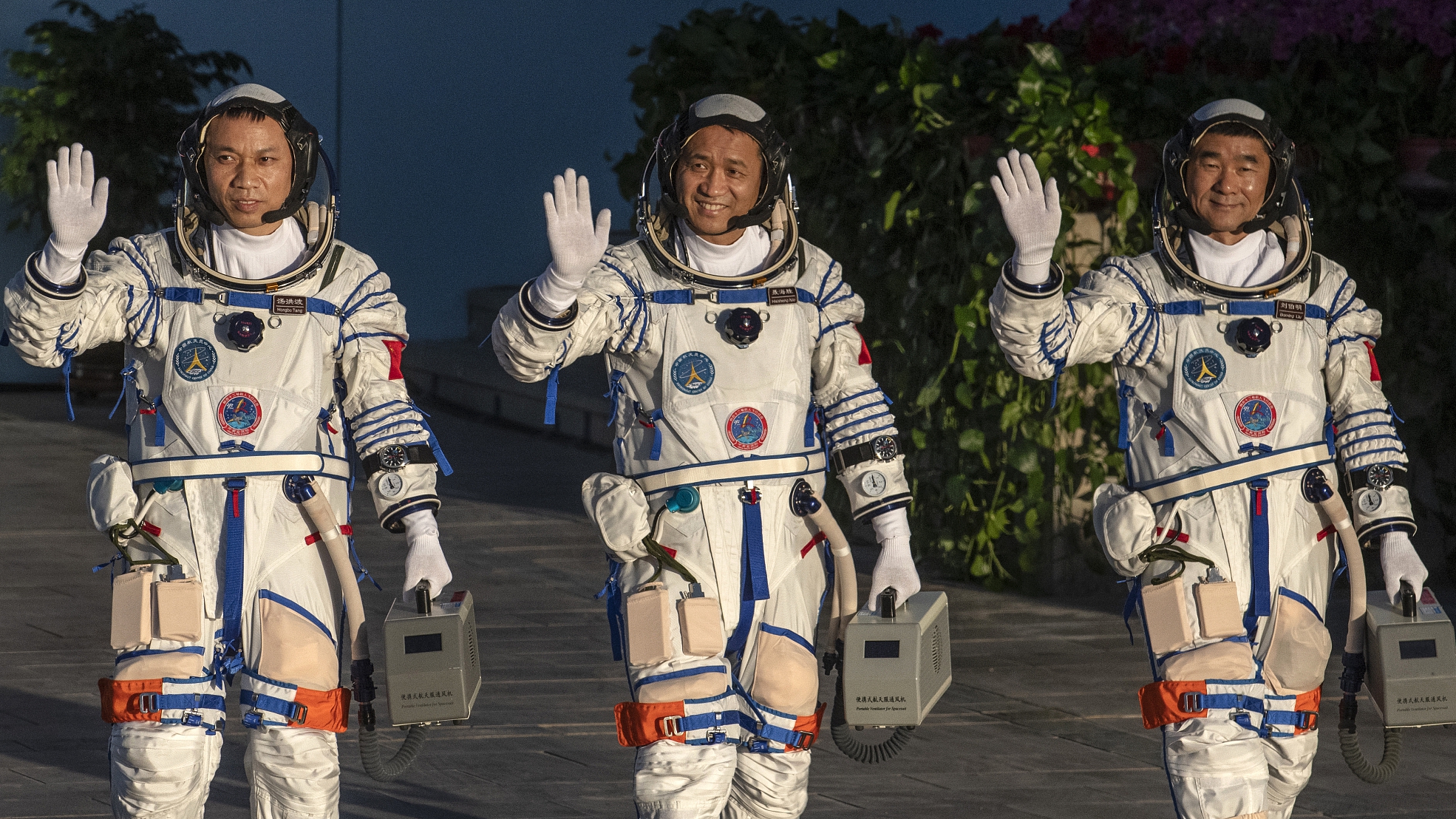
L-R: Tang Hongbo, Nie Haisheng and Liu Boming before the launch of the Shenzhou-12 spacecraft at Jiuquan Satellite Launch Center, June 17, 2021. /CFP


After fierce training sessions – including underwater work wearing 200-kilogram spacesuits – the three taikonauts, namely Nie Haisheng, Liu Boming and Tang Hongbo, have finally walked out of training center and boarded the Shenzhou-12 spacecraft.

"The most challenging task is not those training sessions. Instead, it's maintaining the passion of an explorer at heart," the CMSEO said.

Nearly three hours later: Rocket launched


A Long March-2F Y12 rocket, carrying the Shenzhou-12 spaceship with Nie Haisheng, Liu Boming and Tang Hongbo on board, blasts off from Jiuquan Satellite Launch Center in NW China, June 17, 2021. /CFP

A Long March-2F rocket carried the Shenzhou-12 to orbit from Jiuquan Satellite Launch Center. It took about 573 seconds for the rocket to put the spacecraft into space.

"It's been five years since the last taikonaut broke out of the atmosphere," the CMSEO said. "We are moving firmly to the goal we set."

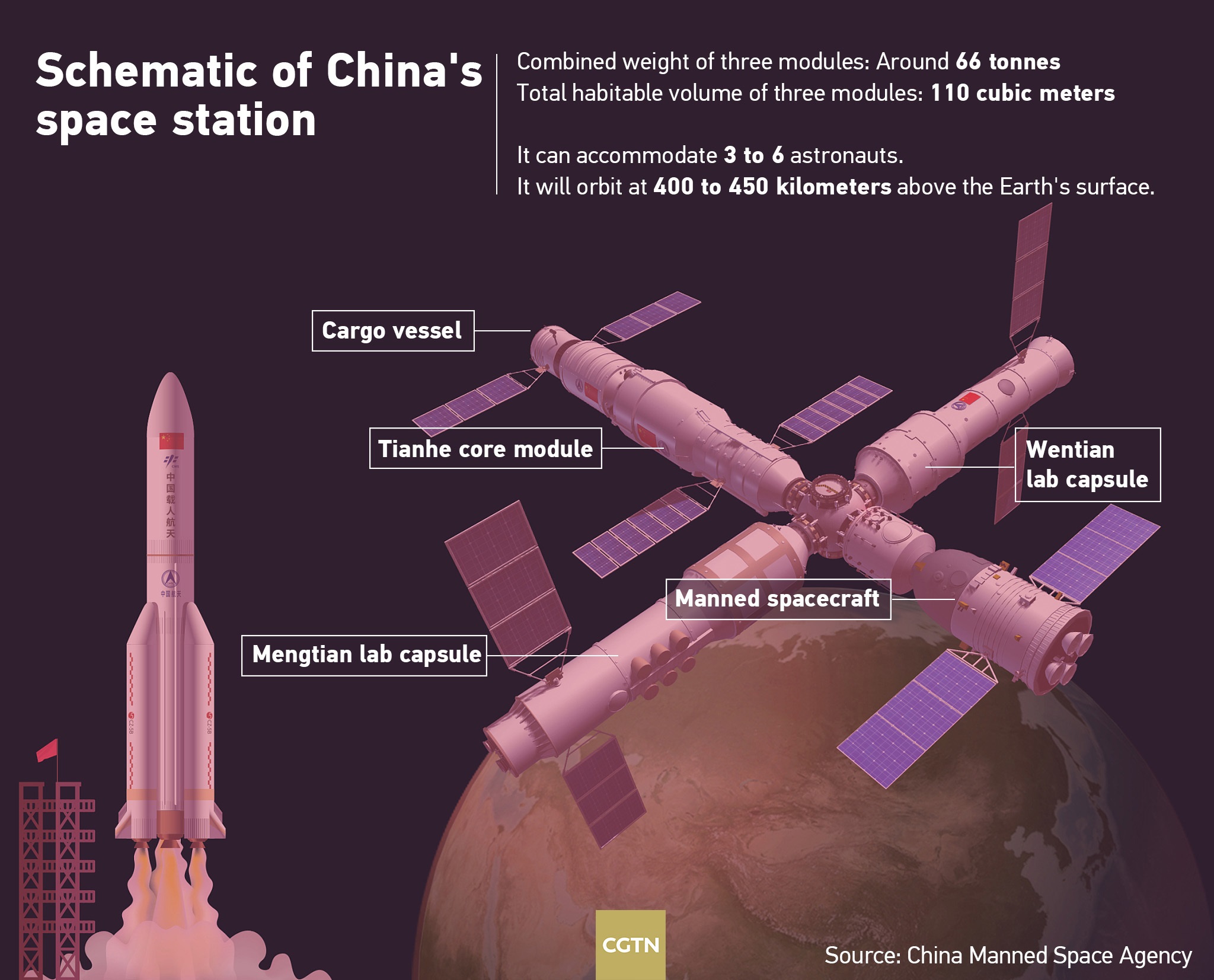
3:54 p.m.: Shenzhou-12 docked with the China Space Station core module


The core module of the space station – Tianhe – was already waiting on the orbit. Serving as a connector of other space station modules, it was launched back in April.

Already connected to the station is the Tianzhou-2, a cargo ship filled with supplies needed by the taikonauts to survive, work and have fun.

The docking between Shenzhou-12 and the China Space Station was done automatically by machines without human intervention.

6:48 p.m.: Taikonauts entered China's space station

Described by the CMSEO as a "milestone of a new age" for China's space exploration, the entrance means a lot for the Chinese people.

The three-person crew is expected to stay in the space station for three months, during which time they'll help set up the station and carry out some scientific research.

9:30 a.m., June 23: A video call from the president

Chinese President Xi Jinping made his first video call to the space station and extended his greetings to the taikonauts.

June 30: 'Happy birthday' from space


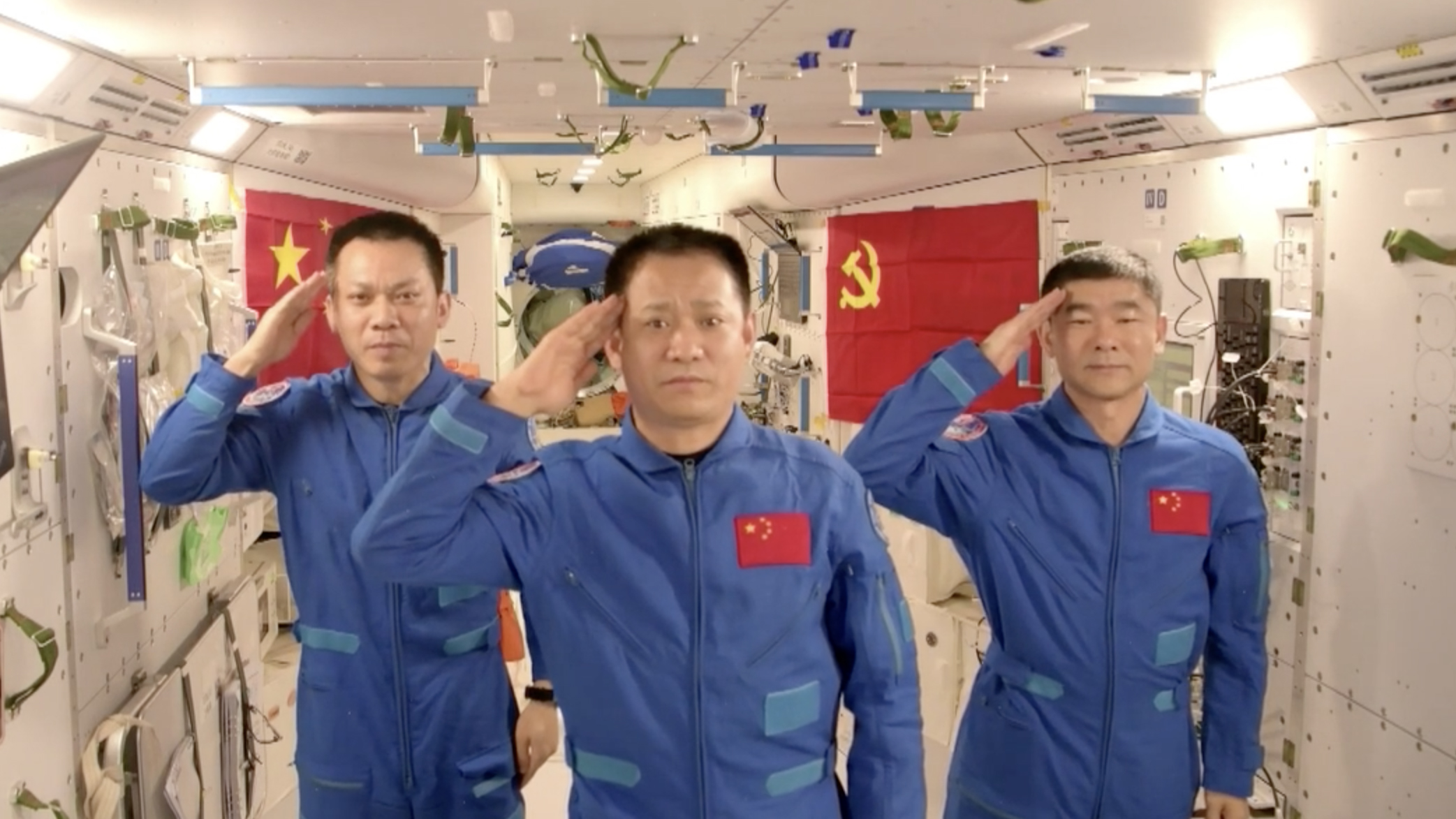
The three taikonauts sent birthday wishes to the Communist Party of China (CPC) from space, ahead of the CPC's centenary.

"Each success of the space program relates to the CPC's decisions, care and leadership," the CMSEO said.

8:11 a.m., July 4: Spacewalk with a robot arm

Two of the three taikonauts performed a seven-hour-long session outside the space station.

A robot arm helped Liu Boming to and from one place to another on the outside of the space station.

CMSEO said China's space program will carry on with their endeavor in space.
Working, dining, TV watching, exercising: A typical day in China Space Station

CGTN


One month has passed since the three Chinese astronauts, or taikonauts, moved into the Tianhe core module of China's space station Tiangong. Their daily life aboard the space station has been a novelty for people back on Earth.

Read more: A month in China Space Station: What's been done so far?

A China Media Group (CMG) reporter went to the Astronaut Center of China on Friday to take a sneak peek at the taikonauts' routine.

The trio started work at 8:00 a.m. Beijing time on Friday. They completed a platform inspection of the manned spacecraft and collected trace elements in the air in four hours.

Afternoon work began at 2 o'clock. On arriving at the center at about 4 p.m., the reporter saw Nie Haishang and Tang Hongbo replacing the carbon dioxide removal device, which is part of the environmental control and life support systems in the cabin.

They had dinner at around 6 p.m., as they do every day, and finished in one hour, after which they started watching "Xinwen Lianbo," the most-watched daily TV news program in China.

The support team on the ground regularly transmits news programs to the taikonauts, which is one of the primary means through which they are kept updated about things happening on the ground, according to CMG.

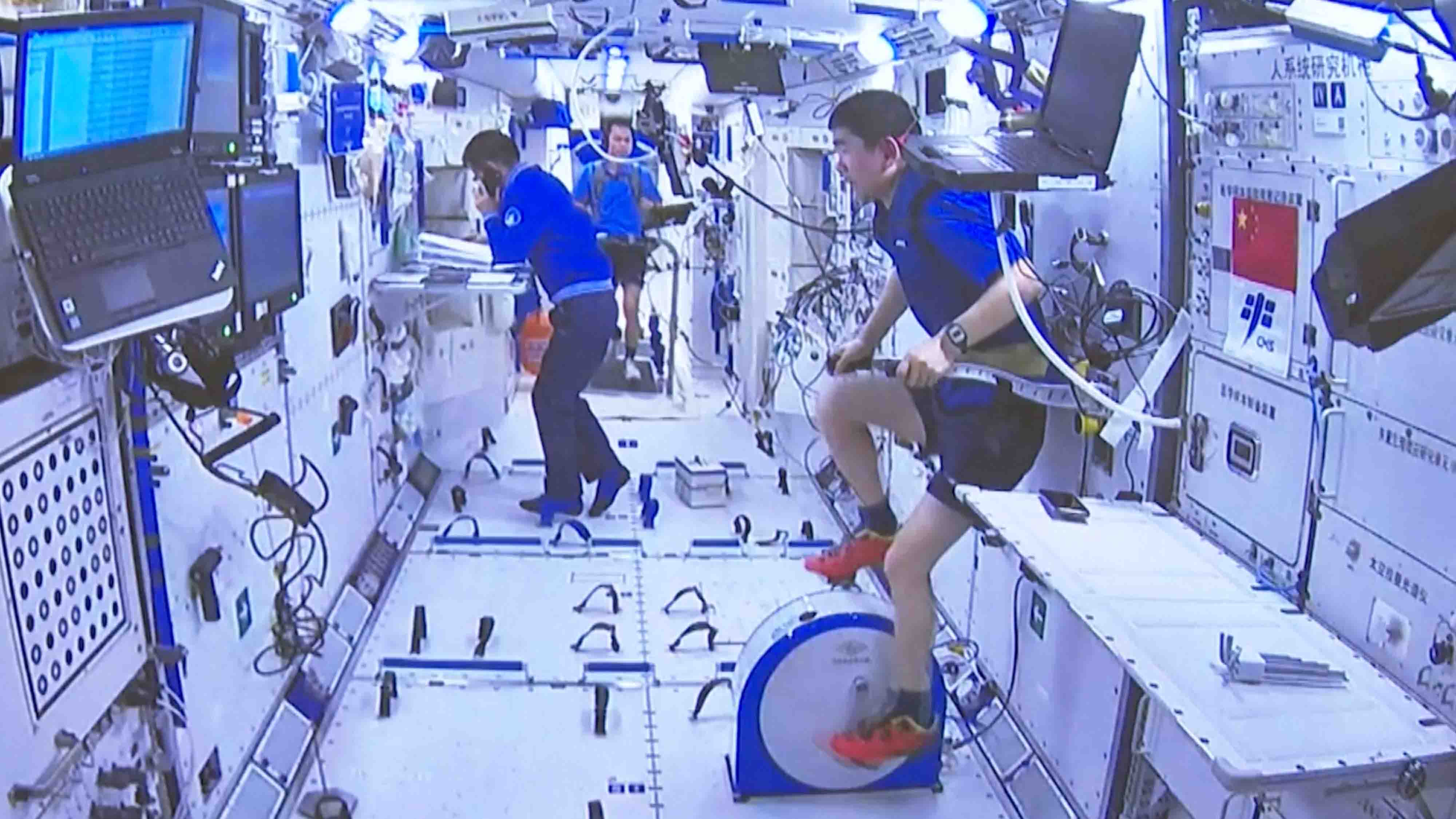
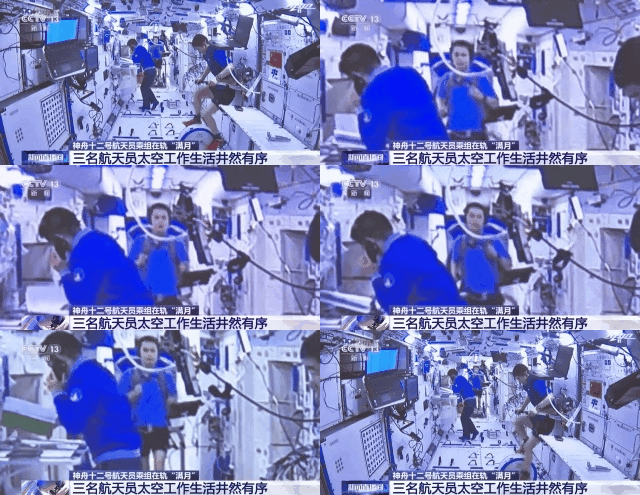
Working out is one of the top priorities to keep healthy in space. The taikonauts were provided with various customized fitness equipment, including a bicycle and a treadmill.


While Liu Boming exercised on the space bike and Tang was on the treadmill, Nie, as mission commander, talked to the ground crew about the day's work and plans for the next day.

"Exercising is a daily routine for them, and everyone has their 'prescription,'" said Li Yinghui, deputy chief designer of the astronaut system of China's Manned Space Program.

"The exercise intensity now is about 60 to 80 percent of their maximum capacity and will increase with their in-orbit time to sustain them against the physiological effects brought by weightlessness," Li explained.

As planned, the trio carried out the platform inspection of the core module, material transport, garbage storage, and space medical experiments on Saturday.


The World's Largest Astronomy Museum Opens  in Shanghai


POSTED ON JULY 15, 2021 BY MATT WILLIAMS

China has certainly been making its growing power and influence felt in recent years, especially when it comes to the realm of space exploration and science. In the past ten years alone, China has deployed the three space stations with their Tiangong (“Heavenly Palace”) program, unveiled the Long March 5 heavy launch rocket, and sent robotic missions to the far side of the Moon and the surface of Mars.

Here on Earth, facilities like the Five hundred meter Aperture Space Telescope (FAST) illustrate China’s growing accomplishments in space and astronomy. And on Friday (July 16th), the largest museum in the world dedicated to the study of space – the Shanghai Astronomy Museum – will open its doors. The purpose and design of this museum is to highlight China’s accomplishments in space and astronomy, as well as the country’s future ambitions in space.

The design was conceived by Ennead Architects, a firm with offices in New York and Shanghai that won an international competition in 2014 for their inspired creation. Their previous work includes New York’s Rose Center for Earth and Space at the American Museum of Natural History (AMNH). At 39,000 m2 (420,000 ft2), this new branch of the Shanghai Science of Technology Museum (SSTM) will be the largest of its kind in the world.

Architect’s impression of the museum at night. Credit: Ennead Architects

Inspired by the orbits of celestial bodies and the geometry of the cosmos, the layout of the SAM has no straight lines or right angles. According to Thomas J. Wong, a partner at Ennead and the museum’s lead designer, it was also inspired by the “three-body problem,” an as-of-yet unresolved question in classical physics of how to calculate the motion of three celestial bodies.

It is also the title of the novel written by celebrated Chinese science fiction author Liu Cixin, which was released in 2008 (translated into English in 2014) and is the first installment in his Remembrance of Earth’s Past series (which deals with extraterrestrials). As Wong explained in a video interview with CNN about the project:


“We really thought that we could leverage the architecture to bring incredible impact to this whole experience. The building is meant to be this embodiment of … astronomically inspired architecture. The reason why we thought the three-body problem was interesting is because it’s a complex set of orbits. (These are) relationships that are dynamic, as opposed to a simple circle around the center. And that was part of the (design’s) intent – to capture that complexity.”

According to Ennead’s website, the structure’s complex curvilinear shape is formed from three overlapping arcs, which is symbolic of how the museum is a celebration of “the continuum of time and space.” It also symbolizes a connection to the past and the future, being a modern “forward-looking” structure representative of China’s future ambitions in space, and a connection to China’s long history of astronomy.

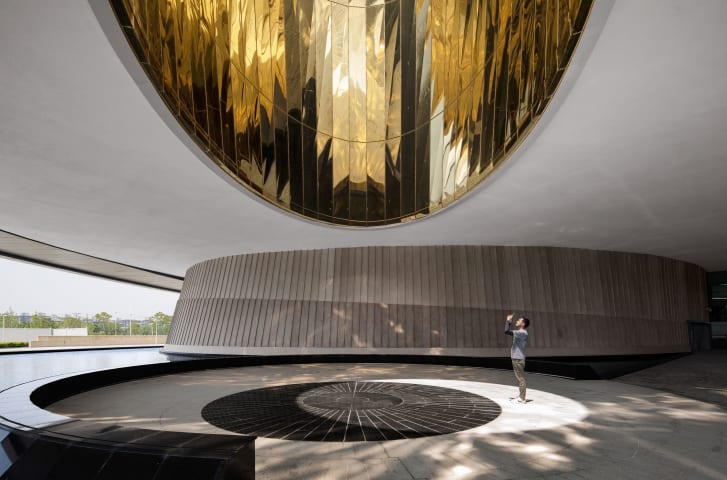
The Oculus and reflecting pool in the museum’s entryway. Credit: Ennead Architects

“In linking the new Museum to both scientific purpose and to the celestial references of buildings throughout history, said Wong, “the exhibits and architecture will communicate more than scientific content: they will illuminate what it means to be human in a vast and largely unknown universe.”

In Wong’s design, the geometry of the cosmos is conveyed through three arcing shapes: the Oculus, the Sphere, and the Inverted Dome. In addition to architectural features, these are also astronomical instruments that track the motions of the Sun, Moon, and stars (respectively). Each of these also houses an important visitor attraction, beginning with the Oculus located at the museum’s main entrance.

Suspended above the main entrance to the Museum, the Oculus produces a circle of sunlight that moves along the ground, across the entry plaza and a reflecting pool. At noon during the summer solstice, there is a full circle of light that aligns with a circular platform inside the museum’s entry plaza. In this respect, the Oculus acts as a timepiece and illustrates how Earth’s relationship with the Sun depends on the time of day and the season.


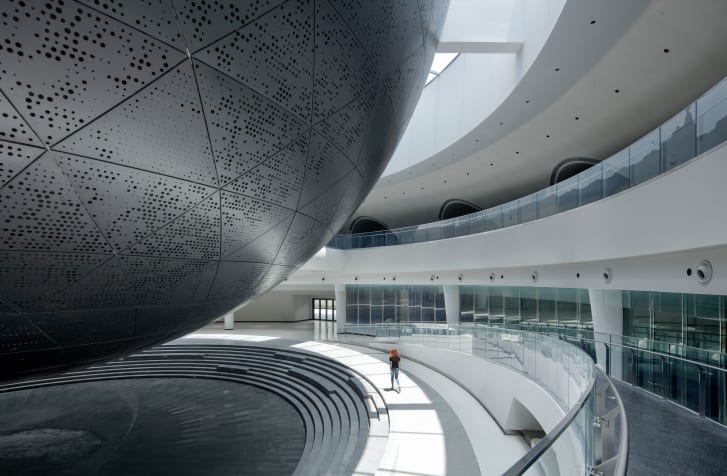
The next stop is the planetarium theater, which is submerged in the building with its underbelly emerging from the ceiling inside. With little visible support, it creates the illusion of weightlessness and alludes to the primordial shapes of planets, stars, and other celestial objects. Last, but not least, the sphere gradually emerges into view as visitors moved around the building, resembling a Moonrise on Earth’s horizon.
The planetarium, which is housed inside a large sphere in the museum. Credit: Ennead Architects

Last, there’s the vast inverted glass dome, a tension structure that sits atop the central atrium that gives viewers an unimpeded view of the sky. This dome contains a 720-degree spiraling ramp that and focuses the eye upwards towards the dome’s apex and gives visitors a chance to experience an unimpeded view of the sky. This represents the culmination of the simulated cosmological journey that is the Museum.

“We want people to understand the special nature of the Earth as a place that hosts life, unlike any other place that we know of in the universe,” as Wong put it. This museum will feature both temporary and permanent exhibitions, featuring immersive environments, artifacts and instruments of space exploration, and educational activities. It will also house a ~24 meter (78 foot) tall solar telescope, an observatory, a youth observation camp, and a Digital Sky Theater.


The exhibition already houses a very impressive collection of specimens, with over 70 samples of meteorites, some of which originated from Mars and the asteroid Vesta, and Moon rocks. The museum also has an impressive range of artifacts from over 120 collections, including original works by Galileo, Kepler, Newton, and other astronomers. The museum also has facilities that rely on augmented reality, virtual reality, biometrics, and artificial intelligence to simulate different kinds of astronomical experiences.

Seen from the sky, one can also get the impression that the museum looks like an astrolabe – an ancient device was essentially a handheld model of the universe. From classical antiquity and the Islamic Golden age to the High Middle Ages and “Age of Discovery, this instrument was used by astronomers to measure the altitude above the horizon of a celestial body, identify stars and planets, determine local latitude or time, and navigate at sea.

The “wheels within wheels” configuration of the main structure are also reminiscent of ancient and Renaissance cosmological maps that show the orbits of the planets around the Sun. The elliptical shape of the main buildings is also highly reminiscent of Kepler’s depiction of elliptical orbits. For that matter, it also calls to mind a traditional timepiece, where its interlinked structures and concentric circles grounds resembling gears and wheels.

And as for the planetarium, I dare anyone to say with a straight face that it doesn’t remind them of the big sphere from Sphere (look it up, you’ll see). The museum will be open to the general public next Monday (July 19th), but many have already witnessed the Astronomy Museum’s exhibits and displays through special tours. For those of us who can’t make the trip, the competition video posted above provides a nice walk-through.

For more information, check out Ennead Architects‘ website.

Further Reading: CNN, Ennead Architects

FIDE WORLD CUP  OF CHESS HIT BY COVID

Hoping for the best


Amid an inequitable vaccine rollout in different parts of the world and new variants of the Covid-19 virus creating uncertainty even in first-world countries, a chess event that sees players arriving from five continents is taking place in Sochi. To deal with the situation, the International Chess Federation has put forth a public health and safety protocol, which includes daily checks for temperature and symptoms, in addition to periodic Covid-19 tests.


The Winawer Variation in just 60 minutes - that can only work by reducing it to a clear repertoire for Black and, where possible, general recommendations rather than variations. Alexei Shirov was surprised at how quickly he managed to make of the French Winawer an opening he himself could play. And now he will let you share in his conclusions.

Following the protocol, it was announced before the start of the second round that third seed Levon Aronian would not play his first game against Australian GM Bobby Cheng. The Armenian had a fever earlier this week and “even though he felt well today, in order not to risk the safety of the other players it was decided that he would withdraw from the first game, and undergo additional health tests before deciding if he is fit to play in the second game” (FIDE).

Although this was a bit of a worrying factor, more concerns were raised later in the day when it was confirmed that a player had tested positive for Covid-19. In a field that includes 309 players, this should not come as a massive surprise — however, the fact that the news broke once the games had started was the real issue. Anish Giri tweeted, after beating Boris Savchenko with the white pieces:

FIDE explained that privacy regulations prevent them from disclosing the name of the player who had tested positive and, given the elephant in the room (pointed out by Giri), explained:

The player who has been forced to forfeit his game today had been tested before his trip, and then again in Sochi on July 10th, July 11th, and July 14th. After three negatives, it was this last test the one that turned out to be positive.

The health agency that runs the tests for the event should have alerted FIDE of any positive before 1PM, local time. However, for reasons that we are investigating now, FIDE was not informed about the result of this test until 15:21, when the game had already started.

FIDE did the only thing that was possible in the circumstances: to immediately stop the game, isolate the players, and provide medical advice to them.

During the day, it was also known that Indonesian IM Mohamad Ervan had forfeited his first-round match against GM Nodirbek Abdusattorov after his mandatory test upon arrival had turned out positive. Ervan was one of four players who made their way to Sochi from Indonesia, together with Irene Sukandar, Medina Aulia and Susanto Megaranto. It was GM Megaranto, Fabiano Caruana’s opponent, who left the board mid-game on Thursday. Caruana tweeted:


Much like the ever-courteous Caruana, we expect for this to be an isolated issue that gets resolved without further consequences for the players or the tournament.


Fabiano Caruana | Photo: Anastasiia Korolkova

Update: Irene Sukandar and Medina Aulia decided to withdraw from the tournament despite having tested negative for Covid-19.

Levon Aronian also decided to withdraw. He wrote on Facebook

Dear all, with great regret I have to inform you about my withdrawal from the FIDE World Cup 2021. Having a high fever and tonsillitis, despite my great desire to play, I have to be rational and put mine, and the health of other players first.

No major surprises


The first games of round 2 saw most favourites taking wins or draws in both sections. Magnus Carlsen made his debut and had no trouble beating Croatian GM Sasa Martinovic with the black pieces — coincidentally, yesterday was Martinovic’s 30th birthday!

Before the start of the round, the world champion received the Fair Play Svetozar Gligoric award, in recognition to his “exemplary behaviour that promotes the spirit of fair play and sportsmanship in chess”. In July last year, the Norwegian politely resigned a game against Ding Liren on move 4 after the Chinese star had lost the previous encounter due to a disconnection.


Keeping the mask on — world champion Magnus Carlsen | Photo: Anastasiia Korolkov

Check This Chess-Playing Raspberry Pi Robot

By Ian Evenden 3 days ago

Not that kind of Single Board Computer
(Image credit: Joey Meyer)

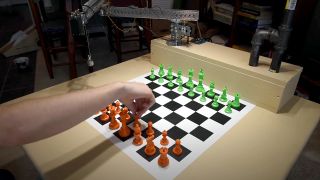
Sounding like some sort of delightful fruit confection, but in reality a cold, hard, machine of war surely destined to rule us all one day, the Raspberry Turk is a robot that plays chess powered by a Raspberry Pi. Not a chess computer like Deep Blue, but an actual robot that can see the pieces and move them using a robotic arm. The project was created by Apple software engineer and chess fan Joey Meyer.

As you will have probably guessed from the name, the brains behind this Turk come from a Raspberry Pi 3 which uses OpenCV to see the game pieces and a servo controlled arm and gripper to hold and move the pieces. Inspiration comes from the Mechanical Turk, a fake chess-playing machine constructed by an Austrian inventor that toured Europe between the end of the 16th and middle of the 17th centuries.

The Mechanical Turk’s secret was not the fiendishly clever mechanism, nor the beautifully polished cabinet or human-like automaton that sat upon it, but the very small chess player secreted within the woodwork. The Raspberry Turk, by contrast, is written mostly in Python, with the code available on GitHub, and takes advantage of the open-source Stockfish chess engine. It stands upon a wooden table into which it would be difficult to insert even the smallest, flattest Grand Master.

With all the electronics kept neatly in a wooden box at the side of the board, the robot arm (made from Actobotics components) and camera module are all that hang over the board, which is painted directly onto the table top. The Raspberry Turk takes around 30 seconds to make a move, and the pieces have embedded metal studs to make grasping them easier using an electromagnet built into the arm. Meyer trained the computer vision model by hand, moving pieces himself and taking multiple images of every possible position. If you fancy having a go yourself, Meyer’s notes on the project are also available to peruse.


 GREENWASHING PART DEUX

Nuclear-powered cryptomining gets greenlight - report

Kitco News


Well, uranium juniors should support this.

Talen Energy said it has permits in hand and can mine cryptocurrencies using nuclear power from Susquehanna Steam Electric Station based in Allentown, Pennsylvania.

Data Centre Dynamics reported the news.

The project will have two phases. Talen will start with 164MW of capacity, but will eventually build out to 300MW. The project can be expanded to 1GW capacity if there is demand.

Talen said the project will come online in the Q2 2022.

Susquehanna Steam Electric Station has capacity for 2,500 megawatts. Talen said it is one of the biggest plants in the U.S. The plant employs over 900 staff. The plant was commissioned in the mid-80s.

Talen is touting that the cryptocurrency mining will not require burning any fossil fuels.

"As the demand for energy increases among data center and cryptocurrency processing clients, so does the call for decarbonizing these energy sources. Talen Energy is constructing a hyperscale data center campus adjacent to its Susquehanna nuclear generation facility,” according to a company presentation obtained by Data Centre Dynamics. “It will provide low-cost, reliable, carbon-free power to the data center clients on campus. This allows clients to benefit from carbon-free, 24/7 power being supplied directly to the campus, without the intermittency that renewable energy can experience, or requiring fossil fuels."

On its website Talen describes itself as an independent power generation infrastructure company that owns or controls approximately 13,000 MW of generating capacity in well-developed, structured power markets throughout North America. The company has a mix of nuclear, natural gas, coal and solar power plants in its portfolio.

Last month the El Salvador government announced it would start mining bitcoin using geothermal energy. The country also made bitcoin legal tender.

GREENWASHING


IS NUCLEAR POWER THE FUTURE OF BITCOIN MINING?

As the bitcoin mining industry grapples with criticism over its energy use, nuclear power is emerging as its source of the future.

JESSIE WILLMS
JUL 16, 2021

The Bitcoin network’s share of global carbon dioxide emissions is only about 0.13% of the global annual total — approximately 47 million tons of a rough total 37 billion tons, by some estimates. But despite the fact that many bitcoin mining firms use renewables for a significant amount of their energy needs, Bitcoin is under sustained attack for its consumption.

It is becoming clear that the biggest challenge for bitcoin mining right now is no longer just finding the best mining equipment (as Chinese miners have shut down over a regulatory crackdown and apparently freed up a significant amount of equipment). It is how to answer so-called environmental, social and governance (ESG) concerns about energy use and climate change.

Throughout the U.S., there are regions that are expanding their nuclear power capabilities and numerous examples of bitcoin mining firms pivoting to nuclear power, a carbon-free source that should help to answer those concerns.

In Ohio, in what the companies are calling a “groundbreaking climate-friendly agreement,” Energy Harbor and Standard Power are partnering to provide nuclear power to a new bitcoin mining center in Coshocton.

Compass Mining has seemingly leapfrogged the competition, skipping the nuclear reactor step and going straight to nuclear fission in a 20-year agreement with California-based advanced fission company Okla to mine bitcoin with nuclear power.


It also appears that the stage is being set for nuclear-powered bitcoin mining in Wyoming, which is partnering with Bill Gates’ TerraPower to build a “modular” new nuclear reactor to help reduce the state’s dependence on fossil fuels.

CONVERTING AN ABANDONED PAPER MILL INTO A BITCOIN MINING CENTER IN OHIO


Two companies in Ohio are pioneering a project that will bring a nuclear-powered mining center to Coshocton, Ohio.

Standard Power, an infrastructure and hosting provider, is converting an abandoned paper mill into a state-of-the-art nuclear powered bitcoin mine. Energy Harbor, an independent power producer, is committing to supply clean, reliable nuclear power for five years, starting in December 2021, to this bitcoin mining facility and to stabilize the grid when necessary by reducing its power usage.

“Standard Power will also be providing valuable reliability and stability to the transmission grid by completely shutting down operations when the electric grid and other Ohio customers need the power the most,” according to the announcement.

COMPASS MINING GOES STRAIGHT TO NUCLEAR FISSION

Compass Mining, an online hosting and retail service helping miners get set up, has signed a 20-year agreement to launch a nuclear fission mining operation.

Conscious of the growing demand for “clean” energy, California-based energy company Oklo is pioneering the use of nuclear fission and, according to an announcement, is the first advanced fission company to have its license to construct and operate a power plant accepted for review by the U.S. Nuclear Regulatory Commission.

“We are proud to blaze new trails on the commercialization of our powerhouses by partnering with Compass in decarbonizing Bitcoin,” said Jacob DeWitte, CEO of Oklo, in the announcement.

WYOMING IS PAVING THE WAY FOR NUCLEAR BITCOIN MINING


As one of the U.S.’s biggest net suppliers of energy (it produces 14-times more energy than it consumes), Wyoming is already well positioned in its quest to become a bitcoin mining mecca.

As the state’s energy grid currently uses almost 90 percent fossil fuels, Wyoming is moving toward greener energy by partnering with Bill Gates’ company TerraPower to build a new style of nuclear reactor in an abandoned coal plant.

According to TerraPower, its new modular reactor, called a Natrium, is the next stage of advanced nuclear power technology and will guarantee reliable, cheap power for future bitcoin miners.

“Once operating, the Natrium plant is estimated to produce nearly 3 million megawatt hours of carbon-free power each year and avoid almost 2 million metric tons of carbon,” the U.S. office of nuclear energy said of the project. “It will also avoid other pollutants that lead to smog and acid rain to improve the overall air quality in the region.”

Recognizing that the new reactor will create thousands of construction jobs and hundreds of permanent jobs, the U.S. Department of Energy is investing nearly $2 billion to support the licensing, construction and demonstration of this first-of-a-kind reactor by 2028.


And it seems likely that this growing emphasis on nuclear power will soon be enjoyed by Bitcoin miners, as the state’s U.S. Senator Cynthia Lummis, an outspoken advocate for Bitcoin, continues to foster the industry.

“Wyoming powers America, and I’m proud of the work that Governor Gordon and Senator Barrasso have done to advance nuclear energy production here,” Lummis recently tweeted. “It’s great to see TerraPower and PacifiCorp recognize what we in Wyoming have always known: there’s no better place to do business.”

IS BITCOIN’S FUTURE NUCLEAR?

In the end, mining companies are looking for the cheapest energy available and it may be that nuclear power will become one of the most inexpensive sources in the years to come. If miners can access cheap power in nuclear sources, that will be a formula for long-term success.

Mining consultant and cofounder of Citadel 256 Magdalena Gronowska believes that ultimately, a mix of renewables like wind and solar power along with nuclear power will be a best case scenario.

“Nuclear is a carbon free, reliable and cheap energy source,” she told Bitcoin Magazine. “It's not perfect in that it emits nuclear waste, but every energy source has tradeoffs between environmental footprint, reliability and capital and operating costs… We need a diverse mix of energy generation, to serve both baseload and peak load, as we transition to a low carbon economy.”
TAGSBITCOIN MININGENERGY CONSUMPTIONWYOMINGNUCLEAR POWER
Gen Z kids are the ‘Greta Generation’

A new study has shown young children care more about climate change than their peers or fashion


The Big Zero report
Kiran Bose
Friday 16 July 2021


GRETA QUEEN OF THE MAY
Image: Liv Oeian / Shutterstock


Kids these days care more about climate change and sustainability than fashion or what their friends think.

That is according to new research by GWI, which has labelled Generation Z kids the ‘Greta Generation’.

GWI delved into the behaviours and beliefs of more than 15,000 children aged 8-15.

The findings show that almost half of 12-15 year-olds feel that caring for the planet is important to them, which is higher than the priorities stereotypically associated with young adolescents.

Their peers’ opinions were important to only 28% of the teens and only 23% prioritised being up to date on fashion trends.

The research found that teens now expect a commitment from brands on climate change and environment before they consider buying, which GWI claims highlights the influence Greta Thunberg has on young people today.

The research also found that 15% of 12-15 year-olds are interested in vegan or vegetarian food, with 22% saying they choose what they eat. GWI suggests that Generation Z seem used to more autonomy with the power of online streaming and deciding what they would like to do or watch and if given the option, would have a meat-free diet.
PRIVATIZED WATER
UK
Environment Agency: ‘Certain water companies fall short of their environmental responsibilities’

Last year saw the second-highest number of serious pollution incidents since 2015, a new report suggests

The Big Zero report
Dimitris Mavrokefalidis
Thursday 15 July 2021


Image: Shutterstock

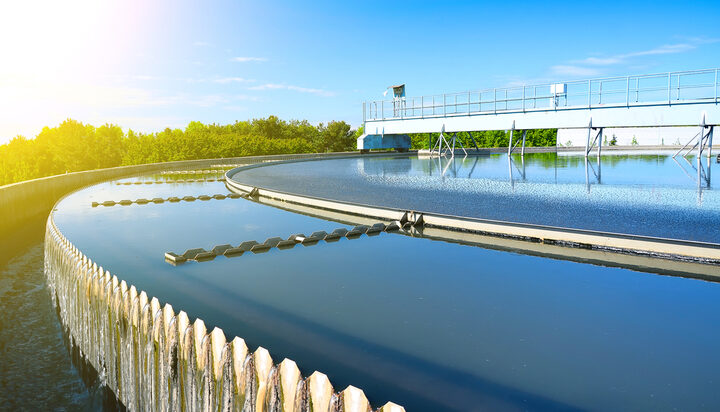
A number of water firms are still failing to deliver on their responsibilities to the environment, regulators and customers.

In its annual report on the environmental performance of companies, the Environment Agency suggests despite some improvements last year, no single company out of England’s nine water and sewerage companies achieved all the expectations for the period 2015 to 2020.

These include the reduction of total pollution incidents by at least one-third compared with 2012 and for incident self-reporting to be at least 75%.


The body also found that although serious pollution incidents declined in 2020 for the second year in a row, this was still the second-highest number of total incidents since 2015.

Southern Water and South West Water were rated as two-star, meaning that their practices require improvement.

Thames Water and Anglian Water were rated as three-star which translates to good performance.

Finally, five companies, including Northumbrian Water, Severn Trent Water, United Utilities, Wessex Water and Yorkshire Water achieved four stars and certain improvements are still required.

The analysis shows that Severn Trent Water, United Utilities and Wessex Water kept the highest level of performance for most of the last five years.

The report follows a £90 million fine for Southern Water after pleading guilty in court to unpermitted pollution discharges.


Environment Agency Chair Emma Howard Boyd said: “Over half the water sector is now achieving the highest industry rating, showing that clear targets and regulatory focus combined with investment in the environment delivers change in the water sector.

“But, some companies are still failing in their duty to the environment and there remains a tendency to reach for excuses rather than grasp the nettle.”