Sunday, July 18, 2021

Ethiopia: Authorities Must Release Tigrayans, Activists and Journalists - and Reveal Whereabouts of Unaccounted Detainees


Yan Boechat / VOA
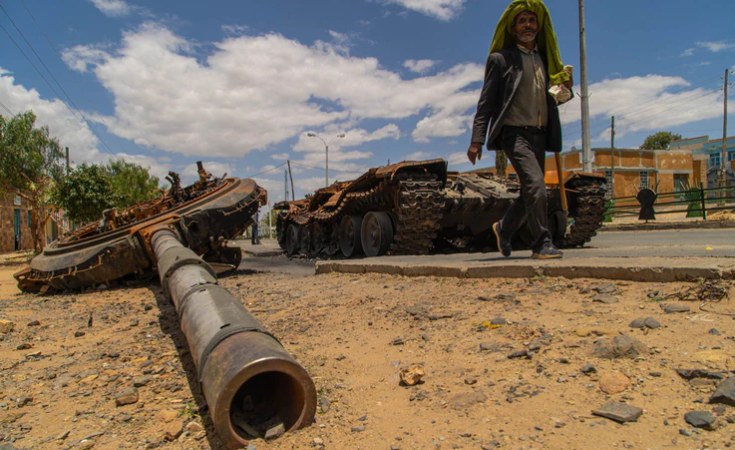
A man passes by a destroyed tank on the main street of Edaga Hamus, in the Tigray region, in Ethiopia, on June 5, 2021.

16 JULY 2021
Amnesty International (London)

Arrests seem ethnically motivated and while some people released on bail, hundreds remain in detention

'[The government] must ensure that all detainees are protected against torture and other ill-treatment' - Deprose Muchena

Police in Addis Ababa have arbitrarily arrested and detained vast swathes of Tigrayans, activists and journalists without due process, following the recapture of the Tigray region's capital, Mekelle, by forces from the Tigray People's Liberation Front (TPLF), Amnesty International said today.

The arrests appear to be ethnically motivated, with former detainees, witnesses and lawyers describing how police checked identity documents before arresting people and taking them to detention centres.

Deprose Muchena, Amnesty International's Director for East and Southern Africa, said:

"We are urging the Ethiopian government to end this wave of arbitrary arrests, and to ensure that all detainees are either promptly charged with internationally recognised crimes and given fair trials, or immediately and unconditionally released.

"The government must also inform families of the whereabouts of those detained and ensure that they have access to lawyers and their relatives. Not disclosing the fate or whereabouts of detainees is committing the crime of enforced disappearance. They must also ensure that all detainees are protected against torture and other ill-treatment."

Former detainees have told Amnesty that police stations are filled with people speaking Tigrinya, and that authorities had conducted sweeping mass arrests of Tigrayans.

While some people have been released on bail, it is thought hundreds of others remain in detention, and their whereabouts unknown. Amnesty is not aware of any internationally recognisable criminal charges against those still in detention who were arrested in these cases documented by the organisation.

Ethiopian law requires police to present detainees in court within 48 hours of arrest to review the grounds for arrest. Promptly bringing detainees before a judicial authority is an important safeguard against torture, ill-treatment and enforced disappearance.

Beaten, harassed, arrested

Amnesty remotely interviewed 14 people in Addis Ababa, including former detainees, eyewitnesses to arrests, and relatives and lawyers of those still in detention.

One man, who was arrested in the Merkato area on Friday 2 July, told the organisation that police raided his business at around 7pm. They harassed and beat customers and employees and demanded to see their identity documents, before taking five people - all ethnic Tigrayans - to the nearby Woreda 6 police station. Identification cards in Ethiopia identify the ethnicity of the holder.

The shopkeeper, who was among those arrested, said:

"They kept us on the open-air and it was raining the whole night. We also stayed there the next day on Saturday. More people of Tigrayan origin joined us during the daytime on Saturday. We were 26 Tigrayans arrested in the station that day."

Nineteen people were released the next day - some after presenting a bond - but the rest were taken to Awash Arba area in Afar Region, 240 km east of Addis Ababa, according to those interviewed by Amnesty. The shopkeeper was released on Saturday evening, only to learn that his brother was among those being held at Awash Sebat. He said:

"The next day I was told my brother is also arrested. He called us from Awash Sebat using a phone line of another person. He told us he is taken there by the police with many people. I know some of the people arrested with him."

Tsehaye Gebre Hiwot, who works at a tyre maintenance shop near Gotera, was arrested by police together with a relative, Haile Girmay, on 3 July. A family member told Amnesty that she had visited Tsehaye Gebre Hiwot in the nearby police station. She said:

"When I visited him, I saw many other Tigrayan broomsticks and mopper vendors [a business traditionally associated with people of Tigrayan origin] arrested there. They were all speaking in Tigrinya. I don't know if they are released or taken with him."

A further nine witnesses told Amnesty that they had seen dozens of Tigrayans detained in Tekle Haimanot - 5th Police Station, Gerji, Federal Police Remand Centre, and Merkato police stations when visiting detained friends and relatives. One man, who said five of his friends had been arrested in a raid on a dormitory hall on 2 July in Tekle Haimanot, said he saw about 50 Tigrayans in the 5th police station when he visited on 3 July.

Amnesty also heard of similar pattern of arbitrary arrests targeting Tigrayan residents in Awash Sebat, a town in Afar Region 200 km to the east of Addis Ababa. One witness said that five Tigrayan business owners in the town, including her husband, were arrested on 3 July. She said:

"He and many other Tigrayans in the town were arrested that day. They stayed in the police station of the Federal Police until 7 July before they were transferred to Awash Arba Prison at a place called Berta. They were taken to a court in Awash Arba on 7 July and the court remanded them until 19 July. Then the police took them to the prison. The prison is around 35km away from Awash Sebat. We visit and deliver them food and clothes in the prison."

Activists and journalists targeted

Tsegaze'ab Kidanu is an Tigrayan living in Addis Ababa, who has been coordinating humanitarian assistance for people affected by the conflict in Tigray. He is also a volunteer managing media relations for an association called Mahbere Kidus Yared Zeorthodox Tewahido Tigray. On 1 July, a day before his association released a statement on the human rights situation in Tigray, he was arrested at his home.

Tsegaze'ab's family and lawyer visited him at the Federal Police Remand Centre on 2 and 3 July, but when they returned on 4 July he was not there. According to Tsegaze'ab's lawyer, they later heard from another detainee that he had been taken to Awash Arba. His lawyer was also never informed of charges brought against Tsegaze'ab.

The lawyer also shared the names of 24 Tigrayans who were arrested from various neighbourhoods of Addis Ababa between 30 June and 8 July. The lawyer told Amnesty that one detainee, released on bail on 5 July, was charged with having 'links with TPLF' which is designated as a terrorist group by the Ethiopian government.

Journalists and media workers who have been reporting on the situation in Tigray have also been detained without due process. On 30 June, police arrested 11 journalists and media workers working for Awlo Media and Ethio Forum, YouTube media outlets who have been covering the conflict and the human rights situation in Tigray, along with their lawyer.

A lawyer and family members interviewed by Amnesty said that they were able to visit the detainees on 1 July, but since 2 July their whereabouts have been unknown and they also have no information on whether the detainees have been charged with any crime or not.

A relative of one detainee said:

"On Friday [2 July], the police told us that they released them early in the morning around 6 pm. But none of them came to their house or called us. When we asked them repeatedly, the police said, we [police] don't know where they are, don't ever come again'. We have been looking for them since then."


Read the original article on AI London.

Forest growth can be stunted by noise pollution, study shows

Nathan Howes 2 hrs ago

It's no secret that noise can be disruptive to animals and humans, but a new study has found that it can also prevent forests from growing.

Duration 1:04 Noise pollution in urban areas can have negative impacts on animals, mammals


A New Mexico woodland mostly consisting of pinyon pine and juniper trees, researchers discovered there are less tree seedlings in sites with noisy backgrounds than in tranquil locations.

MUST SEE: Earth is shaking less due to coronavirus lockdowns and social distancing

The area that was examined has many natural gas wells, some that are quiet while others have compressors that make a consistent commotion. This allowed the researchers to compare sites that were alike other than the noise level.

"We found support for long-term negative effects of noise on tree seedling recruitment, evenness of woody plants and increasingly dissimilar vegetation communities with differences in noise levels," outlined in the study, conducted by Jennifer N. Phillips, Sarah E. Termondt and Clinton D. Francis.

© Provided by The Weather NetworkA new study indicates the effects of noise on forest growth could be long-lasting and an immediate removal of it may not result in a quick recovery. Photo: Andrew Coelho/Unsplash.

For at least a 15-year period, the fact-finders found only about 13 pinyon seedlings and four juniper seedlings per hectare, whereas 55 pinyon seedlings and 29 juniper seedlings per hectare were uncovered in peaceful areas.

It was documented that pinyons only generate seeds once every five to seven years, so recovery time is a slow process. In prior noise-filled sites that had been silent for the previous two to four years, junipers had begun to grow one more, but pinyon seedlings were still limited.

It wasn't just those plants that were affected, according to the study. The noise was found to be a problem for the entire vegetation community, with various wildflower and shrub species in control in loud versus quiet sites.

ALSO SEE: New study suggests music festivals can be stressful to fish

It was also discovered that seedling efforts and plant community configuration didn't recover following the removal of the noise sources, possibly partly due to a lag in recuperation among animals that disperse and pollinate plants.

"Our results add to the limited evidence that noise has cascading ecological effects. Moreover, these effects may be long-lasting and noise removal may not lead to immediate recovery," the authors said in the study.

The full findings were recently published in Proceedings of the Royal Society B.

Thumbnail courtesy of Andrew Coelho/Unsplash

Find Nathan Howes on Twitter.
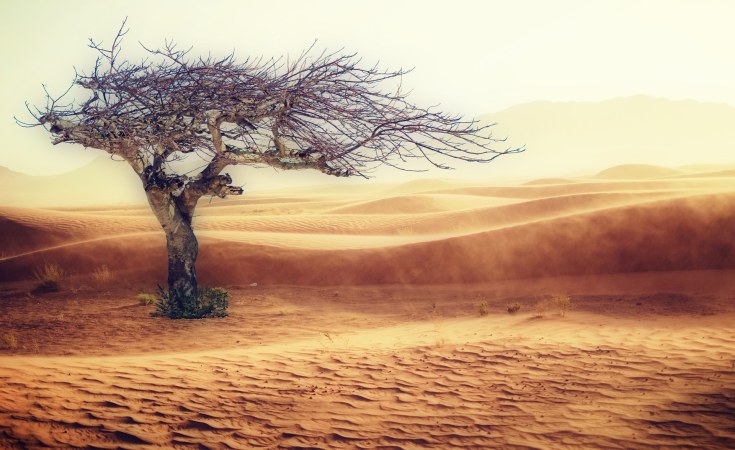
Nigeria to Lose Vegetation By 2039 Unless... - Climate Specialists

Pixabay
climate change drought water

18 JULY 2021
Vanguard (Lagos)

July 18, 2021

...As Solidaridad inaugurates Multi Stakeholder Platform for sustainable Oil-palm production in Kogi

By Boluwaji Obahopo - Lokoja

By year 2039, Nigeria may have lost all its vegetation and experience serious environmental hazard unless urgent steps are taken to reverse the trend.

Senior Climate Specialist and County Director of Solidaridad West Africa, a solution-oriented Civil Society Organisations, Dr. Sam Ogallah stated this, weekend, in Lokoja during the inauguration of Multi-Stakeholder Platform (MSP) for Sustainable Climate Smart Oil Palm production among communities in Kogi.

Dr Ogalla said unless Nigeria adopts the plantation of sustainable climate smart crops, the country faces a serious climate vulnerability in less than 20 years.

He said the inauguration of the Multi-Stakeholder Platform for sustainable climate Smart Oil palm production was part of the National Initiative on Sustainable Climate Smart Oil Palm Smallholder (NISCOPS) project.

Ogalla said that the setting up of the MSP was informed by the result of the studies the organisation conducted in 2019 in the oil-palm sector in Oil-palm Producing States in Nigeria including Kogi, Enugu, Akwa-ibom and Cross Rivers states.

"We conducted climate vulnerability Analysis studies that gave us a red alert on what we are likely to face between now and the next 30 years if things are not done differently.

"Aerial photos and images taken in the course of the study had shown sustained degradation of the ecosystem. We compared the land use, vegetation and land cover as at 1949 and and projected it to 2039.

"We now see that by 2039, most of what we have now will become rare as there will be no vegetation again; due to lack of proper planning of settlement areas among other degrading human activities".


Delta embarks on vegetation control

He said that Solidaridad also conducted analysis on Gender Inclusion and Gender Participation in the oil palm value chain and discovered a lot of biases against women and youths from the report.

"Access to land for women and youths is also an issue. Favourable land tenure system is also an issue. Who has the right to land, who owns the land. We have seen this play out in various communities.

"So the essence of this MSP is to be able to meet with the people who are the custodians of the land and see how we can help with re-orientating and sensitising them, build their capacities so that they can see and do things differently."

Ogalla said that the studies also revealed that farmers had limited knowledge of best management practices and were overwhelmed with issues of non-application of improved planting materials and inefficient palm-oil processing facilities.

Realising the enormity of the situation, he said the organisation decided to take a Multi-Stakeholder approach involving people from different backgrounds with direct or indirect interest in oil-palm, to look at the issues, brainstorm and address them holistically.

"The idea is that at the end of the day, we should be able to produce oil-palm sustainably and talking about sustainability, we have three pillars - Economy (income), Social and Environment.

"We talk about producing oil palm to have income that would translate into improvement in livelihood for smallholder households in our local communities and when there is sustainable income, there will be less social problems", he said.

"Environmentally, we have to produce Oil-palm or palm oil in a very sustainable atmosphere so that we can sustain our natural resources for our future generations", Ogallah explained.

The stakeholders were drawn from Oil-palm farming communities, traditional rulers, Agriculture related Ministries, Departments and Agencies as well as the Media and Civil Society Organisations.

Vanguard News Nigeria

The US Is Now Investigating Its Deadly Indian Boarding School System, And Native Americans Are In Dire Need Of Mental Health Support

“People are getting retriggered with each new calamity in a way that’s paralyzing. The level of grieving is almost electric.”

Brianna SacksBuzzFeed News Reporter
Posted on July 16, 2021, at 2:00 p.m. ET


Cole Burston / AFP via Getty Images
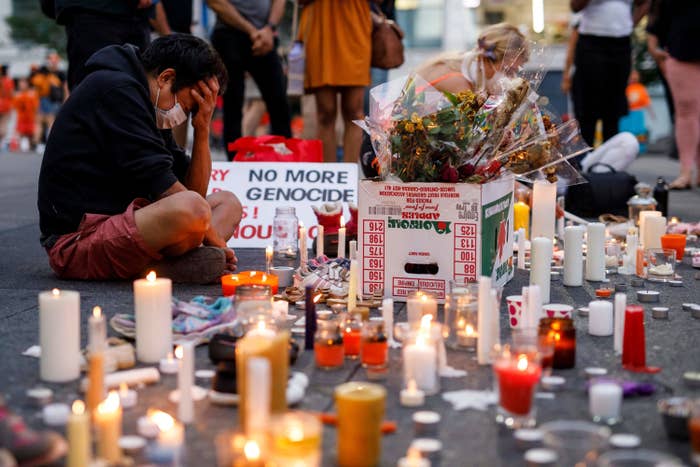
A man holds his head as he attends an impromptu vigil at an anti–Canada Day event titled "No Pride in Genocide" in Toronto, July 1, 2021, to encourage reflection on Canada's treatment of Indigenous people following the discovery of unmarked graves at residential schools in Canada.

Since the remains of more than 1,000 Indigenous children were found buried at former boarding schools in Canada, survivors and their descendants on the US side of the border expressed their own share of outrage and heartbreak, filling Facebook and other social media platforms with personal stories of brutal treatment and even more death.

“Sheldon Jackson [College in Alaska] was run by Presbyterians. They abused my mother and her sisters and killed her twin sister,” a survivor wrote in a Facebook group.

Another survivor commented that he went to this “hell school from the 60s to the 70s and [he] remember[ed] the mean nuns, all of there names.”

“I hated that school Dzilthnaodithhle community school [in New Mexico] I was one of the kids who was abused,” another shared.

As the communal, intergenerational trauma continues to build, advocates and leaders in the US are gearing up for a reckoning that’s just beginning and could create an unprecedented need for culturally informed mental health services. After First Nation officials announced the first set of hundreds of unmarked graves in May, the Canadian government’s dedicated helpline saw more than triple its typical calls from Indigenous people seeking counseling or other crisis-related services, a spokesperson told BuzzFeed News. But in the US, Native Americans continue to carry the grief they’ve held for generations largely without official recognition or support — even though the scale of abuse and death is likely much worse.

The US had a far more extensive boarding school system than Canada, which has acknowledged the family separations, abuse, and killings as cultural genocide in a report by its Truth and Reconciliation Commission. Meanwhile, in the US, the history of stolen children has been hidden, and a government investigation into the unknown number of deaths was only recently announced. From the 1800s to the 1970s, the US forced tens of thousands of children into hundreds of government-sponsored schools, many of whom never came home, their families never being told what had happened. Nearly every Native American has a parent, grandparent, or other relative who survived the abusive system, and the recent headlines have triggered horrific memories and resurfaced traumatic family histories.

“We haven't even begun the truth-telling,” said Denise Lajimodiere, a citizen of the Turtle Mountain Chippewa who has been interviewing survivors for 14 years, starting with her own parents. “And talking about it is so traumatizing. One man I spoke to touched the back of his head and said, ‘The stories will stay here.’”

Between 1819 and 1978, US law promoted the “civilization” of Native Americans, leading to the creation of boarding and industrial schools that forced children from their families.


Historical / Corbis via Getty Images
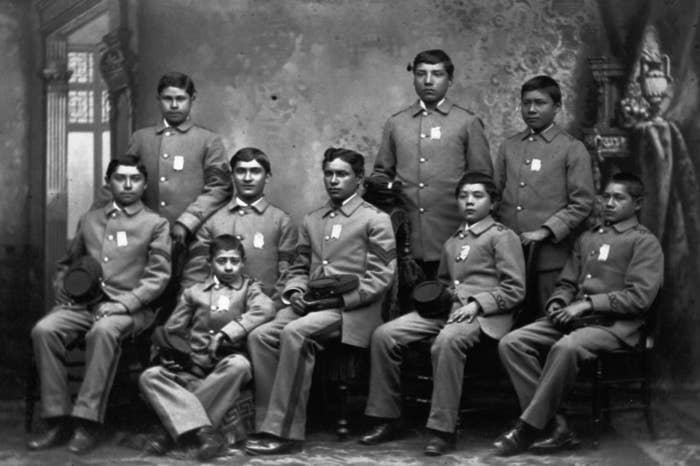
Native American students at Carlisle School in Pennsylvania between 1876 and 1896


The point of these schools, as the founder of Pennsylvania's Carlisle Indian Industrial School infamously put it, was to “kill the Indian in him, save the man” by erasing students’ culture and making them talk, act, and look like white, Christian Americans. When the children arrived, officials — some directly employed by the government and some by church groups — cut their hair, took their clothes, changed their names, and mostly prohibited them from having contact with their families. At many schools, children were beaten for saying hello in their own language; they were malnourished and sexually abused. They were forced to perform tough manual labor for families through "outing programs" during the summers and when they got back to school, crammed into dirty dorms where infections would sweep through their ranks. And when they died, whether from disease, neglect, or abuse, their classmates were sometimes forced to bury their bodies in mass graves, according to multiple reports, UN filings, and BuzzFeed News interviews with the descendants of survivors.

Canada modeled its residential schools on the US boarding system and, since embarking on a truth and reconciliation process in 2007, determined that more than 150,000 Indigenous children attended 139 schools, and as many as 6,000 of them are estimated to have died. Thanks to ground-penetrating radars, search teams in Canada have been able to find evidence of those deaths, often in unmarked graves beneath the grounds of former schools. The new technology, Native American leaders told BuzzFeed News, has resulted in gruesome discoveries of children’s remains that will likely continue.

In May, the Tk’emlúps te Secwe̓pemc First Nation announced it had found the remains of 215 children, some as young as 3, buried on the grounds of the former Kamloops Indian Residential School. Less than a month later, 751 unmarked graves were found at the former Marieval Indian Residential School in Saskatchewan. The discovery of an additional 182 unmarked graves near the St. Eugene Residential School was then announced June 30, and work is continuing to determine if they contain the remains of students. On Monday, the Penelakut Tribe in British Columbia said that it had found more than 160 "undocumented and unmarked” graves at the former Kuper Island Indian Residential School.


Anadolu Agency / Anadolu Agency via Getty Images

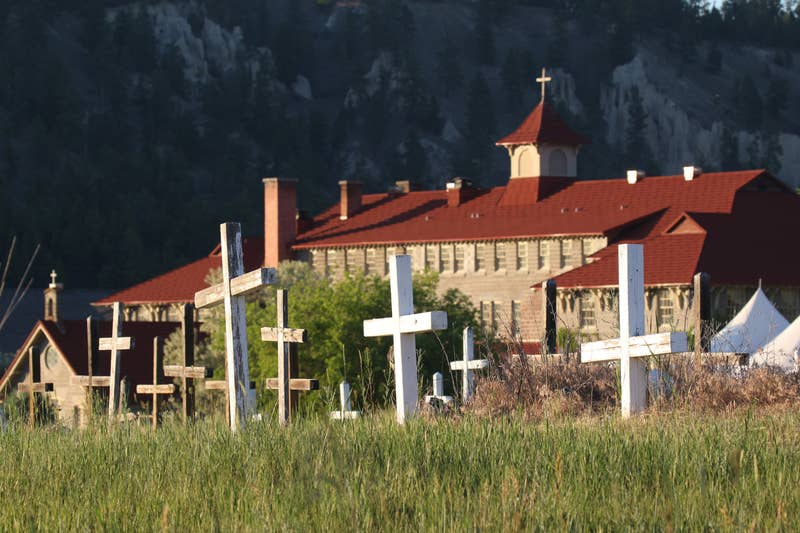
The Lower Kootenay Band said remains of 182 people were found in unmarked graves close to the former St. Eugene's Mission School near Cranbrook, British Columbia. A present-day cemetery is in the vicinity of the unmarked graves.

But in the US, there has never been an official count of how many students died in these institutions. Instead, for years, a small group of tribes and advocates have been trying to piece together the history. The National Native American Boarding School Healing Coalition has catalogued more than 370 schools in 29 states, each with a graveyard. Since 2012, the group of Native American leaders and researchers has been trying to pry loose federal boarding school records and remains from museums, universities, and institutions like the National Archives and Records Administration so that family members of the stolen children can find out what happened to them. With almost three times as many schools operating in the US as in Canada, the death toll may be staggering.

This largely hidden chapter of American history is finally set to get an official telling. Last month, Department of the Interior Secretary Deb Haaland, a citizen of the Pueblo of Laguna whose grandparents survived boarding schools, ordered a formal investigation to “uncover the truth about the loss of human life and the lasting consequences.” Since the Interior Department oversaw the schools for more than 100 years, employees will now review historic government records to identify possible burial sites. A report is due in April 2022.

Native American advocates and community leaders applauded the action, saying justice and recognition have been long overdue. But before the US begins a national reckoning on its own cultural genocide, they say they desperately need more immediate mental and emotional health services in their communities, where they’re already seeing a spike in depression, unhealthy coping mechanisms, and other related issues.

The challenges are stark: Indian Country has some of the highest rates of depression, PTSD, domestic violence, and substance abuse in the country — in part, according to Lajmodiere and other researchers, because of the trauma and atrocities from the boarding school era that have trickled down generations. In 2019, suicide was the second-leading cause of death for younger American Indians and Alaska Natives, especially teens. Then the pandemic hit, killing Native Americans at a rate higher than any other ethnic group in the US.

Stacy Bohlen, CEO of the National Indian Health Board, said they were already pushing for more mental health support because of the post-traumatic stress disorder left behind by the pandemic. With the new investigation into boarding school deaths, she and other advocates have been concerned by the lack of a concerted effort by federal or state governments to plan for a new round of trauma.

The handful of Native American groups that have been offering some support have brought back troubling reports about what people are experiencing, she said.

“Devastated is not the appropriate word. They’re annihilated. It’s like they’re walking around in a space and time continuum that is disconnected, in a daze,” she said. “People are getting retriggered with each new calamity in a way that’s paralyzing. The level of grieving is almost electric.”


Darryl Dyck/The Canadian Press via AP
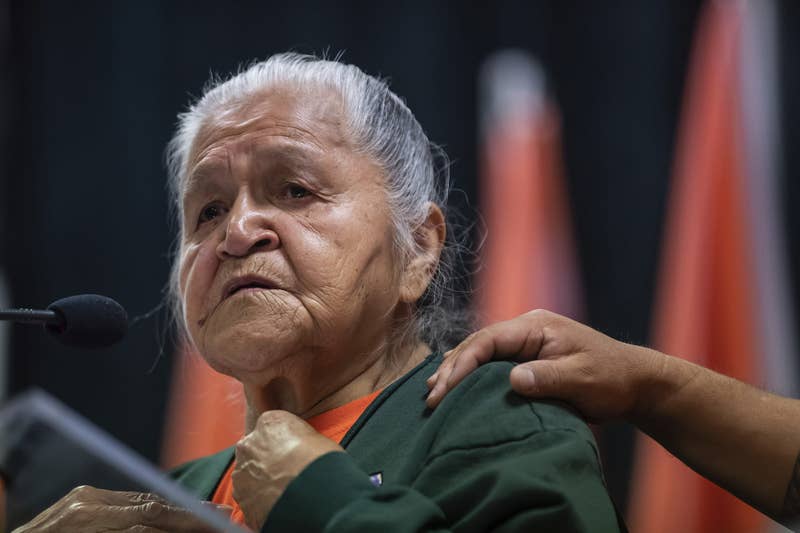
Kamloops Indian Residential School survivor Evelyn Camille, 82, pauses while speaking about her experience at the school, July 15, 2021.


To appropriately respond, Bohlen said the federal government needs to embrace, for the first time, a sweeping public health approach to prevent further harm as well as put tribal leaders in charge of how the resources are allocated so that they can build their own systems. Most importantly, she said, the US must honor and create official spaces in which survivors can share their stories, as it did for those who lived through the Holocaust. Human rights atrocities are nothing new; there’s a playbook, she pointed out.

In a statement to BuzzFeed News, Haaland’s office acknowledged the need and said they’re working on solutions.

“As we engage in this work, front of mind is creating a safe space for people to share information and seek resources,” Melissa Schwartz, Haaland’s communications director, said. “We recognize the need for this and are working on ways to meet that need. We don’t have that set up just yet, but we will advise the public as soon as we do.”

Sen. Elizabeth Warren, who has apologized for claiming Native heritage in the past, worked with Haaland last year on a bill for the US to create its own truth and healing commission. Though that effort died in committee, Warren has said she plans to reintroduce the legislation in the coming weeks.

"The horrific revelations surrounding Native American boarding schools have renewed suffering and trauma for Native communities, and the federal government must act to right these wrongs,” Warren said in a statement to BuzzFeed News. “I have long fought for support for the mental health and wellbeing of Native people across this country, and I will keep pushing for action that empowers tribal nations and Native communities to address these crucial challenges."

The ability to be heard, acknowledged, and validated by your country is powerful and essential to healing, Angela White, executive director for the Indian Residential School Survivors Society Canada (IRSSS) told BuzzFeed News. In contrast to the US, Canada created the infrastructure for this type of work more than a decade ago.

In 2007, as part of a formal apology and settlement with residential school survivors, the largest class-action lawsuit in the country’s history, the government created a financial compensation system and the Truth and Reconciliation Commission. For years, the commission created opportunities for thousands of former students or their descendants to share their experiences, part of a pathway to healing. Officials also obtained boarding school records from government institutions and churches, making them available to families. Although the commission formally wrapped up in 2015, government-funded services like the IRSSS remain because, as White puts it, “intergenerational survivors and everyone in between still need help.”

During a regular year, the nonprofit fields about 140,000 contacts on a variety of issues. But after the announcements about the hundreds of graves at multiple schools, the phones would not stop ringing. In May, the organization threw up a crisis line specifically for residential school survivors and descendants and sent five staff members directly to Kamloops. The response was overwhelming. Thousands of people were contacting the organization every day, seeking a culturally safe space where they could process emotions or simply have someone validate what they saw or experienced as children, White said.

“Because they were told they would not be believed by these nuns, priests, and teachers, that broke down their entire self-esteem and as years went on, no one did believe them, no one wanted to hear them or see them until now when it's been put in our faces,” White said. “If these services weren’t available, you would be seeing more and more self-harm, alcohol and drug-related deaths. Our goal is to limit those as much as we can.”

Indigenous Services Canada also reported a drastic increase in calls, jumping 265% at the end of May and then reaching a peak of 481 calls in a single day on June 1, a spokesperson told BuzzFeed News. KUU-US Crisis Line Society, which serves Indigenous people in British Columbia, noticed such a spike in need that they planned to implement chat and text options.

And what many callers are looking for, White said, is someone who understands their culture and where they are coming from. While having any mental health provider on the other end of the line is helpful, the Canadian organizations learned that it is imperative to culturally train staff and recruit those who can serve the needs of their tribes and communities. More than half of the cases handled by White’s group are for culturally specific healing services, she said.

“If the United States is going to do this, I would make sure they get it right immediately and not have it as an afterthought,” she said. “They need to set up a crisis line. They need to set up cultural spaces or amplify what they already have and start trainings for trauma-informed care. They also need to recruit those well into their healing journey. If you're not well into your healing journey already, this job is not for you.”


Matt Rourke / AP
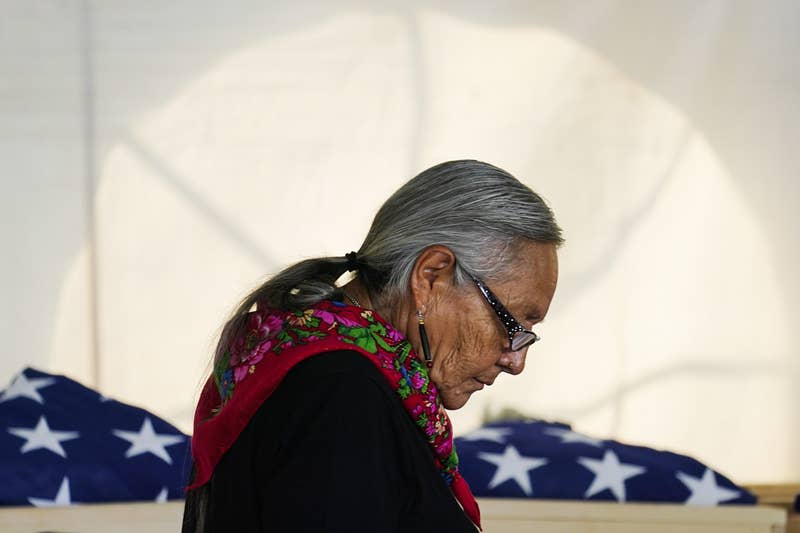
Ione Quigley, the Rosebud Sioux's historic preservation officer at the US Army's Carlisle Barracks, in Carlisle, Pennsylvania, July 14, 2021. The disinterred remains of nine Native American children who died more than a century ago while attending a government-run school in Pennsylvania were headed home to Rosebud Sioux tribal lands in South Dakota after a ceremony returning them to relatives.


Even with resources, healing can be a difficult and complex journey. Those who survived the boarding schools never learned what it was like to have parents or to be held, comforted, or told they were loved. They grew up and became parents themselves.

“They didn’t know how to be parents, so they beat us like they were beaten in boarding school. They were never told they were loved or hugged, so we were never told we were loved or hugged,” Lajimodiere said. “That was my experience, and in my research I heard that over and over.”

It’s a difficult cycle to break. Lajimodiere grew up with an alcoholic, abusive father. Her grandparents, who were stuffed into a closet when they misbehaved, were beaten and forced to kneel on brooms for merely being children. When Lajimodiere had a daughter, she struggled to tell her child that she loved her.

But through her work, in which she connected with other children of survivors, she saw she was far from alone. It wasn’t really her father, she realized — it was what happened to him. Seeing his place in the bigger picture allowed her to finally forgive him.

“We are only as healthy as our secrets,” she said. “To heal, we have to forgive ourselves at a basic level. We have to forgive each other. I had to forgive my father and at some point, my daughter will have to forgive me. And then we can start telling the truth.”


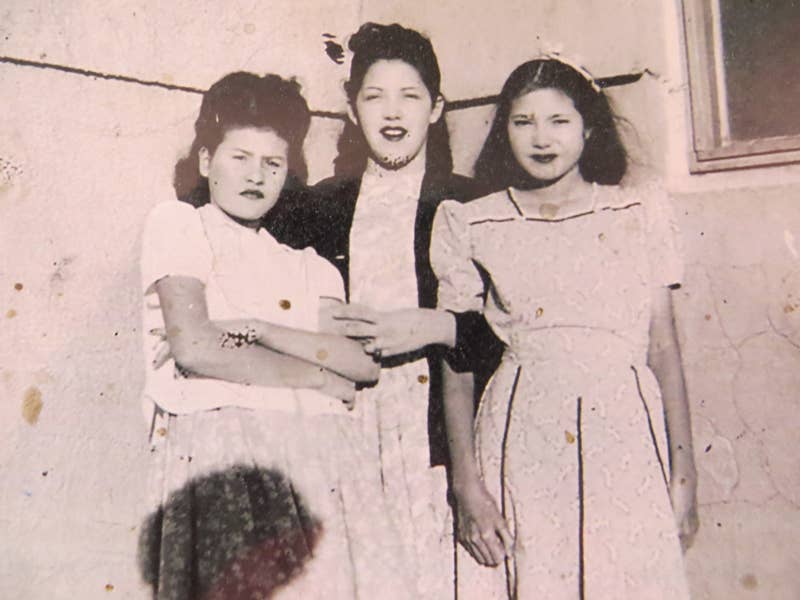
Courtesy Denise Lajimodiere
Is Antarctica a country? The future of the world's least understood continent

Lilit Marcus, CNN • Published 17th July 2021


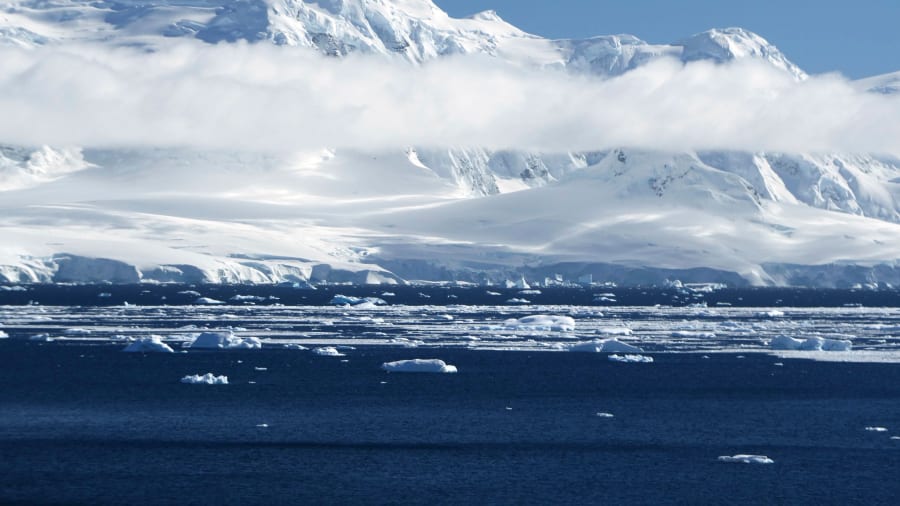
Antarctica: The globe's least inhabited continent has long filled travelers with curiosity.
David Tipling/UIG/Getty Images


(CNN) — As long as humans have known of its existence, they have wanted to visit Antarctica.

It is the world's least visited, least populated continent. On the best day, it is extremely hard to get to. And yet, the appeal of the unknown and the desire to set foot on every continent have encouraged travelers to try and make their way to the South Pole.

Still, for the obsessive catalogers of the world, Antarctica is difficult to classify. It's not a country, so can you cross it off a bucket list? Who controls it? If it had a capital city, where would it be? What would be the native language?


A national flag for a nation-less place

These were among the questions that Evan Townsend posed to himself when he signed up for the first of two stints working at McMurdo Station, the US-run base in Antarctica.

Townsend, an elementary school teacher in Boston, knew he had a strict baggage limit when going to Antarctica to work as a support staffer -- everyone is limited to 85 pounds, he says, which has to include clothes, toiletries, medicine, electronics and anything else they might want or need during their stay.

As one of his duties would be managing the arts and crafts room on base, he wanted to bring some decorations with him, but knew he needed to keep it light. Townsend chose the Pride flag -- it weighed almost nothing, but its significance was heavy.


One day, Townsend and a few colleagues took the Pride flag outside and snapped photos of themselves to post on social media. The photos ended up becoming an international story, with many news outlets saying the outing was Antarctica's first-ever Pride parade.

"That was when I realized the power of flags," Townsend says. "On one hand, I'm completely isolated at the end of the Earth. And on the other hand, I'm part of this global community."


The "True South" flag Townsend designed to represent Antarctica
Courtesy Evan Townsend/True South

Despite not having a background in design, Townsend identifies as a longtime "flag nerd" and began to toy with the idea of creating a flag to represent Antarctica.

He went with dark blue for the Southern Ocean waters and white for the landscape, with an isosceles triangle in the center to represent Antarctica's icy peaks.

"I wanted it to be a neutral flag, for sure," Townsend says. "It's a distinct design, it's a distinct color, to make sure that it's not affiliated with any particular group or nationality. I wanted it to be something that had a lot of symbolism, but that was simple enough that people could apply their own perception of Antarctic and their own understanding of the continent to the flag."


Swedish nurse Johanna Davidsson didn't set out for the South Pole aiming for a world record -- but she walked away with one anyway.

The name of the flag project, True South, also has its own significance.

"'True south' literally means the direction toward the geographic south pole, as opposed to magnetic south which would lead to the magnetic south pole," Townsend explains. "it's meant to represent the shared goals and values by which the Antarctic community can orient itself."

And Townsend has no plans to trademark or copyright the flag's design, as he believes it should belong to the whole world.

"The best flags are flags that get their meaning and their power from the people that fly them," he adds.

Who's in charge here, anyway?

Townsend is just one of the many people around the globe who are transfixed by Antarctica, even if they are never able to visit and see the place for themselves.

So, what is it about the southernmost continent that continues to entrance people?

In a world that's more interconnected than ever, Antarctica remains one of the few places that most people don't know anything about.

There is no indigenous population in Antarctica, and human activity there is still relatively recent.
The only permanent installations are a handful of scientific stations, which only employ scientists and their support staff -- a term comprising anyone from chefs and maintenance workers to electricians and airport managers.

It's common for people to multitask. Townsend worked in food service, as a bartender and as a craft room manager during his tenure. At its peak, the number of human Antarctic residents is approximately 10,000.

In 1959, 12 countries -- including Japan, South Africa, France, the United Kingdom, Argentina and what was then the USSR -- signed the Antarctic Treaty in Washington, DC.

Among the items they agreed on was that that Antarctica should "be used for peaceful purposes only" and that science would be at the forefront of any development or settlement there. Members of the military are allowed to be there, but only in support roles.

Although few people live there, Antarctica's scope of influence is massive. Climate change has caused the continent to shrink. And despite the treaty's existence, world politics have changed and new power players -- namely China -- have emerged in Antarctica.


The True South flag flies alongside the flags of the original 12 Antarctic Treaty Signatories at the ceremonial South Pole.

Courtesy Lisa Minelli/True South

Klaus Dodds, professor of Geopolitics at the University of London, is the author of several books about the polar regions, most recently "The Arctic: A Very Short Introduction," published in June 2021.
"Stuff just keeps being taken from Antarctica. Information, ice, resources like seals and whales and fish," he says. "Antarctica's fragility, I think, represents the fragility of the wider world."
While climate change is the biggest influence on Antarctica, there's another major factor that will only grow more significant as the pandemic ebbs -- tourism.

About 90% of tourists to Antarctica come by boat. These trips are expensive, and most travelers spend only a few hours actually on the land before getting back on the ships and turning around.
Currently, the United States is the single largest source of Antarctic tourism, but China is quickly rising into second place, and Dodds believes within in a decade it will top the list.
Some destinations, like Argentina resort town Ushuaia and Australia's Hobart, make money from these tourists due to their location as final pre-Antarctic ports of call. Dodds predicts that the next decade will see multiple cruise ship companies open up Antarctica itineraries and more travel companies invest in the continent's infrastructure.

Just as countries jockey for power with military bases and political maneuvers, Antarctica has become another site for their rivalries -- and fears -- to play out.

"Nobody can answer the question (of) who owns Antarctica," Dodds says.

"I think the Antarctic represents, in essence, not just the idealism that the treaty represents, but it also represents the supreme contradictory nature of humanity more generally. So for all the things we wish to celebrate in Antarctica, there's also the ugliness of humanity."

He points to a few major successes: Antarctica was the first continent to be completely free of nuclear weapons. It is also demilitarized.

Another example of the continent's potential for beauty and unity? The True South flag, which Dodds admires.

"(It) is a well-intentioned reminder that Antarctica is a marvel. Antarctica should represent the very best in all of us."
Canadian nurses are leaving in droves, worn down by 16 merciless months on the front lines of COVID-19

ADDING INSULT TO INJURY UCP IN ALBERTA IS DEMANDING A  3% ROLL BACK AS IF KENNEY WERE KLEIN


KELLY GRANT
HEALTH REPORTER
PUBLISHED 2 DAYS AGO

Nurses waiting outside the isolation room help the team working inside the isolation room of COVID-19 patient inside the intensive care unit of Humber River Hospital in Toronto on April 15. CARLOS OSORIO/REUTERS

Nurse Lynnsie Gough tried to hang on, but in the end, the workload and sorrow of COVID-19 were more than she could bear.

“It just kept getting worse and worse,” Ms. Gough, 35, said of her job as an intensive-care nurse at a hospital in Ontario’s Niagara area. “I was having anxiety attacks where I would feel or be physically ill. I felt like I was going off to war or prison every day going into work.”

The only way to preserve her well-being, Ms. Gough concluded, was to quit.

Last month, she joined the growing ranks of Canadian nurses who are retiring early, switching to part-time schedules, departing to work for private staffing agencies or leaving the profession after 16 merciless months on the front lines of the pandemic.

The nursing shortage, a long-standing problem exacerbated by COVID-19, is now forcing some hospitals to close beds temporarily, scale back emergency-department hours over the summer and delay the full reopening of operating rooms. In Ontario, the government has begun offering bonuses as high as $75,000 to attract experienced, out-of-province critical-care nurses to strapped hospitals.

“We’ve seen nurses leave and leave and leave,” said Bernard Mathieu, an emergency physician at Montreal’s Maisonneuve-Rosemont Hospital. “We see new, fresh nurses come in for orientation who decide not to stay because they see the quality of life they’re being offered is terrible.”

“Stratospheric” levels of mandatory overtime in Quebec hospitals have spurred nurses to leave for private staffing agencies that offer better pay and flexible schedules, he added.

Dr. Mathieu penned an open letter on behalf of his emergency-department colleagues this week begging Quebec’s health minister to help resolve the shortages. Dr. Mathieu wrote that half of all nursing posts and three-quarters of all respiratory-therapist jobs at Maisonneuve-Rosemont were vacant, compelling the hospital to temporarily close about a quarter of its acute-care beds.

Catherine Dion, a spokeswoman for the regional health authority that oversees the hospital, said by e-mail: “We are doing everything we can to limit [the staffing shortage’s] impact while providing the best health care to the population we serve.”

Exhausted medical workers need time off over the summer, she wrote, adding that pandemic-related burnout is a problem across Quebec’s health system. Nursing shortfalls also led to the temporary closing of an emergency department in Gatineau last month, and to plans for nightly shutdowns or reduced hours at some other Quebec emergency rooms over the summer.

Dr. Mathieu’s letter came on the heels of a June 3 missive signed by more than 60 emergency doctors from three hospitals in Winnipeg warning of epic levels of burnout. “Many senior experienced nurses in our EDs have resigned, while many others are planning to leave,” the letter said. “Morale and staffing are at all-time lows. We view the situation as critical, unsustainable and in need of immediate action.”

Nunavut Health Minister Lorne Kusugak announced on Friday that two of the territory’s health centres would close temporarily in mid-August, while another five would close to all but emergency cases for a few weeks over the summer because a “nationwide shortage of health care staff [has] made the recruitment of nurses into the territory very difficult.”

In Alberta, meanwhile, the United Nurses of Alberta, which is in the midst of acrimonious contract negotiations with the United Conservative Party government, said nursing shortfalls have led to summertime bed cuts in about a dozen emergency departments, including at the Royal Alexandra Hospital in Edmonton and the St. Therese-St. Paul Healthcare Centre northeast of Edmonton.

James Wood, a spokesman for Alberta Health Services, said more than 98.5 per cent of the province’s 8,400 acute-care beds remain open, despite staffing challenges.

Mr. Wood noted that staffing challenges aren’t new and are especially common during the summer, when badly needed vacations deplete the nursing and physician work forces.

But Shazma Mithani, an emergency physician at Royal Alexandra, said that in the seven years she’s worked as an attending physician at the hospital, she has “never seen anything like this before, ever.” Her hospital is closing a minimum of six of the emergency department’s 27 acute-care beds for the summer because it can’t fill nursing shifts, Dr. Mithani said.

Statistics Canada reported last month that in the first quarter of 2021, the health care and social-assistance sector saw a larger year-over-year increase in job vacancies than any other sector, led by postings for registered nurses, registered psychiatric nurses, nurse’s aides or orderlies and licensed practical nurses.

Total vacancies in the sector rose to 98,700, an increase of nearly 40 per cent over the same time a year earlier. Nearly half the want ads for registered nurses and registered psychiatric nurses had gone unfilled for 90 days or more.

Individual hospitals see signs of the exodus in their own numbers. Windsor Regional Hospital, across the border from Detroit, had 59 experienced nurses retire during COVID-19, nearly twice the 31 nurses who retired in the 16 months immediately before the pandemic. “Replacing that work force is really critical,” said Karen Riddell, Windsor Regional’s chief nursing executive. “We have to do it before we lose all of that expertise and experience.”

Windsor Regional, which has long competed with hospitals in Michigan for nurses, is one of the beneficiaries of a new Ontario government program offering bonuses of between $10,000 and $75,000 to experienced nurses who come from outside the province or return to the profession from retirement or unemployment.

The temporary program was available to nearly 50 Ontario hospitals where the provincial government funded extra critical-care beds for the treatment of COVID-19, according to Ontario Ministry of Health spokesman Bill Campbell.

Windsor Regional has hired six nurses through the program so far, and another 12 are in interviews, Ms. Riddell said.

Doris Grinspun, the CEO of the Registered Nurses’ Association of Ontario, said bonuses “do nothing” and encouraged the government to instead focus on retention by improving working conditions and training existing nurses to fill gaps in critical care and other specialties.

An online survey Ms. Grinspun’s organization conducted in January and February found that 9.3 per cent of 2,102 respondents planned to leave the profession after the pandemic, nearly twice the proportion that leave the profession in a typical year.

Ms. Gough is now among them. Although she hasn’t ruled out a return to nursing, she is haunted by the pressures she faced during the pandemic, when her workload was twice or three times as heavy as normal. She oversaw redeployed nurses with little or no ICU experience. She worried all the time that, as she rushed between patients, she would make a mistake.

Her sister, a registered practical nurse in long-term care, is equally demoralized, Ms. Gough said. “We both are feeling like we don’t want to have anything to do with nursing anymore,” she said. “It seems that no matter where you go at this point in time, everywhere is short.”
Why Socialists Should Distrust Antitrust

BY DOUG HENWOOD

People are right to be disgusted by giant corporations. But the liberal “antitrust” response too often valorizes small-scale competition instead of solidarity and worker organization.

No other politician has been more associated with the antitrust case than Senator Elizabeth Warren of Massachusetts. (Evelyn Hockstein-Pool / Getty Images)

Last week, Joe Biden tweeted, “Let me be clear: capitalism without competition isn’t capitalism. It’s exploitation.”

It would be too much to expect this rather dim politician to understand, much less endorse, the classic Marxist analysis of profit originating in the exploitation of workers — they produce more in value for their employer than they’re paid in wages. But the remark, in all its naivete, does capture a spreading belief in liberal policy circles that monopoly is at the heart of our economic troubles, from crappy jobs to crappy pay and benefits. I’m not convinced.

According to the introductory economics I learned in college — which was admittedly long ago — two essential features of monopolized markets were high prices and restricted supply. Those features weren’t at all visible in the US economy until the pandemic began messing with supply chains, resulting in short supplies in some sectors in the face of pent-up demand, demand that was supercharged with stimulus checks.

Even so, the shortages and price spikes are affecting just a few sectors, like new cars and lumber. They’ve yet to spread economy-wide, and there’s no sign they’re about to. They’re not the product of some long-term monopolization. For most of the last forty years, inflation has been quite low — in no small part because the working class was crushed as the 1970s turned into the 1980s and because shortages have been rare.

The giants that people point to as proof of our monopoly problem include Amazon, Google, and Facebook. Amazon, like Walmart before it, is known for low prices that crush competitors. (Workers too.) That’s not standard monopoly behavior. Google and Facebook dominate their fields, but most of their “products” are free. Yes, that means “you’re the product,” as the saying goes, but what kind of improvement would it be if broken-up Googles and Facebooks charged for their services or maintained the same monetizing-the-user’s-identity business model as the originals?

Nor is it clear how introducing competition would improve the quality of service. One of the lures of Facebook, for those subject to the lure, close to three billion users at the most recent count, is that so many people are on it. That facilitates communication. Breaking it up into competing services would be like making an AT&T phone customer incapable of contacting a Deutsche Telekom subscriber.

Behind antitrust is a faith in competition as a positive good. As socialists we should take exception to that. We already have too much competitive individualism in this society, and we don’t need any more. We need solidarity. Stimulating the war of each against all isn’t the way to get there.

A better way to handle bigness is to regulate the behemoths and encourage the growth of unions. That would do more to improve working conditions at Amazon than turning it into four or twenty little Amazons. As political economist Sam Gindin pointed out in an interview on my radio show, the deregulation movement of the 1970s and 1980s was a war on regulated oligopolies, and it was accompanied by union busting, wage cuts, and job losses. That could be a portent of life under monopoly busting.

Why is antitrust getting the attention of liberals these days? In his book on the history of American corporate governance, law professor Mark Roe notes that Franklin Roosevelt saw it as a war against “private” socialism that could stave off “government” socialism. We may be seeing something similar now. With socialism polling decently, socialists working their way into the Democratic Party, and the business class in disrepute with much of the population — Gallup reports that 73 percent of the public is either somewhat or very dissatisfied with major corporations, compared to 48 percent in 2001 — pursuing antitrust may be a campaign to restore the prestige of capitalism itself. Fronting small business as the emblem of commerce is a classic bourgeois self-defense strategy.

There’s nothing magic about smallness. Vincent Carosso ends his huge book on the Morgan banking family by quoting an unnamed socialist refusing to curse the peak Morgan, J. P., on his death: “We grieve that he could not live longer, to further organize the productive forces of the world, because he proved in practice what we hold in theory, that competition is not essential to trade and development.” It’s a sentiment worth recovering.


ABOUT THE AUTHOR
Doug Henwood edits Left Business Observer and is the host of Behind the News. His latest book is My Turn.
Lightning Kills 76 in India, Including 
Selfie-Takers Near Famous Fort

by Naharnet Newsdesk 5 days ago

amer fort india lightning strike

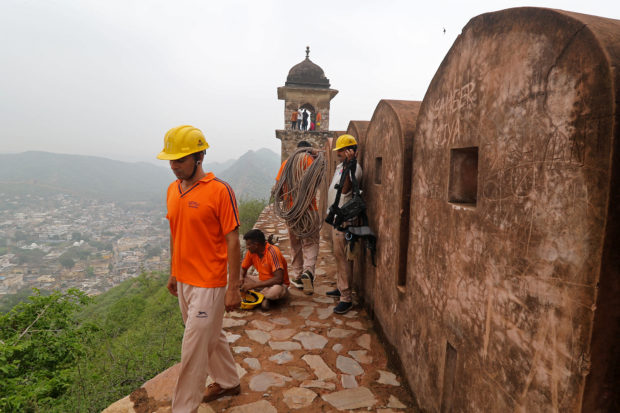
Members of State Disaster Response Force conduct a search operation near the watchtowers of the Amer Fort on the outskirts of Jaipur on July 12, 2021, after 11 people were killed in lightning strikes at the fort. AFP


Several people reportedly taking selfies near a historical fort in northern India were among nearly 80 killed by lightning strikes during the early stages of the annual monsoon season, officials said Monday.

Deadly lightning strikes are common in the vast Asian nation during the June-September deluge, which bring respite from the summer heat across the northern Indian plains.

Of the 76 killed, at least 23 people died in the mostly desert state of Rajasthan, including a dozen who were watching the storm cross Jaipur city from watch towers near the famous 12th-century Amer Fort late Sunday, a state disaster department official told AFP.

"It was already raining when the people were there. They huddled in the towers as the rainfall intensified," a senior Jaipur police officer, Saurabh Tiwari, added.

He said up to 30 people were on the towers when the lightning struck. Emergency teams were checking if any victims had fallen into a deep moat on one side of the towers.

"Some of the injured were left unconscious by the strikes. Others ran out in panic and extreme pain," he added.

Officials told local media some of those killed were taking selfies during the storm.

Every year, tens of thousands of tourists visit the Amer Fort, a medieval complex on a hilltop outside Jaipur also known as the Amber Fort.

People had been flocking to the fort, which gives a panoramic view of the tourist city of Jaipur, after several weeks of intense heat in the state.

In the neighboring state of Uttar Pradesh, at least 42 people were killed in lightning strikes on Saturday and Sunday, officials said. They did not give further details about where they had been killed.

Another 11 people died in the central state of Madhya Pradesh over the weekend, an official at the state's disaster control room told AFP.

Two of them, who had taken their camels and sheep for grazing, were sheltering under a tree when they were hit by lightning, the official said.

Prime Minister Narendra Modi said the victims' families would be offered compensation.

Last month, 27 people were killed and four passengers on a flight were hospitalized after severe turbulence during monsoon storms the eastern state of West Bengal.

Nearly 2,900 people were killed by lightning in India in 2019, according to the National Crime Records Bureau -- the most recent figures available.

The monsoon is crucial to replenishing water supplies in South Asia, but also causes widespread death and destruction across the region each year.

Indra

Myths and Folklore
Indra or Parjanya is the Hindu god of of lightning, thunder, rains and river flows, and king of the gods and Heaven. He lives in Swargaloka (Hindu upperworld), the husband of Sachi. He is brother to Surya and the son of Aditi. He also appears in Buddhist and Jainist, and some interpret the Daoist Jade Emperor as an interpretation of him. 1 Myths & Legends 


China to play a constructive role in post-war Afghanistan with SCO
Wang Peng
Opinion 17:31, 18-Jul-2021


CFP

Editor's note: Wang Peng is a distinguished research fellow at the Center for American Studies, Zhejiang International Studies University. The article reflects the author's opinions, and not necessarily the views of CGTN.

International media call this week "China's Central Asia Time", since Chinese State Councilor and Foreign Minister Wang Yi has visited Turkmenistan, Tajikistan and Uzbekistan from July 12 to 16, marking his first trip to Central Asia this year.

Wang Yi's remarkable visit has shown the great significance of China's relations with central Asian nations. Central Asian countries are China's close neighbors. There is an old Chinese phrase that "a distant relative cannot be so helpful as a near neighbor".

China's relations with Afghanistan


When it comes to Afghanistan, as good neighbors, China and Afghanistan has no conflict or war and maintained traditional friendship, which have made a strong foundation for their bilateral ties building. So now are the honor and responsibility of China and its neighbor to inherit and carry forward this glorious legacy.

China's diplomatic principles, such as non-intervention, equality and mutual benefit, provide political guarantee and mutual trust. China never regards itself as a superior power to force its neighbors to obey and follow instructions. Rather, as an equal and trustable partner, China only provides practical advice and necessary material assistance in a humble and prudent way. Wang Yi pointed out that China supports and expects all parties in Afghanistan to follow the "Afghan-owned and Afghan-led" principle and proceed from the fundamental and long-term interests of Afghanistan to build a political structure that suits Afghanistan's national conditions and has the support of the Afghan people through intra-Afghan dialogue and consultation. This approach has established deep political trust and international reputation for China.

In addition, China and Afghanistan are highly complementary in strategy and economy. China needs security cooperation from Kabul while Afghanistan needs capital, foreign aid, and technology for its post-war reconstruction, especially infrastructure building. China can make great help. As Wang Yi said that the Chinese has attached great importance to the China-Afghanistan strategic cooperative partnership, and is willing to work with the country to prepare for high-level contacts between the two countries and send a positive and peaceful signal to the outside world.

Security and post-war reconstruction in Afghanistan

After America's two-decades-long war that failed to bring peace, now the withdrawal of U.S. and NATO forces from Afghanistan offers this country a new chance to take its destiny into its own hands.

However, the security situation of Afghanistan is still uncertain. The domestic peace process between Kabul government and the resurgent Taliban will determine the future of this suffering country and its people.

As Wang Yi emphasized that the urgent task now is to avoid a civil war, restart the intra-Afghan negotiations, and seek a political reconciliation plan, especially to prevent various terrorist forces from gaining ground in Afghanistan.

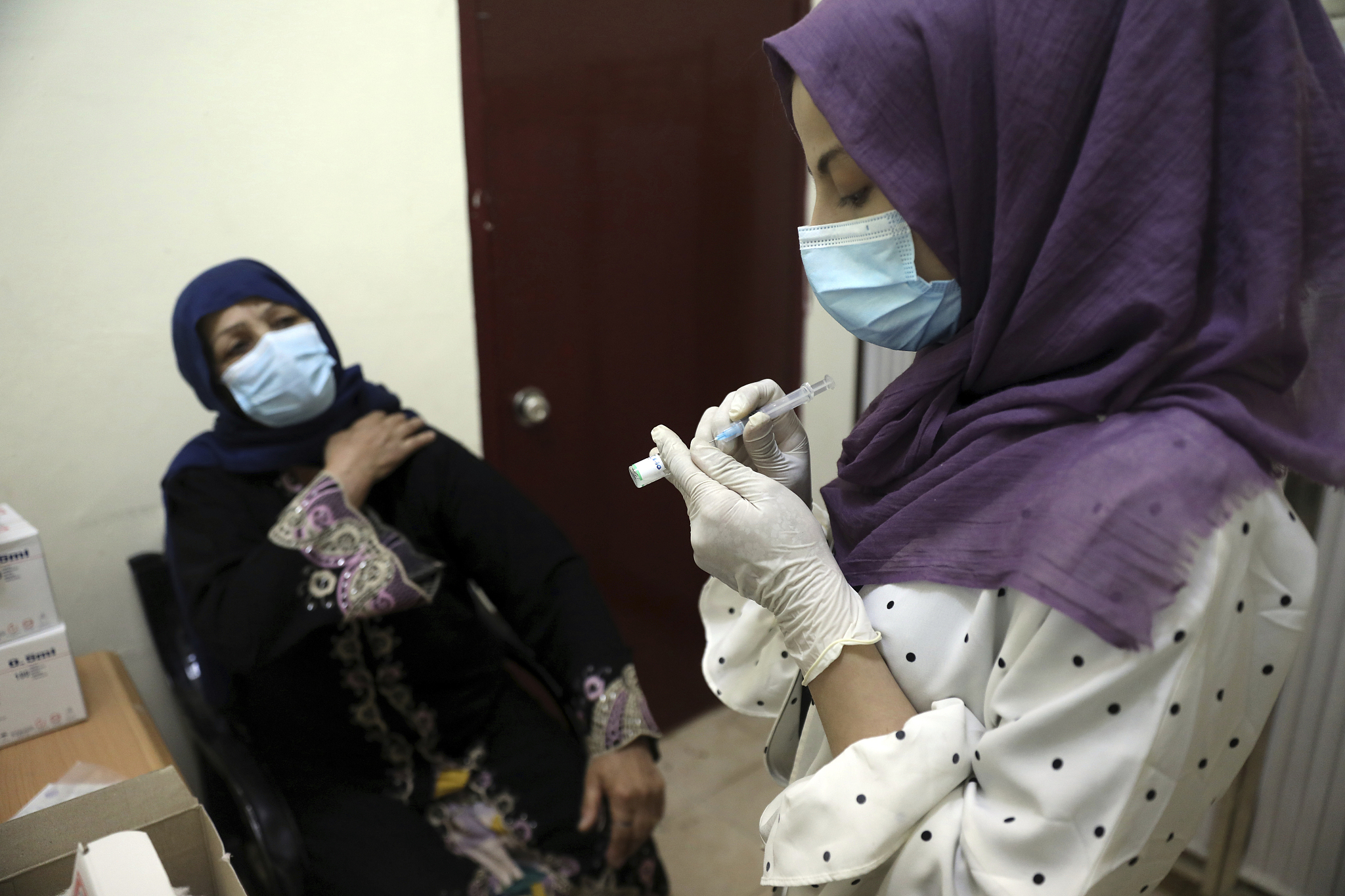
A doctor fills a syringe with the Sinopharm COVID-19 vaccine at a vaccination center in Kabul, Afghanistan, June 16, 2021. /CFP


Therefore, what should be noticed, no matter who comes to power finally, it is critically necessary that the administration of Afghanistan must cut all ties with terrorist groups; since it is the only way for the Afghanistan government to win the trust and acceptance from international society, especially from its neighbors. The legal government of Afghanistan with international recognition should resolutely draw a line with all terrorist forces, and return to the political mainstream of Afghanistan with a responsible attitude toward the country and people. After all, China which shares a narrow border with Afghanistan has ample reasons to concern about extremism spilling over into their border provinces; and so are Afghanistan's other neighbors.

As part of those prevention efforts, China has been sharing up ties with its central Asian neighbors to deal with possible security threats in the post-U.S. era. In this regard, the Shanghai Cooperation Organization (SCO) has great potential to offer solution.

The role of the SCO in Afghan security and economic cooperation


Wang Yi has attended meetings of the SCO where foreign ministers of the member countries have discussed solutions to the Afghanistan conflict. Meanwhile the international society wondered what solutions the SCO may contribute at a time when the U.S. and its NATO allies are pulling troops from the country.

Last month, Wang Yi has proposed five points in promoting peace and reconciliation in Afghanistan. This time, Wang Yi said on July 14 that the Chinese will continue to provide anti-epidemic support including vaccines to Afghanistan until the country beats the outbreak.

As mentioned above, since the security situation of Afghanistan is still uncertain, the most urgent affair for Afghanistan is the domestic peace resolution and civil war prevention. It is reported that the Taliban and the Afghanistan government are currently meeting in Qatar to attempt a peace agreement. However, the international society widely suspects that it is unlikely any power-sharing will be agreed longer term as the Taliban regard the incumbent Afghan government as a "Washington puppet". If so, a bitter civil war seems to be unavoidable; and no doubt, it will be the nightmare for tens of thousands of innocent Afghan civilians.

In this case, the international humanitarian relief and assistance will be of particular value and great necessity. The SCO members who have had twenty years to build coordinating intelligence, security, and military capabilities, with an eye on when the extraterritorial power pulls out of Afghanistan may take its international responsibility for regional security and Afghan people's life. With that day arriving, Central Asia now has a regional body capable of understanding, organizing against, and repelling threats. SCO may serve the role as a practical multilateral platform for Afghan domestic security dialogue and regional security cooperation.

The second priority is how to deal with the pandemic. As COVID-19 pandemic dampens the international flow, in order to recovery and strengthen the connection, China, Afghanistan and their Central Asian neighbors can establish joint prevention and control mechanism, especially the immune and vaccine cooperation through the SCO platform. International media widely believe China is ready to play a bigger role in the post-war era of Afghanistan.

 Skywatching

An 'Earth-like' world

The latest research suggests that "Earth-like" planets are more common in our galaxy than we thought.

Since our galaxy is not particularly unique, this would suggest that other galaxies contain lots of Earth-like planets too. However, what exactly do we mean by Earth-like? The honest answer is a world on which we might expect life of a kind we can relate to can exist. We also want evidence of that life to be detectable from here.

A key condition for being Earth-like is for the temperature and air pressure on the surface of the planet to be such that water can exist in all its three forms: vapour, liquid, and solid. The circulation of water and its moving to and fro among its three forms on Earth is key to the existence of life as we know it. On Earth, the "water cycle" keeps our world habitable.

Maintaining such conditions in the long term requires a planet to be massive enough for its gravity to hold down its atmosphere, stopping it diffusing off into space. In addition, it needs a liquid iron core. Flows in this core generate a magnetic field. All stars produce their own versions of the solar wind, a continuous outward flow of particles and magnetic fields, flowing at speeds of hundreds to thousands of kilometres a second. If this wind hits a planet's atmosphere, it gradually scours it away. A strong magnetic field holds this wind away from the atmosphere. This is partly why Earth, protected by its strong magnetic field, still has a thick atmosphere. Mars is a smaller world. Its core has solidified and its magnetic field has disappeared, allowing the solar wind to reach the top of the atmosphere, scraping most of it away. Martian weather is now largely limited to sandstorms, dust devils and occasional dustings of frost on the rocks in the morning.

For life as we know it, just any liquid won't do. Liquid water is essential. Water molecules consist of two atoms of hydrogen and one of oxygen. The electrons in these atoms interact in a way that leaves a bit of a positive charge on one end and a bit of a negative charge on the other, so that they attract each other. In addition, some of the water molecules break up into ions - atoms that have lost an electron or two, or picked up one or two that they should not normally have. The result is a suitable environment for a wider range of different chemical processes than almost any other liquid. We, along with all other life forms on our world, are chemical organisms, with all those complex chemical reactions that give us life taking place in water. If you take a sample of blood and remove all the corpuscles and organic chemicals, what's left is basically seawater. This is a strong hint that life on Earth began in the sea. The ancient oceans provided the environment in which life really got going. We might not see surface oceans on worlds orbiting other stars, but we can search for water vapour in their atmospheres.

Life might have got going a billion years or less after the Earth formed, some 4.5 billion years ago, but for most of that time it was mostly single-celled. It was only 500 million years ago that life proliferated and got more sophisticated, starting on the road to what we see around us today. This suggests the best candidates for supporting life as we know it are yellow and orange stars, which have a stable maturity long enough for life to appear and evolve to advanced forms.

One thing that makes Earth particularly unique among planets we have detected and studied so far is its oxygen atmosphere. This gas is highly reactive and a key element in our metabolism. However, it was a by-product of plant activity. A young, Earthlike planet might not yet have got to the point where its living things have changed its atmosphere to one containing a lot of oxygen.

--

• Jupiter and Saturn rise before midnight. Jupiter is the bright one.

• Venus lies low in the sunset glow.

• The moon will be full on the 23rd.