Sunday, July 18, 2021

Dozens arrested in Los Angeles as anti-trans protest outside spa turns violent

Wi Spa, a Koreatown business with a trans-inclusive policy, has become the target of a rightwing media storm

Protesters support transgender rights outside Wi Spa in Los Angeles.
Protesters support transgender rights outside Wi Spa in Los Angeles. Photograph: Jill Connelly/ZUMA Wire/REX/Shutterstock
 and  in Los Angeles

Dozens of people have been arrested in Los Angeles following a chaotic and at times violent demonstration by anti-transgender protesters who targeted a Koreatown spa that has a trans-inclusive policy allowing trans women to use women’s facilities.

Saturday marked the second weekend of violent protests this month in the streets around Wi Spa, a neighborhood business that has found itself at the heart of a right-wing media storm over an alleged incident in which a customer filmed herself complaining about a trans woman in the women’s area of the spa.

The far-right protesters called for a boycott of Wi Spa and chanted baseless claims about paedophilia, as women carrying signs reading “protect female spaces” and “It’s worse in women’s shelters” marched alongside men wearing helmets and masks that covered their faces.

Calls to defend “female spaces” and “women’s shelters” have become rallying cries of anti-trans groups, who have falsely suggested that trans-inclusive policies endanger cis women. California has for years had laws in place that allow trans people to use facilities that match their gender.

The chants and signs in Los Angeles on Saturday highlighted the convergence of anti-trans activism with other strains of far-right activism. Many demonstrators chanted “Save our children,” a slogan taken up by QAnon conspiracy theorists, whose ideology is centered on an elaborate narrative about a cabal of influential paedophiles. Other demonstrators wore shirts pledging to murder leftwing activists, with reference to rightwing death squads in Chile in the 1970s. According to multiple protesters, Arthur Schaper, the leader of the California chapter of an anti-LGBT hate group, arrived early to the protest outside Wi Spa and took refuge behind a line of police officers as trans rights protesters heckled him.

For hours on Saturday, the neighborhood around Wi Spa was filled with lines of police in riot helmets and clashes between police and protesters, with reports of less-lethal weapons being used against the trans rights and anti-fascist activists who showed up as part of a counter-protest against the far-right demonstrators. The volatile protests, in the middle of an ordinary Saturday, left some passers-by confused and fearful.

A Los Angeles police department spokesperson said police made several dozen arrests for failure to disperse after declaring an unlawful assembly shortly after 11am. LAPD also appeared to fire rubber bullets at trans rights demonstrators from a close distance, despite a recent judge’s ruling restricting the department’s use of certain “less lethal” projectile launchers against protesters. A Guardian journalist who tried to interview far-right protesters was chased, pushed, and shoved to the ground.

Footage also showed LAPD officers taking a trans flag from demonstrators, and the police department later posted a photo of a rainbow-painted piece of wood left behind, claiming it was some kind of violation.

Far-right groups and Republicans legislators have over the past year increasingly targeted trans people as part of a broader culture war, with anti-LGBTQ campaigns and a series of anti-trans state bills, including legislation targeting medical care for trans youth and attempting to prevent trans girls from participating in women’s sports.

The US rightwing media have spent several weeks turning the inclusive policy of a local Korean spa into national news. Tucker Carlson’s Fox News show put the spotlight on Wi Spa in late June, highlighting a viral video of the customer who complained to spa employees . In the video, spa employees politely reiterated the business’ non-discrimination policies and compliance with the law, as the customer argued, “There’s no such thing as transgender.”

A Los Angeles LBGT newspaper later reported that there were questions about the veracity of the allegations in the viral video, and that it was not clear if any transgender customers were even present in the spa when the video was filmed.

The following Saturday, 3 July, saw violent clashes around the spa as anti-trans demonstrators showed up to protest Wi Spa, and local trans rights and anti-fascist activists showed up to defend it. Police said they made no arrests during the first round of chaotic protests, despite several violent attacks captured on video.

Amber Hooper, from Orange County, had watched the violence in early July in shock, and had decided to come to Wi Spa with a friend for the second counter-protest on Saturday 17 July, after local activists said far-right demonstrators were planning to return. The friends said they wanted to represent their community, and were hoping the violence would stop.

It was frustrating to see that “the people who talk about law and order are against the laws that protect trans people,” Hooper said. “Trans rights are human rights.”

Jamie Penn, a neighborhood activist and medic, said that the trans rights demonstrators wanted to protect the spa and its business, but that the spa itself was trying to remain neutral, and that it seemed to want the whole situation to go away.

Wi Spa did not immediately reply to a request for comment on the ongoing protests. “Like many other metropolitan areas, Los Angeles contains a transgender population, some of whom enjoy visiting a spa,” Wi Spa had said in a statement to Los Angeles Magazine in late June, noting that California law bars businesses from discriminating against trans people. “Wi Spa strives to meet the needs of all its customers.”

Southern California has long been a center of rightwing extremism, including violent pro-Trump demonstrations, militia groups, activists links to QAnon, and white supremacist organizations, and many of the California defendants charged with participating in the 6 January pro-Trump insurrection at the US capitol came from Los Angeles and surrounding cities.

LAPD has faced intense scrutiny for its aggressive response to demonstrators, including multiple reports in recent months finding that officers used excessive force and violated its own policies during last year’s Black Lives Matter demonstrations, in some cases causing serious injuries requiring hospitalization.


Flagstaff declares state of emergency as Arizona hit by devastating floods

Debris from areas burned by wildfires courses through city streets as one woman dies in flash flood on Colorado River

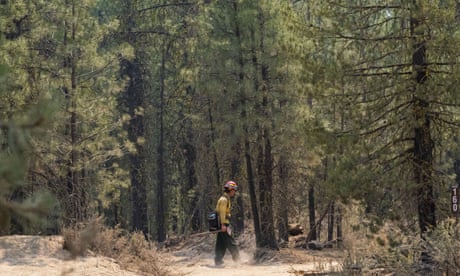
A resident shovels back floodwater as monsoon rains fell on the Museum Fire burn area causing flooding from the Paradise Wash in east Flagstaff, Ariz. on Wednesday, July 14, 2021. The threat of flash flooding will remain through next week, the National Weather Service said, though the coverage will be more scattered than widespread. (Jake Bacon/Arizona Daily Sun via AP)
01:37
Arizona: stranded family rescued as flash floods inundate cities – video report
 in New York

Parts of Arizona have been hit with devastating flooding, with the city of Flagstaff declaring a state of emergency after being inundated with torrents of water that turned streets into murky, fast-running streams.

In one widely shared video, a person shouting “Oh my God!” filmed as a Toyota Prius was shown being swiftly carried down a Flagstaff street by a raging swell of dark water. The city, located among the mountains of northern Arizona and considered a gateway to the Grand Canyon, has been pelted by several days of rain, prompting local officials to urge people to shelter in place.

“Water was pouring in the front door, and all we could do is try to block the door and keep more water from coming in,” said local resident David Gilley, who videoed waist-high water accumulating outside his window after 2.5in of rain fell in just two days.

The monsoonal rains also swelled the Colorado River, causing a flash flood that killed one person who was on a rafting trip in the Grand Canyon. Such floods have long been part of an environment that, although largely desert, experiences bursts of intense rainfall.

The flooding in Flagstaff, however, appears to have been aided by the scars of a severe 2019 wildfire that burned away vegetation across a large area of a nearby mountain, which allowed water to flow unimpeded into the city.

“You see in the video of the Prius moving along that there is a lot of mud coming through, which is a contribution of the burn,” said Upmanu Lall, director of the Columbia water center at Columbia University.

Arizona’s governor, Doug Ducey, put out a series of tweets about the emergency.

High temperatures have scorched western states in recent weeks, with Flagstaff hitting 94F (34.4C) on 15 June, the highest daily temperature on record for the city, breaking the previous high set in 1974.

Lall said long periods of dry weather can help fuel fires, leaving behind loose soils that can cause a wave of debris to flow when a sudden flood arrives.

The US west has been in the grip of a drought for the past 20 years, with current exceptional drought and heat levels probably exacerbated by human-induced global heating.

“If we have drier, hotter conditions that follow active monsoon years the propensity for fires and debris flows will go up, which is what the climate community is highlighting,” he said.

In 2018, heavy rains that followed a period of intense wildfire in California caused floods and mudslides that injured several hundred people and caused the evacuation of hundreds of homes.

The climate crisis is also being linked to the severe floods currently being experienced in Europe, with more than 100 people dying after flooding in western Germany and Belgium.

Climate scientists, who have warned that flooding will become more frequent in some places as a warming atmosphere is able to hold more moisture, have expressed shock at the scale of the disaster.

Flagstaff is a popular “gateway town” for visitors traveling north from the Phoenix area to the Grand Canyon.

Grand Canyon national park officials on Friday identified a Michigan woman as the person found dead in frigid water after a flash flood swept through a commercial rafting group’s overnight camp site along the Colorado River.

Rebecca Copeland, 29, of Ann Arbor, was found on Thursday near the camp that was washed away on Wednesday evening by a torrent of water that rushed through a slot canyon about a quarter of a mile from the group, which was using an established site for camping, park officials said in a statement.

The Associated Press contributed reporting

‘When will this end?’: Detroit area suffers again with flooding


ED WHITE
DETROIT, MICHIGAN, UNITED STATES
THE ASSOCIATED PRESS
 JULY 16, 2021

Steady rain drenched the Detroit area Friday, flooding highways and raising the anxiety of frustrated residents whose homes filled with water again exactly three weeks after thousands of basements were wrecked by sewage from a tremendous storm.

A downtown ramp to M-10, known as the Lodge Freeway, was below water and closed, while sections of Interstate 94 in Detroit and suburbs were also flooded for hours.

The National Weather Service posted a flood warning for Wayne County until late afternoon as well as flood advisories for elsewhere in southeastern Michigan.

“When will this end?” Chelsea Parr said on a Facebook page for Grosse Pointe Farms residents.

Indeed, people in the Grosse Pointe communities posted remarkable video of water rising in basements from floor drains, geysers in streets and manhole covers rising and falling, apparently from pressure under ground.


“Beyond angry,” said Sarah Peruski, standing at the top of the stairs to a flooded basement.

Detroit urged residents to clear catch basins in the streets. Dearborn blasted an outdoor emergency siren to warn people about the rain. The rain eased by early evening, though forecasters said it could resume before midnight.

In the Detroit area, some highways are below ground level, making them vulnerable in any long rain event. They depend on pumps to get rid of water.

A state police officer in waders used a boat to rescue a man stranded on top of his submerged car near the downtown convention centre.

The pumps were working, but there was “more rain coming down than we can handle,” said Diane Cross, a spokeswoman at the Michigan Department of Transportation, said of the saturated freeways.

“The rivers and creeks and even the sewer systems, grassy areas that all absorb the rain normally are kind of full,” Cross said.

The rain fell a day after President Joe Biden declared a disaster in Michigan due to flood damage from late June. Thousands of basements in Detroit and some suburbs were swamped with water and sewage when more than 6 inches (15 centimetres) fell in just a few hours.

Power disruptions stalled pumps operated by the Great Lakes Water Authority, sending sewage back through pipes. Piles of possessions from contaminated basements sat on curbs for days before being hauled away by weary crews.

The agency insisted Thursday that it’s “ready for the storm.”

One day after Biden declares state of emergency from June floods
Major floods hit metro Detroit again


Kathleen Martin
WSWS
a day ago

On Friday, just three weeks after record rainfall wreaked havoc on the metro Detroit area, more storms overwhelmed the region’s crumbling infrastructure. The National Weather Service issued a flood warning for Wayne County and neighboring Macomb County due to heavy rains.

One day after President Joe Biden declared a state of emergency for Washtenaw and Wayne counties from the June 23–25 floods, scenes similar to the events of late June emerged on social media. They showed abandoned vehicles sitting in water on the sides of major freeways, stranded drivers awaiting emergency assistance and flooded basements with waist-high water.

Three days before the new flooding, the Detroit Water and Sewerage Department (DWSD) announced that over 24,000 households had submitted flood damage claims in the wake of the June devastation. Since nothing was done in the meantime to improve infrastructure and prevent such floods from happening again, many of the residents filing for much-needed disaster relief are the same ones who were hit again by Friday’s flooding.

Interstates 75, 96 and 94 as well as popular commuter routes—the Lodge, Davison and Southfield freeways—were once again underwater by late Friday morning. The Lodge briefly reopened in the early afternoon, but quickly flooded again as the rain continued, stranding one driver atop his car as he waited for rescuers to save him. The Department of Natural Resources lent a boat to the rescue effort and the man was recovered unharmed.

One local news outlet reported that many Dearborn Heights residents were kayaking through their neighborhoods because it was safer than driving.

The floods three weeks ago were the result of a power outage at DTE Energy that led to freeway pump failures. Apparently the pump locations did not have backup generators in case of a power outage. It is unclear precisely what infrastructural failure caused Friday’s flooding, since no major power outages were reported this time around.
Dearborn City Council meeting erupts
Dearborn neighborhood flooded again Friday [Source: Twitter, @safecampdore]

On Tuesday, just a week and a half after residents gathered in Dearborn to protest the lack of response from city officials following the June flooding, a Dearborn City Council meeting erupted in anger.

The four-hour meeting was nearly ended twice by City Council President Susan Dabaja, who claimed she was being “crucified” as residents raised concerns about the floods.

Over 8,000 Dearborn homes were impacted in the June flooding. Many of these residents, as well as residents of Detroit and other surrounding suburbs such as Inkster and Grosse Pointe, had just begun the process of replacing destroyed appliances and rebuilding damaged homes, only to have them all ruined again.

Residents have raised concerns about how they will pay for the damage that has been done, now twice in the span of three weeks. Many have yet to recover from the 2014 and 2018 floods.

Many who attended the protests and City Council meeting voiced anger over the lack of trash collection. Moldy furniture and carpet soaked in raw sewage sat for days on curbs in the sun, creating serious public health concerns.
Grosse Pointe Park residents file lawsuit
A flooded basement in Detroit from the June storm [WSWS media]

Also on Tuesday, 11 households in Grosse Pointe Park filed a lawsuit against the Great Lakes Water Authority (GLWA), the Detroit Water and Sewerage Department (DWSD) and the cities of Detroit and Grosse Pointe Park. Each family has had to deal with hundreds of thousands of dollars in property damage.

The suit contends that the authorities were aware of the potential failure of two particular freeway pumps and that they disregarded weather reports warning that heavy rainfall would occur. They also allege that city and water officials are well aware of the failing infrastructure but have done nothing to improve it.

Paul Doherty, attorney at Ven Johnson Law and also a flood victim, released a statement on behalf of the families he is representing in the case. The statement said:

DWSD takes in nearly half of a billion dollars in water and sewer fees annually, yet aging water and sewer lines under their purview regularly fail, devastating anything and everything caught in the path of these floodwaters. Local residents are at the mercy of faceless local bureaucrats who literally put their constituents’ safety at risk by not investing in proper infrastructure. This flooding has upended lives causing stress and a feeling of powerlessness, and a huge financial strain of rebuilding homes or businesses.

GLWA’s General Counsel Randal Brown responded in a statement:

GLWA supports Governor Whitmer’s request for federal aid to provide residents and businesses in the impacted areas with the resources to rebuild after the floods. Seeking federal aid is the appropriate way to address this unprecedented event.

City officials and GLWA spokespeople have maintained in recent weeks that pumps and equipment all operate as they should. While heavy rainfall due to changing climate patterns has been on the rise in recent years, nothing has been done to update or maintain infrastructure to deal with these changes, and officials use climate change as an excuse for shoddy infrastructure.

Hundreds greet Aristide on return to troubled Haiti


Danica Coto and Astrid Suarez
The Associated PressStaff
Published Friday, July 16, 2021 3:46PM EDT

PORT-AU-PRINCE, HAITI -- Former President Jean-Bertrand Aristide returned to Haiti on Friday after a nearly a month in Cuba, thrilling hundreds of supporters who gathered at the airport at a time of tensions over the recent assassination of the country's leader.

Aristide, a charismatic yet divisive figure in Haiti who was receiving unspecified medical treatment in Cuba, arrives back in a country simmering with tension over the July 7 assassination of President Jovenel Moise as new details about the investigation emerged.

Colombian Police Chief Gen. Jorge Luis Vargas on Friday accused a former Haitian government official of ordering ex-Colombian soldiers to kill Moise. He said Joseph Felix Badio told Colombians Duberney Capador and German Rivera that "what they have to do is kill the president of Haiti."

Vargas said Badio gave that order roughly three days before the assassination during a meeting in Haiti with the two Colombians, who had been in the country since May 10.

Capador was killed in a shootout with Haitian police hours after Moise was slain. Rivera remains detained in Haiti while police are still searching for Badio, who previously worked for Haiti's Justice Ministry and then the government's anti-corruption unit until he was fired in May.

More than 20 suspects accused of direct involvement in the slaying have been arrested, the majority of them former Colombian soldiers. At least three other suspects were killed, and police have said they are still looking for at least seven others.

Colombia's government has said only a small group of Colombian soldiers knew the true nature of the operation and that the others were duped.

Also on Friday, Police Chief Leon Charles said 24 police officers were standing guard when the president's house was attacked. He said they have been interrogated and that a fifth high-ranking police official has been placed in isolated detention with four others, although none have been named as suspects.

Interim Prime Minister Claude Joseph said the government will continue to bring those responsible to justice.

"We will continue to pose questions," he said.

Tickets for most of the former soldiers, at least, were purchased through a Florida-based company, Worldwide Capital Lending Group, Vargas said Friday.

Officials earlier said they had been bought by another Florida company, CTU Security, which allegedly recruited the men.

Worldwide issued a statement Thursday saying it helped provide a loan to CTU, but said it was meant to help finance infrastructure projects sought by Christian Emmanuel Sanon, a Haitian physician and pastor who has been arrested in the plot.

"At no time during any meeting or conversation with Dr. Sanon or with any of his representatives was there any mention, discussion or suggestion of an assassination plot against President Moise or the intention to use force to bring about a change of leadership in Haiti," the company said.

Meanwhile, throngs of Aristide supporters cheered when they saw the former president arrive. They had arrived a couple of hours before the plane landed, holding pictures of the former priest, some saying, "The king is back!"

Aristide was taken home in an ambulance that made its way through the crowd. Some touched the vehicle's windows before being pushed away by police. Some supporters lingered outside after the ambulance entered Aristide's home, but the former leader did not come out and speak.

Joel Edouard "Pacha" Vorbe, an executive committee member of Aristide's Fanmi Lavalas party, told The Associated Press that Aristide "is completely recovered," although he didn't have details about his condition. Neither Aristide nor the government have described the health issue.

Aristide's return adds a potentially volatile element to an already tense situation in a country facing a power vacuum. Aristide has long been one of Haiti's most polarizing politicians and is still popular with many.

Aristide became a global figure of resistance when, as a slum priest known for fiery oratory, he led a movement that ousted the hated dictator Jean-Claude "Baby Doc" Duvalier in 1986.

He was elected president in 1990, forced out in a military coup a year later and restored to power by the U.S. military in 1994 to serve out the remainder of his term. As a champion of the poor and advocate of leftist "liberation theology," he was deeply hated by members of the elite.


Reelected in 2000, he was ousted four years later in a rebellion led by opponents with ties to the elite and the old Duvalierist regime. Aristide spent seven years in exile in South Africa before returning in 2011. He has largely kept a low profile, except when campaigning for his party's unsuccessful presidential candidate in 2016.

Joseph is currently governing Haiti with the backing of police and military, although he faces growing challenges to his power.

While Haiti's government has asked for military help, U.S. President Joe Biden said Thursday that sending troops was "not on the agenda." However, he said U.S. Marines would be deployed to boost security at the U.S. Embassy.

Mathias Pierre, Haiti's elections minister, said he believes the door is still open for potential U.S. military assistance, noting that the country is in a "fragile situation" and requires a secure environment to hold elections in upcoming months.

Suarez reported from Bucaramanga, Colombia. AP journalists Fernando Llano and Pierre Richard contributed to this report


Supporters of former Haitian President Jean-Bertrand Aristide celebrate his arrival from Cuba, where he underwent medical treatment, in Port-au-Prince, Haiti, Friday, July 16, 2021. President Jovenel Moise was assassinated at his residency on July 7. (AP Photo/Fernando Llano)


Former Haiti official may have ordered president’s assassination, Colombia says

By Staff Reuters
Posted July 16, 2021 

Man arrested as alleged leader in assassination of Haitian president

Former Haitian justice ministry official Joseph Felix Badio may have ordered the assassination of Haiti’s President Jovenel Moise, a Colombian police chief said on Friday, citing a preliminary investigation into the murder.

Moise was shot dead when assassins armed with assault rifles stormed his private residence in the hills above Port-au-Prince on July 7.

An investigation by Haitian and Colombian authorities, alongside Interpol, into Moise’s killing has revealed that Badio appeared to have given an order for the assassination three days before the attack, General Jorge Vargas said in an audio message sent to news outlets by the police.

It was not immediately possible to reach Badio for comment. His whereabouts is unclear.


READ MORE: Police arrest Haitian with alleged tie to masterminds behind president’s assassination

According to Vargas, the investigation found that Badio had ordered former Colombian soldiers Duberney Capador and German Rivera – who had initially been contacted to carry out security services – to kill Moise.

“Several days before, apparently three, Joseph Felix Badio, who was a former official of (Haiti’s) ministry of justice, who worked in the anti-corruption unit with the general intelligence service, told Capador and Rivera that they had to assassinate the president of Haiti,” Vargas said.

Vargas did not provide proof or give more details about where the information came from.

Capador was killed and Rivera captured by Haiti police in the aftermath of Moise’s murder, authorities have said.

On Sunday, Haitian authorities detained 63-year-old Christian Emmanuel Sanon, widely described as a Florida-based doctor, and accused him of being one of the masterminds behind the killing.

Former Haitian Senator John Joel Joseph is being sought by police after Haiti’s National Police Chief Leon Charles identified him as a key player in the plot, while Dimitri Herard, the head of palace security for Moise, has also been arrested.

“This is a big plot, a lot of people are part of it,” Haiti’s Acting Prime Minister Claude Joseph said in a news conference. “I am determined to move the investigation forward.”

The group of assassins included 26 Colombians and two Haitian Americans, according to Haitian authorities. Eighteen of the Colombians have been captured, while five are on the run and three were killed.

Many of the Colombians accused of involvement in the assassination went to the country as bodyguards, Colombian President Ivan Duque said on Thursday. That has been confirmed by relatives and colleagues of some of the detained Colombians.

READ MORE: U.S. citizens, ex-Colombian soldiers among suspects detained in Haitian president’s killing

“We are assisting in all the support tasks for the interviews that are being carried out with the captured Colombians,” said Vargas.

Colombia will send a consular mission to Haiti as soon as it is approved by the Caribbean nation, Colombian Vice President and Foreign Minister Marta Lucia Ramirez told journalists on Friday, to meet with the detained Colombians, ensure their rights are being respected, and move ahead with the repatriation of the remains of the deceased Colombians.

The ministry is in daily contact with the families of the dead and detained, Ramirez added.

She repeated Colombian government assertions that very few of the men, who were ex-military, knew about the assassination plan but said those responsible should pay the price.

“Whoever they are, wherever they are from, (they should face) all the drastic consequences this crime should bring,” she said.

(Reporting by Nelson Bocanegra, Julia Symmes Cobb and Oliver Griffin; Additional reporting by Andre Paultre; Editing by David Gregorio, Rosalba O’Brien and Muralikumar Anantharaman)
Somalia Ex-Minister's Presidential Quest Tests Rigid Patriarchy


16 JULY 2021
The East African (Nairobi)By Abdulkadir Khalif

When Somalia's former Foreign Affairs minister Fawzia Yusuf Haji Adam announced her candidacy for president in the next elections, the reaction in Mogadishu was mostly muted.

Yet Ms Adam, from a prominent family of scholars, is not just testing the waters. She may well be testing the rigidity of an age-old culture.


If the federal electoral commission accepts her candidacy, she will be only the second woman in Somalia's history to contest the presidency.

In 2004, Asha Ahmed Abdalla sought Somalia's top leadership position. That vote was held in distant Kenyan capital Nairobi as Mogadishu then was an arena for warlords.


And during an election contest that took place at Kasarani Stadium at the end of reconciliation midwifed by the Intergovernmental Authority on Development (Igad) and Kenya, she lost after the first round of voting by a 275-member federal parliament.

Indirect election

Somalia's politicians had been gathering in Mbagathi. When they agreed on an indirect election through delegates, three voting rounds were needed.

Col Abdullahi Yusuf Ahmed was elected and proceeded to restore the presidential seat at Villa Somalia in December 2006, before quitting the post two years later.

There are many similarities between that vote and the polls planned for October 10.

One is that Somalia has failed to organise universal suffrage. So leaders still have to jostle for delegates who elect MPs, who in turn elect the president.

Only that the Mbagathi reconciliation meant Somalia's transitional federal government at the time was governing from Kenya, had no idea what the capital Mogadishu was like and the president was basically chosen by a handful of influential clan elders without input from anyone else.

Powerful clan elders

Today, those clan elders are still powerful and have helped nominate delegates in consultation with the electoral commission, as well as blessing or rejecting candidates.

For Ms Adam, 69, her decision to run for president, she argued, was not to stand out of the crowd but because the pace of development had been sorely slow and she wants to do something about it. She vowed to mobilise resources.

"My sole aim is to breathe a new lease of life into Somalia. Our political ideology and beliefs are at the heart and soul of our political trajectory in deciding the best way forward for my nation," she said.

A member of parliament in the expiring legislature, Ms Adam stormed to stardom in 2012 after Hassan Sheikh Mohamud appointed her minister for foreign affairs and international cooperation and named her deputy prime minister.

She remains the only Somali woman to have held that position.

Her campaign team says she is running on the National Democratic Party ticket and will chair the Hiigsi coalition. She wants to run on issues that cement "nationhood" including "durable peace, justice and development".

She will face incumbent Mohamed Farmaajo, former Galmudug president Abdikarim Guled, former presidents Mr Mohamud and Sheikh Sharif Ahmed, former prime minister Hassan Khaire and former lawmaker Abdikadir Ali Osoble, who are seen as frontrunners for the seat.

Conservative


She faces two challenges. One is she is female in a male-dominated polity where only elites with money have been voted in. Under influential clan elders, the Somali political scene has largely remained conservative, as seen when leaders haggled over the 30 per cent allocation of seats to women.


There has been no clarity on how seats will be allocated to women to achieve the threshold, but at least the outgoing parliament had seen about 24 per cent seats go to women.

Still, some clan elders have openly rejected the idea of quotas for women or even giving them a chance at all.

Ms Adam, though prominent in the early years of Mr Mohamud's rule, was born in Hargeisa, Somaliland. In Somalia's tense clan politics, people from Somaliland hardly crack it in the presidency in Somalia, given Somaliland's continual declaration of (unrecognised) independence from Somalia.


Somalilanders who choose one Somalia have often landed the prime minister's post or deputies. The indirect elections also cost lots of money and candidates have to move round, by air, seeking to get as many favourable delegates as possible to elect MPs, who are then required to elect the president.

Hoping to shine


Having reached the highest political office ever achieved by a Somali woman, Ms Adam's ambition now is to rule the Horn of Africa country. Her hope is to shine in a race crowded by men.

Ms Adam is armed with a significant diplomatic career. She had joined the foreign service in the 1980s, serving in different offices in the Somali ministry of foreign affairs as well as in missions in other foreign countries.

During her tenure as foreign minister and deputy premier, she rubbed shoulders with top diplomats around the world.

Somalis may remember her for attempting to help in returning Somalia's assets seized abroad after they were illegally grabbed when the country fell to warlords.


Read the original article on East African.
 Nalini Burn - The vaccines have given conspiracy theorists another shot in the arm

16 JULY 2021
L'Express (Port Louis)
By Touria Prayag

Vaccination has been making the headlines for weeks, resulting in a heated debate between those who feel it's necessary to get back to some normalcy and those who are either worried of its possible side-effects or the autocratic way in which it is being imposed. Nalini Burn, socioeconomist, has been at the forefront of this debate. We approached her for her views on the matter.

"I ask the opponents of mandatory vaccination: If it was not mandatory, would you get vaccinated? If you would, then, why give priority to individual freedom over the right to health?"

There has been a lot of debate and exchanges about mandatory vaccination. You are one of the proponents of the vaccine and have been forceful about it. Give us the reasons why we should all be vaccinated


Hey, there is a pandemic out there-Covid 19! The official deaths -underestimated- are about 3.96 million with millions ill, some seriously, and over a long period, globally. And this mostly in rich countries, such as the USA and the UK, despite their life-saving public health capabilities.

Be that as it may, why are you advocating vaccination as the only solution?

First, because of commitment to the right to health. It is about the best available universal health care that is possible to achieve in any country and which means to stop preventable deaths and morbidity.

How about the approach of allowing the disease to run its course "naturally"?

That will lead to millions of deaths, debilitating disease and complications and devastate livelihoods. It is not a moral and ethical option and is a gross violation of human rights. Also, in the case of a transmissible disease, like COVID 19, the one effective human rights-compliant way to prevent it is through vaccination.


But up until now, there is no certainty about the efficacy of the vaccines available, is there?

Yes there is. Vaccines greatly reduce how severely you get the disease and how much you can transmit it. Since their roll-out in January 2021, we can already see how the link between infection, hospitalisation and death can be broken. We are more vulnerable because of the burden of non- transmissible diseases like diabetes, heart disease, cancers do increase risk of being seriously ill and not surviving COVID, particularly as we age.

Can't we stop the spread of Covid through any other means without violating human rights?


The so-called Zero Covid, through physical barriers like quarantine, lockdowns, but with low vaccination rates, is not working, as "fortress" Australia is now discovering. That way of dealing with Covid is also a life threatening violation of human rights because of the social, economic, cultural, health, psychological damage inflicted on humans as social beings, on their livelihoods. It has revealed and amplified the inequalities and injustices burdening our societies, increasing gender-based violence, placing intolerable strains on the care we provide to each other, paid and unpaid. Vaccines are a way of preventing that transmission to enable us to manage to live with Covid, eventually tame it, as we now do with the flu.

Going to the extent of forcing people to get the jab?

I am NOT a proponent of mandatory vaccination. It is deeply concerning that the debate has been framed, conflated, and is now polarised in this way.

"The virus is targeting younger age groups as the vaccinated develop the immune response to fight infection."

Are you saying people should have a choice if they don't want to be vaccinated?

Some have even called trying to convince them and challenging their viewpoint over vaccination as 'terrorism'! But I will persist in helping, with empathy, nurture a human rights-based ecosystem of INFORMED CONSENT to nudge vaccine-hesitant people towards vaccination.

So you are for free choice, aren't you?

Yes, free choice for you as long as you respect my right to health within this ecosystem, not to be infected as far as possible and with access to health care for other illnesses. The State Party has an obligation to protect. I, as a rights-holder also have a responsibility to protect myself and respect others. The right to individual freedoms and liberties (and the corresponding obligation to respect) are other fundamental human rights. It is a sort of contract between the state and citizens. But all bound within public space, guaranteed by the rule of law as a fundamental human rights principle. The infectious nature of the disease makes health a public good, indivisibly delivered to one and all. It cannot be individually exclusively packaged and privatised. The virus does NOT respect individual bodily integrity. It cunningly violates all its defences. It does not choose. It will just keep finding someone out there it can infect and it mutate. The limits of an individualised right-wing libertarian ethos and anti-human rights agenda are exposed. Letting the disease run its course does mean the 'freedom' to die of hunger, disease, pestilence. It is up to individual choice and circumstances. Laisser-faire again. The issue is ideological, ethical! Focusing on the mandatory nature galvanises the anti-state - any state - stance, while commandeering its obligation to respect.


There are many reasons why the opponents of vaccination do not want to take the jab. Some resent its mandatory nature, others because of health concerns and some worry about whether it is effective and safe or not. All this is very confusing, isn't it?

I ask the opponents of mandatory vaccination: If it was not mandatory, would you get vaccinated? If you would, then, why give priority to individual freedom over the right to health? I signed the disclaimer form to get vaccinated. Given the State's obligation, I will challenge it in court, if necessary. Yes there are people for whom vaccination is risky on health grounds. And that is the reason why healthy people should protect them by getting vaccinated. As for efficacy, the virus is targeting younger age groups as the vaccinated develop the immune response to fight infection. Yes, it is confusing: What information is pertinent? How to process it? But is it information or deliberate disinformation? Last year, when Covid first stopped the world, remember the conspiracy theories and Covid denial: About China, WHO, Bill Gates, Big Pharma, a programmed sequenced New World Order. Now the vaccines have given these another shot in the arm. An infodemic grafting onto the pandemic, inflaming vaccine hesitancy. I spend much time, like others, researching, checking and calling out obscurantist disinformation churned out by the cyberfactories - very good at going viral.

So let me put the question to you again: How does the ordinary citizen find her way through all of this?

Yes, I really feel for who you call the "ordinary citizen". There is unfortunately in many a tendency to choose a trusted influencer/guru and believe and go by whatever he or she says. Anti-science as belief is now an acknowledged global risk. I do believe the only way is to vastly communicate interactively, inclusively tease out the moral, policy trilemmas to respond to this disaster risk, based on informed science-backed consent.

Shouldn't the government be part of this communication plan?

The government has refused to initiate an inclusive interactive dialogue with citizens, who did suggest it. It has responded with haughty opacity, selective drip-dripping of bits of meaningless data, harsh, ill thought-out measures, top-down draconian legislation and measures. Then it has given conflicting messages about being Covid free and safe. It has not used the quarantine/confinement window to prepare for opening, for living as safely as possible with a virus that has far from run its course anywhere. Let's not forget the context of COVID- related procurement scandals, the Wakashio episode and the unprecedented mobilisation against all of this. Now it has lurched into vaccines by heavy-handedly trying by the back door to make it mandatory. While disclaiming responsibility for any risk associated. This unjust breach of trust is yet another human rights violation. The anti-vax lobbies have seized the opportunity to weaponise the rights discourse. And some of the supposedly alternative opposition is also jumping on the anti-mandatory vaccination bandwagon as platform to oppose the government.

While Government is making it more and more difficult for its citizens to move around without being vaccinated, the types of vaccines on offer have sometimes not been cleared by the World Health Organization. Isn't that tyrannical?

Was the word tyrannical framed when there were non-pharmaceutical interventions such as lockdowns and quarantine? No transport, income, food, workplace, schools, places of worship, fresh air/exercise, split families, incarcerated at home with your abuser, burnt out with multiple care responsibilities. Human rights violations, unequal, backed by repressive legislation. WAPs like the Pass Laws of colonialism and where biosurveillance now adds to the coercive apparatus of the surveillance state. But the fixation is on vaccines, which actually offer the easing of movement restrictions. When I travel to countries where yellow fever vaccination is mandatory, I consent to it for my safety.

That's a tried and tested vaccine. The Covid-19 vaccines are new and have only got the Emergency Use Licence. Some we are asked to take have not even reached that status.

Closer scrutiny of the procedures can make one anticipate likely approval. Sputnik V listing is being held up NOT essentially on safety and efficacy but on production issues. Are people aware of the colossal, unprecedented collaborative efforts and technological advances, building on previous SARS research, to accelerate vaccine development? Impelled by an emergency race between vaccine and the virus and its variants, given our globalised lifestyles and population levels? THE global health risk is the shortage of vaccines and the inequalities of where it is available, accessible and affordable. Waiting for further safety leaves free course to the virus to reach the vast majority of mostly unvaccinated populations and mutating, particularly in the poor discriminated countries of the Global South. Some protection is much better than none!

Some side-effects reported lately are worrying. Don't they worry you?

Some reported side effects go viral without closer scrutiny and with spurious, scary conclusions. There are also mixed messages from some medical authorities and some medical professionals. The research into reported adverse events after vaccination have to sort out whether they are because of vaccination or some other related and unrelated factors. And communicate results, as gradually they are investigated, through surveillance. Up to now, the numbers and proportions involved in side effects are actually very small, the side effects are mild and not long lasting. I think there is a need for a sort of ongoing clearing house for this, the sort of interactive platform I was mentioning, with a consortium of concerned media, health professionals, lay persons.


"I am NOT a proponent of mandatory vaccination. It is deeply concerning that the debate has been framed, conflated, and is now polarised in this way."

The statistics coming out of the Seychelles, the good student of the Indian Ocean when it comes to vaccination, do not tell a good story, do they?

Seychelles was a good student for many lobbies. Of vaccinate and open up quickly for compelling economic reasons. Did the authorities think vaccination was the only quick fix and so did its people, celebrating with super spreader events? And was it not caught out by variants, from elsewhere?

How about Israel, one of the first countries to have vaccinated a large chunk of its population?

Vaccines alone are not a miracle solution. They are not 100% effective. They should be used with complementary measures that also boost the immune system as hygiene, physical distancing. In the case of Israel, not all have been vaccinated, least of all Palestinians. Even with the contagious Delta variant, the vaccination rate has reduced the transmission of the infection, hospitalisation and death among the vaccinated.

British Prime Minister Boris Johnson has announced "freedom day" to be effective on Monday 19th - a very controversial decision that has pushed a large part of the scientific community to be up in arms. How do you feel about that?

Totally irresponsible from a populist ideologue who now again leaves it to the population to decide, having initially sought herd immunity, leading to tragic death tolls, all sorts of mental, physical and social pathologies, exhausted front line staff, overwhelmed NHS. Yet, he still keeps sending confused messages, with confinement fatigue rampant. Some "freedom" this, indulging in Wembley-like super-spreader events!


Read the original article on L'Express.
South Africa: The Fault-Lines of the World's Most Unequal Society

Niko Knigge/Flickr
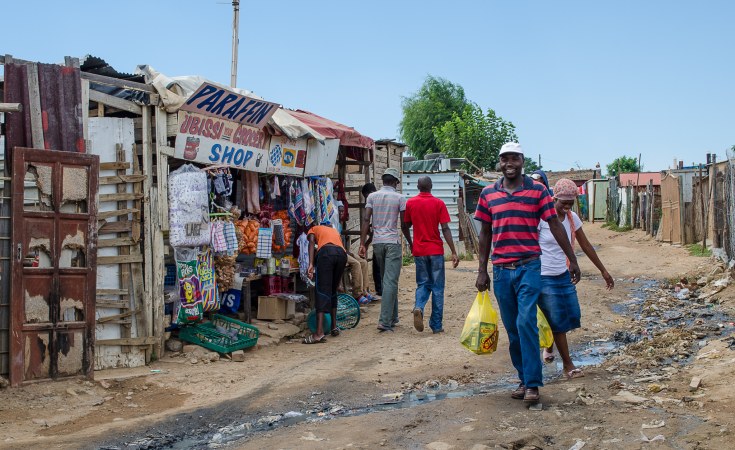
Diepsloot in South Africa.

16 JULY 2021
allAfrica.com
ANALYSISBy John Allen

Cape Town — Amid the explosive cocktail of ingredients which contributed to the outbreak of looting and burning in South Africa this week, new fault-lines running through a society divided by class as well as by race were on display as never before.

The unrest may have been triggered by the jailing of former president Jacob Zuma and exacerbated by factors ranging from orchestrated incitement by pro-Zuma forces, to hardships caused by Covid-19 job losses, to wanton criminality. But as rioting spread from Zuma's home province of KwaZulu-Natal to the economic heartland of Gauteng, the effects of extreme economic inequality in post-apartheid South Africa became apparent.

During the apartheid era, the sporadic uprisings against a regime underpinned by a powerful military were mainly aimed at symbols and infrastructure identified with an oppressive state, as well as at those subjects of the system who were perceived to be collaborating with it.

But this week, the wall-to-wall coverage provided by the country's three 24-hour television news channels showed unprecedented scenes of working- and middle-class black South Africans mobilising, sometimes alongside white compatriots, to defend those gains they have made since political liberation in 1994.

South Africa has long been known as a nation of income inequality, in which a few top earners enjoy a high proportion of the country's income, in contrast to the small proportion earned by the vast majority. The government agency, Statistics South Africa, says the inequality is "extremely high and has remained so since 1993". The latest World Bank figures show that it is the worst in the world. The official unemployment rate, driven to a record high by one of the strictest Covid-19 lock-downs in the world, was 32.6 percent in the first quarter of this year and 46.3 percent among youth under 35.

However, the racial make-up of higher income groups has changed since 1994 (albeit leaving white South Africans still the most privileged as a group). The economic and political analyst Moeletsi Mbeki has pointed to figures showing that black South Africans have overtaken whites to make up the biggest constituency of South Africa's middle class.

Speaking to church leaders in 2019, Mbeki cited statistics showing that business and political elites, independent professionals and the middle class totalled more than two million of the working-age population of 23 million. Blue-collar workers in the private and public sectors - who are overwhelmingly black - made up another nine million.

Against this, 12 million South Africans were either unemployed or part of what he described as an "under-class".

It is against this backdrop that the attacks of the last week - primarily aimed at property - have unfolded.

How the rioting spread

Long-distance trucks carrying supplies on the main highway between Durban and Johannesburg were the first targets after Zuma's jailing. As looting and arson spread in KwaZulu-Natal, two of Zuma's children, the twins Duduzane and Duduzile, were among those accused of encouraging insurrection on social media.

The political analyst Rebone Tau was among observers who suggested that the "Free Zuma campaign" had within it "an element of Zulu nationalism". (Later in the week, King Misuzulu ka Zwelithini, recently named to succeed his father as the new cultural leader of Zulu-speaking people, made his first public address in that capacity, condemning the "lawlessness and criminality" which "has brought shame upon us as fingers are pointed at my father's people.")

The attacks quickly spread to Gauteng, where as in KwaZulu-Natal they were principally aimed at warehouses, shopping malls and business centres. As the government got to grips with the situation, security ministers began to point fingers at sinister, dark forces, which they later identified as pro-Zuma intelligence operatives gone rogue.

South Africans have long been accustomed to politicians blaming unrest on instigators rather than acknowledging governmental failure, but this week at least one independent expert agreed - and usually sceptical journalists reported - that a deliberately-planned counter-intelligence operation primed and set off the rioting.

Nevertheless, if pro-Zuma sentiment was the match which lit the fire, the tinder which enabled it to catch and spread so fast - vastly outstripping the capacity of the police to respond – was hunger, poverty, mismanagement by local government and the lack of confidence in the country's political leadership which the corruption of the Zuma years engendered.

The comment of a 25-year-old to GroundUp, a news service which focusses on the stories of the marginalised, was typical of many. Explaining to reporter Kimberly Mutandiro why he was selling looted sweets at half-price, he told the reporter: "It's hunger, my sister. If l can get R30 (U.S. $2), l will buy something to eat. Everyone is helping themselves to goods in shops, we just follow suit."

In north-eastern Johannesburg, serious maladministration of a "renewal project" in the poor and overcrowded black community of Alexandra was reported last week by the government's Human Rights Commission to have created "a ticking time-bomb". The report was issued in response to unrest in 2019 - which erupted again this week.

The church leader, Archbishop Thabo Makgoba, who grew up in Alexandra, spoke out against this week's unrest, but voiced his understanding of its roots. "The vast majority of us are good people at heart," he said.

"But when people go to bed hungry, unemployed, dominated and marginalised, the good in us can be overwhelmed, especially if we see no end to our suffering and especially in times of instability when it seems all bets are off. Desperation can take over, especially when people lose confidence in their political parties and perceive the police as unable to protect their communities."

During apartheid, shopping malls in the crowded black residential areas such as Alexandra and Soweto in Johannesburg and Hammarsdale near Durban, were unknown. Now they are commonplace - and became the targets of attack this week.

In acts of what police and security analysts described as "opportunistic criminality", looters stole and rolled away high-end goods such as huge flat-screen TVs, fridges and microwave ovens in front of television cameras.

Some of the looters were heard drawing distinctions between stores which were assumed to carry insurance against losses - usually owned by large conglomerates - and those operated by emerging black business owners, which are often uninsured.

But as it became apparent that black South Africans with jobs and owners of new businesses would lose as much as, if not more than, anyone else, anger grew.

Nombuso Makhanye told Naledi Sikhakhane of New Frame in Hammarsdale: "There was no need for them to burn the shops. They don't think about the people who work there. I am the sole breadwinner in my family, and I only have experience in supermarkets, so getting a job elsewhere would be nearly impossible."

Entrepreneurs who had sunk their life savings into businesses ranging from mattress and bedding shops to restaurants in black residential areas told television journalists their livelihoods had been wiped out.

Sayabo Wodimu, the owner of a small, informal "spaza shop" in Alexandra, told GroundUp reporter Masego Mafata: "I don't know what I did to deserve this. I know the people in this community, I help them where I can, so I don't understand why they destroyed my shop. They took clothes, groceries and even the engines for my refrigerators."

In communities across the affected areas, residents took matters into their own hands in the absence of police. Racist incidents were reported in Durban and the KwaZulu-Natal capital, Pietermaritzburg, where residents of some predominantly white or Indian suburbs set up roadblocks and demanded proof of residence - or receipts for groceries - from black motorists.

But extensive self-help initiatives launched within the law were also reported. In Johannesburg, where a mall founded by a legendary black business pioneer, Richard Maponya, was reported to be the only one in Soweto not destroyed, residents spent the night ready to defend the complex, and handed to the police those suspected of coming to loot.

Operators of minibus taxis, who make their living from taking millions of black commuters to work or to shopping malls, rallied in support of residents defending local businesses. In the Eastern Cape, an area which has so far escaped the unrest, they formed a convoy through one township, warning against looting.

In KwaZulu-Natal and Gauteng, local residents and volunteers joined forces to begin cleaning up. On Tuesday, a Soweto woman, Emelda Masango, started a Facebook group matching volunteers with people needing help. By Friday, it had 50,000 members. Wrote Marianne Thamm in the Daily Maverick: "This past week not only revealed to us the vulgarity and the violence of a disastrous scheme to destabilise the country, but also the capacity for solidarity and community in the face of a total collapse of law and order."

With AllAfrica staffer Andre van Wyk.