Monday, July 19, 2021

#ILO AT #BRICS CONFERENCE
Concrete, targeted policies and actions needed to address impact of pandemic on informal workers, women

Enhancing transition from informality to formality as a means towards improving living and working conditions, productivity, and job growth will need access to quality employment, social protection
Published: 16 Jul 2021, 

“Ministers, in your meetings in 2019 and 2020, you expressed support for the principle of a human-centred approach to development. Now is the time to convert these aspirations … into concrete action,” the head of ILO said while addressing the BRICS Labour and Employment Ministerial Meeting under India’s Presidency. It was just an indirect way of saying that the governments of BRICS countries – Brazil, Russia, India, China and South Africa – did voice their aspirations year after year, but failed to take concrete actions

The BRICS 7th Labour and Employment Ministerial Meeting held on July 15, 2021 just reiterated these aspirations, and it cannot be taken at its face value because of the prior experience of the performance of the governments in past several years.


The adoption of a declaration is, however, significant because it recognized exacerbation of already prevailing largescale unemployment, decent work deficits and inequality during the COVID-19 crisis. COVID-19 has turned our world, and the world of work upside down, and has derailed progress in reducing poverty around the world, and made achieving decent work for all even more of a challenge.

The member countries did express their ‘strong determination’ to recover with stronger markets and social protection systems for the workforce, but not on recovery plans which need to be human-centred, resilient, inclusive, and sustainable, as the ILO Director-General, Guy Ryder, emphasized.

Repairing the damage caused accordingly will require great efforts and considerable resources. However, the ‘strong determination’ of the governments implies things other than what they have been talking about in words. The declaration adopted do addresses critically important challenges – informality, gender equality, social protection, and the growth of the digital economy – but the real challenge of unemployment and unemployability looms large.

The severe impact of the crisis on informal workers highlighted the need to accelerate progress on the shift from the informality to formality, because hundreds of millions of people earn their living in the informal economy – six out of every ten workers in the world.

Then there is gender disparity. Women lost more jobs than men, and more of them, comparatively, withdrawn for the labour market. Gender inequality got worse in the care work dominated by women.

If we are to address these issues effectively, we need concrete, targeted policies and actions, not merely ‘strong commitments’ in words.

We have been witnessing such ‘strong commitments’ without proper actions in India, as the Union government has been trying to push the controversial ‘labour reform’, which central trade unions, bank employees unions, insurance employees unions, and many more call anti-labour and pro-corporate.

However, Union Minister of Labour has talked about the controversial ‘labour reforms’ boastfully, and called them ‘path breaking reforms’ brought by the government through amalgamation, simplification and codification of its labour laws into four labour codes, namely “the Code of Wages 2019, the Code on Social Security 2020, the Industrial Relations Code 2020, and the Occupational Safety, Health and Working Conditions Code 2020.”

India’s stance in the BRICS meeting clearly shows that the government is bent upon implementing the proposed ‘reforms’ in the near future despite still opposition of the labour unions of the country.

The Union Minister of Labour said that the new labour codes provide integrated pathways towards robust formalization of the labour market, increasing participation of women in labour force and enhancing the role of gig and platform workers in the labour market. In the backdrop of the dismal performance of the Modi government in all the areas of aspirations expressed, the stress on enhancing intra-BRICS solidarity and promoting sustained, inclusive, full and productive employment and decent work for all, is nothing but hoodwinking of workers in India, and trying to get international support for its controversial ‘labour reforms’.

The need of signing of social security agreements among BRICS nation was emphasized, but it was for international migrant workers, not for domestic workers within the country.

“Formalisation of Labour Markets” is has now been seen as an important tool for eradication of miseries of informal workforce in every country. Enhancing the transition from informality to formality as a means towards improving living and working conditions, productivity, and job growth will need access to quality employment and social protection. It has been reiterated for quite some time but near to nothing has been done. It was yet again reiterated and the ministers expressed their commitment to it.

Promoting sustained participation of women in the labour market, in remunerative, productive and decent work was agreed upon by all as top priorities in the national policy agenda. Enhancing the role of gig and platform workers in labour market was also agreed upon. But an expressed commitment has no value if not followed by appropriate actions.

Apart from the ‘labour and market reforms’, emphasis was also given on development of the digital economy, including digital delivery of services, which is of course technology-centred, not human-centred as the ILO wants it should be, to overcome the workers tribulations. Though digital technologies can boost labour productivity, increase flexibility, encourage greater inclusion, and create new jobs for higher skilled workers, it can undermine fundamental principles and right at work, if not properly regulated.

We need a legal framework for protecting the gig and platform works, ensure decent work for all, and bring strong and inclusive social protection systems.

(IPA Service)

Views are personal

 International Journal of Labour Research

Trade Unions matter in a human-centred recovery from COVID-19

The new edition of the International Journal of Labour Research explores strategies to help workers and their organizations shape COVID-19 response policies and advocate for social justice and workers’ rights.

Press release | Geneva | 24 June 2021
GENEVA (ILO News) - Trade unions matter and play an important role in combating the pandemic and ensuring a human-centred recovery, according to the new edition of the International Journal of Labour Research, launched by the ILO’s Bureau for the Workers’ Activities.

COVID-19 and Recovery: The Role of Trade Unions in Building Forward Better ,” says that trade unions have stood their ground and helped to better protect workers and their jobs around the world. This is despite the devastating impact of the crisis on workers and their families, the surge in violations of trade union rights, the loss of members, and a hostile environment towards trade unions in some countries.

The journal outlines the urgent need for unions to develop new strategies to address the challenges of achieving a job-rich recovery, strengthening occupational safety and health systems, and reaching universal social protection for all, gender equality, digitalization and a just transition to environmentally sustainable economies. In tackling these issues, the COVID-19 pandemic could be an opportunity for trade union revitalization.

“The COVID-19 pandemic has shown in a dramatic fashion that the challenges which were highlighted two years ago in the ILO Centenary Declaration, are still so relevant throughout the current crisis. There can be no social justice and decent work for all without a human-centred roadmap and the strengthening of institutions in the world of work, in particular workers’ organizations. As such, the adoption of a Global Call to Action for a Human-Centred COVID-19 Recovery  by the 109th Session of the International Labour Conference  this year, confirms this vision of the Centenary Declaration  and the urgency of its implementation,” said Maria Helena Andre, Director of ILO ACTRAV.

This year’s International Journal of Labour Research highlights the importance of social dialogue as a vehicle to increase union membership and contribute to the effective design and implementation of a robust and inclusive recovery strategy.

Data in the journal show that social dialogue, used to achieve consensus between workers and employers, contributed to a 26 per cent increase in trade union membership overall. Globally, 83 per cent of unions have adopted social dialogue in response to the pandemic, with about 89 per cent engaging in tripartite consultations. Workers’ organizations must engage further with governments and employers’ organizations at every stage in the formulation and implementation of policy responses to COVID-19, the journal says.

The journal calls for global solidarity within and across borders and urgent action to accelerate the process of a fully inclusive, sustainable and resilient recovery from the crisis.


Called a crucial figure in the growth of the United Farm Workers, Ben Maddock dies at 87 | News

He joined the US Marine Corps in 1956 and the trade union in 1969. According to legend and friends, he lived in a barn for part of his childhood and grew up on a family’s small citrus ranch in the countryside of Woodlake, Tulare County. Agriculture was in his blood and the octopus was in his hands, but Ben Maddock continued to fight for the rights of the weakest individuals in California’s rich agricultural industry.

Maddock, in collaboration with trade union leader Cesar Chavez, has organized large-scale vineyard strikes and international boycotts to gain historic legal protection for farm workers, unprecedented. Helped negotiate and manage union contracts.

Maddock, who became Chavez’s trusted best friend and a key figure in the union, died at his home in Wasco on July 9. He was 87 years old.

“Ben was an important person, one of the people who literally helped build UFW in the late 1960s and late 1980s,” UFW long-time spokesman Mark Grossman said in an email.

Grossman recalled that Maddock was closely associated with the organization, negotiations, contract management and strikes of agricultural workers in the Delano region.

“Ben from Anglo in Tulare County was part of the rainbow of farm workers who once existed in the valley,” Grossman said.

Maddock was born in Turea on June 27, 1934 and graduated from Woodlake High School in 1953. After working in the Marine Corps, Maddock began working as a tilesetter.

Guided by a desire for fairness and workers’ rights, Maddock led a strike by his fellow tile workers. Although the labor behavior turned out to be successful, Maddock was blackballed by his employer, Grossman wrote in honor of Maddock.

In the end, interested in making things better for the workers, he took up-and-coming labor activists to UFW’s office on “40 acres” on the outskirts of Delano.

According to Grossman, he promised to volunteer for the union for several months. Instead, he stayed for 22 years.

Maddock oversaw the distribution of the union newspaper, El Marquerado. Maddock, who refused to go to Keen’s Lapas when Chavez moved UFW’s headquarters there in 1971, became the union organizer of Delano.

Grossman said there was skepticism because Maddock did not speak Spanish. But he proved that he could.

Former UFW President Arturo Rodríguez praised him at a funeral mass in Wasco on Thursday. He was flying to service from San Antonio, Texas.

Paul Chavez, son of Chavez and chairman of the Cesar Chavez Foundation, was also present, as was farm workers and union officials holding the UFW flag. Grossman was also there, and he provided a copy of Eulogy to the Californians.

Rodriguez began by talking to Ben Maddock’s widow, Maria Maddock.

“Ben was a friend, mentor, teacher, and trusted adviser to Cesar Chavez and many of us in the trade union for 22 years,” Rodriguez said. “Your loss is also our loss.”

As the mourners listened, Rodriguez told stories one after another.

“I first met Ben in Detroit when I was organizing a second boycott of grapes in 1973. Ben came from a 73-year bitter and bloody grape strike in the Delano region, and with Maria. Born from a boycott.

“I was a young, environmentally friendly and idealistic organizer who recently graduated from college,” Rodriguez recalls.

The former union president said he was fortunate to learn from Maddock about organizing, strategy and building campaigns.

“These lessons never left me,” he said.

“For months we were picketing in front of A & P supermarkets throughout the Detroit Metro area, hoping they would be the first major supermarket chain to remove table grapes from the shelves.

“As we continued picketing in their parking lot, A & P management threatened to arrest us,” he recalled. “One Saturday, Ben helped us all make a plan. In the event of an arrest, we had to be ready to take action immediately.”

When the first picketters were arrested, they were found to be George and Sylvia Delgado, and two daughters Teresa and Christina, four and two years old, respectively.

They were also the granddaughter of Cesar Chavez.

“The next morning, on Sunday, the cover of the Detroit Free Press had a photo of her parents holding her while Teresa and Christina were all arrested,” Rodriguez said. “The sight has brought a lot of public contempt for the management of A & P.”

It was also a turning point for boycotts, and Maddock’s organization helped make that happen.

Maddock returned to Delano in 1975 and headed a 40-acre field office, Rodriguez said. His work will be crucial to the success of the procession, boycott, and enactment of what has become an agricultural and labor-related law.

According to an obituary about Maddock’s family, Maddock left UFW 22 years later. He was hired as a field representative for the California School Employees Association, where he worked until he retired.

Ben and Maria moved to Wasco to be surrounded by their families. In later quiet years, Maddock loved Christmas lights and was known for playing board and card games with his niece and nephew, and watching birdwatching, gardening, and the Dodgers.

But his years at UFW helped define his values ​​and life.

Among the funeral mourners were dozens of current and former UFW colleagues who worked with Maddock, Grossman said.

“They came from all over California and from outside the state,” he said. “Many people were hoisting the black eagle flag of a small union in churches and graveyards.”

A large UFW flag covered the casket and was presented to Maddock’s widow after the graveyard worship was carefully folded into a triangle.

Years after his busy days, the 40-acre land is now recognized as a National Historic Landmark.

“There was a giant who walked those 40 acres,” Rodriguez told the rally on Thursday. “Names like Kennedy, Chavez and Reuters.

“There are countless other giants who have walked on those premises,” he said. “Many of them have been lost in history. One of them is Ben Maddock. Let’s never forget his name.”

Reporter Stephen Mayer can be reached at 661-395-7353. Follow him on Facebook and Twitter: @semayerTBC.

Called a crucial figure in the growth of the United Farm Workers, Ben Maddock dies at 87 | News Source link Called a crucial figure in the growth of the United Farm Workers, Ben Maddock dies at 87 | News

‘I was desperate’: the fight to get Australia’s fruit pickers a fair wage

Backpackers tell of hours hunting for fruit that’s almost as meagre as their pay, as Fair Work Commission case begins


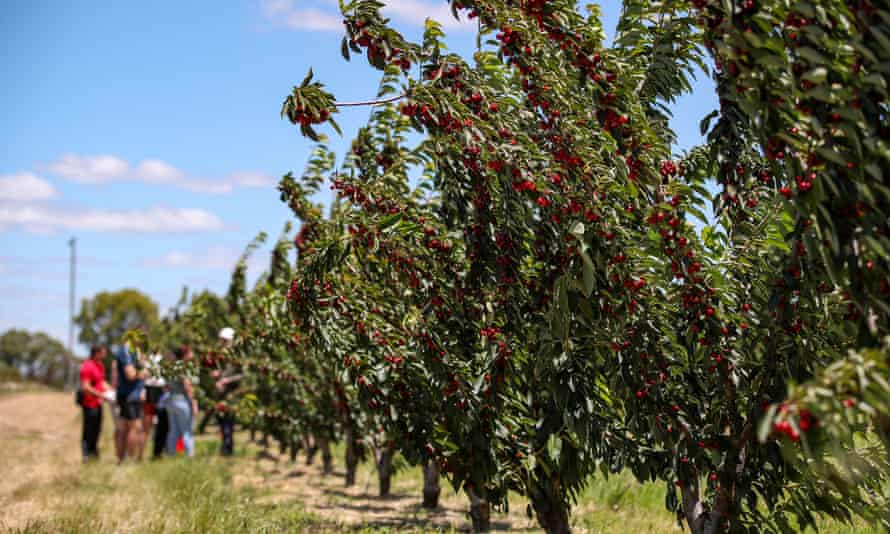
File photo of Cherry pickers in Young, NSW. Unions are trying to change the Horticulture Award, which allows paying by piece and does not specify a minimum hourly wage. Photograph: Xinhua/Rex/Shutterstock

Ben Butler
Sat 17 Jul 2021

Niko Karhu laughed when he got his paycheque for $31.24 after spending five hours picking tomatoes on a Bundaberg farm last May.

The Finnish backpacker says he spent five hours hunting for fruit that was almost as meagre as his pay.

“It was more like, like just walking, wondering where they are and picking a tomato every, you know, two or three metres,” he says.

At the end of the day, Karhu, who is now training to be a diving instructor, was paid based on the – small – amount of fruit he had been able to pick.

Paying by piece is allowed by the Horticulture Award, which governs fruit and vegetable picking.

Unlike most awards, it does not specify a minimum hourly wage that workers must receive – something unions are trying to change.


Seasonal work on Australia’s farms: ‘No one wants to do this sort of work’

Last week, the Fair Work Commission heard arguments in a case brought by the Australian Workers Union, and supported by the United Workers Union, to change the award so that pickers have to receive at least the Australian minimum wage, $20.33 an hour, for what is hard, physical work that often takes place under beating sun or pouring rain.

Launching the case in December, the AWU national secretary, Dan Walton, told Guardian Australia that the industry had “become the centrepiece for exploitation in this country”, with employers paying as little as $3 an hour for labour.

But employers oppose the increase – one group, the Australian Fresh Produce Alliance, has told the commission that a lack of minimum rates “means that novice employees are incentivised to learn the job and achieve competence as quickly as reasonably possible and more experienced employees are incentivised to maximise their productivity”.

This was not Karhu’s experience. At the end of the day when he was presented with his pay he “absolutely burst into laughter”, he says.

“I knew that going to Bundaberg was a risk,” he says. “I’ve never heard anything good about that town work-wise. But I was desperate.”

Karhu, who is a UWU member, needed to work 88 days on a farm in order to stay in Australia on a working holiday visa.


A few days later, he again worked for piece rates, this time at a chilli farm. This time, the problem was not lack of fruit – it was the low piece rates. Experienced pickers did not fare any better, he says.

“I remember that we were moving at pretty much the same pace, all of us,” he says.

“Obviously it was my first – and last – day but a few of the people there, they’d been there before, and I wasn’t that far behind.”

His pay that day was $32.40.
In Spain’s strawberry fields, migrant women face sexual abuse

Farm bosses routinely sexually harass and exploit seasonal workers who pick the red fruit that lines shelves in European supermarkets, investigation reveals.

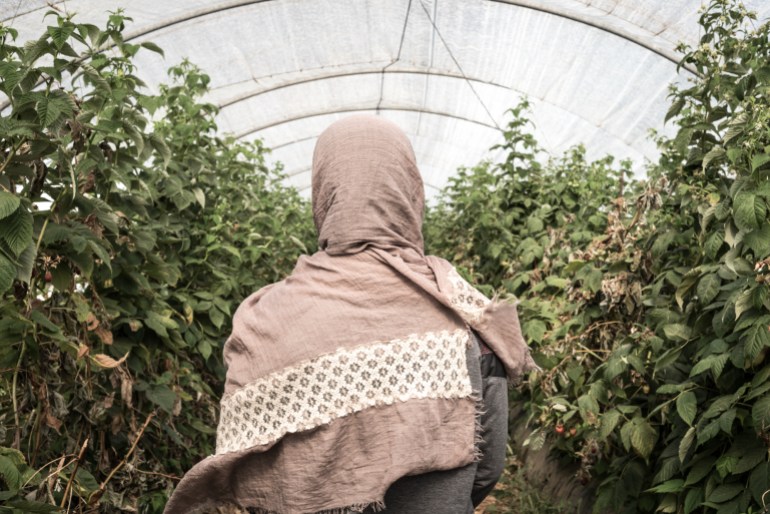
Women fruit pickers in Spain, often from Morocco or Eastern Europe, are being exploited as they attempt to support themselves and families back home [Stefania Prandi/Al Jazeera]
10 Jul 2021

*The names of all workers in this article have been changed to protect their identities.


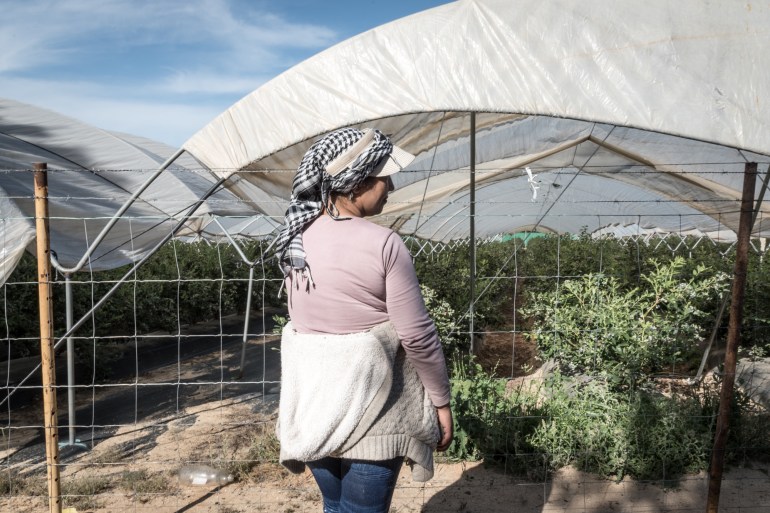
Huelva, Spain – It is mid-May and the hot air is filled with the sugary scent of strawberries mixed with fertiliser as Jadida*, a Moroccan woman, walks on the side of the road, a farm behind her. A large pair of sunglasses covers her face, almost entirely. Greenhouses surround her as far as the eye can see.
KEEP READINGRape, abuses in palm oil fields linked to top cosmetic brands: APPhotos: Death and despair as African migrants arrive in SpainCalls for Spain to regularise migrant who rescued strangersCaught on camera: Libyan coastguard shoots at migrant boat

Jadida had told her colleagues she was going grocery shopping, so on the way back she must pass by the shops to avoid their suspicions, she says as she begins the interview.

Talking to the migrant workers who pick strawberries in Europe’s biggest red fruit producing region, the Huelva province in Spain, is not easy. The fields are fenced, and in many places there are surveillance cameras, guards and electric gates which close as soon as strangers approach.

But after these reporters handed out their phone numbers to a group of strawberry pickers in the area, inviting them to be interviewed, Jadida called back because she wanted to share her experiences of sexual abuse, allegedly by her supervisor.

At first, he was kind to her. But on her second day at work, he tried to persuade her to join him in his room. She refused, and he began calling her phone constantly. Eventually, he approached her when she was working in the fields and tried to pressure her into having sex with him.

Continuously rejecting him has had consequences. The supervisor now threatens to have her fired and sent back to Morocco.

“He tells the other bosses that I am lazy and not working. He gets me in trouble and accuses me of things that I haven’t done,” Jadida told Al Jazeera.

She is one of thousands of women – among them many Moroccans and Romanians – who each year spend three to six months picking strawberries, raspberries and blueberries underneath the “sea of plastic” of Huelva.

Jadida says her boss tries to pressure her into sex by continually harassing her by phone and approaching her physically [Stefania Prandi/Al Jazeera]

Al Jazeera, in collaboration with the Danish investigative media outlet Danwatch, interviewed 16 female farm workers, all of whom had contracts with the seven largest red fruit producers who sell to well-known supermarkets in the UK, France, Belgium, Netherlands, Denmark, Germany and Sweden.

Most workers recounted daily humiliations, such as penalties for taking toilet breaks, union busting and little or no protection against COVID-19. Several reported sexual harassment and being blackmailed for sex.

According to Jadida, many of her colleagues do not dare to reject the supervisor.

The only other worker she knows who did so was frequently seen crying in the greenhouses and eventually moved to another part of the farm, Jadida claims.

“As soon as I get out of here, I want him arrested,” she says.

Strawberry pickers with temporary work visas have few opportunities to report harassment and abuse.

Most arrive as part of a bilateral “contracting in origin” agreement between Morocco and Spain which in 2019 alone, saw almost 20,000 Moroccan women pick Spanish strawberries.

According to the deal, migrants lose the opportunity to work in Spain if they leave their Spanish workplace for any reason.

Furthermore, it emphasises that the Moroccan state recruitment agency ANAPEC must ensure that migrant workers return to Morocco when the season ends. Scholars and NGOs say this is why ANAPEC demands that hopeful workers must show evidence that they have children under the age of 14 at home – so that they have something they must return to.

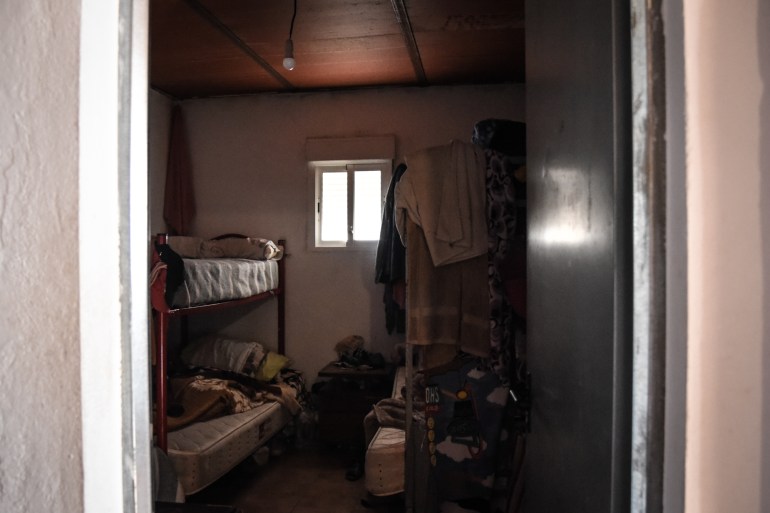
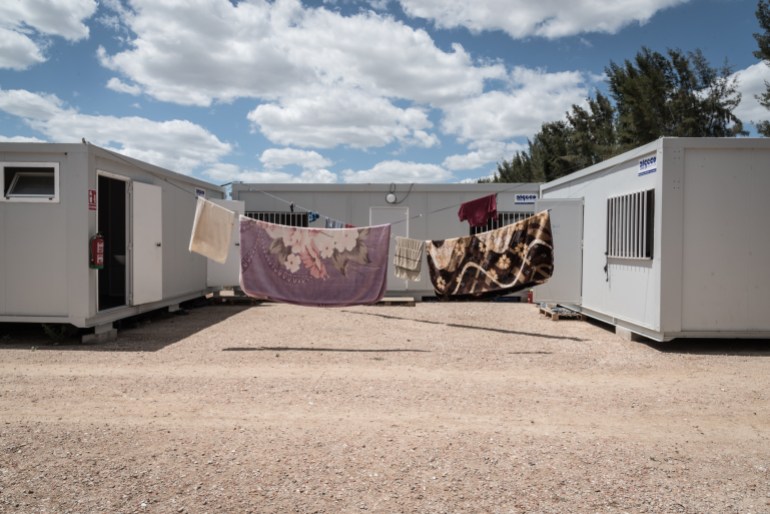
The women stay in small apartments – barracks and containers in between the greenhouses, far from any town centre.

Isolated and reliant on temporary work visas, they are extremely dependent on their employers’ mercy, not only for security but also basic health standards, unions and local NGOs claim
.
Yasmine describes how she had a miscarriage at work and was bleeding in the fields for a month before being taken to the doctors [Stefania Prandi/Al Jazeera]

One worker, 29-year-old Yasmine*, said she was pregnant when she began working for a major strawberry supplier. After two weeks in the fields, she miscarried. She bled and asked her supervisor to be taken to the doctor, but he said she would have to pay 20 euros ($24) for the gas.

Two weeks later, when her condition had still not improved, he eventually took her to a clinic, which immediately referred her to the hospital.

“I was bleeding on my clothes. Everyone could see it,” she said.

While unions and NGOs stress the temporary workers’ lack of legal certainty, the situation is considerably worse for undocumented migrant workers who cannot file charges for abuse without risking being reported to the police and deported.

“If a man likes a female employee, he harasses her. That’s just how it is,” said Hadiya*, standing in front of her home, approximately two and a half metres from the nearest row of plastic-covered blueberry bushes.

The small shed she lives in is made up of discarded greenhouse parts, wooden pallets and plastic tarpaulins.

It is in one of the many temporary settlements that house some of the undocumented migrants working in Spanish agriculture.

When Hadiya’s work visa from Morocco expired two years ago, she became undocumented. Since then, managers repeatedly asked her for sex in two farms where she picked strawberries.

When that happened, “it [was] time to find another workplace”, she said.
Women live crammed in containers and small houses without anti-COVID measures [Stefania Prandi/Al Jazeera]

It is not clear how many migrant labourers work in Spain.


Last year, the Catholic charity Caritas estimated that in Huelva, Almería and Tenerife “more than 12,000 migrants live in extremely unsanitary conditions, lacking direct access to water and sanitation and with no COVID-19 preventive measures other than hygienic kits supplied by civil society organisations”.

A study published by the Foundation for Applied Economic Studies this year estimates the total number of undocumented migrants living in Spain to be 500,000.

According to an EU Parliament briefing in February, most legal foreign guest workers in Huelva are “Eastern Europeans, followed by Africans – mostly Moroccan women – and Latin Americans”.

The report added: “Hundreds of sub-Saharan migrants live year-round in shantytowns close to the fields. Spain’s agricultural model has been questioned for years because of the poor working and living conditions of its migrant workers.”

Asked if she has witnessed sexual harassment on the farms, Saeeda*, another undocumented Moroccan worker from the settlement, exclaimed: “Well, yes!

“When the manager hires a woman, he demands something in return.”

Saeeda was living in an informal settlement for migrant workers before parts of the camp burned down. She died in the fire [Stefania Prandi/Al Jazeera]


Saeeda’s fate tells another story about conditions for undocumented migrants in Spain. Three days after our interview with her, her shack caught fire. This happens often in these settlements, which do not adhere to Spanish fire regulations.

Saeeda was found dead. The 39-year-old was the sole breadwinner for her teenage son who lives with his elderly grandmother in Morocco. She had not seen them for two years when she passed.

According to Angels Escrivà, associate professor at Huelva University and part of the Mujeres 24H network that supports women migrant workers, the strawberry industry initially recruited Moroccan men.

“But the employers thought the men were not docile enough; they were forming unions and in the 2000s there were even riots. So they opted for women,” she said.

Female farm workers are however far from “docile”.

In the past few years, an increasing number have taken red fruit producers to court over exploitation issues.

In 2018, 10 Moroccan women filed lawsuits against Spanish strawberry producer Doñaña 1998, which they accused of assault, sexual harassment, rape and trafficking. That same year, four other women sued an unnamed strawberry exporter for sexual harassment and gross labour exploitation.

A provincial court in Huelva has rejected the Doñaña 1998 workers’ case and they are now awaiting a decision from a labour court. Their lawyer has appealed the case to the constitutional court.

In the second case, a labour court rejected the case of the four women. They have appealed and are still waiting for a criminal court to hear their claims.

These reporters have been in contact with another former strawberry picker who is currently suing a large red fruit exporter on similar charges.

Spanish authorities said they were unable to disclose how many of such cases are continuing. But neither Angels Escrivà nor the lawyer of the four women said they knew of cases won by migrant female agricultural workers.

In 2018, migrant and Spanish female workers organised themselves in Jornaleras de Huelva en Lucha (Female Day Labourers who Fight), a grassroots union focused on the needs of the labourers.

“There is this incorrect idea that migrant women do not organise themselves. Instead, they get together and resist,” said Ana Pinto, a spokesperson from the group.

In response to claims of sexual abuse at farms, the Spanish minister of labour Yolanda Díaz has said that workplaces would be inspected.

She was not available for an interview for this article. Neither were the industry associations Freshuelva and Interfresa.

Antonio Alvarado Barroso, chief of Huelva’s department for Labour and Immigration, did not respond directly to questions on sexual harassment, but offered a brief comment. “The more inspections that are carried out, the better,” he said.

To protect workers’ identities, it has not been possible to confront the individual companies concerning the personal stories about sexual harassment.
Female workers are kept isolated in barbed wired barracks in between thousands of greenhouses [Stefania Prandi/Al Jazeera]

SOURCE: AL JAZEERA
Ontario's Sam Hammond begins tenure as President of the Canadian Teachers' Federation 


NEWS PROVIDED BY
Canadian Teachers' Federation


OTTAWA, ON, July 15, 2021 /CNW/ - Long time union leader Sam Hammond of the Elementary Teachers' Federation of Ontario (ETFO) succeeds Shelley L. Morse as President of the Canadian Teachers' Federation (CTF/FCE).

Hammond was elected President-Designate of the CTF/FCE by acclamation at the Federation's 100th Annual General Meeting in 2020. His two-year term begins today.

Sam Hammond CTF President (CNW Group/Canadian Teachers' Federation)


Hammond is honoured to represent over 300,000 elementary and secondary school teachers from coast to coast to coast.

"I've been actively engaged in the critical work of the CTF/FCE since attending my first annual meeting in July 2004 and have worked tirelessly to solidify ETFO's place in the labour movement," said Hammond. "This has allowed me to forge solid alliances with unions and union leaders across the country. We should be very proud of our individual and collective efforts to protect our members, our fundamental collective bargaining rights and publicly funded public education."

First elected to the ETFO Provincial Executive, Hammond served as Vice-President and First Vice-President before becoming President in 2009. He has served as a President-Designate and Vice-President on the CTF/FCE Executive Committee and has chaired both the Finance and Constitution and Bylaws Committees as well as the Advisory Committee on the Teaching Profession.

A recipient of the Queen Elizabeth Diamond Jubilee Medal and Toronto Pflag's Ally Award, Hammond is unconditionally committed to the essential work of the CTF/FCE and has been a member of the Federation's Board of Directors for 12 years. He taught all grades from Junior Kindergarten to grade eight; was an instructor in the Labour Studies Program at McMaster University and taught Collective Bargaining for the CLC and qualifications courses for Brock University.

The following four leaders in public education were elected CTF/FCE Vice-Presidents, serving two-year terms alongside Hammond on the Executive Committee from 2021-2023:
Clint Johnston, Vice-President (British Columbia Teachers' Federation)
Jenny Regal, Vice-President (The Alberta Teachers' Association)
Paul Wozney, Vice-President (Nova Scotia Teachers' Union)
Heidi Yetman, Vice-President (Quebec Provincial Association of Teachers)

The CTF/FCE Executive Committee also includes outgoing President Shelley L. Morse, in the role of Past President (2021-2022) and Secretary General Cassandra Hallett.

The Canadian Teachers' Federation

Founded in 1920, the Canadian Teachers' Federation is the national voice for the teaching profession. As the national alliance of provincial and territorial teacher organizations, the CTF/FCE represents over 300,000 elementary and secondary school teachers across Canada.

SOURCE Canadian Teachers' Federation

For further information: Media Contact: Andrew King, Director of Communications, aking@ctf-fce.ca, Mobile: 819-213-7847
Related Links

http://www.ctf-fce.ca


How Canada is failing its Black filmmakers

Delay in progress masked by positive news releases, success of a few, creators say

Jackson Weaver · CBC News · Posted: Jul 10, 2021

From left, Arnold Pinnock, Kelly Fyffe-Marshall and Jennifer Holness. All three Canadian creators have seen the industry change for the better in how it treats Black filmmakers but say the limited success of a few and positive news releases mask a lag in progress. (Submitted by Arnold Pinnock, Chris Young/The Canadian Press, Submitted by Jennifer Holness)

Arnold Pinnock's dream project didn't come together easily. Instead, in the years the Canadian actor fought to pitch and produce a series rooted in the history and culture of Black people in this country, there seemed to be little interest.

"In the past, I was told straight to my face in some circumstances that there was not an audience," Pinnock told CBC News. "So financially to do a project ... it wasn't beneficial."

In the eyes of many network heads, he said, there was little appetite for such narratives, and putting money into them would only showcase how little audiences cared.

Since those early experiences, though, things have begun to change, Pinnock explained. And that shift helped him to bring the historical drama The Porter, which examines the real-life civil rights struggle of railway porters to create North America's first Black labour union, to life. Now the series is being jointly produced by CBC and BET+, and it is currently filming in Winnipeg as the largest Black-led TV series ever created in Canada.

But while his success highlights the forward progress the industry has made in supporting Black creators, other events offer a more sobering look at how far there is to go — a lag in progress that some creators say is being masked by positive news releases and the limited success of a few creators.

Pinnock appears in this behind-the-scenes photo from The Porter. The series, which is currently being filmed in Winnipeg, is the country's biggest Black-led television production ever. (Submitted by Arnold Pinnock)

For example, even as Telefilm Canada pledged last year to increase representation "in order to abolish systemic racism" through its Equity and Representation Action Plan, a recent study by the Canadian Media Fund pointed to the fact that Canada has failed to capitalize on "global demand for content from Indigenous, Black or racialized creators."

Telefilm Canada only announced its plan after admitting it couldn't provide detailed answers on how much funding was allocated to BIPOC (Black, Indigenous and People of Colour) filmmakers in the past five years, since it has not historically collected that data.

LISTEN

Canadian actor brother duo Stephan James and Shamier Anderson launch initiative to promote Black talent

While Canadian actor-brothers Shamier Anderson and Stephan James created The Black Academy, Canada's first-ever awards show dedicated to celebrating Black talent on screen, a 2021 report by the Toronto-based not-for-profit Women in View at the same time gave the country a "dismal" rating when it comes to the hiring of Black and Indigenous women in the film and television industry.

"Growth in work for Black women and women of colour has not kept pace with broader industry trends. Of particular concern is the area of television writing," the report noted in its conclusion.

"As both film and TV draw on the same talent pool, it appears that hidden barriers are preventing Black women & women of colour writers from gaining entry to TV."
'Very, very tough road' to get series made

Pinnock noted that it was a "very, very tough road" to get The Porter developed but said the change that has been made is important — and it's possible to keep it going.

There is a vanguard of Black Canadian creators building strong stories, bringing more Black narratives home to Canada and shifting what decision-makers see as a safe bet. From The Porter's own crew of Charles Officer, R.T. Thorne, Annmarie Morais and Marsha Greene to Nova Scotia's Diggstown from showrunner Floyd Kane and many more, Pinnock said Black Canadian voices are continuing to shift the tide.

And the more they're able to do so, the more the trend will continue.

"After, you know, all of the relevance that's happened in the last two years, I believe there's more eyeballs on networks wanting to change," he said. "Because let's be straight up, BIPOC products [weren't] in the mainstream of shows being developed, and they definitely are [now]."

Toronto filmmaker creates account of what it means to be Black in 2020: 


Toronto filmmaker Kelly Fyffe-Marshall has turned her trauma into art with her latest short film, Black Bodies. While visiting California, Fyffe-Marshall and her friends were checking out of a rental property when someone called the police on them, accusing the group of breaking into the property. Black Bodies has earned a prestigious premiere at this year’s TIFF. Marivel Taruc spoke with Fyffe-Marshall about the film — and its message. 3:18

But even as those creators' projects see success, Kelly Fyffe-Marshall explained there are underlying issues still to be addressed.

The Brampton, Ont.-based filmmaker saw success and a jump-start to her career earlier this year when her short film, Black Bodies, was showcased at the Sundance Film Festival.

While that alone was an incredible accomplishment, Fyffe-Marshall says she was forced to see it in a very different way. Despite finding herself in the rarefied company of one of the most famous film festivals on Earth, she said no one in Canada seemed to notice or care about the achievement.

There was little celebration or media coverage until she took to Twitter to shine light on the situation. Despite being one of only six Canadian productions at the festival, she wrote, "it's been crickets in Canada."

Soon after, Selma and When They See Us filmmaker Ava DuVernay shared the tweet — and Fyffe-Marshall said that's when people started to take notice.

While Fyffe-Marshall said the support was "beautiful," the fact that she needed validation from outside her own country was disheartening.

"It also proves the point that you do need the American co-sign," she said. "You do need to go to America to get what you want in Canada. And so [it was] very bittersweet."

She explained that Canada "has a glass ceiling that is very low" — most of the opportunities in this country are for American productions, and that problem only increases when you're looking to create original programming that focuses on BIPOC perspectives.

Black filmmakers struggle in Canada

For that reason, Fyffe-Marshall said, talented Black filmmakers rarely see their careers fostered in Canada, and they are forced to either quit, move to the United States or subsist at a low level for years.

Combined with a film industry heavily focused on grants instead of commercial success, BIPOC creators, she said, are left behind when compared with those in the U.S.

Fyffe-Marshall, right, works behind the scenes during the shooting of her short film, Black Bodies. It was showcased earlier this year at the Sundance Film Festival. (Yvonne Stanley)

"How have we been helping people that are in the middle ground, like I am and my peers," she asked. "How are we helping people at the top who have been struggling for 15 to 20 years in the industry and are not where they should be, where they deserve to be?"

To provide an avenue of success for Black Canadian creators, Fyffe-Marshall said she wants to see a fundamental restructuring in how the film industry fosters filmmakers and promotes its films to audiences both in Canada and abroad.

That's something director and Hungry Eyes production company president Jennifer Holness agrees with. Although she's spent more than 20 years making films in Canada, until recently she was considering whether she should even continue in the industry.

A large part of that, she said, was a general lack of investment in Canadian content, "that there's just not enough money in the system."

Without that money, all Canadian productions flounder. But the flip side of the issue, which Holness said primarily affects BIPOC creators, is a related lack of "triggers" — a smaller number of companies who might develop your project.

And with fewer broadcasters and developers come gatekeepers — a small number of people who, if they say no to a project, effectively kill any opportunity of it being made. Until very recently, Holness said, those gatekeepers have been overwhelmingly white and less motivated in telling stories from underrepresented communities.

Holness, a director and producer, has been making movies for more than 20 years. But until recently, she says, she was prepared to quit due to the burdens BIPOC creators face in Canada. (Submitted by Jennifer Holness)

"I've just never really had a Black person or, to be honest, a diverse person of colour to pitch to in my entire 20-year career," she said.

That has also begun to shift in recent years, she said, but the system the industry operates under is still broken and still does a disservice to BIPOC creators. Even so, Holness said she wants to continue in the industry and find ways to tell stories that have been historically ignored.

"If I can tell a story, you know, that helps a young person feel valued, feel seen, feel like they're part of the fabric of this country and, you know, and have a place," she said, "I think that's more than anything else what keeps me going."


For more stories about the experiences of Black Canadians — from anti-Black racism to success stories within the Black community — check out Being Black in Canada, a CBC project Black Canadians can be proud of. You can read more stories here.

With files from Sharon Wu and Eli Glasner


NO COMPRIMISE
 AN AUTOBIOGRAPHY OF A BC TRADE UNIONIST

“We understood that the ruling class and the working class had very little in common.”


John Jensen was a mentor for many with his blunt, plain talk, underpinned by humour and warmth - if he thought you were worth it. (photo supplied)

Northwest labour leader memoir out in print


JACOB LUBBERTS
Jul. 8, 2021 

The life story of a northwestern labour leader and activist who got his start in Kitimat is now out in print.

No Compromise is the memoir of John Jensen who arrived in Kitimat in the 1960s and quickly became a key part of the carpenters union locals in Kitimat and elsewhere as well as participating in various social and environmental causes.

Jensen came to Canada from Denmark and never hesitated to call himself a socialist, as his convictions and beliefs were acquired from his early years during the Nazi occupation of his home country.

Jensen joined forces with environmentalists, women’s groups and First Nations through citizen groups like VOICE (Victims of Industry Changing the Environment) to fight corporations such as Alcan and Eurocan, questioning large-scale industrialization, the rush to export natural gas and opposing clearcutting of the regional forest.

His influence was felt from the coast into the Bulkley Valley and beyond in helping organize regional study conferences.

No Compromise has vignettes such as the time carpenters walked off-site from the Eurocan pulp mill in Kitimat when something went wrong and went to the Kitimat Hotel to drink beer.

After a couple of hours and a few pints, the owner of Bobsien Construction came to the pub begging staff to return to work.

Promising to pay the workers for the time they spent drinking beers, as well as paying for the beer, the owner finally persuaded them to come back to work.

The memoir also details the struggle to build Terraceview Lodge on the site of an old army hospital in Terrace which was built to care for casualties during a possible North Coast invasion during the Second World War, his fight for a Canadian carpenters union and his years as president of the Kitimat-Terrace and District Labour Council.

It also provides a glimpse of the people he encountered during his career and a chapter explains what it was like to salvage logs for a living in the waters near Kitimat.


And there’s a foreword by provincial environment minister George Heyman who describes Jensen as a mentor. Jensen died in 2019 at the age of 90.

No Compromise is available at the Kitimat Public Library and is at Misty River Books in Terrace.
Nova Scotia Health grappling with 'unprecedented' nurse shortage


Nova Scotia Health says vacancies at 20%, compared with 7% in first quarter of 2020


Angela MacIvor · CBC News · Posted: Jul 16, 2021
Jason MacLean, president of the Nova Scotia Government and General Employees Union, said at least 25 nurses have quit in the last two months at the Halifax Infirmary emergency room without having another job lined up. (Elizabeth Chiu/CBC)

Nova Scotia Health is in "crisis mode" as it furiously tries to fill hundreds of shifts left empty by nurses across the province who are either leaving for temporary positions at public health clinics or outright quitting, a union leader says.

Jason MacLean, president of the Nova Scotia Government and General Employees Union, said nurses are burning out.

He said at the QEII Health Sciences Centre's Halifax Infirmary emergency room, at least 25 nurses have quit in the last two months without having another job lined up.

As a result, MacLean said emergency room staff levels are at half capacity most of the time.

"When you have a place that normally runs at 18 people for nursing and it's constantly running around eight people, that is a crisis," said MacLean.

Janet Hazelton, president of the Nova Scotia Nurses' Union, said this summer marks the worst staffing shortage she has witnessed in 30 years.
Major gaps across Nova Scotia

She cited the draw of nurses to public health sites for COVID-19 testing, contacting tracing and vaccine clinics.

"Take a couple of hundred people out of the mix and it makes the problem even worse," said Hazelton.

Major gaps in service are being felt across the entire province — from Cape Breton to Yarmouth — in hospitals big and small.

And Nova Scotia Health isn't disputing those facts.

Colin Stevenson, the organization's vice-president of quality and system performance, said the current situation is "unprecedented."

In the first quarter of 2020 — when the pandemic began — the total nursing vacancy rate including registered nurses and licensed practical nurses within Nova Scotia Health was seven per cent. It has since jumped to 20 per cent.

"We do expect that we're going to, as we're coming into the summer, potentially have some reduction in services to allow for vacations ... but the fact that we're coming into this period with an already 20 per cent vacancy rate is concerning," said Stevenson.
Resources maxed

The staffing shortage is exacerbated by the fact that some hospitals have in-patient units and critical care departments at full capacity, which means no beds are available.

Stevenson says ideally, Nova Scotia Health would like to operate at 85 per cent maximum.

"That creates a pressure that we need to respond to, that our staff are trying to respond to and we're trying to support them in a way in which they can be safe for themselves providing the care and most important that we're creating a safe environment for those that we're here to serve," he said.

The current staffing crunch can be mostly traced to the demand of COVID-19 sites, said Stevenson.

A quarter of the approximately 800 public health positions needed for those jobs were temporarily filled by nurses who previously worked in a non-public health role, including casuals.

Nurses have been moved from critical care, emergency, surgical, medicine, mental health and addictions and ambulatory programs.

Stevenson said with a reduction in the demand for COVID-19 services, Nova Scotia Health is looking to the some 200 registered nurses and licensed practical nurses who accepted reassignment positions to be reintegrated back into previous or new positions.

Nova Scotia Health is also focusing on staffing emergency departments. In the central health zone — which includes the Halifax Infirmary — 14 out of the approximately 19 vacant positions have recently been filled, with most nurses starting in September.
Concerns at Cobequid

One persisting concern for the nurses' union is the fact that Cobequid Community Health Centre in Lower Sackville, N.S., has not been able to shut down overnight on several occasions over the last few months.

The hospital is scheduled to close at 12 a.m. AT and transfer patients to nearby centres such as Dartmouth General Hospital or QEII Health Sciences Centre.

"There's no capacity to take them anywhere else, so those nurses have to work and those patients have to stay," said Hazelton. "The issue with that is because Cobequid is not equipped to look after patients for long periods of time."

The health authority says in June, it needed to stay open 20 per cent of the time. In May, Cobequid didn't stay open at all.

Hazelton said it's not ideal for patients because the hospital doesn't have a kitchen or in-patient beds, and it's exhausting for nurses because they have to stay hours beyond their scheduled shift.

She added it's only a matter of time before the problem gets even worse.

"If you work for 24 hours straight, it's going to take you days to get over that. And if you do it often, you're going to get sick," she said.

A labour management committee is being formed between the unions and Nova Scotia Health to discuss how best to fill nursing positions in the short term.