Monday, July 19, 2021


ZERO WASTE EUROPE CONDEMNS NEGLECT OF INCINERATORS FROM ETS REVISION


Zero Waste Europe (ZWE) has condemned the European Commission’s (EC) decision to leave municipal waste to energy incinerators out of the scope of its reformed EU Emissions Trading System (ETS), proposed yesterday.

The Brussels-based NGO regrets  that this ruling will leave a number of ‘polluting plants’, a figure of over 500, ‘with no obligation to address their climate impact’.

EfW PlantsThe ETS refers to a ‘cap and trade’ system, within which a limit on emissions is set and businesses across the scheme purchase and trade emissions allowances within this limit.

Businesses are compelled to record and report their carbon emissions and are either rewarded or penalised for their capacity to manage these emission levels within the anticipated limit.

The scheme currently covers over 11,000 power stations and industrial plants in 31 countries.

In March, ZWE published an article calling for municipal waste to energy incinerators to be included within this system, outlining the benefits they believe this change would bring.

Municipal incinerators release large amounts of CO2 – over 52 million tonnes in 2018 – and these emissions have increased by 288 per cent between 1990 and 2017, according to data from the European Environment Agency.

Since municipal incinerators are not part of the ETS, ZWE claims the CO2 that they release results in an unpaid cost of around £1.11 billion per year.

According to ZWE, the exclusion of municipal incinerators in the ETS is also undermining the decarbonisation efforts of EU Member States in that it is delaying the transition to less carbon-intensive power generation infrastructure.

Involving municipal incinerators in the ETS revision could also benefit renewable energy producers who are currently in competition with energy from waste (EfW) facilities, suggests the NGO.

ZWE also argues that a higher gate fee, as part of ETS costs, would embolden higher quality waste management methods, such as refining the process of sorting and recovering materials from residual waste.

Furthermore, ZWE has suggested it could also incentivise waste providers to decrease the share of fossil content in waste input.

Janek Vӓhk, ZWE’s Climate, Energy and Air Pollution Coordinator, commented: “The emissions from municipal incinerators have been growing uncontrollably.

“The EC decision is a lost opportunity to subject the high CO2 intensive industry to the ‘polluter pays’ principle to help encourage other more sustainable and low-carbon treatment options”.

“While the electricity grid should be decarbonising as a result of more renewable energy sources coming online, electricity produced at the incinerator is becoming a major climate issue undermining the further development of renewable energies in EU Member States.”

Business reiterate Brazil boycott as nation urged to set deforestation-linked bonds


14 July 2021, source edie newsroom

Nando's, Ocado and the Woolworths Group are the latest businesses to have signed a letter urging Brazilian policymakers to reject a new land-use proposal that could further spur deforestation in the Amazonian region, with a new report urging the nation to link efforts to combat deforestation to sovereign bonds.


Policymakers are discussing the controversial reforms this week

Earlier this year, a string of big-name supermarkets, food-to-go chains, suppliers and manufacturers threatened to boycott Brazilian products if lawmakers did not bolster laws designed to protect the Amazon rainforest. Brands such as Sainsbury’s Tesco and Marks & Spencer all signed the original letter, sent in May.

The businesses urged lawmakers not to pass a new legislative proposal known as PL 510/21. The measure has been dubbed a “land grabbers bill” by environmental groups including Fridays For Future.

Brazil is set to vote on some aspects of this legislation this week. Ahead of these negotiations, Nando’s Ocado the Woolworths Group and the entire Dutch animal feed industry have signed the letter threatening to boycott Brazil if the legislation is passed.

Under the new legislation, private-sector firms or individual asset owners would be permitted to transform lands that were occupied by local communities as recently as 2014. Under current rules, lands must have been vacant since 2011.

Moreover, to receive the title to the land, new owners would not need an on-site inspection – another alteration from current requirements. The bill would also enable those currently occupying land illegally to apply for formal ownership, while many green groups want to see such pieces of land made public once again.

Sovereign bond risk

In related news, a new report from Planet Tracker and the Grantham Research Institute has urged the nation to issue a “Deforestation-Linked Sovereign Bond to help fund a green recovery”.

Research from the organisations warns that Brazil could be left behind as other nations forge ahead with net-zero commitments and policies to tackle climate change and the ongoing ecological breakdown.

Currently, investors holding $113bn of Brazilian sovereign bonds would be exposed to risks as the capital markets shift towards greener standards. The report claims that historic approaches to depleting its natural capital base through deforestation is creating investment risk moving forwards.

In response, Brazil has been urged to reform public spending and end subsidies that incentivise unsustainable agribusiness practices. A key recommendation is the creation of a bond linked to performance to reversing deforestation.

“A Deforestation-Linked Sovereign Bond would be an effective way for Brazil to align its fiscal and sustainability ambitions with those of the capital markets,” Director of Fixed Income & Head of Land Use Programme at Planet Tracker's director of fixed income and head of land use programmes Peter Elwin said.

“Deforestation is depleting Brazil’s natural capital base, threatening its economic health, and issuing a DLSB would be a strong statement by Brazil that it was intent on following a different path.”

Matt Mace


The Montgomery bus boycott 

and the women who made 

it possible

See all Fiat Vox episodes.

While Fiat Vox is on summer break, we have been revisiting some of our favorite episodes. Today’s episode, originally released in February 2020, is about how the 1955-56 bus boycott in Montgomery, Alabama, which lasted for more than a year, was led by a group of Black women activists working behind the scenes: the Women’s Political Council.

In June, this episode received a gold award from the Council for Advancement and Support of Education (CASE), as part of the 2021 CASE Circle of Excellence Awards.

People wait for rides at a parking lot in 1956 during the Montgomery bus protest

The bus boycott in Montgomery, Alabama, which started in December 1955 and lasted more than a year, was a protest campaign against the policy of racial segregation on the public transit system. During the boycott, volunteer drivers gave rides to would-be bus passengers. (Photo taken in 1956 by Dan Weiner; copyright John Broderick)

Read a transcript of Fiat Vox episode #79: “The Montgomery bus boycott and the women who made it possible.”

Narration: This is Fiat Vox. I’m Anne Brice.

[Music: “Highride” by Blue Dot Sessions]

While Fiat Vox is on summer break, we have been revisiting some of our favorite episodes. Today’s episode, originally released in February 2020, is about how the 1950s Montgomery bus boycott, which lasted 382 days, was led by a group of Black women activists working behind the scenes, called the Women’s Political Council.

And, we found out earlier this month that this episode received a gold award from the Council for Advancement and Support of Education, or CASE, as part of the 2021 CASE Circle of Excellence Awards. So, that’s pretty exciting for us!

Okay, here’s the episode. I hope you enjoy it.

[Music fades]

Ula Taylor: People know about Rosa Parks. People know about Martin Luther King Jr. — and they should. And they know that it was the Montgomery bus boycott that ignited a certain kind of Southern civil rights movement.

[Music: “Stucco Grey” by Blue Dot Sessions]

Narration: Ula Taylor is a professor in the Department of African American Studies at UC Berkeley, where she’s been on the faculty since 1992. In one of her classes, she teaches students about the 1955 citywide bus boycott in Montgomery, Alabama.

Ula Taylor: I have them read this book written by Jo Ann Robinson, who was one of the main organizers of the Montgomery bus boycott, and I introduce them to a group of women called the Women’s Political Council.

mug shot of Jo Ann Robinson

As the president of the Women’s Political Council, Jo Ann Robinson was a leader in organizing the 1955-56 Montgomery bus boycott. (Fair use photo via Wikimedia Commons)

Narration: In Robinson’s 1987 memoir, The Montgomery Bus Boycott and the Women who Started It, Robinson writes about how it was actually a group of women — the Women’s Political Council, of which she was president — that made possible the 382-day bus boycott that changed the course of the civil rights movement in the United States.

This is Fiat Vox, a Berkeley News podcast. I’m Anne Brice.

[Music fades]

Narration: The bus boycott was officially called on Dec. 5, 1955, four days after Rosa Parks refused to give up her seat to a white passenger. Martin Luther King Jr. emerged as the public-facing leader of the boycott.

[Audio excerpt from the film “King: A Filmed Record,” aired on Democracy Now! in 2013: Martin Luther King Jr: “That was the day when we started a bus protest, which literally electrified the nation. And that was the day when we decided that we were not going to take segregated buses any longer.”]

Narration: But the main reason the boycott was successful, says Taylor, was because of the organizing effort by the Women’s Political Council.

Ula Taylor: They kept a critique of all of the horrific ways that Black people were forced to ride the bus. They wrote letters to the bus company. They wrote letters to the mayor, basically saying that there needed to be a more humane way of riding the bus.

We’re talking about at least 200-plus Black women in the Women’s Political Council in Montgomery, Alabama. And these were “professional” Black women. Many of them worked at the historically Black colleges. Many of them were local teachers. Many of them had been formally educated at historically Black colleges.

Yes, Martin Luther King Jr. was an amazing, charismatic leader for all of us, but it was because of the Women’s Political Council that provided an anchor and grounding for him to even come into prominence.

[Music: “Copley Beat” by Blue Dot Sessions]

white woman sitting on a bus alone in 1956 during the Montgomery bus boycott

During the boycott, many buses on the road had few passengers. (Photo taken in 1956 by Dan Weiner; copyright John Broderick)

Narration: Taylor says that in almost every political movement in history, there have been women in the background, doing the work that has positioned them outside of the limelight. And that there were different reasons for this throughout time.

Ula Taylor: So, for example, during the 1960s, we have a certain kind of call for a Black nationalist representation of manhood and womanhood. It was during this time period that a lot of these organizations are reacting to the Moynihan Report that said slavery emasculated Black men and created a “mannish woman.”

Narration: The 1965 Moynihan Report, officially called “The Negro Family: The Case for National Action,” was a controversial report written by Assistant Secretary of Labor Daniel Patrick Moynihan and his staff as a way to persuade White House officials that civil rights legislation alone would not produce racial equality.

It concluded that the “deterioration of the fabric of Negro society is the deterioration of the Negro family” and argued that the matriarchal structure of Black culture weakened the ability of Black men to function as authority figures.

Portrait of Ula Taylor

Ula Taylor is a professor in the Department of African American Studies. She teaches her students that the Montgomery bus boycott was successful, in large part, because of the organizing effort by the Women’s Political Council. (UC Berkeley photo)

Ula Taylor: And so, there was this whole idea that Black men and women have been taken outside of their gender-specific norms because of slavery. And now, we’re going to reverse that by centering Black manhood. And we see this largely with Black men being the visual leadership of movements.

[Music fades]

Eventually, this is going to crack when we see Black women resisting certain kinds of masculine notions of leadership and patriarchy, but it does help to understand why certain organizations were committed to patriarchal ideas about leadership. And how, in many ways, it’s in conversation with the Moynihan Report. It’s in conversation with discussions on the crisis of the Black family. And so, all of these things shape how there is a certain kind of masculine and feminine leadership.

Narration: Ella Baker was one woman who resisted patriarchal notions of leadership. A civil rights and human rights activist whose career spanned more than five decades, Baker was among the founders of Martin Luther King Jr.’s Southern Christian Leadership Conference and helped to launch the Student Nonviolent Coordinating Committee.
Here’s Baker speaking at a 1974 solidarity rally in Puerto Rico:

[Audio excerpt from a video of Ella Baker speaking at a 1974 solidarity rally in Puerto Rico: “Brothers and sisters in the struggle for human dignity and freedom, I am here to represent the struggle that has gone on for 300 or more years.”]

Narration: Taylor says that Baker advocated for group leadership instead of relying on just one person to carry an entire cause.

Ula Taylor: She was an amazing activist who understood that if you put all of your hopes on a messiah, when that person is gone, then what happens to the movement? So, she really hammered home the importance of group-centered leadership — that you have to see the leader in yourself in your group, as opposed to relying on anybody outside of yourself.

[Audio excerpt of Ella Baker’s 1974 speech continued: “I had to learn that hitting back with my fist one individual was not enough. It takes organization. It takes dedication. It takes the willingness to stand by and do what has to be done when it has to be done.”]
Rosa Parks being fingerprinted after being arrested

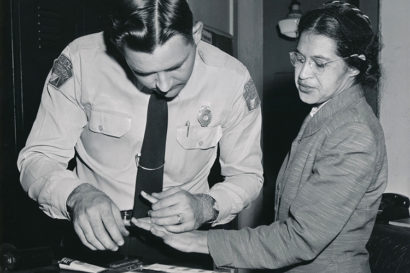
Rosa Parks gets fingerprinted after having been arrested in February 1956 during the bus boycott. The boycott ended and buses were integrated on Dec. 21, 1956, after the U.S. Supreme Court ruled that Montgomery’s segregation laws on buses were unconstitutional. (Associated Press photo via Wikimedia Commons)

Ula Taylor: I think it’s important to understand that there are different ways of being a leader. And the Women’s Political Council basically functioned as the anchor of the Montgomery bus boycott. So, even though those women were not in the limelight, they were engaging in a form of leadership. But because we live in a country in a culture where we oftentimes identify leadership as a talking head, we don’t understand all of the thinking that goes behind a lot of the ideas that the talking head is even articulating.

[Music: “Palms Down” by Blue Dot Sessions]

Narration: Taylor says she encourages her students to volunteer — to create patterns of engagement that will follow them throughout their lives.

Ula Taylor: They have the skillset and the critical toolkit to address all of these multiple crises that are happening in America: homelessness, gentrification, drug addiction, racism, the neoliberal crisis or the neoliberal university. This is what they deal with.

They have to understand that they can chip away at the crisis. It may not happen overnight, but they have to understand that they have a skillset, they have access to resources that they may not even imagine. I think it’s important to create a pattern to engage in some capacity — to feel like you’re doing something to create the world that you want to live in, that you want your children to live in and your grandchildren to live in.

Narration: The time is now, says Taylor. We can’t wait for anyone else to do it for us.

For Berkeley News, I’m Anne Brice.

You can subscribe to this podcast, Fiat Vox, spelled F-I-A-T V-O-X, and give us a rating on Apple Podcasts or wherever you listen. If you liked this episode, consider sharing it with a friend. And check out our other podcast, Berkeley Talks, that features lectures and conversations at UC Berkeley. You can find all of our podcast episodes on Berkeley News at news.berkeley.edu/podcasts.

Listen to other Fiat Vox episodes

LOWER EAST SIDE NYC
Protesters Chant “Boycott MOCA” at Museum of Chinese in America Reopening

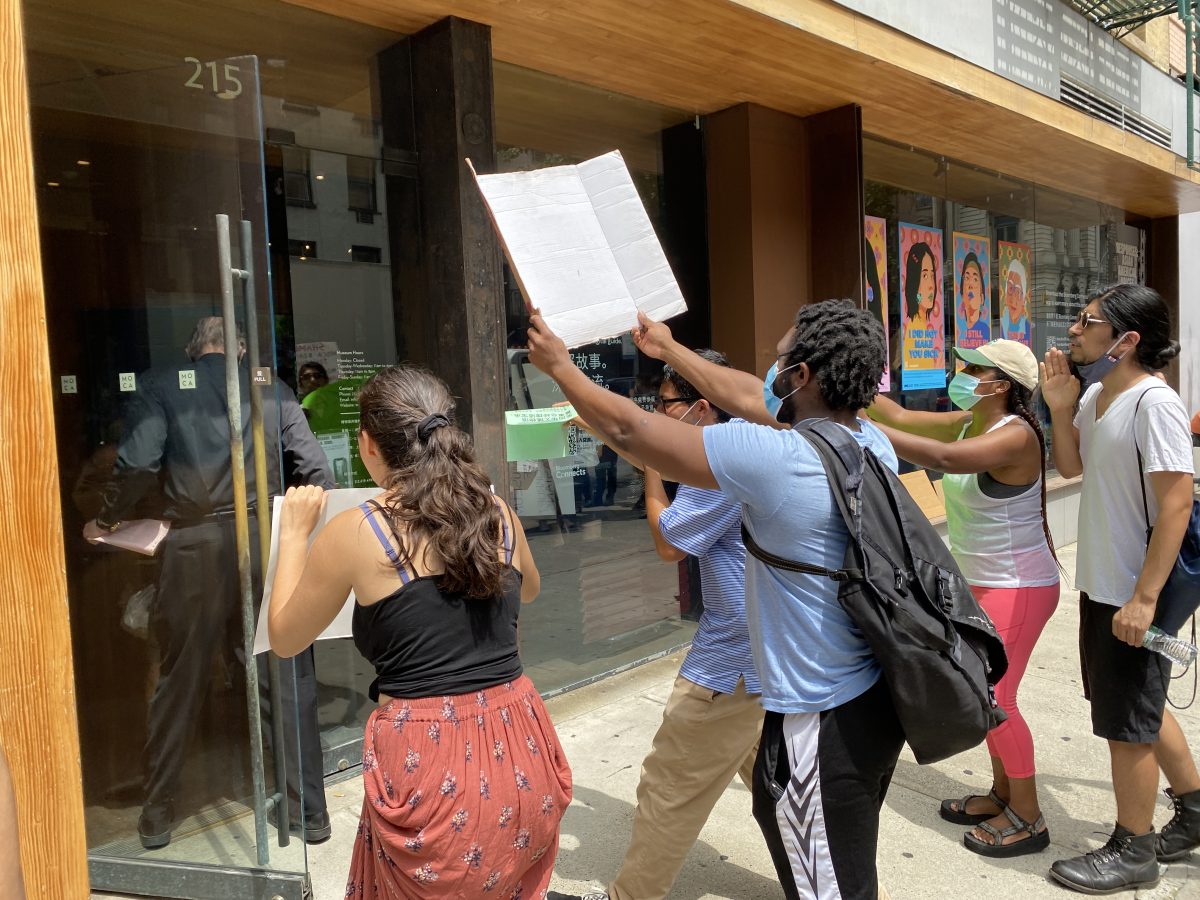
While visitors watched performances in the museum’s lobby, protesters pressed placards against the windows, chanting slogans like “Boycott MOCA” and “Chinatown is not for sale.”


by Hakim Bishara
July 14, 2021

Protesters calling to boycott the Museum of Chinese in America (MOCA) in New York for "complicity" in mass incarceration and gentrification (photo by Hakim Bishara for Hyperallergic)


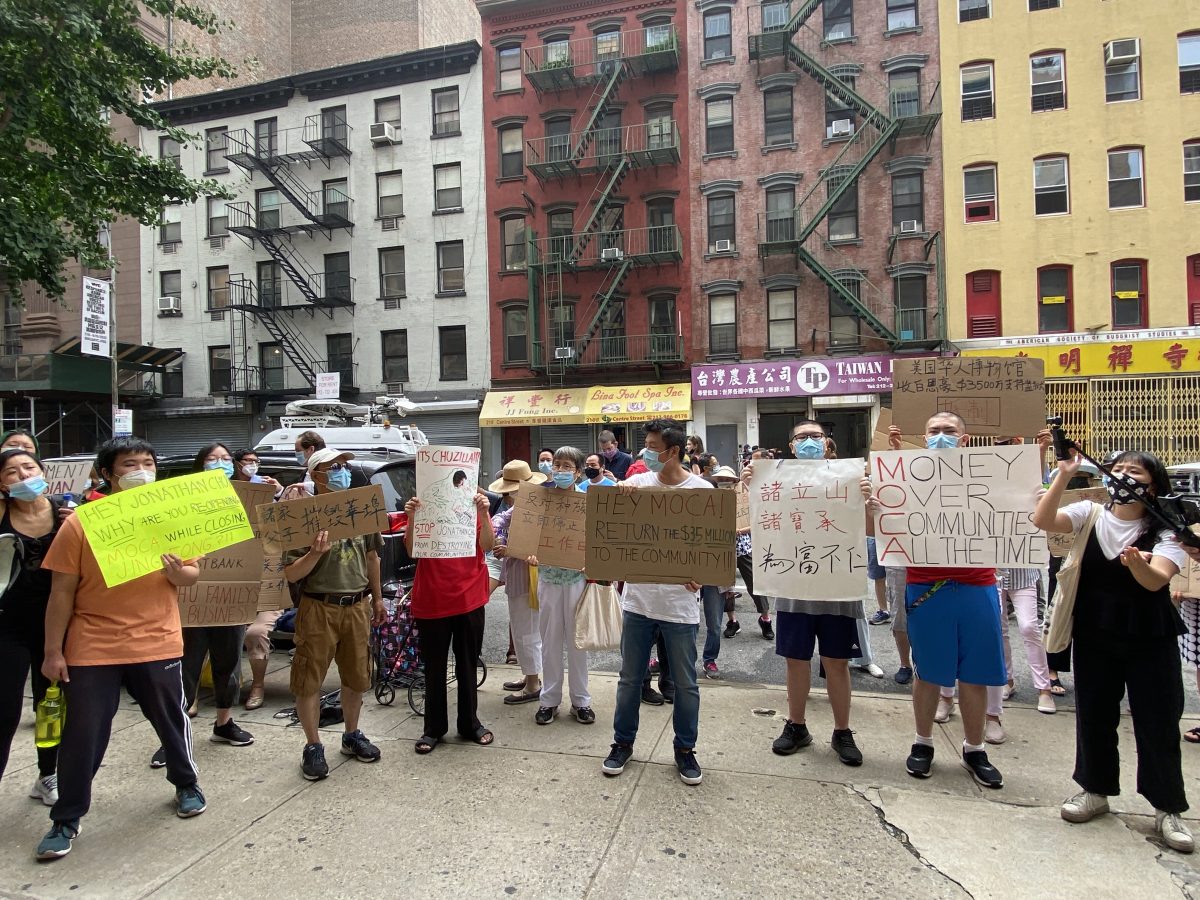
After over a year of closure due to the COVID-19 pandemic, the Museum of Chinese in America (MOCA) reopened today, July 14, with a celebratory debut of the exhibition Responses: Asian American Voices Resisting the Tides of Racism. But while visitors inside were reflecting on artistic responses to Anti-Asian hate during the pandemic, about 100 protesters gathered outside the Chinatown museum and accused the institution itself of “racism.” They called to boycott the institution for “promoting displacement” of the same community that it wishes to represent.

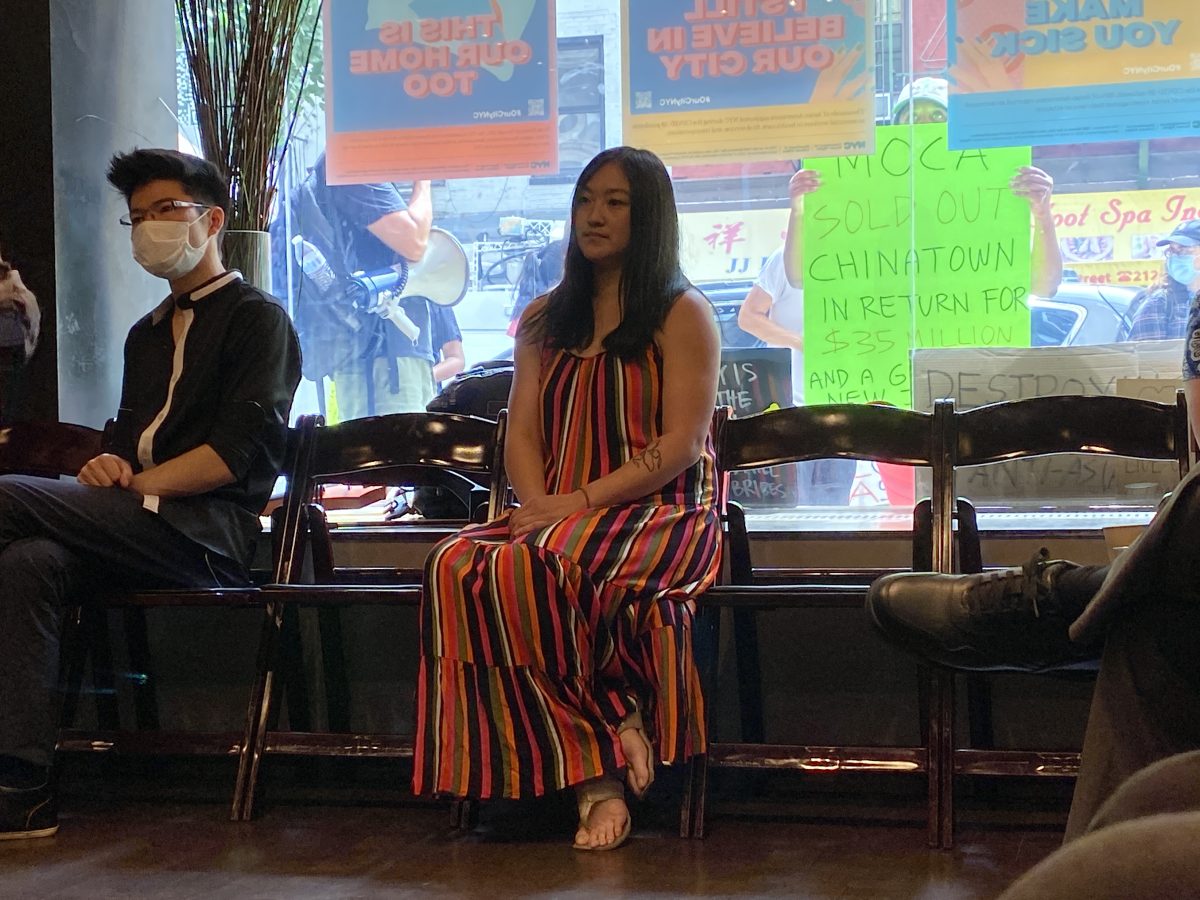
While visitors were enjoying soothing musical and dance performances in the museum’s lobby, they could see the protesters pressing their placards against the windows and hear them chanting slogans like “Boycott MOCA” and “Chinatown is not for sale.” The protesters, who surrounded the museum’s main entrance at Centre Street, also booed guests who arrived at the opening, confronting them with the chant “Shame on you.”

About 100 protesters gathered outside of MOCA during the reopening

A dance performance to celebrate the MOCA’s reopening after over a year of closure due to the COVID-19 pandemic

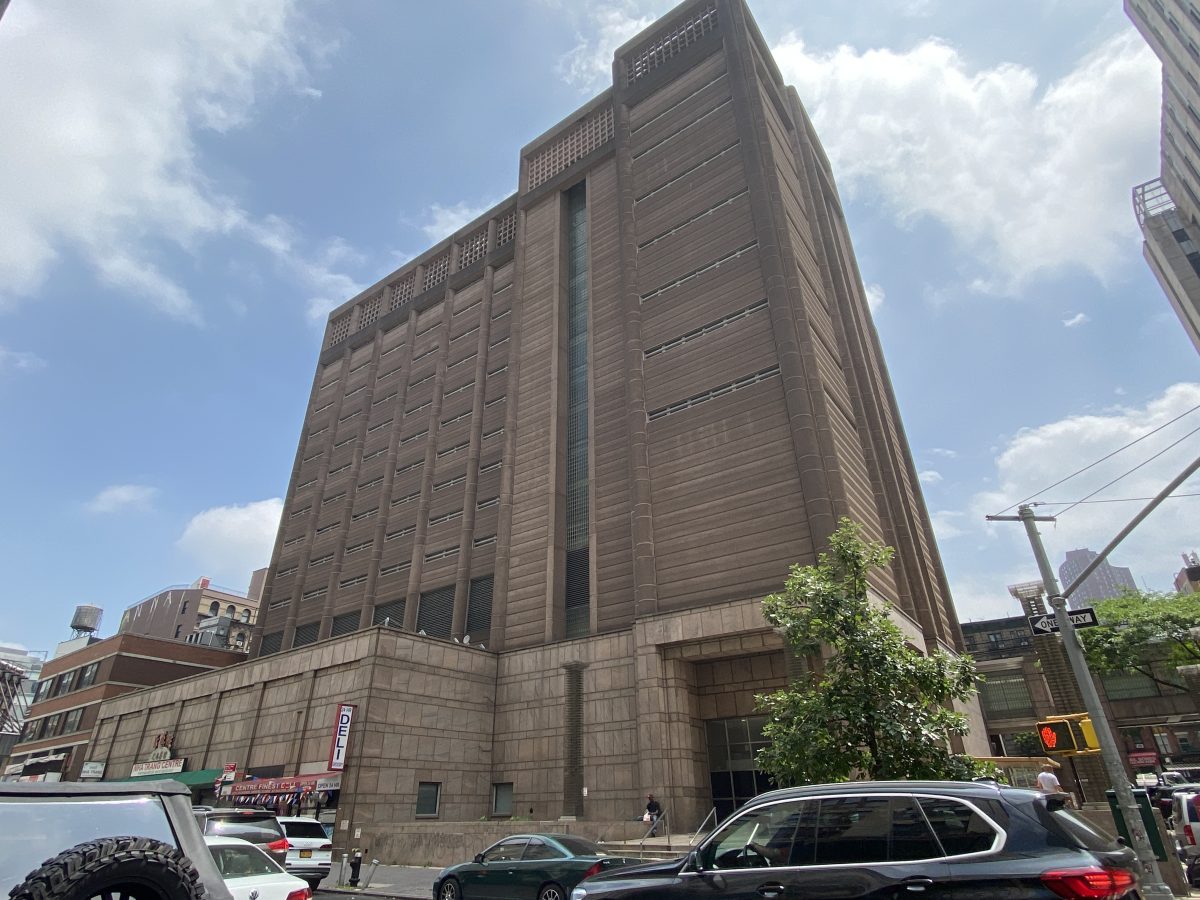
These jarring contrasts demonstrate the growing rift between the museum and grassroots organizations, including artist groups, in Chinatown. For months, these groups have been protesting against the museum’s acceptance of a $35 million concession as part of a jail expansion plan that would rehaul and expand an existing 15-story detention complex nearby. These funds were earmarked for a permanent home and performing arts space for MOCA, which suffered a devastating fire in its archive last year. The funds are part of a “community give-back” program included in Mayor Bill de Blasio’s plan to close the notorious Rikers Island jail complex and replace it with four borough-based detention centers across the city.

“They are trying to ignore us because they don’t want to admit to themselves that they are part of such a racist, hateful institution that uses the Asian-American community to prop itself up while beating it down at the same time,” said Jihye Simpkins, one of the protest’s organizers and a member of the Coalition to Protect Chinatown and the Lower East Side.

Protesters booed guests who arrived to the opening, confronting them with the chant “Shame on you.”

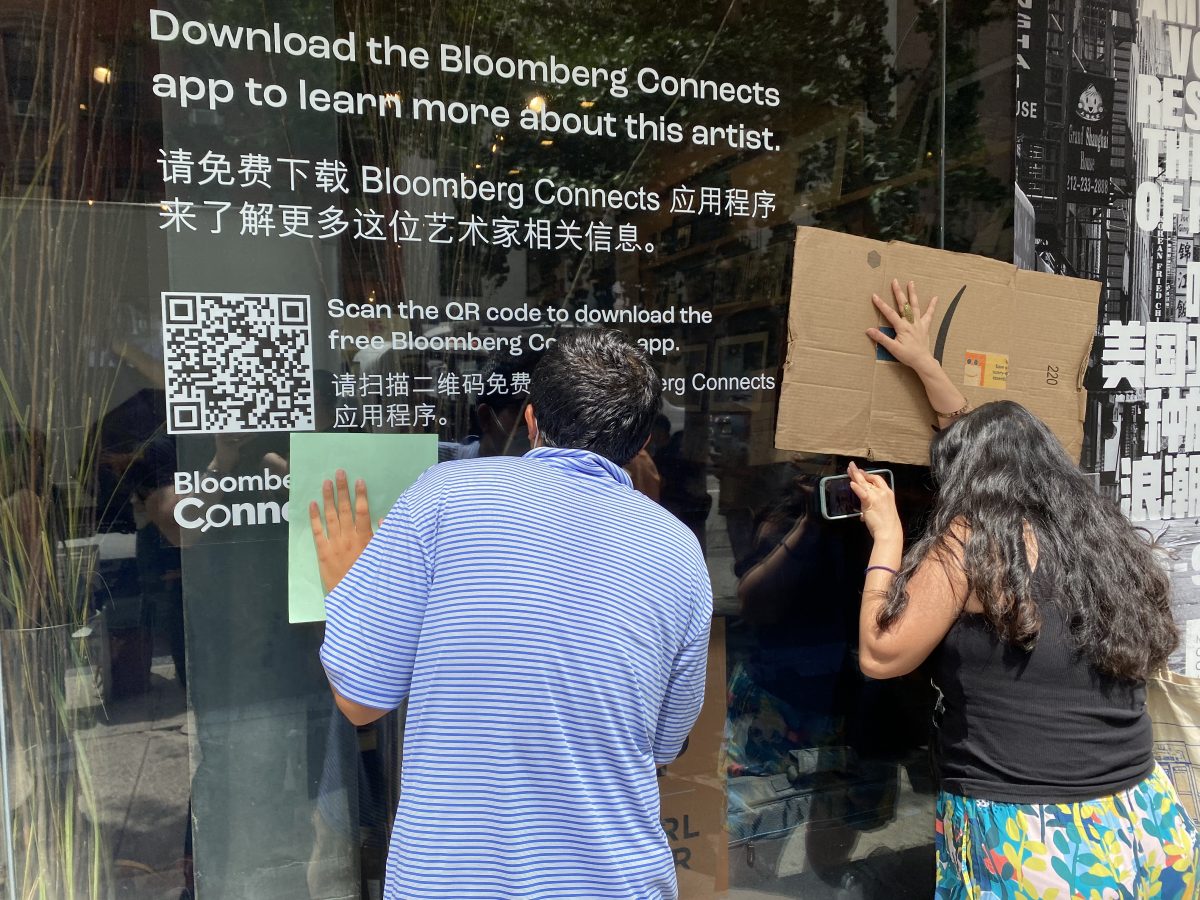
Protesters pressing their signs to MOCA’s windows during the reopening event

Among the most vocal opponents of the museum have been artists scheduled to go on view in the museum’s scheduled exhibitions.

On Monday, July 12, artists Colin Chin and Nicholas Liem sent a letter to MOCA requesting to withdraw their works from the museum’s collection and current exhibition, citing its “complicity” with mass incarceration and the gentrification of Chinatown. The artists’ withdrawn photo series depicts the Oakland Chinatown communities’ expressions of solidarity with Black Lives Matter protests last summer. During today’s protest, the two Bay Area artists delivered another message to the museum, read by the activist and architecture student Dorothy Qian.
For months, activist groups have been protesting against the museum’s acceptance of a $35 million concession as part of a jail expansion plan

Protesters carrying signs against Johanthan Chu, a real-estate mogul and MOCA’s co-chair, who’s accused of contributing to Chinatown’s gentrification

“With our photos showing murals of Angela Davis, Yuri Kochiyama and other social justice activists, we found MOCA’s actions and the title of the exhibition Responses: Asian American Voices Resisting the Tides of Racism to be hypocritical in the greatest sense,” Qian read from the artists’ statement. “It is because of this that we not only decided to pull our work from the show but to also raise awareness of the actions which were only recently known to us.”

In March of this year, citing similar reasons, 19 members of artist collective Godzilla withdrew from a retrospective of their work at MOCA, causing the museum to cancel the exhibition.

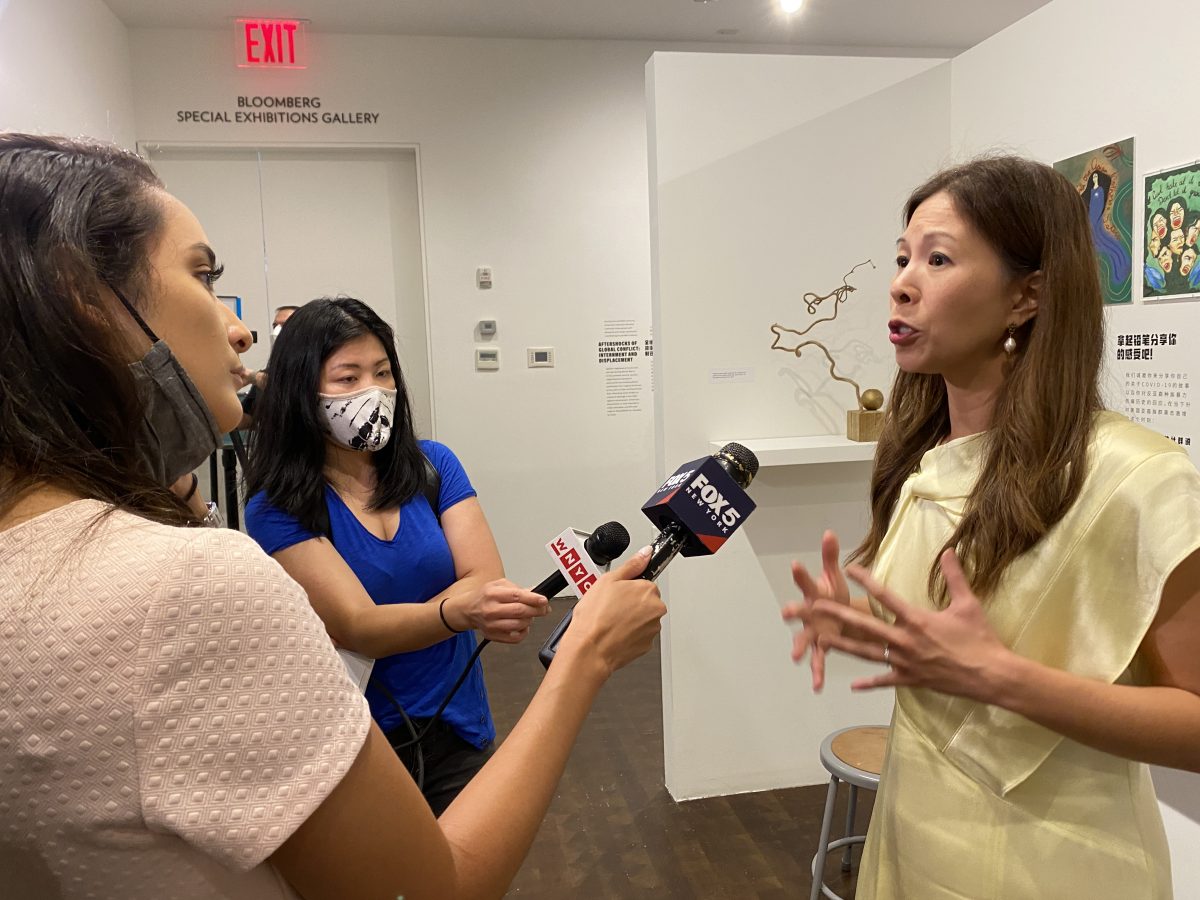
When first approached by Hyperallergic for comment during the opening event, MOCA’s president Nancy Yao Maasbach refused to comment, saying “You’re not my favorite person.” But in a written statement to Hyperallergic on Monday responding to Chin and Liem’s withdrawal from the exhibition, Yao Maasbach wrote: “MOCA has always been opponents of jail construction in Chinatown which we have made public, so it is unfortunate that the decision by these two artists to back out of MOCA’s new exhibit RESPONSES: Asian Americans Resisting the Tides of Racism has been guided by misinformation.”

Installation view of the exhibition Responses: Asian American Voices Resisting the Tides of Racism

Protesters pressing their signs against MOCA’s windows during the opening

To this, Simpkins countered: “MOCA says that they are opposed to the new jail but what are they doing to stop it? Accepting $35 million for the jail expansion plan is not opposition.”

Another major conflict between the museum and members of the Chinatown community revolves around Jonathan Chu, a real-estate mogul and co-chair of MOCA, whom the protesters accuse of contributing to the gentrification of the neighborhood. The activists claim that as the landlord of the restaurant Jing Fong, a 40-year-old staple in the community that shuttered in March, he declined pleas for rent forgiveness, leaving the restaurant with no other choice but to close its 800-seat location (the largest unionized restaurant in Chinatown) and relocate to a smaller space. In an email to Hyperallergic, a representative of Chu challenged these allegations, writing: “The owners of Jing Fong made the decision on their own to relocate their restaurant. Any suggestion otherwise is in direct conflict with what the Jing Fong owners have made clear themselves.”

Speaking with Hyperallergic in March, Claudia Leo, a spokesperson for Jing Fong, said that China Arcade LLC, the company owned by Chu, had “offered some rent relief” and explained that the closure was the result of plummeting revenue during the pandemic.

Since March, activists from the Coalition to Protect Chinatown and other groups have been protesting twice a week in front of one of Chu’s buildings in the neighborhood, requesting the reopening of Jing Fong’s banquet hall and the rehiring of about 180 laid-off workers.

The Manhattan Detention Complex in Chinatown, New York, will be rehauled and expanded as part of the city’s jail expansion plan.

John Chen, a former worker at Jing Fong, was among the protesters today. He carried a sign in Chinese that read: “The Chu family, father and son, are destroying Chinatown.” In conversation with Hyperallergic, Chen said that he has been relying on unemployment benefits since the restaurant’s closure, unable to find a new job (activist Kai wen Yang assisted in translating the conversation).

“How can we continue to live in this city if we can’t find work?” Chen asked. “We are losing our neighborhood.”

The protesters are urging Chu to accept a plan proposed by former Jing Fong workers to buy the restaurant. Some, like Chin and Liem, also demand he be removed from MOCA’s board.
MOCA’s president Nancy Yao Maasbach speaking to the press at the reopening of the museum.

When approached again for comment, Yao Maasbach referred Hyperallergic to Henry S. Tang, an investment banker and friend of the museum who attended the reopening.

“The closing of the restaurant is an issue between the landlord and the tenant. It’s not related to MOCA,” Tang said. “MOCA was organized for the community 50 years ago. It’s not responsible for the gentrification of Chinatown; it’s responsible for the modernization of the area. Linking these issues capriciously is a disservice to the community. ”

Though emotions were running high, the protesters said that reconciliation with MOCA is possible if it opts to refuse the city’s $35 million grant or “give it back to the community.”

“We want that money back,” said Simpkins. “Chinatown was devastated by the pandemic and MOCA did nothing to help the community.”


Related

Museum of Chinese in America Should Reject “Jail Money,” Says Artist-Activist Group
October 1, 2020
Artists Request Museum of Chinese in America Remove Their Work From Its Collection
July 12, 2021
Art Workers Mobilize to Combat Anti-Asian Racism
May 21, 2020


Hakim Bishara
Hakim Bishara is a staff writer for Hyperallergic. He is also a co-director at Soloway Gallery, an artist-run space in Brooklyn. Bishara is a recipient of the 2019 Andy Warhol Foundation and Creative Capital Arts Writers Grant and he holds an... More by Hakim Bishara
‘Boycotts give hope to Uighurs’ – a time for solidarity not apathy from labour movement

Sir, – I was quite surprised to read Ruairí Quinn’s nonchalant assessment of the human rights atrocities being committed in Xinjiang against the Uighur people (“China’s cotton trade: Boycotts give hope to Uighurs but companies take a hit”, Business, July 9th).

Mr Quinn suggests that South African apartheid cannot be compared with “what is happening today with the second largest economy in the world, [one] that is probably going to be the largest”.

Detailed reports from Amnesty International highlight the state of affairs at present: hundreds of thousands of people interned, perhaps one million people placed in so-called “re-education camps”, the widespread incidence of torture, the use of slave labour, and forced sterilisation.

These abuses constitute crimes against humanity.

In March 2021, the European Union imposed its first set of sanctions on Beijing in three decades. This move was accompanied by similar action by the UK, Canada, and the US. This change in European policy toward China, the EU’s largest trading partner, is considerable and reflects the seriousness of the situation in Xinjiang.

Mr Quinn describes himself as a socialist, “in the Labour Party sense of that word”, but “would have no respect for anybody who would come into Ireland and start telling us how we should run our affairs”.

We should not discredit and devalue these blatant atrocities for fear of offending some “other systems that have emerged”. Nor should we be shunted into silence given the size of the Chinese economy. If criticism of human rights abuses were dependent on economic hegemony, would there have been a whimper of support for the civil rights movement in the United States in the 1960s?

The labour movement has always been outward looking and internationalist, giving voice to the oppressed and the marginalised, irrespective of national borders. Now is a time for solidarity not apathy. 

– Yours, etc,

LUKE O’CALLAGHAN-WHITE,

Harold’s Cross

Dublin 6W.
The Federal Writers’ Project Fueled the Cultural Ferment of the New Deal Era

FDR’s Federal Writers’ Project employed thousands of out-of-work writers to produce guidebooks, compile local histories, and collect stories of the country at a moment of turmoil. We need an equivalent program today.


American author Richard Wright was hired to work for the Federal Writers’ Project. (Mondadori via Getty Images)

Review of Scott Borchert, Republic of Detours: How the New Deal Paid Broke Writers to Rediscover America (Farrar, Straus and Giroux, 2021)

BYALEX N. PRESS JACOBIN JUL 17,2021


When Alfred Kazin arrived at the Manhattan office of the Federal Writers’ Project (FWP) to interview for a job as an editor, the writers were on strike.

The room was “crowded with men and women lying face down on the floor, screaming that they were on strike,” he writes in his memoir of the 1930s. “In order to get to the supervisor’s office at the other end of the hall, I had to make my way over bodies stacked as if after a battle; and as I sat in the supervisor’s office, he calmly discussed the job while shouts and screams came from the long hall outside.”

Kazin didn’t get the job. While he downplays his desire for the position in his memoir, FWP archives include a record of his follow-up about the position. For a precariously employed freelancer and the son of working-class Jewish immigrants, the FWP was a coveted placement, offering job security and a community, strikes and all.

Such security was the hallmark of the project, a part of FDR’s Works Project Administration (WPA). The WPA launched in 1935, a year that saw 20 percent unemployment, and at its height, it employed 3.3 million people across the United States. The FWP was a minuscule piece of that program, its budget costing 0.002 percent of the WPA outlay, but for its modest size, it had significant achievements.

Just as others were put to work building bridges and sewers under the WPA banner, so, too, were creative workers set to the collective task of crafting texts. The books in question were guides to the country — one for each of the then-forty-eight states, along with many cities, regions, and territories, as well as some ten thousand oral histories, including invaluable records of formerly enslaved people.

The guides were not straightforward. A traveler seeking relevant hotel or culinary information might find them, at best, meandering and, at worst, useless. Instead, they were literary achievements, records of a period and a people, a hodgepodge reflecting the bizarreness and ambition of the FWP itself.

As Scott Borchert describes the guides in Republic of Detours: How the New Deal Paid Broke Writers to Rediscover America, a new history of the FWP, they “sprawled. They hoarded and gossiped and sat you down for a lecture. They seemed to address multiple readers at once from multiple perspectives. They ran to hundreds of pages. They contained a melange of essays, historical tidbits, folklore, anecdotes, photographs, and social analysis — along with an abundance of driving directions thickened by tall tales, strange sites, and bygone characters.”

One reason was their authorship. At one point, the project employed nearly seven thousand people. While the production process differed state by state, the guides were a collective endeavor, one that deployed hundreds of writers to streets across the country to collect stories, to decide what readers did and did not need to know about the United States. Hence, as Borchert writes, the tours “highlighted scenic overlooks and recreation spots, but they were also dense with Indian massacres, labor strikes, witches, gunfighters, Continental Army spies, Confederate deserters, shipwrecks, slave rebellions, famous swindlers, and forgotten poets.”

It wasn’t necessarily what one might think of as “professional writers” penning these texts either, though, definitionally, the FWP took those excluded from such a category and made them writers by trade. Anzia Yezierska, a writer and member of the New York office, characterized her coworkers as “spinster poetesses, pulp specialists, youngsters with school-magazine experience, veteran newspaper men, art-for-art’s-sake literati, and the clerks and typists,” a mishmash milieu that generated a “strange fellowship of necessity.”

The ethos was shaped by Henry Alsberg, the FWP’s director. Alsberg, a pinko friend to Emma Goldman, gay man, and hanger-on of the Greenwich Village bohemian-radical scene, approached his task with the belief that anyone who could write was a writer. The standard that mattered for him was that 90 percent of the writers would come from the relief rolls; 10 percent was set aside for skilled writers and editors who could provide technical expertise.

The result — not only the finished product, but every step of the process — was chaotic. In New York, a mail carrier applies because he is “a man of letters.” A story circulates about how, when a toilet overflowed in the office of one of the state projects, all four editors sprang up to fix it because they were all plumbers by trade.

One state’s director, a pulp fiction writer, simply tells his workers to make things up. Another such director is checked in on by someone from the national office. “She led him to a room of workers pounding away at typewriters and said, ‘Have you ever seen such an inspiring sight? Seventeen poets, all in one room, writing poetry seven hours a day.’” The FWP’s associate director, George Cronyn, receives a progress report with the subject line “What I have been doing thru the week.” Its conclusion? “Friday — in bed all day, not working, but certainly thinking of God and the Writers’ Project.”

But amid, or perhaps because of, such eccentricity, the project achieved breakthroughs. It’s not for nothing that, upon the FWP’s dissolution in 1943, Time magazine called it “the biggest literary project in history.” Kazin, despite being turned down for the job in the New York office, singled the American Guides out for praise. Writing in On Native Grounds, his book on American literature, Kazin argued that “More than any other literary form in the thirties, the WPA writers’ project, by illustrating how much so many collective skills could do to uncover the collective history of the country, set the tone for the period.”

The guides give the reader a sense of a country “full of secret rooms,” creepy, but redeemed by an “odd, ludicrous sense of humor,” wrote Robert Cantwell in a 1939 review for the New Republic.

It is doubtful if there has ever been assembled anywhere such a portrait, so laboriously and carefully documented, of such a fanciful, impulsive, childlike, absent-minded, capricious and ingenious people, or of a land in which so many prominent citizens built big houses (usually called somebody’s folly) that promptly fell into ruins when the owner backed inventions that didn’t work.

But more than the merit of the guides themselves, there was the achievement of keeping a roof over the heads of the thousands who relied on the program for employment. Further, the work subsidized creativity, keeping people who would go on to be the era’s most celebrated writers from quitting their craft.

Richard Wright was given flexibility on the job, and he used it to begin drafting Native Son. He struck up a friendship with Ralph Ellison, who worked in the New York office, encouraging him to write. The project’s national coordinating director might have called the New York City project “ a vast psychodrama” — and the anecdote in Kazin’s memoir certainly suggests it was far from a typical workplace — but it was also a hotbed of creativity, and the project that, along with Chicago, employed many of the FWP’s few black writers (the guides in Southern states sometimes shied away from regional history for fear of provoking racist backlash, leaving Zora Neale Hurston, who was attached to the Florida office, more isolated than she already was in the rural parts of the state from whence she sent her dispatches).

Nelson Algren, fresh from an arrest for stealing a typewriter — his defense was that the object was his only means of earning a living, an argument that got him a suspended sentence — was hired onto the Illinois project in 1936. He joined the local John Reed club along with the state project’s shop committee, striking up a friendship with Wright. He met Studs Terkel, who worked on the federal project’s radio division; he ignored Saul Bellow, who was also in the FWP.

A year into working on the FWP, Algren writes a piece advertising the project:

Men who may otherwise have become too demoralized by poverty to do creative work, or would be frying hamburgers or turning out ad copy or running a roulette wheel, are now assisting both themselves and the nation’s cultural life through the federal writers’ project . . . such names are supplemented by dozens of young unknowns with genuine creative impulses who no longer have to sell Realsilk hose or Herald and Examiner life insurance from door to door to meet their rent.

He is writing about himself.

A Usable Past

It isn’t easy to imagine a twenty-first-century FWP. Rather than direct job provision for cultural workers, today’s dominant model is the provision of funds to institutions like the National Endowment for the Arts (NEA), created in 1965, which grants money to artists. Rather than offering stability, this approach perpetuates the precarity to which creative workers are already subject: a scramble, the pressure to come up with a fully formed project in advance of application.

Congressman Ted Lieu has introduced a bill in the House to create a contemporary FWP, which would focus on stories of the COVID-19 pandemic, employing writers to create an archive of work from the present. The idea came from David Kipen, former director of literature at the NEA. While it would be better than nothing, the project would entail having the Department of Labor administer money to nonprofits, libraries, news outlets, and communications unions, suggesting the precarity and scramble may yet remain.

We can never repeat the past — and, given the shortcomings of the FWP, we shouldn’t seek to — but in imagining possible contemporary endeavors, it’s worth recalling how hard it was to imagine the project back then, too. When journalist Dorothy Thompson first heard about the FWP, she exclaimed, “Project? For writers? Absurd!” And yet it was built and defended, with the still-unpopular argument that writers are in fact people, and they need to eat, too.

As one can imagine happening with today’s culture-war-obsessed GOP, the FWP was undermined by red-baiting. Congressman Martin Dies Jr hounded Alsberg and his staff with subpoenas. Investigators were caught planting and then photographing communist literature in the New York office (as if communists don’t deserve a paycheck!). But despite all this, by the time it shut down in 1943, the project had created dozens upon dozens of guides, employing thousands of out-of-work people at a time of upheaval.

As is true of many of the other achievements of the FDR administration, the FWP was in part a response to union demands. Writers were struggling, and the Newspaper Guild and the Authors Guild wanted jobs, while the Unemployed Writers Association, with the backing of the likes of Theodore Dreiser and Ida Tarbell, worked to represent those still coming up.

Borchert writes of a 1934 strike at the Macauley Company, a Manhattan book publisher. It received wide support from both writers and workers in other publishing houses. He characterizes such solidarity as “a sign of the simmering discontent and growing class-consciousness spreading throughout the industry.”

It’s a scene that bears a striking resemblance to the world today, and the writing world’s unions — the News Guild, the Writers’ Guild of America, and the Freelance Solidarity Project, an organization of freelancers agitating to raise standards both at individual publications and across the industry. When writers’ employment was decimated by forces beyond their control in the 1930s, they called for work relief; what about now?

“In late February of 1935,” writes Borchert, “the Writers Union launched picket lines across New York. The Daily Mirror reported that, in the absence of government intervention, the only work available was writing more protest signs.” The joke lands just as well today. The strength of the FWP was that it was a job like any other: a paycheck for people who needed it. There’s no reason we can’t imagine what that would look like now.


ABOUT THE AUTHOR
Alex N. Press is a staff writer at Jacobin. Her writing has appeared in the Washington Post, Vox, the Nation, and n+1, among other places.
The five-day workweek is dead

It’s time for something better.

By Anna North Jul 13, 2021
Long and unpredictable work hours leave many Americans with little time for anything but their jobs. d3sign/Getty Images


The five-day workweek is so entrenched in American life that everything, from vacation packages to wedding prices to novelty signs, is built around it. When you live it every Monday through Friday, year in and year out, it can be hard to imagine any other way.

But there’s nothing inevitable about working eight hours a day, five days a week (or more). This schedule only became a part of American labor law in the 1930s, after decades of striking by labor activists who were tired of working the 14-hour days demanded by some employers. Indeed, one of the biggest goals of the American labor movement beginning in the 19th century was “an attempt to gain time back,” Erik Loomis, a history professor at the University of Rhode Island, told Vox.

And now, more than 15 months into the pandemic, there’s a growing conversation about how American workers can take back more of their time. The trauma and disruption of the last year and a half have a lot of Americans reevaluating their relationships to work, whether it’s restaurant servers tired of risking their safety for poverty-level wages or office workers quitting rather than giving up remote work. And part of that reevaluation is about the workweek, which many say is due for a reboot.

Over the past few decades, work for many salaried employees has ballooned far beyond 40 hours a week, thanks to a combination of weakened labor laws and technology that allows bosses to reach workers at any time of the day or night. At the same time, low-wage and hourly workers are frequently subject to unpredictable schedules that can change at a moment’s notice, and may not give them enough hours of paid work to live on. Today’s work schedules, with their combination of “overwork and then no work,” in many ways mirror the conditions that preceded the reforms of the 1930s, Loomis said.

Then as now, the country may be ripe for a change. Some employers are testing out four-day workweeks. A recent study of shorter workweeks in Iceland was a big success, boosting worker well-being and even productivity. And workers themselves are pushing back against schedules that crowd out everything that isn’t work. During the pandemic, there’s a growing feeling that “we have one life — and are we working to live, or are we living to work?” Rachel Deutsch, director of worker justice campaigns at the Center for Popular Democracy, told Vox.

But to really make the workweek fair and humane for all Americans — and give us more time to do things that aren’t work — the country will need systemic changes to help workers take back their power. Otherwise, only the most privileged will benefit from the new interest in shorter workweeks — if anyone benefits at all.


The 40-hour workweek was a hard-won victory for labor activists


In the 19th century, many factory and other low-wage workers were at work nearly all the time. The workweek was whatever your employer said it was, which “could be 14 hours a day, it could be six days a week, it could be seven days a week,” Loomis said. In “strike after strike after strike,” he explained, workers fought for a more livable schedule, a push exemplified by the 1880s slogan, “eight hours for work, eight hours for rest, eight hours for what we will.”

They won some victories — the Ford Motor Company, for example, reduced its workweek from 48 to 40 hours in 1926 (though that may have been more about Henry Ford’s conviction that fewer hours made workers more productive). But it wasn’t until the 1930s that the Great Depression and more mass strikes convinced President Franklin Delano Roosevelt and reformers in the federal government that something had to change.

The result was the Fair Labor Standards Act, passed in 1938, which — among other reforms — required overtime pay for many employees if they worked more than 40 hours a week. There were exceptions — farm workers, for example, were not guaranteed overtime — but for millions of workers, the eight-hour day and five-day week became the law of the land.

Not everyone wanted to stop there. “There really were battles in the ’40s and ’50s over whether or not the eight-hour day was sufficient,” Loomis said. Pushes for a six-hour day or other ways of shortening the workweek continued in the 1960s, but rising unemployment in the 1970s had labor leaders focusing all their attention on trying to save jobs. The idea of a shorter workweek fell by the wayside.

But since then, a lot of Americans’ work schedules have only gotten worse. For example, many salaried workers (as opposed to those paid an hourly wage) are exempt from the overtime requirements of the Fair Labor Standards Act, and employers have taken advantage of this to require more and more hours of these workers. As of 2014, the average salaried worker worked 49 hours per week, according to a Gallup survey, with 25 percent working more than 60 hours — and working hours for many have actually gone up, not down, during the pandemic.

Meanwhile, the rise of smartphones and laptops has broken down the barriers between work and home, allowing bosses to contact employees at any time of the day or night. As management professor Scott Dust wrote at Fast Company earlier this year, “thanks to technology, the eight-hour, ‘9-to-5’ workday is a mirage.”

Hourly workers, especially in low-wage service jobs, meanwhile, have faced a different problem: the rise of just-in-time scheduling, in which employers decide on worker schedules just days in advance, depending on factors like how busy a particular store is. That practice has led many large employers to keep most of their employees part-time, so they can be called in at a moment’s notice, and not paid when they aren’t needed. It’s a way of essentially “offloading all of the risk of your business model onto workers,” Deutsch said.

For workers subject to just-in-time scheduling, long workweeks aren’t necessarily the problem: rather, one-third of retail and food-service workers in one 2019 survey said they were involuntarily working part-time, wanting more hours than their employer would give them. That can make it difficult or impossible for people to pay their bills, necessitating a second job — except that unpredictable schedules make juggling two or more jobs complex, to say the least. And a constantly changing work schedule can also make it hard to arrange for child care — the same survey found that unpredictable schedules for parents led to instability in children’s routines, as well as anxiety and behavior problems in kids.

A constantly changing schedule meant that Madison Nardy, a former beauty consultant at a Philadelphia-area Target, never knew how much money she’d be taking home each week, as she struggled to balance work with attending community college and caring for her mom, who has a disability. Though she was hired with the understanding that she would work 30 or 35 hours a week, soon “my hours began to dwindle down,” she told Vox. “One week I would have eight hours, the next week it would go up to 20, and then back down to 12.”

The hours she did work could be punishing — sometimes she was scheduled to close the store at 1 am and come back the next morning at 7 or 8, a practice called “clopening.” Her constantly fluctuating schedule left her so exhausted and stressed that there were days “where I would go in the bathroom and just cry,” Nardy said. “I was always running around like a chicken without a head.”


1933


The pandemic could be paving the way for a new workweek revolution

Nothing in the Fair Labor Standards Act prohibits the practices Nardy said she experienced — employers switching up workers’ schedules with little notice, or giving each employee too little work to live on. “The only protections that we have for hourly workers are from a time when overwork was the only problem,” Deutsch said.

Recently, however, there’s been a growing push for workers’ rights in general, not just around scheduling. The Fight for $15, for example, has won minimum-wage increases in many states as well as drawing the attention of policymakers to issues facing hourly workers. “Labor reform is rising in the Democratic Party for the first time since the ’30s,” Loomis said, in part because “people are out in the streets demanding it.”

And the pandemic has only intensified that push. Record numbers of Americans across economic sectors are quitting their jobs, with nearly 4 million people handing in their notice in April alone. Whether it’s hourly retail workers frustrated with contingent schedules or more highly-paid salaried employees tired of working 60-hour weeks, there is “a broader consensus now that our work should sustain us,” Deutsch said. “Our whole life should not be at the mercy of a job that does not allow us to thrive.”

More livable schedules have had success elsewhere in the world. Companies in Japan, New Zealand, and elsewhere have experimented with shorter workweeks in recent years, often reporting happier workers who are actually better at their jobs. But one of the largest and most high-profile recent experiments took place in Iceland, where local and federal authorities working with trade unions launched two trials of a shortened workweek, one in 2015 and one in 2017. In the trials, workers shifted from a 40-hour work week to 35 or 36 hours, with no cut to their pay. It wasn’t just office workers who participated — the trials included day care workers, police officers, care workers for people with disabilities, and people in a variety of other occupations.

The results were impressive, according to a report on the trials published in June by Autonomy, a UK-based think tank that helped analyze them. Workers reported better work-life balance, lower stress, and greater well-being. “My older children know that we have shorter hours and they often say something like, ‘Is it Tuesday today, dad? Do you finish early today? Can I come home directly after school?’” one father said, according to the report. “And I might reply ‘Of course.’ We then go and do something — we have nice quality time.”

And perhaps counterintuitively, worker productivity generally stayed the same or actually increased during the trials. Workers and managers worked together to make changes like reorganizing shift changes and reducing meetings, Jack Kellam, an Autonomy researcher who co-wrote the report, told Vox. “These trials were not implemented top-down.”

Just having more rest may have helped people be more productive — as the Autonomy researchers note, overwork can lead to fatigue, which actually lowers productivity.

Encouraged by the results of the trial, many Icelandic workplaces have embraced shorter hours, with 86 percent of the working population either working shorter hours already or on contracts that will phase in the reduction in the coming years. The Autonomy report has also generated global interest at a time when workers and companies alike are rethinking what jobs should look like. For example, the shift to remote work over the last 15 months has shown that “quite drastic changes in working practices can happen quite quickly,” Kellam said. Now his work on the Iceland trials has gotten news coverage in countries from Australia to Germany, and several companies have approached Autonomy for advice on implementing shorter hours for their employees.

But making something like the Icelandic trials work in the United States would require major changes. For one thing, unions in Iceland, which represent 90 percent of workers, played a big role in negotiating both the trials and the long-term adoption of shorter hours that resulted. But union density is much lower in the United States, with just 10.8 percent of workers represented.

Making it easier to form unions would be a big step toward helping American workers negotiate better schedules, Loomis said. The PRO Act, which would reverse years of anti-union legislation at the state level, would be a start — but so far, it appears unlikely to pass the Senate.

As for unpredictable schedules, years of worker activism have led to fair workweek laws in cities like New York and San Francisco, which typically require employers to provide adequate notice of schedules (often two weeks ahead of time) and compensation for last-minute changes, as well as banning “clopening.” Rep. Rosa DeLauro (D-CT) and Sen. Elizabeth Warren (D-MA) have introduced such a law at the federal level, called the Schedules That Work Act — but it, too, has gained little traction with Republicans in the Senate.

Such nationwide changes can seem far-off, and in a country as work-focused as the United States, it can be hard to imagine reforms that would help (some) people work less. But some say the pandemic, along with growing worker activism in recent years, have created conditions similar to the 1930s, where big changes finally seem possible. The fact that labor law reform has close to universal support among Democrats in Congress — after decades of not being a priority for the party — is meaningful, Loomis said. And that happened in large part because workers demanded it.

Nardy is one of the workers agitating for change. She was part of a coalition that helped push Philadelphia to pass a fair workweek law in 2018, and now she’s studying political science at Temple University, with the goal of running for city council. “There isn’t really somebody sitting in office that really, genuinely cares about workers’ rights,” she said.

But one day, that person might be her. And although workers in the United States don’t yet have the kind of bargaining power they wield in other countries, their voices are growing louder, and their discontent more palpable, by the day. At this point in the pandemic, many are saying, “maybe the life I was leading that seemed inevitable, and never-changing, maybe I don’t want that,” Loomis said. It’s a kind of “spontaneous realization by millions of people that they could do better.”