Thursday, August 05, 2021

Climate crimes

Facebook let fossil-fuel industry push climate misinformation, report finds

Thinktank InfluenceMap accuses petroleum giants of gaming Facebook to promote oil and gas as part of climate-crisis solution

THE GUARDIAN
Thu 5 Aug 2021

Facebook failed to enforce its own rules to curb an oil and gas industry misinformation campaign over the climate crisis during last year’s presidential election, according to a new analysis released on Thursday.

The report, by the London-based thinktank InfluenceMap, identified an increase in advertising on the social media site by ExxonMobil and other fossil-fuel companies aimed at shaping the political debate about policies to address global heating.

InfluenceMap said its research shows the fossil-fuel industry has moved away from outright denying the climate crisis, and is now using social media to promote oil and gas as part of the solution. The report also exposed what it said was Facebook’s role in facilitating the dissemination of false claims about global heating by failing to consistently apply its own policies to stop erroneous advertising.

“Despite Facebook’s public support for climate action, it continues to allow its platform to be used to spread fossil-fuel propaganda,” the report said. “Not only is Facebook inadequately enforcing its existing advertising policies, it’s clear that these policies are not keeping pace with the critical need for urgent climate action.”

The report found that 25 oil and gas industry organisations spent at least $9.5m to place more than 25,000 ads on Facebook’s US platforms last year, which were viewed more than 431m times. Exxon alone spent $5m.

“The industry is using a range of messaging tactics that are far more nuanced than outright statements of climate denial. Some of the most significant tactics found included tying the use of oil and gas to maintaining a high quality of life, promoting fossil gas as green, and publicizing the voluntary actions taken by the industry on climate change,” the report said.

The report noted a rise in spending on Facebook ads in July 2020, immediately after then-presidential candidate Joe Biden announced a $2tn climate plan to promote the use of clean energy. The spending remained high until after the election four months later.

“This suggests the oil and gas industry uses Facebook advertising strategically and for politically motivated purposes,” the report said.

InfluenceMap said it found 6,782 energy industry ads on Facebook last year promoting claims that natural gas is a green or low carbon fuel, even though research by the Intergovernmental Panel on Climate Change says otherwise.

The research found that Exxon in particular used the social media site to push continued use of oil as affordable, reliable and important to keep the US from relying on other countries for its energy supply.

InfluenceMap also accused the company of running misleading ads that sought to shift the greater responsibility for cutting carbon emissions from industry to the lifestyle choices of ordinary Americans. The report said that the International Energy Agency calculates that global targets to reduce emissions rely heavily on the energy industry moving to green technologies, while just 8% of reductions will come from consumer choices such as taking fewer flights.

“These messages are often packaged in adverts promoting the climate-friendliness of oil and gas companies and the necessity of oil and gas for maintaining a high quality of life,” the report said.

InfluenceMap also drew attention to the part played by industry-funded groups led by the American Petroleum Institute, which spent $3m on Facebook ads last year portraying fossil-fuel companies as climate-friendly.

InfluenceMap said that while Facebook removed some ads for making false claims or failing to include a disclaimer identifying them as about environmental politics, it permitted many others to go unchallenged.

Facebook told the Guardian it has taken action against some groups running pro- fossil-fuel ads and that multiple advertisements have been rejected because they were run without being identified as political.

“We reject ads when one of our independent factchecking partners rates them as false or misleading, and take action against pages, groups, accounts, and websites that repeatedly share content rated as false,” said a Facebook spokesperson.

Last year, a group of US senators wrote to Mark Zuckerberg, Facebook’s chief executive, about concerns that the social media platform was permitting demonstrably false claims about the climate crisis to be posted on the grounds they were ‘opinion’.

“Given Facebook’s long and troubling history with disinformation, it is deeply concerning that Facebook has now determined that climate disinformation is reportedly “immune to fact-checking”, said the senators, including Elizabeth Warren.

“The climate crisis is too important to allow blatant lies to spread on social media without consequence.”
Little girl finds unique fossil at Alberta lake

By Sarah Ryan Global News
Posted August 3, 2021 
  WATCH ABOVE: Sarah Ryan tells us how a young girl came across a unique fossil at an Alberta lake.

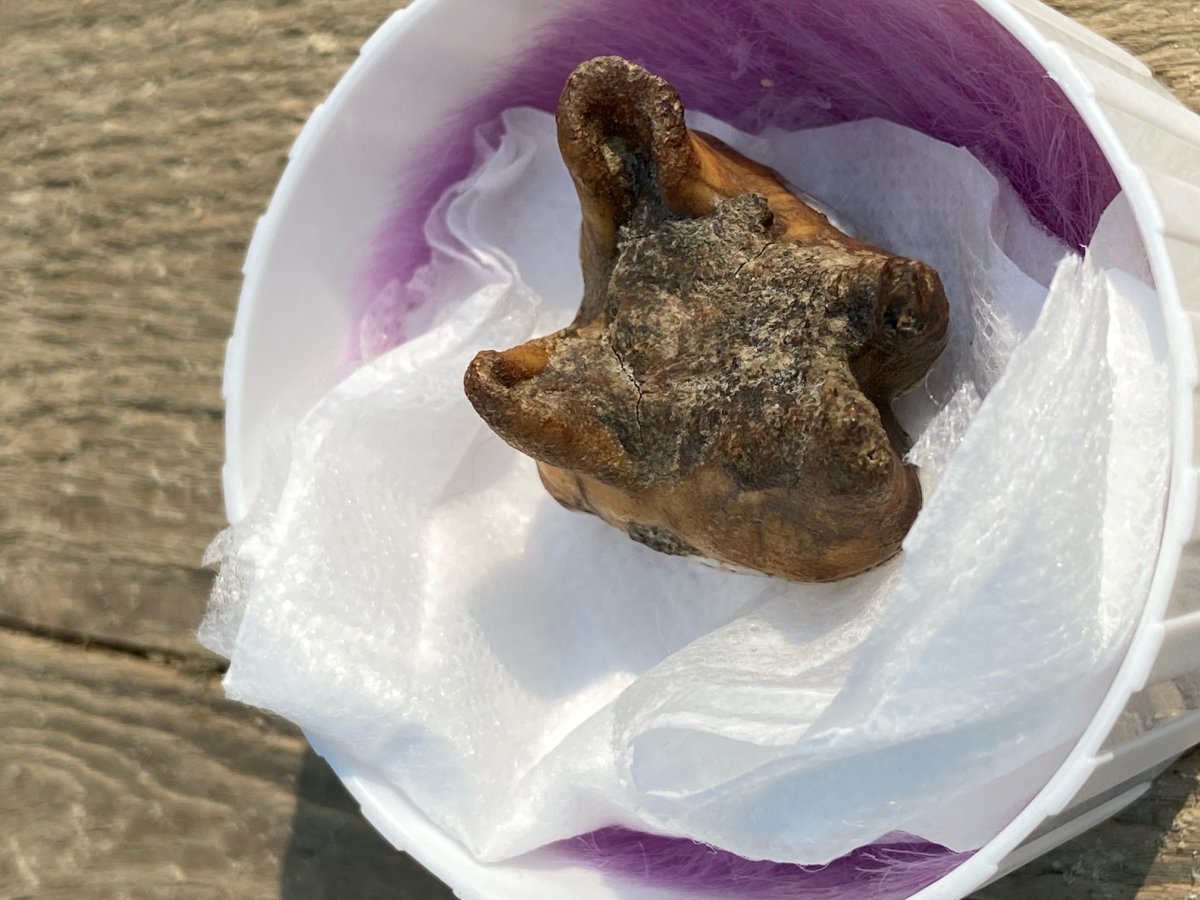
At six years old, Abby Darby made an incredible discovery, all while playing with rocks.

“On the beach sand, I thought I saw a cool rock. But then I dug it out and it wasn’t a rock,” she explained.

Knowing she had something special, she ran to show her family the unusual find.

Right away, they agreed the specimen was likely a fossil.

“I thought after that it would be really cool if I could tell her exactly what it was, because we all had our guesses,” explained Darby’s aunt, Krysta Poole.

“Grandma, she had a claw guess. but all the other ones thought it was a tooth,” Darby said.

READ MORE: Friends recover ancient fossil in Edmonton’s river valley: ‘Like finding a needle in a haystack’

Poole sent a video of Darby’s find to the Faculty of Science at the University of Alberta.

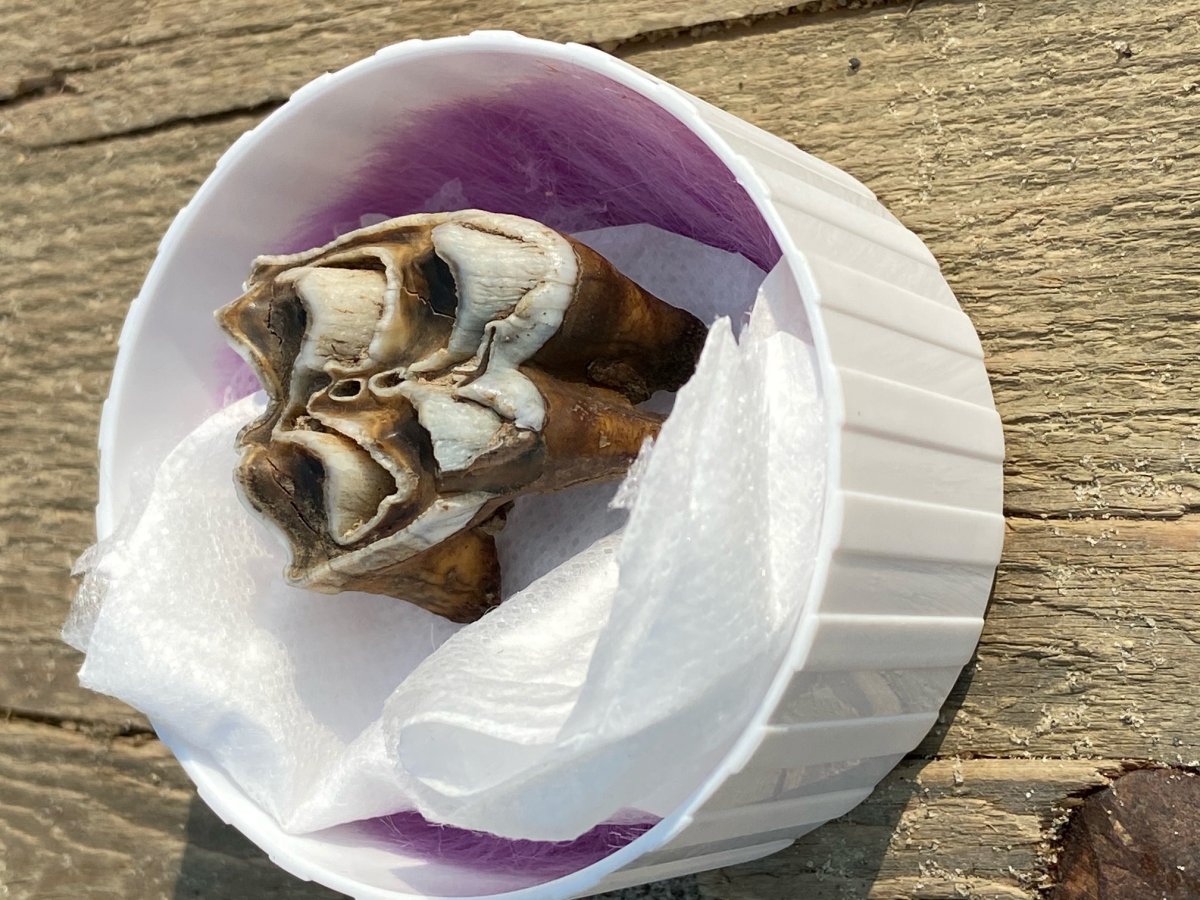
Mark Powers, a PhD student in vertebrate paleontology, took a look at it and said “it’s definitely a tooth, you can see it right away. And it’s definitely mammal because it has the multiple roots. A lot of what we see in dinosaurs or lizards is a single root.

In addition to the roots, he compared the cusps and pits of the tooth to other fossils.

“Upon looking at some specimens here at the University of Alberta in our teaching collections, I can confirm it’s definitely a camel family member.”

A camel, on the Canadian Prairies? Powers said camels are believed to have originated in North America, though they would have looked very different than the ones we have today.

The University of Alberta’s collection includes a small skull from a camel found in Wyoming, for example.

It’s estimated this fossilized tooth would be between 22,000 and 25,000 years old.

“There were huge glaciers that were covering most of Alberta during that time,” Powers said.

“So there would have been some ravines where the ice sheets were retreating away from each other, where we would get a lot of water influence from the melting glaciers. That’s where animals probably would have hung out.”

Darby’s aunt was surprised to hear the news.

“I never knew camels were around here,” Poole said. “We could have never guessed that ourselves.”

She quickly shared the findings with her niece.

“I thought that it was amazing,” Darby said.

Powers said by analyzing the tooth’s enamel and isotopes, researchers could learn a lot.

“That can actually give us an indication of migration, diet and all sorts of changes in their environment as they grew,” he said. “Mammals are great for that because all of it is recorded in the enamel, and most mammals only have two sets of teeth in their life.”

Darby’s family plans to donate the tooth to the Royal Alberta Museum.

“So next year, when I’m in Grade 1, I can show my friends,” Darby explained.

Sarah Ryan / Global News
24
Sarah Ryan / Global News
34
Sarah Ryan / Global News
44
Sarah Ryan / Global News
These gorgeous renewable energy hubs used to be coal plants

Across Europe, energy giant Enel is converting its old polluting infrastructure into new centers for clean power.


08-04-21


[Image: courtesy Frigerio Design]

Enel, headquartered in Rome and Europe’s largest utility company, used to depend heavily on coal. But it’s in the process of shutting down all of its coal power plants globally over the next six years and transforming the old sites for new uses, including as renewable energy hubs.

[Image: courtesy Frigerio Design]“The main goal is to create genuine energy centers that are increasingly integrated with their local environment, reducing the impact on the landscape, thanks to a new idea of what a power plant can be,” Fabio Cautadella, head of power plant repurposing at the Enel Group, said via email. “Most of the coal-fired plants are being converted to renewable energy, but in some cases, they are enjoying a new lease on life with completely different roles. These projects are being developed in collaboration with the local communities, and in some specific cases with other partners, with a view to creating jobs and improving the quality of life in the area.”


In Teruel, Spain, for example, a massive former coal plant will be converted into Europe’s largest solar power plant, with extra wind power and battery storage on site that will more than replace the power generation from coal. Other sites will transition to green hydrogen, “a highly promising solution that can serve as an alternative to electricity in the so-called “hard to abate” sectors, such as heavy industry, shipping, and aviation,” Cautadella says. “In these cases, hydrogen can be extracted through processes powered by renewable sources, a unique technology that is genuinely green.”


In Italy, the company ran a “new energy spaces” competition for architects to redesign four former coal plants that run, in part, on renewable energy. A winning design in Venice turns part of the complex into a center focused on sustainable innovation open to the public. New buildings on the site, made with recycled materials, are designed to use as little energy as possible, and new plantings will help reconnect the industrial complex with the surrounding lagoon.

[Image: Enel]

The projects aren’t all moving toward sustainability as quickly as is technically possible—some of the sites will use renewable energy in combination with gas, which still adds to climate change. Enel doesn’t plan to fully decarbonize until 2050, and arguably could reach that goal much faster. Still, the company was early to embrace renewable energy, launching Enel Green Power in 2008, now a global leader with more than 1,200 renewable power plants on five continents. And over the next decade, it’s planning to spend $190 billion to nearly triple its renewable capacity and build out the grid for a future with electric cars and other surging demands for electricity. Its investments in renewables over the next few years are nearly as much as the combined plans of BP, Total, and Shell. Finding new uses for old coal plants is one part of the larger transition.

“This repurposing is in line with the principles of the circular economy: This way, not only will they offer a new value to the areas in which these facilities are located, but they will also enable the reuse, at least in part, of the materials and some parts of the plants in order to minimize consumption of raw materials,” says Cautadella.

 ALBERTA

Heartland Petrochemical Complex Update

HPC represents Inter Pipeline’s largest growth project and is expected to create a step change in cash flow generation once fully in-service. HPC, which is in the final stages of completion in Strathcona County, Alberta, will be an industry-leading petrochemical facility converting locally sourced, low-cost propane into high-value polypropylene. Polypropylene is an easily transported and fully recyclable plastic used in the manufacturing of an extensive range of essential finished products and consumer goods such as healthcare products, medical supplies, textiles and lightweight automotive components. Despite the prolonged impact of COVID-19, with Inter Pipeline’s strong adherence to rigorous health and safety procedures, HPC has exceeded a world-class 14 million work hours without a lost time incident on-site.

Since the April 22, 2021 HPC update, Inter Pipeline has successfully negotiated an eighth take-or-pay agreement for HPC’s production capacity. The new contract is with an investment grade, multinational integrated energy producer.

Inter Pipeline has now secured 68 percent of HPC’s production capacity under long-term take-or-pay agreements, which is very near our stated objective to contract a minimum 70 percent of capacity in advance of the facility becoming operational. Negotiations are continuing with several additional counterparties. These contracts are structured to include a stable return on capital payment to Inter Pipeline plus fixed and variable operating fees, with no exposure to commodity price fluctuations. The weighted average term of the executed contracts remains approximately nine years.

If no other contracts are secured, the remaining 32 percent of HPC production capacity would be tied to merchant sales of polypropylene production. Merchant sales are exposed to the spread between North American posted polypropylene and Edmonton propane prices. The current June 2021 spread is US$2,600 per tonne and is at a record high since the Cochin pipeline discontinued Alberta propane export service in 2014. The current spread is also approximately 80 percent higher than the average spread of US$1,450 per tonne over the same time period. The current strong pricing spread provides the opportunity for additional upside to Inter Pipeline should this pricing dynamic continue post HPC start-up and is indicative of the strong competitive positioning that HPC enjoys with its abundant, low-cost Canadian propane feedstock.

Inter Pipeline is planning a staggered start-up of HPC with the commencement of polypropylene facility operations expected early in the second quarter of 2022. The propane dehydrogenation facility (PDH), which is substantially mechanically complete, is expected to be operational several months later, with definitive timing subject to the completion of final commissioning plans later this year. The estimated cost of the complex is expected to be approximately $4.3 billion subject to any final cost adjustments related to the potential capitalization of certain additional PDH commissioning expenses and interest during construction for the commissioning period.

Due to the highly integrated nature of Inter Pipeline’s NGL operations, HPC can produce polypropylene before the start-up of the PDH plant utilizing polymer grade propylene (“PGP”) feedstock production from Inter Pipeline’s adjacent Redwater Olefinic Fractionator (“ROF”). A 600,000 barrel PGP storage cavern at ROF and pipeline connectivity between ROF and HPC provide the necessary infrastructure to support a stable supply of feedstock and operational flexibility.

Inter Pipeline continues to expect that 2023 will be the first full year of HPC’s polypropylene production and reconfirms its previous guidance of annual adjusted EBITDA between $400 to $450 million for that year. However, as the definitive timing for commissioning of the full complex has not yet been finalized, the Company considers it prudent to withdraw its 2022 financial guidance for HPC. The long-term average annual adjusted EBITDA for HPC remains approximately $450 million to $500 million, based on the seven-year historical average North American posted polypropylene to Edmonton propane price spread of approximately US$1,450 per tonne.

Advisors

Inter Pipeline has retained TD Securities Inc. and the Special Committee has retained J.P. Morgan Securities Canada Inc. as financial advisors. Burnet, Duckworth & Palmer LLP and Dentons Canada LLP are acting as legal advisors to Inter Pipeline and its Board of Directors. Kingsdale Advisors has been retained as Inter Pipeline’s strategic shareholder advisor.

About Inter Pipeline Ltd.

Inter Pipeline is a major petroleum transportation and natural gas liquids processing business based in Calgary, Alberta, Canada. Inter Pipeline owns and operates energy infrastructure assets in Western Canada and is building the Heartland Petrochemical Complex — North America’s first integrated propane dehydrogenation and polypropylene facility. Inter Pipeline is a member of the S&P/TSX 60 Index and its common shares trade on the Toronto Stock Exchange under the symbol IPL.  www.interpipeline.com

WE GOT BIGGER BALLS AND FIELDS

Shane Ray warns NFL players who sign in the CFL: ‘I definitely don’t think you should take it as high school football’

OUR PLAYERS WORK FOR A LIVING EIGHT MONTHS OF THE YEAR, FOOTBALL IS THEIR PASSION

Ultra-athletic defensive lineman Shane Ray has come to respect the talent level in the CFL since strapping up with the Toronto Argonauts.

Ray was added to the Argos’ exclusive 45-man negotiation list in December and signed his contract in February after being out of the NFL for the 2019 and 2020 seasons. The 28-year-old viewed the Canadian league as a way back onto the football field.

“The CFL game has been really fun for me, playing in the NFL I didn’t really know what to expect with all the changes. Just figuring everything out and getting in tune with how the game flows. It hasn’t been a super huge transition for me, I’ve come out ready to work everyday,” Ray said.

“These last few years have been tough for me, getting injured in 2017 and having to rebuild myself. And then years of not having the contact I wanted with NFL teams, that weighs on you mentally. It’s given me a new appreciation for the game.”

The six-foot-three, 245-pounder has the skill set to thrive in the CFL if he can learn to play on the bigger field, but he admits not knowing much about the three-down league until a workout for Argos scouts. He views the opportunity in The Six as a chance to rebound and return to the NFL or alternatively start a career in Canada.

“I can’t say that I would just come out here and run through guys, that’s not what’s going on. These guys all get paid and they come into work with their hard hats and they’re ready to go — I appreciate the competition,” Ray said.

“I definitely don’t think that if you’re a player that’s in this position to come out here and play in the CFL, that you should take it as high school football. There are talented players out here and you definitely have to come in every day with the mentality that you’re going to work your craft.”

“I feel like the thought with guys that come over here from the NFL is that they don’t take it serious. I take this very serious, this is not just something I’m doing. This is what I love to do, I’m playing the game of football and I want to win. I want to go out there and I have things that I want to do for my legacy.”

According to coaches, talent evaluators, and teammates, Ray was “nearly unblockable” for the Argos entire training camp at the University of Guelph. His consistent performance has earned him a starting position on the opposite side of future Canadian Football Hall of Famer Charleston Hughes.

“Self scouting report on my ability to get to the quarterback: exceptional. If I can’t do anything else, I can rush the passer. That’s been something I’ve always had a knack for, that’s what I love to do. I look forward to putting it on tape. I can sit here and talk about it, but guys that are on the field they can see what I’m capable of doing,” Ray said.

Hughes has been helping Ray learn the nuances of pass rushing in the Canadian game. The four-time three-down league sack leader and six-time CFL all-star has been a sounding board for the uber-talented Ray. The word “elite” has been used by people around the Argos to describe his abilities as pass rusher.

“We have a D-line group chat and he’s putting his highlights in there. We all have the opportunity to see and we all understand what he’s done in this league,” Ray said.

“My first few days here, he didn’t hesitate to give me information. He was watching some of my tape, and was explaining to me how the steps are a little bit different as far as when you want to do your move here compared to the States, it’s been working for me.”

The first-round, 23rd overall pick in the 2015 NFL Draft has shifted his mentality to focus on winning the Grey Cup. Ray wants to add a CFL championship to his Super Bowl LI ring, which he won as a rookie with the Denver Broncos. Double Blue head coach Ryan Dinwiddie has noticed Ray being open to learning the CFL brand of football.

“A lot of guys that come from the NFL don’t know exactly what they’re getting into in the CFL and they’re coming up here for the wrong reasons. He’s coming up here because he loves football and he wants to play it again,” Dinwiddie said.

“I’ve really liked that approach. Those guys that have that approach coming from the NFL usually make an impact. The guys that think they’re bigger than the CFL, and they come up here and they don’t know what they’re getting into, there’s a rude awakening for them.”

Ray proved throughout camp that he was fully healthy once again. The main issue that caused him to fall out of favour in the NFL was a “complete wrist dislocation” which caused him to snap the main ligament in the joint. He went from thinking it was a six-week surgery to having a 14-week surgery amid the loss of blood flow in his wrist. Ray had to get screws to put everything back and hold it together.

“For an outside linebacker/defensive end, your hands are everything. It took a really long time just to get that strength back in my wrist and my whole arm to be honest. Nobody really knows what you go through,” Ray said.

“Nobody knows how much work I really had to put in to get to this point. My body and my weight back — all the eating, lifting, training, the rough nights, the not knowing if I would get another opportunity. For me, this is everything.”

Westinghouse ATF makes progress towards approval

04 August 2021


Irradiated lead test rods containing Westinghouse's EnCore advanced fuel technology have arrived at the US Department of Energy's (DOE) Oak Ridge National Laboratory (ORNL) where they will undergo a year of testing to support regulatory licensing efforts. The fuel is being developed under the DOE's Accident Tolerant Fuel Program, an industry-led effort looking to commercialise new fuels within the decade.

ORNL took delivery of the irradiated ATF in June (Image: ORNL)

The rods were loaded into a commercial US nuclear reactor in the spring of 2019 and removed after completing their operating cycle during a scheduled outage in the autumn of 2020. They were shipped by to ORNL by NAC International in June, the DOE Office of Nuclear Energy said yesterday.

ORNL will carry out post-irradiation experiments on the fuel to help qualify it with the US Nuclear Regulatory Commission. No signs of degradation have been seen in the fuel during initial visual observations after it was removed from the reactor.

Accident tolerant fuels - or ATFs - not only enhance the tolerance of light-water reactor fuel under severe accident conditions but also offer improvements to reactor performance and economics.

The fuel rods were fitted with Westinghouse's near-term EnCore Fuel solutions of chromium-coated zirconium alloy cladding and ADOPT higher-density uranium fuel pellets, which improve fuel cycle economics, enable longer operating cycles and enhance accident tolerance. ADOPT fuel and chromium cladding also support higher burnup and 24-month cycle operation for high-power density plants, the company said. A second, longer-term, phase solution using uranium nitride pellets and advanced silicon carbide-based cladding is also in development.

Jeff Bradfute, Westinghouse vice president of Americas Fuel Delivery, said the shipment shows the "substantial progress" EnCore Fuel is making towards commercialisation. "The examination of these high-performance features is the latest milestone our strategic timeline to enable utilities to quickly gain the safety and cost benefits that EnCore Fuel will provide," he said.

Westinghouse is making "incredible strides" in the development of its ATFs, Frank Goldner, a nuclear engineer at DOE's Office of Nuclear Energy, said. "These fuels will have a tangible impact on the industry once deployed in the near-term and could help make our US fleet more economical to operate," he added.

Three vendors - Framatome, GE Hitachi with GNF, and Westinghouse - are working with the DOE to develop new fuels under the ATF programme. All are on track to have their accident tolerant fuels ready for batch loading by the mid-2020s and commercially available with widespread adoption by 2030, DOE said.


Jordan declares uranium plant 'fully operational'

27 July 2021

Jordan has been operating a "pioneering" processing plant to recover yellowcake from uranium ores since the start of the year, the head of the country's Atomic Energy Commission has announced. Khaled Toukan's remarks were reported by state news agency Petra and shared by the Jordanian Uranium Mining Company (JUMCO), operator of the plant. JUMCO, which is the commercial arm of Jordanian Atomic Energy Commission, was established in 2013 to carry out radioactive elements exploration and development in Jordan.


JUMCO said its uranium processing plant is fully operational (Image: JUMCO/Petra)

JUMCO General Manager Mohammad Shunnaq said the company had, over the past year, "undertaken the design and installation of a factory for the production of yellow cake". Operation of the pilot plant has processed 70 tonnes of "ore", he said.

In addition to the uranium exploration, Jordan's nuclear program includes the Jordan Research and Training Reactor which became operational in 2016, and the Nuclear Power Plant Project to produce electricity and desalinate seawater, which is currently ongoing.

According to World Nuclear Association, Jordan imports most of its energy and seeks greater energy security as well as lower electricity prices. The country has significant uranium resources, some in phosphorite deposits, and is considering the use of small modular reactors. Jordan has signed nuclear cooperation agreements with France, Canada, the UK and Russia in respect to both power and desalination, and is developing its plans in line with International Atomic Energy Agency recommendations. It has also signed a nuclear cooperation agreement with China, covering uranium mining in Jordan and nuclear power, and others with South Korea, Japan, Spain, Italy, Romania, Turkey and Argentina related to infrastructure including nuclear power and desalination.

Researched and written by World Nuclear News

Canadian firm enters US uranium sector with mine purchases

16 July 2021

Vancouver-based International Consolidated Uranium (CUR) has agreed to buy the Tony M, Daneros and Rim conventional uranium mines in Utah, as well as the Sage Plain property and eight Department of Energy leases in Colorado from Energy Fuels Inc. In addition, the companies have agreed to enter into toll-milling and operating agreements with respect to the projects. The transaction positions CUR as a potential near-term US uranium producer.

The mines purchased by CUR from Energy Fuels (Image: CUR)

Under a definitive asset purchase agreement announced yesterday, CUR will pay Energy Fuels USD2 million at the closing of the transaction, CAD6 million (USD4.8 million) of deferred cash payable over time, up to CAD5 million of deferred cash payable on commencement of commercial production, and such number of CUR shares that results in Energy Fuels holding 19.9% of the outstanding CUR common shares immediately after closing. CUR will also pay Energy Fuels a management fee, along with a toll milling fee for ore produced at the acquired projects in the future.

The portfolio of projects being acquired by CUR includes, among other assets, three permitted, past-producing mines in Utah: Tony M, Daneros and Rim.

The Tony M mine in southeastern Utah is a large-scale, fully-developed and permitted underground mine. Located about 127 road miles west of Energy Fuels' White Mesa Mill, the mine was operated by Denison from September 2007 to November 2008, when it was placed on care and maintenance. In June 2012, Energy Fuels acquired all of Denison's uranium properties in the USA.

The Daneros mine - located about 70 miles west of the White Mesa Mill - is a fully-developed and permitted underground mine. It operated from 2009 until October 2012 when the mine was placed on standby by Denison.

The Rim mine is a permitted, formerly producing mine located approximately 62 road miles from the White Mesa Mill. The mine has operated historically on a periodic basis starting in the mid-1960s. Mining last occurred in early 2008 by Denison and ceased in late 2010. Energy Fuels acquired the property in 2012 and has maintained it on care and maintenance since that time.

The transaction also includes CIR's acquisition of the Sage Plain property in Utah and eight Department of Energy (DOE) leases in Colorado. The project area - some 54 road miles from the White Mesa Mill - is at the location of the historic Calliham mine. The DOE leases are located in the historically productive Uravan Mineral Belt in Colorado. The leases are located 80-175 road miles from the White Mesa Mill. New 10-year leases for these lease tracts were executed by Energy Fuels in January 2020.
Strategic alliance

CUR and Energy Fuels have also entered a strategic alliance for the projects, which involves three key components: a toll-milling agreement, operating agreements and an investor rights agreement.

Under the toll-milling, Energy Fuels will toll-mill ore mined from the projects at the White Mesa Mill, subject to payment by CUR of a toll-milling fee and certain other terms and conditions. With this agreement, CUR will become the only current US uranium developer - other than Energy Fuels itself - with guaranteed access to the White Mesa Mill, which is the only permitted and operating conventional uranium mill in the USA.

Through the operating agreements, Energy Fuels will provide ongoing services for a fee to maintain the projects in good standing, as well as additional services as agreed to by the parties.

Under the investor rights agreement, for so long as Energy Fuels' equity ownership in CUR remains at or above 10%, it will be entitled to equity participation rights to maintain its pro rata equity ownership in CUR and to appoint one nominee to the CUR Board of Directors.

Growth strategies

"Our strategy has been to acquire uranium projects around the world, create critical mass, and target the acquisition of larger, more advanced projects," said CUR President and CEO Philip Williams. "While the recently announced acquisition of the high-grade Matoush Project in Quebec was a big step forward for CUR, today's acquisition and alliance with Energy Fuels represents a giant leap. In one transaction, we are entering the important US uranium sector by acquiring past producing mines which are permitted and well positioned for a rapid restart when market conditions are right."

CUR has acquired a 100% interest or has entered into option agreements to acquire a 100% interest in seven uranium projects, in Australia, Canada and Argentina, each with significant past expenditures and attractive characteristics for development.

Energy Fuels holds three of the USA's key uranium production centres: the White Mesa Mill in Utah, the Nichols Ranch ISR Project in Wyoming and the Alta Mesa ISR Project in Texas. The White Mesa Mill is the only conventional uranium mill operating in the USA today, has a licensed capacity of over 8 million pounds of U3O8 per year and has the ability to produce vanadium when market conditions warrant.

"The assets we are selling to CUR are proven US uranium mines, and in fact production from these mines since 2006 has accounted for over 1,050,000 lbs of US uranium production, which would rank those mines as fifth among all current uranium producers in the US over those years," said Energy Fuels President and CEO Mark Chalmers.

"However, because Energy Fuels is focusing its attention on its core projects - the Nichols Ranch and Alta Mesa ISR properties and the Pinyon Plain, La Sal and other conventional properties - we do not believe markets have properly valued the projects within our expansive portfolio of exceptional assets," he added. "We believe that, in order to realise the full value of our expansive portfolio, certain assets, such as the projects, can be repositioned to the benefit of Energy Fuels and its shareholders, provided we find the right vehicle to unlock the value of these assets. In this transaction, we believe we have found that vehicle in CUR."


Transformative muon technology deployed at McClean Lake

07 July 2021

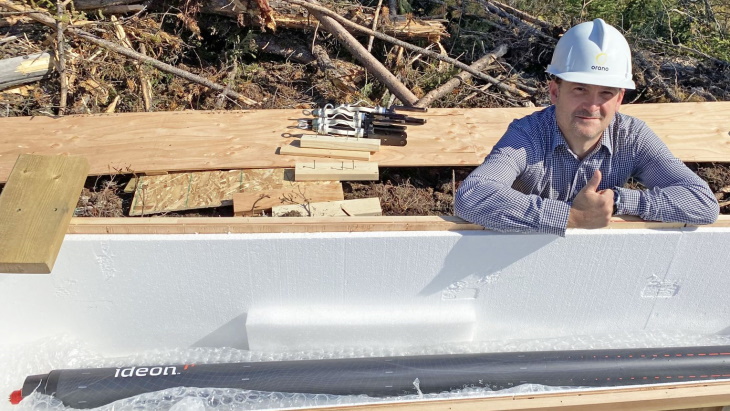
The world's first cosmic-ray muon detector developed specifically for use in industry-standard boreholes, has been deployed at Orano's McClean Lake site in northern Saskatchewan where it will be used to image a uranium deposit. The technology developed by Canadian start-up company Ideon Technologies could transform mineral exploration

Orano Canada Exploration Technical Director Rémy Chemillac with the borehole muon detector (Image: Ideon)

Muon tomography uses muons - naturally occurring subatomic particles created when cosmic rays enter Earth's upper atmosphere - to provide x-ray-like imaging up to 1 km beneath the Earth's surface. This means that new mineral and metal deposits can be identified with precision and confidence, with less need for drilling, reducing costs and risks, saving time and minimising environmental impact.

Ideon - a spin-off of Canada's TRIUMF national particle accelerator laboratory - has developed a discovery platform which integrates proprietary muon detectors, imaging systems, inversion technologies, and artificial intelligence to produce high-resolution 3D density maps of underground targets. The company has been working with Orano since 2016, when its first-generation large format detectors were used to image a high-grade uranium deposit under 600 m of sandstone at the McArthur River mine.

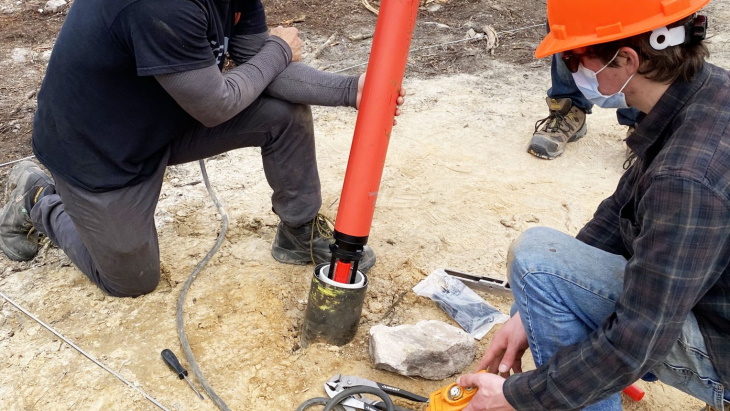
A miniaturisation effort has led to the development of the first industry-standard borehole (less than 10 cm in diameter), low-power (less than 10W continuous power consumption), zero-maintenance muon tomography detector suitable for operation in the extreme environmental conditions of mineral exploration sites around the world. Its deployment is a milestone that has taken more than a decade to reach, Ideon CEO Gary Agnew said.


Deploying the detector in the borehole (Image: Ideon)

"We've spent seven years doing commercial trials in partnership with the mining industry and several years of system design and development, de-risking and prototyping in the lab," he said. "Orano has been there right along with us for much of that journey, leading the way as a customer-driven innovator in the global energy transition. We are grateful for their enthusiasm, flexibility, trust, and willingness to break new ground with us."

Hervé Toubon, R&D and innovation director at Orano Mining, said the company expects the project to "transform the very nature" of exploration. It is "virtually impossible" to detect high-grade deposits at depth using traditional geophysical exploration techniques, he said. "The subsurface intelligence we gain with muon tomography gives us the ability to accurately locate those anomalies while reducing the need for drilling and lowering our overall environmental impact. That value proposition is hard to beat."

Orano's imaging target is a high-grade, compact uranium deposit located at a depth of 300 m. Multiple borehole muon detectors are deployed down a single drill hole in a connected sequence, delivering progressive imaging results throughout the survey. The McClean Lake project, which is approved by the Eureka intergovernmental R&D funding and coordination organisation, is receiving advisory services and funding support from the National Research Council of Canada Industrial Research Assistance Program and will run until the end of 2021.

In addition to muon tomography models, Ideon said it will also work with Orano to develop joint inversions with existing drill data and other geophysical datasets.

Muon detection systems have also been used to investigate passively the contents of legacy waste containers at Sellafield in the UK and to investigate the location of molten fuel within the damaged reactors at the Fukushima Daiichi plant in Japan.

Cigar Lake to resume operation as wildfire risk passes


05 July 2021

Workers are returning to the Cigar Lake uranium mine in northern Saskatchewan, Canada, ahead of its planned restart later this week, Cameco has announced. All non-essential personnel were evacuated last week from the site as a precaution due to the proximity of a nearby wildfire
.
Cigar Lake (Image: Cameco)

Cameco announced on 1 July that it had decided to evacuate about 230 workers from the Cigar Lake site. Around 80 personnel remained to secure the site and for essential duties. At that time, the company said: "The situation is complicated by extremely warm, dry weather, resulting from the heat dome that has settled over western Canada in recent days, along with variable wind and smoke conditions."

On 2 July, Cameco said the wildfire had moved past the main camp area without serious impact to the site itself. "While our inspections continue, we believe no structural damage has occurred to any buildings and all assets appear intact," it said.

Yesterday it announced, in consultation with provincial wildfire management officials from the Saskatchewan Public Safety Agency, it believed the risk to Cigar Lake posed by the fire had now subsided.

"With improved weather and smoke conditions, minimal likelihood of further road closures in the area, and all infrastructure at Cigar Lake remaining intact, Cameco believes the full complement of personnel can be safely remobilised and regular operations resumed," it said.

Cameco is now in the process of transporting employees and contractors back to the Cigar Lake site. Final inspections and preparation of equipment will occur over the days ahead to ready the operation for a return to production.

Cigar Lake is the world's highest grade uranium mine and has produced a total of over 93 million pounds U3O8 since it was commissioned in 2014. Ore from Cigar Lake is processed at the McClean Lake mill, 70 kilometres from the mine, which is operated by Orano. Uranium production at Cigar Lake was suspended due to restrictions created by the COVID-19 pandemic for five months from March 2020, and for a second time in December, resuming in April.

Researched and written by World Nuclear News
Federal Health Minister warns Alberta counterpart over risks of ending COVID restrictions too early
JAMES KELLER
CALGARY
PUBLISHED AUGUST 4, 2021

Dr. Deena Hinshaw, Alberta's Chief Medical Officer of Health, defended the province’s decision to end routine COVID-19 testing, contact tracing and mandatory isolation in an op-ed released to media outlets on Wednesday.
JASON FRANSON/THE CANADIAN PRESS

Federal Health Minister Patty Hajdu has written her counterpart in Alberta to warn that the decision to end routine COVID-19 testing, contact tracing and mandatory isolation at a time of increased transmission could put children at risk, as she urged the province not to declare victory over the virus too early.

In a letter to Alberta Health Minister Tyler Shandro, Ms. Hajdu wrote that the rapid spread of the Delta variant calls for more caution, not less – and asked him to explain the evidence and rationale behind the province’s changes, which were announced last week.

“Although this decision falls squarely within your jurisdiction, experts from Alberta and around the country are voicing their significant concerns,” she said in the letter, which was obtained by The Globe and Mail.

“I echo the Canadian Paediatric Society, who has called on you to recognize that this ‘unnecessary and risky gamble’ could worsen the spread of the virus and put children at risk.”

Alberta’s Chief Medical Officer of Health, Deena Hinshaw, announced that the province would no longer legally require people who test positive for COVID-19 to isolate beginning on Aug. 16. As well, routine testing will no longer be offered for most people and contact tracers won’t notify people who may have been exposed to the virus, except in cases that involve high-risk settings such as long-term care facilities.

The changes have been widely criticized by public-health experts and prompted several protests in the province. The Opposition New Democrats called on the government to reverse course. The Canadian Paediatric Society said Alberta’s approach is particularly dangerous for children under 12, who aren’t yet eligible to be vaccinated.


Has my province lifted all COVID-19 restrictions or are some still in place? The rules across Canada

Coronavirus tracker: How many COVID-19 cases are there in Canada and worldwide? The latest maps and charts

Ms. Hajdu noted in her letter that recent federal modelling projected a sharp increase in infections in Alberta, as well as in other provinces.

“We have seen in previous waves that public-health measures, including isolation and quarantine, are very important and effective tools for controlling resurgence. Indeed, these measures have saved lives,” she writes.

Mr. Shandro and Premier Jason Kenney have defended the changes, which they said were proposed by Dr. Hinshaw and driven by data. Mr. Kenney has brushed aside criticism by suggesting those who are calling for continued restrictions are doubting the effectiveness of vaccines and are needlessly sowing fear.

Brett Boyden, a spokesman for Alberta’s Health Minister, said Dr. Hinshaw “has been very clear on the sound medical reasoning behind her decisions” and added that Dr. Hinshaw talks regularly with with her federal counterparts.

Dr. Hinshaw released an op-ed to media outlets on Wednesday in which she apologized for causing “confusion, fear or anger,” but also defended the province’s shift. She said the changes are about learning to live with COVID-19, and argued that the province cannot sustain treating the pandemic as a continuing emergency in which every cough or runny nose requires a medical test and long periods of isolation.

“As vaccine coverage has changed the nature of the province-wide risk of COVID-19, it is time, in my opinion, to shift from province-wide extraordinary measures to more targeted and local measures,” she wrote.

Dr. Hinshaw also addressed the concerns about unvaccinated children. She argued the risk to young children is too low to justify the mental-health effects and other harms caused by public-health measures such as isolation.

“This doesn’t mean we should ignore the risk to kids from any of these things, but I believe it means we should consider COVID risk in context of all other risks that we face,” wrote Dr. Hinshaw, who added that she has two children of her own who are under 12.

Alberta had by far the highest per-capita rates of COVID-19 infections in Canada during the second and third waves, including a period in May when the province had the highest rates of new infections anywhere in North America. Alberta also led the country for hospital and ICU admissions late last year.

The province has seen an increase in infections in recent weeks, with daily cases more than doubling in the past week alone, and it now has among the highest infection rates in Canada. Dr. Hinshaw has urged the public to pay less attention to infection numbers, which she said no longer predict hospital admissions and deaths.

Alberta also has among the lowest vaccination rates in the country. About 76 per cent of eligible people have had at least one dose of a COVID-19 vaccine, which is the second-lowest rate in the country, ahead of Saskatchewan. The province is also lagging behind the national rate for second doses, with 66 per cent of people fully immunized.

Wednesday's letters:
 Is Hinshaw to be the fall person?
Author of the article:Edmonton Journal
Publishing date:Aug 04, 2021 • 
Dr. Deena Hinshaw, Alberta's chief medical officer of health, gives a COVID-19 pandemic update from the media room at the Alberta legislature in Edmonton, on Wednesday, July 28, 2021. PHOTO BY IAN KUCERAK /Postmedia

On July 28, I watched Dr. Hinshaw approach the podium for her news conference and do her usual hand sanitization, remove her mask and sanitize her hands a second time. Her announcement was a surprise. We will be treating the COVID-19 virus the same as colds, influenza and other seasonal diseases. No more mandatory testing. Testing will be done only in doctors’ offices and hospitals. Premier Kenney and Health Minister Shandro were not at this news conference.

Our provincial government has absolved itself of its responsibility for safety of the population. No contact tracing, no mandatory quarantine for positive cases and no masks required. Our under-12 population is completely unprotected as vaccines are not yet available for them.

Why do I have the feeling Dr. Hinshaw has been set up as the fall person for this gamble? Minister Shandro spoke to this announcement later by saying that the lifting of restrictions was at the direction of Dr. Hinshaw. Minister Shandro did not say “the government in consultation with Dr. Hinshaw,” which would indicate a team approach and shared responsibility. What does Dr. Hinshaw really think? She continues to wear a mask and use hand sanitizer. This government is not known to treat their employees with respect as we well know.

Phyllis Stone, Sherwood Park


New COVID approach unbelievable


This virus is now twice as contagious as smallpox and Deena Hinshaw is about to play Russian roulette with Albertans. I watched Dr. Hinshaw announce the new COVID restrictions and I was in complete disbelief as to what she suggested. Alberta would be the one and only place in the world to make such drastic changes in guidelines.

For 16 months she professed her sadness with lives lost and shared how serious it was and now it’s a free-for-all, who-cares attitude. She needs to step down as she does not represent nor care for Albertans any longer and she needs to take Jason Kenney with her as he doesn’t care either.

J.T. Syrnyk, Edmonton


Investors call for urgent action by steelmakers on carbon emissions
Simon Jessop


A protester from the Climate Coalition demonstrates, with 100 hundred days to go before the start of the COP26 climate summit, in Parliament Square, London, Britain, July 23, 2021. REUTERS/Peter Nicholls/File Photo

Summary

IIGCC issues priority actions for steelmakers

Calls for short-term targets in line with IEA report

Also says need to demonstrate emerging technology works


LONDON, Aug 4 (Reuters) - Steelmakers need to take urgent action on producing less carbon in order to meet the Paris Agreement on climate change, investors managing $55 trillion in assets said on Wednesday.

Emissions from steel production account for 9% of the global total and must fall 29% by 2030 and 91% by 2050 to meet the net zero scenario laid out by the International Energy Agency in May, the Institutional Investors Group on Climate Change said.

The IIGCC, as part of the Climate Action 100+ initiative, said in a statement that while it was technically feasible to reach net zero greenhouse gas emissions by mid-century, the steel industry was being too slow to act.

Steel firms needed to set short, mid and long-term targets in line with the IEA report, and align their capital expenditure plans with net zero, including not investing in new, unabated production capacity, the IIGCC added.

They also needed to demonstrate that emerging technology can work and produce reports by the end of 2022 on how carbon capture and storage, and hydrogen-based processes can be used.

In addition, they needed to be transparent about the public policy positions they will take to accelerate their transition, for example on carbon pricing and research and development.

While nine companies responsible for around 20% of global steel production have so far set firm net zero emissions commitments, they are mainly in Europe and Asia, and are largely in line with national net zero pledges and existing regulation.

"We cannot afford to delay action – while emerging technology has a role to play, the IEA’s report highlights that existing technology can deliver 85% of the emissions reductions needed by 2030," IIGCC Chief Executive Stephanie Pfeifer said.

ArcelorMittal (MT.LU), the world's top steelmaker, and German peer Salzgitter (SZGG.DE) earlier this year announced hydrogen-based projects to help lower their emissions.

In Japan, meanwhile, the country's third-biggest steelmaker, Kobe Steel (5406.T), said it plans to cut emissions by 30%-40% by 2030 from 2013 levels. read more
Reporting by Simon Jessop; Editing by Alexander Smith
WATER IS LIFE
Environmental impact of bottled water ‘up to 3,500 times greater than tap water’

Researchers also find impact of bottled water on ecosystems is 1,400 times higher than that of tap water


Joey Grostern
Thu 5 Aug 2021 10.30 BST

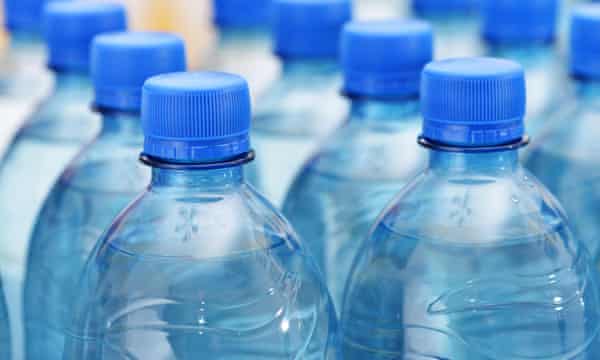
The impact of bottled water on natural resources is 3,500 times higher than for tap water, scientists have found.

The research is the first of its kind and examined the impact of bottled water in Barcelona, where it is becoming increasingly popular despite improvements to the quality of tap water in recent years.

Research led by the Barcelona Institute for Global Health (ISGlobal) found that if the city’s population were all to drink bottled water, this would result in a 3,500 times higher cost of resource extraction than if they all drank tap water, at $83.9m (£60.3m)a year.

Researchers also found the impact of bottled water on ecosystems is 1,400 times higher than tap water.Do you drink bottled water? Read this | Adrienne Matei

The authors concluded that the reduction in environmental impacts more than offset the small risk of bladder cancer associated with drinking tap water. The process of treating drinking water generates low levels of trihalomethanes (THM), which have been associated with a higher risk of bladder cancer. THM levels in drinking water are regulated in the EU.

The lead author of the study, the ISGlobal researcher Cristina Villanueva, said: “Health reasons don’t justify the wide use of bottled water. Yes, strictly speaking, drinking tap water is worse for local health, but when you weigh both, what you gain from drinking bottled water is minimal. It’s quite obvious that the environmental impacts of bottled water are higher compared to tap water.”

In the US, 17m barrels of oil are needed to produce the plastic to meet annual bottled water demand. In addition, bottled water in the UK is at least 500 times more expensive than tap water.

Villanueva added: “I think this study can help to reduce bottled water consumption, but we need more active policies to change that.

“For example, in Barcelona, we could have more education campaigns to make the public aware that the health gains from drinking bottled water are minor compared to the environmental impacts. We need to improve access to public water, to public fountains, to public buildings where you can bring your own bottle and don’t need to buy one. We need to facilitate access to public water in public streets.

“People trust bottled water because advertisers have done a good job of convincing people it’s a good option, so we need the effort on the other side.”