It’s possible that I shall make an ass of myself. But in that case one can always get out of it with a little dialectic. I have, of course, so worded my proposition as to be right either way (K.Marx, Letter to F.Engels on the Indian Mutiny)
Wednesday, August 11, 2021
NASA’s new space suits are delayed, making a 2024 Moon landing ‘not feasible’
The agency’s lunar-grade astronaut suits are behind schedule, an inspector general report says
The person in the white suit is wearing a prototype of NASA’s new xEMU in 2019, whose development has been delayed, an inspector general report found.
Photo by Joel Kowsky / NASA via Getty Images
NASA’s development of new astronaut space suits will be nearly two years late and nix its effort to land humans on the Moon by 2024, an inspector general report released on Tuesday found. Those delays compound a daunting set of schedule challenges NASA already faces — from the development of its new human-rated lunar lander to getting its massive Space Launch System rocket off the ground. An audit from the agency’s Office of Inspector General said NASA is on track to spend more than $1 billion on space suit development by the time its first two suits are ready, which would be “April 2025 at the earliest,” the report said. “Given these anticipated delays in spacesuit development, a lunar landing in late 2024 as NASA currently plans is not feasible.”
NASA is trying to return astronauts to the surface of the Moon for the first time since 1972 under its Artemis program that was spawned by the Trump administration in 2019. The program, as set by former Vice President Mike Pence, called for a crewed lunar landing in 2024 — a deadline that President Biden’s transition team deemed unrealistic. But NASA continues to embrace the date, with administrator Bill Nelson insinuating delays are likely because “space is hard.”
NASA’S SPACE SUIT DESIGN HAS CHANGED WITH SHIFTING SPACE PRIORITIES, DRIVING UP COSTS AND DELAYS
NASA has already spent $420 million on space suit development since 2007, before the advent of its Artemis program, and it plans to “invest approximately $625.2 million more” through 2025, the report said. The space suit’s design and purpose have changed repeatedly over the years as NASA’s priorities in space teeter between new administrations. A new Artemis-tailored space suit design, called xEMU, was unveiled in 2019. Current suits worn by astronauts on the International Space Station are restrictive, haven’t been upgraded in decades, and aren’t designed for long walks on the Moon.
The xEMU program anticipated development delays by allotting 12 months of wiggle room on its path to meet the 2024 Artemis deadline. But that schedule margin has already disappeared after NASA ran into funding shortfalls, closures to NASA centers during the COVID-19 pandemic, and more technical challenges, the report found. NASA slashed the space suit program’s planned $209 million budget by $59 million after Congress gave the agency 77 percent of what it requested for its Gateway Program in 2021, under which space suits are developed. That set the program back three months, the report said.
NASA space suit engineer Kristine Davis models a prototype of the agency’s new lunar space suit in 2019. Photo by Xinhua / Liu Jie via Getty Images
Intermittent closures to NASA’s Johnson Space Center during the pandemic caused at least three more months of delays, the report said. Then there were the hardware problems. Design upgrades and other changes caused production issues with the suit’s Display and Control Unit — the screen astronauts will use to control the suit’s critical functions. Circuit boards within a key part of the suits’ life support system, needed “rework” to ensure communications between the suit and the astronaut — and other astronauts — worked right. The program was hit with another delay when NASA halted testing for the suit’s assembly process. The team caused an unspecified “component failure” after “staff used the wrong specifications to build a complicated” life support system interface. When auditors interviewed NASA personnel about this flub, they blamed schedule pressure, among other issues. Additional factors included “a communication breakdown among the team” and the team’s rapid growth, “including the addition of inexperienced personnel.” An “unreleased drawing” and old hardware used during tests were also to blame, personnel told auditors.
Currently, 27 different entities are pitching in to build different parts of the space suit, the report notes. NASA previously contracted with just two companies, Hamilton Standard and ILC Dover, to build the space suits it currently uses on the ISS.
“Seems like too many cooks in the kitchen,” SpaceX CEO Elon Musk opined on Twitter in response to the news, adding in another tweet: “SpaceX could do it if need be.” It’s unclear whether SpaceX has an active space suit development program; government astronauts who have flown the company’s Crew Dragon capsule wear SpaceX-designed flight suits, not long-duration space suits. Some private companies are already planning to design their own space suits, including Axiom Space, which, this month, posted new jobs for space suit engineers.
NASA’s space suit woes aren’t the only threat to its 2024 goal. The agency’s inspector general, Government Accountability Office, and NASA’s aerospace safety panel have all expressed concern that development delays in NASA’s human lunar lander and Space Launch System programs — the core organs of the Artemis program — will make a 2024 landing nearly impossible, with the safety panel raising fears that the hastened landing date could lead to schedule pressure among engineers.
In response to the report, NASA’s human exploration chief Kathy Lueders said the agency plans to rejig its space suit development schedule and carry out a space suit test on the ISS by June 2022, before the first crewed Artemis mission poised for sometime in 2023. For that mission, astronauts will fly around the Moon in NASA’s Orion capsule without a lunar landing. The next mission, Artemis III, will have the Moon landing.
“Demonstration and testing of [the space suits] on ISS are a priority,” Lueders said.
Elon Musk offers for SpaceX to make NASA spacesuits, after watchdog says program to cost $1 billion (PER SUIT!!)
Elon Musk offered SpaceX’s services to help NASA make its next-generation spacesuits.
His proposal came in response to a report by NASA’s inspector general on the work being done to develop a new line of Extravehicular Mobility Units, which are informally called spacesuits.
NASA has spent more than $420 million on spacesuit development since 2007 but, even with another $625 million in spending planned, the inspector general report found that the spacesuits for the agency’s lunar missions will “not be ready for flight until April 2025 at the earliest.”
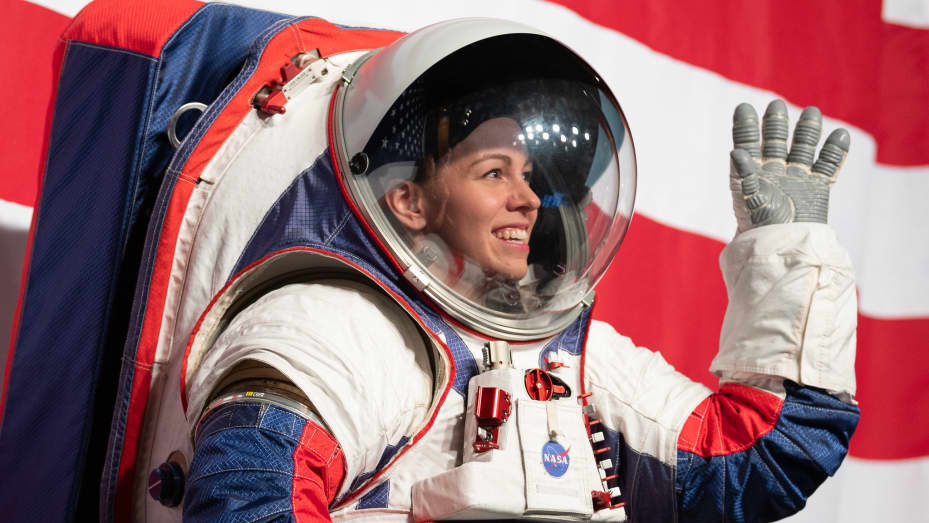
Kristine Davis, a spacesuit engineer at NASA’s Johnson Space Center, wears a ground prototype of the new Exploration Extravehicular Mobility Unit (xEMU), during a demonstration on Oct. 15, 2019. Joel Kowsky / NASA
Elon Musk offered SpaceX’s services to help NASA make its next-generation spacesuits, after a watchdog report on Tuesday said the agency’s current program is behind schedule and will cost more than $1 billion.
“SpaceX could do it if need be,” Musk wrote in a tweet.
Musk’s company has developed and made flight suits for astronauts who launch into orbit in SpaceX’s Crew Dragon spacecraft. The flight suits are primarily designed to protect the astronauts in case of a fire inside of the spacecraft, or if the cabin depressurizes. Building spacesuits would be a more complex and challenging endeavor, given the need to survive outside of a spacecraft in the harsh environment of space.
NASA spokesperson Monica Witt, in a statement to CNBC on Musk’s offer, pointed to the agency’s request last month to companies in the space industry for feedback on “purchasing commercial spacesuits, hardware, and services.”

From left: Mission specialist Thomas Pesquet of the ESA, pilot Megan McArthur of NASA, commander Shane Kimbrough of NASA, and mission specialist Akihiko Hoshide of JAXA. SpaceX
Musk’s proposal came in response to a report by NASA’s inspector general – which is the investigative office which audits the agency for fraud and mismanagement – on the work being done to develop a new line of Extravehicular Mobility Units, which are informally called spacesuits.
Astronauts on board the International Space Station use spacesuits “designed 45 years ago for the Space Shuttle” program, the report noted. The IG also highlighted that those spacesuits have been “refurbished and partially redesigned” over the past decades to continue working.
The space agency has started three different spacesuit programs since 2007, the inspector general found, and has spent $420.1 million on development since then. Additionally, the report said NASA “plans to invest approximately $625.2 million more” on development, testing and qualification to complete a suit for a demonstration on the ISS and two suits for the crewed mission to the moon – for a total cost of “over $1 billion” through 2025.
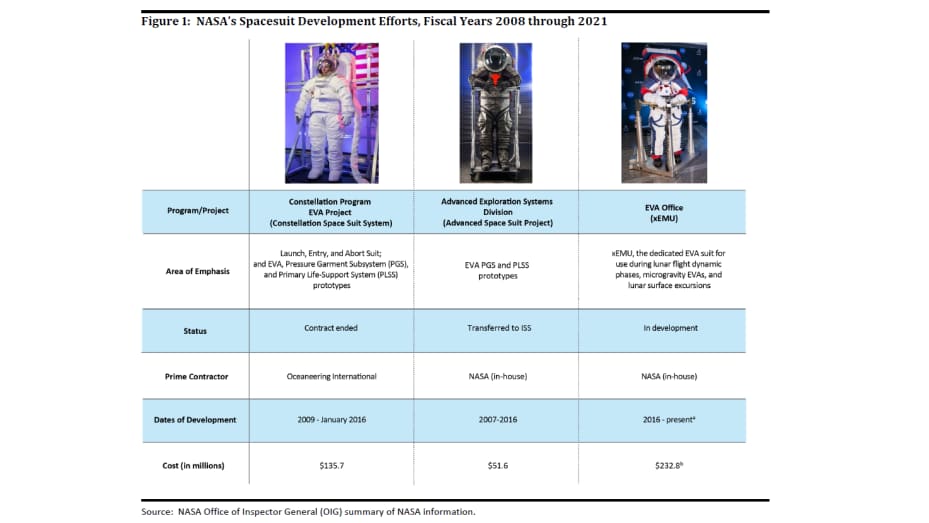
NASA Inspector General
Beyond the soaring cost, the inspector general said delays “attributable to funding shortfalls, COVID-19 impacts, and technical challenges” have eliminated the chance the spacesuits are ready in time. The spacesuits will “not be ready for flight until April 2025 at the earliest,” the report said. NASA originally said the spacesuits would be ready by March 2023.
NASA needs new spacesuits for its Artemis program, which was announced by former President Donald Trump’s administration and has continued under President Joe Biden. Artemis is expected to consist of multiple missions to the moon’s orbit and surface in the years ahead, with NASA aiming to land astronauts on the lunar body by 2024. Although NASA has stuck to the 2024 goal, the inspector general has warned repeatedly that the schedule is threatened by several major programs that are key to Artemis’ success.
The spacesuits have a multitude of different components, which the inspector general noted are supplied by 27 different companies. That’s a point Musk also highlighted, saying in a tweet that it “seems like too many cooks in the kitchen.”
SpaceX did not respond to CNBC’s request for comment on whether the company has begun work on its own spacesuits. While the company hasn’t publicly disclosed spacesuit plans, it is one of nearly 50 companies that expressed interest in NASA’s program to purchase privately developed spacesuits and spacewalk services.
Robots are coming for the lawyers — which may be great for anyone in need of cheap legal assistance
by Elizabeth C. Tippett and Charlotte Alexander, The Conversation
Credit: Pixabay/CC0 Public Domain
Imagine what a lawyer does on a given day: researching cases, drafting briefs, advising clients. While technology has been nibbling around the edges of the legal profession for some time, it's hard to imagine those complex tasks being done by a robot.
And it is those complicated, personalized tasks that have led technologists to include lawyers in a broader category of jobs that are considered pretty safe from a future of advanced robotics and artificial intelligence.
But, as we discovered in a recent research collaboration to analyze legal briefs using a branch of artificial intelligence known as machine learning, lawyers' jobs are a lot less safe than we thought. It turns out that you don't need to completely automate a job to fundamentally change it. All you need to do is automate part of it.
While this may be bad news for tomorrow's lawyers, it could be great for their future clients—particularly those who have trouble affording legal assistance.
Technology can be unpredictable
Our research project—in which we collaborated with computer scientists and linguists at MITRE, a federally funded nonprofit devoted to research and development—was not meant to be about automation. As lawprofessors, we were trying to identify the text features of successful versus unsuccessful legal briefs.
We gathered a small cache of legal briefs and judges' opinions and processed the text for analysis.
One of the first things we learned is that it can be hard to predict which tasks are easily automated. For example, citations in a brief—such as "Brown v. Board of Education 347 U.S. 483 (1954)"—are very easy for a human to pick out and separate from the rest of the text. Not so for machine learning software, which got tripped up in the blizzard of punctuation inside and outside the citation
It was like those "Captcha" boxes you are asked to complete on websites to prove you're not a robot—a human can easily spot a telephone pole, but a robot will get confused by all the background noise in the image.
A tech shortcut
Once we figured out how to identify the citations, we inadvertently stumbled on a methodology to automate one of the most challenging and time-consuming aspects of legal practice: legal research.
The scientists at MITRE used a methodology called "graph analysis" to create visual networks of legal citations. The graph analysis enabled us to predict whether a brief would "win" based on how well other briefs performed when they included a particular citation.
Later, however, we realized the process could be reversed. If you were a lawyer responding to the other side's brief, normally you would have to search laboriously for the right cases to cite using an expensive database. But our research suggested that we could build a database with software that would just tell lawyers the best cases to cite. All you would need to is feed the other side's brief into the machine.
Now we didn't actually construct our research-shortcut machine. We would need a mountain of lawyers' briefs and judicial opinions to make something useful. And researchers like us do not have free access to data of that sort—even the government-run database known as PACER charges by the page.
But it does show how technology can turn any task that is extremely time-consuming for humans into one where the heavy lifting can be done at the click of a button.
Legal scholar Miriam Cherry discusses workplace automation with Elizabeth Tippett.
A history of partial automation
Automating the hard parts of a job can make a big difference both for those performing the job and the consumers on the other side of the transaction.
Take for example, a hydraulic crane or a power forklift. While today people think of operating a crane as manual work, these powered machines were considered labor-saving devices when they were first introduced because they supplanted the human power involved in moving heavy objects around.
Forklifts and cranes, of course, didn't replace people. But like automating the grind of legal research, power machines multiplied the amount of work one person could accomplish within a unit of time.
Partial automation of sewing machines in the early 20th century offers another example. By the 1910s, women working in textile mills were no longer responsible for sewing on a single machine—as you might today on a home sewing machine—but wrangling an industrial-grade machine with 12 needles sewing 4,000 stitches per minute. These machines could automatically perform all the fussy work of hemming, sewing seams and even stitching the "embroidery trimming of white underwear." Like an airline pilot flying on autopilot, they weren't sewing so much as monitoring the machine for problems.
Was the transition bad for workers? Maybe somewhat, but it was a boon for consumers. In 1912, women perusing the Sears mail order catalog had a choice between "drawers" with premium hand-embroidered trimming, and a much cheaper machine-embroidered option.
Likewise, automation could help reduce the cost of legal services, making it more accessible for the many individuals who can't afford a lawyer.
DIY lawyering
Indeed, in other sectors of the economy, technological developments in recent decades have enabled companies to shift work from paid workers to customers.
Touchscreen technology, for example, enabled airlines to install check-in kiosks. Similar kiosks are almost everywhere—in parking lots, gas stations, grocery stores and even fast-food restaurants.
At one level these kiosks are displacing paid labor by employees with unpaid labor by consumers. But that argument assumes that everyone could access the product or service back when it was performed by an employee.
In the context of legal services, the many consumers who can't afford a lawyer are already forgoing their day in court altogether or handling legal claims on their own—often with bad results. If partial automation means an overwhelmed legal aid lawyer now has time to take more clients' cases or clients can now afford to hire a lawyer, everyone will be better off.
In addition, tech-enabled legal services can help consumers do a better job of representing themselves. For example, the federal district court in Missouri now offers a platform to help individuals filing for bankruptcy prepare their forms—either on their own or with a free 30-minute meeting with a lawyer. Because the platform provides a head start, both the lawyer and consumer can make better use of the 30-minute time slot.
More help for consumers may be on the way—there is a bumper crop of tech startups jostling to automate various types of legal work. So while our research-shortcut machine hasn't been built, powerful tools like it may not be far off.
And the lawyers themselves? Like factory and textile workers armed with new power tools, they may be expected to do more work in the time they have. But it should be less of a grind. It might even free them up to meet with clients.
The big picture: Robotics and automation are more affordable now than they once were, and with more people questioning whether or not they want to be involved in the food services industry due to unstable schedules and relatively low wages, there might be no better time than the present for restaurant operators to further test the waters.
For better or for worse, the pandemic has impacted nearly every facet of modern life. Nowhere is that more evident than in the food services industry.
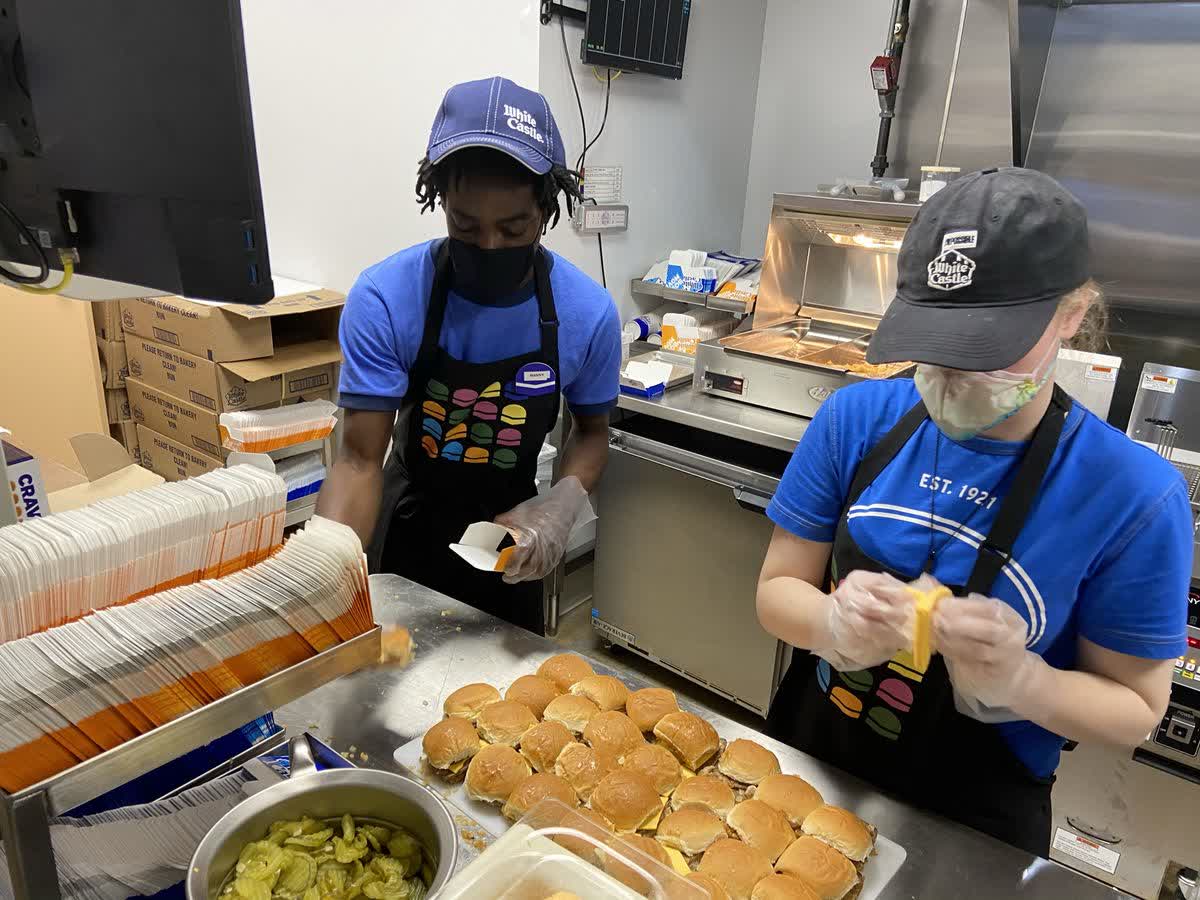
In just over a year and a half, virtually everything has changed as it relates to food. Online grocery shopping has finally started to gain traction. Many fast food joints closed their lobbies, turning instead to takeout or delivery to keep the lights on. Others that weren’t able or willing to adapt often went out of business.
All of the turmoil has wreaked havoc on the job market, and as The Wall Street Journal reports, it’s forcing yet another rethink by restaurants and executives.
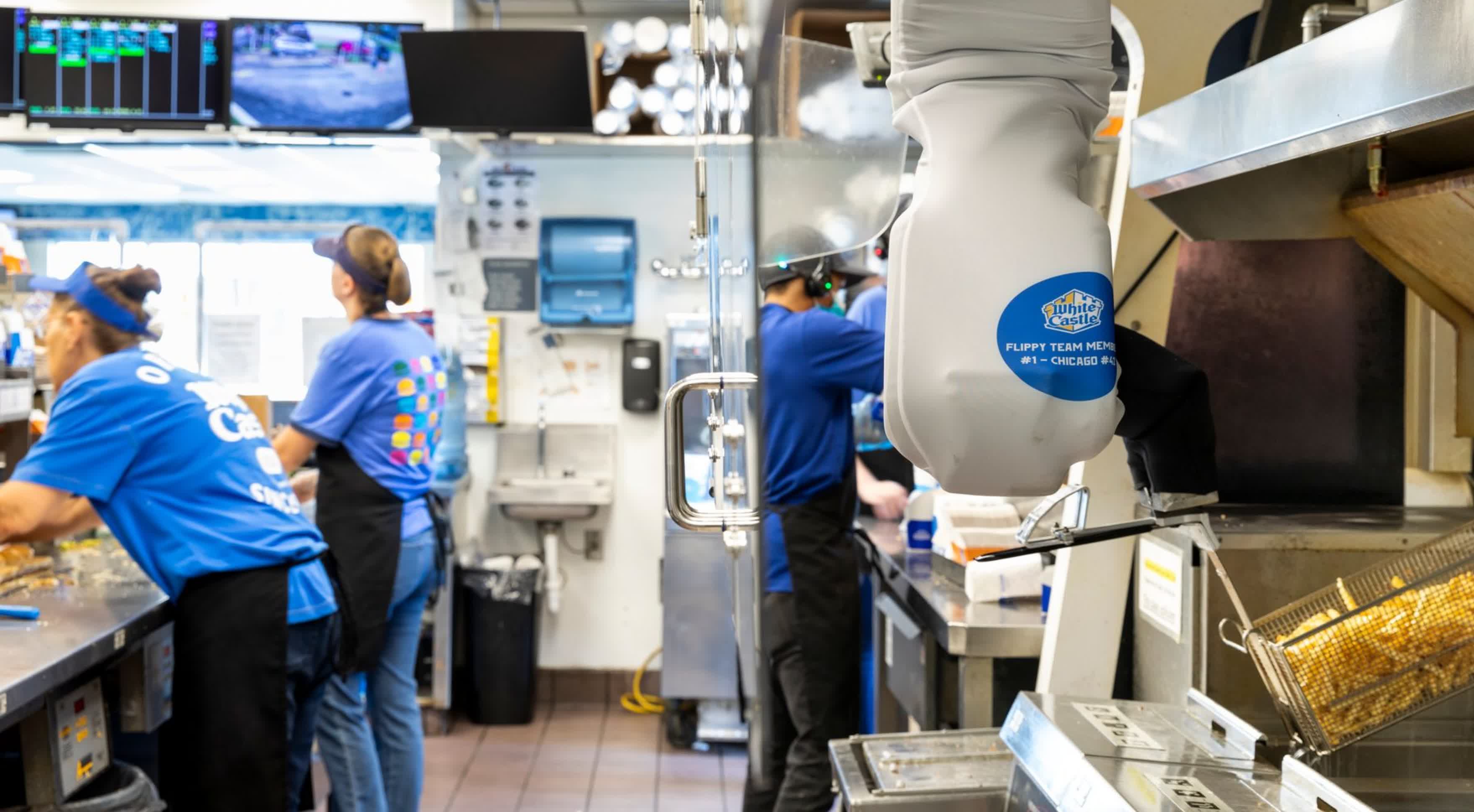
White Castle last year started testing a robotic fry cooker at select locations. “Flippy,” from Miso Robotics, operates 23 hours a day at the Merrillville, Indiana, White Castle – it gets one hour of downtime a day for cleaning. The company is so happy with the bot’s performance that it is planning to bring it to 10 additional restaurants across the country.
According to the US Bureau of Labor and Statistics, there were more than 1.4 million job openings in the accommodation and food services sector as of May 2021. That’s more than double the number from a year earlier.
Indeed, with so many unfulfilled jobs and the pandemic still looming, even more restaurants and fast food establishments are willing to experiment with replacing human labor with robots. And the cost isn’t nearly as much of a factor as it once was.
“The 17-year-old fry cook isn’t expensive labor, but the 17-year-old becomes expensive labor if he or she doesn’t show up for work,” said, Ruth Cowan, an expert in kitchen automation.
Bird Protection System In Operation At Wind Farm In Tasmania
I expect that when the large oil companies transition into energy companies and buy up all the renewable generation — thus continuing their oligarchy — the FUD will cease around wind turbines. Very few people cared that birds died from the pollution caused by coal-fired power stations, but one sparrow gets hit by a turbine and the deal’s off.
A wind farm in Tasmania has pioneered a novel solution. Probably would have been simpler and less expensive to build the wind farm somewhere else. However, what they have come up with could be a world first, and might be useful in many countries around the globe. The Cattlehill Windfarm in Tasmania’s central highlands is trialling a way to mitigate the impacts on the endangered Tasmanian wedge-tailed eagle. Using tower-mounted optical units, eagles are detected, their flight path analyzed, and turbines in their way are shut down. There has only been one fatality so far, and that was likely due to human error.
One common argument against the use of wind turbines is the belief that they cause a lot of bird deaths. (Trump said so!) There is not a lot of empirical data on this issue. What there is suggests that far more bird deaths are caused by the pollution from coal and gas fired power generation and cats. “Wind farms killed approximately seven thousand birds in the United States in 2006 but nuclear plants killed about 327,000 and fossil-fuelled power plants 14.5 million,” according to a 2019 study. A Canadian study found that the vast majority of bird deaths were from feral cats, followed by domestic cats. In all, 60% of all bird deaths are caused by cats. The Royal Society for the Protection of Birds in the UK has put in a wind turbine at its headquarters to make the point that more birds will die from climate change than from this form of renewable energy generation.
Back in Tasmania, the Identiflight system is being fine-tuned. As a side effect, it is collecting massive amounts of data about the flights of eagles, with over 3 million images taken and over 130,000 flight paths tracked. And the economics — each shutdown lasts about 2 minutes, leading to a total of about 14 hours curtailment over 48 turbines on a daily basis. The eagles don’t fly at night and that is when the wind is blowing the most.
This good corporate behavior is generating a better social license for the wind power industry, an example that could be followed in other parts of Australia and around the world.
When robots make mistakes—and they do from time to time—reestablishing trust with human co-workers depends on how the machines own up to the errors and how human-like they appear, according to University of Michigan research.
In a study that examined multiple trust repair strategies—apologies, denials, explanations or promises—the researchers found that certain approaches directed at human co-workers are better than others and often are impacted by how the robots look.
"Robots are definitely a technology but their interactions with humans are social and we must account for these social interactions if we hope to have humans comfortably trust and rely on their robot co-workers," said Lionel Robert, associate professor at the U-M School of Information.
"Robots will make mistakes when working with humans, decreasing humans' trust in them. Therefore, we must develop ways to repair trust between humans and robots. Specific trust repair strategies are more effective than others and their effectiveness can depend on how human the robot appears."
For their study published in the Proceedings of 30th IEEE International Conference on Robot and Human Interactive Communication, Robert and doctoral student Connor Esterwood examined how the repair strategies—including a new strategy of explanations—impact the elements that drive trust: ability (competency), integrity (honesty) and benevolence (concern for the trustor).
The researchers recruited 164 participants to work with a robot in a virtual environment, loading boxes onto a conveyor belt. The human was the quality assurance person, working alongside a robot tasked with reading serial numbers and loading 10 specific boxes. One robot was anthropomorphic or more humanlike, the other more mechanical in appearance.
The robots were programed to intentionally pick up a few wrong boxes and to make one of the following trust repair statements: "I'm sorry I got the wrong box" (apology), "I picked the correct box so something else must have gone wrong" (denial), "I see that was the wrong serial number" (explanation), or "I'll do better next time and get the right box" (promise).
Previous studies have examined apologies, denials and promises as factors in trust or trustworthiness but this is the first to look at explanations as a repair strategy, and it had the highest impact on integrity, regardless of the robot's appearance.
When the robot was more humanlike, trust was even easier to restore for integrity when explanations were given and for benevolence when apologies, denials and explanations were offered.
As in the previous research, apologies from robots produced higher integrity and benevolence than denials. Promises outpaced apologies and denials when it came to measures of benevolence and integrity.
Esterwood said this study is ongoing with more research ahead involving other combinations of trust repairs in different contexts, with other violations.
"In doing this we can further extend this research and examine more realistic scenarios like one might see in everyday life," Esterwood said. "For example, does a barista robot's explanation of what went wrong and a promise to do better in the future repair trust more or less than a construction robot?
More information:Esterwood, C. et al, Do You Still Trust Me? Human-Robot Trust Repair Strategies,Proceedings of 30th IEEE International Conference on Robot and Human Interactive Communication(2021).DOI: 10.7302/1675
NASA is training human-like robots to explore caves on Mars
When searching for signs of life on other planets, scientists say caves are a crucial place to look. But how can a team on Earth effectively explore intricate, dark, unfamiliar landscapes on another world?
NASA and Boston Dynamics have found an answer: Fully autonomous robots.
Caves are one of the most likely places to find signs of both current and past life on other planets because they are capable of protecting life from cosmic rays and extreme temperature fluctuations around our solar system. A NASA project called BRAILLE is now working on exploring Mars-like caves that already exist on Earth in order to hone key technologies for future missions.
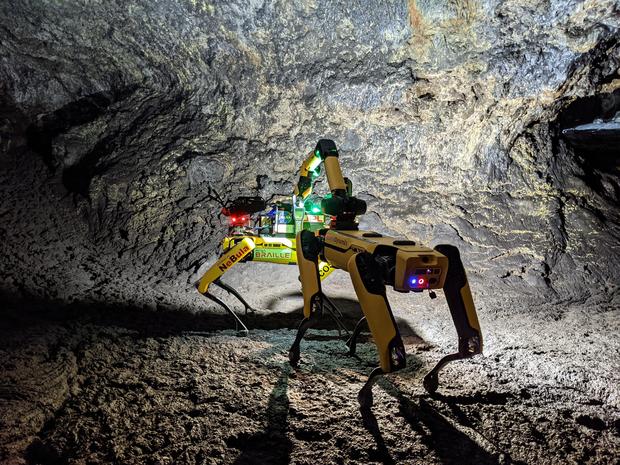
According to researchers, the project has enabled the first-ever fully autonomous robotic exploration of these types of caves, which are several hundred meters long and limit communication with the surface. As the robots explore, with no prior information about the environment, a team of researchers outside the cave simultaneously performs actions that scientists on Earth would be executing during a real Martian mission.
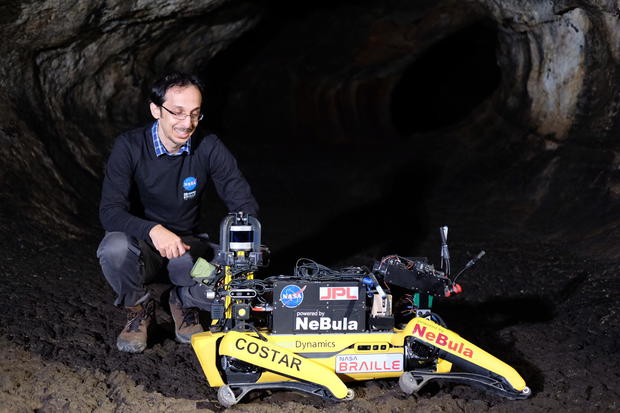
The Boston Dynamics SPOT robot explores a Mars-like cave. NASA/JPL
The research, which project lead Ali Agha said could "fundamentally change how we think about future missions," is now in year three of four in its quest to journey to the moon, the red planet and beyond.
But researchers are interested in exploring caves for another reason beyond finding signs of life: caves provide obvious natural shelters for future astronauts exploring Mars or the moon.
"Future potential human exploration missions can benefit from robots in many different ways," Agha told CBS News. "Particularly, robots can be sent in precursor missions to provide more information about the destination before humans land on those destinations. In addition, robots can accompany astronauts during the missions to help with scouting certain terrains or with logistics and many tasks that can make astronauts' missions safer and more efficient."
So, how is designing a Mars robot different from designing an Earth robot? They are similar in a lot of ways, Agha said, especially when it comes to the AI robot brain, called NeBula, and its ability to process information and make decisions when they don't have contact with scientists on Earth.
But when it comes to the robot body, that's where things get more complicated. Scientists need to consider temperature management, shielding the robots from radiation, as well as the severe power and energy constraints that come with trekking to a far-away world — all aspects not previously considered on Earth.
Boston Dynamics' Spot robot has proven an extremely viable body for NeBula.
"SPOT is one of the most capable robots that we have and it is amazing to see how it successfully reacts to high-level decisions and commands coming from the robot brain and how it can maintain stability over rough and extreme terrains," Agha said. "In addition to our capable traditional wheeled rovers, the ability to "walk" is a huge asset when dealing with uneven terrains with no roads and no flat surfaces." There are three main factors for the robot's success:
It needs to be able to carry enough payload for its eyes, ears and brain to be able to traverse the challenging Martian or lunar terrain.
It needs to carry a meaningful amount of science instruments.
It must prove it can maintain a "reasonable" level of stability, speed and endurance on another world.
"We have these multiple mobile robots that can carry different instruments, as opposed to one big robot that's going to have trouble traversing its terrain," said deputy project lead Benjamin Morrell, referring to past Martian rovers.
Ali Agha, Project Lead, JPL NeBula Autonomy and AI, NASA Jet Propulsion Laboratory, Caltech, with the Boston Dynamics robot. NASA/JPL
"Boston Dynamics Spot robot is one of the few robots that satisfy these constraints simultaneously," Agha said. "So integrating our robot brain, NeBula, on Spot has been pushing the boundaries of what was possible in exploring unknown Mars-like environments."
The robots typically cannot communicate from inside the cave, so scientists eagerly await their return to the surface for data, which could include a 3D map of the cave's interior, information on science targets or general findings about the environment.
Some of the robots are also equipped with arms to bring back small samples from the cave walls for analysis. Researchers hope that these robots will be able to autonomously carry out parts of future missions in space, after humans have built up a certain level of trust with them.
"The next-generation robot bodies and mechanical locomotion capabilities would enable new types of missions over terrains that were otherwise inaccessible by traditional rovers," Agha said. "Also, due to the increased speed and traversal capabilities, future missions can target destinations that are traditionally considered to be too far from landable regions on Mars."
Chinese tech giant Xiaomi has unveiled a quadrupedal robot named CyberDog: an experimental, open-source machine that the firm says “holds unforetold possibilities.”
It’s not clear what purpose Xiaomi envisions for CyberDog. In a press release, the company stressed the open-source nature of the machine’s design and that it would release only 1,000 units initially for “Xiaomi Fans, engineers, and robotic enthusiasts.” The company says it hopes these first users will “propel the development and potential of quadruped robots” and is pricing the robot to sell. The first 1,000 units will cost just 9,999 Yuan, or roughly $1,540 (though it’s not clear if this price will be the same for any future releases).
The same press release highlights CyberDog’s “pet-like nature,” including its ability to respond to voice commands and follow its owner like a real dog. Looking at pictures of CyberDog, though, it’s clear Xiaomi isn’t pitching the machine as a rival to Aibo, Sony’s own robot canine. While Aibo is small and cute, CyberDog is sleek and futuristic — even a little menacing. Renders of the machine make it look like the protagonist in a sci-fi TV show, pacing up stairs and appearing silhouetted in doorways. Inevitable comparisons to Black Mirror’s “Metalhead” episode will be made, as they always are.
Xiaomi says CyberDog is nimble enough to perform backflips, can trot along at speeds of 3.2m/s (compared to Spot’s 3.9m/s), and weights 3kg (compared to Spot’s 5.2kg). CyberDog is powered by Nvidia’s Jetson Xavier AI platform and is equipped with an array of cameras and sensors. These include touch sensors, a GPS module, an ultra-wide-angle fisheye lens, and Intel’s RealSense D450 camera for depth-sensing. These components enable the robot to navigate semi-autonomously.
“CyberDog can analyze its surroundings in real-time, create navigational maps, plot its destination, and avoid obstacles. Coupled with human posture and face recognition tracking, CyberDog is capable of following its owner and darting around obstructions,” says Xiaomi. The machine can also respond to voice commands, including recognizing wake words and instructions, or it can be controlled using a connected smartphone app.
CyberDog also has three USB-C ports and one HDMI port, which Xiaomi says can be used to customize its hardware. The company suggests lidar sensors, panoramic cameras, and search lights could all be added to the robot.
Xiaomi’s CyberDog has a very similar design to Boston Dynamic’s Spot robot.
Image: Xiaomi
The release of CyberDog by Xiaomi is very interesting, though not necessarily as a product in its own right. Instead, it says a lot about the current robotics landscape and the accessibility of this tech.
Boston Dynamics popularized the quadrupedal format for robots, and companies around the world are now exploring exactly how and where such machines can be deployed effectively. The price of this hardware has been falling though, allowing for new use-cases to be explored. Earlier this year, Chinese robotics firm Unitree released a quadrupedal bot that cost just $2,700, and Xiaomi’s own CyberDog undercuts that again. Obviously, the capability of these machines will not be identical, but broader access to the technology will show whether it’s worth these firms pursuing at all.
ISRAEL SENDS ROBOTS ARMED WITH MACHINE GUNS TO PALESTINIAN BORDER
HEAVILY ARMED MILITARY ROBOTS WILL GUARD THE BORDER TO GAZA.
IDF
After Its Gaza War, Israel Is Sending Armed Robots to Watch Hamas
Supposedly Jaguars will assume routine patrol duties for the Gaza division, reducing by one battalion the forces deployed to guard the barrier.
Here's What You Need to Remember: The IDF has broader ambitions to eventually integrate the Jaguar into its conventional warfighting capabilities, using it as an expendable scout at the vanguard of mobile ground formations. However, the system’s role in a border patrol and possibly anti-riot capacity will likely continue to receive scrutiny as public security services across the world explore deploying unmanned systems with offensive capabilities.
A photo posted last Saturday appears to confirm that the Israeli Defense Forces (IDF) has operationally deployed Jaguar robotic vehicles armed with machine guns to patrol the Gaza border wall. The unmanned system also has a built-in public address system which could be used to warn border infiltrators to cease and desist.
It’s unclear how recently this began, as the image, posted by the National Resistance Brigades, the armed wing of a small Marxist-Leninist Palestinian group, is undated. The IDF first announced it would deploy the mobile robotic sentries earlier in April, prior to a war with Hamas in May.
The Gaza border barrier, which began construction in 1994 and has been progressively reinforced since, encompasses the small coastal territory governed by the extremist group Hamas.
The wall has decreased the frequency of terrorist attacks on nearby Israeli communities, prompting Hamas’s current focus on using rockets to attack Israel. However, the barrier (which is matched by a barrier on the Egyptian border) also has cut off Gazans from employment, emergency medical care, and other services. Palestinians routinely organize protests near the wall which at times have been met with lethal force. Hamas militants also frequently shoot at the IDF forces guarding the barrier with anti-tank missiles, sniper rifles and mortars.
Supposedly Jaguars will assume routine patrol duties for the Gaza division, reducing by one battalion the forces deployed to guard the barrier. The diminutive six-wheeled unmanned ground vehicle (UGV) built by Israeli Aerospace Industries weighs only 1.5 tons and uses numerous high-resolution cameras both for surveillance and to avoid getting stuck while driving on rough terrain. This sort of self-driving capacity is seen as a technical breakthrough given how much harder it is to implement self-driving vehicles in off-road contexts. The Jaguar’s sensor also allows it to operate in fog and dust, and the vehicle can automatically recharge itself at a charging station with a simple command.
The armament—either a 7.62-millimeter FN MAG or 5.56-millimeter Negev machine gun with 400 or 500 rounds, respectively—is mounted on a stabilized Pitbull remote weapon system made by Israeli firm General Robotic. This weighs around 200 pounds and allows accurate fire while on the move. Cameras integrated in the Pitbull enable detection of a human being from up to 1.2 kilometers away in daylight, or out to 800 meters at night using a thermal sight.
It also can also be optionally equipped with sensors designed to pinpoint the sources of incoming small arms and anti-tank fire, as well as employ a radar, though the IDF hasn’t revealed to what extent it’s deploying those capabilities.
However, it’s reported the Jaguar is fitted with a self-disabling device so that, in the event one falls into the hands of hostile forces, they won’t be able to recover any sensitive components. It also can transmit its coordinates so that it can be tracked and presumably destroyed by an orbiting drone.
An IDF soldier also comments that the Jaguar “…can mount almost any weapon, rocket launchers, less [than] lethal weapons and crowd-dispersal means.” The latter two items suggest that beyond Gaza, Jaguars may be employed in confrontations with protesters or rioters.
Like the aforementioned robotic sentry gun turrets deployed around Gaza, the Jaguar is usually remotely operated by a human being, and would typically be teamed up with dismounted soldiers observing from a safe vantage and surveillance drones flying overhead. The command link reportedly has a range of “miles,” which if true, is impressive given difficulties maintaining a reliable communication link with other robotic ground combat vehicles.
In an article for Shephard Media, Arie Egozie that “The [Concept of Operations] for Jaguar is to integrate it with tactical forces in mobile, dismounted operations. The IDF foresees a support role for the vehicle in a wide range of missions, including intelligence, surveillance and armed reconnaissance; convoy protection; decoy; ambush; and attack.”
In a video, an IDF soldier explains “Surveillance teams will plan the missions and operate the assets under the commander’s instructions. When there is a threat, there is always a person in the control room, who handles the incident.”
Ordinarily, decisions to use lethal force would be made by the operator using a “touch and fire” interface, with the robot automatically adjusting its aim to track a moving target and correct for accuracy. The Pitbull also has a track-and-fire capability for shooting down aerial drones.
However, Egozie writes “…where necessary, pre-programmed scenarios enable the UGV to fire autonomously [ie. without direct human command].”
In combat, that mode might be desirable when facing possible disruption to the Jaguar’s command link. But in areas proximate to civilians, such a mode could pose ethical issues because that could mean entrusting an artificial intelligence to make decisions on whether or not to kill a human being. Discriminating military from civilian targets is already difficult for human beings, and an artificial intelligence may have a weaker grasp of the context to make such decisions.
The IDF has broader ambitions to eventually integrate the Jaguar into its conventional warfighting capabilities, using it as an expendable scout at the vanguard of mobile ground formations. However, the system’s role in a border patrol and possibly anti-riot capacity will likely continue to receive scrutiny as public security services across the world explore deploying unmanned systems with offensive capabilities.
Israel is Using Robots with Machine Guns to Patrol Gaza Border
The Jaguar's role in a border patrol and possibly anti-riot capacity will likely continue to receive scrutiny as public security services across the world explore deploying unmanned systems with offensive capabilities.
Aphoto posted last Saturday appears to confirm that the Israeli Defense Forces (IDF) has operationally deployed Jaguar robotic vehicles armed with machine guns to patrol the Gaza border wall. The unmanned system also has a built-in public address system which could be used to warn border infiltrators to cease and desist.
It’s unclear how recently this began, as the image, posted by the National Resistance Brigades, the armed wing of a small Marxist-Leninist Palestinian group, is undated. The IDF first announced it would deploy the mobile robotic sentries earlier in April, prior to a war with Hamas in May.
The Gaza border barrier, which began construction in 1994 and has been progressively reinforced since, encompasses the small coastal territory governed by the extremist group Hamas.
The wall has decreased the frequency of terrorist attacks on nearby Israeli communities, prompting Hamas’s current focus on using rockets to attack Israel. However, the barrier (which is matched by a barrier on the Egyptian border) also has cut off Gazans from employment, emergency medical care, and other services. Palestinians routinely organize protests near the wall which at times have been met with lethal force. Hamas militants also frequently shoot at the IDF forces guarding the barrier with anti-tank missiles, sniper rifles and mortars.
Supposedly Jaguars will assume routine patrol duties for the Gaza division, reducing by one battalion the forces deployed to guard the barrier. The diminutive six-wheeled unmanned ground vehicle (UGV) built by Israeli Aerospace Industries weighs only 1.5 tons and uses numerous high-resolution cameras both for surveillance and to avoid getting stuck while driving on rough terrain. This sort of self-driving capacity is seen as a technical breakthrough given how much harder it is to implement self-driving vehicles in off-road contexts. The Jaguar’s sensor also allows it to operate in fog and dust, and the vehicle can automatically recharge itself at a charging station with a simple command.
The armament—either a 7.62-millimeter FN MAG or 5.56-millimeter Negev machine gun with 400 or 500 rounds, respectively—is mounted on a stabilized Pitbull remote weapon system made by Israeli firm General Robotic. This weighs around 200 pounds and allows accurate fire while on the move. Cameras integrated in the Pitbull enable detection of a human being from up to 1.2 kilometers away in daylight, or out to 800 meters at night using a thermal sight.
It also can also be optionally equipped with sensors designed to pinpoint the sources of incoming small arms and anti-tank fire, as well as employ a radar, though the IDF hasn’t revealed to what extent it’s deploying those capabilities.
However, it’s reported the Jaguar is fitted with a self-disabling device so that, in the event one falls into the hands of hostile forces, they won’t be able to recover any sensitive components. It also can transmit its coordinates so that it can be tracked and presumably destroyed by an orbiting drone.
An IDF soldier also comments that the Jaguar “…can mount almost any weapon, rocket launchers, less [than] lethal weapons and crowd-dispersal means.” The latter two items suggest that beyond Gaza, Jaguars may be employed in confrontations with protesters or rioters.
Like the aforementioned robotic sentry gun turrets deployed around Gaza, the Jaguar is usually remotely operated by a human being, and would typically be teamed up with dismounted soldiers observing from a safe vantage and surveillance drones flying overhead. The command link reportedly has a range of “miles,” which if true, is impressive given difficulties maintaining a reliable communication link with other robotic ground combat vehicles.
In an article for Shephard Media, Arie Egozie that “The [Concept of Operations] for Jaguar is to integrate it with tactical forces in mobile, dismounted operations. The IDF foresees a support role for the vehicle in a wide range of missions, including intelligence, surveillance and armed reconnaissance; convoy protection; decoy; ambush; and attack.”
In a video, an IDF soldier explains “Surveillance teams will plan the missions and operate the assets under the commander’s instructions. When there is a threat, there is always a person in the control room, who handles the incident.”
Ordinarily, decisions to use lethal force would be made by the operator using a “touch and fire” interface, with the robot automatically adjusting its aim to track a moving target and correct for accuracy. The Pitbull also has a track-and-fire capability for shooting down aerial drones.
However, Egozie writes “…where necessary, pre-programmed scenarios enable the UGV to fire autonomously [ie. without direct human command].”
In combat, that mode might be desirable when facing possible disruption to the Jaguar’s command link. But in areas proximate to civilians, such a mode could pose ethical issues because that could mean entrusting an artificial intelligence to make decisions on whether or not to kill a human being. Discriminating military from civilian targets is already difficult for human beings, and an artificial intelligence may have a weaker grasp of the context to make such decisions.
The Gaza Strip in Palestine has effectively become an open-air jail, with people's movements severely limited and regulated, due to the influence of Israel's military. To add to the confusion, Israel is now sending killer robots to patrol the border.
Thick barriers, a naval blockade, drones, machine gun turrets, and armed soldiers protect Gaza's border with Israel. Adding to these are Jaguars, tank-like robots armed with 7.62-millimeter machine guns, which are now patrolling the heavily secured border.
The Jaguar has already been spotted near the Palestinian border where it will be used to disperse crowds. It is also equipped to shoot down armed militants attempting to enter or fire missiles into Israel. According to an Israeli militar press release, the Jaguar robot is semi-autonomous, which means it can guide itself to a target and identify problems along the route.
Israel's semi-autonomous robots
However, in most cases, a human operator will instruct the robot to fire its machine gun - or, if it has been corrupted, to self-destruct. While those human operators must use a point-and-shoot interface to pull the trigger, the Jaguar's software can automatically change its aim to better target whatever the soldier is instructing it to fire at.
While the Jaguar's deployment may achieve its claimed purpose of keeping more Israeli soldiers out of harm's way, the Daily Beast points out that the robots are likely to exacerbate tensions along the Gaza border.
Israel recently announced that it will relax trading and fishing restrictions in the Gaza Strip, which were imposed during 11 days of conflict with the Palestinian enclave's Hamas leadership last month. With the help of Egypt, Israel maintains tight control over Gaza's borders. During the last month's fighting, Israel tightened its restrictions and suspended Gaza exports. It also restricted raw material importation and reduced the fishing area available to Palestinians.
With the ceasefire imposed by Egypt mostly holding, Israel permitted a limited reopening of commercial exports from Gaza on Monday. Hamas, on the other hand, wanted a broader relaxation of restrictions and hinted at the prospect of restarting hostilities, Reuters via MSN reported.
Due to Israeli limitations on raw materials imports, notably carbon dioxide gas, at least one factory in the Strip, Pepsi Gaza, closed. Coordination of Government Activities in Territories, the agency that oversees civilian activities in the area, did not specify which raw commodities will be permitted into the country.
Last week, Egypt and the UN stepped up mediation after incendiary balloons fired from Gaza triggered retaliatory Israeli air attacks on Hamas targets, putting the fragile ceasefire in jeopardy. Gaza militants fired rockets at Israeli cities and Israel conduct airstrikes across the coastal enclave last month. At least 250 Palestinians and 13 Israeli were killed.
Tensions between Hamas and Israel may re-escalate
Israel has permitted Palestinians stranded in Jordan to return home through the Erez border, according to the Palestinian Authority's (PA) General Authority for Civil Affairs in Gaza. It also allowed for the return of inbound and outbound mail to Gaza, as well as the export of agricultural commodities and sewing industry items. This is in response to a ban that went into force on May 11.
In Gaza City on June 22, Hamas met with Tor Wennesland, the UN special coordinator for the Middle East peace process, and his delegation to further UN efforts to stabilize the cease-fire and lift the Gaza barrier. However, the conference concluded on a bad note, with tensions mounting once more.
The discussion with the UN was unfavorable, according to Yahya al-Sinwar, the Gaza Strip's Hamas head, who warned Israel about the "consequences of maintaining the barrier on the coastal enclave in place and blackmailing the resistance and the Palestinian people." The Hamas leadership released a statement warning Israel against slow steps in removing the closure and failing to commit to the previously agreed-upon understandings, and delaying the reconstruction work, as per Al-Monitor. Prison Guards
Palestine’s Gaza Strip, thanks to the influence of Israel’s military, has functionally become an open-air prison where residents’ movements are heavily restricted and controlled. And now, to up the ante, Israel is sending killer robots to guard the border.
The border between Gaza and Israel is guarded by thick walls, a naval blockade, drones, machine gun turrets, and armed soldiers. Now, the heavily-reinforced border is also patrolled by tank-like robots called Jaguars armed with 7.62-millimeter machine guns, according to the Daily Beast. The Jaguar has already been photographed at the border, where it’s expected to handle crowd dispersal and perhaps even shoot down armed combatants trying to enter or fire projectiles into Israel. Locked On
The Jaguar robot is semi-autonomous, according to a press release from the Israeli military, meaning it can steer itself to a designated target and spot obstacles on the way. But under most circumstances, a human operator will actually tell the robot to fire its machine gun — or, if it’s compromised, to self-destruct.
While those human operators need to actually pull the trigger through a “point-and-shoot” interface, the Daily Beast notes that the Jaguar’s software can automatically adjust its aim to better target whatever it thinks the soldier was telling it to fire at. That little add-on, plus the fact that the Jaguar comes pre-programmed with the ability to fire autonomously in certain scenarios — likely to return fire — present an unsettling glimpse of a future where killer robots can select and terminate human targets all on their own.
While the deployment of the Jaguar may accomplish its stated goals of keeping more Israeli soldiers out of harm’s way, the Daily Beast notes that the robots will probably only increase tensions at the Gaza border. For as long as the residents of Gaza continue to live in a heavily-militarized dystopia, it’s hard to imagine the deployment of killer robots will do anything except make matters worse.
A cybersecurity expert explains how the spyware invades phones and what it does when it gets in
A woman holds a phone in front of the office of NSO Group, which makes a tool that can see and hear everything a phone is used for. Jack Guez/AFP via Getty Images
August 9, 2021
End-to-end encryption is technology that scrambles messages on your phone and unscrambles them only on the recipients’ phones, which means anyone who intercepts the messages in between can’t read them. Dropbox, Facebook, Google, Microsoft, Twitter and Yahoo are among the companies whose apps and services use end-to-end encryption.
This kind of encryption is good for protecting your privacy, but governments don’t like it because it makes it difficult for them to spy on people, whether tracking criminals and terrorists or, as some governments have been known to do, snooping on dissidents, protesters and journalists. Enter an Israeli technology firm, NSO Group.
The company’s flagship product is Pegasus, spyware that can stealthily enter a smartphone and gain access to everything on it, including its camera and microphone. Pegasus is designed to infiltrate devices running Android, Blackberry, iOS and Symbian operating systems and turn them into surveillance devices. The company says it sells Pegasus only to governments and only for the purposes of tracking criminals and terrorists. How it works
Earlier version of Pegasus were installed on smartphones through vulnerabilities in commonly used apps or by spear-phishing, which involves tricking a targeted user into clicking a link or opening a document that secretly installs the software. It can also be installed over a wireless transceiver located near a target, or manually if an agent can steal the target’s phone.
Pegasus can infiltrate a smartphone via the widely used messaging app WhatsApp without the phone’s user noticing. Christoph Scholz/Flickr, CC BY-SA
Since 2019, Pegasus users have been able to install the software on smartphones with a missed call on WhatsApp, and can even delete the record of the missed call, making it impossible for the the phone’s owner to know anything is amiss. Another way is by simply sending a message to a user’s phone that produces no notification.
This means the latest version of this spyware does not require the smartphone user to do anything. All that is required for a successful spyware attack and installation is having a particular vulnerable app or operating system installed on the device. This is known as a zero-click exploit.
Once installed, Pegasus can theoretically harvest any data from the device and transmit it back to the attacker. It can steal photos and videos, recordings, location records, communications, web searches, passwords, call logs and social media posts. It also has the capability to activate cameras and microphones for real-time surveillance without the permission or knowledge of the user. Who has been using Pegasus and why
NSO Group says it builds Pegasus solely for governments to use in counterterrorism and law enforcement work. The company markets it as a targeted spying tool to track criminals and terrorists and not for mass surveillance. The company does not disclose its clients.
The earliest reported use of Pegasus was by the Mexican government in 2011 to track notorious drug baron JoaquÃn “El Chapo” Guzmán. The tool was also reportedly used to track people close to murdered Saudi journalist Jamal Khashoggi.
It is unclear who or what types of people are being targeted and why. However, much of the recent reporting about Pegasus centers around a list of 50,000 phone numbers. The list has been attributed to NSO Group, but the list’s origins are unclear. A statement from Amnesty International in Israel stated that the list contains phone numbers that were marked as “of interest” to NSO’s various clients, though it’s not known if any of the phones associated with numbers have actually been tracked.
A media consortium, the Pegasus Project, analyzed the phone numbers on the list and identified over 1,000 people in over 50 countries. The findings included people who appear to fall outside of the NSO Group’s restriction to investigations of criminal and terrorist activity. These include politicians, government workers, journalists, human rights activists, business executives and Arab royal family members. Other ways your phone can be tracked
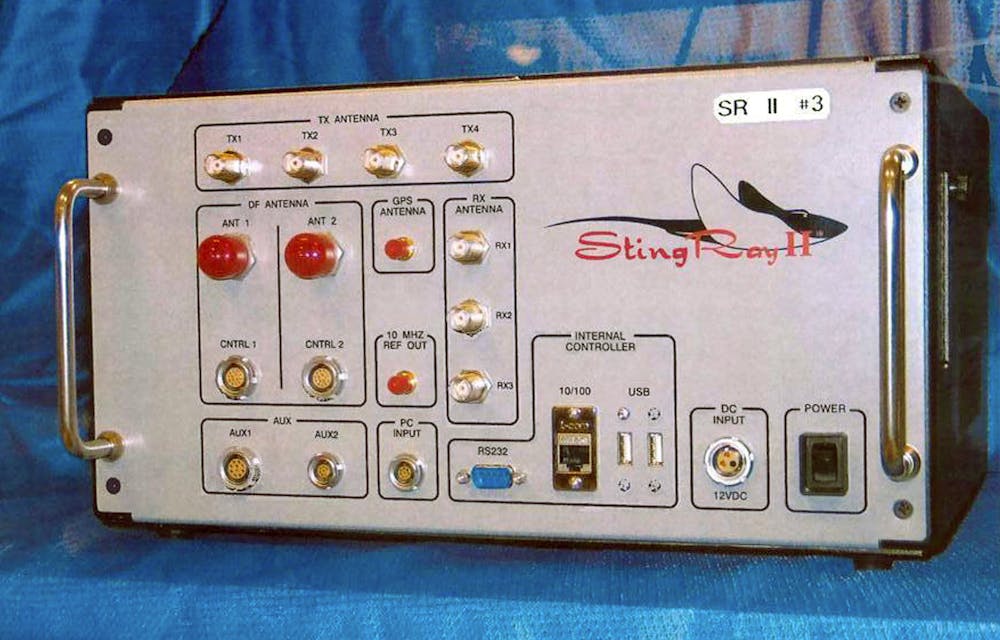
Pegasus is breathtaking in its stealth and its seeming ability to take complete control of someone’s phone, but it’s not the only way people can be spied on through their phones. Some of the ways phones can aid surveillance and undermine privacy include location tracking, eavesdropping, malware and collecting data from sensors. Law enforcement agencies use cell site simulators like this StingRay to intercept calls from phones in the vicinity of the device. U.S. Patent and Trademark Office via AP
Governments and phone companies can track a phone’s location by tracking cell signals from cell tower transceivers and cell transceiver simulators like the StingRay device. Wi-Fi and Bluetooth signals can also be used to track phones. In some cases, apps and web browsers can determine a phone’s location.
Eavesdropping on communications is harder to accomplish than tracking, but it is possible in situations in which encryption is weak or lacking. Some types of malware can compromise privacy by accessing data.
The good news is, depending on who you are, you’re unlikely to be targeted by a government wielding Pegasus. The bad news is, that fact alone does not guarantee your privacy.
Author
Bhanukiran Gurijala Assistant Professor of Computer Science & Information Systems, West Virginia University West Virginia University provides funding as a member of The Conversation US.
The 'tragedy of the commons' and why it is helping to scorch our planet
THE TRAGEDY OF THE COMMONS WAS THE CREATION OF PRIVATE PROPERTY
If it is hot on the upcoming Labour Day long weekend, you may decide there will be nothing better than a relaxing jaunt to the public beach.
But as you're trying to squeeze into a small space with your umbrella, pail and sand shovel, between everyone else and their screaming children who had the same idea, all after a grueling slog through weekend traffic, you may decide the trip really wasn't as worthwhile as you envisioned.
In an everyday modern nutshell, that is the idea implied by a 1968 paper in the journal Science entitled "The Tragedy of the Commons." It is a familiar concept in economic and environmental circles, but chats with friends and colleagues indicate it is less well known outside those groups.
The problem with sharing
In many ways, the worrying problems of an overheating world — as outlined in this week's report from the Intergovernmental Panel on Climate Change (IPCC) — can be traced back to a concept supposedly derived from a small English village and its overuse of a shared plot of land.
And it may be why, despite so many promises and commitments, Canada, like most of the world's countries, keeps increasing its output of greenhouse gases.
"There is truth in the metaphor, but how we use the metaphor can be so fraught," said Dale Beugin, an economist and vice-president of the Canadian Institute for Climate Choices.
Like many of the stories used to illustrate economic theory, this one's origins and accuracy are disputed. But in its most simple and amiable form, the lesson stems from a plot of village pasture — often described as "the common" in British communities — where those who did not have property of their own could still allow a few animals to graze.
In the economic morality tale, the tragedy arises when so many of the townsfolk set more and more animals on the common land, such that the pasture becomes unproductive and barren. That concept, first outlined in 1832 by William Forster Lloyd, is the basis of the Science paper authored by Garrett Hardin.
Many of Hardin's other views have been condemned by both the left and right; he supported eugenics and favoured free abortion, and has been described as a white nationalist.
But Hardin's concept that "freedom in a commons brings ruin to all," has been repeatedly used to understand what are called "common pooled resources" in over-fishing, water pollution — and even trips to a crowded public beach via a crowded public highway.
It is also used to understand what we are doing to our climate.
"If everyone optimizes for themselves, it leads to everyone being worse off — and that's true in Hardin's commons metaphor, but it is also true in climate change," said Beugin.
"It only makes sense to make lots of greenhouse gas emissions if we aren't accounting for the damages that society as whole will absorb because of all of our emissions collectively."
The world is a village
That may apply when we drive a gas-guzzling SUV, if all we care about is our personal comfort and prestige, especially if we can stick our neighbour who doesn't drive with an equal share of the climate bill.
And that is what national carbon taxes are supposed to fix.
But as the IPCC report shows, climate change is not just a national problem.
The world's atmosphere is one of the ultimate common pooled resources: The level of atmospheric carbon rises in poor countries, where people produce almost no greenhouse gases per person, at the same rate it does in Canada, one of the world's biggest GHG generators per capita.
Besides some of Hardin's more unsavoury ideas, there is another reason that the tragedy of the commons argument has been controversial: The free market solution that comes with it.
Rather than having a common field that no one looks after, the lesson celebrated by many economists is that fields should not be held in common at all, but privately owned with long tenure. That way a private landowner will only pasture the right number of animals to keep the land's income high. "That's hard to do with the atmosphere," said Beugin. "I don't think there is any way to assign property rights to the atmosphere."
That may sound hopeless, but there are a few reasons why the tragedy of the commons lesson may not condemn us to a climate Armageddon.
One is the original story upon which the idea is built: For a number of complex reasons, town commons did not all become overgrazed waste lands. Rather than running on a dog-eat-dog principle, communities realized what was happening and developed rules to limit the number of grazing animals.
It leaves hope the world can do the same.
Through research from around the world, the late Elinor Ostrom, the first woman to win the Nobel Prize in economics, showed that local communities were surprisingly good at managing pooled resources, especially in traditional settings, because their lives and their welfare ultimately depended on it.
The message was that co-operation works.
Nancy Olewiler, an economist and head of the School of Public Policy at Vancouver's Simon Fraser University, remains optimistic that collective climate action by individuals, through their governments, remains possible.
"In the classic case, the commons case, you had to work as a community," said Olewiler. "But the minute you don't work as a community, then the total amount the community can collect goes down."
One problem is that each regional and national player insists they are only responsible for a tiny amount of the total climate damage. "They simply do not want to act unless everyone else acts," said Olewiler.
If you are convinced that countries will only respond to immediate economic self-interest — the way Hardin described English villagers — one way to motivate the slowpokes is to put a tax on imports from countries that fail to cut their carbon output.
But if, like Ostrom, you believe people want to co-operate, another path to climate success is for countries like Canada is to scale back on our own share of the global greenhouse gas output, Beugin says, to show the rest of the world it is possible.
If we are not sure which is best, maybe Canada should do both.