Sunday, August 29, 2021

Emirati Women's Day: the power of women in the UAE’s nuclear field

Overall in the UAE, 70 per cent of all university graduates are women. In the country's nuclear energy field, the figure is rising – now 20 per cent are women. Courtesy: Enec

The UAE has one of the highest percentages of females across the nuclear energy industry

MOHAMED AL HAMMADI


For decades, Emirati women have personified the nation's progress and have been continuously supported and empowered by the leadership of the UAE.

The late Sheikh Zayed, the Founding Father, was visionary in his approach, leading the way in empowering women and highlighting the importance of equality in terms of access to education and career opportunities. As a result, Emirati women began travelling abroad in the 1970s to complete their education and attain their degrees so they could contribute to the development of nation, which was formed 50 years ago in 1971.

The advancement of Emirati women has been championed by Sheikha Fatima bint Mubarak, Chairwoman of the General Women's Union, and affectionately known as the Mother of the Nation. She has been at the centre of women’s participation and achievements in the UAE government and economy. Many inspirational women have followed her example and made their mark, including the UAE's latest accomplishment of being the first in the Arab world to generate clean electricity through nuclear energy.

Workers from Barakah nuclear power plant mark 75 million 'safe working hours' in June. Courtesy: Emirates Nuclear Energy Corporation

It goes without saying that the UAE’s nuclear energy industry would simply not be feasible without women’s participation across all aspects of our programme – from reactor operations, fuel cycle engineering, simulator training and quality assurance, to risk management, HR and strategy. Women's skills contribute to our industry’s workforce. Emirati women are swiftly closing the talent gap and supporting the nation’s continued growth and development.

Twelve years ago, the UAE Peaceful Nuclear Energy Programme was at the stage of inception. Today, as we celebrate Emirati Women’s Day, I have a lot to celebrate and feel proud of. Looking out onto the vast Barakah Nuclear Energy Plant in Al Dhafrah region, a plant that has today started up its second of the four units, with an operating crew that includes female reactor operators, provides an opportunity to reflect on the journey that has brought us to this moment
.
Salama Al Ketbi is the senior project engineer the power plant site in Barakah in the Western Region. Christopher Pike / The National

Beyond the sophisticated technology and the scale of the construction project we have delivered, it is the people who deliver and who have made this project a reality that I am most proud of. We now have a team of more than 3,000 people, 60 per cent of whom are Emiratis and 20 per cent are women. This is one of the highest percentages of females across the nuclear energy industry globally, and women professionals are truly making the change in the UAE’s nuclear sector.

The UAE is now a regional leader in this arena, ranking number one for gender equality in the Arab World

Without question, one of the most rewarding aspects of the past decade has been witnessing this generation of female pioneers play a leading role in our burgeoning nuclear energy sector. Back in 2009, when the Emirates Nuclear Energy Corporation (ENEC) was formed, there were no Emirati women in the nuclear field, and no role models for this generation of women to look up to; they were the first – true trailblazers for the UAE’s nuclear industry.

This is mirrored in countless sectors across the UAE. In the year of the nation's golden jubilee, the government has made the empowerment of women a national priority. Emirati women constitute 50 per cent of the seats at the Federal National Council and make up 27 per cent of the ministerial assembly, with nine female ministers. Overall in the UAE, women make up around 46.6 per cent of the total labour force; 23,000 Emirati businesswomen run projects worth more than Dh50 billion ($1.36 billion approx), and occupy 15 per cent of board positions in chambers of commerce and industry in the UAE.

READ MORE

Oil drilling chief who manages 66 men describes life in the field
Nuclear empowerment for women: meet four Emirati trailblazers
UAE starts up second reactor at Barakah nuclear plant

The statistics I find most encouraging, however, are: 77 per cent of Emirati women enrol in higher education and make up 70 per cent of all university graduates in the UAE. Impressively, 56 per cent of the UAE's graduates in Stem (science, technology, engineering and mathematics) courses at government universities are women. The UAE is now a regional leader in this arena, ranking number one for gender equality in the Arab World, according to the World Economic Forum’s 2020 Global Gender Gap report.

And why is women’s participation so crucial? According to gender diversity studies conducted by Boston Consulting Group, companies that have gender-balanced workforces and leadership teams are more creative, innovative and resilient. Diverse companies also derive 36 per cent more revenue from innovation, and companies in the top quartile for women board members outperform those in the bottom quartile by 66 per cent, when it comes to return on invested capital. Inclusion and diversity result in not just an improved workforce, but in stronger communities and more resilient economies.

Barakah unit 2. The UAE's nuclear power plant has started up its second unit, just four months after commercial operations began using the first reactor.

While the UAE’s nuclear energy industry regards women as champions, the wider energy international industry remains the least gender diverse sector of the global economy. According to the IEA, women represent 48 per cent of the global work force, only 22 per cent of the labour force in the oil and gas sector, 32 per cent in renewables and 22 per cent in nuclear. And they make up just under 14 per cent of senior managers.

As our world faces its greatest ever challenge – tackling climate change and transitioning to a low-carbon economy – we need solutions that are inclusive, innovative and sustainable. Gender equity has never been more important than it is today. This global issue is being addressed by the UAE on an accelerated timeframe. And as a new nuclear nation, we have established a strong benchmark for gender diversity, and the future of women in Stem fields is promising.

The UAE’s role in promoting nuclear sciences amongst women was highlighted in 2016, when we hosted the 24th Global Annual Conference of the Women in Nuclear (WiN), a first for the region, with 700 attendees from 56 countries. Young Emirati women at Emirates Nuclear Energy Corporation (Enec) have also benefited from the expertise of international advisors and role models, such as Agneta Rising, ex-director general of the World Nuclear Association, and the late Lady Barbara Judge, who have provided valuable input for the UAE programme

.

Barakah


As both chief executive of Enec and a father of four bright and determined daughters, I am proud of the achievements of Emirati women. To support their future success, Enec encourages women to pursue education and careers in nuclear-related fields, as well as to raise awareness of Stem subjects through initiatives such as WiN UAE Chapter and sponsorships that develop talent. But we must, and we shall continue, to do more.

To the Emirati women who work in the UAE Nuclear Peaceful Nuclear Energy Programme, our colleagues and friends, thank you for your talent, dedication and your passion for what you do, and for being such inspirational role models for the next generation of women across the nation and the Arab world.


Updated: August 28th 2021
Mohamed Al Hammadi
Mohamed Al Hammadi is the chief executive of the Emirates Nuclear Energy Corporation
FRANCE BUYING NA NUKE UTILITIES
Framatome acquires RCM Canada nuclear power division
August 7, 2021
Image credit: Stock

French nuclear infrastructure firm Framatome is acquiring a Canadian company that will help broaden its reactor work in that nation and beyond.

Framatome has announced the deal to buy the nuclear power division of RCM Technologies Canada Corp. The RCM acquisition strengthens and expands Framatome’s position in CANDU reactor design expertise.


Have you read?

Bilfinger wins contract for inspection services at Hinkley Point C

“We welcome our new colleagues to Framatome’s worldwide team of engineers and experts,” said Bernard Fontana, CEO of Framatome. “Framatome has been in Canada for more than 50 years and we are reinforcing our commitment to growing our operations in the country. The acquisition of RCM’s nuclear power systems division enhances our unique expertise in engineering, procurement and construction for the nuclear energy industry and positions us well to serve our Canadian customers.”

Framatome has more than 300 employees working in Canada. They are focused on engineering, nuclear services, hardware, design, safety and control systems within the Candu nuclear fleet there.

The CANDU (for Canada deuterium uranium) is a heavy pressurized water reactor design. It was originally developed in Ontario and has been exported globally. CANDU Energy is a member of the SNC-Lavalin Group.

Framatome is majority-owned by France’s EDF Energy with minority stakes held by Mitsubishi Heavy Industries and Assystem.

Originally published by Rod Walton on power-eng.com

French EDF set to buy GE's nuclear turbines business - La Tribune

CONTRIBUTORS
Matthieu Protard Reuters
GV De Clercq Reuters
PUBLISHEDAUG 27, 2021 
CREDIT: REUTERS/SARAH MEYSSONNIER

France's state-backed utility EDF is set to buy General Electric's (GE) nuclear turbines activity, French newspaper La Tribune reported on Friday on its website.


PARIS, Aug 27 (Reuters) - France's state-backed utility EDF EDF.PA is set to buy General Electric's (GE) GE.N nuclear turbines activity, French newspaper La Tribune reported on Friday on its website.

GE's nuclear activities are mostly based in Belfort, in eastern France, and pooled in its GE Steam Power unit, La tribune also said. The unit makes the Arabelle turbines used in EDF's EPR nuclear reactors.

EDF had no immediate comment on the report. GE could not be reached for comment.

(Reporting by Matthieu Protard and GV De Clercq; Editing by Kirsten Donovan)


Canada and Nuclear Weapons

Article by Taylor C. Noakes
Published Online August 6, 2021
Last Edited August 6, 2021
Canada and Nuclear Weapons | The Canadian Encyclopedia


Canada helped develop nuclear weapons during the Second World War. Canada also operated nuclear weapons during the Cold War. The Canadian Forces were equipped with nuclear warheads from 1964 to 1984. Canada has never used a nuclear weapon in anger nor tested a nuclear weapon. Canada is a signatory to the Nuclear Non-Proliferation Treaty and has historically advocated for disarmament. However, Canada is also protected by American nuclear weapons as a member of the North Atlantic Treaty Organization (NATO) and the North American Aerospace Defense Command (NORAD). (See also Canada and the United States.) Canada was the first nation to give up its nuclear weapons voluntarily.

See also Canada and Weapons of Mass Destruction.


Second World War


At the beginning of the Second World War, the United Kingdom had the world’s most developed nuclear weapons program. Because of the threat of a Nazi invasion and the bombing of Britain, the British nuclear program was transferred to Canada in 1942. Canada was already an important leader in the study of nuclear physics. (See Nuclear Fusion.)

At the Quebec Conference of August 1943, the British-Canadian nuclear research program merged with its American counterpart, the Manhattan Project. Canada’s contribution included supplying and processing uranium as well as researching the production of plutonium. Canada also provided scientists in addition to research and production facilities. (See Canada and the Manhattan Project.)

Canada’s involvement in the Manhattan Project led to the development of its nuclear energy industry. Canadian nuclear reactors have since been designed so that they cannot be used to make nuclear weapons.

Early Cold War Period and Broken Arrows

The first nuclear weapons deployed in Canada were between 11 and 15 Mark IV atomic bombs. These bombs were upgraded versions of the Fat Man bomb used to destroy Nagasaki in 1945. These bombs were deployed along with 43 American long-range bombers in the summer of 1950 to Goose Air Base in Labrador. (See Happy Valley-Goose Bay; Canadian Forces Base.) The deployment of these weapons was kept secret from the Canadian public.

Two “Broken Arrow” incidents occurred over Canadian territory in 1950. Both involved Mark IV bombs. Broken Arrow is a US military term that refers to an accident involving a nuclear weapon. On 13 February 1950, an American B-36 bomber on a flight from Alaska to Texas experienced engine failures. This forced the aircraft to jettison its bomb near Princess Royal Island, British Columbia. The bomb self-destructed in a conventional (non-nuclear) explosion. The crew bailed out and most survived. The plane, however, crashed into Mount Kologet. (See also Rocky Mountains.)


DID YOU KNOW?

Atomic weapons policy at the time was that the plutonium core of these bombs was kept at a separate location to avoid an accidental nuclear detonation.

On 10 November 1950, a B-50 Superfortress bomber experienced severe engine malfunctions. The crew dropped its Mk. IV bomb over the St. Lawrence River near Rivière-du-Loup. The bomb self-destructed over the water. The explosion spread about 45 kg of uranium into the air. Both of these Broken Arrow incidents were covered up. They only became more widely known after the Cold War.

Nuclear weapons caused a lot of controversy in Canada. In the early years of the Cold War, a nuclear war between the United States and the Soviet Union would likely have taken place over Canadian territory. This encouraged anti-nuclear activists and led to the creation of Canadian Voice of Women for Peace. Despite this, Canada remained a close ally of the United States — the world’s first nuclear power. Both nations had co-operated in the defence of North America since the Second World War.

In the early Cold War, the main threat came from Soviet bombers armed with nuclear bombs. To defend against these, the Royal Canadian Air Force (RCAF) equipped itself with high-performance fighter jets. These included the Canadian-built CF-100 Canuck interceptor, and later, the planned CF-105 Arrow. Canada and the United States also collaborated on the construction of several lines of early warning radar stations. These stretched across the country and one — the DEW Line — was built in the High Arctic. (See Arctic Circle.) They could detect Soviet bomber formations before they entered North American airspace. Radar would form the backbone of Canada’s contribution to NORAD throughout the Cold War.

Cold War: ICBMs, Bomarcs and Genies


By the 1960s, intercontinental ballistic missiles (ICBMs) began replacing bombers in delivering nuclear weapons. It was widely believed that ICBMs had made bombers and interceptors obsolete. These new threats led to the cancellation of the Avro Arrow.

NORAD, a joint Canada-United States aerospace defence command, first came online in 1957 and became official in 1958. Canada acquired Bomarc missiles as part of the continental defence strategy. The Bomarc was a first-generation surface-to-air missile that was guided to its target by ground-based radars. The Bomarcs had a range of about 700 km and were effective against targets even if they exploded up to 1 km away. Their nuclear warheads had an explosive yield of 10 kilotons (two-thirds of the strength of the weapon that destroyed Hiroshima).

In total, 56 Bomarc missiles were deployed to Canada, and were operated from 1960 to 1972. The use of nuclear warheads for the Bomarcs was highly controversial and caused a political crisis in Canada in the early 1960s. (See Bomarc Missile Crisis.)

Prime Minister John Diefenbaker had contradictory positions on nuclear weapons. He publicly opposed the use of nuclear weapons. However, his government also began the nuclear weapons acquisition process. It purchased rockets and missiles while the issue of nuclear warheads was being debated by the Canadian public. Diefenbaker was also displeased that the Canadian Forces went to high alert during the Cuban Missile Crisis of 1962 — a decision essentially made by the American military. Diefenbaker was concerned that Canada was being dragged into a nuclear conflict against its will. These two crises strained diplomatic relations with the United States and made Diefenbaker seem weak on defence issues in Canada. (See Canada and the United States.) His successor, Lester B. Pearson, committed Canada to accepting nuclear warheads to defend Canada.

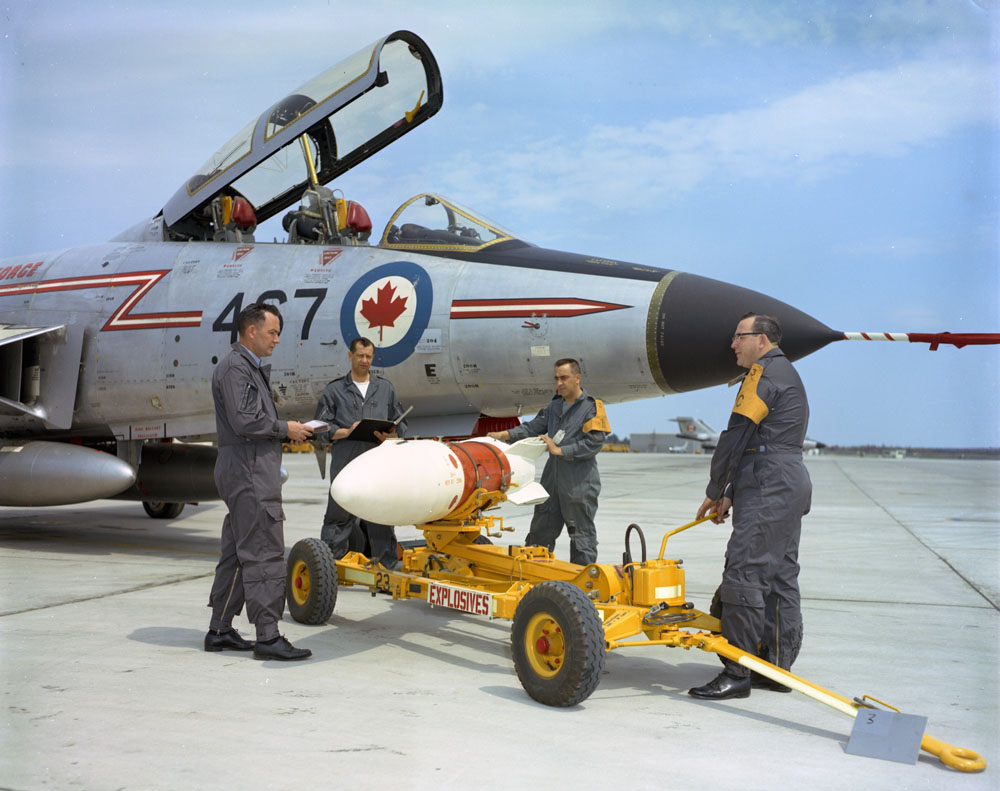
The cancellation of the Avro Arrow in 1959 meant Canada didn’t have a new fighter jet for continental defence. Instead, the Diefenbaker government purchased 66 CF-101 Voodoos interceptors. The Voodoo was designed to carry the Genie rocket, which was fitted with a nuclear warhead. Canada was initially supposed to purchase 330 Genie rockets with nuclear warheads. The exact number of nuclear weapons present in Canada is a matter of debate, however. Like the Bomarc, the Genies didn’t have to hit a target directly. They could knock targets out of the sky with their blast and shock wave. The Genie had a range of 10 km and a blast radius of 300 m. They had an explosive yield of 1.5–2 kilotons (roughly 10 per cent the explosive force of the Hiroshima bomb). The Genies were operated from 1965 to 1984.

Canadian Nuclear Weapons in Europe: Honest John and Starfighters


Throughout the Cold War, Canada had a large permanent military force in Western Europe. This included significant army and air force deployments in France and West Germany. Canada deployed nuclear weapons as part of its NATO contribution to the defence of Western Europe.

The only nuclear weapon operated by the Canadian Army was the Honest John short-range nuclear artillery rocket. Canada had access to 16 W31 variable-yield warheads set to the 2-kiloton explosive yield. Four complete Honest John systems were deployed in West Germany, while two systems remained in Canada for training. The nuclear warheads were only deployed in Germany. The Honest John had a range up to 50 km. Canada operated the system from 1964 to 1970.

Canada’s most destructive and numerous nuclear weapons were carried by the RCAF’s CF-104 Starfighter. Between 1964 and 1972, Starfighters had access to different types of nuclear bombs with a variety of explosive yields. These ranged from 5 kilotons (around 33 per cent of one Hiroshima bomb) up to possibly 1.45 megatons (almost 100 times more powerful than the Hiroshima bomb). The best estimate is that Canadian Forces in Europe had access to between 90 and 210 nuclear bombs during this period. Information regarding these weapons remains limited.
Nuclear Disarmament

Canada’s operation of nuclear weapons was controversial throughout the Cold War, and the topic remained a closely guarded national secret. Officials never confirmed nor denied the presence of nuclear weapons on Canadian military bases. Canada is generally considered to be the first nation to have voluntarily given up its nuclear weapons. Systems were deactivated beginning in 1968 and continuing until 1984. (See Disarmament.) Canada maintains the technological capability to develop nuclear weapons. Canada also remains protected by the American nuclear umbrella and the nuclear weapons of its NATO allies.
What’s Driving China’s Nuclear Buildup?
TONG ZHAO

AUGUST 05, 2021
COMMENTARY

Summary:
Satellite data has revealed the construction of new nuclear missile silos in Gansu and Xinjiang in western China. How U.S. and Chinese experts interpret the buildup and the motivations behind it could greatly reshape their security relationship.

Related Media and Tools


China’s nuclear arsenal appears to be expanding substantially for the first time in years. Over the past few decades, China had maintained only about twenty silo-based intercontinental ballistic missiles (ICBMs). But recent evidence from independent U.S. experts shows that the country is likely constructing more than 200 new missile silos. China’s current program to modernize and update its nuclear weapons is moving at an unprecedented speed and scale.

This expansion is poised to change China’s traditionally small and mostly land-based arsenal across the board. Besides silo-based ICBMs, China also is building more road-mobile ICBMs and strategic nuclear submarines, even as it introduces air-based nuclear capabilities. The possibility that China could use fissile material produced in civil nuclear facilities to build up its nuclear warhead stockpile has raised further concerns because this would eliminate the biggest constraint on China’s warhead stockpiling capacity. The open-ended nature of this expansion, the abrupt departure from China’s long-standing minimalist nuclear policy, and the lack of any official Chinese confirmation or explanation have all contributed to confusion and suspicions about Beijing’s intentions.

GEOPOLITICS DRIVES CHINA’S MODERNIZATION


For decades, China has worried about how U.S. military capabilities—like missile defense and conventional precision strike weapons—could undermine the credibility of China’s capacity to retaliate against a nuclear attack. New improvements to U.S. capabilities constantly remind Chinese nuclear experts of their nuclear deterrent’s potential vulnerability.

As a result, Chinese experts have consistently agreed that Beijing needs to continue gradually modernizing its nuclear forces. For decades, it appeared that China was not investing in a massive nuclear buildup because its top political leaders believed that the country had other more important priorities—especially at a time when China perceived no immediate external threat. But that era is gone now.

THE CHANGED CALCULUS OF CHINESE LEADERS


Under its current leadership, China’s continued rise is coupled with growing disputes with Western countries over issues like human rights, democratic values, rule of law, and international norms. These developments have led Chinese leadership to conclude that China faces a new geopolitical reality in which Western countries are deliberately creating trouble and making up excuses to demonize and contain China, fearing that the country’s rise could challenge the West’s dominance in the international system. Believing that Western hostility is a result of bigger structural changes in the international system, Beijing feels the only solution is to further consolidate its own power until Western countries acknowledge the new reality—that China’s success and strength are beyond doubt.

Fearing that any weakness would embolden Western countries to destabilize China and threaten its regime’s security, Chinese thought leaders like Hu Xijin (the editor-in-chief of a major state-owned tabloid) stress that it is critical for China to quickly build a much larger nuclear arsenal. Hu argues that a bigger arsenal would make the country’s rivals respect China and exercise more self-restraint when dealing with Beijing.

Hu by no means always represents official Chinese positions on specific policy issues, but his reasoning seems to be striking a chord with the general public. Much more importantly, this line of thinking may also resonate with China’s paramount leader, who has long stressed that China should stand up against perceived Western aggression by showing unequivocal strength and firm determination.

Indeed, shortly after coming to power in 2012, Chinese President Xi Jinping emphasized the importance of the Second Artillery—the Chinese military’s missile branch, which was later upgraded to a full military service and renamed the Rocket Force—as “a strategic pillar of China’s great power status.” During an important national political meeting in March 2021, he directed the military to “accelerate the construction of advanced strategic deterrent” capabilities, which was the strongest and most explicit public instruction on the topic to come from China’s highest-ranking leader. With the country’s national decisionmaking power increasingly concentrated in one person, the current paramount leader’s support for greater nuclear capabilities could go a long way to steer China’s nuclear development policy away from its traditional moderate trajectory.

WHY BEIJING CARES ABOUT THE SIZE OF ITS ARSENAL


During the Cold War, the Soviet Union felt that keeping up with the United States’ nuclear arsenal was necessary for it to achieve real political equality with Washington. Today, similar reasoning seems to be behind China’s nuclear buildup—a belief that the United States won’t drop its hostility against China unless its hand is forced by robust Chinese strategic power. So it seems likely that Beijing is building up its permanent capabilities rather than planning to trade them away as a bargaining chip anytime soon in future arms control negotiations with Washington.

China’s changing perceptions about its geopolitical environment come at a time when decades of fast economic development are giving Chinese leadership the ability to make vast investments in the country’s nuclear forces. For example, China in recent years procured a large number of strategic nuclear submarines of its existing model, the 094 class, instead of building a smaller number of them while the more advanced 096 class is still being developed.

This indicates that China has become more willing to invest in quantity, in addition to its traditional focus on quality. Perhaps this is why China wants to use its unique advantages in large-scale infrastructure and industrial manufacturing to build up its silo-based nuclear capabilities.

THE FUTURE OF U.S.-CHINA ARMS CONTROL

It appears less and less hopeful that the two countries can avoid a nuclear arms race unless they can face and jointly examine their fundamental disagreements—such as their severe geopolitical perception gap. As Washington and Beijing talk past each other, they risk harboring wrong assumptions about how the other party would use nuclear weapons in future conflicts. If so, that will generate new tensions and threat perceptions, risking a downward spiral in overall bilateral security relations.

Unfortunately, these risks are not being adequately examined or understood at all. The recent revelations of new Chinese missile silos are rarely reported by Chinese media. Instead, the country’s most authoritative official media platforms—such as the People’s Daily and China Central Television—have dismissed the revelations by suggesting that the United States is demonizing China and that the so-called missile silos are actually windmills on a wind farm.

There has also been very little discussion about these new developments among Chinese citizens, and more importantly, policy experts. Chinese nuclear experts—who are supposed to contribute to policy debates and deliberations—have so far remained almost completely silent. Most experts do not seem to know what is going on and find it too sensitive to even talk about or debate the new revelations. In fact, a number of Chinese security experts have privately asked me whether the rumored silos are actually windmills—and have seemed rather surprised to hear my personal view that, perhaps, they are not. If facts are scarce and ambiguous, experts in any country will struggle to give the best-informed and most sound policy advice to their political leaders.


The scariest part of this great power competition is that in some places it has led to stricter internal security regulations that greatly discourage even domestic academic discussions on basic factual issues. Direct, candid, and substantive exchanges between U.S. and Chinese experts have also become much harder. As the two societies diverge, they will face even greater challenges to building shared views on factual issues, let alone policy matters.

MORE ESCALATION AHEAD

At a recent public conference panel in China, a senior Chinese nuclear expert made the following observation: when it comes to the nuclear race, the United States and China today are somewhat like the United States and the Soviet Union in the early 1960s. This observation implies that the two countries may be in the early stages of a long, intense nuclear arms race. This expert judged that it might take a major crisis—something of similar severity to the Cuban Missile Crisis—to sober up political leaders enough to make them reflect on the dangers of the current course.

The international community was lucky that the 1962 Cuban Missile Crisis did not become a massive nuclear exchange, which could have destroyed humanity. But luck is never guaranteed. We should not wait to see whether another major missile crisis will save us or destroy us.


Tong Zhao is a senior fellow in Carnegie’s Nuclear Policy Program based at the Carnegie–Tsinghua Center for Global Policy.


OPINION / VIEWPOINT

US Strategic Command general aspires to muddy the water of nuclear arsenals

Published: Aug 29, 2021 

A formation of JL-2 missiles takes part in a grand military parade celebrating the 70th founding anniversary of the People's Republic of China in Beijing, capital of China, Oct. 1, 2019. (Xinhua/Gao Jie)


US Air Force Lieutenant General Thomas Bussiere, who is deputy commander of the US Strategic Command which oversees the nuclear arsenal, said on Friday that China will soon surpass Russia as the top nuclear threat of the US, a Reuter report said.

Bussiere claimed China is in the midst of a rapid nuclear weapons build-up that "can no longer be aligned" with the country's public clarification that China wants to maintain a minimum nuclear level of deterrence.

"There's going to be a point, a crossover point, where the number of threats presented by China will exceed the number of threats that currently Russia presents," Bussiere told an online forum.

He said the judgment would not be based solely on the number of China's stockpiled nuclear warheads, but also on how they are "operationally fielded." He believed the cross-over point will appear in the next few years.

Bussiere emphasized that, unlike with Russia, the US does not have any treaties or dialogue mechanisms with China on the issue to "alleviate any misperceptions or confusion."

I think Bussiere's remarks had two malicious goals. First, he wants to sow discord between Russia and China, instigating a sense of crisis in Russia that China's nuclear capabilities are to surpass Russia.

His reasoning is problematic. The number of nuclear warheads in China and Russia is not in the same order of magnitude. It is known that Russia owns more nuclear warheads than the US. It's incredible that China's nuclear capability could surpass that of Russia in the foreseeable future.

Bussiere said his judgment is not based solely on the number of China's stockpiled nuclear warheads, but he didn't give any other parameters. Instead, he just vaguely said that it also depends on how they are "operationally fielded." What he wants to achieve is to confuse and mislead the public.

It's well-known that China is the sole nuclear power that has declared a policy of "no-first-use" of nuclear weapons at any time, and, under any circumstances. China has far fewer nuclear warheads than Russia or the US, and has made the aforementioned self-restrained commitment. How can China's nuclear deterrent surpass that of Russia?

Bussiere's second purpose is sinister, too.

He said the US did not have any treaties or dialogue mechanisms with China on the issue to "alleviate any misperceptions or confusion." By saying so, he aspires to draw China into the mechanisms that would restrain China's nuclear arsenal development.

He wanted to prevent China from increasing nuclear deterrent, and, to sustain the huge disparity of nuclear weapons between China and the US. Washington has been trying to play up so-called public-opinion pressure on China's nuclear arsenal build-up. Bussiere's remark is the latest US effort.

China must have a firm attitude when it comes to nuclear arsenal development, because it is closely tied to China's core national security. We should not be dissuaded and impacted by the tricks played by US officials and generals.

The author is editor-in-chief of the Global Times. opinion@globaltimes.com.cn


STRATCOM: China’s Pursuit of Nuclear and Hypersonic Weapons Adds Urgency to U.S. Deterrence

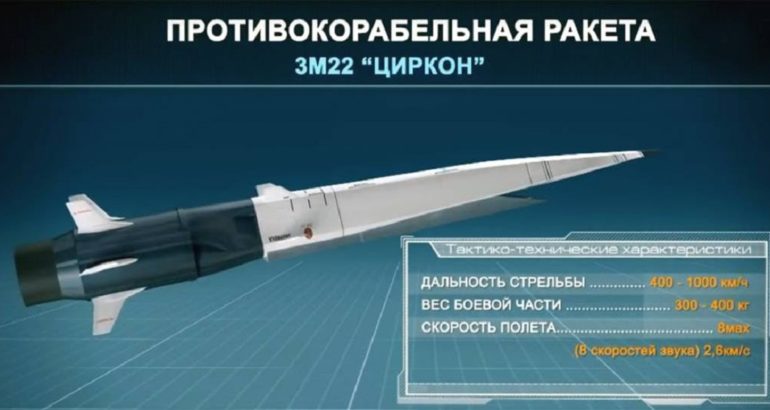
Artist impression of 3M22 Tsirkon / Zircon hypersonic missile via Naval News

China’s recent full-speed-head breakout in nuclear forces, space and cyber efforts, and hypersonic systems adds new urgency to America’s need to ensure its deterrence systems are holding, U.S. Strategic Command’s top officer said Thursday.

Adm. Charles Richard said the United States has never before “faced two peer opponents” with extensive nuclear weapons arsenals and high-technology systems capable of operating across multiple domains.

In his Hudson Institute online forum discussion, Richard concentrated on China rapidly fielding a range of strategic weapons. He listed six new ballistic missile submarines, air-launched cruise missiles, an improved nuclear command and control system, delivery systems for different domains, upgraded missile defense systems and changed doctrine for the use of these weapons as examples of the breakout.

Richard added that China, unlike the United States and Russia, is not constrained by treaties regarding its nuclear forces.

“What I am focused on is totality” that not only changes what the Chinese are capable of doing as it builds new missile silo fields and launches ballistic missile submarines, but “what is the next thing we’re going to find.” He said some of the silos could be a “shell game” to create doubt in analysts’ minds.

At the same time, Richard said “Russia still remains the near-term pacing threat.” Moscow has continued to modernize is strategic forces – especially nuclear weapons that the Kremlin said are not covered by agreements. He mentioned Moscow’s development of nuclear-tipped missile defense systems as fitting in that category.

Earlier, the Kremlin developed and fielded intermediate-range nuclear cruise missiles that it claimed were not covered by a treaty. As a result, Washington withdrew from the Intermediate Range Nuclear Arms Treaty under the Trump administration and began testing longer-ranger cruise missiles.

The fact is: both Russia and China can “go [to] any level of violence” in a crisis, including using nuclear weapons with their “unique destructive capability,” he said.

Richard said the command’s mission is to ensure that a potential adversary does not act.

He added the United States “hasn’t done anything for the last 30 years” in modernizing its nuclear forces before the Obama administration changed course on updating the triad. That policy continued through the Trump administration and is central to the reviews of the National Defense Strategy, nuclear posture and missile defense the Biden administration is conducting.

The goal is to have an integrated defense that is “is influencing the decision-making of someone else” to not risk an attack.

Richard said the reviews should lead to better definitions of “who’s responsible for what” in the American command system and answer “where I fit into the whole mosaic of deterrence.” He said a guiding principle in future strategic deterrence should be to maintain “the margins and edges” that the nation has achieved in the past.

On active missile defenses, Richard said science and technology, as well as research and development projects, have the potential to make them a more affordable option in the future.

“Strategic deterrence and nuclear deterrence are two different things,” but “credibility is a key component of both.” He said allies like Japan and South Korea, which he has met with recently, understand the United States’ commitment to deterrence, including threats from North Korea.

Richard said STRATCOM has a requirement to provide the nation with conventional prompt strike” in case of attack. The command “is ready to receive on the first day” a hypersonic conventional intercontinental weapon from any service.


 WIERDIEST PRO NUKE VIEW

Unearthing 2-Billion-Year-Old Nuclear Reactors

 in West Africa

Written by Luke Sweeney
Posted August 16, 2021


Based on our current best guess, the first life on Earth popped up around 3.5 billion years ago — just in time for the planet’s 1 billionth birthday. 

In fact, humanity as we know it is a relative newcomer to the stage, with the first bones of our ancestral Homo sapiens dating as far back as 300,000 years ago in Africa.  

Yet somehow, eons before anything remotely close to a human existed on Earth, evidence shows there were nuclear reactors running in Western Africa.

Yes, I'm serious. 

Based on soil studies, these 2-billion-year-old reactors were pumping out thousands of kilowatts for almost a million years straight

Early nuclear researchers sank decades of research into cracking nuclear fission, completely unaware that they were competing for second place. 

Keep reading — I guarantee the science behind this once-in-a-lifetime discovery will permanently change your perspective on nuclear energy...

Nuclear Energy Is as Old as Life Itself

The first man-made nuclear reactor was secretly built in the 1940s as part of the Manhattan Project. Humanity was not the least bit concerned with nuclear power plants at this point.

Each side was in a mad race to harness its destructive power first. The idea of carbon-neutral power wouldn't be taken seriously for decades. 

Regardless of why they are built, our nuclear reactors are shockingly simple devices. We’ve essentially just been reusing the same design since the 1960s.

1 - How Reactors Work

A controlled nuclear reaction using rods of radioactive fuel heats water and turns a turbine, which generates electricity. 

That's a huge oversimplification, as there's also a multibillion-dollar facility full of safety equipment and controls. But at its core, nuclear is not much different than any other type of power. 

So that leads us to one important question: who  or what  was busy constructing nuclear reactors while the smartest things on Earth were bacteria? 

Before anyone says “aliens,” we first need to take a step back and reexamine nuclear reactors themselves. 

The fuel rods are typically made of uranium, but plenty other radioactive materials will also work. They just have to be radioactive enough to easily release neutrons after colliding with another particle. 

2 - Fuel Rod Diagram

This chain reaction of neutrons is called nuclear fission, and it’s the fundamental core of nuclear power. It is also the part that is most likely to cause a catastrophic meltdown. 

To keep this from happening, reactors use control rods to soak up excess neutrons. Once no more neutrons are flying around, the domino effect slowly grinds to a halt and the reactor shuts down safely. 

All of these things were present in West Africa billions of years ago. 

Just not quite in the same form that you're expecting… 

Nuclear Energy Is 100% Natural 

In 1972, routine tests of radioactive material at a mining operation in the small town of Oklo, Gabon, yielded unexpected results. 

Based on the unbreakable laws of radioactivity, all uranium samples should always show the same exact concentration of the Uranium-235 isotope: 0.72%. 

Even on samples of moon rock, the concentrations remain the same. 

So when samples started consistently reading 0.717%, the onsite engineers knew that they had encountered something incredible. 

The only explanation? A natural nuclear reaction had depleted the uranium, lowering the amount of isotopes.

Nuclear scientists had only theorized that this was possible, but no actual proof had ever been found. 

That is, until this tiny West African town suddenly became home to the only known natural nuclear reactor on the planet. 

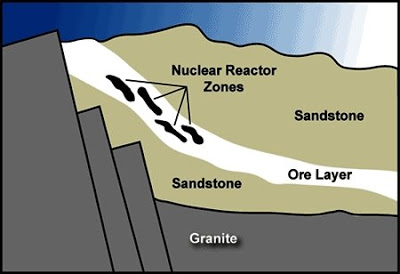
3 - Natural Reactor Zones

Uranium-rich soil acted as the fuel source, and the surrounding groundwater acted as the control rods. 

It was a crude design, but it was a reactor nonetheless. And it operated for hundreds of thousands of years without a single meltdown. 

Most remarkably, the geology of the area prevented any radioactive waste from contaminating the environment for billions of years. 

So if nature can do it, why can't we? 

Nuclear Is a Public Relations Problem, NOT a Science Problem 

This may be old news to my veteran readers here, but it’s no secret — the public just doesn't seem to trust nuclear energy

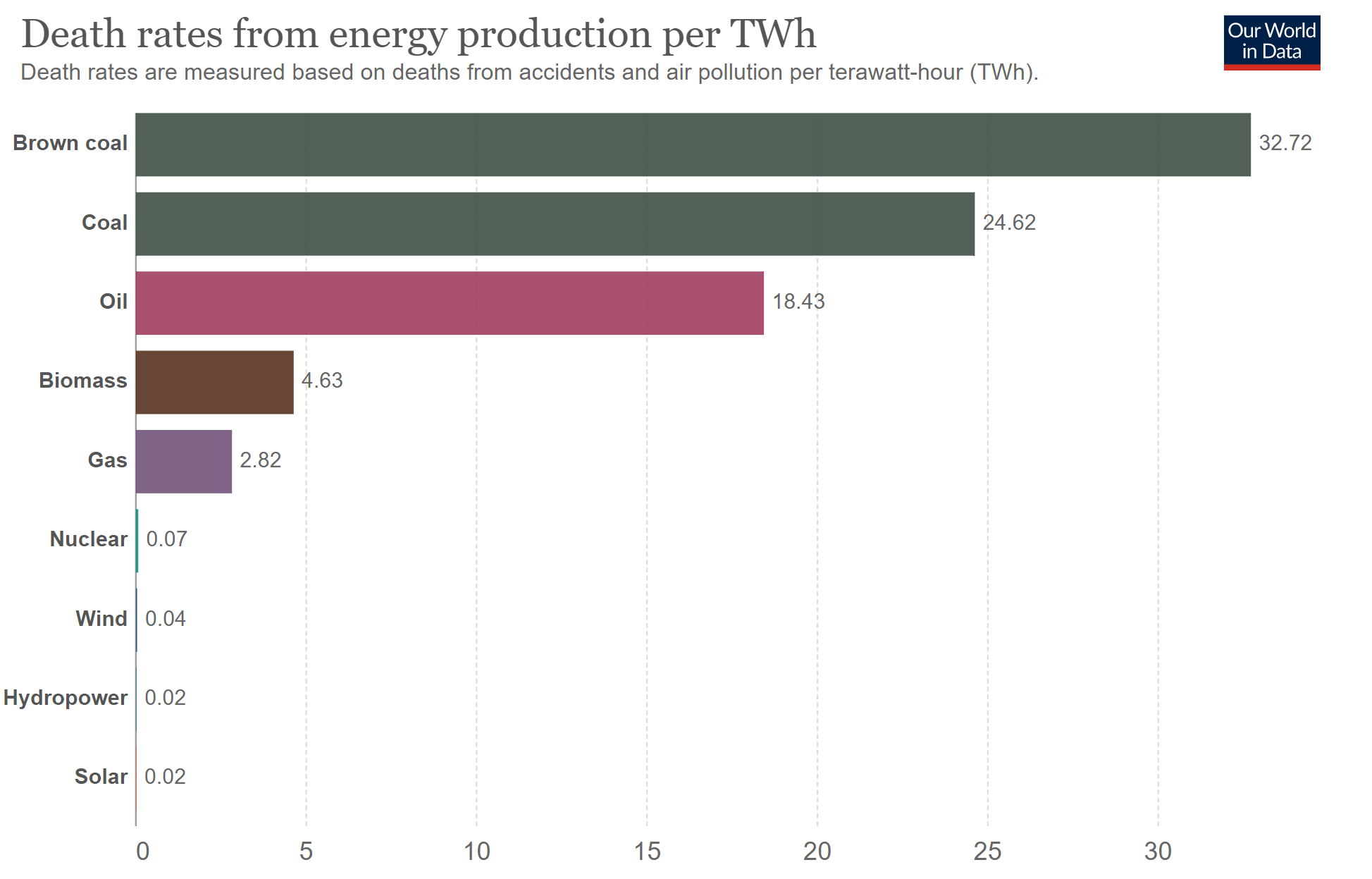
Meltdowns make big news, but overall the death toll is low. Coal and other fossil fuels are directly responsible for killing millions if not billions by dumping their waste products directly into the air. 

All of that makes for sensational headlines craved by the mainstream media today.

4 - Deaths from Energy Types

The fear of nuclear energy is outdated, but how can we blame the public when our own nuclear infrastructure is outdated too? 

We aren't quite as old-school as a 2 billion-year-old uranium pit, but it’s difficult to convince people that reactors are safe when the majority were built decades ago. 

Well, maybe it’s time to start upgrading them from the inside out

After digging through some research, my colleague Keith Kohl recently uncovered a company that is completely rethinking nuclear reactors

And it’s a stock that’ll mint his readers a fortune.

You see, instead of shutting down reactors and starting over, this team of engineers wants to target and improve the most dangerous aspects of nuclear power. 

Their solution is cheaper, more efficient, and reduces huge amounts of strain on the entire system — and it won't be long before it becomes a mandatory part of reactors everywhere

Want a sneak peak at this revolutionary technology? Just click here for full access to the biggest nuclear advancement of the century...

To your wealth,

Luke Sweeney
Contributor, Energy and Capital

Luke’s technical know-how combined with an insatiable scientific curiosity has helped uncover some of our most promising leads in the tech sector. He has a knack for breaking down complicated scientific concepts into an easy-to-digest format, while still keeping a sharp focus on the core information. His role at Angel is simple: transform piles of obscure data into profitable investment leads. When following our recommendations, rest assured that a truly exhaustive amount of research goes on behind the scenes..

 Nuclear energy is anything but clean

The nuclear power industry has successfully rebranded an appallingly toxic energy industry by never mentioning the terrible legacy of nuclear waste, writes Ann Denise Lanes

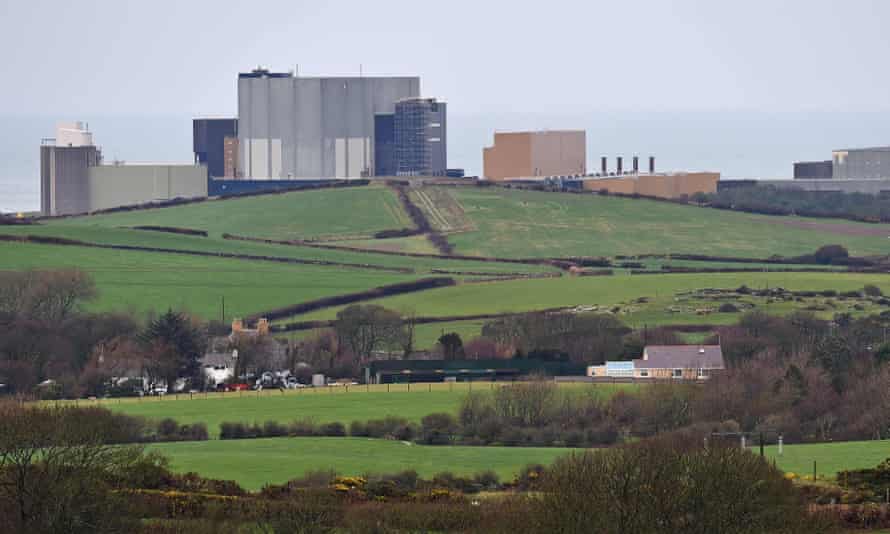
 The Wylfa Newydd nuclear power station on Anglesey, Wales. ‘There is no safe long-term solution for storing nuclear waste,’ says Ann Denise Lanes. Photograph: Paul Ellis/AFP/Getty Images
Letters

Re your report (Nuclear storage plans for north of England stir up local opposition, 23 August), it is no surprise that ongoing discussions to choose locations for the dumping of nuclear waste are cloaked in secrecy.

Over the last decade, the nuclear power industry has successfully rebranded an appallingly toxic energy industry as “zero carbon” and even “clean” (Zero-carbon electricity outstrips fossil fuels in Britain across 2019, 1 January 2020) by never mentioning the terrible legacy of nuclear waste. Nuclear energy is neither clean nor zero-carbon when you consider its complete fuel cycle, from uranium mining overseas to the energy-intensive production of fuel rods to the management of highly toxic radioactive waste products such as plutonium.

The nuclear lobby has done a very effective PR job in diverting attention away from everything other than the electricity feed into the National Grid. It knows that there is no safe long-term solution for storing nuclear waste – how could you guarantee safety from the most dangerous chemical element on the planet for 24,000 years (the half-life of plutonium)? The last thing this industry wants is an open discussion. It would reopen the debate on nuclear waste that it has, up to now, successfully buried in millions of pounds’ worth of rebranding. Hence the secrecy.
Ann Denise Lanes
Halton, Lancashire

CHESS
Interview with IM Sophie Milliet

by Tatiana Flores

8/27/2021 – In an exclusive interview with Tatiana Flores, 6-time French women’s champion Sophie Milliet talks about the benefits chess has brought her, some of her most important tournaments and games, her efforts to support female players in chess, and much more.


Interview with IM Sophie Milliet

Sophie Milliet was born on November 2, 1983 in Marseille, France. She received her WGM title in 2004, and her IM title in March 2009. Among several successes, she has won the French Women’s Championship six times, represented her country twice at Chess Olympiads and played for multiple international clubs. In an exclusive interview with Tatiana Flores, Ms. Milliet talks about the benefits chess has brought her, some of her most important tournaments and games, her efforts to support female players in chess, and much more.


IM Sophie Milliet has represented France for several years already | Photo: Yovie Insan Nugraha / JAPFA 2019


I read that you are very sporty. What other sports do you practice? Can you combine them with chess?

Yes, that’s true! I like it a lot, to exercise. I think it is a great addition to playing chess professionally. I believe it’s helpful to also be in a good physical condition when playing tournaments. I play a lot of badminton, and even participate in some small tournaments when I have the time for it. It is true that chess occupies most of my time, so there isn’t much left. Sometimes it’s a great challenge to keep my weekends free for it! But I enjoy it a lot, and I also regularly go to the gym.

Which have been the most important tournaments in your career so far?

Since 2003 I have played for the French team and participated in all the European individual and team championships, as in the Chess Olympiads. I had the chance to play in the World Cup once, and in the very important tournament of Cap D’Agde. I also was invited once to play in the Salamanca Chess Festival, where the world elite participates too, and specially that one was a very nice experience.

Which have been your best or most anecdotal games so far?

I had my best performance in this Cap D’Agde tournament I just mentioned. There I drew against Anatoly Karpov, one of the best players in history, and for that I’m very proud. After that, I also made a draw with Black against Veselin Topalov at the Salamanca Chess Festival. I suffered in that game, but managed to equalize in the end! (Laughs). Those were exciting games.

Which have been the hardest and the happiest moments in your professional career so far?

I’d say the French individual championship every year is a big goal for me. Generally I start as a favourite, and with the years I’ve managed to deal with the pressure quite well. Of course, there were still years in which I didn’t manage to win the title, when I didn’t feel well and couldn’t enjoy the game. Playing under those conditions is indeed hard. The years in which I felt good, I also managed to win the championship. This has already happened six times, and the individual championship is still a very important tournament for me.

What projects do you have planned for the rest of the year?

To my delight, I have a lot of new things in my program, therefore I’ll be very busy for the rest of the year. After nearly a one-and-a-half-year break (which was honestly too long for me), this makes me very happy. First of all, I’ll participate in the European Women’s Championship that starts next week. Shortly after that, around the end of the month, I’ll play in the international tournament of San Cristóbal de La Laguna in Tenerife. After that, I have a lot of team tournaments with the different clubs I play for. Among them is my new Italian club ASD Pedone Isolano, the Belgian club Wachtebeke, of course my German club Schwäbisch Hall, and my Spanish club Manlleu. So I’ll be playing in a lot of team tournaments until the end of the year.


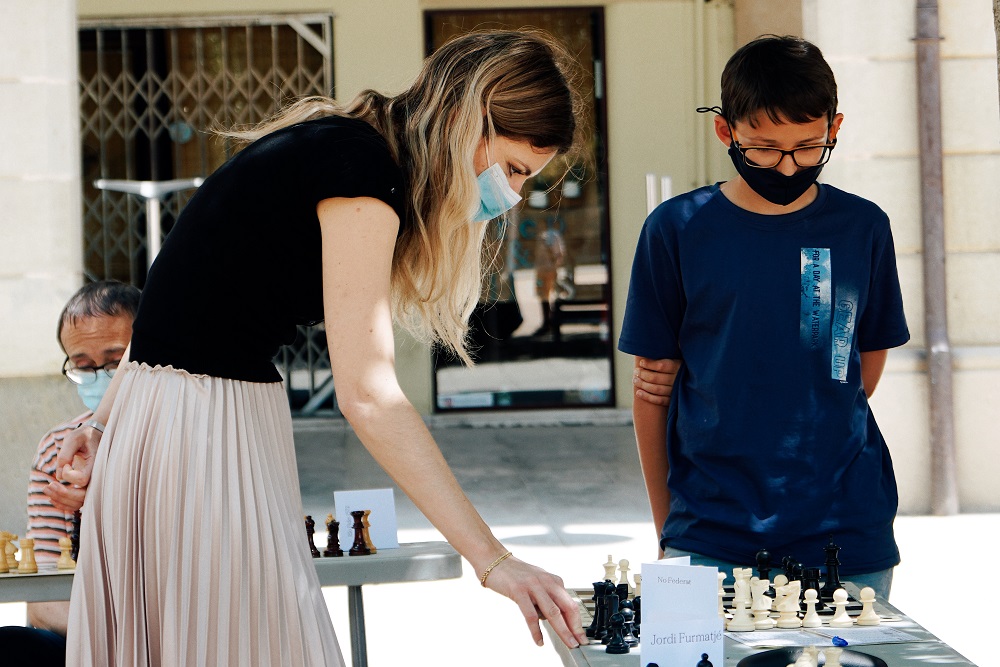
IM Sophie Milliet playing a simultaneous exhibition for her new club Manlleu in Catalonia, 2021 | Photo: Gabri Reyes

How would you describe your playing style?

My playing style… good question! (Laughs). I’d say I’m a very complete player. I generally try to train and improve in all areas, but I’d say that first and foremost I like having the initiative, and that I’m a dynamic player too.

Did you ever have a role model or a referential figure among chess players?

I’m not completely sure about that. It’s true that I belong to the generation in which Kasparov dominated chess (when I was young), and I liked his playing style very much. Thus, I think he was more of a “guiding line” after which I developed as a player and afterwards also progressed. Then, I think Judit Polgar was a great example for every female chess player. She was an exceptional player, and I even had the chance to play against her once, but I lost.

Which advantages has chess brought you in your life?

I think one of the biggest advantages chess has brought me is that it has allowed me to travel a lot. I had the opportunity to play tournaments all over the world, even in very distant countries. Indonesia is one which I fell for, and where I’ve already played several times. This of course makes it possible for me to meet people from different cultures, and at the same time feel very close to them thanks to chess.


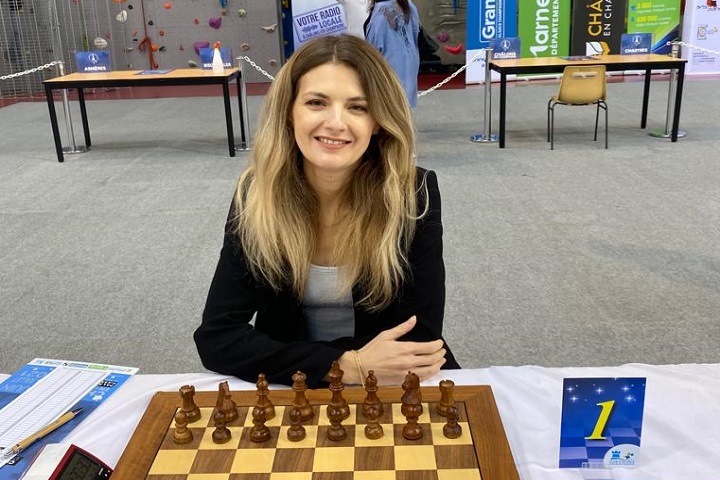
IM Sophie Milliet at the Grasse Échecs tournament (Top 12) in June 2021

What would you change or improve in the chess world?

I believe that, generally, the status of women in chess can be extensively improved. We could push female players much more in the foreground in both the international and national scene. After the success of The Queen’s Gambit, someone could have thought that this would’ve helped to put women’s chess in the spotlight, but I think that didn’t happen. The promotion of women’s chess is a matter of heart to me. That’s why last year, in the French Federation elections, I supported Jöel Gautier.

I know you are a fan of the manga “Blitz” by Cédric Biscay. Do you think that art can be a good way to bring chess closer to a wider audience?

Yes! I think that generally chess can be combined with a lot of other areas. When I talk about this with people, we quickly find a lot of similarities between chess and art, and even business. I find it super interesting to follow this approach. This manga came out quite recently, and has been a very nice surprise. I like reading it a lot, and it’s funny to me how good the fight in every chess game is represented. I believe it all fits very well with the manga style, and many things that appear in it (like the chess psychology for example) feel very realistic. The manga shows lots of interesting aspects, and it’s very entertaining. I enjoy it very much!

Thank you very much for your time, Ms. Milliet! The ChessBase team and I wish you a lot of luck at the European Women’s Championship.

The interview was conducted via Zoom on August 5, 2021 in French. Tatiana Flores transcribed it and translated it into English.