Friday, October 08, 2021


Faces of three ancient Egyptian mummies recreated using DNA technology and thermal meshing
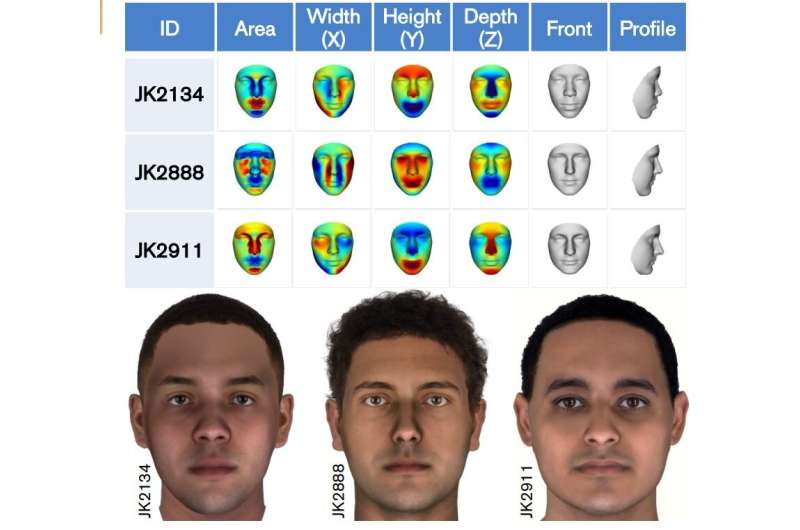
Faces of three ancient Egyptian mummies recreated using DNA technology and thermal meshing
Credit: Parabon Nanolabs

A team of workers at Parabon Nanolabs has digitally recreated the faces of three mummies from ancient Egypt using DNA technology and thermal meshing. They have posted a release statement on the company's website describing their process and results.

The three mummies were found at a site in Egypt called Abusir el-Meleq, an ancient city located south of modern Cairo. Prior research has shown that they were buried sometime between 1380 BC and 425 AD. In 2017, researchers at the Max Planck Institute for the Science of Human History found tissue that had survived in good enough condition to allow for genetic sequencing of the three bodies, all of whom were male. In this new effort, the workers have used data from that sequencing effort, along with other tools to digitally recreate the faces of the three mummies.

The process began with a type of phenotyping called Snapshot, which can be used to determine , ancestry and skin color. It showed that all three of the mummies had once been young men with skin the color of modern Mediterranean or Middle Eastern people with deep brown eyes. They were also able to determine hair color and texture, freckling and facial shape. Next, the workers created 3D meshes using thermal scans of the mummies' heads. The meshes were then used to form the basic facial characteristics of the three young men (all three of whom were believed to be approximately 25 years old at the time of their death) based on their bone structure. The team then combined the data from their Snapshot phenotyping with their meshes to create  of the three men who lived thousands of years ago.

The workers note that there was severe degradation of the DNA, but point out that they did not need the full set of single nucleotide polymorphisms; all they needed were those that revealed information about certain traits that differ between individuals, such as eye and . They note also that their techniques have also already been used to help identify the remains of people living in modern times as part of forensic efforts involved in cold cases.

Scans unveil secrets of world's oldest mummies

More information: parabon-nanolabs.com/news-even … rom-ancient-dna.html

© 2021 Science X Network

New approach to skeletal age-estimation can help identify juvenile remains

Peer-Reviewed Publication

SIMON FRASER UNIVERSITY

Measuring cranial bones for juvenile age estimation 

IMAGE: DEANNA SMITH, AN SFU ARCHAEOLOGY MA STUDENT AND STUDY LEAD AUTHOR MEASURES A BONE IN THE LAB. view more 

CREDIT: KOBIE HUANG

New research by SFU archaeologists could help forensic teams in their work to estimate the age of the remains of children discovered during archaeological work or in criminal investigative cases. Their study is published in the journal Forensic Science International.

While age is typically determined by dental records or other methods, such as measuring the long bones in the upper or lower limbs, those methods may not always be possible, especially in the case of young children. The researchers turned their attention to another approach—measuring the crania and mandibular bones, located in the skull.

For their study, researchers measured those bones in the child skeletal remains of known sex and age from natural history museum collections in Lisbon, Portugal and London, U.K. The bones were from 185 children from birth to 12.9 years who lived during the 1700s to 1900s. The measurements were found to provide a valid and comprehensive approach to juvenile age estimation.

According to SFU forensic anthropologist Hugo Cardoso, age, in combination with sex, context, and other characteristics of the skeleton, helps to narrow down who the child could be from a list of potential candidates. Families can then provide a DNA sample to confirm the identity of the child whose remains have been found, leading to closure for the family.

“Estimating the age of child remains is important because it helps with identification purposes, especially in criminal investigations,” says study lead Deanna Smith, an SFU archaeology MA student and member of the Wikwemikong First Nation. Determining the age of remains can help to reduce the pool of possibilities from a list of hundreds of missing children of various ages, for example.

Researchers assist in various situations where identification of remains is sought, from criminal investigations to cases with insufficient medical records to estimate age. “As physical anthropologists, we’re often called to identify found human remains, which then are subjected to a medicolegal death investigation,” says Cardoso, chair of the Department of Archaeology and co-director of the Centre for Forensic Research. “We are also involved in the study of remains found intentionally in archaeological projects, such as excavating a prehistoric or historic cemetery.”

Cardoso adds that in other archaeological contexts, excavating cemeteries can provide a snapshot of the entire population within a certain period of time and geographical area, allowing researchers to learn more about how people lived in the past—and age determination is a key factor. “Estimating age can help researchers to reconstruct demographics of the population and gain a better understanding of aspects of nutrition, health and stress during the growth years.”

###

#BANPALMOIL

Borneo forest patches adjacent to palm oil plantations may be key refuges for species including Asian water monitor lizards

Peer-Reviewed Publication

PLOS

Deep Look. An Asian water monitor lizard (Varanus salvator) in the Lower Kinabatangan Wildlife Sanctuary, Sabah, Malaysia (Borneo). 

IMAGE: THE PICTURE SHOWS THE HEAD OF AN INDIVIDUAL RESTING ON THE GROUND, JUST AFTER ITS EYES WERE UNCOVERED FOR RELEASE. USUALLY, THESE LIZARDS SPENT A FEW MINUTES RELAXING AND RECOVERING FROM THE HANDLING PROCESS BEFORE RUNNING AWAY. DURING THE HANDLING THEIR EYES ARE FOLDED WITH A BANDANA TO REDUCE STRESS. view more 

CREDIT: SERGIO GUERRERO-SANCHEZ, CC-BY 4.0 (HTTPS://CREATIVECOMMONS.ORG/LICENSES/BY/4.0/)

Borneo forest patches adjacent to palm oil plantations may be key refuges for species including Asian water monitor lizards

Article Title: The critical role of natural forest as refugium for generalist species in oil palm-dominated landscapes 

Author Countries: Malaysia, United Kingdom

Funding: Guerrero-Sanchez was supported by the scholarship provided by the National Council for Science and Technology (Consejo Nacional de Ciencia y TecnologĂ­a; CONACyT; scholarship No. 235294; Mexico Gov.). Fieldwork was supported by the Danau Girang Field Centre and Cardiff University through its PhD program.

Competing Interests: The authors have declared that no competing interests exist.

Article URL:  https://journals.plos.org/plosone/article?id=10.1371/journal. pone.0257814 
 

Feather phenomenon: Radar indicates stronger hurricanes trap, transport more birds

Higher winds, more T-storms keep birds confined to calm-eyed center of cyclones

Peer-Reviewed Publication

UNIVERSITY OF NEBRASKA-LINCOLN

Meteorological radar 

IMAGE: RADAR FROM TROPICAL STORM BETA AFTER IT MADE LANDFALL NEAR CORPUS CHRISTI, TEXAS, ON SEPT. 22, 2020. THE WHITE OVAL MARKS A BIOSCATTER SIGNATURE, INDICATING THE PRESENCE OF BIRDS. RESEARCH FROM THE UNIVERSITY OF NEBRASKA–LINCOLN HAS FOUND THAT MORE INTENSE HURRICANES APPEAR TO TRAP AND TRANSPORT MORE BIRDS WITHIN THEIR COMPARATIVELY CALM EYES, WHICH COULD HAVE ECOLOGICAL IMPLICATIONS BY DISPLACING SPECIES. view more 

CREDIT: REMOTE SENSING IN ECOLOGY AND CONSERVATION / JOHN WILEY & SONS, INC.

Whether birds get caged in the eye of a hurricane may depend on the intensity and totality of the chaos beyond the calm, says a novel study from the University of Nebraska–Lincoln’s Matthew Van Den Broeke.

Reports of birds being trapped in the center of hurricanes date back to at least the 19th century, when crews observed the phenomenon from the bows of ships and saw their vessels become mobile ports for exhausted birds.

“It’s been really fun reading some of these older observations from the 1800s about taking a ship through a hurricane eye and watching birds landing on it,” said Van Den Broeke, associate professor of Earth and atmospheric sciences. “So we’ve known for a long time that this happens.

“But it’s really only since (the advent of) radar observations that we have gotten any sense of how many of these systems actually do transport birds and insects.”

The technology that allowed meteorologists to really begin differentiating weather from organisms — dual-polarimetric radar, which added a second, vertical dimension to previously one-dimensional observations — became widely available only in the past 10 years. Which means that much still remains unclear about when, how often and under what conditions a hurricane turns a free bird into a whirlybird.

Van Den Broeke set out to analyze the dual-pol data from 33 Atlantic hurricanes that struck either the U.S. coast or Puerto Rico between 2011 and 2020. Those 33 included some of the most ferocious hurricanes in recent memory: Irene in 2011, Sandy in 2012, Harvey and Irma in 2017, Dorian in 2019.

He was hunting specifically for bioscatter signatures — the electromagnetic, speed-of-light waves that bounced back to a radar station not from the precipitation encircling the eye, but from birds or even insects within. In every one of the 33 cases, Van Den Broeke identified at least some bioscatter.

But the signatures differed. Tellingly, those differences generally corresponded with differences in the hurricanes themselves. The greater the wind speed of a hurricane, the denser and sometimes larger the bioscatter signature was, indicating the presence of more birds within the eye. Van Den Broeke also classified the hurricanes according to whether their eyes were closed, open or somewhere in between. A closed eye was 100% surrounded by thunderstorms, whereas a mostly closed eye was 75%-99% surrounded, and so on. As with wind speed, greater thunderstorm coverage generally correlated with more birds.

Of course, stronger winds and more thunderstorms tend to go together, Van Den Broeke said, making it difficult to tease apart the precise influences of wind speed vs. precipitation. What is clear: The more severe the hurricane, the more daunting the prospect of abandoning the relative safety of the eye — even if it might mean spending thousands of miles and a week in the air.

Though the intensity of a hurricane may hold the greatest sway, Van Den Broeke came across evidence that timing and geography matter, too. The largest bioscatter signatures appeared in hurricanes that occurred between July and October, when many bird species are migrating southward to the tropics, suggesting that native seabirds are not alone in getting swept up. Bioscatter was also larger and denser, on average, in hurricanes that struck the Gulf Coast and Florida, which boast a larger concentration and diversity of birds than other areas struck by the recorded hurricanes.

That could have ecological implications, Van Den Broeke said, especially if the strength and frequency of Atlantic hurricanes are growing in response to global warming. Population dynamics could hypothetically be skewed, or invasive species introduced, by a hurricane of the right intensity crossing a migratory route at the wrong time.

“Ecologists think about transport quite a bit,” he said. “How do you get organisms from one point to another? How many organisms are being transported? Are you able to transport new species that weren’t previously present? Can you transport pests that might be a threat to agriculture?”

The question of just how many birds might be transported by a single hurricane is a murky one, and probably unanswerable without knowing which species are trapped within the eye, Van Den Broeke said. Other lingering questions, though, should prove more resolvable.

In his recent study, Van Den Broeke discovered that the cruising altitude of trapped birds also increases in tandem with hurricane intensity. He’s unsure why, though it may have to do with the thermal structure of a typical hurricane. Hot, moist air near the water’s surface tends to rise up the eye until it reaches a boundary, called the inversion, beyond which the higher, drier air tends to sink. Inversion altitude can vary substantially among hurricanes and might be affecting that of the birds, Van Den Broeke said.

He’s now analyzing inversion data collected by parachuted instruments, called dropsondes, that are released within hurricanes from aircraft flown by the U.S. Air Force and the National Oceanic and Atmospheric Administration.

“I’m comparing the observations of inversion height to the bioscatter signatures,” said Van Den Broeke, whose work is supported by the National Science Foundation. “Does it match up? Do birds fly above that? Below it? And can we say something, then, about intensity changes in tropical cyclones, and relate that to how the bioscatter signature behaved?

“It’s possible there’s some kind of systematic effect there.”

If so, bioscatter altitude might eventually become a radar-based proxy for hurricane traits that can currently be measured only via dropsonde. In the meantime, Van Den Broeke, who once considered a career in ecology and still has a penchant for it, said he’s relishing the chance to bridge two fields that rarely overlap.

“I’m always fascinated by ecosystems and the interactions of organisms with their environment,” he said. “But my expertise is in meteorology, so to be able to combine the two fields is really exciting to me.”

Protecting the ozone layer is delivering vast health benefits

Montreal Protocol will spare Americans from 443 million skin cancer cases

Peer-Reviewed Publication

NATIONAL CENTER FOR ATMOSPHERIC RESEARCH/UNIVERSITY CORPORATION FOR ATMOSPHERIC RESEARCH

An international agreement to protect the ozone layer is expected to prevent 443 million cases of skin cancer and 63 million cataract cases for people born in the United States through the end of this century, according to new research.

The research team, by scientists at the National Center for Atmospheric Research (NCAR), ICF Consulting, and U.S. Environmental Protection Agency (EPA), focused on the far-reaching impacts of a landmark 1987 treaty known as the Montreal Protocol and later amendments that substantially strengthened it. The agreement phased out the use of chemicals such as chlorofluorocarbons (CFCs) that destroy ozone in the stratosphere.

Stratospheric ozone shields the planet from harmful levels of the Sun’s ultraviolet (UV) radiation, protecting life on Earth.

To measure the long-term effects of the Montreal Protocol, the scientists developed a computer modeling approach that enabled them to look to both the past and the future by simulating the treaty’s impact on Americans born between 1890 and 2100. The modeling revealed the treaty’s effect on stratospheric ozone, the associated reductions in ultraviolet radiation, and the resulting health benefits. 

In addition to the number of skin cancer and cataract cases that were avoided, the study also showed that the treaty, as most recently amended, will prevent approximately 2.3 million skin cancer deaths in the U.S.

“It’s very encouraging,” said NCAR scientist Julia Lee-Taylor, a co-author of the study. “It shows that, given the will, the nations of the world can come together to solve global environmental problems.”

The study, funded by the EPA, was published in ACS Earth and Space Chemistry. NCAR is sponsored by the National Science Foundation.

Mounting concerns over the ozone layer

Scientists in the 1970s began highlighting the threat to the ozone layer when they found that CFCs, used as refrigerants and in other applications, release chlorine atoms in the stratosphere that set off chemical reactions that destroy ozone. Concerns mounted the following decade with the discovery of an Antarctic ozone hole.

The loss of stratospheric ozone would be catastrophic, as high levels of UV radiation have been linked to certain types of skin cancer, cataracts, and immunological disorders. The ozone layer also protects terrestrial and aquatic ecosystems, as well as agriculture.

Policy makers responded to the threat with the 1987 Montreal Protocol on Substances that Deplete the Ozone Layer, in which nations agreed to curtail the use of certain ozone-destroying substances. Subsequent amendments strengthened the treaty by expanding the list of ozone-destroying substances (such as halons and hydrochlorofluorocarbons, or HCFCs) and accelerating the timeline for phasing out their use. The amendments were based on Input from the scientific community, including a number of NCAR scientists, that were summarized in quadrennial Ozone Assessment reports.

To quantify the impacts of the treaty, the research team built a model known as the Atmospheric and Health Effects Framework. This model, which draws on various data sources about ozone, public health, and population demographics, consists of five computational steps. These simulate past and future emissions of ozone-destroying substances, the impacts of those substances on stratospheric ozone, the resulting changes in ground-level UV radiation, the U.S. population’s exposure to UV radiation, and the incidence and mortality of health effects resulting from the exposure.

The results showed UV radiation levels returning to 1980 levels by the mid-2040s under the amended treaty. In contrast, UV levels would have continued to increase throughout this century if the treaty had not been amended, and they would have soared far higher without any treaty at all. 

Even with the amendments, the simulations show excess cases of cataracts and various types of skin cancer beginning to occur with the onset of ozone depletion and peaking decades later as the population exposed to the highest UV levels ages. Those born between 1900 and 2040 experience heightened cases of skin cancer and cataracts, with the worst health outcomes affecting those born between about 1950 and 2000.

However, the health impacts would have been far more severe without the treaty, with cases of skin cancer and cataracts rising at an increasingly rapid rate through the century. 

“We peeled away from disaster,” Lee-Taylor said. “What is eye popping is what would have happened by the end of this century if not for the Montreal Protocol. By 2080, the amount of UV has tripled. After that, our calculations for the health impacts start to break down because we’re getting so far into conditions that have never been seen before.”

The research team also found that more than half the treaty’s health benefits could be traced to the later amendments rather than the original 1987 Montreal Protocol. Overall, the treaty prevented more than 99% of potential health impacts that would have otherwise occurred from ozone destruction. This showed the importance of the treaty’s flexibility in adjusting to evolving scientific knowledge, the authors said.

The researchers focused on the U.S. because of ready access to health data and population projections. Lee-Taylor said that the specific health outcomes in other countries may vary, but the overall trends would be similar.

“The treaty had broad global benefits,” she said.

About the article

Title: “Estimation of Skin and Ocular Damage Avoided in the United States through Implementation of the Montreal Protocol on Substances that Deplete the Ozone Layer”

Authors: Sasha Madronich, Julia Lee-Taylor, Mark Wagner, Jessica Kyle, Zeyu Hu, and Robert Landolfi

Journal: ACS Earth and Space Chemistry

This material is based upon work supported by the National Center for Atmospheric Research, a major facility sponsored by the National Science Foundation and managed by the University Corporation for Atmospheric Research. Any opinions, findings and conclusions or recommendations expressed in this material do not necessarily reflect the views of the National Science Foundation.

On the web: news.ucar.edu

On Twitter: @NCAR_Science

Contacts:

David Hosansky, NCAR/UCAR Manager of Media Relations
hosansky@ucar.edu
720-470-2073

Ali Branscombe, NCAR/UCAR Communications Specialist
abran@ucar.edu
651-764-9643


New book explores political secrecy among ordinary Americans in today's divisive culture


Rather than being silent, people in the political minority engage in "networked silence," according to author Emily Van Duyn


Book Announcement

UNIVERSITY OF ILLINOIS AT URBANA-CHAMPAIGN, NEWS BUREAU

van duyn_emily210914-08-lbs-m 

IMAGE: AUTHOR EMILY VAN DUYN CHALLENGES EXISTING THEORIES OF POLITICAL COMMUNICATION IN THE NEW BOOK “DEMOCRACY LIVES IN DARKNESS: HOW AND WHY PEOPLE KEEP THEIR POLITICS A SECRET” (OXFORD UNIVERSITY PRESS). VAN DUYN IS A PROFESSOR OF COMMUNICATION AT THE UNIVERSITY OF ILLINOIS URBANA-CHAMPAIGN. view more 

CREDIT: PHOTO BY L. BRIAN STAUFFER

CHAMPAIGN, Ill. — In a rural community in East Texas, a group of women decided to meet in secret to discuss politics, holding its first clandestine gathering in a secluded barn at the end of a dark road. Thereafter, they rotated meeting locations each month, ensuring that the drapes were tightly closed in members’ houses before the meetings began. New members signed nondisclosure agreements, promising not to reveal who was present and the topics discussed.

While it may sound like a scene from the anti-communist Red Scare of the 1950s, the Texas group was founded in November 2016, shortly after Republican Donald Trump won the U.S. presidential election, according to Emily Van Duyn, the author of a new book.

In “Democracy Lives in Darkness: How and Why People Keep Their Politics a Secret” (Oxford University Press), Van Duyn, a professor of communication at the University of Illinois Urbana-Champaign, explored individuals’ decisions to selectively reveal their political views.

Centering on the group in Texas and novel survey data on political secrecy, Van Duyn looked at how much people feel they need to hide their views from others in the current bitter, hyperpartisan culture. Van Duyn also examined the consequences of growing polarization – including the rising trend among Americans to cluster in communities with neighbors whose views mirror our own – and the broader implications for the state of democracy in the U.S.

Referring to the Texas group pseudonymously as the “Community Women’s Group” or the CWG in the book, Van Duyn said the group’s very existence raises fundamental questions as to whether “politics in the United States happen in a completely liberal, rather than an illiberal, democracy.”

Van Duyn, who describes herself as a “proud native Texan” and conducted the research for her doctoral dissertation at the University of Texas, Austin, was alerted to the CWG’s existence by an acquaintance who attended its second meeting. After gaining members’ trust, Van Duyn sat in on several of the group’s meetings and interviewed and surveyed 22 members.

The author described the CWG as a “strange mix of super-left progressive Democrats and anti-Trump Republicans a little more on the right.” Members were not political extremists but grandmothers and average citizens with mainstream beliefs who were deeply concerned about the future of the country under a Trump presidency.

In a county where Trump reaped more than 75% of the votes, CWG members felt so marginalized and fearful of the social, economic and potentially violent repercussions of defying the Republican majority surrounding them – including spouses, friends, neighbors and clients – that they only met at night and communicated through a private listserv and Facebook group.

In rural communities like the one in Texas, where residents routinely mix with their neighbors socially and rely on them for their livelihoods, holding nonmajority political opinions can be particularly isolating, stigmatizing and risky. Yet, few studies on political communication have explored the complex dynamics of these communities and the array of risks that people who live there must weigh in deciding whether to defy the partisan majority, Van Duyn said.

“Much more than social ostracism, they were really afraid of economic retribution,” Van Duyn said. “Some of the women were business owners and real estate agents who relied on word-of-mouth and community members patronizing their businesses.”

Political violence was a tangible threat. One member told Van Duyn that a vehicle ran her off the road because she displayed an Obama sticker on her car, while another woman said her animals had been shot after she wrote letters to the editor of the local newspaper.

“Is it the case that we’re really in a liberal democracy if people feel they can’t express their beliefs by putting their candidate’s sign in their front yard saying who they voted for? Have we kind of stifled that with the levels of polarization we have created?” Van Duyn said.

Popular theories on political communication suggest that for individuals whose beliefs differ from the majority around them expressing their views is a dichotomy – either they speak out or remain silent to avoid potential rejection and isolation. However, Van Duyn said the actuality is more complex. Politically isolated individuals exercise what she called “networked silence” – they find back channels of like-minded people for political expression and engagement.

“To say that people are only going to express their beliefs or not isn’t complex enough for today’s contexts where we have this blend of networked communities,” she said. “People don’t just live in one space – they have online communities, friends thousands of miles away, knitting clubs and church groups. Just because they don’t express their beliefs in one space doesn’t mean they’re silent altogether. It just means they may go somewhere else to do it.”

Drawing parallels with the LGBT movement, the book examines political organizing in secret and in private, and the incentives for activists to stay in the shadows. Secret groups such as the CWG can serve as incubators, Van Duyn wrote, giving members the courage and validation to openly express their political beliefs with a sense of safety until they feel prepared “come out” and transfer their activism from private to public networks.

With growing rancor both within and between the dominant Democratic and Republican parties, and some constituencies feeling left behind or ideologically alienated from both groups, it’s likely that other such secret groups exist and that people who feel politically isolated will increasingly turn to online and offline back channels, she said.

In her survey research, Van Duyn found that 22% of Americans said they sometimes hide their political beliefs from others.

“Certainly, this book has a lot of sad moments and points to the fact that we have all of these anti-democratic things happening in society that make people feel they can’t express their beliefs,” Van Duyn said. “But there’s also this other side of the coin, which is the fact that this group of women still existed.

“They faced all this opposition and were not in a situation where you’d think they would keep fighting this fight, yet they did. There’s some optimism in that for me. In contrast to The Washington Post’s slogan, ‘democracy dies in darkness,’ this book suggests that democracy exists in darkness, but also, more optimistically, that despite this darkness, it keeps going.”

CAPTION

Van Duyn’s book, published by Oxford University Press, challenges existing political communication theory with the premise that the politically isolated don't stay silent -- they find backchannels to engage in "networked silence."

CREDIT

Courtesy Oxford University Press.

#YEG CIVIC ELECTION 2021

School board trustees

Everyone always forgets the school boards, but do your research and absolutely don’t skip this part of the ballot. What these people do impacts our kids! And the low attention paid to school board races—both public and Catholic—leads to a lot of yahoos bumbling into these roles. Just last week an Edmonton public school board trustee went on a tear about horse paste, for example. So please do not skip this very important part of the ballot! If you know who you'd like for council but aren't sure about the school board choice, ask your council candidate—they'll be able to tell you which one shares your values.


*UPDATE* We are now happy to also endorse Rhonda Whitten & Gary Hansen in Leduc Black Gold School District Ward 3 

Bill 29 makes several changes to the rules for the next municipal elections in Alberta.

How Alberta Welcomed Big Money Into City Elections


The UCP’s Bill 29 undermines local democracy, municipalities say.


TAYLOR LAMBERT • SEPTEMBER 19 2020

Alberta’s next municipal elections kick off a year from now. This week, rookie councillor Jeromy Farkas was the first to throw a hat into the ring for the Calgary mayoral race.

But in a summer overflowing with disruption and chaos, Albertans might have missed the UCP’s attempt at municipal campaign finance reform.

So let’s leave the autumn weather behind for a moment and go back to the summer: not sunshine and socially-distanced patios, but the passage of Bill 29.

The legislation lifts restrictions on how much each donor can contribute in municipal elections, making it easier for wealthy Albertans to exert greater influence.

“These are dangerously undemocratic and unethical changes,” said Duff Conacher, co-founder of Democracy Watch.

First, a quick background on where things stood before this new bill.

For a long time, what few restrictions Alberta had on who could donate how much to political campaigns were pretty loose. But the previous NDP government passed three notable pieces of legislation between 2015 and 2018.


These are dangerously undemocratic and unethical changes. 
DUFF CONACHER, CO-FOUNDER OF DEMOCRACY WATCH

In 2015, the very first bill they introduced banned corporate and union donations to provincial political parties, and was passed unanimously in the legislature. This had the side effect of sending that money to political action committees, or PACs, giving these third-party groups tremendous influence.

In 2016 came the Fair Elections Financing Act, which further addressed provincial campaigns, reducing the amount a person could donate to a candidate or party in a single year from $15,000 (or $30,000 in an election year) to $4,000.


That legislation also introduced campaign spending limits, which limited spending of third-party advertisers to a maximum of $150,000 during a campaign, and required public disclosure of any donations over $250.

The third bill tackled municipal and school board elections, but it wasn’t passed until 2018, a year after the last municipal campaigns—and so it was never put into practice.

The bill banned corporate and union donations and reduced the donation limit for individuals from $5,000 to $4,000. And it also imposed campaign spending limits and reduced campaign periods from four years to one.

A ‘legalized bribery system’

There’s a lot to take in there, but note the limits for individual donors: $4,000 total, in a given calendar year. If you’re thinking, “Geez, who has that kind of money to give to a campaign?” well, hold that thought.

Bill 29, which was introduced in June and came into effect September 1, makes several notable changes to the rules for the next municipal elections across the province, scheduled for October 18, 2021.

Individuals can now contribute $5,000 per candidate, with no limit on the number of candidates someone can donate to.

Wealthy people with deep pockets will be allowed to pump large sums of money into a campaign.

It’s been reported elsewhere that Bill 29 removed a requirement for candidates to disclose their donor lists before the election, but that’s not quite accurate.

Just as before, the UCP’s bill requires a disclosure report by March of the year after the election. But, importantly, it removes the provision allowing local jurisdictions to pass bylaws requiring pre-election disclosure—making it easier to keep things in the dark.

The effect of these two changes is plain and obvious: wealthy people with deep pockets will be allowed to pump large sums of money into a campaign by supporting a slate of candidates who are sympathetic to their interests, and you, dear voter, won’t know anything about it until it’s all over.

It doesn’t take much imagination, then, to see this as a mutually beneficial arrangement between a party determined to implement its deeply conservative, free-market agenda in all spheres, and those with deep pockets who stand to benefit from that agenda. Conacher called it a “legalized bribery system.”

The UCP has pitched Bill 29 as “levelling the playing field.” So said Kaycee Madu, who introduced the legislation when he still held the municipal affairs portfolio. Alberta’s municipalities have openly disagreed.

A threat to local democracy

The Alberta Urban Municipalities Association (AUMA) was involved in the consultation process for Bill 29. According to president Barry Morishita, the group was supportive of ideas like preventing candidates from rolling over war chests from one election to the next by requiring they donate to charity campaign surpluses over $1,000.

But the AUMA pushed back on other government proposals, such as preventing disclosure until months after the election, and dramatically increasing donation limits.


You have to remember, this is the root of our democracy for local elections.
BARRY MORISHITA,
AUMA PRESIDENT


When the feedback was not heeded, the AUMA released an unusually blunt statement in response to the legislation, accusing the government of rejecting “principles of local democracy.”

“You have to remember, this is the root of our democracy for local elections,” said Morishita. “This is a pretty important piece of legislation for municipalities.”

The new rules will have an impact on all municipal campaigns. But while the door is now wide open for serious money to influence races in Calgary and Edmonton, Morishita pointed out that campaigns in smaller centres are run on smaller budgets.

“We don’t think that people of means should have the ability to manipulate a race, and they can manipulate a mid-size or small race easier than a big race.”

Morishita, who has served as mayor of Brooks since 2016, cited his own campaign experience. “I didn’t even spend $10,000,” he said. “Just four people could fund a campaign against me with twice that amount.”

Levelling the playing field

Banning corporate and union donations but allowing a high personal donation limit can be easily circumvented by wealthy individuals, who can use family members or employees as donation surrogates.

The solution, according to Conacher, is simple: “To be democratic, the donation limit has to be an amount that the average voter can afford.”

The UCP is dramatically raising the amount an individual can give to campaigns.

Ordinary Albertans, of course, do not donate many thousands of dollars to political campaigns

The jurisdiction doing it best in Canada is Quebec, which limits personal contributions to $100 per party or candidate per year, and $200 in an election year. Donations are not accepted by campaigns directly, but by Élections QuĂ©bec, which vets and tracks contributions before passing them along to the campaign and publicly disclosing the name of the donor.

Quebec also supplements political parties with public funding, but Conacher is skeptical of that approach. He argues that large amounts of money are simply not necessary to run a political campaign in the digital age.

Of course, no party or candidate wants to unilaterally disarm if their opponent is sporting a massive war chest. But restricting all parties to small contributions that the majority of voters can afford—well, that certainly sounds like something akin to a level playing field.

Instead, the UCP is dramatically raising the amount an individual can give to campaigns, benefiting individuals with large amounts of money and the candidates they might support.

A questionable track record

Both the premier and his party have what might be charitably called a mixed record on upholding democratic principles when it comes to elections.

When Kenney was running for the leadership of the Progressive Conservatives in 2016 and 2017, he broke a pledge by declining to reveal the names of 63 donors who contributed nearly $400,000 to his Unite Alberta PAC.

He was not required by law to disclose them, and claimed the privacy of the donors outweighed concerns about transparency.

How you win is as important as winning.
BARRY MORISHITA,
AUMA PRESIDENT


Then there was the UCP leadership race where Kenney’s team infamously coordinated with “kamikaze” candidate Jeff Callaway.

That race prompted an investigation by the province’s independent elections commissioner, which resulted in donors being fined for illegal contributions—until the commissioner was fired by the UCP government mid-investigation in order “to streamline government, to remove redundancies, to save Alberta taxpayers hard-earned tax dollars.”

(The RCMP said they are reviewing Democracy Watch’s request for an investigation on the grounds of obstruction of justice; the RCMP is also investigating that campaign as possible fraud.)

Details on regulations for third-party advertisers in municipal elections are expected this fall, but they’re unlikely to make a big difference, since Bill 29 removes all spending limits for such groups outside of the six months prior to election day.

To be sure, all political parties and candidates want more money to play with, and many are able to justify some ethical flexibility in fundraising by convincing themselves that the ends of wielding power justify the means of getting there.

But “how you win is as important as winning,” said Morishita.

Though Bill 29 is now law, Conacher says citizens can still push back by complaining to their MLA and questioning municipal candidates.

“Ask every candidate to disclose donors before election day, and if they say they won’t, don’t vote for them.”

Taylor Lambert is the Alberta politics writer for The Sprawl.

Now more than ever, we need strong independent journalism in Alberta. That's what The Sprawl is here for! When you become a Sprawl member, it means our writers, cartoonists and photographers can do more of the journalism we need right now. Become a Sprawl member today!


Kareem Abdul-Jabbar in Jacobin: On Kyrie Irving’s Vaccine Refusal

NBA great Kareem Abdul-Jabbar writes in Jacobin arguing that athletes like Kyrie Irving aren’t making a “personal choice” by refusing the COVID vaccine — they’re jeopardizing the public health of all through their platforms
.
Former NBA player Kareem Abdul-Jabbar during a ceremony at Pauley Pavilion in Los Angeles, 2017.
(John W. McDonough / Sports Illustrated via Getty Images)

10.06.2021

I’m a huge fan of LeBron James, both as one of the greatest basketball players ever and as a humanitarian who cares about social injustice. I have written his praises many times in the past and undoubtedly will in the future. I admire him and have affection for him. But this time, LeBron is just plain wrong — and his being wrong could be deadly, especially for the Black community.

After Golden State Warriors’ Andrew Wiggins received criticism for refusing to get the COVID-19 vaccine for personal reasons, his teammate Draymond Green said the public needs to “honor” that decision: “There is something to be said for people’s concerns about something that’s being pressed so hard,” he stated. “Why are you pressing this so hard? You have to honor people’s feelings and their own personal beliefs.” To which LeBron responded that he “couldn’t have said it better myself.” Actually, it couldn’t have been said worse.

Wiggins has since received the vaccine, though he made clear that it was under financial duress. Other than vague claims about “freedom,” he’s never offered rational support for his stance. Neither has Brooklyn Nets point guard Kyrie Irving, who continues to reject the expertise of prominent immunologists without reason, contributing to vaccine hesitancy among people in the Black community, who are dying at twice the rate of white people. His lack of regard for Black lives doesn’t deserve acceptance, nor does his lack of regard for the health and welfare of the NBA community.


On the surface, it appears that Draymond and LeBron are arguing for the American ideal of individual freedom of choice. But they offer no arguments in support of it, nor do they define the limits of when one person’s choice is harmful to the community. They are merely shouting, “I’m for freedom.” We’re all for freedom, but not at the expense of others or if it damages the country. That’s why we mandate seat belts, motorcycle helmets, car insurance, and education for our children. For example, seat belt compliance is at 88 percent in the United States, but that 12 percent that doesn’t comply results in 47 percent of car accident fatalities (seventeen thousand) and costs US employers $5 billion a year, and those costs are passed on to us. They made the choice, but we survivors are left to deal with the grief and the price tag.

The cost of COVID-19 for this country is difficult to measure. We can come up with a monetary amount: Harvard economists say it’s cost us $16 trillion so far — money that might have been spent to build the country, provide jobs, or help the disadvantaged. But the real cost is the seven hundred thousand lives, thousands of which could have been saved if they’d followed the Centers for Disease Control and Prevention protocols and gotten vaccinated. And thousands more are dying every day. Add to that the medical costs of those who will suffer for years from long-haul symptoms.

The only support for Draymond’s statement is his belief that when people “press hard,” there’s something inherently wrong with their opinion. There is no logic to that statement. If I press hard against institutional racism, if I press hard against police brutality, if I press hard against recent laws making it harder for minorities to vote, if I press hard against child pornography, if I press hard in support of #MeToo, am I automatically wrong?

On the contrary, the passion of those urging vaccines might suggest that there’s some urgency to their opinion. That the situation is serious and we need to take immediate action to protect people. That thousands are dying every day, mostly among the unvaccinated. That people in the Black community, where vaccine hesitancy is high, are dying at a disproportionately higher rate than white people. That publicly talking about honoring opinions that contribute to their deaths is irresponsible.

The country also mandates against drunk driving, “pressing hard” against the freedom to drive under the influence. We do that because drunk driving kills eleven thousand Americans every year and costs us more than $44 billion. Vaccine deniers and those who want to “honor” them are like drunk drivers who are convinced they’re okay to drive. When they make it home without an accident, that means they were right. Until they aren’t. Which is why 97 percent of COVID deaths are among the unvaccinated.

And while some who don’t get the vaccine might never get sick or, if they do, suffer mild symptoms, they are still potentially spreading the disease to others, killing some. While we’re honoring the unvaccinated, COVID cases are rising alarmingly among young children.

I think of the situation like those old fire brigades, when people stood in a line, passing buckets of water to save their neighbor’s house from burning to the ground. Maybe some people were afraid to join the line. But when the town leaders joined in, it encouraged others to do their duty. Today’s celebrities and athletes are like those town leaders. You either join the line to save your neighbor’s home, or you stand by and let it burn because you don’t owe them anything.

ABOUT THE AUTHOR
Kareem Abdul-Jabbar is the NBA's all-time leading scorer. During his twenty seasons in the league, he won six league championships and MVP awards.
