Saturday, October 16, 2021

‘It’s a sweat factory’: Instacart workers ready to strike for pay and conditions

Gig workers report falling wages, unmanageable orders and lack of concern from the company


Instacart shopper Willy Solis: ‘I’m participating in the Instacart walkout because I feel like there is no other option.’ Photograph: Supplied

Gloria Oladipo
@gaoladipo
Fri 15 Oct 2021 

For Instacart workers across the country, the popular grocery delivery app promised flexibility and a solid wage, perks that enticed thousands to join the app during the height of the Covid-19 pandemic.

But amid worsening working conditions including plummeting pay, safety concerns, and a punitive rating system, Instacart employees, known as shoppers, will be staging a walkout on 16 October and will continue striking until the company meets their demands for better treatment.

Workers, uniting as the Gig Workers Collective, have been organizing against Instacart for years, citing what they say is a trend of unresponsiveness from the company in the face of their concerns. The collective’s asks are mostly for a restoration of features the company has dropped: reinstating Instacart’s commission pay model, paying its shoppers per order rather than bundling them, a 10% default tip instead of the current 5%, transparency about how orders are assigned, and a rating system that doesn’t hurt shoppers forproblems outside their control.

Shoppers have also asked for occupational death benefits, noting the increasing dangers shoppers face on the job.

Ahead of the walk-off, the Guardian spoke to three Instacart shoppers on their journey to joining Instacart, problems they have encountered since joining the app, and why they’re participating in the 16 October protest.

Willy Solis. Photograph: Supplied
Willy Solis, 43, Instacart shopper in Texas since October 2019, lead organizer with the Gig Workers Collective

For Willy Solis, Instacart started as a way to make ends meet during a transitional employment period. After running a business since 2008 and while trying to move out of state, he joined Instacart because it offered a low bar of entry and the flexibility Willy needed.

“I thought it was a pretty good deal as far as the pay compared to what I was actually doing, the time frame I was allowed to do it in, and all that stuff,” said Solis.
Advertisement

But soon, Solis noticed dips in his pay – small at first, but ever-growing. When Instacart decided to bundle individual orders together (“batches” as shoppers call them), batches began to double and triple in size – with 60 or 70 items in a batch for multiple orders at different addresses – while the pay remained the same. Tips, which make up the bulk of pay for shoppers, also dropped when Instacart’s default tip was set at a paltry 5%.

In some cases, he was making up to 50% less than average on orders. Soon, Solis was experiencing huge cuts in his pay from when he started. While he once brought home $1,000 a week, now Solis often struggles to break $500 for a week’s work after sitting on the app for hours in search of profitable orders, even while working across multiple apps besides Instacart.

“It’s getting to the point where it’s just not enough and I’m not making what I need to make,” said Solis.

Instacart’s changing pay structure is the source of at least two class-action lawsuits, but safety is also something Solis has struggled with. As an immunocompromised person, trying to stay safe during the pandemic while having to work to pay bills was a challenge that Instacart offered little support with.

While the company did send out personal protective equipment (PPE) to shoppers after facing public outrage and mounting collective action, Solis says the PPE was of poor quality and he was never compensated for the equipment he bought himself. When Solis did get Covid, he didn’t qualify for Instacart’s pay assistance program, and had to rely on family during the two months he was unable to work.
Advertisement

“It was a very tough period of time financially,” said Solis. “I had to work my tail off to try and get back on track.”

Changes to Instacart’s support service, now automated, has also left Solis feeling unsafe on the job. During threatening situations Solis has experienced, having live Instacart support was important for de-escalation; now, he says, that human resource is gone.

Instacart’s newly tenured CEO, Fidji Simo, has offered little response to workers’ concerns, and Solis says he’s ready to strike.

“I’m participating in the Instacart walkout because I feel like there is no other option. We don’t have another choice but to get so loud and so vocal that we bring that kind of attention to the issues,” said Solis.

Jen. Photograph: Supplied
Jen, shopper advocate, 54, based in Massachusetts, shopping with Instacart since April 2020


During the pandemic, the clothes business side hustle that Jen had established came to sudden halt. Looking for a different income source, Jen noticed long wait times on Instacart’s app while trying to get her own groceries delivered. She was intrigued and decided to sign up for herself. (Jen asked to be identified with her first name only for safety reasons.)

“I thought, ‘Well, let me help during the pandemic. Let me make money and let me also help with this shortage of shoppers.’”

Shopping on Instacart was enjoyable at first; using the app was convenient and demand was still high. But with Instacart’s dropping pay and losing profitable orders with bots, hackers using stolen Instacart shopper accounts to shop on the app, Jen struggled to find competitive orders.

“I haven’t shopped in more than four weeks now because there’s not one batch that comes on my screen that would put me making over minimum wage,” said Jen.

Jen also struggled with Instacart’s rating system, often described as “punishing” by shoppers. While Instacart maintains the system is fair and allows for the lowest rating of 100 deliveries to be dropped, shoppers remarked that a rating slightly below 5 stars could significantly affect their earning potential.

Jen found herself frequently penalized for false accusations of not delivering items from customers. On one occasion, after delivering bulk bags of Halloween candy to one shopper, Jen was penalized for not fulfilling the order – even though she had pictures of the completed delivery and she saw the customer bring the order inside.
Advertisement


“At the end of the day, nothing happened. The customer got the candy for free and I was punished.”

Jen, who runs a YouTube channel about her experiences with Instacart and aggregated concerns she hears from others, noted Instacart’s indifferent response to shoppers’ concerns, including failing to address the impact that customer fraud has on shoppers.

“Instacart doesn’t care. It’s a revolving door. It’s like a sweat factory. They’ll put 100 in, fire 10, and put 100 more back in. They are soulless when it comes to their frontline workers,” she said. “It’s just not OK. We’re human beings and we deserve to be treated like such.”

Robin Pape. Photograph: Supplied
Robin Pape, 42, based in upstate New York, Instacart shopper since 2018

In 2018, after receiving an Instacart referral link from a friend who needed the extra sign-up bonus, Robin Pape decided to try the app out. But soon, with Instacart’s new pay structure, Pape saw her pay fall by more than a third.

Most of the Pape spends on the app she is waiting for worthwhile delivery orders, as batches grow increasingly scarce given the more than 200% increase in active Instacart workers in Pape’s area since the time she started.

“They were so proud [of] the hundreds of thousands of shoppers they were hiring [during the pandemic] while still not sending out PPE or appropriate hazard pay,” said Pape.

Like other shoppers, Pape has had run-ins with Instacart’s harsh rating system. She has seen her ratings drop even when customers don’t add a rating at all. Pape noted additional challenges: changing store layouts, a national supply shortage and other conditions that remain out of her control.

“There are certainly people who feel like [an Instacart shopper] is not a skilled position. But there certainly are a lot of skills in navigating the stores and shopping for three different customers and communicating with them and keeping it all straight and doing it efficiently enough to be competitive in this gig,” said Pape.

As one of Gig Worker Collective’s founding members, Pape believes the upcoming walkout is an opportunity to speak out against Instacart and treatment that has “only gotten worse and worse and worse”.

“I’m supporting the Instacart walkout because if a company can’t afford to pay their contractors a living wage, they don’t need to be in business,” said Pape.


Instacart shopper activists are going on strike

They want better wages and transparent communication with the company
               
 Image Credits: Bryce Durbin/TechCrunch

On Saturday, some Instacart shoppers will go on strike, protesting the company’s low pay and lack of communication with its laborers. The action is led by the Gig Workers Collective, formed in early 2020, though Instacart shoppers have organized several walk-offs since 2016. At the onset of COVID-19 lockdowns in the U.S., for instance, the collective rallied for better safety precautions amid the outbreak.

The Gig Workers Collective — representing a body of about 13,000 of Instacart’s 500,000 shoppers — launched a campaign last month urging customers to delete the Instacart app as a show of solidarity with shoppers’ demands. But Instacart didn’t address the collective’s demands, which include being paid by individual order, not by a batch of orders; to re-introduce item-based commissions; to ensure the rating system doesn’t punish shoppers for issues beyond their control; to provide occupational death benefits; and to make the default tip at least 10%, up from the current 5% default. Now, the shopper activists will go on strike until these demands are met.

Some shoppers are frustrated that despite Instacart’s $39 billion valuation, they feel it’s becoming harder to make a reasonable hourly rate on the platform. In the past, Instacart had a $10 minimum on earnings for each batch a shopper completed (batches can contain between one and three individual customers’ orders). But after founder and former CEO Apoorva Mehta publicly apologized in February 2019 for subsidizing this $10 minimum with shoppers’ tips, the minimum batch pay changed to $7 for full-service shoppers, who both pick the groceries and deliver them. Instacart framed this as “a higher guaranteed floor” — the previous minimum batch payment was $3, though shoppers always got at least $10 because of the established minimum (which was paid for in part with shoppers’ own tips, unbeknownst to them at the time). But with that policy removed, some shoppers are making even less money than they were before the policy change.

Now, a shopper might fill three customers’ individual orders for a minimum total of $7 base pay, before tips. Instacart told TechCrunch that it considers items, mileage, weight and other factors when determining payment for a batch. But Willy Solis, a lead organizer for the Gig Workers Collective and Instacart shopper, told TechCrunch that there’s “no rhyme or reason” to the way orders are combined into batches.

“You would think that they would be in the same geographic location that you’re delivering to, but they’re not,” he said. “It can be totally different parts of the city, so you have to drive east for one and west for the other.”

Instacart told TechCrunch that batching orders makes it possible for shoppers to earn three individual tips off of one trip to the grocery store. But this means that shoppers can only earn decent compensation if their customers tip appropriately. When customers go to check out, the default tip option is 5%. One of the collective’s goals of the strike is to raise the default to 10%, which was standard on the platform in 2016. If a customer tips higher than 5%, that percentage will auto-populate as the default for their next order, but shoppers are still finding that they aren’t making adequate hourly wages.

The Gig Workers Collective told TechCrunch that workers have seen a significant slash to their earnings over the last three months. A shopper in Canada, Daniel Feuer, recently wrote an open letter to Instacart CEO Fidji Simo, who took the helm of the company in July. He created a graph that shows his hourly wage over the last year.

“It’s not gone unnoticed that, in the company’s pre-IPO drive to profitability, batch earnings pay has been drastically cut,” he wrote. “See how it starts dropping in May this year?”
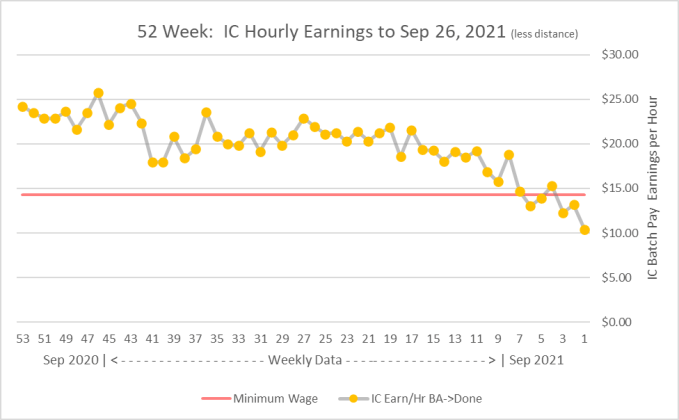
Image Credits: Daniel Feuer

Other shoppers have also observed that their pay has gone down over time. Shoppers pay for their own gas, car insurance and car expenses, so their take-home pay stretches less than it might seem.

“My pay has gone down probably 70% since I started four years ago,” said Sharon Goen, a 58-year-old Instacart shopper based in Las Vegas, Nevada. “It used to be that anything over 24 items, you get a bump in pay. Now, it’s $7 a batch. I saw one the other day that had 77 unique items, 100 units, for $7. You can’t go through the store and get 77 items in 15 minutes. You’re there for an hour and a half.”

Anni McClung, a shopper based in Houston, Texas, started shopping on Instacart four months ago. But she’s already confused by how pay is calculated.

“I would like someone to explain to me why for one batch I get $7, for two batches I get $7 and for three batches I get $7. Seems like they have to pay me $21,” McClung told TechCrunch. “Why is it $7 for half a mile, and also $7 for 6.8 miles?”

McClung, who will participate in the strike, said that she tried to contact Instacart’s customer service line for shoppers to learn how mileage is calculated into base pay for a batch. She said that she was routed to three different representatives without receiving an answer.

TechCrunch asked Instacart to clarify how base pay is impacted by the distance a shopper has to drive. The company said that mileage is incorporated into a shopper’s base pay at a rate of $0.60 per mile from store to customer delivery, except in California, where the rate is $0.30 per mile. But shoppers aren’t seeing that value reflected in their batches. Instacart declined to tell TechCrunch whether or not the $7 minimum is inclusive of the $0.60 per mile driven. If that is the case, then that would explain why shoppers might see a batch that’s five miles away for less than $8 — if the mileage were added to the minimum labor fee, then a five-mile drive would give the shopper an extra $3 to their $7 base.
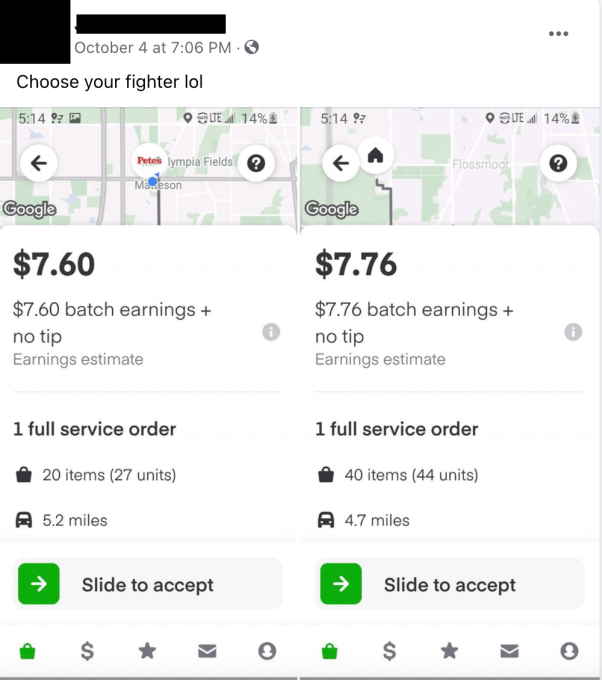
Image Credits: Screenshot from Instacart Chicago Shoppers group on Facebook, obtained by TechCrunch

Instacart contracted 300,000 more shoppers during the coronavirus pandemic since the demand for grocery delivery was higher than ever. Instacart told TechCrunch that its shopper population has remained steady at around 500,000 shoppers since then, and that customer demand is four times higher than it was at the start of 2020. Since March 2020, Instacart said shoppers have earned more than $5.5 billion on the platform.

But as customers adapt to the conditions of the pandemic, shoppers observe that fewer customers are using the service, making it harder to get work on the app. Instacart said that there are waitlists to become a shopper in many regions. Shoppers that spoke to TechCrunch from Nevada, Texas and New York all reported that their markets are oversaturated with shoppers’ demand for batches to fill.

“In the beginning of the pandemic, it was great. I was making anywhere from $1,200 to $1,500 a week only working about 30 hours or so,” said JoJo Spatafora, a shopper in Staten Island, New York who has been with Instacart for three years. “But it seems as if things have changed and they over-hired. Instacart has been aware of this and has not done anything about it. They only care about customers, not their shoppers.”

In the past, shoppers would set the hours they wanted to work, and during that time, they would be individually assigned batches — they had four minutes to look it over and decide if they wanted to accept before it would be assigned to someone else. Since 2019, Instacart has used an on-demand system, where shoppers can choose to work at a moment’s notice. Because of that, many shoppers will be offered a batch at once, which shows the base pay, tip, distance to drive, and a preview of the items in the order — whoever swipes on the batch first gets the job. Goen told TechCrunch that her area is so oversaturated with shoppers that when a batch pops up, she needs to accept it without taking much time to look over the details.

“I’m 58 years old, and if I see something that’s got a decent pay, I don’t have the time to see how many cases of water are going to a third-floor apartment,” Goen said. “I just can’t physically do those kinds of orders anymore, and if I were to accept that and then cancel it, that would go against my acceptance rate.” If a shopper has canceled around 15% of their last 100 orders, they will start to receive notices from Instacart before their account is suspended.

Shoppers going on strike hope that this action will get the attention of CEO Fidji Simo. Instacart told TechCrunch that Simo has been regularly conversing with shoppers about their experiences on the job, but Simo hasn’t responded to the Gig Workers Collective’s open letters.

“As far as the strike, I don’t participate in such nonsense because it does not make a difference,” Spatafora told TechCrunch. “Once when shoppers went on strike, Instacart decided to punish us by removing the three-dollar bonus every time a customer gives us a five-star rating.”

Spatafora is referring to a past Instacart policy that would give shoppers an extra $3 for each order they completed with a five-star rating. Workers were tipped off that the bonus would last through January 2020. But when shoppers went on strike in November 2019 to demand that the default tip be raised from 5% back to 10%, the company removed the bonus soon after. Instacart said that it always planned to end the bonus in November 2019, but the Gig Workers Collective claimed that this was an act of retaliation.

“Are we really going to impact business? Probably not,” said Goen. Instacart affirmed to TechCrunch that they don’t expect to see a change in their revenue. “But this will be my sixth walk-off I think. I’m going to keep doing it ’til we make progress. And we have made progress every now and then.” 

The Sunday Magazine

Misconceptions about science fuel pandemic debates and controversies, says Neil deGrasse Tyson

Schools should teach science as an evolving process — not

 a series of hard facts, argues astrophysicist

Astrophysicist Neil deGrasse Tyson attends the 23rd annual Webby Awards at Cipriani Wall Street in New York on May 13, 2019. Tyson told The Sunday Magazine host Piya Chattopadhyay that debates and controversies surrounding COVID-19 and other scientific topics often stem from a basic misunderstanding of the scientific method. (Christopher Smith/Invision/Associated Press)

Astrophysicist Neil deGrasse Tyson says some of the bitter arguments about medicine and science during the COVID-19 pandemic can be blamed on a fundamental misunderstanding of science.

"People were unwittingly witnessing science at its very best.… [They said,] 'You told me not to wear a mask a month ago and now you tell me [to] wear it.… You don't know what you're talking about.' Yes, we do," the American astrophysicist and author told The Sunday Magazine host Piya Chattopadhyay.

"Science is a means of querying nature. And when we have enough experiments and enough observations, only then can we say: This is how nature behaves, whether you like it or not. And that is when science contributes to what is to what is objectively true in the world."

Tyson, who is also the director at the Hayden Planetarium in New York City, is doing his part to try to make his corner of the scientific world more accessible with his new book A Brief Welcome to the Universe, co-authored with Michael A. Strauss and J. Richard Gott.

He hopes readers can take those lessons to other scientific topics, including the COVID-19 pandemic, which has seen several controversies flourish about the nature of the virus and the measures developed to fight it.

Misconceptions about how science works stems in part, he said, from the fact that it's often improperly taught at the earliest levels of education.

"People think science is the answer. 'Oh, give me the answer. You're a scientist. What's the answer?' And then I say things like: 'We actually don't have an answer to that.' And people get upset. They even get angry. 'You're a scientist. You should know,'" he explained.

"What's not taught in school is that science is a way of learning what is and is not true. The scientific method is a way of ensuring that your own bias does not leave you thinking something is true that is not, or that something is not true that is."

Big universe, simple language

A Brief Welcome to the Universe is billed as an approachable "pocket-sized tour" of the cosmos, answering such questions as "How do stars live and die?" and "How did the universe begin?"

It's a condensed version of the 2016 edition of the book, Welcome to the Universe: An Astrophysical Tour.

Welcome to the Universe: A Pocket-Sized Tour is co-authored by Neil deGrasse Tyson, Michael A. Strauss and J. Richard Gott. (Princeton University Press)

Tyson and his co-authors argue in the book that astrophysics uses simpler language than other scientific disciplines, which makes it a good starting point to learn about science.

"I don't simplify the origin of the universe and then call it 'The Big Bang' to you. We call it that to each other," said Tyson. The same goes for well-known phenomena like black holes, sunspots and the planet Jupiter's Great Red Spot, he added.

Start with those, and then you can move onto other topics, some with more complex names — such as the Coriolis force, which, among other things, explains how the Earth's rotation subtly affects the way a football travels in the air during a field kick.

"There are simple things in science. And if you're interested, you can then go out and learn the complex things. But I'm not going to lead with the complex things. What good is that? That never solved anything," he said.

Many people likely know Tyson from his appearances on American talk shows, often critiquing or debunking questionable science seen in movies and other pop culture. He's commented on everything from the feasibility of resurrecting dinosaurs, like in Jurassic Park, to the improper night-sky backdrop in the final scenes of Titanic.

Tyson, left, and Seth MacFarlane, executive producer of Cosmos, participate in the Television Critics Association's winter presentations in Pasadena, Calif., on Jan. 13, 2014. (Kevork Djansezian/Reuters)

He also talks about science on his podcast StarTalk, as well as on a National Geographic TV show of the same name and another show called Cosmos.

Tyson was temporarily removed from both programs in late 2018, after accusations of sexual misconduct from two women, which he denied. Following an investigation, in early 2019, National Geographic and Fox reinstated Tyson on their shows. They did not address the allegations in their statement announcing the decision.

About Pluto

Perhaps none of the topics Tyson is known for speaking about has sparked more discussion than Pluto, the former ninth planet.

"Oh, don't get me started," Tyson responded immediately upon mention of the icy celestial body, which was demoted from planet to dwarf planet status in 2006 by the International Astronomical Union.

The term "dwarf planet" is relatively new. It grouped Pluto, which was originally discovered in 1930, with a number of other icy bodies larger than an asteroid but smaller in size and mass to rocky planets closer to the Sun, including the Earth.

NASA’s New Horizons spacecraft captured this high-resolution, enhanced-colour view of Pluto on July 14, 2015. Once considered the solar system's ninth planet, it was reclassified as a dwarf planet in 2006. (NASA/JHUAPL/SwRI)

"The word planet really should be discarded," he said. "Because if I say I discovered a planet orbiting a star, you have to ask me 20 more questions to get any understanding of what the hell the thing is."

The word "planet" comes from the Greek planetes, meaning "wanderer." In ancient times, that included Mercury, Venus, Mars, Jupiter and Saturn, but also the moon and the sun. Earth wasn't considered a planet, because it was believed to be the unmoving centre of the known universe.

Over time, the scientific method progressed beyond that: the Earth is a planet that orbits the sun, which is a star. We now know our moon is one of at least 200 moons in the solar system.

To Tyson, Pluto's reclassification represents the next step in our evolving understanding of the cosmos, which has necessarily become more complex.

It also illustrates a broadening of our scientific horizons that ancient civilizations might have never contemplated.

That's why when Tyson was asked how to best answer a child's question about things we do not know, such as "how big is the universe," he said the best thing we can say is that we do not know.

"That is one of the greatest answers you can ever give someone — because it leaves them wanting for more. And they might one day be the person who discovers what the answer will be."


Written by Jonathan Ore. Produced by Sarah-Joyce Battersby.


Dark Matter Alternative Passes Big Test

• Physics 14, 143
A cosmological model that doesn’t require dark matter has overcome a major hurdle in matching observations from the cosmic microwave background.
WMAP Science Team/NASA
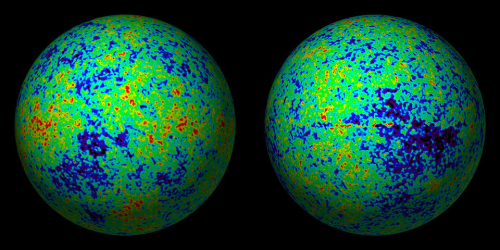
Sky patterns. MOND models—which don’t require dark matter—have not previously been able to reproduce the temperature variations measured in the cosmic microwave background (shown here), a relic from the big bang. But now researchers have created a MO... Show more

Researchers pursuing an unconventional view of cosmology that dispenses with dark matter have developed a model that can match observations of the cosmic microwave background (CMB), the leftover glow of the big bang [1]. This dark-matter-free model is an extension of the so-called MOND (modified Newtonian dynamics) theory, which assumes that the gravitational force on galaxy scales is different from the standard Newtonian force. Previous MOND-based models could not reproduce the CMB. The researchers say that their model can be further tested with observations of galaxy clusters and gravitational waves.

The MOND theory was devised more than 30 years ago as a way to explain galactic rotation data without invoking the existence of the mysterious dark matter [2]. MOND proponents offered an alternative mystery in which the gravitational force changes for accelerations smaller than a threshold of 1010m/s2. The idea did not spring from any underlying theory, but surprisingly, the same acceleration threshold works for nearly all galaxies—small and large, young and old.

The main reason that dark matter has been favored over MOND is that dark matter is consistent with a much larger range of astrophysical observations. For example, dark matter can explain galaxies’ bending of light from distant sources (gravitational lensing), whereas MOND in its initial form could not. Researchers have devised so-called relativistic MOND models that can fit the lensing observations [3], but until now, none of these revised versions of the theory were able to reproduce CMB data. “If the theory can’t do that, then it’s not worth considering further,” says Constantinos Skordis from the Czech Academy of Sciences in Prague.

NASA/CXC/SAO/D. Hartmann/JPL-Caltech
Turnaround is fair play. Galaxies, like M101 shown here, have rotation profiles that can’t be explained by the visible matter. The popular solution is to assume the existence of dark matter, but another solution, called MOND, can account for galaxy d... Show more

Skordis and Czech Academy colleague Tom Złósnik have now created a MOND-inspired model that accounts for the CMB while also being consistent with gravitational lensing observations and gravitational-wave speed measurements. The model follows recent MOND efforts in postulating the existence of two fields that permeate all of space and together act like an extra gravitational force. One of these fields is a scalar field—similar to the Higgs field that is associated with the Higgs boson. The other is a vector field, which has a direction at each point in space, somewhat like a magnetic field.

Skordis and Złósnik set the model’s parameters so that, in the early Universe, the gravity-modifying fields generate a gravitational effect that mimics that of dark matter. Mimicking dark matter in this way ensures that the observed CMB patterns are reproduced. The fields evolve over cosmic time, and eventually the gravitational force follows the original MOND proposal.

Skordis says that the model is similar to other alternative gravity models that have been proposed to explain dark energy (see Viewpoint: Reining in Alternative Gravity). All cosmological models add something (new particles or new fields) to explain observations, he says. He admits that—unlike dark matter models that are often based on fundamental symmetry principles—the new model was not conceived with an underlying theory in mind. However, such a theoretical basis might be uncovered using the new MOND model.

“It really is a huge breakthrough,” says cosmologist Stacy McGaugh from Case Western Reserve University in Ohio. “For years stretching into decades, people have largely ignored MOND because it seemed impossible to do what Skordis and Złósnik have now done.” But David Spergel, a cosmologist from the Flatiron Institute in New York, finds the new model “baroque.” He argues that relativistic MOND models only work by “effectively positing a complex form of dark matter.”

Cosmologist Katherine Freese from the University of Texas congratulates the researchers for their accomplishment. “It is a big deal to construct a relativistic version of MOND that is able to match all existing data, especially fitting CMB data along with the MOND phenomenology in galaxies,” she says. “However, the model has a lot of ingredients,” she says. “I myself would still vote for dark matter as a simpler explanation.”

McGaugh counters that dark matter models cannot explain everything, such as the Universe’s lithium abundance or the discrepancies between different types of measurements of the cosmic expansion rate. The new MOND model might be able to solve these problems, but Skordis says that it will take more time to work out the theoretical details. He says that the model can be checked in other ways, for example, by comparing its predictions with observations of galaxy clusters or by looking for signatures of the gravity-modifying fields in gravitational waves.

Tessa Baker, an expert in alternative gravity models from Queen Mary University of London says that if dark matter detectors continue to come up empty, “then we may see increased interest in this family of modified gravity models.”

–Michael Schirber

Michael Schirber is a Corresponding Editor for Physics based in Lyon, France.

References

  1. C. Skordis and T. ZÅ‚oÅ›nik, “New relativistic theory for modified Newtonian dynamics,” Phys. Rev. Lett. 127, 161302 (2021).
  2. M. Milgrom, “On the use of galaxy rotation curves to test the modified dynamics,” Astrophys. J. 333, 689 (1988).
  3. J. D. Bekenstein, “Relativistic gravitation theory for the modified Newtonian dynamics paradigm,” Phys. Rev. D 70, 083509 (2004).

More Information


Scientists find evidence the early solar system harbored a gap between its inner and outer regions

solar system
Credit: Pixabay/CC0 Public Domain

In the early solar system, a "protoplanetary disk" of dust and gas rotated around the sun and eventually coalesced into the planets we know today.

A new analysis of ancient meteorites by scientists at MIT and elsewhere suggests that a mysterious gap existed within this disk around 4.567 billion years ago, near the location where the asteroid belt resides today.

The team's results, appearing today in Science Advances, provide direct evidence for this gap.

"Over the last decade, observations have shown that cavities, gaps, and rings are common in disks around other ," says Benjamin Weiss, professor of planetary sciences in MIT's Department of Earth, Atmospheric, and Planetary Sciences (EAPS). "These are important but poorly understood signatures of the physical processes by which gas and dust transform into the young sun and planets."

Likewise the cause of such a gap in our own solar system remains a mystery. One possibility is that Jupiter may have been an influence. As the gas giant took shape, its immense gravitational pull could have pushed gas and dust toward the outskirts, leaving behind a gap in the developing disk.

Another explanation may have to do with winds emerging from the surface of the disk. Early  are governed by . When these fields interact with a rotating disk of gas and dust, they can produce winds powerful enough to blow material out, leaving behind a gap in the disk.

Regardless of its origins, a gap in the early solar system likely served as a cosmic boundary, keeping material on either side of it from interacting. This physical separation could have shaped the composition of the solar system's planets. For instance, on the inner side of the gap, gas and dust coalesced as terrestrial planets, including the Earth and Mars, while gas and dust relegated to the farther side of the gap formed in icier regions, as Jupiter and its neighboring gas giants.

"It's pretty hard to cross this gap, and a planet would need a lot of external torque and momentum," says lead author and EAPS graduate student Cauê Borlina. "So, this provides evidence that the formation of our planets was restricted to specific regions in the early solar system."

Weiss and Borlina's co-authors include Eduardo Lima, Nilanjan Chatterjee, and Elias Mansbach of MIT, James Bryson of Oxford University, and Xue-Ning Bai of Tsinghua University.

A split in space

Over the last decade, scientists have observed a curious split in the composition of meteorites that have made their way to Earth. These space rocks originally formed at different times and locations as the solar system was taking shape. Those that have been analyzed exhibit one of two isotope combinations. Rarely have meteorites been found to exhibit both—a conundrum known as the "isotopic dichotomy."

Scientists have proposed that this dichotomy may be the result of a gap in the early solar system's disk, but such a gap has not been directly confirmed.

Weiss' group analyzes meteorites for signs of ancient magnetic fields. As a young planetary system takes shape, it carries with it a magnetic field, the strength and direction of which can change depending on various processes within the evolving disk. As ancient dust gathered into grains known as chondrules, electrons within chondrules aligned with the magnetic field in which they formed.

Chondrules can be smaller than the diameter of a human hair, and are found in meteorites today. Weiss' group specializes in measuring chondrules to identify the ancient magnetic fields in which they originally formed.

In previous work, the group analyzed samples from one of the two isotopic groups of meteorites, known as the noncarbonaceous meteorites. These rocks are thought to have originated in a "reservoir," or region of the , relatively close to the sun. Weiss' group previously identified the ancient magnetic field in samples from this close-in region.

A meteorite mismatch

In their new study, the researchers wondered whether the magnetic field would be the same in the second isotopic, "carbonaceous" group of meteorites, which, judging from their isotopic composition, are thought to have originated farther out in the solar system.

They analyzed chondrules, each measuring about 100 microns, from two carbonaceous meteorites that were discovered in Antarctica. Using the superconducting quantum interference device, or SQUID, a high-precision microscope in Weiss' lab, the team determined each chondrule's original, ancient magnetic field.

Surprisingly, they found that their field strength was stronger than that of the closer-in noncarbonaceous meteorites they previously measured. As young planetary systems are taking shape, scientists expect that the strength of the magnetic field should decay with distance from the sun.

In contrast, Borlina and his colleagues found the far-out chondrules had a stronger magnetic field, of about 100 microteslas, compared to a field of 50 microteslas in the closer chondrules. For reference, the Earth's magnetic field today is around 50 microteslas.

A planetary system's magnetic field is a measure of its accretion rate, or the amount of gas and dust it can draw into its center over time. Based on the carbonaceous chondrules' , the solar system's outer region must have been accreting much more mass than the inner region.

Using models to simulate various scenarios, the team concluded that the most likely explanation for the mismatch in accretion rates is the existence of a gap between the inner and outer regions, which could have reduced the amount of gas and dust flowing toward the sun from the outer regions.

"Gaps are common in protoplanetary systems, and we now show that we had one in our own solar system," Borlina says. "This gives the answer to this weird dichotomy we see in meteorites, and provides evidence that gaps affect the composition of planets."

Meteorites show transport of material in early solar system
More information: Caue Borlina, Paleomagnetic Evidence for a Disk Substructure in the Early Solar System, Science Advances (2021). DOI: 10.1126/sciadv.abj6928. www.science.org/doi/10.1126/sciadv.abj6928
Journal information: Science Advances 
Provided by Massachusetts Institute of Technology 
ALPHA & OMEGA
IN THE BEGINNING… WHAT IF THERE WAS NO BEGINNING OF TIME?


Credit: NASA

Oct 15, 2021

There is something unnerving about hearing a somber voice intone “In the beginning”… but wait. What if the beginning of time is no more real than the sci-fi movies you hear it in?

Could the Big Bang have never really happened? Will there be no end to the universe? Is everything in between, even the passage of time, just an illusion? Physicist Bruno Bento is now proposing that the universe may have had no beginning at all, meaning it did not just blow up out of nothingness, expanding rapidly from a few atoms into an expanse too vast for the human brain to fathom. What we perceive as the past and future may be infinite.

Bento didn’t just wake up one morning and decide that the universe didn’t suddenly explode into being about 14 billion years ago. Turns out that general relativity does not hold up with singularities like black holes and the Big Bang. He and his colleagues recently posted a study on the preprint server arXiv, in which they used causal set theory to propose that space and time may not be what we think they are.

“Sometimes, general relativity gives us infinities that we do not consider to be physical,” he told SYFY WIRE. “This is what we mean when we say it breaks down — we need something else, something new, to describe regions of strong gravity where it does not provide a physical answer.”

Most scientists believe Einstein is right about general relativity, or the idea that our perception of gravity arises from the curve of space and time. Some phenomena insist on bending that theory and could possibly break it in the future. Black holes are dangerous territory for general relativity because there are too many aspects of them we cannot see. Though there is not enough evidence to disprove it (yet), the inability of any instrument to observe gravity inside a black hole, from which light cannot escape, raises controversial questions.

The thing about black holes and other weird gravitational phenomena is that general relativity cannot fathom the extreme size and energies involved. There is a threshold it cannot cross when you are dealing with singularities, or parts of spacetime where everything we think we know about physics suddenly starts to fall apart. Gravity gains almost unfathomable strength at minuscule scales in a singularity. Even if there is something that can explain black hole innards or the hypothetical Big Bang, we have to find out what that is. Enter causal set theory.

“Spacetime is fundamentally discrete in causal set theory,” said Bento. “It is a causal set. This means that there is a minimum possible distance between any two events, both in space and time. We don't know exactly what this minimum scale is, there are currently no experiments that can probe these scales.”

Because you can’t exactly go into a lab and test this out, theoretical physics may be able to offer some closure. Bento believes that how the breakdown of general relativity happens could mean the Planck scale, which declares a minimum limit for the universe, may be able to pick up where it left off. Breakdown could still happen past that limit. However, that scale may be small enough to possibly reveal things beyond the realm of human observation.

What this means for the passage of time is that an element in a causal set is an event, or a specific point in spacetime. Elements is created whenever corresponding events start to happen. “Now” is the emergence of such an event. What is seen as a “causal set” is supposed to grow from the first element onward, adding new elements on top of the set, so the passage of time means that one element after another comes into being. “Past” is all the elements that already emerged. “Future” is those that are still coming up.

“In causal set theory, the passage of time was used as an input when constructing a dynamics for causal sets, or how a causal set (a universe) should behave,” Bento said. “One consequence of this is that the past is finite and the universe has a beginning.“

But wait. How, then, can there be no end and no beginning? That lies in how Bento and his team see possibilities in causal set theory. The set could potentially grow in either way, up or down, and if it can grow in the direction of the past and the future, and if it can do that, it means that there is no end or beginning. What we think of as “time” might just be a way of trying to understand something that would otherwise make our brains explode.

What is really surprising is that Bento thinks the universe would still look exactly the same without a Big Bang. It isn’t that general relativity just vanishes. It can still explain everything that direct observations can be made on, whether by telescope, the naked eye or otherwise. So our solar system and everything observable in it is real. Earth is real. We ourselves are real.

“The problem appears when we cannot see,” he said. “That being said, it's usually accepted that a Big Bang singularity does not exist (nor do black hole singularities). The debate is in what will replace them and how.”

Now try to go to sleep at night thinking about that


Katie Mack: Life-altering questions about the end of the universe | TED

Oct 15, 2021

TED
In this fascinating conversation, cosmologist and TED Fellow Katie Mack delves into everything from the Big Bang theory to what we see at the edge of the observable universe to a few ways the cosmos might end. 
Stay tuned to hear Mack recite an original poem on the wonder and marvel of existence. 
This conversation, hosted by deputy director of the TED Fellows program, Lily James Olds.

Opinion

Was Our Universe Created in a Laboratory?


Developing quantum-gravity technologies may elevate us to a “class A” civilization, capable of creating a baby universe


October 15, 2021
Credit: NASA, ESA, HEIC, and The Hubble Heritage Team (STScI/AURA)

The biggest mystery concerning the history of our universe is what happened before the big bang. Where did our universe come from? Nearly a century ago, Albert Einstein searched for steady-state alternatives to the big bang model because a beginning in time was not philosophically satisfying in his mind.

Now there are a variety of conjectures in the scientific literature for our cosmic origins, including the ideas that our universe emerged from a vacuum fluctuation, or that it is cyclic with repeated periods of contraction and expansion, or that it was selected by the anthropic principle out of the string theory landscape of the multiverse—where, as the MIT cosmologist Alan Guth says “everything that can happen will happen ... an infinite number of times,” or that it emerged out of the collapse of matter in the interior of a black hole.

A less explored possibility is that our universe was created in the laboratory of an advanced technological civilization. Since our universe has a flat geometry with a zero net energy, an advanced civilization could have developed a technology that created a baby universe out of nothing through quantum tunneling.

This possible origin story unifies the religious notion of a creator with the secular notion of quantum gravity. We do not possess a predictive theory that combines the two pillars of modern physics: quantum mechanics and gravity. But a more advanced civilization might have accomplished this feat and mastered the technology of creating baby universes. If that happened, then not only could it account for the origin of our universe but it would also suggest that a universe like our own—which in this picture hosts an advanced technological civilization that gives birth to a new flat universe—is like a biological system that maintains the longevity of its genetic material through multiple generations.

If so, our universe was not selected for us to exist in it—as suggested by conventional anthropic reasoning—but rather, it was selected such that it would give rise to civilizations which are much more advanced than we are. Those “smarter kids on our cosmic block”— which are capable of developing the technology needed to produce baby universes—are the drivers of the cosmic Darwinian selection process, whereas we cannot enable, as of yet, the rebirth of the cosmic conditions that led to our existence. One way to put it is that our civilization is still cosmologically sterile since we cannot reproduce the world that made us.

With this perspective, the technological level of civilizations should not be gauged by how much power they tap, as suggested by the scale envisioned in 1964 by Nikolai Kardashev. Instead, it should be measured by the ability of a civilization to reproduce the astrophysical conditions that led to its existence.

As of now, we are a low-level technological civilization, graded class C on the cosmic scale, since we are unable to recreate even the habitable conditions on our planet for when the sun will die. Even worse, we may be labeled class D since we are carelessly destroying the natural habitat on Earth through climate change, driven by our technologies. A class B civilization could adjust the conditions in its immediate environment to be independent of its host star. A civilization ranked class A could recreate the cosmic conditions that gave rise to its existence, namely produce a baby universe in a laboratory.

Achieving the distinction of class A civilization is nontrivial by the measures of physics as we know it. The related challenges, such as producing a large enough density of dark energy within a small region, already have been discussed in the scientific literature.

Since a self-replicating universe only needs to possess a single class A civilization, and having many more is much less likely, the most common universe would be the one that just barely makes class A civilizations. Anything better than this minimum requirement is much less likely to occur because it requires additional rare circumstances and does not provide a greater evolutionary benefit for the Darwinian selection process of baby universes.

The possibility that our civilization is not a particularly smart one should not take us by surprise. When I tell students at Harvard University that half of them are below the median of their class, they get upset. The stubborn reality might well be that we are statistically at the center of the bell-shaped probability distribution of our class of intelligent life-forms in the cosmos, even when taking into account our celebrated discovery of the Higgs boson by the Large Hadron Collider.

We must allow ourselves to look humbly through new telescopes, as envisioned by the recently announced Galileo Project, and search for smarter kids on our cosmic block. Otherwise, our ego trip may not end well, similarly to the experience of the dinosaurs, which dominated Earth until an object from space tarnished their illusion.

AUTHOR
Avi Loeb is former chair (2011-2020) of the astronomy department at Harvard University, founding director of Harvard's Black Hole Initiative and director of the Institute for Theory and Computation at the Harvard-Smithsonian Center for Astrophysics. He also chairs the Board on Physics and Astronomy of the National Academies and the advisory board for the Breakthrough Starshot project, and is a member of President's Council of Advisors on Science and Technology. Loeb is the bestselling author of Extraterrestrial: The First Sign of Intelligent Life Beyond Earth (Houghton Mifflin Harcourt).