Saturday, November 06, 2021

World’s Top Wind Turbine Makers Expect Another Difficult Year

William Mathis
Sat, November 6, 2021,


(Bloomberg) -- Some of the world’s largest wind-turbine producers expect another tough year ahead.

Surging commodity prices and supply-chain headwinds are set to last into next year, according to Vestas Wind Systems A/S and Siemens Gamesa Renewable Energy SA. That’s making it harder for a business that’s so key to delivering the world’s climate goals to keep profitable.

The challenges come at an awkward time. Just as world leaders are gathering in Glasgow, Scotland, to try to hash out ambitious plans to avoid the worst consequences of global warming, installing more renewable sources of energy is becoming increasingly difficult and expensive.

“We are operating in a very difficult environment with challenging short-term market dynamics and low visibility on supply chain normalization,” said Siemens Gamesa Chief Executive Officer Andreas Nauen. “However, the current difficulties should not overshadow the bright future for wind energy, driven by its role in the decarbonization of our planet.”

The turbine industry is facing adversity at nearly every point in the supply chain. Components are hard to get, there isn’t enough shipping capacity to move finished products, and in some markets workers can’t get to building sites because of restrictions to contain the global pandemic.

“Everyone’s fighting against everyone to get both the raw materials and the components, which leads to very adverse price stability,” Vestas’s Chief Executive Officer Henrik Andersen said in an interview earlier this week.

Commodity prices surged this year as global economies rebounded from the pandemic, boosting the price of everything from oil to natural gas and steel. The metal is the single biggest input for manufacturers, making up about 84% of a turbine’s weight.

Vestas lowered its earnings outlook on Wednesday. It now expects full-year margin on earnings before interest and tax and before special items of 4%. That’s down from previous range of 5% to 7% and about half of what the company expected at the beginning of the year.

On Friday, Siemens Gamesa posted a second year of losses. The world’s largest maker of offshore wind turbines lost 627 million euros ($725 million) in the year ended in September. That’s on top of a loss of 918 million euros a year earlier. Still, the company expects profits to recover next year, with margins forecast to turn positive.

Shares in both companies plunged this week, adding to billions of dollars already shaved off their market value this year.

“The market is expecting the situation will change and go back to normal but we truly don’t know when this will happen,” Nauen said in a call with analysts on Friday.

For Siemens Gamesa, the impact has been particularly acute. Even before the current slate of problems, the company had already been trying to turn its struggling business around. It appointed Nauen as chief executive last year as part of an overhaul meant to return its onshore turbine business to profitability.

This isn’t the first time the wind turbine business has faced difficulties. Companies have been locked in stiff competition as project developers fought to cut costs in order to win auctions to build wind farms.

“Margins have been squeezed pretty heavily for quite a few years now,” said Oliver Metcalfe, wind industry analyst at BloombergNEF. “These supply chain issues are making things worse.”

If turbine makers can weather the current storm, the future still looks bright. Demand for their products is set to surge in the coming years as the world increasingly relies on wind power to generate electricity. More renewables are also needed to reduce dependency on fossil fuels, with prices of everything from coal to power and oil surging this year.

“What is needed now is to ensure we have a high push on developing more renewable energy worldwide, including Europe,” Christian Rynning-Tonnesen, chief executive officer of Norwegian electricity producer Statkraft AS, said in an interview this week. “That’s needed for supply reasons, but it’s also needed to fight climate change. That’s the long-term solution.”
Fear Stalks Rohingya Refugee Camps After Murders

November 06, 2021 2:50 AM
Agence France-Presse
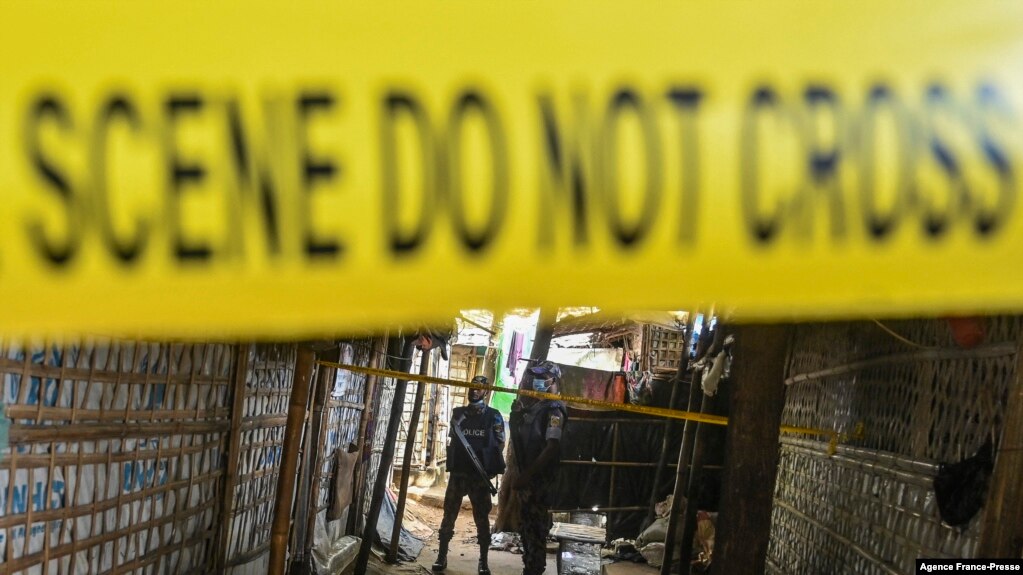
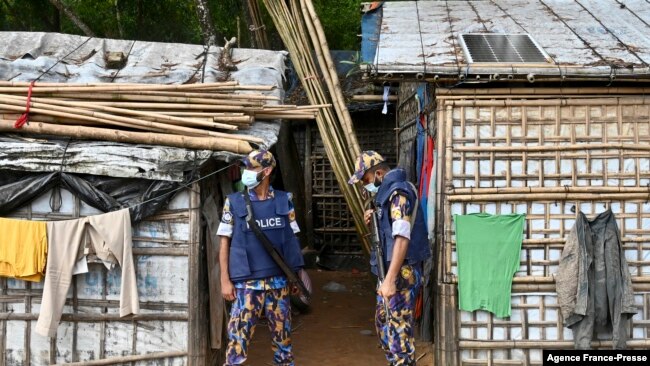
FILE - Police stand guard in October 2021 near the office of top community Rohingya leader and activist Mohib Ullah, who was killed by gunmen in late September, at Kutupalong refugee camp in Ukhia.


KUTUPALONG, BANGLADESH —

Bloodstains still mark the spot where assassins gunned down Mohib Ullah, an activist who was a leading voice for the 850,000 Rohingya living in fear in Bangladeshi refugee camps.

In the weeks since the murder, a senior member of the now-shell-shocked volunteer group that Ullah headed has received phone calls telling him he'll be next. And he's not alone.

"They can hunt you down the way they have brazenly shot dead our leader and so many people," Noor, too frightened to give his real name or be filmed, told AFP.

"They," he believes, are members of the Arakan Rohingya Salvation Army (ARSA), an insurgent group fighting the Myanmar military but also thought to be behind a wave of killings and criminal activity in the camps.

ARSA has denied it killed Ullah.


Most of the Rohingya have been in the camps since 2017 when they fled a brutal military offensive in Buddhist-majority Myanmar, where the predominantly Muslim minority are reviled and seen as illegal immigrants.

Refusing to go back until they are assured of security and equal rights, the refugees remain stuck in bamboo-and-tarp shacks with no work, poor sanitation and little education for their children.

Overflowing latrines fill narrow mud lanes with excrement in monsoon season, and fires can rip through the flimsy homes in minutes during the hot summers.

By day the Bangladesh authorities provide some security. But at night the camps become the domain of gangs -- allegedly linked to ARSA -- that traffic millions of dollars' worth of methamphetamine from Myanmar.

"The scenario is different as soon as the sun sets," Israfil, a Rohingya refugee who goes by one name, told AFP.

"The dark time is the long hours when they do whatever they want to do," he added.

'Brutal carnage'

Working among the chaos and unease in the camps, Ullah and his colleagues quietly documented the crimes that his people suffered at the hands of the Myanmar military, while pressing for better conditions.

FILE - A member of the Armed Police Battalion stands guard in October 2021 near the office of top community Rohingya leader and activist Mohib Ullah, who was shot dead by gunmen in late September, at Kutupalong refugee camp in Ukhia.

The former schoolteacher shot to prominence in 2019 when he organized a protest of around 100,000 people in the camps to mark two years since their exodus.

That year he met U.S. President Donald Trump in the White House and addressed a U.N. meeting in Geneva.

But his fame appears to have gone down badly with ARSA.

They saw Ullah as threatening their place as the sole voice representing the Rohingya -- one who was opposed to their violence, his colleagues and rights activists say.

"He became a thorn in ARSA's side," said Nur Khan Liton, a top rights activist in Bangladesh. "ARSA was also frightened by his enormous popularity."

Three weeks after Ullah's murder in late September, gunmen and machete-wielding attackers slaughtered seven people in an Islamic seminary that had allegedly refused to pay protection money to ARSA.

"The brutal carnage bore all the marks of ARSA. The group previously slaughtered at least two top Islamic clerics because they didn't back ARSA's violent struggle," said a top expatriate Rohingya activist.

"ARSA has carried out the murders to establish its full control in the camps. After the latest carnage, everyone seems to be silenced," he added, asking to remain anonymous.

'No presence'

After the attack on the seminary, the U.N. refugee agency urged the Bangladesh authorities "to take immediate measures to improve the security in the refugee camps."

FILE - Police stand guard Oct. 5, 2021, near the office of top community Rohingya leader and activist Mohib Ullah, who was shot dead by gunmen, at Kutupalong refugee camp in Ukhia.


Blood stained office carpet.

A series of turf war killings in 2019 prompted the Bangladesh army to erect barbed-wire fences around the camps. The elite Armed Police Battalion was tasked with patrolling the area.

Police have also carried out a series of security operations that have killed dozens of alleged Rohingya drug traffickers.

But although they have arrested dozens of people over Ullah's killing, they are in denial about ARSA's activity, blaming instead "rivalries" in the camps.

"ARSA has no presence in the camps," Naimul Haque, the commanding officer of the Kutupalong camp, insisted to AFP.

'Extreme fear'


Members of Ullah's group are far from reassured, saying that their security concerns fall on deaf ears.

Some even mutter that ARSA and the Bangladesh security forces are in cahoots -- something Dhaka vehemently denies.

Kyaw Min, a top Rohingya leader, said police assist ARSA to "reign" at night by "conveniently" not being around when they operate.

A month before he died Ullah sent a letter, seen by AFP but which could not be independently verified, to the Bangladesh authorities.

He named 70 men in the camps he said were ARSA members and said he and his colleagues feared for their lives.

Bangladesh's refugee commissioner Shah Rezwan Hayat and camp-in-charge Atiqul Mamun denied receiving any such letter.

Family members of senior Rohingya leaders told AFP that Bangladesh security forces have since relocated at least six families including Ullah's, fearing they will be targeted.

"We thought we would be safe in Bangladesh. But now we don't know when the killers will knock on our doors," activist Sa Phyo Thida told AFP.

"Just like those genocide days in Myanmar in 2017 when we were living in fear of the military death squad, we now live in extreme fear."
COP26: Thousands rally in Glasgow to demand climate action

Issued on: 06/11/2021


A demonstrator holds a sign during a protest as the UN Climate Change Conference (COP26) takes place, in Glasgow, Scotland, Britain, November 6, 2021. 

Text by: NEWS WIRES|
Video by: FRANCE 24

Thousands of climate protesters braved torrential rain in Glasgow on Saturday to take part in worldwide demonstrations against what campaigners say is a failure of crunch UN talks to bring about the radical action needed to tame global warming.

Dozens of events are planned worldwide to demand cuts in fossil fuel use and immediate help for communities already affected by climate change, particularly in the poorer countries in the South.

In Glasgow, organisers and police said they ultimately expected up to 50,000 people to parade through the streets of the Scottish city.

Demonstrators began gathering on Saturday morning in a park near the COP26 summit venue, chanting: "Our world is under attack, stand up fight back!"

"I think a lot of politicians are scared of the power of this movement," said a 22-year-old Norwegian protester who gave her name as Jenny.

She said it was important to fight for people from smaller nations who could not travel to the conference, which has been beset by accusations of exclusion.

Delegates from nearly 200 countries are in Glasgow to hammer out how to meet the Paris Agreement goals of limiting temperature rises to between 1.5 and 2 degrees Celsius.

At the halfway stage of the COP26 negotiations, some countries have upgraded their existing pledges to reduce greenhouse gas emissions, while there have been separate deals on phasing out coal, ending foreign fossil fuel funding, and slashing methane.

Widespread demos

The promises followed a pre-COP26 estimate from the UN that said national climate plans, when brought together, put Earth on course to warm 2.7C this century.

With just 1.1C of warming so far, communities across the world are already facing ever more intense fire and drought, displacement and economic ruin wrought by global heating.

And a major assessment last week showed global CO2 emissions were set to rebound in 2021 to pre-pandemic levels.

Swedish campaigner Greta Thunberg said the summit had gone nowhere near far enough in a speech at Friday's youth march in Glasgow, where she labelled the conference "a failure".

In Australia on Saturday, protesters in Sydney and Melbourne -- some dressed as lumps of coal or Prime Minister Scott Morrison, a vigorous defender of the mining industry -- echoed that sentiment, calling the talks "a sham" and their national leader "an absolute embarrassment".

"No more blah, blah blah. Real climate action now," read one sign at a protest in Sydney.

South Korean capital Seoul saw roughly 500 take to the streets demanding immediate action for communities already hit by the fallout of a heating planet.

About 1,000 people gathered in London outside the Bank of England with placards reading "Less talk more action" and "No More COP outs".

But others have urged critics not to rush to judgement about the UN-led climate process.

"COP26 has barely started," tweeted Michael Mann, director of Penn State's Earth System Science Center.

"Activists declaring it dead on arrival makes fossil fuel executives jump for joy."

'Words not enough'


Security has been boosted in Glasgow and many city-centre shops closed for Saturday's march, which is expected to draw a variety of groups including Extinction Rebellion.

"Many thousands of us are marching right across the world today to demand immediate and serious action," said Scottish activist Mikaela Loach.

"We're clear that warm words are not good enough -- and that the next week of talks must see a serious ramping up of concrete plans."

COP26 negotiations will continue on Saturday before pausing on Sunday ahead of what is shaping up to be a frantic week of shuttle diplomacy, as ministers arrive to push through hard-fought compromises.

Countries still need to flesh out how pledges made in the Paris deal work in practice, including rules governing carbon markets, common reporting timeframes and transparency.

Brianna Fruean, a Samoan member of the Pacific Climate Warriors, who addressed a world leaders' summit at the start of COP26, said it was time for leaders to take note of protesters' demands.

"It can't go on like this," she said.

"We refuse to be just victims to this crisis. We are not drowning, we are fighting and on Saturday the world will hear us."

(AFP)

Climate march keeps up pressure on leaders at U.N. summit

By ELLEN KNICKMEYER, FRANK JORDANS and SETH BORENSTEIN
11/6/2021
Climate activists hold up banners during a protest organized by the Cop26 Coalition in Glasgow, Scotland, Saturday, Nov. 6, 2021 which is the host city of the COP26 U.N. Climate Summit. The protest was taking place as leaders and activists from around the world were gathering in Scotland's biggest city for the U.N. climate summit, to lay out their vision for addressing the common challenge of global warming. (AP Photo/Alberto Pezzali)


GLASGOW, Scotland (AP) — The public pressure that helped spur more world action on global warming is due to be on full display outside the U.N. climate summit Saturday, when thousands of demonstrators are expected to march through the rainy grey streets of Glasgow to demand leaders move faster to cut fossil fuels that are wrecking the climate.

Police helicopters buzzed over Glasgow early Saturday as authorities prepared for a second day of protests by climate activists. Scots are accustomed to inclement weather, and turnout for the march was expected to be strong despite stiff gusts and a drizzle that turned to cold rain.

Inside the more than half-mile-long (kilometer-long) conference venue, negotiators knuckled down for a seventh straight day of talks to finish draft agreements that can be passed to government ministers for political approval next week.

Among the issues being haggled over at the talks by almost 200 countries are a fresh commitment to the goal of capping global warming at 1.5 degrees Celsius (2.7 degrees Fahrenheit), getting countries to review their efforts more frequently in a way that would increase pressure for deeper cuts, and financial support for poor nations.

A Democratic and Republican delegation of U.S. senators was scheduled to visit the summit on Saturday. Off-year Republican victories that have unsettled members of President Joe Biden’s Democratic Party gave the bipartisan visit more impact.

The summit’s daily bustle of side events on Saturday also saw British actor Idris Elba bring his star power to the U.N. talks, highlighting the importance of helping small farmers cope with global warming.

Elba, known for roles such as the HBO series “The Wire,” BBC One’s “Luther” and this year’s Western film “The Harder the Come,” attended with Sabrina Dhowre Elba, a model and producer and his wife. They took the stage Saturday in support of the U.N.’s International Fund for Agricultural Development.

Elba said he wanted to highlight the dangers of global food chains being disrupted as small farmers in particular are hit by erratic seasonal rains, drought and other impacts of climate change.

“This conversation around food is something that needs to be really amplified, and one thing I’ve got is a big mouth,” said Elba, adding that 80% of the food consumed worldwide is produced by small-scale farmers.

Speaking on the same panel, Ugandan climate activist Vanessa Nakate, 24, said global warming is already causing hunger for millions around the world, including in her country.

She said a shift from meat to plant-based diets could help prevent millions of tons of greenhouse gas emissions each year while freeing up more land for food farming that’s currently used for animal feed.

Saturday’s march was expected to draw a range of participants and ages, after tens of thousands of young people in the Fridays for Future movement protested Friday outside the conference’s steel fences and turnstiles.

Speaking at the Fridays for Future rally, Swedish climate activist Greta Thunberg, 18, branded the U.N. climate talks in Glasgow so far “a failure,” accusing leaders of purposefully creating loopholes in the rules and giving misleading pictures of their countries’ emissions

“World leaders are obviously scared of the truth, yet no matter how hard they try, they cannot escape it,” Thunberg said. “They cannot ignore the scientific consensus, and above all they cannot ignore us - the people, including their own children.”

Thunberg’s mix of school strikes, blunt and impatient talk about government excuses, and mass demonstrations have galvanized climate protests since 2018, especially in Europe but to a lesser extent around the world.

The climate protest movement, and worsening droughts, storms and other disasters that brought home to many the accelerating damage of global warming, has kept pressure on governments for stronger and faster action to reduce fossil fuel emissions.

The Fridays For Future protest was part of a series of demonstrations being staged around the world Friday and Saturday to coincide with the Glasgow talks.

Greta Thunberg slams COP26 as 'greenwashing' failure

The 18-year-old Fridays For Future mainstay said that the world needed "immediate drastic annual emission cuts." She called world leaders to action instead of "profiting from this destruction."


Climate activist Greta Thunberg hit out at the lack of leadership against climate change

Globally renowned Swedish activist Greta Thunberg on Friday slammed the COP26 UN climate summit as "a failure" at the first of various protest marches throughout the weekend.

Thunberg labeled the summit in Glasgow to cut emissions "a two-week long celebration of business as usual and blah, blah, blah" during the Fridays for Future march.


What did Greta Thunberg say?


"It is not a secret that COP26 is a failure," Thunberg told thousands of mainly young protesters that had gathered in the Scottish city.
"This is no longer a climate conference. This is now a global greenwashing festival."

She hit out at delegates from 200 countries who had got together to work out how to meet the goals of the Paris Agreement to limit climate change across the globe.

"They cannot ignore the scientific consensus and they cannot ignore us," said Thunberg.

"Our leaders are not leading. This is what leadership looks like," she said, pointing to the crowd.

The founder of Fridays for Future said leaders of the global north seemed to be trying to prevent any real change.

"They are actively creating loopholes and shaping frameworks to benefit themselves and to continue profiting from this destruction," she said. "We need immediate drastic annual emission cuts unlike anything the world has ever seen."

What's been achieved so far?

The COP26 started with real hope as over 100 countries committed themselves to cutting emissions by at least 30% this decade.

But environmental groups doubted the pledge, suggesting that especially richer countries often fail to live up to their promises.

The UN estimated that under the proposed climate action plans the earth would warm up by 2.7 degrees Celsius this century.

"Youth have brought critical urgency to the talks," Greenpeace International Executive Director Jennifer Morgan said. "They have emphasized what is at stake for young people if the gap to 1.5 C is not closed."

"World leaders are obviously scared of the truth, yet no matter how hard they try, they cannot escape it," 18-year-old Thunberg said.


Climate activist Greta Thunberg speaks at a Fridays for Future march during the UN Climate Change Conference (COP26), in Glasgow, Scotland, on November 5, 2021. 
© Yves Herman, Reuters

Climate activist Greta Thunberg labels COP26 a 'failure' as youth demand action


Issued on: 05/11/2021 -

Text by: NEWS WIRES|
Video by: 
Nicholas RUSHWORTH

Swedish campaigner Greta Thunberg on Friday branded the UN climate summit in Glasgow a “failure” during a mass protest in the Scottish city demanding swifter action from leaders to address the emergency.

Thunberg said pledges from some nations made during COP26 to accelerate their emissions cuts amounted to little more than “a two-week long celebration of business as usual and blah, blah, blah”.

“It is not a secret that COP26 is a failure,” she told the thousands of people at the protest.

“This is no longer a climate conference. This is now a global greenwashing festival.”

Delegates from nearly 200 countries are in Glasgow to hammer out how to meet the Paris Agreement goals of limiting temperature rises to between 1.5 and 2 degrees Celsius.

The first week of talks saw countries announce plans to phase out coal use and to end foreign fossil fuel funding, but there were few details on how they plan the mass decarbonisation scientists say is needed.

The promises followed a major assessment that showed global CO2 emissions are set to rebound in 2021 to pre-pandemic levels.


“They cannot ignore the scientific consensus and they cannot ignore us,” said Thunberg.

“Our leaders are not leading. This is what leadership looks like,” she said gesturing to the crowd.

Two days of demonstrations are planned by activist groups to highlight the disconnect between the glacial pace of emissions reductions and the climate emergency already swamping countries across the world.

Some progress


Onlookers to Friday’s march lined the streets and hung out of windows to watch the stream of protesters, who held banners reading “No Planet B” and “Climate Action Now”.

“I’m here because the world leaders are deciding the fate of our future and the present of people that have already been impacted by climate crisis,” said 18-year-old Valentina Ruas.

“We won’t accept anything that isn’t real climate policy centred on climate justice.”

Students were out in force, with some schools allowing pupils to skip lessons to see the march and one young green warrior holding a placard that read: “Climate change is worse than homework”.


Experts say a commitment made during the high-level leaders’ summit at the start of COP26 by more than 100 nations to cut methane emissions by at least 30 percent this decade will have a real short-term impact on global heating.

But environmental groups pointed out that governments, particularly wealthy polluters, have a habit of failing to live up to their promises.

Vanessa Nakate told the crowd that people in her native Uganda were “being erased” by climate change.

“People are dying, children are dropping out of school, farms are being destroyed,” she said.

“Another world is necessary. Another world is possible.”

‘Take responsibility’


Countries came into COP26 with national climate plans that, when brought together, put Earth on course to warm 2.7C this century, according to the UN.

With just 1.1C of warming so far, communities across the world are already facing ever more intense fire and drought, displacement and economic ruin wrought by the Earth’s heating climate.

“Scientists have done what they need to do, they’ve told us about the problem. Young people have done what they need to do by calling attention to this issue,” said Natalie Tariro Chido Mangondo, a Zimbabwean climate and gender advocate.

“And it’s just up to our leaders to get their act together.”

Campaigners say they expect up to 50,000 demonstrators in the Scottish city on Saturday as part of a global round of climate protests.

A spokesman from Police Scotland said there were “fewer than 20 arrests made” as of Friday night, mainly for public disorder offences.

(AFP)

COP26: Lobbying threat to global climate action

Lobbyists are pushing the climate to dangerous extremes by blocking or diluting policies that would reduce the burning of fossil fuels.


Lobbyists for oil giant ExxonMobil told undercover reporters that the company was supporting a carbon tax in order to stall more serious carbon pollution cuts


As world leaders meet for a landmark summit to cut carbon pollution, scientists and environmental groups are sounding alarm bells that businesses and governments are lobbying to keep burning fossil fuels.

"Every time there's a climate policy being proposed — which basically entails control of fossil fuels — the industry is there mobilizing against it," said Benjamin Franta, a science historian at Stanford University who studies how the fossil fuel industry has blocked climate action. "Sometimes it defeats it entirely. Sometimes it merely weakens it."

Often overlooked as an obstacle to climate action, lobbying has come into the spotlight as world leaders gather to seek compromise on the fate of the planet at the annual UN climate conference, which is being held this year in Glasgow, Scotland. The UK organized the COP26 summit in partnership with businesses like Boston Consulting Group, which consults for oil and gas companies. Unlike at previous COPs, however, the hosts have banned fossil fuel companies from sponsoring the event itself.

An investigation by The Ferret, a cooperatively owned newsroom in Scotland, found that 35 side events at the summit are being organized by — or feature — big polluting companies and groups that represent them. They include banks like Goldman Sachs, which invests in fossil fuels, and lobby group, the International Association of Oil and Gas Producers.

Ahead of the conference, campaign group Transparency International (TI) wrote a letter to COP26 President Alok Sharma to address conflicts of interest that undermine climate action. "We have already seen the impact of this," said Delia Ferreira Rubio, chair of TI, in a statement. "Undue influence and illicit lobbying from the industry even extends to the very meetings where progress on climate crisis is meant to be discussed."
What does lobbying look like?

Lobbying can range from secretive meetings with government officials to influencing narratives through public advertising and the funding of third-party groups.

"The tricky part is that lobbying is most effective if nobody knows that you're doing it," Franta said.

This can stretch to science. Documents leaked in October to Unearthed, an investigative journalism outlet from environmental group Greenpeace, revealed that some of the world's biggest coal, oil, beef and animal feed-producing countries tried to strip a landmark UN climate report of findings that could hurt their industries.


Oil producing nations wanted to cut references to fossil fuels in IPCC reports, according to one investigation

Saudi Arabia, Australia and Japan pushed to remove a conclusion that the world needs to rapidly phase out fossil fuels from an upcoming Intergovernmental Panel on Climate Change (IPCC) report scheduled to be published next year, according to Unearthed. Brazil and Argentina tried to delete passages highlighting the climate benefits of plant-based diets. The Organization of Petroleum Exporting Countries (OPEC), meanwhile, wanted to cut several mentions of fossil fuel lobbying — including a reference to "powerful interest groups who have vested interest in maintaining the current high carbon economic structures."

Climate scientists involved in the report said they were under no obligation to accept comments and routinely rejected those that are not grounded in science. But such pressure from governments has raised fears of self-censorship. A landmark IPCC report in August, for instance, contained a 40-page summary for policymakers that did not use the words "fossil fuels." While two such mentions in the draft had been removed at Saudi Arabia's request, they were both only in figure captions, and had not been written into the body text.

How does corporate lobbying hold back climate action?

Powerful companies continue to fight policies that would make it harder for them to sell fossil fuels.

A report by UK think tank Influence Map in 2019 found the five largest publicly traded oil and gas majors — ExxonMobil, Royal Dutch Shell, Chevron, BP and Total — invested more than $1 billion (€860 million) of shareholder funds into "misleading climate branding and lobbying" in the three years following the Paris Agreement.

In many cases, oil and gas companies try to change public perception using the same messages with which they lobby politicians, said Faye Holder, a climate expert at Influence Map. This includes portraying themselves to the public as part of a solution to climate change, rather than a cause, and highlighting their investments in clean energy while funneling far more money into dirtier fuels. "Advertising becomes really important [because it] socializes these concepts before you even reach the policymakers."

In May, lobbyists for oil giant ExxonMobil told an undercover reporter from Unearthed that the company's support for a carbon tax was a move to stall serious measures to cut carbon pollution. Former senior executive Keith McCoy also admitted that Exxon funded "shadow groups" that distorted climate science to stall regulation. "We were looking out for shareholders," McCoy told the reporters, who were posing as recruitment consultants.

ExxonMobil CEO Darren Woods distanced the company from the tactics, describing the comments as "entirely inconsistent with our commitment to the environment."

Experts say it fits a broader trend, though it is hard to quantify exactly how much of an impact lobbying has had in slowing climate action. "It stands to reason that it has been impactful since the companies spend quite a bit of money on it," Franta said. "A for-profit business is not going to spend a lot of money on something unless they perceive that it has some beneficial outcome for them."


SOLAR ENERGY IN UNUSUAL PLACES
Solar catamaran on a world tour
The catamaran Race for Water is the largest solar yacht in the world and runs completely without fossil fuels. Modules on deck power the electric motors and charge the batteries for the night. Instead of masts and sails, the yacht also uses a steering kite.

Holocaust survivor Margot Friedländer turns 100

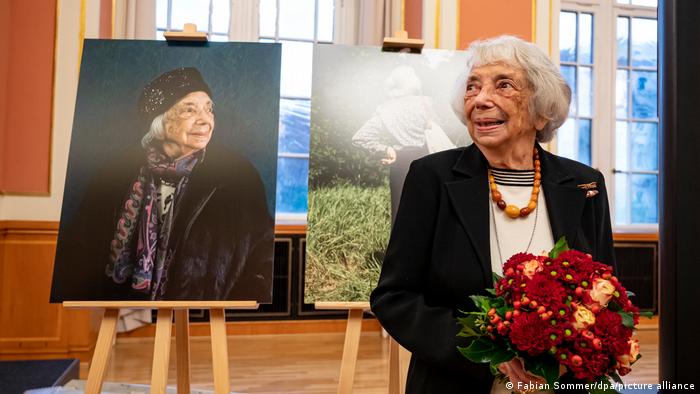
German Jewish Holocaust survivor Margot Friedländer, who moved back to Berlin at the age of 88, celebrates her 100th birthday on Friday. Her late years of education and reconciliation are being honored this week.


Margot Friedländer turned 100 on Friday

Margot Friedländer says she has lived four different lives in her 100 years, but it was the moment when her first life became her second that marked her forever. That was when her early, mainly happy years in Berlin turned into 15 months of hiding in various houses in Berlin, evading the Nazi authorities as long as she could, and then another year of surviving the Theresienstadt concentration camp.

In her 2008 memoir, Friedländer recounts an incident on January 20, 1943, in the apartment of a couple she barely knew in Berlin's Kreuzberg district. She knew that her mother had recently been there.

The acquaintance told Friedländer, who was 21 years old and had the last name Bendheim at the time, that her mother had left. She had gone to report herself to the authorities to join her son, Margot's brother Ralph, who had been arrested that afternoon by the Gestapo. The woman then handed Margot her mother's handbag containing her last connection with her family: An address book and an amber necklace. And there was a message, passed on verbally: "Try to make your life."

"These words shaped my life," Friedländer told DW this week at one of the events taking place in Berlin to mark her 100th birthday on Friday — this one the opening of an exhibition of portraits of her. "I feel that I have accomplished something, not just for my mother, not just for six million Jews, but for the many million people who were killed because they didn't want to do what they were told to do."


Friedländer with her friend Thomas Halaczinsky, who has made three films about her later life in Berlin

'Try to make your life'

Though she was not to find out until decades later, Friedländer's mother and brother were murdered in Auschwitz within weeks of that January day. Her father, who had fled to Belgium years before, had already been gassed, too.

Sixty-five years later, her mother's hastily delivered final message became the title of Friedländer's memoir, a book that began the work of remembrance and education that has taken up the last decade in Berlin, where she moved back for good in 2010.

It wasn't an easy move to make, and there were many people who tried to dissuade her. Other Holocaust survivors she knew in New York, including her cousin Jean, objected to her visits to Germany. Her husband Adolf Friedländer, another Holocaust survivor who she had met in Theresienstadt and who died in 1997, had always rejected the occasional invitations that had arrived over the years from the Berlin government.

"I often ask myself if coming back here was the right thing to do," Friedländer said in "A Long Way Home," a 2010 documentary co-produced by DW. In the same film, Margot admitted to uncomfortable feelings around some Berliners: "I'm still very guarded about the people of my generation whom I meet here. They were the ones who cheered the Nazis back then. And did nothing to put a stop to what was going on. Everybody knew about it, and they looked away. Although I came back, it's still something that affects me very deeply."

For the next generation

But those doubts were answered in the work she undertook after the age of 87, when her memoirs were published, and she began to give readings around Germany, especially in schools. "They listen to me intently," she says now of the students. "I have received — I don't know — a thousand letters. I tell them: What happened can't be changed, but this is for you. That became my mission."

Friedländer's journey in Berlin has been documented in a loose trilogy of documentaries made by Thomas Halaczinsky, a German filmmaker living in New York. The first of them, "Don't Call It Heimweh," became the occasion for her first visit to Berlin in 2003.


Friedländer speaking to the likely next mayor of Berlin, Franziska Giffey, on Tuesday


Halaczinsky said he was interested in the crisis Friedländer experienced when he first met her in the early 2000s. "I was seeing how the effects of German history, of fascism, of oppression, of the Holocaust, actually continue to exist in the lives of people like Margot, who were struggling to come to terms with their lives and their own identity," he told DW.

Friedländer's specific situation contained a peculiar conflict: She had spent 15 months in hiding in Berlin, being protected by non-Jewish Germans, while at the same time other Germans were murdering her family. "She was struggling with exactly that, and she was trying to find some way to figure out how she could balance that," he said. "How does somebody at that age actually find the center point of herself?"

In the second of Halaczinsky's films, "A Long Way Home," Friedländer answers the question herself: "How can I possibly feel homesick for Germany, after the Germans killed my parents?" she says.

"To that, I'd have to reply: This is precisely why I've come here — I've come here to meet the young people who had nothing to do with it."

A service for Germany

Those early struggles seem a long way away 18 years later. Friedländer has since been showered with state awards and honorary citizenships. Portraits have been painted, busts cast, her story told in exhibitions, films, books, and a graphic novel. The Schwarzkopf Foundation, set up to empower young people to engage in politics, founded an annual prize in her honor in 2014, the latest of which was presented by Chancellor Angela Merkel.

Politicians have lined up to laud her, among them Berlin's likely next mayor, Franziska Giffey, who was also at Tuesday's exhibition opening. "I think she's a model for all of us," she told DW. "She goes to children and young people and people of all ages and shares her life. And this act of commemoration is very, very important for our political education today. To hear this voice, in her 100th year, is very important for all of us defending a free and open society."

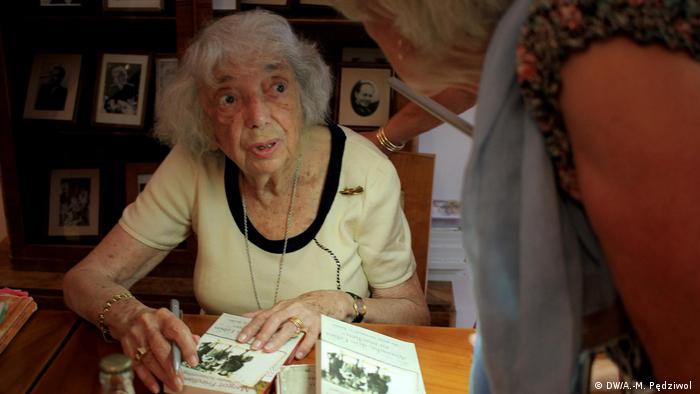
Friedländer has spent the last decade telling her story and presenting readings of her memoir, 'Try to Make Your Life'

"She reaches out a hand of reconciliation," said Schwarzkopf Foundation Chairman André Schmitz, who befriended Friedländer after welcoming her to Berlin as state culture secretary in 2003. "She makes it easy for us Germans: She's charming, she's joyful, she enjoys being heard — she doesn't make accusations against us, but says: Watch out, this was possible once, and is always possible. That's an invaluable service."

The last of Halaczinsky's films, which covers these last few years of her work, has recently been aired by public broadcaster ARD. It is entitled "Angekommen" ("Arrived"), and its very last scene catches Friedländer in an unusually uncertain moment.

"I don't make many presumptions that very much will remain after I have died," she says. "There are great people who have done something. But my contribution is after all, very, very small. Perhaps the generation now that hears me in schools will say something to their children. I have no idea how far that will go, because so many people keep saying we don't want to talk about it anymore."

Pessimistic as this may sound, Halaczinsky sees the ending as a call to action, because soon we won't be able to rely on Holocaust survivors for first-hand accounts of the real horrors of fascism.

"Even though her work is being acknowledged, this is not a work that can be finished. It's a process, it continues," Halaczinsky said. "Her doubts are a warning to all of us."
Gaia-X cloud: A safe haven for Europe's data?

Europe has just marked the second anniversary of Gaia-X. It's a cloud data project intended to help the continent achieve "digital sovereignty," but many companies remain skeptical or have simply never heard of it .


Europe's cloud industry is seen as crucial in regaining control over the continent's data

In the era of digitalization, companies, administrations and the public at large produce huge amounts of data. The permanent stream of bits and bytes is multiplying exponentially by the day as innovations such as artificial intelligence, autonomous driving and automation are coming online now and in the future.

At the same time, Big Data has become big business for those companies who are able to store and mine the huge data pools, and, ideally, share them with other companies for commercial gain. In this, many companies have come to rely on outside cloud service providers — a business that's been booming in recent years, with more data meanwhile being stored by firms externally rather than in-house.

Apart from saving valuable storage capacity, businesses can also cut costs by renting rather than buying software applications and processing power, while data clouds guarantee access from seemingly anywhere in the world.


Europe's independent cloud ecosystem

Gaia-X is a Franco-German project idea that was first presented to the public at a European Digital Summit in October 2019. About one year later, the Gaia-X Association (AISBL) was founded as an international nonprofit organization based in Belgium. Its aim is to foster the digital sovereignty of European cloud service users, and promote European values of transparency, openness, data protection and security.


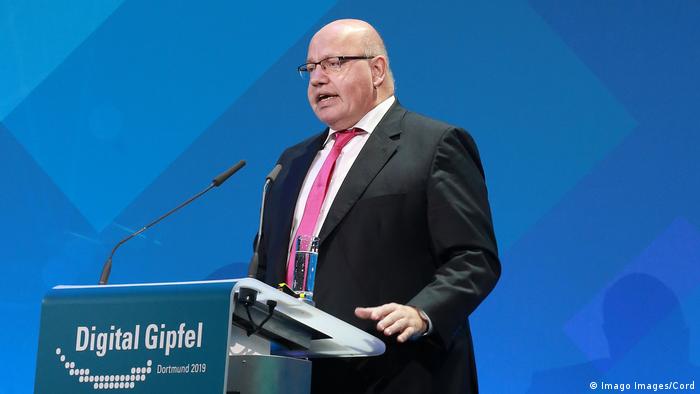
Germany's Peter Altmaier first floated the idea of Gaia-X saying it would be a key tool for allowing Europeans to "assert themselves in the world"

Senior French and German ministers have promised Europe will regain its "digital sovereignty" in the face of dominant American players like Amazon, Google and Microsoft. German Economy Minister Peter Altmaier said during the AISBL founding ceremony the data infrastructure ecosystem would "drive innovation and create new data-based services and applications."

In the opinion of its founders, Gaia-X is not intended to create a competing product to existing offers by US providers. Instead its stated aim is to link different data infrastructures via open interfaces and standards in order to connect data and make them available to a broad audience.

"Gaia-X is based on existing data infrastructure systems, but acts as a software federation system that mainly orchestrates data exchanges within the ecosystem," said Andreas Weiss from eco, the largest internet industry association in Europe.

Among the project's German founding members are such big industry names as BMW, Airbus, Bosch, Deutsche Telekom, SAP and Siemens. On the French side, Amadeus, Atos, Electricite de France (EDF), Orange and Scaleway were early members of Gaia-X.

Within less than a year after the AISBL nonprofit was founded in 2020, the alliance elected a new board, developed from about a dozen founding members into 320 member organizations, launched dozens of national hubs across Europe and started work for several committees to draw up technical and policy rules.

Common standards are key

Presently, many European companies build individual interfaces for data exchange and interoperability solutions with each of their customers seperately — a tedious and costly process.

"Some companies seeking to exchange data still use e-mail, fax or other technologies that are no longer state of the art. Sometimes they have to sort out in advance how to exchange their data," said Rainer Sträter from cloud services provider IONOS. This might still work between two companies, he told DW, but it's impossible among several hundreds of firms, which, for instance, need to organize supply chains. Here, interoperability was essential and could only be achieved through standardized data, he added.

According to market analyst IDC and cloud company Seagate, the lack of standardized data exchanges in Europe means that only about one third of the data existing in companies would effectively be used to develop new products and business innovations.

The European Commission says data services will become a major driver of economic growth in the next decade, garnering data industry revenue worth about €829 billion ($957 billion) annually by 2025 — three times as much as in 2020.

At the moment, however, it's mainly the cloud services of Amazon, Microsoft, and Google that are flourishing amid the boom, cementing their dominance over Europe, where they account for almost 70% of the market. Europe's biggest cloud player, Deutsche Telekom, accounts for only 2%.


US services dominant, Gaia-X not well-known

The German Economy Ministry says on its website that cloud services providers outside Europe are able to "rapidly scale their infrastructure and dominate the market with their huge capital reserves." In times of growing international tensions and trade conflicts, the ministry warns, Europe must be able to "act more independently" with regard to its data.

But with its cloud agenda still only evolving, Europe will likely remain reliant on big US companies for a while, and exposed to the reach of Washington through extraterritorial laws like the US Cloud Act. The law allows Washington to requisition European data held by US companies.

Small wonder then that the primary concern of European companies is data security when it comes to using cloud services. According to the Cloud Monitor 2021 compiled by consultancy KPMG and the Bitkom industry association, 75% of the European companies not using cloud services named security issues as the main reason for their reluctance, while 67% are worried about unclear regulatory frameworks.

Apart from legitimate security concerns, Gaia-X also seems to have a public relations problem. Only about 6% of some 500 German companies polled by the Institute of the German Economy (IW) recently said they had heard of the European cloud project — a worryingly low number two years after it started.
Dubious bedfellows

In order to move things forward, the Gaia-X alliance decided in April to accept global cloud players such as Microsoft, Huawei, Amazon, Google, Salesforce and Alibaba as full members. Palantir, a controversial California-based company with alleged links to the US military-industrial complex, was revealed to have been a Gaia-X member since day one.

Such developments have caused worries that the foreign data giants could influence the initiative to benefit them rather than Europe's own interests. But Boris Otto, the head of the Fraunhofer ISST institute and interim chief technology officer (CTO) at the Gaia-X Association, sought to play down the differences. "We don't want to isolate Europe, but seek to invite anyone who agrees to play by our rules," he said in a statement.

IONOS' Rainer Sträter shares this view, insisting that Gaia-X's vision is still alive. Once completed, he told DW, the open source project would allow Europeans to freely chose their cloud services providers in line with their own requirements. And those European companies that are already heavily relying on cloud services, would be able to switch between providers more easily because all Gaia-X participants would need to abide by the same standards of transparency and data security. This could also benefit smaller cloud services who are presently unable to compete with the heavyweights of the industry, he added.


Google runs partnerships with major European telecoms. Will deep commercial ties make data sovereignty impossible?

Whether the Gaia-X alliance can really advance the cloud project to help protect European interests will become clearer in mid-November, when members meet for a two-day summit in Milan. They are planning to launch so-called labels for cloud companies active in Europe to market their security, privacy and sovereignty practices.

This article has been adapted from German.
What are the chances for peace in Ethiopia's Tigray conflict?

As the war in Ethiopia comes to a head, opponents of Prime Minister Abiy Ahmed are forging an alliance for a "safe transition." A national dialogue to provide a way out of the crisis appears to be a distant prospect
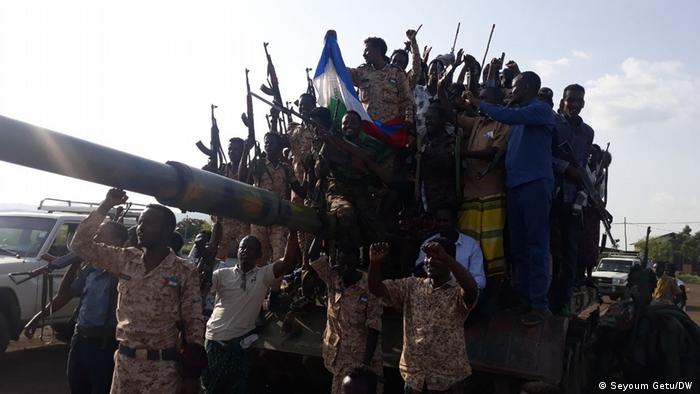
In mid-October, Ethiopian army special forces were still confident of victory


"The situation in Ethiopia is currently very perilous. This is probably the most dangerous moment in the country for decades," said Murithi Mutiga, International Crisis Group Project Director for the Horn of Africa, based in Nairobi, Kenya. "The primary issue is that all sides have decided that they can settle this conflict militarily."

According to the analyst, the Tigrayan forces have gained strength. "They seem determined and try to make a decisive move that could either lead to the end of the siege in Tigray or to the collapse of the Abiy government," Mutiga told DW.

For its part, the government of Prime Minister Abiy Ahmed has stepped up its war rhetoric. Facing a possible advance on the capital, Addis Ababa, it is calling for a general arming of the people, as well as for all civilians to join the fight. According to observers, there have been busloads of forcibly recruited teenagers and clampdowns during which Tigrayans still staying in the capital were arrested.

In the meantime, the US special envoy to the Horn of Africa, Jeffrey Feltman, has met with the prime minister in Addis Ababa. "It is essential that he, the AU and possible neighbors, at least get all parties to give talks a chance," said Mutiga.
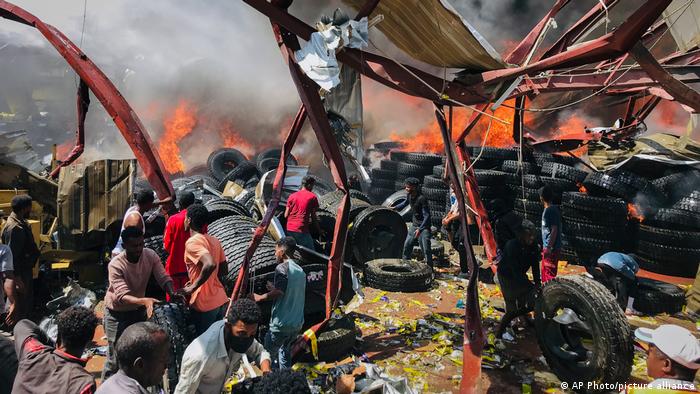
Mekele, the capital of the Tigray region, has been repeatedly hit by airstrikes


Abiy 'can flee and go into exile'

The Ethiopian Army and troops from Tigray siding with the Tigray People's Liberation Front (TPLF) party have been battling for the region in the north of the country since last November. Voluntary fighters have joined both sides. In the meantime, the TPLF has received reinforcement from the Oromo Liberation Army (OLA) and claims to have made territorial gains in the course of its advance on the capital.

On Friday, TPLF and OLA announced the formation of an alliance along with seven other opposition groups — with the aim of reversing "the harmful effects of the Abiy Ahmed rule" and precipitating a "safe transition" for the country.

Abiy, who was awarded the 2019 Nobel Peace Prize for his political reforms in Horn of Africa, imposed a state of emergency on Tuesday. He labeled TPLF leaders as terrorists, "a cancer," or "weeds." His Facebook post that called on people to "bury" advancing fighters was deleted by the social network on Thursday.

Is there any chance for negotiations between the arch enemies? Norwegian peace researcher Kjetil Tronvoll believes there isn't: "There is no negotiated takeover of power. We can expect an ongoing conflict," he told DW.

The TPLF, he added, had no interest in assuming power in Addis Abeba through political means, "but they want to topple Abiy (and achieve) a transitional agreement." Abiy's political career, Tronvoll said, was over: "He can flee and go into exile."
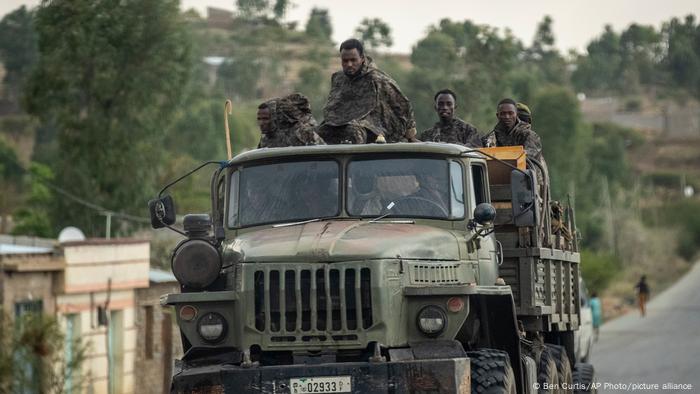
Experts do not believe that a quick solution to the Ethiopian conflict is possible

The will to win

The current fight was no military challenge for the troops of the Tigray regional government — they could reach Addis Abeba within a week, Tronvoll believes.

But why is the TPLF campaign so successful? Abiy, Tronvoll explains, made a mistake when he dealt with the national army, which had long been dominated by Tigrayans. "He arrested 17,000 soldiers and officers in the chain of command (of the government army) when he came to power. He incapacitated his own army. Being from the Oromo ethnic group, he could not trust them." Today, there was a lot of infighting in the Ethiopian National Defense Force (ENDF), Tronvoll added.

The troops from Tigray, Tronvoll emphasizes, have a stronger fighting morale and the will to win. There is discipline in TPLF troops, who are "highly educated people, not peasants as in the resistance war. Now they are recruiting doctors and high school graduates, and they believe in their course."

In addition, the survival of their families is at stake. In the face of a situation like this, international efforts came too late and, worse still, most diplomats are unfamiliar with the complexity of Ethiopia, with the people, with the sentiment of the parties, according to Tronvoll.

Diplomacy has failed


Bayisa Wak-Woya, a former UN employee from Ethiopia, also mentions a setback in diplomacy: Many diplomats, he said, do not know enough about the different traditions and cultures of the country and were, therefore, failing in their mediation efforts. "It is very difficult to know what is happening at the war front in Ethiopia now. Transparency is a rare commoditiy in that country."

One thing, however,is certain, he believes: "Civil wars are different from wars of aggression." In the former, maintaining the state's sovereignty is a non-argument: "What are human rights violations for some is maintaining law and order for others. This makes it difficult to design a dignified exit (from the fighting) for the parties involved."
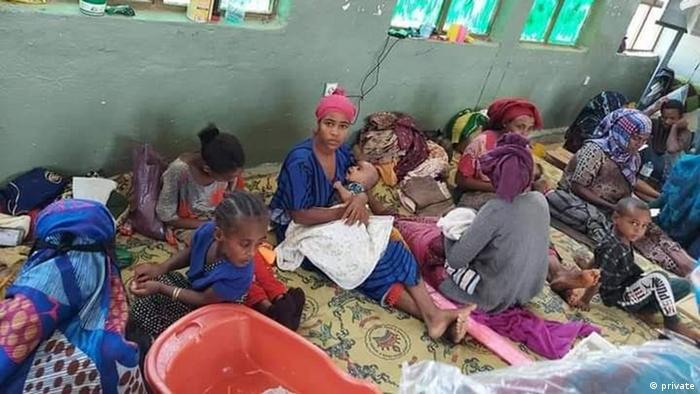
Hunger and displacement aggravate the catastrophic humanitarian situation in Tigray


What, then, is the way forward? "External powers (…) should refrain from taking sides and putting pressure on the parties in the conflict. So far the diplomatic talks failed to bear fruit, because the international community started to condemn parties. Not a good start," Wak-Woya says, who, nonetheless, is still hopeful that peace can be brought to the region.

Inner balance in disarray


Considerable efforts are being made to prepare international negotiations, according to people familiar with the situation. But discretion is of the essence here, so as not to jeopardize the prospect of successful talks. The inner balance of Ethiopia's immature political system has been in disarray for decades, ethnohistorian Wolbert Smidt, an expert on Ethiopia, tells DW.

That disarray, Smidt says, originated in the late 19th century, an era which saw Ethiopia massively expanding into neighboring regions, which were organized in completely different ways with regard to languages, ethnic groups and cultures. Today's conglomerate of regional states is lacking equality on the political level; there are extreme differences in education, wealth, access to power and recognition, accoring to Smidt.

Realistic offers to advancing troops

One symptom of those long-lasting marginalizations is the current civil war. "Talks must clarify whether there's any common ground left," Smidt says. The government is holding on to its autocratic tendencies, he believes. Now, however, clarity about the military situation is paramount, instead of forcing through reforms.

African partners believe that Ethiopia is tearing itself apart because of these internal contradictions, Smidt says. "We must now make realistic offers to the advancing troops."
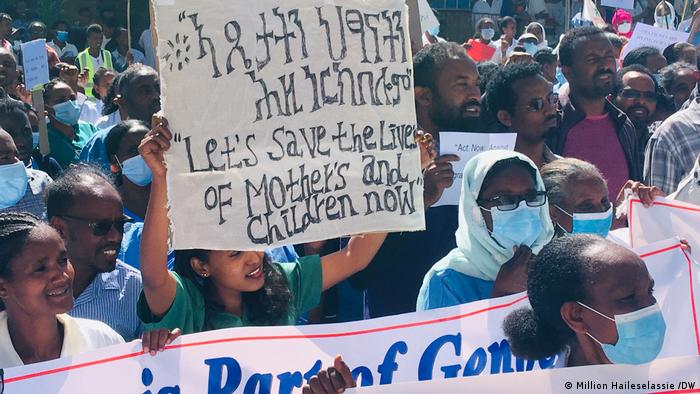

Doctors in Tigray protest against a de facto blockade of medical supplies

According to Smidt, the only formula for peace is a national dialogue involving all ethnic and regional-political groups. At first, however, the guns must remain silent. "No reform, no matter how idealistic, can work if you don't integrate stakeholders of central importance."

That political process collapsed years ago. "That means that in the short term, we only have the option of stopping the war, so that a transitional government can be established. It is only on that basis that a longer civil process can be set in motion."

This article was translated from German.

Facebook whistleblower warns company is neglecting languages other than English

Facebook is taking an English-first approach in tackling "extreme" online content, whistleblower Frances Haugen told DW. 


She warned that the current situation in Ethiopia shows how dire the consequences can be.

The role Facebook plays in fanning the flames of ethnic and political tensions shows how urgently change is needed at the social media giant, whistleblower Frances Haugen said in an interview with DW.

Haugen is a former product manager for the social media giant, which recently rebranded itself under the new name "Meta."

She is due to testify in front of a panel at the European Parliament on Monday about her disclosures on the company.
Tackling 'extreme content' in English — but less so in other languages

"One of the core things that I'm trying to draw attention to is the underinvestment in languages that aren't English," Haugen told DW.

With the company most concerned about preventing regulatory scrutiny in the United States, the English language gets the most attention in terms of adapting the company's artificial intelligence (AI) software.

"Unfortunately the most fragile places in the world are the most diverse when it comes to languages," Haugen said.

She said Facebook's current safety strategy is to use AI to catch "extreme content" and ensure it doesn't rank higher in users' feeds.

"The problem is that strategy requires us to build those AI systems over and over and over again in each language for the platform to be safe — and right now Facebook is not doing that," she explained.
Ethiopia conflict illustrates need for change

Relying on AI to help ensure public safety — and then not updating the systems in other languages — can have major, real-world consequences, the whistleblower said.

"I saw a pattern of behavior where I believed there was no chance that Facebook would be able to solve these problems in isolation," Haugen said, explaining her decision to come forward.

"I saw what I feared was going to happen continue to unfurl," she said, pointing to the deteriorating situation in Ethiopia as a more recent example.

"I knew I could never live with myself if I watched 10 million, 20 million people over the next 20 years die because of violence that was facilitated by social media," Haugen added.

Rights groups have sounded the alarm over a rise in hate speech on social media in Ethiopia amid the advance of Tigrayan forces.

Amnesty International warned that many posts "inciting violence" and using slurs against ethnic Tigrayans have "gone unchecked."

Earlier this week, Facebook removed a post by Ethiopian Prime Minister Abiy Ahmed, saying it violated the company's policies against calling for violence.

On Friday, Twitter suspended its "trends" section in Ethiopia, citing a rise in threats of physical violence.

This interview was conducted by DW political correspondent Giulia Saudelli.


Who are the Tigray fighters, and why is Ethiopia at war with them?

A year ago, Ethiopian Prime Minister Abiy Ahmed launched a military campaign against Tigray fighters, promising a quick victory. But Tigrayans managed to turn the tide. DW explains who they are and why they're fighting.
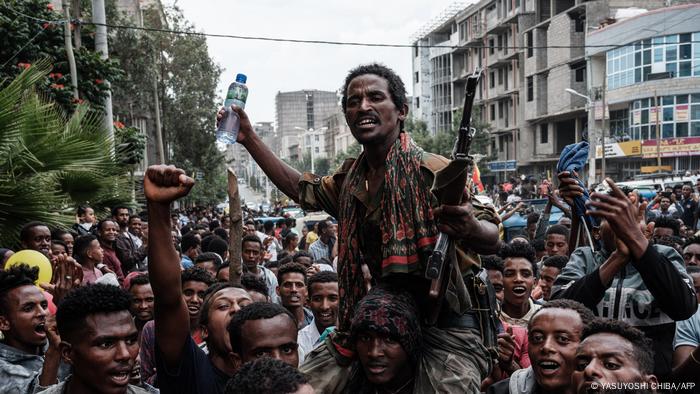

Tigray, Ethiopia's northernmost region, is home to most of the country's estimated 7 million ethnic Tigrayans

Since early November 2020, the Ethiopian government and Tigray fighters have been exchanging fire in a conflict that has claimed thousands of lives and has left more than 400,000 people facing famine, according to a recent UN estimate.

The conflict has escalated rapidly since June, when fighters began to retake most of Tigray and expand into neighboring regions. The fighters have managed to recruit allies and are approaching the capital, Addis Ababa.

So, who are the Tigray fighters?

From militiamen to rulers

In the mid-1970s, a small group of militiamen founded the Tigray People's Liberation Front (TPLF). With a left-wing nationalist ideology, they vowed to fight for the rights of Tigrayans, a relatively small ethnic group that account for just 5% of the population and had long been marginalized by the central government.

Throughout the 1980s the TPLF emerged as a formidable challenger to Ethiopia's then Marxist military dictatorship. The group eventually led an alliance of militia organizations, the Ethiopian People's Revolutionary Democratic Front (EPRDF), that overthrew the Soviet Union-backed regime in 1991.


The alliance then began to run Ethiopia under a federal system, with TPLF holding sway over the other groups and dominating politics for nearly three decades.

Tigrayan leader Meles Zenawi was Ethiopia's transitional president from 1991 until poorly contested elections in 1995, when he was elected prime minister. He would go on to rule the country until his death in 2012, and was succeeded by Hailemariam Desalegn. During this time, Ethiopia saw economic growth, but the government clamped down on dissent.

The EPRDF government led the country through periodic drought and famine, and the 1998-2000 border war with northern neighbor Eritrea. Human rights deteriorated during this time, with opposition groups complaining of persecution and corruption, which fed into growing public discontent.

In early 2018, after several years of frequent anti-government protests from different ethnic groups had seriously damaged the legitimacy of the EPRDF government, Hailemariam stepped down. The EPRDF selected Abiy Ahmed, of the Oromo ethnic group, as his successor and he was soon elected prime minister.

Abiy, a non-Tigrayan politician with little ties to the TPLF, enjoyed widespread popularity. He unseated many Tigrayan officials, charged some with corruption and introduced a set of political reforms which sidelined the TPLF. In late 2019, Abiy disbanded the EPRDF coalition government and moved to create the new Prosperity Party (PP). Refusing to join the group, the TPLF moved back to its stronghold.


Tigrayans are Ethiopia's third-largest ethnic group

After the 2020 general election was postponed by the COVID-19 pandemic, the TPLF and some other opposition leaders accused Abiy of delaying the vote to stay in power. Despite the delay, officials in the Tigray region went ahead with regional elections in September 2020. A month later, the federal government began withholding funds from the regional administration.

In early November 2020, TPLF forces were accused of having attacked and looted federal military bases in the region. Abiy kicked off a military campaign in the Tigray region, known as Operation Law enforcement, and promised to swiftly defeat the TPLF fighters.

But since June 2021, the Ethiopian army has endured continued setbacks and has been forced to withdraw from Tigray. Now the front line is getting closer and closer to Addis Ababa, with the prime minister calling on residents to be ready to defend the capital.

The Tigray fighters might have the upper hand, but capturing Addis Ababa will not be easy. They are likely to face resistance from other Ethiopians who fear the return to power of a party that ruled the country for nearly three decades.


ETHIOPIA: TIGRAY CRISIS ONE YEAR ON
A city burns
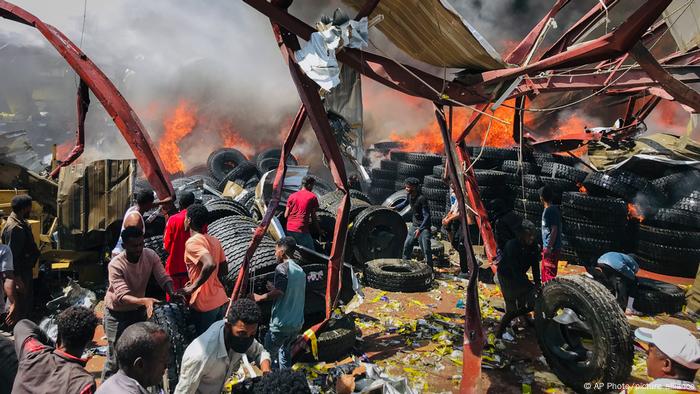
Residents of Tigray's capital Mekele sift through wreckage following an airstrike by government forces on October 20. The military said it was targeting a weapons manufacturing facility operated by the Tigrayan People's Liberation Front (TPLF), which the rebel Tigray forces have denied.     123456789
Ancient Mayan artifacts returned to Guatemala and Mexico

Germany's return of 13 Mayan cultural objects also reflects a recent trend of private collectors returning what is not theirs.


Bought at a flea market in 2003, these ancient Mayan artifacts will be returned to Guatemala and Mexico


The discovery and return of Mayan artifacts have been making headlines lately — with some private collectors both in Germany and elsewhere voluntarily surrendering the objects.

In late 2020, a man in the city of Klötze in the eastern German state of Saxony-Anhalt contacted the police to hand over WWII-era weapons that had belonged to his father.

His cellar also housed a collection of 13 objects — including figures, plates and cups dating back to 250-850 AD. Claiming not to know of their origins, he said that they had been purchased for less than €100 ($116) at a flea market in Leipzig in 2003.

An expert later confirmed the objects' authenticity and declared that 11 of the pieces were produced in what is today Guatemala and two others were from Teotihuacan, located roughly 40 kilometers (25 miles) northeast of modern-day Mexico City. The ancient Mesoamerican city of Teotihuacan was the largest city in the pre-Columbian Americas. Police suspect these items were looted by tomb raiders.

On Friday, Saxony-Anhalt State premier Reiner Haseloff handed the priceless Mayan cultural artifacts over to Guatemalan Ambassador Jorge Lemcke and Mexican Ambassador Francisco Quiroga at a ceremony in Berlin.


Saved from resale: fragment from the Piedras Negras archaeological site in Guatemala

'Private collectors' goodwill'


The handover came a week after another private collector in France returned a Mayan artifact to Guatemala after it was initially slated for auction in 2019.

Thought to have been looted from a Mayan archaeological site in the 1960s, the stone fragment depicts the head of a ruler of Piedras Negras wearing a headdress in the form of a bird of prey. Piedras Negras was the capital of a Mayan kingdom that existed between 4th century BC and 9th century AD, and was located in what is now northwestern Guatemala.

The Los Angeles Timesreported that the object changed hands several times before being ultimately acquired by private collectors Manichak and Jean Aurance in Paris. It was later included as part of a collection of pre-Columbian artifacts slated for auction in Paris in 2019. It had been estimated to fetch between €23,325 ($27,000) and €33,692 ($39,000).

Guatemala objected and produced evidence of provenance, with drawings and pictures dating back to its discovery in 1899, and the carving was then withdrawn from the auction.

Negotiations followed between Manichak Aurance, the French and Guatemalan governments, and UNESCO, which later released a statement saying Aurance opted to voluntarily return the fragment.

"The voluntary handover of this fragment of a Mayan stela to its homeland in Guatemala showcases the evolution of the international environment in favor of the return of emblematic cultural objects and artefacts to their homelands under UNESCO's guidance over the last 50 years," UNESCO Director-General Audrey Azoulay said in a statement.

"It also shows the importance of the UNESCO 1970 Convention in fighting the illicit trafficking of cultural objects," Azoulay said. "This success story has been possible thanks to international cooperation and a private collector's goodwill; it is a model for others to follow."


A clay drinking vessel estimated to be 1,500 years old is one of the 13 items returned
Market for antiquities


In May, two German collectors voluntarily returned 34 pre-Columbian artifacts to Mexico. Twenty-eight of the objects were in the city of Monheim am Rhein in western Germany and the remaining six in Recklinghausen, some 70 kilometers (43 miles) away.

Commenting on that event, Diego Prieto, director of Mexico's National Institute of Anthropology and History, highlighted the "growing sensitivity" in the global community about the need to respect cultural heritage and return artifacts.

People of Mayan descent constitute over 40% of the population in Guatemala. In the north of the country lie the ruins of the city of Tikal, one of the former centers of Mayan power.

Meanwhile, near Mexico's capital, Mexico City, lie the sprawling ruins of Teotihuacan — the center of a culture that dominated Central America in the first century AD.

InsightCrime.org reported in February that informal markets peddling Mayan artifacts still exist in Guatemala. Quoting an expert from the La Ruta Maya Foundation, the report explained how Mayan sites were looted between the 1960s and 1980s, when a trend of pre-Columbian exhibitions in the United States saw increased demand for cultural items from museums and private collectors. Guatemala's civil war had also forced some archaeologists to abandon excavation sites, leaving them exposed to impoverished rural communities seeking additional sources of income.


A clay figurine believed to be 1,500 years old that doubles as a candle holder, representing Huehueteotl, the fire god of Teotihuacan

Who are heirs?

Nikolai Grube, a professor of Ancient American studies at the University of Bonn, told DW in May that the Indigenous peoples of the Americas are the legitimate heirs of these artifacts.

"Their ancestors created these cultural assets. But, nowadays, they are not even allowed to speak their language; it does not appear in school, their culture is not part of national life. A real kind of apartheid reigns. Either members of the indigenous population live in poverty in the countryside, or in the favelas of the big cities," he said, adding that cultural institutions like museums often operate without their participation.

"The debate about African looted art is in full swing, and rightly so, and should have happened much sooner, especially since the debt is particularly large due to the German colonies. And that would be needed now for South America, as well," Grube said. "There is blood on all these objects as well — it's just older."