Saturday, November 06, 2021

'They're afraid they won't come back:' Petition wants elder care in Nunavut

IQALUIT — Aani Uqaitu hasn't been able to see her 89-year-old mother for six months since she was sent to a long-term care home 1,200 kilometres away from Sanikiluaq, Nunavut.

© Provided by The Canadian Press

Uqaitu's mother, who has dementia, is one of many Nunavut elders who are flown to Southern Canada every year for care.


The territory does not have the capacity to care for elders with complex needs. Nunavut's Health Department says there are 43 elders currently living at Embassy West Senior Living in Ottawa.

A petition to build an elder care home in each of Nunavut's 25 communities hopes to change that. The petition has received over 19,000 signatures in the last month.

"It's been really hard," Uqaitu told The Canadian Press.

In October, a group of elders in Baker Lake, Nunavut, protested outside the community's elders centre, which closed in 2018. They held signs that called for it to be reopened.

There are elders centres in Cambridge Bay, Gjoa Haven and Igloolik. There are also assisted-living facilities in Arviat and Iqaluit. A long-term care centre is to open in Rankin Inlet in 2023.

Manitok Thompson, a former Nunavut member of the legislature who now lives in Ottawa, started the petition with her friends after seeing more and more elders sent to the south over the years.

Thompson said she spends much of her time visiting them at Embassy West and crying with families who have to leave their loved ones behind.

"I was shocked. I got very emotional," she said. "It's just not right."

Thompson, who speaks Inuktitut, said she regularly gets requests from Nunavut residents to visit their family members in Ottawa.

"I've heard so many stories of 'she died alone' or 'he died alone,'" Thompson said. "The spirit dies. It's too different. The language is not there."

Often she'll bring the elders familiar country foods like cooked seal meat. Her friends bring it down for her when they come to Ottawa. Sometimes she brings containers of it back when she visits Nunavut.

Uqaitu, who lives in Sanikiluaq with her family, has been through this before. Her father died at Embassy West last year, but she couldn't see him because of pandemic restrictions.

"I'm always afraid that it might happen again with my mom," she said. "She always says she wants to go home."

Recently, a doctor told Uqaitu her mother had stopped eating. Herequested that the elder be given a meal replacement formula.

"She always lived on country food. She doesn't want to eat white people's food," Uqaitu said.

She and her husband have full-time jobs and, like many people in the community, were not able to keep their parents at home.

"There are elders here who don't want to be sent out to Embassy West. They're afraid they won't come back."

Thompson hopes Nunavut's newly elected members of the legislative assembly will table the petition when the assembly sits later this month. She also wants the assembly to create a special committee to look at bringing elder care home to the territory.

"This petition is a cry for help. The elders are not going to complain," Thompson said.

"Leaving somebody is very, very difficult. But what choice do they have?"

This report by The Canadian Press was first published Nov. 5, 2021.

___

This story was produced with the financial assistance of the Facebook and Canadian Press News Fellowship

Emma Tranter, The Canadian Press
Indigenous leaders concerned over B.C.'s process for old-growth logging deferrals

VANCOUVER — Indigenous leaders in British Columbia have expressed concerns over the tight timeline and lack of support in the government's plan for old-growth logging deferrals, while they underscore the urgency of preserving at-risk ecosystems.

© Provided by The Canadian Press

A panel of scientific experts mapped 26,000 square kilometres of old-growth forests considered at risk of irreversible biodiversity loss, and on Tuesday B.C. asked First Nations to decide within 30 days whether they support deferrals.

The province has said nations may indicate they need more time and discussions in order to incorporate local knowledge into the deferral plans, such as identifying and including old-growth forests that are at risk but missing from B.C.'s maps.

A 30-day time frame for such complex analysis is "totally unreasonable," Grand Chief Stewart Phillip of the Union of B.C. Indian Chiefs said in an interview.

In the meantime, the government is still allowing logging in the old-growth ecosystems identified as being at risk of permanent loss, Phillip said.

The province has stopped selling BC Timber Sales licences over the 26,000 square kilometres,Forests Minister Katrine Conroy told a news conference this week.

Any deferrals implemented through agreements with First Nations would last two years, after which the forests would either remain off limits or be included in sustainable management plans that prioritize forest health, Conroy said.

Asked about nations that may not want to stop harvesting in the areas proposed by the panel, Phillip said "the issue is not who does the logging."

"The issue is to protect, preserve and defend old-growth forest stands."

Jasmine Thomas,acouncillor with the Saik'uz First Nation, said her community is involved in forestry and they're not asking for all harvesting to stop, but "business as usual can't keep happening, logging can't keep happening" in areas of at-risk old-growth while the nation works through its long-term resource management plans.

Saik'uz has conducted technical work in its territory in central B.C., which has found "not only old-growth areas being diminished drastically, but also other related resources such as fisheries, wildlife and watersheds," Thomas said in an interview.

That work has also identified areas that could be suitable for harvesting to mitigate the impacts of reducing the timber supply on the forestry industry, she said.

"Mind you, we have all been aware that this decrease in annual allowable cut was going to be coming, in relation to the biodiversity crisis that we're experiencing and issues such as wildfire, (pine) beetles and other cumulative impacts," Thomas said.

Saik'uz issued a declaration last month that free, prior and informed consent must be obtained for any logging and resource development in its territory.

While Saik'uz technicians are busy reviewing B.C.'s deferral plans, Thomas said some neighbouring communities are facing resource and capacity challenges. It will also take time for nations to consult their own members, she noted.

The First Nations Leadership Council, which includes the executives of the chiefs union, the B.C. Assembly of First Nations and the First Nations Summit, issued a statement Thursday, saying it was "extremely concerned that old growth remains unprotected today, and that the province has passed responsibility to First Nations without providing financial support for nations to replace any revenues that might be lost if they choose to defer logging old growth in their territory."

Terry Teegee, regional chief of the B.C. Assembly of First Nations, said in the statement "the lack of proper consultations with First Nations prior to the announcement, as well as the government's failure to provide details on transition financing and financing for Indigenous-led conservation solutions, all point to the province's repeated pattern of advancing a mismanaged forestry landscape that fails to uphold Indigenous title and rights, jurisdiction, and decision-making."

B.C. has adopted the United Nations Declaration on the Rights of Indigenous Peoples, and Teegee said the province must fully inform nations on how the deferrals would affect their communities before potentially obtaining consent.

Maps of the proposed deferral areas were shared with First Nations about a week before the government announcement, the Forests Ministry said in a statement.

"We will be working with First Nations through established forums and protocols to do this important work," it said. "For those nations that do not have these in place, staff will be reaching out to those nations to begin the engagement process."

B.C.'s deferral plan includes just shy of $12.7 million over three years to support First Nations through the process, but no further funding was announced.

That amounts to about $20,000 per year for each of more than 200 First Nations across B.C., said Phillip, calling the funds "totally insufficient to undertake the work."

Environment Minister George Heyman was asked about the funding at a news conference in Glasgow, where he was attending the United Nations climate talks.

The $12.7 million is meant for "the initial stages of conservation planning and considering deferrals," intended not as the end of funding, but as a "signal" that First Nations would have some support, Heyman said, noting forestry is not his portfolio.

This report by The Canadian Press was first published Nov. 5, 2021.

Brenna Owen, The Canadian Press
Hearing on Baffinland mine expansion ends, board to make recommendation

IQALUIT, Nunavut — The hunters and trappers association in the community closest to an iron ore mine on the northern tip of Baffin Island doesn't want to see the mine expand its operations, saying the effects have already been palpable.
 
© Provided by The Canadian Press

Baffinland Iron Mines Corp. is seeking to expand its Mary River iron ore mine near Pond Inlet by doubling its annual output from six to 12 million tonnes.

Speaking on the last day of a public hearing on the mine's proposed expansion, Enookie Inuarak of Pond Inlet's hunters and trappers association said the mine's effects on the surrounding environment "have already been significant."

"We have seen impacts on marine mammals already ... We are exhausted by constantly having to give evidence of impacts of Baffinland's operations on Inuit," he said.

Inuarak also said many members of his community are divided on whether they want the expansion to go ahead. One the one hand, the mine provides residents with jobs, while on the other hand it could have negative effects on hunting, he said.

"We don’t want to sacrifice our culture and traditions for the sake of money and benefits. We ask other communities not to sacrifice us."


The public hearing on the mine's proposed expansion finished on Saturday in Iqaluit, two years after it began. The Nunavut Impact Review Board, the territory's environmental assessment agency, heard from representatives from Nunavut communities, the Nunavut government, the Government of Canada and environmental groups.


The mining company wants to build a 110-kilometre railway to transport the ore from the mine to the ocean. It would be the most northern railway in Canada and the first in Nunavut.

The community of Pond Inlet, which is about 176 kilometers from the mine, has opposed the proposal and protested against it earlier this year by blocking the mine's road and airstrip.

The proposed expansion also includes a benefits agreement between Baffinland and the Qikiqtani Inuit Association, which represents Inuit on Baffin Island. But Inuarak said he believes the benefits won't outweigh the cost of the expansion's effects on the animals harvested around Pond Inlet.

"When you talk about benefits, it sounds like you’re trying to buy us," Inuarak said. "Our culture and our traditions are not for sale."

Other North Baffin communities near the mine are concerned about what effects the proposed expansion would have on wildlife.

Alan Kormack from Clyde River told the board he does not support the expansion.

"Baffinland has not convinced us that this project will be safe," Kormack said. "Our wildlife and sea mammals are being depleted. They’re not around anymore."

Baffinland has said it can't continue to be profitable without increasing production.

The hearing resumed on Monday after it was suspended in April because of a COVID-19 outbreak in Iqaluit. It has stopped and started several times, having originally began in November 2019.

On Nov. 6, 2019, two years ago today, the hearing was abruptly adjourned when Nunavut Tunngavik Inc. put forward a motion to suspend the proceedings. At the time, the Nunavut Land Claims organization argued Inuit had not been properly consulted on the project.

All interveners have until Nov. 22 to submit written closing statements to the Nunavut Impact Review Board, which will then make a recommendation to federal northern affairs minister Dan Vandal whether to approve the proposed expansion. Vandal will then have the final say on whether the expansion will go forward.

This report by The Canadian Press was first published Nov. 6, 2021.

---

This story was produced with the financial assistance of the Facebook and Canadian Press News Fellowship.

Emma Tranter, The Canadian Press
On-reserve schools to get free menstrual products, says Indigenous Services minister

Lenard Monkman 
© Adrian Wyld/Canadian Press Minister of Indigenous Services Patty Hajdu responds to a question at a news conference Oct. 26 in Ottawa. She tweeted on Friday about making menstrual products freely available in on-reserve schools.

Period equity activists are waiting for more details after Indigenous Services Minister Patty Hajdu tweeted on Friday that menstrual products would be freely available in all on-reserve schools.

In an emailed statement to CBC News, a spokesperson for Indigenous Services Canada said "Menstrual products are a basic need, and will be freely available to all students at First Nation-operated schools on reserves and federal schools."

The statement did not provide a timeline of when the initiative would roll out, or if Inuit and Métis communities would be included.

Tania Cameron, a Kenora, Ont.-based community organizer who is Anishinaabe from Niisaachewan Anishinaabe Nation, has been running a menstrual product drive since Nov. 1. for students in northwestern Ontario First Nations after they were excluded from an Ontario initiative to provide the products for free in schools.

"It's huge," Cameron said of the announcement.

"I think if it impacts that one student not to miss school that day, if it helps that student not be embarrassed or ashamed that their family doesn't have the resources to provide for that product, then I think this is a major win for all of the students on-reserve."

Which communities will be included?

Veronica Brown is lead co-ordinator of the Ontario chapter of Moon Time Sisters, a period equity organization that works with northern and remote Indigenous communities.

She said she was excited to see the minister's tweet on Friday, and is waiting for more clarification from the federal government.

"What is this actually going to look like? Are Inuit communities also included in this? Or is it just specifically on-reserve... or band funded schools? So that's kind of a question that we're asking because we do support quite a lot of Inuit communities," said Brown.

Brown said a move to fund menstrual products for on-reserve schools would definitely make an impact, but the work they do would continue.

"The conversation can't stop at schools," she said, adding that high prices in remote communities are barriers for others as well.
CANADA'S SHAME
The Backlog: Thousands of veterans with disabilities are waiting years for support


OTTAWA — Nearly a dozen years ago, Micheal McNeil was hit with an improvised explosive device in Afghanistan. The former combat engineer, who is now a 40-year-old father of three in Saint John, N.B., has traded a fight with the Taliban for a constant battle with the federal government instead.

© Provided by The Canadian Press

“They want you to walk away. They’re literally: delay, deny, watch you die,” he says.

“They want you to walk away from the benefits. They don't want you to get them. And that's why they make it so hard.”

McNeil is one of tens of thousands of Canadian veterans who sustained long-term injuries from their military service and are now waiting to find out whether Veterans Affairs Canada will approve their disability claims.

In McNeil’s case, he has been waiting more than two years to find out whether the seizures he started experiencing in 2018 will be recognized as related to his service in uniform. If so, his family would receive benefits if he dies from the condition.

The disability benefits backlog has emerged over the past five years as a major source of stress, frustration and fear inside Canada’s veterans community.

The government has blamed the backlog on an explosion in the number of claims from injured veterans over the past six years, as more benefits became available and more former service members heard about them.

The influx followed a dramatic reduction in the size of the federal public service starting in 2012 as Stephen Harper’s Conservative government tried to cut spending and balance the books.

Veterans Affairs was particularly hard hit just as Canada's involvement in the war in Afghanistan was winding down. Nearly one in three positions were axed. The Liberals later hired hundreds back, but demand continued to outpace resources.

The Canadian Press was the first to reveal the existence of a backlog in December 2017. At that point, there were 29,000 applications pending with Veterans Affairs Canada. By March 2020, that number had jumped to nearly 49,000 claims.

Veterans Affairs acknowledges the existence of a backlog, but says the actual size is much smaller. It only counts the total number of complete applications that have been officially assigned to a staff member and been left unresolved longer than 16 weeks. Most experts and advocates say such a breakdown misstates the real extent of the problem.

Veterans whose applications are approved are entitled to different benefits and support depending on their condition, including financial compensation for long-term injuries, income replacement for those unable to work, job training and medical treatment.

Ray McInnis is the director of the Royal Canadian Legion’s service bureau, which helps veterans with the often complex process of applying for disability benefits. That includes helping obtain medical documents and filling out and submitting various forms.

“When we submit a disability application, our main focus is to get entitlements so that they can get treatment,” McInnis says. “The treatment is the most important part.”

Amy Green has been waiting since September 2019 to hear whether Veterans Affairs will approve her claim for a traumatic brain injury, which she says was sustained after an Afghan civilian intentionally crashed his motorcycle into her G-Wagon in Kabul in 2004.

Now living in London, Ont., Green has struggled with post-military life after being released from the Canadian Armed Forces in 2014. She says she hit bottom in 2019 after she hit and kicked police officers following a car crash that triggered “a huge spiral downwards.”

“I thought I was in an explosion in Afghanistan, but I’d actually caught my car on fire,” she says. “So I went to a treatment facility and just started getting my life back on track.”

Veterans Affairs currently pays for treatment for post-traumatic stress disorder, which includes counselling. But Green says approval for a traumatic brain injury, which is a physical wound, would give her access to different treatment.

“The difficult part is everything’s in limbo,” she says. “Everything that I would like to do.”

Many veterans support groups and organizations have stepped up to fill the gap by offering treatment to injured ex-soldiers whether they are getting support from Veterans Affairs or not.

But that shifts the financial burden from the government to organizations such as the Vancouver-based Veterans Transition Network, which relies on fundraising to make ends meet.

“It costs us a lot of money every single year, but we do it because that's the position that the organization takes,” says Oliver Thorne, the group's operations director. “Our mission is to make the program as accessible as possible.”

The backlog is also believed to have discouraged many veterans from submitting claims, even though a successful application opens the door to extensive support and benefits.

Veterans Affairs Minister Lawrence MacAulay has described the backlog as “unacceptable” and committed $192 million in June 2020 to hire 540 temporary staff to help clear it.

The number of outstanding claims has fallen since the 49,000 peak recorded last March and stood at just over 40,000 as of June. But there are concerns the progress will be fleeting.

The number of new claims plummeted during the first year of the COVID-19 pandemic as many veterans were unable to get the medical records needed to apply. There could be a flood of new claims after funding for the temporary staff expires in March.

Parliamentary budget officer Yves Giroux warned the government about exactly that scenario in September 2020. Internal documents obtained through the Access to Information Act show Veterans Affairs officials agreed with that assessment in May.

“There is a possibility that the department could see an influx of applications once the country begins moving into a normal state,” reads an internal report. “We need to realize significant efficiencies to start to offset the reduction in resources and increased intake.”

The department has since said it has approval to extend some of the temporary staff past March, but did not say how many.

"Currently, various factors are being considered with regards to staff retention," Veterans Affairs spokesman Marc Lescoutre said in an email.

The government has faced calls for changes beyond hiring more staff. One is to expand the list of common conditions afflicting Canadian veterans that are automatically approved to make sure former service members get the support they need.

Brian Forbes is executive director of the War Amps and national director of the National Council of Veterans Associations, an umbrella group for 60 veterans organizations, and has been seeking such a change for years.


“The thing that is quite irritating is that post-traumatic stress claims are approved around 96 per cent of the time,” he says. “Why don’t we just recognize that this case is going to be approved and let’s give them the treatment benefits?”


Forbes isn’t the only one calling for such an approach; a House of Commons committee recommended MacAulay amend existing legislation to allow for the pre-approval of claims so veterans can get faster support.

MacAulay told the committee that Ottawa was looking at the Australian and American experiences with pre- and automatic approval to see what lessons can be learned, but otherwise stood by the current process.

Some veterans like McNeil believe Ottawa doesn’t want to fix the problem. He says he thinks the federal government has put up barriers to keep from having to shell out money to those who got injured while in uniform. That has brought anger and a sense of betrayal.

“I have more PTSD from fighting the government in the last 3,000 to 4,000 days than I do from Afghanistan,” he says. “Because it's so goddamn traumatic.”

This report by The Canadian Press was first published Nov. 5, 2021.

Lee Berthiaume, The Canadian Press
Movement to keep fossil fuels in the ground gaining momentum in Canada and abroad

Inayat Singh, Alice Hopton
© Gerald Herbert/The Associated Press Momentum is growing at the United Nations climate conference in Glasgow, COP26, for the world to phase out oil and gas production. The federal government this week announced a cap on oil and gas emissions that, when…

Our planet is changing. So is our journalism. This story is part of a CBC News initiative entitled to show and explain the effects of climate change and what is being done about it.

The movement to keep oil and gas in the ground has reached Canada, as Quebec joined the Beyond Oil and Gas Alliance this week — becoming the first North American member of a new group being launched at the United Nations climate conference in Glasgow that wants to phase out the production of oil and gas.

It comes after the Quebec government committed to permanently ban all oil and gas exploration and extraction within the province, closing the door on the future exploitation of a significant amount of natural gas reserves that could supply the province with its own energy for decades — and providing a model for other provinces to follow.

"We see provinces move first. This is what happened in terms of our public health system. It's also what happened quite significantly for carbon pricing, with Quebec and British Columbia moving first and then the federal government adopting this minimum standard across the country," said Caroline Brouillette, a Montreal-based policy expert at Climate Action Network Canada.

"So it totally makes sense that this is the way it would go forward in terms of putting an end to fossil fuel expansion in Canada."

Quebec does not currently produce any oil and gas, but it has 182 active exploration permits that cover 32,000 square kilometres of land, Brouillette said.
Cutting emissions but not production

Cutting fossil fuel production also means targeting the emissions when oil and gas are burned. Canada, like other countries in the Paris Agreement, is only required to report emissions that come from its territory.

The emissions numbers for the oil and gas sector only account for emissions from producing, transporting and processing those fuels in Canada. The emissions from those fuels when they are actually burned in cars or power plants abroad don't count toward Canada's totals.

"So most of the fossil fuels that Canada produces, we export and go somewhere else, and then they're consumed and they're burned. And the emissions associated with that shows up on another country's tab," said Angela Carter, an associate political science professor at the University of Waterloo in Waterloo, Ont., who researches the fossil fuel industry.

This has led to a growing call to target the production and supply of oil and gas, rather than just the emissions. Canada's current plan to cut emissions from the oil and gas industry relies on making companies extract the oil more efficiently.

According to the official government modelling of Canada's climate plan, emissions from the oil and gas sector in the country are expected to fall from 193 Mt/CO2-equivalent in 2018 to 134 Mt/CO2-equivalent in 2030.

This modelling analysis took place before Prime Minister Justin Trudeau's announcement this week of more ambitious targets for 2030 and a cap on oil and gas emissions that, when implemented, might lead to deeper emissions reductions.

"Yes, there is attention to bringing down the emissions associated with the extraction. And that needs to happen," Carter said.

"But in terms of absolute emissions globally, that means also winding down production."

Major reports give dire warnings


Two recent reports have placed giant question marks over the continued production of oil and gas. In a headline-grabbing report in May, the International Energy Agency said that no new oil and gas fields should be developed anywhere in the world in order to limit an increase in the global average temperature to 1.5 C above pre-industrial levels.

Fossil fuels would have to fall from four-fifths of the global energy supply today to one-fifth by 2050, the report said. Sales of cars that run on fossil fuels such as gasoline and diesel will have to be halted by 2035, and power plants that run on coal and oil will have to be phased out by 2040.

Then in October, right before the COP26 conference, the UN Environment Programme released its Production Gap Report, which said that countries are currently on track to produce 57 per cent more oil and 71 per cent more gas in 2030 than would be consistent with limiting global warming to 1.5 C.

The report, which examined 15 major fossil fuel-producing countries, including Canada, also warned that steep declines in production will be required if the world is to meet its climate targets.

The Conference of Parties (COP), as it's known, meets every year and is the global decision-making body set up to implement the United Nations Framework Convention on Climate Change, adopted in the early 1990s, and subsequent climate agreements.
Countries joining alliance on oil and gas

The Beyond Oil and Gas Alliance that Quebec is joining is led by Denmark and Costa Rica. Denmark stopped issuing new licences for oil and gas exploration and plans to end all production by 2050. The country was the largest oil producer in the European Union.

Costa Rica, on the other hand, does not produce any oil and gas but has reserves that it will leave untouched.

"A lot of developing countries believe that in order to industrialize, in order to get that prosperity, they need to exploit their fossil fuel reserves," said Catherine Abreu, executive director of Destination Zero, a non-profit that provides consultancy services to organizations working on climate justice.

"And Costa Rica said, 'We're going to take a different development path.'"

© Kyle Bakx/CBC Catherine Abreu, a member of Canada's Net-Zero Advisory Body and executive director of Destination Zero, is watching which provinces will follow Quebec in phasing out fossil fuel production.

Abreu is a member of Canada's Net-Zero Advisory Body, a group of independent experts that provides advice to the federal environment minister on ways to achieving net-zero emissions by 2050. She says she's hopeful that Quebec's move will spread to other parts of Canada.

"Given the fact that British Columbia is relatively progressive on climate change and that there is a similar level of public concern over climate change in B.C., as there is in Quebec, I'm wondering whether we might see something happen there. That being said, the politics are different from province to province," Abreu said from the COP26 summit in Glasgow.

"Every Canadian knows that very well, and the governments in major oil-producing provinces like Alberta and Saskatchewan and Newfoundland, they've not yet moved to a place where they're really actively planning for a transition away from oil and gas for people and communities.

"And so it's no wonder that the workers and communities in those provinces are not yet willing to accept the idea of that kind of transition because their governments haven't made a plan for what comes next."

Industry stresses role in climate change fight

Meanwhile, Canada's oil and gas industry is insisting it still has a role to play in meeting the goals of the Paris Agreement. In a statement released Friday, the Canadian Association of Petroleum Producers joined its counterparts in several other countries to call for "responsibly produced" oil and gas to be recognized as an important option for countries in "reducing energy poverty and strengthening energy security while also reducing CO2 emissions by displacing more carbon-intensive fuel sources."

In an interview with CBC Radio's The Current, Martha Hall Findlay, the chief sustainability officer at Suncor Energy, said, "The realities out there are that there is still a huge amount of demand globally for fossil fuels." She stressed that oil and gas companies like hers are major investors in clean technologies in Canada

.
© Alberto Pezzali/The Associated Press Demonstrators march through the streets of Glasgow this week. The protest took place as leaders and climate activists from around the world gathered for COP26 to lay out their vision for addressing the common challenge of global warming.

And Newfoundland and Labrador Premier Andrew Furey travelled to COP26 to make a pitch for his province's oil products, which he said are "some of the cleanest in the world" because their production has a lower carbon footprint than other types of oil.

It's a pitch Abreu is skeptical about.

"I mean, every country that is a major oil and gas-producing country thinks that somehow their oil and gas is magical, non-climate-change-causing oil and gas," she said.

"Canada is not alone in having that impression. And the reality is that all oil and gas causes climate change once it's combusted. And so we really just need to release this myth that our oil and gas, wherever it comes from, is cleaner than anyone else's."
Ontario Police Are Looking Long & Hard For Thieves Who Stole Over $90K Worth Of Condoms

What does one even do with that many prophylactics?!


Roman Tiraspolsky | Dreamstime
Cormac O'Brien

If you go home with a Tinder date and find out that they have a lifetime-supply-sized hoard of condoms, the Ontario Provincial Police might want to hear from you.

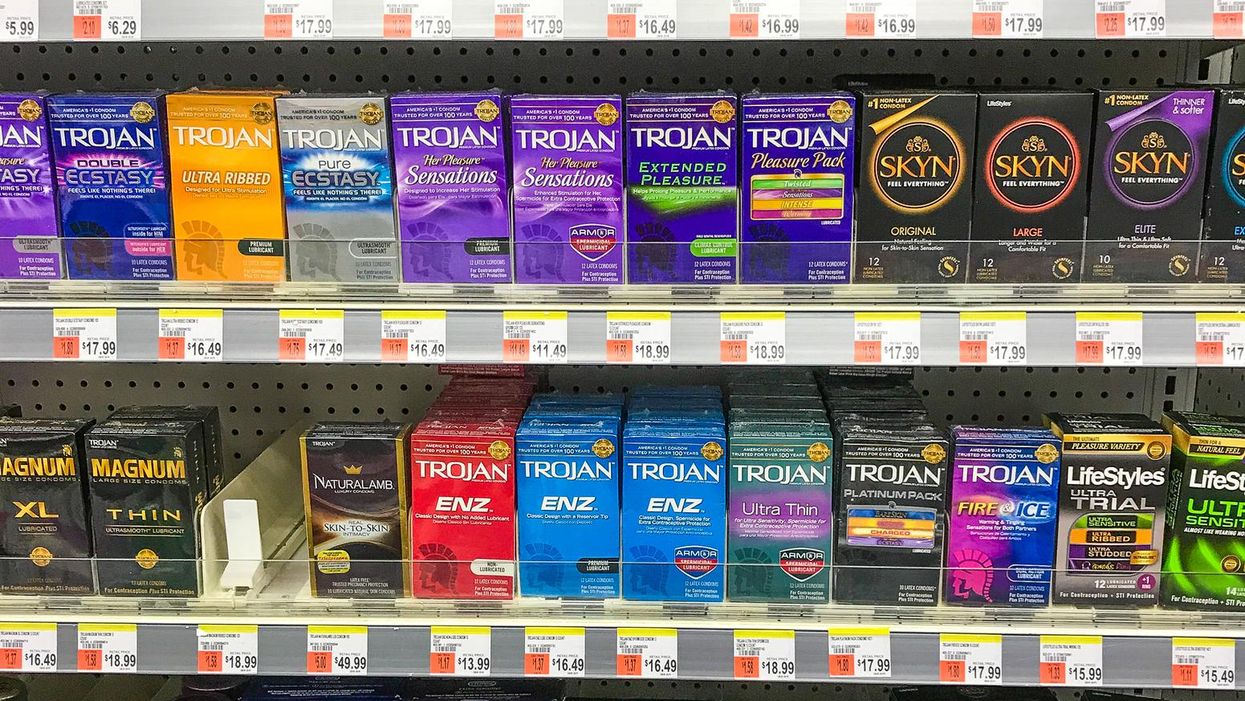
On November 5, police received a report of the theft of $90,000 worth of condoms from an address on Road 68 in Zorra Township, just outside of London, Ontario.

Police say the thieves damaged a fence to get into the property in question, breaking into a white freight truck with a trailer — which housed the Skyn-brand condoms — and stole both the truck and its load.

The perps in question also damaged multiple other vehicles on the property, OPP said.

Surveillance is being reviewed, and anyone with information is being asked to contact Oxford OPP at 1-888-310-1122.
NO DICKIES ALLOWED
Canada's NDP is trying to get rid of what's being called an "archaic" and "gender-based" dress code in the House of Commons

.
© Provided by Narcity

According to The Canadian Press, NDP MP Randall Garrison said that his party will ask for the proper attire rules to be updated when Parliament returns on November 22 so they're more inclusive and accommodating to transgender, non-binary and two-spirit MPs.

Garrison noted that a simple statement about what is appropriate in the House of Commons would be good enough without specifically mentioning gender-based outfits.

"The provisions are archaic," he said. "The gender-based dress code needs to be eliminated."

According to the House Of Commons Procedure and Practice guide, all MPs are required to dress in "contemporary business attire" in order to be recognized to speak in the debate, on points of order or during Question Period.

Men have to wear a jacket, shirt and tie as their standard attire but there are no specifics on what women have to wear. Turtlenecks and ascots have actually been deemed "inappropriate" for men to wear.

There are some exceptions to the rules, which allow for kilts to be worn on certain occasions, for military uniforms to be worn by MPs who are in the armed forces and for different tops to be worn for medical reasons, like having an arm cast.

When MPs return to the House of Commons on November 22, Justin Trudeau said his government will be "busy getting into the business of delivering on an ambitious agenda."
The buzz about fusion energy: Expert explains industry’s ‘reinvigoration’ as tech attracts VC dollars

Lisa Stiffler 3 hrs ago

For decades, the promise of harnessing the power of fusion on a commercial scale to create vast amounts of carbon-free energy has hovered just out of reach for scientists. At last that tantalizing dream appears closer to reality and the cash is starting to flow.

© Provided by Geekwire Chris Hansen, senior research scientist in the William E. Boeing Aeronautics and Astronautics Department at the University of Washington. (UW Photo)

This week, fusion energy startup Helion generated a lot of interest with its announcement of a $500 million round — and the Everett, Wash.-based company could land an additional $1.7 billion if it meets upcoming milestones. Other fusion energy companies, many also located on the West Coast, have announced venture capital investments this year in the double- and triple-digit millions.


“Helion Energy’s $500 million Series E marks the largest deal in clean energy ever and could be the beginning of a new era: abundant, clean energy from commercialized fusion technology,” said Svenja Telle, PitchBook’s emerging technology analyst.

So what is fusion energy, and why the excitement?

Fusion takes place in a plasma — which is a superheated gas and the most energetic of the four states of matter — where two nuclei smash into each other, forming a new atom and releasing energy. The most developed method to make fusion uses powerful magnets to contain the plasma. The energy that is generated can be captured and converted into electricity.

The most well-known example of fusion’s power is the sun, a massive fusion reactor producing enormous amounts of energy, which, thanks to excessive greenhouse gas emissions, we are now trapping too much of on Earth.

GeekWire this week caught up with Chris Hansen, a University of Washington senior research scientist in the William E. Boeing Aeronautics and Astronautics Department, to learn more about the field. His lab is studying different aspects of fusion energy and collaborating with startups including Seattle-based UW spinoff CTFusion and other universities.

Questions and answers have been edited for clarity and length.

GeekWire: Why has it been so difficult to harness fusion for electricity production?

Hansen: We always talk about fusion as “we want to harness the sun,” and recreating the sun on Earth already sounds pretty hard, right? But we actually have to do much more than that. The sun uses fusion, but the energy density of the sun is comparable to a compost heap. It’s actually very low energy density and only works because it’s massive. It’s just gigantic.

But on Earth, we’ve got to do a lot better than a compost heap. You’re talking 10-times higher temperatures [about 100 million degrees Celsius] and orders of a million times higher energy density. So it’s very challenging conditions to create. We can do it scientifically, many experiments have demonstrated that it’s possible, but to do it in a way that is cost effective is the hard part.

GW: Dang! That sounds crazy tough. Why bother with fusion?

Hansen: It’s a very interesting problem. There are so many different aspects of fusion that still have to be solved, and so many things that integrate together it’s this scientific grand challenge that requires us to advance almost every type of technology that society uses.
Related: As interest in fusion energy ignites, Helion lands $500M from OpenAI CEO, Facebook co-founder

It’s very exciting, pushing the boundaries of what we can do as humanity.

And then, if you think about if you are able to succeed, just the way that it would dramatically change the whole landscape — of course the energy [production] on the planet, but being in the aerospace engineering department, it opens up all sorts of other things that we don’t even really consider. Doing space missions and travel with people farther out in the solar system, and making it much easier to think about generating large amounts of power on planets that don’t have the conventional resources that we have.

GW: So why is the sector finally taking off?

Hansen: To some extent, we just didn’t have the related technologies that were necessary to make it work 20 years ago. There’s a lot of … new magnetic technologies, new materials, but I think one of the biggest impacts that has not only impacted fusion, but allowed those other technologies to come up too, is just computing.

Our ability to model and move forward on some of these scientific and technological developments because of increased computing power has really been a difference maker. It’s very difficult to make measurements in a fusion reactor because 100 million degrees is pretty hot. So as a result, we really rely on models and computer simulations to interpret and understand some of the things we’re seeing.

As computing has extended, the sophistication of those models has gotten better and we’re really getting to the point where we have a good enough understanding that we feel like we can make some of these big steps again and we feel confident about some of the predictions. And that’s what you see being manifested in the industry’s reinvigoration.
© Provided by Geekwire Hansen’s lab is working on plasma-related technology that could lower the cost of fusion. In this video of their work, the hourglass shape is the wall of a device containing plasma. Inside the vessel, the plasma naturally relaxes into a donut shape. The ghostly image of the plasma is created because hotter regions emit light in different wavelengths, and the high-speed camera used to capture the image is only sensitive to one of the wavelengths.

GW: If one of the companies succeed, how quickly could fusion provide power?

Hansen: Once you get the thing to work, there are still a lot of other things that need to happen. Fusion reactors are extremely safe, and we don’t have the risks that we traditionally think of with nuclear power, but it’s also not wind or solar so there’s some regulation structure that’s going have to be created. There are other materials and things like the whole rest of the power plant has to come together.

But depending on how quickly someone can get the fusion part of it to work, that could be very fast.

I’m fairly familiar with Zap Energy’s concepts that are very cheap and relatively small scale. If something like that or something like Helion that’s on this smaller scale, cheaper side you could see that ramp up pretty fast. CTFusion, which my lab works with, is also pursuing an approach that could really shorten that timeline. It would be very different from these large power plants that people traditionally would think of when they think of fusion energy or other systems.

GW: Fusion power has been decades in the making, and there must still be naysayers. What is their case against the technology, and how do you answer them?

Hansen: People who associate it with traditional nuclear power have concerns given the history of how that has been handled [see Chernobyl and Fukushima disasters] … But we really need to make clear that fusion is fundamentally different. The reason that [commercialized fusion energy] hasn’t happened yet is it’s so hard to create the conditions that allow it to happen. But that’s part of what makes it so inherently safe, because you can just immediately shut down the system. All the fuel that is in there is now inert. You have none of these things that can lead to bad consequences in current nuclear fission systems.

The other thing is people who basically think we should funnel all the money into other types of renewable resources. But you have a challenge with intermittent sources [like wind and solar that aren’t always available]. At the moment, they’re extremely cheap and they’re great, and we should definitely be investing in that. But there’s a little bit of an open question as you try and approach 100% carbon free, you do have to deal with that intermittency. And so that will raise the cost.

I think fusion would fit really well in there. I personally would argue that that’s a good investment but, I can see the see the other side. There are some battery people out there and smart grid people who would say that we can do it this other way. But in government funding, at least, there’s all the different peer review and competitive proposals to try and make your case.
21 Brazil scientists snub medals in row with Bolsonaro

AFP 

Twenty-one scientists awarded one of Brazil's highest honors, the National Order of Scientific Merit, rejected their medals Saturday after President Jair Bolsonaro withdrew two colleagues whose work apparently discomfited his government from the list of honorees.

© EVARISTO SA A file photo of Brazilian President Jair Bolsonaro

The far-right president named 25 people Wednesday to receive the honor, which Brazil created in 1992 to recognize the most important contributions to science and technology.


However, two days later, he withdrew the names of two prominent scientists from the list.

One was Dr. Marcus Lacerda, who published one of the first studies finding the drug chloroquine is ineffective against Covid-19 -- rebutting Bolsonaro's pet strategy for fighting the pandemic.

The other was Dr. Adele Benzaken, who was fired as director of the Brazilian health ministry's HIV/AIDS department when Bolsonaro took office in 2019, after her department published a pamphlet aimed at transgender men.


In protest, all 20 of the other scientists and one of the three "national personalities" named by Bolsonaro to receive the honor rejected their medals in an open letter.

"This is yet another clear demonstration of the persecution of scientists and the latest step in the current government's systematic attack on science and technology," they said.

"This act of protest, which saddens us, expresses our indignation at the destruction of Brazil's university system and of science and technology in general."

Bolsonaro has faced sharp criticism from the scientific community over budget cuts for research and technology, as well as his frequent rejection of scientific findings and history of spreading misinformation, particularly on Covid-19.

The president long touted chloroquine as a treatment for Covid-19 despite evidence it was ineffective, and flouted health experts' advice on face masks and stay-at-home measures to contain the pandemic.

Benzaken, the director of leading public health institute Fiocruz in the Amazon region, said she was "extremely honored" by her colleagues' decision to reject their medals over what she called the government's "inelegant" treatment of her and Lacerda.

"That was the greatest honor of all," she told AFP, criticizing the Bolsonaro government's attitude toward science.

"There have been heavy cuts to funding for science in Brazil, a total disregard for statements based on scientific evidence, little value attributed to science," she said.

jhb/md