Sunday, January 09, 2022

'Old Man Out!': Anger In Kazakhstan Focuses On Ex-leader

By Christopher RICKLETON
01/08/22 AT 9:53 PM

As protesters armed with sticks and discarded police shields prepared to storm the mayor's office in Kazakhstan's largest city Almaty, they marched to chants of "old man out!"

They were not referring to President Kassym-Jomart Tokayev, 68, but Nursultan Nazarbayev, the octogenarian who after more than a quarter-century in office picked career diplomat Tokayev as his loyalist successor in 2019.

Since Kazakhstan's independence from the Soviet Union in 1991, Nazarbayev has been synonymous with the world's ninth-largest country, a majority Muslim Central Asian state rich in oil.

Since Kazakhstan's independence from the Soviet Union in 1991, founding president Nursultan Nazarbayev has been synonymous with the country Photo: AFP / NICHOLAS KAMM

But the 81-year-old has yet to appear in public since the country was plunged into unprecedented chaos this week when armed clashes between protesters and police escalated from demonstrations over a New Year fuel price hike.

For many residents of the city of 1.8 million people, the strongman who styles himself as a force for stability in the wider region is an increasingly incendiary and divisive figure.

"Kazakhstan has been turned into a private company of the Nazarbayevs!" vented a 58-year-old called Saule, as Almaty residents surveyed the charred, bullet-strewn territory of the presidential residence whose now-battered gates open out onto a street named after him.

"One clan lives well and everyone else is in poverty," complained Yermek Alimbayev, a builder who was chatting with volunteers manning a makeshift checkpoint in the city, where Kazakh military and a force from the Russia-led Collective Security Treaty Organisation (CSTO) have secured strategic buildings.

  
Protesters in Kazakhstan have chanted 'old man out!' in reference to 81-year-old former leader Nursultan Nazarbayev Photo: AFP / Abduaziz MADYAROV

In one particularly striking image this week, demonstrators pulled down a statue of Nazarbayev in the provincial town of Taldykorgan.

 
Map of Kazakhstan Photo: AFP / Sophie RAMIS


The breadth and depth of anger now laid at his door would once have been unimaginable.


Credited with overseeing impressive economic growth in the years after the millennium, the one-time steelworker and Communist Party bigwig benefited from a personality cult that blossomed even as local incomes were hammered by successive economic crises.

Image consultants promoted his reputation abroad as an elder statesman committed to nuclear diplomacy and world peace.

Among them was former British prime minister Tony Blair, who continued to advise Nazarbayev even after police lethally repressed a 2011 oil strike in the western town of Zhanaozen, where this week's unrest over the fuel price hike began.

While the precise contours of the political crisis that has engulfed Kazakhstan are unclear, it is evident that the ruling elite has been roiled.

On Saturday, authorities announced the arrest on treason charges of Karim Masimov, a high-profile Nazarbayev ally who was dismissed from his post as security committee chief at the height of the unrest.

A notice on the presidential website said Tokayev had also appointed a new man as the committee's first deputy -- a role previously occupied by Nazarbayev's nephew, Samat Abish.

Tokayev has not mentioned the former president in a series of addresses to the nation since the crisis began, though he did say he was taking over as head of the national security council.

Nazarbayev had assumed the powerful position as part of the power transition.

Nazarbayev's spokesman on Saturday denounced rumours that the ex-leader had left the country, saying he was in the capital Nur-Sultan and in touch with Tokayev.

If the Nazarbayev political star is finally on the wane in Kazakhstan, then his relatives shoulder some of the blame.

Oldest daughter Dariga Nazarbayeva's political career, mainly in the rubber-stamp legislature, has been marked by a series of controversial statements and perceptions of an abrasive style.

Offshore leaks and a high court challenge in London have revealed the extent of her family's foreign property holdings -- part of a capital flight trend Nazarbayev officially discouraged while president.

His middle daughter Dinara and her husband Timur Kulibayev control Halyk, the largest commercial bank, and are among the richest people in the country.

Rustam Nugmanov, a 48-year-old man who arrived in Almaty on Saturday morning on the first train allowed to leave the capital for the troubled southern city, said Kazakhs had "woken up" and were ready for life without Nazarbayev.

"He did a lot for the country, but he could have done so much more," said Nugmanov. "Maybe he just wasn't capable. Greed, other human weaknesses. He kept feeding those weaknesses."


Kazakhstan unrest: At least 164 killed in crackdown on protests, reports say

Sun., January 9, 2022


At least 164 people have died in Kazakhstan during violent anti-government protests, according to media reports citing health officials.

If confirmed it would mark a sharp rise from the previous figure of 44 deaths.

Almost 6,000 people have been arrested, including "a substantial number of foreign nationals", Kazakhstan's presidential office said on Sunday.

The demonstrations, triggered by a rise in fuel prices, turned into huge riots as they spread across the country.

They started on 2 January and grew to reflect discontent at the government and former President Nursultan Nazarbayev, who led Kazakhstan for three decades and is still thought to retain significant influence.

Last week, troops from countries including Russia were sent to Kazakhstan to help restore order.

The presidential statement added that the situation had stabilised, with troops continuing "cleanup" operations and guarding "strategic facilities".

A state of emergency and a nationwide curfew remain in place.

AT THE SCENE: 'Like something from an apocalypse film'

CONTEXT: Why is there unrest in Kazakhstan?


Kazakhstan: The basics

Where is it? Kazakhstan shares borders with Russia to the north and China to the east. It is a huge country the size of Western Europe.

Why does it matter? A former Soviet republic which is mainly Muslim with a large Russian minority, it has vast mineral resources, with 3% of global oil reserves and important coal and gas sectors.

Why is it making the news? Fuel riots, which have escalated to become broader protests against the government, have resulted in resignations at the top and a bloody crackdown on protesters.

In the capital, Nursultan, there are obvious signs that security has been tightened, says the BBC's Steve Rosenberg, with the entrance to the city's Presidential Palace blocked.

There is a growing suggestion, our correspondent adds, that the recent violence is linked to a power struggle within Kazakhstan's ruling elite.

Some 103 fatalities in the latest violence were reportedly in the main city, Almaty.

The security forces said they killed rioters in Almaty while trying to restore order and that protesters had tried to take control of police stations in the city.

President Kassym-Jomart Tokayev said "20,000 bandits" had attacked Almaty and that he had told security forces to "fire without warning".

US Secretary of State Antony Blinken on Sunday criticised the president's directive. "The shoot-to-kill order, to the extent it exists, is wrong and should be rescinded," he told ABC News' This Week.

He said the US was also seeking clarification from the Kazakh president on why he had requested the presence of Russian troops.

On Saturday, Kazakh authorities said the country's former intelligence chief Karim Massimov had been arrested on suspicion of treason. They gave no further details.

AFP

Amid Kazakhstan unrest, Almaty residents seek bread and information

After days of violent anti-government protests, the situation in Kazakhstan's largest city, Almaty, appears to have stabilized. DW spoke with residents who are now wondering what's next.
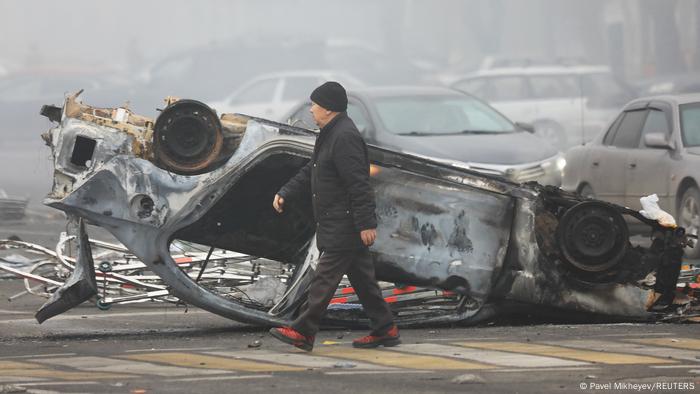


After days of unrest and turmoil, a semblance of normalcy has returned to Almaty

For days, Almaty has been enveloped in thick fog in the evenings. Explosions are heard from different parts of the city, sometimes accompanied by gray-blue flashes of light muffled by the murky haze. Gunfire, too, breaks the silence from time to time.

But compared to earlier this week, the situation has calmed considerably. Residents of Kazakhstan's largest city are now venturing out once again.

Many were scared to leave their homes, especially after dark — and not only because of the curfew imposed after mass protests broke out on Tuesday. Those who had unexpected access to the internet, despite an online shutdown, were shocked by footage that showed a young woman with a child being hit by bullets. It remains unclear who shot at her.

More people are now out on the streets, many seeking out small grocery stores in their neighborhoods. The big supermarkets and shopping centers in the city remain closed.
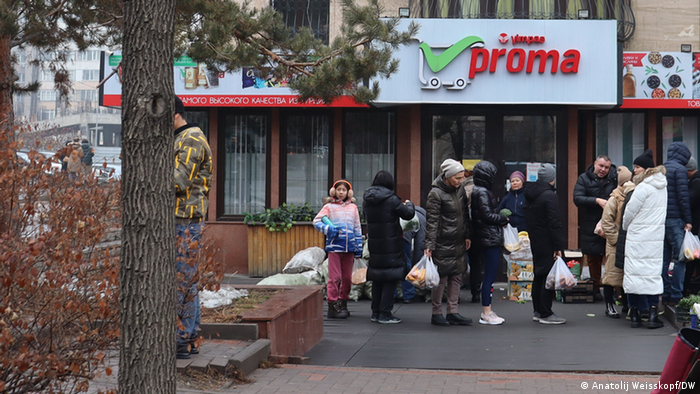

Basics like bread, milk and noodles have been hot commodities in Almaty

Askar Jermekov owns a small food store and told DW he has seen a big demand, especially for bread and noodles. "Before I open my store, I have to line up in front of the bread factory for a long time. If I can manage, I buy about 50 loaves of bread," he said. "I open my shop at 9 in the morning and by 10 I have almost nothing left, no noodles or milk. I'm now considering how to manage the shopping for tomorrow. The bread factories are operational, but the problem is that their drivers are scared and are refusing to deliver to shops."

'Everyone has to help as much as possible'

Nevertheless, residents seem to have enough bread. Many of the small snack bars in the city's neighborhoods, which normally sell shawarma and the savory puff pastry, samsa, have also begun baking their own loaves.

Some have also been preparing other dishes according to Kazakh, Uyghur, Uzbek or Tajik traditions — Almaty is a multiethnic city. The dishes are then transported by car to small stores, where they are distributed free of charge to those in need. It's estimated that more than 7,000 such trips have been carried out so far.
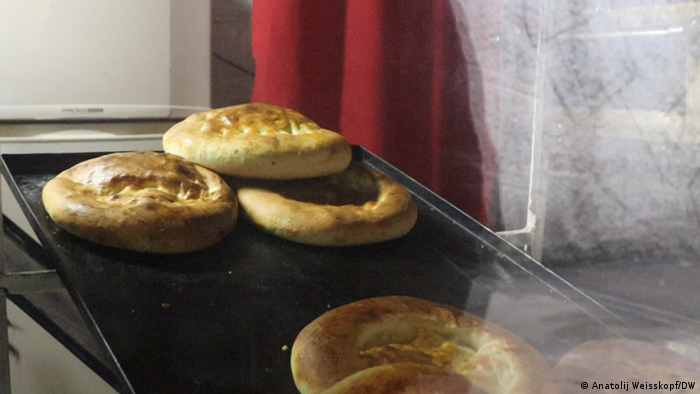

Free delivery of bread loaves have been a lifeline for many residents

"People are having a hard time. At a time like this, everyone has to help as much as possible. When I heard that there was a problem in the city with bread supplies, I showed up early in the morning and baked some," said the owner of a small bakery, who did not want to be named. "But I only give one loaf per person so that everyone gets something."

'We don't know anything, we only hear shooting'

Another small bakery near the now burned-down residence of the Kazakh president has also resumed business, also distributing free bread to those in need. Waiting in long lines, people exchange the latest information.

"How else are we supposed to know what's happening around us? There is no internet and the mobile network doesn't work everywhere. Television reception is disrupted," said one woman. "We don't know anything, we only hear shooting. It's an information vacuum. That's also one of the reasons we come here, to at least find out something." Nearby, other people standing in line nod as she speaks.

Getting reliable information in and out of Almaty is difficult. Many rumors and unbelievable stories are circulating in the city, mostly spread by those people who still have a landline. At the moment, the old-school telephones are almost the only means of communication available to the general population.
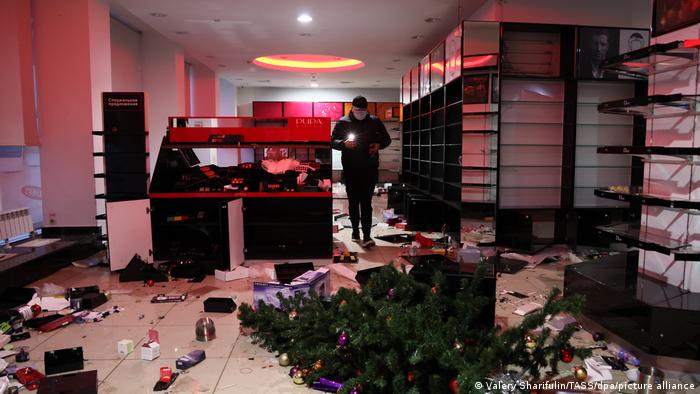


Many shops in Almaty were looted and vandalized during days of turbulent protests and violence

With mobile internet switched off and intermittent problems with wired connections, instant messaging services — very popular here — have been essentially shut down. In addition, many terminals that could be used to top up cellphone credits have been vandalized during the riots.
Situation remains volatile

As dusk falls, fresh gunfire can be heard. But those who still want a loaf of bread stay in line, seemingly already used to the new situation.

Suddenly, two armored personnel carriers drive by at high speed. It's unclear who they belong to, because the vehicles aren't marked. Many people in the bread line begin to speculate. Some think they are the so-called "peacekeepers" from Belarus or Russia, while others are convinced the vehicles belong to the Kazakh army, which is still trying to maintain order.

In any case, after days of violent turmoil the streets are once again being patrolled by police officers, with some security officials armed with machine guns. Patrols are common, even though numerous police cars were burned or destroyed during the unrest.

'We are dealing with bandits and terrorists'

In a televised address on Friday, Kazakh President Kassym-Jomart Tokayev said Almaty alone had been invaded by "20,000 bandits," and ordered security forces to fire on the "terrorists" without warning. He dismissed as "stupidity" appeals "from abroad" for all parties to negotiate a peaceful solution to the crisis.

This article was originally written in Russian

SUNNI PATRIARCHY
Outspoken Saudi princess released after nearly three years in jail

Human rights advocate Princess Basmah and her daughter were imprisoned without charge in 2019

 
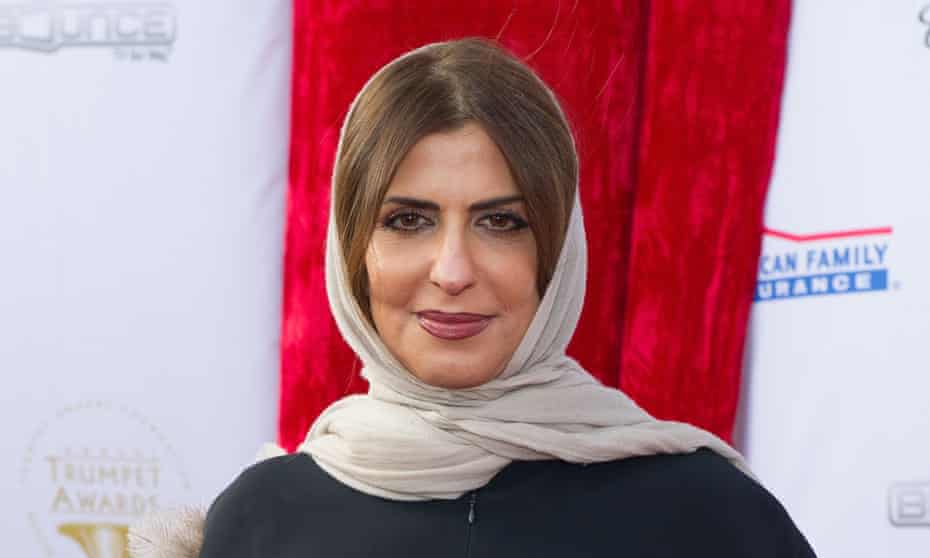
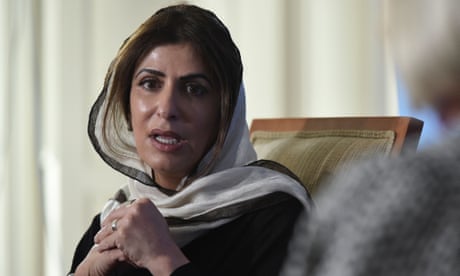
Princess Basmah, the daughter of Saudi Arabia’s second king and an outspoken human rights advocate, has been freed after almost three years in jail. 
Photograph: Marcus Ingram/Getty Images

Staff and agencies
Sun 9 Jan 2022

Saudi authorities have released a princess and her daughter who had been detained without charge for nearly three years.

Princess Basmah bint Saud bin Abdulaziz al-Saud, 57, an outspoken human rights advocate and member of the royal family, went missing in March 2019 along with her adult daughter Souhoud al-Sharif.

“The two ladies were released from their arbitrary imprisonment, and arrived at their home in Jeddah on Thursday 6 January 2022,” her legal adviser Henri Estramant said on Saturday.

“The princess is doing fine but will be seeking medical expertise. She seems worn out but is in good spirits, and thankful to reunite with her sons in person.”


Supporters of detained Saudi princess call for UK to help secure release


The government has not made a comment about her release. It has never publicly commented about the case.

In 2020, Princess Basmah said via social media that she had been imprisoned in the capital Riyadh for more than a year and was sick. She demanded that the current ruler and her cousin, Crown Prince Mohammed bin Salman, release her and provide medical care.

She claimed she was being detained without charge in al-Ha’ir prison, where numerous other political detainees have been held, and neither she nor her daughter received explanations for their arrests, despite repeated pleas to the kingdom’s royal court, and to her uncle King Salman.

The youngest child of the late King Saud, Princess Basmah has been critical of the kingdom’s treatment of women.

She had been due to travel abroad for medical treatment around the time of her arrest in late February 2019, and was informed after her detention that she was accused of trying to forge a passport, a close relative said at the time. The nature of her illness has never been disclosed.

Following her release, rights group ALQST for Human Rights said: “She was denied the medical care she needed for a potentially life-threatening condition. At no point during her detention has any charge been levelled against her.”


Prince Mohammed has overseen a reform drive since he was appointed by his father King Salman in June 2017 at the expense of the previous designated heir to the throne, Mohammed bin Nayef.

Reforms have included lifting a decades-long ban on women driving and the easing of so-called “guardianship” rules that give men arbitrary authority over female relatives. But Saudi authorities have also cracked down on dissidents and even potential opponents, ranging from preachers to women’s rights activists, even royals.

In written testimony to the UN in 2020 Princess Basmah’s family said her detention was likely due in large part to her “record as an outspoken critic of abuses”. She was also deemed an ally of Mohammed bin Nayef, the written testimony added.

With Reuters and Agence France-Presse
Taliban arrest Afghan professor after social media criticism

A prominent Afghan university professor who openly criticised the Taliban's hardline regime has been arrested in Kabul, a spokesman for the government said.

© JACK GUEZ
 Kabul University law professor Faizullah Jalal (pictured with
 his wife Massouda during a trip to Paris in 2004) has long had 
a reputation as a critic of Afghanistan's leaders

Professor Faizullah Jalal has made several appearances on television talk shows since the previous US-backed government was ousted in August, blaming the Taliban for the worsening financial crisis and criticising them for ruling by force.

Since returning to power, the Taliban have cracked down on dissent, forcefully dispersing women's rights protests and briefly detaining several Afghan journalists.

Taliban spokesman Zabihullah Mujahid tweeted that Jalal had been detained Saturday over statements he made on social media in which he was "trying to instigate people against the system and was playing with the dignity of the people".

"He has been arrested so that others don't make similar senseless comments in the name of being a professor or scholar that harm the dignity of others," he added.

Mujahid shared screenshots of tweets he claimed had been posted by Jalal, which said the Taliban intelligence chief was a stooge of Pakistan, and that the new government considers Afghans as "donkeys".

In one television appearance, Jalal called Taliban spokesman Mohammad Naeem -- who was also participating -- a "calf", a grave insult in Afghanistan.

Clips of his passionate criticism went viral on social media, sparking concern he risked Taliban retribution.

Jalal's wife Massouda, who once stood as Afghanistan's first woman candidate for the presidency, posted on Facebook that her husband had been arrested by Taliban forces and detained in an unknown location.

"Dr. Jalal has fought and spoken out for justice and the national interest in all his activities pertaining to human rights," she said.

A long-time professor of law and political science at Kabul University, Jalal has long had a reputation as a critic of Afghanistan's leaders.

On Twitter, rights group Amnesty International condemned the arrest of the lecturer "for exercising his freedom of expression and criticising the Taliban", calling for his immediate and unconditional release.

The Taliban have formed an all-male cabinet made up entirely of members of the group, and almost exclusively of ethnic Pashtuns.

They have further restricted women's rights to work and study, triggering widespread international condemnation.

bur/ecl/jd/fox/mtp
Archive Amassed By Nazis Sheds Light On Masonic History

By Stanislaw WASZAK
01/09/22

Curators combing through a vast historic archive of Freemasonry in Europe amassed by the Nazis in their wartime anti-Masonic purge say they believe there are still secrets to be unearthed.
Poland has a vast archive of items that shed light on the history of Freemasonry in Europe Photo: AFP / JANEK SKARZYNSKI

From insight into women's Masonic lodges to the musical scores used in closed ceremonies, the trove -- housed in an old university library in western Poland -- has already shed light on a little known history.

But more work remains to be done to fully examine all the 80,000 items that date from the 17th century to the pre-World War II period.

'It is one of the biggest Masonic archives in Europe,' says curator Iuliana Grazynska Photo: AFP / JANEK SKARZYNSKI

"It is one of the biggest Masonic archives in Europe," said curator Iuliana Grazynska, who has just started working on dozens of boxes of papers within it that have not yet been properly categorised.

"It still holds mysteries," she told AFP, of the collection which curators began going through decades ago and is held at the UAM library in the city of Poznan.

The collection was amassed by the Nazis during their wartime anti-Masonic purge Photo: AFP / JANEK SKARZYNSKI

Initially tolerated by the Nazis, Freemasons became the subject of regime conspiracy theories in the 1930s, seen as liberal intellectuals whose secretive circles could become centres of opposition.

Lodges were broken up and their members imprisoned and killed both in Germany and elsewhere as Nazi troops advanced during WWII.

Fine prints, copies of speeches and membership lists of Masonic lodges in Germany and beyond feature among the collection's 80,000 items 
Photo: AFP / JANEK SKARZYNSKI

The collection was put together under the orders of top Nazi henchman and SS chief Heinrich Himmler and is composed of many smaller archives from European Masonic lodges that were seized by the Nazis.

It is seen by researchers as a precious repository of the history of the day-to-day activities of lodges across Europe, ranging from the menus for celebrations to educational texts.

The first edition of the earliest Masonic constitution written in 1723, six years after the first lodge was created in England, is one of the gems of the collection 
Photo: AFP / JANEK SKARZYNSKI


The collection was put together under the orders of SS chief Heinrich Himmler and some documents still bear Nazi stamps 
Photo: AFP / JANEK SKARZYNSKI

Fine prints, copies of speeches and membership lists of Masonic lodges in Germany and beyond feature in the archive. Some documents still bear Nazi stamps.

"The Nazis hated the Freemasons," Andrzej Karpowicz, who managed the collection for three decades, told AFP.

Nazi ideology, he said, was inherently "anti-Masonic" because of its anti-intellectual, anti-elite tendencies.

The library puts some select items on show, including the first edition of the earliest Masonic constitution written in 1723, six years after the first lodge was created in England.

"It's one of our proudest possessions," Grazynska said.

The oldest documents in the collection are prints from the 17th century relating to the Rosicrucians -- an esoteric spiritual movement seen as a precursor to the Freemasons whose symbol was a crucifix with a rose at its centre.

During the war as Allied bombing intensified, the collection was moved from Germany for safekeeping and broken up into three parts -- two were taken to what is now Poland and one to the Czech Republic.

The section left in the town of Slawa Slaska in Poland was seized by Polish authorities in 1945, while the others were taken by the Red Army.

In 1959, the Polish Masonic collection was formally established as an archive and curators began studying it -- at that time, Freemasonry was banned in the country under Communism.

The collection is open to researchers and other visitors, who have included representatives of German Masonic lodges wanting to recover their pre-war history.

It is "a mine of information in which you can dig at will," said Karpowicz.
Copyright AFP. All rights reserved.
Concern grows for Palestinian teen held by Israel

Palestinian teenager Amal Nakhleh's first name means "hope" in Arabic, but his parents are in despair because he is chronically ill and one of the few minors held without charge by Israel. 
© ABBAS MOMANI
Moammar Nakhleh, the father of 17 year-old Palestinian prisoner Amal, shows a photograph of his son on his telephone, in Jalazun refugee camp, near the occupied West Bank city of Ramallah, on January 8, 2022

"Since his arrest last year I have only seen him twice, including last week when he told me he wanted to go on hunger strike," journalist Moammar Nakhleh said of his 17-year-old son.

"This scares me because he is already very weak," from myasthenia, a rare neuromuscular disease, and underwent surgery in 2020 to have a tumour removed from his rib cage, Nakhleh said.

Israeli authorities accuse Amal of throwing stones at soldiers and have held him for a year in administrative detention. The practice allows for suspects to be detained without charge for renewable six-month terms while investigations are ongoing.
© ABBAS MOMANI 
Moammar Nakhleh is the father of 17-year-old Palestinian prisoner Amal. Israeli authorities accuse Amal of throwing stones at soldiers and have held him for a year under administrative detention

Amal faces a new hearing Monday, and his father is worried that his detention could be renewed.

Administrative detention has been criticised by the Palestinians, human rights groups and foreign governments, who charge that Israel abuses it.

Israel defends the practice, saying that "due to the complex and volatile security situation in the West Bank, detention orders are issued against those who plan terrorist attacks, or those who orchestrate, facilitate or otherwise actively assist in the commission of such acts"
.
© MOHAMMED ABED 
Palestinian artists paint a mural, in Gaza City on January 5, 2022, of Hisham Abu Hawash, a Palestinian prisoner who ended his hunger strike after Israel committed to his eventual release

"The use of administrative detentions, which allow for the deprivation of a person's liberty for a limited time only, is an effective and lawful security measure against such continuous terrorist attacks," Israel argues in a foreign ministry statement.

Leading Israeli newspaper Haaretz joined the fray days ago with an editorial entitled "Enough with administrative detentions".


"It's time for Israel to learn to forgo this undemocratic, corrupt practice of unlimited administrative detention, without evidence or charges that can be refuted," Haaretz said.

- 'Where is the evidence' -


The editorial highlighted the case of Hisham Abu Hawash, one of more than 450 Palestinians held for more than a year in administrative detention by Israel.

Six teenagers are among these prisoners, according to the Israeli human rights group Hamoked.

Tuesday's editorial came as Abu Hawash, a 40-year-old member of the Islamic Jihad movement, ended a 141-day hunger strike after Israel agreed to his eventual release.

The deal proposed to Abu Hawash, a father of five, stipulates that his detention will not be extended beyond February 26, in return for his ending his fast.

"If the state had evidence against Abu Hawash, it should have charged him. If not, it had to release him immediately," Haaretz said.

According to the paper, military prosecutors "had no unclassified evidence on which to draft an indictment to present to a military court" in the Abu Hawash case.

But for the Shin Bet domestic security agency, "'confidential material' is enough for a military commander to sign an order for six months of administrative detention, and an additional one six months later, repeat ad infinitum".

So why was Amal arrested?

The Shin Bet declined to comment when asked by AFP but the agency has previously been quoted as saying that he was "suspected of having taken part in terrorist activity".

- 'Bracing for the worst' -

Amal's predicament dates back to November 2020 when he was arrested by Israeli authorities in the occupied West Bank.

A football fan, he was out with friends after recovering from his cancer surgery, his family said.

Accused of throwing stones at soldiers, Amal was held for 40 days but then set free by an Israeli judge.

"At the hearing, a representative of the security forces said they had a 'file' against him and would seek administrative detention," Amal's father recalled.

"The judge asked them to provide him with the incriminating file," which they failed to, prompting the judge to free Amal.

But in January last year, he was re-arrested and placed in administrative detention, which has since been twice renewed.

The UN refugee agency UNRWA has taken up Amal's case with the Israeli authorities.

"We are demanding his immediate release from administrative detention for two reasons: his medical condition which is incredibly serious... and he is a minor," UNRWA's West Bank chief, Gwyn Lewis, told AFP.

"We have written several times and followed up but there has never been any information on why he was arrested."

Moammar Nakhleh fears that Amal's detention will be renewed again on Monday.

"I am scared that if his detention is renewed, I will not see him for a long time," he said at the family home in Al-Jalazun refugee camp.

"I'm bracing for the worst."

gl/dms/hkb/kir/fz

Shaky ground: Texas Railroad Commission takes much-needed stand on oilfield earthquakes
A FRACKQUAKE BY ANY OTHER NAME

Jason Jennaro
Fri, January 7, 2022

A map of seismic activity in the Permian Basin is pictured.

On the cloudy afternoon of Dec. 15, I was in Houston speaking to a colleague on the phone in Midland when a 3.6 magnitude quake shook the oil-rich town. She nearly fell out of her chair, quickly ending the conversation by saying, “I need to check on my children.” It was one of 15,000 earthquakes to hit West Texas’ Permian Basin in the last five years.

More: 'The time is now': New Mexico taking action on oil and gas-induced earthquakes

The Permian Basin has been a prolific economic engine for the State of Texas and is a vital energy resource for the United States. The basin is the center of the U.S. shale revolution, employs half of all U.S. drilling rigs, produces almost 5 million barrels of oil per day and boasts the largest oil-shale reserve base on the planet. Its resource is deep and geographically vast, with one of the thickest hydrocarbon structures in the world spanning 300 miles from Big Lake, Texas to Carlsbad, New Mexico.

But the Permian Basin has a problem: a 15 million barrel per day problem.

Approximately three barrels of brackish water are produced for every barrel of oil, and this wastewater needs to go somewhere. Much of this water is disposed of into thousands of deep injection wells known as saltwater disposals. Many of these injection wells were drilled on or close to ancient but historically inactive fault lines. Scientists have warned for years that deep water injection can pressurize these faults and induce quakes. With 5,200 West Texas quakes in 2021, double what was observed in 2020, this is no longer a theoretical discussion. Earthquakes are now impacting West Texas cities spanning from Pecos to Big Spring on a weekly basis. The Texas Railroad Commission (RRC), the principal regulatory body for Texas oil and gas, has responded in a pragmatic and data-driven way by severely limiting wastewater disposal in parts of six counties, impacting how millions of barrels of oil are produced daily.

More: Risk of earthquakes caused by oil and gas operations in New Mexico rising

The RRC is a storied Texas institution established in 1891 to first regulate railroads and then the nascent oil industry. For 130 years the RRC has had the central role in safeguarding the state’s place as the unofficial capitol of American energy, and in protecting its environment and its communities.

Earthquake data employed by the RRC is gathered by the TexNet Seismic Monitoring Program. In 2015 the Texas legislature under Gov. Abbott passed a law that established TexNet to scientifically determine the causes of increased seismic activity via continual seismic data collection and analysis. The rapid rise in West Texas earthquakes has prompted data-driven regulatory action from the RRC to mitigate induced seismicity while still facilitating the development of the state’s most important energy asset.

More: New Mexico investigates earthquakes induced by oil and gas as Texas cracks down on injection

Over the last two years the RRC regulated and encouraged the development of multi-customer produced water recycling and storage facilities. These facilities repurpose produced water for use in the completion process and thus reduce dependence on deep well injection into basement formations where fault lines exist. The RRC also developed stringent commercial recycling permitting standards know as Division 6-H11 (Div. 6-H11). These rules are essential because they protect west Texas’ aquifers, waterways and ecosystems from produced water contamination. Produced water typically contains oil, residual chemicals from the fracking process and suspended solids, and when stored improperly it can create toxic hydrogen sulfide gas. Commercially permitted recycling facilities operating under Div. 6-H11 are held accountable by stringent reporting, bonding, engineering, monitoring and other standardized RRC regulations.

Over the final months of 2021 the RRC responded more forcefully with first-of-kind Seismic Response Actions that severely limit deep well produced wastewater injection into seismically active areas, particularly around the population centers of Midland-Odessa. These actions encouraged wastewater to be recycled safely or at a minimum redirected away from population centers and seismic clusters.

To understand these actions, it’s important to understand how Permian Basin operators have managed billons of barrels of fresh and wastewater over the last decade, and how it has evolved.

More: 4.3 magnitude Texas earthquake felt in Carlsbad Wednesday

In the early 2010s operators used freshwater from local aquifers to frack single well developments. Upon completion, the wastewater byproduct was trucked to local disposal wells for injection. In the early days of shale there were very few earthquakes so induced seismicity was understandably not a consideration. By the late 2010s, multi-well development techniques materially improved efficiency but they also increased the demand for freshwater for fracking and deep well injectors for the disposal of wastewater.

While additional water infrastructure was built to handle increased industry demands, the water reservoirs supporting the Permian Basin started to signal distress: freshwater aquifers began to decline and injection formations started tremoring. The RRC was quick to act. Today’s water supply chain relies less on freshwater aquifers and more on consuming recycled produced water. Produced water now moves almost exclusively via pipeline, not by truck, to recycling facilities or to disposals further away from population centers or concentrated areas of seismicity.

More: Data ties series of West Texas earthquakes to oil and gas wastewater

Make no mistake about it, deep well saltwater disposals are here to stay. With over 2,000 active disposals in Texas, they are an essential tool in managing produced wastewater. However, with data-driven regulation and thoughtful oversight, the RRC has encouraged operators to be better stewards of the Permian Basin by either recycling the produced water when it is possible or moving it to disposals outside of population centers or seismic clusters when it is not.

Thank you, Chairman Wayne Christian, Commissioner Christi Craddick and Commissioner Jim Wright for your thoughtful stewardship of the Permian Basin, its citizens and its resources.

Jason Jennaro is CEO of Breakwater Energy Partners. Breakwater has constructed the largest commercially permitted produced water recycling facilities in the state of Texas. He has master’s degrees from Harvard University and Georgetown University. Mr. Jennaro serves on the Board of Directors of Make-a-Wish Gulf Coast and lives in Houston, Texas with his wife and two boys.

This article originally appeared on Carlsbad Current-Argus: Shaky ground: Texas Railroad Commission takes much-needed stand on oilfield earthquakes
3 reasons everyone's quitting their job, according to Biden's labor secretary

Juliana Kaplan
Fri, January 7, 2022

Rachel Flores

In November, 4.5 million workers quit their jobs, including 1 million in leisure and hospitality.

It further cemented 2021 as the year of quitting, with eight months of nearly record quits.

The labor head said workers may be seeking better jobs or dealing with virus and childcare concerns.

The past year cemented a new American pastime: quitting your job.

For eight months, workers left at nearly record highs. In November, the most recent month that the Bureau of Labor Statistics has released data for, a record 4.5 million workers said, "I quit." That's 3% of the whole workforce.

One big clue as to why so many Americans are leaving their jobs comes from who, exactly, is quitting. A record-breaking 1 million leisure and hospitality left their jobs in November, with low-wage sectors disproportionately leading departures. With hiring still robust, that suggests that the pay of many low-wage employers won't cut it anymore.

At the same time, the Bureau of Labor Statistics' latest data release showed that the economy added just 199,000 jobs in December — a far cry from the 450,000 payrolls economists predicted.

Following the release of the jobs data, Secretary of Labor Marty Walsh told Insider that there were many reasons people were quitting — and homed in on three reasons that might explain the number of quits and low payrolls.

1. People want better work

"I think a lot of people are looking to better themselves," Walsh said. "They're quitting the job that they're in, and they're going to be looking for better-paying jobs and more opportunities."

In December, the jobs site Indeed released a survey of 1,000 workers who had left at least two jobs since March 2020. Of those respondents, 92% said: "The pandemic made them feel life is too short to stay in a job they weren't passionate about."

When it comes to the November quitters, Nick Bunker, the economic-research director at Indeed, previously told Insider that "lots of workers in those lower-wage industries seem to be leaving jobs for greener pastures, where they can get higher wages."

Walsh added "that's why it's important for us to make investments in workforce development" and job training.

2. They're worried about COVID-19


"A lot of people obviously are concerned about the virus as well," Walsh said. Fears for personal health and of contracting the virus have continually been cited as one major driver of pandemic labor shortages. That's especially salient right now, as the US has had a surge in cases amid the rise of the Omicron variant. The Centers for Disease Control and Prevention reported 705,264 new COVID-19 cases on January 5, which came after a huge spike beginning in mid-December.

That could also point to why workers were leaving the primarily in-person leisure and hospitality industry. In November, even pre-Omicron, the country was regularly logging tens of thousands of cases.

3. Childcare remains hard

"Childcare is a major issue in this country," Walsh said, adding: "It's not being supported in a lot of ways right now."

He said 100,000 people had left the childcare sector since February 2020. Insider previously reported that likely aggravated childcare deserts, areas where the number of children outnumber licensed care slots by at least three to one. Several childcare workers previously told Insider that while they loved their jobs, they were considering leaving over low pay and hard working conditions.

In November, the US lost daycare workers for the second month in a row, shedding 2,100 jobs in that sector.

"We have to do more to support childcare," Walsh said. For example, the stalled Build Back Better Act would lower childcare costs, increase its accessibility, and aim to institute universal pre-K. But that legislation is on the back burner.
Canada is Chinese citizens' least favorite country, according to state media survey


Carl Samson
Fri, January 7, 2022

Canada, once a hot travel destination among Chinese people, has become China’s least favorite country, according to a recent survey from state-run Global Times.

The poll, conducted by the Global Times Research Center with market survey firm DATA100, gathered 2,148 responses across 16 Chinese cities from Dec. 10-15, 2021.

The survey showed Canada at the bottom of the ranking, with only 0.4% of respondents saying they like the North American country.

Singapore, on the other hand, received a positive response from 14% of participants, emerging at the top of the list, alongside China itself. The two most popular countries were followed by Germany, France, the U.S., Russia and Maldives.

Singapore was also the country Chinese people said they would like to visit the most (17.1%), followed by Maldives and France. Previous data gathered since 2018 reportedly showed that the island city-state did not even crack the top six up until now.

Japan, which ranked No. 1 in 2019 and 2020, fell to sixth place in 2021.

The poll results reflect ongoing tensions between Ottawa and Beijing. On Dec. 25, Canadian Prime Minister Justin Trudeau urged Western countries to stand united against China, claiming that the East Asian state has been “playing” them against each other.

“We’ve been competing, and China has been from time to time very cleverly playing us off each other in an open market competitive way,” Trudeau told Global News. “We need to do a better job of working together and standing strong so that China can’t, you know, play the angles and divide us one against the other.”

Canadians also seem to feel similarly about the Chinese. A survey by Research Co. and Glacier Media found that 68% of Canadians have an unfavorable opinion of China.


Canada and China’s relationship began to sour in 2018 with the arrest of Huawei Chief Financial Officer Meng Wanzhou on a U.S. extradition warrant. In an apparent retaliation, the “Two Michaels” – Michael Kovrig and Michael Spavor – were detained in China on national security charges.

In September 2021, Meng reached a deal with U.S. prosecutors, and Kovrig and Spavor were subsequently released.


In early December, Canada also joined the U.S. and other Western allies in declaring a diplomatic boycott of the Beijing Olympics. The stance was taken in protest of China’s alleged human rights abuses, most notably in the northwestern region of Xinjiang.

“We are extremely concerned by the repeated human rights violations by the Chinese government,” Trudeau told reporters, according to Politico. “I don't think the decision by Canada or by many other countries to choose to not send diplomatic representation to the Beijing Olympics and Paralympics is going to come as a surprise to China. We have been very clear over the past many years of our deep concerns around human rights violations.”

Shortly after, the Chinese Embassy in Canada responded to the move, calling it a purely political show, according to the Global Times.

Featured Image via Justin Trudeau (left) and CGTN (right)

US companies plan to ‘do more, not less’ business in China: Ian Bremmer


·Anchor/Reporter

A broad crackdown on private enterprise, regulatory tightening, and uneasy U.S.-China relations have done little to discourage American companies from doing business in the world’s second largest economy.

In fact, Eurasia Group President Ian Bremmer says executives plan to double down on their investments.

“I talked to CEOs of Western companies literally every day, and I will tell you that on balance, the majority of them are planning on doing more business in China over the next 10 years, not less,” Bremmer told Yahoo Finance Live. “The reason for that is simple. It's because China is on track, still to be the world's largest economy by 2030. And corporations ultimately want to be where their markets are going to be.”

The sheer size of the Chinese market has long made it the most valuable asset for U.S. multinationals operating in the country. The International Monetary Fund estimates China will become the world’s largest economy in the early 2030s.

But those growth prospects for American companies have increasingly been clouded by geopolitical risks and a shifting domestic environment. As China's President Xi Jinping looks to secure a third five-year term, and cement his legacy, he has reshaped the priorities of the economy under the aim of “common prosperity,” going after some of China’s biggest companies including Alibaba and Tencent.

That has coincided with slowing growth in the economy. China’s GDP expanded at 4.9% in the third quarter, dragged down in part by supply chain constraints, global energy crunch, COVID-19 uncertainty, and a debt-ridden property mark.

“China today is more economically unequal than the United States. And China is ostensibly a socialist economy. that shouldn't be happening and Xi Jinping is trying very hard to address that,” Bremmer said. “If that means breaking some eggs, in terms of local Chinese corporations and what they are and aren't allowed, the kind of wealth they can amass the kind of business practices that they can have for technology companies and consumer internet for video game companies... they're going to take action. Clearly this is creating more concern about Chinese growth and the sustainability of that growth.”

China Vs USA relationship: partner or competitor?
"China today is more economically unequal than the United States," Eurasia Group President Ian Bremmer.

U.S. policy against China have only added to the jitters for executives. Last month, President Biden signed a law banning imports from the Xinjiang region, where Western countries have accused the Chinese of carrying out genocide against Uyghur Muslim minorities. Intel (INTC) and Walmart’s (WMT) Sam’s Club faced backlash domestically, after Chinese users took to social media platforms calling out the companies for complying with the new import ban. A Walmart representative later denied those allegations, saying customers simply couldn’t find the products "because of a misunderstanding" of the app’s search function.

In a recent survey by the U.S. China Business Council (USBC), 45% of U.S. companies said they have felt pressure to make statements about political issues, with the pressure coming from both the U.S. and Chinese governments, as well as consumers. One-third of those who responded said that nationalism has increasingly played a role in consumer decisions, with heightened U.S.-China tensions.

China investment in the U.S. is down significantly, while U.S. investment in China continues at a slower pace as the result of an "unpredictable business environment," according to Doug Barry, USBC senior director for communications and publications.

Yet, even with those headwinds, Barry said his members report plans to increase investments in China, because ‘they don’t want to miss out, if growth in markets slows.’

Bremmer said the White House policy is predicated on that understanding.

“The reality of U.S. foreign policy towards China is to avoid crisis precisely because our economies are enormously interdependent,” Bremmer said. “That's not going to end anytime soon.”

Akiko Fujita is an anchor and reporter for Yahoo Finance. Follow her on Twitter @AkikoFujita

ARMED STRUGGLE IS NOT TERRORISM
Colombia's leftist ELN rebels claim responsibility for bombing


 A destroyed truck of the Police Mobile Anti-Riot Squad (ESMAD) is seen after an explosion in Cali

Sat, January 8, 2022, 2:41 PM·2 min read

BOGOTA (Reuters) - Colombia's leftist rebel National Liberation Army (ELN) on Saturday claimed responsibility for an attack in the country's third-largest city, Cali, that injured more than a dozen police officers.

ELN operatives carried out the bombing, which was directed against members of ESMAD, the Colombian national police's feared anti-riot unit, late on Friday, while they were traveling in a vehicle.

"At 9:55 pm on Jan. 7, our units carried out an operation against ESMAD ... in the city of Cali," the ELN said in a statement published on a website belonging to its so-called urban front, adding that its members withdrew uninjured.


The ELN and national police both confirmed that 13 officers were injured in the attack, with police officials saying that some were seriously hurt. No deaths were reported.

The attack drew condemnation from the government and police, with President Ivan Duque decrying it as an attempt by the rebels to influence presidential elections later this year.

"Colombia does not and will not bend to terrorism and our government will never reward terrorists," Duque said in a message on Twitter.

Colombia is offering a reward of 1 billion pesos for information regarding El Rolo, the leader of the ELN's urban front, and 350 million pesos for information concerning those who planned and executed the attack, said General Jorge Vargas, the country's top police official. Together, the two rewards amount to around $334,000.

LIBERATION THEOLOGY IN PRACTICE
The ELN is estimated to have some 2,350 combatants and has fought the government since its 1964 founding by extremist Roman Catholic priests.

Peace talks between the ELN and Colombia's government were put on ice after a rebel bombing killed 22 police cadets in 2019.

The government accuses Venezuela's President Nicolas Maduro of harboring ELN rebels and dissident members of the demobilized FARC guerrillas who reject a 2016 peace deal, something the government in Caracas has repeatedly denied.

(Reporting by Oliver Griffin and Luis Jaime Acosta; Editing by Paul Simao)