Friday, April 29, 2022

Russia’s Antiquated Nuclear Warning System Jeopardizes Us All

As the war in Ukraine’s pits Russia against the West, it’s time to look at Moscow’s weak satellite systems, which raise the chances of nuclear conflict.
April 29, 2022
WASHINGTON MONTHLY
In this photo released by the U.S. Army Space and Missile Defense Command, an unarmed Minuteman 3 intercontinental ballistic missile launches during an operation test at Vandenberg Air Force Base, Calif., on Tuesday, Feb. 23, 2021. The missile was successfully launched from California in a test of the defense system, the U.S. Air Force said Wednesday. 
(Brittany E. N. Murphy / U.S. Army Space and Missile Defense Command via AP)


Since Russian President Vladimir Putin announced a heightened nuclear alert level, much of the world has worried that he might go nuclear in his war against Ukraine. But there is another concern: a false alarm from Russian early-warning systems, which experts believe are dangerously vulnerable to errors.

The risk of a catastrophic mistake has been a threat since the outset of the nuclear age, but miscalculation becomes more likely in a period of heightened Russian-American tension. Leaders would have only minutes to make fateful decisions, so each side needs to be able to “see” clearly whether the other has launched missiles before retaliating. Ambiguity in a moment of “crisis perception,” the Rand Corporation has noted, can spark “conflict when one nation misinterprets an event (such as a training exercise, a weather phenomenon, or a malfunction) as an indicator of a nuclear attack.”

Russia and the United States are the most heavily armed of the nine nuclear powers, which include China, France, the United Kingdom, North Korea, Pakistan, India, and Israel. (Iran is poised to join the club.) But only the U.S. has comprehensive surveillance of the globe, provided by three active geosynchronous satellites, with two in reserve, whose infrared receptors can spot missile plumes. That data is supplemented by radar, which gives the U.S. the capacity to double-check that a launch has actually occurred.

Specialists call this verification by both satellite and radar “dual phenomenology.” The Russians don’t have it, at least not reliably. They lack adequate space-based monitoring to supplement their radar.

What they have is a “terrible and dangerous technology shortfall,” according to Theodore Postol, a professor of science, technology, and national security policy at MIT and a former scientific adviser to the chief of naval operations.

He believes that Russian satellites are handicapped by their inability to look straight down and distinguish the infrared signature of a missile launch against the Earth’s terrain. “Imagine that you took a photograph of a complex and rocky area of ground,” he explained in an email to me. To pick out an ant, you’d need to find it in “some very small pixel in a vast array of pixels.” In the infrared part of the spectrum, you need multiple high-quality sensors, each with a small enough field of view to discriminate between the background and a rocket plume and to avoid a false detection from reflected sunlight or extraneous interference.

American satellites look down with sophisticated sensors and orbit in fixed positions relative to the Earth’s surface. By contrast, Postol says, Russian satellites have to look sideways, along a line that forms a tangent over American ICBM missile fields in Wyoming, Montana, and North Dakota. Nine Russian satellites in elliptical orbits take turns observing small areas, looking horizontally for missiles that rise above the horizon to spot their plumes against the dark background of space.

The slanted perspective is less reliable, Postol said. First, it covers only a minuscule segment of North America. Second, it won’t see missiles until they reach higher altitudes, where the rocket plumes are dimmer and harder to define. Third, “luminosity from atmospheric phenomena causes background effects that can lead to false detections.” The mirage effect can be seen in a recent image from a newer Russian satellite. Finally, he said, if a missile is not launched precisely where the satellite’s tangent of sight meets the Earth’s surface, the rocket might never rise above the horizon.

That might seem to give the U.S. an advantage of a surprise attack. But if Russian radar picked up a missile later, the time before impact would shrink dangerously—to just over 10 minutes from a U.S. submarine near Norway, about 17 minutes from Wyoming—with little chance to double-check that the launch is authentic. Without global coverage, Russian satellites cannot see submarine launches carrying ballistic missiles with multiple warheads until the missiles enter Russian radar. Knowing their system’s limitations, Moscow might strike quickly, even letting lower officials make the call.

“There is not adequate decision-making time for leaders in Moscow to understand what might be happening if it looked like there was a general attack on Russia,” Postol observed. “They would have no ability to assess the situation. If they want to have the option to assure that they can retaliate, they will have to pre-delegate launch authority to people in the field. If you do that, you run the risk of a gigantic, spasmodic launch of all your nuclear forces.”

Another specialist, Pavel Podvig, agrees on the time problem but argues that geography is the main obstacle to double verification. He is a Moscow-trained physicist and arms control specialist who heads a Geneva-based project analyzing Moscow’s nuclear forces. “The radar warning comes too late to provide a useful check of the satellite information,” he told me in an email—although radar did exactly that in 1983.

In the early morning of September 26, 1983, a Soviet satellite signaled that five American ICBMs had been launched. Officers in Serpukhov-15, a command bunker near Moscow, watched in horror as electronic maps pulsated and lights flashed. “For fifteen seconds, we were in a state of shock,” recalled Lieutenant Colonel Stanislav Petrov, who would pass his assessment to the general staff, who would convey it to Soviet leader Yuri Andropov.

For five minutes, a phone in one hand and an intercom in the other, Petrov tried to interpret the cascade of warnings. Two things didn’t add up. One, “when people start a war, they don’t start it with only five missiles,” he told the Washington Post reporter David Hoffman. Two, Soviet radar didn’t see any missiles flying. Through a veil of high tension, “I had a funny feeling in my gut,” Petrov recalled. Balancing the odds at 50-50, he deemed it a false alarm. An investigation found that the warnings had been triggered by sunlight reflecting off clouds.

Since then, and following the early-warning system’s decline during Russia’s economic crisis in the early 1990s, the country has surely advanced. But how far? Podvig and Postol disagree on the state of satellite technology. Podvig told me in several email exchanges that the newer Tundra satellites “appear” to have look-down capability. However, he stopped well short of backing up his assertion with hard information, much of which is probably classified and inaccessible.

For his part, Postol cited circumstantial evidence of shortfalls. “If the new Tundra satellites were able to look down at the Earth,” he said, “only two or three of such satellites would be needed.” The Russians have nine, and they orbit through staggered observation slots lasting two and a half hours each, consistent with less reliable tangential lines of observation.

So Russia relies heavily on radar, which cannot detect anything over the horizon. A missile would not be seen until it passed rapidly through the radar station’s fan of surveillance. That would add another minute for tracking a target, defining it, and calculating its trajectory. Also, radar can be blinded by ionized air from a high-altitude nuclear detonation, and radar disruption from another cause might be mistaken for a prelude to a nuclear attack.

Russia’s nuclear early-warning system pose two big questions: Who decides to launch, and on what basis? Postol imagines that Moscow might adopt a pre-delegation posture that would decentralize or automate Russia’s launch authority—raising the likelihood of error. And what would the trigger be? Podvig argued in 2016 that under Moscow’s doctrine dating from Soviet days, Russian commanders would delay a retaliatory launch until after “signs of the actual attack (such as nuclear explosions).”

If that wait-and-see doctrine existed, it appears to have been revised. The Bulletin of Atomic Scientists reported recently that in June 2020, Putin updated the nuclear deterrence procedures, which permit a launch only under certain conditions. The first of those reads: “arrival of reliable data on a launch of ballistic missiles attacking the territory of the Russian Federation and/or its allies.” That echoes the dangerous launch-on-warning doctrine that makes inadvertent war more likely—and early-warning systems more crucial.

Then, too, pre-delegation seems to contradict what is known of Moscow’s standing procedures. Leonid Ryabikhin, an expert in missile technology and arms control who taught at the Soviet Air Force Academy, wrote in 2019 that a nuclear launch would require encoded authorization from at least two of the three portable terminals controlled by the president, the defense minister, and the chief of the general staff.

Only if the government were decapitated by, say, a first strike on Moscow would a backup system kick in. Known in the West as the “Dead Hand” and in Russia as “Perimeter,” it has been understood as a computer process that would launch automatically if command-and-control connections with the leadership were destroyed.

But is it fully automated? Not necessarily. A 2003 book by Russian Colonel Valery Yarynich, who served in the central command of the Strategic Rocket Forces, reported that human intervention would still be required at “the super hardened radio command and control center,” located somewhere underground. “The [Perimeter] system has no capability for preparing a launch order automatically without the participation of the center’s crew,” he wrote. “If, with[in] a certain period of time, there is no evidence of actual nuclear explosions” from seismic shock, a spike in air pressure, or radioactivity, no missiles would be launched.

U.S.-Russia arms control treaties address the numbers and deployment of various nuclear weapons but have left Moscow and Washington capable of obliterating humanity many times over. The chance of error remains unaddressed.

The probability of nuclear war by accident would be reduced if Russia and the U.S. shared surveillance information, a proposal discussed in 1998 by President Bill Clinton and Russian President Boris Yeltsin. A brief experiment in cooperation was held from December 1999 to January 2000 to avoid Y2K computer problems at the turn of the millennium. Eighteen Russian officers spent about three weeks at Peterson Air Force Base in Colorado to ensure that nothing went awry.

The permanent Joint Data Exchange Center, as it was to be named, fell victim to U.S.-Russian tensions following Putin’s election in 2000. By the time President George W. Bush met Putin in 2001, the late John Steinbruner wrote, “the building designated to house JDEC sat abandoned in Moscow on an overgrown lot and was reportedly being used by local teenagers as a drinking hangout.”

Postol believes that to help Russia avoid error, the U.S. must provide it with infrared sensors to differentiate a missile plume from background terrain. “Possessing the sensors gives you no information about how to fabricate them,” he said, “and therefore does not release any sensitive technology secrets.”

That’s a voice crying in the wilderness. Imagine how hard it would be to achieve such cooperation today, just when it’s needed most.

DAVID K. SHIPLER

David K. Shipler is a Washington Monthly contributing writer; Pulitzer Prize–winning author of seven books, including Russia: Broken Idols, Solemn Dreams; and former Moscow bureau chief for The New York Times. He blogs at The Shipler Report and cohosts the podcast Two Reporters. Follow David on Twitter @DavidShipler.
Texas stumbles in its effort to punish green financial firms

NPR
April 29, 2022
MARIO ALEJANDRO ARIZA
MOSE BUCHELE

Fossil fuels power the Texas economy, accounting for some 14% of gross state product between 2019 and 2020. Now, Texas is the first state in the nation to pass anti-divestment laws for fossil fuels.
Gregory Bull/AP

For years, fossil fuel producing states have watched investors shy away from companies causing the climate crisis. Last year, one state decided to push back.

Texas passed a law treating financial companies shunning fossil fuels the same way it treated companies that did business with Iran, or Sudan: boycott them.

"This bill sent a strong message to both Washington and Wall Street that if you boycott Texas energy, then Texas will boycott you," Texas Representative Phil King said from the floor of the Texas legislature during deliberations on the bill, SB 13, last year.

But the Lone Star state is straining to implement the law. Loopholes and exceptions written into the law could sap its impact on financial firms that have aggressive climate policies.

This March, the Texas State Comptroller began sending letters out to financial institutions, probing their climate policies. Leslie Samuelrich, president of Green Century Capital Management, a fossil fuel-free mutual fund, says her firm recently received its letter.

"It felt very politically motivated," she says. Samuelrich says she plans to ignore the one she got.

Even so, Samuelrich says the law could have a "chilling effect" on some investment firms.

Despite Texas's emerging problems in implementing the first law penalizing companies for fossil fuel divestment, the concept of boycotting green finance is spreading. At least seven other states are now considering or have passed similar legislation, raising the prospect of a coalition of fossil fuel producing states putting pressure on Wall Street.

"The state of Texas is a large state with a lot of money," says Rob Greer, associate professor in the Bush School of Government and Public Service at Texas A&M University. "They can certainly sort of make a difference. But when you're talking about the largest financial institutions...the global trends are going to be those that dictate a lot of this - and the state of Texas may maybe be out of sync with some of those global trends."

A popularity contest


Fossil fuels help to power the Texas economy, employing some 14% of Texas workers in 2019, according to the American Petroleum Institute. They also power the state's politics. The new law was written by Jason Isaac, a former legislator whose foundation takes money from the fossil fuel industry.

The law bars Texas's state retirement and investment funds from doing business with companies that the State Comptroller says are "boycotting" fossil fuels. The funds are worth approximately $330 billion, though it's not clear how much of them is invested in companies Texas plans to boycott. The law applies to new or existing contracts greater than $100,000.

Texas applies the term "boycott" liberally. Because of how the law is written, even firms that invest their customer money in fossil fuels but also offer fossil-fuel free financial products could be considered boycotters.


Vehicles drive along Congress Avenue that leads to the Texas Capitol building in Austin. Last August, Texas hired MSCI, a financial ratings firm that analyzes green investments, to aid it in drawing up a list of which firms it should boycott, public records obtained by Floodlight show.
Joe Raedle/Getty Images

Since Texas passed its bill, at least seven other states have either considered or passed similar legislation. Last fall, a coalition of 15 treasurers from mostly Republican-led states published a letter saying they would stop banking with financial institutions engaged in "boycotting" fossil fuels.

But if the state boycotts are spreading, so too is the popularity of green investing. In 2014, there were some $52 billion dollars divested from fossil fuels worldwide, according to the Global Fossil Fuel Divestment Commitment Database. By 2022, that number stood at $40.43 trillion.

Experts are skeptical about the Texas law's chances of success. They point to gaping loopholes in the legislation. They say that the climate risks to the financial system are so huge that there's no real way to stop financial firms from pricing them in - and going greener in the process.

"I see this as just the next or one of many symbolic actions," says David Spence, a law professor at The University of Texas, Austin.

New documents obtained by the investigative reporting group Floodlight reveal just how much trouble the Lone Star State has had in trying to figure out who to stop working with.

The Comptroller's Dilemma

When the Texas state legislature originally debated its fossil fuel boycott bill, representatives from the State Comptroller's office pointed out an obvious issue: nobody had ever come up with a list of companies like this before.

"This is not obvious, you're really going to have to do a lot of research," says Sheri Greenberg, a former Democratic Texas state lawmaker who used to help oversee pension fund investments.

Texas is now learning how hard it is to sort out which financial firms are actually going green. There are no national standards for companies to report their greenhouse gas emissions.

A spokesman for the comptroller's office says the process "has proven challenging."

This spring, however, the U.S. Securities and Exchange Commission announced that it will begin standardizing how financial firms must disclose risks and opportunities from climate change.

But for now, figuring out who is really doing climate-conscious finance is actually quite tricky. So tricky, in fact, that the new law might even snare consultants the state hired to help.

Last fall,Texas hired MSCI Inc., a financial ratings firm that analyzes green investments, to provide data about financial firms, public records obtained by Floodlight show.

But there was a problem: MSCI is precisely the kind of company Texas officials are looking to boycott: it is committed to carbon neutrality before 2040.


Floodwaters cover an access road to oil refineries in Port Arthur, Texas in the aftermath of 2005's Hurricane Rita.
Stan Honda/AFP via Getty Images

That's the sort of thing that can now get you in trouble in Texas. In emails, a lawyer at the Comptroller's office worried the state might not be allowed to work with MSCI under the new law.

The lawyer's solution was to keep the contract cheap - under the amount at which the new law kicks in. After email negotiations on August 26th, MSCI agreed to drop its price from $100,000 to $95,000, emails show. The contract squeaked under the bar set by the new law, and was signed.

"The simple truth is that the creation of this list would present no challenge whatsoever if these companies were open, transparent and honest about their position on the fossil fuel sector," a spokesman for the comptroller's office wrote in a statement.

But the trouble with MSCI's contract is just the first hurdle the state can expect as it attempts to stem the tide of climate-conscious investing.
Loopholes and carve-outs

Because of the way that Texas has defined the term "boycott" in the law, financial companies that are merely investing in other funds that shun fossil fuels could possibly run afoul of the statute.

"Let's take Wells Fargo, for instance," says Greenberg, the former state pension overseer. "If they have any mutual funds or exchange traded funds in their portfolios that prohibit or limit investment in fossil fuels, then that is problematic." But the law also contains myriad carve-outs. For example, companies that want to work with Texas can still avoid investing in fossil fuels as long as they are doing so for strictly financial, rather than ethical or environmental, reasons.

"It's smart business to not invest in fossils," says Robert Schuwerk, executive director of the North American office of Carbon Tracker, a financial think tank that studies the green energy transition.

If a company believes that its fossil fuel assets are going to be worth less in the future because of things like carbon taxes, or more powerful natural disasters caused by climate change, then it makes sense for a company to sell those assets now, Schuwerk explains.

The Texas comptroller's office did not comment on the effect of exemptions in the law. A spokesman for the office directed questions about those exceptions to the legislature.

"We don't know what the impact will be to corporate behavior and wouldn't want to speculate on how companies will respond," the spokesman says.

Other states that have passed similar laws argue that allowing some exceptions won't weaken the effort.

"If they're making a business decision," says Riley Moore, the state treasurer of West Virginia, "somebody comes in for a loan for a coal company, and they decide that it's a big credit risk, and they don't want to do it, then that's fine."

Moore says he sees the law applying directly to companies' public statements.

"(If) they're saying we, as a financial institution, will not lend money to coal, for instance. That is a blanket statement that is a problem for the state of West Virginia," Moore says.

Samuelrich, the mutual fund manager, says that for her firm, being listed as a boycotted entity might not be such a bad thing.

"I don't think this is going to affect demand at all," she says. "In fact it might spur more people to realize that they can invest fossil fuel free."

This story is a collaboration with Floodlight, a non-profit environmental news organization.
UN experts press for action over “terror” designations


Maureen Clare Murphy 
Rights and Accountability 
28 April 2022

Israeli occupation forces stand guard in front of Havat Ma’on settlement in the West Bank’s South Hebron Hills in October 2021. Keren ManorActiveStills

A dozen UN human rights experts are calling on governments to resume and increase funding to prominent Palestinian organizations designated by Israel as “terrorist groups” in October.

The experts, who include Michael Lynk, the UN special rapporteur on human rights in the West Bank and Gaza Strip, say that “the information presented by Israel” fails to substantiate its accusations against the groups.

The targeted organizations – Addameer, Al-Haq, Defense for Children International-Palestine, Bisan Center for Research and Development, the Union of Agricultural Work Committees and the Union of Palestinian Women’s Committees – include human rights groups engaged with the International Criminal Court’s Palestine investigation into war crimes in the West Bank and Gaza Strip.

No government has thrown its support behind the Israeli designations. But states that have funded the targeted Palestinian groups have yet to explicitly reject the move or even give Israel a deadline to present credible evidence supporting its claims.

Ned Price, a US State Department spokesperson, said on Tuesday that the Biden administration was still reviewing the information provided by “our Israeli partners.” Price said that such a review can be a “lengthy” process because it involves multiple departments and agencies. He added that the US government doesn’t fund any of the targeted groups.

Belgium is so far the exception, having announced last month, following an internal investigation, that there was no basis to the Israeli allegations and that Brussels would not take any action against the targeted Palestinian organizations.
“Incalculable impact”

The UN experts called on those governments “to announce that they will continue to financially and politically support these organizations and the communities and groups they serve.”

The experts note that the European Union suspended funding to two of the organizations and other funders have delayed their contributions while they investigate the Israeli claims.

“This has undermined the work of these Palestinian organizations and has had an incalculable impact on the communities they support,” the experts said.

By suspending or delaying support, funders of the Palestinian organizations are presuming guilt despite the vague allegations, which Israel says is based on secret evidence.

The American Bar Association – which describes itself as “the world’s largest voluntary association of attorneys and legal professionals” – has raised concerns over the fairness of the Israeli actions against the groups.

In a letter to Israeli Prime Minister Naftali Bennett last week, the president of that association questioned whether “an impartial and administrative review” of the terror designations is possible given that the targeted groups are not able to access the supposed evidence against them.

“Secret evidence” is an essential tool in Israel’s arsenal of repression tactics that it uses against Palestinians living under its regime of occupation, apartheid and settler-colonization.

Israel indefinitely detains hundreds of Palestinians without charge or trial at any given time under administrative detention orders issued by military courts on the basis of secret evidence.
Trial balloon

“Secret evidence” is also the grounds on which Israel has detained Mohammed El Halabi, a humanitarian worker from Gaza, for nearly six years.

Human Rights Watch called on Israel to immediately release El Halabi, the head of the Gaza office of World Vision, an international Christian charity, this week.

Arrested in 2016, El Halabi has been on a seemingly unending trial, with his case going to court around 170 times.

The manufactured case against El Halabi can be viewed as a trial balloon as Israel seeks to consolidate its control by criminalizing charity workers and human rights and social service organizations.

Israel’s goal is to further isolate Palestinians, wielding the specter of terrorism to scare off international funders and supporters.

The lack of international pressure over El Halabi, hailed as a humanitarian hero by the UN in 2014, has emboldened Israel to crack down on prominent and well-regarded Palestinian groups that stand in its way of effectively annexing the West Bank.

An external audit commissioned by the Australian government – which provided significant funding to World Vision’s budget in Gaza prior to El Halabi’s arrest, after which the charity’s activities in the territory were suspended – found no evidence to support Israel’s claims that the charity worker diverted humanitarian funds to armed groups.

Pressure to confess


Israel is prolonging El Halabi’s detention to pressure him to accept a deal that would see him sentenced to time served and his release on condition of pleading guilty to a lesser charge.

El Halabi, insisting on his innocence, refuses to profess guilt of crimes he says he did not commit.

The charity worker is currently awaiting a verdict on his trial, which concluded in July last year.

This week, European Union diplomats paid a visit to El Halabi’s family in Gaza, noting that he “has been in Israeli prison for almost six years without a verdict.”

The EU stated that international law requires a “fair and impartial judicial process within a reasonable time frame” and acknowledged that “this has clearly not been respected in Mohammed’s case.”

What the EU did not concede, however, is that the unconditional support for Israel that comes from Brussels contributes to Israel’s confidence that it can trample the rights of any Palestinian with total impunity.

“El Halabi’s outrageously long prosecution combines many of the hallmarks of Israel’s rigged justice system against Palestinians, including mistreatment, secret evidence and prolonged pre-trial detention to coerce pleas” according to Omar Shakir, the director of Human Rights Watch’s Israel-Palestine program.


“The case underscores why other countries should push back when Israel hurls wild allegations against staff of civil society organizations that serve Palestinians,” he added.Maureen Clare Murphy's blog
Altercation: AIPAC Goes Full Trump

It endorses most of the GOP representatives who voted to overturn the Electoral College results—but not pro-Israel hawk Liz Cheney.


BY ERIC ALTERMAN
APRIL 29, 2022

EVAN VUCCI/AP PHOTO
Then–Republican presidential candidate Donald Trump speaks at the 2016 AIPAC Policy Conference at the Verizon Center, March 21, 2016, in Washington.

AIPAC has been in the news lately, and not in a good way. After decades of pretending that it would not know a political contribution if it bumped into one and broke its nose, it ended the charade and announced in December 2021 that it would be creating a super PAC to donate directly to congressional candidates. Having raised nearly $16 million in its first quarter of existence, it has now endorsed 109 of the 147 Republican congressmen who supported Donald Trump’s campaign to try to overturn the Electoral College’s results on January 6th, along with a few Democrats. “Our goal is to make America’s friendship with Israel so robust, so certain, so broadly based, and so dependable that even the deep divisions of American politics can never imperil that relationship and the ability of the Jewish state to defend itself,” it explains.

In a Boston Globe op-ed by Alan Solomont and Nancy Buck (both associated with J Street), however, we learn that “AIPAC’s new endorsees include such allies of Donald Trump as Representative Jim Jordan of Ohio, who refuses to cooperate with the Select Committee to Investigate the January 6th Attack on the US Capitol; Representative Pete Sessions of Texas, who met with ‘Stop the Steal’ leaders just days before the insurrection; and Representative Scott Perry of Pennsylvania, who has echoed white nationalist conspiracies about ‘replacement theory’ and compared Democratic leaders to the Nazis.”

Read more Altercation

And guess which Republican AIPAC apparently forgot to include? That’s right. The rather crazily “pro-Israel” Lynn Cheney is being blackballed. In the past, Cheney has taken the AIPAC line down the line. Even before she was in Congress, she represented the Republican Party at an AIPAC Policy Conference panel and (falsely) complained of Obama: “There is no president who has done more to delegitimize and destabilize the State of Israel in recent history than President Obama.” She also attacked Ilhan Omar and Rashida Tlaib, in a manner consistent with AIPAC’s attacks on them. But now, apparently because she’s become persona non grata with the people out to destroy American democracy, she’s getting stiffed.

Cheney is understandably pissed, accusing AIPAC’s leadership of “playing a dangerous game of politics.” AIPAC’s behavior has also angered many people who would normally be inclined to march in step with it. Richard Haass, the president of the Council on Foreign Relations, termed AIPAC’s list “morally bankrupt and short-sighted.” Even former Anti-Defamation League leader Abe Foxman could not stomach it, calling the endorsements a “sad mistake.”

Given that a mere 4 percent of American Jews, in 2022, put Israel at the top of their list of concerns (and they are divided on the issue), and that the vast majority voted for Joe Biden and oppose Trump and the Republicans, what AIPAC shamelessly calls its “United Democracy Project” is clearly not only undermining its bona fides as a supporter of American democracy; it is also renouncing whatever claim it had to represent the values, and interests, of American Jewry.

Then again, it’s not as if AIPAC, its allies in Congress, and the rest of the world of establishment Jewish organizations can claim to care about democracy inside Israel, either. After all, there can be no argument that the laws under which the Palestinians are forced to live in the West Bank are even remotely subject to democratic rule. Did you know, for instance, that if a West Bank Palestinian marries an Israeli Arab citizen, they are not allowed to move in with their spouse inside the Green Line? And did you also know that at Palestinian universities faculty are not allowed to invite speakers to their classes who are not preapproved by Israel’s minister of defense? This past February, the Israeli occupation authorities quietly issued a new 97-page ordinance called “Procedure for Entry and Residence for Foreigners in Judea and Samaria Area,” (which is what Israel calls the West Bank) demanding that “Foreign-passport holding Palestinians must provide information—for visa purposes—on an application for approval prior to travel, which includes the names and national ID numbers of “first-degree” relatives, or other non-relatives with whom they may stay or visit.” This article notes that the rules also “complicate and formalise written and unwritten entry restrictions for foreigners wishing to visit, do business, reunite and reside with their Palestinian families, work or volunteer in the West Bank, or study or teach at Palestinian academic institutions.” These are actually relatively minor examples recently in the news. One could list the hundreds of ways in which Palestinians are not allowed to exercise the same rights that extend not only to Israelis but also to settlers.

It’s not as if AIPAC, its allies in Congress, and the rest of the world of establishment Jewish organizations can claim to care about democracy inside Israel, either.

Yet the vast majority of establishment Jewish organizations in the United States, including but hardly limited to AIPAC, are spearheading legislation to demand that both the federal government and state authorities treat the West Bank as indistinguishable from Israel. For instance, last month Rep. Lee Zeldin (R-NY) introduced legislation prohibiting participation in boycotts or requests for boycotts of “a country which is friendly to the United States” that are “enforced by foreign governments or international organizations.” It includes a section to prevent “U.S. citizens and companies and federal and state governments from providing information to foreign governments and international organizations that assist boycotts of friendly countries.”

OK, that’s anti–free speech and all, but it also insists that the legislation label the U.N. Human Rights Council’s creation of a database of companies doing business in the West Bank, East Jerusalem, and the Golan Heights as an act of BDS. “Too many, even in the halls of Congress, have emboldened antisemitic and anti-Israel rhetoric by accepting the BDS movement,” Zeldin said. “This legislation not only reinforces congressional opposition to the BDS movement but protects American companies from being forced to provide information to international organizations that peddle this hate-filled movement and holds those who attempt to violate that protection accountable.” (Much the same law was introduced in 2018 by Sens. Ben Cardin (D-MD) and Rob Portman (R-OH), and earned 58 Senate co-sponsors—42 Republicans, 15 Democrats, and one independent—and 292 House co-sponsors—216 Republicans and 76 Democrats. Another earlier version was introduced by Zeldin in 2020, when it enjoyed 63 Republican co-sponsors and one Democrat, and died in committee. I wrote of my opposition to both BDS as well as these laws here.)

Recall that last year, the liberal ice cream impresarios Ben Cohen and Jerry Greenfield announced that they would no longer allow their ice cream to be sold in the occupied territories, though it remained widely available across Israel itself. In doing so, they spoke in the traditional terms of American liberal Zionists. Describing themselves as “proud Jews” and “supporters of the State of Israel,” they said they simply wished to voice their opposition both to the Boycott, Divestment, and Sanctions movement, which targets all of Israel, and to an Israeli policy that “perpetuates an illegal occupation that is a barrier to peace and violates the basic human rights of the Palestinian people who live under the occupation.”

And yet in his recent book, It Could Happen Here, Jonathan Greenblatt, who replaced Foxman as the ADL’s CEO, termed Cohen and Greenfield’s decision “an insidious effort to delegitimize the Jewish state.” Pro-Israel lobbyists have demanded—and won—divestment from whatever investments countless states hold in their pension funds in the ice cream company’s parent company, Unilever. These and other punitive actions were taken because the two men took a position that Israel and the occupied territories should be treated as separate entities—that the West Bank was not “Israel,” and vice versa. They did so, moreover, at a moment when most Americans, including 58 percent of American Jews, wanted the United States to restrict its aid to Israel to prevent it from being spent on settlements.

Never mind that, though, according to William Daroff, CEO of the 53-member Conference of Presidents of Major American Jewish Organizations, the umbrella group for mainstream Jewish leaders. “With Ben & Jerry’s, it’s not just about Unilever,” he explained in a February interview. “It’s about every other multinational company that may come under pressure from fringe elements. And we want them to see the tsuris … that’s the technical term—that has been caused for Unilever in state capitals, where 33 states have effected some sort of action to push back against boycott, divestment and sanctions.”

In other words, their purpose was clear: intimidation.

Never mind, also, that you can still buy Ben & Jerry’s pretty much everywhere in Israel today. It is only in the West Bank where it has been withdrawn. So the only way you can complain about a boycott of “Israel”—much less bigotry, etc.—is if you believe there is no distinction to be made between Israel and its occupied territories. And if you believe that, well, you can’t possibly argue that Israel is a democracy. In fact, there’s a word defined in the 1988 Rome Statute that created the International Criminal Court that defines “inhumane acts” undertaken “in the context of an institutionalized regime of systematic oppression and domination by one racial group over any other racial group or groups and committed with the intention of maintaining that regime.” Want to guess what that word is?
US economy contracts for first time since mid-2020

By AFP
April 29, 2022

Washington: The US economy shrank in the first quarter of 2022 as the Omicron variant of the coronavirus hampered activity and companies bought more foreign products to rebuild depleted inventories, in the latest complication for a country already struggling with record inflation.

Analysts however downplayed the likelihood that a recession was coming, noting that the Commerce Department data released Thursday showed consumers and businesses stepping up spending in the first three months of the year -- both indicators of economic health.

The 1.4 percent decline in GDP was nonetheless unwelcome news for President Joe Biden, who has struggled to convince Americans that he can be trusted to preside over the world´s largest economy.

Speaking to reporters at the White House, Biden said he was "not concerned" about the possibility of a recession, pointing to the rise in spending as well as low unemployment as evidence of the economy´s health.

"What you´re seeing is enormous growth in the country that was affected by everything from Covid and the Covid blockages that occurred along the way," he said.

After the economy expanded 6.9 percent in the final quarter of 2021, forecasters were bracing for weak growth in the first three months of this year as the country dealt with a renewed wave of Covid-19 cases and government aid programs lapsed.

The contraction was worse than expected and the first since the months of 2020 when the pandemic was at its worse, but Lydia Boussour of Oxford Economics said the data "isn´t as worrisome as it looks."

"Beneath the weak headline print, the details of the report point to an economy with solid underlying strength and that demonstrated resilience in the face of Omicron, lingering supply constraints and high inflation," she said in an analysis.

After mass layoffs and a record economic collapse after Covid-19 broke out in 2020, the United States has recovered strongly, with the unemployment rate almost back to where it was before the pandemic and GDP expanding 5.7 percent over the course of last year.

But it has been buffeted by external and internal shocks that have fueled a wave of inflation not seen since the 1980s.

These include global supply chain snarls and shortages of components like semiconductors, successive waves of Covid-19, Russia´s invasion of Ukraine and its disruptions to prices for fuel and other commodities, and pandemic lockdowns in China that complicated trade.

The Commerce Department said the decrease in GDP was the result of less private inventory investment and exports, as well as a jump in imports.

Also contributing to the decrease was the spread of the Omicron variant and the expiration in the first quarter of aid programs approved under the American Rescue Plan bill last year, which Biden mounted an unsuccessful effort to extend.

However, consumer spending picked up by 2.7 percent while business spending rose 7.3 percent, both increases from the prior quarter, the data said. Ian Shepherdson of Pantheon Macroeconomics said last quarter´s shortfall was partially a result of companies importing more to stock their shelves

and keep factories running, and growth could rebound in the second quarter of 2022.

"The economy is not falling into recession. Net trade has been hammered by a surge in imports, especially of consumer goods, as wholesalers and retailers have sought to rebuild inventory," he wrote in an analysis.

The economy is now bracing for the Federal Reserve to make its next move to fight inflation next week, likely by increasing interest rates by a half-percentage point -- twice as much as when it last month made its first hike since the pandemic began.

Despite the GDP surprise, Rubeela Farooqi of High Frequency Economics said the report will likely convince central bankers the economy can handle higher rates.

"For policymakers, more than the overall decline, a positive trend in consumer spending and business investment will be important and will keep the Fed on track to continue to normalize policy over coming months," she said in a note.
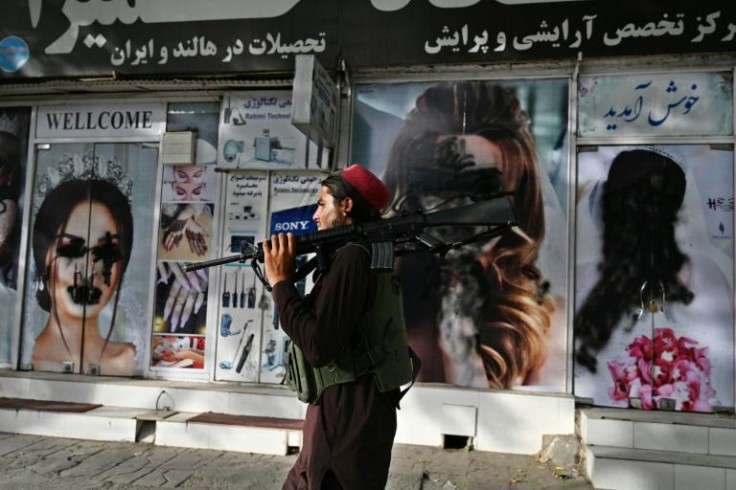
Taliban bans TikTok and PUBG in Afghanistan

The Taliban seized control of Afghanistan in August last year

April 25, 2022 

The Taliban in Afghanistan have now banned TikTok and PUBG in the country, saying that the apps mislead the younger generation.

TikTok is a video sharing app while PUBG is a popular mobile game. The ban was announced by Taliban spokesperson Inamullah Samangani last week. TikTok's "filthy content was not consistent with Islamic laws," he told Bloomberg.

"We've received a lot of complaints about how the TikTok app and the PUBG game are wasting people's time," said Samangani. "The ministry of communications and information technology was ordered to remove the apps from internet servers and make them inaccessible to everyone in Afghanistan," he further stated.

The Taliban have already banned music, movies and television soap operas which has left Afghans with few options to keep themselves entertained. In a statement on Thursday, the cabinet said that the applications "led the young generation astray." The country has banned PUBG's subsidiary company Krafton as well.


The Taliban, which had earlier claimed that they will take a more liberal approach to government, have been restricting the social lives of Afghani citizens gradually.

In a Gallup survey conducted in February this year, almost 94 percent of Afghans rated their lives poorly enough to be considered suffering. It also found that a significant portion of the male population in Afghanistan believes that women are not treated with respect in the country.

"For the first time in the history of Gallup surveys in Afghanistan, the majority of men in Afghanistan (60 per cent) do not feel that women are treated with respect and dignity, according to the poll.

Only 9 million Afghans have access to the internet in Afghanistan, a country which has around 38 million people, writes The Independent. There are around four million social media users in the country, and TikTok is one of the popular apps used by young Afghans.


The group has made life miserable for all citizens, particularly women, who are not even allowed to get an education beyond the 6th grade currently.

The Taliban have barred women from boarding flights without a male chaperone. Women are forbidden from taking inter-city road trips alone, they can only visit public parks on Sundays, Mondays, and Tuesdays.

All male government employees have been asked to wear a beard to work or risk being fired from their jobs. The regime also recently took a U-turn on its earlier promise of allowing women to get an education and decided not to allow the re-opening of girls' schools beyond sixth grade.

MISOGYNY AND FEMICIDE
The Taliban have imposed various restrictions on women and girls, despite pledging a softer rule compared with their first stint in power in the 1990s 
Photo: AFP / Wakil KOHSAR

US reports its first human case of H5 bird flu

By Shivam Patel
April 29, 2022 — 
The US Centres for Disease Control and Prevention has announced the first known human case of H5 bird flu in the United States in a person in Colorado.

The person tested positive for avian influenza A(H5) virus and was involved in the culling of poultry presumed to have had H5N1 bird flu, the centre said in a statement.

“This case does not change the human risk assessment for the general public, which CDC considers to be low,” the agency added.


The H5 avian flu has been found in 29 American states. CREDIT:AP

The patient reported fatigue for a few days as the only symptom and has since recovered, the CDC said, adding that the person was being isolated and treated with the influenza antiviral drug oseltamivir.

H5N1 viruses have been found in US commercial and backyard birds in 29 states and in wild birds in 34 states since the centre started monitoring for illness among people exposed to the viruses in late 2021.

“CDC has tracked the health of more than 2,500 people with exposures to H5N1 virus-infected birds and this is the only case that has been found to date. Other people involved in the culling operation in Colorado have tested negative for H5 virus infection, but they are being retested out of an abundance of caution,” the CDC said.

RELATED ARTICLE

Illness
First human case of H10N3 bird flu in China

Globally, this is the second human case associated with this specific group of H5 viruses, which are currently predominant, the CDC said. The first was reported in Britain in December 2021.

Reuters

 NEDERLANDS

Bird flu claims over three million victims in six month outbreak 

Business April 29, 2022 

The bird flu epidemic in the Netherlands continues unabated and at least 600,000 ducks and hens have been killed this month alone, according to government figures. 

The latest case is in Lunteren, where bird flu has been found on a poultry farm with 50,000 birds. It is the fifth case of bird flu in the Gelderland town this month and 37 other farms within three kilometres of the affected location are now being checked for the disease. 

The Dutch poultry industry is concentrated around Lunteren and Barneveld in Gelderland, where some 230 farms are located within a 10 kilometre radius, local paper the Gelderlander reported.

Some three million birds have been killed because of bird flu in the six months since the disease was first identified in the Netherlands. 

The Netherlands has some 1,700 poultry farms, half of which produce eggs – totalling some 10 billion eggs a year.

 Bird flu infections have so far been found on 30 farms, most of which were producing eggs.


Read more at DutchNews.nl
UK
‘Your couriers have to use food banks’: Deliveroo accused of hypocrisy over Trussell Trust partnership


Deliveroo has joined forces with national food bank charity The Trussell Trust to provide two million meals to those in need. But critics have warned the gig economy firm’s model has left its couriers relying on food parcels themselves.

LIAM GERAGHTY
20 Apr 2022
THE BIG ISSUE 


Deliveroo and The Trussell Trust have joined forces to deliver two million meals to people facing food poverty. But critics have warned Deliveroo’s model means of their riders are relying on food banks to get by. Image: The Trussell Trust

Deliveroo has been accused of “sanitising its increasingly discredited public image” by teaming up with a national food bank charity after repeated allegations of low pay.

The gig economy firm announced this week it would join forces with The Trussell Trust to deliver two million meals to people in need and to allow customers to donate to the charity’s food banks with in-app food orders.

But critics have questioned the partnership following long-standing allegations of low pay in Deliveroo’s business model. Last year a Bureau of Investigative Journalism (TBIJ)investigation found some riders were paid as little £2 an hour, while couriers in Belfast walked out as recently as last month over pay.

“Once again we are seeing Deliveroo show more concern for sanitising its increasingly discredited public image than for the welfare of its riders and drivers, many of whom are at the sharp end of the cost of living crisis,” said Ahmed Uhuru Hafezi from the Couriers Branch of the Independent Workers’ Union of Great Britain (IWGB), the union that represents Deliveroo riders.

“Take a visit to food banks across London and you will see couriers filling their delivery bags with emergency food supplies for their own families, forced into relying on charity due to poverty pay and a lack of basic rights such as sick pay.

“If Deliveroo wants to tackle food poverty and hunger in the UK, it should start by paying its workers enough to cover their expenses and feed their families, rather than relying on the good will of food banks and its customers.”

P&O scandal: Forcing ferry companies to pay UK minimum wage would ensure something good comes out of this sordid affair – Scotsman comment

The scandalous decision by P&O Ferries to sack nearly 800 staff without notice and replace them with cheaper agency workers caused justified anger across the political spectrum

 
The P&O ferry Spirit of Britain sails into the Port of Dover after undergoing sea trials 

That anger increased when it emerged the company had taken this action despite receiving £11 million in taxpayers’ money to furlough staff during the Covid pandemic and again when chief executive Peter Hebblethwaite revealed his £325,000 salary had not been cut.

In contrast, the new crew are being paid an average of just £5.50 an hour – £4 below the UK’s minimum wage but permissible under international maritime law.

So UK Transport Secretary Grant Shapps’ pledge that the government will introduce new legislation to force ferry companies that use British ports to pay the minimum wage is most welcome and suggests that at least something good will come out of this sordid affair.

READ MORE: Adrift: P&O Ferries European Causeway vessel at centre of Irish Sea emergency

His call for P&O Ferries to return its furlough money is equally just. Companies that receive public money should be made to realise that it comes with conditions, even if they are only moral and not, as they should always be, legal.

Speaking as the firm began cross-Channel sailings for the first time since sacking their staff, Shapps also called for Hebblethwaite to resign, a moderate request in comparison to union demands for him to be prosecuted and jailed.

P&O Ferries has acted in defiance of public opinion, basic standards of decency and, by Hebblethwaite’s own admission, employment law.

It’s time for our elected representatives to remind this rogue company of the importance of all three and the power that they hold.


Climate change affecting Scotland’s lochs and reservoirs


Environment minister Mairi McAll

A report published this week by Scotland’s Centre of Expertise for Waters (CREW), shows that between 2015 and 2019, 97 per cent of monitored Scottish lochs and reservoirs have increased in temperature.

While most warmed by up to 1.0°C per year over this period, 9 per cent increased by more than that – some by up to 1.3°C per year.

Researchers warn these changes increase the risk of harmful algal blooms developing, which could restrict their use for recreation and water supply, and as a safe habitat for wildlife.

Waters in the south and east of Scotland are expected to warm the most at first, but this climate-related impact will reach all parts of the country by 2040.

The report makes a number of recommendations to address the immediate impact, as well as further research to improve our understanding of how climate will impact the complex functioning of lochs and reservoirs in the future.

Environment minister Mairi McAllan said: ‘This important research provides yet more worrying evidence of the risks of harm from climate change on Scotland’s water environment. It is vital we do more to mitigate those impacts, to seek to reduce the pace of warming but also to adapt to it.

‘We have committed £243 million since 2015 through the Agri-Environment Climate Scheme to support land management practices which protect and enhance Scotland’s natural heritage, improve water quality, manage flood risk and mitigate and adapt to climate change.

‘Scotland is renowned worldwide for the quality of our water. Research like this will be hugely valuable in informing the development of policy solutions and measures to mitigate and adapt to climate change, and also protect, restore and enhance these vital natural assets.’

Freshwater ecologist Dr Linda May of the UK Centre for Ecology and Hydrology (UKCEH), lead author of the report, said: ‘This research has shown, for the first time, that climate change is already warming our lochs and reservoirs in Scotland, and that this trend is likely to continue.

‘It provides early warning of the potential impacts of climate change on biodiversity, water supply and recreational use, and highlights the need for mitigation measures to be put in place as quickly as possible.’

Dr Pauline Lang, project manager for CREW, said: ‘This pioneering research led by experts at the UK Centre for Ecology and Hydrology demonstrates that, without intervention, climate-driven risk is projected to further increase by 2040.  To prevent the modelled scenarios becoming reality, we trust the recommendations proposed will enable effective climate action for safeguarding freshwaters now and during the critical decades ahead.

‘This project is a great example of how CREW can pivot towards Scotland’s water-related needs by bringing a community of researchers and stakeholders together to collaborate on addressing the most important environmental concerns of this time.’

NatureScot freshwater and wetlands advice manager Iain Sime said: ‘Scotland, like the rest of the world, is facing an unprecedented climate emergency. The findings of this comprehensive review are stark, demonstrating the impact that climate change is already having on our freshwater lochs and reservoirs, and their biodiversity.

‘The need for urgent action is clear, and at NatureScot we are using the £65million Nature Restoration Fund to prioritise efforts that support the conservation of our lochs and ponds.’

Scottish Environment Protection Agency (SEPA) senior ecologist Ian Milne said: ‘CREW’s report, which used SEPA data from 142 lochs and reservoirs, is important in highlighting some of the climate change pressures Scotland’s environment is facing.

‘The findings emphasise the significance of SEPA’s ongoing work to tackle the threats of climate change and biodiversity loss, which is being done in partnership with Scottish Government, local authorities, Scottish Water, environment and community groups, farmers, land managers and others through our River Basin Management Plans.’