Friday, April 29, 2022

To Govern the Globe


APRIL 29, 2022
Facebook

In early April, a desperate plea from the Intergovernmental Panel on Climate Change (IPCC), a group of leading scientists working with UN patronage, went largely overlooked. “It’s now or never, if we want to limit global warming to 1.5ºC (2.7ºF),” wrote Jim Skea, the co-chair of IPCC’s Working Group III. “Without immediate and deep emissions reductions across all sectors it will be impossible.”[1] While global warming of 1.5ºC above pre-industrial levels may sound marginal, it is already a compromise. The situation also now looks to be far worse than initially estimated and is expected to occur much sooner. By 2040, there will likely be “significant coastal flooding, even more intense storms, fierce droughts, wildfires, and heat waves causing damages worth $54 trillion.” Absent truly staggering carbon-reduction, the IPCC estimates that warming may reach an apocalyptic 4.0ºC above preindustrial temperatures by 2100.[2]

The Pentagon recently requested a defense budget of $813 billion for FY 2023. Adjusted for inflation, this figure exceeds spending at the heights of both the Korean and Vietnam wars, and, as William Hartung, senior research fellow at the Quincy Institute, notes, is “$100 billion more than peak spending during the Cold War.”[3] Unsurprisingly, the U.S. spends more on its military than any other country in the world. It has been continuously at war for decades, is currently engaged in counterterror operations in more than 80 countries, and maintains approximately 750 far-flung military bases across the globe.
There is a stark contradiction between the embedded inertia of U.S. military-industrial predominance and the epochal challenges that lay ahead. The tools that enshrined Washington’s world order at the dawn of the American Century—a globe-spanning military footprint, liberal international principles, and free market capitalism—can no longer guarantee its continuation. In fact, the same strategic architecture that elevated the U.S. as a singular world power may be its undoing. Failure to effectively respond to the pressing realities of climate change and complex international conflict bears grim consequences for both U.S. dominion and the fate of human life on this planet.

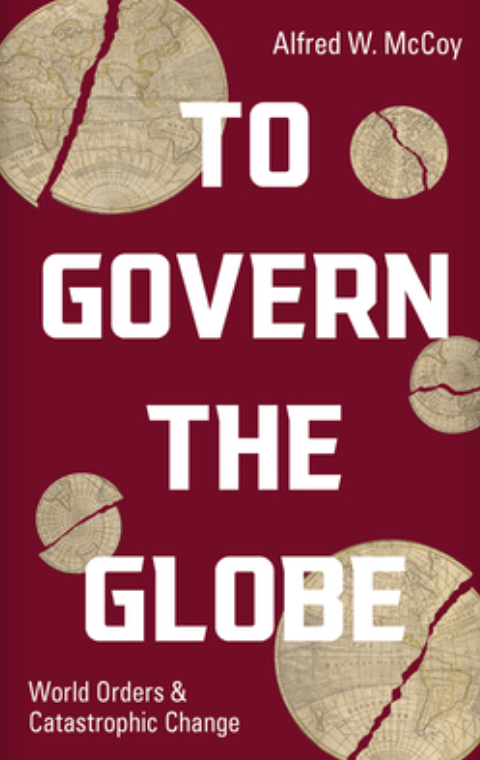
In To Govern the Globe: World Orders & Catastrophic Change, Alfred W. McCoy, Fred Harvey Harrington Professor of History at the University of Wisconsin-Madison, offers a kaleidoscopic and timely analysis of the present U.S. decline, contextualizing it among a succession of empires and world orders across the past millennium. Empires are ephemeral, McCoy writes, but the world orders within which empires ebb and flow are enduring. If an empire’s habits can both create new and shape existing world orders, a world order, in contrast, is deeply rooted and can even “survive the decline of the global hegemon that created it.”[4] Emerging from historical hinge points—at the intersections of catastrophes like the Black Death and innovations in energy achieved through the use of slave labor or fossil fuels—world orders structure the relations among nations and the conditions of life for their peoples.[5] Importantly, McCoy argues that world orders are often undone by a “distinctive duality” that exists between their power and principle.[6]

Looking back some seven centuries, it is evident that the core contradictions now running through Washington’s world order are neither unique nor unprecedented. Spain and Portugal ruled in the Iberian age, both utilizing advances in navigation and shipbuilding as well as novel geopolitical concepts, to craft intercontinental empires. Through territorial conquest and extractive slave labor, the Spanish and Portuguese crowns amassed great fortunes. Yet they squandered their riches on lavish excess at the expense of their cities and local manufacturers, accruing extensive foreign debt.[7] With little fanfare, the Iberian empires collapsed, no longer able to bear the weight of their lumbering kingdoms and challenged culturally by the burgeoning Protestant Reformation.

However, by 1700 the “hallmarks of the Iberian age, slavery and imperial conquest,” had survived.[8] Britain infused these Iberian holdovers with the market logic of merchant capitalism and, through the “barely visible tendrils of trade, capital flows, and naval patrols radiating from London,” compromised the sovereignty of peoples across the globe.[9] The industrial revolution played a key role in the growth of Britain’s “informal empire,” the population of which ballooned from 12.5 million in 1750 to 200 million by 1820 and peaked at nearly 700 million on the eve of the Second World War.[10] Steam, fossil fuels, and, later, electricity radically increased the productive potential of its economy, grew its military, and accrued massive wealth. Despite its material prosperity, the dissonance between Britain’s domestic freedoms and colonial injustices, along with its failure to build a stable system of international alliances, wrought chaos upon its dominion.

Thus, in the wake of two devastating wars, European economic decline, and widespread social upheaval across the formerly colonized world, the U.S. ascended as global hegemon. Presciently, Britain’s world order crumbled owing to the duality of its “global power that balanced a liberal world order with a self-aggrandizing empire.”[11] It also pioneered the energy transition towards fossil fuels and the global exploration for oil, soon to be double-edged cornerstones of Washington’s rule.

By 1945, with just a small fraction of the world’s population, the U.S. accounted for 60% of its industrial output, generated 46% percent of its electrical power, and held 59% of its proven oil reserves. U.S. casualties in World War II totaled 416,000, a costly figure that nonetheless paled in comparison to the 19 million lives lost across Europe, 20 million in China, and 24 million in the Soviet Union. With a standing military of more than 12 million active-duty members, 1000 warships, and some 39,000 aircraft, President Harry Truman remarked that the U.S. was “the most powerful nation, perhaps, in all history.”[12]

Such raw industrial and military strength buttressed newly established U.S.-led international governmental and financial institutions. At Bretton Woods in 1944 and San Francisco in 1945, the U.S. and other Allied nations created the International Monetary Fund, World Bank, and UN. Though couched in liberal internationalist rhetoric, the U.S. ensured that these organizations would accommodate the excesses of its empire, advance its global dominion, and, importantly, safeguard its wealth and power.[13] Indeed, George Kennan, the American statesman and author of the “Long Telegram,” which asserted the necessity of communist containment, put the realpolitik of postwar-U.S. empire bluntly:

We have about 50 percent of the world’s wealth but only about 6.3 percent of its population…Our real task in the coming period is to devise a pattern of relationships which permit U.S. to maintain this disparity without positive detriment to our national security. To do so, we will have to dispense with all…high-minded international altruism.[14]

With a “formidable four-tier apparatus—economic, military, diplomatic, and clandestine,” McCoy writes, the U.S. set out to govern the globe.[15]

To maintain its wartime advantage and grow the global capitalist system for which it was now responsible, the U.S. required untrammeled access to oil and other strategic resources. However, the quest for and profligate expenditure of fossil fuels were not without consequences. Throughout the Cold War, the U.S. frequently compromised its claims to moral leadership: covert coups and interventions subverted surging Third World nationalism, exposing self-interested and short-sighted foreign policy. State department-funded development initiatives also ensured that modernization was sympathetic to U.S. interests. American officials justified many of these programs using prevailing ideas about nature. As historian Megan Black argues in The Global Interior: Mineral Frontiers and American Power, the U.S. Department of the Interior, having outgrown continental expansion, set its sights abroad in the postwar years. Interior “offered that resources were global and thus belonging to all…and were dangerously misunderstood and undervalued by people across the globe.”[16] This twin thrust recast U.S. extraction as both natural and righteous. In sustaining its empire and superpower status, the U.S. engendered a climate that was at once destructive and self-perpetuating—the chaotic volatility it introduced into host societies would give rise to conflict, decades down the road.

Simultaneously, scientists were beginning to theorize the effects of human activity on the Earth’s climate. During the Cold War, the Pentagon endeavored to research extreme climates, such as the Arctic, in order to maintain its military edge in adverse conditions. The U.S. Army Corps of Engineers created the Snow, Ice, and Permafrost Research Establishment (SIPRE) in 1950 to generate data that could be “used as a basis for increasing the efficiency of military operations.”[17] Buried beneath Greenland’s icesheet at Camp Century, SIPRE set about extracting ice-cores, thousands of meters long, as documented by Kristina and Henry Nielsen in Camp Century: The Untold Story of America’s Secret Arctic Military Base Under the Greenland Ice. Analyzing the carbon content in sections of the ice-cores, SIPRE scientists Chester Langway and Willi Dansgaard discovered climate variations in response to changes in atmospheric content across vast swaths of time, a finding with troubling implications for the fossil fuel-dependent U.S.

In a case of great historical irony, Camp Century also provided cover for Project Iceworm, a secretive nuclear deterrence program.[18] Iceworm entailed the construction of a sprawling rail network under the frozen surface, “spanning several thousand square kilometers…the aim being to enable the hidden transportation, by train, of 600 missiles equipped with nuclear warheads” to launch sites aimed at the Soviet Union.[19] The uncomfortable intimacy between the doomsday potential of Cold War atomic strategy and cutting-edge climate science at Camp Century encapsulated the contradictions at the heart of Washington’s world order—at once aware of the deleterious effects of its power, but neither willing nor able to change course.

Allowed to compound throughout the twentieth-century, McCoy argues that the “production, delivery, and consumption of fossil fuels” that has underwritten Washington’s rule now constitutes the “world’s most extensive, and the most expensive, web of energy-intensive infrastructures.”[20] Neta Crawford, co-director of the Costs of War Project based at Watson Institute for International and Public Affairs at Brown University, writes that the Department of Defense is now the largest consumer of energy in the U.S., and is moreover the single largest institutional consumer of fossil fuels in the world.[21] And consumption begets emissions. To demonstrate the singular toll U.S. military operations take, consider a 2017 strike on Islamic State targets in Libya: two B-2 Stealth Bombers flew nearly 12,000 miles, emitting 1,000 metric tons of greenhouse gases.[22] By comparison, the average passenger vehicle typically emits just 4.6 metric tons of carbon dioxide in an entire year.

Instead of altering costly practices, the Pentagon has remained stubbornly committed to its standard operating procedures. In the recent past, policy makers and advisers felt that the civilian branches of government were incapable of meeting the threats posed by climate change and sought to “securitize” the federal response.[23] However, Nils Gilman, a former consultant to the Department of Defense on climate, recalls that the Pentagon used this as an opportunity “demand more, rather than to act differently.”[24] Military budgets have continued to climb in order to maintain activities that were concerns long before climate change was on anyone’s mind. Conspicuously, Gilman writes, neither the Pentagon’s 2021 Climate Risk Analysis report nor its accompanying Climate Adaptation Plan “proposed a single reordering of the defense and foreign policy establishments strategic priorities, with the one exception of plans (eventually, one day) ‘to include consideration of the social cost of greenhouse gas emissions in applicable cost-benefit analysis decisions.’”[25] In an executive order signed in December 2021, President Biden called on government agencies to transition to 100 percent carbon-free electricity by 2030 and reach net-zero emissions by 2050, as well to eliminate climate pollution from federal buildings and vehicles. The military, however, will be exempted across the board.[26]

As it currently stands, national security comes at the cost of high levels of emissions. Yet climate change promises to compromise national and global security. It is often described as “existential threat,” in that it fundamentally alters our conceptions of human history and existence, while changing our relationships with both the planet and other people.[27] But the Center for Climate and Security has also referred to climate change as a “threat multiplier.”[28] Too often, climate change is pigeonholed as an environmental issue when it is concerned with economics, security, geopolitics, and society at large. Climate change will undoubtedly affect “physical infrastructure on which economic activity depends,” affect resource disputes as melting sea ice changes access to oil reserves, affect migration as refugees follow shifting food and water sources, and, importantly, affect social stability, thereby increasing the likelihood of future unrest and conflict.[29] Given that mitigating climate change would serve strategic objectives—as well as stave off end-times predictions—it should be surprising that the U.S. is not currently taking drastic action.

Cutting military fossil fuel consumption would have cascading positive effects. The first is an overall decrease in greenhouse gas emissions and promotion of carbon sequestration. If the military were to become less oil-dependent, it could reduce the political and fuel resources used to defend its access to oil, particularly in the Persian Gulf. The U.S. could then shrink its global military presence and decrease its dependence on oil-rich states, reevaluating Faustian relationships with current allies. Finally, scaling back operations would entail smaller defense budgets, freeing up precious resources to be invested in economically productive activities and transferred to agencies better equipped to fight climate change.[30] Each of these would also contribute to the long-term prevention of multi-level threats stemming from climate-related natural disasters, famines, and the like.

The U.S. remains militarily involved across the globe because of the many vested interests and careers that now depend on its perpetual foreign adventures. A systematic policy of restraint—along with climate policies that reduce many of the root causes of military conflict—would render thousands of people and institutions obsolete.[31] Failure to act by the U.S. military-industrial establishment is, in no small part, an act of class-preservation.

The climate crisis has also been exacerbated by neoliberal economic globalization. For much of the twentieth-century, Washington’s world order was defined against its perceived antithesis in the Soviet Union. The presence of an external and existential foe allowed it to neglect its own mounting contradictions. However, following the implosion of the Soviet system and Cold War drawdown, the U.S. unleashed a “two-tier strategy to open the world to unchecked capital flows.”[32] With the enactment of the North American Free Trade Agreement (NAFTA), creation of the World Trade Organization (WTO) in 1995, and broad financial deregulation, it engendered an ideal business climate for multinational corporations. U.S. foreign investment increased tenfold “from $700 billion in 1990 to $6.3 trillion in 2014.”[33] At the same time, Washington set out to bring former Soviet satellite states into its orbit, weaponizing the concepts of human rights and democracy promotion in doing so.[34]

The open and globalized world economy came at the detriment of domestic social safety nets and produced staggering inequality. Largely insulated from public opinion—and with the momentum of a runaway freight train—the ascendant ruling class pursued top-down capital accumulation with little regard for social, environmental, or political stability. “U.S. elites,” McCoy laments, “failed to craft a shared vision to replace the Cold War’s anti-communist containment,” leading to increasingly fragmented and insufficiently ameliorative policies.[35] There is a case to be made that the U.S. has become “parastatal” in this way; its power is decentralized and divided among corporations and self-interested lobby groups not subject to democratic oversight.

To return to the central question of To Govern the Globe: Can this liberal international system survive the ongoing erosion of U.S. global power and the potentially catastrophic heating of the planet?[36] According to McCoy, the answer is uncertain. But without serious reflection and immediate action, the contradictions baked into Washington’s world order will likely bring about its downfall. Past paradigms for U.S. engagement with the world are no longer feasible. Entrenched militarism expends excessive resources, prevents collective action, and, significantly, wastes what little time there is to act. Uni- and bilateral foreign policy must also be eschewed in favor of multilateralism and “great power engagement”—to do otherwise, the U.S. risks inhibiting international diplomacy and cooperation on pressing, existential issues like climate change.[37] The current global system is characterized by “strong nation-states and weak global governance,” McCoy writes. “Any world order based on primacy of the nation-state will probably prove incapable of coping with the political and economic crisis likely to arise from the appearance of some 275 million climate change refugees by 2060 or 2070.”[38] Since the end of the Second World War, U.S. global primacy has taken on a quality of inevitability. However, as humanity teeters on the precipice of cataclysmic change, it is imperative to both imagine its end and the emergence of new forms of global governance.

Notes

1. Molly Taft, “‘It’s Now Or Never’: We Have 3 Years to Reverse Course, Major Climate Report Finds,” Gizmodo, April 4, 2022, https://gizmodo.com/it-s-now-or-never-we-have-3-years-to-reverse-course-1848745616

2. Alfred W. McCoy, To Govern the Globe: World Orders & Catastrophic Change (Chicago, IL: Haymarket Books, 2021), 305-306. 

3. William Hartung, “Biden’s new Pentagon budget request is too damn high,” Responsible Statecraft, Quincy Institute for Responsible Statecraft, April 10, 2022, https://responsiblestatecraft.org/2022/03/28/bidens-new-pentagon-budget-request-is-too-damn-high/

4. McCoy, To Govern the Globe, 15. 

5. I have borrowed the term “hinge points” from historian Daniel Bessner, who has used it describe moments in history that mark decisive breaks with the past, https://jsis.washington.edu/wordpress/wp-content/uploads/sites/25/2017/04/v5n2-Bessner.pdf

6. McCoy, To Govern the Globe, 14. 

7. Ibid., 75. 

8. Ibid., 83. 

9. Ibid., 132. 

10. Ibid., 133. 

11. Ibid., 188. 

12. Ibid., 215. 

13. Ibid., 220. 

14. Ibid., 219. 

15. Ibid., 220. 

16. Megan Black, The Global Interior: Mineral Frontiers and American Power (Cambridge, Massachusetts: Harvard University Press, 2018), 120. 

17. Kristian H. Nielsen and Henry Nielsen, Camp Century: The Untold Story of America’s Secret Arctic Military Base Under the Greenland Ice (New York, NY: Columbia University Press, 2021), 200. 

18. Ibid., 255. 

19. Ibid. 

20. McCoy, To Govern the Globe, 260. 

21. Neta C. Crawford, “Pentagon Fuel Use, Climate Change, and the Costs of War,” Costs of War

Project, Watson Institute for International and Public Affairs, Brown University, updated and revised November 13, 2019. 

22. Andrea Mazzarino, “The Costs of (Another) War When We Could Be Fighting Climate Change,” Tom Dispatch, March 29, 2022, https://tomdispatch.com/the-costs-of-another-war/

23. Nils Gilman, “The Guns of Warming: How Treating Climate Change as a Security Issue Backfired,” The Breakthrough Institute, March 29, 2022, https://thebreakthrough.org/journal/no-16-spring-2022/the-guns-of-warming

24. Ibid. 

25. Ibid. 

26. Adam Aton, “Military Exempt from Biden order to cut federal emissions,” ClimateWire, E&E News, December 22, 2021, https://www.eenews.net/articles/military-exempt-from-biden-order-to-cut-federal-emissions/

27. Andrew Moseman and Kieran Setiya, “Why do some people call climate change an “existential threat”?’, MIT Climate Portal, July 12, 2021, https://climate.mit.edu/ask-mit/why-do-some-people-call-climate-change-existential-threat

28. Caitlin E. Werrell and Francesco Femia, “Climate Change as Threat Multiplier: Understanding the Broader Nature of the Risk,” The Center for Climate and Security, BRIEFER No. 25, February 12, 2015, https://climateandsecurity.org/wp-content/uploads/2012/04/climate-change-as-threat-multiplier_understanding-the-broader-nature-of-the-risk_briefer-252.pdf

29. Ibid. 

30. Crawford, “Pentagon Fuel Use, Climate Change, and the Costs of War.” 

31. Nils Gilman, Twitter post, August 29, 2021, https://twitter.com/nils_gilman/status/1431967061631127556

32. McCoy, To Govern the Globe, 237. 

33. Ibid. 

34. Ibid. 

35. Ibid. 

36. Ibid., 6-7. 

37. Richard Hanania, “‘Great Power Competition’ as an Anachronism,” Defense Priorities, November 23, 2020, https://www.defensepriorities.org/explainers/great-power-competition-as-an-anachronism

38. McCoy, To Govern the Globe, 316-17. 

Jesse Robertson holds a degree in history and ethnic studies from Lewis and Clark College in Portland, Oregon. His research focuses on the history of the United States in the world, the American West, and how imperial encounters shape politics and culture.

Why Trump Runs Free


APRIL 29, 2022
FacebookTwitter

Photograph Source: mathiaswasik – CC BY 2.0

Trumptrocities

Writing the third chapter of my latest book This Happened Here: Amerikaners, Neoliberals, and the Trumping of America, was an exhausting and soul-chilling experience. Titled “A Fascist in the White House, 2017-21,” this chapter attempted to catalogue, categorize, and cross-reference the transgressions of the malignant ogre Donald Trump as US president. It records more than 400 “Trumptrocities” filed and cross-listed across 8 different folders. Among the orange-brushed brute’s many offences: the caging and theft of migrant children; pardoning the sadistic war criminal Eddie Gallagher; the placement of open Camp of the Saints fascists like Steve Bannon and Stephen Miller in top advisory roles; embrace of the slaveowners’ Confederacy; defense of murderous white supremacists in Charlottesville; a mass-murderous and pandemicist response to Covid-19; the ugly nativist and sexist call for Ilhan Omar and the Squad to “go back to your crime-ridden countries;” the juvenile disfiguring of a weather map; the sick racist worsening of Puerto Rico’s horrific Hurricane Maria experience; the insane claims that the corporate Democrats are “Marxists” and “radical Left” and that “the radical Left” was taking over America; mad declarations of his own special genius; repeated tyrannical assaults on independent media; open encouragement and cultivation of political violence; embrace of fascist militiamen who attacked state capitals to protest basic public health protections; constant denigration of women; embrace of authoritarian rulers the world over; jokes about being “president for life;” calls for the military suppression of the George Floyd Rebellion; the holding of a bizarre Christian nationalist photo-op following a brutal attack on civil rights protesters in Lafayette Square; the ordering of a police state execution of an antifascist; the arch-criminal assassination of a top Iranian general in Iraq; the embrace of neo-Nazi Q’Anon and fascist lunatics like Marjorie Taylor Greene; providing over for the Saudis’ literal butchering of journalist Jamal Khashoggi; cuddling up to world fascist hero and future Bucha butcher Vladimir Putin; the embrace of a white teen MAGAt who slaughtered two people with an AR-15 at a Black Lives Matter rally in Kenosha, Wisconsin; handing the nation’s climate and energy policy portfolio to fossil fuel interests determined to turn the planet into a giant Greenhouse Gas Chamber; and, by the way, the attempted subversion and overthrow of the 2020 presidential election.

That’s just the short list. The full record is mind-boggling even if it was unsurprising to those who knew that The New Yorker’s Adam Gopnik was on to something when he issued this warning in early May of 2016:

‘There is a simple formula for descriptions of Donald Trump: add together a qualification, a hyphen, and the word “fascist” …his personality and his program belong exclusively to the same dark strain of modern politics: an incoherent program of national revenge led by a strongman; a contempt for parliamentary government and procedures; an insistence that the existing, democratically elected government…is in league with evil outsiders and has been secretly trying to undermine the nation; a hysterical militarism designed to no particular end other than the sheer spectacle of strength; an equally hysterical sense of beleaguerment and victimization; and a supposed suspicion of big capitalism entirely reconciled to the worship of wealth and ‘success.’… The idea that it can be bounded in by honest conservatives in a Cabinet or restrained by normal constitutional limits is, to put it mildly, unsupported by history.’

That was dead on, even if Gopnik left out the critical race and gender components of the fascist formula – and even though the “normal constitutional limits” did just barely hold in 2020-21 (if Republican voter suppression and election rigging efforts work how they are supposed and the reigning media and politics culture stuck in its longstanding “normalcy bias,” the limits may well fail in 2024-25).

Attempted Reichstags

That Trump would test those limits to the point of an attempted coup was also predictable early on. It was clear almost from the start of his presidency that Trump had no interest in trying to stay in power the normal bourgeois electoral way: by making and trying to sell policies meant to appeal to enough voters and keeping enough ruling class players happy to prevail in the next election. As Yale historian Timothy Snyder predicted just three months into the Trump reign, the nation’s 45th president would seek to stay in office through some sort of Reichstag Fire[1] moment(s) that would permit him to consolidate power over and against the will of the populace and electorate.

In the long hot summer of 2020, consistent with Snyder’s warning, Trump was in putsch mode, looking for Reichstag Fires. He openly flouted public opinion on the pandemic, public health, civil rights, race, police statism, and the rule of law. This kept his approval rate in the low 40s and the militantly uncharismatic, basement-dwelling corporatist Joe Biden well ahead of him in national polls. This was nothing for his critics and opponents to celebrate however, for, when combined with his clear desire to stay in power, it suggested strongly that he was going to try to keep the presidency in undemocratic, anti-constitutional, and violent ways.

Trump’s first attempted 2020 Reichstag was the beautiful George Floyd uprising, which he called “radical Left” and wanted to crush in the streets with the 101st Airborne, much to the dismay of even his own military command. His next Reichstag try was the 2020 election itself, which he falsely claimed was “stolen” by the “radical Left” Democrats. This Big Hitlerian Lie was the insane claim and running through the addled minds of the thousands of maniacs who stormed the US Capitol at the call of their deranged Dear Leader on the sixth day of 2021. The terrible events of January 6th were final proof that there had indeed been a fascist[2] in the White House since January 20, 2017. As US House investigators are learning in ever greater detail, Trump and his team were deeply involved in the Attack on the Capitol, the last and desperate phase of the Trump team’s attempt to carry out a coup d’état and stay in power over and against the judgement of voters and even of an idiotic 18th Century Electoral College already tilted to the right.

Like Another Fascist After Another Failed Putsch

It was all very consistent with warnings made early on by astute political observers like Gopnik and Henry Giroux and with the likely serial rapist Trump’s long Mafia-like business career and sociopathic personality going back well before his emergence as a serious presidential contender. The malignant hyper-narcissist and “instinctive fascist” Donald Trump has long been one of the sickest individuals ever spawned by the human species.

How is this auburn-tinted swine not caged? Why does this malignant bag of fascist poison still stain the nation and world with its continuing presence as the de facto leader of one of the two ruling political parties in the world’s most powerful state? How does this deranged, blood-soaked pathogen from Queens still walk free? How does the tiny-fingered tangerine-tinted tyrant roam the land with Secret Service protection to spread yet more Hitlerian falsehood, including the violently absurd and destructive claim to have won the 2020 election – an attempted Reichstag Fire the noxious putschist Trump is still trying to fan?

The evidence of Trump’s technical/statutory criminality as president is abundant on at least six counts:

* Interfering with the certification of Biden’s election win on 1/6/2021.

* Trying to bully the Georgia Secretary of State into falsifying the popular presidential vote in Georgia.

* Inciting physical attacks on US Congresspersons and Congressional staff on 1/6/2021.

* Interfering with the federal investigation of the Capitol Riot.

* Removing government documents and tampering with and destroying classified White House documents.

* Using the threat to withhold military assistance to blackmail Ukraine president Volodymyr Zelensky into digging up political dirt on Biden in 2019.

(To be sure, these aren’t even Trump’s worst crimes. His most horrendous offences as president were Covid-19 pandemicide and his quieter but even deadlier crime of pedal-to-the-medal ecocide.)

From the US House Select Committee to Investigate the January 6th Attack on the United States Capitol (hereafter “House Select Committee”) and US Attorney General Merrick Garland down to the district attorney office of Fulton County, Georgia, the Michigan Attorney General, the New York Attorney General, and the Manhattan DA’s office, top Democratic policymakers and legal authorities and key state and local prosecutors have more than enough ammunition to prosecute and incarcerate the Malignant One. But so what? All indications are that the dismal Dems will let Trump and his fascist collaborators skip down a path like the one enjoyed by Adolf Hitler following the failed Nazi Party Beer Hall Putsch: no real punishment and continued liberty to spread hate, lies, and fascism.

Properly surnamed after an inert decorative object, Garland shows little inclination to pull the legal trigger on Herr Trump. Biden pretends to be bothered by this but shows no interest in using his bully pulpit to push his listless, Lieberman-and Obama-like AG from passivity to prosecution. The demobilizing dollar Democrats seem ready to let the clock run out on the House’s January 6th committee as the Amerikaner Party of Trump (the APoT, formerly known the Republicans) prepares to take back the House and squelch the investigation this fall.

It isn’t just Trump who is getting away with an attempted fascist coup. The charges made against, and the sentences handed down to his frothing minions who waylaid the US Capitol have been pathetically mild. Garland won’t prosecute coup complicit Republifascist Congresspersons and former White House staffers who have essentially told the Jan. 6 committee to go f*ck itself by flatly refusing to comply with Congressional subpoenas.

The Rod Stewart-esque message to Trump and his late-fascist freakshow is clear:

Old thugs be free tonight.
Time is on your side,
Don’t let them put you down, don’t let ’em push you around,
don’t let ’em ever change your point of view.

A Gentleman’s Agreement

What gives? I won’t pretend to be able to look into the corrupted minds of the depressing neoliberal elitists atop the Democratic Party, but my semi-educated guess is that they have no serious desire to cage the lethal orange creature from Hell for four basic reasons. The first explanation is their normative commitment to the belief that imperial US presidents do in fact operate above the law and can’t properly perform their often-dirty duties if they think they might be criminally liable for nefarious actions even after leaving office. In the name of “look[ing] forward as opposed to backwards” (to quote future war criminal Barack Obama as President-Elect in January of 2009), this is a longstanding “gentleman’s agreement” between the two US ruling class parties. It apparently holds even if a former president tried to stay in power by overthrowing a bourgeois-democratic election in the imperial “homeland” itself!

Fear of Retaliation After Congress Reverts to Republifascist Control

A second and related explanation relates to the Dems’ fear of political-legal retaliation after they lose the US House (and perhaps the Senate) this Fall and the presidency in 2024-25, thanks in no small part to their ongoing captivity to capital, which continues to expose the elitist inauthenticity of their thoroughly disingenuous claim to be “the party of the people.” The “lock her up” APoT may well undertake multiple trumped-up party-line revenge impeachments of Biden no matter what, but the Justice Department going hard after the fascist criminal Trump will guarantee that ugly likelihood impeachments and add on wild prosecutions of Biden and Harris by a US attorney general taking orders from a Fuhrer Trump or DeSantis in 2025 or 2026. Congressional Democrats and liberal media personnel would also face significantly escalated legal, political, and physical menace. These are prices and risks top Democrats are unwilling willing to pay and take.

Fear of Violence

A third explanation is fear of neofascist violence. It’s not for nothing that Fulton County, Georgia’s Black female district attorney Fani Willis had to request FBI security assistance after she had the audacity to launch an investigation of crime boss Trump’s Gotti-like attempt to intimidate the Georgia Secretary of State into “finding” enough Trump votes to reverse the 2020 outcome in that battleground state. A considerable section of the very preponderantly white male Trumpenvolk is armed and dangerous, ready to maim and kill in defense of their demented hero. A serious prosecution and conviction of their cult object would certainly spark bloody revenge from the more deranged and weaponized of the orange-brushed beast’s little green men.

Pied Piper II?

A fourth Dem consideration is electoral. Remember the “Pied Piper” strategy of 2015-16, revealed by WikiLeaks – the Clinton Dems’ determination that Trump’s emergence as the top 2016 Republican presidential candidate would guarantee a Hillary victory and should therefore be encouraged? After eight years of standard cringing service to Wall Street, corporate America, and the miliary industrial complex under Obama (as under Bill Clinton 2003-2001), the capitalist-imperialist “inauthentic opposition” party (IOP) was looking forward to running against someone so awful that the counterfeit nature of their claim to be a progressive party wouldn’t matter. They wanted to run against Trump.

We saw how that worked out and yet we should not discount the possibility that the Dems want to face Trump yet again, using the horrific nature of his twice-impeached presidency and his real and alleged connections to Russia and Putin to (they think) crush him in the 2024 election. The Russia and Putin links likely hold special meaning for the Dems in the wake of Putin’s criminal invasion of Ukraine. The Dems’ will saddle “Putin toy” Trump with the crimes of Mariupol, Bucha, and, perhaps, Putin’s coming US-/NATO-egged-on deployment of tactical nuclear weapons in Ukraine.

If the IOP (the Dems) do in fact want to run against Trump for a third time, the idea would probably be to keep him out of jail and not to feed the paranoid victimization fantasies of his Amerikaner base by actually prosecuting him for, you know, trying to overthrow the US constitutional bourgeois republic.

Why the Ruling Class Lets the Trumpenstein Live On

The nation’s ruling class could turn off the Trump show once and for all. Why doesn’t it pull the plug, one way or another, on Malignant Orange? It’s riven by its own internal divisions, with not insignificant parts of the bourgeoisie aligned with revanchist white nationalism and fossil fascism. Much of the majority of the US wealth and power elite that doesn’t like Trump and Trumpism-fascism probably doesn’t mind his continuing presence as a “bad cop” bogeyman driving voters to cower under the umbrella of the nicer cop corporate and imperial Democrats. And the nation’s masters are happy for the rabble (the citizenry) to be screaming and even shooting at each other across the binary red-blue partisan, geographic (largely rural v. metro), and culture war divides instead of uniting against their parasitic capitalist owners and the broader bourgeois and imperial system. America’s owners expect to keep rolling in profits no matter whether the government is held down by neofascists or neoliberals or some combination of the two.

“Normalcy Bias”

All of which helps explain why our rulers’ so-called mainstream media seems now, in Salon writer Chauncy de Vega’s words, to have “made its peace with fascism.” As de Vega explains:

‘America’s democracy crisis is getting worse. The Republican-fascists and their allies are undeterred. If anything, they are energized and have escalated their attempts to end democracy in America…In the new America the Republican-fascists are trying to force into being, if you are not one of the MAGA elect, your life will be hell. If you think your life is difficult now, it will be orders of magnitude worse if the fascists and their movement achieve their goals… But instead of explaining this reality to the American people in a consistent, clear, repeated, transparent and direct way – while providing the larger context and importance of these facts – the mainstream news media has, for the most part, chosen to focus on the latest distraction…As public opinion polls have repeatedly shown, the result is a growing lack of concern about Trump’s coup attempt, the Republican-fascist movement and the overall crisis of democracy… The mainstream media is possessed by normalcy bias and clings to fantasies of an old order of more or less functional democracy. What we describe as “normal politics” colors how the news media, and the country’s leadership class more generally, views all political events…There is…the…prospect that the news media as an institution, and many of its most prominent voices, will simply adapt to whatever new “normal” a full-on Republican-fascist regime imposes once it takes power in 2024 or in the years beyond. If one worships at the mantle of power and influence, rather than truth and democracy, such a decision is only natural’ (emphasis added).

Poor Jamie Raskin: Bless His Heart 

In the meantime, let us offer some praise and pity for poor Jamie Raskin, a US House manager of Trump’s second impeachment (the one over January 6th): praise for having decency, intelligence, and courage to say the F-word (fascism) when describing the right-wing Republican forces that menaces the US; pity for his childish faith in “normal” constitutional mechanisms to defeat the threat. The former law professor Raskin is so passionately enthralled by his country’s deeply conservative aristo-republican 18th Century Constitution that he claimed (in an MSDNC documentary titled “Love the Constitution”) to seriously believe that the House case for the conviction of Trump after January 6th would be so convincing as to garner a 100-0 vote in the US Senate. This was an utterly ludicrous thing to have expected (or claim to have expected) from a Senate half occupied by the fossil fascist APoT – a Senate containing seven “Republicans” who had refused to certify Biden’s clear victory even right after the assault on the Capitol. Now, bless his heart, Raskin wants us to know that the long, drawn-out House Select Committee’s June 2022 hearings will “blow the roof off the House.” Here’s some of what Raskin said to an event hosted by Georgetown University last week:

“The hearings will tell a story that will really blow the roof off the House…No president has ever come close to doing what happened here in terms of trying to organize an inside coup to overthrow an election and bypass the constitutional order…and then also use a violent insurrection made up of domestic violent extremist groups, white nationalist and racist, fascist groups in order to support the coup…It’s anybody’s guess what could have happened — martial law, civil war. You know, the beginning of authoritarianism…I want people to pay attention to what’s going on here, because that’s as close to fascism as I ever want my country to come to again.”

Okay, the privileged minority of people who have time, energy, and inclination to “pay attention to what’s going on” (I tenuously include myself in that category) look forward to the hearings and findings. But so what if the US House gets its “roof blown off?” What then? Will the media shift from covering the latest horror in Eastern Europe to alert USAers to the crisis of democracy and the steady of advance of fascism at home? (The main domestic political story to challenge World War III for headline coverage in June should be the Republifascist Supreme Court’s reversal of Roe v. Wade and [one would hope] the mass protests that decision could well engender.)

What’s the House going to do with its roof blown off? Convince a half-Republifascist Senate to convict Trump 18 months after the failed putsch in a time when 57% of Republicans think the Capitol Riot was “an act of patriotism”? The savagely gerrymandered lower chamber of Congress is by all indications slated to return to Republifascist, white-nationalist control later this year, and that’s the end of the House Select Committee. The Senate may well also revert to management by the arch-sexist white nationalist party.

The Constitution superfan Raskin says the committee aims to have a report out about their investigation by the end of the summer or early fall. Super. Order your advance copy now: it will no doubt be an indispensable primary source for future historians, assuming we still have historians in coming years. In the meantime, it will look great gathering dust on a shelf next to The Mueller Report.

And what’s with “that’s as close to fascism as I ever want my country to come to again”? Is Raskin paying attention to what’s happening right now across the US and how it all points to a likely Republifascist return to triple-branch governmental power under a President Trump II or DeSantis I in 2025? Amerikaner fascism is marching along quite well underneath the fog of Ukraine, with book and abortion banning in the red state lead. As de Vega noted two days ago, “America’s democracy crisis shows no signs of ending anytime soon. Too many Americans are still in denial about the existential threat that Donald Trump, his movement and the broader white right pose to the future of the United States.” Maybe Raskin would like to put his constitutional and procedural fantasies aside long enough to come out in the streets wearing a green bandana to join Rise Up 4 Abortion Rights (RU4AR) in sending a message to the absurdly far-right Supreme Court: if you insist on subverting the rule of law by overturning Roe v. Wade (a decision still supported by 72% of the US populace), then we intend to shut this country down in holy opposition to the female enslavement of forced motherhood.

Endnotes

+1. The Holocaust Encyclopedia: “On February 27, 1933, the German parliament (Reichstag) building burned down. The Nazi leadership and its coalition partners used the fire to claim that Communists were planning a violent uprising. They claimed that emergency legislation was needed to prevent this. The resulting act, commonly known as the Reichstag Fire Decree, abolished a number of constitutional protections and paved the way for Nazi dictatorship.”

+2. It was at this absurdly late date that the leading historian of European fascism Robert Paxton, author of the widely read volume The Anatomy of Fascism, finally stood down from his denial of Trump’s fascism. See Robert Paxton, “I’ve Hesitated to Call Donald Trump a Fascist. Until Now,” Newsweek, January 11, 2021. The third chapter, titled “The Anatomy of Fascism Denial,” of my new book This Happened Here is a rigorous and sometimes amusing survey and critique of the often preposterous lengths many mostly older, white, and male academics (20th Century European historians especially), pundits, and “left”-identified commentators went to deny, misunderstand, and underestimate the fascist essence of Trump and Trumpism.

Paul Street’s latest book is This Happened Here: Amerikaners, Neoliberals, and the Trumping of America (London: Routledge, 2022).

Oyster reefs in Texas are disappearing. Fishermen there fear their jobs will too


Oyster harvester Johny Jurisich empties a dredge filled with oysters onto his boat near Texas City, Texas.
Lucio Vasquez/Houston Public Media

April 29, 2022
KATIE WATKINS

FROM

At Johny Jurisich's family dock in Texas City, more than a dozen empty oyster boats with names like Sunshine and Captain Fox lazily float in the marina on a recent Monday morning – an odd sight for what is normally peak oyster harvesting season.

"On a Monday morning, this beautiful weather, they would all be out there (in the bay). This would be an empty marina," says Jurisich, whose family owns the wholesale company US Sea Products and has worked in the oyster business for generations.

Nearby at Misho's Oyster Company in San Leon, mariachi music blares into an empty shucking room, the conveyor belts at a standstill. Just a few dozen oyster sacks line what would normally be a full freezer room.

Currently, 25 of the state's 27 harvesting areas are already closed. The season normally runs from Nov. 1 through April 30, but many of the areas have been closed since mid-December – a move the state says is necessary for future sustainability.

But those in the oyster business worry about the sustainability of their industry and livelihoods — and it's set up a clash between state officials and oyster harvesters over how the resource should be managed.

"We're not making any money"


"It's taken a big toll on me actually," Jurisich says. "I started this right out of high school. So I mean, this is all I've ever done."

Alex Gutierrez, who owns a few oyster boats and has worked as an oyster fisherman for 35 years, says he usually hires between 10-15 people to work with him each season. But recently he's been dipping into his savings and doesn't think he'll be able to afford the annual maintenance on his boats.

"There's just no money to spend on the boats, we're not making any money," he says. "And you don't want to spend the little savings that you might have and then have empty pockets."

The Gulf Coast region produces 45% of the nation's $250 million oyster industry, according to NOAA fisheries. In Texas, the industry contributes an estimated $50 million to the state economy.

The Texas Parks & Wildlife Department decides when to close areas for harvesting using a traffic-light system that went into effect in 2015. If samples taken by state biologists come back with too many small oysters or too few oysters in general the agency closes the area.

Johny Jurisich measures a freshly harvested oyster. He keeps those over 3 inches and puts the smaller ones back into the water.
Lucio Vasquez/Houston Public Media

Oysters prevent shoreline erosion, closing the harvesting areas are necessary to give them time to repopulate

Jurisich and others from the industry disagree with how the state takes the samples and also with the system itself. They say by closing some bays, it forces all of the boats into just a few areas, inevitably overwhelming those reefs as well.

"We feel that it's been somewhat abused, and just mishandled and the data is skewed," Jurisich says. "It forces too many boats in small areas, and then upsets the recreational fishermen."

Christopher Steffen, a natural resource specialist with Texas Parks & Wildlife, says the agency takes samples based on where harvesting happens.

"If an area's being fished quite a bit and there's a lot of fishing pressure, then we'll go back out and resample that area," he says. "If it's below the threshold, then that area can close in response to the decreased number of oysters."

Steffen says the closures are necessary to give oysters time to repopulate. Oysters prevent shoreline erosion and help filter the water, but unlike fish, they can't swim away to escape poor conditions.

While it's unusual to have so many closures, Steffen says it's also in line with the trends the agency has been seeing in oyster populations.

That's because Texas oysters have been having a rough decade, enduring hurricanes, flood events, and drought, says Jennifer Pollack with the Harte Research Institute.

Across the Gulf Coast region about 50-85% of the original oyster reefs have disappeared

"Oyster reefs really just aren't able to recover from the things that we see happening to them," Pollack says.

Across the Gulf Coast region, an estimated 50-85% of the original oyster reefs have disappeared, according to a report by the Nature Conservancy. They've been hit with hurricanes, flood events, droughts and the BP oil spill.

In Galveston, Hurricane Ike in 2008 was particularly devastating, destroying more than 6,000 acres of oyster habitat there, according to TPWD.

"We have all these disturbances that knock the reefs back, we have harvesting that continues, that probably keeps them at maybe a lower abundance level of oysters in the bay," Pollack says. "They just can never climb back out so they're a little bit less resilient next time something happens."

A lot of these conditions – droughts, heavier rainfall – are only expected to be exacerbated by climate change.

Beyond the temporary closures, Texas Parks & Wildlife is also studying the permanent closure of three bays.

Oyster fishermen like Antonio Ayala worry that would push the industry even closer to the brink.

"They're punishing us, instead of helping us," Ayala says in Spanish.

Like oysterman Alex Gutierrez, Ayala says he's also had to dip into his savings just to pay the bills. He's thought about getting another job, but after 30 years harvesting oysters, this is all he knows.

"Nobody wants to hire an old man," he says.

A story in USA TODAY sparked Oprah Winfrey's new documentary on – and battle against – racial bias in health care

The Color of Care is a disturbing film about racial disparities in health care and loss in the pandemic. 'I was haunted by the words of the story and that picture,' Oprah said of the USA TODAY piece.


I'm USA TODAY editor-in-chief Nicole Carroll, and this is The Backstory, insights into our biggest stories of the week. If you'd like to get The Backstory in your inbox every week, sign up here.

In late March 2020, Gary Fowler, 56, went to three Detroit emergency rooms looking for care. His father had COVID-19 and was in the hospital on a ventilator. Now Fowler had a fever and was feeling ill as well. He wanted a coronavirus test, and he needed help with his breathing.

Three times, he was turned away.

Fowler's son, Keith Gambrell, explained what happened  in interviews with reporter Kristen Jordan Shamus of the Detroit Free Press, part of the USA TODAY Network.  

At the first hospital, "He tells them, 'My father has the coronavirus. I would like to get a test because I am showing symptoms. I am coughing,' " Gambrell said. "He had a fever of 101. He had shortness of breath. He was showing all the signs.

"They tell him, 'Sir, more than likely the fever is from bronchitis.' And they tell him to go home. But they also give my dad a piece of paper saying to act like you have the virus."

Fowler was not tested for COVID-19. 

He continued to seek medical care in the following days, Shamus wrote, going to another emergency room with a 100.7 degree fever and shortness of breath. There, Gambrell said, his father was told he'd get better care at a facility three miles away.

We’re not going back to normal:We died in normal. America needs to face health inequity

So they drove him the roughly three miles to the next ER, where Gambrell said his father explained: " 'My chest hurts. I can't breathe. I have a fever that has not broke. I've been taking Tylenol, I've been drinking stuff and it is not breaking. I think I have the virus because my father tested positive for it and I saw him ... the day he went to the hospital.'

"But it was the same thing. They tell him: 'You're fine. You have bronchitis. Go home. Drink water. Act like you have the virus.' "

He followed instructions. He went home. He couldn't breathe well, so he slept upright in a blue recliner by his bed.

That's where he died on April 7.

"My dad passed at home, and no one tried to help him," Gambrell said. "He asked for help, and they sent him away. They turned him away."

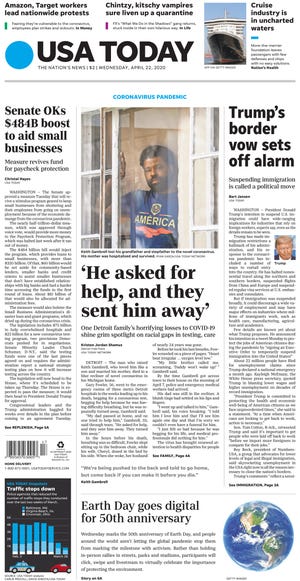
USA TODAY ran the story on the front page on April 22, 2020. That is where Oprah Winfrey read it. She said she couldn't get it out of her mind. 

She talked to Shamus recently about her story.

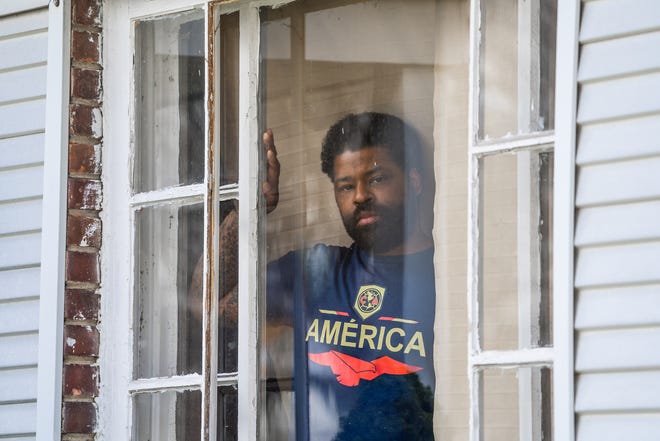
"I was haunted by the words of the story and that picture," Winfrey said of Gambrell, who was photographed by Free Press photographer Ryan Garza staring through the window of his northwest Detroit home. "In the middle of the night, I woke up thinking about that."

Front page of the April 22, 2020, edition of USA TODAY.

She said the story humanized how the pandemic disproportionally sickened and killed people of color and clearly showed the racial bias in health care.

"It was so vivid in my mind that I thought, 'Oh, this would make its own movie. This would make its own film if you could tell the story,' " Winfrey said.

"I ... sent the story to everybody I knew, digitally. I sent it to one of my producers who's worked with me for years for the Oprah show. And I said, 'Gee, you know, I wish there were something we could do about this story.' ... Then, when I was talking to my team about documentaries and what kind of work we wanted to do and I said, 'I can't get the story of Gary Fowler out of my head.' There have to be more Gary Fowlers,' and that's how it happened.

"It" is The Color of Care, a disturbing new documentary that details racial disparities in health care and the families who lost loved ones in the pandemic. Winfrey's Harpo Productions partnered with the Smithsonian on the documentary.

But it's just the start of her push for change. 

"It's a moment to ignite a cultural conversation around this public health crisis, and ... to move the conversation forward because there's so many people who aren't even aware that this is what is happening," Winfrey told Shamus.

A preexisting condition:How America's racist policies fueled high COVID-19 deaths in communities of color

Winfrey would like to get the film shown in medical schools, to professional health care networks, nonprofits and to health care journalists.

"I want people to be aware that because of the color of your skin, there are disparities in your ability to receive your rightful health care. What we're trying to do is have this campaign, ... it's a yearlong campaign, reach current and future medical professionals."

That campaign kicked off Wednesday night at the documentary's premiere at the Smithsonian National Museum of African American History & Culture. Gambrell was there.

He was wore two teddy bear necklaces around his neck. One contained ashes of his father, the other of his grandfather. 

I asked him how he got involved in the documentary. He said Harpo first called him in August 2020.

Keith Gambrell of Detroit Keith Gambrell of Detroit is part of "The Color of Care", Oprah Winfrey's disturbing new documentary on racial disparities in health care.

"I was sitting on the porch with my mom and they were like, 'We saw your picture in USA TODAY. Would you be interested in doing the film?' They didn't say it was Harpo, but I was like, yeah, sure. I just want to get the story out there."

The next day, they called him back and said the film would be produced by Harpo. "And I was like, are you serious? It was major. I would say it's a blessing. I hate that it's for my dad, but I'm glad it's for him. You know, look what's happened. They're raising awareness of these issues.

I asked him what his dad would think of the film, of the campaign, of the change that is to come.

"I think he'd be proud," Gambrell said. "I know he'd cry for sure."

And what does he want to come from this?

"I hope that with this film, doctors and nurses will treat people like human beings. Take away a person's color or religion and treat them as a human being. Stop telling someone what you think is wrong with them and let them tell you what's bothering them because no one knows your body like you know your body."

Shamus asked Winfrey the same thing: What are you hoping that the documentary will accomplish?

"I'm hoping that it becomes more than a film," she said, "just like your words became more than a story and how your words got passed on to me and then I now have created this film that passes it on in a different language."

Journalists want to make a difference. That's why so many do what we do, including Shamus. 

"It's incredible," she said about the documentary and the campaign. "We all hope that when we write stories that they will affect people, that they will impact the community, that they will make change and help us become a better society.

"But when you actually see something tangible come from your work, there's just no way to describe how good that feels."

Backstory:You can talk about suicidal thoughts and depression. USA TODAY editor shares advice after her mother's death by suicide.

Backstory:'Take a chance': Lessons from Simone Biles, Melinda French Gates, Nina Garcia and other USA TODAY Women of the Year

"The Color of Care" premieres on May 1 at 8 p.m. Eastern on the Smithsonian Channel.

Nicole Carroll is the editor-in-chief of USA TODAY. Reach her at EIC@usatoday.com or follow her on Twitter here

Thank you for supporting our journalism.