Tuesday, May 24, 2022

Kyrgyzstan: Protecting pasture to protect walnut forests

In the mountain village of Arslanbob, a smartphone app is helping communities get the most out of their grazing lands, and in turn protect the world's largest natural walnut forest.
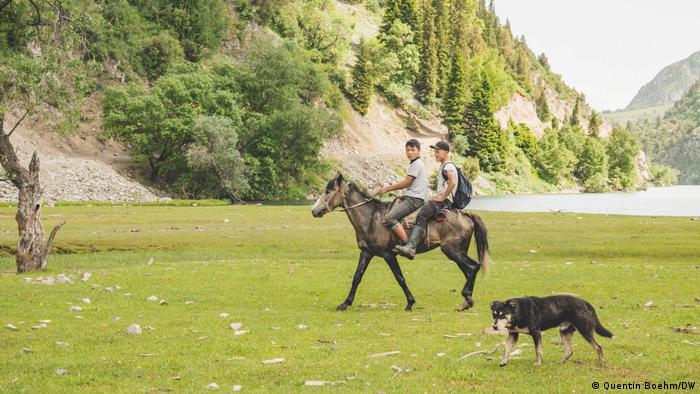

Teenagers ride a young horse during their family’s transhumance to the high pastures above their village in the Jalalabad region of Kyrgyzstan

Kyrgyzstan's ancient walnut forest spans tens of thousands of acres across the flanks of the Babash-Alta mountains. For generations, these natural woodlands have supported communities living on its fringes, in a sprawling network of villages collectively known as Arslanbob.

October is a traditional time of celebration when villagers move into the forest for a few weeks to gather nuts. This bounty is sent off along trade routes that trace the old Silk Road, passing through local markets across the Jalalabad region of Kyrgyzstan and on to Turkey, Russia, and Iran.

But the forests are coming under pressure from climate change and soil erosion — and from overgrazing. Local initiatives are trying to preserve this unique natural resource by engaging villagers in better management, not only of the forest itself but also of surrounding pastures.
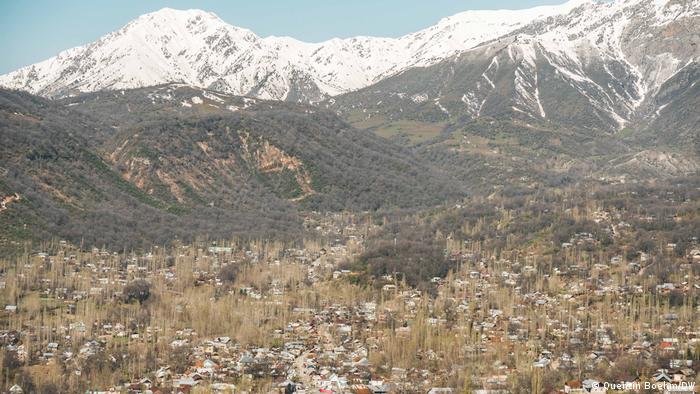

Winter draws to an end in Arslanbob, beneath the snowy peaks of the Babash-Alta mountains

Stressed pastures mean stressed forests

Traditionally, livestock stays close to the village during the winter months, and in summer villagers drive their animals to summer pastures in the highlands above the forest. But this can be a journey of several days and increasingly, these pastures, like the forest, aren't as lush as they used to be.

Instead, villagers are grazing their animals on the nearer winter pastures, meaning when summer ends there isn't enough fodder to see them through the cold months, and livestock are let loose to graze in the forest.
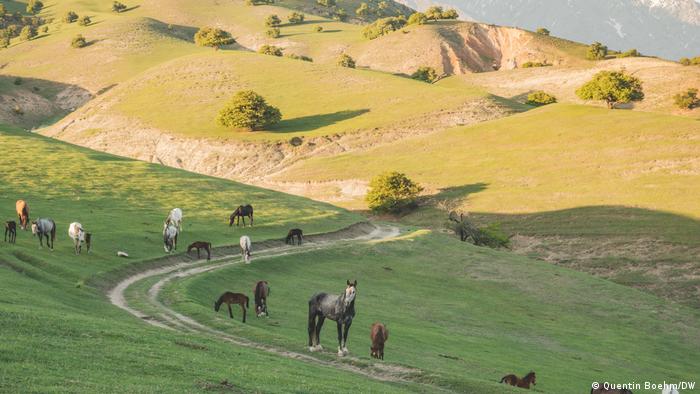
Horses graze in at Alaash Jailoo, a summer pasture about two days ride from Arslanbob. Horses are raised for meat and milk in Kyrgyzstan, as well as for farm work and sport

Hayat Tarikov, a retired forest ranger who spent his career maintaining the walnut forest, says the animals strip the forest floor of uncollected nuts and eat the buds off young trees and shrubs in the spring, making it more difficult for the forest to regenerate and thrive.

"If people kept their animals off the forest from September until May, then the flora on the forest floor could recover," Tarikov says.
Smartphone data to manage grazing

Grazing rights in Kyrgyzstan are granted through a decentralized system of regional pasture committees, composed of village leaders and shepherds.

Each year, Aziz Chirmashev receives a permit to use highland pastures. When the grazing season begins in early summer, he travels there with a 200-head herd of sheep, goats, horses, and cows belonging to villagers in Arslanbob. As the summer draws on, he drives his herd higher and higher to reach fresh grass.

"Our pastures are getting worse," Chimarshev says.
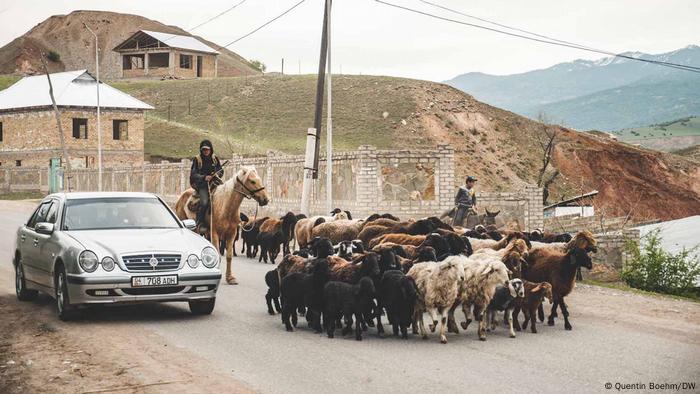

A shepherd drives his small herd to pasture


But to pin down just how much worse, and where — to establish how much grazing a given pasture can sustain — Central Asian environmental NGO Camp Alatoo is testing a smartphone app to map pasture health in the region.

The leaders of pasture committees collect and feed in data on stone cover, lichens, bare ground, and plant cover. This information helps determine how much grazing each area can support, and for how long.

"Year-to-year, it is difficult to tell the health of a pasture," explains Zhyrgal Kozhomberdiev, leader of pasture management at Camp Alatoo, "but five years of data would be a starting point to draw conclusions on the changes of a grazing area or region."

With this knowledge, Kozhomberdiev says, the committees might help shepherds like Chirmashev reach underutilized pastures further from the forest.


A herding family poses outside their yurt on the Alaash Jailoo. They will move the yurt up to three times over the summer as they move their livestock to higher pastures with more grass

Sowing the seeds of resilience

The Ministry of Agriculture says it also has plans to produce seeds of the plants typically found in healthy pastures and sow them in degraded land where overgrazing has left only unpalatable plants.

With these initiatives to restore pastures, and render remote pastures more accessible, the hope is that herders won't turn to the forests to graze their animals.
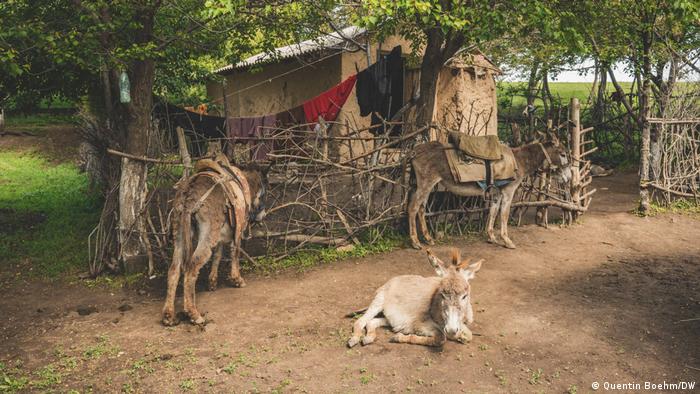

Donkeys doze outside a shepherd's summer residence


At the same time, more direct action is also being taken to improve the health of the forest. Kozhomberdiev says that since 2021, foresters have been monitoring walnut trees to identify those more resistant to soil erosion and irregular water cycles.

The plan is to collect nuts from these resilient mother trees and grow saplings that will then be planted in the forest. But this isn't a quick fix. On average, walnut seedlings need five years of good conditions before they fruit — years in which they are particularly vulnerable to hungry cattle and goats.

'The forest calls them home'


Kozhomberdiev hopes that poor walnut harvests in recent years will serve as a warning to "shepherds and villagers to remember the rhythm of the land and limit the animals' grazing."
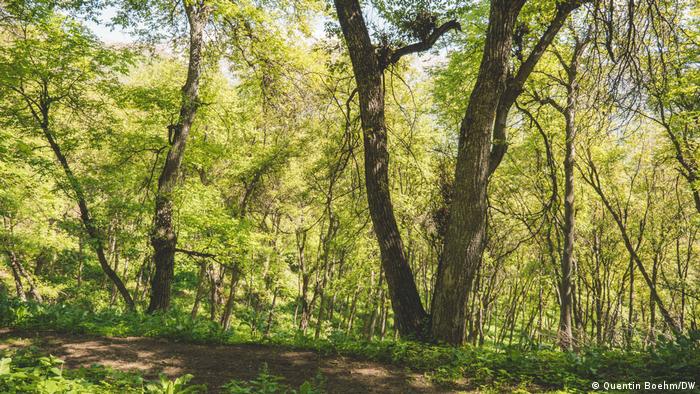

A corner of the Arslanbob walnut forest in spring


These days, the rhythm of life in Arslanbob isn't only dictated by the forest harvest, by times to winter down or scale the mountains in search of lush pasture, but also by the seasonal work that takes many villagers abroad, to neighboring Kazakhstan or to Russia.

But Tarikov says that far from abandoning traditional ways of life, they often come back with a deepened desire to see the ancient forest preserved. "One thing that is different about Arslanbob is that when young people leave here looking for work elsewhere, they come back," he says. "This forest calls them home."
Sri Lanka Tamils fleeing to India to escape economic crisis

Krithiga Narayanan (Tamil Nadu), Deutsche Welle - 


Sri Lanka's economic and political turmoil is affecting all sections of society, but the Tamil community is being hit particularly hard.Dozens of poor families from Sri Lanka have fled to southern India over the past few weeks amid an acute economic and political crisis gripping the Indian Ocean island nation.


© Krithiga Narayanan/DW
The Mandapam refugee camp in Rameswaram is being used by Indian authorities to house those arriving from Sri Lanka

The country of 22 million people has been battling severe shortages of essential items, including food, fuel and medicine, as foreign reserves run dangerously low.

The resulting public fury targeting the government triggered mass street protests and political upheaval.

The resignation of Prime Minister Mahinda Rajapaksa and his Cabinet, and the appointment of a new prime minister, has done little to soothe public anger.

Armed soldiers are currently patrolling the streets to maintain order.

Embarking on perilous journey

Rani (name changed), 41, who asked not to reveal her identity, told DW how eight of her family members, including small children, fled to India by boat, to escape the economic misery.

They sold the land they owned in Sri Lanka and rented a boat with that money. They traveled together with another family of four: a couple with their two children, aged 4 and one and a half.

"My husband and children could not find jobs. Every day the prices of food were increasing. My family needs at least 2 kilograms (4.4 pounds) of rice per day. The price we last paid for rice was around 250 Sri Lankan rupees (E0.65, $0.69) per kilo. We had to pay around 500 rupees per day for rice alone. We could not buy any other food items for our children," she said.

"My son has thalassemia. He has to eat nutritious food. I wanted to provide a better life for my children. That is why I decided to come to India," Rani said.

"We were scared that we would be caught by Sri Lankan authorities while we were crossing and be told to go back. If we had been caught, all the money we had spent to rent the boat, would have been for nothing. We were also scared of what awaited us in India."

Sri Lankan Tamils hit hard by economic crisis


Indian authorities have so far recorded 28 Sri Lankan families, or 85 people, arriving via boat in southern Tamil Nadu state.

All of them belong to the Tamil community, an ethnic minority in Sri Lanka, which share deep social, cultural and linguistic ties with people in Tamil Nadu.

Sri Lankan Tamils, the largest ethnic minority in the island nation accounting for about 12% of the population, have been struggling to recover from the bloody decades-long civil war that lasted until 2009, claiming around 100,000 lives.

Even some 13 years after the end of the war, reconciliation appears far off. And now the economic turmoil seems to be hitting them particularly hard.

"Even though the political and economic crisis in Sri Lanka is affecting all segments of society, there is an ethnic component to the harm Tamils are facing as a result of the crisis," said Suraj Girijashanker, a specialist in international refugee law and assistant professor at the Jindal Global Law School.

He pointed out that Sri Lankan Tamils -- particularly in areas which have been neglected by a series of Sinhalese-majority governments -- are experiencing the economic hardship even more severely.

"Often we tend to treat economic harm in isolation, but the history and context in Sri Lanka complicates this picture as there is disparate impact on Tamils because of their ethnicity," he told DW.

'India needs a better refugee policy'


This is not the first time there has been an influx of people from Sri Lanka to India; Sri Lankan Tamils have been coming to India since the start of the civil war.

According to India's Home Ministry, there were 58,843 Sri Lankan Tamils residing across 108 refugee camps in Tamil Nadu as of 2021. Besides, around 34,135 refugees were staying outside the camps, registered with the state authorities.

India, however, is not a signatory to the 1951 Refugee Convention or the 1967 Protocol Relating to the Status of Refugees.

New Delhi also does not have domestic legislation regulating the entry and stay of people seeking asylum. It treats all those coming into the country seeking refugee status as illegal migrants under The Foreigners Act of 1946.

The UN Refugee Agency (UNHCR) is responsible for processing such people's applications and determining their status in India. Until then, they're handed a document that allows them to stay in the country.

But the document, a piece of blue paper, is widely dismissed by Indian authorities.

Without assistance from the Indian government, asylum-seekers and migrants find it immensely challenging to either rent homes or find work.

"India needs a national asylum law which prevents disparate standards for different refugee populations during different periods. Such a law may draw from the 1951 Refugee Convention, but also needs to keep the domestic conditions in mind," said Girijashanker.

This view is shared by K.M.Parivelan, chairperson of the Center of Statelessness and Refugee Studies at the Tata Institute of Social Sciences, who also facilitated the voluntary repatriation of Sri Lankan civil war refugees in the past when he worked with the UNHCR.

"India needs a better refugee policy in line with international humanitarian and human rights frameworks," he told DW.

"On humanitarian grounds Sri Lankan Tamils need to be protected as a special case. We need to provide interim care and protection. Livelihood support can be given as a temporary measure and then they can be voluntarily repatriated to Sri Lanka," Parivelan said, stressing that, "it should be voluntary repatriation in all circumstances."

Stuck in the refugee camp


Indian authorities have been taking those arriving from Sri Lanka over the past couple of months to the Mandapam refugee camp in Rameswaram town.

"We have been staying here for more than a month now, with no end in sight. People who came two months before us are also facing the same situation," Rani said.

"My daughter-in-law is six-months pregnant and weak. We have to get permission from the authorities to go for health checkups. We don't know how we are going to manage once the baby is born," she added.

Mani (not his real name), a 26-year-old man who used to work as a painter in Sri Lanka, reached India in March, along with his wife.

"We could not do anything in Sri Lanka because of the economic crisis. That's why I decided to come to India with my wife on a boat," he told DW.

"If I had known that we would be held in a refugee camp like this, I would not have come at all," he said, noting that they have been staying at the camp for over a month.

"We do not know what is going to happen to us. If we are given some documentation by India, we can work and provide for our families. That is all we ask."

Edited by: Srinivas Mazumdaru

Copyright 2022 DW.COM, Deutsche Welle. Distributed by Tribune Content Agency, LLC.
German man on trial for supplying Russian chemical weapons program

Trial of a German businessman accused of trying to "promote production of chemical weapons" begins in Dresden. The man has been custody since May 2021.

The accused allegedly sold goods worth around €1 million via a Russian firm directed by the secret service


A German businessman accused of exporting armaments for Russia's chemical and nuclear weapons program appeared before the Higher Regional Court of Dresden on Tuesday.

The man is accused of violating the War Weapons Control Act and the Foreign Trade and Payments Act and has been in custody since May 2021.
What do German prosecutors say?

Prosecutors allege that since 2017, Alexander S. attempted to "promote the production of chemical weapons" by brokering the delivery of equipment from a Chinese manufacturer to Russia, in violation of the War Weapons Control Act.

The accused was also alleged to have exported goods ten times without a necessary license and was also accused of acting "for the secret service of a foreign power."

German officials say the defendant is a managing director of a trading company in Saxony. Since 2017, he was alleged to have sold goods worth around €1 million ($1.07 million) via a Russian firm believed to be directed by the Russian secret service.

Prosecutors say the accused knew that the exported items could be used in both civilian and military sectors and could also be used in the development of "ABC weapons" — short for atomic, biological and chemical weapons.

The man is alleged to have tried to conceal the destination of the consignments by providing fake receipts.

Germany wants stamping out proliferation

Germany's Federal Prosecutor's Office says the country has made an international commitment to prevent the proliferation of technology enabling the production or distribution of weapons of mass destruction.

Any export of this nature needs to be in compliance with the Foreign Trade and Military Weapons Control Act.

High-tech civilian products could also fall into this category if the potential use could be for military purposes.

Editor's note: DW follows the German press code, which stresses the importance of protecting the privacy of suspected criminals or victims and obliges us to refrain from revealing full names in such cases.

Edited by: Darko Janjevic

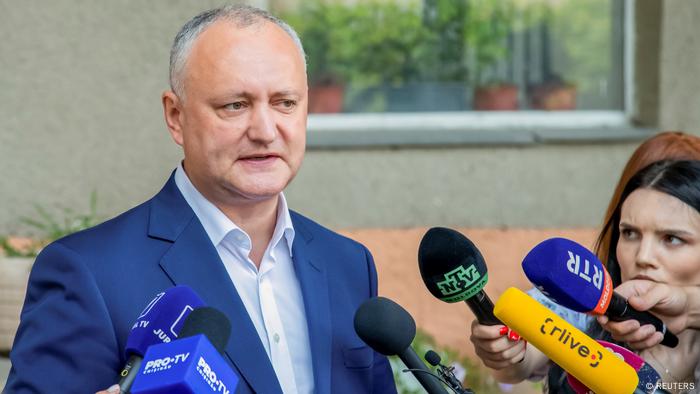
Moldovan ex-president detained for alleged graft, treason

Ex-Moldovan President Igor Dodon is accused of taking bribes. The pro-Russia politician was in office from 2016 until 2020.

Dodon has reportedly been taken into custody for 72 hours

Igor Dodon, the pro-Russia ex-president of Moldova, has been arrested in Chisinau on suspicion of high treason, according to multiple media reports on Tuesday.

Dodon has been detained by authorities for 72 hours, Deschide.MD quoted Moldova's acting prosecutor general, Dumitru Robu, as saying.

Who is Igor Dodon?

Dodon was elected president of Moldova in 2016 and served until he lost the 2020 election to Maia Sandu, a former World Bank official who ran on a pro-EU, anti-corruption ticket.

Interfax said searches were being conducted at Dodon's home and at the Moldovan-Russian Business Union, a trade body founded by Dodon in 2022.

Interfax reports that the arrest follows the reopening of an investigation into the so-called pileup affair, concerning video evidence of bribes being taken.

In the video, Dodon is seen to accept a "pile," apparently containing money, from oligarch and then-leader of the Democratic Party Vladimir Plahotniuc. The cash was supposedly intended to finance Dodon's party.

In 2020, prosecutor Alexander Stoyanoglo declined to investigate the case, citing a lack of evidence. 

The country has been hit by several political crises and a $1 billion (€930 million) bank fraud scheme, which equates to almost 15% of its annual economic output.

What does Russia think?

The Kremlin said it was concerned about the arrest of one of its allies in the country.

"Of course we are concerned," Kremlin spokesperson Dmitry Peskov said in a conference call with reporters. "We hope that Dodon's rights will be respected."

Sandu's Party of Action and Solidarity had been endorsed by Germany's defense minister at the time Annegret Kramp-Karrenbauer and the former European Council president Donald Tusk, while Dodon was supported by Vladimir Putin.

Neighboring Romania's president, Klaus Iohannis, had lavishly praised Sandu after their first meeting, viewing her victory as a signal of a new dawn in the country.

Russia has had troops in Transnistria, a breakaway region of Moldova, since 1992. The Kremlin has said it would withdraw them under international pressure but failed to do so.

In April, a Russian general said controlling southern Ukraine could be a way to open a land bridge to Transnistria. He added that Russian speakers in the region needed "protection" from Moldova, where most of the population speaks Romanian.

er/aw (Reuters, Interfax)

WAR IS RAPE

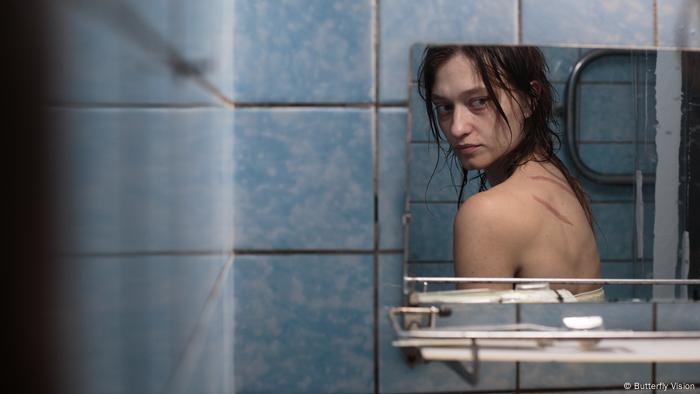
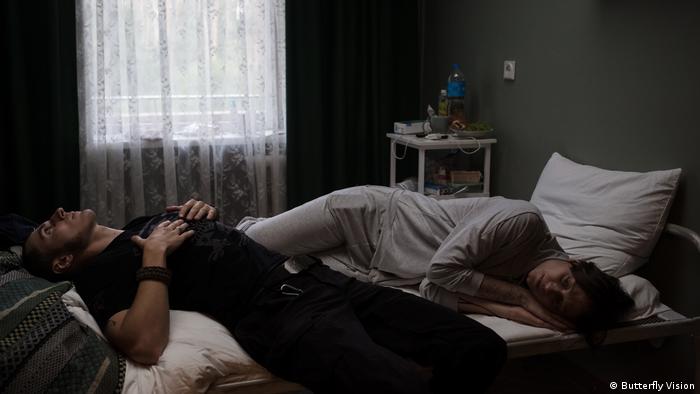
Cannes: Ukrainian film 'Butterfly Vision' depicts trauma of war

Premiering at the Cannes Film Festival, Maksim Nakonechnyi's feature portrays the trauma of a Ukrainian female soldier kept captive and raped by her Russian captors in Donbas.

Rita Burkovska plays the lead role in Maksim Nakonechnyi's film 'Butterfly Vision'

"Butterfly Vision" is about a female soldier who returns home after months of captivity, and finds out that she is pregnant, having been raped by her prison guard.

Ahead of the film's Cannes premiere on May 25, DW met Ukrainian director Maksym Nakonechnyi at the festival.

DW: How did you come to tell the story of "Butterfly Vision"?

Maksym Nakonechnyi: Since the very start of the Russian-Ukrainian war back in 2014, my colleagues and I have been trying to get involved and take action as artists and filmmakers. And we were making a lot of films on the topic.

I also had a lot of friends who were actually serving, and many women were among them. So I was just hearing their stories, their experiences.

And then I was also editing a documentary called "Invisible Battalion," which tells the stories of women veterans and women soldiers. While I was editing it, listening to some phrases and scenes again and again, I got deeply impressed by their perspective.

So it's a fiction film, but how much of it was inspired by real cases and stories you were hearing, for example while you were editing?

I was deeply impressed by one of the phrases in particular; it was a woman soldier saying that being captured was the scariest thing for her. She didn't want the Russians to know that she is a woman. She had made a deal with her fellow combatants, asking them to kill her in a situation where she could possibly become a captive.

So, from this initial testimony, we started researching the topic; with my co-writer and then with my main actress, we talked to different participants, witnesses, or victims of war or of war crimes, and we collected their stories. And we were not only collecting the facts, but also observing their mode of survival with such an experience. All that would flow into the story's details, for example through the acting or the camera work.

The film itself was shot in the Donbas region. How difficult or how dangerous was it to work there?

While we were researching for the production, we visited our soldiers at the actual front line to observe details there, and back then we also had to take some measures just to be safe.

The locations that we chose were not at the actual front line. But the exchange scene in the film was shot in Donbas. We had chosen the location back in 2020, and we were shooting this scene in the beginning of 2021. And that was just about the time of Russia's first attempt to build up their troops around our borders.

So, when we were preparing to go to the location, we were contacted by the local authorities, who told us that this location was too dangerous and that we had to move a bit further from the border.

So, yeah, that was among the dangers; there was a possibility that the invasion would catch us in Donbas.

And, now as your film comes out, it has a broader relevance; we're in the midst of a full-scale war ...

Well, before the full-scale invasion started, when our war was still considered a "frozen conflict" by both the international community and a lot of Ukrainian citizens, too, I would say that there was a huge gap, even in Ukrainian society.

And that was a difficult situation for the soldiers or the people who had experienced the horrors of war and who were returning to peaceful civil life. What made it harder was that they would feel this indifference from the other people, who didn't have such an experience.

And now, when it started touching each Ukrainian citizen, each Ukrainian family and household, it became very clear that, as long as you don't experience something, you cannot fully get it. But you can at least be aware — and that is the key to living together as a united society.

That wasn't so clear, and that wasn't so present back then, unfortunately. And that was also one of the initial reasons why we decided to make that film.

The team behind "Butterfly Vision" will mark the Cannes premiere on May 25 

with a protest on the red carpet, according to Screen Daily

There's a lot of focus here in Cannes on Ukrainian stories and films. What do you hope people will hear?  

Well, first of all, Ukrainian artists being present on such a big and well-known cultural platform is a matter of our struggle and survival in itself, because our cultural identity is under attack. And that's why each case of Ukrainian culture being successful, being presented, being loud and noticed, is a part of us still being alive and developing.

So that's one of the conclusions I would love the international audience to make after seeing the film: that they know that we're present, not only where the actual hostilities take place. It's much broader; it influences many more spheres of life.

But, also, I would love our film to bring thoughts about the future, because it's a story of survival. It's a story of a will to survive and to keep standing and fighting. And I hope it will make its contribution to our general survival, standing and fighting as Ukrainian society, and to global progressive democratic society in general.

Previous to this war, the stories being told about Ukraine were perhaps understood outside of the country as being influenced more by Russian stories. Do you think the way people understand Ukraine outside the country has now changed? 

Ukrainian stories and the Ukrainian perspective could have been marginalized somehow, or there would be some kind of tiredness, let's say, because maybe there was this kind of misunderstanding.

For people abroad, the war [that started in 2014] was kind of over. So they were wondering, why would Ukrainian filmmakers keep telling stories about war?

And now it's obvious why.

Before this war, the Ukrainian perspective was marginalized or ignored, there was this false perception of us as just a part of a bigger, post-Soviet cultural field. Of course, that was the result of Russian propaganda. That's over now. There is no way back. The process has started where the world has begun to see us as a sovereign identity with all the aspects that entails: cultural, political, sociological, existential and metaphysical. A Ukraine with a separate postcolonial identity.

This interview has been edited for length and clarity. 

Edited by: Elizabeth Grenier

Ukrainian publishing house makes books to survive

Despite bombardment and rocket fire, the Vivat publishing house in Kharkiv never stopped producing books. It even opened a new bookstore.

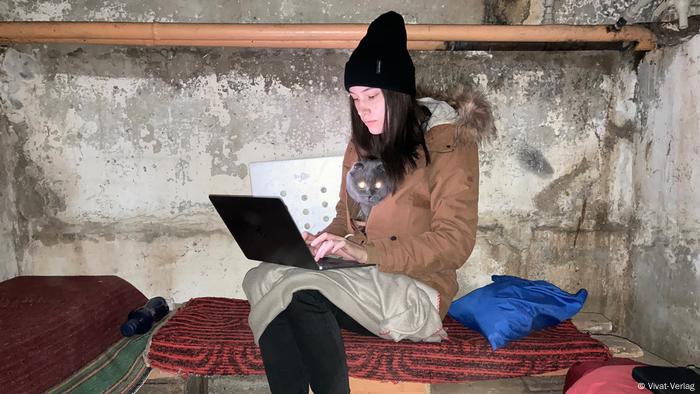
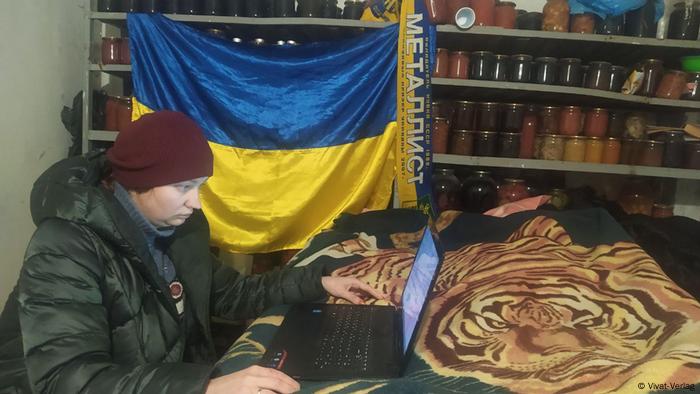
A worker at Vivat publishing house in Kharkiv works from a bomb shelter

Kharkiv, the name of Ukraine's second-largest city, has been often heard in the news over the past three months. Here, in the area next to the Russian border, the first Russian bombs fell on the night of February 24. In the weeks that followed, the city was systematically shelled. According to various estimates, one-third to one-half of the inhabitants of Kharkiv, a city of over a million people, have left since then. But for those who remained, life goes on. They plant flowers in parks, they clean the streets — and they even produce books.

Book production in the bomb shelter

"On the one hand, making books is a profession and a vocation for us," Julia Orlova, founder and managing director of Vivat publishing house told DW in an interview. "On the other hand, the work keeps us from going crazy." Before the war, her publishing house had 177 permanent employees and about 200 freelancers. Many are no longer there, while others are fighting at the front.

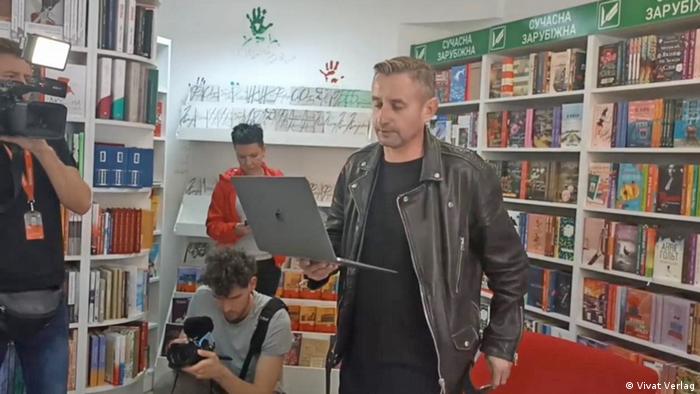
Ukrainian poet Serhiy Zhadan recently read new works in Vivat's new bookshop

But many continue to work, often from bomb shelters. "Our editorial processes, typesetting and correcting texts, contracts or even illustration can continue," says Orlova, whose print shop in Kharkiv was damaged by the shelling. Now, the publisher must work with other printers near Kyiv and in western Ukraine. Vivat's warehouse was also moved to the vicinity of Lviv, and can only now restart distribution, which is primarily done digitally. On May 20, the publishing house reopened its bookstore in the destroyed city center of Kharkiv. Ukraine's leading poet Serhiy Zhadan read his new poems at the opening.

"We want to use this symbolic action to draw attention to the problems of Ukrainian publishers, who are saving the Ukrainian book industry despite huge financial losses and drops in income," said Vivat press officer Galina Podilko. "People in Ukraine desperately need to feel that life goes on." She also said that demand for books has been growing steadily in recent weeks, especially for children's and young adult books. Since the outbreak of the war, Vivat has already produced more than 60 books. Other publishers in the country are also following suit.

Vivat accountant Anna Grabina working in her house basement, calling it "almost cozy"

‘When it comes to war…there is only black or white'

Vivat was created in 2013 when two smaller publishing houses merged. Gradually, it became one of Ukraine's top publishers. The year before the war began, Vivat sold nearly two million books. "That makes us one of the top three publishing houses in the country," Orlova says. She is particularly proud of the quality of their books. "We work with leading Ukrainian and international authors, building new talent." Vivat's portfolio includes fiction, nonfiction, Ukrainian texts and translations and many children's books.

Russian books were also produced until 2014, but the Russian annexation of Crimea was a turning point. "We took a clear pro-Ukrainian position. This caused us great economic losses because eastern Ukraine is Russian-speaking, and Crimea also used to be one of our markets. But it was very important to take an absolutely clear position. When it comes to war and violation of international law, there is only black or white," says Orlova.

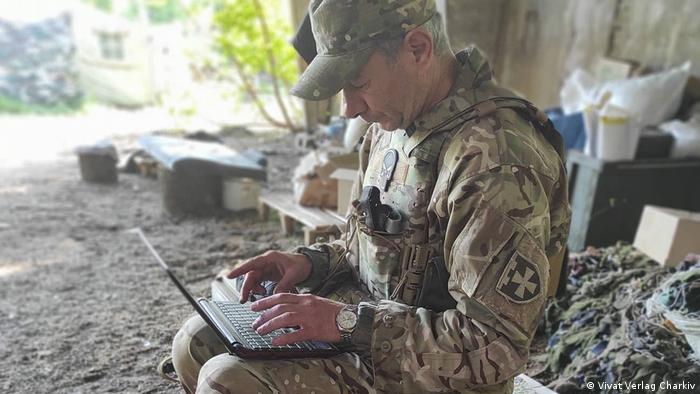
Vivat author Vitali Zapeka working on his new children's book at the front 

— dedicated to his granddaughter

From the publisher's point of view, neither Russian books nor Russian publishers belong in the Ukrainian market at the moment — nor on the international scene. "It pains me, because I had many friends and colleagues in Russia," says Orlova, who was born in Murmansk, Russia. But every Russian publisher also pays its taxes in Russia, supporting the war. Moreover, Orlova wants to see a clear stance on Russian culture in the publishing industry in relation to the annexation of Crimea and the war in Donbas — as well as on the war in Ukraine.

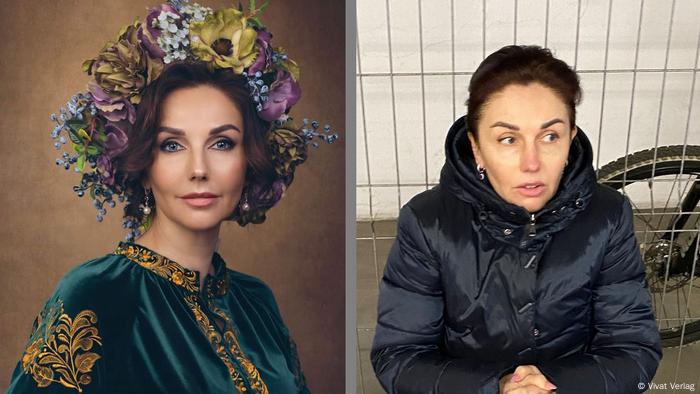
Publisher Julia Orlova wearing a traditional Ukrainian outfit (l) before the war, 

and is also shown in her basement in March 2022

‘You can't prepare for war and death'

Orlova could not sleep on the night of February 24, like many in Kharkiv. "There was a lot of information from reconnaissance services that it would start that night. Still, no one believed that war would break out." Despite warnings, she had not been prepared. "One can't prepare for war or death," she says. At five o'clock in the morning, she was woken from her sleep by the sound of explosions, gunfire and the hiss of defensive missiles.

"We all ran to the balcony, although it was the stupidest thing that could have been done." Since then, Orlova has learned to distinguish the sounds of weapons from one another — whether from the Russian or Ukrainian sides.

Vivat employees have been working from the front and in bunkers

Renaissance of the Ukrainian publishing industry

Even if the end of the war is not yet in sight, Julia Orlova and her staff agree: Ukraine will win the war. In fact, they have long since won it morally. "I hope for a renaissance of the Ukrainian publishing industry in the post-war period. And we will play a central role in rebuilding the country." She said it was particularly important for the world to become better acquainted with Ukrainian literature: "We have many great authors, especially in the field of children's and young adult books. It is very worthwhile to discover them."

Why is India's book market struggling?

India's book publishers are facing a myriad of challenges — from heightened production costs to a reduction in the kinds of books consumers are willing to read.


High shipping costs have also hit book publishers

India's book publishers are facing new challenges during the pandemic because of the high cost of raw materials and soaring inflation.

Inflation, driven by high food and fuel prices, reached an 18-month high of 7.5% in April in India, according to a Reuters poll.

Publishers from across the country — for English and regional languages — say they have faced an acute shortage of paper and higher production costs for months now. As a result, they are being forced to hike the prices of books.

About 80% of books in India are published in Indian languages, according to a 2007 publication by the Federation of Indian Publishers (FIP).

The average Indian spends less than $5 (€4.65) on a single book published in an Indian language. But there is a lack of data on the actual number of books published.

Dearth of data makes publishing trends difficult to discern


The British Council published a report in February called the "Indian Literature and Publishing Sector" to make note of the challenges facing publishers.

In the report, researchers noted that a 2007 study by the Federation of Indian Chambers of Commerce and Industry (FICCI) found that half of the titles published in India were either in Hindi or English.

The FICCI report also said about 90,000 titles were published every year. Researchers of the British Council report pointed to the "sporadic" tracking of the sector since there was no study undertaken on a regular basis.

A 2015 book market report by Nielsen India estimated the Indian book market to be worth $3.9 billion and growing by about 20% each year.
Heightened production costs after pandemic years

Alind Maheshwari, a director of Rajkamal Prakashan Group, a notable publisher of Hindi-language books, told DW that the company couldn't publish as many books as it had before the pandemic.

"Paper used to cost around 60 rupees ($0.77/€0.72) per kilogram (2.2 pounds), and now costs 110 rupees per kilogram. It nearly doubled," Maheshwari said.

Delhi-based Rajkamal Prakashan used to publish about 200-250 books a year before the pandemic. Now, they publish just 72-100 books a year, including translations of English books.

Maheshwari explained that book distribution channels have been impacted substantially since the pandemic posed a challenge to book distributors or those responsible for supplying new books to stores.

Satabdi Mishra, co-founder of Walking BookFairs in the eastern state of Odisha, told DW that it was becoming increasingly expensive to print books with "the price hike in printing and transport services."

The publication of some books was also put on hold because of the pandemic, and "finally, when we got around to publishing it, prices had gone up significantly," Mishra said.

A global shortage of shipping vessels and heightened shipping costs in December contributed to some of the rise in production costs.

Indian paper mills were also forced to cut operations to two to three times a week, industry experts said.

Arpita Das, the publisher of the independent Yoda Press for English-language books, said a hike in book costs has put pressure on the company because, which tries "to keep prices low enough for avid readers to be able to afford books."

Readers in decline

Thomas Abraham, the managing director of Hachette India, one of the five big publishing houses in the country, said Indians largely read for utilitarian purposes and less for entertainment purposes.

In the UK and US, new titles usually do well with readers. But in India, "it's the exact opposite," Abraham told DW. People generally read a lot of older titles like books by Enid Blyton or Agatha Christie.

"The country is losing its bibliodiversity" — diversity in the kinds of books people read — Abraham said.

A combination of changing reading habits and increasing costs of publishing meant that many publishing houses had to do away with the so-called experimental or midlist books, which are not high priority because they only have a specific readership.
Pandemic brings more e-reading

The Nielsen book report added that e-reading devices didn't find too many buyers in India. However, the pandemic changed the scenario because people began buying more e-books on Amazon, specifically in the first period of the lockdown in 2020.

Big publishing houses said e-book sales doubled during that time, but there was a caveat.

Even though e-book sales doubled, they contributed very little to revenue because they could not make up for the losses incurred during the first four months of lockdown in 2020, Abraham said.

"We’ve seen that e-book spikes happen only when there's a deep discount offer from e-book sellers," he said.

Others have taken matters into their own hands in a decisive fashion.

Mishra said Walking BookFairs was selling one of its latest releases — a collection of short stories by diverse Indian authors — "only at local, physical bookstores throughout India — to support local bookstores — and it is not available for sale on Amazon or Flipkart."

Edited by: Leah Carter

EXCLUSIVE: Germany's Scholz decries Putin's 'imperialistic' war in Ukraine

In an exclusive interview with DW, German Chancellor Olaf Scholz pledged to help countries in Africa that are also suffering from Russia's invasion of Ukraine.


German Chancellor Olaf Scholz emphasized that bringing an end to Russia's war in Ukraine "would be the best for the whole globe," in an exclusive interview with DW on Tuesday in the South African city of Johannesburg.

Speaking with DW's chief political editor, Michaela Küfner, Scholz said the EU and the US were leading an initiative to lower fuel prices around the world — by urging countries to increase their production of oil and gas.

The comments came during Scholz's first official visit to Africa, where he discussed the wide-ranging impacts of the war in Ukraine with African leaders.

Scholz says Russians are already 'suffering' because of the war

The chancellor slammed Russian President Vladimir Putin's decision to pursue "a very brutal war" in Ukraine, calling it an "imperialistic approach."

During direct talks with Putin, Scholz said he told the leader that the war "will never have a good outcome" for Russia. He also added that the international sanctions are hitting Russia's economic development hard and will have lasting effects.

"They will go back in their opportunities of economic development for decades, they will suffer and they are suffering, and for getting out of this, [Putin] has to stop the war," he added

Germany wants to boost global fuel supply

With the war in Ukraine and sanctions on Russian energy imports contributing to a spike in global fuel prices, Scholz confirmed that the US and EU are working together to lower costs.

"We will have a very difficult situation if we look at fuel prices. Obviously this will be not feasible to subsidize them down, and even not on a global level," Scholz said, but added that "it is necessary that we start to increase the supply" of fuel.

"We are now discussing with all these countries that are exploring oil and gas and trying to convince them to increase their capacities, so this would help the world market," the chancellor added.

Berlin should work 'intensely' on diplomatic ties with Africa

Scholz said it was vital for Russia to end its war in Ukraine not only for European security, but also for global peace.

"It is obvious that a lot of countries are suffering from this war and from the Russian aggression, and this is why we are very decided that we will help the countries that are suffering," he said.

Germany is working to support the UN's World Food Programme to address grain shortages that are hitting countries in Africa particularly hard.

He added that European countries in particular have a responsibility to improve relations and support to formerly colonized countries.

"Germany [and] all countries with a colonial past have to be very honest and admitting that this past is part of their history and that they have responsibility for better relations with the countries, for instance in Africa. And doing this is also the basis for a good relationship in the future," he said.

Addressing the colonial past and working to deepen cooperation "is the basis for a multilateral world" that consists of "countries that cooperate for a better future," according to the German leader.

During his first official visit to the African continent, Scholz has met with leaders in Senegal, spoke with German troops in Niger and is now in South Africa for the next stage of his journey.

"Africa is the continent next to Europe and so it is of essence that we work intensely to have very good relations with all the states in Africa, and also it is important that we develop our relations with all the democratic states on the globe," he said.

Interview conducted by: DW's Chief Political Editor, Michaela Küfner

Edited by: Darko Janjevic

US warns Turkey against new Syria offensive

US soldiers patrol between areas held by the Syrian Kurdish forces and Turkish-backed fighters in northeastern Syria in December 2021
(AFP/Delil souleiman) 

Tue, May 24, 2022, 2:43 PM·2 min read

The United States on Tuesday warned Turkey against launching a new military operation in northern Syria, saying the uneasy NATO ally would be putting US troops at risk.

Turkish President Recep Tayyip Erdogan said Monday that Turkey would soon launch a new military operation into northern Syria to create a 30-kilometer (19-mile) "security zone" along the border.

"We are deeply concerned about reports and discussions of potential increased military activity in northern Syria and, in particular, its impact on the civilian population," State Department spokesman Ned Price told reporters.

"We condemn any escalation. We support maintenance of the current cease-fire lines," he said.

At the United Nations, spokesman Stephane Dujarric said that the priority for war-battered Syria should be a political solution and humanitarian assistance.

"We stand for the territorial integrity of Syria, and what Syria needs is not more military operations from any quarter," Dujarric told reporters.

Turkey has launched three offensives into Syria since 2016 aimed at crushing Syrian Kurdish fighters who assisted the US-led campaign against the Islamic State group, also known as ISIS.

The so-called People's Protection Units (YPG) are considered "terrorists" by Turkey, which sees them as part of the banned PKK separatist movement at home.

Turkey ordered the last incursion in October 2019 when then US president Donald Trump, following talks with Erdogan, said that US troops had accomplished their mission in Syria and would withdraw.

Amid a backlash even from some of Trump's allies, then US vice president Mike Pence flew to Turkey and reached an agreement with Erdogan that called for a pause in fighting.

"We expect Turkey to live up to the October 2019 joint statement, including to halt offensive operations in northeast Syria," Price said.

"We recognize Turkey's legitimate security concerns on Turkey's southern border. But any new offensive would further undermine regional stability and put at risk US forces in the coalition's campaign against ISIS," Price said.

Erdogan's talk of an offensive comes as he threatens to block the NATO membership of Finland and Sweden, which have sought to join the Western alliance out of alarm at Russia's invasion of Ukraine.

Erdogan has alleged support for the PKK in the two Nordic states, which are planning high-level talks with Turkey to ease its concerns.

After Trump's abrupt pullout decision in 2019, the YPG sought protection from Syrian President Bashar al-Assad and Russia, the regime's main supporter, which saw a prime opportunity to replace the United States as the key player.

Russia and Turkey then negotiated a ceasefire which has mostly held.

Trump soon reversed course on the withdrawal and has some 900 US troops still officially in Syria as part of the fight against the Islamic State movement.

President Joe Biden has shown no eagerness to pull out the troops despite his exit from the 20-year war in Afghanistan last year.

sct-prh/jh
Argentina to ease exchange control for oil and gas companies


A gas well at Campo Maripe in the Vaca Muerta, an enormous non-conventional oil and gas deposit nestled in a geologic formation that provides 43 percent of Argentina's total oil production and 60 percent of its gas (AFP/Emiliano Lasalvia) (Emiliano Lasalvia)


Tue, May 24, 2022

Argentina on Tuesday announced an easing of foreign exchange controls for the shale oil and gas industry in a bid to promote investment and boost production.

In an area known as Vaca Muerta in Patagonia, Argentina has what is considered the second-largest shale gas reserve in the world and the fourth largest of shale oil.

Extraction has been hampered by a lack of much-needed but costly investment, especially for hydraulic fracking.

On Tuesday, Economy Minister Martin Guzman said "a special regime for currency access" would be put in place for the hydrocarbon industry "to guarantee the special equipment they require," especially for fracking.

About 20 oil companies have been operating in Vaca Muerta since 2013, including Chevron, Shell, Total and Statoil in partnership with the Argentine oil company YPF.

Since September 2019, Argentina has had exchange controls in place with a limited official rate of about 120 pesos for one dollar.

At the same time, currency can be exchanged at a rate of some 200 pesos to the dollar through debt bonds or on the informal market.

"We have a great opportunity in energy in Argentina. The next 15 years have great potential for development," said President Alberto Fernandez, on a working trip with Guzman.

The government says oil production can increase by 70 percent and gas production by 30 percent over the next five years.

In recent months, Argentina has increased its production of hydrocarbons to reach a record 578,000 barrels per day in April -- an increase of 13 percent in 12 months, according to the government.

Gas production in the same month was 127 million cubic meters, an increase of 12 percent year-on-year.

That has allowed the country to reverse five years of decline in oil production, said Guzman.

Last month, the government launched a construction tender phase for a gas pipeline from Vaca Muerta to the north of the country, to increase domestic supply and exports at a time when worldwide energy costs have shot up due to the war in Ukraine.

nn/sa/mlr/jh