Tuesday, May 24, 2022

ALBA-TCP Summit To Be Held in Havana on May 27

President Nicolas Maduro (C) and other Latin American presidents at the 20th ALBA-TCP summit, Havana, Cuba, 2021. | Photo: Twitter/ @periodicocubanoPrevious

Published 24 May 2022 

This regional integration block was born in 2004 with the signing of a "Joint Declaration" by Hugo Chavez and Fidel Castro.

The 21st Summit of the Bolivarian Alternative for the Peoples of Our America - People's Trade Agreement (ALBA-TCP) will meet on Friday in Havana, Cuba.

RELATED:
ALBA-TCP Condemns Killing of Palestinian Journalist by Israel

On Tuesday, the Cuban Ministry of Foreign Affairs (MINREX) announced the date of the meeting of the members of this Latin American and Caribbean integration platform.

“The nations that make up our Alliance will share common development strategies and analyze the regional political situation,” the MINREX tweeted.

This meeting will have special importance since it will be held before the 2022 Summit of the Americas in Los Angeles, where Cuba, Venezuela, and Nicaragua will not be present because they were not invited by President Joe Biden's administration.

The ALBA-TCP, which brings together ten member states and three invited countries, held its 20th summit in December 2021 in Havana.


This regional integration block was born in 2004 in Havana with the signing of the "Joint Declaration and the Agreement for the Application of ALBA" by Venezuela's President Hugo Chavez, and the President of the Council of State of Cuba, Fidel Castro.

ALBA-TCP emerged as an alternative to the Free Trade Agreement of the Americas (FTAA) promoted by the United States at the beginning of the century. Its founding members were Cuba and Venezuela (2004).

Later, they were joined by Bolivia (2006), Nicaragua (2007), Dominica (2008), Antigua & Barbuda (2009), Saint Vincent & the Grenadines (2009), Saint Kitts & Nevis, and Grenada (2014). Ecuador and Honduras withdrew from the Alliance when those countries were led by right-wing governments.

Obama’s Handshake With Raúl Castro Shows the Way for Biden’s Summit of the Americas

By: teleSUR/MS

Raul Castro and Barack Obama | Photo: Codepink

Published 18 May 2022

Biden should invite all the nations of the region to the summit and shake the hands of every head of state to foster better dialogue and a brighter future for the hemisphere.

By Medea Benjamin
CODEPINK

On May 16, the Biden administration announced new measures to “increase support for the Cuban people.” They included easing travel restrictions and helping Cuban-Americans support and connect with their families. They mark a step forward but a baby step, given that most U.S. sanctions on Cuba remain in place. Also in place is a ridiculous Biden administration policy of trying to isolate Cuba, as well as Nicaragua and Venezuela, from the rest of the hemisphere by excluding them from the upcoming Summit of the Americas that will take place in June in Los Angeles.

This is the first time since its inaugural gathering in 1994 that the event, which is held every three years, will take place on U.S. soil. But rather than bringing the Western Hemisphere together, the Biden administration seems intent on pulling it apart by threatening to exclude three nations that are certainly part of the Americas.

For months, the Biden administration has been hinting that these governments would be excluded. So far, they have not been invited to any of the preparatory meetings and the Summit itself is now less than a month away. While former White House press secretary Jen Psaki and State Department spokesman Ned Price have repeated that “no decisions” have been made, Assistant Secretary of State Brian Nichols said in an interview on Colombian TV that countries that “do not respect democracy are not going to receive invitations.”

Biden’s plan to pick and choose which countries can attend the Summit has set off regional fireworks. Unlike in the past, when the U.S. had an easier time imposing its will on Latin America, nowadays there is a fierce sense of independence, especially with a resurgence of progressive governments. Another factor is China. While the U.S. still has a major economic presence, China has surpassed the U.S. as the number one trading partner, giving Latin American countries more freedom to defy the United States or at least stake out a middle ground between the two superpowers.

The hemispheric reaction to the exclusion of three regional states is a reflection of that independence, even among small Caribbean nations. In fact, the first words of defiance came from members of the 15-nation Caribbean Community, or Caricom, which threatened to boycott the Summit. Then came regional heavyweight, Mexican President Manuel López Obrador, who stunned and delighted people around the continent when he announced that, if all countries were not invited, he would not attend. The presidents of Bolivia and Honduras soon followed with similar statements.

The Biden administration has put itself in a bind. Either it backs down and issues the invitations, tossing red meat to right-wing U.S. politicians like Senator Marco Rubio for being “soft on communism,” or it stands firm and risks sinking the Summit and U.S. influence in the region.

Biden’s failure at regional diplomacy is all the more inexplicable given the lesson he should have learned as vice president when Barack Obama faced a similar dilemma.

That was 2015, when, after two decades of excluding Cuba from these Summits, the countries of the region put down their collective feet and demanded that Cuba be invited. Obama had to decide whether to skip the meeting and lose influence in Latin America, or go and contend with the domestic fallout. He decided to go.

I remember that Summit vividly because I was among the bevy of journalists jostling to get a front seat when President Barack Obama would be forced to greet Cuba’s President Raúl Castro, who came into power after his brother Fidel Castro stepped down. The momentous handshake, the first contact between leaders of the two countries in decades, was the high point of the summit.

Obama was not only obligated to shake Castro’s hand, he also had to listen to a long history lesson. Raúl Castro’s speech was a no-holds-barred recounting of past U.S. attacks on Cuba—including the 1901 Platt Amendment that made Cuba a virtual U.S. protectorate, U.S. support for Cuban dictator Fulgencio Batista in the 1950s, the disastrous 1961 Bay of Pigs invasion and the scandalous U.S. prison in Guantanamo. But Castro was also gracious to President Obama, saying he was not to blame for this legacy and calling him an “honest man” of humble origins.

The meeting marked a new era between the U.S. and Cuba, as the two nations began to normalize relations. It was a win-win, with more trade, more cultural exchanges, more resources for the Cuban people, and fewer Cubans migrating to the United States. The handshake led to an actual visit by Obama to Havana, a trip so memorable that it still brings big smiles to the faces of Cubans on the island.

Then came Donald Trump, who skipped the next Summit of the Americas and imposed draconian new sanctions that left the Cuban economy in tatters, especially once COVID hit and dried up the tourist industry.

Until recently, Biden has been following Trump’s slash-and-burn policies that have led to tremendous shortages and a new migration crisis, instead of reverting to Obama’s win-win policy of engagement. The May 16 measures to expand flights to Cuba and resume family reunifications are helpful, but not enough to mark a real change in policy—especially if Biden insists on making the Summit a “limited-invite only.”

Biden needs to move quickly. He should invite all the nations of the Americas to the Summit. He should shake the hands of every head of state and, more importantly, engage in serious discussions on burning hemispheric issues such as the brutal economic recession caused by the pandemic, climate change that is affecting food supplies, and the terrifying gun violence–all of which are fueling the migration crisis. Otherwise, Biden’s #RoadtotheSummit, which is the Summit’s twitter handle, will only lead to a dead end.

Medea Benjamin is the co-founder of the peace group CODEPINK. She is the author of ten books, including three books on Cuba—No Free Lunch: Food and Revolution in Cuba, The Greening of the Revolution, and Talking About Revolution. She is a member of the Steering Committee of ACERE (Alliance for Cuba Engagement and Respect).
Bolsonaro Moves Forward With the Privatization of Eletrobras

Eletrobras privatization plan wins approval from Brazil court. 


Published 21 May 2022


Brazil's government will sell Latin America's largest electric company. The Court of Auditors gave the green light to reduce the state's stake in the energy company from 72 percent to 45 percent.

Jair Bolsonaro's government is heading towards its first major privatization of a state-owned company with the recent decision of Brazil's Court of Auditors that gave the go-ahead to reduce from 72 percent to 45 percent the state's stake in Brazil's Eletrobras.

RELATED:
Bolsonaro Ignored 97% Of Deforestation Warnings: MapBiomas


The Brazilian president expects the privatization to be completed before the October elections.

Eletrobras is the largest electricity company in the region and in the coming months will become the first state-owned company to be sold by the Bolsonaro administration.

Brazil's Union Court of Accounts (TCU) endorsed the privatization of the energy giant. The body in charge of auditing the State's accounts will allow the sale to take place between mid-June and mid-August, a few months before the elections in which the current president is expected to run for president.

Judge Ana Arraes, president of the TCU, indicated that the proposal obtained seven votes in favor and one against after more than four hours of debate. The only magistrate who voted against was Vital do Rego, who in April asked to postpone the process to consult with specialists because he assured that Eletrobras would be offered for a much lower value than it has.

The members of the court remarked that despite the approval, the Ministry of Mines and Energy and the National Bank for Economic and Social Development (BNDES) must comply with the TCU's recommendations in order to move forward with the sale.


The privatization of Eletrobras had already been approved by the Brazilian Congress in mid-2021. It will be carried out through capitalization with the issuance of new shares that will reduce the State's participation from the current 72 percent to 45 percent. Brazil will maintain its veto power over strategic decisions in the company which generates a third of the country's energy.

Former President Lula da Silva, a favorite in the polls to succeed Bolsonaro, had expressed himself against privatizing the power company. "Without a public Eletrobras, Brazil loses much of its energy sovereignty and security. Electricity bills will be even more expensive. Only those who do not know how to govern try to sell strategic companies, even more so by rushing to sell in liquidation", said the leftist leader.

The state-owned company was founded in 1962 and has almost half of the electricity transmission lines in the country, with more than 70 thousand kilometers of power lines and the capacity to generate some 50 thousand megawatts (MW).


The Government expects to raise up to 67 billion reais (13.5 billion dollars at the current exchange rate), 25 billion of which will go to the Treasury, while the rest will be destined to public programs for tariff reduction and development, according to experts' estimates.
PEOPLES COURT
Bolsonaro on Trial for COVID-19 Pandemic Mismanagement


Jair Bolsonaro is charged with three years of impunity and discriminatory
 acts during the COVID-19 pandemic. May. 24, 2022. 
| Photo: Twitter/@rodyribeiro16

Published 24 May 2022

On May 24 and 25, the trial of Brazilian President Jair Bolsonaro by the Permanent Peoples' Tribunal (PPT) takes place, on charges of committing crimes against humanity during the COVID-19 pandemic and of attacking minorities and democracy in Brazil.

Bolsonaro publicly minimized the impact of the pandemic and encouraged Brazilians to continue working regardless of the risk of infection, thus neglecting his responsibilities as a manager of fair public policies.

The legal petition was filed by the Commission for the Defense of Human Rights Dom Paulo Evaristo Arns, Public Services International, the Articulation of Indigenous Peoples of Brazil and the Black Coalition for Rights.

Former Human Rights Minister Paulo Sérgio Pinheiro said that "Bolsonaro will be judged for his impunity in the last three years." He further said that during the pandemic period, the president rolled out an anti-vaccine campaign, put off vaccinations and proposed ineffective drugs, which led to misinformation and popular panic.

According to Sérgio Pinheiro Jair Bolsonaro, despite being denounced by the Supreme Court and the Parliamentary Commission of Inquiry on the pandemic, continues to disrespect the rights of the population and treat civil society as his enemy.


Today Bolsonaro is being tried by the Permanent Court of Peoples for crimes against humanity during the pandemic, having a 2-day trial for attacks against minorities and democracy in Brazil. We trust that justice will be served!

The Tribunal that will receive the case is an opinion-making body that investigates cases pursued by international public opinion in defense of the rights of peoples, but it has no sentencing power from a legal point of view.

The crimes perpetrated by Bolsonaro during the pandemic will be exposed before the PTT tribunal by lawyer and professor Eloisa Machado, from the Getulio Vargas Foundation in Sao Paulo, as well as witnesses in the case. The tribunal is composed of 12 world-renowned personalities and an incumbent who will hear the lawsuits.

The plaintiffs consider that it is the "right time to install this court of opinion" even though the Planalto Palace, the seat of the Executive Branch, has not yet confirmed that it will send a representative to defend the president.

UK
The Guardian view on the Afghan evacuation: a governmental disaster and human tragedy


A damning report by the Commons foreign affairs committee exposes the full scale of failure by ministers and officials

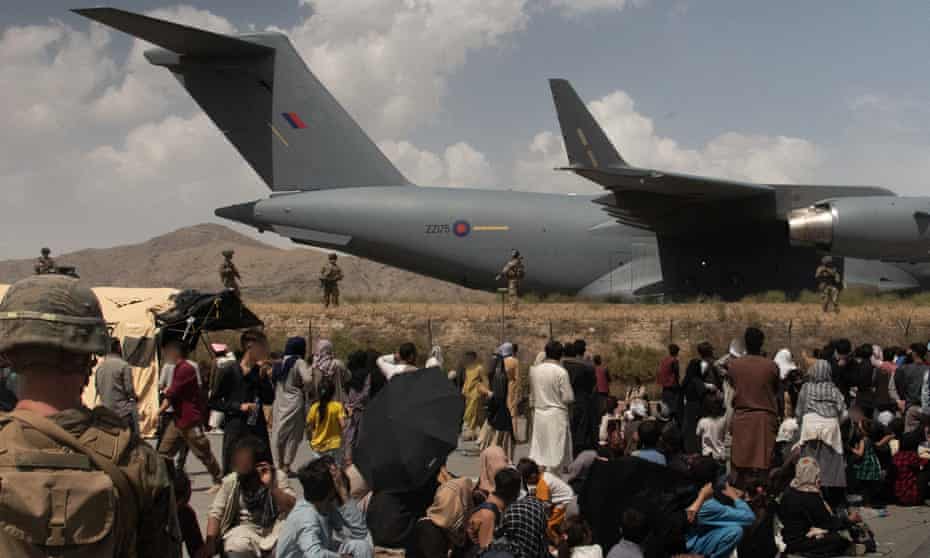
‘The “chaotic and arbitrary” Foreign Office response probably cost hundreds of people their chance to leave, and thus likely cost lives.’ 
Photograph: LPhot Ben Shread/MoD/Crown Copyright/PA

Editorial
Tue 24 May 2022

The excoriating parliamentary report on Britain’s handling of the withdrawal from Afghanistan is such a lengthy catalogue of failure that it is far quicker to say what was done well: there were heroic efforts by individuals, working under enormous pressure, to save lives. Unfortunately, as the inquiry by the Commons foreign affairs committee – chaired by the Conservative MP Tom Tugendhat – makes clear, they were utterly let down by both ministers and top officials. It describes the British withdrawal as a disaster and a betrayal, and is particularly damning about the evacuations.

Politicians and senior officials showed too little interest, were absent at key moments, took inadequate or misguided action and failed to record what they did. MPs found that the “chaotic and arbitrary” Foreign Office response probably cost hundreds of people their chance to leave, and thus is likely to have cost lives. Yet those who are to blame have utterly failed to take responsibility. Indeed, when challenged, the Foreign Office provided answers that “in our judgment, are at best intentionally evasive, and often deliberately misleading”.

The chaos in the days before and after the fall of Kabul to the Taliban on 15 August 2021 looked appalling enough at the time. The detail provided by Foreign Office whistleblowers and others shows it was worse. The government should have begun planning when the US withdrawal was announced in February 2020, instead of simply hoping the US might change course. What action it did take was late, inadequate and often incompetent. It was hopelessly slow in addressing the cases of Afghans who had worked for it, and failed to design a scheme to help others who had supported UK objectives until Kabul fell. Emails from desperate people went unread. Sensitive documents were left to fall into Taliban hands. Multiple senior officials believe that the prime minister played a role in the disgraceful decision to prioritise the case of the Nowzad animal charity. While Downing Street has denied that, the report notes that “we have yet to be offered a plausible alternative explanation”.

Dominic Raab, then foreign secretary, had a single one-to-one conversation with the British ambassador in Kabul in the two weeks before the city fell, as the Taliban advance accelerated. He – like the prime minister, the minister for Afghanistan, Lord Ahmad, and the Foreign Office’s permanent secretary, Sir Philip Barton – were still on holiday on 15 August. Though Sir Philip, like Mr Raab, has expressed regret for not returning sooner, his failure to come back until 26 August, the day the civilian evacuation ended, is – as the committee notes – impossible to excuse; it is right to call for his resignation. Mr Raab, demoted to justice secretary (with the consolation title of deputy prime minister), has surely proved himself unfit for high office.

Beyond holding those who failed accountable, three issues are paramount. First, as the human rights group Global Witness says, the failure continues; people are still waiting for visas and the criteria have been tightened to bar some of those originally told that they had valid claims. Second, those who have made it to the UK must be properly supported to make their home here; thousands of Afghans remain in temporary accommodation. Finally, Afghanistan is in desperate straits. Development as well as humanitarian aid is necessary, along with serious consideration of how to get the economy back on to its feet. Britain has failed Afghans appallingly. It must not continue to do so.


Foreign Office failures in Afghanistan evacuation was ‘betrayal’ of allies that cost lives, MPs warn

Foreign Affairs Committee gives damning assessment of Afghan withdrawal and calls for most senior Foreign Office civil servant to consider postition
Armed Forces personnel evacuated more than 15,000 people from Afghanistan in August 2021
 (Photo: Ben Shread/MoD/Crown Copyright/PA Wire)

By Richard Vaughan
May 24, 2022 

A failure of leadership shown by Dominic Raab and the most senior civil servants at the Foreign Office during the Afghanistan withdrawal was a “betrayal” to UK allies that cost lives, MPs have insisted.

In a scathing report into the handling of the UK’s evacuation from the region, the Foreign Affairs Committee condemned both ministerial and civil servant decision making and lack of planning that led to Afghans who had helped the British mission being left behind.

It also attacked the Whitehall department’s lack of transparency over who authorised the evacuation of dogs and cats owned by the Nowzad animal charity from Kabul, and urged the FCDO’s most senior civil servant, Sir Philip Barton, to consider resigning for his failure to ensure the department took the “basic administrative step of recording its decisions”.

The panel of cross-party MPs said they were forced to rely on information provided by whistleblowers about the mishandling of the evacuation, something the committee said should leave those who lead the department “ashamed”.

Dominic Raab Mr Raab refused to return from holiday at the time Kabul fell to the Taliban on 13 August 2021 
(Photo: Wiktor Szymanowicz/Anadolu Agency via Getty)

In particular, the report issues a brutal assessment of Mr Raab’s performance during the crisis, stating: “The absence of the FCDO’s top leadership—both ministerial and official—when Kabul fell is a grave indictment of the attitudes of the Government, representing a failure of leadership across the board in the Foreign Office.”

The report adds that failure to get a grip on the situation was a “betrayal of our allies”, which was “not only morally wrong, but has undermined the credibility of the UK with serious consequences for our interests around the world”.

Mr Raab, who was moved from the Foreign Office and appointed Justice Secretary and Deputy Prime Minister in the last reshuffle, has come under sustained criticism for refusing to return from holiday at the time Kabul fell to the Taliban on 13 August 2021.


Sir Philip, the Foreign Office’s most senior civil servant, also failed to return from his holiday until 26 August, nearly two weeks later and only after the civilian evacuation mission had been completed.

Difficulties getting people out of the country were compounded by a decision to remove UK consulate staff from Kabul leading to a 48-hour delay before replacements arrived.

The report states: “This mismanagement and under-resourcing of the evacuation effort in a crucial period likely cost hundreds of people their chance to leave the country, and as a result likely cost lives.”

Tory Chair of the Committee, Tom Tugendhat MP, said: “The UK’s part in this tragedy exposes a lack of seriousness in achieving co-ordination, a lack of clear decision-making, a lack of leadership and a lack of accountability.”

And he added: “The absence of the FCDO’s top leadership – ministerial and official – when Kabul fell is a grave indictment on those supposedly in charge. While junior officials demonstrated courage and integrity, chaotic and arbitrary decision-making runs through this inquiry. Sadly, it may have cost many people the chance to leave Afghanistan, putting lives in danger.”

A Government spokeswoman said: “We are still working hard to assist the people of Afghanistan, having already helped over 4,600 individuals to leave the country since the end of the military evacuation.

“We carried out a thorough review to learn lessons from our withdrawal from Afghanistan and have drawn on many of the findings in our response to the conflict in Ukraine including introducing new systems for managing correspondence and increasing senior oversight of our operational and diplomatic response.”


Statistical physics rejects theory of 'two Ukraines'

Statistical physics rejects theory of 'two Ukraines'
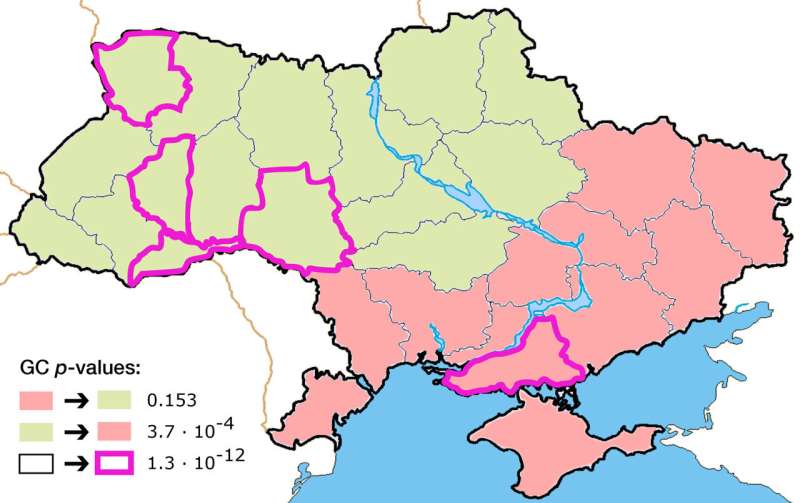
A map of Ukraine, with green and red regions marking pro-West and pro-Russian, but the
 purple outlined regions are more relevant to the war. Credit: Massimiliano Zanin and Johann H. Martínez

When reading news and analyses of the Russian invasion of Ukraine, researchers in Spain perceived many conflicting messages being transmitted. The most notable one is the theory of "two Ukraines" or the existence of ideologically pro-West and pro-Russian regions.

This doesn't match the unity of Ukrainians against the Russian invasion, so they wondered if they could provide any solid proof to support or reject such a theory via data analysis tools.

In the journal Chaos, Massimiliano Zanin and Johann Martínez, from Instituto de Fisica Interdisciplinar y Sistemas Complejos (Institute for Cross-Disciplinary Physics and Complex Systems), analyze a data set of violent events within Ukraine since January 2021 but prior to the invasion on February 24, 2022, by combining temporal and spatial correlations through entropy and complexity metrics with functional networks.

The key finding of their work is the theory of two Ukraines doesn't hold up against the data. Conflicts do exist within Ukraine but aren't ideologically west versus east. The researchers found these conflicts tend to form a complex network of interactions with no clear geographical boundaries.

"Contrary to Russian discourse, we have not seen any indication of an eastern part of Ukraine being harassed by a western part," said Zanin. "This should be taken into account toward a possible resolution. The data suggest a solution involving splitting the country would be artificial and not guarantee long-term stability and peace."

Statistical physics is a framework to analyze real  but it is often a daunting task to get access to relevant quantitative data about international events, aside from  such as Twitter. An increasing number of open intelligence communities, such as the Armed Conflict Location and Event Data Project, are beginning to change this.

"We use two techniques from  to analyze whether the appearance of violent events was independent or caused by others," said Zanin. "We developed this idea on two axes: time and space. Time is used to explore whether some events are responses or reactions to previous events. Space is used to understand whether what happened within one region was a consequence of events within other parts of the country."

As opposed to other fields, like engineering, obtaining reliable and high-quality data about social and political events is a major challenge.

"When working on this kind of data, it's also uncomfortable, because we'd like to have more events to support more complex analyses. But there are victims and deaths behind the data," said Zanin. "We wish this type of analysis wasn't necessary at all."New web-based app maps violence in Ukraine based on in-country news sources

More information: M. Zanin et al, Analyzing international events through the lens of statistical physics: The case of Ukraine, Chaos: An Interdisciplinary Journal of Nonlinear Science (2022). DOI: 10.1063/5.0091628

Journal information: Chaos 

Provided by American Institute of Physics 

Egypt's drummers beat away bad rap of tabla tunes


Five hundred people gathered to watch Tablet al-Sitt play at a recent concert in Cairo 
(AFP/Mohamed HOSSAM)

Nessrin Ali Ahmad
Tue, May 24, 2022, 7:30 PM·3 min read

Many Egyptians associate the tabla drum with belly dancers and seedy nightclubs but, despite its image problem, percussionists are giving the ancient instrument a new lease of life.

And it is often women who are now playing the goblet-shaped traditional drum, an early version of which has been found in the ancient temple of the Goddess Hathor in Qena, southern Egypt.

The beat of the tabla is ubiquitous, animating every Egyptian wedding, concert and impromptu dance party.

And yet professional tabla players have been associated with nightclubs, where they accompany the undulations of belly dancers, looked down on as figures of ill-repute by many Egyptians.


"The public's image of the tabla is very negative," said music expert Ahmed al-Maghraby. "People associate it with a lack of morals."

That is something the newcomers want to change.

"There's a new trend now: solo tabla concerts," said musician Mostafa Bakkar, who struggled with his own family's disapproval of his decision to become a tabla player and teacher.

"People find the environment shameful," he told AFP. "They make fun of me and ask, 'So where's the dancer?'"

- 'Music therapy' -

The quip has its roots in Egyptian popular culture.

The 1984 hit movie "Al Raqessa wal Tabal" (The Dancer and the Tabla Player) told the story of a percussionist whose career grinds to a halt after leaving his belly dancer partner to strike out on his own.

Bakkar, 30, who ties his dreadlocks back with a white bandana, said he also organises improvised drum-playing circles for amateurs.

"I pass out tablas to people around me and we play music in unison," he told AFP.

"It's a kind of group therapy," chimed in neuropsychologist Christine Yaacoub, a regular at Bakkar's drumming sessions.

"I saw how happy tabla can make people, so now I use it as music therapy with my patients," she said.

By practising percussion together, "we heighten our attention span", she explained, because the tabla allows people "to express themselves without speaking".

- 'Break the rules' -

Most professional tabla players have been men, but now more and more Egyptian women are taking up the ancient instrument, either professionally or as a hobby.

In 2016, tabla players Rania Omar and Donia Sami, one of whom is veiled, went viral on social media with a video that attracted a fair share of online hecklers but also an outpouring of support.

Encouraged, the duo went on to become the first all-woman tabla band in Egypt.

In 2019, 33-year-old Soha Mohammed joined them to create "Tablet al-Sitt" (The Woman's Tabla), "to give all women a chance to sing freely and play the tabla".

Mohammed has since been travelling with eight other percussionists across Egypt, treating audiences to new takes on traditional classics.

At a recent Cairo show under a bridge on the Nile's banks, 500 people gathered at the "Sawy Culture Wheel", singing and clapping along as Tablet al-Sitt played folk favourites.

For band member Rougina Nader, who at age 21 has spent 12 years playing the instrument, it was a long, difficult road to becoming a full-time percussionist.

"We upset men, because we're competition, and audiences love us," she told AFP. "There are obstacles, but that won't stop us from continuing to break the rules."

naa/sbh/bha/hc/fz
Tunisia's first LGBTQ play lifts curtain on hidden violence


Tunisia's first LGBTQ play lifts curtain on hidden violenceThe play aims to challenge "discriminatory" mentalities and campaign for an end to a "backward law", as well as promote queer art
 (AFP/FETHI BELAID)More

Kaouther Larbi
Tue, May 24, 2022

It's the first queer play to be staged in Tunisia -- director Essia Jaibi's latest work aims to challenge conservative attitudes in a country where same-sex acts are punishable by prison terms.

"Flagranti" (or "In the Act"), which premiered at a city-centre theatre in the capital at the weekend, deals with "a reality that we pretend not to see", Jaibi told AFP.

The work, co-produced by LGBTQ rights group Mawjoudin (translating to "we exist"), is played by six mostly amateur actors aged between 23 and 71, reflecting a decades-long struggle for gay rights in the North African country.

Infused with black humour, it tells the stories of people who have suffered violence at home, in the workplace and in public.

Tunisia is seen as relatively liberal on social issues compared with other Arab countries, but nevertheless imposes sentences of up to three years in prison for "sodomy" for both men and women.

The country saw a rise in public LGBTQ rights activism in the years following its 2011 revolution that kicked off the Arab Spring uprisings.

But despite years of efforts, rights groups say the community is still vulnerable, with as little as a photo on a telephone potentially leading to arrest, physical violence and anal examinations.

The notorious Article 230 of the penal code saw 59 people jailed between early 2020 and last October, according to Mawjoudin.

The play, inspired by real events, "talks about a taboo subject, a reality that in Tunisia we keep pretending not to see, which this show is trying to bring to the public's attention," Jaibi said.

Mawjoudin member Karam Aouini said the play aims to challenge "discriminatory" mentalities and campaign for an end to a "backward law", as well as promote queer art.

The NGO also organised Tunisia's first queer cinema festival in 2018.

- 'Historic moment' -

The two-hour play deals not only with LGBTQ issues, but also other problems facing all Tunisians: police and judicial corruption, impunity and the brain drain as people leave to seek better economic prospects in Europe and elsewhere.

When the play ended, the audience erupted into a storm of applause.

For audience member Alay Aridhi, 27, the event was "a historic moment" for Tunisia.

"Holding an event like this in an Arab, Muslim country isn't easy," he said. "It seems we can now tell these stories."

Salim, a 24-year-old member of the LGBTQ community, said the play had touched him deeply.

"I saw my life on the stage. It was overwhelming, I had a lump in my throat," he said.

Rights groups are continuing to campaign for an end to Article 230, first introduced by French colonial administrators in 1913.

But with parliament dissolved and the country in political turmoil after President Kais Saied's power grab last year, no such move is on the radar for now.

The United Nations Committee Against Torture has condemned Tunisia's use of anal tests.

The country in 2017 committed to ending the practice, but it has continued nonetheless.

In December, two men were found guilty of same-sex acts after they refused to undergo such examinations -- seen by judges as proof of their guilt.

The Tunisian president, whose July power grab allowed him to issue laws and seize control of the judiciary, has said he is opposed to jail terms based on sexual orientation -- but also to the full decriminalisation of homosexuality.

Actor Hamadi Bejaoui, who portrayed a doctor named Adam in the production, described it as a "harsh experience that shows a human being crushed".

But despite this, he remains determined.

"We will not back down. The fight continues!" he said.

kl/fka/par/jsa
India

Bulldozer is a Sign Hindutva is Flat

The author searches for meanings in the symbol of a bulldozer as they are unleashed on the streets of India to demolish all in their path.

Brahma Prakash
24 May 2022

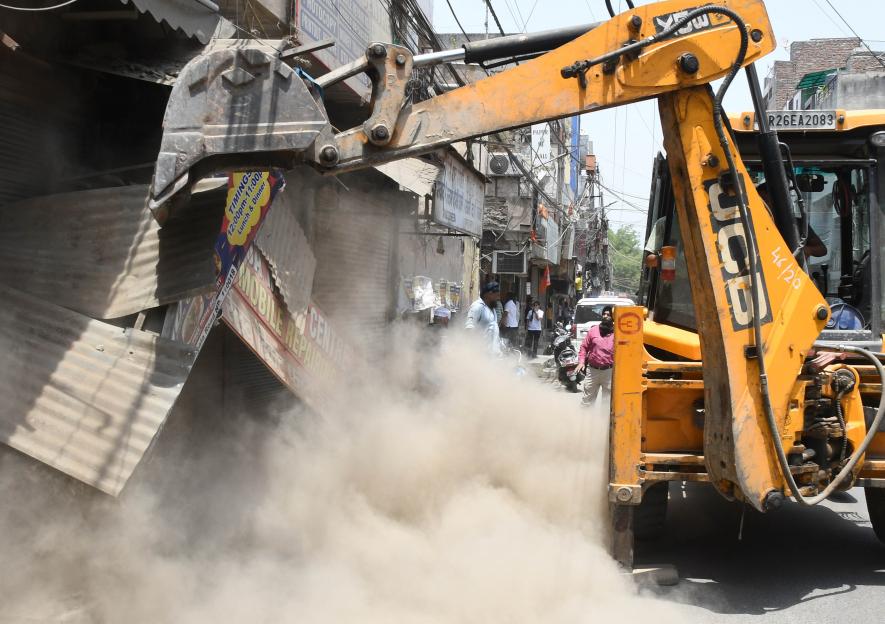
Image Courtesy: Tribune India

Like my ideologue, John Berger, I keep looking for a figurative image to understand the art and ideology of our time. For some time now, I have been searching for a complex definition of Hindutva: Its possible grey areas. Its coated meanings. Its teeth hidden in the tongue and belly like a bulldozer itself. I was looking for a figurative image that captures its dynamite power. Its unbridled emotions. Its automobility. I looked for a body and machine that captured its muscle and movement. Its muscular politics.

I was trying to understand the electric power of Hindutva that makes the words viral and puts the body in a trance. Perhaps an installation work of Hindutva that instils the fear of aligning aesthetics and anaesthesia together. I was looking for an artefact. An object that has cultic and exhibitory values but can equally cut the body like the swords of the Ram Navami procession. I was looking for an image that brings artillery and artefact together. Music and terror together. Slogan and silence together. Fun and violence together. I was looking for a toy of Hindutva that steals the love and instils the violence in children’s minds, like the toy gun culture of the US empire. I was looking for the object that rolls all these things together in one bundle like a bulldozer itself.

The figurative image for the Hindutva that I have found is that of a bulldozer—moving and bulldozing. It was open, out there, in body and spirit, politics and procession, sign and sensation, mobs and automobility, manhood and machinehood. It is a device that becomes biopolitical as well as geopolitical in its domination. It moves to demolish; it moves to displace; it moves to dominate. It moves to decimate. It moves to dismiss any prospect of dialogue. It moves to move the earth where one stands. It moves to create a new site for the settlers at the expense of the livelihood of the others.

In India, the bulldozer does not remain a machine. It has become an artefact now. It has entered the popular psyche. There is a massive demand for bulldozers. People are offering it as wedding and birthday gifts. There is massive demand for bulldozer toys. A report says bulldozer pichkaris sold like cakes in Banaras during Holi. There are popular songs and music tracks dedicated to the device. The media is full of news and views of it. Leaders are trying to name themselves after it—bulldozer baba, bulldozer mama, brother bulldozer, and so on. Bulldozer is a new bull of Indian politics. In a medicine shop in Bihar, a young man was asking for a bulldozer (condom). I checked. In fact, there is a JCB condom. Its promotion says, “It restores the confidence and relieves you of the inferiority complex.” Clearly, the bulldozer is a sign of the insecurity of Hindutva masculinity.

FLATNESS OF HINDUTVA

I soon realised that Hindutva doesn’t hold complexity. It simply cannot. It is not interested in complex seeing. Perhaps we do not need a complex definition for Hindutva. Bulldozer is a sign that Hindutva is flat. It wants to excavate everything; the soil that nurtures the soul, the food that nourishes the body, and the home that gives us a sense of belonging. It wants to dig out everything. It plans to smoothen out history. It wants to cut down the raising hands. It wants to roll down the raising heads. It wants to make everything flat and transparent, going with the agenda of neo-liberal politics. For Hindutva, everything is an exhibition, from faith and religion to nationalism. It is a remarkable show of politics on a spectacular level. How will we know unless you show? It is a neo-liberal formation of Hinduism in destructive form. Some say the bulldozer brings development.

Of course, there is a difference between Hinduism and Hindutva. But not in the way the liberals want to show us; Hinduism is good, Hindutva is bad. The differences lie in the ways they disclose themselves. Hinduism maintains pretensions, Hindutva is flat. One is ceremonial, the other is a show. When it comes to caste hierarchy, let us be brutes; if Hinduism is cunning, Hindutva is crude. What Hinduism does with its’ accommodating ideology’, Hindutva does it by othering! What lower castes were to Hinduism, Muslims are to the Hindutva. One maintains its ideology through hegemony; the other wants to maintain it by brute force symbolised by the bulldozer. Hate remains the common, and so the hierarchy.

One cannot hide by saying Hindutva is dangerous for Hinduism. In fact, Hindutva has given a new lease of life to Hinduism, which was facing a crisis from its lower castes. Check the geography. Hinduism has expanded its territory. The expansion becomes only possible through the ideology of Hindutva. The Hindutva of today is the Hinduism of tomorrow. What we are facing is the normalisation of Hindutva ideology as Hinduism. Hindutva is a general manifestation of Hinduism in a neo-liberal regime. We can say that Hindutva is not an aberration. It is the religion in its true Sanatani sense.

One cannot hide by saying Hindutva is inspired by western ideology; it has its Indian roots too. Did we forget its history: how dissenters were punished, women were burnt, and Buddhism was crushed in its own land? What we are witnessing is new but not so new. Do we believe that the hatred we see today was made in seven or ten years? It has been accumulating for years and is outpouring now. It has found its opportune time and moment.

The bulldozer is a sign that Hindutva is flat! Made of iron, its heart is flattened, and its eyes are flattening. It sees nothing. It hears nothing. It wants to make everything flat. It believes in the uniformity of all. The most insidious thing Hindutva does with life and culture is make everything flat. It sees things in black and white—you are a Hindu or a Muslim. You are nationals or anti-nationals. You are with Us or against Us. Its art, rhetoric, epics and sculptures typically follow and fall on this line. It makes everything flat. Have you seen the Bollywood movie? The Kashmir Files? In the movie, politics falls flat, and so does difference, without addressing the gaps. See the sheer flatness of the Statue of Unity, the world’s tallest monument, standing in front of the Narmada; it is spectacular. It asks for the gaze but does not unveil. It does not gape. It remains straight. Nothing is better than a bulldozer to represent this art of Hindutva. Flat. Brute. Massive. A spectacular machine. It does not hide anything. It does not have revealing power. Flatness becomes its clarion call. The art of bulldozer has a flatness of aesthetics. It reminds us of futurism—the art of the fascists.

If Hinduism is represented by the figure of a Brahmin with a ponytail, Hindutva reminds me of the figure of Brahmarakshas. In many folk narratives, the figure is shown as a huge but mean figure. It is a scary figure with horns and tentacles on his head and a ponytail. He hangs upside down on a tree. Like a bulldozer, the figure has a swishing tail, carnivore teeth and sharp nails. Despite their differences, Brahmins, Brahmarakshas and bulldozers keep looking for sacrifices. Sometimes they capture the mind. Sometimes they rip apart the body; sometimes, they rip apart the land.

BULLDOZER, TOO, HAS A HISTORY


The deployment of bulldozers against the minorities might be new in India, but it has a long genocidal history. Before the bulldozer came into the world, ‘bulldozer’ was the term deployed to intimidate Black people in parts of the United States. Bulldozing was used to describe intimidation by violent and unlawful means. The lawlessness of the bulldozer is not new, nor is the violence inscribed in the term. In the United States of the 1870s, the term “bulldose” was used for administering a large and efficient dose of any medicine or punishment.

The first recorded use of the term goes back to 1876, when its meaning and chilling effect were there but not yet the machine. Ahead of the US presidential election of 1876, Black American voters were on the receiving end of severe beatings and lashings for participating in their rights in the form of “bulldose”—“a dose fit for a bull”. They would be thrashed, whipped and often lynched. “Many were bulldosed into silence,” writes Andy Hollandbeck in In a Word: The Racist Origins of ‘Bulldozer’. He also writes that bulldozing got a clear meaning, ‘to coerce or restrain by use of force’. The invention of the massive machine made the term more concrete. Bulldozer brought the figurative image of its powerful meaning: using brute force.

The arrival of the bulldozer in India is not a coincidence; it symbolises the ideology of the time. The bulldozer does not move much, but it marks the genocidal connection beyond geographical boundaries. It was there against the Blacks in the United States. It is there in China against the minorities. It is used in Palestine by Israeli authorities. It has been at the centre of indigenous and ethnic displacement across the world. In this regard, Pranay Samajula writes, “The fact that bulldozers have cropped up in both India and Israel as a chilling symbol of state repression itself is common to both cases: in both India and Israel, the far-right regimes that govern the two countries share a common vision of an ethnic-majoritarian apartheid state, and willing to go to extreme lengths to realise that vision.”


Long before the demolitions and displacements in Delhi and Madhya Pradesh, Israeli authorities deployed it against Palestinians in massive ways. The machine came, carrying legacy and meaning, and so did the chilling memories and effect. What is this connection between unknown territories? We are not sure if Indian authorities have learnt from white or Jewish supremacists, but their genocidal connection is clear. Their bulldozing connection is clear. So clear is its brutality of power and the flatness of its aesthetics.

Brahma Prakash is Assistant Professor of Theatre and Performance Studies at the School of Arts and Aesthetics, Jawaharlal Nehru University, New Delhi. The views are personal.

How Small Farms Are Reclaiming Culture in Palestine
Palestinians are organising Community-Supported Agriculture programmes and small farms to become food sovereign and protect their culture against colonialism.

April M. Short
24 May 2022


LONG READ


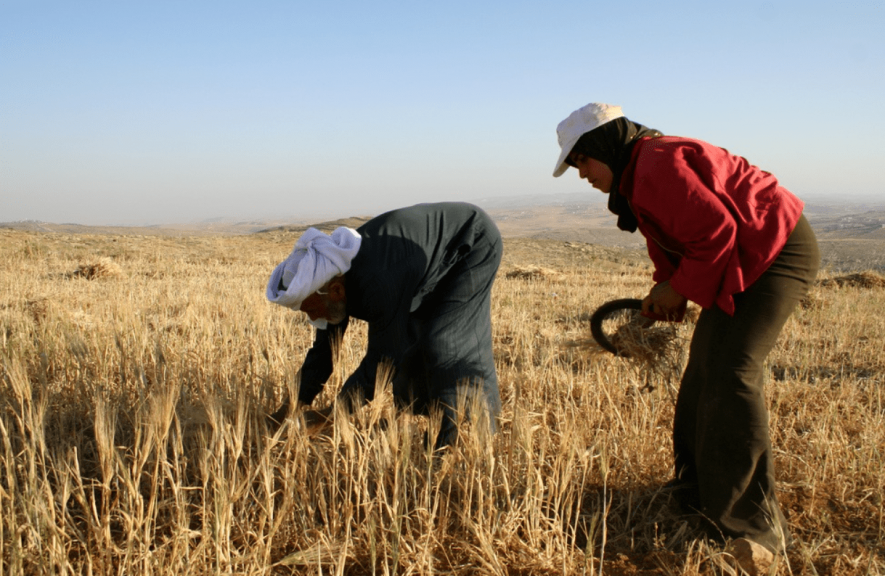
Food sovereignty is an urgent issue in communities around the world, especially since the COVID-19 pandemic led to further disruptions in the already fragile global food supply chains. In Palestine, where traditional farming has been a way of life for millennia (and perhaps where farming began, according to historians), connections with land and food sovereignty are intrinsic to cultural identity.

Palestinian people’s access to land and food has been seriously strained since long before the pandemic due to Israel’s policies and practices directed toward Palestine, and the pandemic’s recent impacts on global food systems have heightened existing food insecurity issues in the region. Small farmers around the world have faced struggles for years, but as a Washington Post article put it in 2017, “Palestinian farmers really have it rough.”

“In a century of Palestinian struggle against colonialism, land, in all of its forms and meanings, has constituted the ethos of our struggle and culture,” said Soheir Asaad in a recent webinar held in honour of Palestinian Land Day that Palestinians commemorate on March 30 every year. Asaad works as an advocacy team member for the Rawa Fund that supports local, community-led solutions to the issues Palestinians face. She was the moderator of a free online webinar on April 5 titled, Blossoming in Palestine: Community Organizing Around Land.

“The Zionist dispossession of our land, theft of natural resources, and ethnic cleansing have been part and parcel of a systematic, holistic targeting of the very existence of a Palestinian society,” she said during the webinar.

An article by Carly Graf published by the Pulitzer Center in 2019 opens with the story of a 60-year-old Palestinian woman who has lived in her family farm home in Burin, a village in the West Bank, her entire life, subsisting on the family’s heirloom olive harvests. She awakens one morning in May 2019 to see smoke rising some distance away and finds her olive orchards burning to the ground. There was nothing she could do but cry, as her land had been “swallowed” as part of Israel’s expansion of its nearby Yitzhar settlement in the 1980s. She can no longer “access this property freely.” As the article explains, this scene is familiar to Palestinians in the West Bank:

“In the name of security, Israel systematically removes… [Palestinian families] from the land and erases their historic rootedness to this geographic place. For Palestinians, food and agriculture are not merely a pastime; they are a way of life. Without it, they’re rendered powerless economically, voiceless politically and devoid of their own cultural legacy. Yet that’s exactly why a sovereign and self-supporting food system is an early target of Israel.”

Asaad said in the webinar that land continues to be central to Palestine’s “deeply rooted culture,” and in recent years “we not only witness the Israeli attempts and policies to control Palestinian lands, to forcibly displace Palestinians; we’ve also seen an escalation in targeting those who organise around land.”

Community-led initiatives related to land and food justice in Palestine today are aimed at reconnecting people with the land and encouraging them to economically support locally grown food. These efforts seek to support food sovereignty and strengthen cultural roots through community-led food and agroecology projects in response to the degradation of land, culture and ways of life, and the widespread displacement of Palestinians on the part of Israel.

During the webinar, a panel of four speakers—Yara Dowani, Lina Ismail, Jamal Juma’a and George Korzom—discussed practices and models of land reclamation and strategies for political organising against settler aggression and colonialism via agriculture and agroecology.

First to speak on the panel was Dowani, a farmer, activist and researcher who has been managing Om Sleiman (meaning “ladybug”) Farm, an agricultural cooperative in the West Bank, for four years. Dowani spoke about the challenges that come with operating a small local farm and attempting to address food access and food sovereignty in the West Bank.

The farm, she explained, started as a community-supported agriculture programme (CSA), connecting farmers directly with consumers by allowing people to subscribe to a harvest and have baskets of food delivered directly from the farm. She said that Om Sleiman also works to educate people through workshops and courses about natural farming techniques.

Dowani said the project of Om Sleiman Farm is focused on regenerating the land of the farm as well, which is particularly rocky and dry to work with—but represents a culturally symbolic location close to an Israeli settlement. This land, she said, was “liberated by the Palestinians from the village.”

Small community-led agricultural initiatives like Om Sleiman are particularly significant in Palestine as Israel continues to expand its settlement efforts in a region that has traditionally been the “food basket” of Palestine, known as Area C in the West Bank. Palestinian farms in the region have been shrinking and disappearing for decades, due to tactics of intimidation as well as direct destruction by Israeli forces, as the panelists explained in the webinar.

Asaad said in the webinar that in recent years Israeli policies have gone beyond controlling Palestinian lands and forcibly displacing people. They have also been targeting organisers, particularly popular organizing around land initiatives and farming. “We’ve seen violence and specific targeting of land initiatives, popular organizing around land, organizing with farmers, especially in Area C in the West Bank.”

She mentioned an Israeli internal report, titled “The Palestinian Campaign for Area C: Shaping a Security Reality on the Ground,” dated June 7, 2021, which she said discusses “how to better annex Area C and ‘control’ the Palestinian invasion.” She said the report “indicated clearly that some of the targets are Palestinian organisations and organisers working under the pretext of ‘terrorism,’ but the reason is very clearly to push forward the plan of annexation.”

Jamal Juma’a, co-founder of various civil society organisations and movements such as the Palestinian Agriculture Relief Committee (PARC), the Palestinian Environmental NGOs Network and Stop the Wall, said in the webinar that Palestinian farmers and agricultural organisers are currently being targeted because their lands are located in a resource-rich zone that Israel would like to control.

“These communities—pastoral settlements and outposts—are located where the resources are, so for Israel’s project of settlement they are the main obstacle,” he said, noting that every week he hears cases of sheep and cows being attacked on farms or killed by projects to erect Israeli structures.

“The Israeli project is not just a military occupation and the violence that comes along with it,” Juma’a said in the webinar. “It is a permanent ethnonational and settler colonial system that’s deeply rooted in the Zionist ideology and practices that aim at establishing an exclusive Jewish state, from the river to the sea. That’s where all the Israeli policies started, from [1948] up to now.”

He said in the webinar that Israeli forces will often conduct military exercises on or close to farms and plantations operated by Palestinian Bedouin, which force entire communities to leave, and crops and livestock are destroyed in the process. He explained that farmers and agricultural organizations are also regularly labeled as terrorist groups in order to justify Israel’s settlement expansion plans, and these practices are often designed to intimidate farmers out of organising for better legal and economic protections, or pressure them to leave their lands, he said.

“What we see today in the West Bank is an apartheid colonial system,” he said. “I’m talking mainly about Area C, which is 62% of the West Bank where most of the Palestinian resources are located, which is under full Israeli control.”

Juma’a explained in the webinar that the development policies in the area have focused “first on obstructing Palestinian development of Area C by military orders, which bar Palestinians from registering land, forbid them from building, forbid local and district planning committees and councils from working properly. They deprive the Bedouin communities from having any infrastructures like roads, health clinics, schools, water networks, etc.”

He noted that, meanwhile, Israel has been building its own settlements and highway infrastructure, “while confiscating land and destroying Palestinian houses.” And, he said, the situation has been escalating since 2020.

“If the situation continues like this on the ground, we will have a serious problem of food security, because we are talking about the food basket of the West Bank, from livestock and agriculture,” Juma’a said.

Lina Ismail, a researcher and environmental activist who works as the community programs officer in the community-based Dalia Association spoke in the webinar about ways for people in Palestine to better support the local economy and help move away from extractive capitalist structures, including following ethical consumers guides.

“To add to what… Juma’a mentioned, when we look at the lifestyle in Palestine, it is shifting toward more consumerism and more individualistic way of life,” she said, noting that colonization and the increasingly globalised world are major factors at play in this shift. “We are shifting our lifestyle patterns. This is coupled with of course the international, conditional aid system,” she said, noting that the influx of aid at certain times all at once has created a dependency on aid projects in Palestine, and “a sense that we are not able to do anything on our own.”

“With regard to agricultural projects, many new agricultural projects came with this kind of mindset,” she said. “Big agriculture, big spaces planted with monoculture imported seeds and chemicals, destroyed our traditional way of farming and disrupted our relationship to the land. In a sense, it commodified the land. It became commercial.”

She noted that discussions of economic empowerment in Palestine have often come from a “very specific lens” that does not consider the colonial context Palestinians live in, nor “the emancipatory vision we aspire to.”

She said what Dalia Association means by “food sovereignty” is, “the right of peoples to healthy and culturally appropriate food, produced in ecologically sound and sustainable methods, and their right to define their own agricultural and food systems,” she said. “It’s also about our right to reclaim our own way of agriculture… When talking about the liberation of Palestine we talk about the basic sources of existence, and one of them is the production of food. When we are deprived of that, we cannot be thinking of emancipation or liberation.”

Ismail emphasised the importance of creating food sovereignty in Palestine, and referenced a 2021 report by Abdalaziz Al-Salehi, published by the Dalia Association, titled “Palestinian National Food Sovereignty in Light of the Colonial Context.” The report discusses “the reality of agriculture and food production in occupied Palestine” and “the importance of supporting smallholder farmers who constitute over 75.3% of total holdings in order to face the Israeli occupation’s policies that include land confiscation and use of resources.” Near the end, the report also includes a list of “Practical Techniques to Achieve the Principle of Food Sovereignty.”

Ismail said the work she and her organisation have been doing is talking to farmers about creating “linkages between partner farmers and consumers,” such as CSA, and producing the research materials that talk about agroecology, the use of local resources, local inputs and local seeds, natural material, “and how this regains our autonomy over the land and also our independent way of food production.”

“There is a growing movement [of local cooperatives and agricultural initiatives], and we are documenting it,” she said. “Many are refusing this kind of idea or not seeing that it is already present. It is happening on the ground, and more and more youth and women are entering this movement. But what’s needed now is to consolidate these efforts… and what we are doing is organizing field visits supporting these kinds of initiatives and getting to know each other informally rather than only formally and through organisations. This network is spreading.”

She mentioned the 2021 documentary Untold Revolution about the growing movement of agroecology in Palestine, which is directed by filmmaker Ameen Nayfeh and produced by the Dalia Association in partnership with the Heinrich Böll Foundation.

Asaad said often when talking about the economy in Palestine, people focus on efforts to boycott Israel. In a question to George Korzom, she asked how people might expand the discussion to focus on local initiatives that do exist and “economic models that strengthen the resilience of people, particularly at a revolutionary moment and turning point as we’ve seen last year [in 2021], and the question of solidarity and popular protection.”

Korzom is director of the research and environmental media programme at MA’AN Development Center. He spoke to the idea of localised initiatives—like Om Sleiman Farm, CSA programmes and efforts toward localizing the economy—as part of an emancipatory political process.

“Within that resistance production strategy we can always encourage our relatives, our friends in different areas to go and buy vegetables and fruits directly from young Palestinian farmers and support their organic fields and their agroecological initiatives,” Korzom said in Arabic, through a translator, noting that a number of young farmers are setting up networks to sell their products in different towns and shops. He said in recent years small cooperative efforts in Palestine have been growing to support young local farmers, including CSA programs in various towns.

He noted that community contributions to cooperative farming efforts do not necessarily need to be financial.

“For example, the consumer can volunteer time working on the project, planting or harvesting,” he said, noting that the popularly supported and subsidized model is a way to strengthen small-scale, organic farming and move the economy away from large supermarkets and back to local people.

“This process replaces the chain of supermarkets and the high cost of packaging and transportation and marketing, and supports small farmers by giving them more independence away from the greedy traders and their businesses and companies, and thus provides consumers with healthy, organic products of high quality,” Korzom said. “So this a qualitative change and shift in our production and consumption patterns toward establishing an economy that is resistant in nature. And this is the responsibility primarily of youth who are the main driver and engine for revolutions and revolts throughout Palestinian history.”

He said youth are already spearheading efforts to move to cooperative farming models that resist chemicals and help reconnect with land.

In the webinar, Juma’a spoke about how small-scale initiatives like CSAs and support for local economy might add up to support those who struggle against land confiscation displacement. He emphasised the need for a larger movement of organising for farmers, and policies that protect farmers’ rights in Palestine.

Unfortunately, he said, there is a “bigger problem” Palestinian farmers are facing that needs to be solved at a higher level, “to stop this deterioration.” He said “serious efforts to organise farmers movements to stand up and fight for their rights” are necessary in order to confront the impacts of colonization on Palestinian life.

Juma’a called for a popular movement led by farmers organisations, in order to force the support of the Palestinian Authority, get the attention of the international community, and begin to hold Israel accountable for its treatment of Palestinian farmers.

“The land is shrinking and livestock numbers are dropping dramatically,” he said. “Shortages of water for cultivation and drinking is a serious problem. Agriculture workers and families’ initiatives are very important… in order to sustain agriculture in getting back to the roots… Our fathers and grandfathers and families used to work on the land, so it’s important to regain this knowledge and regain this way of cultivation."

April M. Short is an editor, journalist and documentary editor and producer. She is a writing fellow at Local Peace Economy, a project of the Independent Media Institute. Previously, she served as a managing editor at AlterNet as well as an award-winning senior staff writer for Santa Cruz, California’s weekly newspaper.

This article was produced by Local Peace Economy, a project of the Independent Media Institute.