Tuesday, May 24, 2022

ITUC’s Gender-transformative Agenda For Recovery And Resilience

The International Trade Union Confederation has published the outcomes of the 4th ITUC World Women’s Conference that will act as a “milestone” for future work and a blueprint for unions to drive change.

The document contains concrete recommendations to build recovery and resilience with a new social contract grounded in equality and equity, including:

  • a commitment to 50% representation of women on the decision-making bodies of all ITUC affiliates by the time of the 6th ITUC World Congress;
  • the adoption of pro-employment and gender-responsive macroeconomic frameworks, including fiscal, monetary, industrial, sectoral and inclusive labour market policies;
  • the implementation of comprehensive care economy frameworks, such as rewards for all care work and representation of care workers through collective bargaining and social dialogue;
  • an intersectional approach to the universal ratification and implementation of C190 and R206 – for the right of everyone to a world of work free from violence and harassment, including gender-based violence;
  • equal pay and anti-discrimination legislation, quotas and/or initiatives to train, recruit and retain women in under-represented sectors and jobs;
  • specific policies to close the gender gap in social protection;
  • gender-transformative just transition plans, including public investments in the care economy, green infrastructure and access for women to STEM-related education and jobs; and
  • free and quality education as a prerequisite to lifelong learning.
  • ITUC General Secretary Sharan Burrow said: “This is a milestone that will inform debates at the 5th ITUC World Congress and our future engagement in making equality and equity a reality for all working people.

“We all need to use this document and its recommendations with our leadership and governments to influence and drive change around these priority areas.

“I look forward to seeing what we can achieve as we build this transformative agenda set out by the 4th ITUC World Women’s Conference.”

© Scoop Media

MORE GOOD NEWS FROM DAVOS
Ukraine invasion may be start of ‘third world war’, says George Soros

Veteran philanthropist tells World Economic Forum civilisation ‘may not survive’ what is coming


01:23'Our civilisation may not survive' Ukraine invasion, says George Soros – video


Larry Elliott
THE GUARDIAN
Economics editor
Tue 24 May 2022 


Russia’s invasion of Ukraine threatens to be the “beginning of the third world war” that could spell the end of civilisation, the veteran philanthropist and former financier George Soros has warned.

In a ferocious attack on Vladimir Putin and China’s Xi Jinping at the World Economic Forum in Davos, Soros warned that autocratic regimes were in the ascendant and the global economy was heading for a depression.

Soros, who has become a hate figure for the hard right in the US, also heavily criticised the former German chancellor Angela Merkel for cosying up to Moscow and Beijing.

With the mood in Davos already downbeat due to the war in Ukraine, Soros ramped up the gloomy rhetoric to new heights.

“The invasion may have been the beginning of the third world war and our civilisation may not survive it,” he said.

“The invasion of Ukraine didn’t come out of the blue. The world has been increasingly engaged in a struggle between two systems of governance that are diametrically opposed to each other: open society and closed society.”

The 91-year-old former hedge fund owner said the tide had started to turn against open societies in the aftermath of the 9/11 terrorist attacks on the US in 2001. “Repressive regimes are now in the ascendant and open societies are under siege. Today China and Russia present the greatest threat to open society.”

Soros, who led the speculative financial attack that drove the pound out of the European exchange rate mechanism 30 years ago, said Europe had responded well to the crisis triggered by Russia’s invasion.

“It will take a long time to work out the details, but Europe seems to be moving in the right direction. It has responded to the invasion of Ukraine with greater speed, unity and vigour than ever before in its history.”

He added: “But Europe’s dependence on Russian fossil fuels remains excessive, due largely to the mercantilist policies pursued by former chancellor Angela Merkel. She had made special deals with Russia for the supply of gas and made China Germany’s largest export market. That made Germany the best performing economy in Europe but now there is a heavy price to pay. Germany’s economy needs to be reoriented. And that will take a long time.”

Soros said Putin had won Xi’s agreement to the Russian invasion at the opening of the Beijing Winter Olympics in early February. But he insisted the Chinese leader was not as strong as he believed.

“Xi harbours a guilty secret. He never told the Chinese people that they had been inoculated with a vaccine that was designed for the original Wuhan variant and offers very little protection against new variants.”

Soros said Xi was unable to “come clean” because he was at a delicate moment in his career. “His second term in office expires in the fall of 2022 and he wants to be appointed to an unprecedented third term, eventually making him ruler for life.”

China’s lockdowns to combat Covid-19 had pushed the economy into freefall but Xi was unable to admit he had made a mistake, he said.

“Coming on top of the real estate crisis the damage will be so great that it will affect the global economy. With the disruption of supply chains, global inflation is liable to turn into global depression.”
Sign up to the daily Business Today email or follow Guardian Business on Twitter at @BusinessDesk

Contrary to general expectations, Xi may not get his coveted third term because of the mistakes he had made, Soros predicted.

“While the war rages, the fight against climate change has to take second place. Yet the experts tell us that we have already fallen far behind, and climate change is on the verge of becoming irreversible. That could be the end of our civilisation.

“Therefore, we must mobilise all our resources to bring the war to an early end. The best and perhaps only way to preserve our civilisation is to defeat Putin as soon as possible. That’s the bottom line.”

ALBA-TCP Summit To Be Held in Havana on May 27

President Nicolas Maduro (C) and other Latin American presidents at the 20th ALBA-TCP summit, Havana, Cuba, 2021. | Photo: Twitter/ @periodicocubanoPrevious

Published 24 May 2022 

This regional integration block was born in 2004 with the signing of a "Joint Declaration" by Hugo Chavez and Fidel Castro.

The 21st Summit of the Bolivarian Alternative for the Peoples of Our America - People's Trade Agreement (ALBA-TCP) will meet on Friday in Havana, Cuba.

RELATED:
ALBA-TCP Condemns Killing of Palestinian Journalist by Israel

On Tuesday, the Cuban Ministry of Foreign Affairs (MINREX) announced the date of the meeting of the members of this Latin American and Caribbean integration platform.

“The nations that make up our Alliance will share common development strategies and analyze the regional political situation,” the MINREX tweeted.

This meeting will have special importance since it will be held before the 2022 Summit of the Americas in Los Angeles, where Cuba, Venezuela, and Nicaragua will not be present because they were not invited by President Joe Biden's administration.

The ALBA-TCP, which brings together ten member states and three invited countries, held its 20th summit in December 2021 in Havana.


This regional integration block was born in 2004 in Havana with the signing of the "Joint Declaration and the Agreement for the Application of ALBA" by Venezuela's President Hugo Chavez, and the President of the Council of State of Cuba, Fidel Castro.

ALBA-TCP emerged as an alternative to the Free Trade Agreement of the Americas (FTAA) promoted by the United States at the beginning of the century. Its founding members were Cuba and Venezuela (2004).

Later, they were joined by Bolivia (2006), Nicaragua (2007), Dominica (2008), Antigua & Barbuda (2009), Saint Vincent & the Grenadines (2009), Saint Kitts & Nevis, and Grenada (2014). Ecuador and Honduras withdrew from the Alliance when those countries were led by right-wing governments.

Obama’s Handshake With Raúl Castro Shows the Way for Biden’s Summit of the Americas

By: teleSUR/MS

Raul Castro and Barack Obama | Photo: Codepink

Published 18 May 2022

Biden should invite all the nations of the region to the summit and shake the hands of every head of state to foster better dialogue and a brighter future for the hemisphere.

By Medea Benjamin
CODEPINK

On May 16, the Biden administration announced new measures to “increase support for the Cuban people.” They included easing travel restrictions and helping Cuban-Americans support and connect with their families. They mark a step forward but a baby step, given that most U.S. sanctions on Cuba remain in place. Also in place is a ridiculous Biden administration policy of trying to isolate Cuba, as well as Nicaragua and Venezuela, from the rest of the hemisphere by excluding them from the upcoming Summit of the Americas that will take place in June in Los Angeles.

This is the first time since its inaugural gathering in 1994 that the event, which is held every three years, will take place on U.S. soil. But rather than bringing the Western Hemisphere together, the Biden administration seems intent on pulling it apart by threatening to exclude three nations that are certainly part of the Americas.

For months, the Biden administration has been hinting that these governments would be excluded. So far, they have not been invited to any of the preparatory meetings and the Summit itself is now less than a month away. While former White House press secretary Jen Psaki and State Department spokesman Ned Price have repeated that “no decisions” have been made, Assistant Secretary of State Brian Nichols said in an interview on Colombian TV that countries that “do not respect democracy are not going to receive invitations.”

Biden’s plan to pick and choose which countries can attend the Summit has set off regional fireworks. Unlike in the past, when the U.S. had an easier time imposing its will on Latin America, nowadays there is a fierce sense of independence, especially with a resurgence of progressive governments. Another factor is China. While the U.S. still has a major economic presence, China has surpassed the U.S. as the number one trading partner, giving Latin American countries more freedom to defy the United States or at least stake out a middle ground between the two superpowers.

The hemispheric reaction to the exclusion of three regional states is a reflection of that independence, even among small Caribbean nations. In fact, the first words of defiance came from members of the 15-nation Caribbean Community, or Caricom, which threatened to boycott the Summit. Then came regional heavyweight, Mexican President Manuel López Obrador, who stunned and delighted people around the continent when he announced that, if all countries were not invited, he would not attend. The presidents of Bolivia and Honduras soon followed with similar statements.

The Biden administration has put itself in a bind. Either it backs down and issues the invitations, tossing red meat to right-wing U.S. politicians like Senator Marco Rubio for being “soft on communism,” or it stands firm and risks sinking the Summit and U.S. influence in the region.

Biden’s failure at regional diplomacy is all the more inexplicable given the lesson he should have learned as vice president when Barack Obama faced a similar dilemma.

That was 2015, when, after two decades of excluding Cuba from these Summits, the countries of the region put down their collective feet and demanded that Cuba be invited. Obama had to decide whether to skip the meeting and lose influence in Latin America, or go and contend with the domestic fallout. He decided to go.

I remember that Summit vividly because I was among the bevy of journalists jostling to get a front seat when President Barack Obama would be forced to greet Cuba’s President Raúl Castro, who came into power after his brother Fidel Castro stepped down. The momentous handshake, the first contact between leaders of the two countries in decades, was the high point of the summit.

Obama was not only obligated to shake Castro’s hand, he also had to listen to a long history lesson. Raúl Castro’s speech was a no-holds-barred recounting of past U.S. attacks on Cuba—including the 1901 Platt Amendment that made Cuba a virtual U.S. protectorate, U.S. support for Cuban dictator Fulgencio Batista in the 1950s, the disastrous 1961 Bay of Pigs invasion and the scandalous U.S. prison in Guantanamo. But Castro was also gracious to President Obama, saying he was not to blame for this legacy and calling him an “honest man” of humble origins.

The meeting marked a new era between the U.S. and Cuba, as the two nations began to normalize relations. It was a win-win, with more trade, more cultural exchanges, more resources for the Cuban people, and fewer Cubans migrating to the United States. The handshake led to an actual visit by Obama to Havana, a trip so memorable that it still brings big smiles to the faces of Cubans on the island.

Then came Donald Trump, who skipped the next Summit of the Americas and imposed draconian new sanctions that left the Cuban economy in tatters, especially once COVID hit and dried up the tourist industry.

Until recently, Biden has been following Trump’s slash-and-burn policies that have led to tremendous shortages and a new migration crisis, instead of reverting to Obama’s win-win policy of engagement. The May 16 measures to expand flights to Cuba and resume family reunifications are helpful, but not enough to mark a real change in policy—especially if Biden insists on making the Summit a “limited-invite only.”

Biden needs to move quickly. He should invite all the nations of the Americas to the Summit. He should shake the hands of every head of state and, more importantly, engage in serious discussions on burning hemispheric issues such as the brutal economic recession caused by the pandemic, climate change that is affecting food supplies, and the terrifying gun violence–all of which are fueling the migration crisis. Otherwise, Biden’s #RoadtotheSummit, which is the Summit’s twitter handle, will only lead to a dead end.

Medea Benjamin is the co-founder of the peace group CODEPINK. She is the author of ten books, including three books on Cuba—No Free Lunch: Food and Revolution in Cuba, The Greening of the Revolution, and Talking About Revolution. She is a member of the Steering Committee of ACERE (Alliance for Cuba Engagement and Respect).
Bolsonaro Moves Forward With the Privatization of Eletrobras

Eletrobras privatization plan wins approval from Brazil court. 


Published 21 May 2022


Brazil's government will sell Latin America's largest electric company. The Court of Auditors gave the green light to reduce the state's stake in the energy company from 72 percent to 45 percent.

Jair Bolsonaro's government is heading towards its first major privatization of a state-owned company with the recent decision of Brazil's Court of Auditors that gave the go-ahead to reduce from 72 percent to 45 percent the state's stake in Brazil's Eletrobras.

RELATED:
Bolsonaro Ignored 97% Of Deforestation Warnings: MapBiomas


The Brazilian president expects the privatization to be completed before the October elections.

Eletrobras is the largest electricity company in the region and in the coming months will become the first state-owned company to be sold by the Bolsonaro administration.

Brazil's Union Court of Accounts (TCU) endorsed the privatization of the energy giant. The body in charge of auditing the State's accounts will allow the sale to take place between mid-June and mid-August, a few months before the elections in which the current president is expected to run for president.

Judge Ana Arraes, president of the TCU, indicated that the proposal obtained seven votes in favor and one against after more than four hours of debate. The only magistrate who voted against was Vital do Rego, who in April asked to postpone the process to consult with specialists because he assured that Eletrobras would be offered for a much lower value than it has.

The members of the court remarked that despite the approval, the Ministry of Mines and Energy and the National Bank for Economic and Social Development (BNDES) must comply with the TCU's recommendations in order to move forward with the sale.


The privatization of Eletrobras had already been approved by the Brazilian Congress in mid-2021. It will be carried out through capitalization with the issuance of new shares that will reduce the State's participation from the current 72 percent to 45 percent. Brazil will maintain its veto power over strategic decisions in the company which generates a third of the country's energy.

Former President Lula da Silva, a favorite in the polls to succeed Bolsonaro, had expressed himself against privatizing the power company. "Without a public Eletrobras, Brazil loses much of its energy sovereignty and security. Electricity bills will be even more expensive. Only those who do not know how to govern try to sell strategic companies, even more so by rushing to sell in liquidation", said the leftist leader.

The state-owned company was founded in 1962 and has almost half of the electricity transmission lines in the country, with more than 70 thousand kilometers of power lines and the capacity to generate some 50 thousand megawatts (MW).


The Government expects to raise up to 67 billion reais (13.5 billion dollars at the current exchange rate), 25 billion of which will go to the Treasury, while the rest will be destined to public programs for tariff reduction and development, according to experts' estimates.
PEOPLES COURT
Bolsonaro on Trial for COVID-19 Pandemic Mismanagement


Jair Bolsonaro is charged with three years of impunity and discriminatory
 acts during the COVID-19 pandemic. May. 24, 2022. 
| Photo: Twitter/@rodyribeiro16

Published 24 May 2022

On May 24 and 25, the trial of Brazilian President Jair Bolsonaro by the Permanent Peoples' Tribunal (PPT) takes place, on charges of committing crimes against humanity during the COVID-19 pandemic and of attacking minorities and democracy in Brazil.

Bolsonaro publicly minimized the impact of the pandemic and encouraged Brazilians to continue working regardless of the risk of infection, thus neglecting his responsibilities as a manager of fair public policies.

The legal petition was filed by the Commission for the Defense of Human Rights Dom Paulo Evaristo Arns, Public Services International, the Articulation of Indigenous Peoples of Brazil and the Black Coalition for Rights.

Former Human Rights Minister Paulo Sérgio Pinheiro said that "Bolsonaro will be judged for his impunity in the last three years." He further said that during the pandemic period, the president rolled out an anti-vaccine campaign, put off vaccinations and proposed ineffective drugs, which led to misinformation and popular panic.

According to Sérgio Pinheiro Jair Bolsonaro, despite being denounced by the Supreme Court and the Parliamentary Commission of Inquiry on the pandemic, continues to disrespect the rights of the population and treat civil society as his enemy.


Today Bolsonaro is being tried by the Permanent Court of Peoples for crimes against humanity during the pandemic, having a 2-day trial for attacks against minorities and democracy in Brazil. We trust that justice will be served!

The Tribunal that will receive the case is an opinion-making body that investigates cases pursued by international public opinion in defense of the rights of peoples, but it has no sentencing power from a legal point of view.

The crimes perpetrated by Bolsonaro during the pandemic will be exposed before the PTT tribunal by lawyer and professor Eloisa Machado, from the Getulio Vargas Foundation in Sao Paulo, as well as witnesses in the case. The tribunal is composed of 12 world-renowned personalities and an incumbent who will hear the lawsuits.

The plaintiffs consider that it is the "right time to install this court of opinion" even though the Planalto Palace, the seat of the Executive Branch, has not yet confirmed that it will send a representative to defend the president.

UK
The Guardian view on the Afghan evacuation: a governmental disaster and human tragedy


A damning report by the Commons foreign affairs committee exposes the full scale of failure by ministers and officials

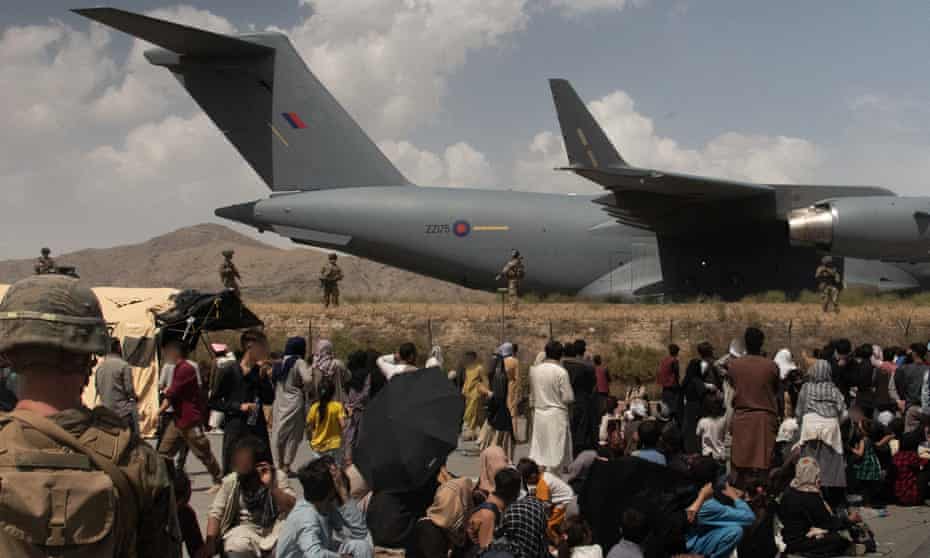
‘The “chaotic and arbitrary” Foreign Office response probably cost hundreds of people their chance to leave, and thus likely cost lives.’ 
Photograph: LPhot Ben Shread/MoD/Crown Copyright/PA

Editorial
Tue 24 May 2022

The excoriating parliamentary report on Britain’s handling of the withdrawal from Afghanistan is such a lengthy catalogue of failure that it is far quicker to say what was done well: there were heroic efforts by individuals, working under enormous pressure, to save lives. Unfortunately, as the inquiry by the Commons foreign affairs committee – chaired by the Conservative MP Tom Tugendhat – makes clear, they were utterly let down by both ministers and top officials. It describes the British withdrawal as a disaster and a betrayal, and is particularly damning about the evacuations.

Politicians and senior officials showed too little interest, were absent at key moments, took inadequate or misguided action and failed to record what they did. MPs found that the “chaotic and arbitrary” Foreign Office response probably cost hundreds of people their chance to leave, and thus is likely to have cost lives. Yet those who are to blame have utterly failed to take responsibility. Indeed, when challenged, the Foreign Office provided answers that “in our judgment, are at best intentionally evasive, and often deliberately misleading”.

The chaos in the days before and after the fall of Kabul to the Taliban on 15 August 2021 looked appalling enough at the time. The detail provided by Foreign Office whistleblowers and others shows it was worse. The government should have begun planning when the US withdrawal was announced in February 2020, instead of simply hoping the US might change course. What action it did take was late, inadequate and often incompetent. It was hopelessly slow in addressing the cases of Afghans who had worked for it, and failed to design a scheme to help others who had supported UK objectives until Kabul fell. Emails from desperate people went unread. Sensitive documents were left to fall into Taliban hands. Multiple senior officials believe that the prime minister played a role in the disgraceful decision to prioritise the case of the Nowzad animal charity. While Downing Street has denied that, the report notes that “we have yet to be offered a plausible alternative explanation”.

Dominic Raab, then foreign secretary, had a single one-to-one conversation with the British ambassador in Kabul in the two weeks before the city fell, as the Taliban advance accelerated. He – like the prime minister, the minister for Afghanistan, Lord Ahmad, and the Foreign Office’s permanent secretary, Sir Philip Barton – were still on holiday on 15 August. Though Sir Philip, like Mr Raab, has expressed regret for not returning sooner, his failure to come back until 26 August, the day the civilian evacuation ended, is – as the committee notes – impossible to excuse; it is right to call for his resignation. Mr Raab, demoted to justice secretary (with the consolation title of deputy prime minister), has surely proved himself unfit for high office.

Beyond holding those who failed accountable, three issues are paramount. First, as the human rights group Global Witness says, the failure continues; people are still waiting for visas and the criteria have been tightened to bar some of those originally told that they had valid claims. Second, those who have made it to the UK must be properly supported to make their home here; thousands of Afghans remain in temporary accommodation. Finally, Afghanistan is in desperate straits. Development as well as humanitarian aid is necessary, along with serious consideration of how to get the economy back on to its feet. Britain has failed Afghans appallingly. It must not continue to do so.


Foreign Office failures in Afghanistan evacuation was ‘betrayal’ of allies that cost lives, MPs warn

Foreign Affairs Committee gives damning assessment of Afghan withdrawal and calls for most senior Foreign Office civil servant to consider postition
Armed Forces personnel evacuated more than 15,000 people from Afghanistan in August 2021
 (Photo: Ben Shread/MoD/Crown Copyright/PA Wire)

By Richard Vaughan
May 24, 2022 

A failure of leadership shown by Dominic Raab and the most senior civil servants at the Foreign Office during the Afghanistan withdrawal was a “betrayal” to UK allies that cost lives, MPs have insisted.

In a scathing report into the handling of the UK’s evacuation from the region, the Foreign Affairs Committee condemned both ministerial and civil servant decision making and lack of planning that led to Afghans who had helped the British mission being left behind.

It also attacked the Whitehall department’s lack of transparency over who authorised the evacuation of dogs and cats owned by the Nowzad animal charity from Kabul, and urged the FCDO’s most senior civil servant, Sir Philip Barton, to consider resigning for his failure to ensure the department took the “basic administrative step of recording its decisions”.

The panel of cross-party MPs said they were forced to rely on information provided by whistleblowers about the mishandling of the evacuation, something the committee said should leave those who lead the department “ashamed”.

Dominic Raab Mr Raab refused to return from holiday at the time Kabul fell to the Taliban on 13 August 2021 
(Photo: Wiktor Szymanowicz/Anadolu Agency via Getty)

In particular, the report issues a brutal assessment of Mr Raab’s performance during the crisis, stating: “The absence of the FCDO’s top leadership—both ministerial and official—when Kabul fell is a grave indictment of the attitudes of the Government, representing a failure of leadership across the board in the Foreign Office.”

The report adds that failure to get a grip on the situation was a “betrayal of our allies”, which was “not only morally wrong, but has undermined the credibility of the UK with serious consequences for our interests around the world”.

Mr Raab, who was moved from the Foreign Office and appointed Justice Secretary and Deputy Prime Minister in the last reshuffle, has come under sustained criticism for refusing to return from holiday at the time Kabul fell to the Taliban on 13 August 2021.


Sir Philip, the Foreign Office’s most senior civil servant, also failed to return from his holiday until 26 August, nearly two weeks later and only after the civilian evacuation mission had been completed.

Difficulties getting people out of the country were compounded by a decision to remove UK consulate staff from Kabul leading to a 48-hour delay before replacements arrived.

The report states: “This mismanagement and under-resourcing of the evacuation effort in a crucial period likely cost hundreds of people their chance to leave the country, and as a result likely cost lives.”

Tory Chair of the Committee, Tom Tugendhat MP, said: “The UK’s part in this tragedy exposes a lack of seriousness in achieving co-ordination, a lack of clear decision-making, a lack of leadership and a lack of accountability.”

And he added: “The absence of the FCDO’s top leadership – ministerial and official – when Kabul fell is a grave indictment on those supposedly in charge. While junior officials demonstrated courage and integrity, chaotic and arbitrary decision-making runs through this inquiry. Sadly, it may have cost many people the chance to leave Afghanistan, putting lives in danger.”

A Government spokeswoman said: “We are still working hard to assist the people of Afghanistan, having already helped over 4,600 individuals to leave the country since the end of the military evacuation.

“We carried out a thorough review to learn lessons from our withdrawal from Afghanistan and have drawn on many of the findings in our response to the conflict in Ukraine including introducing new systems for managing correspondence and increasing senior oversight of our operational and diplomatic response.”


Statistical physics rejects theory of 'two Ukraines'

Statistical physics rejects theory of 'two Ukraines'
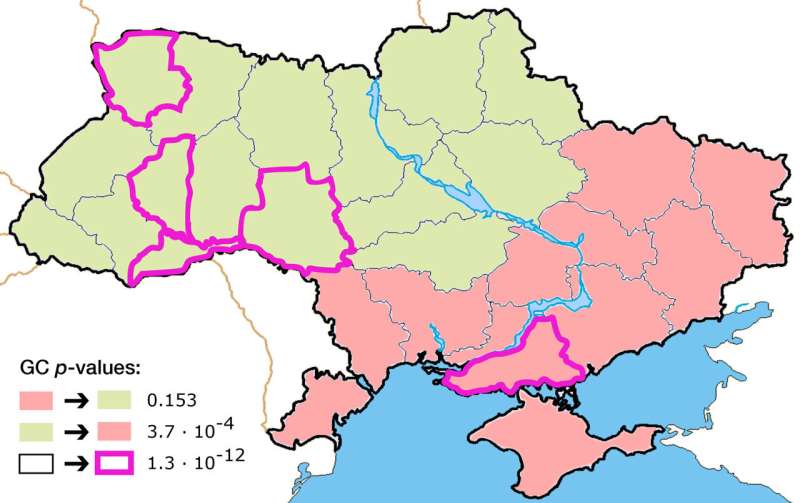
A map of Ukraine, with green and red regions marking pro-West and pro-Russian, but the
 purple outlined regions are more relevant to the war. Credit: Massimiliano Zanin and Johann H. Martínez

When reading news and analyses of the Russian invasion of Ukraine, researchers in Spain perceived many conflicting messages being transmitted. The most notable one is the theory of "two Ukraines" or the existence of ideologically pro-West and pro-Russian regions.

This doesn't match the unity of Ukrainians against the Russian invasion, so they wondered if they could provide any solid proof to support or reject such a theory via data analysis tools.

In the journal Chaos, Massimiliano Zanin and Johann Martínez, from Instituto de Fisica Interdisciplinar y Sistemas Complejos (Institute for Cross-Disciplinary Physics and Complex Systems), analyze a data set of violent events within Ukraine since January 2021 but prior to the invasion on February 24, 2022, by combining temporal and spatial correlations through entropy and complexity metrics with functional networks.

The key finding of their work is the theory of two Ukraines doesn't hold up against the data. Conflicts do exist within Ukraine but aren't ideologically west versus east. The researchers found these conflicts tend to form a complex network of interactions with no clear geographical boundaries.

"Contrary to Russian discourse, we have not seen any indication of an eastern part of Ukraine being harassed by a western part," said Zanin. "This should be taken into account toward a possible resolution. The data suggest a solution involving splitting the country would be artificial and not guarantee long-term stability and peace."

Statistical physics is a framework to analyze real  but it is often a daunting task to get access to relevant quantitative data about international events, aside from  such as Twitter. An increasing number of open intelligence communities, such as the Armed Conflict Location and Event Data Project, are beginning to change this.

"We use two techniques from  to analyze whether the appearance of violent events was independent or caused by others," said Zanin. "We developed this idea on two axes: time and space. Time is used to explore whether some events are responses or reactions to previous events. Space is used to understand whether what happened within one region was a consequence of events within other parts of the country."

As opposed to other fields, like engineering, obtaining reliable and high-quality data about social and political events is a major challenge.

"When working on this kind of data, it's also uncomfortable, because we'd like to have more events to support more complex analyses. But there are victims and deaths behind the data," said Zanin. "We wish this type of analysis wasn't necessary at all."New web-based app maps violence in Ukraine based on in-country news sources

More information: M. Zanin et al, Analyzing international events through the lens of statistical physics: The case of Ukraine, Chaos: An Interdisciplinary Journal of Nonlinear Science (2022). DOI: 10.1063/5.0091628

Journal information: Chaos 

Provided by American Institute of Physics 

Egypt's drummers beat away bad rap of tabla tunes


Five hundred people gathered to watch Tablet al-Sitt play at a recent concert in Cairo 
(AFP/Mohamed HOSSAM)

Nessrin Ali Ahmad
Tue, May 24, 2022, 7:30 PM·3 min read

Many Egyptians associate the tabla drum with belly dancers and seedy nightclubs but, despite its image problem, percussionists are giving the ancient instrument a new lease of life.

And it is often women who are now playing the goblet-shaped traditional drum, an early version of which has been found in the ancient temple of the Goddess Hathor in Qena, southern Egypt.

The beat of the tabla is ubiquitous, animating every Egyptian wedding, concert and impromptu dance party.

And yet professional tabla players have been associated with nightclubs, where they accompany the undulations of belly dancers, looked down on as figures of ill-repute by many Egyptians.


"The public's image of the tabla is very negative," said music expert Ahmed al-Maghraby. "People associate it with a lack of morals."

That is something the newcomers want to change.

"There's a new trend now: solo tabla concerts," said musician Mostafa Bakkar, who struggled with his own family's disapproval of his decision to become a tabla player and teacher.

"People find the environment shameful," he told AFP. "They make fun of me and ask, 'So where's the dancer?'"

- 'Music therapy' -

The quip has its roots in Egyptian popular culture.

The 1984 hit movie "Al Raqessa wal Tabal" (The Dancer and the Tabla Player) told the story of a percussionist whose career grinds to a halt after leaving his belly dancer partner to strike out on his own.

Bakkar, 30, who ties his dreadlocks back with a white bandana, said he also organises improvised drum-playing circles for amateurs.

"I pass out tablas to people around me and we play music in unison," he told AFP.

"It's a kind of group therapy," chimed in neuropsychologist Christine Yaacoub, a regular at Bakkar's drumming sessions.

"I saw how happy tabla can make people, so now I use it as music therapy with my patients," she said.

By practising percussion together, "we heighten our attention span", she explained, because the tabla allows people "to express themselves without speaking".

- 'Break the rules' -

Most professional tabla players have been men, but now more and more Egyptian women are taking up the ancient instrument, either professionally or as a hobby.

In 2016, tabla players Rania Omar and Donia Sami, one of whom is veiled, went viral on social media with a video that attracted a fair share of online hecklers but also an outpouring of support.

Encouraged, the duo went on to become the first all-woman tabla band in Egypt.

In 2019, 33-year-old Soha Mohammed joined them to create "Tablet al-Sitt" (The Woman's Tabla), "to give all women a chance to sing freely and play the tabla".

Mohammed has since been travelling with eight other percussionists across Egypt, treating audiences to new takes on traditional classics.

At a recent Cairo show under a bridge on the Nile's banks, 500 people gathered at the "Sawy Culture Wheel", singing and clapping along as Tablet al-Sitt played folk favourites.

For band member Rougina Nader, who at age 21 has spent 12 years playing the instrument, it was a long, difficult road to becoming a full-time percussionist.

"We upset men, because we're competition, and audiences love us," she told AFP. "There are obstacles, but that won't stop us from continuing to break the rules."

naa/sbh/bha/hc/fz
Tunisia's first LGBTQ play lifts curtain on hidden violence


Tunisia's first LGBTQ play lifts curtain on hidden violenceThe play aims to challenge "discriminatory" mentalities and campaign for an end to a "backward law", as well as promote queer art
 (AFP/FETHI BELAID)More

Kaouther Larbi
Tue, May 24, 2022

It's the first queer play to be staged in Tunisia -- director Essia Jaibi's latest work aims to challenge conservative attitudes in a country where same-sex acts are punishable by prison terms.

"Flagranti" (or "In the Act"), which premiered at a city-centre theatre in the capital at the weekend, deals with "a reality that we pretend not to see", Jaibi told AFP.

The work, co-produced by LGBTQ rights group Mawjoudin (translating to "we exist"), is played by six mostly amateur actors aged between 23 and 71, reflecting a decades-long struggle for gay rights in the North African country.

Infused with black humour, it tells the stories of people who have suffered violence at home, in the workplace and in public.

Tunisia is seen as relatively liberal on social issues compared with other Arab countries, but nevertheless imposes sentences of up to three years in prison for "sodomy" for both men and women.

The country saw a rise in public LGBTQ rights activism in the years following its 2011 revolution that kicked off the Arab Spring uprisings.

But despite years of efforts, rights groups say the community is still vulnerable, with as little as a photo on a telephone potentially leading to arrest, physical violence and anal examinations.

The notorious Article 230 of the penal code saw 59 people jailed between early 2020 and last October, according to Mawjoudin.

The play, inspired by real events, "talks about a taboo subject, a reality that in Tunisia we keep pretending not to see, which this show is trying to bring to the public's attention," Jaibi said.

Mawjoudin member Karam Aouini said the play aims to challenge "discriminatory" mentalities and campaign for an end to a "backward law", as well as promote queer art.

The NGO also organised Tunisia's first queer cinema festival in 2018.

- 'Historic moment' -

The two-hour play deals not only with LGBTQ issues, but also other problems facing all Tunisians: police and judicial corruption, impunity and the brain drain as people leave to seek better economic prospects in Europe and elsewhere.

When the play ended, the audience erupted into a storm of applause.

For audience member Alay Aridhi, 27, the event was "a historic moment" for Tunisia.

"Holding an event like this in an Arab, Muslim country isn't easy," he said. "It seems we can now tell these stories."

Salim, a 24-year-old member of the LGBTQ community, said the play had touched him deeply.

"I saw my life on the stage. It was overwhelming, I had a lump in my throat," he said.

Rights groups are continuing to campaign for an end to Article 230, first introduced by French colonial administrators in 1913.

But with parliament dissolved and the country in political turmoil after President Kais Saied's power grab last year, no such move is on the radar for now.

The United Nations Committee Against Torture has condemned Tunisia's use of anal tests.

The country in 2017 committed to ending the practice, but it has continued nonetheless.

In December, two men were found guilty of same-sex acts after they refused to undergo such examinations -- seen by judges as proof of their guilt.

The Tunisian president, whose July power grab allowed him to issue laws and seize control of the judiciary, has said he is opposed to jail terms based on sexual orientation -- but also to the full decriminalisation of homosexuality.

Actor Hamadi Bejaoui, who portrayed a doctor named Adam in the production, described it as a "harsh experience that shows a human being crushed".

But despite this, he remains determined.

"We will not back down. The fight continues!" he said.

kl/fka/par/jsa