Friday, July 08, 2022

Mexico accuses ex-president of millions in illegal funds

FILE - Mexico's incoming President Enrique Pena Nieto of the Institutional Revolution Party (PRI) wears the presidential sash after being sworn-in at his inauguration ceremony before Congress in Mexico City, Dec. 1, 2012. Mexico’s anti-money laundering agency said on July 7, 2022 it has accused Peña Nieto of handling millions of dollars in possibly illegal funds. (AP Photo/Alexandre Meneghini, File) (ASSOCIATED PRESS)

MEXICO CITY (AP) — Mexico’s anti-money laundering agency said Thursday it has accused ex-President Enrique Peña Nieto of handling millions of dollars in possibly illegal funds, perhaps a signal from President Andrés Manuel López Obrador that he is getting serious about his promise to pursue corruption.

It marks the first formal legal accusations against Peña Nieto, despite a cloud of allegations about corruption during his 2012-2018 administration. López Obrador made rooting out corruption the main theme of his presidency, but hadn't yet moved against any of his predecessors.

The criminal complaint filed against Peña Nieto by the government’s Financial Intelligence Unit does not mean prosecutors have yet decided to file any formal charges. But the head of the unit, Pablo Gomez, said federal prosecutors have received the complaint alleging use of illicit funds and are investigating it.

Gomez said Thursday that a company run by Peña Nieto’s family had “a symbiotic relationship” with a firm that received about $500 million in government contracts while he was president. He did not identify the companies, but said they were distribution firms.

Gomez also said Peña Nieto had received money transfers from a relative, apparently linked to the two companies, for about $1.3 million after leaving office. Gomez said Peña Nieto’s accounts and those of the companies haven’t been blocked.

Peña Nieto moved to Spain after leaving office.

On Thursday, Peña Nieto wrote in his Twitter account that his money was legally obtained.

“I am certain that the appropriate authorities will allow me to clear up any questions about my holdings, and to prove their legality through legal channels,” the former president wrote. “I have confidence in legal institutions.”

The former head of Mexico’s state-run oil company under Peña Nieto, Emilio Lozoya, has claimed that Peña Nieto and his right-hand man, then-Treasury Secretary Luis Videgaray, directed him to bribe lawmakers, including five senators, to support controversial energy and other structural reforms in 2013 and 2014.

Videgaray has denied the accusations. Neither man faces any charges in that case.

The failure to bring down any top figures from previous administrations has been an embarrassment for López Obrador, as has the failure of Attorney General Alejandro Gertz Manero to build any strong legal case based on Lozoya's allegations.

The hands-off approach toward Peña Nieto has fueled speculation that López Obrador had reached some kind of gentleman's agreement with the ex-president in 2018. In exchange for quickly recognizing López Obrador's presidential victory and allowing him unusual power during the transition period, Peña Nieto purportedly would have gained a promise of impunity.

López Obrador has said simply that “revenge isn't my strong point” and that Mexico should look to the future, not the past.

Yet last year, López Obrador sponsored a national referendum of Mexican voters about whether to prosecute former leaders accused of wrongdoing. TIt failed to reach the 40% participation required to make it binding and critics pointed out that the government didn't need the public’s blessing to prosecute anyone who had committed crimes.

U.S. Treasury to end 1979 treaty with global minimum tax holdout Hungary


Hungarian PM Orban attends a business conference in Budapest

Fri, July 8, 2022 

WASHINGTON (Reuters) - The U.S. Treasury on Friday said it was moving to terminate a 1979 tax treaty with Hungary in the wake of Budapest's decision to block the European Union's implementation of a new, 15% global minimum tax.

A Treasury spokesperson said that since Hungary lowered its corporate tax rate to 9% - less than half the 21% U.S. rate - the benefits of the tax treaty unilaterally benefit Hungary and no longer benefit the United States.

"The benefits are no longer reciprocal - with a significant loss of potential revenues to the United States and little in return for U.S. business and investment in Hungary."

The timing of the termination following years of U.S. concerns about the treaty suggests that Treasury is using it to try to pressure Hungarian Prime Minister Viktor Orban to agree to implment the 15% global minimum tax agreed by nearly 140 countries.


The termination is expected to completed in six months after the Treasury sends formal notification to Hungarian authorities.

"Hungary made the U.S. government’s longstanding concerns with the 1979 tax treaty worse by blocking the EU Directive to implement a global minimum tax," the Treasury spokesperson said. "If Hungary implemented a global minimum tax, this treaty would be less one-sided. Refusing to do so could exacerbate Hungary’s status as a treaty-shopping jurisdiction, further disadvantaging the United States."

(Reporting by David Lawder; Editing by Nick Macfie)
AOC mocks Brett Kavanaugh for skipping dessert at DC steakhouse amid protests outside: 'The least they could do is let him eat cake'

Bryan Metzger
Fri, July 8, 2022

Democratic Rep. Alexandria Ocasio-Cortez of New York
 and Supreme Court Justice Brett Kavanaugh.
Kevin Dietsch and Zach Gibson/Getty Images

Supreme Court Justice Brett Kavanaugh left through the back door of a DC steakhouse amid protests outside.

"Poor guy. He left before his soufflé," said AOC, mocking media coverage of the protest.

She pointed out that the overturning of Roe v. Wade will negatively impact people with ectopic pregnancies.

Following reports that Supreme Court Justice Brett Kavanaugh left a DC steakhouse early on Wednesday night amid protests outside, Democratic Rep. Alexandria Ocasio-Cortez of New York took issue with media coverage of the incident.

"Poor guy. He left before his soufflé because he decided half the country should risk death if they have an ectopic pregnancy within the wrong state lines," the prominent progressive a "Squad" member wrote on Twitter. "It's all very unfair to him. The least they could do is let him eat cake."

Kavanaugh was one of six justices that voted to overturn Roe v. Wade, revoking the constitutional right to an abortion.

In the wake of that ruling, women with ectopic pregnancies — which occur when an embryo implants outside the uterus, can be life-threatening, and never result in a live birth — may no longer be able to access care in states that enact sweeping abortion bans.

Politico reported on Friday that Kavanaugh left Morton's as protesters with ShutDownDC gathered outside, though they also reported that the conservative Supreme Court Justice "did not hear or see the protesters and ate a full meal but left before dessert."

Morton's issued a statement to Politico denouncing the protest, saying Kavanaugh and other patrons were "unduly harassed by unruly protestors."

"Politics, regardless of your side or views, should not trample the freedom at play of the right to congregate and eat dinner," a representative for the restaurant chain told Politico. "There is a time and place for everything. Disturbing the dinner of all of our customers was an act of selfishness and void of decency."

"I will never understand the pearl clutching over these protests," Ocasio-Cortez continued. "Republicans send people to protest me all the time, sometimes drunk and belligerent."

She also alluded to prior media coverage of conservative figures being driven from restaurants, including when former White House Press Secretary Sarah Huckabee Sanders was asked to leave a Virginia restaurant in 2018.

"Nobody cares about it unless it's a Republican in a restaurant," said Ocasio-Cortez. "Can someone please explain the obsession because I don't get it."


Türkiye uncovers world's second-largest rare earth element reserve

- Of the 17 known rare elements, the country will produce 10 from the new field, Energy Minister says

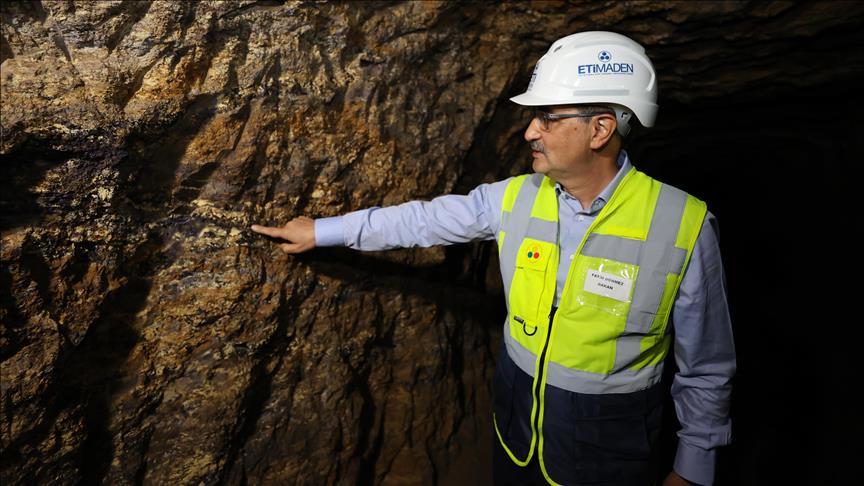
Türkiye uncovered the world's second-largest rare earth element reserve in the Beylikova district of Eskisehir in central Anatolia, the Minister of Energy and Natural Resources Fatih Donmez revealed on Friday.

The reserve is estimated to hold reserves of 694 million tons, second only to China, which currently has the largest rare element field with reserves of 800 million tons.

Rare earth elements are used in fields such as aviation, defense, the space industry and biomedicine.

Donmez confirmed that as the field is extremely close to the surface, it will be less costly to extract elements.

'Of the 17 known rare elements, we will be able to produce 10 here,' he said.

Additionally, the new reserve will allow the processing of about 570,000 tons of ore annually.

He also declared that 250 tons of thorium will be produced, an element used as fuel in the nuclear industry.

The discovery will allow local production of rare elements that will primarily be used in the country's industrial sectors but also for export.

'We will have the opportunity to export more than we need abroad,' he stated.

Reporting by İsmail Ozdemir and Deniz Acik

Writing by Zeynep Beyza Kilic

Anadolu Agency

US Feds must step in or renewable energy will have nowhere to go, says MIT report


Devin Coldewey
Thu, July 7, 2022 

Building wind and solar farms is an important part of building a new green grid, but a calm night stops their energy generation cold. It's just as important to research and build green energy storage — and to that at scale requires federal intervention as soon as possible, suggests a new report from MIT.

"The Future of Energy Storage" is part of a series looking at the transition of power sources in America, and this one is particularly relevant given the momentum currently enjoyed by the solar and wind industries. Too much renewable energy sounds like a good problem to have, but if it can't be relied on as a city or region's main or only source of electricity, they're going to feel the need to hedge their bets with a coal plant or something like it.

The solution is basically batteries: store excess power when the sun is out and the wind is high, and run off them at other times. It's hardly a revelation, but the increasing reliance on what the study calls "variable renewable energy" means that what battery capacity we have isn't nearly enough. We'll need to increase it by orders of magnitude and across the country (and eventually the world, of course — but not every country is equally prepared to make this shift).

But the problem is this: Wind farms and solar make money, while storage facilities … don't. Sure, they might break even on the long term, but they aren't the easy money that solar farms have become. The most efficient and green energy storage options, like pumped hydro, are incredibly expensive and limited in the locations they can be built. While the most easily accessed technologies, like lithium-ion batteries, are widespread but neither capacious nor organized enough to serve as a grid supplement.

This is where the Department of Energy needs to step in, MIT says. The federal government has the means both to subsidize the utilization of existing storage options and to fund intensive research into new and promising ones. A hydrogen energy storage system could be a game changer, the report notes, but it isn't going to fund itself. Like other critical infrastructure, it must be paid for up front by the feds and paid off over time.

Severe weather, blackouts show the grid’s biggest problem is infrastructure, not renewables

But it isn't just about writing checks. The DOE will need to evaluate the feasibility of doing things like repurposing old infrastructure like decommissioned power plants, reusing their connections to the grid and the communities that were built around them. If coal plants weren't simply shut down but rather converted into hydrogen electrolysis centers, the jobs could stay but the emissions would go.

And then there's the matter of the cost of the energy itself. The report warns that even with adequate storage, the cost of power would fluctuate far beyond the norms we've established today with our consistent (but dirty) fuel-based sources of energy. Maybe peak power today costs twice as much as off-peak power — but in 10 years, that gap could be much wider. On one hand, the low-end cost would be nearly zero — but peak power might be far more expensive.

The electricity market will change a lot, and consumers shouldn't have to wonder whether running the dishwasher will cost them a penny or a buck. Instead, smart modeling of these cost and supply issues should be used to abstract away the variability and provide both consistency for consumers and payback for electricity generators.

The U.S. is at a good point for the feds to step in, and if they do so it will be watched eagerly by other countries working on making a similar leap. The report notes that India, for a number of reasons, is also facing a growing power and emissions crisis, and the U.S. may serve as a useful test bed for proving out technologies that could serve their larger population similarly well.

You can read the full report or the executive summary, both very accessible, at the report page here.
Canada's Ukrainian community urges Trudeau not to return Russian gas turbine

Ukrainians fleeing Russia's invasion arrive in Winnipeg
Steve Scherer and Rod Nickel

Thu, July 7, 2022 

OTTAWA (Reuters) -Canada's Ukrainian community is urging Prime Minister Justin Trudeau to refuse to compromise the country's sanctions against Russia in order to return a turbine that Moscow says is critical for supplying natural gas to Germany.

Russia's state-controlled Gazprom cut the capacity along the Nord Stream 1 pipeline to just 40% of usual levels last month, citing the delayed return of equipment being serviced by Germany's Siemens Energy in Canada.

Canada has one of the world's biggest Ukrainian diasporas outside of countries that border Ukraine and it has successfully pressured Ottawa to impose increasingly strict sanctions against Russia since it invaded Ukraine in February.

Ukrainian Canadian Congress (UCC) national president Alexandra Chyczij urged Trudeau, in a letter on Wednesday, to see through Russia's "obvious ploy" to divide Ukraine's allies.

Ottawa should instead broker a solution that does not involve waiving sanctions, she wrote in the letter, posted on UCC's website.

"Any waiver of Canadian sanctions would be viewed as a capitulation to Russian blackmail and energy terrorism, and would only serve to embolden the Russian terrorist state," Chyczij said.

In an interview, UCC CEO Ihor Michalchyshyn said the group is acting independently and not receiving direction from Kyiv regarding lobbying Ottawa about the turbine.

The Canadian government has not responded to the UCC's letter, he said.

"We have not gotten reassurance of anything, either way," Michalchyshyn said. "That's why we're quite concerned."

A Canadian government source said the Ukrainian government itself opposes the turbine's return.

Trudeau's office had no immediate comment on the letter.

"We will not stop imposing severe costs on the Putin regime while their unjustifiable invasion is ongoing and we will continue to support our European friends and allies," said Ian Cameron, spokesman for Canada's natural resources minister, in a statement.

The Russian embassy in Ottawa said Russia has no role to play in returning the turbine.

"It is a problem between Canada and Germany," the embassy said in a statement. "We would welcome the release of the turbine which could help to restore gas flow to Europe."

The technical problem with the turbine is merely a Russian pretext, German Economy Minister Robert Habeck said last week.

Canada, alongside its Western allies, has issued sweeping sanctions on Russia after Moscow sent troops into Ukraine in what the Kremlin calls a "special military operation."

(Reporting by Rod Nickel in Winnipeg and Steve Scherer in Ottawa;Editing by Marguerita Choy)


Media: Canada will return the turbine to Gazprom


Today

The Canadian authorities announced their intention to withdraw from sanctions the turbine for the Nord Stream gas pipeline. Agreements on this issue were carried out with Berlin.

European Truth and Reuters write about it . The reason for the lifting of restrictive measures should be the argument that the return of the turbine will give Russia the opportunity to restore the pumping of fuel to Europe. The Ukrainian government is aware of Ottawa's intention and has already stated that it is "unreasonable and dangerous for the sanctions regime."

Canada and Germany do not want the absence of turbines to stop Russia from supplying gas via Nord Stream. But Kyiv insists that the sanctions prohibit the transfer of any gas-related equipment to Moscow.

- If, God forbid, this decision is approved, we will undoubtedly turn to our European colleagues with a request to reconsider their approach. Because if countries do not comply with the decisions they have agreed on sanctions, what kind of solidarity can we talk about? - said in the Ukrainian Ministry of Energy.

Last month Kyiv demanded not to return the turbine to Russia.

Recall that we are talking about a Siemens turbine, which is currently being repaired in Canada.

Note that Berlin also asked Ottawa not to return the turbine to Moscow. Such requirements were put forward by the head of the German Ministry of Economy and Climate, Robert Habeck. Moreover, he insisted on transferring this turbine to Germany. He said the move would deprive Russian leader Vladimir Putin of "excuses" for cutting gas supplies.

Germany Expects Canada to Release Key Nord Stream Part


(Bloomberg) -- Germany expects Canada to release a key Russian pipeline part caught up in sanctions, according to a person familiar with the situation.

Releasing the part could potentially ease a gas standoff between Russia and Germany. The Kremlin said on Friday that if the turbine is sent back then gas flows to Europe can increase.

A German government spokesman said they had received positive signals, but no confirmation the turbine is on its way. It wasn’t immediately possible to contact the Canadian government.

Germany has urged Canada to release the part as it takes all possible measures to prevent an energy catastrophe this winter. 

Economy Minister Robert Habeck told Bloomberg earlier this week that the turbine for the Nord Stream 1 pipeline needs to be returned before maintenance work begins on Monday. Releasing the component would remove an excuse for Russian President Vladimir Putin to keep the conduit closed, he said.

Shell Decides to Build Europe’s Largest Green Hydrogen Plant

(Bloomberg) -- Shell Plc has decided to proceed with building Europe’s largest plant producing hydrogen from renewable power as oil majors bet the fuel could be key to cutting carbon emissions.

Holland Hydrogen I will include 200 megawatts of electrolyzers, powered by a wind farm off the coast of the Netherlands, according to a statement from Shell on Wednesday. That’s 10 times the size of the largest existing green hydrogen facility in Europe. Shell didn’t disclose the value of the investment.

Green hydrogen is a key part of Europe’s plans to cut emissions and reliance on imported natural gas from Russia. The clean-burning gas can be used to replace fossil fuels in industrial processes such as chemicals production, heavy transportation and power generation. 

Big Oil Bets That Green Hydrogen Is the Future of Energy

“Renewable hydrogen will play a pivotal role in the energy system of the future and this project is an important step in helping hydrogen fulfill that potential,” said Anna Mascolo, executive vice president of emerging energy solutions at Shell. 

While Europe has big plans for green hydrogen, most production is currently on a small, experimental scale. Iberdrola SA has what it calls Europe’s biggest green hydrogen facility in Spain, with a capacity of 20-megawatts. 

Once the project is complete in 2025, Shell will use the roughly 60,000 kilograms of green hydrogen it produces daily to supply the Shell Energy and Chemicals Park Rotterdam. That facility currently uses hydrogen produced using fossil fuels to run its operations. Using the green alternative will lower overall emissions from producing gasoline, diesel and jet fuel. 

©2022 Bloomberg L.P.


One night last month, Britt Gerhard and her husband heard a bang on the roof of their house in San Francisco around 8 p.m. It was so loud, they thought it was an earthquake.

The couple had just put their 4-year-old daughter to bed, and Gerhard, a 38-year-old artist, was alarmed. Suddenly, shiny and silver things, each just a few inches long, began flying past the window.

They were anchovies

“We went outside, and there were just fish everywhere, about 20 to 30 fish,” Gerhard said. “I was like, ‘OK, we’ve had a pandemic and fires and now, fish are falling from the sky.’”

In the past month, a handful of residents in the Bay Area have reported similar occurrences. Then, last week, several thousand dead anchovies washed up about 30 miles north, on the shore of the Bolinas Lagoon.

The happenings might seem bizarre, or even biblical, but scientists say they have a perfectly rational explanation: The anchovy population off the California coast is booming.

Those that washed ashore were likely chased by marine predators into the shallow lagoon waters, where they soon got stuck and ran out of oxygen, said Jarrod Santora, a marine ecologist with the National Oceanic and Atmospheric Administration.

As for the fish falling from the sky, he added, “That’s just birds carrying them back to their chicks, and they can only carry so many, and some of them fall out.”

Santora said that the gulls that nest atop buildings in the city often fight one another for food, and that they might drop their fish in a process known as kleptoparasitism: “That’s when a bird beats up on another bird for its lunch.”

Anchovies are a boom-and-bust species: Their populations naturally shrink and expand, and scientists don’t know exactly why. But since a marine heat wave that ended around 2016, the population of anchovies off the California coast has exploded “by orders of magnitude,” Santora said. It has created a banquet for the birds, sea lions and whales that feast on them, he added.

“These humpbacks are recovering, and they’re very hungry,” Santora said, adding that he suspected that a group of the whales could have driven the anchovies into shallow water. The whales, he said, cooperatively feed in small groups by splitting the fish into smaller schools, weakening their defenses.

“Five humpback whales can move an anchovy school basically anywhere they want to,” he added, “and just scoop it all up.”

The mass anchovy die-off in Bolinas Lagoon was rare, but not unprecedented. In 2013, anchovies crowded into Santa Cruz harbor, depriving themselves of oxygen. The next year, a mass die-off of the tiny fish fouled an Oregon beach town. Earlier this year, thousands of the fish also washed up dead on a beach in Chile.

Rudi Ferris, a fisherman who has lived in Bolinas for more than five decades, said that he recalled a handful of die-offs in the seaside town, and that only one, in the late 1970s, rivaled the carnage he witnessed last month.

“It stunk horribly for a really long time,” said Ferris, 71. This time, he added, he watched the scene from afar through his binoculars. A mass of pelicans and gulls were “frantically eating,” he said.

Staff members with Marin County Parks, which manages the lagoon, said that most of the fish had either been eaten or washed back out to sea, but that the phenomenon had provided a brief glimpse into the wonders of ocean life.

“We don’t usually get to see how many fish are in the ocean,” said Max Korten, director and general manager for Marin County Parks. “It’s kind of amazing.”

© 2022 The New York Times Company

Losing our freedoms on the road to becoming the Divided Fascist States of America


Chris Preece
Thu, July 7, 2022 

I enjoy my freedom as an American, free speech, freedom to worship how I like, and the comfort of knowing my kid will have opportunities to reach his full potential. This America, the one we have loved but had some tough times with, may be ending. Likely ending sooner than we think.

My wife, many loved ones, and half our population had their right to bodily autonomy (to do with their own body as they see fit) recently ripped from them by the Supreme Court of the United States (SCOTUS) and Kentucky State Legislature. Kentucky’s law on abortion has NO exceptions for rape or incest and only a narrow exemption for the life of the mother. Our wives, daughters, mothers, and friends now have their bodies controlled by our government. This is the first time in American history that SCOTUS has taken rights away from people regarding bodily autonomy.

Access to an abortion had been upheld by SCOTUS for 49 years under the view that we have a right to privacy and bodily autonomy. Since the right to privacy and bodily freedom are being whittled away, Justice Thomas has expressed interest in reexamining our right to contraception (condoms and birth control), as well as our right to marry whomever we love. All these cases center around sex. Do you want the government in your sex life? I do not.

Also, if we do not have a right to privacy, the government could start invading our cars, homes, phones, or worse. Yes, this is extrapolating to make a point. If SCOTUS is not afraid to strip reproductive rights away, how far are they willing to go?

SCOTUS has agreed to hear a case next term (Moore v. Harper) about state legislatures being able to control federal elections, potentially going as far as to allow state electors to cast votes for whomever they like regardless of how we, the people, vote. If SCOTUS allows state legislators to control these elections, the states could make up their own rules and ignore our votes. Then we would no longer have a democracy. Let that sink in. We could potentially no longer have a democracy. Each state would have its own rules on federal elections, and our country would be even more divided Red v. Blue.

Our lives have increasingly gotten harder. Harder to buy gas, food, and a place to live. This is designed to keep us regular folks too busy to pay attention to politics. Now, I ask you to stand up and fight back against SCOTUS and their decisions to strip away our rights and democracy.

You may feel that your actions don’t matter, but they do. We all have a voice and a vote. When we talk to our friends and get more people involved, we amplify our voices. I help organize a group of concerned citizens, Bluegrass Reproductive Justice Coalition, to push back against our government. Check out our Facebook page. If you want to push back against our government in general, you can start your own group or join groups like Kentuckians for the Commonwealth or The Poor People’s Campaign.

Actions you can take now: join a group with a common cause, start your own group, contact all your friends and get them informed and engaged, contact Senators Kyrsten Sinema and Joe Manchin to abolish the filibuster, expand SCOTUS, codify Roe, and pass Voting Rights and US Term Limits.

America needs us all to stand up for our freedoms right now. If we don’t fight, fascism will gladly take all our freedoms, leaving us as the Divided Fascist States of America.

Chris Preeece is a high school science teacher in Berea, comic book creator, new dad, and former Democrat candidate for U.S. Congress in Kentucky’s 6th congressional district.

With events 'scarier' than Jan. 6 predicted, are we on verge of another civil war? Opinion


Christopher Blattman
Wed, July 6, 2022

In 2016, democracy rating organizations began downgrading the United States, some scoring American institutions below that of El Salvador, then Nigeria, then Iraq.

Then, following the Jan. 6 insurrection last year, articles and books began predicting something scarier: another civil war.

The most sensational accounts foretold a national breakup, neighbor killing neighbor. The more level-headed ones warned of something still dire: a far-right insurgency waging a long campaign of bombings and attacks. The disturbing evidence emerging from the Jan. 6 congressional hearings merely underscores such concerns.

These worries are understandable but flawed.

After a career studying civil wars small and large, organized violence in the United States strikes me as extraordinarily unlikely. Worse, focusing on civil war dangerously distracts Americans from the real risks.

Now, those prophesizing war have a point. If you take civil conflict from recent history, you find a chillingly familiar list of initial conditions: politics hardening along identity lines; a surge of armed groups; an erosion of institutions. Ethnic polarization and democratic backsliding are especially persistent predictors of state collapse.

More: Our view: Until America is at peace with itself, we need protection from extremists

American democracy healthier than forecasts predict

But apply this to the United States with care. The data driving these results comes from predicting massive acts of violence – genocide or revolutionary wars – almost all from low- and middle-income countries. It’s dubious to use these models to predict a different phenomenon – low-scale insurgency – in America or other rich, advanced democracies.

America’s democracy numbers also don’t add up. In 2015, raters like the Polity Project gave the United States a perfect score of 10 – one it had enjoyed for decades. Then Donald Trump was elected president, and America’s score fell to 8.

In 2019, after the failed impeachment of Trump, Polity’s score fell further to 7. Finally, on Jan. 7, 2021, immediately following the insurrection, Polity announced a drop to a 5, meaning “no longer a democracy.”


Insurrectionists loyal to then-President Donald Trump climb the U.S. Capitol on Jan. 6, 2021.

Political scientists woke up, as rapid plunges to this level are persistently correlated with outbreaks of civil war.

But this slide is suspicious. It would mean that American democracy today is several points below that of 1859, on the eve of the Civil War, and when a majority of adults were barred from voting. It would put present-day U.S. institutions on par with other 5's, like Haiti and Somalia. Meanwhile, countries like Hungary – the poster nation for democratic backsliding – maintain a perfect 10.

This defies credibility. One suspects that it’s the democracy raters who have become politicized, not American institutions. The backslide is surely exaggerated. So, then, are predictions of civil war.

The fact is, even societies with hardened identities rarely erupt in conflict. One study looked at every ethnic pairing in Africa and Eastern Europe in the late 20th century and found no more than 1 in 1,000 turned violent in a given year.

So, yes, if you trace back from a civil war you find polarized politics, or a surge of protest and arms. But trace back from periods without war and you will find a lot of the same conditions. These are not automatic forerunners of violence.
Immense pain of civil war is a deterrence

Here's why: As a general rule, enemies prefer to loathe one another in peace. That’s because war – especially civil war – is disastrous. It kills people, destroys economies and weakens the country to outside enemies. This gives all sides huge incentives to avoid violence.

For anyone who doubted these horrific consequences, the events of Jan. 6, 2021, offered a painful reminder. This may be why far-right movements and violent political acts have declined since the insurrection.

Because of these costs, most political factions don’t fight. An extremist militia in the United States would be no exception. Few things are harder than launching an insurgency against a powerful state. Intelligence services will hunt you down. Justice systems will jail you. You will live clandestinely, full of hardships. This is why even the most disaffected groups are often dissuaded from violence. Better to use politics by normal means.

Those who do see violence ahead for America often point to the Troubles in Northern Ireland – a rare example of insurgency in a wealthy democracy. I draw comfort from this comparison. Northern Ireland was far more polarized and factionalized than America today. It also had a decades-long history of a well-organized, clandestine armed movement with broad public sympathy.

Naturally there are parallels to America today, but the differences in scale and seriousness are vast.

Another key difference is the state response. British forces had limited intelligence and were indiscriminately violent. When a Catholic boy in Derry threw a flaming bottle of fuel, the British military would sweep in and arrest half the neighborhood, beating (even killing) a few. Insurgent leaders joked that the British state was their best recruiter.

U.S. security services are less partisan, more targeted and restrained. The FBI disrupts most militias before they lay their first bomb. And if a far-right fundamentalist does demolish a building, federal agents don’t round up all the Proud Boys for 20 miles and beat them up. They mount an investigation and see the perpetrator prosecuted.

I would be worried if U.S. military and federal intelligence and law enforcement agencies showed more polarization. But they’ve been strikingly resilient. So, in many ways, has America’s electoral system. In 2020, the vast majority of Republican election administrators upheld Joe Biden’s victory.

But there are still real risks here in the United States. Do you know who else noticed the resilience of the electoral system? Trump’s most ardent supporters. That’s why the worrying activity now is not restive militias – it is a shortsighted but determined slice of the Republican Party who are filling election administration offices with partisans willing to trade democracy for short-term political gain.

Even then, however, don’t anticipate a civil war. There would surely be protests and angry confrontations. This could instigate sporadic violence in the streets. But a Northern Ireland-style insurgency? That’s unlikely. We shouldn’t ignore the risk. But nor should we exaggerate it.

Instead of focusing on a lone riot, I would prefer that the congressional committee broaden its investigation, heading off furtive efforts to co-opt elections and ensuring that federal agencies continue to be led and staffed by professionals who put country ahead of party.

Frightening but rare events should not distract us from the real present danger.

Christopher Blattman, a professor in the University of Chicago Harris School of Public Policy, is the author of "Why We Fight: The Roots of War and the Paths to Peace." This piece appeared first on USATODAY.com

This article originally appeared on USA TODAY: Americans are dangerously divided, but new civil war is unlikely