Tuesday, July 12, 2022

New Bolivian Law to Protect Victims of Gender Based Violence by Targeting Corrupt Judges


A new law in Bolivia attempting to curb the nation’s high rates of gender-based violence foresees up to 20 years prison sentences for corrupt judges and prosecutors who favor defendants accused of femicide, infanticide and rape.

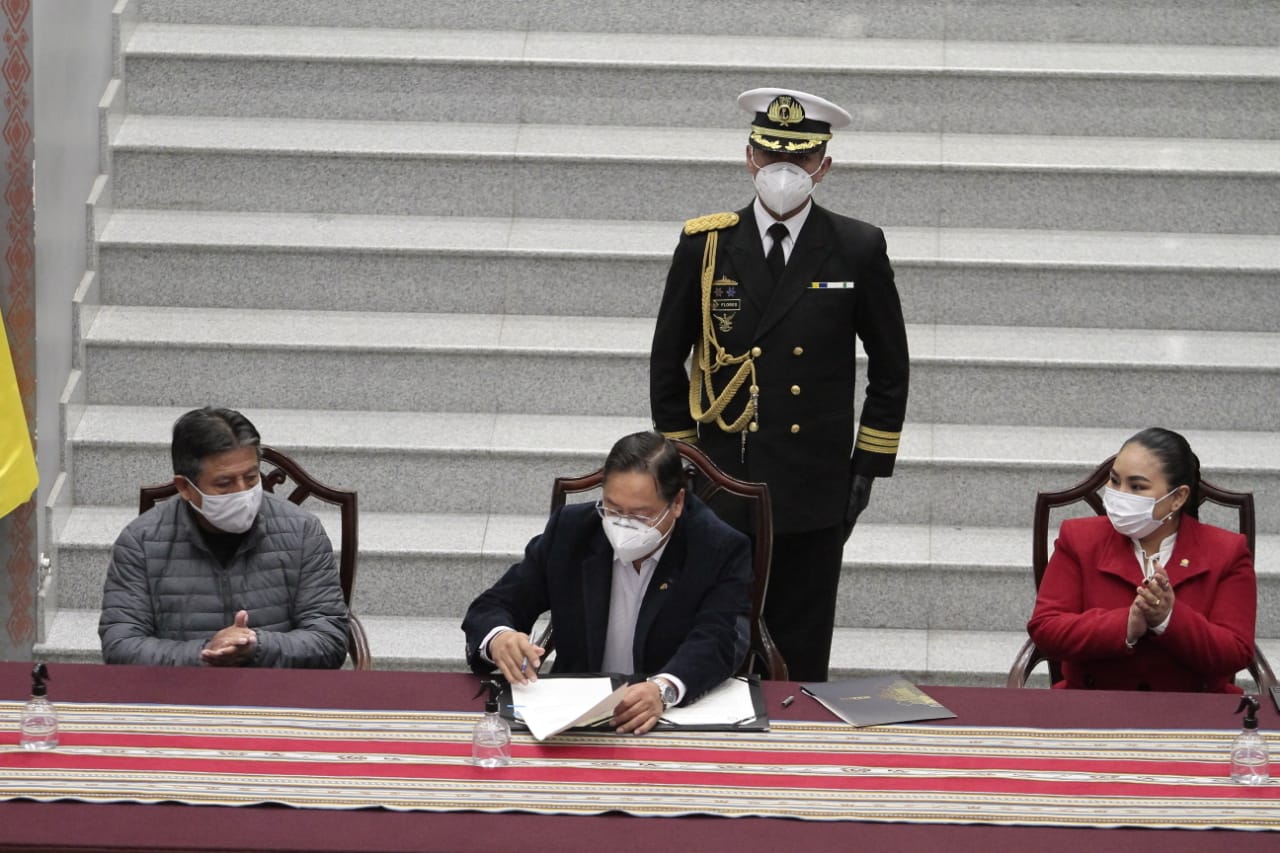
Luis Arce Bolivia FemicideBolivian President Luis Arce signs a law aimed at curbing the nation’s gender-based violence. (Photo: Agencia Boliviana de Información, TwitterLicense)The law punishing crooked administrators of justice comes just months after large scale feminist protests broke out in January, when the serial rapist and murderer Richard Choque, whose 30 year prison sentence was reduced to a house arrest by a now-apprehended judge, went on with his crimes.

The demonstrations demanded government action against the corrupt judicial systems that fail to protect victims and persecute these criminals.

The Law for the Protection of Victims of Femicide, as the new regulation is called, was promulgated last week on Monday by Bolivian president Luis Acre in the Casa Grande del Pueblo, the Bolivian presidential residence, according to a tweet by the government press agency Agencia Boliviana de Información.

“It is vital that the judges have no option to favor criminals and that this crime be punished without any excuse,” said Acre during the promulgation, referring to the corrupt judges who up until this new legislation, would be charged with 5 to 10 years in prison for the crime of malfeasance. Acre said that the new law will target lawyers who, out of greed, or by hiding behind legal loopholes and capricious interpretations, let these criminals go free.

The judge who heard Choque’s case, Rafael Alcón, now faces charges of malfeasance and breach of duties, as are 14 other judges facing trials for similar reasons, the Associated Press reported.

Acre said the judges don’t have an option to favor criminals, as in the case of Choque. "No more impunity, no more prevaricating judges, we want a justice that is sensitive to this problem and that allows us to set precedents to improve as a society as a whole,” he said.

The Minister of Justice, Iván Lima, said the law will also prevent defendants from being detained at home, which is often the same home the complainant lives in.

Bolivia has the highest rate of sexual violence in Latin America. The nation had 108 femicides in 2021, and 48 femicides and 21 infanticides since January 2022. However those who choose to come forward often face crashing barriers when seeking justice; and many of the perpetrators are either never caught, go unpunished, or are freed soon after arrest.

The law is the product of the work carried out by the Commission for the Review of Cases of Rape and Feminicide for the past four months to promote structural reforms and give justice to the victims.

Hong Kong activist sentenced: Beijing has 'wiped out' democracy and freedom

Koo Sze-yiu will have to spend nine months in prison for sedition: he had organised a protest against the Winter Olympics in the Chinese capital. A veteran of the pro-democracy camp, he has already had 14 convictions for his activism. He told the judge that prison is nothing compared to the contribution of dissidents in China.


Hong Kong (AsiaNews) - The Chinese authorities have "wiped out" democracy and freedom in the former British colony said activist Koo Sze-yiu in his appeal for the reduction of his nine-month prison sentence for sedition, decided by Judge Peter Law.

As reported by the Hong Kong Free Press, the veteran pro-democracy campaigner pleaded not guilty and accused Beijing of having 'eradicated' dissidents through the National Security Act, imposed two years ago.

The National Security Police arrested Koo on 4 February on charges of planning a protest in front of the Beijing Contact Office in Hong Kong to coincide with the opening of the Winter Olympics in the Chinese capital.

Officers stopped the activist a few hours before his protest. He had prepared a coffin to be placed in the street, covering it with slogans such as 'democracy and human rights are above the Winter Olympics', end one-party dictatorship'.

Judge Law convicted him under the Anti-Sedition Act, dating back to British colonial times. Unlike the National Security Act, which also provides for life imprisonment, the Anti-Sedition Act sets a maximum sentence of two years.

Koo is over 70 years old and has already suffered 14 convictions for his activism. He also has stage four cancer, but Judge Law pointed out that the convict's health condition will not be taken into account for any sentence reduction.

Law warned Koo not to 'politicise' the trial, but to no avail. The activist closed his speech by saying that being a 'fighter' for democracy and freedom is not a problem for him. He reiterated that even if a period in prison awaits him, it is nothing compared to the contribution of Chinese dissidents: '“I am unrepentant… [the court] does not need to have mercy on me. Spending time in prison is part of my life, the more time you spend in prison, the smarter you get,” he said.
Hubble successor hailed as first image inspires awe
By Andrew Silver


Image: European Space Agency

James Webb Space Telescope is a joint initiative of Canada, Europe and the United States

Politicians and scientists have hailed the first image from the James Webb Space Telescope, a €10 billion collaboration between the Canadian, European and US space agencies to replace the Hubble Space Telescope in providing unprecedented images of the universe.

The first image (pictured) from the JWST was unveiled by US president Joe Biden on 11 July, after the three agencies spent months positioning the telescope a million miles from Earth and opening and testing its various delicate instruments following its launch in December last year.

Biden described the unveiling of the image as “a historic moment for science and technology, for astronomy and space exploration, for America and all of humanity”, adding that it helped to illustrate “why the federal government must invest in science and technology, more than we have in the past”.

Nasa administrator Bill Nelson said the image was “the deepest, sharpest infrared image of the distant Universe so far” obtained. He said researchers using the JWST would be able to tell whether distant planets were habitable, and that the telescope was going to be able to answer scientific questions that have yet to be formulated.

Macarena Garcia Marin, an instrument scientist at the European Space Agency, agreed that the image was just a “first glimpse” of what the JWST could do. She said she “can’t help but think of what images and science results are just around the corner in the many years to come”.

The power of joining forces

Leaders of the agencies also said the JWST success shows what they can do when they work together, after they spent almost two decades collaborating on its development.

Esa director general Josef Aschbacher said: “Only with teamwork, dedication and the human drive to push boundaries and explore have we arrived at this historical moment.”

Nelson said the JWST was “just the start of what we can accomplish in the future when we work together”.

Eddie Bernice Johnson, the chair of the US House of Representatives science committee, said she hoped the images provided by the JWST would “inspire an entire generation”.

On the day the image was released, the European Space Agency announced it had created an advisory group to guide its human and robotic space exploration. The 12-person group will provide an independent analysis of the geopolitical, economic and societal relevance of such work, as well as making recommendations, the agency said.

The group includes Anders Fogh Rasmussen, former Nato secretary general and former prime minister of Denmark, as well as economist Mariana Mazzucato, who advised the EU on its research and innovation missions.

Hadron Collider Scientists Discover Three Subatomic Particles Never Seen Before

Beneath the Swiss Alps lives the world’s largest and most powerful particle accelerator and recently scientists found three new subatomic particles never seen before. NBC News’ Jacob Ward is joined by Yale University physics Professor Dr. Sarah Demers to discuss how this week’s discovery could help researchers learn how the universe was born and what the future looks like. 


THEY HAVE  CREATED A NEW QUANTUM REALITY
Dobbs, glass houses and international law

July 12, 2022


The United States Supreme Court’s decision last week to overturn Roe v Wade and eliminate the right to an abortion was one of the most consequential constitutional opinions in its history – even for a court that has already done violence to settled precedent in areas like gun control, religion and immigration.

But conspicuously absent from the constitutional analysis in Dobbs v Jackson Women’s Health was any acknowledgement of Article VI of the Constitution, which provides that treaties are “the supreme law of the land.”

Two such treaties – the International Covenant on Civil and Political Rights (ICCPR) and the International Convention on the Elimination of All Forms of Racial Discrimination (ICERD) – recognise the human rights to life, privacy, and non-discrimination. Taken together, these treaties, and the rights they safeguard, require access to safe and lawful abortion services as a matter of law.

The US, moreover, has signed and ratified both instruments, which means that the ICCPR and ICERD are binding laws upon our country.

First, Article 6 of the ICCPR provides that “[e]very human being has the inherent right to life. This right shall be protected by law. No one shall be arbitrarily deprived of his life.”

As guaranteed by the ICCPR, the right to life does not apply prenatally. In fact, during the ICCPR’s drafting – in which the US played a key part – the delegations specifically voted against adding language stating that the right to life began at conception. The UN Human Rights Council has held in multiple cases that the right to life does not apply from conception. On the contrary, it has emphasised the need to uphold a women’s right to life by protecting abortion access.

The UN Human Rights Office of the High Commissioner has likewise stated that, consistent with the right to life, countries (1) “should not introduce new barriers” to abortion and (2) “should remove existing barriers that deny effective access by women and girls to safe and legal abortion”.

This interpretation of the ICCPR is supported by evidence that abortion bans do not eliminate abortions,but rather result in more unsafe abortions. Unsafe abortions increase maternal morbidity and mortality. More women will, therefore, die unnecessarily because of abortion bans – the very definition of arbitrary deprivation of life.

Second, although Dobbs rejects the notion that the Constitution provides for a right to privacy, that right is guaranteed by the ICCPR. Article 17 of the ICCPR provides that “[n]o one shall be subjected to arbitrary or unlawful interference with his privacy, family, home or correspondence, nor to unlawful attacks on his honour and reputation”. The UN Human Rights Committee has concluded, in varying contexts, that restrictions on abortion infringe upon this privacy right.

Most recently, it held that Ireland’s forcing a woman to choose between continuing an unwanted pregnancy or travelling to another jurisdiction to receive a safe, legal abortion at her personal expense was an intrusive interference contrary to the ICCPR. After Dobbs, women in nearly two dozen states are faced with that exact same choice today.

Third, Article 26 of the ICCPR provides that “the law shall … guarantee to all persons equal and effective protection against discrimination on any ground such as race, colour, sex, language, religion, political or other opinion, national or social origin, property, birth or other status”. ICERD, in Article 5, contains similar language.

Again, the UN Human Rights Committee has issued authoritative guidance stating that interference with women’s access to reproductive health care, including failure to ensure that pregnant people do not have “to undergo life-threatening clandestine abortions,” violates these rights to non-discrimination. And in response to Dobbs, Michelle Bachelet, the UN high commissioner for human rights, reiterated this point, emphasising that “[a]ccess to safe, legal and effective abortion is firmly rooted in international human right law and is at the core of women and girls’ autonomy and ability to make their own choices about their bodies and lives, free of discrimination, violence and coercion”.

Russia’s invasion of Ukraine has brought international law into heightened focus in recent months. Courts, policy experts, and legislators from both sides of the political spectrum have condemned Russian aggression in violation of international law. Countries around the world have expressed a renewed commitment to building on international and multilateral agreements. Yet by allowing states to ban abortion, the Supreme Court has staked a position that plainly runs afoul of the US’s treaty obligations. If we are to demand that other countries and states respect their international commitments, then we should, too. The Constitution requires no less.

The views expressed in this article are the authors’ own and do not necessarily reflect Al Jazeera’s editorial stance.

The post Dobbs, glass houses and international law appeared first on Al Jazeera.
Women in Iran Are Rebelling Against the Compulsory Hijab Law

July 11, 2022


Women across Iran are defying the rule that says they must cover their hair in public, posting videos of themselves removing their hijabs in protest against the country’s hardline president.

President Ebrahim Raisi, a cleric supported by the country’s very conservative religious elite, described the recent backlash of mostly young people to the hijab law as “an organised promotion of moral corruption in Islamic society.”

The authorities are cracking down on the rebellion and plan to celebrate “Hijab and Chastity” day on Tuesday. The events will include a rally in Azadi Stadium, a large football stadium in Tehran, to encourage women to follow the hijab rule.

The Iranian security forces have stepped up their moral policing patrols across Iran to reinforce the strict dress code in recent months, and many women are rebelling against the stricter rules.

The law in Iran requires women to wear a head covering, but the restrictions vary from one administration to the next, depending on the political background of the incumbent president.

Some regions are more liberal than others, with women in the religious Mashhad and Qom provinces tightly monitored while those in Tehran or Shiraz can often get away without wearing a full head covering.

Since Raisi’s victory last year, more restrictive guidance has been introduced, and officials have given directives to refuse “badly veiled” women into government offices, banks, and public transport.

Iranian women have followed the Islamic hijab rule for the past four decades, since it was mandated after the Islamic Revolution in 1979. People have found ways around the limitation of the laws to wear colourful fabric and show some of their hair. Religious scholars have long been concerned about this, saying they are breaching the Islamic republic’s principles of “chastity and hijab” guidance.

The Imam of Tehran’s Friday prayers, Ayatollah Ahmad Khatami, bashed women who defied the regime’s mandatory hijab laws in his sermon and said, “Stealing, embezzling, and removing hijab are all sins, and by the way, the majority of those unveiled women are either wives or daughters of those thieves.”

The country’s ‘fashion police’ units, officially called the Guidance Patrols, have stepped up enforcing the “hijab law” across Iran. The branch has been pictured and filmed by bystanders rounding up women and warning them about their clothing.

In June, the government introduced two organisations to tackle the “badly veiled” phenomena. A number of incidents circulated on social media showed women contesting the authorities.

Campaigns against the regime’s restrictive policies are organised mostly by political activists and dissidents outside of Iran, but young women inside Iran have started to post selfies without the hijab in defiance of increasing pressure from the government.

In an incident in Shiraz, a city known for its loose implementation of the dress code, a group of teenage girl and boy skaters gathered, with girls not wearing their headscarves on the 23rd of June. Ten of them were arrested.

Iran’s “Hijab and Chastity Day” on Tuesday is designed to tackle the “badly veiled” trend and promote the state-approved dress code.

The post Women in Iran Are Rebelling Against the Compulsory Hijab Law appeared first on VICE.
TUC names former call centre worker Paul Nowak next general secretary

Paul Nowak will take over from Frances O’Grady when she retires after 10 years

Nowak, 50, had been the TUC’s deputy general secretary since 2016.
 Photograph: Stefan Rousseau/PA

Richard Partington Economics correspondent
@RJPartingtonTue 12 Jul 2022 

The Trades Union Congress has named Paul Nowak, a former call centre worker from Merseyside, as its next general secretary.

Nowak will become general secretary designate at the TUC Congress in Brighton in September and take over from Frances O’Grady when she retires at the end of the year after 10 years at the helm.


A union member from the age of 17 when he worked part-time at Asda, Nowak said it was an “honour” to be chosen to lead the movement amid the cost of living emergency.

He was the sole candidate nominated by trade unions to lead the umbrella group, which supports the activities of 48 separate member unions representing 5.5 million workers across the country.

Nowak, 50, had been the TUC’s deputy general secretary since 2016. He worked in the coronavirus pandemic leading union efforts to push the government to publish strong safe working guidance, helping to negotiate improvements to ensure millions of people had a safe environment to work in.

O’Grady, the TUC’s first female secretary general, had played a central role in the creation of the furlough scheme, working closely with Rishi Sunak while he was chancellor to protect jobs during the pandemic.

Nowak’s appointment comes amid growing industrial unrest across Britain, with the prospect of renewed strike action on the railways and a summer of public sector pay disputes across the economy.

Before Boris Johnson’s resignation as prime minister on Thursday, the government had warned against workers taking bigger pay rises, saying it would risk a 1970s-style “wage-price spiral” that would force the Bank of England to raise interest rates further to curb persistently higher rates of inflation.

However, workers are currently suffering the biggest real-terms hit to average pay packets on record, as typical pay awards fail to keep pace with inflation soaring to the highest level in four decades.

Nowak said unions were rising to the challenge and fighting back. “A decade of standstill wages, overseen by successive Tory governments, has left working people at the mercy of this cost of living crisis. But unions are rising to the challenge and fighting back,” he said.

The government this week approved controversial plans to allow agency staff to replace striking workers, despite widespread anger over mass sackings at P&O Ferries when the company drafted in low-paid temporary workers to replace the employees it fired. Ministers had promised an employment bill in 2019 to strengthen workers’ rights, only to repeatedly drop the plan.

“As TUC general secretary, I will push back on attacks on workers’ rights, make the voices of workers heard, and back our unions to grow and win for their members and for all working people,” Nowak said.

“It doesn’t matter if you work in a care home, a supermarket or a power station – everyone deserves decent pay, job security and dignity at work.”
The Evertonian who went from the shop floor to the top

Standing up for workers’ rights has been an almost life-long mission for Paul Nowak, having first joined the GMB union at the age of 17 while working part-time at Asda while growing up on the Wirral.

Born in Bebington on the peninsula between north Wales and Liverpool – a city with a long legacy of trade union leaders – Nowak has served as a union rep and activist while working in a call centre for BT, at Cheshire county council’s bus information team, and as a hotel night porter.

Before becoming a union official in the late 1990s, he had always been employed on temporary and agency contracts, long before the boom in the gig economy that followed the 2008 financial crisis and the current battle over economic insecurity.

A member of the first intake of the TUC’s organising academy in 1998 – alongside Sharon Graham, now general secretary of Unite and Roz Foyer, the general secretary of the Scottish TUC – he has worked closely with unions and employers to negotiate successful resolutions to major disputes with companies including Royal Mail and British Airways.


A lifelong Everton fan, he has a wife, Vicky, three grown-up children and still lives on the Wirral. Nowak is of mixed heritage and is the grandson of immigrants: his grandfathers came to the UK during the second world war from Poland and China respectively, before settling and raising families in Liverpool.

In his spare time, when not watching his beloved Blues, he can be found spending time with family, playing the guitar with friends, or exploring Britain’s canals.
BBC claims SAS unit ‘killed detainees and unarmed men in Afghanistan’

UK's Ministry of Defence believes the broadcaster's 'Panorama' programme 'jumps to unjustified conclusions'

The 'Panorama' report alleged senior officers, including former head of the British Army Gen Sir Mark Carleton-Smith, did not report the alleged murders. PA

The National
Jul 12, 2022

British special forces soldiers allegedly killed detainees and unarmed men in suspicious circumstances during counter-insurgency operations in Afghanistan, according to a BBC investigation.

The Panorama investigation reportedly uncovered 54 suspicious killings carried out by one British SAS unit on a six-month tour of Afghanistan in 2010-11.

It also claimed that senior officers, including former head of the British Army Gen Sir Mark Carleton-Smith, did not report the killings and did not disclose evidence held by UK special forces to the military police.

Sir Mark declined to comment, the BBC said.

The Ministry of Defence (Mod) said it believes the Panorama programme “jumps to unjustified conclusions from allegations that have already been fully investigated”.

The Mod added that “two Service Police operations carried out extensive and independent investigations into allegations about the conduct of UK forces in Afghanistan”.

It said neither investigation “found sufficient evidence to prosecute” and that “insinuating otherwise is irresponsible, incorrect and puts our brave armed forces personnel at risk both in the field and reputationally”.

The Mod said it “stands open to considering any new evidence, there would be no obstruction”, adding: “We will always investigate allegations to the full, but our independent police and prosecutors can only act on the evidence before them.”

Units deployed to Afghanistan had been tasked with targeting Taliban leaders and the bomb-making networks causing frequent casualties using improvised explosive devices, Panorama said.

From 2009 onwards, the SAS conducted hundreds of raids on suspected Taliban targets to arrest key insurgency leaders and those involved in bomb-making networks.

However, Panorama reported that intelligence flaws meant innocent civilians were caught up in the operations.

One man who attended meetings in 2011 where targets were selected told the programme: “There were mistakes at every single level, serious mistakes — serious organisational mistakes.

“The scope for misidentification was so high in Afghanistan because we didn’t understand the villages. We didn’t understand the tribes. And therefore, the sausage machine that is producing these names is going to make tonnes and tonnes and tonnes of mistakes.”

Sources within UK special forces reportedly told Panorama that senior officers at headquarters in London were worried about the number of people being killed during the raids.

Panorama also said it has seen internal documents showing alarm at the SAS accounts of killings, with often many more people dead than weapons reportedly recovered.

A senior officer who worked at UK special forces HQ reportedly told the programme: “Too many people were being killed on night raids and the explanations didn’t make sense. Once somebody is detained, they shouldn’t end up dead.

“For it to happen over and over again was causing alarm at HQ. It was clear at the time that something was wrong.”

According to the programme, insiders who worked on an investigation into the way British troops behaved in Afghanistan, called Operation Northmoor, claimed they were stopped from getting to the truth.

Panorama said one senior Royal Military Police officer, who did not want to be identified, said: “I believe there was pressure from above to shut down the investigation.

“It became increasingly clear to me that it didn’t matter what evidence we were able to gather, these cases were never going to be allowed to go to court.”

Panorama SAS Death Squads Exposed: A British War Crime? will air on BBC One on Tuesday at 9pm.
Updated: July 12, 2022, 5:03 AM

HERE ARE THE BBC REPORTS


Joe “I am a Zionist” Biden’s Statement on Abu Akleh Investigation


Image creditmondoweiss.net

Carlos Latuff is an intrepid Brazilian political cartoonist. Read other articles by Carlos, or visit Carlos's website.

Myths and Facts about the Israeli Siege on Gaza

15 Years of Failed Experiments

15 years have passed since Israel imposed a total siege on the Gaza Strip, subjecting nearly two million Palestinians to one of the longest and most cruel politically-motivated blockades in history.

The Israeli government had then justified its siege as the only way to protect Israel from Palestinian “terrorism and rocket attacks”. This remains the official Israeli line until this day. Not many Israelis – certainly not in government, media or even ordinary people – would argue that Israel today is safer than it was prior to June 2007.

It is widely understood that Israel has imposed the siege as a response to the Hamas takeover of the Strip, following a brief and violent confrontation between the two main Palestinian political rivals, Hamas, which currently rules Gaza, and Fatah, which dominates the Palestinian Authority in the occupied West Bank.

However, the isolation of Gaza was planned years before the Hamas-Fatah clash, or even the Hamas’ legislative election victory of January 2006. Late Israeli Prime Minister Ariel Sharon was determined to redeploy Israeli forces out of Gaza, years prior to these dates.

What finally culminated in the Israeli Disengagement from Gaza in August-September 2005 was proposed by Sharon in 2003, approved by his government in 2004 and finally adopted by the Knesset in February 2005.

The ‘disengagement’ was an Israeli tactic that aimed at removing a few thousand illegal Jewish settlers out of Gaza – to other illegal Jewish settlements in the West Bank – while redeploying the Israeli army from crowded Gaza population centers to the border areas. This was the actual start of the Gaza siege.

The above assertion was even clear to James Wolfensohn, who was appointed by the Quartet on the Middle East as the Special Envoy for Gaza Disengagement. In 2010, he reached a similar conclusion: “Gaza had been effectively sealed off from the outside world since the Israeli disengagement … and the humanitarian and economic consequences for the Palestinian population were profound.”

The ultimate motive behind the ‘disengagement’ was not Israel’s security, or even to starve Gazans as a form of collective punishment. The latter was one natural outcome of a much more sinister political plot, as communicated by Sharon’s own senior advisor at the time, Dov Weisglass. In an interview with the Israeli newspaper Haaretz, in October 2004, Weisglass put it plainly: “The significance of the disengagement plan is the freezing of the peace process.” How?

“When you freeze (the peace) process, you prevent the establishment of a Palestinian state, and you prevent a discussion on the refugees, the borders and Jerusalem,” according to Weisglass. Not only was this Israel’s ultimate motive behind the disengagement and subsequent siege on Gaza but, according to the seasoned Israeli politician, it was all done “with a presidential blessing and the ratification of both houses of Congress.” The President in question here is no other than US president at the time, George W. Bush.

All of this had taken place before Palestine’s legislative elections, Hamas’ victory and the Hamas-Fatah clash. The latter merely served as a convenient justification to what had already been discussed, ‘ratified’ and implemented.

For Israel, the siege has been a political ploy, which acquired additional meaning and value as time passed. In response to the accusation that Israel was starving Palestinians in Gaza, Weisglass was very quick to muster an answer: “The idea is to put the Palestinians on a diet, but not to make them die of hunger.”

What was then understood as a facetious, albeit thoughtless statement, turned out to be actual Israeli policy, as indicated in a 2008 report, which was made available in 2012. Thanks to the Israeli human rights organization Gisha, the “redlines (for) food consumption in the Gaza Strip” – composed by the Israeli Coordinator of Government Activities in the Territories – was made public. It emerged that Israel was calculating the minimum number of calories necessary to keep Gaza’s population alive, a number that is “adjusted to culture and experience” in the Strip.

The rest is history. Gaza’s suffering is absolute. 98 percent of the Strip’s water is undrinkable. Hospitals lack essential supplies and life-saving medications. Movement in and out of the Strip is practically prohibited, with minor exceptions.

Still, Israel has failed miserably in achieving any of its objectives. Tel Aviv hoped that the ‘disengagement’ would compel the international community to redefine the legal status of the Israeli occupation of Gaza. Despite Washington’s pressure, that never happened. Gaza remains part of the Occupied Palestinian Territories as defined in international law.

Even the September 2007 Israeli designation of Gaza as an “enemy entity” and a “hostile territory” changed little, except that it allowed the Israeli government to declare several devastating wars on the Strip, starting in 2008.

None of these wars have successfully served a long-term Israeli strategy. Instead, Gaza continues to fight back on a much larger scale than ever before, frustrating the calculation of Israeli leaders, as it became clear in their befuddled, disturbing language. During one of the deadliest Israeli wars on Gaza in July 2014, Israeli right-wing Knesset member, Ayelet Shaked, wrote on Facebook that the war was “not a war against terror, and not a war against extremists, and not even a war against the Palestinian Authority.” Instead, according to Shaked, who a year later became Israel’s Minister of Justice, “… is a war between two people. Who is the enemy? The Palestinian people.”

In the final analysis, the governments of Sharon, Tzipi Livni, Ehud Olmert, Benjamin Netanyahu and Naftali Bennett failed to isolate Gaza from the greater Palestinian body, break the will of the Strip or ensure Israeli security at the expense of Palestinians.

Moreover, Israel has fallen victim to its own hubris. While prolonging the siege will achieve no short or long-term strategic value, lifting the siege, from Israel’s viewpoint, would be tantamount to an admission of defeat – and could empower Palestinians in the West Bank to emulate the Gaza model. This lack of certainty further accentuates the political crisis and lack of strategic vision that continued to define all Israeli governments for nearly two decades.

Inevitably, Israel’s political experiment in Gaza has backfired, and the only way out is for the Gaza siege to be completely lifted and, this time, for good.

Facebook

Ramzy Baroud is a journalist and the editor of The Palestine Chronicle. He is the author of five books. His latest is These Chains Will Be Broken: Palestinian Stories of Struggle and Defiance in Israeli Prisons (Clarity Press). Baroud is a Non-resident Senior Research Fellow at the Center for Islam and Global Affairs, Istanbul Zaim University (IZU). Read other articles by Ramzy, or visit Ramzy's website.