Thursday, July 14, 2022

Rising Oil-Fired Power Generation In Saudi Arabia Could Weigh On Global Supply

Direct crude and product burn at power generation plants in the two largest OPEC producers has accelerated as the summer approaches, which could leave lower available crude supply for international markets, analysts say.

So far this year, oil-fired power generation has rebounded to meet strong power demand, commodity analyst Giovanni Staunovo said on Wednesday, citing data from the International Energy Agency (IEA).

In Saudi Arabia and Iraq, OPEC’s largest and second-largest oil producer, respectively, burning of fuel oil and direct crude oil use for power generation jumped by 270,000 barrels per day (bpd) in April compared to March, Staunovo added.

Saudi Arabia, the world’s largest crude oil exporter, relies on crude and fuel oil for electricity generation and cranks up direct crude and fuel burns during the scorching summer months.

After OPEC+ decided to accelerate the rollback of the cuts and have those completely unwound by the end of August, some analysts pointed out that the direct crude burn in Saudi Arabia’s power plants could consume a large part of the increase in production.

The higher OPEC+ production targets for the months of July and August coincide with the peak summer heat in Saudi Arabia, which typically increases significantly the volumes of crude and products burned at power plants.

At the same time, the ten OPEC producers in the OPEC+ pact pumped 24.8 million bpd of crude oil in June, OPEC data showed on Tuesday, with production falling 1 million bpd short of the target levels.

Saudi Arabia naturally raised its crude oil production by the most in June compared to May. Yet, per OPEC’s secondary sources, even the Saudis were lagging behind their quota for June. Saudi Arabia’s oil production rose by 159,000 bpd to 10.585 million bpd, OPEC said. To compare, the Saudi target was 10.663 million bpd, so the Kingdom was 78,000 bpd below its quota last month using secondary source figures. But Saudi Arabia self-reported to OPEC that its production figures were indeed in line with its target—10.646 million bpd.


UK Approves 25% Windfall Tax On Oil And Gas Producers

British lawmakers have officially approved a 25% windfall tax on oil and gas producers that will earn the government nearly $6 billion in one year to put towards surging consumer energy bills.

Now that the bill has been approved by parliament, it will have to pass the House of Lords to become law.

The windfall tax legislation, originally proposed in May, has now been amended according to Reuters to list 2025 as the end date of the tax. The newer version of the legislation also makes it possible for energy firms to offset the cost of decommissioning oilfields as well as the cost of investing in the electrification of producing fields. 

Oil and gas giants operating in the British North Sea have warned that the windfall tax will undermine efforts to attract investment to the UK and slow oil and gas production growth in the North Sea. 

Equinor is set to decide on a new oilfield development in the North Sea next year, but its officers in June expressed doubt as to whether the company should forge ahead with more energy investments in the UK. 

In the midst of an energy crisis that is engulfing Europe due to Russia’s war on Ukraine and subsequent Western sanctions, the UK windfall tax is meant to ease the cost of living for British residents. 

The windfall tax will not be extended to electricity companies, the BBC quoted a spokesman for Prime Minister Boris Johnson as saying on Monday. 

While shares of oil and gas companies have tanked in anticipation of the windfall tax, shares of electricity producers rose Monday after the announcement. 

The windfall tax surfaced shortly after BP and Shell reported large profit increases, and as soaring profits for oil and gas companies have come under scrutiny amid surging inflation and fuel prices that consumers are forced to pay.

Hungary has also implemented a windfall tax, and even Russia’s Gazprom is not immune. Last week, Russia’s lower house of parliament approved tax code amendments that would levy a $20-billion windfall tax on Gazprom from September to November this year. 


Germany To Halt Russian Coal Imports Next Month

Germany will stop importing Russian coal from August 1 and crude oil from December 31, the country's deputy finance minister, Joerg Kukies said today, as quoted by Reuters.

"We will be off Russian coal in a few weeks," Kukies said at the Sydney Energy Forum, which is taking place this week.

"Anyone who knows the history of the Druzhba pipeline, which was already a tool of the Soviet empire over eastern Europe, ridding yourself of that dependence is not a trivial matter, but it is one that we will achieve in a few months," he added.

Kukies admitted, however, that replacing Russian hydrocarbons, not only in Germany, will be no easy task, citing the fact that together, the United States and Qatar could only supply some 30 billion cu m of natural gas equivalent to Europe, which imports more than 150 billion cu m of Russian gas annually.

Despite the challenge, Germany is in a rush to build LNG import terminals so it can replace at least part of Russian gas imports with liquefied gas from abroad. The problem here is, however, tightening supplies, with Freeport LNG in the U.S. offline until at least September, and Shell's Prelude in Australia shut down amid industrial action.

Demand for gas in Germany and Europe as a whole remains strong as governments seek to fill up their gas storage caverns ahead of the next heating season. Germany, specifically, is also on edge after Gazprom stopped the flow of gas via the Nord Stream 1 pipeline this week for regularly scheduled maintenance. Fears are that it will not turn the taps back on once the maintenance is done.

The suspension of coal and oil purchases from Russia is a result of sanctions the EU placed on Moscow earlier this year, providing buyers of the commodities with a temporal cushion of six months for each, so they could stock up on coal and oil before the respective embargos kicked in.


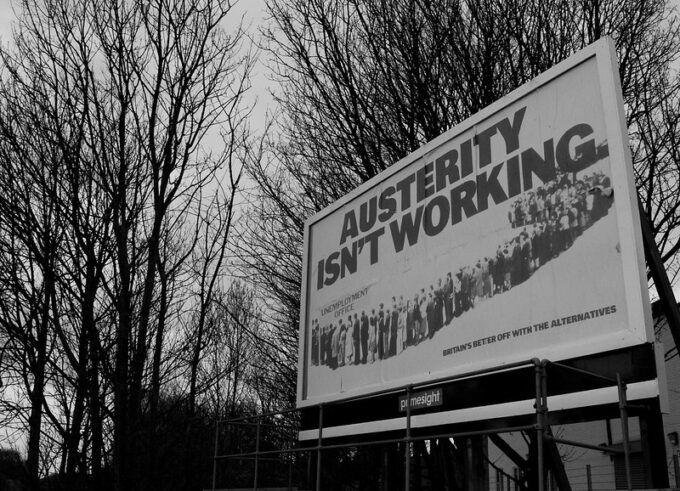
The Fed’s Austerity Program to Reduce Wages

 FacebooTwitter

Photograph Source: wandererwandering – CC BY 2.0

The Federal Reserve Board’s ostensible policy aim is to manage the money supply and bank credit in a way that maintains price stability. That usually means fighting inflation, which is blamed entirely on “too much employment,” euphemized as “too much money.”[1] In Congress’s more progressive days, the Fed was charged with a second objective: to promote full employment. The problem is that full employment is supposed to be inflationary – and the way to fight inflation is to reduce employment, which is viewed simplistically as being determined by the supply of credit.

So in practice, one of the Fed’s two directives has to give. And hardly by surprise, the “full employment” aim is thrown overboard – if indeed it ever was taken seriously by the Fed’s managers. In the Carter Administration (1977-80) leading up to the great price inflation of 1980, Fed Chairman Paul Volcker expressed his economic philosophy in a note card that he kept in his pocket, to whip out and demonstrate where his priority lay. The card charted the weekly wage of the average U.S. construction worker.

Chairman Volcker wanted wages to go down, blaming the inflation on too much employment – meaning too full. He pushed the U.S. bank rate to an unprecedented 20 percent – the highest normal rate since Babylonian times back in the first millennium BC. This did indeed crash the economy, and with it employment and prosperity. Volcker called this “harsh monetary medicine,” as if the crash of financial markets and economic growth showed that his “cure” for inflation was working.

Apart from employment and wage levels, another victim of Volcker’s interest-rate hike was the Democratic Party’s fortunes in the 1980 presidential election. They lost the White House for twelve years. The party thus is taking great courage – or simply being ignorant – by entering on this autumn’s midterm election by emulating Mr. Volcker’s attempt to drive down wage levels by financial tightening, which already has crashed the stock market by 20 percent.

President Biden has thoroughly backed up Republican-appointed Federal Reserve Chairman Jerome Powell in endorsing a financial crash in hope that it will roll back U.S. wage levels. That is the policy of the Democratic Party’s donor class and hence political constituency.

To Wall Street and its backers, the solution to any price inflation is to reduce wages and public social spending. The orthodox way to do this is to push the economy into recession in order to reduce hiring. Rising unemployment will oblige labor to compete for jobs that pay less and less as the economy slows.

This class-war doctrine is the prime directive of neoliberal economics. It is a feature of the tunnel vision of corporate managers and the One Percent, the Federal Reserve and IMF are its most prestigious lobbyists. Along with Janet Yellen at the Treasury, public discussion of today’s U.S. inflation is framed in a way that avoids blaming the 8.2 percent rise in consumer prices on the Biden Administration’s New Cold War sanctions on Russian oil, gas and agriculture, or on oil companies and other sectors using these sanctions as an excuse to charge monopoly prices as if America has not continued to buy Russian diesel oil, as if fracking has not picked up and as if corn is not being turned into biofuel. There has been no disruption in supply. We are simply dealing with monopoly rent by the oil companies using the anti-Russian sanctions as an excuse that an oil shortage will soon develop for the United States and indeed for the entire world economy.

Covid’s shutdown of the U.S. and foreign economies and foreign trade also is not acknowledged as disrupting supply lines and raising shipping costs and hence import prices. The entire blame for inflation is placed on wage earners, and the response is to make them the victims of the coming austerity, as if their wages are responsible for bidding up oil prices, food prices and other prices resulting from the crisis. The reality is that they are too debt-strapped to be spendthrifts.

The Fed’s Junk Economics of What Bank Credit Is Spent On

The pretense behind the Fed’s recent increase in its discount rate by 0.75 percent on June 15 (to a paltry range of 1.50% to 1.75%) is that raising interest rates will cure inflation by deterring borrowing to spend on the basic needs that make up the Consumer Price Index and its related GDP deflator. But banks do not finance much consumption, except for credit card debt, which in the United States is now less than student loans and automobile loans.

Banks lend almost entirely to buy real estate, stocks and bonds, not goods and services. Some 80 percent of bank loans are real estate mortgages, and most of the remainder are loans collateralized by stocks and bonds. So raising interest rates will not lead wage-earners to borrow less to buy consumer goods. The main price effect of less bank credit and higher interest rates is on asset prices – deterring borrowing to buy homes, as well as for arbitragers and corporate raiders to buy stocks and bonds.

Rolling Back Middle-Class Home Ownership

The most immediate effect of the Federal Reserve’s credit tightening will be to reduce America’s home-ownership rate. This rate has been falling since 2008, from nearly 68 percent to just 61 percent today. The decline got underway with President Obama’s eviction of nearly ten million victims of junk mortgages, mainly black and Hispanic debtors. That was the Democratic Party’s alternative to writing down fraudulent mortgage loans to realistic market prices, and reducing their carrying charges to bring them in line with market rental values. The indebted victims of this massive bank fraud were made to suffer, so that Obama’s Wall Street sponsors could keep their predatory gains and indeed, receive massive bailouts. The costs of their fraud fell on bank customers, not on the banks and hence on their stockholders and bondholders.

The effect of discouraging new home buyers by raising interest rates lowers home ownership – the badge of being middle-class. Despite this, the United States is turning into a landlord economy. The Fed’s policy of raising interest rates will greatly increase the interest charges that prospective new home buyers will have to pay, pricing the carrying charge out of reach for many families.

As the United States has become more debt-ridden, more than 50 percent of the value of U.S. real estate already is held by mortgage bankers. Homeowners’ equity – what they own net of their mortgage debt – has fallen even faster than home ownership rates have declined.

Real estate is being transferred from “poor” hands to those of wealthy landlord corporations. Private capital companies – the funds of the One Percent – are going to pick up the pieces from the coming wave of foreclosures to turn homes into rental properties. Higher interest rates will not affect their cost of buying this housing, because they buy for all cash to make profits (actually, real estate rents) as landlords. Within another decade the nation’s home ownership rate may fall toward 50 percent (and homeowners’ equity even lower), turning the United States into a landlord economy instead of the promised middle-class home ownership economy.

The Coming Economic Austerity (Indeed, Debt-Burdened Depression) 

While home ownership rates have plunged for the population at large, the Fed’s “Quantitative Easing” has increased its subsidy of Wall Street’s financial securities from $1 trillion to $8.2 trillion – of which the largest gain has been in packaged home mortgages. This has kept housing prices from falling and becoming more affordable for home buyers. But the Fed’s support of asset prices ha saved many insolvent banks – the very largest ones – from going under. Sheila Bair of the FDIC singled out Citigroup, along with Countrywide, Bank of America and the other usual suspects. The working population is not considered to be too big to fail. Its political weight is small by comparison to that of Wall Street banks and other FIRE-sector donors.

Lowering the discount rate to only about 0.1 percent enabled the banking system to make a bonanza of gains by making mortgage loans at around 3.50 percent. And despite the stock market’s plunge of over 20 percent from nearly 36,000 to under 30,000 on June 17, America’s wealthiest One Percent, and indeed the top 10 Percent, have vastly increased their wealth in stocks, while the bond market has had the largest boom in history. But most Americans have not benefitted from this runup in asset prices, because most stocks and bonds are owned by only the wealthiest layer of the population. The Fed is all in favor of asset-price inflation. But For most American families, corporations and government at all levels, the financial boom since 2008 has entailed a growing debt burden. Many families face insolvency as Federal Reserve policy aims to create unemployment. Now that the Covid moratorium on the evictions of renters behind in their payments is expiring, the ranks of the homeless are rising.

The Biden Administration is trying to blame today’s inflation and related distortions on Putin, even using the term “Putin inflation.” The mainstream media follow suit in not explaining to their audience that Western sanctions blocking Russian energy and food exports will cause a food and energy crisis for many countries this summer and autumn. And indeed, beyond: Biden’s military and State Department officers warn that the fight against Russia is just the first step in their war against China’s non-neoliberal economy, and may last twenty years.

That portends a long depression. But as Madeline Albright would say, they think that the price is “worth it.” Biden’s cabinet depicts this New Cold War as a fight of the “democratic” United States – “democracy” being a euphemism for privatizing economic planning in the hands of the largest banks “too big to fail” and other members of the neo-rentier class – in opposition to “autocratic” China and even Russia – being “autocratic” for treating banking and money creation as a public utility to finance tangible economic growth, not financialization, and otherwise resisting Western neoliberal takeover.

There is no evidence that America’s neoliberal-neoconservative New Cold War can restore the nation’s former industrial and related economic power. The economy cannot recover as long as today’s debt overhead is left in place. Debt service, housing costs, privatized medical care, student debt and a decaying infrastructure have made the U.S. economy uncompetitive. There is no way to restore its economic viability without reversing these neoliberal policies. But there is little “reality economics” at hand to provide an alternative to the class war inherent in neoliberalism’s belief that the economy and living standards can prosper by purely financial means, by debt leveraging and corporate monopoly rent extraction while the United States has made its manufacturing uncompetitive – seemingly irreversibly.

The Rentier Class Has Sought to Make America’s Neoliberal Privatization and Financialization Irreversible

It has succeeded to such a degree that there is no party or economic constituency promoting the policies needed for an industrial recovery. Yet the Democratic Party leadership, subjecting the economy to an IMF-style austerity plan, will make this November’s midterm elections unique. For the past half century, the Fed’s role has been to provide easy money for the economy, to give the ruling party at least the illusion of trickle-down prosperity to deter voters from electing the opposition party. But this time the Biden Administration is running on a program of financial austerity.

The Party’s identity politics address almost every identity except that of wage-earners and debtors. That does not look like a platform that can succeed. But as the ghost of Margaret Thatcher no doubt is telling them: “There Is No Alternative.”

Michael Hudson’s new book, The Destiny of Civilization, will be published by CounterPunch Books next month.

NATO: by Making China the Enemy, the Alliance Is Threatening World Peace

NATO’s new posture towards Beijing brings into question its whole claim to be a 'defensive' alliance

 Posted on

As the saying goes, if you only have a hammer, every problem looks like a nail. The West has the North Atlantic Treaty Organization (NATO), a self-declared “defensive” military alliance – so any country that refuses its dictates must, by definition, be an offensive military threat.

That is part of the reason why NATO issued a new “strategic concept” document last week at its summit in Madrid, declaring for the first time that China poses a “systemic challenge” to the alliance, alongside a primary “threat” from Russia.

Beijing views this new designation as a decisive step by NATO on the path to pronouncing it a “threat” too – echoing the alliance’s escalatory approach towards Moscow over the past decade. In its previous mission statement, issued in 2010, NATO advocated “a true strategic partnership” with Russia.

According to a report in the New York Times, China would have found itself openly classed as a “threat” last week had it not been for Germany and France. They insisted that the more hostile terminology be watered down so as to avoid harming their trade and technology links with China.

In response, Beijing accused NATO of “maliciously attacking and smearing” it, and warned that the alliance was “provoking confrontation.” Not unreasonably, Beijing believes NATO has strayed well out of its sphere of supposed “defensive” interest: the North Atlantic.

NATO was founded in the wake of the Second World War expressly as a bulwark against Soviet expansion into Western Europe. The ensuing Cold War was primarily a territorial and ideological battle for the future of Europe, with the ever-present mutual threat of nuclear annihilation.

So how, Beijing might justifiably wonder, does China – on the other side of the globe – fit into NATO’s historic “defensive” mission? How are Chinese troops or missiles now threatening Europe or the US in ways they weren’t before? How are Americans or Europeans suddenly under threat of military conquest from China?

Creating enemies

The current NATO logic reads something like this: Russia’s invasion of Ukraine in February is proof that the Kremlin has ambitions to recreate its former Soviet empire in Europe. China is growing its military power and has similar imperial designs towards the rival, breakaway state of Taiwan, as well as western Pacific islands. And because Beijing and Moscow are strengthening their strategic ties in the face of western opposition, NATO has to presume that their shared goal is to bring western civilization crashing down.

Or as last week’s NATO mission statement proclaimed: “The deepening strategic partnership between the People’s Republic of China and the Russian Federation and their mutually reinforcing attempts to undercut the rules-based international order run counter to our values and interests.”

But if anyone is subverting the “rules-based international order,” a standard the West regularly invokes but never defines, it looks to be NATO itself – or the US, as the hand that wields the NATO hammer.

That is certainly the way it looks to Beijing. In its response, China argued: “Thirty years after the end of the Cold War, [NATO] has not yet abandoned its thinking and practice of creating ‘enemies’ … It is NATO that is creating problems around the world.”

China has a point. A problem with bureaucracies – and NATO is the world’s largest military bureaucracy – is that they quickly develop an overriding institutional commitment to ensuring their permanent existence, if not expansion. Bureaucracies naturally become powerful lobbies for their own self-preservation, even when they have outlived their usefulness.

If there is no threat to “defend” against, then a threat must be manufactured. That can mean one of two things: either inventing an imaginary threat, or provoking the very threat the bureaucracy was designed to avert or thwart. Signs are that NATO – now embracing 30 countries – is doing both.

Remember that NATO should have dissolved itself after the fall of the Soviet Union in 1991. But three decades later, it is bigger and more resource-hungry than ever.

Against all advice, and in violation of its promises, NATO has refused to maintain a neutral “security buffer” between itself and Russia. Instead, it has been expanding right up to Russia’s borders, including creeping furtively into Ukraine, the gateway through which armies have historically invaded Russia.

Offensive alliance

Undoubtedly, Russia has proved itself a genuine threat to the territorial integrity of its neighbor Ukraine by conquering its eastern region – home to a large ethnic Russian community the Kremlin claims to be protecting. But even if we reject Russian President Vladimir Putin’s repeated assertion that Moscow has no larger ambitions, the Russian army’s substantial losses suggest it has scant hope of extending its military reach much further.

Even if Moscow were hoping to turn its attention next to Poland or the Baltic states, or NATO’s latest recruits of Sweden and Finland, such a move would clearly risk nuclear confrontation. This is perhaps why western audiences hear so much from their politicians and media about Putin being some kind of deranged megalomaniac.

The claim of a rampant, revived Russian imperialism appears not to be founded in any obvious reality. But it is a very effective way for NATO bureaucrats to justify enlarging their budgets and power, while the arms industries that feed off NATO and are embedded in western capitals substantially increase their profits.

The impression that this might have been NATO’s blueprint for handling Moscow is only underscored by the way it is now treating China, with even less justification. China has not recently invaded any sovereign territories, unlike the US and its allies, while the only territory it might threaten – Taiwan – is some 12,000 kilometers from the US mainland, and a similarly long distance from most of Europe.

The argument that the Russian army may defeat Ukraine and then turn its attention towards Poland and Finland at least accords with some kind of geographical possibility, however remote. But the idea that China may invade Taiwan and then direct its military might towards California and Italy is in the realms of preposterous delusion.

NATO’s new posture towards Beijing brings into question its whole characterization as a “defensive” alliance. It looks very much to be on the offensive.

Russian red lines

Notably, NATO invited to the summit for the first time four states from the Asia-Pacific region: Australia, Japan, New Zealand and South Korea.

The creation of a NATO-allied “Asia-Pacific Four” is doubtless intended to suggest to Beijing parallels with NATO’s gradual recruitment of eastern European states starting in the late 1990s, culminating in its more recent flirting with Ukraine and Georgia, long-standing red lines for Russia.

Ultimately, NATO’s courting of Russia’s neighbors led to attacks by Moscow first on Georgia and then on Ukraine, conveniently bolstering the “Russian threat” narrative. Might the intention behind similar advances to the “Asia-Pacific Four” be to provoke Beijing into a more aggressive military stance in its own region, in order to justify NATO expanding far beyond the North Atlantic, claiming the entire globe as its backyard?

There are already clear signs of that. In May, US President Joe Biden vowed that the US – and by implication NATO – would come to Taiwan’s aid militarily if it were attacked. Beijing regards Taiwan, some 200 kilometers off its coast, as Chinese territory.

Similarly, British Foreign Secretary Liz Truss called last week for NATO countries to ship advanced weapons to Taiwan, in the same way NATO has been arming Ukraine, to ensure the island has “the defense capability it needs.”

This echoes NATO’s narrative about its goals in Ukraine: that it is pumping weapons into Ukraine to “defend” the rest of Europe. Now, NATO is casting itself as the guardian of the Asia-Pacific region too.

‘Economic coercion’

But in truth, this is not just about competing military threats. There is an additional layer of western self-interest, concealed behind claims of a “defensive” alliance.

Days before the NATO summit, the G7, a group of the seven leading industrialized nations that form the core of NATO, announced their intention to raise $600bn to invest in developing countries.

This move wasn’t driven by altruism. The West has been deeply worried by Beijing’s growing influence on the world stage through its trillion-dollar Belt and Road Initiative, announced in 2013.

China is being aggressive, but so far only in exercising soft power. In the coming decades, it plans to invest in the infrastructure of dozens of developing states. More than 140 countries have so far signed up to the initiative.

China’s aim is to make itself the hub of a global network of new infrastructure projects – from highways and ports to advanced telecommunications – to strengthen its economic trade connections to Africa, the Middle East, Russia and Europe.

If it succeeds, China will stamp its economic dominance on the globe – and that is what really worries the West, particularly the US and its NATO military bureaucracy. They are labeling this “economic coercion.”

This week, the heads of the FBI and MI5 – the US and UK’s domestic intelligence services – held an unprecedented joint news conference in London to warn that China was the “biggest long-term threat to our economic and national security.” Underscoring western priorities, they added that any attack on Taiwan would “represent one of the most horrific business disruptions the world has ever seen.”

Unilateral aggression

Back in the Cold War era, Washington was not just, or even primarily, worried about a Soviet military invasion. The nuclear doctrine of mutually assured destruction meant neither had an interest in direct confrontation.

Instead, each treated developing nations as pawns in an economic war over resources to be plundered and markets to be controlled. Each side tried to expand its so-called “sphere of influence” over other states and secure a larger slice of the planet’s wealth, in order to fuel its domestic economy and expand its military industries.

The West’s rhetoric about the Cold War emphasized an ideological battle between western freedoms and Soviet authoritarianism. But whatever significance one attributes to that rhetorical fight, the more important battle for each side was proving to other states the superiority of the economic model that grew out of its ideology.

In the early Cold War years, it should be recalled, communist parties were front-runners to win elections in several European states – something that was starkly evident to the drafters of the NATO treaty.

The US invested so heavily in weapons – today, its military budget exceeds the combined spending of the next nine countries – precisely to strong-arm poorer nations into its camp, and punish those that refused. That task was made easier after the fall of the Soviet Union. In a unipolar world, Washington got to define who would be treated as a friend, and on what terms, and who a foe.

NATO chiefly served as an alibi for US aggression, adding a veneer of multilateral legitimacy to its largely unilateral militarism.

Debt slavery

In reality, the “rules-based international order” comprises a set of US-controlled economic institutions, such as the World Bank and the International Monetary Fund, that dictate oppressive terms to increasingly resentful poor countries – often the West’s former colonies – in desperate need of investment. Most have ended up in permanent debt slavery.

China is offering them an alternative, and in the process it threatens to gradually erode US economic dominance. Russia’s apparent ability to survive the West’s economic sanctions, while those sanctions rebound on western economies, underscores the tenuousness of Washington’s economic primacy.

More generally, Washington is losing its grip on the global order. The rival BRICS group – of Brazil, Russia, India, China and South Africa – is preparing to expand by including Iran and Argentina in its power bloc. And both Russia and China, forced into deeper alliance by NATO hostility, have been seeking to overturn the international trading system by decoupling it from the US dollar, the central pillar of Washington’s hegemonic status.

The recently released “NATO 2030” document stresses the importance of NATO remaining “ready, strong and united for a new era of increased global competition.” Last week’s strategic vision listed China’s sins as seeking “to control key technological and industrial sectors, critical infrastructure, and strategic materials and supply chains.” It added that China “uses its economic leverage to create strategic dependencies and enhance its influence,” as though this was not exactly what the US has been doing for decades.

Washington’s greatest fear is that, as its economic muscle atrophies, Europe’s vital trading links with China and Russia will see its economic interests – and eventually its ideological loyalties – shift eastwards, rather than stay firmly in the western camp.

The question is: how far is the US willing to go to stop that? So far, it looks only too ready to drag NATO into a military sequel to the Cold War – and risk pushing the world to the brink of nuclear annihilation.

Jonathan Cook won the Martha Gellhorn Special Prize for Journalism. His latest books are Israel and the Clash of Civilizations: Iraq, Iran and the Plan to Remake the Middle East (Pluto Press) and Disappearing Palestine: Israel’s Experiments in Human Despair (Zed Books). His website is www.jonathan-cook.net. This originally appeared in the Middle East Eye.

Author: Jonathan Cook

Jonathan Cook is a writer and journalist based in Nazareth, Israel. His latest books are Israel and the Clash of Civilizations: Iraq, Iran, and the Plan to Remake the Middle East (Pluto Press) and Disappearing Palestine: Israel's Experiments in Human Despair (Zed Books). Visit his Web site

ANTIWAR.COM