Thursday, July 14, 2022

Shireen Abu Akleh killing: Why all journalists must push for justice

To honour the Al Jazeera correspondent's legacy, we must identify those responsible and insist that they be held to account


Peter Oborne
1 July 2022 

Family and friends of slain Palestinian journalist Shireen Abu Akleh hold a vigil in Bethlehem on 16 May 2022 (AFP)

There’s a journalists’ altar at St Bride’s Church, the Christopher Wren architectural masterpiece a few yards south of London’s Fleet Street.

On this sacred spot, the best and the bravest among us are remembered. Those who gave their lives, to tell the truth about corruption, injustice, and oppression. The ones who must never be forgotten.

Anna Politkovskaya refused to give up her reporting on the Second Chechen War despite death threats and was fatally shot. Daphne Caruana Galizia, the Maltese investigative reporter assassinated in 2017, is also remembered there, as is Lyra Catherine McKee, shot dead while reporting on a riot in Derry.

If western journalists don't seek justice for Abu Akleh, we are complicit in her killing

Jamal Khashoggi, barbarously sliced up by Saudi Crown Prince Mohammed bin Salman's goons in the Saudi Arabian consulate in Istanbul, has his place on the altar of heroic sacrifice, as does Marie Colvin, killed by Syrian President Bashar al-Assad’s army in Homs.

This week, a new name joined the list of martyrs who have made the supreme sacrifice and given their lives, to tell the truth: Shireen Abu Akleh, in all likelihood shot by an Israeli sniper in Jenin in the northern West Bank on 11 May. Her funeral two days later was grotesquely disrupted when Israeli police attacked mourners in occupied East Jerusalem.

This desecration shaped the service at St Bride’s. Journalist Penelope Quinton, who organised the service, told me: “Not only did they take away her life, they took away her dignity as she was laid to rest. The principle that her funeral should be allowed to pass with dignity was violated.”
'She was a mother to me'

Events at the funeral explained why Quinton chose to include in the service Edward Elgar’s famous anthem: “They are at rest; we may not stir the heaven of their repose by rude invoking voice".

The choir also sang John Tavener’s Song for Athene as a tribute to the indomitable spirit of Abu Akleh. Athene is the Greek goddess of war and intellect, the two intermingled spheres in which Abu Akleh spent her life.

The St Bride’s memorial was filled with song, biblical readings, superlative choral verses, and profoundly moving addresses from some of those who knew Abu Akleh best and loved her deeply.

Ali al-Samoudi, the Al Jazeera journalist who was with Abu Akleh when she was killed and only recently came out of hospital after being badly injured in the same incident, spoke in Arabic via video link. He marvelled at Abu Akleh’s deep religious faith: “She took her rosary everywhere and always gave money to those in need."
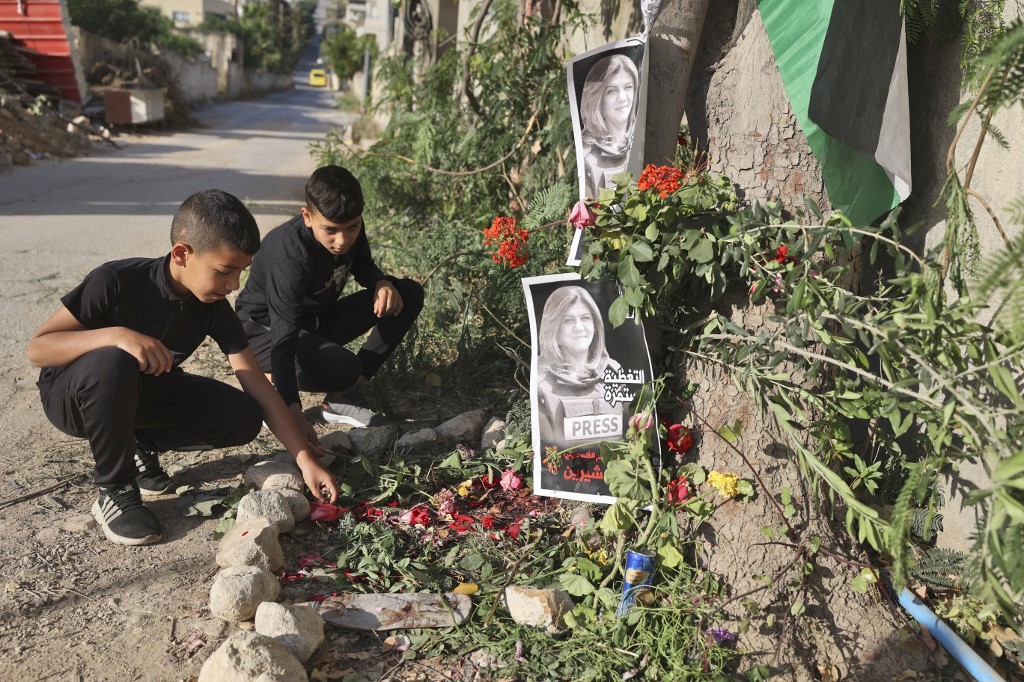
Children visit the site where Abu Akleh was shot dead in Jenin on 12 May 2022 (AFP)

Samoudi, a veteran correspondent, did not tell his audience that - by an astonishing coincidence - two decades ago, he himself was reportedly blown into the air by an Israeli tank shell in exactly the same place that Abu Akleh was killed. He miraculously survived.

Najwan Simri, another Al Jazeera colleague, spoke in Arabic of the irreparable personal loss she felt upon Abu Akleh’s death: “She was a mother to me. She was a sister to me.”

The great British Palestinian singer Reem Kelani brought tears to the eyes of many in the congregation with a breathtaking rendition of The Singer Said, which features lyrics by Palestinian poet Mahmoud Darwish.

Some of the words could have been written specifically to describe Abu Akleh’s final moments on earth: “This is how I died / standing, standing / I died like the trees.”
Minute of silence

But we were not there only to mourn and honour Abu Akleh. The congregation stood for a minute of silence to remember the names of all those who have died covering the Israel-Palestine conflict.

Among them were Yusef Abu Hussein, killed in an Israeli air raid last year; Yasser Murtaza, shot dead while covering the 2018 Gaza protests; and so on, and so on.

Among the congregation were journalist Duncan Campbell and his wife, the great actress Julie Christie, and four MPs: former Labour leader Jeremy Corbyn, John McDonnell, Tommy Sheppard, and Claudia Webbe. Quinton told me that she had invited many Tory MPs, but I could see none among the congregation. She said she had invited Foreign Secretary Liz Truss, but did not receive a response; she also invited many members of the Labour front bench, but none were at the service.


Shireen Abu Akleh killing: The West cannot wash away the stain of complicity
Read More »

On the media front, none of the BBC, Sky News, the New York Times, the AP, or AFP had an official presence at the service. Don Macintyre, a veteran political journalist who served as Jerusalem correspondent for the Independent, was among the congregation.

After the service, I spoke with Nadia Nasser Najjab, Abu Akleh’s close friend from the days when they both taught at Birzeit University (Abu Akleh taught English literature before her move into journalism). “I believe that if the case of Shireen is kept alive,” Najjab said, “the case of other Palestinians killed will also be kept alive."

Speaking for the family, Abu Akleh’s niece, Lina, noted that: “Shireen always was a hopeful person and believed that there will be justice for Palestine.”
Lessons learned

I believe there are lessons we journalists must take from Abu Akleh’s magnificent career: report the facts accurately, truthfully, and never give up. Don’t walk on eggshells. Spit it out. Never use the passive tense. Remember how many news outlets reported that Abu Akleh “died” in “clashes”?

She didn’t die. She was killed. To honour her legacy, we need to stick with this story, identify who killed her and who gave the orders, and then insist that they be held to account.

Shireen Abu Akleh was an American citizen and well-known reporter working for a celebrated international news organisation. If we don’t get justice for her, there will never be justice for any Palestinian journalist - or any Palestinian.

One final reflection: if western journalists don’t seek justice for Abu Akleh, we are complicit in her killing.

The views expressed in this article belong to the author and do not necessarily reflect the editorial policy of Middle East Eye.

Peter Oborne won best commentary/blogging in both 2022 and 2017, and was also named freelancer of the year in 2016 at the Drum Online Media Awards for articles he wrote for Middle East Eye. He was also named as British Press Awards Columnist of the Year in 2013. He resigned as chief political columnist of the Daily Telegraph in 2015. His latest book, The Assault on Truth: Boris Johnson, Donald Trump and the Emergence of a New Moral Barbarism, was published in February 2021 and was a Sunday Times Top Ten Bestseller. His previous books include The Triumph of the Political Class, The Rise of Political Lying, and Why the West is Wrong about Nuclear Iran.

SEE
Shireen Abu Akleh: US senators say Biden's handling of investigation is neither credible nor independent

In two separate letters, Democrats demand accountability over slain Palestinian-American journalist who was killed by an Israeli bullet


A picture taken on 6 July 2022 shows a mural depicting slain Al Jazeera journalist Shireen Abu Akleh (AFP)

By MEE staff
Published date: 13 July 2022 

Senate Democrats have criticised a US-led review of the killing of Palestinian-American journalist Shireen Abu Akleh, arguing that the probe "hardly constitutes an independent investigation".

Abu Akleh, a veteran journalist with Al Jazeera Arabic, was killed on 11 May during an Israeli military raid in the Jenin refugee camp. Her death sparked outrage among Palestinians and widespread international condemnation.

Since the killing, investigations by Middle East Eye, The Washington Post, The New York Times, as well as international bodies and the United Nations, have lent support to eyewitness accounts that Abu Akleh was killed by Israeli forces.


Burying bad news: US condemned over report on Shireen Abu Akleh's killing
Read More »

In a letter addressed to US President Joe Biden on Tuesday, pro-Israel lawmaker Senator Bob Menendez wrote that the administration had not provided any details of a "thorough… credible investigation" into the killing.

Menendez, along with co-signatory Senator Corey Booker, urged Biden to provide a senior-level classified briefing on the investigation's details and what steps the administration would take next regarding accountability.

"We urge you to raise Ms Abu Akleh's case at the highest levels and press for accountability during your upcoming visit to Israel and the West Bank. We also ask for continued US participation in transparent and timely investigations into any remaining or new evidence," the letter said.

In a separate communique to Secretary of State Antony Blinken, Senators Chris Van Hollen, Patrick Leahy, Chris Murphy, and Dick Durbin criticised the US's forensic analysis of the bullet that killed Abu Akleh as insufficient and pressed the administration for further details on the investigation.

"While we were glad to see the USSC [US Security Coordinator] involved in an independent forensic analysis of the bullet that killed Ms Abu Akleh, that hardly constitutes an independent investigation into the overall circumstances of her killing," the letter said.

Ensuring accountability


In the second letter, the lawmakers also said that the administration failed to live up to Blinken's call for an "independent, credible investigation" into Abu Akleh's killing.

The forensic analysis fails to meet "any plausible definition of the 'independent' investigation that you and members of Congress have called for," the lawmakers wrote. "Nor does it provide the transparency that this case demands."

The lawmakers specifically questioned what led the USSC to conclude that gunfire from the positions of Israeli forces likely killed Abu Akleh, and how the USSC determined that the shooting was unintentional.


"What steps will you take to ensure the 'independent, credible' investigation you called for?" the letter continued, further asking, "What steps do you plan to take to ensure… accountability?"

Palestinian activists have criticised the State Department's probe into the killing and the decision to make it public on 4 July – US Independence Day – a major national holiday when many people are spending time with their families and not focusing on the news.

Abu Akleh's family has described Washington's assessment as "frankly insulting to Shireen's memory" and demanded that Biden meets with them during his visit to Israel this week.

The White House did not immediately respond to MEE's request for comment on the letters.

Slain Palestinian American reporter’s family ‘outraged’ as Biden arrives in Israel


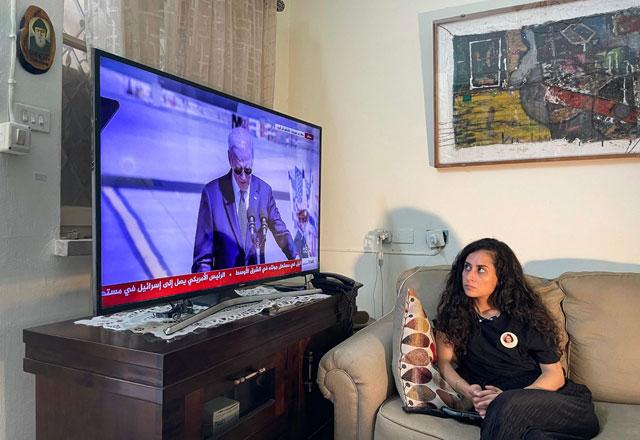
Lina Abu Akleh, the niece of slain Al Jazeera journalist Shireen Abu Akleh, watches on a television screen at the family home in occupied East Jerusalem, the speech of US President Joe Biden, upon his arrival at Tel Aviv’s Ben Gurion Airport, on Wednesday (AFP photo)

By AFP - Jul 13,2022 - 

OCCUPIED JERUSALEM — The niece of slain Palestinian American journalist Shireen Abu Akleh expressed “outrage” on Wednesday as US President Joe Biden arrived in Israel, condemning Washington for inaction over her killing.

Lina Abu Akleh watched on television from her home in Israeli-occupied East Jerusalem as Air Force One touched down near Tel Aviv, just over two months after her aunt, a veteran Al Jazeera correspondent, was shot in the head while covering an Israeli army raid in the occupied West Bank.

The United Nations concluded she was killed by Israeli fire in Jenin, while wearing a helmet and vest marked “Press”. The family is adamant she was deliberately targeted, which Israel denies.

Drawing on rival probes by the Israelis and Palestinians, the US State Department concluded on July 4 that she was likely shot from an Israeli military position, but said there was no evidence of intent to kill.

“Sadness, outrage and, just, upset,” said Lina on watching Biden arrive, describing feelings stemming from “the lack of action they [the US] have taken towards the case of Shireen”.

“The amount of power that the US administration has to make a change, yet, not taking that political choice to do that, is very frustrating,” said the 27-year-old, dressed in black.

“They either choose their interests with Israel, or they carry out a meaningful effort towards accountability and justice for Shireen,” she added.

US Secretary of State Antony Blinken called Lina while en route to Tel Aviv with the president, inviting the family to Washington.

But Lina said they are still awaiting a response to their request to meet with the president during his time in Jerusalem.

Portraits of Shireen hang at the entrance to their home, while the journalist’s dog lay at Lina’s feet.

As Al Jazeera broadcast footage of Biden’s arrival, Lina said she has still not got used to the absence of her aunt’s voice on the network.

“It’s so weird watching this because Shireen would have been the one” covering such events, she said.

‘Still in grief’ 

During Biden’s talks with Israeli Prime Minister Yair Lapid, the Abu Akleh family hopes the president will press his host for details about the journalist’s killing on May 11.

Lina said that the Israeli authorities have the name of the soldier who shot her aunt.

Rashida Tlaib, a US congresswoman of Palestinian origin, has said the president “must obtain the names of the soldiers responsible for killing Shireen, along with that of their commanding officer”.

The Democrat lawmaker has also echoed the Abu Akleh family’s call for US authorities to launch their own probe, one that would see “these individuals... fully prosecuted for their crimes by the Department of Justice”.

Israeli Defence Minister Benny Gantz said last week it remained impossible to determine the source of the shooting, and “the investigation will continue”.

The Israeli forces’ top lawyer has not ruled out criminal charges against an individual soldier over Abu Akleh’s killing but said prosecution was unlikely, as she was shot in what the military deemed a scene of active combat.

Biden did not mention the case in his remarks on landing in Israel, before embarking on his two-night stay during which he will also meet with Palestinian President Mahmud Abbas.

In Jerusalem, the Abu Akleh family is still coming to terms with the killing of the star reporter.

“We’re mourning, we’re still in grief. It’s a huge shock,” said Lina, with a badge of Shireen pinned to her chest.

“But we are not discouraged — we will continue our fight for justice and accountability for Shireen.”

SEE

Israel's homeless population growing

but response anemic, report says

Study shows that hundreds of cases of street dwellers that are treated on a local level go unreported each year as resources allocated barely cover a fraction of group's needs

Hadar Gil-ad|
Published: 07.10.22, 

Israel's homeless population has been growing steadily in recent years, already numbering in the thousands, but the state does not adequately address its needs, a new Knesset report published last week found.
  • Follow Ynetnews on Facebook and Twitter

  • "Treatment of homeless people is done in several different ways, both through government ministries and through local authorities, but like we see in other phenomena, here too there is a lack of holistic understanding of all the resources needed [to prevent people from winding up on the street] and rehabilitation," MK Yasmin Sacks Friedman, who commissioned the report, said.
    דרי רחוב בדרום תל אביב
    Homeless people in the southern parts of Tel Aviv
    (Photo: Yariv Katz)
    Many homeless people in Israel are struggling with mental issues, drug addiction and chronic diseases that are left unattended. Feeling abandoned and increasingly wary of society, many of them avoid seeking help.
    The report points to glaring gaps between Welfare Ministry data on the country's homeless population and that of local authorities.
    According to ministry data, some 2,000 individuals experiencing homelessness received aid in 2019. Their number grew to 2,250 the following year, 86% of them were men and 67% were aged 26-55.
    On the other hand, according to data collected by the Welfare Ministry from 89 departments for social services in local authorities, about 3,470 homeless people were treated in 2020 when about 29% received short-term treatment that was not reported or treated but not registered as homeless.
    דרי רחוב מתגודדים במחסה באזור התחנה המרכזית הישנה
    (Photo: Dana Kopel)
    In addition, local authorities report about 800 street dwellers in their jurisdiction who are not treated, of whom 345 are not interested in receiving care or are unmotivated to receive it, and about 455 other street dwellers who are not recognized, but authorities know or estimate they live in their jurisdiction.
    The report's authors point out that these discrepancies in data collection demonstrate the ambiguity around the size of Israel's homeless population and that the country's homeless shelters can house only about a third of its street dwellers.
    Israel: Elections are a sideshow as army and settlers call the shots

    The depressing truth about Israeli politics today is that the upcoming election may yield the same inconclusive outcome as the previous four

    Richard Silverstein
    30 June 2022

    Israeli Prime Minister Naftali Bennett and Foreign Minister Yair Lapid attend a session at the plenum at the Knesset, Israel's parliament, in Jerusalem on 30 June 2022 (Reuters)


    On Monday, Israel’s coalition government led by Prime Minister Naftali Bennett dissolved itself after a year in office. Bennett’s party, Yamina, originally held a thin one-seat majority in the 120-member Knesset.

    But Bennett had successively lost MKs who abandoned the coalition. Most left because they felt Bennett’s unwieldy melding of parties from across the political spectrum, right to left, betrayed their nationalist values.
    Why Israel's collapsed 'coalition of change' was no longer worth savingRead More »

    It didn’t help Bennett that Likud, the opposition party led by former Prime Minister Benjamin Netanyahu, waged intense efforts from the day the new government took office to poach MKs and cause the government’s fall.

    After intense deliberations with the defectors and further threats by others to bolt, Bennett realised that he no longer had a stable coalition, and that the only alternative was dissolution. He also wanted to pre-empt a no-confidence defeat, causing the electorate to perceive him as a loser. Going out on his own terms was far preferable.

    Among the blandishments Likud offered to MKs who defected was a safe Likud seat in the next election if they deserted. Therefore, it was bizarre to see the very opposition which sought to topple the coalition actually try to stall the final vote on dissolution.

    The reason was simple: if they could peel off just a few MKs from the ruling coalition to switch to Likud, Netanyahu's camp could create its own "alternative government" and avoid elections. This ploy failed and the country will go to the fifth election in three years.

    On Wednesday, Bennett announced that he would not be running in the upcoming elections.

    Unprecedented stalemate

    The past three years have offered an unprecedented stalemate in the history of Israeli politics. It has put the business of governing into limbo for long periods, as governments rose and fell in quick succession.

    During that period, major policy issues could not be addressed for lack of consensus, and due to the refusal of key MKs to provide votes to pass legislation. Thus, a bill to preserve the legal status of settlers under Israeli law, rather than military courts, did not gain enough votes to pass.

    This stagnation emphasises that real power in the country lies not with elected officials, but with the army, police and intelligence apparatus

    Normally, everyone living in the West Bank - a territory under Israeli occupation - is ruled by military law. But historically, the Knesset offered legislation that exempted settlers.

    It was the highest priority of the right-wing coalition to renew it. But it was adamantly opposed by the Arab parties. The result was that two Palestinian MKs refused to vote for the legislation and it failed.

    The debate on the legislation featured the odd phenomenon of the leftist Meretz party, in the government coalition, supporting a bill that violated every principle it held dear, while Palestinian MKs in the coalition were excoriated for remaining true to their values and refusing to support it.

    The reason for these odd bedfellows was that the only glue that held the disparate political factions together was their determination to prevent Netanyahu from returning to power. It was the Anything-But-Bibi government.

    If the history of politics tells us anything, it is that a government built solely on opposition, and which cannot perform the elementary tasks of governing, will not survive.

    More of the same


    The depressing truth is that the upcoming Israeli election may offer more of the same: an outcome that offers a mandate to neither Likud nor its opponents. Polls of voter preferences for the coming election show the Likud winning the most seats, but its chances of forming a ruling coalition with other parties remain shaky.

    That would mean yet another period of uncertainty, as the various parties jockey for power, while the country finds itself, once again, without a functioning government.

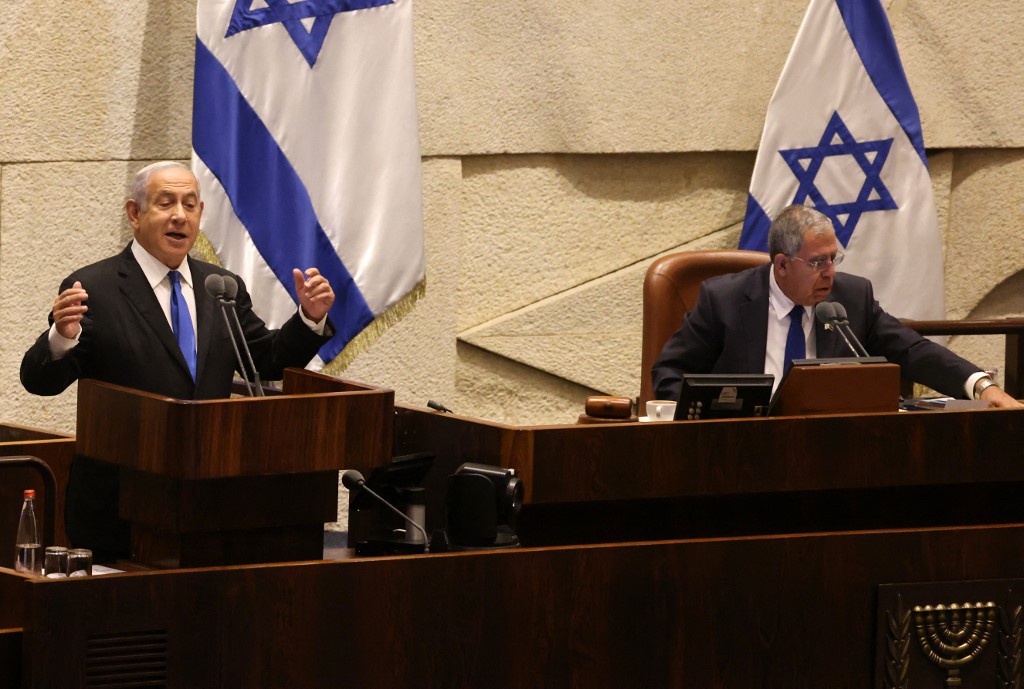
    Israeli former Prime Minister Benjamin Netanyahu (L) speaks before the Knesset (parliament), in Jerusalem on 30 June 2022.

    This stagnation further emphasises that real power in the country lies not with elected officials, but with the army, police and intelligence apparatus. That’s why Israel, during this period of instability, has continued land grabs against Palestinians, and continued its evictions of Palestinians from homes in Sheikh Jarrah. It’s why border police storm Muslim holy places.

    It is also why settlers march through Palestinian neighbourhoods in East Jerusalem chanting genocidal slogans to terrorise the Palestinian residents - all of which goes unchallenged by the political class.
    A garrison state

    Politicians no longer set the agenda. This vacuum has permitted the only sector of Israeli society which is united in its determination to pursue its interests: settlers and their powerful lobby.

    When a society that conceives of itself as a democracy cannot govern itself, and turns instead for stability to the army and intelligence services, it becomes a garrison state

    Because they are unelected, the army, police and intelligence services remain stable. They can pursue their strategic goals relentlessly with little interference.

    The political echelon cedes key decision-making to them and provides enormous budgets, permitting them to execute their plans.

    They hardly even need to lobby the Knesset for huge funding increases. Their status is sacrosanct. They are unassailable. No "mere" politician dare cross them.

    When a society that conceives of itself as a democracy cannot govern itself, and turns instead for stability to the army and intelligence services, it becomes a garrison state, rather than a democracy.

    The views expressed in this article belong to the author and do not necessarily reflect the editorial policy of Middle East Eye.


    Richard Silverstein writes the Tikun Olam blog, devoted to exposing the excesses of the Israeli national security state. His work has appeared in Haaretz, the Forward, the Seattle Times and the Los Angeles Times. He contributed to the essay collection devoted to the 2006 Lebanon war, A Time to Speak Out (Verso) and has another essay in the collection, Israel and Palestine: Alternate Perspectives on Statehood (Rowman & Littlefield) Photo of RS by: (Erika Schultz/Seattle Times)
    Jordan: From a nationalist uprising to backing an Arab-Israeli Nato

    In contrast to the 1950s anti-imperialist mobilisations against the Baghdad Pact, today the Americans and Jordanian king are confident in their plan to create a new military alliance with Israel

    Joseph Massad
    28 June 2022 

    King Abdullah II of Jordan stands for a photo with members of the US Senate at the US Capitol in Washington DC on 10 May 2022 (AFP)

    US alliances have not changed much in the last seven decades.

    In recent weeks, an active effort by the US and Israel to bring about yet another military alliance between Israel and a number of Arab countries against Iran has been afoot.

    A few days ago, Jordan’s King Abdullah announced on US television that he “would be one of the first people that would endorse a Middle East Nato.” He added: “I’d like to see more countries in the area come into that mix.”

    What Abdullah did not say explicitly is that Israel would be part of that mix. The Americans, however, have been more forthright.

    A White House spokesperson stated that the US "strongly support[s] Israel’s integration into the broader Middle East region, and this will be a topic of discussion when the president visits Israel."

    Meanwhile, Jordan has been not only working with Nato as the king averred, but it is also home to a number of extra-sovereign US military bases and facilities, over which it has no jurisdiction or control by virtue of the 2021 Defence Agreement the monarch signed with the Americans without parliamentary approval.
    A new alliance

    Days before the king made his comments, Israel’s Defence Minister Benny Gantz announced that Israel was joining several Arab countries to form a new US-led joint air defence network, called Middle East Air Defence Alliance (MEAD).

    Jordan is expected to be part of this joint air defence network. As King Abdullah is an absolute ruler and need not answer to anyone inside his country, he can make and unmake policy as he pleases.

    This does not mean that internal opposition to the new alliance will not emerge, but rather that the king is certain that his security agencies can neutralise any serious
     dissent quickly.

    Biden Middle East visit: Why an Israel-led security pact is a paper tiger
    Andreas Krieg 

    Such a military alliance aimed specifically at Iran, as well as Syria, Hezbollah, and Hamas, and belatedly at Russia, is not a new idea, although more formal arrangements are underway this time than previously.

    In 2006-2007, US Secretary of State Condoleezza Rice hoped that the new Middle East to which she, on behalf of the US, wanted to give birth, would include a US-led military alliance. At the time Rice was able to recruit Saudi Arabia, Egypt and Jordan to her new pact, but the times were not auspicious to fully and openly include Israel.

    It was, however, John Foster Dulles, as secretary of state under President Dwight Eisenhower, who was known for his "pactomania." His many efforts to establish military pacts around the world included the creation in 1955 of the Central Treaty Organisation or CENTO, better known as the Baghdad Pact, as the main anti-Soviet front in the Middle East.

    Besides Britain, Turkey, the Shah’s Iran, Pakistan, and Hashemite Iraq, the Americans worked hard to enlist Jordan but failed due to nationalist anti-imperialist opposition to King Hussein’s wishes. The pact was opposed not only by Nasser's Egypt but also by then anti-Hashemite Saudi Arabia.

    General Gerald Templer, Britain’s imperial chief of staff, visited Jordan on a mission to sell the pact to its rulers.

    The king and his prime minister, Hazza’ al-Majali, supported the venture, while the anti-colonial nationalist tide in the country, as well as Jordan's Muslim Brotherhood, vehemently opposed it. In the Jordanian army, then led by British Lieutenant-General John Bagot Glubb, an anti-imperialist group of “Free Officers” opposed the pact.

    They insisted that the enemies of Jordan were the British and Israel and not the USSR.

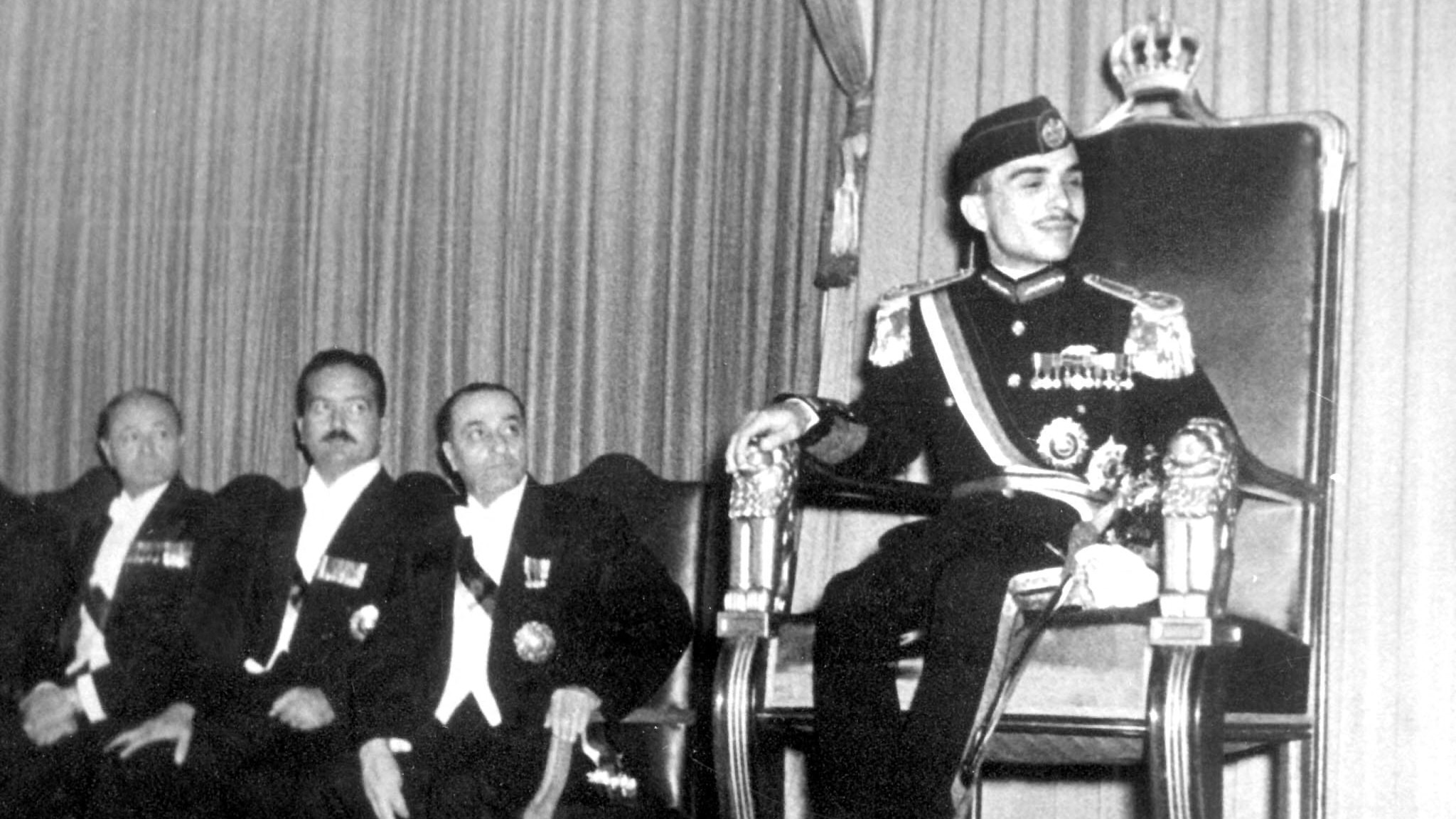
    A picture shows King Hussein of Jordan when he was crowned in 1952 in Amman (AFP)

    Due to the massive demonstrations opposing the British and Jordan’s joining the Baghdad Pact, the army was deployed in Jordan’s cities and began to shoot at civilians. While al-Majali's cabinet was forced to resign, a number of demonstrators were killed by the army.

    Police were pelted with stones as were British army officers, and Jordanian crowds burnt army Land Rovers. Protests took place all over the country. Aside from the West Bank, East Bank cities and towns from Amman and Zarqa to Irbid, Salt, Ajloun, ar-Ramtha, and even the village of Anjara were full of demonstrators.

    One of the British officers in Zarqa, Lieutenant Colonel Patrick Lloyd, was killed by a mob while his entire army regiment stood by watching without firing a shot. Zarqa police refused to enforce the curfew and released violators arrested by the army. To regain control of Zarqa, military aircraft flew over the town for reconnaissance, terrifying the population.

    A nationalist tide

    The episode strengthened the anti-imperialist nationalist tide in Jordan and led to Glubb’s expulsion in March 1956.

    Between 1954 and 1957, Jordan had an active political life, with a lively, relatively freely-elected anti-imperialist parliament, and in 1956-57, it had a nationalist and anti-imperialist prime minister, Suleiman al-Nabulsi. But the Jordanian anti-imperialists’ victory was short-lived. The US did not take the defeat of its plans for the pact lying down.

    Why Israel's leaders and allies are in a state of panic over its future
    Read More »

    In January 1957, President Eisenhower announced the Eisenhower Doctrine. He declared that the US would come to the aid of any country in the Middle East threatened by communism.

    In his speech setting out his doctrine, the president declared that: “The Middle East is the birthplace of three great religions - Muslim, Christian and Hebrew. Mecca and Jerusalem are more than places on the map. They symbolise religions which teach that the spirit has supremacy over matter and that the individual has a dignity and rights of which no despotic government can rightfully deprive him. It would be intolerable if the holy places of the Middle East should be subjected to a rule that glorifies atheistic materialism."

    In private meetings with the CIA’s Frank Wisner and the Joint Chiefs of Staff, Eisenhower insisted that the Arabs should obtain inspiration from their religion to fight communism and that “we should do everything possible to stress the ‘holy war’ aspect.” The plan was for the US to support new “reformist” groups like the Society of the Muslim Brothers and shun traditional clerics.

    Later that year, during a palace coup by King Hussein against the democratically-elected parliament, cabinet and army officers, members of the Jordanian branch of the Society of the Muslim Brothers, according to to the memoir of Jordanian free officer Shahir Yusuf Abu Shahut about the period, Army and politics in Jordan, published in 1992, joined the Jordanian army units’ campaign of repression in fighting the anti-imperialist nationalist and pro-democracy forces in the country whom they dubbed "communists".

    But according to Muslim Brotherhood sources, the claim that they were part of the campiagn of repression against nationalists at the time is 'outright wrong'.
    A palace coup

    The king justified the palace coup by claiming that there was an army plot to overthrow him, although the Jordanian chief of staff, Ali Abu-Nuwar, who fled the country during the palace coup, explained in a press conference that "the alleged [anti-king] plot was planned and designed by the American embassy in Jordan and by collaborators with colonialism in order to reach their goals."

    Eisenhower was keen on propping up the Saudis as a counterweight to Abdel Nasser

    Immediately following the palace coup, the army was purged of all anti-imperialist and nationalist elements and was restored to the status quo ante which prevailed under Glubb Pasha. Jordan, as a result, suffered under martial law from 1957 until 1992.

    The Saudis, who had been the traditional enemies of the Hashemites, had also sided with Egyptian President Gamal Abdel Nasser against the western-created, anti-Soviet Baghdad Pact. The US state department decided "to detach Saudi Arabia from Egyptian influence".

    Eisenhower was keen on propping up Saudi Arabia as a counterweight to Abdel Nasser, especially as the Americans recognised the importance of Saudi control of Muslim holy places.

    Eisenhower’s plan was for the Saudi king to "be built up, possibly, as a spiritual leader. Once this were accomplished, we might begin to urge his right to political leadership."

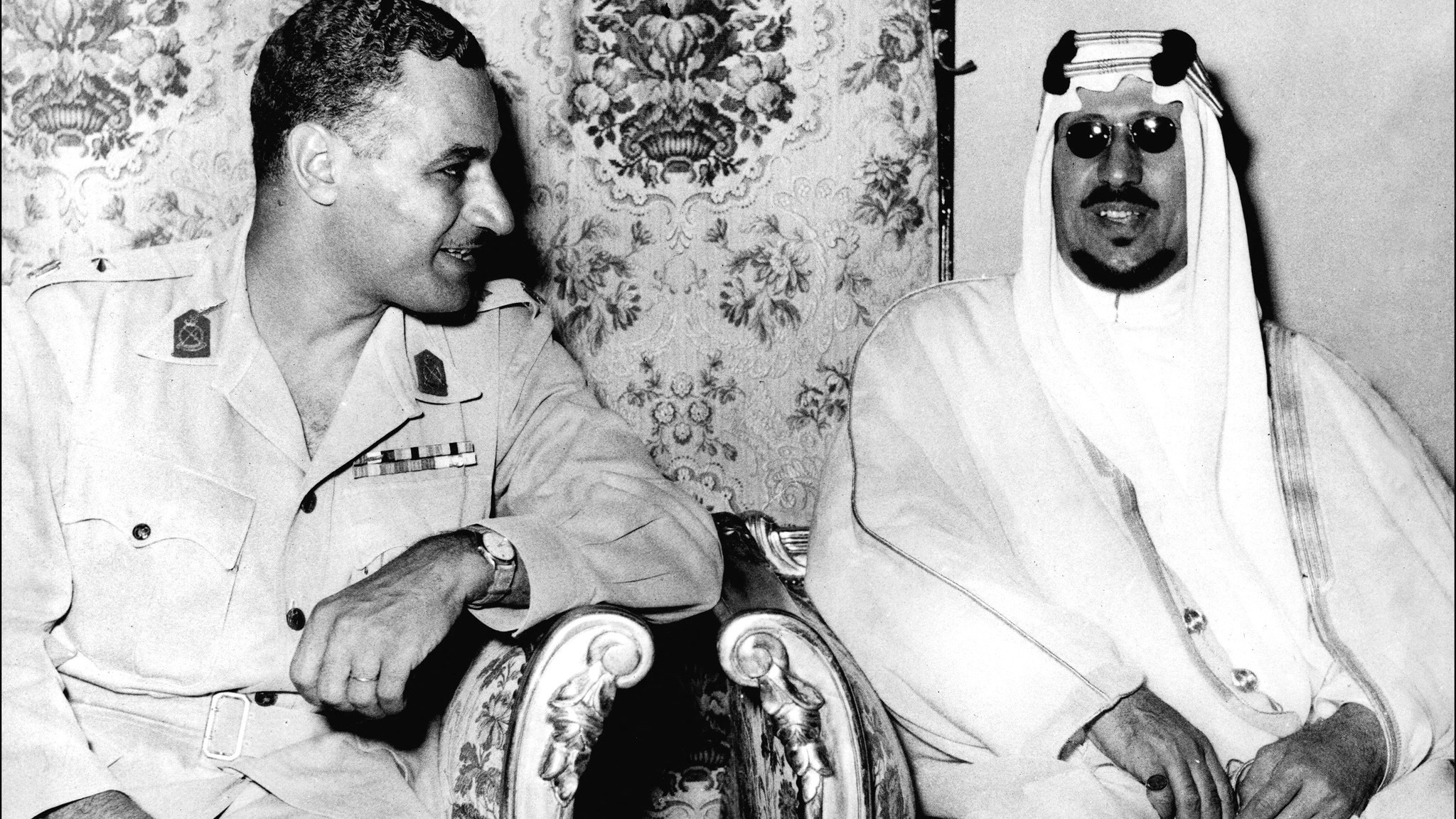
    Saudi Arabia King Saud ibn Abd al-Aziz (R) and Egyptian president Gamal Abdel Nasser confer in Cairo March, 1956 (AFP)

    As King Saud seemed less responsive and not fit for the role, in May 1962, Crown Prince Faysal (who, with the support of the Americans, forced his brother King Saud to abdicate in 1964 and replaced him on the throne) organised an international Islamic conference in Mecca to combat the popularity of anti-imperialist Arab nationalism, socialism, and “secularism,” and launched the Muslim World League.

    This was part of the new role that the US subcontracted to Saudi Arabia under King Faysal against Abdel Nasser during the Cold War.

    But this was in the 1950s and 1960s.


    Today we live in a world where there are no longer major anti-imperialist forces in the Arab world. Indeed, there are no signs that anyone in the US-equipped Jordanian military, let alone in Jordan’s political class, espouses any anti-imperialist nationalist inclinations as was the case in the 1950s.

    However, there are those whose hostility to anti-imperialism is such that they still seek to undermine the credentials of the 1950s anti-imperialist Prime Minister al-Nabulsi.
    A new Middle East

    A few weeks ago, perhaps as part of a campaign to force Jordanian public acquiescence in the new Middle East Nato, former Jordanian prime minister, Samir al-Rifai, attacked al-Nabulsi and accused him of having plotted with foreign powers in the 1950s to overthrow the Hashemite regime.
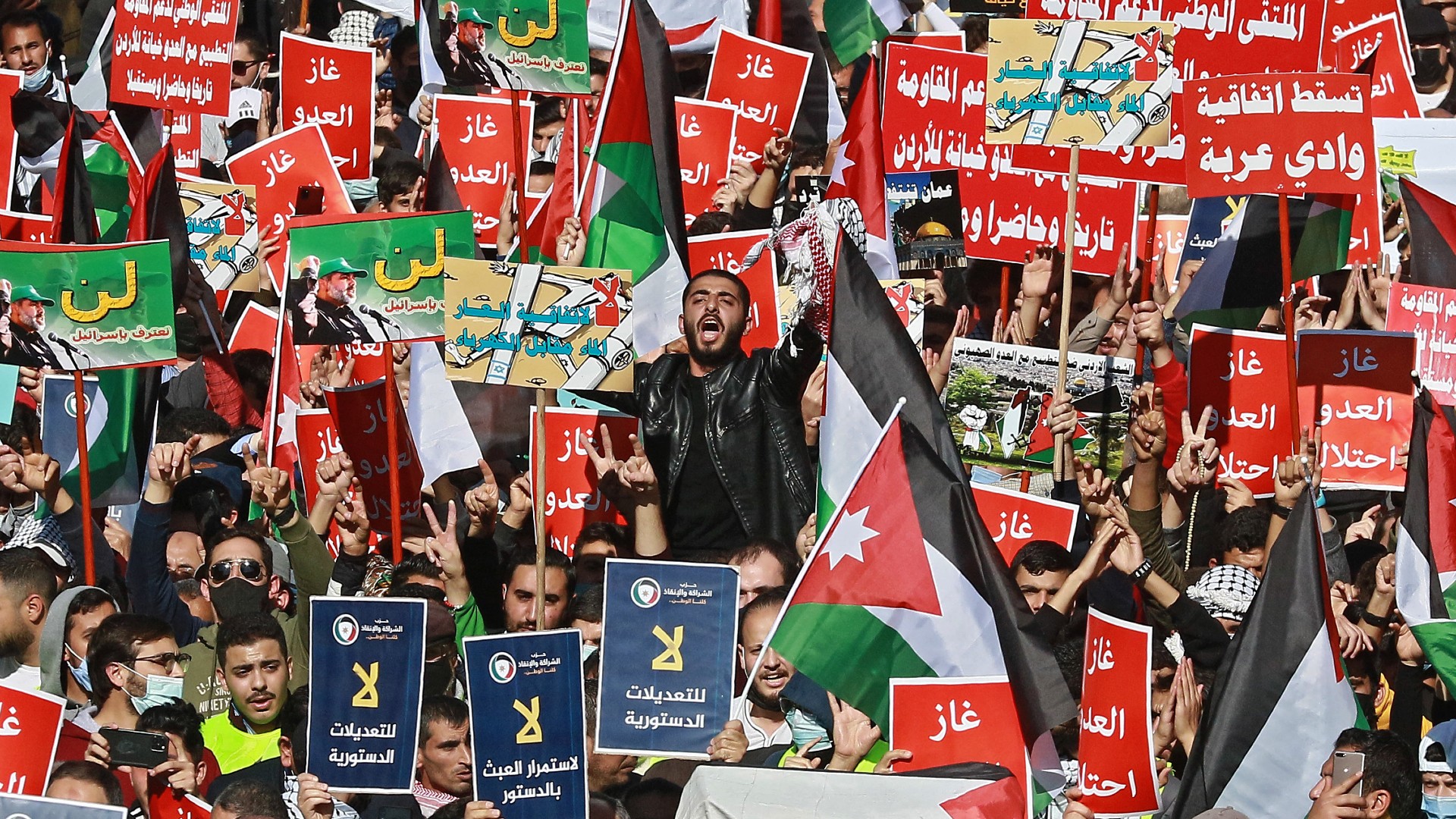
    People hold up signs against agreements with Israel and others against constitutional amendment proposals on 26 November 2021 (AFP)

    Another effort, perhaps also designed to help convince Jordanians that Iran, and not Israel, is their enemy, includes stories circulated last month in the press that Iranian cyber-espionage tried to hack Jordan’s foreign ministry.

    More serious are the allegations that Iran is behind a major campaign of smuggling drugs to Jordan from the Syrian border.


    Iran, in fact, maintains friendly diplomatic relations with Jordan, despite the former closeness of the Jordanian regime with the pre-revolutionary dictatorship of the Shah, and King Hussein’s active support in the 1980s of Saddam Hussein’s war on revolutionary Iran.


    Another effort designed to help convince Jordanians that Iran, and not Israel, is their enemy, includes stories that Iranian cyber-espionage tried to hack Jordan’s foreign ministry

    Whereas the British generals unleashed the British-trained Jordanian army on civilians in the mid-1950s, they did so in a Jordan that was mobilised against continued British colonialism, US imperialism, and the Israeli enemy.

    Still, the anti-imperialist forces at the time were successful in preventing King Hussein from joining the Baghdad Pact.

    Indeed, if the Society of the Muslim Brothers was part of the coup against the nationalists in the 1950s , a few days ago, along with other Jordanian patriotic groups, it came out strongly against the new pact.

    Today, the US and King Abdullah, however, do not appear to be worried that the US-supported and equipped Jordanian army, let alone Jordan’s formidable US-supported security agencies, will face any 1950s-scale popular mobilisation against the new Middle East Nato-in-the-making, and that no Jordanian prime minister will need to be toppled nor will the need arise for a palace coup to be organised.

    Both the Americans and the king seem at ease with their new plan and confident in its success.

    The views expressed in this article belong to the author and do not necessarily reflect the editorial policy of Middle East Eye.


    Joseph Massad is professor of modern Arab politics and intellectual history at Columbia University, New York. He is the author of many books and academic and journalistic articles. His books include Colonial Effects: The Making of National Identity in Jordan; Desiring Arabs; The Persistence of the Palestinian Question: Essays on Zionism and the Palestinians, and most recently Islam in Liberalism. His books and articles have been translated into a dozen languages.
    India is on a dangerous path to another Rwanda

    The anti-Muslim propaganda needs only a spark to metastasize into nationwide, wide-scale anti-Muslim violence

    CJ Werleman
    4 July 2022 

    A demonstrator shouts slogans during a protest against the killing of a Hindu tailor on 29 June 2022 in New Delhi (AFP)

    For the past two years, experts have accused the Indian government of pushing its Muslim minority to the brink of genocide - but last Tuesday, the country awoke to news that a Hindu tailor had been hacked to death in Udaipur by two Muslim men, who posted a video online of the attack, claiming it was in retaliation for the victim sharing derogatory remarks made by a former government spokesperson against the Prophet Muhammad.

    There are now genuine concerns that India is following a similar trajectory to Rwanda in the early 1990s, when a singular event - the shooting down of an airplane carrying Hutu President Juvenal Habyarimana - sparked a genocide against ethnic Tutsis. The minority community had been subjected to years of racist propaganda, specifically tropes that characterised them as anti-national foreign invaders.

    There's never been a more perilous time for 200 million Indian Muslims than now

    The echoes of Rwanda ring eerily and loudly in India today. There are any number of bad reasons why historians could look back on the killing in Udaipur as a similarly pivotal moment, given the Modi government has spent the past eight years otherising Muslims as anti-national foreign invaders who belong in Pakistan. This trope helped Prime Minister Narendra Modi attain power in 2014 and then consolidate power five years later.

    Nothing unites and mobilises the country’s Hindu majority quite like an imagined or perceived threat from Pakistan, which is why the Modi regime is desperately trying to tie the murder to its Muslim-majority neighbour, no matter how extraneous or ridiculous the notion is. In a tweet, Home Minister Amit Shah promised: “The involvement of any organisation and international links will be thoroughly investigated.”

    This is less dog whistle and more bullhorn, meant to tie the Muslim perpetrators - and the Indian Muslim population writ large - to "sinister" Pakistani forces. If genocide is to materialise in India, as many credible experts have forewarned, then it will likely be triggered by actual events manipulated and weaponised by nefarious political entrepreneurs.
    Harsh crackdown

    The gruesome murder of a Hindu tailor could be that moment. Authorities say they are now investigating whether the killers have links to Dawat-e-Islami in Pakistan, while pro-government commentators try to draw parallels between the killing and the recently released Hindu nationalist propaganda film The Kashmir Files, which has been weaponised by the Modi regime to paint Kashmiri Muslims as bloodthirsty jihadists and tools of Pakistan.


    It’s clear the Modi regime intends to use the Udaipur incident as a pretext to further entrench Muslims as the referent object in its security discourse

    This is happening as prominent Indian Muslim journalists are not only being silenced on social media, but also jailed in India and Kashmir for merely doing their jobs or posting tweets critical of the government - a crackdown that has drawn condemnation from international bodies, including the Committee to Protect Journalists and Reporters Without Borders.

    It’s clear the Modi regime intends to use the Udaipur incident as a pretext to further entrench Muslims as the referent object in its security discourse. This provides a fig leaf to justify an even harsher crackdown on the religious minority - and if two decades of the global “war on terror” have taught us anything, it’s that the most egregious human rights abuses against Muslims occur under the rubric of “national security”.

    It’s not for nothing that the Indian government is calling Udaipur a “terrorist incident”, a term it has not once used against the hundreds of mob attacks committed by Hindu extremists against Muslims during the eight years of Modi’s rule. It’s also not for nothing that during the decade spanning 2009-2019, around 91 percent of all hate crimes occurred under Modi’s first term in office.
     
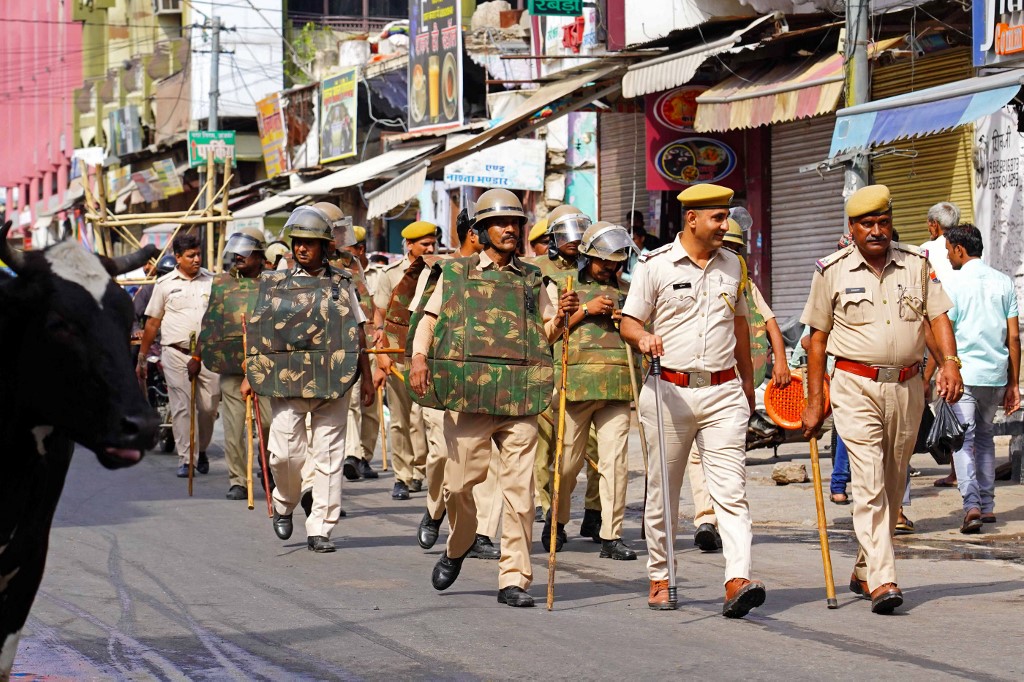
    Police march through a street in Ajmer, India, on 29 June 2022 (AFP)


    An analysis by the Indian television network NDTV found the country has experienced a massive increase in hate speech since 2014, with Modi’s Bharatiya Janata Party (BJP) responsible for more than 80 percent of it. This hate is amplified and parroted in India’s vast right-wing media ecosystem, which has become indistinguishable from mainstream journalism in recent times.
    Targeting minority communities

    Last month, the Editors Guild of India slammed pro-government media outlets for their “irresponsible conduct” that “deliberately” creates circumstances that lead to the targeting of minority communities. It compared these outlets to Radio Rwanda, noting: “Some of these channels prompted by the desire to increase viewership and profit were seemingly inspired by the values of Radio Rwanda whose incendiary broadcast caused a genocide in the African nation.”

    This anti-Muslim propaganda needs only a spark to metastasize into nationwide, wide-scale anti-Muslim violence. It took only a single BJP minister’s speech in February 2020 to ignite the Delhi riots, which saw three dozen Muslims hacked, shot and burned to death over six bloody days.


    For Indian Muslims the end times have arrived
    Read More »

    Last Thursday, thousands of Hindu nationalists marched through the city of Udaipur, holding Hindu saffron flags and chanting genocidal slogans, with many calling for the death penalty for the two Muslim men accused of killing the Hindu tailor.

    If mass killings or genocide are to be avoided, then cool heads will need to prevail - but the Indian government is bereft of such people. Not once has Modi condemned communal violence or crimes of hate. This is a man who the US government holds responsible for inciting the Gujarat riots of 2002, which resulted in the deaths of hundreds of Muslims.

    It’s for these reasons that the man who predicted the genocide in Rwanda years before it took place has warned of an impending genocide of Muslims in India, comparing the situation under the Modi regime to events in both Rwanda and Myanmar, where thousands of Rohingya Muslims were killed in 2017.

    There’s never been a more perilous time for 200 million Indian Muslims than now.

    The views expressed in this article belong to the author and do not necessarily reflect the editorial policy of Middle East Eye.

    This article is available in French on Middle East Eye French edition.

    CJ Werleman is a journalist, columnist and analyst on conflict and terrorism.
    Lebanon: LGBTQ+ community says crackdown is endangering members

    After Covid-19, economic collapse and the Beirut port explosion, the LGBTQ+ community finds itself newly targeted


    The LGBTQ+ community is concerned at the scale of recent official hostility (AFP)
    in Beirut, Lebanon
    Published date: 10 July 2022 

    Sitting on the balcony of his apartment in the Achrafieh neighbourhood of Beirut, Kareem, a 23-year-old filmmaker who identifies as queer, reflects on the latest developments targeting his community in Lebanon.

    “As a Syrian and queer person, every time I pass a military base, I wonder what would happen if they arrested me,” he tells Middle East Eye, asking for his surname not to be used over fears for his security. “Last week, no fewer than nine Syrians were arrested in Beirut and Saida, and other places in Lebanon, on the basis of expired residency." It's little wonder he's concerned at being singled out, and that's before taking into account "the increase in measures against LGBTQ+ people in the country".

    Kareem arrived in Lebanon in 2016 from his village in Sweida, southwestern Syria, with a scholarship to begin his studies in television and film at the Lebanese American University.

    Looking out of the window, he describes how Lebanon's LGBTQ+ community has been impacted by a three-pronged crisis over the past three years: the Covid-19 pandemic, the country's economic collapse, and the Beirut port explosion in 2020 have created a housing crisis for the community, and left many without jobs.

    “In Beirut, I learned to surround myself with people who accept me for who I am," he says. "It's part of the process of self-acceptance. However, the number of safe spaces we used to have has diminished considerably.


    "The 4 August explosion in Beirut completely destroyed neighbourhoods that included safe places like coffee shops and bars, such as Riwaq, Kalei or Tota," he says, referring to the huge blast at the capital's port that left more than 200 people dead, and devastated some of the city's most trendsetting areas.

    "Now they have been rebuilt and I can meet my friends again," he says, but adds that many LGBTQ+ people lost their homes in the explosion.

    Riwaq, an LGBTQ+ friendly restaurant in Beirut's Geitawi district
     (MEE/Clément Gibon)

    "Some activists from the community organised fundraisers to help people from the LGBTQ+ community to restore their homes," he says.

    "However, the aid wasn’t enough, as a lot of people were also suffering from mental health issues as a result of the blast. Aid was also not enough to address all the needs of the community.”

    'Contrary to the habits and customs of our society'

    In its latest report on the situation facing the LGBTQ+ community in Lebanon, Oxfam determined that housing was one of their main challenges, with the community facing increased exposure to violence in their current living spaces and experiencing an urgent need for shelter.

    The report found that as a result of the three-pronged crisis, 70 percent of LGBTQ+ respondents said they had lost their jobs, making meeting even their most basic needs increasingly complicated.

    The deterioration in their economic status and loss of safe spaces have had a significant impact on the mental health of the LGBTQ+ community, ranging from suicidal thoughts to health risk behaviours related to coping mechanisms.

    It was in this vulnerable context that Lebanon's outgoing interior minister, Bassam Mawlawi, sent a letter on 25 June, during Pride Month, to the General Security Directorate and the General Directorate of Internal Security Forces (ISF), asking them to prevent “gatherings aimed at promoting sexual perversions”.

    "This phenomenon is contrary to the habits and customs of our society" and religious principles, Mawlawi said, adding that "personal freedoms cannot be invoked".

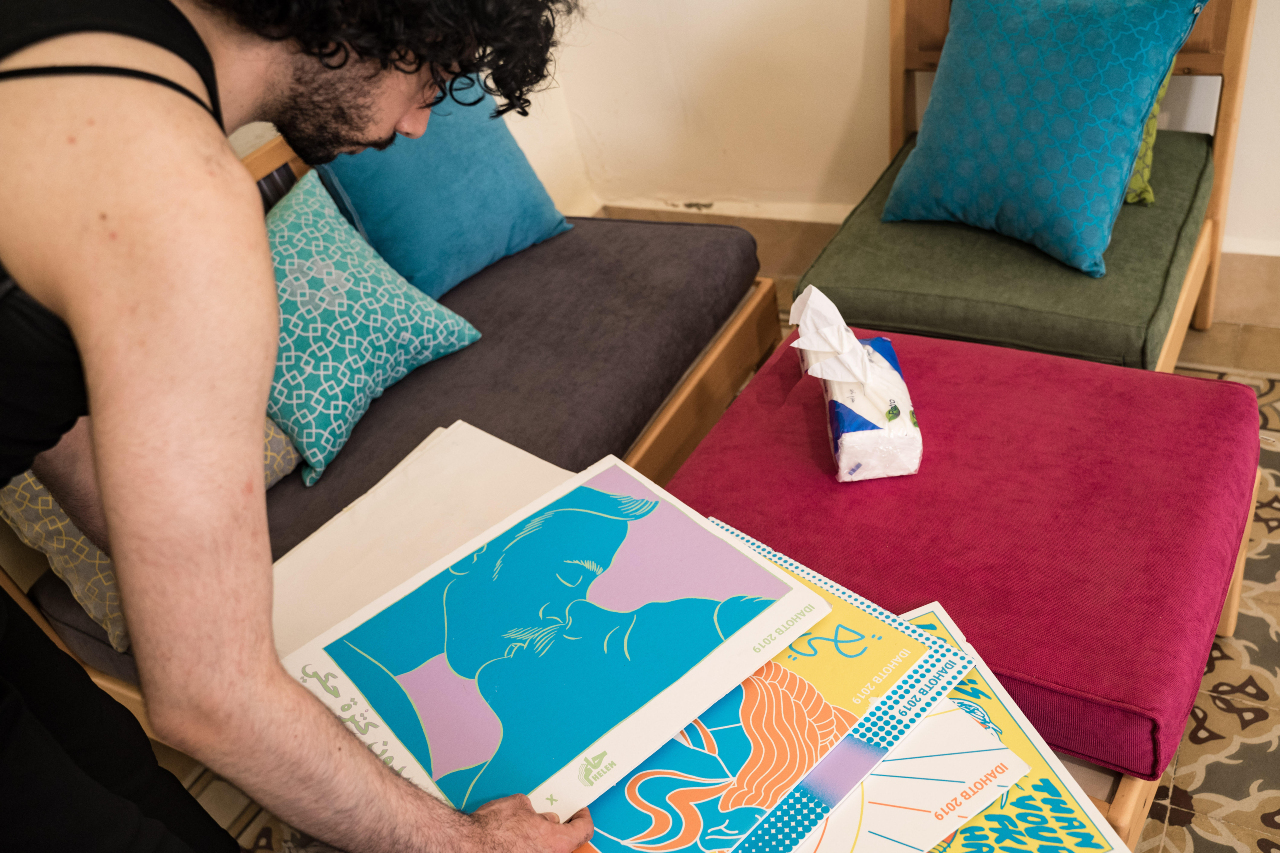
    For Tarek Zeidan, executive director of Helem, the first LGBTQ+ rights NGO in the Arab world (established in Beirut in 2001), the measure was vague, underhanded and calculated to divert attention from unpopular policies.

    Activists at Helem in Beirut, a pioneer for LGBTQ+ rights in the Arab world (MEE/Clément Gibon)

    “This is like the cherry on top: many people are afraid and angry at this barbaric, unnecessary and unbelievable aggression that is used against us," he tells MEE.

    "What we have done has not changed; what has changed is the status quo in Lebanon, and that was the catalyst for this letter.

    “In despotic, autocratic or militarised regimes, it is common to fabricate artificial morals or moral panics to divert public attention in times of great economic and social dysfunction,” Zeidan adds.

    Events cancelled and postponed

    Mawlawi's letter is especially controversial because it not only exceeds the rights granted to him as interior minister, but also violates both the Lebanese constitution - which guarantees freedom of expression - and treaties it has ratified, such as the International Covenant on Civil and Political Rights.

    The measure also contradicts the recommendations to guarantee the right to peaceful assembly and expression of LGBTQ+ people that Lebanon accepted at its Universal Periodic Review at the UN Human Rights Council in 2021.


    'The situation is very risky for queers in Lebanon. Some people can’t even leave their homes because they don’t feel safe'
    - Kareem, 23, a queer filmmaker

    It is also seen as normalising hate speech towards the LGBTQ+ community. Following its publication, social networks have seen a wave of incitement to violence against the community by religious groups, individuals and even members of parliament.

    Several events offering safe spaces to the LGBTQ+ community have been cancelled - like those planned by Haven for Artists, a feminist-cultural organisation promoting art and activism - or postponed for security reasons.

    Kareem says these cancellations and suspensions have come at the very time when the community needs to come together.

    “A panel discussion that I was planning to attend has been cancelled, probably because in this situation the event could risk becoming a target by the government to arrest people who attend it, whether they are queer or not," he says. "This is another strategy of the Lebanese government to divide and conquer, and spread anxiety.

    “The situation is very risky for queers in Lebanon. Some people stated that they felt like they can’t even leave their homes because they don’t feel safe,” he adds.

    Other types of intimidation include the vandalism of rainbow billboards, such as one installed by the group Beirut Pride that was destroyed by a Christian group called the Soldiers of God.

    Judicial backing


    While Lebanese authorities have regularly interfered with gender and sexuality human rights events, it is the scale and intensity of recent events that have concerned the LGBTQ+ community.

    Nonetheless, the community has been successful in asserting some of its rights in recent years.

    Lebanon to break up LGBTQ+ gatherings after pressure from religious groups
    Read More »

    Since 2009, no fewer than five court rulings have gone against Article 534, the penal code directly inherited from the French mandate that criminalises “unnatural sexual intercourse”.

    Karim Nammour, a legal researcher, activist and member of The Legal Agenda, a Beirut-based non-profit research and advocacy organisation, described to MEE the progress brought by the most recent 2018 Mount Lebanon Misdemeanour Court of Appeal decision.

    “The judiciary started issuing decisions stating that homosexuality is not against the order of nature. In the last couple of decisions it went further and stated that homosexuality is the exercise of a natural right and therefore should not be considered as a crime,” he says.

    “We wish to see parliament follow the footsteps of the judiciary in promoting LGBTQ+ rights. A lot of members of parliament spoke about LGBTQ+ rights in their campaigns, and programmes. Now we wish to see them advocating for it in the parliament.

    "If that doesn't work, the judiciary can continue to oppose article 534 and stop prosecuting people under it,” he adds.

    The issue of LGBTQ+ rights has officially moved from being a side issue to a serious and politically divisive debate, Zeidan acknowledges.

    “Our mainstreaming efforts are horizontal, with other people mobilising; not just vertical, with an already established entity or institutions. In many cases, our role is to co-create a new Lebanon, a new system, or whatever is being developed.”

    Activism for the advancement of LGBTQ+ rights has also been steadily increasing, with different initiatives and a growing motivation within the community.

    “It is important to know that our strength and security come from our numbers, and we are many," says Kareem. "We have to stand up and tell them that they have to go, not us.”