Saturday, July 16, 2022


Crypto lender Celsius Network reveals $1.19 billion hole in bankruptcy filing

Hannah Lang
Thu, July 14, 2022

(Reuters) -Celsius Network listed a $1.19 billion deficit on its balance sheet in a bankruptcy court filing on Thursday, a day after the cryptocurrency lender filed for Chapter 11.

New Jersey-based Celsius froze withdrawals last month, citing "extreme" market conditions, cutting off access to savings for individual investors and sending tremors through the crypto market.

In the filing at the U.S. Bankruptcy Court for Southern District of New York on Thursday, Celsius also said it had $40 million in claims against Singapore-based Three Arrows Capital, a crypto hedge fund that filed for bankruptcy earlier this month.

As of July 13, Crypto had about 23,000 outstanding loans to retail borrowers totaling $411 million backed by collateral with a market value of $765.5 million in digital assets, it added.

Crypto lenders boomed during the COVID-19 pandemic, drawing depositors with high interest rates and easy access to loans rarely offered by traditional banks. They lent out tokens to mostly institutional investors, making a profit from the difference.

But the lenders' business model came under scrutiny after a sharp crypto market sell-off spurred by the collapse of major tokens terraUSD and luna in May.

Another U.S. crypto lender, Voyager Digital Ltd, filed for bankruptcy this month after suspending withdrawals and deposits. Singapore's Vauld, a smaller lender, also froze withdrawals this month.

(Reporting by Hannah Lang in Washington; Editing by Chris Reese and Richard Chang)


Celsius becomes third major crypto firm in two weeks to file for bankruptcy

David Hollerith
·Senior Reporter
Thu, July 14, 2022

Crypto lender Celsius Network has initiated bankruptcy proceedings, the company said Wednesday night, marking the third high-profile crypto firm to do so in the last two weeks.

The New Jersey-based firm filed bankruptcy under Chapter 11 with the Southern District of New York, stating it has $167 million in assets on hand to fund operations during restructuring.

“I am confident that when we look back at the history of Celsius, we will see this as a defining moment,” Alex Mashinsky, Celsius' co-founder and CEO, said in a release.

After the collapse of Terra’s algorithmic stablecoin UST, crypto lending and brokerage firms have faced solvency issues with common failings coming from directly investing in Terra coins (LUNA, UST), lending money to firms who did - such as now bankrupt hedge fund Three Arrows Capital - or simply losing out from other risky positions involving leverage.

The firm joins Three Arrows Capital as well as another lender, Voyager Digital, in the list of major crypto firms filing for bankruptcy protection.

Celsius, whose mantra has been “Unbank Yourself,” offered both retail and institutional customers high-yield interest savings accounts. The firm earned yield for customers by lending its assets out to hedge funds or depositing them in higher risk decentralized finance trades that relied on additional leverage.

Celsius logo and representation of cryptocurrencies are seen in this illustration taken, July 7, 2022. REUTERS/Dado Ruvic/Illustrations

On June 12, Celsius showed the first signs stress, freezing customer accounts on its platform, which in some cases caused customers to lose their funds by preventing them from paying down crypto loans on the platform as market conditions collapsed.

Between freezing customers' accounts and filing for bankruptcy, the firm has remained largely silent.

Celsius hired restructuring lawyers, laid off 150 employees, and unwound a number of decentralized finance positions over the last month, paying down at least $900 million in debt according to Yahoo Finance’s tally.

On a consolidated basis, the firm stated in the petition it holds between $1 and $10 billion assets and matching liabilities on its balance sheet, and has more than 100,000 customers who, in a bankruptcy scenario, are now deemed unsecured creditors.

Celsius' largest unsecured creditor according to the petition is one Pharos USD FUND, which it owes $81 million. Notably, it also owes $12.7 million to trading firm Alameda Research.

Based on a recent report by blockchain analytics firm Arkham Intelligence, Celsius entrusted $530 million in corporate funds to crypto asset manager KeyFi so it could engage in higher risk decentralized finance trading strategies.

KeyFi founder Jason Stone, who recently filed a lawsuit against Celsius, said the transaction yielded $350 million in losses for the company. In the complaint, legal representatives for Stone accused Celsius of being a “fraud” and “Ponzi scheme.”

The celsius token (CEL) has fallen more than 32% following its bankruptcy announcement to trade at 46 cents per coin. At the start of May, it changed hands above $2 per coin.

‘I just wake up and cry’: Voyager and Celsius bankruptcies have destroyed some crypto investors’ confidence in centralized platforms

Frances Yue - 

© Courtesy of Yotsy Ruiz

THE HUMAN COST

Yotsy Ruiz recently bought his first ever crypto hardware wallet — a Nano X from Ledger. He is transferring all his crypto holdings that he can still move to the small physical device which looks like a USB flash drive, and away from large centralized exchanges such as Binance and Coinbase

How are VCs response to the collapse of several crypto compani


The 40-year old resident of Frederick, Md., who owns a home remodeling business, hastily made the move after crypto broker Voyager Digital, which he trusted with some of his savings, froze all user withdrawals at the start of July and filed for bankruptcy protection.

In November, Ruiz invested about $33,000 of crypto on the Voyager platform. His holdings, including more than 11,110 Cardano and 360,000 Terra Luna Classic among others, are today worth about $5,000 as crypto prices have plunged. Now, it’s unclear if Ruiz will ever even get his coins back.

“Sometimes you want to buy coins like Shiba Inu you want to buy Dogecoin people tell you, ‘no, no, don’t buy that, those are bad products and you can lose the money.’ But then you trusted these exchanges. You lost not only one coin, but all the money there,” Ruiz said in an interview with MarketWatch.

Voyager said it had signed up more than 3.5 million users as of March 31, by offering high interest rates that reached up to 12% on their crypto deposits and connecting customers to crypto exchanges and market makers for trading. It also partnered with Mastercard on a debit card backed by stablecoin USDC that granted rewards of up to 9% annually. But the crypto broker sank into the swamp after it said Three Arrows Capital, a Singapore-based digital asset hedge fund that was recently ordered to liquidate by a court in the British Virgin Islands, defaulted on over $650 million of loans to the company.

With the crash of cryptocurrencies, several companies, like Voyager and Celsius Network, that emerged during the go-go years to offer digital currency investors lightly regulated financial and banking services have collapsed. As bitcoin has traded 70% lower from its all-time high, and smaller coins have tumbled even more, crypto lender Celsius, which said it had more than 1.7 million customers, stopped all customer withdrawals in June and filed for bankruptcy protection on Wednesday. Now, Celsius customers are faced with being unsecured creditors in federal bankruptcy court in New York. Digital asset exchange CoinFlex has also paused customer withdrawals. These failures have shaken investor confidence in many firms that underpin a nascent industry that has attracted huge capital inflows.

Hear from: Mike Novogratz at the Best New Ideas in Money Festival on Sept. 21 and Sept. 22 in New York. The Galaxy Digital CEO has ideas about navigating the crypto winter.

Ruiz, who also invested in Terra’s Luna Classic, previously known as Luna, felt more devastated with Voyager’s bankruptcy recently than in May, when he saw Luna plunge to close to zero from more than $80 in a week. Terra’s collapse was a huge blow, but “not everything was lost, and I knew I had to assume the risk,” Ruiz said. “I got other solid projects for the long term.” Ruiz, who says his portfolio is split between stocks and crypto, believes prices of some digital currencies will eventually go up.

It is one thing to face losses from one token, but another to see a centralized platform restrict access to all his crypto that is on it, Ruiz said. In the Voyager case, “I didn’t even know how to tell my wife,” Ruiz said. “She still doesn’t know.”

Ruiz has now lost faith in many cryptocurrency institutions. “I’m not planning to use exchanges anymore,” Ruiz said. “If I do, I’ll just buy say $1,000 or so bitcoin and then right away try to transfer back into another wallet that I want to keep my money there.”

In Orlando, Fla., another 40-year-old Voyager customer has reached a similar conclusion. The investor, who works in information security, told MarketWatch he hopes to transfer all his crypto to an offline storage vehicle, or cold wallet, if he ever manages to retrieve his funds locked on the Voyager platform. The investor asked to remain anonymous because he is concerned about repercussions, saying that Voyager “is a company that I no longer trust. I don’t know what they’d do.”

The investor has more than $114,000 worth of bitcoin ether and stablecoin USDC deposited at Voyager, roughly 80% of his family’s life savings. On July 1, when he received an email from Voyager that the company had halted user withdrawals, “my heart sank.”

“ I felt like a pain went through my body. I didn’t know what to say. I mean, thinking about it, it was the worst thing that ever happened,” the investor said. “Quite candidly, at times at night, I just wake up and cry. Because it’s such a disbelief to me. Like it’s one thing that you buy an asset and the asset goes down. It might pick up one day, and we still have access to it, right?”

In fact, back in March 2021, choosing to invest with Voyager was a “very careful” decision, according to the investor, after he compared several different platforms and did research about their management teams. Voyager was a publicly traded company listed on the Toronto Stock Exchange and the investor was able to find a lot of its financial information by reading its securities filings. “They were way solvent,” he thought. “Ratios were good. They had a good operating business. I also looked at their business model and the growth of the customer base,” the investor said. Meanwhile, the platform was “very intuitive, very easy” to use. It also marketed that all the U.S. dollar deposits were insured by the Federal Deposit Insurance Corporation, the U.S. government agency that backs depositors in American banks, which was a major appeal. Voyager had a partnership with Metropolitan Commercial Bank, a New York community bank.


Voyager recently assured investors that their U.S. dollar deposits will be returned in full, upon completion of a “reconciliation and fraud prevention process.” However, users who have crypto assets on the platform will instead receive a combination of some of their crypto, proceeds from any Three Arrows recovery, common shares in the newly reorganized company and Voyager’s own tokens VGX, according to the company’s restructuring plan, which is subject to change and requires court approval.

Still, “who would want those utility token for the company that has lost all trust?” asked the investor. “If they ever come back up…who’s gonna come and do business with these people?” The company’s shares was equally unappealing for him. “I just want my principal back. I’m willing to forgo every interest that they give me.”

Representatives at Voyager did not respond to requests seeking comment.

At many, if not most crypto exchanges, customer funds are pooled together and not segregated, according to Daniel Saval, a partner at law firm Kobre & Kim. In the case of a bankruptcy filing, the issue becomes important to determine whether customers will be treated as unsecured creditors. If a customer is “unable to show that they have control over their accounts that they’re able to actually identify or trace their specific crypto assets, then most likely those assets are going to be considered property of the bankruptcy estate,” according to Saval. It means that the customers will share with all other creditors the pool of assets, instead of claiming what was in their accounts, Saval said.

In May, Coinbase COIN, the largest U.S.-based crypto exchange, added language to its securities filings that said in a bankruptcy situation “the crypto assets we hold in custody on behalf of our customers could be subject to bankruptcy proceedings and such customers could be treated as our general unsecured creditors.” The bankruptcy filing of Celsius Network on Wednesday in federal court in New York means that its customers are faced with becoming unsecured creditors in that case, with limited claims only to the general bankruptcy estate and not their specific accounts.

Maxwell McIntyre, a 39-year-old who works for the U.S. Department of Defense in Japan, has about $14,000 with Voyager. Most of the funds are in U.S. dollars, thanks to his decision to convert most of his USDC on the platform to dollars on June 20, a few weeks after Celsius stopped withdrawals.

McIntyre believes he will get the U.S. dollar deposits back, but as far as crypto, “I’m pretty much just expecting that to be lost at this point,” McIntyre said.

Overall, he feels that “we’ve been lied to quite a bit about all this.”

“Just a few weeks ago, we were being told that all our capital is great. They have plenty of capital and they don’t lend to any risky decentralized finance lenders,” McIntyre said. He also felt bad that he once recommended Voyager to his mother, his wife, and his children. He even helped his wife to set up an account, which is slated to be given to their kids — it has about $4,360 in it.

Nevertheless, McIntyre said his view on cryptocurrencies “hasn’t changed one bit.” He believes that crypto could be a “very powerful financial tool” with the potential to solve some world problems.

But he no longer has the same trust for centralized platforms. “I am definitely not going to keep it on an exchange just to earn the extra little bit of interest when that’s very possible I could lose it,” McIntyre said.

Things Are Going to Break’: Texas Power Plants Are Running Nonstop


Will Wade, Mark Chediak and Naureen Malik
Fri, July 15, 2022

(Bloomberg) -- As searing Texas heat drives power demand to record highs, the state’s grid operator is ordering plants to run at a historic pace, often forcing them to put off maintenance to keep cranking out electricity. That’s helped keep the lights on, for now, but the short-term focus is putting even more stress on a system that’s already stretched near the limit.

Twice in the past week, officials have called on Texans to limit electricity use during scorching afternoons as demand inched perilously close to overwhelming supply. Now, there are growing concerns over how long power plants can maintain the grueling pace as they run nonstop, according to Michele Richmond, executive director of Texas Competitive Power Advocates, a generator industry group.

“Things are going to break,” she said. “We have an aging fleet that’s being run harder than it’s ever been run.”

To meet the surge in power demand, Ercot, the grid operator, is leaning heavily on a mechanism called reliability unit commitments to ensure there’s enough supply. Plants are being regularly ordered to go into service, or remain in operation, and skip any scheduled maintenance. The measure also overrides shutdowns for economic factors or any other issues. And Ercot is using the rule more than ever before as the state battles bout after bout of extreme weather.

The Electric Reliability Council of Texas, as the operator is formally known, called for 2,890 hours of RUCs system-wide in the first half of this year. That’s more than triple the 801 hours in the first half of 2021, according to data from Ercot’s independent market monitor provided by Richmond. For all of 2020, there were 224 RUC hours.

The problem is that deferring repairs now will likely come back to haunt power-plant owners, Richmond said.

“If you put off preventative maintenance because it’s needed for reliability, it increases the chances you’ll need a more comprehensive outage” later on as plants start to malfunction, she said.

Growing Population, Crypto


The situation underscores that the Texas grid is relying on short-term solutions for what’s poised to be a long-term problem. The state is contending with a population boom that’s driven demand higher. Crypto mining has also taken off in the past year, bringing with it the industry’s power-intensive operations. Meanwhile climate change has made extreme weather events that drive up electricity use more likely to occur and more severe — creating situations like a deadly February 2021 freeze that caused blackouts across the state.

Brad Jones, Ercot’s interim chief executive officer, is aware he’s walking a fine line. On one hand, there have been six times in the past year that using RUCs have enabled the operator to avoid declaring grid emergencies. Or as Peter Lake, chairman of the Public Utility Commission of Texas, said at a June 22 hearing: Six times when the grid otherwise would’ve been “on the brink of rolling blackouts.”

However, Jones says he knows that forcing plants to stay in service is raising the risk of breakdowns. For example, a key concern at this time of year is boiler-tube leaks, especially at older plants. These leaks don’t always mean a plant must shut down immediately, but if they’re not closely monitored they can lead to bigger, more costly repairs.

“Typically, a generator can run for a while with the water leaking,” Jones said in an interview. “The question is, how long is that.”

The grid operator is in constant contact with generators and works to give them time to make needed repairs when conditions allow, Jones said. Ultimately, the state needs more power plants, and regulators are working on ways to make that happen, he said.

Ercot and other operators are facing dual challenges, said Michael Webber, an energy-resources professor at the University of Texas at Austin. Most companies schedule maintenance during the spring and fall, when the weather is mild and power use is typically lower.

But climate change means these windows of temperate weather are getting shorter. This year, for instance, an early May heat wave forced some generators to skip tune-ups. And periods of high heat are also lasting longer, putting more stress on power plants that are running all-out for weeks at a time.

Maintenance for power plants — especially older ones — can be time consuming and complicated, said Webber, who also serves as chief technology officer of Energy Impact Partners, a clean tech venture fund

“You kind of have to dismantle the plant,” he said. “It’s not something you can do in a couple of hours.”

All of this is exacerbated by the state’s aging fleet. The average age of coal-powered plants in Texas is about 50 years, and natural-gas plants average about 30 years.

“It’s kind of like humans — we need to rest and recover,” Webber said. “If we run full speed for a long time, we can collapse.”
CRIMINAL CAPPLETALISM
Taiwan accuses Chinese Apple supplier of stealing secrets, charges 14


New Apple products go on sale at flagship Apple Store in New York

Fri, July 15, 2022 

TAIPEI (Reuters) - Taiwanese prosecutors on Friday accused a Chinese Apple Inc supplier of stealing commercial secrets from a Taiwanese supplier and poaching its workforce to win orders from the U.S. company, saying it had charged 14 people.

Taiwan has been stepping up efforts to stop what it views as underhand and illegal activities by Chinese firms to steal know-how and poach away talent in what Taipei's government views as a threat to the island's tech prowess.

Prosecutors in New Taipei said after a year-and-a-half investigation they had found that China's Luxshare Precision Industry Co Ltd had targeted Taiwanese competitor Catcher Technology Co Ltd "in order to quickly enter the Apple production chain to win orders".

Luxshare "lured" Catcher's China based research and development team with promises of high salaries and stole business secrets from the Taiwanese firm, causing them big losses, the prosecutors said in a statement.

Luxshare was doing this in order to be able to "quickly build factories and mass produce cases for iPhones, iPads and other products", the statement said.

Luxshare did not immediately respond to a request for comment, and neither did Apple.

New Taipei prosecutors have now charged 14 people in connection with the case for breach of trust and taking commercial secrets for use overseas, they added.

"The department will do its best to investigate such cases to maintain the sound development of our country's enterprises and ensure the competitiveness of national industries."

Catcher, which makes iPhone and iPad cases, said in a statement it continues to implement and optimise the protection of trade secrets and intellectual property rights, and will investigate anything that infringes on its rights and interests.

The company is cooperating with the probe, it added.

In May, Taiwanese authorities raided 10 companies or their R&D centres operating in Taiwan without approval suspected of illegally poaching chip engineers and other tech talent.

(Reporting by Ben Blanchard; Editing by Tomasz Janowski)


A Mile-Long Procession Of Buses Carried Items From School Shooting Victims To Ted Cruz’s House


Steffi Cao
Thu, July 14, 2022

A fleet of 52 yellow school buses formed a mile-long procession to Sen. Ted Cruz’s house in Houston on Thursday morning — 4,368 empty seats to honor the number of children killed by gun violence since 2020.

The first bus carried items from school shooting victims, including a pair of worn-out checkered Vans from 15-year-old Gracie Muehlberger, killed at her Santa Clarita high school in 2019; a kindergarten graduation card with a smiling teddy bear on it, awarded to Sandy Hook victim Chase Kowalski; and a ​​LeBron James Miami Heat jersey adored by Joaquin Oliver, who died in the Parkland school shooting in 2018.

Named “The NRA Children’s Museum,” this project is the latest by artist Manuel Oliver, father of Joaquin.

“It’s partially with the intention that some people will think this is truly an NRA museum,” Oliver told BuzzFeed News.

Since his son's death, Oliver has channeled his advocacy for gun control into works of public art and activism. On Monday, he interrupted President Joe Biden during a Rose Garden speech, calling on the White House to open an office specifically for gun violence. Last year, he orchestrated a fake graduation where a former National Rifle Association president spoke to over 3,000 empty seats, representing the teen victims of gun violence. Now he wants people to look at which government officials accept NRA donations.

“We’re going after the money,” Oliver said. “These leaders are not loyal to the Second Amendment. They’re loyal to the gun industry and manufacturers, who protect them. And there’s lots of messages that supporting gun control is not patriotic. It’s corrupt, and I wanted to find a graphic way of showing them what the impact really is.”

Oliver hand-delivered a letter from his late son Thursday to the home of Cruz, who has received a total of $749,000 from the pro-gun group. The note, which had been written by a 12-year-old Joaquin, spoke to gun owners about his thoughts on gun control in the country. When the buses arrived, a security guard came out and accepted the letter. Oliver did not receive an immediate response from Cruz. The procession left shortly after due to encircling police presence.

Speaking to BuzzFeed News from Cruz’s offices on Thursday, Oliver said he was asked to leave the senator’s property by security, where he asked them a few questions from the sidewalk. “I asked if they wanted to know who I am, if they were a little curious,” he said. “I left the letter, and [the guard] took some pictures and made some calls. I don’t know who he called.”

Oliver said that his wife Patricia found the letter a month after Joaquin was killed. “It was from a school project,” he said. “He was a kid writing this letter. I was really impressed when I read it. We’ve been keeping it, our little letter to remind us about what we’re fighting for. My son knew, at 12 years old, what to do better than Ted Cruz. I want [Cruz] to read that with his own eyes.”

“I am writing this letter to talk to you about how were going to solve this gun law movement,” Joaquin said in the note, written five years before his death. “Most of you have a problem with the idea of universal back round check. Why are you mad that there’s a back round check it’s for your own good maybe you are fond of having crazy people with death machines. You shouldn’t have anything against back round checks if you’re innocent.”

Oliver said that he was hoping Cruz would be at his offices, but he instead met someone who identified themself as one of the senator's staff advisers, who told him that the lawmaker was currently at the Capitol.

Recently the nation has seen a renewed surge of mass shootings throughout the country, from the horrifying elementary school shooting in Uvalde to the recent 4th of July shooting in Highland Park, Illinois. Part of Oliver’s goal was to put pressure on officials like Cruz and Marco Rubio to renounce funding from the NRA and to enact legislation for universal background checks.

“It’s a shame on us as a nation,” Oliver said. “We are at a point where any option is a miracle. The latest gun measures, we all know it was not enough. The guys that wrote it knew it was not enough. We think of ourselves as the most powerful nation in the world — and I hate that we’re OK with solutions that are clearly not enough.”

Gun violence is the leading cause of death for American children; there have already been over 300 mass shootings this year alone. The bus fleet, which traveled to Cruz’s home and Houston office today, hopes to highlight the scale of loss, and the emphasis on how young and innocent their lives were.

“I believe young people will make sure gun violence will not be part of their futures,” Oliver said. “But we need to help them build a foundation to get there.”

Speaking to the press outside of Cruz’s offices, Oliver revealed that this will be the first of many stops at various pro-gun government leaders’ spaces. “If you’re a senator and you believe the things that are happening are OK, look out for a yellow school bus that will be outside your office,” he said. ●

Jul. 14, 2022, at 17:51 PM
Dalai Lama travels to remote Ladakh region bordering China


FILE- Tibetan spiritual leader the Dalai Lama gestures to indicate that he is in good health during a religious talk at the Tsuglakhang temple in Dharmsala, India, Friday, March 18, 2022. The Dalai Lama on Friday, July 15, 2022, arrived in the remote Ladakh region bordering China where he received a rousing reception. He will stay in Ladakh for about 45 days. 
(AP Photo/Ashwini Bhatia, File) (ASSOCIATED PRESS)

AIJAZ HUSSAIN
Fri, July 15, 2022 


SRINAGAR, India (AP) — The exiled Tibetan Buddhist spiritual leader the Dalai Lama on Friday arrived in India's remote Ladakh region bordering China where he received a rousing reception.

Thousands of people lined both sides of the road outside the airport in the cold desert region’s Leh town to welcome the Dalai Lama, who is touring outside his base in the northern Indian city of Dharmsala for the first time since the outbreak of the coronavirus pandemic in 2020. He will stay in Ladakh for about 45 days.

The Dalai Lama has made Dharmsala his headquarters since fleeing from Tibet after a failed uprising against Chinese rule in 1959. India considers Tibet to be part of China, though it hosts Tibetan exiles.

Officials said at least 20,000 people gathered all along the road to the Dalai Lama's summer palace, some 10 kilometers (6 miles) from the airport. The ride took the spiritual leader about 90 minutes, since the entire stretch was filled with people jostling and some dancing in traditional attire.

They welcomed the spiritual leader by waving religious flags and Tibetan flags and showering the road with flower petals. At least 7,000 Tibetans live in Ladakh.

“Happy. Once more (I have) come (to) Ladakh,” the Dalai Lama said in tangled English as he entered his palace. “These people showing from heart this.”

The visit is also his first since India split the high-altitude region from disputed Kashmir and took direct control of it in 2019 while revoking the entire territory's semiautonomous status. A year after that change, Indian and Chinese troops came close to war in Ladakh and ever since they have been locked in a military standoff along their disputed border.

China criticized India’s Prime Minister Narendra Modi for greeting the Dalai Lama on his 87th birthday earlier this month, saying New Delhi should stop using Tibet-related issues to interfere in China’s “internal affairs.”

India’s Foreign Ministry hit back and said: “It has been a consistent policy of our government to treat him as a guest in India and as a respected religious leader who enjoys a large following in India.”

Before his last visit in 2018, the Dalai Lama would frequently travel to Ladakh and deliver religious sermons in the region, which is famous for its Buddhist monks in mountaintop monasteries, sparsely populated and stunning landscapes and elusive snow leopards prowling rugged terrain.

China doesn’t recognize the Tibetan government-in-exile and hasn’t held any dialogue with the representatives of the Dalai Lama since 2010.

China says Tibet has historically been part of its territory since the mid-13th century, and the Communist Party has governed the Himalayan region since 1951. But many Tibetans say they were effectively independent for most of their history, and that the Chinese government wants to exploit their resource-rich region while crushing their cultural identity.

The Dalai Lama denies being a separatist and says he only advocates substantial autonomy and protection of Tibet’s native Buddhist culture.
‘You do not have to settle anymore’: Record-high inflation keeps the Great Resignation rolling


Serah Louis
Fri, July 15, 2022 


It’s been over a year since the American workplace turned upside down, with employees quitting en masse in search of more fulfilling jobs and flexible work arrangements.

But as inflation hits a new 40-year high, stragglers have found yet another convincing reason to jump ship.

“It’s a worker’s market,” says Andrew Flowers, labor economist at job advertisement firm Appcast. “And this bargaining power, it means that, with high inflation, this is the time to either ask for a raise or to potentially find a better offer elsewhere.”

Another 4.3 million Americans quit their jobs in May, the latest numbers show, nearly unchanged from the month before and still among the highest levels in decades.


While job vacancies decreased, there remain almost two jobs available for every worker who’s looking.

With the rising cost of food, gas and everything else giving all Americans a pay cut, workers who haven’t yet made a move have every reason — and every opportunity — to act soon.

The window remains open for now

The consumer price index surged to a spectacular 9.1% in June from a year earlier, putting pressure on workers who would otherwise be happy with the status quo.

Globally, one in five employees is likely to switch jobs in the next year, with most leaving for a better salary, according to a recent survey by accountancy firm PricewaterhouseCoopers.

Over a third are planning to ask for a raise in the next year, though that number is significantly higher in the tech sector (44%) and lower in the public sector (25%).

“Employers know that quit rates are high. They know that job openings are plentiful. And so they know their employees can be choosier,” Flowers says.

The added pressure of rising prices means employers may consider proactively hiking wages to avoid losing employees. Wages and salaries in the private sector increased by 5% for the 12-month period ending in March.

“Employers have a really insatiable appetite at the moment to hire,” Flowers says.

However, he adds, it’s unclear how long the labor market will remain so tight, especially as the Federal Reserve raises interest rates to cool off the economy.
How to go about asking for a raise

Whether or not it’s a good time for you to request a raise can really depend on your industry and whether your organization is thriving, says Chelsea Jay, a career coach based in Lansing, Michigan.

The accommodation and food services and leisure and hospitality sectors have seen the highest quit rates, reports Harvard Business Review, while retail and non-durable manufacturing industries have experienced the most growth in their quit rates. Workers in professional and business services are also leaving in droves.

Flowers says it’s fair to bring up rising prices when asking for a raise, though Jay argues that shouldn’t be the focus of the conversation.

“You can talk about inflation — but more than inflation, I encourage professionals to talk about their skill set and what they have brought to the organization,” says Jay.

She recommends talking to your coworkers about your salaries and doing research within your company, industry, city, state and career level. It’s also a good idea to look into when your company typically gives out raises and bring an estimate to the table at that time.

Nearly half of workers who tried to renegotiate their salary last year were successful, a survey by the job search site FlexJobs found.

1932


What if you can’t get a raise?


If your request is denied, consider renegotiating your benefits. You can look into a hybrid working arrangement or more paid time off, or ask your employer to pay for a professional development opportunity, like a certification course.

That said, Jay warns against relying on short-term handouts, like retention bonuses.

“It's a Band-Aid to cover up the bigger issue,” she says. “Companies don't give bonuses every single year. So if you are not happy with your salary, either you need to get a raise from them, or you need to move on to a company that is willing to pay you right.”

She adds that everyone’s priorities are different, and you need to determine what’s most important to you if you decide to seek work elsewhere. In your interview with a potential employer, ask about the company culture, leadership, expectations of your role and the benefits and perks you’re interested in.

“Don't settle. You're in a time where you do not have to settle anymore,” she says.
What can employers do to retain talent?

Employers may see higher retention when they promote from within, Flowers emphasizes.

“It's one thing to say, ‘Hey, I'm going to leave this job and get a 10% raise elsewhere.’ But if a worker sees that they have a future and that they can move up the ladder through internal mobility … then maybe they won't just go take the highest offer.”

Jay also advises employers to give quitting employees the space to be transparent about why they’re leaving in their exit interviews.

It’s important that companies actively respond to feedback by implementing new policies and making changes to avoid losing even more workers in the future.

“[The Great Resignation] really shone a light on the issues that corporate America and these companies are having when it comes to the way that they treat their employees and how they show value and how they show respect,” says Jay.

“So if anything, what it did for a lot of companies was made them realize, hey, we're slipping in these areas. We need to step our game up here.”
What to read next


This article provides information only and should not be construed as advice. It is provided without warranty of any kind.


Israel sells Haifa Port to India's Adani Ports, Israel's Gadot for $1.2 billion


By Ari Rabinovitch and Jonathan Saul

JERUSALEM (Reuters) - Israel said on Thursday it will sell Haifa Port, a major trade hub on its Mediterranean coast, to winning bidders Adani Ports of India and local chemicals and logistics group Gadot for 4.1 billion shekels ($1.18 billion).

Gadot and Adani made it to the end of a two-year tender process that Israel hopes will lower import prices and help shorten notoriously long wait times at Israeli harbors.

"The privatization of the port of Haifa will increase competition at the ports and lower the cost of living," Finance Minister Avigdor Lieberman said.

Adani will have a majority 70% stake and Gadot will hold the remaining 30%, according to an industry official.

"Delighted to win the tender ... Immense strategic and historical significance for both nations!" Adani Group Chairman Gautam Adani wrote on Twitter.

Global supply chains have been hit over the past year by lack of staffing at ports, lockdowns and a strain on available ships for hire as vessels get stuck due to congestion in many parts of the world.

About 98% of all goods move in and out of Israel by sea and the government has been upgrading the sector to maintain economic growth.

Haifa, surrounded by the Carmel mountains to the east which limit winds and choppy waters, has operated as a port for centuries. Today, it is Israel's leading deep water port and handled about half the country’s freight volume in 2021.

Warming ties with neighbouring Arab countries are also creating new trade opportunities for Israel and Haifa is well placed to become a regional hub, as well as a link between Asia and Europe.

Adani Ports, which has said it is the largest transport utility in India, is targeting expansion and seeks to become the premier global port group, the company’s chief executive Karan Adani, told an earnings call in May.

The new owners will compete with a private port that opened down the bay last year, which is operated by Shanghai International Port Group (SIPG).

Haifa Port said the new group will operate the port until 2054 and that along with containers it will now be able to focus on handling general cargo and hosting cruises.

($1 = 3.4876 shekels)

(Additional reporting by Sudarshan Varadhan in New Delhi; editing by Jonathan Oatis and Andrew Heavens)

In a Twist, Old Coal Plants Help Deliver Renewable Power. Here's How.

Elena Shao
Fri, July 15, 2022 

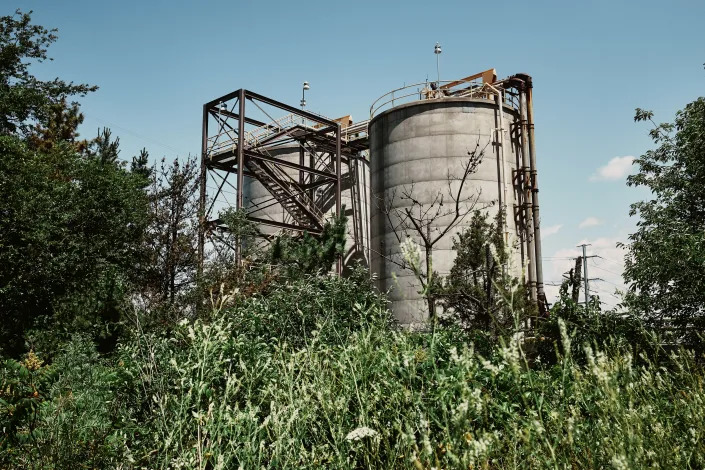
Silos of ash and other waste at the Brayton Point Power Station, a retired coal-fired power plant in Somerset, Mass., on July 7, 2022. (Simon Simard/The New York Times)

Across the country, aging and defunct coal-burning power plants are getting new lives as solar, battery and other renewable energy projects, partly because they have a decades-old feature that has become increasingly valuable: They are already wired into the power grid.

The miles of high-tension wires and towers often needed to connect power plants to customers far and wide can be costly, time-consuming and controversial to build from scratch. So solar and other projects are avoiding regulatory hassles and potentially speeding up the transition to renewable energy by plugging into the unused connections left behind as coal becomes uneconomical to keep burning.

In Illinois alone, at least nine coal-burning plants are on track to become solar farms and battery storage facilities in the next three years. Similar projects are taking shape in Nevada, New Mexico, Colorado, North Dakota, Nebraska, Minnesota and Maryland. In Massachusetts and New Jersey, two retired coal plants along the coast are being repurposed to connect offshore wind turbines to the regional electrical grids.

“A silver lining of having had all of these dirty power plants is that now we have fairly robust transmission lines in those places,” said Jack Darin, director of the Illinois chapter of the Sierra Club, an environmental advocacy group. “That’s a huge asset.”

Over the past two decades, more than 600 coal-burning generators totaling about 85 gigawatts of generating capacity have retired, according to the U.S. Energy Information Administration. (Individual power plants can have more than one generator.) A majority of the 266 remaining coal-burning power plants in the country were built in the 1970s and 1980s and are nearing the end of their approximately 50-year operational lifetime.

Most of that retired capacity will not be replaced with coal, as the industry gets squeezed out by cheaper renewable energy and tougher emissions regulations. At the same time, renewable energy producers are facing obstacles getting their projects connected to the grid. Building new power lines is costly and controversial, as neighbors often oppose transmission lines that can disturb scenic vistas or potentially reduce property values nearby. In addition, getting power line projects approved by regulators can be time-consuming.

Building and operating renewable energy projects has long been cheaper than fossil fuel plants. The barrier “is not economics anymore,” said Joseph Rand, a scientist at the Lawrence Berkeley National Laboratory, which conducts research on behalf of the U.S. Department of Energy. “The hardest part is securing the interconnection and transmission access.”

This makes old coal plants an attractive option as sites for renewable energy projects. Not only are the old plants already wired into the transmission system, they also have substations, which help convert electricity to a supply that is suitable for use in homes and businesses.

That was a key factor in choosing Brayton Point Power Station as a grid connection point for a 1,200-megawatt wind farm 37 miles off the coast of Massachusetts, said Michael Brown, CEO of the offshore wind developer Mayflower Wind.

At 1,600 megawatts, the coal-fired plant was the largest one in New England when it retired in 2017. The facility itself, located in the waterfront town of Somerset, will be replaced by an undersea-cable factory owned by the Italian company Prysmian Group. And the offshore wind project will connect to the grid at the Brayton Point interconnection point, making use of the existing substation there.

In one of the most ambitious efforts, Vistra Corp., a Texas-based power generation company that also owns a variety of power plants in California and Illinois, said it would spend $550 million to turn at least nine of its coal-burning facilities in Illinois into sites for solar panels and battery storage.

The largest, a plant in Baldwin, Illinois, that is set to retire by 2025, will get 190,000 solar panels on 500 acres of land. Together, the panels will generate 68 megawatts of power, enough to supply somewhere between 13,600 and 34,000 homes, depending on the time of year. It will also get a battery that can store up to 9 megawatts, which will help distribute electricity when demand peaks or the sun is not shining.

Vistra CEO Curtis Morgan said it became clear that the power company would need to “leave coal behind,” and it was eager to build new zero-emissions projects to replace some of the power from those plants. However, he said, the slow process of getting approval from grid operators, which coordinate and monitor electricity supplies, has been a roadblock for a number of Vistra’s proposed projects.

A surge in proposals for wind, solar and battery storage projects has overwhelmed regulators in recent years, according to an analysis from the Lawrence Berkeley National Laboratory, which overlooks the University of California’s Berkeley campus. In 2021, wait times had almost doubled from a decade before, to nearly four years, and that does not include the increasing number of projects that are withdrawing from the process entirely.

If every project currently waiting for approval gets built, “we could hit 80% clean energy by 2030,” said Rand, the lead author of the report. “But we’d be lucky if even a quarter of what’s proposed actually gets completed.”

Three of Vistra’s battery storage projects in Illinois — at the Havana, Joppa and Edwards coal plants — also benefited from an infusion of grants from a state law, the Climate and Equitable Jobs Act, aimed at supporting a “just transition” for coal-dependent communities toward renewable energy. It was signed by Gov. J.B. Pritzker last fall and also required all fossil-fuel-burning plants to cut their emissions to zero by 2045, which could lead to their closure, though most of the coal plants in Illinois were already poised to shut down within a decade.

The Coal-to-Solar Energy Storage Grant Program that emerged from the legislation also supports two other battery projects, owned by NRG Energy, which will be built at the Waukegan and Will County coal-burning power stations.

The advantage of building renewable energy projects on old coal plants is twofold, said Sylvia Garcia, director of the Illinois Department of Commerce and Economic Opportunity, which oversees the coal-to-solar program. First, projects benefit from the ease of reusing an existing connection to the grid. Second, it is an effort toward “trying to reinvest in the communities that have lost those coal plants” in the first place, she said.

While the new projects will temporarily create construction jobs, operating a solar plant or battery facility usually does not require as many employees. The Baldwin plant previously employed around 105 full-time workers. And while Vistra has not yet finalized numbers on a site-by-site basis, the nine Illinois projects combined will create 29 full-time jobs annually, the company’s communications director, Meranda Cohn, said in an email.

Coal plants also typically sit on a sizable parcel of land, and redeveloping those sites into renewable energy projects is a way to put something productive on a piece of property that might otherwise go unused.

“It’s really shifting a very negative resource into one that is more positive for the community,” said Jeff Bishop, CEO of Key Capture Energy, which plans to locate a 20-megawatt battery storage project at a retired coal plant near Baltimore.

Elsewhere in Holyoke, Massachusetts, the retirement of Mount Tom Station, a coal plant that had operated for more than five decades, presented a number of possibilities, said Julie Vitek, vice president of government and regulatory affairs for the power producer ENGIE North America. After meetings with government officials, environmental groups and residents, a solar farm emerged as the best way to “give new life to the industrial land at Mount Tom,” she said.

Today, the property is home to some 17,000 solar panels and a small battery installation that form a community solar project managed by Holyoke Gas & Electric, a city-owned utility that gives customers the choice to opt in to receiving solar power from the project. The panels produce about 6 megawatts of power, enough to power about 1,800 homes.

It is not only solar, battery and wind developers that are eyeing old coal plants for their infrastructure. TerraPower, a nuclear power venture founded by Bill Gates, is locating a 345-megawatt advanced nuclear reactor adjacent to a retiring coal plant in Kemmerer, Wyoming. The location will not only allow the reactor to take advantage of the existing grid connection but also to make use of the coal plant’s cooling system, said Chris Levesque, TerraPower’s president and CEO.

“In a way, it’d be a real shame not to make use of those coal plants,” Levesque said.

© 2022 The New York Times Company
IMF calls for quick creditor agreements on Chad, Ethiopia, Zambia debts


 The IMF logo is seen outside the headquarters building in Washington

Thu, July 14,2022
By David Lawder

WASHINGTON (Reuters) -The International Monetary Fund on Thursday called on creditor committees for Chad, Ethiopia and Zambia to quickly reach agreements with authorities to restructure the countries' debts, saying this could unlock IMF financing programs and disbursements for them.

IMF spokesman Gerry Rice told a news briefing that the Fund has made progress in its discussions with Chad, the first country to seek help under the G20's common framework, but that it needed a debt agreement among creditors, including mining and trading giant Glencore to unlock IMF funds.

"So, the creditor committee on Chad, we expect to continue to meet," Rice said. "We think it's essential, again, that the agreement be reached promptly with all creditors -- including Glencore -- to allow us to submit this first review under the ongoing arrangement that we have with Chad."


A debt restructuring deal would allow the IMF to seek board approval of a review of Chad's $571 million Extended Credit Facility agreement, which would unlock some financial support for the country, Rice said.

In June, three senior Chadian officials were arrested and fired over allegations they had embezzled money from the state oil company.

The country owes one-third of its external debt burden to commercial creditors, and almost all of that to Glencore in oil-for-cash deals dating back to 2013 and 2014.

Ahead of Wednesday's meeting of bilateral creditors, the scandal had given private creditors pause about whether to agree to further relief on oil-backed loans that had already been restructured in 2018, according to a source with knowledge of private creditor thinking.

A spokesperson for Glencore given declined to comment.

Zambia, another early debt restructuring candidate under the G20 framework, is expected to meet with its creditor committee on Monday, July 18, its finance minister said on Wednesday.

If a deal on Zambia is reached, the IMF can proceed to board consideration of a new financing program after its August recess, Rice said, adding: "So we'd be looking at probably around early September for that, again, provided that these steps are taken."

On Ethiopia, he said that the IMF next week will meet with the east African country's creditor committee to provide an update on its economic situation, but declined to comment on the impact on debt talks from Ethiopia's continuing civil war.

The G20 Common Framework was launched in 2020 and designed to streamline debt restructuring efforts in the wake of poorer countries buckling under the fallout from the COVID-19 pandemic.

However, progress so far has been glacial, and IMF and World Bank officials have been blunt about the failings of the Common Framework. They are pushing for finance officials of the G20 major economies to apply more pressure on China and private sector creditors to participate.

(Reporting by David Lawder; additional reporting by Rodrigo Campos, Julia Payne and Rachel Savage; editing by John Stonestreet and Aurora Ellis)

The big default? The dozen countries in the danger zone


 Brazil's B3 Stock Exchange in Sao Paulo


Fri, July 15, 2022
By Marc Jones

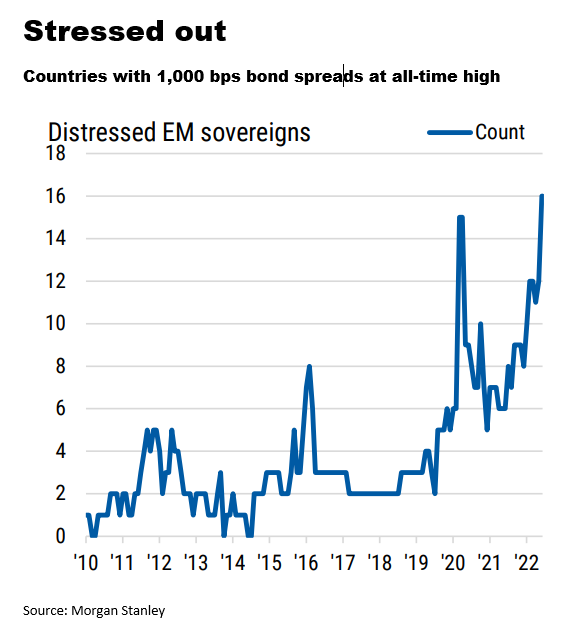
LONDON (Reuters) - Traditional debt crisis signs of crashing currencies, 1,000 basis point bond spreads and burned FX reserves point to a record number of developing nations now in trouble.

Lebanon, Sri Lanka, Russia, Suriname and Zambia are already in default, Belarus is on the brink and at least another dozen are in the danger zone as rising borrowing costs, inflation and debt all stoke fears of economic collapse.

Totting up the cost is eyewatering. Using 1,000 basis point bond spreads as a pain threshold, analysts calculate $400 billion of debt is in play. Argentina has by far the most at over $150 billion, while the next in line are Ecuador and Egypt with $40 billion-$45 billion.

Crisis veterans hope many can still dodge default, especially if global markets calm and the IMF rows in with support, but these are the countries at risk.

ARGENTINA


The sovereign default world record holder looks likely to add to its tally. The peso now trades at a near 50% discount in the black market, reserves are critically low and bonds trade at just 20 cents in the dollar - less than half of what they were after the country's 2020 debt restructuring.

The government doesn't have any substantial debt to service until 2024, but it ramps up after that and concerns have crept in that powerful vice president Cristina Fernandez de Kirchner may push to renege on the International Monetary Fund.


UKRAINE


Russia's invasion means Ukraine will almost certainly have to restructure its $20 billion plus of debt, heavyweight investors such as Morgan Stanley and Amundi warn.

The crunch comes in September when $1.2 billion of bond payments are due. Aid money and reserves mean Kyiv could potentially pay. But with state-run Naftogaz this week asking for a two-year debt freeze, investors suspect the government will follow suit.


TUNISIA

Africa has a cluster of countries going to the IMF but Tunisia looks one of the most at risk.

A near 10% budget deficit, one of the highest public sector wage bills in the world and there are concerns that securing, or a least sticking to, an IMF programme may be tough due to President Kais Saied's push to strengthen his grip on power and the country's powerful, incalcitrant labour union.

Tunisian bond spreads - the premium investors demand to buy the debt rather than U.S. bonds - have risen to over 2,800 basis points and along with Ukraine and El Salvador, Tunisia is on Morgan Stanley's top three list of likely defaulters. "A deal with the International Monetary Fund becomes imperative," Tunisia's central bank chief Marouan Abassi has said.


GHANA


Furious borrowing has seen Ghana's debt-to-GDP ratio soar to almost 85%. Its currency, the cedi, has lost nearly a quarter of its value this year and it was already spending over half of tax revenues on debt interest payments. Inflation is also getting close to 30%.


EGYPT

Egypt has a near 95% debt-to-GDP ratio and has seen one of the biggest exoduses of international cash this year - some $11 billion according to JPMorgan.

Fund firm FIM Partners estimates Egypt has $100 billion of hard currency debt to pay over the next five years, including a meaty $3.3 billion bond in 2024.

Cairo devalued the pound 15% and asked the IMF for help in March but bond spreads are now over 1,200 basis points and credit default swaps (CDS) - an investor tool to hedge risk - price in a 55% chance it fails on a payment.

Francesc Balcells, CIO of EM debt at FIM Partners, estimates though that roughly half the $100 billion Egypt needs to pay by 2027 is to the IMF or bilateral, mainly in the Gulf. "Under normal conditions, Egypt should be able to pay," Balcells said.

GRAPHIC: Egypt's falling foreign exchange reserves- https://fingfx.thomsonreuters.com/gfx/mkt/zgpomxkqnpd/Pasted%20image%201657817324629.png

KENYA

Kenya spends roughly 30% of revenues on interest payments. Its bonds have lost almost half their value and it currently has no access to capital markets - a problem with a $2 billion dollar bond coming due in 2024.

On Kenya, Egypt, Tunisia and Ghana, Moody's David Rogovic said: "These countries are the most vulnerable just because of the amount of debt coming due relative to reserves, and the fiscal challenges in terms of stabilising debt burdens."


ETHIOPIA


Addis Ababa plans to be one of the first countries to get debt relief under the G20 Common Framework programme. Progress has been held up by the country's ongoing civil war though in the meantime it continues to service its sole $1 billion international bond.


EL SALVADOR

Making bitcoin legal tender all but closed the door to IMF hopes. Trust has fallen to the point where an $800 million bond maturing in six months trades at a 30% discount and longer-term ones at a 70% discount.

PAKISTAN

Pakistan struck a crucial IMF deal this week. The breakthrough could not be more timely, with high energy import prices pushing the country to the brink of a balance of payments crisis.

Foreign currency reserves have fallen to as low as $9.8 billion, hardly enough for five weeks of imports. The Pakistani rupee has weakened to record lows. The new government needs to cut spending rapidly now as it spends 40% of its revenues on interest payments.


BELARUS


Western sanctions wrestled Russia into default last month and Belarus now facing the same tough treatment having stood with Moscow in the Ukraine campaign.


ECUADOR


The Latin American country only defaulted two years ago but it has been rocked back into crisis by violent protests and an attempt to oust President Guillermo Lasso.

It has lots of debt and with the government subsidising fuel and food JPMorgan has ratcheted up its public sector fiscal deficit forecast to 2.4% of GDP this year and 2.1% next year. Bond spreads have topped 1,500 bps.

NIGERIA

Bond spreads are just over 1,000 bps but Nigeria's next $500 million bond payment in a year's time should easily be covered by reserves which have been steadily improving since June. It does though spend almost 30% of government revenues paying interest on its debt.

"I think the market is overpricing a lot of these risks," investment firm abrdn's head of emerging market debt, Brett Diment, said.

GRAPHIC: Currency markets in 2022- https://fingfx.thomsonreuters.com/gfx/mkt/zgpomxnjrpd/Pasted%20image%201657869185784.png

(Reporting by Marc Jones; Additional Reporting by Rachel Savage in London and Rodrigo Campos in New York; Editing by Susan Fenton)
Steve Bannon says in leaked audio Trump planned to declare victory on election night even if losing


Steve Bannon says in leaked audio Trump planned to declare 
victory on election night even if losing

John Bowden
Thu, July 14, 2022 

In shocking new audio obtained by a liberal news outlet former White House chief strategist Steven Bannon is heard outlining a plan for Donald Trump to declare victory on election night before voting was concluded and the results were in.

Mother Jones published audio of Mr Bannon discussing the plan in a conversation that took place prior to election night; according to the former administration official Mr Trump would have declared victory from the Oval Office even before results were conclusive in the various states that determined the winner.

“What Trump’s gonna do is just declare victory. Right? He’s gonna declare victory. But that doesn’t mean he’s a winner,” says Mr Bannon in the audio. “He’s just gonna say he’s the winner.”

And he outlined why he believed the strategy would work: Mail-in voting, long decried by Donald Trump as a way for Democrats to turn out voters, would supposedly take longer to count and therefore give the president an advantage in the early hours of the evening.

Because of mail-in votes, “they’re going to have a natural disadvantage, and Trump’s going to take advantage of it. That’s our strategy,” Mr Bannon said, suggesting that the president was both aware of and on board with the plan.


Steve Bannon (AP)

The release of the audio comes as Mr Trump is under investigation in at least two settings for his efforts to block Joe Biden from reaching the White House in 2020 and 2021. He faces one public probe being run by the January 6 select committee, which has no prosecutorial power but can supply evidence to the Justice Department and recommend charges be filed. Mr Trump faces another in Georgia, where state officials are investigating his attempts to pressure GOP figures in Georgia’s government to overturn his defeat after election night.

The Justice Department has not said publicly whether Donald Trump is under investigation at the federal level as well, though at least one member of the January 6 committee has publicly expressed doubt and confusion about the DoJ’s apparent lack of action on the matter in multiple interviews.

In his latest interview with MSNBC’s Ari Melber on Wednesday, California Democrat Adam Schiff declared that it was “so unprecedented” for the January 6 committee or any congressional investigation to be “ahead” of the DOJ’s own investigators, as he suggested was the case.


He added in a press gaggle that he “certainly think[s] that the Justice Department has more than enough evidence to begin an investigation involving the former president” regarding Mr Trump’s efforts to overturn the election.

Mr Bannon has recently signaled that he will reverse course and agree to testify before the committee as he faces trial for contempt of Congress for dodging a congressional subpoena; the Justice Department essentially called that a stunt to avoid punishment in a court filing calling for his trial to go forward.

"The Defendant’s last-minute efforts to testify, almost nine months after his default—he has still made no effort to produce records—are irrelevant to whether he willfully refused to comply in October 2021 with the Select Committee’s subpoena," the Justice Department argued in a filing calling for his latest decision to not factor in at trial.

The Jan 6 committee plans to return next week for its final, prime time public hearing.

‘Game over’: Steve Bannon audio reveals Trump planned to claim early victory


Adam Gabbatt in New York
Thu, July 14, 2022 

Photograph: Kevin Dietsch/Getty Images

Days before the 2020 presidential election Donald Trump was planning to declare victory on election night, even if there was no evidence he was winning, according to a leaked Steve Bannon conversation recorded before the vote.

In the audio, recorded three days before the election and published by Mother Jones on Wednesday, Bannon told a group of associates Trump already had a scheme in place for the 3 November vote.

“What Trump’s gonna do is just declare victory. Right? He’s gonna declare victory. But that doesn’t mean he’s a winner,” Bannon, laughing, told the group, according to the audio.

“He’s just gonna say he’s a winner.”

Related: Trouble for Trump as committee makes case Capitol attack was premeditated

The release of the audio comes as Bannon is due to go on trial Monday for criminal contempt, after he ignored a subpoena last year from the House select committee investigating the attack on the US Capitol on January 6 last year.

After several attempts to postpone the trial beyond 18 July – including on Wednesday, when Bannon’s attorneys cited some of his past comments during Tuesday’s January 6 committee hearing, and the planned airing of a CNN documentary on Bannon this coming Sunday – a federal judge for a second time denied Bannon’s motion to delay, and ruled Bannon could not make two of his principal defences to a jury.

Bannon had said he was now willing to testify before the House select committee, but the offer was dismissed by the justice department as a “last-ditch attempt to avoid accountability”, and US district judge Carl Nichols, a Trump appointee, said the trial must go ahead.

Before the 2020 election it had been reported that Trump planned to declare victory early, and in the Mother Jones audio Bannon says Trump planned to “take advantage” of the likelihood that Democratic postal votes would be tallied later than in-person Republican ballots.

Trump did exactly that hours after the election, claiming, “Frankly, we did win this election”, even as millions of ballots were yet to be counted, and after Fox News had – correctly – called the state of Arizona for Joe Biden.

“As it sits here today,” Bannon said later in the audio, describing a scenario in which Trump held an early lead in swing states, “at 10 or 11 o’clock Trump’s gonna walk in the Oval, tweet out: ‘I’m the winner. Game over. Suck on that.’”

Mother Jones said the audio, which is nearly an hour long, was recorded during a meeting between Bannon and supporters of Guo Wengui, an exiled Chinese mogul whom Bannon helped launch a series of rightwing websites.

In the meeting Bannon said Democratic supporters were more likely than Republicans to vote by mail, meaning their votes would be counted and reported later.

That would lead to a public perception that Trump was winning the election, according to the audio. Democrats would “have a natural disadvantage”, Bannon said.

“And Trump’s going to take advantage of it. That’s our strategy. He’s gonna declare himself a winner.”

“So when you wake up Wednesday morning, it’s going to be a firestorm,” Bannon said.

“You’re going to have antifa, crazy. The media, crazy. The courts are crazy. And Trump’s gonna be sitting there mocking, tweeting shit out: ‘You lose. I’m the winner. I’m the king.’”

Axios reported before the 2020 election that Trump had “told confidants he’ll declare victory on Tuesday night if it looks like he’s ‘ahead’”, and Bannon said on his podcast on the day of the election that Trump would claim victory “right before the 11 o’clock news”. The Mother Jones audio supports both claims.

Trump, the only US president to have been impeached twice, lost the election: Biden won 306 electoral votes to Trump’s 232. About 81.3 million people voted for Biden, compared with 74.2 million for Trump.

Bannon’s offer to testify to the January committee – a development first reported by the Guardian – was kept up in the air by Judge Nichols, who said he would rule on that motion at trial since it was possible for Bannon to argue he was unclear about the date of his subpoena default.

At trial, the justice department intends to call as witnesses FBI special agent Stephen Hart and the select committee’s deputy staff director, Kristen Amerling, and may also call Sean Tonolli, a select committee attorney, according to the government’s witness list.