Saturday, July 16, 2022

Alberta to 'kickstart' industrial, oilpatch carbon capture projects with $40-million fund

Meghan Potkins
Fri, July 15, 2022 

no0715carbon-capture

Nearly a dozen carbon capture projects from Alberta’s oilpatch and industrial sectors will receive an injection of cash from the provincial government aimed at accelerating the deployment of more than $20 billion in capital spending on emissions reduction.

Emissions Reduction Alberta (ERA) announced this week it would provide more than $40 million to 11 carbon capture utilization and storage (CCUS) projects across the province through its Carbon Capture Kickstart fund.

“What we’re really trying to do is catalyze a lot of the technical work that needs to be undertaken (to) actually see carbon capture technologies deployed,” ERA CEO Justin Riemer said in an interview with the Financial Post.

“What’s exciting about this is that there are a range of sectors that are taking advantage of this opportunity and pursuing plans for Class 3 (cost estimates) and Class 4 feasibility studies to assess the readiness for carbon capture in the energy sector, oil and gas, oilsands, fertilizer sector, cement (and) electricity.”

Among the recipients of the funds are energy producers, including a consortium of oilsands companies proposing a major trunkline and carbon sequestration hub, as well as individual carbon capture projects from Suncor Energy and Strathcona Resources. Funds will also go to projects proposed by Enmax, Lafarge Canada and Nutrien.

The funding comes from Alberta’s carbon levy on large industrial emitters. Five of the projects will also receive additional funds from Natural Resources Canada to advance engineering and design work.

The cash boost is part of a suite of recent government announcements — including the federal government’s new investment tax credit for carbon capture — aimed at pushing companies to reaching the point of making a final investment decisions sooner when it comes to carbon capture.

Experts say there’s no time to waste if Canada’s large emitters are to meet the daunting greenhouse gas targets laid out in the latest federal emissions reduction plan. Those include a requirement that Canada’s oil and gas sector achieve a reduction of 31 per cent from 2005 emissions levels over the next eight years.

The speed at which some large emitters are now pursuing carbon capture came as a surprise, said ERA executive director Justin Wheler. First-generation projects in Canada such as the Shell Quest carbon capture project, or SaskPower’s Boundary Dam carbon capture project took seven to 10 years to get up and up and running.

“(These latest projects) are targeting getting these facilities done in half the time (and) the only way to do that is to start today on the detailed engineering and economics,” Wheler said. “That’s why I called it a kickstart: it’s a small amount of money in the grand scheme of things, but it’s really targeted at getting getting people moving today.”

Still, the projects are extraordinarily expensive and face an existential risk in the form of the political uncertainty around carbon pricing in the future.

The Pathways Alliance — formerly known as the Oilsands Pathways to Net Zero alliance — is in the early stages of evaluating a massive $46.33-million investment in a carbon capture project in northern Alberta.

The proposal involves 11 separate projects tied into a pipeline that would carry carbon to a sequestration hub. The group — comprised of Canadian Natural Resources, Cenovus Energy, ConocoPhillips Canada, Imperial Oil, MEG Energy Corp. and Suncor — will receive $5 million from the Kickstart fund to help advance engineering on the project that could capture around 12 million tonnes of emissions a year in its first phase.

Kendall Dilling, president of the Pathways Alliance, said the energy sector is cognizant of the need to get moving on projects if it is to maintain the goodwill of governments and Indigenous communities.

“The Pathways (Alliance)’s raisons d’ĂȘtre is to do stuff. To get steel in the ground, to get building (solutions) to address our greenhouse gas emissions,” Dilling said. “There’s only so long that you can plan and talk and design. It’s important to get to execution.”

• Email: mpotkins@postmedia.com | Twitter: mpotkins
Mark Carney says Canada should make a 'big bet' on carbon capture

Marisa Coulton
Fri, July 15, 2022 

mark-carney-gs0715

Canada should make a “big bet” on carbon capture to lower emissions from the oil and gas sector, Mark Carney, former governor of the Bank of Canada told delegates at the International Economic Forum of the Americas in Montreal, which brought together business leaders from around the world to discuss the green transition in the private sector.

“For Canada as a whole, we need to make a big bet, or I should say investment rather than a bet, in carbon capture in Western Canada to address the 25 per cent of our emissions that come from the oil and gas sector,” he said on Tuesday. “It’s necessary, in and of itself, to address that.”

Carney added that Canada has the opportunity to be “front and centre” in the “reordering and rewiring” of the global economy.

“As the world is being rewired, we’ve got clean energy, we’ve got amazing human capital, we’ve got stability, we’ve got fantastic trading relationships around the world,” he said. “And all of that gets leveraged.”

Over the course of the conference, carbon capture emerged as one of the more promising mitigation methods in the fight against climate change.

The Intergovernmental Panel on Climate Change (IPCC) defines carbon capture as “a process consisting of the separation of (carbon dioxide) from industrial and energy-related sources, transport to a storage location and long-term isolation from the atmosphere.” In other words, instead of releasing CO2 into the atmosphere, energy producers will capture and store it.

The IPCC has said that carbon capture has “considerable” potential, and will likely need to be a part of emissions reductions efforts going forward. The Center for Climate and Energy Solutions, an Arlington, Va.-based environmental non-profit said carbon capture is now “viewed as the only practical way to achieve deep decarbonization in the industrial sector.”

Energy producers are catching on, helped in part by the Canadian government, which committed $10 billion to carbon capture in the 2022 budget. Companies will be able to take advantage of an investment tax credit that will reduce the cost of carbon-capture projects by 50 per cent to 60 per cent.

“We’re working with universities and other companies to pilot a carbon capture from stacks in our refineries,” said Kevin Scott, chief refining and supply officer at Saint John, N.B.-based Irving Oil Ltd. “(It’s) one of the few and first projects of its kind in the world to actually capture the CO2 out of emissions and then work with others to figure out how we’re going to sequester those.”

But carbon capture has its downsides, too. For one, it’s more expensive than releasing CO2 into the atmosphere. It also has environmental risks.

Belgian battery company announces $1.5-billion investment in Ontario

According to an IPCC report, the captured carbon could either be pumped into the ocean or buried underground. Storing the carbon underground would be relatively low risk, but adding CO2 to the ocean will “alter the local chemical environment” and cause “the mortality of ocean organisms.” The pipelines used to transport the CO2 over long distances would also run the risk of leakage.

Critics say that carbon capture will merely prolong oil and gas production in Canada.

At the conference, Carney said he was impressed by the rapid uptake of hydrogen fuel across various industries. Hydrogen does not directly contribute to climate change when released into the atmosphere, but it does compound the impact of other gasses in the atmosphere, thereby contributing to indirect warming.

But until the economy has been appropriately rewired, “we need a system that is focused on transition,” Carney said.

Financial Post
Shinzo Abe’s assassin forced to give up college after mother's $722,000 donation to Unification Church, says uncle


Jane Nam
Fri, July 15, 2022

The uncle of Shinzo Abe’s suspected shooter Tetsuya Yamagami stated that Yamagami’s mother had donated approximately 100 million yen ($721,875) to the Unification Church, leading to the family’s alleged financial ruin.

Yamagami reportedly told police that he had targeted the former prime minister due to Abe’s affiliation with the Unification Church, which Yamagami blamed for bankrupting his mother due to its forceful donating practices.

On Friday, the uncle, who is the 77-year-old older brother of Yamagami’s father, shared that Yamagami’s mother first joined the church in 1991 after her husband’s suicide in 1984.

She made multiple donations to the religious group throughout her time as a devoted member, including proceeds from the sale of the family’s property and house.


More from NextShark: NYT Reporter Warns Conservative Writer Andy Ngo is a ‘Real Threat’, Should Be Censored on Twitter

Despite becoming bankrupt in 2002, she continued giving to the church, albeit in smaller amounts, under the principle of “world peace and unification.”

“I believe she was a very important follower of the church. She was under mind control,” the uncle said.

He added that the family was thrown into poverty and Yamagami was forced to give up college due to financial ruin.

More from NextShark: Asian Woman Punched and Kicked for Purse With $132 in Queens

“He was extremely smart just like his father,” the uncle recalled of Yamagami. “He was also hardworking and I only have good memories of him.”

Church officials stated at a news conference on Monday that it had no direct relationship to Abe, although it did with other lawmakers through an affiliated organization.

It also insisted that it had returned 50 million yen ($360,929) back to her, while claiming there were also no records of her donations to the organization.

More from NextShark: Andrew Yang’s Presidential Campaign Had a ‘Toxic’ Bro Culture That Drove Women to Therapy, Report Says

The Unification Church was first founded in South Korea in 1954 by Rev. Sun Myung Moon, who was heavily influenced by the Confucian idea that world peace begins with harmonious families.

The church is known for its mass weddings, in which leaders officiate thousands of new couples at once in a single gathering, and its influence over conservative political parties.

Yamagami reportedly planned to kill the church’s religious leaders first but changed his target to Abe after watching a video message sent by Abe to one of the Unification Church’s affiliates.

More from NextShark: Video shows safety driver of WeRide test car asleep behind the wheel

COVID-19 also prevented him from being able to travel to South Korea, where many of the seniors are.

Yamagami told police that he began experimenting with making his own firearms around spring of last year and had initially thought of making a bomb instead of a gun.

Featured Image via Vice
German climate activists aim to stir friction with blockades


Climate Direct Action
Climate activist Lina Schinkoethe, right, and her mother Solvig Schinkoethe, second from right, sit with their hands glued to the ground during a protest with the group Uprising of the Last Generation in Berlin, Germany, Tuesday, June 21, 2022. The group claims the world has only a few years left to turn the wheel around and avoid catastrophic levels of global warming. 
AP Photo/Markus Schreiber

FRANK JORDANS
Fri, July 15, 2022

BERLIN (AP) — “It’s absolutely crazy to stick yourself to the road with superglue,” admits Lina Schinkoethe.

And yet, the 19-year-old recently landed in jail for doing just that, in protest at what she believes is the German government's failure to act against climate change.

Schinkoethe is part of a group called Uprising of the Last Generation that claims the world has only a few years left to turn the wheel around and avoid catastrophic levels of global warming.

Like-minded activists elsewhere in Europe have interrupted major sporting events such as the Tour de France and the Formula One Grand Prix in Silverstone in recent weeks, while others glued themselves to the frame of a painting at London’s Royal Academy of Arts Tuesday. But Schinkoethe's group has mainly targeted ordinary commuters in cities such as Berlin who, on any given day this summer, might find themselves in an hours-long tailback caused by a handful of activists gluing themselves to the asphalt.


Their actions have prompted outrage and threats from inconvenienced motorists. Tabloid media and some politicians have accused them of sowing chaos and harming ordinary folk just trying to go about their business. Some have branded them dangerous radicals.

Schinkoethe says the escalation in tactics is justified.

“If we wanted people to like us then we’d do something else but we’ve tried everything else,” she told The Associated Press. “We’ve asked nicely. We’ve demonstrated calmly.”

She recalls joining the Fridays for Future protests led by Swedish activist Greta Thunberg which saw hundreds of thousands of students worldwide skip school and rally for a better world.

“I really hoped something would change, that politicians would react and finally take us and the science of climate change seriously," she said. "But we're still heading for a world that’s 3 to 4 degrees Celsius (5.4 to 7.2 Fahrenheit) warmer.”

Such a rise in global temperatures is more than twice the 1.5-C (2.7-F) limit countries agreed to in the 2015 Paris climate accord. While progress has been made in reducing greenhouse gas emissions, experts agree the goal is still far out of reach.

Scientists agree that the world has no time to waste in cutting emissions, but have tried to counter 'doomism' by arguing that the world isn’t heading for one single cliff edge so much as a long, steep slope with several precipitous drops.

“Each tenth of a degree matters,” said Ricarda Winkelmann, a scientist at the Potsdam Institute for Climate Impact Research near Berlin.

“If we really start acting now and reduce global greenhouse gas emissions to net zero by 2050, chances are that we can limit some of the most severe climate impacts,” she said.

Such messages are lost on many of those caught up in the blockades.

At two protests witnessed by The AP in June and July, several truckers got out of their cabs to berate the activists. One physically hauled two protesters off the road.

Other drivers, some of whom weren't affected by the blockade, also hurled abuse at the activists. A few expressed support for the climate cause but questioned the way the protests were conducted.

“They need to find a different way to do this than to block other people,” said one driver on his way to work, who would only give his name as Stefan.

Berlin's mayor has called the street blockades “crimes,” while the city's top security official is demanding that prosecutors and courts mete out swift convictions. So far, no cases have gone to trial.

Still, Schinkoethe believes she has no choice but to keep going.

“We need to generate friction, peaceful friction, so that there’s an honest debate and we can act accordingly,” she said.

That sentiment was echoed by Ernst Hoermann, a retired railway engineer and grandfather of eight who has been traveling to Berlin from Bavaria regularly to take part in the protests.

“We basically have to cause a nuisance until it hurts," he said as a police officer tried to unstick him from the road with the help of cooking oil.

Similar protests have resulted in weeks-long prison sentences in Britain, where the government has sought court injunctions to preemptively stop road blockades by the group Insulate Britain.

Hoermann, 72, said he isn't afraid of fines or the prospect of prison.

“Not compared to the fear I have for my children,” he said.

Last Generation has recently tried to focus attention on Germany's plans to drill for oil and gas in the North Sea.

Despite having the most ambitious climate target of any major industrialized nation, Germany's center-left government is scrambling like other European countries to replace its Russian energy imports and avoid painful fuel shortages in the coming years.

Schinkoethe says the number of people participating in the group’s actions has grown from 30 to 200 in six months, and argues that the blockades follow the tradition of civil disobedience seen during the U.S. civil rights movement and the fight for women's suffrage.

“What we’re doing is illegal," she said. “At the same time it’s legitimate.”

Manuel Ostermann, a senior member of one of Germany’s police unions, accused the group of committing crimes while portraying themselves as victims.

“Where the process of radicalization gets going, extremism isn’t far off,” he wrote on Twitter.

Members of Last Generation have tried to counter that, citing U.N. Secretary-General Antonio Guterres who earlier this year said that “the truly dangerous radicals are the countries that are increasing the production of fossil fuels.”

"I’m going to keep going until the government locks me and the other activists up for their peaceful protests, or gives in to our demands,” said Schinkoethe.


U.S. cannot fulfill climate change pledges if Manchin won't vote for clean energy, experts say

Ben Adler
·Senior Editor
Fri, July 15, 2022

If Sen. Joe Manchin, D-W.Va., will not vote for a budget reconciliation bill that includes the measures to reduce climate change in the version passed by the House of Representatives last year — as the Washington Post reported Thursday night that he would not — it virtually guarantees that the United States will fail to meet its international commitments to reduce the greenhouse gas emissions causing climate change, experts say.

As part of his efforts to galvanize a strong global agreement to avert catastrophic climate change by staying below 1.5 degrees Celsius (2.7 Fahrenheit) in Glasgow, Scotland, last year, President Biden pledged that the U.S. would reduce by at least half its emissions from a 2005 baseline by 2030. Due to the energy sector’s reduction in coal use, the nation is already almost halfway to that goal, with emissions having dropped by about one-fifth since 2005. But getting the rest of the way there is impossible without legislation that hastens the transition from fossil fuels to clean energy, according to modeling by economists, scientists and policy wonks.


Democratic Sen. Joe Manchin with Republican Sen. Shelley Moore Capito, both of West Virginia. (Tom Williams/CQ-Roll Call via Getty Images)

“This appears to be the final installment in the collapse of Democratic hopes for a major legislative package on climate for the 117th Congress,” Barry Rabe, a professor of environmental policy and public policy at the University of Michigan, told Yahoo News in an email about Manchin’s reported stance. “Despite bold initial promises, Congress has once again failed to deliver on a climate bill. This clearly imperils any prospects to honor President Biden’s emission reduction pledge and further challenges American credibility in global climate deliberations.”

On Thursday, the Rhodium Group, a research and data analytics firm specializing in energy and the environment, issued a study showing that the U.S. is on pace to reduce emissions 24% to 35% below 2005 levels by 2030. Absent significant new policies, in other words, the best-case scenario is that the U.S. gets 70% of the way towards Biden’s goal of cutting emissions in half, and it is just as likely to get halfway to the goal.

Manchin had previously signaled support for provisions in the budget bill, formerly known as Biden’s Build Back Better agenda, that would subsidize the deployment of clean energy and electric vehicles. Democrats wanted to spend hundreds of billions of dollars over 10 years on tax credits for purchases such as rooftop solar panels, electric cars and tax credits on incentives for projects such as advanced battery storage and cleaning up industrial processes. Congressional Democrats and Biden had already agreed to drop other climate provisions, such as the Clean Electricity Performance Program, which would have provided incentives for electric utilities that switched to clean energy sources such as wind and solar power, at Manchin’s request.


Solar panels on a rooftop in Los Angeles. 
(Daniel Slim/AFP via Getty Images)

Previous studies by organizations such as the World Resources Institute (WRI), a leading global environmental think tank, had found that the U.S. could meet Biden’s emissions target, just barely, with the package of climate provisions Manchin had indicated he could support, possibly in exchange for approval of more fossil fuel infrastructure projects.

“Failure to enact a climate-smart budget package would be a devastating setback to achieving the United States’ pledge to cut emissions in half by 2030,” said Dan Lashof, director of WRI United States, in a statement on Friday. “Research shows that strong financial investments, like those under consideration in the budget reconciliation package, are essential for the U.S. to achieve that timeline.”

But on Thursday evening the Washington Post reported that Manchin had told Democratic leaders he would not vote for a bill that includes spending on climate change or tax increases on wealthy individuals and corporations to pay for it. “Senator Manchin believes it’s time for leaders to put political agendas aside, reevaluate and adjust to the economic realities the country faces to avoid taking steps that add fuel to the inflation fire,” said Manchin’s spokesperson Sam Runyon.

On Friday morning, the West Virginia Democrat told a local radio station in his home state that he is open to backing the climate change policies if inflation eases next month. “I said, ‘Chuck, can we just wait until the inflation figures come out in July ... and then make a decision what we can do and how much we can do?’” Manchin said, referring to a conversation he had with Senate Majority Leader Chuck Schumer, D-N.Y. “[Schumer] took that as a no, I guess, and came out with this big thing last night. And I don’t know why they did that. I guess to try to put pressure on me, but they’ve been doing that for over a year now. It doesn’t make any sense at all. As far as I’m concerned, I want climate, I want an energy policy.”


Senate Majority Leader Chuck Schumer.
(Yuki Iwamura/AFP via Getty Images)

If Manchin doesn’t provide his crucial vote, however, and Republicans gain control of at least one chamber of Congress in November’s midterm elections, there is no hope for legislation to address climate change. And without legislation, the federal government has limited tools at its disposal to reduce emissions. Only Congress can tax and spend. And contrary to Manchin’s reasoning about inflation, a 2021 study by the Rhodium Group found that American households would save an average of about $500 per year on energy bills if the climate package were passed.

“We need to make it more affordable for everyday Americans to get off of fossil fuels,” Leah Stokes, a political scientist who specializes in environmental policy at the University of California, Santa Barbara, told Yahoo News. “Fossil fuels are expensive, they are driving inflation. The bill would have been really great for everyday Americans’ pocketbooks. It would have helped them close the gaps, so that they could afford an electric vehicle, so that they could afford an electric heat pump. There were all these investments that were going to make it easier for utilities to build wind and solar, that were going to make it easier to retire dirty, expensive fossil fuel plants. It really was about helping to invest in climate solutions, so that we can move at a faster pace.”

Using executive authority under existing laws such as the Clean Air Act, the Environmental Protection Agency can require stronger pollution controls and the Department of Interior can restrict fossil fuel development on federal land, but those moves — assuming they survive the inevitable legal challenges from the fossil fuel industry — will only reduce emissions at the margins.


President Biden speaking in Tel Aviv, Israel, on Wednesday. 
(Kobi Wolf/Bloomberg via Getty Images)

“One of the tragedies of the past 18 months is that the Biden administration has been wary of upsetting these delicate negotiations with Senator Manchin and so they have held back on using the full force of their executive authority,” Stokes said. “That’s not the case going forward, the Biden administration will be acting. It will be much more aggressive on everything from Clean Air Act regulations to limiting fossil fuel development. There’s no reason to delay anymore. So we could be in a slightly better place, if and when the Biden administration kicks into high gear on climate change.

“But getting to the goal is difficult,” she added. “And there is modeling that has estimated what does it mean if the Biden administration uses all the regulations it can and it tends to be, it gets us like five percentage points closer to the goal. So if we’re at 35%, it gets us to 40%, optimistically.”

“We are not currently on track to meeting our international climate commitments or our environmental justice commitments,” Jamal Raad, executive director of Evergreen Action, a climate advocacy group, told Yahoo News. “A major investment was necessary over the next decade to supercharge our transition to clean energy and bring down the cost of wind and solar and ramp up renewable energy production. Without that major investment, it’s hard to see how we meet our commitments.”

Manchin called out by climate change's powerful voice: 'A modern-day villain who drives a Maserati and lives on a yacht courtesy of the coal industry'

By Rachel Koning Beals

MANN VS. MANCHIN


Oft-quoted Penn State University scientist and published author Michael Mann says Sen. Manchin is sinking global climate action by shrinking U.S. role

That's a swing from oft-quoted Penn State University scientist and published author Michael Mann, responding Friday to reports that Sen. Joe Manchin of West Virginia would get in the way of legislative progress for the Biden administration's push to slow climate change.

President Joe Biden, as part of a sweeping spending bill that's been reduced to the dregs of its nearly $2 trillion beginnings, wanted to give Americans incentives for pollution-fighting electric cars, solar energy and more.

Read: Activists swarm Joe Manchin's Maserati as he tries to leave parking garage

"Given the U.S.'s role as the leading all-time carbon polluter, it is difficult to see global action on climate without U.S. leadership," added Mann, the prominent climatologist, speaking to The Guardian. By some measures, China is considered the world's largest polluter, with the U.S. in second, depending if a per-capita comparison is used.

Solar stocks were hit hard Friday by Manchin's opposition to climate spending.

Mann later tagged Sen. Manchin in a tweet, half-heartedly joking he "held back a bit" in his characterization of Manchin's lobbyist and election-contribution affiliations. The senator has a powerful spot as chair of the energy committee.

West Virginia newspaper coverage of Manchin's seaworthy vessel has characterized it as more houseboat than yacht, citing boating experts that say the "Almost Heaven" doesn't quite rank as a luxury liner.

Manchin, often referred to as a "moderate" Democrat but one known to back the traditional energy output of his home state and generally siding with Republicans in pushing U.S. energy independence from the Middle East and Russia, has made clear his reluctance to keep climate change and energy proposals in a last-ditch budget reconciliation bill.

Manchin has said high inflation shouldn't be worsened by what he sees as policy driving up gasoline prices.

"No matter what spending aspirations some in Congress may have, it is clear to anyone who visits a grocery store or a gas station that we cannot add any more fuel to this inflation fire," Manchin said earlier this week.

Manchin last year blocked the roughly $2 trillion version of the Democratic-drafted Build Back Better bill, pressing for a smaller plan. That bill's considerable climate focus was deemed the largest-ever U.S. effort on the pressing issue and was roundly praised by other industrial economic giants.

In all, Biden and fellow Democrats have spent nearly two years trying to get Manchin, a critical vote in a closely divided Senate, to agree to a huge package of support for renewable energy(ICLN) and electric cars(TSLA)(F). Democrats now appear to have run out of time, with the end of the fiscal year looming in September and November's midterm elections increasingly likely to see congressional control switch to the Republicans, according to polling. New surveys do show a tougher road suddenly for the GOP in Senate races.

At least one policy analyst saw a slim chance some form of energy tax credits might squeak through in a November interim session. And Biden vowed new executive orders to make up the congressional gap on climate.

Republicans, and Democrats typically from states linked to traditional energy, aren't as staunchly against mitigating climate change using both government and private-sector prowess as they've been in earlier decades, surveys show.

But the party broadly wants efforts that favor nuclear energy, natural gas, and carbon capture and storage in the energy mix.

Read: Carbon capture, nuclear and hydrogen feature in most net-zero emissions plans and need greater investment: report

And they want polluters such as China and India to play a bigger role in curbing emissions. With climate change, and most private-sector endeavors, they back lighter regulation. In fact, the conservative-majority Supreme Court just ruled on limiting the EPA's reach in demanding fewer emissions by power plants.

-Rachel Koning Beals

SEE 
Trump lost, and the 2020 election wasn’t stolen, group of prominent conservatives concludes after exhaustive study

Weston Blasi - Yesterday 

© APTrump lost, and the 2020 election wasn’t stolen, group of prominent conservatives concludes after exhaustive study
KEY WORDS
‘Donald Trump and his supporters had their day in court and failed to produce substantive evidence to make their case.’

Related video: New conservative-led report debunks every single Trump claim of election fraud
View on Watch


That’s an excerpt from a 72-page report titled “Lost, Not Stolen: The Conservative Case that Trump Lost and Biden Won the 2020 Presidential Election,” just out from a blue-ribbon panel of American conservatives.

The report sets out to analyze the many fraud claims that the Republican former president, Donald Trump, and his allies have offered to explain Trump’s loss by 7 million–plus votes (306-232 in the Electoral College) to Democrat Joe Biden in the 2020 U.S. presidential election.

Among the noted figured behind the report are retired federal appeals court judges Thomas B. Griffith, J. Michael Luttig and Michael W. McConnell; former Solicitor General Theodore Olson, who served under President George W. Bush; former U.S. senators John Danforth and Gordon Smith; longtime Republican election lawyer Benjamin Ginsberg; and veteran Republican congressional chief of staff David Hoppe. Each one has been elected as a Republican, been appointed to their office by a Republican, or is otherwise associated with the GOP.

From the archives (June 2022): Conservative legal scholar, Pence lawyer, other witnesses tell Jan. 6 committee of ‘crazy,’ anti-democratic scheme to hand Trump a second term

Also see: Paul Ryan was ‘sobbing’ and ‘horrified’ while watching the Jan. 6 attack on the Capitol, book says

“Once they had lost, Trump and his supporters had an obligation to recognize that the election debate was over,” the report states. “Questions of election legality must be resolved dispassionately in courts of law, not through rallies and demonstrations.”

Weeks after Biden’s win — called by major-media decision desks on Nov. 7, 2020, four days after Election Day, and affirmed by the Electoral College on Dec. 14 — Trump supporters infiltrated the U.S. Capitol on Jan. 6, 2021, immediately following a Trump rally near the White House dubbed “Stop the Steal” and, not coincidentally, as Congress was meeting to certify Biden’s electoral victory. The attack on the Capitol complex halted for hours that bedrock democratic process and led to millions of dollars’ worth of damages and more than 140 injuries along with five deaths. The incident is being investigated by a bipartisan House committee, which has been holding public hearings over the past several weeks.

The “Lost, Not Stolen” report highlights Nevada, a state that Biden won in 2020, as one notable site of baseless fraud claims.

According to the report, Trump and his legal team called Nevada “the big treasure trove of illegal balloting,” but were not able to produce evidence to support such a claim. The Nevada secretary of state, a Republican, highlighted just 100 cases of potential fraud out of the 1.4 million votes cast in Nevada during the 2020 election. Biden won Nevada by more than 33,000 votes.

Trump’s claims of widespread voter fraud have continued to be aired as recently as this week, as he sought to cast new doubt on the Wisconsin result, appearing to believe that a state court’s ruling restricting the use of ballot drop boxes could, and should, be applied retroactively — notwithstanding, the Milwaukee Journal Sentinel observed, that Trump’s 2016 win in the state over Democrat Hillary Clinton would also be placed in jeopardy.

Biden beat Trump in the Badger State by some 20,600 votes in 2020, while Trump outpolled Clinton by just under 22,750 votes four years earlier, when Gary Johnson and Jill Stein combined to draw about 140,000 votes.

From the archives (June 2022): Trump attorney general William Barr calls vote-fraud claims ‘bullsh—,‘ ‘bogus’ and ‘idiotic’: ‘I didn’t want to be a part of it’

Trump is not alone in believing, or professing to believe, the 2020 election was not legitimately conducted. In polls cited by Politifact, a majority of self-identifying Republicans have said they do not think Biden was “legitimately elected.” One Quinnipiac poll conducted six months after the election found as much as two-thirds of Republicans agreeing with the claim that Biden’s election to the presidency was not legitimate.

See also: Elon Musk tells Trump to ‘hang up his hat and sail into the sunset’

The “Lost, Not Stolen” report comes as Biden’s overall approval rating has fallen from percentages in the mid-50s in April 2021 to below 40% of late, adding credence to what many self-identifying Republicans have described as a gut feeling that Biden could not have won 81.3 million votes (to Trump’s 74.2 million). Biden’s average favorable rating, at 42.2%, is also underwater.

See: Most Democrats want an alternative to Biden in 2024, poll finds

Not helping is a persistently high inflation rate, which the Federal Reserve, echoed by the Biden White House, had expected to be “transitory” and to have moved well lower by this summer. Instead, according to June data, inflation, as measured by the consumer-price index, has climbed to a 41-year high of 9.1%.

Why a recession is 'not the situation we have today,' according to a strategist


With recession fears rattling markets, BNP Paribas Chief Market Strategist Daniel Morris still thinks it is too early for investors to reposition their portfolios.

“When we think of a recession, it’s really a collapse in demand and that’s absolutely not the situation we have today,” Morris told Yahoo Finance Live. “Consumer demand is still strong, business investments still pretty good, and unemployment very low,”

Even with inflation soaring 9.1% year-over-year (YoY) in June 2022, American consumers are spending. A Bank of America (BofA) Institute report released Thursday finds that credit and debit card spending was up 11% YoY in last month. BofA internal data also confirms that consumers are spending and saving more than in pre-pandemic levels.

The labor market is also exhibiting strength amid tightened financial conditions. The U.S. Bureau of Labor Statistics recorded the addition of 372,000 jobs in June 2022, which was 104,000 jobs higher than estimates. The unemployment rate also stayed at 3.6% for the fourth month in a row.

The National Bureau of Economic Research (NBER) defines a recession as a “significant decline in activity that is spread across the economy and that lasts more than a few months.” That does not mean that an economy is in a recession after two consecutive quarters of negative gross domestic product (GDP) growth, according to Morris.

“If you look at the recession that occurred after the dot-com bust in 2000, you did not have two quarters of negative GDP growth, but it was still classified as a recession,” Morris explained.

Morris points out 2 indicators from the dot-com recession investors should look out for in the future: the labor market and the Fed.

“What happened in the labor market and whether or not the Fed responds to the slowdown … kind of really that combination signals this was a recession,” Morris said.

The Fed is prepared to be more hawkish if it needs to. Meeting minutes from last month’s meeting suggest the Fed will take a more “restrictive stance” if inflation does not fall, and Chairman Jerome Powell announced a 50 or 75 basis point hike for July 2022 at last month’s press conference.

However, after June's CPI report release, investors are looking to the possibility of the Fed raising interest rates by 1%. CME Group’s FedWatch data, as of Wednesday, forecasts a 44% probability of a 100 basis point hike at July’s FOMC meeting.

All things considered, Morris and his team think the risk of a recession is not in the near term.

“We don’t really see [a recession] happening until next year, and that means the markets aren’t going to be pricing in that potential outcome for a while yet,” Morris said.

Energy use from US cryptomining firms is contributing to rising utility bills

Dani Anguiano in Los Angeles

Sat, July 16, 2022 

<span>Photograph: Stephen Shaver/REX/Shutterstock</span>
Photograph: Stephen Shaver/REX/Shutterstock

The largest US cryptomining companies have the capacity to use as much electricity as nearly every home in Houston, Texas; energy use that is contributing to rising utility bills, according to an investigation by Democratic lawmakers.

Cryptomining is a highly energy intensive process involving the use of specialized computers running constantly to solve complex math problems in order to create new virtual coins.

Related: Trillion-dollar crypto collapse sparks flurry of US lawsuits – who’s to blame?

Energy use in the industry is greater than that of entire countries. The US has become the center of cryptomining after it was banned in China. More than a third of the global computing power dedicated to mining bitcoin, the largest cryptocurrency, comes from the US, Senator Elizabeth Warren and five other Democrats reported in a letter to the Environmental Protection Agency.

“The results of our investigation … are disturbing … revealing that cryptominers are large energy users that account for a significant – and rapidly growing – amount of carbon emissions,” the letter states. “It is imperative that your agencies work together to address the lack of information about cryptomining’s energy use and environmental impacts.”

The congressional Democrats have asked the EPA and the Department of Energy to require cryptominers to disclose emissions and energy use, noting that regulators know little about the full environmental impact of the industry.

The lawmakers solicited information from seven of the largest US cryptomining companies, including Stronghold, Greenidge, Bit Digital, Bitfury, Riot, BitDeer and Marathon, about their energy sources and consumption and the climate impacts of their operations. The data revealed that the industry is using a substantial amount of electricity, ramping up production and creating significant carbon emissions at a time when the US needs to drastically reduce emissions to combat the climate crisis.

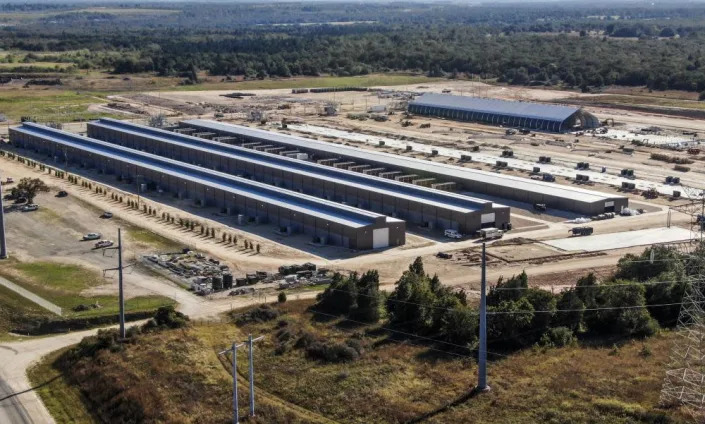
An aerial shot shows rows of long sheds on land surrounded by power lines.
Riot Blockchain's bitcoin mining facility in Rockdale, Texas. An investigation revealed the industry is creating significant carbon emissions. Photograph: Tannen Maury/EPA

Emissions data from three companies, Bit Digital, Greenidge and Stronghold, indicated their operations create 1.6m tons of CO2 annually, an amount produced by nearly 360,000 cars. Their environmental impact is significant despite industry claims about clean energy use and climate commitments, the lawmakers wrote.

“Bitcoin miners are using huge quantities of electricity that could be used for other priority end uses that contribute to our electrification and climate goals, such as replacing home furnaces with heat pumps,” the letter states.

“The current energy use of cryptomining is resulting in large amounts of carbon emissions and other adverse air quality impacts, as well as impacts to the electric grid.”

The power demands of the industry are also coming at a cost to consumers, the letter states, citing a study that found cryptomining operations in upstate New York led to a rise in electric bills by roughly $165m for small businesses and $79m for individuals.

In Texas, which has become a cryptomining hub, the industry is expected to continue to expand significantly in the coming years, increasing the amount of electrical load to nearly a third of the grid’s current maximum capacity over the next four years and straining the system, according to a report from the Verge.

“The more crypto mining that comes into the state, the higher the residents should expect the electricity prices to become,” ​​Eric Hittinger, a professor at Rochester Institute of Technology, told the outlet.

The cryptocurrency market has crashed in recent months, dropping in value from more than $3tn in November 2021 to less than $1tn.

Cryptominers defend gigawatt-scale energy usage called out by Congress


Harri Weber
Fri, July 15, 2022 

Citing "disturbing" levels of power used by cryptocurrency miners, a group of Democrats led by Sen. Elizabeth Warren is urging the Environmental Protection Agency and the Department of Energy to crack down on the controversial industry.

The letter, signed by four senators and two representatives, calls on regulators to compel cryptominers to disclose their carbon emissions and energy use. Environmentalists have long raised concerns about Bitcoin and other power-hungry, proof-of-stake tokens — and globally, cryptocurrencies are estimated to consume more energy than entire countries, such as Venezuela and Finland.

In the U.S., just seven firms have built more than 1.045 gigawatts of capacity for cryptomining purposes, the report states. "This is enough capacity to power all the residences in Houston, Texas." The mining farms highlighted in the report are run by Stronghold, Greenidge, Bit Digital, Bitfury, Bitdeer, Marathon and Riot.

Though the crypto winter of 2022 might incentivize some miners to scale back operations, the lawmakers argue the industry at large is poised to grow rapidly and "is likely to be problematic for energy and emissions." Still, they caution that "little is known about the full scope of cryptomining activity." Hence their call for more data.

In response to the lawmakers, the companies downplayed the industry as a source of planet-cooking emissions. Nevertheless, they highlighted their individual efforts to curtail emissions and tap into renewable sources.

Marathon pointed to its work "with energy companies to build clean, green, renewable energy resources (e.g., solar and wind) that might not otherwise be built." However, most of the energy tapped by Marathon currently comes from a coal-burning plant in Hardin, Montana.

Along similar lines, Riot argued that "Bitcoin mining drives more demand for renewable energy than the typical U.S. energy consumer" and spotlighted its use of hydroelectricity in upstate New York. Riot's operations in Rockdale, Texas, however, feature nearly seven times the capacity and draw power from the state grid. Texas generated most of its energy from nonrenewable sources last year (51% from natural gas and 13.4% from coal).

Speaking of coal, Stronghold told lawmakers that it is "actively working to remediate coal refuse piles and converting coal refuse into energy." Coal mining waste is an environmental nightmare, and cleaning it up is a good idea. Burning coal waste, on the other hand, still yields harmful emissions, though scrubbers can lessen the worst effects.

Blockfusion and Bitdeer, meanwhile, pointed to their use of software to minimize strain on energy grids.

Though the letter casts a critical eye on crypto, the majority of near-term emissions cuts in the U.S. need to come from the power and transportation sectors in order for the U.S. to reach its 2030 net emissions goal, according to researchers at the Electric Power Research Institute. In April last year, the White House said it aimed to halve U.S. greenhouse gas emissions by 2030.

D.C. remains virtually deadlocked on climate legislation, yet Democratic lawmakers (those not named, Sen. Joe Manchin) have sought to curtail emissions via tax credits, which could juice both renewable energy generation and electric car sales. In a June interview with TechCrunch, Energy Secretary Jennifer Granholm said passing clean-energy tax credits this summer was "the most certain path" for the U.S. to follow.


As Coinbase falters, Binance.US is waiting in the wings


Anita Ramaswamy
Thu, July 14, 2022 

As the largest publicly traded crypto exchange in the United States, Coinbase has become something of a household name. But as the going gets tough in the crypto markets, the company seems to be fumbling the bag, leaving it vulnerable to competition.

Coinbase's stock price is down nearly 80% from where it started the year and it recently made headlines for laying off one-fifth of its staff. The company posted a $430 million loss in the first quarter of 2022, underperforming Wall Street analysts’ expectations. Its trading volumes and number of monthly transacting users were both down from Q4 last year — bad news for a company that depends heavily on transaction fees for its revenue.

The exchange got over its skis quicker than even Coinbase itself probably imagined, a point evidenced by its decision to rescind job offers last month from candidates who had already accepted them. Its competitors, though, have been lying in wait for their moment to close in on the U.S. market. Now, sensing Coinbase's moment of weakness, the two largest crypto exchanges in the world by volume (Coinbase is third globally) -- Binance and FTX -- are hoping to seize their opportunity stateside.

The three crypto giants all have different established customer bases and are trying to steal each other’s market share. Retail investors comprise around 95% of Coinbase’s transaction revenue, although institutions account for most of its trading volume, according to its latest quarterly filing.

FTX is best-known for catering to more sophisticated traders through its derivatives offering, which makes up the majority of its volume -- a natural fit for the exchange given its founder and chief executive Sam Bankman-Fried’s background working at a quant hedge fund. Coinbase entered the derivatives business for the first time last month, while FTX launched an institutional trading platform in March this year.

SBF, as he’s known in the crypto world, has been pulling out all the stops to broaden its appeal to the average retail investor, including introducing zero-fee U.S. stock trading in May, to try to turn FTX into a one-stop shop for its customers' needs. After all, if Coinbase ascended to its current level of success in large part because of U.S. retail investors, its decline presents a valuable opportunity for global exchanges to poach its users and boost their own revenues.

It makes sense, then, that Binance has its sights set on luring more retail investors, but the largest global exchange is still a bit of a dark horse in the race for the U.S. market as it battles against FTX for customers. Its Binance.US division saw spot trading volumes below $300 million as of July 12. That’s a drop in the bucket compared to its global business, which saw volumes of $10 billion for the same period — about seven times higher than volumes at both FTX and Coinbase.

Today, 70% of trading volume on Binance.US, the American offshoot of the global exchange, comes from institutional customers, its CEO Brian Shroder told TechCrunch in an interview. Still, retail investors bring in more revenue overall, in part because of the steep discounts Binance.US offers to its highest-volume customers, he added.

Binance is also taking a markedly different approach from FTX in luring U.S. retail investors, focusing on its core competency in crypto.

"Some exchanges want to go back to stock trading and target that market. That's, again, not a wrong or right approach. We are a pure web3 company. We're not going back; we're moving forward. We want to build more web3 tools," Binance founder Changpeng Zhao told Decrypt in an interview this week.

The exchange is also taking a less flashy tack when marketing in the U.S. While other competitors including Coinbase, FTX and Crypto.com were spending millions of dollars on Super Bowl ads during the crypto bull run, Binance.US stayed relatively quiet.

Under Shroder's tenure, Binance.US seems to be reversing its reputation, once marred by rapid management turnover and ongoing regulatory battles, and pulling ahead in the fight to win over the U.S. retail investor. From a customer perspective, its strategy is undeniably appealing — undercut competitors by offering lower fees.

Coinbase’s fees are notoriously high at up to 3.99% for certain spot trades compared to FTX.US, which charges up to 0.20%. Binance.US, meanwhile, reaffirmed its commitment to keeping costs low for its customers last month when it launched fee-free bitcoin spot trading for all users, saying it is the first U.S. crypto exchange to have done so, though it's worth noting that exchanges still make money from the spread on trades even if they don't charge an upfront fee. It also rolled out a staking product last month that it claims provides some of the highest APY rates compared to its competitors and said it plans to add fee-free trading for more currencies in the future.

“On the cost side, it is unquestionable that we are the lowest-cost provider in this space,” Shroder said.

When asked about how Binance.US is able to provide above-market yields from its staking product, Shroder’s response was: “My guess is that when you look at the other firms having much lower APYs, it's just that they are taking that themselves, and we are passing it on to the customer."

Naturally, investors gravitate toward lower fees and higher returns, giving the deep-pocketed Binance a potential advantage over Coinbase in that it can afford to sacrifice profits in the U.S. to attract users as long as it makes them elsewhere. The same goes for FTX, which is able to offer no-fee equity trading only because it’s making money in other parts of its business.

Customers have shown enthusiasm for Binance.US, although investors, at times, have seemed more hesitant. Still, this April, the company was able to raise its first external funding from investors in a $200 million round valuing it at $4.5 billion. The fundraise marked a crucial first step on its path to an IPO -- a milestone Shroder told TechCrunch he sees happening in the next two to three years.

Armed with the new cash and an extension to the round that Shroder says is coming soon, the company seems well positioned to weather a choppy market. It is actively hiring for 80+ new roles to add to its current employee base of ~400, TechCrunch reported last month.

Binance.US CEO tells employees the company is ‘growing faster than ever’

"What I experienced at Uber, I'm living through again"

Despite Binance’s recent efforts in the U.S. market, its messy history with local regulators makes it easy to underestimate. The company is currently under investigation by the U.S. Commodities and Futures Trading Commission for allegations that it engaged in market manipulation. The U.S. Justice Department and IRS are also reportedly examining whether the exchange engaged in money laundering and tax evasion.

For context, Binance.US launched in 2019 as a standalone entity that licenses its branding and core technology from Binance itself. Zhao is said to have spun off the division in a bid to appeal to U.S. regulators who refused to greenlight the global exchange.

Zhao still wields significant influence over the U.S. exchange today as a major shareholder, although he told Decrypt this week that Binance "is no longer top-down driven" by him. The New York Times reported last August that Zhao held 90% of Binance.US shares.

Zhao’s ownership stake, according to the Times, became a sticking point with outside investors when former Binance.US CEO Brian Brooks tried to raise a venture round for the company as a step to an eventual IPO. Brooks ended up leaving the company just three months after taking over the top job, perhaps in part because the deal fell through.

Brooks isn’t the only top exec at Binance.US who has left unexpectedly. The company’s founding CEO, Catherine Coley, left the company so quietly last May that numerous unconfirmed rumors began swirling regarding her whereabouts. Last October, when Shroder took over the company as its next permanent CEO after Coley, Binance.US’s founding CFO Joshua Sroge made his exit. Last week, after nine months of searching, the company finally filled Sroge’s role, appointing former Acorns exec Jasmine Lee as its new permanent CFO.

In addition to its troubles in the U.S., Binance has also faced heavy regulatory scrutiny in Japan, the EU, Germany, Thailand and other regions. Shroder, who previously led Uber's Asia-Pacific strategy, likened the exchange to the controversial ride-share startup.

"What I experienced at Uber, I'm living through again," Shroder said. "When I was at Uber, we were bad boy No. 1, you know? We were the big bad guys picking on the taxi industry and hurting the taxi employees and things like that.”

“What was true about Uber is also true about Binance, globally, and then Binance in the U.S., which is that basically there was an entrepreneur who had an innovative approach to expanding technology that has never been contemplated by regulators,” he continued. “To support that, the regulators had to play catch-up to the technology, and I think that's exactly what we're experiencing now in the crypto space."

Shroder is determined to shepherd Binance.US to its longstanding goal of going public, a milestone he believes it will achieve in the next two to three years. He said Binance.US is strong enough to continue growing even amid tough market conditions, citing the firm’s plans to hire some employees who were let go by Coinbase and competing crypto exchange Gemini as evidence that his company is better positioned for the challenges ahead.

“Coinbase and Gemini have multiple products and services, and they have them out there; they've been out there for a while. We historically have only had spot [trading] up until really this [quarter]. So as we add more products and services, which we have a very aggressive roadmap to do, we require more products and tech talent; we require more operations people to actually run those new business units. With the infusion of capital that we just got from our very first seed round, we're taking all the funding, and we're plowing it back into growth,” Shroder said.

Only time will tell if Shroder’s ambitious plan will work, but he is determined to reshape the narrative surrounding Binance.US in the public eye. One of the biggest misperceptions the public has about Binance.US, he said, is around its "desire to be a fully compliant and regulated entity," a goal Shroder said has been central to the company since its founding.

"In the vacuum of you telling your own story, your story is being told by your competitors, or your story is being told based on your click rate. And to the extent that negative headlines drive views more than positive ones, I think that that just creates a misperception in the market that is not based on reality," Shroder said.

Note: This article has been updated post-publication to clarify details of FTX and Coinbase's trading volumes by customer type.