Tuesday, August 30, 2022

Lloyd Robertson speaks out on Lisa LaFlamme's firing from CTV: 'She held to her own integrity'

Mark Daniell - TORONTO SUN

Lisa LaFlamme (right) sits in the anchor's chair as CTV announced that she would succeed Lloyd Robertson as anchor of CTV News back in 2010.
© Provided by Toronto Sun

Former CTV National News anchor Lloyd Robertson has spoken out after his successor Lisa LaFlamme was ousted from her hosting gig on the network’s evening news broadcast earlier this month.

“She held to her own integrity, all through with the old man. From the beginning, saying, ‘My bond is our father-daughter relationship.’ Right to the end, she was there for him,” Robertson, 88, said , comparing LaFlamme’s experience to that of Cordelia in William Shakespeare’s King Lear .

“You don’t go laying off that person the way you laid off Lisa LaFlamme,” Robertson added during a panel entitled Staging Democracy at the Stratford Festival’s Tom Patterson Theatre, according to Guelph Today . “These people are good human beings, communicating with the public in a real way, and being true to their own identities and their own integrity as they go along.”

Robertson was chief anchor of CTV’s national evening news program from 1984 to 2011 before LaFlamme, 58, took over the role. She informed viewers her contract was not being renewed in a video statement posted to Twitter on Aug. 15.

In a Twitter post , the Canadian Screen Award -winner said she was informed June 29 that her contract was not going to be renewed and it was a “business decision.”


“I was blindsided and I’m still shocked and saddened by Bell Media’s decision,” LaFlamme said. “I was also asked to keep this confidential from my colleagues and the public until the specifics of my exit could be resolved.”

In a press release , Bell Media said it was “recognizing changing viewer habits” as it moved “the role of its Chief News Anchor in a different direction.”

In her video, LaFlamme, who began her career in 1989 in Kitchener, Ont. said the job has meant “everything” to her.

“Reporting on the darkest days of war — from Iraq , Afghanistan and this year, Ukraine — to covering natural disasters, this pandemic, federal elections and so many other consequential events, including this summer’s papal apology tour to residential school survivors and their families, is a trust I have never taken for granted,” she said. “I am forever grateful to you — such loyal viewers — for sharing in the belief that news delivered with integrity and truth strengthens our democracy.


Lisa LaFlamme poses with her Canadian Screen Award for Best News Anchor, 
National in Toronto, April 10, 2022.© George Pimentel

“At 58, I still thought I’d have a lot more time to tell more of the stories that impact our daily lives. Instead I leave CTV humbled by the people who put their faith in me to tell their story. I guess this is my sign off from CTV.”

LaFlamme’s departure has been met with anger coast-to-coast, with Michael Melling, the vice-president of news for Bell Media, announcing a leave of absence from the company last week .

Bell Media has also been forced to contend with claims that was ousted because of her grey hair with a number CTV News journalists asserting that her firing was based “more on personal malice than any business-related reasons.”

On Saturday, an open letter published in the Globe and Mail and signed by notable Canadians including Sarah McLachlan, Anne Murray, Jann Arden and Romeo Dallaire, pointedly asked Bell to “make things right.”

“Bell Media’s ‘business decision’ to fire CTV National News anchor Lisa LaFlamme, in the very prime of her career…struck at the heart of not only who we are as Canadians, but who we aspire to be,” said the letter addressed to the board of directors and management of BCE and Bell Canada.

“In making their ‘business decision,’ Bell confirmed one sad truth: even after all the progress women have made, they continue to face sexism and ageism at work everyday in a way which is unacceptable.”

Since announcing her departure, LaFlamme has courted support from mainstream businesses. Wendy’s, Dove and Sports Illustrated all waded into the fray backing the journalist.

Wendy’s changed its red-headed mascot’s hair to grey , while Dove pledged to donate $100,000 to a Canadian organization that helps build better workplaces for women.

Meanwhile, Sports Illustrated retweeted a cover that featured 74-year-old model Maye Musk.

Following its announcement that it is replacing LaFlamme with Omar Sachedina next month, Bell Media said in a statement it “regrets” the way in which LaFlamme’s departure was handled.

mdaniell@postmedia.com

Bell pushes back against accusations surrounding LaFlamme departure, coverage


TORONTO — Bell Media is pushing back against accusations that CTV National News anchor Lisa LaFlamme was ousted because of her appearance and that it interfered in the network's coverage of the fallout.

Wade Oosterman, president of Bell Media, said in a letter out Monday that any allegations management breached its journalistic independence policy in covering the Lisa LaFlamme story are "outrageous.”

“Just as the termination of Lisa LaFlamme’s contract had nothing to do with age, gender or grey hair, I can categorically confirm that no actions were taken which violate journalistic independence policy."

Oosterman's comments are addressed to human rights lawyer Paul Champ, who submitted a letter to the company on behalf of a "large number" of CTV News journalists who raised concerns about the circumstances around LaFlamme's firing and whether they were related to her appearance.

The unnamed CTV News journalists said they believe LaFlamme's firing was based "more on personal malice than any business-related reasons," and worry that her age may have been a prejudicial factor.

"Her dismissal appears to be an egregious act of revenge, tainted by ageism, sexism and misogyny at the hands of a male boss," they said in the letter.

The journalists also said they lack confidence in Michael Melling, who was vice-president of CTV News before Bell Media placed him on leave pending a workplace review.

Since the letter was sent on Aug. 22, reports have also surfaced about concerns on how CTV News has covered the LaFlamme story.

Oosterman said Bell has a journalistic independence policy as a safeguard for unbiased news coverage, which leaves editorial decisions in the hands of the vice-president responsible for CTV News and keeps it outside the control of other executives at the Bell conglomerate.

He urged the unnamed CTV News journalists to raise their concerns directly with him, and to participate in the workplace review being conducted by a third party.

The journalists said in their letter that along with morale being low since Melling took on the role of vice-president of CTV News eight months ago, professional retaliation has also become a significant risk so it was necessary to shield their identities.

This report by The Canadian Press was first published Aug. 29, 2022.

Companies in this story: (TSX:BCE)

The Canadian Press

Ruins of 1st century Roman fort surface amid Europe drought

An ancient Roman military camp in what is now northwestern Spain was revealed in its entirety as reservoirs in Europe continue to shrink during August amid a record-breaking drought.

Portions of columns, arches and the foundation are all that remain of Aquis Querquennis, a fort and military barracks for Roman legions that were likely stationed there to monitor the construction of roads.

The fort was constructed along the Lima River in what is now known as Galicia, an autonomous region in northwestern Spain, and its occupation lasted from around 75 A.D. until it was abandoned less than a century later, according to a 2018 study. Locally, the site is known as A cidá, or "the city," though it is often submerged beneath the As Conchas Reservoir following its construction in 1949.

Over years past, portions of pillars and archways would break the surface as water levels dropped. Then in August 2022, as the reservoir's water levels receded to just 49% of the maximum level, the lake yielded the entirety of the camp.


An aerial photo of Aquis Querquennis, a Roman military camp 
that dates back to the first century. (EFE)

This is not the first ancient relic to be unveiled this summer. Shrinking rivers and lakes across Europe have revealed a number of lost relics, from a World War II-era barge unearthed in Italy's Po River to "Hunger Stones" in the Elbe River, the last readable inscriptions dating back to the 15th century.

Related video: How Europe's drought revealed pieces of history
Duration 1:00

Now in Ourense, Galicia, aerial photographs show the bare bones of the sunken city, the remaining foundation outlining what past researchers have identified as granaries, a basilica and temple, an infirmary and three barracks that were capable of holding two centuria with their respective commanders. It took a historically severe drought to reach this point, however.

The ongoing drought in Europe is expected to be one of the worst in 500 years, scientists at the European Drought Observatory said in early August.

At least 47% of Europe is in drought warning conditions, the second of three drought categories, according to the Observatory. Another 17% of Europe is under alert conditions, the most severe category, and drought hazard continues to increase in a handful of nations, including Spain.

In Madrid, over 250 miles from the site, rainfall from May through Aug. 28 was only 7% of average, and for the same time period, the temperature was 8.4 degrees Fahrenheit above average according to AccuWeather Senior Meteorologist John Gresiak.

Spain, Portugal, France and the United Kingdom all saw temperatures measure over 40 degrees Celsius (104 F), and the Iberian Peninsula saw multiple days with maximum temperatures above 35 C (95 F) as a long-lasting heat wave baked the region.

July 2022 was the hottest month ever recorded for Spain, according to the Spanish National Meteorological Service (AEMET), and was one of the three warmest Julys on record, globally.

Webb Telescope Captures the Bamboozling Beauty of the Phantom Galaxy

Isaac Schultz - Yesterday 

The Phantom Galaxy, as seen in optical and mid-infrared wavelengths.

The spiral galaxy is a whirlpool of brown, blue, and pink.© Image: ESA/Webb, NASA & CSA, J. Lee and the PHANGS-JWST Team; ESA/Hubble & NASA, R. Chandar Acknowledgement: J. Schmidt

Webb’s latest image release is a special collab with the Hubble Space Telescope. Scientists combined data from the two observatories to produce these spectacular shots of the spiral Phantom Galaxy (also known as Messier 74), about 32 million light-years from Earth.

The images capture gas clouds, dust, and star-forming regions in the galaxy in sharp relief. You can even view the distant cosmos beyond the galaxy’s rust-red arms, as seen in optical and mid-infrared light

According to the Guardian, Messier 74 is nicknamed the Phantom Galaxy for how faint it is, which makes it difficult to spot in the sky. Thankfully, the Webb Space Telescope, launched in December and commissioned this spring, is the most powerful space-based observatory yet.


M74 in optical light—the galaxy's center is a pale yellow and it is peppered with pink splotches.© Image: ESA/Hubble & NASA, R. Chandar

M74 in optical light. The bright pink splotches are hydrogen-rich areas where stars are formed.

M74's position—nearly facing Earth head-on—and its well-articulated spiral arms make it a great target for astronomers seeking to better understand galactic evolution. The galaxy also doesn’t have much gas in its center, so the star cluster at its core is well-resolved.

Related video: Webb Telescope gives insight on one galaxy's past and future
Duration 0:50  View on Watch
 
M74 is just over 13 billion years old. It’s a spiral galaxy like our own Milky Way (which is a shade older). What we learn about star formation within M74 could well apply to our immediate galactic neighborhood.

Webb’s first images—of nebulae, galaxies, and spectra from an exoplanet’s atmosphere—showcased the telescope’s scientific potential. Now the telescope is being turned on a bevy of scientific targets of specific interest to various scientific collaborations. There’s even a Twitter bot that will keep you up-to-date on what Webb is observing at any given moment.

Recently, it was the CEERS collaboration’s turn to image targets with Webb, which can observe more distant and fainter targets in better resolution than other space telescopes.

The image of M74 was taken as part of work by the PHANGS collaboration, which is investigating 19 nearby star-forming galaxies to better understand how these hot balls of gas form in our nearby universe.

Looking at the galaxy in different wavelengths of light highlights different features of its structure. In images taken by Hubble in optical light, the galactic center is too bright to see much detail, but in Webb’s infrared view, you can make out individual pinpricks of light.


The spiral galaxy seen in different wavelengths represented in different colors.
© Image: ESA/Webb, NASA & CSA, J. Lee and the PHANGS-JWST Team; ESA/Hubble & NASA, R. Chandar Acknowledgement: J. Schmidt

The same galaxy seen in optical, optical/mid-infrared, and infrared wavelengths.

The Hubble image also highlights a smattering of pink splotches across the galaxy; according to an ESA release, those are hydrogen gas clouds that indicate where stars have recently formed. The merging of Hubble and Webb data makes a composite image that highlights the nuclear center of the galaxy while keeping features of its spiral arms—namely the brownish-red dust—intact.

The wavelengths elicit distinct feelings, too. The optical image makes the galaxy seem more ethereal, while the infrared image makes it look like a dreadful space whirlpool.

It’ll still be some time before the data can be sifted through by the scientific teams, who will then draw conclusions about how stars form in these nearby spiral galaxies; for now, we can just bask in the aesthetics of the cosmos.
California weighs rules giving fast food workers more power

By DON THOMPSON
August 27, 2022

1 of 5
Pedestrians walk below an In-N-Out Burger restaurant sign in San Francisco, Thursday, Aug. 25, 2022. More than a half-million California fast food workers are pinning their hopes on a groundbreaking proposal that would give them increased power and protections. (AP Photo/Jeff Chiu)

SACRAMENTO, Calif. (AP) — Since she came to California from Mexico 24 years ago, Maria Bernal has been supporting her family by often working two jobs at fast food restaurants.

But she says she wound up living in a small Kia with her two youngest children, then ages 3 and 15, for six months after she lost her housing in 2019 when one of her employers began paying her minimum wage for eight hours even when she worked a 16-hour double shift.

Union organizers and other advocates say such wage theft and other exploitation is common in the fast food industry, particularly for women and racial minorities who make up many of California’s more than half-million fast food workers. The industry denies such abuses are widespread.

Bernal and more than 100 others who recently rallied outside the state Capitol are pinning their hopes on groundbreaking legislation that would give fast food workers increased power and protections.

The proposal awaiting final action before the California Legislature adjourns Wednesday would create a new Fast Food Council made up of four workers’ delegates alongside four employers’ representatives and two state officials that would set minimum standards for wages, hours and working conditions in California.

Bernal said she hopes the council would give workers like herself “a seat at the table where they will respect us more and not allow wage theft to happen, and also importantly that we won’t be afraid of retaliation.”

Restaurant owners and franchisers say the proposal would drive up the price of fast food. They cite an analysis they commissioned by the UC Riverside Center for Economic Forecast and Development that puts the price increase at 7% to 20%.

A late wage cap added to the bill would keep the increase on the low end of that range. Late amendments limit any minimum wage bump to $22 an hour next year, with cost of living increases thereafter, while the statewide minimum will be $15.50 an hour.

Other late amendments mean the council would also have to be approved by a petition signed by 10,000 fast food workers, and the council would now disappear after six years unless it is renewed.

Matthew Haller, president & CEO of the International Franchise Association, dismissed the last-minute revisions as “an attempt to put lipstick on a pig.”

An earlier version cleared the Assembly in January with no votes to spare after falling short last year, and the revised bill is awaiting consideration in the Senate.

Though California’s effort would be broader, a wage board created by New York’s governor in 2015 led to an increase in fast food wages there, and similar efforts have been tried by some cities. The left-leaning Center for American Progress says that what also are known as workers’ boards, worker standards boards or industry committees could combat economic inequality along with racial and gender pay gaps.

“If we are successful here, workers in Florida, Texas, New York, even Idaho will be heartened and they can replicate our successes,” Democratic Assemblyman Alex Lee said at the workers’ rally.

California’s measure would cover fast food restaurants with at least 100 establishments nationally.

It grew out of the decade-long Fight for $15 and a Union minimum wage movement and efforts by labor unions to organize fast food workers in California and nationwide.

“This is more than just a labor fight. This is a fight about racial justice, this is a fight about gender justice,” said Joseph Bryant, executive vice president of the Service Employees International Union behind the drive. “Eighty percent of the workers are people of color who work in fast food. Two-thirds of the workers are women who work in fast food, and these workers are being exploited.”

Fast food workers in California are paid nearly $3 an hour less than comparable workers in other service sector jobs, according to a joint study released this month by Harvard and UC San Francisco.

Bernal hopes the California law and the ongoing effort to unionize fast food establishments will one day lead to benefits like paid vacations, medical coverage and a retirement plan. She filed a wage claim earlier this year with state regulators seeking $160,000 in back wages and penalties, while her son is alleging child labor law violations and threats by a restaurant manager.

Employees “are still fighting for some of the basic things that should have been happening a long time ago for the fast food workers who serve our community every day, even through a pandemic,” said Democratic Assemblyman Chris Holden, the bill’s author.

But Jesse Lara, whose family-owned business operates 34 El Pollo Loco franchises in Los Angeles, Orange and San Diego counties, said the bill is unnecessary and would harm the company’s more than 1,000 employees.

It unfairly assumes “that we have to rip off our employees to make a profit,” when many of the firms’ managers have promoted from within, he said. Inflation is “killing us,” he said, and higher wages and benefits would force restaurant owners to raise prices and cut workers’ hours to make ends meet.

The pending bill targets bona fide abuses, but also furthers unions’ goals of collective bargaining with the entire industry instead of attempting to organize fast food chains one restaurant at a time, said Janice Fine, a professor of labor studies and employment relations who directs Rutgers University’s workplace justice lab.

Such sector-wide negotiations are common in Europe, she said, but rare in the U.S.

California already has some of the strongest worker protection laws and regulations in the U.S. if not the world, said Matt Sutton, the California Restaurant Association’s senior vice president for government affairs and public policy.

He disputed claims that the fast food sector has a higher rate of labor, unemployment, health and safety incidents, but said the answer regardless should be for lawmakers to put more money into enforcing labor standards instead of creating a new council with unique regulatory power over one industry.

“There are avenues to punish employers when it’s appropriate,” Sutton said.

Democratic Gov. Gavin Newsom’s Department of Finance also opposed the bill in June, citing its potential costs and what it said could be “a fragmented regulatory and legal environment.”

“It is not clear that this bill will accomplish its goal, as it attempts to address delayed enforcement by creating stricter standards for certain sectors, which could exacerbate existing delays,” the administration warned.
Strike deadlock shuts Nigerian universities for months

By CHINEDU ASADU
August 28, 2022

1 of 9
Adenekan Ayomide, 27, an undergraduate student turned a taxi driver following nationwide university strike, poses for a photograph inside his taxi in Abuja, Nigeria, Tuesday, May 10, 2022. “Nobody is talking about school again,” said Ayomide, who said he is now working more than one job and the budget he had for getting through university now looks unrealistic. 
(AP Photo/Chinedu Asadu)


ABUJA, Nigeria (AP) — Adenekan Ayomide had been attending the University of Abuja for two years when the lecturers went on strike in February. The 27-year-old undergraduate student hoped he would return to school quickly but immediately took a job as a taxi driver to pay bills.

Unfortunately for him, the strike by the Academic Staff Union of Universities has now clocked six months and Ayomide’s hopes of returning to classes anytime soon grow thin.

“Nobody is talking about school again,” said Ayomide, who said he is working more than one job and the budget he had for getting through university now looks unrealistic.

University strikes are common in Nigeria, which has more than 100 public universities and an estimated 2.5 million students, according to Nigeria’s National Universities Commission. The universities here have recorded at least 15 strikes covering a cumulative period of four years since 2000.

The latest strike, however, is biting harder on an education sector that is struggling to recover from a COVID-19 lockdown and an earlier strike that lasted for most of 2020.

No alternative means of learning is provided for students because “more than 90%” of lecturers in Nigerian universities are members of the academic staff union, according to Haruna Lawal Ajo, director of public affairs at Nigeria’s universities commission.

The striking lecturers are demanding a review of their conditions of service including the platform the government uses to pay their earnings, improved funding for the universities and the payment of their salaries withheld since the strike started.

Talks between the lecturers and the government ended in deadlock this month, dashing hopes of a compromise agreement.

Lecturers have faulted the government’s position, arguing that the government has still not provided higher pay for lecturers and more funds for the education sector which it agreed to in 2009.

If the government has not fulfilled a promise made in 2009 by 2022, how can it be trusted? asked Femi Atteh, a lecturer at the University of Ilorin in northcentral Kwara state who now works with his wife to run a food retail business.

“I just see ASUU (the union) trying to fight for the rights of its people. ... Nigerian lecturers are far behind in terms of welfare when compared to others,” said Atteh.

Atteh said some of his colleagues are moving abroad for better opportunities and improved pay.

“Our situation in this country is just in a sorry state,” said lecturer Sabi Sani at the University of Abuja. After 12 years of teaching, Sani said his monthly salary is “not even enough to pay my children’s school fees.”

He said that when “more lecturers realize they can migrate, we will be left with unqualified lecturers to teach our children (because) all the qualified ones will run away.”

It is not just lecturers who are eyeing relocation for better opportunities.

Amidat Ahmed, a 22-year-old economics student at the University of Abuja said the strike has prevented her from getting clearance that would see her wrap up her undergraduate studies in the school because lectures are not available. She is now considering going abroad for a fresh undergraduate degree program.

“My life is stagnant,” said Ahmed who said she is working two jobs including one as a shoemaker where she is learning the skill to set up a business later in life.

It is a case of using the lemons to make lemonade, she said.

“Apart from this (learning the shoe-making trade), I don’t think I have done anything with my life all this while and it has been six months.”

Across Nigeria, students are looking for work to survive. Rent and other bills have accumulated, making things worse for many from poor backgrounds in this nation with a 40% poverty rate, according to the latest government statistics.

Some students’ financial situation is better when school is in session as a small proportion of the students get funding provided by nonprofits and government agencies.

After the latest round of talks to end the strike was unsuccessful, Ayomide remained on the roads as a taxi driver.

“I don’t have 5 naira ($0.012) in my account and I cannot go home because there is no money,” said Ayomide. His only option is to work long hours, he said. “Sometimes, I sleep at the airport or inside the car.”

“We just have to double our hustle and hope for the best,” he said. “This is the country where we are, so we have no choice.”
Mexico’s president revived dangerous form of coal mining

By FABIOLA SÁNCHEZ and MARK STEVENSON
August 28, 2022

1 of 6

FILE - Miners helping in the rescue operation of fellow trapped miners are interviewed in San Juan de Sabinas, Coahuila state, Mexico, May 4, 2011. The administration of Mexican President Andres Manuel Lopez Obrador has resuscitated a form of coal mining so dangerous and primitive that both houses of Mexico’s Congress tried to ban it in 2012. (AP Photo/Alexandre Meneghini, File)


MEXICO CITY (AP) — As hopes faded of rescuing 10 men trapped in a flooded Mexican coal mine, evidence mounted that the current administration’s populist policies have driven the revival of the dangerous, primitive mines that continue claiming lives.

President Andrés Manuel López Obrador enacted a plan two years ago to revive coal-fired power plants in northern Mexico and give preference to buying coal from the smallest mines. The purchases were part of the president’s policies to give more income to the poorest Mexicans.

In doing so, the administration resuscitated a form of coal mining so dangerous that lawmakers in both houses of Mexico’s Congress had tried to ban it a decade ago.

Experts say that mines so narrow and primitive that only one miner at a time can be lowered into a narrow shaft — and only one bucket of coal extracted — are inherently unsafe. At some pits, known as “pocitos,” or “little wells,” air is pumped in and water pumped out through plastic hoses. Some don’t even have that. There are usually no safety exits or auxiliary shafts.

Fifteen men were working inside the Pinabete mine in Sabinas, Coahuila, about 70 miles (115 kilometers) southwest of Eagle Pass, Texas, on Aug. 3. A wall of water from an abandoned mine next door — and possibly wastewater pumped in from a nearby town — filled the single shaft about 40 meters (yards) deep. It blew out so many wooden supports that they have formed floating barriers to rescue crews.

Five workers managed to escape as the mine flooded, but there has been no contact with the rest.

Promoting coal is part of López Obrador’s effort to shore up the state-owned power utility, the Federal Electricity Commission, headed by old-guard politician Manuel Bartlett. Not only was the policy questioned by environmentalists; many also said it endangered miners.

“Manuel Bartlett’s brilliant idea of buying more coal from the smallest producers, and less from big producers, gave rise to a black market that wound up in the exploitation of mines that lack the safeguards needed to protect the lives of the workers,” Miguel Riquelme, the governor of Coahuila state and member of the opposition Institutional Revolutionary Party, said after the accident.

The government utility had defended its decision to buy about two-thirds of coal for power generation from small mines.

“We had to have the mindset of favoring the smallest (producers) because we had to make their economic conditions more equal,” Miguel Alejandro López, the subdirector of purchasing for the company, said in July, describing the orders he got under López Obrador. “Because as he (the president) has said, one of this country’s main failings is inequality.”

López said small mine owners were required to submit proof they complied with labor laws, which in Mexico govern mine safety.

But even the president acknowledged that the Pinabete mine had not complied with the few existing safety and labor standards.

Accidents at small coal mines have been depressingly frequent.

In June 2021, seven miners were killed at a similar small mine in Muzquiz township, about 80 miles (130 kilometers) southwest of Eagle Pass, Texas. The shaft at the Micarán mine also flooded and partially collapsed, and it took days to recover the miners’ bodies.

The operations resemble wildcat mines from the U.S. Old West: Horizontal coal faces spread out from the bottom of the shaft and are shored up with wooden poles.

At some mines, the pit-head winches used to extract miners and coal are run off old car engines placed on blocks.

Lawmakers already knew the dangers of the narrow, unreinforced vertical shafts; explosive gas accumulations and flooding risks are common.

As far back as 2012, Mexican legislators tried to pass laws to do away with such primitive mines. The 2006 tragedy in the nearby Pasta de Conchos mine, where 65 miners died after a gas build-up caused a fire and explosion, was still fresh in their minds. That was a larger mine where gas monitoring proved to be insufficient.

A 2012 Senate bill proposed “the outright ban on vertical coal mines, also known as ‘pocitos,’ because that is where the greatest risks occur.”

In 2013, a bill in the lower house stated, “Coal mining activities have generalized risks, because their techniques are artisanal and rudimentary … Risky mining practices must be minimized or eliminated.”

It is unclear why those laws were never passed.

Mine safety activist Cristina Auerbach noted that coal is politically sensitive in Coahuila, especially among the impoverished communities that once made a living from it.

“Coal is a political issue in Coahuila, not an economic one,” said Auerbach.

She said that from 2006 through last year at least 80 miners had died in accidents in Coahuila. “The smallest businesses in the coal region are the most precarious, like Pinabete,” she said.

But small-scale coal mining appeared to be dying out in Coahuila until López Obrador directed the Federal Electricity Commission to ramp up purchases.

“The region was revived with the new purchase orders from the federal commission,” said Diego Martínez, a professor of applied earth sciences at the Autonomous University of Coahuila.

López Obrador wanted to eliminate subterfuge and corruption in coal purchases, but apparently failed at that; one man was arrested in connection with the Pinabete mine accident after it was found that the mine was apparently registered under different names or titles on purchase contracts and in labor department records.

No one has been sentenced for the 2006 deaths at the Pasta de Conchos mine.

It is not the first time that Coahuila coal mines have been accused of illegal practices; miners make as little as $200 per week, and even when the few government inspectors have found violations, it has been hard to shut them down.

López Obrador said that the Pinabete mine contract with the Electricity Commission said explicitly it could not be subcontracted, but apparently was anyway.

Auerbach, the mine safety activist, said that hundreds of “high risk” small mines continue operating.

“That’s why we’re asking that all of the coal concessions granted in high risk areas be cancelled, because (miners) are always going to die,” she said.
EXTREME WEATHER
Half a million homeless after deadly floods leave a third of Pakistan underwater

Issued on: 30/08/2022 -

01:36
A victim of the floods seen in Mehar, Pakistan, on August 29, 2022. 

Text by: FRANCE 24

Video by: Catherine CLIFFORD

Nearly half a million people crowded into camps after losing their homes in widespread flooding and the climate minister warned Monday that Pakistan is on the “front line” of the world's climate crisis, after unprecedented monsoon rains that began in mid-June wracked the country, killing more than 1,130 people.

A third of Pakistan was underwater as a result of flooding caused by record monsoon rains, Climate Change Minister Sherry Rehman said Monday, creating a crisis of "unimaginable proportions".

"It's all one big ocean, there's no dry land to pump the water out," she said.

The rains stopped more than two days ago, and floods in some areas were receding.

But Pakistanis in many parts of the country were still wading through waters that filled their homes or covered their town's streets as they struggled with how to deal with the damage to homes and businesses.

In one of the worst single incidents of the flooding, at least 11 people were killed Monday when a boat that volunteer rescuers were using to evacuate two dozen people capsized in the flood-swollen waters of the Indus River near the southern city of Bilawal Pur, media reported. An unknown number were still missing from the capsizing.

Rehman and meteorologists told The Associated Press that new monsoons were expected in September. Monsoons have hit earlier and more heavily than usual since the start of summer, officials say – most recently with massive rains last week that affected nearly the entire country.

Pakistan is accustomed to monsoon rains and flooding, Rehman said, but not like this.

“What we saw recently in the last eight weeks is unrelenting cascades of torrential rain that no monsoon has ever brought with it ever before,” she said.

The heavy rains are the latest in a series of catastrophes that Rehman said are exacerbated by climate change, including heatwaves, forest fires and glacial lake outbursts. The damage reflects how poorer countries often pay the price for climate change largely caused by more industrialised nations. Since 1959, Pakistan is responsible for only 0.4 percent of the world’s historic CO2 emissions. The US is responsible for 21.5 percent, China for 16.5 percent and the EU 15 percent.

“Climate knows no borders and its effects can be disproportionately felt," Rehman said. "When you see low pressure systems coming from the Bay of Bengal, they hit us before anyone. So we’re on the front line of a global crisis.”

The National Disaster Management Authority said floods this summer have killed more than 1,136 people and injured 1,636 as well as damaging 1 million homes. At least 498,000 people in the country of 220 million are in relief camps after being displaced, it said. Many more displaced are believed to be living with relatives, friends or outside.
'I lost everything'

International aid was starting to flow into Pakistan, and the military was helping distribute aid to remote areas and evacuate those who had lost their homes. Authorities were starting the long effort of rebuilding roads and restarting railways. The floods destroyed more than 150 bridges and numerous roads have been washed away, making rescue operations difficult.

In the southeastern town of Shikar Pur not far from the Indus River, Rehan Ali dug up bricks from the collapsed walls of his home, nearly completely destroyed by lashing storms and waters that raged through. His family’s possessions were strewn around outside.

The 24-year-old labourer said he cannot rebuild without government help and can’t work now because of the turmoil. “I don’t even have anything to feed my family. I lost everything. I don’t know where to go. God help me,” he said.

Arif Ullah, an official at the Pakistan Meteorological Department, told the AP that more rains will continue to lash parts of Pakistan next month.

Prime Minister Shahbaz Sharif on Monday said the rains so far have been the heaviest Pakistan has seen in three decades.

“I saw floodwater everywhere, wherever I went in recent days and even today,” Sharif said in the town of Charsadda in the northeast of the country. Some 180,000 people in the town have been evacuated after the Swat River overflowed and swamped nearby communities.

Sharif has said the government would provide housing to all those who lost their homes.

But many of the displaced have lost not just homes, but also crops and businesses.

“I am sitting with my family in a tent, and how can I go out to work? Even if I go out in search of a job, who will give me any job as there is water everywhere,” asked Rehmat Ullah, a flood victim in Charsadda.

Zarina Bibi said soldiers evacuated her by boat. She broke down in tears as she recounted how her house collapsed in the floods.

“We were given a tent and food by soldiers and volunteers,” she said. “Floodwater will recede soon, but we have no money to rebuild our home.”
UN to launch appeal for flood victims

At least 6,500 soldiers were deployed to help, and authorities said they were using military planes, helicopters, trucks and boats to evacuate marooned people and deliver aid to them.

However, many of the displaced complained they were still waiting for help. Some said they got tents but not food.

Pakistani authorities say this year’s devastation is worse than in 2010, when floods killed 1,700 people. General Qamar Javed Bajwa, Pakistan’s military chief, said Sunday that his country may take years to recover. He appealed to Pakistanis living abroad to generously donate to the flood victims.

Cargo planes from Turkey and the United Arab Emirates began the flow of international aid, landing in Islamabad on Sunday with tents, food and other daily necessities. The United Nations will launch an international appeal for Pakistani flood victims on Tuesday in Islamabad.

The flood wreckage has hit Pakistan at a time when the country faces one of its worst economic crises, narrowly avoiding a default.

The International Monetary Fund’s executive board on Monday approved the release of a much-awaited $1.17 billion for Pakistan, Pakistan's Information Minister Maryam Aurangez told the AP.

Pakistan and the IMF originally signed a bailout accord in 2019, but the release of a $1.17 billion tranche had been on hold since earlier this year, when the IMF expressed concern about Pakistan’s compliance with the deal’s terms under former prime minister Imran Khan’s government.

Last week, the United Nations in a statement said that it has allocated $3 million for UN aid agencies and their partners in Pakistan to respond to the floods and this money will be used for health, nutrition, food security, and water and sanitation services in flood-affected areas, focusing on the most vulnerable.

(FRANCE 24 with AFP and AP)

'Third' of Pakistan under water as flood aid efforts gather pace

Ashraf Khan, with Zain Zaman Janjua and Emma Clark in Nowshera
Mon, August 29, 2022 


Aid efforts ramped up across flooded Pakistan on Tuesday to help tens of millions of people affected by relentless monsoon rains that have submerged a third of the country and claimed more than 1,100 lives.

The rains that began in June have unleashed the worst flooding in more than a decade, washing away swathes of vital crops and damaging or destroying more than a million homes.

Authorities and charities are struggling to accelerate aid delivery to more than 33 million people affected, a challenging task in areas cut off because roads and bridges have been washed away.

In the south and west, dry land is limited, with displaced people crammed onto elevated highways and railroad tracks to escape the flooded plains.


"We don't even have space to cook food. We need help," Rimsha Bibi, a schoolgirl in Dera Ghazi Khan in central Pakistan, told AFP.


Pakistan receives heavy -- often destructive -- rains during its annual monsoon season, which are crucial for agriculture and water supplies.

But such intense downpours have not been seen for three decades.

Pakistani officials have blamed climate change, which is increasing the frequency and intensity of extreme weather around the world.


"To see the devastation on the ground is really mind-boggling," Pakistan's climate change minister Sherry Rehman told AFP.

"When we send in water pumps, they say 'Where do we pump the water?' It's all one big ocean, there's no dry land to pump the water out."

She said "literally a third" of the country was under water, comparing scenes from the disaster to a dystopian movie.

Planning Minister Ahsan Iqbal said Pakistan needed more than $10 billion to repair and rebuild damaged infrastructure.

"Massive damage has been caused... especially in the areas of telecommunications, roads, agriculture and livelihoods," he told AFP Tuesday.

The Indus River, which runs along the length of the South Asian nation, is threatening to burst its banks as torrents of water rush downstream from its tributaries in the north.

Pakistan as a whole had been deluged with twice the usual monsoon rainfall, the meteorological office said, but Balochistan and Sindh provinces had seen more than four times the average of the last three decades.
- International help -

The disaster could not have come at a worse time for Pakistan, where the economy is in free fall.


Appealing for international help, the government has declared an emergency.

Aid flights have arrived in recent days from Turkey and the UAE, while other nations including Canada, Australia and Japan have also pledged assistance.

The United Nations has announced it will launch a formal $160 million appeal on Tuesday to fund emergency aid.

Pakistan was already desperate for international support and the floods have compounded the challenge.


Prices of basic goods -- particularly onions, tomatoes and chickpeas -- are soaring as vendors bemoan a lack of supplies from the flooded breadbasket provinces of Sindh and Punjab.

There was some relief on Monday when the International Monetary Fund approved the revival of a loan programme for Pakistan, releasing an initial $1.1 billion.

Makeshift relief camps have sprung up all over Pakistan -- in schools, on motorways and in military bases.

In the northwestern town of Nowshera, a technical college was turned into a shelter for up to 2,500 flood victims.

They sweltered in the summer heat with sporadic food aid and little access to water.

"I never thought that one day we will have to live like this," said 60-year-old Malang Jan.

"We have lost our heaven and are now forced to live a miserable life."

bur-qan/fox/cwl/kma/leg


Army helps as desperation mounts in flood-hit cities

By Staff Report

ISLAMABAD: The military stepped up efforts on Monday to rescue hundreds of thousands of people marooned by floods and facing severe shortages of food in the southern and northwestern parts of the country.

An estimated one million have been affected by heavy rainfall, flash floods and landslides since July as Pakistan endured more than 60 percent of its normal total monsoon rainfall in three weeks.

With little aid from a weak civilian government, many flood victims are pinning hopes on the military as the only institution capable of helping them rebuild their lives.

Survivors of the nation’s worst rains and flash floods in history are increasingly impatient over a lack of food and relief goods, and are criticising the government of Prime Minister Shehbaz Sharif for mismanagement.

Some villagers have been living on rooftops for days, while others are eating plants and leaves after exhausting food stocks.

An Inter-Services Public Relations (ISPR) statement said the Pakistan Army on Monday continued relief and rescue operation in flood-hit towns of Sindh, Punjab and Balochistan.

Its troops were engaged with the civil administration in assisting relief and rescue operations in the provinces hit by record rains and flash floods.

The chief military spokesperson said the troops were engaged in shifting affectees to safe areas besides also distributing rations among them.

In Sindh, it said soldiers reached the flood-hit town of Saim Nullah in district Khairpur to safeguard the victims after flooding damaged more than 200 houses.

Troops from the garrison city of Pano Aqil who took part in the efforts shifted the victims to safe locations and a group of military doctors provided immediate medical aid.

Whereas in Balochistan, soldiers from Pakistan Army and Frontier Corps continue to provide assistance to civil administration in their relief efforts in the cities of Quetta, Pishin, Qila Saif Ullah, Ziarat, Zhob, Loralai and Noshki.

“Teams of Pakistan Army, FC, PDMA [Provincial Disaster Management Authority] and civil administration are shifting people to safer places where they are being served with cooked food and other amenities.

Relief camps have been established in Naseerabad, Duki and Lasbela areas,” the ISPR said.

It further shared that free medical camps were also established in flood-affected areas while all-out efforts are being made to restore communication infrastructure at the earliest.

In Punjab, Pakistan Army is carrying out relief activities and providing medical care to the affected people in the cities of Vehari, Rajanpur and Dera Ghazi Khan.

Relief and desperation in Pakistan's makeshift flood camps

Zain Zaman Janjua and Emma Clark
Mon, August 29, 2022


Makeshift camps have sprung up all over Pakistan -- in schools, along motorways and at military bases -- to give shelter to millions of displaced flood victims.

But the relief at finding safety can turn to desperation for many.

In the northwestern town of Nowshera, a technical college was turned into a shelter for up to 2,500 flood victims, who sweltered in the summer heat with sporadic food aid and little access to water for bathing.

"We have been only eating rice for the past three days," 60-year-old Malang Jan told AFP.

"I never thought that one day we will have to live like this. We have lost our heaven and are now forced to live a miserable life."


Jan's family were rescued by boat when his home was submerged in the floods that have swamped a third of the country, killing more than 1,100 people and affecting tens of millions more.

The college gardens are lined with tents -- the classrooms are filled with the families who arrived first and grabbed the chance for privacy.


Others rest shoulder-to-shoulder in corridors with their meagre bundles of belongings.

Goats and chickens salvaged from the rising water graze in the campus courtyard.

The camp of 2,500 is managed by various charities, political parties and administrative officials overwhelmed by the scale of the disaster.

Volunteers hand out tents, mattresses, water, daal and naan.

"It's a situation of panic," said Mushfiq ur Rehman, a district court official who stepped in to oversee food delivery for the local administration.

"There is enough food, but people are getting desperate because they don't trust if they will get a meal again or not."
- 'We're humiliated' -

It is particularly difficult for women in this deeply conservative region of the country, where the all-covering burqa is commonly worn, and women rarely mix with men who are not relatives.


"We are Pashtun people; we don't come out of our homes often, but now we are forced to come out," said Yasmin Shah, 56, who is sheltered in a classroom with her family.

Young women with burqas pulled up over their heads watch from upper floors.

"I cannot come out of this classroom unless I have to," added another, looking after a blind uncle.

Older women take their place in queues to ensure they get a share of food handouts.

The heat is worsened when the few working fans stop working because of power cuts. There are no showers and only a few toilets available for the displaced.

"Our self respect is at stake... I stink but there is no place to take a shower," said Fazal e Malik, who is staying with seven family members in a tent.

"Our women are also facing problems and they too feel humiliated."

When food aid arrives at the college, desperate families mob the trucks, and are sometimes pushed back by police armed with long sticks.


"People send relief goods here but the distribution is not well organised at all," Yasmin said.

"There are routine scuffles and people have to fight to get some food. In the end, some people have a bigger share and others have nothing."

The largest camp in the town was set up at the Pakistan Air Force academy centre, sheltering a further 3,000 people in the accommodation usually reserved for training staff.

Nearby, armed members of a local political party have stepped in to protect abandoned homes, using rowing boats to navigate the flooded streets and watch for looters.

For some fleeing the deluge across the country, the only dry areas are elevated roads and railroad tracks, alongside which tens of thousands of poor rural folk have taken shelter with their livestock.

zz-ecl/fox/qan

IMF approves revival of massive Pakistan loan programme

Issued on: 29/08/2022 -

Islamabad (AFP) – The IMF has approved an agreement to revive a massive loan programme for Pakistan, the finance minister said Monday, as the country grapples with devastating monsoon flooding that has worsened an economic crisis.

"We should now be getting the 7th & 8th tranche of $1.17 billion," Miftah Ismail said on Twitter.

The original $6-billion bailout package with the International Monetary Fund was signed by former prime minister Imran Khan in 2019, but repeatedly stalled when his government reneged on agreed reforms on subsidies and failed to significantly improve tax collection.

The new agreement follows months of deeply unpopular belt-tightening by the government of Shehbaz Sharif, who took power in April and has effectively eliminated fuel subsidies and introduced new measures to broaden the tax base.

The government reached an agreement with IMF staff last month to restart the suspended aid package.

The board of the Washington-based crisis lender also was considering a request to extend the package through June 2023 and add about $1 billion to the total.

The IMF had not yet issued a statement on its decision.

The latest disbursement would bring the total received under the Extended Fund Facility from the IMF to just over $4 billion.
Desperate for aid

Pakistan is desperate for international support for its economy, which suffers from poor revenue collection and dwindling foreign reserves to pay its crippling debt.

The new government has slashed a raft of subsidies to meet the demands of global financial institutions but risks the wrath of an electorate already struggling under the weight of double-digit inflation.

A new coalition government -- which came to power after Khan was ousted by a parliamentary no-confidence vote -- has said it will make the tough decisions needed to turn the economy around.

Successive administrations blame their predecessors for the country's economic woes, but analysts say the malaise stems from decades of poor management and a failure to tackle endemic corruption and widespread tax avoidance.

In a bid to secure the IMF loan, Sharif has imposed three fuel price hikes -- cumulatively totalling 50 percent -- and raised the cost of electricity to effectively end the subsidies introduced by Khan.

Ismail told the national assembly last month that the steps were "essential" to preserve the country from default.

"We knew it would damage our political reputation, but still we did it," he said.

The latest budget has earmarked 3.95 trillion rupees ($18.8 billion) just to service the country's whopping debt of $128 billion.

Under the deal agreed with the IMF last month, policy priorities included steadfast implementation of the budget to reduce the need to borrow.

Pakistan also agreed to continue power sector reforms, introduce a proactive monetary policy to tackle inflation, strengthen governance, combat corruption and improve the social security net.

But the IMF warned that authorities should stand ready to take any additional measures necessary.

© 2022 AFP


Pakistan floods fuel 'back-breaking' food inflation

Kaneez FATIMA
Tue, August 30, 2022 


Catastrophic monsoon floods in Pakistan have sent food prices skyrocketing, putting many staples out of the reach of the poor as the cash-strapped nation battles shortages.

The floods have submerged a third of the country, killing more than 1,100 people and affecting over 33 million.

Recovery could cost more than $10 billion, according to the planning minister.

The rains -- which began in June, and whose unusual intensity has been blamed on climate change -- have also damaged vast swathes of rich agricultural land and crops. Parts of the mountainous north and breadbasket south have been cut off because roads and bridges have been washed away.


"Things are so expensive because of this flood that we can't buy anything," said Zahida Bibi, who had come to a market in the central city of Lahore to get vegetables for dinner.

She told AFP she had to forego some items on her shopping list because inflation had put them out of reach.

"What can we do? We don't make enough money to buy things at such high prices."

Onions and tomatoes -- common ingredients in most Pakistani meals -- have been affected the most.


The prices of both had increased by 40 percent, the Pakistan Bureau of Statistics said Friday.

But on Monday, Finance Minister Miftah Ismail said the price of onions had shot up by more than five times, and that the government was trying to quickly implement policies to stabilise food prices -- including importing from arch-rival India.

"We need to consider getting some vegetables over the land border," he told broadcaster Geo News.

"We have to do it because of the kind of prices and shortages we are experiencing... Inflation has broken people's backs."

- Out of reach -


With millions of acres of farmland still under water and certain roads inaccessible, prices are expected to climb further.

"About 80 percent of the tomato crop in Pakistan has been damaged in the floods, and onion supply has been badly hit as well," Shahzad Cheema, secretary of the Lahore Market Committee, told AFP.


"These are basic items, and ultimately it is the average buyer who will be most affected."

Vegetable seller Muhammad Owais at a market in Lahore was struggling to find buyers at the current high prices.

"Prices have increased so much because of (the flood) that many customers leave without buying anything," he told AFP.

Pakistan was struggling with record high inflation even before the floods, because of rising global oil prices and a balance of payments crisis.

The government found some room to manoeuvre Monday when the International Monetary Fund approved the resumption of a massive loan programme for Pakistan, releasing $1.1 billion immediately.

Pakistan flooding deaths pass 1,000 in ‘climate catastrophe’

By ZARAR KHAN
August 28, 2022

1 of 15
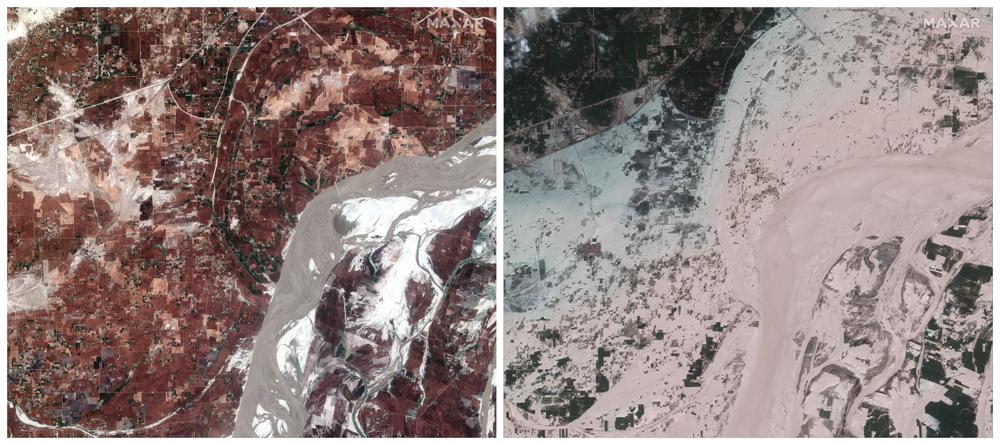
This combination of March 24 and Aug. 28, 2022 photos provided by Maxar Technologies shows the Indus River in the aftermath of flooding in Rajanpur, Pakistan. Deaths from widespread flooding in Pakistan topped 1,000 since mid-June, officials said Sunday, as the country’s climate minister called the deadly monsoon season “a serious climate catastrophe.” (Maxar Technologies via AP)


ISLAMABAD (AP) — Deaths from widespread flooding in Pakistan topped 1,000 since mid-June, officials said Sunday, as the country’s climate minister called the deadly monsoon season “a serious climate catastrophe.”

Flash flooding from the heavy rains has washed away villages and crops as soldiers and rescue workers evacuated stranded residents to the safety of relief camps and provided food to thousands of displaced Pakistanis.

Pakistan’s National Disaster Management Authority reported the death toll since the monsoon season began earlier than normal this year — in mid- June — reached 1,061 people after new fatalities were reported across different provinces.

Sherry Rehman, a Pakistani senator and the country’s top climate official, said in a video posted on Twitter that Pakistan is experiencing a “serious climate catastrophe, one of the hardest in the decade.”

“We are at the moment at the ground zero of the front line of extreme weather events, in an unrelenting cascade of heatwaves, forest fires, flash floods, multiple glacial lake outbursts, flood events and now the monster monsoon of the decade is wreaking non-stop havoc throughout the country,” she said. The on-camera statement was retweeted by the country’s ambassador to the European Union.


Flooding from the Swat River overnight affected northwestern Khyber Pakhtunkhwa province, where tens of thousands of people — especially in the Charsadda and Nowshehra districts — have been evacuated from their homes to relief camps set up in government buildings. Many have also taken shelter on roadsides, said Kamran Bangash, a spokesperson for the provincial government.

Bangash said some 180,000 people have been evacuated from Charsadda and 150,000 from Nowshehra district villages.

Khaista Rehman, 55, no relation to the climate minister, took shelter with his wife and three children on the side of the Islamabad-Peshawar highway after his home in Charsadda was submerged overnight.

“Thank God we are safe now on this road quite high from the flooded area,” he said. “Our crops are gone and our home is destroyed but I am grateful to Allah that we are alive and I will restart life with my sons.”


The unprecedented monsoon season has affected all four of the country’s provinces. Nearly 300,000 homes have been destroyed, numerous roads rendered impassable and electricity outages have been widespread, affecting millions of people.

Pope Francis on Sunday said he wanted to assure his “closeness to the populations of Pakistan struck by flooding of disastrous proportions.” Speaking during a pilgrimage to the Italian town of L’Aquila, which was hit by a deadly earthquake in 2009, Francis said he was praying “for the many victims, for the injured and the evacuated, and so that international solidarity will be prompt and generous.”

Rehman told Turkish news outlet TRT World that by the time the rains recede, “we could well have one fourth or one third of Pakistan under water.”

“This is something that is a global crisis and of course we will need better planning and sustainable development on the ground. ... We’ll need to have climate resilient crops as well as structures,” she said.

In May, Rehman told BBC Newshour that both the country’s north and south were witnessing extreme weather events because of rising temperatures. “So in north actually just now we are ... experiencing what is known as glacial lake outburst floods which we have many of because Pakistan is home to the highest number of glaciers outside the polar region.”


The government has deployed soldiers to help civilian authorities in rescue and relief operations across the country. The Pakistani army also said in a statement it airlifted a 22 tourists trapped in a valley in the country’s north to safety.

Prime Minister Shabaz Sharif visited flooding victims in city of Jafferabad in Baluchistan. He vowed the government would provide housing to all those who lost their homes.

___

Associated Press writers Riaz Khan in Peshawar, Asim Tanveer in Multan, Pakistan, and Frances D’Emilio in Rome contributed.


Hungary allows construction of Russian nuclear reactors

By Matt BernardiniHungary's Foreign Minister Peter Szijjarto announced a new nuclear deal with Russia on Friday. Pool Photo by Mary Altaffer/UPI | License Photo

Aug. 27 (UPI) -- Hungary will allow the construction of two new nuclear reactors by the Russian state-owned company Rosatom, Hungary's foreign minister said.

Russia's nuclear industry has not been subjected to EU sanctions after its invasion of Ukraine. The deal is aimed at expanding the existing Paks nuclear plant, which currently generates 40% of Hungary's electricity.

"Let the construction begin!" said Foreign Minister Peter Szijjarto in a Facebook post Friday, according to the BBC.

The project is expected to cost $12.4 billion, most of which Russia will pay for, the BBC reported. Hungary will pay for the rest. The two new reactors are scheduled to be operational by 2030.

"This will ensure the long-term security of Hungary's energy supply, protect the Hungarian people from extreme price fluctuations on the international energy market, and maintain our efforts to reduce the cost of electricity," Szijjarto said.

As many EU states have tried to lessen their dependency on Russia, Hungarian Prime Minister Viktor Orban has continued to maintain a close relationship with the Kremlin.