Tuesday, August 30, 2022

TikTok faces 64,700 euro fine in Russia for feminist and LGTBI «propaganda»

Social network TikTok is facing a fine of four million rubles (about 64,700 euros) for failing to remove content from its platform that, according to Russian law, promotes "anti-traditional values" such as feminism and LGTBI rights, a Moscow court has ruled.


Pride Day march in Warsaw, Poland. - 

Judge Timur Vajrameev, of the Taganski district, has told that this Tuesday that the Federal Service for Communications and Media Supervision--Roskomnadzor--has filed a complaint against the mentioned social network for "propaganda of non-traditional values", as well as for "distorting traditional sexual values".

The next hearing in the case will resume on October 4. The financial penalty of four million rubles is the highest a company can face if it refuses to remove content banned by the legislation, Russian news agencies have reported.

The one that has been sentenced to pay three million rubles (around $50,000) is the Twitch platform for refusing to delete an interview with the advisor to the Ukrainian Presidency, Alexei Arestovich.

The company was found guilty of promoting false information about the invasion of Ukraine, known to Russia as "special operation", and refusing to rectify it.


Armed left and rightwing protesters clash at ‘drag brunch’ in Texas

Martin Pengelly in New York - 

Right- and leftwing protesters, some heavily armed with semi-automatic rifles, faced off outside a “drag brunch” at a restaurant in Roanoke, Texas, video showed.


Photograph: Martin Pope/Getty Images© Provided by The Guardian

Related: More than 40% of Americans think civil war likely within a decade

The standoff on Sunday was filmed by a Dallas-based investigative reporter, whose footage spread online, and it comes amid rising tensions in US society, polls show majorities of Americans believe political violence is becoming more likely.

At the state level, Republican governments have passed anti-LGBTQ+ laws, particularly in education. At the national level, the supreme court justice Clarence Thomas has suggested the rights to same-sex marriage could be overturned, following the removal of the constitutional right to abortion.

As the Guardian reported in July, drag queens are increasingly reporting rightwing harassment.

In Arizona, the Trump-endorsed Republican candidate for governor, Kari Lake, recently tweeted: “They kicked God out of schools and welcomed the Drag Queens. They took down our Flag and replaced it with a rainbow … let’s bring back the basics: God, Guns and Glory.”

In Texas, leftwing activists who stood outside the drag brunch carried semi-automatic rifles.

The brunch was held at Anderson Distillery & Grill. Before the event, the restaurant owner, Jay Anderson, wrote on Facebook: “It was never my intention to host an event that would result in controversy, hate and divisiveness. It is my intention to welcome people from ALL walks of life.”

“… The live entertainment … will be similar to a variety show with professional drag artists lip-synching, dancing and performing comedy routines. The show will be hosted by my son, Bailey (aka Trisha Delish), who will ensure the show remains clean.

“No foul language. No sexual content. No erotic behavior. Performers will be fully clothed. Music will not contain explicit lyrics.”

Steven Monacelli, the journalist who filmed at the event, reported that it sold out.

The Elm Fork John Brown Gun Club, a leftwing group named for the 19th-century anti-slavery fighter executed shortly before the civil war, and which says it is “not a militia”, said it organised the armed guard outside the restaurant.

Masked leftwing protesters carrying rifles were confronted by people opposed to the event. One opponent told Monacelli: “I’m here to support people that don’t indoctrinate and groom little eight-year-old kids.”


An organiser of the rightwing counter-protest, Kelly Neidert, recently said people who participate in LGBTQ+ pride events should be “round[ed] up”. Her Twitter account is suspended.


Left- and rightwing activists engaged in what Monacelli called “heated exchanges”. He also reported the presence of a member of the Proud Boys far-right group and photographed a rightwing protester carrying a baseball bat wrapped in razor wire.

Monacelli wrote: “Some may say that it’s hypocritical to note the armed counter-protesters at the drag brunch when there are armed antifascists. But one group is here with weapons because they are seeking to defend a group that feels threatened, while the other group is here for different reasons.”

Sgt Ryan Otero of the Roanoke police told the Dallas Morning News he did not know of any arrests.

“We were there to try to keep the peace and basically keep these two sides apart,” he said.
Pronoun use mostly by younger Canadians: Poll
Postmedia News - Yesterday 


A new poll done by the Association for Canadian Studies (ACS) suggests there are differences across age groups in the language people find acceptable around race and gender.© Provided by Toronto Sun

Anew poll done by the Association for Canadian Studies (ACS) suggests there are differences across age groups in the language people find acceptable around race and gender.

The vast majority of Canadians, for example, do not add their gender pronouns to emails or share them at meetings.

Polling found that almost 85% of Canadians don’t add their pronouns to emails, according to a report on the study in the National Post.

But sharing gender pronouns in one’s email signature and on social media is becoming more common as a way to prevent misgendering and show allyship with the LGBTQ+ community. It is a supportive gesture suggested by many organizations.

Of respondents, 84.9% say they do not add gender pronouns to emails or share at meetings; 15.1% say they do.

Most Canadians (85.4%) do not believe adding pronouns should be compulsory.

Those who do use pronouns in emails or social media or share in meetings think it should be required. Of those who do share, 58.8% said it should be compulsory.


The National Post cites Jack Jedwab, president and CEO of the ACS, as saying Canadians need more guidance from academics and policymakers about the language changes, including information on what these terms mean and why it is important to understand their use.

“A lot of people who do use gender pronouns feel very strongly about the need for them to be used as widely as possible,” said Jedwab.

Young people aged 18 to 24 are most likely to share pronouns, with about 30% saying they do so.

After the age of 44, it is less likely that people share pronouns on a regular basis, with only 12.5% aged 45 to 54 saying they do so.

As regards the language around race, that too involves age differences.


Statistics Canada and the Employment Equity Act (EEA) — which promotes equity in workplaces — use the term “visible minorities” to define, “persons, other than Aboriginal peoples, who are non-Caucasian in race or non-white in colour.”

But in Ontario, the Human Rights Commission recommended “racialized person” or “racialized group” as an alternative, as these terms express race, “as a social construct rather than as a description based on perceived biological traits.”

Another ACS poll found many people don’t like the word racialized. Of those polled, 43.6% favoured “persons of colour” and thought it made the most sense in reference to Black or Asian people.

About 30% thought “visible minorities” was the better term.


Canadians who are Black prefer “visible minorities,” with 44.3% saying this term makes the most sense. Another 11.3 per cent of Black-identifying respondents said “racialized groups” is best.

More than half of Asian respondents say “visible minority” is best.

Again, age plays into it. Persons aged 18 to 24 prefer “racialized groups” to refer to Black or Asian people, and 24 per cent say it makes the most sense.

Very few aged 45 to 54 say it’s the better term.

The poll involved 1764 Canadians and was undertaken between July 8 and 10. A probability sample of 1,764 respondents would have a margin of error of plus or minus 2.5 per cent, 19 times out of 20.
From a Republican 'tsunami' to a 'puddle': Why the forecast for November is changing

Ronald Brownstein - 

For political professionals in both parties, that’s the capsule explanation for why the Democratic position in the midterm elections appears to have improved so much since summer began.

When the election looked to be primarily a referendum on the performance of the Democrats who control the White House and Congress, Republicans were optimistic that a towering “red wave” would carry them to sweeping gains in November.

But with evidence suggesting more voters are treating the election as a comparative choice between the two parties, operatives on both sides are bracing for a closely contested outcome that could include an unusual divergence in results for the House and those in Senate and governor races.

“It feels to me to be more like a shallow red puddle that we’re walking through, rather than a tsunami of sorts,” says Republican strategist John Thomas.

The key to the change in expectations is a shift in the issues motivating the electorate. Earlier this year, the debate between the parties centered on inflation, the economy, crime, immigration and President Joe Biden’s stalled legislative agenda in Congress – all issues that motivated the Republican base and alienated many swing voters from Democrats. But a series of dramatic events over the past few months have elevated an entirely different set of issues: gun violence, threats to democracy, climate change and, above all, abortion rights.

The effect has been the political equivalent to one weather system displacing another.

While the focus on the economy and crime encouraged voters to simply grade the performance of the party in power – the classic “referendum election” frame – the new concerns have highlighted stark differences between the two parties and defined the election more as a choice between antithetical directions for the nation. That new frame has both energized Democratic base voters who earlier appeared disenchanted or tuned out and reminded many swing voters why they have recoiled from the Donald Trump-era Republican Party.

While midterm elections are normally “a referendum on incumbents and economic reality … we are not in normal times,” says Jenifer Fernandez Ancona, vice president and chief strategy officer of Way to Win, a liberal group that funds organizations and campaigns focusing on voters of color. “Republicans have embraced this Trump-ism, these brazen assaults on our freedoms and our families and are rejecting the policies voters actually want. That [creates] an opportunity for us to re-turnout our surge voters from 2018 and to move conflicted voters over.”

The new focus on issues such as gun violence, threats to democracy and abortion has not erased the threats to congressional Democrats from the public’s mostly negative assessments about the economy, or its enduring concern about crime. But to a far greater extent than earlier this year, it has provided Democratic campaigns an opportunity to shift the campaign discussion from how voters feel about Biden’s performance to whether they support the direction Republicans would take the country, especially since the GOP nominated so many Senate and governor candidates who have unreservedly embraced Trump.

“The conditions have changed, and we have to step into that and tell this story as clearly as we can,” says Fernandez Ancona. “We need voters to see the midterm as a crossroads, not a referendum.”

Democratic hopes of avoiding the worst in November will likely pivot on whether they can successfully convince enough voters, particularly voters in their presidential-year coalition who might otherwise skip a midterm election, to see the contest in those terms.

An NBC poll released last week, conducted by the Republican polling firm Public Opinion Strategies and the Democratic firm led by Peter Hart and Geoff Garin, captured the rare split screen dynamic that’s reshaping the campaign. When the pollsters asked respondents to identify their top concerns in the midterm election, they found an unusually wide separation between voters in each party’s coalition.

“It is a really unusual election,” said Republican pollster Bill McInturff of Public Opinion Strategies. “Republicans have significant advantages on their set of issues (inflation, economy, crime, border security) and Democrats enjoy significant advantages on issues of concern to their voters (abortion, climate change, guns, health care). There is no overlap, no competitive issues. This means each party has an unusual opportunity to try to create their own narrative to their own voters on what this election is about.”

The poll found that significant numbers of voters remain focused on the issues that dominated the debate earlier this year, and that those voters backed Republicans by wide margins for Congress. Nearly three-fifths of voters who cited the cost of living as one of their top two concerns in the survey preferred Republicans, as did about three-fifths of those focused on crime, two-thirds of those who raised the economy, and nearly 9-in-10 of those who identified immigration as a principal concern, according to detailed results provided by POS.

But Democrats, uncommonly, had comparable advantages on a different set of issues that cumulatively ranked as top-two priorities for nearly as many voters as the concerns that advantaged Republicans. In the survey, Democrats won about two-thirds of voters focused on either gun violence or threats to democracy, over 7-in-10 of those who cited abortion, and more than 8-in-10 who identified climate change.

All of these issues have gained in prominence since the spring: gun violence since the Ulvade, Texas, massacre, abortion since the Supreme Court decision that overturned the national right to the procedure, threats to democracy amid the disclosures of the House committee investigating the January 6, 2021, insurrection and the revelations about Trump’s mishandling of classified material, and climate since the unexpected passage of the Democrats’ slimmed down reconciliation bill. That increased visibility represents the new weather system that has at least partially pushed aside the dark clouds of inflation and economic discontent that hung over Democrats for most of this year.

“The conversation in the nation has changed,” says Michael Podhorzer, former chief political adviser to the AFL-CIO and chair of the Analyst Institute, a collaborative of progressive groups that conducts extensive public polling. “In 2021, the conversation was about what Democrats were or were not doing – inflation, Afghanistan, crime – the classic context for a party-in-power rout. Since June, the conversation has shifted to what returning Republicans to power would mean.” That shift in the conversation, he argues, is “reminding the 81 million people who voted against Trump in 2020” about why they turned out to oppose him and increasing the odds that more of them will show up again in 2022.

The Way to Win group is arguing that Democrats should crystallize the new issues rising in prominence into a straightforward but sharp message: Americans need to vote for Democrats to “protect our freedoms” against “Trump Republicans [who] want to take away freedom from all who do not look, live, and love like them.” Abortion is an especially powerful symbol of that idea, Fernandez Ancona says.

“We have even heard people in focus groups say, ‘prices go up and down, but I can’t prevent myself from being raped and not being able to have an abortion,’” she said. “The idea that something everyone had is now being taken away is so strong it’s overriding” other concerns.

Like many GOP strategists, Thomas believes economic assessments ultimately will motivate more voters than abortion. But he agrees the campaign no longer revolves solely around the economy.

“The Republicans only hope to regain a wave is if there is a uniting singular issue that refocused all voters” and concentrated discontent with Biden’s performance, the way inflation did earlier this year, he said.

“But right now, with this split in the electorate, there’s not one big thing that the voters are unanimously going, ‘Screw those guys, I want to blame somebody,’” Thomas added. “The fragmentation really has benefited the Democrats.”

Many analysts believe that the traditional referendum dynamics may prove most powerful in House races, while many Senate and governor’s races already show signs of evolving into much more of a choice kind of election. “The difference in statewide races is that the voters know the candidates better and so a combination of good candidates [running against] bad candidates are better able to transcend national tides,” says Garin, the Democratic pollster.

By contrast, Garin notes, “House races in some ways are more parliamentary in nature” –meaning that they turn less on assessments of the individual candidates, who are often not that well defined for voters, than on broader views about the two parties and conditions in the country. The clearest measure of the increasingly parliamentary nature of House races over the past several decades has been the tightening correlation between voters’ attitudes toward a president and their willingness to vote for House candidates from his party.

As I’ve written, in exit polls, the share of voters who disapprove of a president’s performance and vote against congressional candidates from his party has increased from about 75% in the late 1980s, to over 80% from the 1990s through the early 2000s, to fully 90% by 2018. But in multiple polls this year, Republican congressional candidates are not drawing nearly that much support from voters who disapprove of Biden.

That’s a measure of resistance to the Trump-era GOP even among voters disenchanted with the Democrats’ performance. Particularly noteworthy is that a recent Pew Research Center survey found congressional Democrats leading among voters who somewhat disapproved of Biden’s performance, while the NBC survey found them essentially breaking even with those voters. That’s a remarkable divergence from recent experience: the opposition party won about two-thirds of voters who somewhat disapproved of Trump in 2018 and former President Barack Obama in 2010, according to exit poll results provided by the CNN polling unit.

These dynamics (along with a slight but perceptible rise in Biden’s approval rating) help explain why some independent analysts, such as the Cook Political Report, have lowered their expectations on the number of seats Republicans may gain in November. But even so, the tendency of voters dissatisfied with the president to back the opposition party in House elections is strong enough that most analysts still believe Republicans can gain enough seats to capture the majority (even if, for the first time, some Democratic analysts see a path to defying the usual midterm history and maintaining control).

It’s in higher-profile Senate and governor’s races that the new issue dynamics are creating the greatest opportunity for Democrats to rise above general discontent over the country’s direction.

With their greater visibility, those races, as Garin noted, are inherently more of a choice. And, at least for now, multiple statewide Democratic candidates facing Trump-endorsed opponents are running strongly and drawing support that considerably exceeds Biden’s approval rating in their states. Races that now fit that description include the Senate contests in Pennsylvania, Georgia, Arizona and Ohio, as well as governor’s races in Michigan, Wisconsin, Pennsylvania and Arizona.

Democrats are far from guaranteed victory in any of those races. But in all of them, they have fortified their position by shifting the campaign focus from discontent over Biden’s performance and inflation to the personal and ideological vulnerabilities of their GOP opponents, particularly their hardline stances against abortion. “In the House you can have a candidate who can’t put three sentences together and no one finds out,” says Jim Kessler, executive vice president for policy at Third Way, a centrist Democratic group. “But you can’t do that in a Senate race. There’s too much money that’s spent, there’s too much coverage. The governor races [are] the same thing.”

If House races unfold as more of a referendum, and statewide contests play out more like a choice, that creates the possibility of an unusual divergence in the midterm result.

Almost always, the party that wins House seats in a midterm also gains Senate seats, and for that matter, adds governorships. Since World War II, the party that gained House seats simultaneously lost Senate seats only in 2018, 1970 and 1962. Over that nearly eight-decade span, no party ever gained House seats and simultaneously lost ground in both the Senate and governor’s races.

Yet a November outcome in which Republicans add only a modest number of House seats and fail to gain ground, or even lose some, in Senate and governor’s contests, no longer seems impossible. All the dynamics boosting Republicans this year haven’t disappeared. But they are no longer the only forces shaping the campaign atmosphere. And that could mean the midterm election produces far more of a split decision than almost anyone considered possible earlier this year.
UN sees situation in Baghdad as «extremely dangerous», calls for calm

Daniel Stewart - Yesterday 

The UN has appealed for restraint in the face of the mobilizations unleashed on Monday in Baghdad following the announcement by Shiite cleric Muqtada al Sadr that he is quitting politics, as it perceives "an extremely dangerous escalation" of tensions.


A supporter of cleric Muqtada al Sadr waves the Iraqi flag at an August 8 protest

The United Nations mission in Iraq (UNAMI) has urged the demonstrators to leave the Green Zone "immediately" and vacate the public buildings occupied in recent hours so that the government can continue to carry out its work.

"State institutions must be able to operate without hindrance in the service of the Iraqi population, under any circumstances and at any time," the mission said in a statement in which it called for "respect for the constitutional order".

UNAMI pointed out that "the survival of the State is at stake" and that "Iraqis cannot be held hostage to an unpredictable and unsustainable situation", for which it called for the collaboration of all parties.

In this sense, he exhorted the different political actors to lower the tension and to bet on dialogue - "the only way to resolve differences" - with the ultimate objective of avoiding what could be "an unstoppable chain of events" in Iraq.
US proposes a «controlled shutdown» of the Zaporiyia power plant to avoid risks

Daniel Stewart - Yesterday 

The White House has put forward a "controlled shutdown" of the Zaporiyia nuclear power plant, located in southern Ukraine and controlled by Russian troops, as the best option to avoid a possible atomic accident.


IAEA mission departs Vienna for the Zaporiyia plant in Ukraine
 - OIEA/DEAN CALMA© Provided by News 360

Coinciding with the dispatch to the area of a mission of the International Atomic Energy Agency (IAEA), a spokesman for the US National Security Council, John Kirby, has recalled that Russia has "militarized" the largest nuclear power plant in Europe.

"We continue to believe that a controlled shutdown of the reactors would be the safest and least dangerous option in the short term," said Kirby, who applauded the start of the international mission that is called to monitor the situation 'in situ'.

Kirby, who appeared at a press conference, also assessed the evolution of the military front, noting that the Ukrainian forces now have a "good chance" to regain ground, reports the portal Politico. On Monday, they announced the launch of a counteroffensive in the Kherson area.

Although the exact scope of these operations is not clear at the moment, the White House assumes that Russia has already had to move resources from eastern Ukraine to the south, fearing the loss of part of what it has conquered in recent months.

"From a strategic point of view, (the Ukrainian offensive) has already had an effect on Russian military capabilities inside Ukraine," he said.
UPS drivers are collapsing on the job and baking cookies on their dashboards as they work without AC in extreme heat as high as 150 degrees

gkay@insider.com (Grace Kay) - Yesterday 

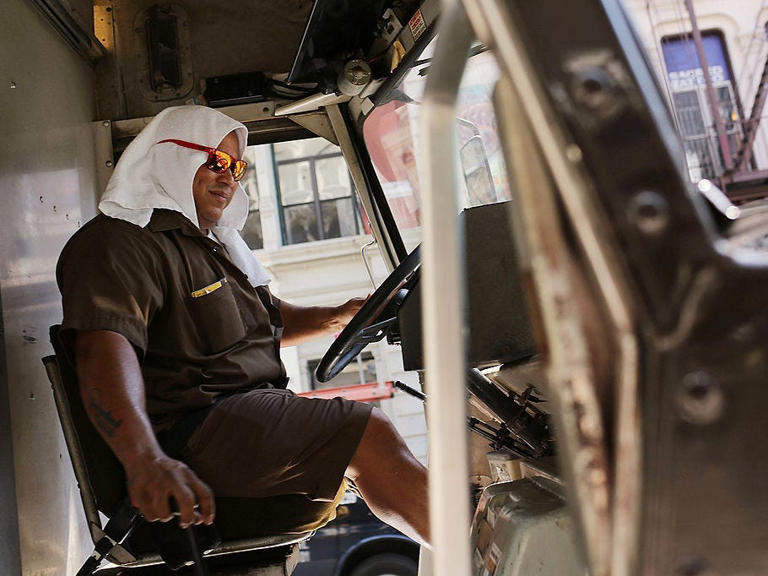
A UPS driver keeps a towel on his head while driving along Broadway during warm weather on July 6, 2012 in New York City. Spencer Platt/Getty Images© Provided by Business Insider

UPS drivers are reporting heat as high as 150 degrees in their vehicles without air conditioning.

Insider spoke with five drivers about what it's like to work in the summer heat.

A spokesperson previously told Insider the drivers are trained to work in hot weather.

Record-breaking summer heat is taking its toll on delivery drivers, and UPS drivers without air conditioning say their job is only getting more difficult.


In June, a 24-year-old UPS driver died on the job amid a heat wave in California. A month later, an Arizona homeowner shared a doorbell video of a UPS driver collapsing during triple-digit temperatures.

It's an issue drivers say they've struggled with for decades, but it's only getting worse.

A UPS spokesperson previously told Insider air conditioning would be ineffective in the vehicles, considering they "make frequent stops, which requires the engine to be turned off and the doors to be opened and closed, about 130 times a day on average."

Meanwhile, drivers are documenting extreme heat conditions in their vehicles by sharing photos of thermometers clocking 150 degrees and cooking steaks and baking cookies on their dashboards. Three drivers told Insider they haven't been able to handle metal equipment, like the shelving units in the back of the vehicle, without burning themselves.


UPS driver bakes cookies on dashboard. Courtesy of Anthony Rosario
© Courtesy of Anthony Rosario

"It's like a greenhouse in there," a Florida driver who has been with the company for nearly four decades told Insider. "You can feel yourself baking and unless you have places to stop along the way for air conditioning there is no relief, not until your shift ends 10 or maybe 14 hours later."

A UPS spokesperson did not respond to a request for comment ahead of publication, but told Insider earlier this month its workers are specially trained to deal with the heat.

"We never want our employees to continue working to the point that they risk their health or work in an unsafe manner," the spokesperson said.

Insider spoke with five drivers who alleged triple-digit temperatures in the delivery trucks, workers collapsing, and supervisors who discouraged employees from seeking medical care. The current drivers spoke on the condition of anonymity to protect their jobs, but their identities have been verified by Insider.
'Cool Solutions'

One Texas driver who has been with the company for over two decades told Insider she's suffered four heat-related injuries in the past two years, including one which left her in the hospital for two days and kept her out of work for weeks.


Heat reading for a UPS truck. Courtesy of Anthony Rosario
© Courtesy of Anthony Rosario

"It just comes over you. You try to drink as much water as you can but you're sweating faster than you can hydrate and then you start to feel poorly. Before you know it, you're about to throw up and you're having a hard time drinking fluids," she said of the last incident, which she said happened less than a month ago.

"My heart was racing and I was so dizzy I couldn't hold myself upright." she added.

UPS says it offers workers training on how to deal with extreme weather conditions, including heat waves, through a program called "Cool Solutions." But, five drivers told Insider the training leaves much to be desired.

"It's just common sense really," the Florida driver said. "They tell you to drink water and food that will keep you hydrated. They tell you to avoid caffeinated drinks or drinking alcohol the night before, to find a cool location for your lunch break — which isn't really possible on my route."

The training also encourages drivers to take more breaks during heat waves, but drivers say their performance can be called into question if they slow down.

"You can pull over and take a break, but they're going to ride you about the numbers later," the Texas driver said.

Three drivers told Insider they've either been told to avoid going to the emergency room or seen supervisors discourage employees from seeking medical care for injuries — an issue they attribute to performance concerns.

"If they can't get the drivers on the road, sometimes the supervisors have to take over their routes," a driver from Colorado said.

UPS provides workers with ice and fans, but several drivers said the ice machines are often broken or out of stock and getting the company to install a fan in the vehicle is even harder.

"They've started telling drivers they're out of parts for fans," Anthony Rosario, a New York union leader who has been with the company for 28 years, said. "Even when they do have one, it's just pushing hot air around," he added.
Drivers push for better conditions

"We have studied heat mitigation with our vehicles and integrated forced air systems with venting to create air flow around the driver and cargo areas," a UPS spokesperson previously said. "We optimize the roof of vehicles to minimize heat in the cargo area, alongside insulating the roof of the cab. We also offer fans to drivers upon request."


A UPS truck in Santa Fe, New Mexico.
Robert Alexander/Getty Images

The issue of air conditioning in the vehicles is at the center of upcoming negotiations between the company and the UPS Teamsters union, as the contract is set to expire next summer. The union has said it plans to strike if its demands are not met in 2023 and has historically pushed for premium pay, pension, and benefits packages that allow drivers to make as much as over $130,000 a year.


Four drivers told Insider they're doubtful as to whether work conditions in the heat will ever change.

David Roy, who worked for UPS in Massachusetts for over 40 years before retiring last year, said he feels the union is "barking up the wrong tree."

"I don't know how these workers think they will stay competitive with other companies. It's hard work, but there's not many other places that offer that level of pay," Roy said, referencing Amazon and FedEx. "I always told myself there's better jobs, but there's also far worse ones."
ISRAEL
Health Ministry asks for public comment on medical cannabis

By JUDY SIEGEL-ITZKOVICH - Yesterday 

The Health Ministry has asked the public for its opinion on changing requirements for being allowed to purchase medical cannabis. The proposed change would replace licenses issued by a handful of physicians with prescriptions that could be given by any medical specialist working in a public health fund or hospital who has undergone appropriate training for it.


Seach medical cannabis farm© (photo credit: SEACH MEDICAL GROUP)

The transition has already been recommended by a committee headed by former ministry director-general Dr. Boaz Lev. After the public comments (by September 13), the change can be presented to the Knesset for official approval.

Some 114,000 Israelis are currently licensed for the right to purchase medical cannabis at pharmacies. Although cannabis is not defined as a drug, there is much evidence that it may relieve the suffering of patients with certain medical conditions including Alzheimer’s disease, amyotrophic lateral sclerosis, HIV/AIDS, Crohn’s disease, epilepsy and seizures, glaucoma, multiple sclerosis (as well as other neurological issues), muscle spasms, severe and chronic pain, and severe nausea or vomiting caused by cancer treatment.

However, today patients who need medical cannabis are required to obtain a license from the state. The process involves bureaucracy and dealing with a relatively limited number of doctors authorized to practice in the field. Many patients turn to private doctors and pay large sums to obtain a license.

After the work of the staff of the Lev Committee, Health Minister Nitzan Horowitz asked for a comprehensive outline of a transition from licenses to prescriptions allowing any Israeli medical specialist doctor in public medicine to issue a prescription for medical cannabis. The outline is conditional on approval of the regulations in the Knesset.


Shai Avraham Sarid at the Seach medical cannabis farm (credit: 
SEACH MEDICAL GROUP)© Provided by The Jerusalem Post

The outline includes the regulation of operational and financial issues and also allows the health funds to approve licenses in the interim period.

Related video: HealthWatch: Study finds 37% fewer people poisoned by synthetic cannabis in states where drug is legal
Duration 0:55


The outline and the relevant documents have been published for public comments to mishpatitjer@moh.gov.il until September 13. After that, the relevant comments will be incorporated in the final outline, which will then be submitted for approval by the health minister and forwarded to the Knesset for final consent.

Cannabis regulation in Israel

The regulation and responsibility for the topic are centralized and carried out by the ministry’s medical cannabis unit headed by Ran Ridnik. The four public health funds will be able to establish a set of approvals in which requests for prescriptions received from each specialist physician in his field of expertise will be examined.

The health funds will submit a request to collect a deductible, according to which an annual collection of NIS 360 will be made to existing patients for the approval of the prescription. A one-time annual fee of NIS 720 will be paid by a new patient for approval of a prescription and the specialist’s time. Existing patients with licenses will pay a fee of NIS 360 for approval.

The arrangements will take effect 180 days from the moment they are approved by the Knesset. In the interim, the health funds will be able to issue licenses to patients. Additional regulatory measures will be made to reduce the price of medical cannabis, creating a solution for the interim period, so that the accessibility of issuing licenses to patients is maintained and the HMOs can continue to operate the system of issuing licenses.
Fetterman calls on Biden to move toward decriminalizing marijuana ahead of Pennsylvania visit

Caroline Vakil - Yesterday

Pennsylvania Democratic Senate nominee John Fetterman called on President Biden to deschedule marijuana, with a goal of ultimately decriminalizing the drug, ahead of Biden’s visit to the state next week.


Fetterman calls on Biden to move toward decriminalizing marijuana ahead of Pennsylvania visit© Provided by The Hill

Biden is expected to travel to Pennsylvania and Wisconsin, two key swing states, on Labor Day ahead of the November midterms.

“It’s long past time that we finally decriminalize marijuana,” Fetterman said in a statement. “The president needs to use his executive authority to begin descheduling marijuana, I would love to see him do this prior to his visit to Pittsburgh. This is just common sense and Pennslyvanians overwhelmingly support decriminalizing marijuana.”

Fetterman also took a shot at his Republican opponent Mehmet Oz, who has spoken out against marijuana legalization.

“I don’t want to hear any bullshit coming out of Dr. Oz’s campaign trying to conflate decriminalizing marijuana with seriously harmful crime. Are we supposed to believe that neither he nor any members of his staff have ever used marijuana?” Fetterman said.

“As mayor of Braddock, I made it my mission to combat serious crime. I know firsthand what real crime looks like. Marijuana does not fit the bill. It’s time to end the hypocrisy on this issue once and for all.”

Related video: Fetterman returns to Senate campaign trail
Duration 1:09

Rachel Tripp, senior communications adviser to Oz, said in a statement that “under John Fetterman’s watch, crime skyrocketed in Braddock,” adding that the Democrat wants to decriminalize all drugs.

“Pennsylvania is ready to elect a leader who will restore safety and security to the commonwealth — Dr. Mehmet Oz,” Tripp said.

Marijuana is a Schedule 1 drug and is illegal at the federal level, though a number of states have approved its use either for medical use, recreational use or both.

A spokesperson for Fetterman’s campaign previously said the Senate candidate would be pressing the president on the issue of decriminalizing marijuana while Biden was in the state.

During a White House briefing on Monday, press secretary Karine Jean-Pierre was asked about Fetterman’s statement and if the president determined how he wants to rethink the nation’s approach on marijuana.

“[T]he president supports leaving decisions regarding legalization for recreational use up to the states, rescheduling cannabis as a Schedule 2 drug so researchers can study its positive and negative impacts and at the federal level, he supports decriminalizing marijuana use and automatically expunging any prior criminal records,” Jean-Pierre said.

While Oz has been critical of marijuana use, he once expressed openness to the drug, saying in an interview two years ago that “it’s a lot safer than alcohol. It’s safer than narcotics. It ought to be used more widely and we can’t even study it that easily because of the way it’s regulated,” according to Marijuana Moment.

Fetterman has led Oz in recent polling and the nonpartisan election handicapper Cook Political Report recently shifted its rating of the Senate seat from “toss up” to “lean Democrat.”

High elevation monitoring kicks off in Kokanee Glacier Provincial Park


The effect of climate change on high level lakes in the West Kootenay is theme of a new pilot study launched by Living Lakes Canada.

Called the High Elevation Monitoring Program, the goal of the study is to begin formulating and collecting baseline data in order to understand how the chemical and biological components of the lakes are functioning.

“Once this baseline is established, we can continue to monitor over time and understand how chemical and biological components in the lakes are responding to climate change,” said Heather Shaw, Living Lakes Canada program manager, in a press release.

Living Lakes Canada is a national non-profit organization based in B.C.’s Columbia Basin concerned with the long-term protection of Canada’s freshwater.


Earlier this month the High Elevation program was launched in Kokanee Glacier Provincial Park, with “loggers” installed in Sapphire Lakes, Tanal Lake and Upper Joker Lake to track the changes in water levels.

Additionally, temperature and light loggers have been installed in Upper Joker Lake.

“We understand that high elevation ecosystems are especially sensitive to climate change. They are also challenging to monitor,” Shaw explained. “We don’t currently have a good understanding of the climate impacts on water quantity and quality in these areas.”

People can watch the on-site program update from Sapphire Lakes at https://youtu.be/GjlsW_6K1-k

Inventory this

People in Nelson can help with the pilot project as well.

For those who venture into Kokanee Glacier Provincial Park Living Lakes Canada is asking people to help create an inventory of plant and animal species within the park boundaries.

This data collection is made easy thanks to the popular and easy-to-use citizen science application, iNaturalist, noted Shaw.

The application can be downloaded to a cell phone before heading to the backcountry, with a search for “Kokanee Glacier — High Elevation Monitoring” project.

Picture this

For those who visit Kokanee Glacier Provincial Park, Living Lakes is asking people to take photos of any flora and fauna using the iNaturalist app.

“When back in cell service, you can then upload your pictures and observations to the project where they will be stored and reviewed by scientists, the iNaturalist community, and Living Lakes Canada employees,” said Shaw.

- For more information on the High Elevation Monitoring Program visit:

livinglakescanada.ca/project/high-elevation-monitoring-program.

- For more information on Living Lakes Canada visit:

https://livinglakescanada.ca/.

Timothy Schafer, Local Journalism Initiative Reporter, The Nelson Daily