Wednesday, September 21, 2022

'Can’t work at a desk': What it's like to be out of work with Long COVID

Adriana Belmonte
·Senior Editor
Mon, September 19, 2022

Two-and-a-half years into the pandemic, millions of Americans are still suffering from long-term effects of COVID-19, otherwise known as Long COVID. The health impacts are clear. What's not clear is the impact on the economy and the workplace.

“I’m desperate to get back to work, but I still can’t work at a desk or talk for more than 20-30 minutes without needing to rest for hours at a time,” Charlie McCone, a 32-year-old based out of San Francisco, told Yahoo Finance. “I feel like people read things like that from Long COVID patients and think it’s an exaggeration, but I wish it were."

That collective suffering — symptoms include fatigue, "brain fog," heart palpitations, and autoimmune conditions — is affecting the economy: As many as 4 million individuals with Long COVID may be out of the workforce because of their symptoms, according to a new Brookings Institution report, suggesting that more than 2% of the U.S. labor force could be sidelined by Long Covid.

According to the Brookings report, “using the average U.S. wage of $1,106 per week, the estimated 3 million people out of work due to Long COVID translates to $168 billion a year in lost earnings. This is nearly 1% of the total U.S. gross domestic product. If the true number of people out of work is closer to 4 million, that is a $230 billion cost.”


Dr. Svetlana Blitshteyn, director of the Dysautonomia Clinic in Buffalo, New York, and a clinical associate professor of neurology at the University at Buffalo Jacobs School of Medicine, has seen the workplace impact first-hand. She's been studying Long COVID patients since 2020.

“My first patient was a medical resident who couldn’t return to his hospital duties after COVID-19,” Blitshteyn told Yahoo Finance. “He told me that several of his co-workers, including a cardiologist attending, were experiencing the same symptoms."

By December 2020, Blitshteyn’s research led her to publish a case series of 20 patients with postural orthostatic tachycardia syndrome (POTS), a condition that affects blood flow in the body, and other autonomic disorders post-COVID. Among those patients, an astounding 60% were unable to return to work. At her practice, most of her Long COVID patients have the same issue or require special accommodations like a part-time schedule or working from home in order to maintain employment.

“Obviously, by the nature of my practice, I end up seeing sicker patients, but I think Long COVID is one of the main reasons why there are shortages of workers in health care and other industries today,” she said.


Indeed, that may be partly why the August jobs report showed labor participation rate at 62.4%, below pre-pandemic levels despite more than 11.2 million open jobs as of July 29.

To better understand the impact of Long COVID, Yahoo Finance spoke with several individuals out of the workforce as they continue struggling with their illness.
'Groundhog Day for the worst hangover you’ve had'

Charlie McCone first developed symptoms in March 2020, when he went to bed one night with chest pain and woke up the next day with a fever, fatigue, and shortness of breath.

“I was laid out for the next two weeks,” McCone said. “I went back to [remote] work on week three because I felt I had been out so long — I had never been out sick for more than 1-2 days. By week four, I thought I was shaking off the last of it so I went on a bike ride and when I got back, the symptoms came rushing back and I was laid out again for the next week. That was my first relapse.”

It’s been two-and-a-half years since McCone first got sick, and he is still battling shortness of breath. “Before I was sick, I was 30 years old with no prior health issues,” McCone said, adding that he would bike 10 miles a day and was also an active tennis player. “I’m now 32, and I’ve spent my entire 30s disabled and housebound with Long COVID.”

McCone initially worked through the illness remotely at his marketing and communications job for the first 18 months until he “essentially collapsed.” For the past year, he’s been on disability as he tries to navigate his next steps.


Tiffany Patino, who has struggled with Long COVID symptoms for a year, rests in bed with most of the lights off at her home in Rockville, MD on December 2, 2021. 
(Photo by Carolyn Van Houten/The Washington Post via Getty Images)

But the physical issues aren't the only problem for folks like McCone, experts contend. Studies show that those battling with Long COVID are at increased risk of developing mental health issues. A British study published in BMJ found that COVID survivors are nearly twice as likely to report suicidal ideation than those who haven’t had the virus. An April 2022 BMC Psychiatry study of those with Long COVID in both Japan and Sweden found that they were also twice as likely to report depression, anxiety, or post-traumatic stress disorder.

“I really miss the simple things — going to the park, being able to breathe normally, chatting with friends, listening to music, having coffee,” McCone added. “Give me that back, and I would honestly be OK living my life half of what it used to be.”

As of July 2021, Long COVID is considered a disability under the Americans with Disabilities Act (ADA). McCone has exhausted his short-term disability and isn’t yet prepared to go back to work, which has caused him “major stress.”

“Long-term disability is not set up to deal with cases like ours,” he said. “A social worker just told me ‘don’t even bother applying.’ Right now, I’m just praying I get better before I go broke. This is the only option I’m really left with at this point: ‘Thoughts and prayers.’”
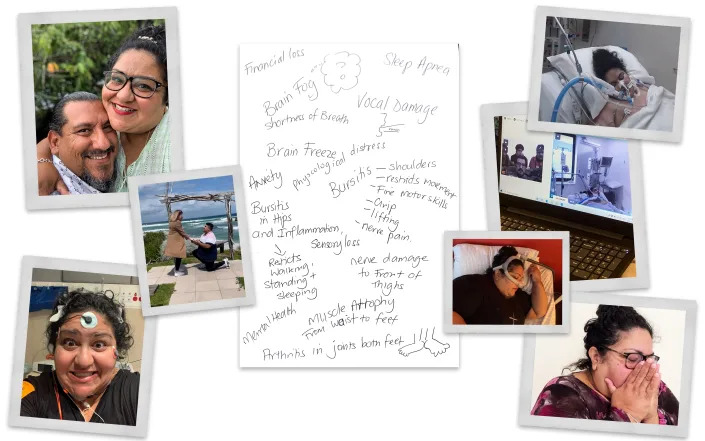

Photos of Sherene Magana Cruz before she got COVID, while in a coma in the hospital with COVID, and portraits of her taken dealing with Long COVID at her home in Australia on August 18, 2022. 
(Photo by Carolyn Van Houten/The Washington Post via Getty Images)


'The fatigue was so intense'


Pamela Bishop is another Long COVID patient who had to leave the workforce due to her ongoing symptoms. Prior to developing COVID, she was a research professor and research institute director at the National Institute for STEAM Evaluation and Research at the University of Tennessee, Knoxville.

For her, it all began in December 2020 when she noticed one morning that she had lost her taste. Soon, her symptoms intensified and she experienced pain in her legs, derealization, hallucinations, heart palpitations, anxiety, shortness of breath, and chest pain.

“I thought I would die every day for three weeks,” Bishop said. By Christmas, she began feeling better and returned to remote work in January. But, the symptoms returned. “The fatigue was so intense I would have to lie down between Zoom meetings,” Bishop said. “My work day stretched out 12-14 hours because I was resting so much between tasks.”


A patient suffering from Long COVID is examined in the post-coronavirus disease (COVID-19) clinic of Ichilov Hospital in Tel Aviv, Israel, February 21, 2022.
 Picture taken February 21, 2022. REUTERS/Amir Cohen

She was eventually forced to go on leave, applying for the Family and Medical Leave Act (FMLA). The FMLA allows eligible individuals to take unpaid but job-protected leave for specified family and medical reasons with continuation of their group health insurance coverage.

Fortunately, Bishop’s university had a sick leave bank that she had bought into years prior. When it became clear she wasn’t getting better, she applied to use it when her FMLA time ran out and was approved for 90 days. She was granted it three times, the maximum amount, and her colleagues also donated some of their leave to her until she realized she wasn’t improving and decided to resign from her role.

“I would love nothing more than to return to work as my career was a huge part of my identity,” Bishop said. “I spent decades getting my education, obtaining my PhD, and then building my career in academia. My career was really taking off at the time I became ill. Unfortunately, there’s no end in sight to this illness currently, and I have no idea if I will ever be able to return to the workforce.”

What lies ahead

Katie Bach, nonresident senior fellow at the Brookings Institution and author of the Brookings report, said that there are three key ways to try to help these individuals and possibly even get them back in the workforce.

"Number one has to be treatment," Bach told Yahoo Finance, adding: "We need to know what treatments work, which means more investment in research funding."

The second is paid sick leave, a luxury not afforded to every American. When some individuals don't have access to paid leave, they often come to work sick rather than risk losing pay by staying home.

The third bucket: employer accommodation and understanding that Long COVID looks different in everyone.

"This administration's been very good at saying that Long COVID can be a disability that is protected under the Americans with Disabilities Act," she said. "I think we need more patience, and ... I believe we need to get guidance to employers on how to accommodate people."


Adriana Belmonte is a reporter and editor covering politics and health care policy for Yahoo Finance. You can follow her on Twitter @adrianambells and reach her at adriana@yahoofinance.com.
Antifa on trial: How one criminal case could redefine the murky left-wing movement


Will Carless, USA TODAY
Wed, September 21, 2022 

LONG READ


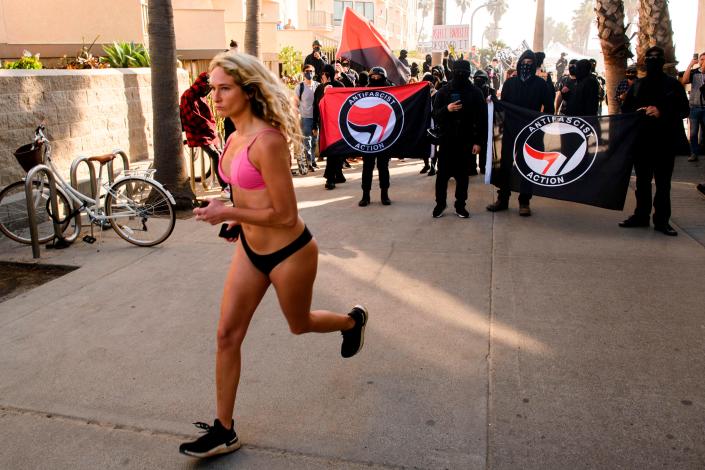
A pedestrian jogs past counter-protesters, some carrying Antifa flags, as they wait to confront a "Patriot March" demonstration in support of Donald Trump near the Crystal Pier on Jan. 9, 2021 in the Pacific Beach neighborhood of San Diego, California.

On Jan. 9, 2021, three days after the insurrection at the U.S. Capitol, a mob of white supremacists, Proud Boys and other supporters of President Donald Trump descended on the neighborhood of Pacific Beach in San Diego.

Wearing body armor and carrying wooden sticks and flagpoles, the group marched through town holding up Nazi salutes, snarling at locals in the beachfront bars, and shouting the same chant that had been used on the streets of the capital days before: “F--- Antifa!”

Waiting to meet the mob was a horde of black-clad self-proclaimed anti-fascists or Antifa, who had organized to “protect” Pacific Beach from these outside provocateurs. As the two groups clashed, despite the efforts of dozens of police officers, brawls broke out. Supporters on both sides plus bystanders of all stripes had their phones up, ready to record the action on video.


Anti-fascists, dressed head-to-toe in black, pepper sprayed Trump supporters in the face, gleefully shouting “Proud Boy killa!” Another group of counterprotesters confronted and attacked a Trump supporter who then drew a knife on them. In an alleyway, away from the main crowd, a group of assorted right-wing extremists surrounded a young man in a George Floyd T-shirt, sucker-punching him and smashing his nose.


In the months that followed, video was reviewed, warrants were issued and homes were searched. And almost a year later, a criminal case emerged, one that now stands to have an impact far beyond San Diego. Experts say it could be a landmark prosecution that changes how American law enforcement tackles the much-misunderstood movement known as Antifa.

San Diego County District Attorney Summer Stephan announced a raft of felony charges for the activities on Jan. 9, after an investigation of “multiple allegations of violent criminal conduct,” “video evidence analysis” and searches and arrests across two counties.

And every person charged was from the Antifa side. No Trump supporter had been charged, or even arrested.


Since then, prosecutors have added charges against more people identified by prosecutors as Antifa, for a total of 11 defendants.

Stephan’s office claims the Antifa side was “overwhelmingly” responsible for the violence. But experts familiar with the case say it was an extraordinary decision to not charge anyone in the far-right group that actually targeted the community, especially given the videos that exist showing them engaging in violence. The question is less about whether the Antifa charges are warranted and more about whether this is a case of selective prosecution, they said.


Counter-protesters, some carrying ANTIFA flags, stand beneath palm trees on the beach awaiting to confront demonstrators for a "Patriot March" demonstration in support of US President Donald Trump on Jan. 9, 2021, in the Pacific Beach neighborhood of San Diego, California.

Only prosecuting one side of a melee raises serious questions about Stephan’s political motives, said Patrick Cotter, a former Chicago federal prosecutor who has practiced criminal law for 40 years.

“When you've got a situation where there's two organized groups who both decided to fight each other, and only one side gets charged and the other side gets to walk, it's idiotic,” Cotter said. “It's an insult to the public's intelligence to suggest that that's a legitimate prosecution. It's not. It's selective prosecution.”

A USA TODAY investigation revealed the victims in the DA's case include people identified by activists as white supremacist agitators notorious for spurring fights in neighborhoods where they're not welcome. At least one has a criminal record and has long been involved with neo-Nazi groups.

The victims also include other Trump supporters, some of whom remain unidentified by the district attorney. Local anti-fascist activists say they have identified several other white supremacists who were present at the rally.

But the first-of-its kind Antifa prosecution could also have implications far beyond the parties to the case.

Influential far-right commentators and conspiracy theorists like Alex Jones and Tucker Carlson and conservative politicians all the way up to former President Donald Trump have long claimed Antifa is not just a disparate social movement but an organized, shadowy army hell-bent on destroying America.

That’s a caricature of Antifa that Stephan herself has previously embraced. She sparked controversy during her election campaign in 2018 when she paid for a website strewn with images of black-clad protesters that shared far-right antisemitic extremist conspiracy theories about billionaire philanthropist George Soros.

If the case against the San Diego 11 succeeds, it could open the doors to conservative prosecutors around the country to target a progressive social movement that has been ill-defined and misunderstood for years, experts said.

“It could be used as ammunition by people who are opposed to Antifa, or what they think of as Antifa,” said Mark Pitcavage, a senior research fellow at the Anti-Defamation League’s Center on Extremism. “And it might also inspire other conservative prosecutors in different places to try similar prosecutions, thinking ‘We might be able to replicate that success.’”

More: Extremist Boogaloo Bois back on Facebook since Mar-a-Lago raid as anger toward feds mounts
'Making a presence and inciting some kind of retaliation'

When San Diego Deputy District Attorney William Hopkins set the scene for the 19 grand jurors gathered to hear the Antifa case in a downtown San Diego court building in May, he described the planned Pacific Beach event as “A conservative demonstration. A flag waving. A patriot march,” according to court records.

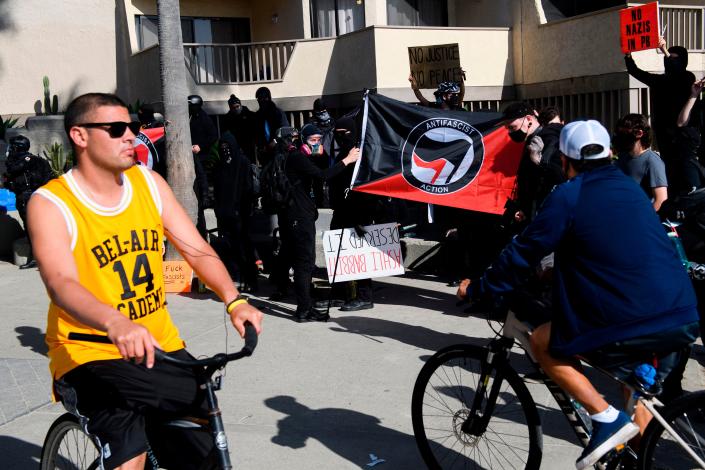
People bicycle past counter-protesters, some holding Antifa flags, awaiting demonstrators for a "Patriot March" demonstration in support of US President Donald Trump on Jan. 9, 2021 in the Pacific Beach neighborhood of San Diego, California.


But Mike Brown, who has lived in the Pacific Beach area for 30 years, said he didn’t see much patriotism on display on Jan. 9, 2021.

A history teacher and surfer, Brown said he was riding his bike in Pacific Beach when he was shocked to see the crowds of far-right and far-left protesters in the largely peaceful neighborhood. The pro-Trump group were not your average political crowd, Brown said.

“These guys weren't just Trump supporters, a lot of them were Proud Boys – you know, wearing the black and the yellow,” Brown said. Those outfits can be seen in some of the videos. “I don't know where they were from, but what pissed me off about it all was that they came into our community and disrupted business, took over the streets, created a lot of tension for a whole afternoon and it wasn't even a local grassroots movement.”

What Pacific Beach witnessed that day was a typical incursion into a mostly liberal neighborhood by far-right agitators who wanted to cause trouble, said Brian Levin, director of the Center for the Study of Hate and Extremism at California State University, San Bernardino.

Far-right extremists have long used the same tactics, Levin said: Arranging a hostile display of force in a neighborhood that they know is likely to oppose them, then stirring up violence from anyone who confronts them.

“The history of these paramilitary groups on the far-right is really about two things: making a presence and inciting some kind of retaliation, and then using that as an excuse to significantly escalate violence,” Levin said.

San Diego Police Department logs from the day describe the same chaos seen in the videos. The logs describe people in "Antifa gear" chasing and fighting with others wearing "Trump gear." At 4:31 p.m. the police log reads, "Protest being hijacked by Proud Boys. Very anti-police and refusing to comply."

A pepper ball (L), exits the barrel of a San Diego Police Department (SDPD) officer's Tippmann FT-12 paintball gun while firing pepper balls towards counter-protesters at a "Patriot March" demonstration, Jan. 9, 2021 in the Pacific Beach neighborhood of San Diego, California.


The indictment against the Antifa defendants lists 11 incidents in which prosecutors allege they committed crimes ranging from illegal use of pepper spray to punching, kicking and striking their opponents with a baseball bat.

Antifa activists, holding a banner reading “Antifascist Action” and chanting “racists go home” can also be seen in videos on YouTube attacking people marching on the pro-Trump side. In numerous altercations, black-clad counterprotesters chase people down the street, hit them with flagpoles and skateboards and spray pepper spray in their faces. Antifa activists also faced off against San Diego Police officers, who used less-than-lethal force against them.

But apparent assaults committed by the other side were also caught on camera.

Brown said he witnessed the attack by far-right extremists on the man and his female companion in an alley. He said a group had broken off from the main protest and assaulted the man, who was wearing a shirt with George Floyd’s image on it and the slogan “No Justice, No Peace,” on the back. The attack was unprovoked, Brown said.

“One guy comes up and just totally sucker punches him and takes him to the ground and then they move on,” he said.

Brown’s account is backed up by a video taken by Amie Zamudio, a local homeless activist, who can be heard pleading with the aggressors to leave their victims alone. Zamudio told USA TODAY she was concerned the man might be homeless because he was walking barefoot, and when she approached him, she saw the pro-Trump aggressors attack him without any provocation.

Brown and Zamudio both said they have never been contacted or interviewed by the District Attorney’s office or investigators with the San Diego Police Department. The man seen in that attack has not been publicly identified, and it's unclear if anyone has filed a police report about the incident.

In another incident, a group of black-clad activists chase three men down the street. One of the men turns and advances before them holding a knife in his right hand.

And another video shows one of the Trump supporters picking up a smoke canister and throwing it towards the anti-fascists as at least a dozen San Diego police officers look on.

Levin and others familiar with the case said given the wide array of violence from both groups, it’s hard to understand why only one side of the altercation is facing charges.

“I am not excusing, in any way, possible criminal conduct on the left,” he said. “But when we look at the array of antagonists that showed up, and their record of criminality and violence, it causes a particular question in the public's mind: What kind of fair-handed investigation was done by authorities and what evidence was reviewed?”

Cotter, the former federal prosecutor, said there’s a simple answer to those questions: politics.

“This is about votes,” he said. “It's about politics. It's about some prosecutor trying to burnish their brand, looking at voters, and saying ‘Who can I prosecute that will give me the most votes?’ and, “If I prosecuted these other guys, would that give me votes or cost me votes?”

The San Diego District Attorney’s Office did not agree to an interview with USA TODAY, but provided a statement including:

“When evidence and facts support criminal charges, we will file them, as we did in July 2020 with a white supremacy group that attacked Black Lives Matter peaceful protesters and when we charged a white supremacist with murder and a hate crimes allegation for killing an innocent Jewish woman at the Chabad of Poway synagogue in April 2019. We obtained convictions in both cases.”

More: FBI agents monitor social media. But who are they watching?
Prosecutors want victims' names hidden

In an unusual legal twist, the prosecutors of the San Diego case asked the superior court judge overseeing it to grant a protective order forbidding the defense attorneys from copying or sharing any documents that identify the alleged victims of the attacks by Antifa with anyone outside the legal team.

That means even if they’re asked, the defense attorneys can’t provide documents identifying who the alleged victims are, even to their clients.

The move, usually reserved for cases involving organized crime like the mafia or gang cases, is designed to protect witnesses and victims from being further targeted by their aggressors. In this case, the prosecutors argued, the victim’s names needed to be kept secret because they might be targeted by Antifa’s network of online sleuths, who might “doxx” them – a slang term for publishing personal information about someone on the internet, for the purpose of intimidating or encouraging others to target them.

The timing of the protective order was unusual, too.

The names of several of the victims have already been shared by Antifa-affiliated social media accounts multiple times. Indeed, in making their case to the judge that the names should be kept secret, prosecutors presented a screenshot of a local anti-fascist Twitter account sharing the names of several people USA TODAY confirmed are among the victims attacked by Antifa. That screenshot remains in publicly available court records.

A USA TODAY investigation found that people named in that tweet have histories of associating with white supremacist organizations and local racist groups in the San Diego area. They include two people from San Diego who have been identified by activists marching in several pro-Trump rallies wearing shirts emblazoned with the logo of American Guard, which the ADL describes as “Hard core white supremacists” and which grew out of two other racist organizations.

Almost all of the victims referred to in court documents only by their initials have long been well-known to local anti-fascists. Indeed, that’s why they were targeted with violence in the first place, three local anti-fascist sources told USA TODAY.

USA TODAY confirmed the names publicly announced by the Antifa Twitter account @SDAgainstFash with one of the defense attorneys on the case.
Antifa both 'a real thing' and a boogeyman

Perhaps more than any other extremist group in America, Antifa has been hard for academics and experts to pin down.

Unlike the Ku Klux Klan, which has a defined leadership structure, or the Proud Boys, which has a clear membership process, Antifa typically eschews any sort of organizational architecture. There’s no central leadership, no set membership process, and no real prerequisites for being an anti-fascist other than simply acting like one.

Plus, anti-fascist activists constantly engage in a semantic dance, employing the rejoinder “If you’re not anti-fascist, then you’re a fascist,” defying easy answers about whether anyone is a member of the movement.

This vagueness has led to a concerted effort by far-right-wing commentators, conspiracy theorists and pundits to discredit Antifa whenever possible. In the absence of a clear definition of the group, Antifa is often portrayed, even on mainstream channels like Fox News, as a highly organized, malevolent force with massive numbers and a clearly defined goal: To sow chaos and disorder on America’s streets.

Anti-fascists certainly do communicate with each other, said Mark Bray, a lecturer in history at Rutgers University and author of "Antifa: The Anti-Fascist Handbook." Anti-fascists in certain regions occasionally hold meetings, but the movement is still far from the regulated force that has been depicted.

“As it's become something more well known, it's become a real thing, but it's also become a boogeyman,” Bray said. "A very common phrase in right-wing circles is ‘BLM-slash-Antifa, which is, I think, essentially, their way of saying violent black leftists and violent white leftists.”

Stephan’s 2018 campaign website appeared to endorse this perception of Antifa. The website, which disappeared after negative media attention, claimed that left-wing philanthropist George Soros funded “anti-law enforcement candidates over experienced prosecutors, trying to tip the balance to the criminals.”

In 2020, Stephan again made headlines after her office charged Black Lives Matter activist Denzel Draughn with eight felonies after Draughn pepper-sprayed SDPD officers he said were attacking a fellow protester. Draughn was acquitted of all the charges at trial.

Dawn Perlmutter, the main expert witness who will testify about Antifa for prosecutors, also has a history of writing for right-wing websites. Perlmutter is an academic who teaches police departments about symbology and extremist movements, but she is also an adjunct professor of osteopathic medicine.

In one article, she described the Black Lives Matter racial justice movement as an “anti-police hate fest.” She decried pro-BLM protestors as “self-loathing affluent white middle-aged women attempting to show how woke they are.” Perlmutter acknowledged to USA TODAY that she wrote the stories.

The San Diego prosecution aims to prove that the black-clad people who committed violence on Jan. 9, 2021, in Pacific Beach weren’t just fired up by a common philosophy or hatred of Trump, or animosity towards authority. By charging the defendants with conspiracy, the prosecutors want to make the case that they acted more like a gang, with a unified goal, common symbols and shared tactics.

From a strictly legal perspective, that could have a significant impact on the defendants who are charged with conspiracy, because the charge could effectively double their sentences for other crimes.

People eating a meal at the beach take pictures as counter-protesters, some carrying Antifa flags, march in opposition to demonstrators holding a "Patriot March" in support of President Donald Trump on January 9, 2021 in the Pacific Beach neighborhood of San Diego, California.

But cases like this aren’t just about the individual outcomes for the San Diego 11, said Cotter, the former federal prosecutor. In a country supercharged by political division, animosity and violence, prosecutions like this are often as much about sending a message out into the world as they are about bringing justice to people who may well have committed crimes, he said.

“If a prosecutor anywhere is successful prosecuting any kind of unusual new kind of case, other prosecutors pay attention,” Cotter said.

He compared the Antifa case to the widespread prosecution of American labor organizers in the early 20th Century. Until unionization was protected by Congress, the movement was a soft target for conservative lawmakers obsessed with targeting progressive causes, Cotter said.


”Prosecutors are politicians looking for ways to build their brand,” he said. “If it’s politically to their advantage to be seen prosecuting these kinds of cases, whether it's Antifa or Hells Angels, or Mexican drug cartels, then other prosecutors pay attention and say, OK, well maybe there's a blueprint there.”

One of the San Diego 11 remains in custody. He and the other 10 defendants face a trial that has been continually delayed but will likely start in the spring.

The trial will be closely watched not just by anti-fascists across the country, but also by conservative pundits, politicians and prosecutors who will finally see whether their perception of Antifa as America’s dark, mysterious underbelly really stands up in court.


Anti-Trans Health Care Laws Are the Latest Republican Target


Kelsey Butler and Andre Tartar
Tue, September 20, 2022 

(Bloomberg) -- For about a week in May, Alabama had the harshest anti-transgender law in the US. Any doctor that prescribed puberty blockers or hormone therapy to people under the age of 18 could face felony charges, spend up to 10 years in prison and pay a $15,000 fine. Physicians scrambled to refill their patients’ prescriptions before the law kicked in; parents started contemplating plans to relocate their families out of state.

A federal judge has since issued an injunction on the medication ban. But it was a a brief preview of what conservative lawmakers are increasingly pushing for across the country. A Bloomberg News analysis found at least 40 similar bills proposed in around two-dozen Republican-controlled states that would sharply limit or outright ban gender-affirming and transition-related health care, often specifically for minors.

One draft law in Georgia would punish any doctor that prescribes puberty blockers to a minor with up to 10 years in prison; another in North Carolina would fine physicians $1,000 per occurence for doing the same. In Mississippi, a bill would limit health insurance coverage for transgender health-care services.


“We’re seeing a tsunami of these laws,” said Michael Bronski, a professor at Harvard University who researches LGBTQ history and culture.

Anti-LGBTQ legislation has been on the rise in recent years, with a raft of bills seeking to limit what bathrooms transgender people can use and what sports teams they can play on. But in the past year anti-trans health-care regulations really started to gain steam. In the 2022 state legislative year, about 60% of all proposed LGBTQ-health related bills aimed to ban or limit transgender-related health care. It’s a reversal from the past decade when pro-LGBTQ legislators were passing progressive laws like banning conversion therapy, the discredited practice of trying to change someone’s sexual orientation or gender identity.

“They’re throwing anything at the wall to see what sticks,” Bronski said.

“Part of the goal is to get rid of the care, but it’s just one of the stops along the way to getting rid of trans people,” said Chase Strangio, a lawyer at the American Civil Liberties Union who has sued multiple states for anti-trans laws arguing they violate the equal protection clause of the 14th Amendment.

Strangio has had some success in convincing judges these laws don’t hold legal water, at least for now. In Arkansas, he got an injunction on a medication ban similar to the Alabama one and in Texas he got another injunction on an order from the governor directing state agencies to investigate parents or doctors who offer gender-affirming care for minors.

The judge that ultimately blocked the Alabama law said “parents—not the states or federal courts—play the primary role in nurturing and caring for their children.” He also said the state had not produced credible evidence that the treatments were “experimental,” and therefore dangerous, as Alabama politicians had argued. The American Academy of Pediatrics and almost two dozen other major medical associations endorse the treatments that clinics are providing for transgender youth.

Conservative groups think that both the public and health-care community will come around to their position. “We’re not there yet, but I do think we’ll reach a point in which this will be seen as an absolutely inappropriate way to intervene,” said Jay Richards, a research fellow at the Heritage Foundation, a conservative think tank that’s working to provide model legislation for lawmakers on the issue.

“It’s just one of the stops along the way to getting rid of trans people”

Advocates say that the extremism is part of the strategy. “Each one of these bills is a test,” said Nikita Shepard, a researcher at Columbia University, who studies gender and sexuality. “How far can it go? How far can the rhetoric go?”

They liken it to the anti-abortion crusade that ultimately led to the overturning of Roe v. Wade earlier this year. For more than a decade, state legislators passed hundreds of laws restricting or banning abortion. Many never went into effect, until a more conservative Supreme Court took one up and this year voted to dismantle federal abortion protections. Now physicians in a dozen states face felony charges if they offer any abortion services.

Doctors who see transgender patients fear that’s where their future is headed, said Kellen Baker, the executive director of the Whitman-Walker Institute, an LGBTQ health research and advocacy group. “We’re seeing a lot of confusion, a lot of fear and a lot of anxiety,” he said.

Clinics are also reporting a rise in violence and harassment. Last month, clinicians at Boston Children’s Hospital, home to the nation’s first pediatric and adolescent transgender health program, were the targets of a harassment campaign; the hospital also received a bomb threat a few weeks later.

Despite the legal hurdles they’ve so far faced, the laws aren’t expected to let up.

Promise to America’s Children, an anti-LGBTQ advocacy group, is asking lawmakers to sign a pledge supporting policies that ban “physical interventions on the bodies of children” such as puberty blockers and hormone therapy. The coalition is backed by the Heritage Foundation, the Family Policy Alliance and the Alliance Defending Freedom, conservative groups that have been instrumental in the anti-abortion fight, too. The group will be providing model legislation and education campaigns, Richards said.

“We're dealing with a fundamental disagreement: Can kids be born in the wrong bodies and so should their bodies be transformed to conform to some presumed internal state or should we be trying to help kids be comfortable in their bodies?” the Heritage Foundation’s Richards said. “There's a chasm between those two different views of reality and we think one is right and one is wrong.”

How do Americans view policies on gender? Poll shows big difference between age groups


Brooke Baitinger
Mon, September 19, 2022 

As transgender and non-binary people become more visible in public life, more state leaders are considering or enacting policies that either protect or restrict their rights.

But how Americans view such policies largely depends on their age, according to poll results released Thursday, Sept. 15, from the Pew Research Center.

Most Americans (64%) said they favor policies that would protect transgender people from discrimination they might face in housing, jobs, and public places, the poll says. Ten percent oppose them, and 25% don’t feel strongly one way or the other.

But Americans’ views are more split when it comes to other policies.

In some instances, the policies some opposed deal with public bathroom use, gender identity in school curriculum, and medical coverage for gender-affirming health care.

At least 21 states have passed some kind of restriction on transgender people, such as: blocking certain transgender student athletes from playing on sports teams that match their gender; making it illegal for health care professionals to provide someone younger than 18 with gender-affirming medical care, such as puberty-blocking medication or hormone replacement therapy; excluding coverage of gender-affirming medical care from state Medicaid; or making it illegal for public schools to teach about gender identity in class.

”At least seven states — Alabama, Arkansas, Arizona, Florida, Kentucky, Tennessee and Texas — have passed two or more of these restrictions,” the poll says.

And it isn’t limited to the southeast. Western states such as Montana have been in the news recently for debating whether transgender people must undergo surgical transitions in order to change the gender on their birth certificate.

Legislators in states on the West Coast, such as California, have considered legislation to create a refuge for families to seek and receive gender-affirming health care that could get them investigated for child abuse in other states, such as Texas.
Transgender athletes

Most Americans, regardless of age, think transgender student athletes should not be able to compete on the team that aligns with their gender, the poll found.

Fifty-eight percent “say they would favor or strongly favor policies that require transgender athletes to compete on teams that match the sex they were assigned at birth,” rather than their gender identity, the poll says.

Seventeen percent oppose or strongly oppose them, the poll found.

“At least 18 states restrict transgender student athletes’ ability to play on sports teams that match their gender identity,” the poll found.

In March 2020, Idaho was the first to pass a transgender athlete ban, with Louisiana being the most recent state to do the same in June 2022
Public bathrooms

Americans’ views are mixed when it comes to public bathroom use. Around four-in-ten favor policies that would require trans people to use public bathrooms that match the sex they were assigned at birth instead of their gender identity.

Few states have taken up the issue since North Carolina’s 2016 law was repealed in 2017, the poll found. That law banned transgender people from using the bathroom that corresponds to their gender identity.

But the issue has popped up in public school districts in at least three states, the poll found. Alabama, Oklahoma, and Tennessee “restrict public school students’ ability to use the bathroom matching their gender identity,” the poll states.

Transgender woman says Florida bar threw her out after using bathroom. ‘Belittling’
Gender identity in school curriculum

Americans are divided when it comes to whether transgender or non-binary identities can be taught in elementary school, the poll found.

About 41% say they would favor or strongly favor laws “that would make it illegal for public school districts to teach about gender identity in elementary schools,” such as Florida’s Parental Rights in Education law — more widely known as “Don’t Say Gay” — which took effect in July.

Thirty-eight percent oppose laws like that, the poll found.

Alabama signed a similar law in April, and “lawmakers in at least 20 states have introduced similar bills this year,” the poll states.

In the same survey, Pew asked parents of K-12 students “whether their children have learned about people who are transgender or who don’t identify as a boy or a girl from a teacher or another adult at their school.”

About 37% of parents with children in middle or high school said their children learned about transgender and/or non-binary folks in school, the poll found. “A much smaller share of parents of elementary school students (16%) say they same,” the poll states.

Overall, almost 30% of parents with kids in school say “at least one of their K-12 children” learned about transgender or gender noncomforming identities in school, the poll says.
Medical coverage and access to gender-affirming health care

Most Americans don’t believe health insurance companies should have to cover gender-affirming health care, the poll found.

About 44% oppose it, and 27% would favor requiring it, the poll says.

Policy on the topic varies widely by state. According to the poll, “at least 24 states as well as the District of Columbia” either require private health insurance companies to cover gender-affirming medical care, or they prohibit companies from excluding it. Those states also “prohibit companies from withholding insurance plans or charging different premiums because of someone’s gender identity,” the poll states.

The poll goes on to say that “at least 25 states and D.C. include medical care” for gender-affirming health care in their Medicaid programs, while “at least eight states explicitly exclude” it. In West Virginia, a federal judge overturned the state’s exclusion and ruled the state’s Medicaid program must cover gender-affirming medical care, The Hill reported last month.

When it comes to health care professionals providing gender-affirming care to anyone younger than 18, a plurality of Americans — 46% — think it should be illegal, and favor policies that would ban it, the poll found.

According to Pew, “a federal judge blocked part of the Alabama law passed in April that would have made it a felony for doctors to provide” puberty blockers and/or hormone replacement therapy for transgender minors. Arkansas passed a similar ban in 2021, “but a judge blocked that law from going into effect,” the poll states.

Lawmakers in Arizona passed a law “that bans physicians from performing irreversible gender reassignment surgeries on minors.” That law takes effect in 2023, the poll states.

Several states, including Idaho and New Hampshire, have tried to ban minors from accessing gender-affirming health care, classifying any efforts to help as child abuse. But those “attempts have failed,” according to Pew.

In Texas, Gov. Greg Abbott’s attempt has been “blocked twice in court,” the poll said.

Americans are divided almost down the middle on whether they want parents to be investigated for child abuse if they help someone younger than 18 get gender-affirming health care, including puberty blockers and/or hormone replacement therapy, the poll found.

About 37% say they would somewhat favor laws that would do so. About 36% oppose them. And 27% neither favor nor oppose it, the poll found.

The Pew Research Center survey was conducted May 16-22 among 10,188 U.S. adults.

Newsom signs bill legalizing composting of human bodies. Thanks, governor

Stephanie Finucane
Mon, September 19, 2022 

I’ve never been thrilled about spending eternity in a casket and now, thanks to a bill signed by Gov. Gavin Newsom on Sunday, I have another option.

It’s called human composting — or natural organic reduction (NOR).

Here’s how it works: At funeral homes, bodies are placed inside closed, reusable containers along with organic materials like straw, wood chips and plant material and then stored at a high temperature. It takes between 30 and 60 days for the body to decompose and another couple of weeks for the remains to aerate. Bones and teeth are broken down by “mechanical means” using the same device crematoriums use to grind bones.

The process generates 1 cubic yard of nutrient-rich soil, according to Recompose, a NOR company based in Seattle.

The soil is then returned to the deceased person’s family, or the funeral home arranges for it to be placed in a serene setting like a forest or a park.

Not everyone is a fan. When I broached the subject with my immediate family, they were less than enthusiastic about the prospect of dealing with my composted remains.

Too bad. My body, my choice, and I definitely do not choose a traditional burial.

Maybe it’s on account of that macabre song I learned as a child. Its official name is “The Hearse Song,” but it’s better known as “The Worms Crawl In.”

Here is one of the more palatable lines: “It all goes well for about a week and then the coffin begins to leak.”

Then comes the chorus: “The worms crawl in, the worms crawl out, they play pinochle upon your snout.”

Cremation was the obvious alternative, composting is much better for the environment.

It requires a whole lot of energy and produces greenhouse gases; a single cremation releases between 284 and 568 pounds of carbon dioxide.

Another plus: the composted soil can be put to good use, by giving sustenance to a tree, for instance.

“I look forward to continuing my legacy to fight for clean air by using my reduced remains to plant a tree,” the bill’s sponsor, Democrat Christina Garcia of Bell Gardens, wrote in a statement.


A man stands alone amidst the headstones at Fort Snelling National Cemetery, Friday, May 24, 2013 in Minneapolis, as visitors got an early start to the Memorial Day weekend. 
(AP Photo/Jim Mone) ORG XMIT: MP101


Opposition from Catholic Church

Human composting has been legally performed in only a handful of states: Washington, Oregon, Colorado and Vermont.


The whole process is made to seem very zen. Websites for NOR facilities in other states are filled with soothing pictures of deep, rich soil, lovely foliage, bits of bark and photogenic stones.

The language, too, is comforting.

There are references to “transformation of the body into soil,” “carbon-cycle ceremonies” and “giving back to the earth.” One company, Return Home, uses the term “Terramation” to refer to process.

There’s been little formal opposition to the practice — the one exception being the Catholic Church.

The California Catholic Conference submitted a letter of opposition to the California bill, according to a Religion News Service article.


The letter compared the process to the disposal of livestock and said it “reduces the human body to simply a disposable commodity.”

In New York State, which also may legalize the process, the Catholic Conference called the process “more appropriate for vegetable trimmings and eggshells than for human bodies.”


The bottom line

Recompose, the Seattle-based company, is expected to expand into California, but the service won’t be available any time soon. The state’s Cemetery and Funeral Bureau isn’t required to issue licenses to NOR facilities until 2027. That allows enough time to allow for appropriate rules and regulations to be written for the new industry.

In the meantime, bodies can be transported to out-of-state NOR facilities, although that adds to the cost.

As for the NOR process itself, costs listed on company websites range from $5,000 to $7,000, not including extras like funeral services, flowers and obituaries.

That’s at least a few thousand dollars more than cremation, which generally averages between $1,000 and $3,000.

Still, I think I’ll hold off on pre-paying for cremation — something I’ve been meaning to do but have never quite gotten around to.

I like the idea of winding up inside a planter full of geraniums or maybe at the base of a fruit tree — even if it means keeping company with worms.

This column has been updated.
MONOPOLY CAPITALI$M
Business groups take aim at chronic rail disruptions after strike threat


Karl Evers-Hillstrom
Wed, September 21, 2022 

President Biden, rail workers unions and railroads avoided a nationwide shut down last week that would have devastated an already ailing U.S. economy. But business groups argue that there is more to be done to address poor rail service, which they say has magnified red-hot inflation.

Retailers, farmers, carmakers and other rail customers are lobbying Congress to pass legislation that aims to cut down on chronic disruptions.

Shippers are seizing on Washington’s newfound scrutiny of railroads — an industry lawmakers have largely ignored for decades — after a contract dispute between carriers and labor unions nearly wreaked havoc on U.S. supply chains.

“There’s a lot of folks who are now aware of just how important railroads are to our economy,” said Chris Jahn, president of the American Chemistry Council, which represents firms that primarily transport products to manufacturers by train. “And now with a spotlight on them, they’re finding out that things are not what they could be or what they should be.”

Freight rail transports nearly one-third of all U.S. cargo, including 20 percent of chemicals, 20 percent of grain shipments, 75 percent of new cars and huge amounts of crude oil, coal and lumber.

But shippers say their goods often don’t arrive on time, or at all in some cases, creating ripple effects throughout the economy that reduce supply and drive up prices.

On average, roughly 70 percent of railcars reached their destination on time since May, when the Surface Transportation Board (STB) began requiring railroads to submit performance data. Railroads fulfilled 87 percent of pickups and deliveries over the same four-month period.

The leading freight carriers laid off nearly 30 percent of their workforce over the last six years, with most of the cuts coming before the pandemic. That left them unprepared for the recent explosion in demand for goods.

The Freight Rail Shipping Fair Market Act, unveiled by House Democrats last month, would provide the STB with new funding and authority to establish minimum service standards, incentivize more efficient shipping practices, speed up dispute resolutions and block price hikes during rail emergencies, among other measures.

Dozens of influential lobbying groups representing shippers, including the American Petroleum Institute and the American Farm Bureau Federation, are teaming up to back the bill, arguing that it would boost the STB’s efforts to streamline railroad service.

“Service failures are contributing to higher prices and supply chain disruptions for food, fuel, and countless other products,” the Rail Customer Coalition wrote in a recent letter to lawmakers. “The proposal contains many common-sense provisions that would improve service and create a more balanced system for railroads and their customers.”

The bill’s introduction has sparked a lobbying battle that pits railroads against their biggest customers.

The Association of American Railroads argues that the measure wouldn’t do anything to help address an economy-wide shortage of workers. The group told lawmakers that the STB is already pursuing similar goals, such as increased competition and transparency in the freight rail industry, through the rulemaking process.

Railroads note that Martin Oberman, the STB’s own chairman, has pushed back on legislation to dictate the board’s direction in an effort to keep politics out of railroad policy debates.

“As you can see, the board has a number of tools in its existing statutory arsenal to enhance rail service,” Oberman told lawmakers in May.

The railroad reform bill is also drawing intense pushback from conservative groups with close ties to GOP leaders. They argue that government intervention over freight rates would ultimately reduce private investment in railroads.

“In short, the bill substitutes bureaucratic whim for free market negotiation,” more than 20 conservative organizations, including the Club for Growth and Americans for Prosperity, wrote in a letter to lawmakers last week. “That is a recipe for disaster.”

Supporters don’t expect the bill to pass before the midterms, as lawmakers have a limited number of days left before leaving for the campaign trail.

Another roadblock is a lack of Republican support. The railroad reform legislation doesn’t yet have any GOP co-sponsors, complicating its path to Biden’s desk.

Earlier this year, Congress passed a similar bill to crack down on ocean carriers that was backed by many of the same agricultural and retail interests. But that measure primarily impacted foreign firms and was introduced with bipartisan support.

Companies that rely on railways have long complained that only a handful of freight railroads dominate the industry. Most refiners and chemical plants are only served by one railroad, leaving them with few options when their local carrier doesn’t have enough capacity.

They say that the lack of competition, combined with severe underinvestment in workforce and rail infrastructure, saddles shippers with sky-high rates that are passed on to consumers.

“We do not have a free market economy in the railroad space,”
Jahn, of the American Chemistry Council, said. “We’d love to give the railroads more business. But the status quo is unacceptable and needs to change now.”

For the latest news, weather, sports, and streaming video, head to The Hill.
EU health regulator says COVID pandemic not over, contradicting U.S. President 


Exterior of European Medicines Agency is seen in Amsterdam

Tue, September 20, 2022 

FRANKFURT (Reuters) -An official at the European Union's drugs regulator said on Tuesday the COVID-19 pandemic was not over, contradicting U.S. President Joe Biden, and that a planned vaccination campaign in the region during the cold season was key to fighting it.

"We in Europe still consider the pandemic as ongoing and it's important that member states prepare for rollout of the vaccines and especially the adaptive vaccines to prevent further spread of this disease in Europe," the European Medicines Agency's (EMA) Chief Medical Officer Steffen Thirstrup told a media briefing, referring to vaccines targeting specific strains of the virus.

He was asked to comment on Biden's remark in an interview broadcast on Sunday that "the pandemic is over".

"I cannot obviously answer why President Biden came to that conclusion," Thirstrup said.

The World Health Organization has said the pandemic remains a global emergency but the end could be in sight if countries use the tools at their disposal.

During the media briefing, EMA officials reaffirmed a call by the agency's Executive Director Emer Cooke made last week in a Reuters Next Newsmaker interview that people in Europe should take whatever COVID-19 booster is available and recommended to them in the coming months.

Apart from the original COVID vaccines, the EMA has in recent weeks endorsed a number of vaccines adapted to the Omicron variant of the virus for use as booster shots to ease the burden from a feared surge in infections during autumn and winter in Europe.

The EMA's head of vaccines strategy, Marco Cavaleri, said the agency was also looking into the use of the adapted shots as a primary course of vaccination and that there were discussions on the types of data that could support such an approval

(Reporting by Ludwig Burger Editing by Madeline Chambers and Mark Potter)

Fauci tempers Biden’s declaration that pandemic is ‘over’


Anna Moneymaker/Getty Images North America/TNS

Theresa Braine, New York Daily News
Tue, September 20, 2022 

Not so fast, Mr. President. Outgoing presidential COVID adviser Dr. Anthony Fauci on Monday walked back President Joe Biden’s assertion that the coronavirus pandemic was “over.”

A lot depends on how we respond to current variables and future virus variants, the nation’s top infectious disease expert said during a fireside chat with the Center for Strategic and International Studies. And much of that is up to the American people.

“How we respond and how we’re prepared for the evolution of these variants is going to depend on us,” Fauci said. “And that gets to the other conflicting aspect of this — is the lack of a uniform acceptance of the interventions that are available to us in this country where even now, more than two years, close to three years, into the outbreak, we have only 67% of our population vaccinated and only one-half of those have received a single boost.”

Biden cited the dropping infection, death and hospitalization rate, as well as the fact that people were relaxing protective protocols when he spoke to “60 Minutes” anchor Scott Pelley.

“The pandemic is over,” Biden declared in answer to Pelley’s question during an interview that aired Sunday night.

Fauci had a slightly more tempered take.

“We are not where we need to be if we are going to quote ‘live with the virus’ because we know we are not going to eradicate it,” Fauci said. “The next question we ask: ‘Are we going to be able to eliminate it from our country or from most of the world?’ and the answer is unlikely, because it is highly transmissible and the immunity that’s induced by vaccine or infection is also transient.”

COVID-19 is still killing nearly 400 people daily, and though the pandemic is “heading in the right direction,” that did not preclude a resurgence caused by yet another variant, Fauci said.

The pandemic phase of the coronavirus outbreak certainly does seem to be ebbing, as even World Health Organization Director-General Tedros Adhanom Ghebreyesus said last week.

“We are not there yet, but the end is in sight,” he said at a press conference in Geneva, with worldwide deaths from the novel coronavirus dropping to levels matching those at the beginning of the pandemic in March 2020.

It’s not clear how much of that drop is due to cases simply not being detected, given that countries worldwide have been relaxing protocols in recent weeks and months, even as the omicron BA.5 variant has taken over.

Fauci says ‘we are not where we need to be’ after Biden declares ‘pandemic is over’


Olafimihan Oshin
Mon, September 19, 2022 

Anthony Fauci, the nation’s top infectious disease expert, said Monday that the U.S. is not where it needs to be regarding the coronavirus pandemic, the day after an interview with President Biden was broadcast in which Biden said that the “pandemic is over.”

In a talk with the Center for Strategic and International Studies, Fauci, Biden’s top COVID-19 adviser who last month announced his pending retirement from the government, said that much depends on how the country handles future virus variants.

“How we respond and how we’re prepared for the evolution of these variants is going to depend on us. And that gets to the other conflicting aspect of this — is the lack of a uniform acceptance of the interventions that are available to us in this country where even now, more than two years, close to three years, into the outbreak, we have only 67 percent of our population vaccinated and only one-half of those have received a single boost,” Fauci said.

He noted that the country is still experiencing more than 400 daily deaths due to COVID-19, though that number is down from a year earlier.

“But we are not where we need to be if we’re going to be able to, quote, ‘live with the virus,’ because we know we’re not going to eradicate it. We only did that with one virus, which is smallpox, and that was very different because smallpox doesn’t change from year to year, or decade to decade, or even from century to century,” Fauci added.

“And we have vaccines and infection that imparts immunity that lasts for decades and possibly lifetime.”

The Hill has reached out to the White House for further comment.

In a “60 Minutes” interview that ran Sunday, Biden, who recently recovered from a COVID-19 breakthrough case, told CBS News correspondent Scott Pelley that the country seems to be in “good shape” to move past the pandemic phase.

“The pandemic is over,” Biden said. “We still have a problem with COVID. We’re still doing a lotta work on it. It’s — but the pandemic is over. if you notice, no one’s wearing masks. Everybody seems to be in pretty good shape. And so I think it’s changing. And I think this is a perfect example of it.”
CRIMINAL CAPITALI$M
Feds: Minnesota food scheme stole $250M; 47 people charged

AMY FORLITI
Tue, September 20, 2022 

MINNEAPOLIS (AP) — Federal authorities charged 47 people in Minnesota with conspiracy and other counts in what they said Tuesday was the largest fraud scheme yet to take advantage of the COVID-19 pandemic by stealing $250 million from a federal program that provides meals to low-income children.

Prosecutors say the defendants created companies that claimed to be offering food to tens of thousands of children across Minnesota, then sought reimbursement for those meals through the U.S. Department of Agriculture's food nutrition programs. Prosecutors say few meals were actually served, and the defendants used the money to buy luxury cars, property and jewelry.

“This $250 million is the floor," Andy Luger, the U.S. attorney for Minnesota, said at a news conference. “Our investigation continues.”

Many of the companies that claimed to be serving food were sponsored by a nonprofit called Feeding Our Future, which submitted the companies' claims for reimbursement. Feeding Our Future’s founder and executive director, Aimee Bock, was among those indicted, and authorities say she and others in her organization submitted the fraudulent claims for reimbursement and received kickbacks.

Bock’s attorney, Kenneth Udoibok, said the indictment “doesn’t indicate guilt or innocence.” He said he wouldn't comment further until seeing the indictment.

In interviews after law enforcement searched multiple sites in January, including Bock's home and offices, Bock denied stealing money and said she never saw evidence of fraud.

Earlier this year, the U.S. Department of Justice made prosecuting pandemic-related fraud a priority. The department has already taken enforcement actions related to more than $8 billion in suspected pandemic fraud, including bringing charges in more than 1,000 criminal cases involving losses in excess of $1.1 billion.

Federal officials repeatedly described the alleged fraud as “brazen,” and decried that it involved a program intended to feed children who needed help during the pandemic. Michael Paul, special agent in charge of the Minneapolis FBI office, called it “an astonishing display of deceit."

Luger said the government was billed for more than 125 million fake meals, with some defendants making up names for children by using an online random name generator. He displayed one form for reimbursement that claimed a site served exactly 2,500 meals each day Monday through Friday — with no children ever getting sick or otherwise missing from the program.

“These children were simply invented,” Luger said.

He said the government has so far recovered $50 million in money and property and expects to recover more.

The defendants in Minnesota face multiple counts, including conspiracy, wire fraud, money laundering and bribery. Luger said some of them were arrested Tuesday morning.

According to court documents, the alleged scheme targeted the USDA's federal child nutrition programs, which provide food to low-income children and adults. In Minnesota, the funds are administered by the state Department of Education, and meals have historically been provided to kids through educational programs, such as schools or day care centers.

The sites that serve the food are sponsored by public or nonprofit groups, such as Feeding Our Future. The sponsoring agency keeps 10% to 15% of the reimbursement funds as an administrative fee in exchange for submitting claims, sponsoring the sites and disbursing the funds.

But during the pandemic, some of the standard requirements for sites to participate in the federal food nutrition programs were waived. The USDA allowed for-profit restaurants to participate, and allowed food to be distributed outside educational programs. The charging documents say the defendants exploited such changes “to enrich themselves."

The documents say Bock oversaw the scheme and that she and Feeding Our Future sponsored the opening of nearly 200 federal child nutrition program sites throughout the state, knowing that the sites intended to submit fraudulent claims.

“The sites fraudulently claimed to be serving meals to thousands of children a day within just days or weeks of being formed and despite having few, if any staff and little to no experience serving this volume of meals,” according to the indictments.

One example described a small storefront restaurant in Willmar, in west-central Minnesota, that typically served only a few dozen people a day. Two defendants offered the owner $40,000 a month to use his restaurant, then billed the government for some 1.6 million meals through 11 months of 2021, according to one indictment. They listed the names of around 2,000 children — nearly half of the local school district's total enrollment — and only 33 names matched actual students, the indictment said.

Feeding Our Future received nearly $18 million in federal child nutrition program funds as administrative fees in 2021 alone, and Bock and other employees received additional kickbacks, which were often disguised as “consulting fees” paid to shell companies, the charging documents said.

According to an FBI affidavit unsealed earlier this year, Feeding Our Future received $307,000 in reimbursements from the USDA in 2018, $3.45 million in 2019 and $42.7 million in 2020. The amount of reimbursements jumped to $197.9 million in 2021.

Court documents say the Minnesota Department of Education was growing concerned about the rapid increase in the number of sites sponsored by Feeding Our Future, as well as the increase in reimbursements.

The department began scrutinizing Feeding Our Future’s site applications more carefully, and denied dozens of them. In response, Bock sued the department in November 2020, alleging discrimination, saying the majority of her sites were based in immigrant communities. That case has since been dismissed.
CRIMINAL CAPITALI$M
AMP handed $9.7 million penalty for charging pensioners 'fees for no service'


 The logo of AMP Ltd, Australia's biggest retail wealth manager, adorns their head office located in central Sydney, Australia

Mon, September 19, 2022 

(Reuters) - Wealth manager AMP Ltd was handed a penalty of A$14.5 million ($9.74 million) on Tuesday by Australia's Federal court for charging customers with 'fees for no service' on their corporate pension accounts.

The Australian Securities and Investment Commission (ASIC) had alleged in 2018 that companies related to the wealth manager charged fees from customers despite being notified that they were no longer able to access the advice.

Between July 2015 and September 2018, AMP entities deducted A$356,188 in fees even though they were aware that the members had ceased their employment and could no longer receive advice services, the court found.

AMP had acknowledged the claims and said it self-reported the issue to the regulator in 2018 and provided remediation to affected customers in November 2019.

"Although AMP has remediated A$691,032 to affected customers, the court found AMP failed to investigate whether or not there was a systemic issue, despite many complaints over a lengthy period of time," ASIC said.

The penalty received on Tuesday has already been provisioned in the 2022 half-yearly financial statement, AMP said.

"Superannuation trustees should treat the penalty imposed today as an important reminder to maintain robust internal governance and assurance arrangements," ASIC Deputy Chair Sarah Court said.

AMP has been embroiled in scandals surrounding its practices and corporate culture, including allegations that five related companies charged life insurance premiums and advice fees to more than 2,000 customers after their deaths.

A Royal Commission inquiry in 2018 found that the 172-year-old firm engaged in "unconscionable" conduct and Australia's biggest banks broke laws when providing financial advice.

(This story refiles to correct currency in third and fifth paragraphs to A$)

($1 = 1.4890 Australian dollars)

(Reporting by Harish Sridharan in Bengaluru; Editing by Dhanya Ann Thoppil and Subhranshu Sahu)
Major U.S. banks threaten to leave Mark Carney's climate alliance - FT


Wed, September 21, 2022 

COP26 in Glasgow


(Reuters) - Major Wall Street banks have threatened to leave United Nations climate envoy Mark Carney's financial alliance over legal risks, the Financial Times reported on Wednesday, citing several people involved in internal talks.

Morgan Stanley, JPMorgan and Bank of America are among the banks that are weighing an exit as they fear being sued over the alliance's stringent decarbonisation commitments, the report said.   
https://on.ft.com/3RZv9Cl

The Glasgow Financial Alliance for Net Zero (GFANZ), set up in 2021 by former Bank of England governor Carney, is a coalition of assets managers, banks and insurance firms representing $130 trillion in assets directed toward tackling climate change.


Some members of the alliance have recently said that they "feel blindsided by tougher UN climate criteria and are worried about the legal risks of participation", the report said.

Morgan Stanley, JPMorgan, Bank of America and GFANZ did not immediately respond to Reuters requests for comment outside business hours.

The banks' legal departments are particularly anxious about U.S. Securities and Exchange Commission (SEC) rules around climate-risk disclosures, the report said. The SEC will soon require formal disclosures in annual reports about governance, risk-management and strategy with respect to climate change.

The bankers have also complained that the demands placed on them are not supported by enough government action on climate change and that there are fewer members in GFANZ from the world's top carbon-emitting countries such as China, Russia and India.

GFANZ earlier said it planned to release a series of frameworks, white papers and other guidance to help its members reach their climate goals as it prepares for the next UN climate summit in Egypt in November.

Carney became the chair of Brookfield's asset management division in August. (This story corrects to remove reference to Santander in paragraph 2 and 5)

(Reporting by Akanksha Khushi in Bengaluru; Editing by Devika Syamnath)
FT: Private equity may become ‘pyramid scheme’, says Danish pension fund

Surin Murugiah/theedgemarkets.com
September 21, 2022 

-

KUALA LUMPUR (Sept 21): A top executive at Denmark’s largest pension fund has warned that the private equity industry is akin to a pyramid scheme, highlighting that buyout groups are increasingly selling companies to themselves and to peers on a scale that “is not good business”.

In a report on Tuesday (Sept 20), the Financial Times (FT) cited ATP chief investment officer Mikkel Svenstrup as saying that he was concerned because last year, more than 80% of sales of portfolio companies by the private equity funds that ATP has invested in were either to another buyout group or were “continuation fund” deals — where a private equity group passes it between two different funds that it controls.

“We’re a big fund investor. We have hundreds of funds and thousands of portfolio companies,” he said. “This is not good business, right? This is the start of, potentially, I’m saying ‘potentially’, a pyramid scheme. Everybody’s selling to each other? Banks are lending against it. These are the concerns I’ve been sharing.”

The FT said ATP is a major investor in private equity funds. It has US$119 billion (RM543.45 billion) under management, and has committed money to 147 buyout funds, according to PitchBook data.

The financial newspaper said Svenstrup’s comments, made at the IPEM private equity conference in Cannes, are similar to those made by Amundi Asset Management CIO Vincent Mortier in June. Mortier said some parts of the private equity industry “look like a pyramid scheme in a way”.


Svenstrup said the “exponential growth” of the private equity industry in recent years, as investors have poured cash into its funds, would stop “at some point”, adding that this is “just a question of time”.

“It’s not that I think the private equity market is going to drop off a cliff,” Svenstrup said. “We’re just going to be looking [at] potentially low returns and high costs.”

He added that the industry plays an important role as “a key driver of taking some companies from one step to the next and eventually, hopefully, getting IPO’d (an initial public offering) or owned by some long-term owners”.

ATP is cutting down on the number of private equity groups it commits money to, he told the conference.

“Obviously, we’ve been looking very carefully at...who’s been tweaking [returns figures by] using bridge financing, leveraged funds...all those tricks they do to kind of manipulate the IRR,” he said. The IRR, or internal rate of return, is a key measure by which private equity groups report returns to their investors.