Friday, September 23, 2022

Lula Has Big Petrobras Plans That Would Undo Privatization Push

Lula Win May Be Stressful, But Not Disastrous, for Petrobras


Peter Millard and Vinícius Andrade
Fri, September 23, 2022 at 9:22 AM·5 min read

(Bloomberg) -- Next week’s elections in Brazil pose a challenge to Petrobras investors. Former President Luiz Inacio Lula da Silva, the front-runner, has vowed to use the company as a vehicle for national development. Incumbent Jair Bolsonaro, who’s fighting for a come-from-behind upset, is proposing the complete opposite, with plans to privatize the state-run giant.

The contrast is a rare one in this election cycle, in which the leading candidates have offered few details about economic policies they’d pursue. It also makes Petrobras a binary case for investors: the firm is churning out dividends and share prices are already cheap compared to other oil majors, but the cash stream could also dry up and leverage could increase if Lula wins and follows through on his pledges.

“The stock is maybe one of the most complex investment cases in Brazil right now,” said Flavio Kac, a portfolio manager at ASA Investments. “A Bolsonaro win would pave the way for its potential privatization, while a new government could lead to margin pressure and lower profits.”

Petrobras shares were down 5.8% to 30.10 reais ($5.75) on Friday at 12:13 p.m. local time, after oil prices fell below $80 in the longest losing streak of the year.

What to Know About Bolsonaro-Lula Showdown in Brazil: QuickTake


Petroleo Brasileiro SA, Latin America’s largest producer with 2.7 million barrels a day of oil and gas output, became a source of contention during the first presidential debate. Bolsonaro accused Lula of mismanaging the company and presiding over an epic corruption scandal. Lula criticized Bolsonaro for “carving up” Petrobras through asset sales, as well as the decision to privatize utility Eletrobras.

Lula, a former union leader who governed Brazil from 2003 to 2010, has a checkered past with Petrobras and the oil industry at large. He presided over growing output and the discovery of the largest group of deep-water fields this century, which have become a profit center for Petrobras.

At the same time, he halted new lease sales in the so-called pre-salt to overhaul taxes and regulations, throttling how fast oil production grew. Without the licensing delays, Brazil would be pumping twice as much right now, according to analysts. Lula also implemented costly build-in-Brazil requirements that discouraged investments. If he wins, the local oil industry will look to who he recruits for his energy team to gauge how big the policy shift will be.

Oil Boom Falls Flat in Region With a Fifth of World’s Reserves

“Lula has relied heavily on lieutenants, so who is that new gang?” said Schreiner Parker, the head of Latin America for Rystad Energy, a consultancy. “It will be interesting to see who fills in the mandarin positions.”

Political consultancy Eurasia sees Lula’s odds of winning the election up at 70%.

Another Lula administration would see Petrobras expanding its refineries in Brazil and rebuilding its international operations, Senator Jean Paul Prates, his point person for oil and gas, said in an interview. The company would also become a global player in the energy transition -- even if it means lower profits and dividends. Petrobras’s limited focus on the pre-salt has generated heaps of cash in the short term, but leaves it exposed to a changing industry in the coming decades, he said.

“It has turned into a huge dairy cow, and it won’t last,” Prates said. “It’s walking blindfolded off a cliff.”

Lula’s Petrobras Would Seek Energy Transition, Expand Refining


While Lula oversaw a massive rally in his eight years in office, aided by a commodities super-cycle, his legacy was tarnished by policy mistakes made by his successor and the so-called Carwash corruption probe. The investigation centered on Petrobras, and put him in jail for almost a year and a half. His convictions were later tossed out by the Supreme Court on procedural grounds, but some Brazilians still see him as a symbol of corruption. In the first presidential debate, Bolsonaro branded Lula’s government “the most corrupt in history.”

Exploration

To be sure, Brazil won’t stop pumping oil no matter the outcome of the October vote. Both candidates are supportive of oil and resource extraction, unlike Colombia’s recently elected President Gustavo Petro, who plans to ban new exploration out of environmental concerns. Besides, Petrobras has found so much oil this century that production will continue to grow whoever wins.

“Petrobras will continue as a giant in Brazil,” said Luiz Felipe Coutinho, the chief executive officer of Origem Energia, which has bought onshore natural gas fields from Petrobras and considers the company its main commercial partner.

Another thing unlikely to change regardless of the outcome is the risk of Petrobras subsidizing fuels. Lula has attacked Bolsonaro over high gasoline prices, a major complaint among Brazilians this year. Bolsonaro responded by attacking Petrobras’s leadership and ultimately slashing taxes to provide consumers relief.

Lula Win May Be Stressful, But Not Disastrous, for Petrobras

“At the end of the day it’s just not really a private sector company. It has a different cadre of investors who understand the quasi-sovereign aspect,” said Wilbur Matthews, founder of Vaquero Global Investment LP, who has owned Petrobras bonds in the past but thinks they are overpriced at the moment. “You don’t buy Petrobras stocks or bonds because you love the corporate dynamics.”
Liz Truss’s Historic Gamble With the UK Economy Is Already Unraveling


Philip Aldrick
Fri, September 23, 2022 

(Bloomberg) -- Liz Truss’s plan for growth, melding the biggest tax giveaway in half a century with Thatcherite deregulation, is a straight-up gamble with Britain’s future, and even before her chancellor of the exchequer had finished delivering it on Friday the bet was starting to sour.

The market’s verdict on the £220 billion policy blitz set out by Kwasi Kwarteng was swift and devastating. Sterling crashed below $1.11 for the first time since 1985, taking its slump for the year to date to 19%. Five-year gilts posted their biggest ever daily decline.

“The markets will do what they will,” Kwarteng, 47, said when challenged in the House of Commons over the mayhem that he had unleashed.

Even before the chancellor’s statement, former Bank of England policy makers were warning that Prime Minister Liz Truss’s determination to cut taxes regardless of the circumstances risked pushing the UK into a sterling crisis.

There was still a sense of shock in how far her chancellor went, scrapping the top rate of income tax in a boost to the highest earners, as well as delivering on cuts to corporate taxes, national insurance contributions and levies on home purchases that had been flagged in advance.

The final total didn’t even include the full cost of capping household energy bills for the next two years. That could add another £100 billion to taxpayers’ liabilities.

The tax cuts will cost the Treasury around £161 billion over the next five years. A further energy guarantee will add about £60 billion to that sum in the next six months, the only figure the Treasury provided.

Those eye-watering figures had analysts reaching for the history books to compare the package with famous policy errors of the past. The reaction -- with the pound falling even as traders priced in steeper hikes in interest rates to offset the increase in inflationary pressures -- is the sort of movement that is usually limited to emerging market currencies.

“Investor confidence is being eroded fast,” George Saravelos, global head of foreign exchange research at Deutsche Bank. He called for an emergency interest rate hike from the Bank of England.

The reaction leaves Truss and Kwarteng in a terrible bind. Truss, also 47, took office less than three weeks ago. Her efforts to stamp her authority on the government were interrupted by the death of Queen Elizabeth II, which brought politics to a halt for 10 days. And Truss has a desperate need to show that she can steer the UK through the global energy crisis.

She defended her plan in comments to CNN’s “State of the Union,” saying “we absolutely need to be incentivizing growth at what is a very, very difficult time for the global economy.”

At the same time, government measures to limit energy prices for consumers are “very important as well,” she said in excerpts from an interview for broadcast on Sunday.

She was elected Tory party leader over the summer due to her popularity with the membership. But two thirds of her lawmakers voted against her, and there were mutterings of a potential no-confidence vote before she’d even taken office.

The fear among investors is that Truss’s tax cuts will give the economy no more than a quick sugar rush, sending the debt ballooning and inflation spiraling, before a crash that leaves no lasting improvement on longer term growth.

Even the government’s fans were lukewarm in their support. Crispin Odey, a Tory backer and founder of the hedge fund Odey Asset Management where Kwarteng once worked as an analyst, said: “They are trying the right things, but there has to be a risk we are going into a Barber boom, by pushing the button on inflation.”

That’s reference to the ill-fated 1972 budget drawn up by Kwarteng’s Tory predecessor Anthony Barber. Barber, like Kwarteng, delivered a massive package of unfunded tax cuts which, in his case, saw the economy overheat and inflation soar before collapsing into recession. Barber’s boss, Edward Heath, was defeated by the Labour opposition two years later, and the UK had to seek a bailout from the International Monetary Fund in 1976.

What Bloomberg Economics Says ...

“The policies announced in Chancellor of the Exchequer Kwasi Kwarteng’s mini-budget will provide the economy with a sugar rush over the next year, but we highly doubt it’ll deliver the gear shift in growth that the government is banking on. That means it will lift inflation at a time when the Bank of England is trying to cool price pressure and, because the policy package is unfunded, put debt on an unsustainable path.”

--Dan Hanson, Bloomberg Economics. Click for the INSIGHT.

Truss similarly may have less than two years before she also has to call an election.

Truss has been clear that what matters to her is increasing the economic pie, rather than worrying about how it is divided.

That boldness is most evident in the central gamble at the heart of the mini-budget. Success hinges on a single number: Kwarteng’s 2.5% growth target, which is almost a whole percentage point above the official forecast for the next three years and a level last seen before the 2008 financial crisis.

If the government can lift GDP growth by a percentage point, the tax cuts will pay for themselves by the end of five years, according to the Treasury documents published on Friday. At that point, the government will have stabilized the national debt, fixed the UK’s productivity conundrum and given the country the competitive advantage of lower taxes.

Martin Weale, a former Bank of England rate setter now at King’s College London, described the growth target as “pie in the sky.” The government can’t be sure it will get 2.5% growth, but it can be sure that the tax cuts put the public finances in a perilous position, he said.

The Resolution Foundation projected that government borrowing as a share of GDP will rise for the next five years, adding a total of £411 billion to the existing £2.3 trillion debt pile.

At the same time, the benefits of the tax cuts are skewed toward the highest earners -- who traditionally are more likely to vote Conservative. Someone earning £200,000 will be £5,220 a year better off as a result of the tax cuts, while a worker on £20,000 will gain just £157.

“After 12 years of running the country, the Tories desperately need to establish a record of delivery quickly if they want to cling on to power,” said Ryan Shorthouse, chief executive of the Bright Blue think tank. “The prime minister and chancellor are going for broke.”


‘Nothing but fear in the UK’: Top US economist slams Liz Truss tax cuts and warns pound could plunge below dollar

Nadine Batchelor-Hunt and Connor Parker
Fri, September 23, 2022

Larry Summers painted a bleak picture of the UK economy. (Reuters)

A former US Treasury secretary has condemned the huge tax cuts unveiled by Liz Truss and Kwasi Kwarteng, branding them "naive and wishful thinking".

On Friday, chancellor Kwarteng announced the steepest tax cuts in a generation and said they were crucial to stimulate economic growth amid a stark cost-of-living crisis. He also announced a lift on banker's bonuses.

Among the measures included cutting National Insurance Contributions (NICs) by 1.5% - giving £1,800 to the richest households and just £7.66 a year to the poorest.

Cuts to income tax, including the top rate from 45p to 40p, have been met with incredulity by critics and will mean that two-thirds (65%) of the gains from Kwarteng's personal tax cuts will go to the richest fifth of households.

It means a worker on £1m per year will see an annual tax cut of £55,000.

The package of measures has been widely criticised as being unaffordable as well as disproportionately helping high earners over and above the most vulnerable at a time when the cost of living is set to bite.

Following the announcement, the pound dropped 3% to below $1.10 for the first time since 1985 as investors made their feelings clear.

Read more: 'Not a game': UK finances on unsustainable path, warns top economist

pound

One senior US economist warned that confidence in the UK could drop so low that the pound may slump below the dollar.

Former US Treasury secretary Larry Summers told Bloomberg that policies were "naive and wishful thinking".

“It makes me very sorry to say, but I think the UK is behaving a bit like an emerging market turning itself into a submerging market," he said.

"Between Brexit, how far the Bank of England got behind the curve and now these fiscal policies, I think Britain will be remembered for having pursuing the worst macroeconomic policies of any major country in a long time."

"There’s nothing in the pattern of market response in the UK that suggests anything but fear rather than confidence in the policy approaches being taken.

“It would not surprise me if the pound eventually gets below dollar if the current policy path is maintained.“

In the UK itself, former prime minister Gordon Brown accused the government of being "heartless" and said the measures would overwhelmingly make the rich wealthier.


Gordon Brown has accused the government of being "heartless". (Getty Images)

In a Twitter thread, Brown warned that the gap between rich and poor continues to widen as "the government lavishes billions on the already wealthy at the expense of the new poor".

He added: "It's no longer the welfare state that's the last line of defence but charities. And yet charities find themselves broke.

Compassion isn’t running out but cash is. Churches are worried they won’t be able to afford to heat their halls for those who cannot heat their homes.

"The reversal of the NI rise will give £1,800 to the richest and just £7.66 a year to the poor.

"The removal of the bankers’ bonus cap, corporation tax cuts and the rejection of a further windfall tax will mercilessly underline that a winter of destitution is coming for millions not because we are a poor country but because we are an ever more unequal one.

"The coming battle must be against poverty, not against the poor. You cannot rely on a heartless government having a change of heart, but concerted action by the public can force a change of mind."

There was even the first signs of discontent on the Tory backbenches, with senior MP Julian Smith warning: "This huge tax cut for the very rich at a time of national crisis & real fear & anxiety amongst low income workers & citizens is wrong."
'A new era'

Announcing his mini-budget to MPs in parliament, Kwarteng said it was a "new approach for this new era" and claimed his plans would pay off with economic growth.

"We promised to prioritise growth," he said. "We promised a new approach for a new era.

"We promised to release the enormous potential of this country. Our growth plan has delivered all those promises and more."

Read more: Martin Lewis brands tax cuts and borrowing in mini-Budget ‘staggering’


Kwasi Kwarteng said the tax cuts which overwhelmingly benefit the wealthiest are necessary for economic growth.
 (Reuters)

Money Saving Expert Martin Lewis described the budget as helping "mega earners".

"From next April the 45% top rate of tax (applies to those earning £150,000) will be scrapped," he said. "So the top rate will be the 40% higher rate threshold. This means mega earners, pay the same rate as those on £50,000."

Elsewhere, think tanks focused on poverty and those on low incomes criticised the government for deciding to provide more money for the wealthy during the rising cost of living.

"This is a mini-budget that has wilfully ignored families struggling through a cost of living emergency and instead targeted its action at the richest," poverty charity the Joseph Rowntree Foundation said on Friday said following Kwarteng' announcements.

"It leaves those on the lowest incomes out in the cold with no extra help to get them through the winter."

It added: "This budget ignored millions of people on low incomes, struggling to afford essentials & unable to pay their bills. It’s left them out in the cold, facing an incredibly bleak winter."

Mia Fahnbulleh, CEO at the progressive think tank the New Economics Foundation (NEF), described Kwarteng's budget as a "massive transfer to the wealthy whilst families on low and modest incomes are left to take the hit during a cost of living crisis".


Surging sales of large gasoline pickups and SUVs are undermining carbon reductions from electric cars


John DeCicco, Research Professor Emeritus, University of Michigan
Fri, September 23, 2022 
THE CONVERSATION 

Pickup trucks for sale at a Michigan dealership. John DeCicco, CC BY-ND

Replacing petroleum fuels with electricity is crucial for curbing climate change because it cuts carbon dioxide emissions from transportation – the largest source of U.S. global warming emissions and a growing source worldwide. Even including the impacts of generating electricity to run them, electric vehicles provide clear environmental benefits.

Plug-in vehicles are making great progress, with their share of U.S. car and light truck sales jumping from 2% to 4% in 2020-2021 and projected to exceed 6% by the end of 2022. But sales of gas-guzzling pickups and SUVs are also surging. This other face of the market subverts electric cars’ carbon-cutting progress.

As a researcher who studies transportation and climate change, it’s clear to me that EVs provide large carbon reductions that will grow as the electric grid shifts to carbon-free energy. But fleetwide emissions, including vehicles of all types and ages, are what ultimately matters for the climate.

While the latest policy advances will speed the transition to EVs, actual emission reductions could be hastened by tightening greenhouse gas emissions standards, especially for the larger gasoline-powered personal trucks that dominate transportation’s carbon footprint. Because it takes 20 years to largely replace the on-road automobile fleet, gas vehicles bought today will still be driving and emitting carbon dioxide in 2040 and beyond.


Public policy progress

Plugging in rather than pumping gas reduces both global warming and smog-forming pollution. It avoids the ecological harm of petroleum production and reduces the economic and security risks of a world oil market coupled to totalitarian regimes such as those of Russia and in the Middle East.

On the good news front, automakers are offering ever more EV choices and promising all-electric fleets within 15 years or so. Two recent policy developments will help turn such promises into reality.

One is California’s recent update to its zero-emission vehicle program. The new regulations will require that by 2035, 100% of new light vehicles sold in California must be qualifying zero-emission vehicles, allowing for a limited number of plug-in hybrid vehicles. Other states that historically have adopted California’s emission standards may follow its lead, so cars running only on gasoline could ultimately be banned across 40% of the U.S. new car market.

In addition, the Inflation Reduction Act recently signed by President Biden includes new incentives for EVs and subsidies for domestic production of EVs, batteries and critical minerals. The new policy targets incentives in several ways, disqualifying high-income consumers, capping the price of qualifying vehicles, providing incentives for used EVs, and restricting the tax credits to EVs built in the U.S. and Canada. It complements the US$7.5 billion for building a national EV charging network authorized by the infrastructure bill that the Biden administration brokered in 2021.


The consumption conundrum


In spite of rapidly growing sales, however, EVs have not yet measurably cut carbon. U.S. Environmental Protection Agency data indicates that the rate of carbon dioxide reduction from new vehicles has all but stalled, while vehicle mass and power have reached all-time highs.

Why? The surging popularity of low-fuel-economy pickups and SUVs. My analysis of the EPA data shows that through 2021, the higher emissions from market shifts to larger, more powerful vehicles swamp the potential carbon dioxide reductions from EVs by more than a factor of three.

Including the largest personal pickup trucks, which are omitted from the EPA’s public data, would further increase the gasoline vehicle emissions that overwhelm EV carbon reductions. Because vehicles remain on the road for so long, excessive emissions from popular but under-regulated pickups and SUVs will harm the climate for many years.
Complications of clean-car rules

A reason for this conundrum is that clean-car standards are averaged across the overall fleets of cars and light trucks that automakers sell. When a manufacturer increases its sales of EVs and other high-efficiency vehicles, it can sell a greater number of less fuel-efficient vehicles while still meeting regulatory requirements.

The standards are structured in several ways that further weaken their effectiveness. The targets an automaker has to meet get weaker if it makes its vehicles larger. Vehicles classified as light trucks – including four-wheel-drive and large SUVs, as well as vans and pickups – are held to weaker standards than those classified as cars.

What’s worse, a regulatory loophole allows the largest pickups to effectively evade meaningful carbon constraints. Such vehicles are classified as “work trucks” even though they are sold and priced as luxury personal vehicles. An ongoing horsepower war gives these massive “suburban cowboy” trucks capabilities far beyond those of the relatively spartan pickups once used by cost-conscious businesses.
Toward faster emission reductions

In spite of falling prices and rising sales, electric cars still face hurdles before they can fully sweep the market. The time it takes to charge an electric car may remain an inconvenience for many consumers. For example, commonly available Level 2 chargers take four to 10 hours to fully recharge an EV battery.

Such obstacles make it unclear whether the car market can move as quickly to an all-electric future as some hope.

Emissions could be cut more quickly if regulators reform clean car standards to close the loopholes that allow excess emissions. California is taking a step in this direction by revising its methods for determining new fleet emission limits for gasoline vehicles. Also hopeful is the recent joint announcement by General Motors and the Environmental Defense Fund, which notes the need to address the large light trucks as part of new standards targeting a 60% reduction in fleetwide greenhouse gas emissions by 2030.

As the world transitions to EVs, their size and energy use will matter, too. Massive EVs will require large batteries, and hence more critical minerals whose supplies are limited. They will demand more electricity that, even if renewable, is not fully free of environmental impacts. Sustainability will suffer if the roads are ruled more by the likes of Hummer EVs rather than Tesla Model 3s.

Policymakers and environmental organizations have mounted major promotional campaigns in support of EVs. But there are no similar efforts to encourage consumers to choose the most efficient vehicle that meets their needs. Significant numbers of Americans now believe that global warming is for real and of concern. Connecting such beliefs to everyday vehicle purchases is a missing link in clean-car strategy.

These sobering car market trends highlight the risk of letting visions of an all-electric future mask the need for better decisions today – by policymakers, consumers and automakers – to more quickly reduce emissions across the entire vehicle fleet.

This piece updates an article originally published on January 28, 2021.

This article is republished from The Conversation, an independent nonprofit news site dedicated to sharing ideas from academic experts. It was written by: John DeCicco, University of Michigan

Read more:

Can my electric car power my house? Not yet for most drivers, but vehicle-to-home charging is coming

Why California gets to write its own auto emissions standards: 5 questions answered

John M. DeCicco, Ph.D., is a Research Professor Emeritus retired from the University of Michigan. He remains professionally active in energy research and teaches the "Mobility and the Environment" module as part of the University of Michigan's online Foundations of Mobility credential. He currently receives no funding, but his past work on vehicle efficiency was supported by environmental organizations, foundations and federal agencies.


FRIDAYS FOR FUTURE PROTESTS
New Zealand students protest climate change


Sep 23, 2022
Reuters

Hundreds of demonstrators, including students, protested outside Parliament House in Wellington, NZ, demanding more action on climate change.
 
Italy Climate Change Protests Live | Global Climate Change | Global Warming | English News Live
Streamed live 8 hours ago
Climate campaigners arrested on suspicion of blocking roads or other offences are waiting up to six months in prison before being tried.
Josh Smith, a 29-year-old stonemason from Manchester, has been held on remand in HMP Peterborough for more than two months.
His court date is not set until 1 February, meaning he will have been incarcerated for half a year before any sentence may be imposed.
Smith, who is one of at least seven people being held long-term in prison awaiting trial, says the one positive about his position is that people seem more receptive to his message about the climate crisis.
Lawmakers Join Students in Global Call for Action on Climate Change
Sep 23, 2022
NBC Bay Area
North Bay Rep. Mike Thompson and a group of Sonoma County high school students called Thursday for the passage of a resolution that would support mental health resources for young people affected by climate change-related disasters. It’s part of a global movement this weekend. Damian Trujillo reports.
  
Youth Rally for Climate in Toronto #GenClimateAction
Sep 22, 2022
Ecojustice Canada

On September 11, 2022, we held a rally in Toronto to support seven young Ontarians taking the Ford government to court over its weakened climate target.
Sophia, Zoe, Shaelyn, Alex, Shelby, Madi, and Beze — backed by Ecojustice lawyers — argued that the Ontario government’s dangerous approach to climate change has put the collective future of youth at risk. 

Now we wait for the verdict.

Whatever happens, this case has already made legal history. It is the first climate lawsuit based on the Canadian Charter of Rights and Freedoms to reach a full hearing in any Canadian court. A victory could set a vital precedent for how governments across the country respond to the climate crisis.
Las Vegas high school students to hold climate change walkout
Sep 21, 2022
8 News NOW Las Vegas
High school students across Clark County are expected to stage a walkout this week in hopes of bringing awareness to climate change justice.

Students hold global climate 

change protests

STORY: Hundreds of demonstrators and environmentalists took the streets in their capital cities on Friday (September 23) to demand action on climate change, joining global protests as part of the student-led “Fridays for Future” movement.

In New Zealand, Green Party leader James Shaw told the crowd: "If anybody tells you that your voice doesn't count and that you're too young to make a difference, do not believe them. It is because of young people that we even have the Zero Carbon Act in this country, that's because of you and people like you all around the country."

Similar protests are set to be held in Britain and Brazil.

VIDEO Students hold global climate change protests (yahoo.com)


Fridays for future: Protesters fear climate change impact, demand aid for poor

Issued on: 23/09/2022 

05:21 Video by: Valérie DEKIMPE

Youth activists staged a coordinated “global climate strike” on Friday to highlight their fears about the effects of global warming. They took to the streets in Jakarta, Tokyo and Berlin carrying banners with slogans such as “It's not too late.” The demonstrations were organised by the Fridays for Future youth movement that took its cue from activist Greta Thunberg, who began protesting alone outside the Swedish parliament in 2018. FRANCE 24's Environment Editor Valérie Dekimpe tells us more


'Surviving is the real test': Students skip school to call for climate action

Issued on: 23/09/2022 - 


00:34 Video by: FRANCE 24

Youth activists staged a coordinated “global climate strike” on Friday to highlight their fears about the effects of global warming and demand more aid for poor countries hit by wild weather.


 Climate Strike: Mikaela Loach on How Capitalism, Colonialism & Imperialism Fuel Climate Crisis


Sep 23, 2022
Democracy Now!

Climate activists, led by Fridays for Future, are holding a global climate strike today to pressure world leaders to do more to address the crisis. We speak to Mikaela Loach, who has helped lead the fight against developing the Cambo oil field off the coast of Scotland and who describes the importance of seeing antiracism and climate activism as linked. "We're in this crisis because fossil fuels and nature have been completely extracted and destroyed to make profit and to continue expansion of economies, in the Global North in particular," says Loach.

Democracy Now! is an independent global news hour that airs on over 1,500 TV and radio stations Monday through Friday. Watch our livestream at https://democracynow.org 
Mondays to Fridays 8-9 a.m. ET.
  

How the Rich REALLY Cause Climate Change


Watch the full companion video on fossil fuel barons here: https://nebula.tv/videos/occ-the-capi... In this Our Changing Climate climate change video essay, I look at how the rich really cause climate change. Specifically, I look at how the focus on the richest people in the world's consumption habits (i.e. our obsession with Taylor Swift's jet emissions) distracts us from how they make their money in the first place. It is through their control and power over production that the rich drive emissions through the roof in pursuit of profits. In order to understand the climate crisis, in order to understand what's driving the climate crisis, we need to look beyond individual footprints and toward the point of production. It is here where the rampant emissions stem from. At the point of production, a handful of individuals make choices that have dire ramifications for billions and dark consequences for the environment. This video leaned heavily on Matt Huber's book Climate Change and Class War, you can check it out here: https://www.versobooks.com/books/3973... Help me make more videos like this via Patreon: https://www.patreon.com/OurChangingCl... Email List: https://ourchangingclimateocc.substac... Twitter: https://twitter.com/OurClimateNow Facebook: https://www.facebook.com/occvideos/ Instagram: https://www.instagram.com/occ.climate/ Reddit: www.reddit.com/r/OurChangingClimate/ Check out other Climate YouTubers: Climate in Colour: https://www.youtube.com/channel/UC8Wp... zentouro: https://www.youtube.com/user/zentouro Climate Adam: https://www.youtube.com/user/ClimateAdam Kurtis Baute: https://www.youtube.com/channel/UCTRM... Levi Hildebrand: https://www.youtube.com/user/The100LH Simon Clark: https://www.youtube.com/user/SimonOxf... Sarah Karver: https://www.youtube.com/channel/UCRwM... Climate Town: https://www.youtube.com/channel/UCuVL... Jack Harries: https://www.youtube.com/user/JacksGap Beckisphere: https://www.youtube.com/channel/UCT39... All About Climate: https://www.youtube.com/channel/UCs0u... Aime Maggie: https://www.youtube.com/channel/UCpIc... Just Have a Think: https://www.youtube.com/channel/UCRBw... Ankur Shah: https://www.youtube.com/c/AnkurShah Planet Proof: https://www.youtube.com/channel/UCdtF... Future Proof: https://www.youtube.com/c/FutureProofTV Timestamps: 0:00 - Introduction 1:58 - How We Talk About Inequality and Climate Change 4:34 - The Inequality Behind It All 7:03 - How the Rich Really Cause Climate Change 10:50 - The Vicious Cycle 12:51 - Climate Action Without Class 15:02 - Controlling Production 18:02 - Sponsored by Nebula and CuriosityStream I use Epidemic Sound for some of my music: http://epidemicsound.com/creator Certain images and footage courtesy of Getty Images _____________________ Further Reading and Resources: https://fascinated-soccer-ac0.notion.... #capitalism #socialism #climatechange
Protesters fear climate change impact, demand aid for poor
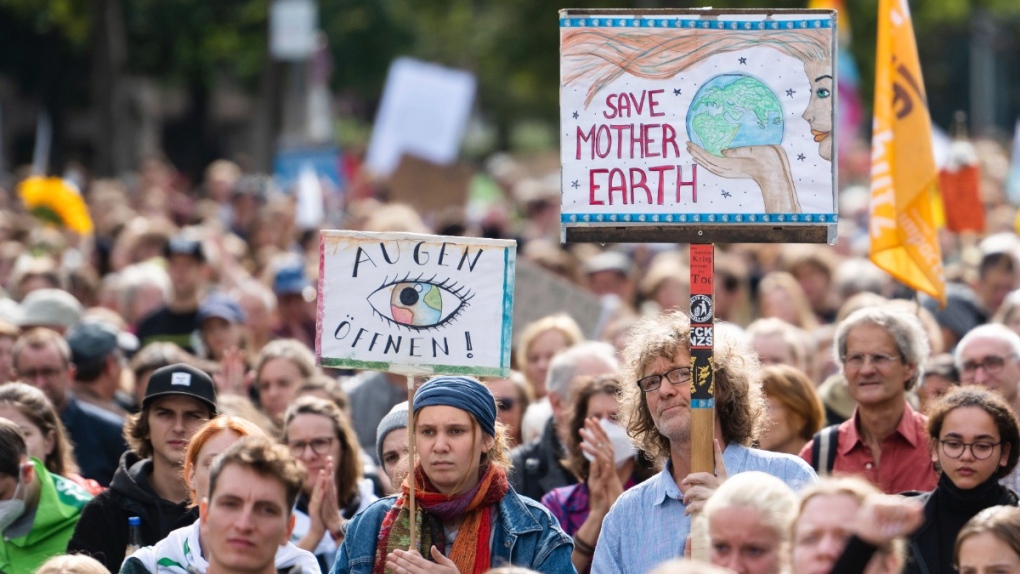
Climate activists attend a demonstration in Cologne, Germany, on Sept. 23, 2022.
 (Marius Becker / dpa via AP)

Frank Jordans
The Associated Press
Sept. 23, 2022 10:18 a.m. MDT

BERLIN -

Youth activists staged a co-ordinated "global climate strike" Friday to highlight their fears about the effects of global warming and demand more aid for poor countries hit by wild weather.

Protesters took to the streets in Jakarta, Tokyo, Rome and Berlin carrying banners and posters with slogans such as "We are worried about the climate crisis" and "It's not too late."

The demonstrations were organized by the Fridays for Future youth movement that took its cue from activist Greta Thunberg, who began protesting alone outside the Swedish parliament in 2018.

"We're striking all over the world because the governments in charge are still doing too little for climate justice," said Darya Sotoodeh, a spokesperson for the group's chapter in Germany.

"People all over the world are suffering from this crisis and it's going to get worse if we don't act on time," she said.

Police said some 20,000 people attended the rally in Berlin, which featured calls for the German government to establish a 100-billion-euro fund for tackling climate change.


In Rome, some 5,000 young people turned out for a march that ended near the Colosseum.

One placard read: "The climate is changing. Why aren't we?" Students highlighted among their priorities the need to rethink Italy's transport policies. The country's ratio of cars per inhabitant is one of the highest in Europe.

In Italy's election campaign, which wraps up on Friday evening ahead of the Sept. 25 vote for Parliament, climate change policies didn't figure heavily at candidates' rallies.

The protests follow warnings from scientists that countries aren't doing enough to meet the 2015 Paris climate accord's top-line target of limiting global warming to 1.5 degrees Celsius (2.7 Fahrenheit) this century compared to preindustrial times.


UN Secretary-General Antonio Guterres told world leaders this week that the fossil fuel industry, which is responsible for a large share of planet-warming gases, is "feasting on hundreds of billions of dollars in subsidies and windfall profits while household budgets shrink and our planet burns."

Guterres urged rich countries to tax the profits of energy companies and redirect the funds to both "countries suffering loss and damage caused by the climate crisis" and those struggling with the rising cost of living.

Demands for poor nations to receive greater financial help to cope with global warming, including the destruction already wrought by deadly weather events such as the floods in Pakistan, have grown louder in the run-up to this year's UN climate summit.

Afraid and anxious, young protesters demand climate action


SETH BORENSTEIN and FRANK JORDANS
Fri, September 23, 2022 

NEW YORK (AP) — Frustrated, anxious but also a tad hopeful, young activists staged a coordinated “global climate strike” Friday to highlight the effects of global warming and demand more aid for poor countries hit by wild weather.

In New York, as leaders of developing disaster-struck nations pleaded their cases at the United Nations, more than a thousand protesters, many of them skipping school, marched through the streets to tell their leaders they were sick of inaction on climate.

"The oceans are rising and so are we,” they chanted. Protesters also took to the streets in Jakarta, Tokyo, Rome, Berlin and Montreal carrying banners and posters with slogans such as, “It’s not too late.”

“It’s one thing to worry about the future, and it’s another to get out there and do something about it,” said 16-year-old Lucia Dec-Prat at the protest in New York. “I honestly feel that the adults aren’t listening.”

Dinah Landsman, 17, said every day she asks herself about what kind of future she'll have as she grows up because of climate change. Her generation has to act, she said.

“No one else is going to do it,” said Landsman, also in New York. “It's us who have the most at stake.”

The protests follow warnings from scientists that countries aren’t doing enough to meet the 2015 Paris climate accord’s top-line target of limiting global warming to 1.5 degrees Celsius (2.7 Fahrenheit) this century compared to preindustrial times.

Michael Taft, a 27-year-old graduate student in New York, said “a lot of kids here are scared about what the next 20 years are going to look like for them.”

But Taft said he still has hope. He looks around at those listening to the speakers and said they aren’t like past generations. They aren’t looking to become finance majors and make lots of money.

“They’re all here because they’re motivated to make change,” Taft said. “And probably one of the people here or in another climate rally in a different country is going to be the person that has a massive role in change and fixing this."

The demonstrations were organized by the Fridays for Future movement that took its cue from activist Greta Thunberg, who began protesting alone outside the Swedish parliament in 2018.

“We're striking all over the world because the governments in charge are still doing too little for climate justice," said Darya Sotoodeh, a spokesperson for the group's chapter in Germany.

“People all over the world are suffering from this crisis, and it's going to get worse if we don't act on time," she said.

Police said some 20,000 people attended the rally in Berlin, which featured calls for the German government to establish a 100-billion-euro fund for tackling climate change.

In Rome, some 5,000 young people turned out for a march that ended near the Colosseum.

One placard read: “The climate is changing. Why aren’t we?” Students highlighted among their priorities the need to rethink Italy’s transport policies. The country's ratio of cars to inhabitant is one of the highest in Europe.

In Italy’s election campaign, which wraps up on Friday evening ahead of the Sept. 25 vote for Parliament, climate change policies didn’t figure heavily at candidates’ rallies.

U.N. Secretary-General Antonio Guterres told world leaders this week that the fossil fuel industry, which is responsible for a large share of planet-warming gases, is “feasting on hundreds of billions of dollars in subsidies and windfall profits while household budgets shrink and our planet burns."

Guterres urged rich countries to tax the profits of energy companies and redirect the funds to both “countries suffering loss and damage caused by the climate crisis” and those struggling with the rising cost of living.

Demands for poor nations to receive greater financial help to cope with global warming, including the destruction already wrought by deadly weather events such as the floods in Pakistan, have grown louder in the run-up to this year's U.N. climate summit.

___

Jordans reported from Berlin. Pietro de Cristofaro in Berlin and Frances D’Emilio in Rome contributed to this report.

___

Follow AP’s climate coverage at https://apnews.com/hub/climate-and-environment