It’s possible that I shall make an ass of myself. But in that case one can always get out of it with a little dialectic. I have, of course, so worded my proposition as to be right either way (K.Marx, Letter to F.Engels on the Indian Mutiny)
Saturday, November 19, 2022
CRYPTOZOOLOGY
'LIKE FINDING A UNICORN'
Here's The Moment Researchers Rediscovered A Bird Species That Was Undocumented Since 1882
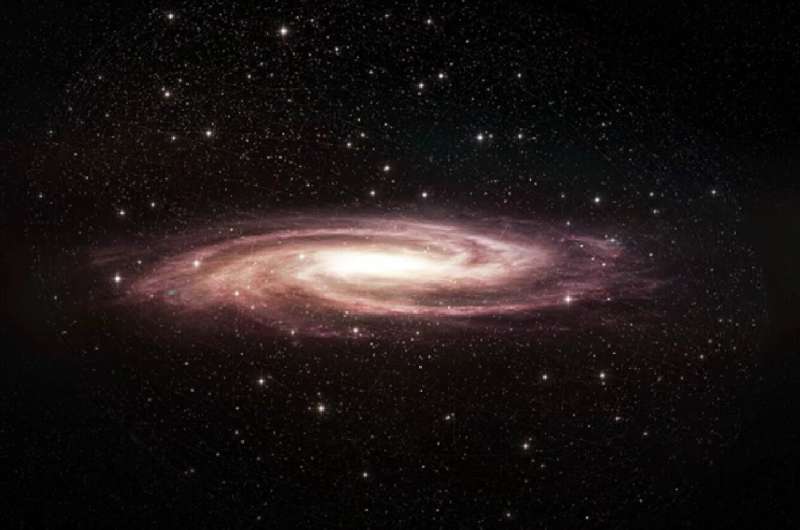
A new study has revealed the true shape of the diffuse cloud of stars surrounding the disk of our galaxy. For decades, astronomers have thought that this cloud of stars—called the stellar halo—was largely spherical, like abeach ball. Now a new model based on modern observations shows the stellar halo is oblong and tilted, much like a football that has just been kicked.
The findings—published this month The Astronomical Journal — offer insights into a host of astrophysical subject areas. The results, for example, shed light on the history of our galaxy and galactic evolution, while also offering clues in the ongoing hunt for the mysterious substance known as dark matter.
"The shape of the stellar halo is a very fundamental parameter that we've just measured to greater accuracy than was possible before," says study lead author Jiwon "Jesse" Han, a Ph.D. student at the Center for Astrophysics | Harvard & Smithsonian. "There are a lot of important implications of the stellar halo not being spherical but instead shaped like a football, rugby ball, or zeppelin—take your pick!"
"For decades, the general assumption has been that the stellar halo is more or less spherical and isotropic, or the same in every direction," adds study co-author Charlie Conroy, Han's advisor, and a professor of astronomy at Harvard University and the Center for Astrophysics. "We now know that the textbook picture of our galaxy embedded within a spherical volume of stars has to be thrown out."
Astronomers have discovered that the Milky Way galaxy's stellar halo—a cloud of diffuse stars around all galaxies—is zeppelin-shaped and tilted. This artist's illustration emphasizes the shape of the three-dimensional halo surrounding our galaxy. Credit: Melissa Weiss/Center for Astrophysics | Harvard & Smithsonian
The Milky Way's stellar halo is the visible portion of what is more broadly called the galactic halo. This galactic halo is dominated by invisible dark matter, whose presence is only measurable through the gravity that it exerts. Every galaxy has its own halo of dark matter. These halos serve as a sort of scaffold upon which ordinary, visible matter hangs. In turn, that visible matter forms stars and other observable galactic structure. To better understand how galaxies form and interact, as well as the underlying nature of dark matter, stellar haloes are accordingly valuable astrophysical targets.
"The stellar halo is a dynamic tracer of the galactic halo," says Han. "In order to learn more about galactic haloes in general, and especially our own galaxy's galactic halo and history, the stellar halo is a great place to start."
Fathoming the shape of the Milky Way's stellar halo, though, has long challenged astrophysicists for the simple reason that we are embedded within it. The stellar halo extends out several hundred thousand light years above and below the star-filled plane of our galaxy, where our Solar System resides.
"Unlike with external galaxies, where we just look at them and measure their halos," says Han, "we lack the same sort of aerial, outside perspective of our own galaxy's halo."
Complicating matters further, the stellar halo has proven to be quite diffuse, containing only about one percent of the mass of all the galaxy's stars. Yet over time, astronomers have succeeded in identifying many thousands of stars that populate this halo, which are distinguishable from other Milky Way stars due to their distinctive chemical makeup (gaugeable by studies of their starlight), as well as by their distances and motions across the sky. Through such studies, astronomers have realized that halo stars are not evenly distributed. The goal has since been to study the patterns of over-densities of stars—spatially appearing as bunches and streams—to sort out the ultimate origins of the stellar halo.
The new study by CfA researchers and colleagues leverages two major datasets gathered in recent years that have plumbed the stellar halo as never before.
The first set is from Gaia, a revolutionary spacecraft launched by the European Space Agency in 2013. Gaia has continued compiling the most precise measurements of the positions, motions, and distances of millions of stars in the Milky Way, including some nearby stellar halo stars.
The second dataset is from H3 (Hectochelle in the Halo at High Resolution), a ground-based survey conducted at the MMT, located at the Fred Lawrence Whipple Observatory in Arizona, and a collaboration between the CfA and the University of Arizona. H3 has gathered detailed observations of tens of thousands of stellar halo stars too far away for Gaia to assess.
Combining these data in a flexible model that allowed for the stellar halo shape to emerge from all the observations yielded the decidedly non-spherical halo—and the football shape nicely dovetails with other findings to date. The shape, for example, independently and strongly agrees with a leading theory regarding the formation of the Milky Way's stellar halo.
According to this framework, the stellar halo formed when a lone dwarf galaxy collided 7-10 billion years ago with our far-larger galaxy. The departed dwarf galaxy is amusingly known as Gaia-Sausage-Enceladus (GSE), where "Gaia" refers to the aforementioned spacecraft, "Sausage" for a pattern appearing when plotting the Gaia data and "Enceladus" for the Greek mythological giant who was buried under a mountain—rather like how GSE was buried in the Milky Way. As a consequence of this galactic collisional event, the dwarf galaxy was ripped apart and its constituent stars strewn out into a dispersed halo. Such an origin story accounts for the stellar halo stars' inherent unlikeness to stars born and bred in the Milky Way.
The study's results further chronicle just how GSE and the Milky Way interacted all those eons ago. The football shape—technically called a triaxial ellipsoid—reflects the observations of two pileups of stars in the stellar halo. The pileups ostensibly formed when GSE went through two orbits of the Milky Way. During these orbits, GSE would have slowed down twice at so-called apocenters, or the furthest points in the dwarf galaxy's orbit of the greater gravitational attractor, the hefty Milky Way; these pauses led to the extra shedding of GSE stars. Meanwhile, the tilt of the stellar halo indicates that GSE encountered the Milky Way at an incident angle and not straight-on.
"The tilt and distribution of stars in the stellar halo provide dramatic confirmation that our galaxy collided with another smaller galaxy 7-10 billion years ago," says Conroy.
Notably, so much time has passed since the GSE-Milky Way smashup that the stellar halo stars would have been expected to dynamically settle into the classical, long-assumed spherical shape. The fact that they haven't likely speaks to the broader galactic halo, the team says. This dark matter-dominated structure is itself probably askew, and through its gravity, is likewise keeping the stellar halo off-kilter.
"The tilted stellar halo strongly suggests that the underlying dark matter halo is also tilted," says Conroy. "A tilt in the dark matter halo could have significant ramifications for our ability to detect dark matter particles in laboratories on Earth."
Conroy's latter point alludes to the multiple dark matter detector experiments now running and planned. These detectors could increase their chances of capturing an elusive interaction with dark matter if astrophysicists can adjudge where the substance is more heavily concentrated, galactically speaking. As Earth moves through the Milky Way, it will periodically encounter these regions of dense and higher-velocity dark matter particles, boosting odds of detection.
The discovery of the stellar halo's most plausible configuration stands to move many astrophysical investigations forward while filling in basic details about our place in the universe.
"These are such an intuitively interesting questions to ask about our galaxy: 'What does the galaxy look like?' and 'What does the stellar halo look like?'," says Han. "With this line of research and study in particular, we are finally answering those questions."
More information: Jiwon Jesse Han et al, The Stellar Halo of the Galaxy is Tilted and Doubly Broken, The Astronomical Journal (2022). DOI: 10.3847/1538-3881/ac97e9
Martian moon Phobos is not long for this Universe.
According to astronomers' calculations, the potato-shaped satellite is drawing slowly, but inexorably, closer to its host planet. Eventually, within about 100 million years, the gravitational interaction between the two bodies will tear Phobos apart, giving the red planet a temporary dusty ring.
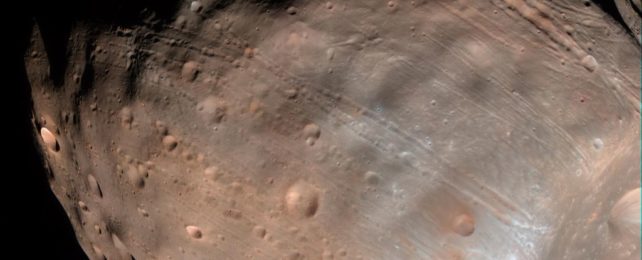
According to a new study, those gravitational interactions may already be having an observable effect. At least some of the mysterious, parallel shallow grooves that cover the moon's entire surface could be the result of fracturing as its orbit slowly decays and tidal forces tug ever harder at its bones.
"Our analysis supports a layered heterogeneous structure for Phobos with possible underlying failure-induced fractures, as the precursor of the eventual demise of the de-orbiting satellite," write a team of astronomers led by Bin Cheng of Tsinghua University in China and the University of Arizona.
Tidal forces that pull on bodies in a system are the result of their gravitational interaction, stretching their structures along an axis that runs between them.
Usually, any significant effect this distortion might have on a solid surface is pretty small. Where tidal forces can be easily observed in the movements of our planet's liquid oceans, visible effects on masses of land are less obvious.
That doesn't mean tidal forces between other solid bodies can't have more obvious consequences. Stretching caused by tidal forces can in some cases cause stress fracturing. We've seen this in Saturn's moon Enceladus, whose icy shell has deep, parallel fractures at its south pole caused by tidal stress.
With an orbit of just 7 hours and 39 minutes, Phobos is pretty close to Mars, drawing closer at a rate of around 1.8 centimeters per year. At that proximity, it's absolutely possible that tidal forces could induce surface fracturing on its 27 kilometer- (16.8 mile-) wide body. The idea that Phobos' stripes are the result of such an interaction has also been previously considered and found plausible.
However, it's unclear whether the current configuration and interaction of Phobos and Mars could produce the observed striping, and other explanations are also in the running. For instance, a 2018 study found that the stripes could be the result of rolling boulders.
So Cheng and his colleagues conducted 3D mathematical modeling explicitly examining the tidal stretching and squeezing of a layered Phobos-like body, with a loose rubbly exterior sitting over a cohesive layer below.
The researchers performed hundreds of simulations using their model. In a significant number of these simulations, tidal forces caused the cohesive layer to split and fracture in parallel grooves, causing the upper loose regolith to drain into the fractures below. The result is a stripey, striated surface very similar to regions observed on Phobos.
Not all areas of Phobos were consistent with the model, the team found. In particular, grooves around the moon's equator didn't match predictions. But the results do show that at least some of the stripes could be caused by fracturing as the moon spirals towards death by tidal disembowelment. This would mean that we are seeing the beginning of the end for Phobos.
These results, therefore, could have implications for studying other moons that are experiencing significant orbital decay, such as Neptune's moon Triton. The draining rubble could also expose pristine material on Phobos, could make the grooves a very interesting region of study for the upcoming Mars moon mission by the Japanese Space Agency.
This mission is expected to deliver conclusive evidence of the origin of these mysterious stripes – but tidal disruption is certainly appearing to be an intriguing possibility.
"Modeling Phobos as a rubble-pile interior overlaid by a cohesive layer, we find that the tidal strain could create parallel fissures with regular spacing," the researchers write in their paper.
"Our analysis suggests that some of the grooves lining the surface of Phobos are likely early signs of the eventual demise of the de-orbiting satellite."
We know it’s going to die one day, probably in around 50 million years – the question is, how? Astronomers have discovered that the unusual parallel grooves covering the surface, thought to probably be the results of some ancient impact, are actually canyons full of dust that are growing wider as the extreme gravitational forces between moon and planet tear it apart.
Both of Mars’s moons are ominously named after the twin sons of Mars, the Roman god of war: Phobos, the larger of the two, for the god of fear and panic; and Deimos, the smaller, for his brother, the god of dread and terror. The reason Phobos is known as Mars’s “doomed “ moon, however, is that the satellite is caught in a death spiral around Mars, slowly falling towards the Red Planet at 1.8 centimeters (0.7 inches) every year (which is faster than Venice is sinking) until they eventually collide.
Both of Mars’s moons are tidally locked to the planet, meaning they always present the same face toward Mars. Tidal forces that pull on objects in space are due to their gravitational interactions and can have observable effects, like the effect the gravitational pull of the Moon has on Earth’s water in the form of tides.
Visible effects on the solid surface of objects in space, however, are usually pretty small. That’s not to say it doesn’t occur – the icy shell of Saturn’s moon Enceladus is covered in stress fractures from the tidal pull of its giant planet.
Orbiting Mars in just 7 hours and 39 minutes, Phobos is pretty close to Mars, making it plausible the tidal forces are causing the surface fracturing of the small moon. This idea has even been put forward before. Orbiting so near puts Phobos closer and closer to the Roche limit, the place where gravitational forces will pull any solid orbiting object apart. This occurs because the gravity on the planet-facing side is so much larger than on the other side it can't stay in one piece. Eventually, Phobos will be destroyed, forming a smaller version of Saturn's rings around Mars.
Alternative hypotheses have been put forward too. In 2018 it was suggested bouncing boulders carved the grooves on Phobos's surface.
In the new study, the team performed hundreds of simulations using a 3D mathematical model of a Phobos-like object, looking into the stretching and squeezing that occurs from tidal forces within a Phobos-like orbit. They found that by modeling Phobos as a "rubble-pile interior overlaid with a cohesive layer" many of the simulations created evenly spaced parallel fissures like the ones seen on the Martian moon.
“Fracture opening triggers drainage of upper loose material into these deep-seated valleys, which we show could lead naturally to the formation of groove-like structures,” they wrote.
Not all regions of Phobos matched the simulations – the grooves around its equator weren't explained by their predictions, for example. However, the findings do suggest that some (or even most) of the stripes are being caused by tidal fracturing as the moon continues on its doomed path to Mars collision.
All this makes for an intriguing target for the Japanese Space Agency's 2024 Martian Moons eXploration (MMX) mission to land spacecraft on both Phobos and Deimos, returning samples in 2029. We might even be able to witness the beginning of the end of Phobos.